FULL STORY:The Old Rottweiler Wouldn’t Let Go of a Blue Coat—Then One Visitor Whispered, “I Remember You”
PART2
She looked to be in her mid-thirties.
Dark hair damp from the rain.
Long brown coat.
No children.
No partner.
She entered slowly, as if she wasn’t completely sure why she had come.
I was at the reception desk.
“Can I help you?”
She smiled nervously.
“I was thinking about adopting.”
“First dog?”
“No.”
“Any particular kind?”
She shook her head.
“Older, maybe.”
That got my attention.
Senior dogs wait longer.
Large senior dogs even longer.
Large senior Rottweilers carrying mysterious men’s clothing?
Longer still.
I asked a few basic questions.
Home.
Schedule.
Other animals.
She lived alone.
Fenced yard.
Worked partly from home.
Had grown up with dogs.
No current pets.
She said:
“I don’t think I’m looking for a puppy.”
“That’s good.”
“Why?”
“Because we have no shortage of people looking for puppies.”
She laughed.
I led her through the first kennel row.
A hound barked until his entire body bounced.
A shepherd spun in circles.
Two terrier mixes competed for attention.
The woman smiled at them.
Asked questions.
Listened.
Then we turned into the older-dog corridor.
The Rottweiler was three kennels down.
He was lying in his usual place.
Blue coat beneath his muzzle.
I noticed the woman stop before we reached him.
Not slow.
Stop.
Completely.
Her face changed.
At first I thought she was afraid.
Then her hand covered her mouth.
She stared.
I looked from her to the dog.
The Rottweiler had lifted his head.
That alone was unusual.
He was looking directly at her.
She whispered:
“No.”
I said:
“Are you okay?”
She took one step closer.
Then another.
Tears filled her eyes so quickly I knew this was not a reaction to a sad shelter dog.
She knew something.
The Rottweiler stood.
His old hips rose slowly.
His head stayed low.
The blue coat remained between his paws.
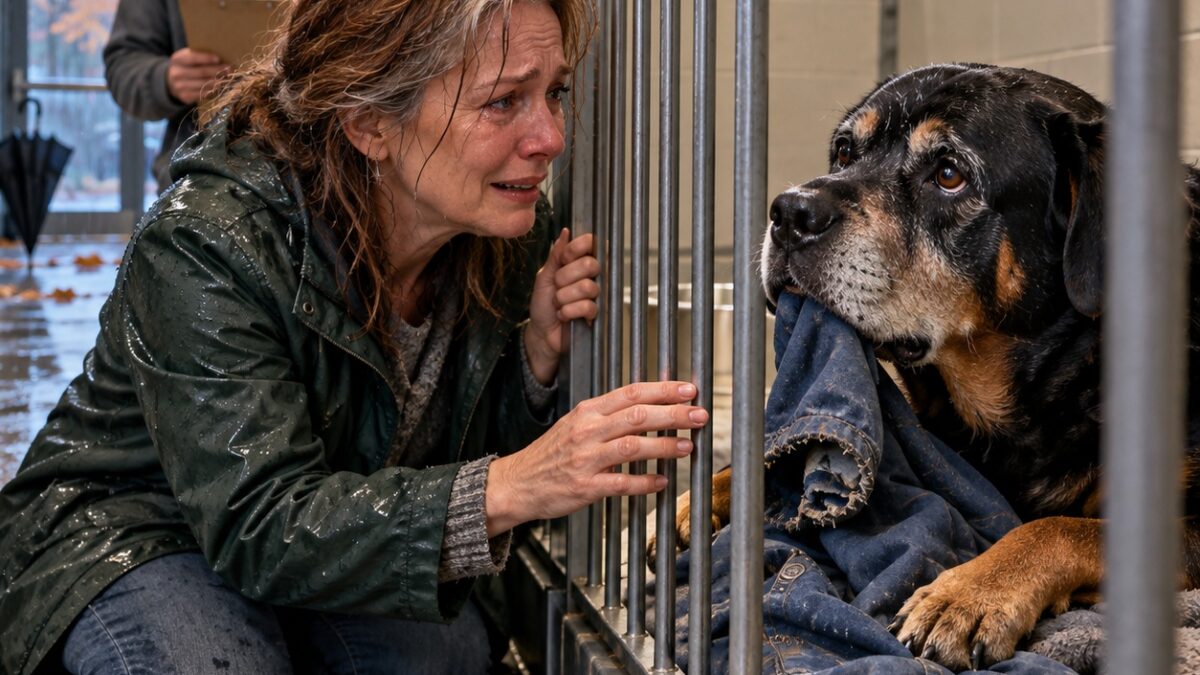
The woman reached the kennel.
Both hands gripped the metal.
“Oh my God.”
The dog moved forward one step.
I asked:
“Do you know him?”
She looked at me.
Her face had gone pale.
Then back at him.
“I think I do.”
My heart began beating harder.
“From where?”
She pointed.
Not at the dog.
At the coat.
“That jacket.”
The shelter noises seemed to recede.
Kennel doors.
Barking.
Phones.
Everything still existed, but my attention narrowed to her voice.
“I know that jacket.”
I crouched near her.
“How?”
She lowered herself slowly to the floor.
The old Rottweiler remained standing several feet inside.
Watching.
The woman said:
“I grew up across the street from him.”
I looked at the dog.
“From the dog?”
She nodded.
“And his owner.”
Her voice cracked.
I sat down too.
“What was his name?”
She hesitated.
Not because she had forgotten.
Because speaking it seemed to hurt.
“His owner was Elias Monroe.”
Then she looked through the bars.
“And you…”
Her hand shook.
“You’re Samson.”
The Rottweiler’s ears rose.
Not dramatically.
Enough.
The woman gasped.
“Samson.”
His body changed.
A small shift forward.
One paw.
Then another.
My skin prickled.
Names matter.
Not magically.
They are sounds paired with history.
Food.
Hands.
Doorways.
Praise.
A person.
A life.
For months we’d called this dog whatever paperwork required.
Senior Rottweiler.
Bear.
Old man.
Buddy.
Now a woman said “Samson,” and something inside him recognized home.
She began crying openly.
“It’s you.”
Samson moved closer.
The blue coat remained behind him.
For the first time since I’d known him, he had walked away from it voluntarily.
I didn’t speak.
Neither did the staff member who had quietly appeared at the end of the hall.
The woman extended her fingers through the bars.
Not reaching for his head.
Just offering.
Samson sniffed.
His eyes stayed on her face.
Then he pressed the side of his muzzle against her hand.
The woman made a sound halfway between a sob and a laugh.
“Hi, Sammy.”
Samson closed his eyes.
That was the moment I believed her completely.
Not because dogs are infallible evidence.
Because familiarity lived in his body.
He was not greeting a stranger.
He was remembering one.
I asked her name.
“Rachel.”
“Tell me.”
She wiped her face.
“I lived across from Mr. Monroe until I was seventeen.”
Samson remained near the bars.
Rachel kept one hand beside him.
“He was older even then. Quiet. Lived alone.”
She smiled through tears.
“Everybody thought he was unfriendly because he didn’t talk much.”
“Was he?”
“No.”
She shook her head.
“He was the kindest man on that street.”
Rachel told me she had first noticed Samson as a puppy.
A thick-legged Rottweiler behind a tall wooden fence.
Elias worked in his garden almost every morning.
Samson followed.
If Elias pruned trees, Samson lay nearby.
If Elias repaired the porch, Samson watched.
If Elias sat outside to read, Samson put his head on the man’s knees.
Rachel saw them for years from her bedroom window.
“I used to do homework looking out at them.”
She laughed softly.
“Sometimes Mr. Monroe would catch me staring and wave.”
She looked toward the coat.
“That jacket…”
Her voice changed again.
“He wore it every fall.”
Blue canvas.
Exactly.
“He was always cold.”
She smiled.
“But Samson was more important.”
I waited.
“When the evenings got really cold, Mr. Monroe would take the jacket off and lay it over Samson.”
I looked through the bars.
Samson had gone still.
Rachel continued:
“He’d sit there in just his sweater because the dog had the coat.”
Her voice broke.
“I used to think that was the sweetest thing I’d ever seen.”
Samson turned.
Looked back toward the blue fabric.
Then at Rachel.
I felt the story reassemble itself.
The coat was not random shelter debris.
It had belonged to his person.
It had touched both of them.
A shared object from a life before everything collapsed.
Rachel said:
“My family moved away when I was eighteen.”
“How far?”
“Across the country.”
She shook her head.
“I came back only a few times.”
“Did you ever see them again?”
“Once.”
She smiled faintly.
“Samson was already gray around the muzzle.”
Then her expression changed.
“A few years ago, a neighbor told me Mr. Monroe had died.”
Samson’s body remained still.
Rachel closed her eyes.
“I asked about the dog.”
“What did they say?”
“No one knew.”
Her eyes opened.
“They thought a relative had taken him.”
She looked around the shelter.
“Apparently not.”
I felt anger rising.
Not useful anger.
We still didn’t know exactly what had happened between Elias’s death and Samson reaching us.
Maybe family tried.
Maybe temporary placements failed.
Maybe records got lost.
Maybe he passed through multiple hands.
The truth was incomplete.
Rachel said:
“I used to think about him.”
She touched the bars.
“Every time I saw a Rottweiler.”
Her voice lowered.
“I pictured him still on that porch waiting.”
Samson turned back toward his bed.
For one second, I thought he was retreating.
Instead, he walked to the coat.
Picked it up.
Rachel stopped breathing.
So did I.
He stood with the faded blue fabric hanging from his mouth.
Then walked slowly back toward her.
One careful step at a time.
His joints stiff.
Head slightly lowered from the weight.
Rachel whispered:
“Samson.”
He reached the gate.
Then did something I had never seen him do.
He opened his mouth.
The blue coat fell to the floor.
At Rachel’s feet.
He looked at her.
Just looked.
Rachel collapsed onto her knees.
I don’t use words like miracle lightly.
I don’t know what Samson intended.
I will not claim he consciously thought:
You remember him, so I can give this to you.
Dogs are not symbols designed for human stories.
But I know behavior.
I know that for months, Samson had carried that coat back to his bed every time it was moved.
I know he slept with it.
Checked it.
Would not enter another space without looking for it.
And now he had placed it beside the first person who spoke his old name.
That was fact enough.
Rachel reached through the bars.
Samson pressed forward.
She wrapped her arms as far around his neck as the kennel allowed.
His large gray head settled onto her shoulder.
Then he released a long sigh.
Not a whine.
Not a cry.
Air.
A body letting go of tension.
Rachel buried her face in his fur.
“I remember you.”
She whispered it again.
“I remember both of you.”
I stood.
Not because the moment was over.
Because it belonged to them.
I walked several yards down the hallway and pretended to check another kennel.
I cried anyway.
Shelter work does not make you immune.
It makes you knowledgeable about the mechanics of grief.
Not resistant to it.
After perhaps ten minutes, Rachel called my name.
I returned.
Her face was wet.
Samson sat near the gate.
The blue coat between them.
“I want him.”
No hesitation.
“I want to adopt him.”
I took a breath.
“We can start the process.”
“Today.”
“We have procedures.”
“I’ll do all of them.”
She looked at Samson.
“I know he’s old.”
“Yes.”
“How old?”
“At least ten. Possibly older.”
“Health?”
“Arthritis. Dental wear. Age-related concerns. Nothing acute right now.”
“How long?”
I knew what she meant.
Nobody knows.
“We can’t tell you.”
“Months?”
“Possibly.”
“A year?”
“Possibly.”
“More?”
“Possibly.”
She nodded.
“Okay.”
No bargaining.
No asking whether adopting a senior dog was worth it.
Just okay.
Then she said:
“If I only get three months, I want him to have those three months somewhere he is known.”
That sentence stayed with me.
Some animals need to be loved.
Samson seemed to need something more precise.
To be known.
Not as old Rottweiler.
Not intake number.
Not abandoned senior.
Samson.
Elias’s dog.
The dog who sat beside the garden.
The dog who slept under a blue coat on cold evenings.
Somebody remembered the entire life that existed before the shelter door.
That mattered.
We did not throw procedure away because the story was moving.
Emotion does not replace responsible adoption.
Rachel completed the application.
References.
Home information.
Veterinary plans.
Schedule.
Financial capability.
We discussed mobility.
Medication.
Potential separation anxiety.
Age.
End-of-life care.
She understood.
Her home had a fenced garden.
Mostly single level.
She worked remotely three days each week.
No other pets.
She had already cared for senior dogs in her family.
Everything aligned.
What usually took longer moved smoothly because nothing required correction.
The following afternoon, Rachel returned.
Samson heard her voice before he saw her.
He stood.
That alone would have told me what I needed.
She entered the kennel for the first time.
No bars.
Samson approached.
Sniffed her coat.
Then leaned.
Rottweilers lean with their whole soul.
Rachel nearly lost balance.
She laughed.
Samson’s tail moved.
I had seen it wag before.
But never like that.
Slow.
Heavy.
Certain.
Rachel picked up the blue coat.
Samson watched closely.
She stopped.
Held it toward him.
“You want this?”
He took it immediately.
Good.
The coat was still his.
Recognition did not mean he was finished with it.
That was important.
Rachel smiled.
“All right.”
On adoption day, the weather had turned cool.
Appropriate, somehow.
Samson walked from his kennel with the blue coat in his mouth.
Head higher than usual.
We moved slowly because of his joints.
Staff lined the hallway.
Not formally.
People just appeared.
Volunteers.
Technicians.
Receptionist.
Ana from behavior.
People who had watched Samson wait.
Nobody cheered.
He wasn’t a graduation performance.
We simply watched.
At the front door, Samson stopped.
Looked back down the corridor.
Maybe sound.
Maybe smell.
Maybe habit.
Then Rachel opened the outer door.
Cold air entered.
Samson stepped through.
Blue coat dragging slightly.
Outside, he paused.
Sunlight hit his face.
Rachel opened the rear car door.
A padded cover had been installed.
Ramp beside it.
Samson sniffed.
Then climbed in.
Rachel sat beside him for a moment before closing the door.
I leaned through the window.
“Take care of her.”
Rachel laughed.
“Excuse me?”
I looked at Samson.
“He knows what I mean.”
Samson ignored me.
Then, as Rachel settled into the passenger side while a friend drove, Samson moved forward.
Placed his muzzle across her lap.
Rachel froze.
Her hand lowered onto his head.
She looked at me through the glass.
Tears again.
“That’s what he used to do.”
“What?”
“With Mr. Monroe.”
She swallowed.
“On the porch.”
The car pulled away.
Samson did not look back at us for long.
He rested his head on Rachel.
The blue coat lay beside him.
I returned inside.
His kennel was empty.
The bed.
Water bowl.
A rectangle where the coat had been.
I sat on the edge of the raised platform.
For months, I had wondered who that old dog belonged to.
Now I understood the better question.
Who still belonged to his story?
Rachel did.
That was enough to start another chapter.
The first update arrived that evening.
A photograph.
Samson standing in Rachel’s living room.
Blue coat in his mouth.
Behind him, a large dog bed near a window overlooking a fenced garden.
Message:
He checked every room, then carried the coat to the bed himself.
I smiled.
Next morning:
Slept six hours. Woke at 4:30 and needed to go out. My fault for wanting a senior dog.
I replied:
Welcome to love.
Rachel sent updates constantly during the first month.
Not because we demanded them.
Because she understood we had become invested.
Samson adapted slowly.
The garden became important.
At first he stayed near the back steps.
Then explored.
Sniffed flower beds.
Walked the fence.
Selected one patch of grass beneath an old maple as his favorite.
He brought the blue coat outside once.
Rachel panicked because the ground was damp.
She tried picking it up.
Samson stared.
She put it back down immediately.
“Lesson learned,” she texted.
Good.
The coat remained in whatever state Samson wanted.
We helped arrange a careful cleaning method that preserved the fabric without stripping everything familiar from it.
That took patience.
He watched the process.
Rachel never removed it secretly.
Trust matters in small things.
By the second month, Samson had two routines.
Morning:
Garden.
Breakfast.
Medication.
Nap beside Rachel’s desk.
Afternoon:
Short walk.
More garden.
Dinner.
Evening:
Blue coat near the sofa.
Rachel wrote:
He doesn’t always carry it now. Sometimes he leaves it in the bedroom for hours.
That update made me emotional.
Not because forgetting Elias would be good.
Because Samson no longer seemed responsible for physically protecting the last piece of him every minute.
The memory could remain somewhere safe while Samson lived another part of the day.
He had learned the coat would still be there.
That’s trust too.
Rachel told us stories she remembered.
Elias had been a retired electrician.
Widowed before Samson arrived.
No children living nearby.
He had adopted the Rottweiler as a young dog.
People warned him.
Big breed.
Strong.
Too much for an older man.
He ignored them.
Samson became his shadow.
Morning coffee on the porch.
Garden.
Hardware store.
Evening walks.
Rachel remembered seeing Elias speak to the dog constantly.
She said:
“He always looked less alone after Samson came.”
That sounded familiar.
Animals often enter human loneliness before anyone has named it.
She told me about the blue coat again.
A cold October afternoon when she was maybe fourteen.
She had been walking home from school.
Elias sat on the porch.
Samson beside him.
Wind cutting across the street.
Elias removed the coat.
Placed it over Samson’s back.
Rachel shouted from the sidewalk:
“Mr. Monroe, aren’t you cold?”
Elias answered:
“He can’t put on his own jacket.”
Then laughed.
Rachel remembered the exact sound.
Decades later.
The coat now lay in her house.
You cannot engineer that kind of continuity.
Life just sometimes folds strangely.
Not every update was perfect.
Samson had difficult nights.
He paced.
Stood near the front door.
Sometimes carried the blue coat from room to room.
One evening he woke whining.
Rachel sat on the floor.
Did not force touch.
He eventually came over.
Rested against her.
The next morning he was normal.
Healing did not mean forgetting.
Age did not make loss disappear.
Rachel understood that.
She never tried to replace Elias.
That may have been the kindest thing she did.
She would say:
“You can miss him here.”
Not because Samson understood the sentence.
Because her behavior matched it.
The coat remained.
The old name remained.
Memories were spoken aloud.
Elias’s photograph—one Rachel found through former neighbors—sat on a shelf.
In it, Elias was standing beside Samson years younger.
Blue coat on his shoulders.
Rachel sent me the photograph.
I stared at it for a long time.
There he was.
The man whose scent we had known only through fabric.
Tall.
Thin.
Smiling slightly.
Samson beside him.
Black coat glossy.
Chest broad.
No gray.
Years younger.
I printed it.
Placed it near the staff room.
Not because Samson needed us to create a shrine.
Because shelter workers rarely get the missing pages.
Usually, an animal arrives with a blank history.
We guess.
Here, for once, we had before.
Then after.
The missing middle remained uncertain.
Elias died.
Samson lost the home.
Transfers happened.
Years and paperwork blurred.
I eventually stopped trying to reconstruct every step.
The important truth was simpler.
Samson had loved someone.
Lost him.
Carried one piece of that person until he met someone who remembered them both.
That was enough.
At six months, Rachel brought Samson back for a visit.
I heard his nails before I saw him.
Slow.
Measured.
He entered the lobby.
His coat looked better.
Body perhaps slightly stronger from regular movement.
Still old.
Still gray.
He saw me.
Tail moved.
I sat on the floor.
“Samson.”
He came over.
Leaned.
Nearly knocked me down.
“Still rude.”
Rachel laughed.
“He has become demanding.”
“Excellent.”
She carried a canvas bag.
I asked:
“Where’s the coat?”
“In the car.”
I stared.
“He left it?”
“He leaves it at home all the time now.”
My eyes stung.
Rachel saw.
“It’s not bad.”
“No.”
“I think he knows where it is.”
Exactly.
The coat did not have to be in his mouth for the memory to exist.
Samson walked toward his old corridor.
Stopped before entering.
Sniffed.
Then turned around.
Came back to Rachel.
No hesitation.
He did not need to revisit the kennel.
We went outside instead.
Samson lay in the grass.
Rachel sat beside him.
She told me his favorite part of the day was sunset in the garden.
Sometimes he brought the blue coat.
Sometimes not.
Sometimes he lay beside it.
Sometimes on it.
One autumn afternoon, she found him carefully pulling the coat from his indoor bed toward the garden door.
She opened it.
Samson carried the coat under the maple.
Placed it on the grass.
Lay beside it.
Rachel sat with him.
No photographs for several minutes.
Just the two of them.
Eventually she took one.
She sent it to me with the message:
I think he was remembering.
Maybe.
Maybe he simply liked the smell.
Maybe fabric was warm.
I did not need to choose.
The photograph was enough.
Old Rottweiler.
Blue coat.
Autumn leaves.
Safe yard.
Sunlight.
A memory and a present sharing the same patch of grass.
Samson’s health remained stable longer than any of us expected.
A year passed.
His arthritis progressed.
Medication increased.
Walks shortened.
The garden became more important because long distances tired him.
Rachel installed rugs across slippery floors.
A ramp beside the back steps.
Another for the car.
She learned how to support his hips with a sling when he had stiff mornings.
People sometimes say adopting a senior animal is “easy because they’re calm.”
I wish.
Senior love can become physical work.
Medication.
Mobility.
Night waking.
Appointments.
Watching.
Always watching.
Is that limp worse?
Did he eat enough?
Was that cough new?
Is he sleeping because he’s comfortable or because something is wrong?
Rachel did all of it.
Without resentment.
She once told me:
“I knew I wasn’t getting a decade.”
Then:
“I wanted the year anyway.”
That sentence became something I repeated to adopters considering older animals.
Not as pressure.
As truth.
You don’t measure love only by duration.
Short lives together can still be whole.
Samson reached the anniversary of his adoption.
We sent Rachel a message.
She replied with a photograph of a ridiculous plate containing dog-safe meat and vegetables arranged like a celebration.
Samson looked uninterested in symbolism.
Interested in meat.
Good.
A few weeks later, October returned.
Cool evenings.
The season of the blue coat.
Rachel called one afternoon.
Her voice was different.
Not panic.
Weight.
“Kaelen?”
“Yes.”
“His bloodwork changed.”
I sat down.
“What did the vet say?”
“Kidney values.”
Old dogs.
So many roads eventually lead through kidneys.
“Manageable?”
“For now.”
We talked.
Diet.
Medication.
Monitoring.
Rachel sounded composed.
Then:
“I knew.”
Knowing doesn’t protect you.
“I know.”
“He’s still eating.”
“Good.”
“Still wants the garden.”
“Good.”
“Still steals my side of the sofa.”
“Very good.”
We stayed on the phone.
Neither wanted to say what existed beneath the conversation.
Time was narrowing.
Samson had already lived longer with Rachel than any of us dared expect.
That did not make approaching loss fair.
A month later, he had a bad week.
Then recovered.
Two good weeks.
Another decline.
Senior dogs teach you how hope can become tiny.
He ate breakfast.
Good day.
He walked to the maple.
Good day.
Tail wag.
Good day.
No vomiting.
Good day.
You stop asking for years.
You ask for one comfortable afternoon.
Rachel kept me updated.
Samson began sleeping more often with the blue coat again.
That detail hurt.
Not because it meant he was regressing psychologically.
Because older bodies seek familiar comfort.
The coat was familiar.
Its texture.
Its smell, whatever remained beneath years of washing and life.
History itself can become comforting.
Rachel placed it near his bed.
Never beneath him unless he chose.
One evening she sent:
He carried it onto the couch tonight. First time in months.
I stared at the message.
Then at Elias’s old photograph in the staff room.
I thought:
Maybe he is tired.
That was all I allowed myself.
The final call came on an October morning.
Early.
My phone vibrated beside my coffee.
Rachel.
I knew before answering.
Some calls announce themselves through your body.
“Hi.”
Silence.
Then:
“He’s gone.”
I closed my eyes.
“How?”
“Sleeping.”
Her voice broke.
“He just went to sleep.”
I couldn’t speak for several seconds.
Rachel continued.
“He was in his bed last night.”
“The blue coat?”
A sob.
“Yes.”
“He put his head on it.”
I covered my face.
She said:
“I sat with him for a while.”
“Was he uncomfortable?”
“No.”
“The vet had seen him yesterday. We knew…”
Her breathing shook.
“I went to bed beside him.”
She had moved blankets onto the floor because Samson no longer slept alone comfortably.
Around dawn, Rachel woke.
The house was quiet.
Too quiet.
Her hand rested on Samson’s side.
No movement.
His muzzle lay on the faded blue fabric.
Eyes closed.
Body relaxed.
No struggle.
No frantic final moment.
Just an old dog who had gone to sleep in a home where someone knew his name, knew his history, knew the man he had loved before her, and never once asked him to choose between memory and the life he had now.
Rachel whispered:
“I told him Mr. Monroe would be waiting.”
I didn’t correct her.
Not every sentence needs analysis.
Sometimes grief deserves whatever language lets love survive the morning.
I drove to her house later.
I had never been there before.
The garden looked exactly like the photographs.
Maple.
Grass.
Low fence.
Samson’s bed near the window.
The house felt wrong without him.
Rachel sat at the kitchen table.
The blue coat folded beside her.
Not perfectly.
Carefully.
She touched it once.
“I don’t know what to do with this.”
There are questions shelter work does not prepare you for.
I said:
“You don’t have to decide.”
She nodded.
“I keep thinking he gave it to me that first day.”
Then shook her head.
“No.”
“He took it back.”
“Good.”
A weak smile.
“Yes.”
“He needed it longer.”
We sat.
Eventually Rachel said:
“I worried he would die thinking I replaced Mr. Monroe.”
“You didn’t.”
“I know.”
She looked toward the coat.
“I never wanted him to forget.”
“He didn’t need to.”
“And he still loved me.”
“Yes.”
Both things fit.
That may have been Samson’s last lesson.
People often treat love like one seat.
If a new person enters, the old person must leave.
Animals don’t necessarily live that way.
Neither do humans.
Samson loved Elias.
Then Elias died.
That love did not disappear.
Samson carried part of it physically.
Later he trusted Rachel.
Slept in her home.
Leaned on her legs.
Waited for her.
That did not betray Elias.
New love did not rewrite old love.
It simply gave grief somewhere warm to live.
Rachel eventually decided to keep the coat.
Not framed.
Not sealed.
Folded in a wooden chest beside Samson’s collar.
Once a year, in October, she takes it out.
Not as ritual obligation.
Because sometimes memory asks to be held.
She sent me a photograph the following year.
Blue coat across her lap.
Sunlight.
No dog.
Caption:
I still remember them both.
I cried at my desk.
Again.
Samson’s kennel had long since housed other dogs.
Life in shelters does not pause for remembrance.
A shepherd mix.
Then a hound.
Then an elderly pit bull.
Beds washed.
Walls disinfected.
Cards changed.
Names replaced.
That is necessary.
But some animals remain in a building after they leave.
Not as ghosts.
As stories staff repeat when another frightened animal arrives with an object nobody understands.
“Remember Samson?”
“Yes.”
“The coat?”
“Yes.”
Then we slow down.
We ask before removing.
We notice what matters.
That’s legacy in a shelter.
Not plaques.
Changed behavior.
Samson taught us that what looks like trash may be the final thread connecting an animal to safety.
Not every object must remain forever.
Health matters.
Sanitation matters.
But compassion means asking:
What does this mean to him?
Before deciding what should happen.
He also taught me not to confuse moving forward with forgetting.
When Samson eventually left the coat at home for entire days, that was progress.
When he returned to it near the end, that wasn’t failure.
It was comfort.
Recovery does not require rejecting the thing that helped you survive.
Sometimes you simply stop needing to carry it everywhere.
Years have passed now.
I still work with shelter animals.
My hair has more gray.
My knees complain when I sit on concrete too long.
I still do it.
Some habits are worth the pain.
Whenever a senior dog arrives, I think about Samson.
I look at what came with them.
A blanket.
A collar.
A toy.
Nothing.
Sometimes nothing is the saddest possession.
I wonder who knew them before us.
Who said their name.
What couch they slept on.
What hands they remember.
Most of the time, I never find out.
That is what made Rachel’s arrival extraordinary.
She did not discover Samson’s story.
She brought part of it back.
The old dog had spent months in our care surrounded by kind people.
Fed.
Walked.
Medicated.
Protected.
But nobody could say:
I remember your porch.
I remember your garden.
I remember him covering you with that coat when the wind got cold.
Until Rachel.
Recognition can be a kind of home.
I believe that now.
Not only being loved.
Being known across time.
Someone looking at the old version of you and seeing the young one too.
Rachel saw gray Samson.
But she also saw the puppy behind the wooden fence.
The strong adult beside Elias.
The dog under the blue coat.
All of him.
Maybe that is why he responded.
Not because she was magically destined.
Because her voice carried continuity.
She knew where he came from.
And she stayed for where he was going.
I think often about that moment at the kennel gate.
Samson picking up the coat.
Walking toward her.
Dropping it.
If I wanted to make the story prettier, I could say he consciously handed over Elias’s memory because he knew Rachel would protect it.
Maybe.
I cannot know.
What I can know is enough.
For months, he would not willingly leave that coat.
Then a familiar person said his real name.
And for the first time, he placed the coat outside his own immediate possession.
That is extraordinary without translation.
We do animals a disservice when we insist every beautiful behavior must contain a human sentence.
Samson didn’t need a speech.
His actions already mattered.
The same was true at the end.
People said afterward:
“He waited until he knew his mission was complete.”
Beautiful.
Maybe.
But the truth is enough.
He was old.
His body tired.
He went to sleep on an object associated with safety while a woman who loved him lay nearby.
He died peacefully.
That is not lesser because biology was involved.
It is greater.
A frightened, displaced senior dog did not die alone in a kennel.
He died at home.
Named.
Remembered.
Loved by someone who also remembered the man he had loved before.
What more could we have given?
We could not give Elias back.
Could not erase the years of uncertainty.
Could not make Samson young.
Could not promise more time than his body had.
We could only make the remaining time safe.
That is the work.
People ask shelter workers how we tolerate senior adoption.
“How can you let someone adopt a dog who might only live six months?”
I never understand the alternative.
Leave him waiting because love might be brief?
Time does not become worthless when there is less of it.
Sometimes the final chapter deserves more attention precisely because earlier chapters cannot be changed.
Rachel gave Samson over a year.
A year of gardens.
Warm floors.
Medicine.
Slow walks.
Sunlight.
Sofa naps.
Autumn afternoons with the blue coat.
A person whose voice contained his old name.
A person sleeping on the floor beside him at the end.
That year mattered.
Not because it balanced some moral equation.
Love is not accounting.
It mattered because Samson experienced it.
Today existed.
Then another today.
That’s how lives are built.
The final photograph Rachel ever sent of Samson alive was not dramatic.
He was lying beneath the maple.
Blue coat spread partly beneath his head.
Eyes half closed.
Sunlight catching the gray in his muzzle.
He looked tired.
Safe.
Rachel’s message said:
He doesn’t walk far anymore, but he still wants to come out here every afternoon.
I printed that photograph too.
It hangs beside the older one of Elias and young Samson.
Two lives.
Same dog.
In the first, his muzzle black.
Elias wearing the blue coat.
In the second, Samson gray.
The coat beneath him.
Different humans.
Different homes.
A continuous thread.
When visitors ask about the pictures, I tell the story.
Not every detail.
Enough.
An old dog arrived carrying a coat.
A woman recognized it.
She remembered who he was.
Then she took him home.
Sometimes the person listening cries.
Sometimes they ask:
“Did he remember her?”
I answer carefully.
“He responded to her in a way he hadn’t responded to anyone else.”
That’s what I know.
Then:
“Did he know the coat belonged to his owner?”
I say:
“It clearly mattered to him.”
Enough.
“Was he happy at the end?”
That one I answer more directly.
“Yes.”
Because I saw the photographs.
Read the updates.
Watched his body soften.
Saw him return to visit and choose Rachel over the shelter hallway.
Saw the evidence.
Happy does not mean every moment untouched by grief.
It means his life contained safety, comfort, choice, affection, and ordinary pleasure again.
That’s happiness enough.
The last time Rachel visited the shelter, she did not come to adopt.
She came to donate Samson’s unused medications.
Senior-dog supplies.
An orthopedic ramp.
Several unopened bags of food.
She stood near his old kennel.
Different dog inside.
A young mastiff.
She smiled.
No tears at first.
Then she touched the gate.
“He spent so long here.”
“Yes.”
“Do you think he was miserable?”
“No.”
She looked at me.
“Really?”
“He was sad.”
I paused.
“But not alone.”
That distinction mattered.
We had not been his home.
But we had held him between homes.
That’s what shelters should be at their best.
A bridge.
Not an ending.
Rachel nodded.
“Thank you for letting him keep the coat.”
I looked at her.
“Thank him.”
“What?”
“He taught us.”
She smiled.
Before leaving, she said:
“I thought adopting him would be unbearable because I knew I’d lose him soon.”
“Was it?”
“Yes.”
Honest.
Then:
“And I would do it again.”
That’s senior adoption.
Not courage because grief does not matter.
Courage because it does.
Rachel eventually adopted another dog.
Two years later.
A middle-aged mixed breed with no blue coat and no mysterious past.
She called first as though needing permission.
I laughed.
“Samson doesn’t own your house.”
“I know.”
“You sure?”
“No.”
Fair.
The new dog did not replace him.
Of course.
There is no replacement.
Only addition.
Rachel sent me a photograph of the new dog sleeping beneath the maple.
The wooden chest containing Samson’s coat visible through the window behind them.
Life continuing without deleting anything.
Perfect.
My favorite line from the entire story is not something Rachel said.
Not something I said.
It was something Elias reportedly said decades earlier when teenage Rachel asked why he had given his coat to the dog in the cold.
“He can’t put on his own jacket.”
Practical.
Tender.
No performance.
That sentence explains why Samson loved him.
At least to me.
Care often looks like noticing what another being cannot do for himself and doing it quietly.
Elias covered Samson.
Years later, Samson carried that covering when Elias was gone.
Then Rachel carried Samson through the final season of his own life.
Care passed forward.
That is the thread I see.
Not fate.
Not magic.
Attention.
Somebody noticing someone else is cold.
Somebody noticing an old dog cannot climb stairs.
Somebody noticing he becomes anxious when the coat moves.
Somebody sitting down instead of forcing.
Somebody staying.
That is love when stripped of all decoration.
Attention repeated.
When Samson died, the blue coat had probably long since lost most of Elias’s original scent.
Fabric fades.
Washes.
Collects new smells.
Shelter.
Car.
Rachel’s house.
Garden.
Samson himself.
Maybe that is fitting.
By the end, the coat no longer belonged only to the past.
It carried all of it.
Elias.
Samson.
Shelter.
Rachel.
Autumn grass.
Home.
Memory changes like that too.
We start by clinging to one person.
One place.
One object.
Over time, new life gathers around the loss.
The loss remains.
But it is no longer alone.
Samson taught me that without ever saying a word.
The coat never stopped being Elias’s.
It also became Samson’s bed.
His security.
His bridge.
Then Rachel’s keepsake.
One object.
Different meanings layered together.
That’s grief.
That’s love.
That’s what remains.
Sometimes, late in the shelter after the dogs settle, I still think I see him in kennel twelve.
Broad gray head.
Blue fabric beneath his muzzle.
Watching the door.
Then I remember the photograph from his final autumn.
Garden.
Sun.
No kennel.
And I am grateful.
Not because his story avoided heartbreak.
It did not.
Elias died.
Samson lost his home.
He waited.
Aged.
Then died too.
There is no version of loving mortal creatures without loss.
The beautiful part is what we do between losses.
Samson got another home.
Rachel got the chance to answer a question that had haunted her since learning Elias died:
What happened to that dog?
The answer could have been terrible.
Instead, one afternoon, she walked into a shelter and found him carrying a blue coat.
She got to kneel beside him and say:
“I remember you.”
Imagine the power of that.
Not:
You’re safe because I say so.
Not:
Forget everything.
Not:
Start over.
I remember.
Your past happened.
He mattered.
You mattered to him.
You still matter now.
And you do not have to carry the whole memory alone anymore.
Maybe Samson understood none of those words.
Maybe he understood tone, scent, name, familiarity.
That is still enough.
Because afterward, he followed her home.
And when his final October arrived, there was no transport van.
No kennel.
No unfamiliar corridor.
No one wondering where he came from.
There was Rachel on the floor beside him.
A garden outside.
His name spoken softly.
And beneath his muzzle, the old blue coat that had traveled farther than any piece of fabric should ever have to travel.
He closed his eyes there.
Safe.
Known.
Not forgotten.
That is the part I return to whenever shelter work becomes too heavy.
We cannot fix everything.
We cannot return dead owners.
We cannot recover lost years.
We cannot promise every animal a decade of happiness.
Sometimes all we get is one year.
A few months.
A final weekend.
But if an animal reaches the end and knows warmth, familiar hands, food, rest, and a place where somebody notices when he stops breathing, then the time was not too short to matter.
Samson taught me that.
He came to us holding the only thing he had left from his old life.
For months, he refused to put it down.
Then one woman stood in front of him and said his name.
He walked toward her.
He set the coat at her feet.
And whether that gesture meant what we thought it meant or something only Samson understood, everything after it became possible.
A car ride.
A garden.
A sofa.
Autumn sun.
A year in which nobody asked him to forget.
A final night in which nobody left.
When I think of him now, I don’t picture the shelter.
I see an old Rottweiler beneath a maple tree.
Gray face resting near faded blue fabric.
Eyes closing in warm afternoon light.
Somewhere inside the house, a woman who remembers both chapters of his life is waiting for him to come in.
And this time, when Samson wakes and lifts his head, he doesn’t have to guard a memory because he’s afraid it’s all he has left.
The memory is safe.
And so is he.








