FULL STORY:The Old Pit Bull Had Spent Two Years Facing the Same Shelter Wall—For Some Reason, I Couldn’t Walk Past Him
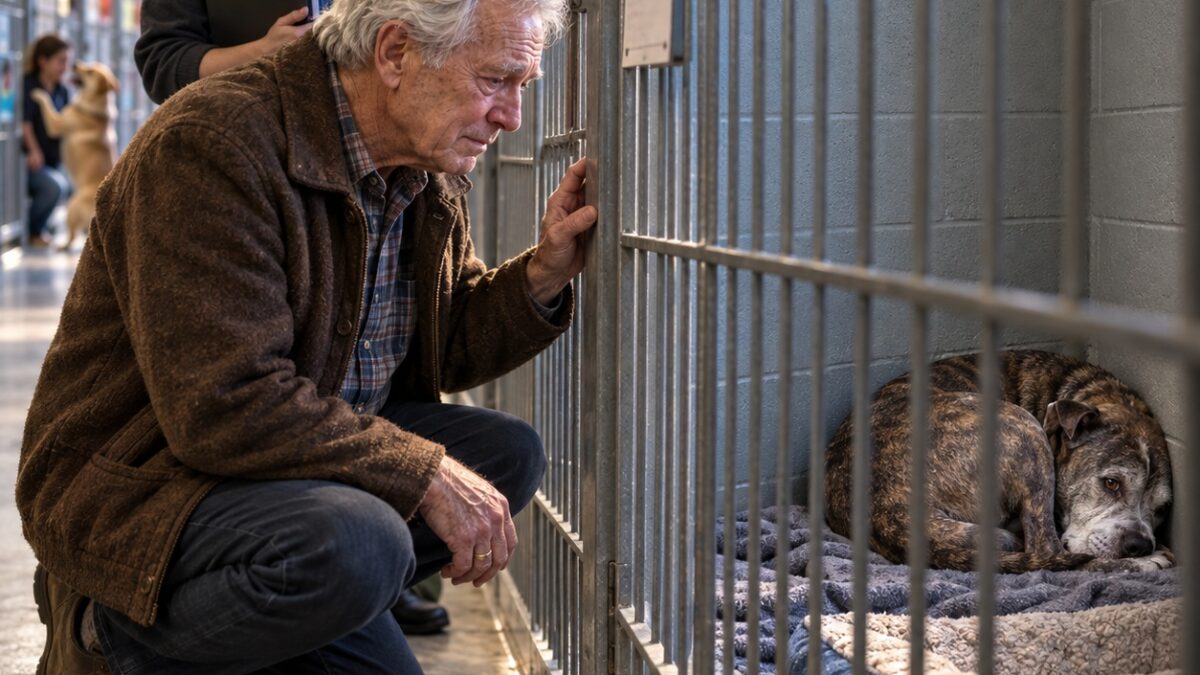
FULL STORY CONTINUATION
I left him there.
That may not sound like much.
Most people bring a newly adopted dog home and immediately start doing things.
Showing rooms.
Offering treats.
Calling the dog’s name.
Touching.
Trying to establish affection before either creature has decided affection is safe.
I had been warned not to do that.
Still, standing in my yard watching Duke sit with his back almost touching the siding, I had the strong urge to kneel beside him.
I didn’t.
Instead, I said, “All right.”
His ear moved.
“That can be your spot.”
No response.
“I had one too.”
Nothing.
I went inside.
From the kitchen window, I could see him.
He remained in the same position for almost forty minutes.
Not sleeping.
Watching.
What exactly, I had no idea.
The yard was small.
A wooden fence.
An old maple tree.
Margaret’s flower beds, now mostly empty because I had stopped pretending I knew what to do with roses.
A weathered bench.
Nothing threatening.
But Duke studied it like territory that needed to be understood before it could be trusted.
Eventually, I opened the back door.
“You hungry?”
He looked toward me.
First eye contact.
Brief.
Then away.
I had purchased senior dog food based on Claire’s recommendation.
I placed the bowl several feet inside the kitchen.
Duke came to the doorway.
Stopped.
Wouldn’t cross.
I moved the bowl closer.
Still nothing.
“Suit yourself.”
I left it near the threshold and walked into the living room.
Ten minutes later, I heard the faint scrape of metal on tile.
I stayed where I was.
When I returned, half the food was gone.
Duke was back outside.
That became our first agreement.
I would not watch him eat.
He would eat.
The second agreement was water.
Same problem.
If I stood nearby, he ignored the bowl.
If I left, he drank.
The third agreement concerned sleep.
I had bought a thick orthopedic dog bed because Claire told me senior pit bulls often had joint pain.
I placed it in the living room.
Duke sniffed it.
Then went back to his corner outside.
“It cost seventy dollars.”
No reaction.
“You could at least pretend to be impressed.”
He looked away.
That evening, the temperature dropped.
I worried.
“Come inside.”
Duke didn’t move.
I waited.
“It’s cold.”
Nothing.
I walked closer.
His body became tense.
Not aggressive.
Frozen.
So I stopped.
“Fine.”
I left the back door open.
The heater ran far too long.
Around ten, I heard claws on the kitchen floor.
Duke came inside.
He passed the expensive bed.
Of course.
Then lay near the wall beside the front room.
I sat in my chair.
The chair.
Margaret had selected it twenty years earlier because she said my old recliner looked like “something found behind a fraternity house.”
I refused to replace it for months.
Then she bought this one without asking me.
After she died, I spent countless nights sitting there until sunrise.
That first night with Duke, I did the same.
He lay fifteen feet away.
Eyes open.
I watched him.
He watched me.
Neither of us slept much.
Around two in the morning, I said, “This is ridiculous.”
His ears lifted.
“Two old men staring at each other.”
Duke blinked.
“I assume you’re a man.”
Nothing.
“Claire said male.”
Another blink.
“Good talk.”
I almost laughed.
It had been a while since I heard that sound in the house.
The first week was difficult.
Not dramatic.
Difficult in quiet ways.
Duke never asked to go outside.
I had to establish a schedule.
Morning.
Noon.
Evening.
Before bed.
He walked on a leash without pulling.
Too well, actually.
He moved beside me with no curiosity.
Did not stop for squirrels.
Barely sniffed trees.
Other dogs barked at him.
He ignored them.
People tried speaking to him.
He ignored them too.
A young woman at the end of the block said, “He’s so calm.”
I smiled because correcting her would have required explaining that calm and absence are not the same thing.
Duke wasn’t calm.
He was withdrawn.
There is a difference.
I understood that better than I wanted to.
After Margaret died, people also called me calm.
“George is handling it well.”
I heard that sentence at the funeral.
Handling it well.
What they meant was that I wasn’t making anyone uncomfortable.
I shook hands.
Thanked people.
Ate food I couldn’t taste.
Signed papers.
Paid bills.
Removed medical equipment from the house.
Functioning is often mistaken for healing.
Duke functioned.
So had I.
Maybe that was why I did not rush him.
Every morning, I made coffee.
Every morning, I placed his food down and walked away.
Every morning, I talked.
At first, about nonsense.
Weather.
News.
The neighbor’s terrible lawn mower.
Then about myself.
“My daughter thinks you’re therapy.”
Duke lay near the kitchen entrance.
“She says I needed something to take care of.”
No reaction.
“I told her I’m perfectly capable of taking care of myself.”
His eyes shifted toward my toast.
“You agree?”
The toast had more influence than my conversation.
I gave him a tiny corner.
That was the first food he took directly from my hand.
Actually, “directly” is generous.
I placed it on the floor.
He waited until my hand moved away.
Then ate it.
“Progress.”
His ears moved.
“You disagree?”
I began telling him about Margaret.
Not intentionally.
The subject simply entered the room and stayed.
“She liked dogs more than I did.”
Duke was curled near the hallway.
“We had one years ago. Murphy.”
His eyes remained closed.
“Stupidest animal alive.”
One ear lifted.
“Couldn’t catch a ball. Couldn’t swim properly. Ate a Christmas ornament once.”
I smiled.
“Margaret loved him.”
I looked at Duke.
“She would’ve liked you.”
That sentence hurt.
For several seconds, I could not continue.
Duke opened his eyes.
Maybe he noticed my voice change.
Maybe not.
“She would’ve made you sleep on the couch.”
I cleared my throat.
“Actually, she’d have pretended you weren’t allowed on the couch, then put a blanket there.”
Duke lowered his head again.
I kept talking.
I told him how Margaret and I met.
Church picnic.
I spilled lemonade down the front of my shirt because she smiled at me.
He looked unimpressed.
“That’s true.”
I told him about our first apartment.
Our children.
The old farm.
I had grown up farming and returned to it later in life.
Margaret and I spent almost twenty years on a property outside town before selling most of it when the work became too much.
After she died, I rented a small piece of land from a friend.
Not really farming.
A few acres.
A shed.
A place to fix things, grow tomatoes badly, and escape the house.
Duke heard all of it.
Or didn’t.
That was the beauty.
He never interrupted.
The second week, something changed.
Small.
So small another person might have missed it.
I was making coffee before sunrise.
Duke usually remained in the living room until I placed his breakfast down.
Then I heard footsteps.
Slow.
Heavy.
Claws against the floor.
I turned.
He stood in the kitchen doorway.
We stared at each other.
“Morning.”
He did not retreat.
I poured coffee.
He took one step forward.
Then another.
He stopped beside my chair.
And sat.
Not touching me.
Not looking at me.
Simply there.
My first instinct was to reach down.
I stopped myself.
Instead, I drank coffee.
For fifteen minutes, Duke sat beside my feet.
Neither of us spoke.
Then he stood and walked away.
That morning changed everything.
Not because he loved me.
He didn’t.
Not yet.
But he had chosen proximity.
The next morning, he did it again.
Then again.
It became our routine.
Coffee.
Silence.
Duke beside my feet.
I started waking earlier.
Not consciously.
I told myself age was ruining my sleep.
Truth was, I liked waiting to hear his footsteps.
After three weeks, he began eating while I remained in the kitchen.
Not close.
But visible.
I pretended not to notice.
After a month, he drank water with me in the room.
Huge victory.
I called my daughter.
“Duke drank water.”
Silence.
“Hello?”
“Dad.”
“What?”
“You called me to report that your dog drank water.”
“He wouldn’t do it before.”
“Okay.”
“You don’t understand.”
“No, apparently I don’t.”
“He trusts me.”
The sentence came out before I intended.
My daughter became quiet.
Then she said, “Good.”
Something in her voice irritated me.
“Don’t make this emotional.”
“Wouldn’t dream of it.”
“You’re doing it.”
“I said one word.”
“I know your tone.”
She laughed.
I hung up on her.
Two months after I adopted Duke, I decided to take him to the little farm.
The idea came after I found an old photograph Claire had included with his paperwork.
Duke standing beside a barn.
Younger.
Muscular.
Tail high.
A man beside him.
His former owner.
The photograph must have been years old.
On the back someone had written:
Frank and Duke – spring.
I stared at it for a long time.
Claire had told me Duke’s owner had died, but she didn’t know much else.
A relative had surrendered Duke shortly afterward.
The dog stopped eating.
Stopped playing.
Then chose that kennel corner.
He had lived there emotionally for two years.
I wondered whether land might wake something in him.
Maybe smells.
Grass.
Open space.
I also worried it could make things worse.
I called Claire.
“Do you think taking him somewhere farm-like is a bad idea?”
“Maybe.”
“Helpful.”
“George, nobody knows.”
“He used to live on one.”
“Yes.”
“Could it trigger him?”
“It could.”
“Could it help?”
“Yes.”
“You’re terrible at this.”
She laughed.
“How is he?”
“Sits with me for coffee.”
“Duke?”
“Yes.”
“He chooses to?”
“Yes.”
Claire went quiet.
“What?”
“Nothing.”
“You’re doing the tone.”
“What tone?”
“The tone my daughter uses.”
“Maybe because we’re both impressed.”
I decided to go.
The farm sat fifteen minutes outside town.
That Saturday was cool but bright.
Duke climbed into the car more easily than the day I adopted him.
Progress again.
During the drive, he watched the window.
No excitement.
But more awareness.
When we turned onto the gravel road, his head lifted.
I noticed immediately.
“You know something?”
His ears moved forward.
We passed a field.
Duke sat up.
By the time I parked beside the shed, he was trembling.
I almost panicked.
“Okay.”
I turned off the engine.
“We don’t have to get out.”
Duke stared through the windshield.
Grass moved in the wind.
Farther away, a line of trees bordered the property.
An old red barn belonging to the neighboring farm stood beyond that.
Duke whined.
The first vocal sound I had heard from him.
My chest tightened.
“Duke?”
He looked at me.
Then at the door.
I opened it.
Duke climbed down.
He stood with all four paws in the grass.
His nose lifted.
He smelled the air.
His whole body trembled.
“Easy.”
I stayed near the truck.
Duke took one step.
Then another.
He began walking.
Slow.
Almost stiff.
Toward the middle of the field.
I followed at a distance.
He stopped.
Looked toward the horizon.
For a long moment, nothing happened.
Then Duke ran.
Not quickly.
Not gracefully.
He was an old dog.
His joints were stiff.
His body carried years.
But he ran.
I froze.
Duke crossed the field with a lumbering stride, gaining speed as though his body had suddenly remembered a language his mind had forgotten.
“Duke!”
He kept going.
For one second, I worried.
Then I realized he wasn’t escaping.
He was running because he could.
Because there was space.
Grass.
Wind.
Something familiar enough to crack open whatever shell he had built.
He went maybe a hundred yards.
Then stopped.
Turned.
Looked back at me.
I could barely see through my tears.
He stood there waiting.
Not running away.
Waiting for me.
I walked toward him.
My knees hurt.
I didn’t care.
When I reached him, Duke sat.
I crouched.
I had never touched him except briefly when clipping the leash.
Not affectionately.
Not because he asked.
This time, I opened my arms.
“Is this okay?”
Duke stared.
Then moved forward.
His head pressed against my chest.
I wrapped my arms around him.
He trembled.
So did I.
He did not pull away.
I buried my face against the top of his head and cried like a child.
Not just for Duke.
For Margaret.
For Frank, whoever he had been.
For two old creatures standing in a field carrying memories that had nowhere else to go.
Duke’s head remained against me.
I whispered, “I know.”
I didn’t know what exactly I claimed to know.
Loss, perhaps.
That’s enough sometimes.
We sat in the grass.
After a while, Duke lay beside me.
His body touched my leg.
That was the first time he chose physical contact.
Something opened that day.
Not everything.
Trauma does not evaporate because of one emotional moment.
Duke didn’t suddenly become a puppy.
He didn’t bounce into the house that evening.
But life began returning in pieces.
Three days later, his tail moved when I came home from the grocery store.
One wag.
I stood inside the doorway.
“Did you just—”
Duke stared.
“Do that again.”
Nothing.
“You wagged.”
He walked away.
I called my daughter.
“His tail moved.”
“Oh God.”
“What?”
“Nothing. Continue.”
“He wagged when I came home.”
“Dad.”
“What?”
“You sound happy.”
“Don’t start.”
She came over that weekend.
Duke had previously tolerated her.
That day, when she entered, he walked toward her.
She crouched.
“Hey, handsome.”
Duke smelled her hand.
Then returned to me.
My daughter looked at me.
“He picked you.”
I pretended the sentence didn’t affect me.
“He knows who feeds him.”
“Sure.”
The farm became a weekly ritual.
Every Saturday morning, Duke stood near the garage door after breakfast.
The first time he did it, I didn’t understand.
“What?”
He stared at the door.
“Bathroom?”
Nothing.
“Walk?”
Nothing.
Then I realized.
“Farm?”
His tail moved.
I laughed.
“All right.”
At the farm, he began exploring.
Sniffing.
Rolling in grass.
One afternoon, he discovered a tennis ball in the shed.
It had probably belonged to the property owner’s dog.
Duke sniffed it.
Pushed it.
Walked away.
The next week, he picked it up.
He carried it three feet.
Dropped it.
I nearly celebrated.
Then remembered Claire’s warning.
Do not turn every behavior into a test.
So I pretended not to care.
“Fine.”
Duke looked at me.
“If you’re expecting me to throw it, you’ve chosen the wrong old man.”
He nudged the ball toward me.
I threw it.
Poorly.
Duke watched it land.
Then looked at me as if questioning my competence.
“Go get it.”
He eventually walked toward it.
No running.
But he returned with the ball.
That was the beginning.
At home, he started changing too.
He slept closer to my bedroom.
Then just outside the door.
Then inside.
I woke one morning and found him lying beside the bed.
“Breaking boundaries?”
Duke lifted his head.
“Fine.”
The next night, he returned.
Eventually that became his place.
Every morning, before I fully woke, Duke stood beside the bed and rested his chin on the mattress.
I would open my eyes to find his old face inches from mine.
“Personal space.”
Tail wag.
“You don’t understand the concept.”
More wagging.
The dog who supposedly might never greet me had created a morning inspection routine.
After six months, he began bringing me toys.
Not often.
Duke was never obsessed with play.
But sometimes in the evening, he would walk into the living room carrying the tennis ball.
He’d place it beside my chair.
Then stare.
“You know we’re indoors.”
Stare.
“You want me to throw a ball across Margaret’s living room?”
Stare.
“She would kill us.”
Tail wag.
I threw it.
Once.
The ball hit a lamp.
The lamp survived.
Duke looked delighted.
“Never again.”
We did it again the next night.
My daughter said I had become ridiculous.
I reminded her the dog had been her idea.
“That doesn’t mean I expected you to turn into this.”
“This what?”
“A person with three dog beds.”
“He has arthritis.”
“He sleeps on the floor beside your bed.”
“He needs options.”
She laughed until she cried.
Duke met my grandchildren.
I worried at first.
He was gentle, but senior dogs deserve respect.
I established rules.
No climbing on him.
No touching while he eats.
No grabbing.
Let Duke approach.
My youngest grandson sat on the floor with a book.
Duke walked over.
Lay beside him.
Within ten minutes, the boy was reading aloud to a pit bull who looked deeply unimpressed by children’s literature.
I watched from the kitchen.
Something inside me shifted.
The house had sound again.
Shoes by the door.
Laughter.
Dog hair.
Dropped toys.
Coffee.
Calls from my daughter because she had started coming by more often “to see Duke.”
I knew the truth.
The dog had done something I hadn’t allowed anyone else to do.
He reopened the house.
Not by replacing Margaret.
That distinction mattered deeply.
For months, I felt guilty whenever happiness surprised me.
The first time I laughed hard enough that my stomach hurt because Duke fell backward trying to catch a leaf, guilt arrived almost immediately.
Margaret wasn’t there.
How dare the room sound joyful?
Grief is irrational that way.
You can know someone wanted you to keep living and still feel disloyal when you do.
One evening, I said that aloud to Duke.
We were on the porch.
He lay beside my chair.
“I sometimes think enjoying this means I’m leaving her behind.”
Duke breathed heavily.
“You wouldn’t understand.”
Then I looked at him.
Maybe he understood better than anyone.
Duke had loved Frank for eleven years.
I didn’t want him to forget.
I would never ask that.
Yet every new thing he enjoyed with me did not erase the old life.
Running at my farm didn’t undo his years with Frank.
Sleeping beside my bed didn’t mean he loved Frank less.
Trust wasn’t replacement.
It was expansion.
I sat forward.
“You’re allowed to love two lives, aren’t you?”
Duke looked up.
His tail tapped the porch once.
I laughed softly.
“That’s annoyingly wise.”
The next day, I opened Margaret’s sewing room.
I had kept it mostly unchanged for nearly three years.
The fabric.
The little stool.
A basket of unfinished quilting pieces.
Her reading glasses in a drawer.
I used to open the door only enough to check for dust.
That morning, I opened the curtains.
Sunlight filled the room.
Duke stood in the doorway.
He did not enter.
Neither did I at first.
Then I walked inside.
I touched the back of Margaret’s chair.
I cried.
Not the violent grief from the early days.
Something quieter.
“Your mother would’ve hated all this dust,” I said.
I had started talking to Duke as if he were family.
He remained in the doorway.
Eventually, he stepped inside.
Sniffed the floor.
Then lay near the window.
That was how the room became part of the house again.
Not erased.
Integrated.
A year after adopting Duke, Claire called.
“I have something.”
“What?”
“Some old records came in from the family member who surrendered him.”
My chest tightened.
“What records?”
“Photos. Veterinary files. A few things from his previous owner.”
“Frank?”
“Yes.”
I drove to the shelter.
Duke came with me.
Walking into that building transformed him instantly.
His body lowered.
Tail down.
Steps slower.
I stopped.
“We can leave.”
Claire appeared.
Her eyes widened.
“Duke.”
He looked at her.
For several seconds, she didn’t move.
Then she crouched.
“Hey, old man.”
Duke approached.
Slowly.
Smelled her hand.
His tail wagged.
Claire covered her mouth.
“Oh.”
I smiled.
“He does that now.”
“He never…”
Her voice broke.
Duke leaned against my leg.
Claire looked at me.
“He’s attached to you.”
“Apparently.”
She stood.
“He looks incredible.”
Duke had gained muscle.
His coat was smoother.
His eyes were brighter.
He still looked old.
I never tried to make age disappear.
But he looked present.
Claire brought a cardboard box.
Inside were photographs.
Duke younger.
Duke beside a tractor.
Duke lying on a porch.
Duke swimming.
A man appeared in many of them.
Frank.
Broad shoulders.
White beard.
Baseball cap.
In one photograph, Frank sat on a wooden step.
Duke leaned against him.
Exactly the way Duke leaned against me now.
I had to sit down.
Claire noticed.
“You okay?”
“Yeah.”
I touched the edge of the photograph.
“He loved him.”
“Looks like it.”
“No.”
I shook my head.
“Duke.”
I looked at the dog.
“He really loved him.”
Claire sat beside me.
“That’s probably why losing him destroyed him.”
I nodded.
There were veterinary records dating back eleven years.
Frank had taken good care of him.
Vaccines.
Dental work.
Arthritis medication.
No neglect.
No cruelty.
No betrayal.
Just death.
That somehow made Duke’s grief harder and easier to understand at the same time.
His old life hadn’t been something to escape.
It had been good.
Wonderful, perhaps.
Then ended.
I took the photographs home.
I framed one.
Frank with Duke beside the barn.
My daughter saw it and looked confused.
“You’re putting his old owner on the wall?”
“Yes.”
“Why?”
“Because he existed.”
She looked at me for a moment.
Then smiled.
“Mom would understand.”
I swallowed.
“Yeah.”
The picture hangs near the back door.
Some visitors find that strange.
I don’t care.
Frank is part of Duke.
Just as Margaret is part of me.
Love before us does not threaten love with us.
That lesson became central to our life.
Duke was thirteen then.
The veterinarian reminded me he was old.
I disliked her immediately for stating obvious facts.
“His bloodwork is good,” she said.
“So he’s fine.”
“For his age.”
“He doesn’t know his age.”
“His joints do.”
She prescribed supplements and adjusted his medication.
I started adding a small ramp near the back steps.
Duke refused to use it for the first week.
He insisted on taking the stairs.
“Pride will kill you.”
He ignored me.
Then one rainy morning he slipped slightly.
After that, he used the ramp.
We did not discuss it.
By fourteen, his runs at the farm became slower.
Still, he ran.
Sometimes only thirty yards.
Then he would stop and wait.
Always wait.
That became our ritual.
Duke moved ahead.
Then turned.
Made sure I was coming.
When I first brought him there, I thought he had been running toward his past.
Eventually, I realized he might also have been running toward the first future he could imagine.
Open land.
A man behind him.
No kennel.
No corner.
At fifteen, Duke’s muzzle was almost completely white.
He slept more.
His hearing declined.
I sometimes called him twice before he responded.
The dog who had once refused to look at me now became irritated if I left a room without him noticing.
He followed slowly.
Kitchen.
Porch.
Bedroom.
Garden.
Everywhere.
I complained.
Secretly, I loved it.
One morning, my daughter found me making scrambled eggs while Duke waited nearby.
“You’re giving him some.”
“No.”
“You already put aside a plate.”
“That’s mine.”
“It has no salt.”
“I watch my blood pressure.”
“Dad.”
“Go away.”
Duke received eggs.
Of course.
My daughter watched him eat.
Then said, “He’s old.”
I froze.
“I know.”
“You ever think about—”
“No.”
“Dad.”
“I said no.”
She went silent.
I immediately regretted the sharpness.
But I did not apologize.
Not then.
Because she had touched the fear I was trying not to name.
I had adopted a thirteen-year-old dog.
Now he was fifteen.
What had I expected?
Forever?
Intellectually, no.
Emotionally, apparently yes.
That evening, I sat beside Duke in the garden.
“You realize this is unfair.”
He rested his head on my knee.
“I finally get used to you.”
His eyes closed.
“And now everyone keeps reminding me you’re ancient.”
No response.
“I’m ancient too, so that’s insulting to both of us.”
Tail thump.
I stroked his head.
“I don’t know how much time we have.”
His breathing remained steady.
“But I suppose nobody does.”
That was something Margaret’s illness had taught me and grief made me forget.
Time is not valuable because there is a lot of it.
Time is valuable because it ends.
Knowing Duke was old did not make adoption a mistake.
It made ordinary days matter more.
We still went to the farm.
Shorter visits.
I brought a folding chair.
Duke wandered.
Sometimes he ran a few steps.
Sometimes he simply stood in the grass, nose lifted.
I watched.
One afternoon, he reached the place where he had first allowed me to hug him.
He sat.
I joined him.
“You remember?”
Duke leaned against me.
I chose to believe he did.
Maybe memory works differently for dogs.
Smell.
Place.
Body.
Emotion.
Maybe he did not replay scenes the way I did.
But his body knew that field was safe.
That was enough.
I wrapped one arm around him.
He rested his head on my chest.
We sat there until sunset.
The same dog that spent two years refusing to leave a shelter corner now disliked going home from open fields.
That fact never stopped amazing me.
People who met Duke late in life could not imagine the dog Claire described.
“Two years?”
“Yes.”
“In one corner?”
“Mostly.”
“But he’s friendly.”
“Now.”
“He plays.”
“Sometimes.”
“He follows you everywhere.”
“Unfortunately.”
Duke wagged whenever I said that.
As if he knew it was a lie.
The truth was simple.
I had gone to the shelter hoping a joyful dog might fill the emptiness in my house.
Duke did not fill it.
That is not what happened.
The emptiness remained.
Margaret was still dead.
Frank was still gone.
There were rooms in both of us that no new relationship could enter.
What changed was that the emptiness stopped being the only thing we carried.
There was also breakfast.
Walks.
Farm days.
Tennis balls.
Vet visits.
My grandchildren.
Coffee.
Rain on the porch.
Duke snoring beside my bed.
Life did not fill the hole.
Life grew around it.
That distinction saved me.
Maybe it saved Duke too.
One evening, Claire visited my house.
She wanted to see Duke outside the shelter environment.
He was lying on the porch.
She approached.
His tail wagged.
Claire sat beside him.
“You look happy.”
Duke licked her hand.
She looked at me.
“You know, when you said you wanted him, I almost refused.”
“What?”
“I thought you were making an emotional decision.”
“I was.”
“Yes, but I thought you’d bring him back.”
That hurt more than it should have.
“You thought I couldn’t handle him?”
“I thought neither of you was ready.”
“Were we?”
Claire smiled.
“No.”
I laughed.
“Excellent.”
“You became ready together.”
That sounded right.
No one is ever fully ready for love after loss.
If you wait until grief disappears, you may wait forever.
Duke had taught me that.
He had not healed first and then trusted me.
Trust was part of healing.
I had not overcome Margaret’s death and then adopted Duke.
Caring for Duke became part of learning how to live with Margaret gone.
Two damaged creatures did not fix each other.
We practiced existing beside each other until existing became living again.
That’s less dramatic.
More true.
A few months later, my daughter brought me a framed photograph.
Duke and me at the farm.
She had taken it without my knowing.
I was sitting in the grass.
Duke beside me.
Both looking toward the field.
On the back she had written:
Two stubborn old men.
I pretended to be insulted.
Then placed it beside the photograph of Margaret.
Eventually, I added the picture of Frank and Duke.
Three photographs.
Three lives touching without erasing one another.
Margaret.
Frank.
Duke.
Me.
That little arrangement became my favorite part of the room.
Duke turned fifteen in the spring.
I did not know his exact birthday, so we used the date listed in his shelter file.
My grandchildren insisted on a party.
I opposed it.
I lost.
There was a dog-safe cake.
A ridiculous blue bandana.
Balloons Duke ignored.
Claire came.
My daughter.
My grandchildren.
Two neighbors.
Everyone sang.
Duke stared as if we had all lost our minds.
Then ate the cake.
Later, after everyone left, I found him asleep beneath the table.
Bandana crooked.
I sat on the floor beside him.
“Fifteen.”
His eyes opened.
“You were supposed to be the sad one.”
Tail movement.
“Now look at you.”
He reached his head toward me.
I scratched behind his ears.
“Look at us.”
That night, he slept with his chin against my slipper.
I thought about the shelter.
That corner.
His stillness.
The warning.
He may never run toward you.
He may never play.
He may never look at you.
Claire had been right to warn me.
And in a strange way, everything she said had also been true.
Duke never became an easy dog.
He remained reserved with strangers.
He hated loud gatherings.
He rarely played for long.
Some mornings he withdrew into himself for reasons I could not understand.
At the farm, there were days he simply sat and stared toward the horizon.
I never knew whether those moments belonged to Frank.
I let them.
I did not need all of Duke.
Nobody should require all of another heart.
Some parts were already loved.
Some parts were scar tissue.
Some parts were private.
What he gave me was enough.
More than enough.
Every morning, Duke still placed his head on the edge of my bed.
Every morning, I opened my eyes.
“Morning.”
His tail moved.
I got dressed.
He followed me to the kitchen.
Coffee.
Breakfast.
Quiet.
The ritual that began with him sitting several feet away had become the center of my day.
Sometimes I wondered what Duke thought when he looked at me.
Did he compare me to Frank?
Did my voice remind him of something?
Did the farm smell like his first home?
Did he understand that I too had lost someone?
Probably not in the way humans construct stories.
He didn’t need to.
Pain recognizes patience without explanation.
That’s what we had from the beginning.
Patience.
I didn’t demand that he become cheerful.
He didn’t demand that I become less sad.
We simply stopped being sad alone.
That was enough to change both of us.
One late summer morning, Duke woke me before dawn.
His head pressed against the mattress.
I opened my eyes.
“What?”
He stepped toward the door.
“Bathroom?”
He looked back.
I dressed and followed.
Outside, the sky was beginning to lighten.
Duke walked into the garden.
Slowly.
He reached the far corner beside the house.
The place he had chosen on his first day.
He sat.
I stopped.
For a second, I saw him exactly as he had been years earlier.
Silent.
Withdrawn.
Facing nothing.
My heart tightened.
Then Duke looked back at me.
Waited.
I walked over.
He leaned against my leg.
Different.
That was everything.
Same corner.
Different dog.
Same house.
Different man.
I sat beside him on the ground.
My knees complained.
Duke rested his head against my thigh.
We watched the sunrise.
I thought about how many times I had sat in that corner after Margaret died.
Sometimes for hours.
Not because I liked the view.
Because the house felt unbearable.
That morning, sitting there with Duke, the corner no longer felt like a place of grief.
It was simply part of the yard.
Healing does that.
It does not erase locations.
It changes what they mean.
The shelter corner had once meant waiting for Frank.
My yard corner had once meant living without Margaret.
Now we occupied it together.
No dramatic revelation.
Just warmth.
Breathing.
Morning light.
I put my hand on Duke’s back.
“You know what?”
He looked at me.
“I think we’re okay.”
His tail touched the ground once.
“Yes.”
I smiled.
“We’re old.”
Another thump.
“Probably annoying.”
Nothing.
“You especially.”
Duke leaned harder into me.
I laughed.
“I know.”
There will come a day when Duke is gone.
I understand that.
I don’t like it.
I don’t accept it gracefully.
But I understand it.
At seventy-four, I also understand that Duke may not be the only one with limited time.
That does not frighten me as much as it once might have.
What frightens me is wasting whatever remains because endings exist.
Frank had eleven years with Duke.
Margaret had forty-six years with me.
I got Duke later.
He got me later.
Later is still life.
People underestimate later.
They think the best love must begin early.
Puppies.
Youth.
First marriages.
First homes.
But some of the most important connections arrive after things have already broken.
Not to restore what was.
To prove there can still be something.
Duke proved that.
Today, he is fifteen.
He sleeps at my feet while I read.
He walks beside me in the garden.
On good days, we drive to the farm.
He does not run a hundred yards anymore.
Maybe ten.
Sometimes twenty.
Then he stops and looks back.
I follow.
Always.
Because once, that old dog waited for me in a field.
Now I make sure he never has to wonder whether I’m coming.
Every evening, before bed, I stop beside the photograph of Frank.
Not intentionally at first.
It became a habit.
I sometimes say, “He’s okay.”
Maybe that’s foolish.
I don’t care.
“He’s old.”
I look toward Duke.
“Stubborn.”
Tail wag.
“Still misses you, probably.”
Then I look at Margaret.
“So do I.”
The room does not become sad.
Quite the opposite.
It feels full.
Not because death has been defeated.
Because memory and life have learned to share space.
Duke taught me that love is not a container with room for only one person.
The heart does not evict the dead to welcome the living.
It expands.
Pain expands it first.
Then, if you’re lucky, something else enters.
A dog.
A friend.
A grandchild laughing.
Morning coffee with an old pit bull at your feet.
I used to believe my life became empty when Margaret died.
I was wrong.
It became quiet.
I mistook quiet for emptiness because I didn’t know how to listen to it.
Then Duke arrived.
For months, all we had was shared silence.
No games.
No enthusiastic greeting.
No instant bond.
Just two old creatures sitting in the same room, carrying people who were no longer there.
That silence became trust.
Trust became routine.
Routine became affection.
Affection became a life.
If I had chosen the cheerful puppy in the first kennel, perhaps I would have been happy too.
I don’t know.
But I know Duke was the dog I recognized.
Not because he needed me more.
I dislike that version of the story.
Duke wasn’t a project.
I wasn’t his rescuer.
We were two living things whose worlds had become smaller after loss.
We simply stopped shrinking together.
That’s different.
Claire once told me senior dogs are difficult to place because people are afraid of the ending.
I understand that fear.
Adopting Duke meant accepting from the first day that goodbye might come sooner than I wanted.
But people make a terrible mistake when they measure love only by duration.
Two years with someone can change a life.
Six months can.
One afternoon can.
A single morning in a field can divide existence into before and after.
Duke spent two years in a shelter corner because people saw his age and imagined grief ahead.
I saw his grief already happening.
And perhaps because mine looked similar, I was less frightened by it.
I did not need him to promise me ten years.
I only needed to open the car door.
He climbed in.
Everything after that was borrowed time.
Beautiful borrowed time.
Sometimes neighbors see us walking and ask how old he is.
“Fifteen.”
They look surprised.
Then sympathetic.
“Oh.”
I know that oh.
It means:
Not much longer.
I no longer resent it.
I smile.
“He’s doing well.”
Because he is.
Doing well doesn’t mean forever.
It means today was good.
He ate breakfast.
Walked in the garden.
Barked once at a squirrel.
Slept in the sun.
Followed me to the mailbox.
Asked for half my toast.
Today was full.
That’s enough.
If Duke taught me anything, it is that life does not need to be long to be returned to you.
It needs presence.
Frank is gone.
Margaret is gone.
Neither love ended.
It changed form.
That’s all.
One became photographs and habits and sentences I still hear in my head.
The other became the way Duke sometimes stares across a field.
Then Duke and I built something new beside those old loves.
Not over them.
Beside them.
I think that matters.
Tonight, when the house becomes quiet, Duke will follow me to the bedroom.
He’ll circle twice.
Lie at my feet.
I’ll turn off the lamp.
Sometime before dawn, I will wake and hear him breathing.
Years ago, the silence of that room terrified me.
Now I listen for his breath.
Not because I fear every moment might be the last.
Though sometimes I do.
I listen because presence deserves to be noticed.
That’s another thing grief teaches if you let it.
Notice who is still here.
Duke is still here.
So am I.
Tomorrow morning, if we’re lucky, his gray head will appear beside the mattress.
I’ll open my eyes.
He’ll stare.
I will complain that it is too early.
He will ignore me.
We will go to the kitchen.
I’ll make coffee.
He’ll sit at my feet.
Maybe neither of us will say much.
That has always been our language.
People sometimes ask me why I chose the dog nobody else wanted.
The answer sounds simpler now than it did then.
I recognized him.
That’s all.
I recognized the posture.
The silence.
The way grief can make a body remain in one place because movement feels like betrayal.
I saw Duke in that shelter corner and knew what it was to keep living without really going anywhere.
Maybe he recognized something in me too.
I don’t know.
But I know this:
He left that corner.
Eventually.
So did I.
The first time Duke ran across the field, I believed I was watching a dog come back to life.
Looking back, there were two of us out there.
One old pit bull running badly through the grass.
One old widower standing behind him crying.
Duke ran.
Then turned.
He didn’t disappear into the distance.
He looked back.
He waited for me.
And I followed.
I have been following ever since.
That, more than anything, is what love has become to me now.
Not rescuing.
Not replacing.
Not forgetting.
One creature moving forward just far enough to show another creature that forward is still possible.
Then stopping.
Looking back.
Waiting.
Come on.
I’m here.
You don’t have to stay in that corner anymore.








