FULL STORY:The Old Golden Retriever Watched His Owner Drive Away—Eight Hours Later, He Was Still Staring Down the Road
PART2
I drove slowly.
At every intersection, I looked into the mirror.
The dog barely moved.
Once, when another car passed quickly beside us, his eyes opened.
Then closed again.
He was exhausted.
Physical exhaustion, yes.
But something else too.
The kind that follows hours of expecting something that never happens.
I had no dog supplies.
No food.
No bed.
No plan.
I called the rescue volunteer.
“Someone picked him up?”
“Yes.”
“Who?”
“Me.”
Silence.
Then:
“Are you taking him home?”
“I guess.”
Another silence.
“Do you have dogs?”
“No.”
“Have you ever had one?”
“No.”
This time the silence sounded concerned.
She gave me instructions.
Keep him quiet.
Water available.
No sudden introductions.
If possible, have a veterinarian scan for a microchip before assuming anything.
Of course.
A responsible person would have thought of that earlier.
I stopped at an emergency veterinary clinic.
The Golden hesitated when we arrived.
He did not want to leave the truck.
I didn’t pull.
A technician came outside with the scanner.
No chip.
No collar.
No obvious acute injuries.
Old joints.
Underweight.
Worn teeth.
Some skin irritation.
They estimated he was at least ten.
Maybe older.
“Has he eaten?”
“Not with me.”
They gave me a small bag of food and recommended a fuller exam within the next few days.
The technician asked:
“What is his name?”
I looked at the dog.
He looked back.
“I don’t know.”
The words hurt unexpectedly.
Whatever name he had heard his entire life had disappeared with the man in the sedan.
On the way home, I kept trying names in my head.
Nothing fit.
When we arrived at my house, he stayed in the truck for several minutes.
I opened the door.
Waited.
He climbed down.
Fields stretched around us.
No traffic.
No shoulder.
No familiar road.
He looked lost.
“Come on.”
He followed me inside.
The house was quiet.
Too quiet, I suddenly realized.
I’d liked that before.
The Golden stopped in the living room.
Sniffed once.
Twice.
Then turned toward the front door.
Sat beside it.
Of course.
I found an old bowl.
Filled it with water.
He drank.
Food came next.
He ate slowly.
Then returned to the door.
That first evening, I called him “buddy” because I had nothing else.
He reacted mildly.
Probably tone.
Eventually I said:
“Ogi.”
I don’t know where it came from.
No family significance.
No clever origin.
Just Ogi.
His head lifted.
I repeated it.
“Ogi.”
He looked at me.
I smiled.
“Well, that’s something.”
Ogi.
It stayed.
The first night, I placed an old folded quilt on the floor beside my bed.
Ogi inspected it.
Then lay beside it.
Not on.
I did not correct him.
At midnight, I woke to nails moving across the floor.
Ogi was circling.
Front door.
Bedroom.
Hall.
Front door.
Bedroom.
As if checking exits.
Making sure he hadn’t somehow missed the person he was still expecting.
I reached one hand over the edge of the bed.
No words.
Ogi stopped.
Approached.
His nose touched my fingers.
Then he lowered his head beneath my hand.
We remained like that.
Me half asleep.
Arm hanging awkwardly.
Old dog standing beside the mattress.
After a few minutes, he lay down.
At two, same.
At four, same.
Neither of us slept much.
Morning light arrived.
I opened my eyes.
Ogi was sitting beside the bed.
Watching me.
Not the door.
Me.
“Good morning.”
His tail moved.
One small sweep.
Then another.
The first wag I had seen that belonged to me rather than the disappearing car.
I smiled.
“Good morning, Ogi.”
Breakfast.
Water.
Backyard.
I had no fence around the whole property, so I improvised a leash from one I bought at a gas station that morning.
Ogi didn’t know what I wanted at first.
He stopped.
Pulled sideways.
Sniffed everything.
Every blade of grass appeared important.
I let him take his time.
Afterward, I drove into town and bought what the store employee told me I needed.
Food.
Proper leash.
Collar.
Bed.
Toys.
Brush.
Bowls.
Waste bags.
Treats.
I had never spent so much money so quickly on a creature who had known me less than twenty-four hours.
When I returned home, Ogi was waiting near the door.
That detail matters.
I had left him for twenty-eight minutes.
A neighbor had agreed to sit inside because I didn’t want Ogi alone yet.
When my truck pulled up, he stood.
The neighbor said later that his entire body had changed at the sound.
I opened the door.
Ogi rushed toward me.
Not jumping.
Not barking.
Just pressing his head against my thigh.
I froze.
Then understood.
I had left.
And returned.
The first repetition.
The first small piece of evidence that I might not be him.
The man in the sedan.
Over the next week, that became our real work.
I had to work.
Furniture orders did not disappear because an old dog had entered my life.
My workshop sat only a short drive away, on another part of my property, but I still couldn’t keep Ogi with me immediately.
Too much noise.
Machines.
Dust.
Unknown environment.
So the first morning, I put on my boots.
Ogi saw.
His expression changed.
He stood.
Watched.
I picked up keys.
He moved to the door.
His breathing changed.
I hated it.
I crouched.
“I’ll come back.”
The words were worthless.
Someone else had probably told him similar things.
Maybe not.
Either way, he had evidence more powerful than language.
People leave.
I placed one of my old shirts near his bed.
A toy.
Water.
The neighbor came again to stay with him.
I left.
At the workshop, I lasted thirty-seven minutes before checking.
“Ogi is sitting by the door,” she said.
Of course.
“He isn’t panicking.”
“Did he eat?”
“No.”
I returned at lunch.
When I opened the door, Ogi ran toward me.
Tail.
Whine.
Head against my legs.
I knelt.
“I came back.”
I repeated it like a promise.
But promises become real only through repetition.
Next day, I left again.
Returned.
Again.
Returned.
Each departure hurt less.
Not quickly.
Ogi still stood beside the door during the first week.
Sometimes for an hour.
Sometimes longer.
My neighbor sent pictures.
Old Golden sitting in exactly the same position.
Waiting.
I hated every photograph.
But every evening I came through that door.
And slowly, the waiting changed.
Day four, Ogi lay down near the door instead of sitting.
Day six, he moved onto the rug.
Day nine, my neighbor said he followed her into the kitchen.
Day eleven, he slept for almost an hour while I was gone.
That one made me emotional.
Trust sometimes looks like sleep.
You cannot sleep deeply if you believe disappearance may happen at any second.
I brought him small things when I returned.
Not bribes.
Just objects that became part of a ritual.
A rope toy.
Soft blanket.
Chew.
I would place them down and say:
“Yours until I come back.”
Ridiculous sentence.
Ogi didn’t know English.
But he knew I returned.
By the second week, we started real walks.
I had imagined an old Golden Retriever would naturally understand walking on leash.
Ogi did not.
Maybe he’d spent most of his life in a yard.
Maybe leash experience had been inconsistent.
We walked fifty feet.
Stopped.
He smelled a rock for three minutes.
Another twenty feet.
Leaf.
Bird.
Fence post.
The world seemed new.
I stopped trying to move efficiently.
That was difficult for me.
I had built my entire adult life around efficiency.
Measure twice.
Cut once.
Order material.
Deliver project.
Schedule.
Time.
Ogi had no interest in schedules.
He wanted to smell one patch of grass until it had fully explained itself.
I learned to wait.
That was his first gift to me.
The man who had always been rushing eventually became the man standing beside a Golden Retriever while he investigated a dead leaf.
And somehow life did not collapse.
The third week, Ogi learned to play.
That sentence sounds ordinary.
It wasn’t.
Until then, toys confused him.
I bought a ball.
He smelled it.
Walked away.
Rope.
Nothing.
A stuffed duck.
Mild suspicion.
Then one afternoon at the edge of the field, Ogi found a stick.
Not even a good stick.
Crooked.
Partially rotten.
He picked it up.
Walked toward me.
Dropped it near my boots.
I looked down.
He looked up.
“Really?”
Tail movement.
I threw it.
Ogi stared at the flying stick.
Then ran.
Ran.
The old dog who had barely moved from the roadside three weeks earlier broke into a clumsy, joyful sprint.
He reached the stick.
Picked it up.
Turned.
For a moment, he stood far away with it in his mouth.
I thought he might keep it.
Instead, he ran back.
Dropped it.
Tail going.
I threw again.
He ran.
Again.
By the fifth throw, I was crying.
I don’t know why.
Maybe because play requires belief in a future.
You chase something because you expect the game to continue.
You bring it back because you believe the person will still be there.
Ogi had spent hours beside the road discovering one person would not return.
Now he was bringing something back to me and expecting me to throw it again.
So I did.
Until sunset.
At home, he collapsed on the floor.
Deep sleep.
No door checking.
Just exhaustion from being a dog.
That became one of my favorite days.
Week four, I brought Ogi to the workshop.
The machines scared him.
Obviously.
I didn’t turn anything on at first.
Opened the door.
Sat inside.
Ogi remained outside.
“Okay.”
He looked at me.
I worked with hand tools quietly.
Door open.
The first day, he never entered.
Second, front paws crossed the threshold.
Then back out.
Third day, he stepped inside.
Walked ten feet.
Left.
Fifth day, he lay near the doorway.
By the seventh, he followed me to the workbench.
I placed a bed in the corner away from machinery.
Eventually, he learned when to retreat before the saw started.
He slept through sanding.
Watched planing.
Sometimes lifted his head when I cursed at measurements.
Clients loved him.
One woman came to pick up a dining table and spent more time talking to Ogi than inspecting the piece.
I charged full price anyway.
The workshop became his territory.
He knew which door opened to the yard.
Where I kept treats.
Which saw meant noise.
Which chair allowed him to lie directly in my path.
I adjusted.
Something else changed.
I talked.
Before Ogi, I might spend an entire workday saying almost nothing.
Now:
“That’s too short.”
“Steve sent garbage walnut again.”
“Don’t eat sawdust.”
“Move your tail.”
“Why are you lying exactly there?”
Ogi listened.
Sometimes.
My house and workshop, places I had always considered peaceful, had actually been silent.
I hadn’t understood the difference.
Ogi filled silence without making much noise.
Week five, I drove back to the road.
I told myself I wanted to see whether anyone had posted signs.
Maybe some clue.
Maybe I wanted closure.
Maybe I was making a mistake.
Ogi rode in the passenger area now with a secured harness.
As we approached the stretch where I’d found him, his body became alert.
I noticed immediately.
Ears.
Head.
He knew.
I almost kept driving.
Instead, I pulled over at roughly the same spot.
Opened the door.
Ogi stepped out.
He stood.
Looked down the road toward the bend.
My chest hurt.
This was the place.
The place where he had watched the sedan disappear.
Where he had refused the blanket.
Where he had waited.
For several seconds, Ogi stared.
I didn’t call him.
Didn’t touch.
I wanted to know what he would choose.
Then he looked at me.
Walked over.
Sat against my leg.
Rested his head on my knee.
No drama.
No barking.
No long gaze after the car that would never return.
He chose proximity.
I put my hand on his head.
“Okay.”
That was all.
We stayed ten minutes.
Then went home.
Week six brought another truth.
Ogi was old.
Not just gray.
His body had limitations.
Walks tired him.
The burst of running with the stick had hidden it temporarily.
But stairs took effort.
His back legs stiffened after long naps.
The veterinarian confirmed arthritis.
Old joint wear.
Nothing surprising.
I sat in the exam room while Ogi leaned against my leg.
“How long?” I asked.
The vet looked at me.
People ask that question as if veterinarians own clocks.
“He could have good years.”
Years.
Plural.
I liked that word.
“But?”
“But he’s senior.”
I knew.
I drove home differently.
Not sad exactly.
Aware.
I had met Ogi in the last chapter of his life.
Maybe not the final pages.
But certainly not the beginning.
There would be no puppy years.
No decade together.
No photographs of him young.
I had inherited gray fur, worn joints, unknown history, and whatever time remained.
That thought could have ruined everything.
Instead, it changed my priorities.
I shortened workdays when I could.
Walked slower.
Let him sniff.
Took him to the field.
Bought joint medication.
Added rugs over slick floors.
The role wasn’t to repair what came before.
I couldn’t.
The man in the sedan had whatever years he had taken from Ogi.
I would never get them back.
My job was simpler.
Make today good.
Then tomorrow.
Then the next.
Week seven, Ogi climbed into my bed.
It happened around eleven at night.
Until then, he slept beside it.
Sometimes head under my hand.
I had bought him an orthopedic dog bed.
Expensive.
He liked the floor.
Naturally.
That night, he stood beside the mattress.
Looked at me.
I moved over.
“Come on.”
Ogi lifted his front paws.
Hesitated.
Then climbed awkwardly.
He was heavy.
My mattress objected.
Ogi turned three times.
Lay at my feet.
I smiled.
Twenty minutes later, he moved closer.
Another half hour.
Closer again.
By one in the morning, his head occupied part of my pillow.
His back pressed against my side.
I put a hand behind one ear.
Ogi sighed.
Closed his eyes.
That was the night I understood the difference between trust and love.
Trust had begun on the road.
He had trusted me enough to enter my truck.
Love took repetition.
Morning after morning.
Return after return.
Meal after meal.
Walk after walk.
Love was not one rescue.
It was accumulated presence.
The next morning, I woke with Golden Retriever hair in my mouth.
Romance has limits.
Ogi became increasingly comfortable being left alone for short periods.
That mattered to me.
I did not want his attachment to become another kind of fear.
Freedom isn’t needing someone beside you every second.
It’s knowing separation is temporary.
Eventually, when I picked up my keys, Ogi lifted his head but did not stand.
I almost cried the first time.
“You’re not coming?”
He blinked.
Went back to sleep.
I smiled all the way to the workshop.
Being ignored can be beautiful.
The eighth week, I started writing down what had happened.
Not for social media.
Not to make myself look generous.
I was afraid of forgetting details.
The way Ogi had watched the bend.
His first step toward me.
The weight of his head on my shoulder.
The first tail movement beside my bed.
People remember endings and smooth over beginnings.
I didn’t want to.
Abandonment shouldn’t become pretty just because life afterward improved.
Something terrible had happened.
A person had taught an animal to trust him, then used that trust to leave the dog waiting.
Ogi’s recovery did not make the act less cruel.
But cruelty did not get to own every page afterward.
I wrote at my desk.
Ogi got up from his bed.
Walked over.
Placed his head on my knee.
I stopped typing.
“You always interrupt at the dramatic part.”
Tail.
I rested one hand between his ears.
He closed his eyes.
And I realized the story was still happening.
Months passed.
The routines deepened.
Ogi learned rain.
He loved watching it through the workshop door.
Not being in it.
Watching.
Head on his paws.
I wondered what weather he had experienced in the past.
Then stopped myself.
I knew almost nothing about his history.
That mattered.
People love filling abandoned animals’ pasts with imagined cruelty.
Sometimes the facts are enough.
I had seen the abandonment.
I didn’t need to invent another tragedy.
Ogi told me who he was now.
That was more useful.
He liked carrots.
Hated bananas.
Loved cheese.
Feared fireworks.
Disliked men wearing motorcycle helmets.
Adored children who sat quietly.
Had no interest in swimming despite being a Golden Retriever, which felt like a manufacturing defect.
He snored.
Stole socks.
Leaned so hard during petting that people nearly fell over.
And if I spent too long sanding one piece, he would stand and stare at me as if questioning my craftsmanship.
He belonged in the workshop.
Clients began asking:
“Where’s Ogi?”
before:
“Is my cabinet finished?”
Annoying.
Also nice.
One afternoon, a little girl came with her father.
She sat on the floor near Ogi.
He approached.
Placed his head in her lap.
The girl whispered:
“He’s sad.”
Her father asked why.
She touched the gray around his muzzle.
“Because he’s old.”
I smiled.
Ogi wasn’t sad.
Not then.
He was old.
There is a difference.
People sometimes mistake age for tragedy.
I had learned to love his slowness.
The pause before standing.
The careful descent from the bed.
The way walks became about scent instead of distance.
Old dogs ask you to stop measuring life by speed.
I needed that lesson.
My business had always been about deadlines.
Output.
Orders.
Profit.
Ogi had no concept of productivity.
He could spend fifteen minutes under one tree.
And somehow the day remained worthwhile.
Six months after I found him, I had to travel overnight for a furniture delivery.
I considered canceling.
Couldn’t.
A friend named Marcus agreed to stay at my house with Ogi.
Ogi knew him.
Liked him.
Still, the idea of not returning that evening made me sick.
The abandoned dog had trained me too.
I packed.
Ogi watched.
Suitcase.
Shoes.
Keys.
His body changed.
That old look returned.
Not full panic.
But concern.
He followed me.
I crouched.
“I’ll be back tomorrow.”
Words.
Still only words.
I left my old work shirt on his bed.
Marcus texted updates.
Ogi ate.
Walked.
Slept near the front door.
That hurt.
Around midnight, Marcus sent a photograph.
Ogi lying with his head on my shirt.
I considered driving three hours home.
Didn’t.
Sometimes protecting trust means letting it survive reasonable distance.
The next afternoon, I returned.
Ogi heard my truck.
Marcus later said the old dog went from sleeping to standing in one movement he should not physically have been capable of.
I opened the door.
Ogi hit me.
Whole body.
Whining.
Tail striking furniture.
He pushed his face against my stomach.
I knelt.
“I came back.”
Again.
The same sentence.
But now it carried months of evidence.
He believed me faster.
That night, he slept deeply.
No door checking.
No pacing.
Something had shifted.
I could leave overnight.
And return.
The world did not end.
Healing sometimes requires carefully proving the feared thing can happen differently.
Not avoiding every trigger forever.
Departure.
Return.
Departure.
Return.
Ogi learned the second half.
A year passed.
The anniversary of the road surprised me.
I had written the date on my calendar.
Didn’t know what to do with it.
Celebrate?
Mourn?
So we went for a walk.
Nothing dramatic.
A field.
Autumn air.
Ogi moving slowly.
Gray face brighter in the sun.
At some point, he stopped.
Looked at me.
I realized how much had changed.
The dog on the road had watched every car because his life was somewhere else.
This dog checked where I was because his life was here.
We returned home.
I made steak.
Ogi got a small piece.
Anniversary solved.
As he aged, his arthritis progressed.
Good days.
Stiff days.
Medication helped.
We added a ramp to the truck.
Ogi refused it initially.
Pride.
He would stand beside it, look at me, then attempt to jump.
I blocked him.
“Absolutely not.”
He looked offended.
Eventually he learned.
Then loved the ramp because old dogs are practical once they abandon ego.
I built him a raised orthopedic platform in the workshop.
Custom oak frame.
My clients would have paid hundreds.
Ogi chewed one corner.
Respect for craftsmanship remained limited.
Winter became harder.
Cold stiffened his joints.
We shortened outdoor time.
More blankets.
More fire.
Ogi slept near the woodstove.
I would work in the adjacent room and hear him snore.
Sometimes I stopped just to listen.
A dog sleeping safely creates a sound you don’t appreciate until you’ve known one who couldn’t relax.
Spring returned.
Ogi revived.
Walks longer.
Tail higher.
One afternoon, he found another stick.
Carried it to me.
I threw it gently.
He trotted.
No sprint now.
Picked it up.
Returned.
Dropped.
I threw again.
Three times.
Then he lay down.
Enough.
I sat beside him.
“Remember when you did this until dark?”
Ogi panted.
Maybe he did.
Maybe not.
Memory belongs differently to animals.
I didn’t need him to remember.
I did.
There was one habit he never entirely lost.
Cars slowing near us.
If an unfamiliar vehicle pulled onto a shoulder during walks, Ogi noticed.
Not panic.
Attention.
His head lifted.
Eyes tracked.
Then relaxed.
The old pattern became weaker but never invisible.
That was okay.
Healing isn’t amnesia.
One day, years after I found him, we drove past the original roadside location by accident.
Roadwork had changed my normal route.
I recognized the bend.
Ogi was lying in the rear seat.
His head lifted.
Looked out the window.
I slowed.
Probably shouldn’t have.
The shoulder appeared.
Same place.
Different season.
Ogi watched.
For several seconds.
Then he yawned.
Lay back down.
I laughed until tears came.
All that meaning.
All my fear.
He yawned.
Maybe that’s the best possible ending to trauma.
A place that once controlled your entire world becomes boring.
We continued.
I never stopped there again.
Ogi’s world belonged elsewhere.
At home, he had reached the stage of life where each vet appointment carried a little more tension.
Heart good.
Lungs good.
Bloodwork acceptable.
Kidneys showing age.
Arthritis.
Nothing immediately terminal.
But eventually age stops being background and becomes the central medical fact.
I knew.
I didn’t want to.
I had always understood I met him late.
Understanding and acceptance are separate.
One evening, Ogi struggled to stand.
I helped.
He looked embarrassed.
Dogs don’t feel embarrassment exactly the way humans do, perhaps, but he seemed frustrated.
We went outside.
He finished.
Came in.
Slept.
The next morning he was better.
I realized I had spent the entire night watching him breathe.
That became a bad habit.
Every deep sleep:
Is he breathing?
Every skipped meal:
Is this it?
Every slower walk:
How much time?
Fear can steal the days you’re trying to protect.
Ogi had spent hours on the roadside waiting for something that might never return.
I was starting to spend his remaining years waiting for loss.
Same trap.
Different direction.
I made myself stop.
Mostly.
We took each day as itself.
If he ate, good.
If he wanted a walk, walk.
If not, yard.
If he wanted the workshop, we went.
If he wanted bed, bed.
No countdown.
One afternoon, I canceled a client meeting because Ogi was sitting by the truck looking interested in going somewhere.
We drove to a park.
Sat under a tree.
He sniffed.
Slept.
Most expensive nap I ever facilitated.
Worth it.
Marcus asked me once:
“Do you regret not finding him younger?”
Of course.
But regret is a strange question.
I didn’t control when our lives crossed.
I could mourn the years I didn’t have or use the ones I did.
Ogi taught me the answer.
He never appeared to hold time against me.
Dogs are generous that way.
He didn’t ask:
Where were you when I was five?
He asked:
Are we going outside now?
Life is cruelly present.
Beautifully present.
I learned.
By the third year, Ogi’s muzzle was nearly white.
The veterinarian guessed twelve or thirteen.
Maybe older.
His hearing declined.
Thunder bothered him less because he could no longer hear it as sharply.
Small mercy.
His eyesight remained good.
His nose, perfect.
Cheese detection never weakened.
The workshop adapted.
I put non-slip mats across the floor.
Moved his bed farther from dust.
Installed a small fan for summer.
Clients brought treats.
I had to enforce limits.
Ogi had built a community without knowing.
The man abandoned at the roadside had become expected everywhere.
If I arrived at the lumberyard without him, Steve—the warped-walnut criminal—would ask:
“Where’s the old man?”
“Home.”
“Why?”
“Sleeping.”
“Bring him next time.”
The irony never escaped me.
That original trip had been for Steve.
If the walnut hadn’t been bad, maybe I would have driven a different day.
Different hour.
Maybe I would never have seen Ogi.
Steve claimed this meant his poor lumber had saved a dog.
I refused to give him credit.
One autumn, Ogi stopped climbing into bed.
Even with steps.
He preferred his orthopedic bed beside me.
I missed his weight.
Didn’t force it.
Choice mattered at the end as much as the beginning.
One night I woke and felt a nose against my hand.
Ogi stood beside the mattress.
I lowered my arm.
He placed his head in my palm.
Exactly like the first night.
My throat tightened.
Years collapsed.
Roadside dog.
Unknown name.
No collar.
No future.
Now old.
Safe.
His head still fit in my hand.
I whispered:
“I’m here.”
He stayed a while.
Then returned to his bed.
That became enough.
When Ogi’s health finally began declining more seriously, it did not arrive as one dramatic event.
Less appetite.
Longer sleep.
More difficulty standing.
A good day after a bad one.
Then another bad.
Veterinarian adjusted treatment.
We bought time.
Not endless.
Time.
I knew where we were going.
I hated every mile.
But I had made myself one promise after seeing Ogi abandoned.
I would never make him suffer because letting go was painful for me.
If the day came, I would stay.
That was the opposite of the road.
Stay.
Always stay.
The day did not come immediately.
We got another summer.
He sat outside the workshop door.
Watched birds.
Ignored sticks.
Accepted cheese.
Emma, the little girl from a client family who had loved him, visited and brushed him gently.
Ogi slept through half of it.
She asked:
“Is he okay?”
“He’s old.”
“Is he going to die?”
Children.
Direct.
“Yes.”
She looked sad.
“When?”
“I don’t know.”
She touched his ear.
“I don’t want him to.”
“Me neither.”
“Is he scared?”
I looked at Ogi.
Deep asleep.
“No.”
I hoped that was true.
Home had done that.
Death is frightening to humans because we live ahead.
Ogi lived mostly here.
Warm sun.
Familiar smell.
Hand on fur.
That afternoon, here was good.
In early fall, he stopped eating breakfast.
Then dinner.
Next morning, he ate a little chicken from my hand.
We went to the vet.
I knew before the tests.
Not the exact diagnosis.
The direction.
His body was tired.
Multiple age-related issues.
Treatment might extend time.
Quality uncertain.
I sat on the clinic floor.
Ogi’s head in my lap.
The veterinarian gave options.
Not pressure.
Options.
I asked the question I had feared.
“If he were yours?”
She looked at Ogi.
Then me.
“I would not wait for him to have a terrible day.”
I nodded.
Could not speak.
We took him home for one more night.
That decision may be the hardest thing I’ve ever done.
Not because I doubted.
Because certainty doesn’t make grief smaller.
I carried Ogi into the truck using a support sling.
He rested in the back.
At home, I opened every door.
Workshop too.
He walked slowly toward his bed.
Then changed direction.
Came to the sofa.
I helped him up.
Sat beside him.
For hours, we did nothing.
Nothing.
The man who once believed dogs were too much responsibility spent his last night with one wishing there were ten thousand more responsibilities available if only they would keep him here.
At sunset, I took Ogi outside.
He couldn’t walk far.
We sat at the edge of the field.
Same direction where we’d played stick years earlier.
Wind moved through dry grass.
Ogi rested against me.
I talked.
Told him about the walnut.
About the road.
About how stupid I had been to think I rescued him.
I told him the truth.
He had changed everything.
My house.
Work.
Schedules.
Friendships.
The way I measured a day.
The man I was.
I apologized for not finding him sooner.
Useless apology.
I thanked him anyway.
Ogi lifted his head once.
Licked my wrist.
Then settled again.
Night came.
We went inside.
He slept beside my bed.
I put my hand down.
His head rested against it.
Morning arrived.
The veterinarian came to the house.
I had requested that.
Ogi hated clinics by then.
He deserved his own room.
His own blanket.
My hand.
We sat on the floor.
Ogi’s head in my lap.
The veterinarian explained each step.
I heard almost none of it.
I kept talking to him.
“You’re okay.”
Hand behind his ear.
“I’m here.”
His eyes were tired.
Relaxed.
“You don’t have to wait for anybody.”
That sentence broke me.
I leaned down.
“You hear me?”
Tears falling into his fur.
“You don’t have to wait anymore.”
The first medication made him sleepy.
His body softened.
I remembered the road.
The old dog refusing to lie down because the car might return.
The hours of vigilance.
Now he could rest.
I whispered:
“I’ll stay.”
And I did.
Until the last breath.
And after.
For a long time.
The house became impossibly quiet.
Not peaceful.
Empty.
The workshop was worse.
His bed in the corner.
No nails on the floor.
No sigh.
No head lifting when I dropped something.
I finally understood the price of being expected by another living thing.
When they’re gone, every place remembers.
For weeks, I still looked toward the door at lunch.
Still thought:
Need to let Ogi out.
Then remembered.
Grief is habit continuing after the person—or animal—has stopped participating.
I kept his collar.
The old stuffed toys.
The first leash.
And the shirt I’d once left near his bed during those early separation days.
I never washed that shirt after he died.
Ridiculous.
Human.
Months later, I drove past the roadside.
Not intentionally.
This time I stopped.
Got out.
Walked to the shoulder.
The place looked smaller than I remembered.
Ordinary.
Cars passed.
No Golden Retriever.
I sat in the grass.
Same place, approximately.
I thought about the abandoned dog staring toward the bend.
Eight hours, the rescue volunteer later estimated, between when the man had likely left him and when Ogi finally climbed into my truck.
Eight hours.
People repeated that number because it sounded tragic.
I eventually understood it differently.
Ogi had not been waiting only eight hours.
He had spent his entire previous life learning that one person was supposed to return.
That morning simply forced him to discover the lesson was false.
What changed his life was not that I appeared.
It was that I stayed long enough for another lesson to become possible.
Some people think rescue means opening a car door.
Taking the dog home.
Buying food.
Those things matter.
But for Ogi, rescue happened in repetition.
I came back from the workshop.
Again.
I came back from the store.
Again.
I came back after a delivery.
Again.
Morning.
Evening.
Again.
Again.
Until the road stopped being the most important evidence he had about people.
That took time.
No grand gesture could replace it.
If I learned anything from Ogi, it is that trust is not built by promising you won’t leave.
Anyone can say that.
Trust is built when you leave for normal reasons—
and come back.
Then do it again.
Eventually, the body stops expecting abandonment.
The door becomes just a door.
Keys become keys.
A vehicle becomes transportation instead of disappearance.
That is healing.
Years after Ogi died, people still asked why I never got another dog.
For a while, I said:
“Not ready.”
True.
Then eventually I fostered one.
Different dog.
Different story.
I was careful not to compare.
Ogi wasn’t replaceable.
Neither was the new dog.
That is another lesson.
Love doesn’t occupy one slot.
Nothing replaces what came before.
Life expands around absence.
The first time the foster dog waited by my workshop door, I almost cried.
Then I laughed.
Apparently my life had changed permanently.
Dogs were no longer “too much responsibility.”
Responsibility had become part of what made the days meaningful.
I blame Ogi.
Gladly.
I still have one photograph of him on my desk.
Not the roadside.
No photograph exists from those first hours, and I’m grateful.
I did not need to document his fear.
The photograph was taken years later.
Ogi is lying outside the workshop.
Old.
Gray.
Eyes half closed.
Sunlight across his paws.
Nothing dramatic.
If you saw it without context, you would see an ordinary old Golden Retriever having an ordinary afternoon.
That is why it’s my favorite.
Ordinary was the thing he almost lost.
Home.
Food.
Sleep.
A person coming back.
A place where his absence would be noticed.
He got those things.
Not forever.
Nothing is forever.
But long enough.
Long enough that when we returned to the road in his fifth week with me, he chose my knee instead of the empty horizon.
Long enough that later he could drive past that place and yawn.
Long enough that he stopped waiting beside doors.
Long enough that his last sleep began in a house where he knew exactly who would remain beside him.
People sometimes romanticize rescue by saying the animal knows you saved him.
I don’t think Ogi thought like that.
He didn’t owe me gratitude.
He wasn’t my moral reward.
He was an old dog who needed help.
I had time.
A truck.
A house.
Eventually love.
That’s all.
If anything, the debt went the other direction.
He taught me that stopping is not wasted time.
Waiting is not always passive.
Silence can be company.
An old animal does not need a perfect past to have a beautiful present.
And love is often nothing more glamorous than being predictable enough that someone else’s nervous system finally believes tomorrow will look like today.
Food.
Walk.
Work.
Home.
Return.
I think about the moment the car drove away sometimes.
The driver never looked back.
At least not while I was watching.
For years, that detail made me furious.
Then I realized something.
Ogi did look back.
For weeks emotionally.
For hours literally.
Eventually, he stopped.
That’s the ending.
Not what the man did.
What Ogi eventually no longer needed to do.
He stopped looking back.
And started following me.
Not because I was special.
Because I was there.
Then I stayed.
When I first sat beside him on that roadside, I told him:
“I won’t leave.”
That was not entirely true.
I left hundreds of times afterward.
For work.
Groceries.
Appointments.
Deliveries.
Life.
The more truthful promise became:
“I will come back.”
Until one day I couldn’t promise even that.
Not because I abandoned him.
Because his life reached its natural end.
So on his final morning, I changed the promise.
“I’ll stay.”
And I did.
Maybe that is what home really is.
Not a place where nobody ever leaves.
That is impossible.
Home is the place where departures are held inside trust.
Where people return when they can.
Where, when they cannot, they do not disappear without love.
Ogi’s first person left him staring down a road.
His last person was holding his head.
I cannot repair the first scene.
But I was there for the second.
That has to be enough.
And most days, it is.
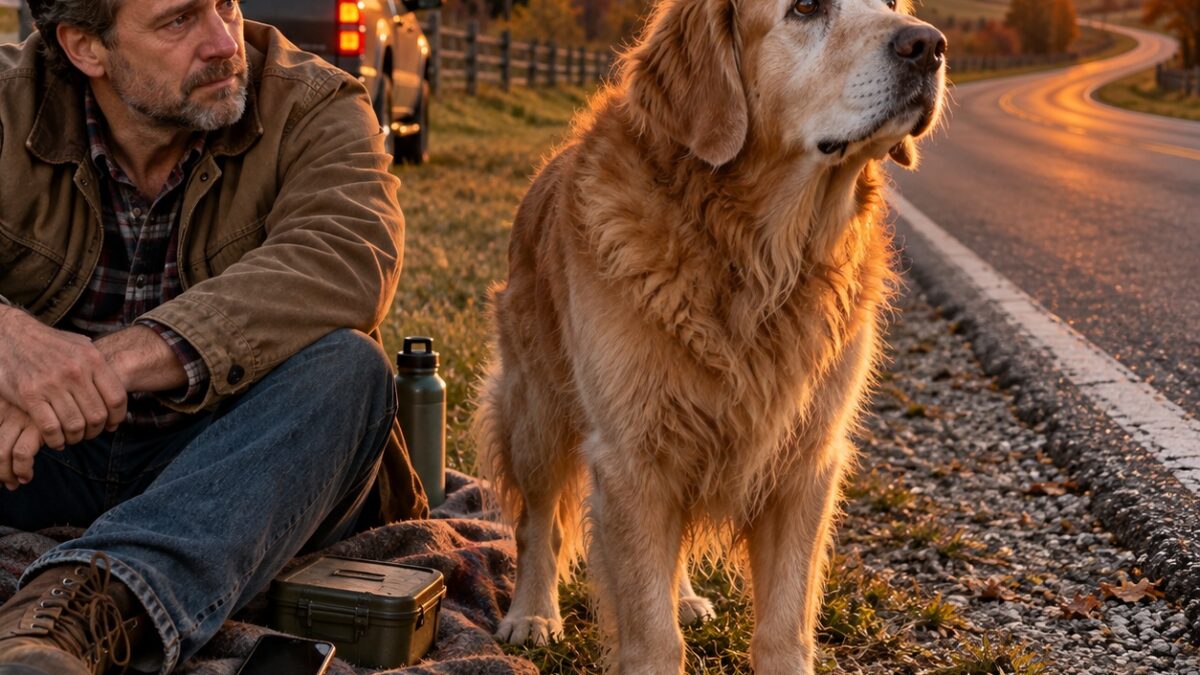
When autumn comes now and the light turns orange in that particular way it did on the afternoon we met, I sometimes remember the old Golden standing three feet away from me.
Blanket on the ground.
Cold arriving.
His body exhausted.
His eyes still checking the road.
Then the paw lifting.
The first step.
Second.
Third.
The weight of his head against my shoulder.
That was the moment my life changed.
Not because Ogi finally trusted me.
He barely did.
Because I understood I had become responsible for what happened next.
He had already been taught one devastating lesson about people.
I had no control over that.
But I could participate in the lesson after.
Stay.
Return.
Wait.
Let him choose.
Again.
Again.
Again.
Until one day he stopped looking at doors altogether.
That is what I remember when someone asks why an abandoned dog might be afraid to enter a car, sleep deeply, eat while someone stands nearby, or remain alone for five minutes.
They aren’t being difficult.
Sometimes they’re living inside evidence we cannot see.
The answer is not demanding that they forget.
The answer is providing better evidence long enough.
Ogi eventually had more good evidence than bad.
My truck returning.
My footsteps.
The workshop.
The bed.
The field.
The stick.
The hand over the mattress.
The sound of my keys followed by the sound of the same keys coming home.
Those things became his world.
That was his real rescue.
Not a stranger stopping on a roadside.
A thousand ordinary returns afterward.
So if you had met Ogi near the end, you would not have seen “an abandoned dog.”
You would have seen an old Golden Retriever lying where he pleased, carrying too much gray around his muzzle, expecting dinner on time, stealing workshop space, and leaning his entire weight into the person beside him because he had finally learned something worth believing.
Somebody was staying.
And for the rest of his life, he never had to stand beside an empty road waiting for proof again.








