FULL STORY:The Old German Shepherd Stopped Eating After His Best Friend Died—So I Came Back Every Morning and Sat Beside Him
FULL STORY CONTINUATION
The veterinarian’s name was Dr. Patel.
She stood beside me with her arms folded while Max lay in the corner.
“He drinks a little.”
“How little?”
“Enough that we’re monitoring.”
“Urine?”
“Reduced.”
“Weight?”
“Down.”
“How much?”
She told me.
Too much.
I looked through the kennel gate.
Max’s hip bones seemed sharper than they had the first day.
“How old?”
“About twelve.”
“For a shepherd…”
“I know.”
Arthritis already affected his back legs.
His eyes showed early cataracts.
His hearing was probably reduced.
None of those things explained why he would not eat.
“We can give fluids.”
Dr. Patel continued.
“We may have to.”
“But?”
She looked at me.
“You’re the doctor.”
“Wrong species.”
“You still know the difference between treatment and living.”
That irritated me because she was right.
An IV could correct dehydration.
Calories could be delivered.
Pain could be treated.
None of those things explained to Max why the person he had spent eleven years waiting for was never coming through the door.
I sat down.
Same folding chair.
Same spot.
Max did not move.
I talked anyway.
At first, I told him facts.
Dogs deserve honesty.
“My wife thinks this is strange.”
No reaction.
“She says I barely talk this much at dinner.”
Still nothing.
“She’s probably right.”
I described my hospital.
The emergency department.
A resident who had nearly fainted during his first central line placement.
A nurse named Gloria who frightened every new intern but secretly carried candy for frightened children.
I told him about the thirty-seven-year-old father we had treated the night before after a car crash.
“He’s going to make it.”
Nothing.
“He has two kids.”
Max’s ear did not move.
I stayed almost an hour.
The next day was the fourth.
Still nothing.
The shelter staff had stopped asking why I came.
They simply nodded when I walked in carrying the chair.
Someone began leaving coffee near the desk for me.
I sat.
Talked.
Max faced the wall.
That morning, I told him about a patient I had lost.
Not recently.
Years earlier.
Seventeen-year-old boy.
Cardiac arrest during basketball practice.
Healthy one second.
Gone the next.
We worked for nearly an hour.
Everything.
Nothing.
His mother asked me afterward:
“Was he scared?”
I had not known.
I still didn’t.
That question had stayed with me for thirteen years.
“I told her no.”
My voice lowered.
“I hope I was right.”
Max breathed.
Slow.
Regular.
“You know what medicine teaches you?”
I asked.
“No?”
“Neither do I anymore.”
His body remained still.
“It teaches you there are things you can fix.”
“And things you can’t.”
I looked at him.
“The hard part is knowing which one you’re looking at.”
I left for the hospital.
That afternoon, Dr. Patel called.
“He still hasn’t eaten.”
I closed my eyes.
“Fluids?”
“Tonight if necessary.”
“Do it.”
“We will.”
Then she said:
“Daniel.”
“What?”
“He may not want to.”
That angered me.
“He’s a dog.”
“Yes.”
“He doesn’t make end-of-life decisions.”
“No.”
“But animals can stop engaging.”
“Then make him engage.”
There was silence.
Dr. Patel said:
“That’s what you’re doing.”
I looked through the glass wall of my office.
Patients.
Nurses.
Residents.
Everything moving.
“I don’t think it’s working.”
“Come tomorrow.”
“I am.”
“I know.”
The fifth morning was colder.
My chair felt ridiculous under me.
I was exhausted.
I had worked until nearly midnight.
Sarah had asked me the night before:
“What exactly are you trying to save?”
I had said:
“A dog.”
She shook her head.
“That isn’t what I asked.”
I didn’t answer.
Maybe because I didn’t know.
At six-fifteen, I sat outside Max’s kennel and told him about a young patient from the previous evening.
Seven years old.
Pneumonia.
Respiratory distress.
Frightened parents.
The little boy had held onto my sleeve so tightly that I carried him from triage to treatment because he refused to let go.
“For an hour,” I told Max, “I had a dinosaur sticker attached to my chest.”
Nothing.
“The boy insisted.”
Still nothing.
“He’s better.”
I smiled.
“Probably going home tomorrow.”
That was when Max’s left ear moved.
Tiny.
Barely noticeable.
I stopped speaking.
Maybe imagination.
I waited.
Nothing.
Then I said:
“His mother cried.”
The ear angled toward me.
My heart started pounding.
Ridiculous.
I had watched patients regain spontaneous circulation without feeling what I felt from one old dog moving one ear.
“Max?”
The ear remained turned.
I lowered my voice.
“You hear me?”
He did not lift his head.
But he was listening.
I talked for another forty minutes.
Anything.
Everything.
When I stood to leave, I said:
“Good job.”
That ear followed my voice.
I called Sarah from the parking lot.
“He moved his ear.”
There was a pause.
“Good morning to you too.”
“Sarah.”
“I’m listening.”
“He heard me.”
“I’m glad.”
“No, you don’t understand.”
She laughed softly.
“I think I do.”
The sixth day, Max looked at me.
That was worse.
And better.
I had just unfolded my chair when he moved his head.
Slowly.
Arthritis making even that seem difficult.
His eyes met mine.
Dark brown beneath the cloudiness of age.
I stopped.
No doctor’s training prepares you for being examined by a grieving dog.
There was no accusation in his face.
That would have been easier.
There was something like exhaustion.
Maybe a question.
Why are you still here?
I sat down.
“Morning.”
He continued looking.
“I told you I’d come back.”
His eyes stayed on me.
“I’m not Arthur.”
I needed to say that.
“I know I’m not.”
Max blinked.
“He loved you, didn’t he?”
No movement.
“I hope he knew you loved him.”
Something in my throat tightened.
“Dogs are better at making that obvious than people.”
I thought of Sarah.
How often had I come home after fourteen hours and answered every question with:
Fine.
Long day.
Tired.
How many times had she asked:
“Are you okay?”
And I had given her a medical update instead of an emotional answer.
Max watched me.
“You’re probably wondering why I keep coming.”
I leaned forward.
“I think I am too.”
That morning, he turned his body slightly toward the kennel door.
Nothing more.
But the wall was no longer the entire world.
Dr. Patel saw it.
“So.”
She said.
“So what?”
“You’re reaching him.”
“No.”
“You are.”
“He looked at me.”
“For five days he barely acknowledged anybody existed.”
I looked at Max.
“Maybe he’s annoyed.”
“That counts as engagement.”
I laughed.
She handed me something.
A key card.
“What’s this?”
“Tomorrow.”
“For?”
“If you want to sit inside.”
I stared at her.
“You trust me?”
“You’re medically overqualified to sit on a kennel floor.”
“Comforting.”
“Don’t make sudden movements.”
“I know.”
“Let him choose.”
That sentence mattered.
Let him choose.
The seventh morning, I did not bring the chair.
I opened the kennel door.
Slowly.
Max watched me.
I stepped inside.
Closed it behind me.
Then sat on the floor.
Cold concrete immediately went through my pants.
Max was maybe four feet away.
I did not move closer.
“Okay.”
He watched.
“It’s me.”
One ear moved.
“I know.”
I rested my hands in my lap.
“You don’t have to do anything.”
That was important.
Every previous morning, some part of me wanted progress.
Eat.
Move.
Look.
Live.
That morning I tried something different.
“No promises.”
I looked at him.
“You can stay there.”
Max breathed.
“I’ll stay here.”
For several minutes, I said nothing.
That silence felt harder than all the talking.
Doctors fill silence.
We explain.
Reassure.
Ask questions.
Give plans.
Silence leaves you without authority.
Eventually, I began talking again.
“I should tell you about Sarah.”
Max looked at me.
“My wife.”
I smiled.
“She is much nicer than I am.”
His head stayed up.
“She says our house is too quiet.”
I had not intended to say that.
It came out.
“We never had children.”
There are sentences couples learn to deliver without explanation.
That was ours.
Years of trying.
Testing.
One pregnancy.
One loss.
Then another.
Eventually, medicine turned our grief into charts, hormone levels, procedures, and statistics.
We stopped.
Not because it stopped hurting.
Because we could not keep making hope clinical.
Afterward, Sarah and I built a life around the absence.
Work.
Travel when possible.
A nice house.
A spare bedroom we called an office.
Neither of us ever said what it had originally been meant to become.
“Our house is quiet.”
I told Max.
“So maybe…”
I stopped.
Too soon.
Too much.
“I don’t know.”
He continued watching.
“I don’t know if you’d like us.”
Then I said:
“But there’s a fireplace.”
One ear tilted.
“A good one.”
Nothing.
“Sarah cooks chicken.”
That earned a small movement of his nose.
I smiled.
“Traitor.”
I let the silence settle again.
Then Max shifted.
His front paws moved.
He tried standing.
His back legs struggled.
I almost got up.
Stopped myself.
Let him choose.
He pushed.
Stood.
For several seconds, he remained there.
Old.
Thin.
Unsteady.
Then one step.
I stopped breathing.
Another.
His nails clicked against the concrete.
Slow.
He paused.
Looked at me.
“Come on.”
I whispered.
“I’m not going anywhere.”
Another step.
Another.
By the time he reached me, tears had already blurred my vision.
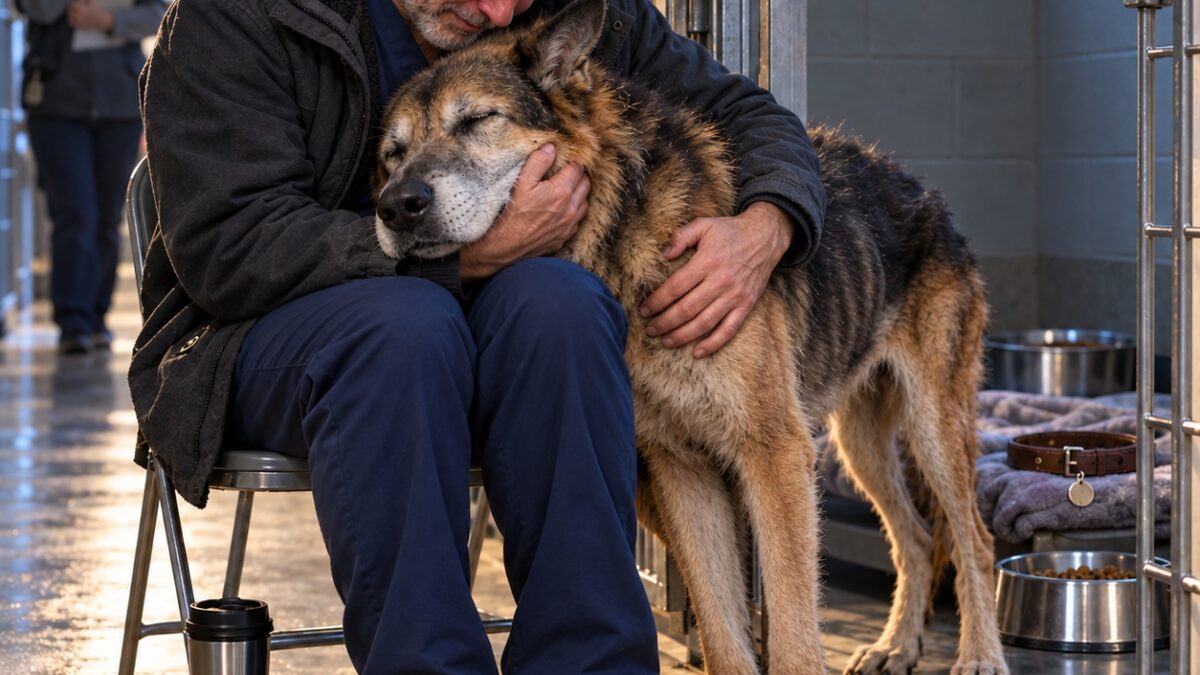
Max stood between my knees.
His head lowered.
Then he rested his muzzle on my lap.
No fanfare.
No tail wag.
Just weight.
Warmth.
And one enormous sigh.
It sounded like surrender.
Not the kind beneath a bridge or in a battlefield.
The good kind.
The kind that says:
For one minute, I will let someone else carry this.
I placed one hand on the side of his neck.
Max closed his eyes.
I cried.
Quietly.
I had not cried at the shelter before.
Had not cried at work in twenty years.
Barely cried after my own father died.
Yet an old German Shepherd rested his face on my knees, and every carefully reinforced wall inside me cracked at once.
“I know.”
I whispered.
Though I didn’t.
Not really.
“I know.”
We stayed that way twenty minutes.
Maybe thirty.
My legs went numb.
I didn’t move.
When I finally had to leave for work, I touched his ear.
“I’ll come back.”
His eyes opened.
I stood.
At the door, I looked back.
Max had not returned to the corner.
He stayed where I had been sitting.
That nearly made me late.
In the parking lot, I called Sarah.
“He came to me.”
She did not make a joke this time.
“What happened?”
I told her.
All of it.
When I finished, she was quiet.
Then:
“Daniel.”
“Yes?”
“Bring me tomorrow.”
Saturday.
My day off.
Sarah wore an old coat and carried chicken in a container.
Of course she did.
“You bribing him?”
“I’m introducing myself intelligently.”
Max was lying near the front of his kennel when we arrived.
Progress.
Sarah crouched outside.
“Hi, Max.”
His head rose.
She did not reach through.
Did not call him repeatedly.
Simply sat.
I loved her more in that moment than I knew how to explain.
After ten minutes, we went inside.
I sat against one wall.
Sarah several feet away.
She held out her hand.
Palm open.
Low.
Max watched.
No chicken yet.
Good.
Then he stood.
Slow.
Walked toward her.
Sniffed.
Sarah did not move.
Max’s tongue touched her fingers once.
Sarah inhaled sharply.
Then smiled.
“Hello.”
Max smelled the pocket with the chicken.
She laughed.
“So much for emotional connection.”
I said:
“I warned you.”
She gave him a small piece.
Then another.
By the end of the visit, Max lay between us.
His body touching my leg.
His head near Sarah’s shoe.
On the drive home, Sarah stared through the windshield for several minutes.
Then:
“We’re adopting him.”
I almost drove through a red light.
“What?”
“You heard me.”
“Sarah.”
“No.”
“Do you know what this involves?”
“Yes.”
“Twelve-year-old German Shepherd.”
“Yes.”
“Arthritis.”
“Yes.”
“Possible kidney issues later.”
“Yes.”
“Medication.”
“Yes.”
“He might have two years.”
“I know.”
“Maybe one.”
“I know.”
“Maybe months.”
Her voice broke.
“I know.”
We stopped at the red light.
Sarah turned toward me.
“Daniel, do you think that means he deserves those months alone?”
That ended the argument.
Adoption took longer than I wanted.
Medical review.
Home assessment.
Paperwork.
Shelter policy.
Max’s condition had to stabilize.
I visited every morning.
Sarah came whenever she could.
Max started eating.
Not much at first.
A few bites if I sat nearby.
Then half a bowl.
Then full meals.
The first time he finished everything, a shelter employee applauded.
Max looked offended.
His weight stopped falling.
Then rose slightly.
His coat improved.
His eyes changed.
Not young.
Never young.
But present.
Arthur still existed inside him.
That never disappeared.
Sometimes the front door of the shelter opened and Max’s head snapped up.
Footsteps came down the hallway.
He watched.
If the person passed, his ears lowered slightly.
That hurt every time.
I realized he still expected Arthur.
Some part of him.
How do you explain death to a dog?
You cannot.
You only repeat absence until expectation changes.
That may be the cruelest form of understanding.
One morning, I brought an old item the shelter had saved from Arthur’s apartment.
A worn blue blanket.
Max smelled it.
Froze.
Then shoved his entire face into the fabric.
The sound he made was something I still cannot describe.
Not howl.
Not whine.
A low trembling noise deep in his chest.
I sat beside him.
Max lay on the blanket.
Pressed his nose into it.
For nearly an hour, he barely moved.
I cried again.
There are griefs we cannot cure because curing them would mean erasing love.
Arthur was not a disease.
Max should miss him.
That was the price of having belonged to someone for eleven years.
I stopped wishing the grief away.
Instead I began wishing it company.
That is different.
The adoption finalized almost a month after I first sat outside the kennel.
Sarah bought everything.
Too much.
Bed.
Bowls.
Ramp for the car.
Orthopedic cushion.
Harness.
Toys Max ignored.
More toys he also ignored.
I bought a leash.
Apparently my contribution was transportation logistics.
The shelter staff gathered near the lobby when Max walked out.
He moved slowly.
Arthritic.
But walking.
At the front door, he stopped.
Turned.
Looked down the kennel corridor.
For a second, I wondered if he was frightened.
Then he stepped outside.
Cold air.
Sunlight.
Sarah opened the back of our SUV.
Ramp down.
Max climbed.
Halfway up, he looked at me.
“Home.”
I said.
The word caught in my throat.
“Let’s go home.”
He lay in the back during the drive.
Sarah turned around every two minutes.
“He’s fine.”
She whispered.
“I know.”
“You’re looking too.”
“I’m driving.”
“You checked the mirror eight times.”
“Medical observation.”
“Of course.”
When we reached the house, Max stood at the threshold.
He sniffed.
Front hall.
Rug.
Wood floor.
Sarah.
Me.
Then stepped inside.
He inspected everything.
Methodically.
Living room.
Kitchen.
Dining room.
Spare bedroom.
Our bedroom doorway.
Back door.
As if mapping this strange new universe.
Sarah had placed an orthopedic cushion beside the fireplace.
Max discovered it.
Circled once.
Lay down.
We watched.
“He likes it.”
Sarah whispered.
“Don’t stare.”
“You’re staring.”
“We both need hobbies.”
That evening, we ate dinner near him.
Max received his medication inside chicken.
He discovered this immediately and began inspecting every future piece of chicken for betrayal.
At ten, we went to bed.
I expected him to stay near the fireplace.
At three-seventeen in the morning, I woke.
Something stood beside me.
Old habit from the hospital made me come awake completely.
Max.
Silhouette beside the bed.
Watching.
“Hey.”
His tail moved once.
“What are you doing?”
He did not move.
I reached down.
Touched his head.
“Go sleep.”
Still there.
I put a pillow on the floor beside me.
“Fine.”
Max lowered himself.
His body landed with the groan of an old man sitting in a difficult chair.
Within minutes, asleep.
I listened.
Breathing.
Slow.
Steady.
For years, Sarah had said our bedroom was too quiet.
That night it contained an old dog snoring softly on the floor.
I smiled in the darkness.
The next morning, Max followed me to the kitchen.
Slowly.
He stood while I made coffee.
Then followed me to the bathroom.
Then back to the kitchen.
“Personal boundaries.”
No interest.
Sarah appeared.
“He’s afraid you’ll leave.”
That stopped me.
I looked down.
Max stood touching my leg.
“I’m going to work.”
His ears lowered.
I crouched.
“I come back.”
How many times had Arthur said that?
Probably thousands.
Then one day he didn’t.
The thought hurt.
“I come back.”
I repeated.
Sarah watched.
“I promise.”
I left.
My shift lasted ten hours.
Longest ten hours I had worked in years.
I checked my phone constantly.
Sarah sent photographs.
Max sleeping.
Max drinking.
Max at the back door.
Max sleeping again.
At 6:42, I pulled into the driveway.
Before I opened the door, I heard barking.
One bark.
Deep.
Old.
I stepped inside.
Max stood in the hallway.
Tail moving.
Not fast.
But moving.
He came toward me.
I knelt.
He pressed his head against my chest.
“I told you.”
I whispered.
“I came back.”
After that, returning became our ritual.
Every workday.
I left.
Max watched.
I came home.
He met me.
One day became two.
Two became weeks.
Expectation changed.
Maybe dogs understand reliability through accumulation.
He stopped following me to the door every morning eventually.
That almost hurt my feelings.
He learned:
Daniel leaves.
Daniel returns.
Simple.
Sacred.
Max settled into home slowly.
He loved the fireplace.
Hated vacuum cleaners.
Tolerated the mail carrier.
Loved Sarah more openly than me because she controlled chicken distribution.
On bad arthritis mornings, I helped him stand.
On better days, we walked one slow block.
Then two.
Neighbors knew him.
Children asked to pet him.
I always let Max decide.
Sometimes yes.
Sometimes he leaned behind my leg.
That was enough.
Sarah talked to him constantly.
Probably more than she talked to me.
“You’re getting chunky.”
Max looked delighted.
“Don’t listen.”
I said.
“You’re recovering.”
Sarah rolled her eyes.
We laughed more.
That surprised me.
Our house had not been unhappy before Max.
Just quiet.
Too orderly.
There is an emotional sterility that can enter a home after certain griefs.
Nothing visibly wrong.
Everything carefully maintained.
No chaos.
No risk.
Max brought hair.
Mud.
Medication bottles.
A giant bed blocking part of the fireplace.
He brought need.
And need can create intimacy when you stop treating it like inconvenience.
Then came the hospital.
I never planned it.
Several weeks after adoption, I had left an important case file in my office.
A specialist needed it urgently.
I was already halfway through a rare Sunday afternoon at home when the call came.
Sarah had gone grocery shopping.
Max was with me.
Leaving him alone for a short period would have been fine.
I knew that.
Still, something about the old fear in his eyes when I picked up my keys stopped me.
“Fine.”
I clipped on his leash.
“You’re coming.”
The emergency department was quieter than weekdays but never quiet.
I entered through the main lobby.
Max walked beside me.
Slow.
Calm.
People noticed.
Old German Shepherd.
Gray face.
Gentle eyes.
Near the pediatric wing, an eight-year-old girl sat in a wheelchair.
Her mother beside her.
I knew them.
Emily Foster.
Weeks in and out of hospital.
Complicated orthopedic recovery after a serious accident.
Pain.
Fear.
Procedures.
Emily had stopped smiling at staff long before that day.
Not because she was unpleasant.
Because children eventually run out of performative courage.
She saw Max.
Her entire face changed.
“Dog.”
Her mother looked.
Then at me.
“Dr. Mercer?”
“Sorry.”
I immediately thought I had violated some rule.
“I just needed a file.”
Emily leaned forward.
“Can I touch him?”
I looked at Max.
He had stopped.
Staring at her.
I said:
“Only if he wants to.”
I moved closer.
Max approached slowly.
No pulling.
No excitement.
He reached Emily.
Sniffed the blanket covering her legs.
Then rested his head across her knees.
Emily went completely still.
Her mother covered her mouth.
One hand came down.
Touched Max’s ear.
He stayed.
Emily smiled.
Small.
Then larger.
Her mother began crying.
Not loudly.
I knew that cry.
Relief finding a crack.
“He hasn’t seen her smile like that in weeks.”
I looked at Max.
The dog who had stopped eating because one person disappeared was now giving a frightened child something no medication had reached.
Emily whispered:
“He’s old.”
“Very.”
“Does he hurt?”
“Sometimes.”
“So do I.”
My throat tightened.
She stroked his head.
“How does he do it?”
“Do what?”
“Not be sad.”
I looked at Max.
He was not “not sad.”
That was the answer.
“He is sad sometimes.”
Emily looked at me.
“Really?”
“Yes.”
“He lost someone he loved.”
Her hand stopped.
“Who?”
“A man named Arthur.”
“What happened?”
“He died.”
Emily looked down at Max.
“I’m sorry.”
Max’s tail moved against the floor.
Emily whispered:
“Me too.”
That moment changed everything.
Word traveled.
Doctors talk.
Nurses talk faster.
By Monday, three people had asked whether Max could visit again.
I laughed.
“He is not a therapy dog.”
A pediatric nurse said:
“Neither are half our administrators, and we still let them in.”
Fair.
Hospital leadership became involved.
Then infection control.
Risk management.
Veterinary records.
Temperament assessment.
Rules.
Training.
Max completed whatever was necessary with the indifference of a dog who had survived enough bureaucracy already.
Eventually, he received permission for controlled visits.
Two times a week.
Unofficial at first.
Then increasingly official.
I thought he might hate it.
He loved it.
Or seemed to.
Max became different in the hospital.
At home, he was old.
Slow.
Occasionally stubborn.
At the hospital, he seemed to understand he had a job.
He walked carefully.
Stopped beside wheelchairs.
Sat near beds.
Allowed frightened children to touch his ears.
Rested his head on laps.
Never jumped.
Never demanded.
He simply stayed.
Maybe that was what grief had taught him.
Presence.
You cannot always fix.
But you can stay.
A child receiving chemotherapy once whispered into his fur for ten minutes.
Nobody heard the words.
Nobody asked.
A retired teacher recovering from a stroke practiced moving her fingers by brushing Max’s coat.
A nurse after a brutal overnight shift sat on the floor beside him and cried into his neck.
Max did not need to know why.
That was his gift.
Humans demand narratives.
What happened?
How bad?
What next?
Dogs accept:
You hurt.
I am here.
I began noticing the effect on myself.
For twenty-three years, I had approached medicine as action.
Diagnose.
Intervene.
Treat.
Correct.
Max introduced another category.
Accompany.
That was harder.
One evening, I had to tell a family their father would not recover.
There was nothing more we could do.
I gave the news.
Answered questions.
The family cried.
Normally, after those conversations, I left quickly.
Not rudely.
Professionally.
Give people privacy.
That was what I told myself.
Max was waiting in the hallway with a volunteer handler.
I saw him.
Thought of Arthur.
Thought of the kennel wall.
Then returned to the room.
Sat down.
Did nothing.
The family did not need more medical explanation.
They needed someone willing to remain in the silence created by the truth.
I stayed ten minutes.
Then fifteen.
Nobody asked me to.
When I got home, Sarah knew something was different.
“What happened?”
“I sat.”
She smiled.
“With someone?”
“Yes.”
“For no reason?”
“There was a reason.”
“You know what I mean.”
I sat beside her.
Max placed his head on my foot.
“I think the dog is ruining me.”
Sarah laughed.
“Finally.”
Months passed.
Max gained enough strength to surprise everyone.
Not youth.
You cannot reverse age with love.
But his coat thickened.
Muscle returned.
His appetite became borderline criminal.
Arthritis responded somewhat to medication and movement.
He could walk farther.
He still had bad mornings.
One winter day, he could barely stand.
I panicked.
Doctor mode.
Hands.
Assessment.
Sarah touched my arm.
“Daniel.”
“I know.”
“No, you don’t.”
“We need imaging.”
“Maybe.”
“He could have a spinal issue.”
“Maybe.”
“Or—”
“Daniel.”
I stopped.
Max watched me.
Sarah said:
“He is old.”
That sentence hurt more than any diagnosis.
“I know.”
“Do you?”
I sat on the floor.
Max rested against me.
We took him to Dr. Patel.
Nothing catastrophic.
Arthritis flare.
Medication adjustment.
Rest.
He improved.
But the scare changed me.
When we adopted Max, I had warned Sarah:
Maybe months.
Then I behaved as if love entitled us to years.
Humans are ridiculous.
We know mortality.
Then act betrayed every time it arrives.
I started counting less.
No:
How long?
Instead:
Today.
Did Max eat today?
Yes.
Walk?
Yes.
Comfort somebody?
Yes.
Sleep by the fire?
Yes.
Good day.
Arthur became part of our home too.
Not physically.
Through Max.
I eventually learned a few details.
The shelter had received Arthur’s remaining records.
He had been seventy-four.
Retired machinist.
Widower.
No children.
Max had been his constant companion.
Neighbor statements said Arthur walked him every morning at six.
Bought him hamburger on Fridays.
Talked to him from the porch.
Arthur had died suddenly at home.
A neighbor found him.
Max had been beside the body.
That detail shattered me.
He had not merely watched Arthur leave and fail to return.
He had been there.
Waiting beside him.
Perhaps nudging him.
Perhaps barking.
Perhaps lying down.
We could never know.
The shelter took Max away after emergency services arrived.
Imagine his final memory of home.
Strangers.
Noise.
Arthur unmoving.
Door closing.
Then kennel.
Of course he stared at the wall.
Of course he stopped eating.
His entire world had ended without explanation.
I told Sarah.
She cried.
Then said:
“Keep the blue blanket.”
Arthur’s blanket.
We did.
It stayed beside Max’s bed.
Sometimes he slept on it.
Sometimes not.
Never washed more than absolutely necessary.
The smell faded eventually.
Time does that even to memory.
One anniversary—one year after Arthur’s death—we took Max to the park.
No ceremony.
No idea if dogs understand dates.
But I did.
We brought hamburger.
Friday tradition, even though it wasn’t Friday.
Max ate like a king.
Sarah said:
“To Arthur.”
I said:
“To Arthur.”
Max focused on hamburger.
Correct response.
I thought of the man I had never met.
“Thank you.”
Sarah looked at me.
“For what?”
“Him.”
I scratched Max’s ear.
“Arthur made him who he is.”
Sarah smiled.
“Maybe Max made Arthur who he was too.”
That was probably true.
Relationships are rarely one-directional.
Max’s hospital work continued.
We formalized it.
Training.
Certification appropriate to the program.
He became an official part of patient-support visits.
People began knowing him before me.
I would enter pediatric rooms and children asked:
“Where’s Max?”
“Good morning to you too.”
Nurses kept treats hidden in desks.
Max knew exactly which nurses.
His ethical standards disappeared around cheese.
Emily—the eight-year-old girl from our first hospital encounter—became especially attached.
Her recovery was slow.
Months.
Surgeries.
Physical therapy.
Pain that made adults impatient and children furious.
Max visited whenever allowed.
On bad days, Emily cried into him.
On better days, she read books aloud.
Max slept.
She claimed he listened.
One afternoon, she took several assisted steps between parallel bars.
Max stood at the other end.
Her therapist said:
“Come on.”
Emily shook her head.
“It hurts.”
Max watched.
I was in the doorway.
The therapist looked at me.
I shrugged.
Then said:
“Max has arthritis.”
Emily looked at him.
“He still walks.”
“Yes.”
“That’s manipulative.”
She was eight and already understood medicine.
“Yes.”
She looked toward Max.
Took one step.
Stopped.
Another.
Pain.
Tears.
Another.
Max’s tail moved.
Emily reached him.
Collapsed into the wheelchair.
Max rested his head on her lap.
She laughed while crying.
“You cheated.”
I said:
“He’s a terrible doctor.”
She smiled.
Eventually Emily went home.
The day she left, she hugged Max for so long her mother had to remind her he needed oxygen too.
She gave him a drawing.
German Shepherd.
Giant red heart.
Underneath:
MAX HELPED ME WALK.
We framed it.
It hangs in our hallway now.
Sarah said:
“Arthur would be proud.”
I thought:
I hope so.
I also wondered whether Arthur would be jealous.
Probably not.
If he loved Max, he would want his dog’s life to continue after his own.
That realization helped me with something I had resisted.
Loving Max did not replace Arthur.
I had worried about that at first.
As though every affectionate touch stole loyalty from a dead man.
That is not how love works.
Max did not have a finite amount.
He could miss Arthur and love us.
Both.
Humans struggle with that too.
People who lose spouses sometimes feel guilty laughing with someone new.
Parents after loss fear joy is betrayal.
Grief tells us love must remain frozen to prove the past mattered.
Max disproved that.
He carried Arthur forward while still leaning into Sarah’s hand.
Memory and new attachment occupied the same body.
That may have been the most profound medicine he ever practiced.
The hospital changed for me.
Not structurally.
Inside my perception.
I began noticing things I had trained myself not to see.
The nurse who sat alone after losing a patient.
The janitor who knew every long-term child’s favorite cartoon.
The father sleeping upright for six nights beside his daughter’s bed.
The residents whose hands shook after their first death.
The social worker eating crackers at four in the afternoon because she had skipped lunch.
For twenty-three years, I had called emotional distance professionalism.
Sometimes it was.
Sometimes it was fear.
There is a difference.
Max helped me learn it.
If an old dog could continue caring after losing the center of his world, perhaps I could risk feeling my patients without letting their pain destroy me.
Empathy and drowning are not identical.
I had confused them.
One night, Sarah said:
“You’re different.”
We were sitting by the fire.
Max asleep across both our feet.
“Older?”
“Always.”
“More annoying?”
“Definitely.”
“What then?”
“You tell me things now.”
I looked at her.
“About work?”
“About you.”
That silenced me.
She continued.
“For years, you told me cases.”
“What happened.”
“What treatment.”
“What outcome.”
“You almost never told me what it did to you.”
I watched the fire.
“I didn’t want to bring it home.”
“You brought it home.”
She touched my arm.
“You just made me live beside it without a name.”
That hurt because it was true.
“I’m sorry.”
Sarah looked down at Max.
“Thank him.”
I did.
“Thanks.”
Max snored.
Ungrateful.
The second year with Max came faster than the first.
Age showed more.
He tired after hospital visits.
We reduced frequency.
Once a week.
Sometimes less.
Patients complained.
I told them union rules.
Max’s union was strict.
He needed naps.
The gray spread.
His eyes clouded more.
We added another rug because hardwood became slippery.
Then runners down the hallway.
Then a ramp at the porch.
Our house slowly redesigned itself around an aging dog.
I found that strangely beautiful.
Love becoming architecture.
One morning, Max did not get up when I reached for my hospital coat.
Usually he watched.
This time, nothing.
I knelt.
“Max.”
His eyes opened.
Tail moved.
But he stayed down.
I touched his abdomen.
Checked gums.
Heart.
Breathing.
Doctor habits.
Then noticed the untouched breakfast.
Fear moved through me.
We went to Dr. Patel.
Bloodwork.
Imaging.
Waiting.
I hate waiting as a doctor because I know too much.
Every delay contains possible diagnoses.
Dr. Patel eventually sat with us.
Kidney disease.
Progressed.
Manageable for a time.
Not curable.
I nodded like a physician.
Sarah cried like a human.
I envied her.
“What do we do?”
I asked.
“Support.”
Fluids.
Diet.
Medication.
Monitoring.
Comfort.
All familiar words.
Different species.
Same truth.
Time narrowed.
Could be months.
Maybe longer.
No one promised.
We adjusted.
Max kept going to the hospital when he felt well.
On bad days, he stayed home.
Emily visited once, older now.
Walking without the wheelchair.
She entered our living room.
Max lifted his head.
Tail moved.
She knelt.
“Hi, old man.”
Max licked her hand.
Emily cried.
“I walk now.”
She whispered.
“You helped.”
Max rested his head against her.
I stood in the doorway and turned away for a moment.
Not every patient comes back.
Doctors often never see the life after discharge.
Max got to.
Maybe that was his reward.
The third year after adoption, he stopped hospital visits entirely.
Too tiring.
Staff held a small retirement gathering.
I protested.
Max did not understand retirement.
He understood treats.
They gave him too many.
Nurses cried.
Doctors pretended not to.
Emily sent another drawing.
This time Max wore a superhero cape.
I disliked it.
Not because it wasn’t beautiful.
Because Max had taught me heroes were often simply creatures who stayed.
No cape.
No miracle.
Presence.
We hung it beside the first.
Retirement suited him.
Fireplace.
Yard.
Slow walks.
Sarah.
Me.
Blue blanket.
A dog’s world becomes smaller with age, but smaller does not have to mean lesser.
One warm afternoon, we sat outside.
Max asleep between our chairs.
Sarah said:
“Do you think he still dreams about Arthur?”
“Yes.”
“You don’t know.”
“No.”
“I just hope.”
“Why?”
“Because I hope love stays somewhere.”
She looked at me.
“It does.”
Simple answer.
Maybe the right one.
The final decline was gradual.
Then sudden.
That is how it often happens.
Weeks of manageable change.
Then one morning the body crosses some invisible line.
Max could not rise.
I helped.
He tried.
Back legs failed.
He looked embarrassed.
Dogs can look embarrassed.
I hate that.
“It’s okay.”
I supported his hips with the sling we kept nearby.
He stood.
Walked three steps.
Stopped.
Breathing hard.
Sarah covered her mouth.
I knew.
Every medical part of me knew.
We took him to Dr. Patel.
She examined him.
Bloodwork worse.
Kidneys failing.
Pain.
Weakness.
Dehydration despite support.
Options existed.
Hospitalization.
Aggressive fluids.
Maybe a little more time.
I asked the question physicians ask when medicine threatens to become something it should not.
“What are we treating for?”
Dr. Patel looked at me.
“Time.”
“What kind?”
She did not answer immediately.
“Probably not good time.”
Sarah started crying.
I looked at Max.
He lay on the blanket.
Arthur’s blue blanket.
We had brought it with us.
He watched me.
His tail tapped once.
I had spent my career resisting death.
Sometimes correctly.
Sometimes because fighting felt easier than accepting.
I thought of the seventeen-year-old basketball player.
The families.
The machines.
The days when intervention saves.
And days when intervention only delays goodbye.
Max had taught me the difference between staying and refusing to release.
I sat on the floor.
His head came onto my lap.
Same place as the seventh morning.
The beginning and the end meeting.
I put my hand on his neck.
“You did enough.”
Sarah knelt beside us.
Max licked her fingers once.
Just like the first day he met her.
She broke completely.
“Oh, Max.”
He breathed.
Slow.
I whispered:
“Arthur’s waiting somewhere.”
I do not know what I believe about dogs after death.
That day, I needed to believe something.
“Maybe he’s got hamburger.”
Sarah laughed through tears.
“Friday hamburger.”
“Unlimited.”
Max’s eyes remained on me.
I leaned close.
“You don’t have to wait by the door anymore.”
My voice failed.
“I’m here.”
Sarah touched his back.
“We’re both here.”
Dr. Patel gave him medication to relax.
Max sighed.
That old familiar sigh.
He became heavier against my legs.
Peaceful.
I kept talking.
Not because he needed every word.
Because for three years, talking had been how I stayed with him.
“You saved Emily.”
“Probably Gloria too.”
“She gave you illegal cheese.”
Sarah laughed.
“You ruined the couch.”
“You stole chicken.”
“You made the house filthy.”
My face collapsed.
“You made it a home.”
Max’s breathing slowed.
I rested my forehead against his.
“Tell Arthur we tried.”
Then I corrected myself.
“No.”
My tears fell into his fur.
“Tell him you were loved.”
When the final medication was given, Max did not fight.
No fear.
His head on my knees.
Sarah’s hand on his side.
Blue blanket beneath him.
He exhaled.
And did not inhale again.
For a long time, nobody moved.
I had pronounced hundreds of deaths.
Checked pulses.
Watched monitors flatten.
Recorded times.
Never once had silence felt like that.
Dr. Patel eventually touched my shoulder.
“He’s gone.”
I wanted to say:
I know.
I couldn’t.
Instead I sat with him.
Exactly as I had on the first week.
That felt important.
I had promised him on the seventh day:
You will not be alone.
I kept it.
Sarah and I drove home with the blue blanket folded on the back seat.
No dog.
The house was unbearable.
His bowl.
Bed.
Medication organizer.
Rugs we no longer technically needed.
Hair underneath furniture.
I sat beside the fireplace.
Same spot his cushion had occupied.
Sarah sat next to me.
Neither of us spoke.
Eventually she said:
“It’s too quiet.”
Years earlier, that sentence had described our life before Max.
Now it meant something else.
I reached for her hand.
“I know.”
For the first time, I understood Max’s first days at the shelter completely.
A door had closed.
A presence had vanished.
Everything familiar remained except the one thing that made it meaningful.
I thought of him facing the wall.
Not eating.
And I understood the temptation.
Withdraw.
Stop engaging.
Protect love by refusing another future.
Then I heard, in memory, my own voice.
I’ll come back tomorrow.
Again.
Again.
Again.
I realized Max had left me the prescription.
Not moving on.
I hate that phrase.
Moving with.
Carrying.
Continuing.
The hospital asked if we wanted a memorial.
I refused.
Then changed my mind.
Not for Max.
For the people he had touched.
Staff gathered near the pediatric wing.
Emily came.
Now eleven.
Walking.
She brought a framed photograph.
Max’s head on her knees in the wheelchair.
The first day.
Her mother stood beside her.
Emily said:
“He was sad when you found him?”
“Yes.”
“And he still helped people?”
“Yes.”
She looked at the photograph.
“Maybe helping us made him less sad.”
My throat tightened.
“Maybe.”
Then she looked at me.
“Did helping him make you less sad?”
Children are cruelly perceptive.
“Yes.”
“What were you sad about?”
I looked at Sarah.
Twenty-three years of walls.
Losses never named.
Children we never had.
Patients I remembered at two in the morning.
A house kept quiet because quiet felt safer.
“I think I was lonely.”
Emily nodded as if this were obvious.
“Then he helped.”
“Yes.”
“He was a good doctor.”
The room laughed.
I cried.
We placed Max’s photograph in a small corner near the pediatric family room.
No superhero language.
No grand plaque.
Just:
MAX
He stayed.
That was enough.
Months passed.
I still went to work.
Still practiced medicine.
But differently.
I sat more.
Listened longer.
Residents noticed.
One asked:
“Did something happen?”
“Yes.”
“What?”
“I met a dog.”
He thought I was joking.
I wasn’t.
Sarah and I started volunteering at the shelter once a month.
The first visit was terrible.
Same corridor.
Same kennel.
Different dogs.
I stopped outside Max’s old space.
Empty that day.
My chest tightened.
Sarah took my hand.
“We can leave.”
I looked down the hallway.
An old beagle watched from another kennel.
Gray face.
No one waiting.
“No.”
I whispered.
“We stay.”
We did not adopt him.
Not then.
That mattered.
Grief does not require immediate replacement.
We sat.
Walked dogs.
Washed bowls.
Helped.
The next month, we came again.
Then again.
Eventually the folding chair returned.
Not for one dog.
For whoever needed someone nearby.
Sometimes I sat outside a frightened kennel and talked.
Residents from the hospital occasionally volunteered too.
Gloria came once.
Brought cheese.
Of course.
Years later, I still think about Arthur.
A man I never met.
I owe him more than he will ever know.
He loved Max for eleven years.
That love created the dog who taught me how to stay.
Arthur probably never imagined that after his death, Max would comfort hospitalized children.
Or exhausted nurses.
Or a physician who had spent two decades pretending compassion could be rationed without cost.
Maybe legacies are like that.
We do not control where love travels after us.
Arthur loved a dog.
The dog survived him.
I sat beside the dog.
The dog entered my home.
Then a hospital.
Then hundreds of lives.
Arthur’s love kept moving.
That thought comforts me.
So does something else.
For years I worried that when Max came to us, part of him remained waiting for Arthur.
I think that was true.
I no longer see it as sad.
Waiting meant Arthur mattered.
Loving us meant life still mattered too.
Both could exist.
That is the lesson I carry most.
Grief and love are not opponents.
New joy does not defeat old love.
It grows beside it.
Max never stopped being Arthur’s dog.
He became ours too.
I never stopped being the doctor shaped by all the patients I lost.
I became someone capable of letting Sarah see the effect.
A person can hold more than one truth without betraying either.
My career lasted many years after Max.
Eventually, I retired.
At my retirement dinner, hospital administration presented photographs.
Residents.
Patients.
Old staff.
Then one image appeared.
Max beside Emily’s wheelchair.
The room went quiet.
I looked at Sarah.
She was already crying.
A former nurse stood and said:
“He changed this place.”
I shook my head.
“No.”
I stood.
“He changed me.”
I looked at the photograph.
“I spent most of my career thinking medicine was what we did to prevent death.”
“Sometimes it is.”
“Sometimes it’s what we do to reduce pain.”
“Sometimes it’s what we do to repair.”
I paused.
“But there are moments when none of those are available.”
“The person is still afraid.”
“Still grieving.”
“Still alone.”
“And in those moments, presence is not nothing.”
I thought of cold shelter concrete.
A folding chair.
An ear turning toward my voice.
“Presence is treatment too.”
That was the last lesson I gave as a physician.
Max taught it first.
After retirement, Sarah and I moved to a smaller house.
We kept the blue blanket.
Still have it.
Folded in a cedar chest.
Sometimes I take it out.
Most of Arthur’s scent disappeared long before Max died.
Max’s disappeared too.
That is how time works.
It removes physical evidence first.
Then sharpness.
But not meaning.
Emily, now grown, became a physical therapist.
She told me years later that Max influenced her.
“I wanted patients to feel like somebody stayed.”
She said.
Another piece of Arthur’s love traveling.
I smiled.
Told her Max would demand licensing fees.
She said she’d pay in cheese.
Fair.
People ask whether Sarah and I ever adopted another dog.
We did.
Eventually.
A senior mixed-breed female named Rosie.
Nine years old.
Overweight.
Snored worse than Max.
We found her at the same shelter.
Sarah saw her first.
Rosie was sleeping upside down with one leg against the wall.
Sarah said:
“That one.”
I laughed.
“Very scientific.”
“She looks ridiculous.”
We adopted her.
Did I feel guilty?
A little.
For perhaps one day.
Then I remembered Max.
Love does not require an empty chair forever.
Rosie never replaced him.
Impossible.
She brought her own chaos.
Different dog.
Different story.
That was the point.
One evening, Rosie lay near the fireplace in the spot Max once loved.
I looked at her.
Felt the old guilt flicker.
Then imagined Max’s face if I told him another dog had occupied “his” cushion.
He would have cared only whether Rosie had left any chicken.
I laughed.
Sarah asked why.
“Nothing.”
But it was not nothing.
It was permission.
Max had taught us how to open a home.
Closing it after him would have misunderstood everything.
There are still mornings when I wake before sunrise for no reason.
Physician schedule permanently wired into me.
Sometimes I make coffee and sit quietly.
That is when I think of the shelter.
Day one.
Max facing the wall.
Day two.
Same.
Day three.
Same.
Day four.
Food untouched.
Day five.
Ear turned.
Day six.
Eyes.
Day seven.
Steps.
Muzzle on knees.
If I had stopped on day four, what would have happened?
I do not know.
Maybe someone else reached him.
Maybe fluids sustained him long enough.
Maybe not.
I try not to make myself central.
Max chose life too.
But persistence mattered.
That frightens me in a useful way.
How many people give up one visit too soon?
One phone call?
One attempt?
We cannot save everyone through persistence.
That would be a cruel lesson.
Some illnesses win.
Some grief requires professionals.
Some animals cannot safely be adopted.
Some people need boundaries, not endless pursuit.
But Max taught me that quiet presence can matter before visible results appear.
Four days, nothing.
That does not mean nothing was happening.
Maybe he was listening before the ear moved.
Maybe my voice was becoming familiar.
Maybe his nervous system was learning:
This person returns.
The visible breakthrough came later.
Healing often begins before we can measure it.
Doctors should know that.
I had forgotten.
We love metrics.
Blood pressure.
Heart rate.
Lab values.
Scan results.
Numbers give us something to hold.
But many recoveries first appear as things no machine records.
A child laughs.
A patient asks about tomorrow.
A grieving dog turns one ear toward your voice.
That is data too.
Human data.
Living data.
Max restored my respect for it.
If I had to tell his story in one sentence, I would not say:
I rescued an old German Shepherd.
That is inaccurate.
I would say:
An old German Shepherd lost the person who made his world feel safe, and for a week I sat near him until he decided maybe safety could exist twice.
That is what happened.
Then he spent the rest of his life giving that same possibility to other people.
Maybe safety can exist twice.
After Arthur.
After loss.
After trauma.
After a hospital.
After disappointment.
After grief.
Not the same safety.
Never the same.
But another version.
Warm.
Real.
Enough.
When Max died, I thought the promise ended.
You will never be alone.
But perhaps promises like that change direction.
He was gone.
I remained.
Then Sarah.
Emily.
Rosie.
Shelter dogs.
Patients.
The lesson stayed.
So I kept the promise differently.
I stopped leaving people emotionally alone simply because I could not cure what hurt them.
That became Max’s final work.
He continued after death.
Exactly the way Arthur continued through him.
Love moving forward through behavior.
That is immortality I can believe in.
Not bodies.
Not names on plaques.
The way one person’s kindness alters how another person behaves toward somebody else years later.
Arthur loved Max.
Max taught me presence.
I sat longer with patients.
Emily became a therapist who stayed.
Somewhere, perhaps one of her patients will learn to stay for someone too.
A chain.
Invisible.
Real.
When I picture Arthur now, I don’t imagine him in a hospital or at the moment he died.
I imagine an old man putting hamburger into a bowl on Friday.
Max beside him.
Ordinary evening.
Neither knowing they were creating something that would travel far beyond them.
That is how most important things begin.
Ordinary.
A meal.
A hand.
A chair outside a kennel.
A promise repeated before anyone believes it.
I came back every morning because I did not know what else to do.
That sounds small.
Maybe it was.
But Max did not need me to perform a miracle.
He needed someone to return.
Day after day.
Until absence stopped being the only pattern he knew.
On the seventh day, he crossed the concrete.
Years later, I still feel the warmth of his muzzle on my knees.
That was the moment medicine changed for me.
Not in a lecture hall.
Not during residency.
Not beside an operating table.
On a dirty shelter floor with an old dog who had every reason to believe everyone he loved eventually disappeared.
He took one more chance anyway.
So did I.
And for the rest of his life, every time I came home and saw him waiting, I silently answered the question he had asked with that first long look.
Are you coming back?
Yes, Max.
I’m back.
I came back.
I always came back.
Until the final day, when staying meant sitting beside him while he went somewhere I could not follow.
And even then, he was not alone.








