FULL STORY:The Millionaire at the Veterans Fundraiser Called My Wheelchair Proof I Wasn’t a Hero—Then One Woman Recognized the Scar Behind My Ear
FULL STORY CONTINUATION
There are names that function like doors.
You hear them, and suddenly ten years disappear.
Kandar River.
I was no longer in a ballroom.
I was thirty-one.
Cold.
Dirty.
Running on almost no sleep.
Radio traffic breaking apart in my ear.
Dust mixing with smoke.
A ravine below us.
Men shouting.
Somebody yelling for a medic.
I forced myself back into the present.
“Yes.”
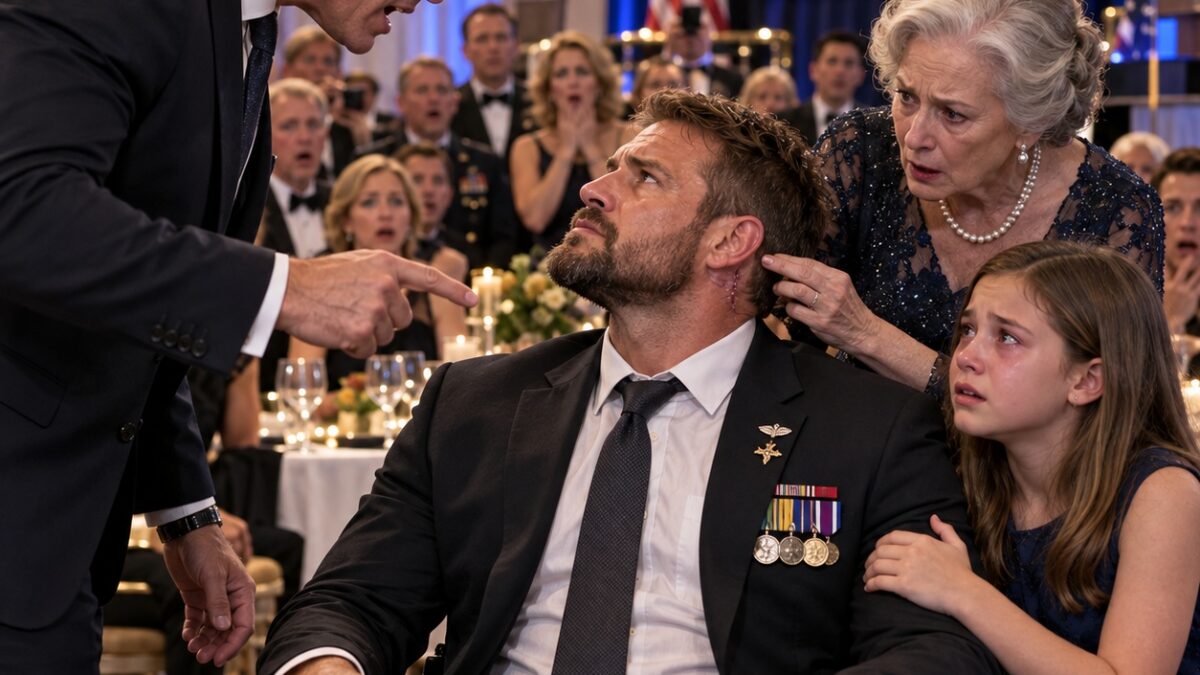
The woman covered her mouth.
“My name is Evelyn Brooks.”
Something inside me shifted.
Then she said:
“My son was Daniel Brooks.”
I looked at her properly for the first time.
The same eyes.
That was what I noticed.
Daniel had those eyes.
Hazel.
Almost gold in certain light.
Always too expressive for a man who spent most of his energy pretending nothing bothered him.
“Danny.”
Her face broke.
“You remember him.”
“Of course I remember him.”
She started crying.
Not loudly.
The kind of crying that comes from holding something for years and suddenly finding the person connected to it standing in front of you.
Tessa looked between us.
“Dad?”
I couldn’t answer her yet.
Evelyn reached into her purse with shaking hands.
She pulled out an old photograph.
The edges were worn.
Daniel.
Younger.
Hospital bed.
One arm in a sling.
Bandaging across his shoulder and torso.
A smile far too big for the condition he was in.
On the back, written in faded ink, were words I could not read from where I sat.
Evelyn held it toward me.
“My son sent me this after his final surgery.”
Her voice shook.
“He wrote that he owed his life to a man named Gideon Shaw.”
Brent shifted nearby.
I had almost forgotten he was there.
Evelyn hadn’t.
He said, “Ma’am, I’m sure this is very meaningful, but we do have a program to—”
“Please be quiet.”
She never raised her voice.
Brent stopped speaking.
Evelyn looked at me again.
“The official report said the evacuation route collapsed.”
“It did.”
“He said his group was trapped after an explosion.”
“Yes.”
“And someone carried him out.”
I looked down.
“Several people helped.”
“Daniel said you did.”
I could feel Tessa watching me.
That was harder than the ballroom.
Harder than Brent.
I had never told her the details.
Not because I wanted secrets.
Because children deserve childhood before inheritance.
Some memories are heavy.
You wait until their shoulders grow.
Evelyn continued.
“He said everyone thought the position was lost.”
I said nothing.
“He said you went back.”
The room seemed quieter.
I hated that.
Attention had always made me uncomfortable, especially when tied to events I remembered very differently from the way they sounded afterward.
People hear rescued and imagine one clean moment.
There had been nothing clean about that day.
The first blast had collapsed part of the ravine wall.
Another hit farther uphill.
Radio communication failed twice.
We had wounded men at three separate points.
Smoke reduced visibility.
A medical evacuation route we had been using became impossible.
Daniel had taken fragments through his leg and abdomen.
He was losing blood.
Badly.
There were men screaming for us to move.
There were other men we could not reach immediately.
Nobody behaved like characters in a movie.
People were scared.
So was I.
I looked at Evelyn.
“Daniel was my friend.”
She nodded.
“He said that.”
“He was also heavy.”
A laugh burst through her tears.
“That sounds like him.”
“He complained the whole time.”
Her smile widened.
“He told me you said that.”
“He kept asking whether the medical tent had spiders.”
Now she laughed properly.
“Oh, God.”
“That is absolutely my son.”
Somebody in the ballroom laughed too.
Then another.
The tension changed.
Not vanished.
Humanized.
Tessa stared at me.
“Dad, you never told me.”
I met her eyes.
“I didn’t bring Daniel out so I could tell stories about it.”
Evelyn shook her head.
“It was more than Daniel.”
I looked at her.
“He told us what happened.”
“Not everything.”
“Enough.”
She took one step closer.
“He said you refused to leave until every wounded man had been accounted for.”
Memory hit again.
Not heroic.
Never heroic in my head.
A corporal screaming that his brother was still down there.
Someone trying to stop me because the ground was unstable.
The taste of blood in my mouth from where I had bitten my tongue.
My own legs still working then.
Working too well.
Carrying me places I sometimes wished they hadn’t.
I looked away.
Brent had lost his smile.
Evelyn continued.
“My son spent years trying to find you.”
“He could have contacted the unit.”
“He tried.”
I frowned.
“People had scattered.”
She wiped her face.
“And nobody would release personal information.”
“That sounds right.”
“He wanted to thank you.”
“He didn’t need to.”
“I know.”
She looked at me with the sort of firmness mothers never lose, regardless of their children’s age.
“But he wanted to.”
Then she turned toward the event coordinator.
“Can we call him?”
I immediately said, “You don’t need to do that.”
“I know.”
“Evelyn.”
She held my gaze.
“I want to.”
The coordinator found a phone.
Evelyn stepped aside.
The room began breathing again.
People whispered.
Some looked at me.
I wished they wouldn’t.
Brent cleared his throat.
“Well.”
Nobody helped him.
He adjusted his jacket.
“I obviously wasn’t aware of the full details of his service.”
I looked at him.
“Would it have changed anything?”
He opened his mouth.
Then closed it.
I waited.
“Would you have spoken to me differently if I’d saved somebody you knew?”
His jaw moved.
No answer.
“That’s what I thought.”
I did not say it angrily.
Anger would have given him somewhere to hide.
Tessa was still holding my hand.
Her thumb moved across my knuckles.
A habit she had inherited from Laura.
Her mother used to do the same thing when she sensed I was pulling too far into myself.
Touch.
Come back.
I looked at my daughter.
She whispered:
“Are you okay?”
“Yes.”
That was not entirely true.
But it was true enough for the moment.
Evelyn returned.
The phone was in both hands.
“Daniel wants to speak to you.”
Everything inside me stopped.
For years, I had stored Danny as memory.
Twenty-three.
Terrified of spiders.
Laughing too loudly.
Trying to trade instant coffee packets for real coffee.
Talking about opening a small business after deployment.
People from that period lived in fixed ages inside my head.
Even the survivors.
I took the phone.
“Hello?”
Silence.
Then:
“Shaw?”
Older voice.
Rougher.
But him.
“Is that really you?”
I closed my eyes.
“Hey, Danny.”
He laughed.
Then the laugh broke.
“You stubborn son of a bitch.”
I laughed too.
A real one.
Maybe the first of the evening.
“I’ve been trying to find you for years.”
“I heard.”
“My mother says you’re at some fancy fundraiser.”
“She’s causing trouble.”
“I believe that.”
Evelyn put a hand over her heart.
I could hear Daniel breathing.
Then:
“How are you?”
That question.
Veterans ask it differently.
Not polite.
Not casual.
I knew what he was really asking.
“Alive.”
He understood.
“Yeah.”
“You?”
“Same.”
He paused.
“Mostly.”
I looked toward Tessa.
“Your mother says you’ve got two boys.”
“They climb everything.”
“How old?”
“Six and eight.”
“That sounds exhausting.”
“They’re trying to finish what the blast started.”
I laughed again.
Tessa smiled because I did.
Daniel continued.
“I walk with a cane.”
“Your mother told me.”
“Doctors said I might not.”
“You never listened to doctors.”
“Still don’t.”
“Probably why you’re alive.”
Silence again.
Then his voice changed.
“Gideon.”
I knew what was coming.
“Don’t.”
“You saved my life.”
“Danny.”
“You did.”
“There were others.”
“I know.”
“You got me out.”
I looked down at my legs.
For the first time that night, I was painfully aware of the wheelchair beneath me.
Daniel said:
“I’ve spent twelve years wanting to tell you something.”
I stayed quiet.
“You saved my life, brother.”
My throat tightened.
“But you never made me feel like I owed you one.”
I couldn’t speak.
That sentence did more damage than Brent ever could.
Not because it praised me.
Because it reminded me of the man I had wanted to be after that deployment.
People survive terrible things and immediately start keeping score.
Who saved whom.
Who failed.
Who owes.
Who was braver.
Who broke.
Who didn’t.
I hated that accounting.
Daniel had survived.
That was enough.
He continued.
“I got married.”
“Your mother skipped that detail.”
“She likes dramatic timing.”
Evelyn nodded proudly.
“My wife’s name is Megan.”
“Does she know about the spiders?”
“She knows everything.”
“Then it’s real love.”
He laughed.
“I coach my boys’ soccer team.”
“You?”
“I know.”
“You hate soccer.”
“I hate youth soccer more.”
“Good.”
A pause.
“I’ve got a life, Gideon.”
I stared toward the ballroom windows.
Rain streaked the glass.
“I know.”
“No.”
His voice strengthened.
“I need you to hear it.”
I did.
“I’ve got a life.”
“Because you carried me out.”
I swallowed.
“You would’ve done the same.”
“Maybe.”
“No.”
“Yes.”
“Still.”
His voice softened.
“Thank you.”
This time, I let him say it.
“You’re welcome.”
The words almost hurt.
Not because gratitude was wrong.
Because accepting it meant admitting something I had spent years minimizing.
That day had mattered.
My choices had mattered.
Pretending otherwise was not humility anymore.
It was avoidance.
Daniel asked about my daughter.
I handed the phone slightly away.
“Tessa.”
Her eyes widened.
“No.”
“Yes.”
“Dad.”
“He’s harmless.”
Daniel shouted through the speaker:
“I heard that.”
Tessa took the phone.
“Hi.”
I watched her face.
Daniel spoke.
She listened.
Then smiled.
Then looked at me.
“You never told me you carried him.”
I shrugged.
Daniel apparently objected because Tessa said:
“He’s shrugging.”
More talking.
Then she laughed.
“What?”
She listened.
“No.”
Another pause.
“Really?”
I stared at her.
“What is he telling you?”
Tessa looked delighted.
“He says you cried because a camel spit on you.”
“That is classified.”
Daniel laughed loudly enough for several people nearby to hear.
“Give me the phone.”
Tessa held it away.
“He says you fell into a ditch once.”
“Phone.”
“He says—”
I took it gently.
“This conversation is over.”
Daniel was laughing so hard he had trouble breathing.
For a few minutes, something impossible happened.
The past stopped being only pain.
That mattered.
People imagine traumatic memory as one unbroken block of horror.
It isn’t.
There were jokes.
Bad food.
Stupid arguments.
Friendship.
Boredom.
Embarrassing moments.
Men singing terribly.
People who died had once laughed.
Survivors had too.
Daniel reminded me of that.
Before hanging up, he said:
“Don’t disappear again.”
I looked toward Evelyn.
“I’ll give your mother my number.”
“Terrible idea.”
“I agree.”
“Do it anyway.”
“I will.”
“Gideon?”
“Yeah?”
“I mean it.”
“I know.”
“Thank you.”
This time, I answered without resistance.
“I’m glad you made it home.”
“So am I.”
The call ended.
For a few seconds, I held the phone against my chest.
Then gave it back to Evelyn.
She hugged me.
Carefully.
People had learned to hug carefully after the wheelchair.
Sometimes too carefully.
Evelyn got it right.
No pity.
Just gratitude.
Then applause began.
I hated applause.
Always had.
The first few claps came from somewhere behind us.
Then more.
Soon most of the ballroom was standing.
Some veterans stayed seated.
Some couldn’t stand.
That detail mattered to me.
Tessa squeezed my hand.
“Dad.”
“I know.”
“You’re turning red.”
“Thank you.”
“I’ve never seen your ears this color.”
“Please stop helping.”
The applause ended eventually.
That was the good thing about applause.
Everything ends.
Brent stood near the edge of the group.
Alone now.
His confidence had not vanished completely.
People like Brent do not transform in thirty seconds.
But embarrassment had replaced certainty.
That was a start.
He approached.
No smile.
No audience-facing posture.
“I owe you an apology.”
I looked at him.
“Yes.”
He blinked.
Probably expected me to make it easier.
I didn’t.
“I judged you without knowing anything about you.”
“Yes.”
“That was wrong.”
“Yes.”
He glanced toward Tessa.
“And I shouldn’t have spoken to your daughter that way.”
Tessa looked at him.
Brent waited.
She said:
“You shouldn’t need to know my dad saved somebody before treating him like a person.”
Brent went completely still.
There are moments when children reduce adults to the size of their own logic.
This was one.
He looked at me.
I did not rescue him.
Tessa was right.
That was the entire point.
If Evelyn had never recognized me, Brent’s behavior would still have been wrong.
If I had spent my military career repairing radios instead of pulling Daniel from a ravine, his behavior would still have been wrong.
If I had never worn a uniform at all, mocking my wheelchair would still have been wrong.
Brent said quietly:
“You’re right.”
Tessa nodded.
That was all.
The fundraiser continued.
I almost left.
Tessa stopped me.
“You worked on this for three months.”
“So?”
“So you’re not letting Mr. Thousand-Dollar Suit ruin dessert.”
She had a point.
We stayed.
The rehabilitation center received the largest allocation as planned.
Brent increased his donation.
A lot.
People later asked whether I thought guilt motivated him.
Probably.
Maybe shame.
Maybe sincere reconsideration.
Human motives are rarely pure.
Money still helped veterans.
I didn’t reject it because Brent’s conscience was complicated.
Later that evening, one of the rehabilitation-center directors approached me.
“Thank you.”
“For what?”
“For not turning the event into a fight.”
“I didn’t do anything.”
“You could have.”
I looked across the ballroom.
Brent was speaking quietly with one of the event coordinators.
“Everybody keeps telling me what I could’ve done.”
The director smiled.
“That may be the point.”
I thought about that on the way out.
Tessa insisted on pushing my chair toward the lobby.
I could move myself perfectly well.
She knew.
I knew.
Sometimes children want to help because helping makes them feel close.
I let her.
Outside, rain glazed the Charleston streets.
Hotel lights reflected in the pavement.
Tessa stopped beneath the awning.
“Dad?”
“Yeah?”
“Why didn’t you tell me?”
“About Daniel?”
“About any of it.”
There it was.
The question I had avoided for years.
I looked at my daughter.
She had Laura’s eyes.
Brown.
Too perceptive.
“I didn’t know what to tell you.”
“The truth.”
“It isn’t always that simple.”
“Why?”
I breathed slowly.
“Because if I tell you the story as ‘your dad saved people,’ that leaves out a lot.”
“Like what?”
“Fear.”
She listened.
“Mistakes.”
“People who didn’t make it home.”
Her expression changed.
“My friends.”
“Things I still don’t like remembering.”
She put both hands on the handles of my chair.
“But you did save Daniel.”
“Yes.”
“Why is that hard to say?”
I thought about it.
“Because surviving something with other people can make praise feel strange.”
“How?”
“Imagine five people are carrying something heavy.”
“Okay.”
“And afterward somebody congratulates only one.”
“That’s not fair.”
“Exactly.”
“But Mrs. Brooks said you went back.”
“I did.”
“Wasn’t that brave?”
Maybe.
I looked toward the rain.
“I was terrified.”
Tessa frowned.
“You can be brave and scared.”
I smiled.
“When did you become smarter than me?”
“Probably nine.”
“Seems early.”
She leaned against my shoulder.
Then asked:
“Did your legs stop working because of that?”
I should have known the question was coming.
“No.”
She waited.
“My final deployment was later.”
“What happened?”
“An explosion.”
“Were you saving someone?”
“No.”
That answer surprised her.
“I was moving between positions.”
“Then?”
“Then the world got loud.”
I tapped my chair.
“And eventually this became part of life.”
She looked down.
“Do you hate it?”
“The chair?”
“Yeah.”
“Sometimes.”
She nodded.
“Do you hate your legs?”
That one hurt.
“No.”
“Even though they don’t work?”
“They work differently.”
That answer had taken me years to learn.
Some days my legs gave me pain without movement.
Nerve pain.
Spasms.
Pins and electricity.
They were not useless.
Bodies are not machines that become worthless when one system changes.
I wished somebody had explained that to me after the injury.
I had spent too long believing it myself.
Tessa said:
“That man was stupid.”
“Brent?”
“Yes.”
“Yes.”
“He thought you weren’t useful.”
“I heard.”
“You do everything.”
“Not everything.”
“You burn pancakes.”
“Unfair.”
“You’re bad at hair.”
“Cruel.”
“You forget permission slips.”
“Occasionally.”
“But you’re useful.”
I laughed.
“Thank you for that breathtaking tribute.”
She hugged me.
“Also you’re my dad.”
There it was.
The only title I actually needed.
We drove home.
I could have let the evening become a story about humiliation reversing itself.
Rich donor insults disabled veteran.
Secret heroic past revealed.
Crowd applauds.
Arrogant man learns lesson.
That version is satisfying.
It is also too simple.
The truth started the next morning.
I woke at 4:13.
Same dream.
Different details.
Smoke.
Daniel yelling.
Someone I could not reach.
Then another sound layered over memory.
Brent’s voice.
Real heroes come home standing.
I stared at the ceiling.
That sentence had found a place inside me I didn’t want to admit existed.
Because some small part of me had thought versions of it before.
Not about other veterans.
Myself.
After the injury, I became an expert in internal cruelty.
You should be stronger.
You should recover faster.
You should stop needing help.
You should be grateful you’re alive.
You should not feel angry.
You should not complain.
You should not let Tessa see you struggle.
The voice never sounded exactly like Brent.
But the logic was related.
Worth tied to function.
Dignity tied to independence.
Heroism tied to intact bodies.
I had rejected those ideas intellectually.
Emotionally was harder.
My phone buzzed around nine.
Unknown number.
I answered.
“Hello?”
“Shaw.”
Daniel.
I smiled before I could stop myself.
“Your mother works fast.”
“She threatened to call you herself every day.”
“That sounds accurate.”
“How’s the kid?”
“Still disappointed in my communication skills.”
“Smart girl.”
“You told her too much.”
“Not enough.”
We talked for nearly an hour.
About everything except the ravine at first.
Family.
Work.
His sons.
Charleston.
My rehabilitation.
Eventually he said:
“I saw the video.”
“What video?”
“Fundraiser.”
My stomach tightened.
Somebody had posted Brent’s confrontation.
Of course they had.
“Great.”
“You handled it better than I would.”
“You would’ve thrown your cane.”
“Probably.”
Silence.
Then:
“He hit a nerve, didn’t he?”
Daniel had always been irritatingly perceptive.
“I’m fine.”
“Shaw.”
I hated that tone.
“What?”
“Real heroes come home standing.”
I stared through the kitchen window.
“Yeah.”
“You know that’s garbage.”
“I know.”
“Do you?”
I did not answer.
Daniel continued.
“I came home on a stretcher.”
“Danny.”
“I mean it.”
“I know.”
“I spent nine months learning to walk again.”
His voice tightened.
“You carried me out and I still needed a cane twelve years later.”
“So?”
“So if standing determines whether you matter, half the people we knew would fail his stupid test.”
I closed my eyes.
“He doesn’t get to define you.”
“I know.”
“No.”
His voice softened.
“You know how I know you saved me?”
I waited.
“Not because you carried me.”
I frowned.
“What?”
“You treated me the same after.”
Memory returned.
Hospital recovery.
Physical therapy.
Daniel furious because nurses helped him shower.
Embarrassed by every dependency.
I had visited when I could.
He continued.
“You never talked to me like I was broken.”
I sat very still.
“You made fun of me.”
“You were easy material.”
“You kept asking what I wanted to do when I got out.”
“I remember.”
“Everybody else asked how I felt.”
“What’s wrong with that?”
“Nothing.”
“But you asked what came next.”
He exhaled.
“That saved me too.”
I did not know that.
“Danny.”
“I’m serious.”
He paused.
“You knew something about coming home before you had to learn it yourself.”
That sentence stayed.
After we hung up, I rolled into the living room.
Tessa was sitting on the floor with homework.
“You’re staring.”
“Thinking.”
“Dangerous.”
“Apparently.”
She looked up.
“Was that Daniel?”
“Yes.”
“Is he funny?”
“No.”
“I heard you laugh.”
“Coincidence.”
She went back to homework.
Then:
“His mom emailed me.”
I froze.
“What?”
“She found my school fundraiser page.”
“Why?”
“She said she wants to buy all my cookie dough.”
“Absolutely not.”
“Dad.”
“She is dangerous.”
Tessa smiled.
Life moved forward.
The fundraiser story circulated longer than I wanted.
Local news picked it up.
Someone titled a clip:
MILLIONAIRE DONOR HUMILIATES DISABLED VETERAN—INSTANTLY REGRETS IT.
I hated everything about that sentence.
Especially instantly.
Brent did not instantly become a better person.
Nobody does.
A week after the event, he called.
I considered not answering.
Did anyway.
“Gideon.”
“Brent.”
“I wanted to apologize again.”
“You already did.”
“I know.”
“What do you need?”
A pause.
“I’m not asking you for anything.”
“Okay.”
“I watched the video.”
“So did half of Charleston.”
“I sounded…”
He struggled.
“Cruel.”
“Yes.”
He took that.
“My father was a veteran.”
I hadn’t known.
“Vietnam.”
I waited.
“He hated talking about it.”
“Common.”
“He also hated what he called pity.”
I began to understand where this was going.
“After he came home, he built the construction business.”
Brent’s voice became less polished.
“He worked until his body failed.”
“Wouldn’t take help.”
“Wouldn’t use a cane.”
“Wouldn’t stop working.”
“What happened?”
“Heart attack at sixty-four.”
“I’m sorry.”
“He used to say men stand on their own feet.”
There it was.
Inheritance.
Bad ideas survive generations because somebody loved the person who taught them.
Brent continued.
“I thought he was strong.”
“Maybe he was.”
“Then what I said to you…”
“Was still wrong.”
“I know.”
I appreciated that he did not use his father as an excuse.
“I think I heard his voice coming out of me.”
I looked toward the photograph of Laura on my bookshelf.
We all carry voices.
Some deserve continuation.
Some need interruption.
“What are you going to do about it?”
Brent was quiet.
“I don’t know.”
“That’s the real part.”
“What?”
“Apologizing is easy.”
He laughed humorlessly.
“Didn’t feel easy.”
“Changing what happens next is harder.”
He said he understood.
Maybe he did.
Over the next few months, Brent remained connected to the fundraiser committee.
I expected him to disappear.
He didn’t.
He funded transportation assistance for veterans attending rehabilitation appointments.
Not glamorous.
No naming rights.
No giant logo.
The rehab center director told me he had specifically asked what families actually needed.
That impressed me more than the size of the donation.
One afternoon, Brent and I ended up in the same planning meeting.
He sat across from me.
No special attention.
Afterward, he walked over.
“How’s Tessa?”
“Judgmental.”
“Still?”
“She’s twelve.”
“Right.”
He hesitated.
“Tell her I haven’t interrupted any children lately.”
“I’ll include it in your progress report.”
He laughed.
That was the beginning of a strange truce.
Not friendship.
Mutual recognition.
Brent never asked me for forgiveness.
Good.
I didn’t know what I would have said.
Forgiveness is not a receipt handed over after apology.
Sometimes it arrives slowly.
Sometimes partially.
Sometimes never.
Dignity does not require it.
Daniel became part of our lives.
His family visited Charleston the following spring.
I recognized him immediately.
Older.
Gray at the temples.
Cane in his right hand.
Slight limp.
Same stupid grin.
He entered my house and said:
“You look terrible.”
I answered:
“You got fat.”
Then we hugged for so long our children became uncomfortable.
Daniel’s boys climbed everything.
He had not exaggerated.
Tessa became unofficial supervisor.
Evelyn cried approximately every twelve minutes.
At dinner, Daniel told stories I had hoped he had forgotten.
Most were embarrassing.
Tessa loved every second.
“Tell her about the camel.”
“No.”
“The ditch?”
“No.”
“The generator?”
“Classified.”
Daniel looked at her.
“Your father once tried to fix a generator using a bootlace.”
“It worked.”
“For eleven minutes.”
“Eleven critical minutes.”
Later, after the kids went to sleep, Daniel and I sat outside.
He used the cane.
I used the chair.
Two men Brent might not have called heroes if he saw us from a distance.
Daniel looked toward the yard.
“I used to hate this thing.”
He tapped the cane.
“I used to hate mine.”
I touched the wheel.
“Still do sometimes.”
“Same.”
He nodded.
“People think acceptance means liking it.”
“No.”
“It means you stop negotiating with reality every morning.”
That was exactly it.
We talked about men we lost.
That conversation lasted longer.
Names.
Families.
Where they would be now.
We did not glorify them.
The dead become too easy to simplify.
They had been funny.
Annoying.
Brave.
Scared.
Bad at cards.
Good at bad impressions.
Human.
Daniel said:
“You know what bothered me about that donor?”
“Which part?”
“He thought injury disqualified you from heroism.”
“I’m not interested in the hero label.”
“I know.”
“But he also thought disability meant finished.”
That was closer.
“Yes.”
Daniel leaned back.
“Remember Harris?”
“Of course.”
“Lost his hand.”
“Yes.”
“He became an engineer.”
“I heard.”
“Martinez?”
“Burn injuries.”
“Runs a nonprofit now.”
I nodded.
Daniel looked at me.
“Everybody thinks coming home is the end of the story.”
“It’s the beginning of a worse paperwork system.”
He laughed.
Then became serious.
“Sometimes coming home is the first time you realize survival is work.”
I thought about Laura.
My injury.
Fatherhood.
Rehabilitation.
Nerve pain.
Nightmares.
Braiding hair.
Fundraiser spreadsheets.
All the quiet parts nobody applauded.
“Yeah.”
Survival was work.
So was dignity.
A year after the fundraiser, I accepted an invitation to speak at the rehabilitation center.
I almost declined.
Then Tessa said:
“You should.”
“Why?”
“Because you keep saying disability doesn’t make people less useful.”
“I do say that.”
“Then prove you believe it.”
Children are exhausting.
I went.
The audience was mostly veterans early in recovery.
Wheelchairs.
Prosthetics.
Canes.
Scars.
Some injuries visible.
Others not.
I did not tell the Kandar story first.
I told them about pancakes.
One man looked confused.
Good.
“I’m a single father.”
I explained Laura.
Tessa.
Hair videos.
Burned breakfast.
Forgetting school forms.
The room relaxed.
Then I said:
“When I was first injured, people kept congratulating me for surviving.”
Some nodded.
“I hated them for it.”
More nods.
“Because survival didn’t feel impressive.”
I looked around.
“It felt like needing help to get dressed.”
“Pain.”
“Being angry at stairs.”
“Watching people speak to whoever was pushing my chair instead of speaking to me.”
A veteran near the back muttered:
“Yep.”
I continued.
“Then I made a mistake.”
“I started measuring my worth by how independent I could become.”
Silence.
“I treated every request for help like failure.”
“That nearly destroyed me.”
I paused.
“My daughter fixed that.”
Someone laughed.
“Kids do that.”
“She needed a father.”
“Not a man proving he needed nobody.”
That was the first time I understood the sentence fully as I said it.
Tessa had never asked me to be the person I was before injury.
Only present.
That mattered more than Brent’s definition.
More than applause.
More than old medals inside a drawer.
Afterward, one young veteran approached.
Twenty-four.
Chair.
Bilateral leg injuries.
He said:
“I hate when people call me inspiring.”
“Then tell them.”
“They mean well.”
“Meaning well doesn’t make every word useful.”
He smiled.
“You hate hero too?”
“I don’t hate it.”
“What then?”
“I don’t want it to become a test somebody else has to pass before they deserve respect.”
He thought about that.
“That donor guy.”
“Yes.”
“He only respected you after the old woman recognized you.”
“Exactly.”
He understood.
That was what stayed with me most from that night.
Not Brent’s insult.
Not Evelyn’s revelation.
Not applause.
Tessa’s sentence.
You shouldn’t need to know someone saved a life before you treat them with respect.
That became the center of everything.
Years passed.
Tessa grew taller.
Then somehow became sixteen while I was distracted.
She learned to drive.
I hated it.
She accused me of hypocrisy because I had driven military vehicles under fire.
I explained that nothing I had done compared with sitting in the passenger seat while she changed lanes.
Daniel agreed.
His boys grew too.
Evelyn sent Christmas cards.
Brent remained involved with the rehabilitation center.
He eventually became one of its major donors.
Quietly.
No ballroom named after him.
No plaque.
That told me something.
At another fundraiser three years later, Brent saw me near the entrance.
He approached.
Tessa was beside me.
Now taller than both armrests.
Brent smiled at her.
“I’ve been practicing.”
She narrowed her eyes.
“At what?”
“Treating people respectfully without requiring evidence of heroism.”
She considered him.
“Good.”
Then walked away.
Brent looked at me.
“Still terrifying.”
“Yes.”
We both laughed.
He grew serious.
“I think about what she said.”
“So do I.”
“That night changed me.”
I shook my head.
“No.”
He frowned.
“You changed you.”
“That sounds like something from a motivational poster.”
“Probably.”
He smiled.
“I’ll take it.”
Later that evening, the rehabilitation center announced a new housing-access program for disabled veterans returning home.
Wheelchair ramps.
Bathroom modifications.
Doorway widening.
Basic construction changes that allowed people to live in their own houses.
Brent’s company had agreed to provide labor at cost.
I looked across the ballroom.
He noticed.
Raised one hand.
No speech.
No need.
That was growth.
Not redemption as performance.
Pattern.
I respected that.
My own relationship with the word hero changed too.
Tessa once asked:
“Do you think you’re a hero now?”
“No.”
“You’re impossible.”
“I don’t think people should self-assign that word.”
“So who decides?”
“I don’t know.”
“Daniel?”
“Maybe.”
“Grandma Evelyn?”
“She’s biased.”
“Me?”
“Extremely biased.”
She smiled.
“What if I think you are?”
I looked at her.
“You’re allowed.”
“Does it make you uncomfortable?”
“Yes.”
“Good.”
I laughed.
Then she became serious.
“Why?”
I thought.
“Because hero can flatten a person.”
“What does that mean?”
“People hear hero and expect courage all the time.”
“I’m scared sometimes.”
“They expect strength.”
“I need help sometimes.”
“They expect sacrifice.”
“Sometimes I’m selfish.”
“Hero sounds cleaner than human.”
Tessa nodded.
“Can you be both?”
That stopped me.
“Probably.”
She smiled.
“Then stop making everything difficult.”
Laura would have loved that answer.
The nerve pain worsened as I got older.
That part of the story is not inspirational.
Some mornings hurt.
Some treatments helped.
Others didn’t.
I remained active.
Not because determination cures damaged nerves.
It doesn’t.
Because a full life can include pain without pretending pain is meaningful.
I worked.
Helped fundraisers.
Raised Tessa.
Stayed in touch with Daniel.
Visited memorials.
Went to therapy.
Took medication.
Asked for help.
Sometimes canceled plans because my body had other plans.
That was life.
No triumphant soundtrack.
Just adaptation.
One Veterans Day, Daniel and I visited a memorial together.
He brought his cane.
I brought flowers.
We found the names.
Men from that deployment.
We stood there for a long time.
Daniel said:
“Do you ever feel guilty?”
“Yes.”
“Me too.”
“For surviving?”
“Sometimes.”
I nodded.
“What do you do?”
He looked at me.
“Raise two obnoxious boys.”
“Good strategy.”
“You?”
“Raise one terrifying daughter.”
“Also good.”
We smiled.
Then he said:
“That’s probably the answer.”
“What?”
“Live enough that surviving doesn’t stay the last event.”
I remembered that.
Live enough that surviving doesn’t stay the last event.
Maybe that was what Brent had misunderstood when he saw my wheelchair.
He looked at disability and saw aftermath.
He thought my important life existed behind me.
Uniform.
Deployment.
Injury.
Done.
But my life after injury had lasted years.
Laura’s illness.
Tessa’s childhood.
Fundraisers.
Phone calls.
Breakfast.
Grief.
Friendships.
Work.
Daniel returning.
None of that was lesser because it happened from a chair.
If anything, I had spent years learning something military culture had not prepared me for.
Being helped without becoming ashamed.
Being a father while hurting.
Allowing vulnerability without surrendering authority over my own life.
Those lessons were quieter than carrying Daniel.
They were also harder in different ways.
The final conversation I ever had with Evelyn about that fundraiser happened when she was eighty-two.
We were sitting on Daniel’s back porch during a family barbecue.
She said:
“I’m glad I recognized you.”
“I’m glad you did too.”
Then she surprised me.
“But sometimes I wonder if I shouldn’t have said anything.”
“Why?”
“You hated the attention.”
“Yes.”
“Brent deserved to be embarrassed.”
“Probably.”
“But Tessa was right.”
I smiled.
“She usually is.”
Evelyn looked toward Daniel playing with his sons.
“You should have been treated with respect even if you had never met my son.”
There it was again.
The real lesson.
“I know.”
She looked at me.
“Do you?”
I laughed.
“Apparently everybody asks me that.”
She squeezed my hand.
“Good.”
I watched Daniel.
Alive.
Older.
Two children.
A life.
For years, his survival had existed in my memory as one terrible afternoon.
Now he was grilling hamburgers badly.
That felt more important.
Brent’s insult no longer bothered me the way it once had.
Not because it became less ugly.
Because eventually I understood it had never been about me.
He carried a narrow definition of worth into that ballroom.
Standing.
Working.
Paying.
Commanding.
Being visibly strong.
I happened to be the person sitting in front of him when that definition became cruelty.
Evelyn did not prove I deserved dignity.
She proved Brent’s measurement was foolish.
That distinction mattered.
Today, Tessa is older than Laura was when we first met.
That sentence feels impossible.
She still adjusts my tie when we attend events.
Still criticizes my pancakes.
Still tells people I’m stubborn.
She was with me recently at another veterans fundraiser.
Smaller.
Less formal.
We sat near the back.
A young veteran entered using a wheelchair.
His wife pushed their baby beside him.
I watched several people move chairs to make room.
Nobody stared.
Nobody applauded.
Nobody asked what happened to him.
They just made room.
That moved me more than applause ever had.
Tessa noticed.
“What?”
“Nothing.”
“You’re doing the face.”
“What face?”
“The emotional Dad face.”
“I don’t have one.”
“You definitely do.”
I looked toward the young family.
“That.”
“What?”
“They just made room.”
She waited.
“No questions.”
“No performance.”
“They saw what he needed.”
“And did it.”
Tessa smiled.
“You’re proud of society for moving three chairs?”
“Yes.”
“Low bar.”
“Progress often is.”
She leaned against me.
I thought about the Harborite Hotel years earlier.
Brent’s voice.
You’re no hero.
Evelyn’s glass hitting the floor.
Daniel’s voice after twelve years.
Tessa telling a grown man something a ballroom full of adults should have already understood.
You shouldn’t need to know someone saved a life before you treat them with respect.
That sentence followed me longer than the applause.
Longer than Brent’s apology.
Longer than any story about the ravine.
Because heroism is rare.
Dignity should not be.
You should not have to carry a wounded friend through enemy fire to earn it.
You should not need medals.
A dramatic past.
A tragic injury.
A mother recognizing your scar.
You should not have to prove that your life contains a story impressive enough to make cruelty embarrassing.
I saved Daniel because he was my friend.
I went back because others were still there.
Years later, people called those things heroic.
Maybe they were.
But the most important thing I learned at that fundraiser had nothing to do with what I did in uniform.
It was what my daughter understood without ever wearing one.
A wheelchair did not make me less of a man.
A battlefield story did not make me more deserving of respect.
Brent was wrong before Evelyn ever opened her mouth.
Everything afterward merely made it impossible for him to keep pretending he wasn’t.
When Tessa and I left that ballroom years ago, I thought the evening had taught her something about me.
I was wrong.
She had been the one teaching everyone else.
Including me.








