FULL STORY:The HOA’s Fake Cops Shot My Guest at the Gate—They Had No Idea Whose Car They’d Just Stopped
FULL STORY CONTINUATION
The first officer out of the cruiser took three steps, saw the gun in Curtis’s hand, and immediately shouted:
“Firearm on the ground!”
Curtis froze.
“Officer, I’m Westbrook Security.”
“Gun. Down.”
“We had a noncompliant—”
“Put it down now.”
Curtis finally bent slowly and placed the handgun on the pavement.
Another officer moved in.
Kicked it away.
Turned Curtis around.
Handcuffed him.
I remember the expression on Curtis’s face more clearly than almost anything else from that afternoon.
Confusion.
Not remorse.
Not yet.
Confusion.
He genuinely seemed unable to understand how he had gone from giving orders to being restrained.
Dean immediately lifted both hands.
“I didn’t fire.”
“Keep your hands where I can see them.”
“I didn’t shoot him.”
“Then cooperate.”
Paramedics arrived seconds later.
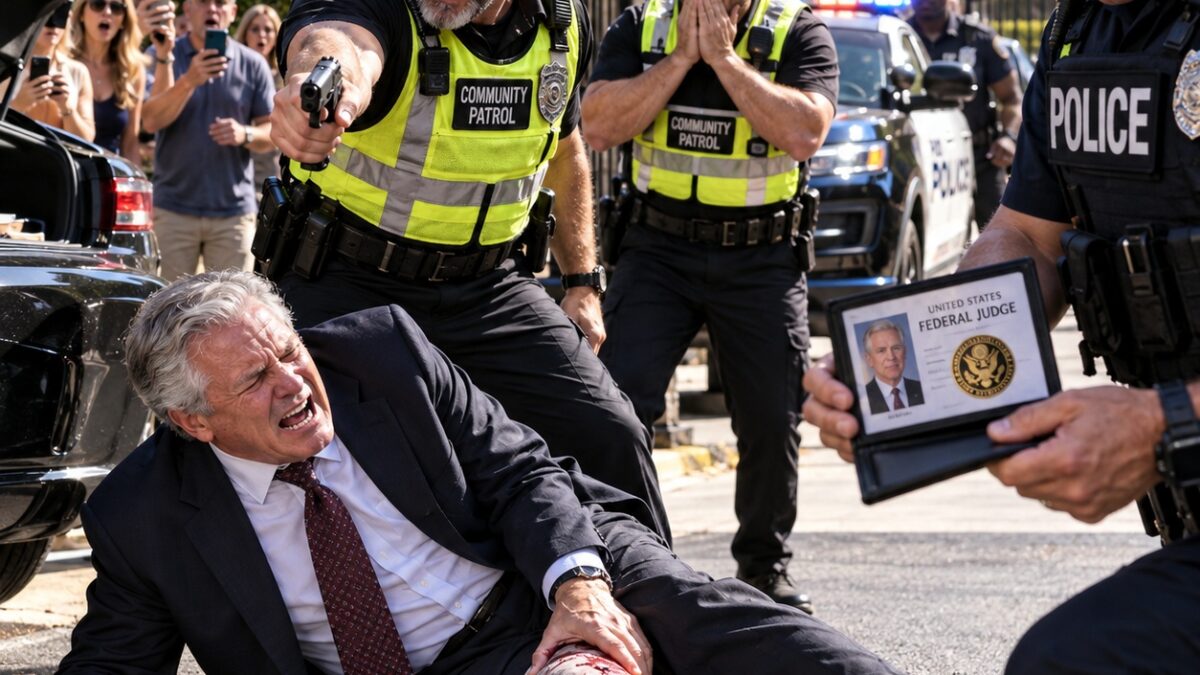
They cut open Arthur’s pant leg.
The bullet had entered the outer portion of his thigh.
There was a lot of blood, but the medic quickly determined no major artery had been hit.
Good news.
Still serious.
Arthur remained conscious.
Police separated everyone.
Witnesses.
HOA personnel.
Residents.
Me.
A sergeant approached while paramedics prepared Arthur for transport.
“Sir, do you have identification?”
Arthur nodded toward his jacket.
“Inside pocket.”
The sergeant removed Arthur’s wallet carefully.
Opened it.
Looked at the driver’s license.
Then at a second credential.
His expression changed.
He looked back at Arthur.
“Judge Reed?”
Arthur closed his eyes briefly.
“Yes.”
The sergeant stepped closer.
“Arthur Reed?”
“Yes.”
There was a pause.
Then the sergeant turned toward another officer and spoke quietly.
I didn’t hear everything.
I heard enough.
Federal judge.
The words spread almost immediately.
Someone behind me whispered:
“Oh my God.”
Dean heard too.
His face went white.
Curtis stopped arguing.
For the first time since I arrived, he said nothing.
Arthur noticed the reaction.
His voice was weak but still controlled.
“My employment is irrelevant to whether that man had authority to search my car.”
The sergeant nodded.
“Yes, sir.”
“He did not.”
“We’re investigating.”
“Good.”
Arthur was loaded onto the ambulance.
Before the doors closed, he looked toward me.
“Your neighborhood is exhausting.”
Despite everything, I laughed.
The ambulance left.
The investigation at the gate continued for hours.
The officers started with the obvious evidence.
Curtis’s firearm.
Shell casing.
Arthur’s vehicle.
Blood pattern.
Witness videos.
Then someone asked about the cameras.
Brenda loved cameras.
We had four covering the entrance.
Two were wide-angle.
One pointed directly at the visitor lane.
Another recorded the guardhouse area.
Audio had been added six months earlier after Brenda complained residents were “verbally abusive” toward patrol volunteers.
For once, her obsession with surveillance helped everyone except her.
Police secured the recording system.
The next afternoon, I was told what the video showed.
Arthur arrived at 2:14.
Dean approached his window first.
“Who are you visiting?”
Arthur gave my address and name.
Dean checked the visitor list.
I had registered him.
That should have been the end.
Instead, Curtis walked over.
According to the recording, Curtis looked through the rear window of Arthur’s sedan.
Then asked:
“Anything in the trunk?”
Arthur said:
“Personal property.”
Curtis replied:
“Open it.”
Arthur asked:
“Why?”
“Random security inspection.”
Arthur said:
“No.”
Not aggressively.
Not sarcastically.
Just no.
Curtis repeated the order.
Arthur asked:
“Are you law enforcement?”
Curtis said:
“We are authorized security officers for this community.”
“That wasn’t my question.”
Curtis leaned closer.
“You’re refusing inspection?”
“Yes.”
“Then you cannot enter.”
Arthur replied:
“Fine. I will leave.”
That should have ended everything.
Arthur put the car in reverse.
Curtis moved behind the vehicle.
Blocked him.
Arthur lowered the window farther.
“You just told me I could not enter.”
“You need to wait while we verify your identity.”
“You already verified it.”
“Stay where you are.”
Arthur turned off the engine.
Opened the door.
Curtis ordered him back inside.
Arthur stepped out with both hands visible.
“I am leaving.”
Curtis moved toward him.
Dean could be heard saying:
“Curtis, let him go.”
Curtis ignored him.
He grabbed Arthur’s wrist.
Arthur pulled away.
“Do not touch me.”
Then Arthur turned toward the open driver’s door.
Reached for the phone he had placed near the console.
Curtis drew his gun.
Dean shouted:
“Curtis!”
Arthur turned.
One shot.
Arthur fell.
There was no weapon.
No attack.
No charge.
No raised fist.
Nothing that resembled what Curtis had told the crowd afterward.
The gate cameras did not merely record the shooting.
They recorded the lie forming immediately after it.
Curtis stood over Arthur and said:
“You should’ve complied.”
That sentence appeared on local television by dinner.
Then national television.
By morning, WESTBROOK RIDGE was trending online for reasons Brenda Sterling never imagined when she ordered those cameras.
Brenda released a statement around 8:00 a.m.
That was another mistake.
It said:
“Yesterday’s unfortunate incident occurred during a lawful community security interaction involving an individual who declined established vehicle inspection procedures.”
Arthur read the statement from his hospital room.
I was sitting beside him.
His thigh was bandaged.
Doctors had successfully repaired muscle damage.
The bullet had passed through without hitting bone.
He was lucky.
Arthur finished reading.
Then handed me my phone.
“Who wrote that?”
“Brenda.”
“Does she have counsel?”
“The HOA does.”
“Not for long.”
He was right.
Within hours, reporters started asking:
Where was the inspection rule?
Who approved it?
What statute allowed an HOA patrol to detain a visitor?
Were the volunteers licensed security guards?
Did their license, if any, allow searches?
Who authorized firearms?
Who trained Curtis?
Brenda had spent years using the phrase community policy as though it were interchangeable with law.
Now people wanted citations.
She had none.
That afternoon, federal officials arrived.
Not a swarm of secret agents seeking revenge because Arthur was a judge.
Reality was less theatrical.
A sitting federal judge had been shot.
That automatically raised security concerns.
The U.S. Marshals Service needed to determine whether Arthur had been targeted because of his judicial position or whether the shooting was unrelated to his work.
Investigators found no indication Curtis knew Arthur’s identity before the shooting.
That distinction mattered.
The main criminal investigation remained centered on the actual conduct at the gate.
But Arthur’s identity guaranteed attention.
And attention exposed everything.
Dark government vehicles entered Westbrook Ridge.
Cameras followed them.
Residents stepped onto porches.
The same gate patrol that had intimidated delivery drivers now watched actual investigators carry boxes of records out of the clubhouse.
Dean cooperated almost immediately.
Curtis did not.
He maintained that Arthur’s movement toward the vehicle caused him to fear a weapon.
Prosecutors would later argue the video told a different story.
Meanwhile, investigators started asking a broader question.
Why were two HOA volunteers acting as though they had police powers in the first place?
That question led directly to Brenda.
The official HOA governing documents were almost boring.
The association could maintain a gated entrance.
Hire private security.
Verify guests.
Regulate access to certain common facilities.
Normal.
Nothing gave volunteers authority to conduct involuntary vehicle searches.
Nothing gave them detention powers.
Nothing allowed them to treat HOA rule violations as crimes.
The “search policy” came from an internal memo Brenda had circulated.
The title:
ENHANCED SECURITY PROTOCOL.
It said patrol personnel could “request visual inspection of vehicle storage areas when circumstances warrant.”
Request.
Not demand.
Another paragraph said individuals who declined screening “may be denied access pending resident verification.”
Denied access.
Not detained.
But Brenda had repeatedly told patrol members to be “firm.”
Former volunteers began producing emails.
One read:
Security loses credibility when residents or visitors believe they can simply say no.
Another:
Command presence must be maintained at all times.
Another:
Noncompliance should have immediate consequences.
Brenda had written all three.
None said:
Shoot someone.
That was important.
But they showed the culture she had created.
The patrol wasn’t trained to see refusal as a legal right.
They were trained to see refusal as defiance.
And defiance had become something they believed they were entitled to defeat.
People started talking.
A lot of people.
Once one person told a story, another did.
A home health nurse said Curtis demanded she open medical supply cases in her SUV.
She refused.
He kept her at the gate for twenty-five minutes.
A plumber said Dean photographed the inside of his work van.
A teenager returning from college said a patrol volunteer asked whether he had drugs because he would not open his trunk.
A woman visiting her elderly mother said Brenda personally told her:
“This community has stricter standards than public roads.”
Arthur heard that one.
“Probably the only true thing she ever said.”
I looked at him.
“How?”
“Stricter doesn’t mean lawful.”
Good point.
The most damaging witness was a former volunteer named Dennis Cole.
Dennis had quit the patrol nine months earlier.
Nobody knew why.
Now we did.
He walked into an investigator’s office carrying a cardboard file box.
Training slides.
Emails.
Incident reports.
Internal complaints.
Photographs.
“I kept everything,” he said.
Those four words frightened Brenda more than any federal vehicle.
Dennis showed investigators a PowerPoint Brenda had used during patrol orientation.
One slide:
PROJECT AUTHORITY.
Another:
CONTROL THE INTERACTION.
Another:
NONCOMPLIANCE ESCALATION.
The escalation chart began reasonably.
Repeat instruction.
Contact homeowner.
Contact board representative.
Then it became dangerous.
Prevent departure until identification confirmed.
Dennis said he objected.
“How do we prevent departure?”
Brenda allegedly answered:
“Use judgment.”
He asked:
“What if they just drive away?”
According to Dennis:
“Then you make it clear that isn’t an option.”
Dennis quit two weeks later.
Brenda denied making that statement.
Then investigators found his email from the next day documenting the conversation.
He had sent it to two board members.
One never answered.
The other forwarded it to Brenda.
Brenda responded:
Dennis is overreacting to standard security procedures.
That email changed the tone of everything.
Because Brenda had been warned.
Not after Arthur was shot.
Before.
Another resident had warned her too.
Six months earlier, Monica Ellis sent a formal complaint after Curtis physically blocked her brother’s pickup at the gate.
Her email ended:
I am worried one of these armed volunteers will eventually hurt somebody because they think they have police authority.
Brenda replied:
Our volunteers understand the limits of their responsibility.
Fourteen weeks later, Arthur was shot.
The HOA board called an emergency meeting.
I arrived thirty minutes early.
The clubhouse was already packed.
People stood along walls.
Outside windows.
In the hallway.
Brenda sat at the front beside three board members.
She looked composed.
She always looked composed when she believed the room still belonged to her.
She opened with:
“We cannot discuss active litigation.”
Someone shouted:
“You discussed it yesterday when you blamed the man who got shot.”
Applause erupted.
Brenda struck the gavel.
“Order.”
Nobody stopped.
She struck it again.
“Order.”
A man near the back laughed.
That sound mattered.
For years, nobody laughed while Brenda held the gavel.
Fear was leaving.
Brenda waited.
Then said:
“The security program has protected this community for years.”
I stood.
“Protected us from what?”
She stared.
I continued.
“How many crimes did they stop?”
“This is not a question-and-answer session.”
“Then what is it?”
“A board meeting.”
“Good. I’m a homeowner. Who authorized car searches?”
Brenda looked toward the association attorney.
He said nothing.
I repeated:
“Who authorized them?”
Brenda answered:
“The board approved enhanced procedures.”
Susan Keller, one of the board members, turned toward her.
“No.”
The room went silent.
Brenda stared.
Susan opened a binder.
“I reviewed every recorded vote for the last three years.”
Brenda’s mouth tightened.
Susan continued.
“We authorized visitor verification and contracted security options. There is no vote authorizing vehicle searches.”
Another board member, Howard Lynn, leaned toward the microphone.
“I never approved searches either.”
Brenda looked furious.
“This discussion is inappropriate given pending legal exposure.”
Susan replied:
“The legal exposure exists because nobody knows what we authorized.”
That was when Dennis stood.
He held a folder.
“I know what Brenda authorized.”
Brenda’s face changed.
“Dennis, sit down.”
“No.”
He walked toward the front.
“You told us refusal meant suspicious behavior.”
“That is false.”
“You told Curtis to stop letting visitors challenge patrol authority.”
“False.”
Dennis held up printed emails.
“Then explain these.”
The room exploded.
People stood.
Shouted.
Demanded copies.
Brenda tried using the gavel.
Nobody heard it.
I looked at that tiny wooden object in her hand and realized power is often only as real as people’s willingness to react to it.
That night, nobody reacted.
The meeting ended without resolution.
The board suspended the patrol program pending investigation.
Brenda objected.
The other board members outvoted her.
For the first time in four years, Brenda Sterling lost a board vote.
The reflective vests disappeared the next morning.
No patrol vehicle.
No radios.
No men standing at the gate pretending to be police.
A licensed security company temporarily handled access control.
They checked names.
Called residents.
Raised the barrier.
No one opened a trunk.
Civilization continued.
Arthur spent another week in the hospital.
His recovery would take months.
I visited often.
One afternoon, he was reading the HOA bylaws.
“You need a hobby.”
“This is fascinating.”
“No, it isn’t.”
Arthur looked over the paper.
“Your HOA is governed better on paper than in real life.”
“That isn’t comforting.”
“It should be.”
“Why?”
“Because the solution may already exist.”
“What solution?”
“Procedure.”
I frowned.
Arthur explained.
Brenda could be recalled.
The bylaws allowed homeowners to force a special membership meeting if enough signatures were collected.
Board officers could be removed by vote.
“Why didn’t we know that?”
“You didn’t read your documents.”
He said it without sympathy.
“Victim blaming.”
“Document blaming.”
Fair.
I brought the section back to Westbrook Ridge.
Susan reviewed it.
Then a homeowner who was an attorney reviewed it.
No loopholes.
No secret power.
Just signatures.
We started collecting.
Not dramatically.
No shouting.
No revenge posters.
Door to door.
“Would you like a special meeting regarding removal of the HOA president?”
Some people signed immediately.
Others hesitated.
“What if she retaliates?”
That question told me how deeply Brenda’s control had become normal.
“The patrol is suspended.”
“She can still fine us.”
“Any new enforcement is being reviewed by the full board.”
“What if she wins?”
“Then she wins.”
The resident looked at the form.
Then signed.
Within four days, we crossed the required threshold.
Brenda challenged the petition.
She claimed signatures were improperly dated.
We corrected them.
She claimed two homeowners were delinquent and therefore ineligible.
The bylaws disagreed with her interpretation.
She claimed notice had to be issued only by the president.
Again, wrong.
For years, Brenda’s power had depended on people accepting her interpretation first and checking later.
Now everybody checked first.
That destroyed her advantage.
The recall meeting was scheduled three weeks later.
While residents prepared, the criminal investigation continued.
Curtis was formally charged under state law with serious offenses related to the shooting.
His exact charges shifted as prosecutors reviewed evidence.
That is normal.
Dean became a key witness.
He admitted both men knew they were not sworn police officers.
He said Curtis had become increasingly aggressive over the previous six months.
He also said Brenda praised patrolmen who “didn’t back down.”
Brenda called Dean a liar.
Then investigators found text messages.
One from her after a prior dispute:
Good job maintaining control. People need to understand these procedures are not optional.
That phrase—NOT OPTIONAL—appeared repeatedly.
Arthur’s civil lawyers took interest.
So did the HOA’s insurance company.
The carrier sent a letter stating that some claims might fall outside coverage if the board knowingly authorized conduct not covered by the policy or if intentional wrongdoing was established.
That letter terrified homeowners.
Not because they suddenly cared more about Arthur.
Because they realized Brenda’s fantasy police force might cost them personally.
Emergency assessments.
Legal expenses.
Insurance cancellation.
Property complications.
The practical consequences reached people fear had not.
Brenda blamed me.
She cornered me after a board session.
“You’ve turned the neighborhood against me.”
“No.”
“You brought Arthur here.”
“I invited a visitor.”
“You knew who he was.”
That startled me.
“What?”
“You knew he was a federal judge.”
“I knew he was Arthur Reed.”
“You expect me to believe you didn’t know?”
“I didn’t.”
She stared.
Then whispered:
“This is a setup.”
I almost laughed.
“A setup?”
“He came here intentionally.”
“To get shot?”
“You know what I mean.”
“No, Brenda. I really don’t.”
She pointed at me.
“You wanted the patrol gone.”
“I wanted them to stop pretending they were police.”
“Same thing.”
“No.”
Her eyes narrowed.
“You people never appreciated what I was protecting.”
There it was.
Not money.
Not conspiracy.
Not some hidden criminal network.
Belief.
Brenda genuinely believed control was protection.
That made her more dangerous, not less.
“You were warned,” I said.
“By complainers.”
“Someone told you an armed volunteer might hurt somebody.”
“They were being dramatic.”
“Arthur got shot.”
“Curtis made an error.”
“No.”
I shook my head.
“Curtis pulled the trigger. But you built the room where he thought pulling it made sense.”
She stepped back like I had slapped her.
“That is defamatory.”
“No.”
I walked away.
The recall meeting happened on a Thursday.
Independent counsel had been retained to supervise voting because nobody trusted Brenda to administer her own removal.
The clubhouse could not hold everyone.
Ballots were distributed to eligible homeowners.
Brenda was given time to speak.
She stood at the front.
No reflective vest.
No patrol members behind her.
Just Brenda.
She said:
“I dedicated four years of my life to protecting this community.”
Nobody interrupted.
“I made difficult decisions because leadership requires courage.”
Still quiet.
“The incident at the gate was tragic, but punishing an entire administration for one individual’s split-second judgment is irrational.”
Susan stood after Brenda finished.
She had prepared a speech.
Then folded it.
She said only:
“Leadership also requires limits.”
Sat down.
We voted.
Brenda lost by a margin so wide even she did not request a recount.
Removed.
Two board members closely aligned with her resigned immediately.
Susan became interim president.
Her first official motion:
Disband the volunteer security patrol permanently.
Unanimous.
Second:
Hire an independent auditor to review spending on the program.
Unanimous.
Third:
Require board approval for any future security policy involving resident or visitor access.
Unanimous.
Someone shouted:
“Fourth: no fake badges.”
People laughed.
Susan smiled.
“I believe that is covered.”
The investigation into HOA spending found plenty of irresponsibility.
Unapproved equipment purchases.
Poor documentation.
Reimbursements without receipts.
Overpriced tactical gear.
But no giant hidden embezzlement scheme.
Honestly, that made the story more believable to me.
People kept expecting a secret fortune.
There wasn’t one.
Brenda hadn’t built her little empire for millions of dollars.
She built it because she liked authority.
Sometimes ego is enough.
The metal badges had cost us $1,840.
Body armor.
Radios.
Flashlights.
Training seminars.
Signage.
Vehicle magnets.
Thousands more.
Almost none of it necessary.
The actual licensed gate service we hired afterward cost less annually than Brenda’s volunteer program once hidden expenses were counted.
The irony became a neighborhood joke.
Professional security was cheaper than pretend police.
Arthur recovered.
Slowly.
At first, walker.
Then cane.
Physical therapy three times a week.
He hated every minute.
One day I found him doing exercises with an elastic band.
“You look ridiculous.”
“I was shot visiting you.”
“Still blaming me?”
“Until death.”
Fair.
He returned to judicial work before he was fully comfortable walking long distances.
The press kept asking about the HOA.
Arthur rarely commented.
When he finally agreed to one interview, the reporter asked:
“Did they treat you differently after learning you were a federal judge?”
Arthur answered:
“Yes.”
“Did that concern you?”
“Very much.”
“Why?”
“Because my rights existed before they knew my occupation.”
That became the sentence everybody remembered.
Not his title.
Not the shooting.
That.
He continued:
“If I had been a delivery driver, plumber, unemployed visitor, teacher, mechanic, or teenager, the legal question would be the same. A private security volunteer does not gain search authority because the person standing in front of him appears unimportant.”
I watched from home.
For the first time, I understood why Arthur had spent his career choosing words carefully.
He didn’t want revenge.
He wanted the line restored.
That became important to me too.
For a while, residents enjoyed the humiliation of Brenda’s patrol.
The badges confiscated.
Curtis handcuffed.
News vans.
Federal vehicles.
But humiliation wasn’t reform.
So we did the boring work.
We rewrote policies.
Visitors would provide a name and destination.
Gate staff could contact the resident.
If access was denied, visitors would be asked to leave.
If someone committed an actual crime, police would be called.
No vehicle searches as a condition invented on the spot.
No physical detention except as allowed under applicable law to any private person in extraordinary circumstances.
No one would use titles implying sworn law-enforcement status.
No armed volunteer patrol.
No equipment resembling police uniforms beyond what legitimate contracted security personnel lawfully used.
Complaint procedures were created.
Appeals.
Written records.
Annual policy review.
Boring.
Wonderful.
The neighborhood changed almost immediately.
Contractors stopped dreading the gate.
Teenagers stopped texting parents before driving home.
Visitors no longer called to ask:
“What do I do if your security guys demand my trunk?”
The first month under the new system, absolutely nothing dramatic happened.
That felt like success.
Curtis’s criminal case took more than a year to resolve.
Court cases are slow.
The gate video remained the central piece of evidence.
His lawyers argued fear.
Prosecutors argued that Curtis had created the confrontation, blocked Arthur from leaving, escalated physical contact, then treated a movement toward a phone as justification for deadly force.
Dean testified.
Residents testified.
Arthur testified.
He did not exaggerate.
That probably made him more convincing.
“What did Mr. Hale say?”
“He ordered me to open my trunk.”
“Did you?”
“No.”
“Why?”
“Because I did not consent.”
“What happened after you tried to leave?”
“He blocked the car.”
“Did you threaten him?”
“No.”
“Did you have a firearm?”
“No.”
“Did you strike him?”
“No.”
“What were you reaching for when you were shot?”
“My telephone.”
Simple.
No speech.
No courtroom surprise about being a judge.
Everyone already knew.
The legal outcome brought Curtis real consequences.
The civil cases brought others.
Arthur reached a settlement with relevant parties after prolonged negotiations.
Terms were not all public.
Several other residents resolved claims tied to prior patrol conduct.
Insurance costs rose.
The HOA paid legal fees.
Reserves took a hit.
Our dues increased temporarily.
That part wasn’t satisfying.
Actions have costs.
Even when new leadership is better, yesterday’s mistakes send bills tomorrow.
We paid them.
That became part of accountability too.
Some residents complained.
“Why should we pay for Brenda’s mistakes?”
Susan answered:
“Because the association made them while representing us.”
Hard truth.
We had spent years saying:
That’s Brenda.
That’s Curtis.
That’s the patrol.
But the HOA was ours.
Our dues bought the badges.
Our silence funded the radios.
Our failure to attend meetings gave Brenda empty rooms where she could make decisions without resistance.
We had not caused Arthur’s shooting.
But we had helped create an environment where authority expanded without scrutiny.
That realization changed meeting attendance more effectively than any newsletter.
The first normal annual meeting after Brenda left had eighty-three homeowners.
Previous average:
Seventeen.
People asked questions.
Lots of them.
Too many sometimes.
Why this landscaping bid?
Why cameras?
How long is footage stored?
Who has access?
Can the board raise fees?
What requires membership vote?
Susan answered what she knew.
When she didn’t know, she said:
“I don’t know.”
I nearly applauded the first time.
Brenda had never said those words.
Power becomes safer the moment leaders can admit uncertainty.
Susan served one year.
Then declined another term.
People begged her.
She refused.
“I don’t want anybody running this place indefinitely.”
That was probably the healthiest sentence an HOA president ever spoke.
Brenda remained in Westbrook Ridge for about six months after her removal.
Then a FOR SALE sign appeared.
Nobody vandalized it.
Nobody celebrated outside.
People simply noticed.
The moving truck arrived on a Tuesday.
I was checking my mail when Brenda stepped outside.
We saw each other.
For a moment, I considered going home.
Then she walked toward me.
“You’re happy?”
“About what?”
“That I’m leaving.”
“No.”
She laughed bitterly.
“Please.”
“You think this was personal.”
“You made it personal.”
“You shot down everything I built.”
I stared.
“Curtis shot Arthur.”
“You know what I mean.”
“Actually, that’s the problem.”
Her face tightened.
I continued:
“You still think losing control is the same thing as being attacked.”
“I protected this neighborhood.”
“From people refusing searches?”
“From uncertainty.”
That answer surprised me.
Maybe because it was honest.
Brenda hated uncertainty.
Visitors.
Crime.
Disorder.
People saying no.
Everything became safer, in her mind, if she could control it.
“You can’t eliminate uncertainty by giving yourself powers you don’t have.”
She looked toward the gate.
“I made mistakes.”
It was the closest thing to admission I ever heard.
“Yes.”
“One man made a worse one.”
“Yes.”
She looked at me.
“You all act like I pulled the trigger.”
“No.”
I paused.
“You created a system where the man holding the gun believed nobody was allowed to question him.”
She said nothing.
Neither did I.
Eventually she turned.
“Goodbye.”
“Goodbye, Brenda.”
She left two days later.
No final scandal.
No police.
Just a moving truck pulling through a gate that no longer belonged to her.
Arthur returned to my house for the first time about eight months after the shooting.
Same sedan model.
Different pants.
I waited at the gate mostly because I wanted to see what happened.
The licensed guard checked the visitor screen.
“Arthur Reed?”
“Yes.”
“Visiting residence 114?”
“Yes.”
“You’re cleared. Have a good afternoon.”
Barrier lifted.
Arthur sat there.
The guard leaned slightly toward the window.
“Sir?”
Arthur looked at me standing nearby.
“That is all?”
I smiled.
“That is all.”
“No trunk inspection?”
“No.”
“No tactical interrogation?”
“We cut the entertainment budget.”
Arthur laughed.
Drove through.
At my house, he walked without a cane.
Small limp.
Barely noticeable.
The professional conversation we had originally planned finally happened.
It lasted twenty-three minutes.
When we finished, I stared at him.
“You got shot over a twenty-three-minute meeting.”
Arthur looked offended.
“Twenty-two and a half.”
I laughed.
He did too.
Then I asked the question that had bothered me for months.
“Why did you want to meet at my house?”
“Privacy.”
“You said that.”
“And?”
“I thought there was some deeper reason.”
Arthur considered.
Then shrugged.
“Your office has glass conference rooms.”
“Okay.”
“And I dislike the café you suggested.”
I stared.
“You hate the coffee?”
“It is terrible.”
“You nearly died because you’re a coffee snob.”
“That is a legally defective summary.”
I laughed harder than I had since the shooting.
For the first time, Arthur did not feel like the man bleeding at the gate.
He was just Arthur.
That mattered.
The neighborhood needed that too.
For months, everything was defined by the incident.
The Gate Shooting.
The Judge.
The Fake Cops.
Eventually, life became ordinary again.
Pool repairs.
Dog complaints.
Roof approvals.
Trees.
One homeowner painted his mailbox the wrong shade of gray.
The new board sent him a polite notice.
He corrected it.
No tactical team deployed.
Progress.
We kept one artifact from Brenda’s patrol.
A COMMUNITY SECURITY badge.
Dennis had one returned after investigators no longer needed it.
He donated it to the HOA.
Susan placed it inside a small display case in the clubhouse.
Below it:
PRIVATE AUTHORITY HAS LIMITS.
Arthur saw it during a later visit.
“You framed a fake badge.”
“Educational exhibit.”
He looked at the plaque.
Then nodded.
“Keep the plaque.”
“Lose the badge?”
“No.”
He smiled slightly.
“Sometimes people need to remember how convincing costumes can become.”
That was true.
The ridiculous part had always distracted us.
Reflective vests.
Radios.
Badges.
Curtis saying “officer” when he sold cars for a living.
We laughed.
But while we laughed, the performance accumulated authority.
Visitors didn’t know the badges were meaningless.
Delivery workers didn’t know.
Contractors didn’t know.
The patrol acted confident.
People complied.
Compliance made them more confident.
Confidence produced more compliance.
That cycle continued until Arthur said no.
One word.
No.
Not profanity.
Not threat.
Not violence.
No.
Curtis interpreted it as an attack on authority.
That was the core of everything.
Arthur later explained it better.
We were sitting on my porch after dinner.
He said:
“A legitimate authority expects limits.”
“What does that mean?”
“Police need warrants in many circumstances.”
I nodded.
“Courts have jurisdictional limits. Judges have ethical limits. Government agencies have statutory limits.”
“And HOAs?”
“Covenants.”
He smiled.
“Unfortunately.”
I laughed.
He continued.
“People who understand legitimate authority usually understand that somebody somewhere can tell them no.”
“And Brenda?”
“She built authority around the absence of no.”
That sentence stayed with me.
The board said yes.
Volunteers said yes.
Residents complied.
Visitors complied.
Brenda’s system worked until a person treated no as a complete answer.
Then the whole thing revealed what it really was.
Not law.
Expectation.
Arthur eventually retired from the bench.
Not because of the shooting.
Age.
Timing.
His own decision.
At his retirement dinner, someone jokingly mentioned Westbrook Ridge.
Arthur looked toward me across the room.
“You owe me a leg.”
“I offered you coffee.”
“From that terrible café?”
“Yes.”
“I withdraw the claim.”
Years had passed by then.
Enough that laughter came easily.
The scars remained.
A small one on Arthur’s thigh.
Larger ones in our neighborhood culture.
We became suspicious of concentrated power.
Maybe too suspicious sometimes.
A proposal to install license plate recognition cameras produced two hours of questions.
Who stores data?
For how long?
Which vendor?
Can police request it?
Can the HOA sell it?
Can board members search it?
The proposal was revised three times.
Finally approved with strict limits.
Brenda would have called the process inefficient.
Arthur called it healthy.
“Friction slows bad decisions.”
I learned to appreciate friction.
Meetings take longer now.
Policies take longer.
People argue.
Sometimes arguments are stupid.
One man spent twenty minutes insisting wind chimes constituted “acoustic trespass.”
I almost missed Brenda.
Almost.
But messy participation is safer than silent efficiency.
Westbrook Ridge stopped being perfect.
That was another improvement.
Some lawns grew a little long.
Holiday decorations stayed up too late.
Mailboxes varied slightly.
Children drew chalk across sidewalks.
The property values did not collapse.
Crime did not consume us.
Nobody invaded because Dean Parker stopped wearing a reflective vest.
The apocalypse Brenda predicted never arrived.
Instead, neighbors started knowing one another better.
The shooting had forced people together in the worst possible way.
We kept some of that connection after the crisis faded.
A real neighborhood watch formed.
No badges.
No guns.
No patrol stops.
Members checked on elderly residents during storms.
Shared information about thefts.
Called real police when necessary.
After a rash of package thefts, residents compared camera footage.
Police identified a suspect.
Nobody detained the delivery driver.
Remarkable.
Arthur joked that Westbrook Ridge had discovered civilization.
He wasn’t entirely wrong.
Years after the shooting, a new family moved in.
The husband came to his first HOA meeting and noticed the badge display.
“What’s that about?”
A room full of longtime residents exchanged looks.
Susan, no longer president but still incapable of staying silent, said:
“How much time do you have?”
The man laughed.
“Seriously.”
She told him the short version.
Fake HOA security.
Car search.
Refusal.
Shooting.
Federal judge.
His mouth opened.
“You’re joking.”
“No.”
He looked at me.
“You were there?”
“Yes.”
“Did they really not know who he was?”
“No.”
He shook his head.
“They picked the wrong guy.”
I corrected him automatically.
“They picked the wrong behavior.”
He frowned.
“What?”
“Arthur’s job wasn’t what made it wrong.”
That had become important to me.
Too important perhaps.
But the phrase “wrong guy” always bothered Arthur.
Because it implied there was a right person to shoot for refusing an unauthorized search.
There wasn’t.
If Arthur had been unknown.
Poor.
Young.
An immigrant.
A contractor.
A rideshare driver.
A teenager.
The patrol would still have lacked authority.
The bullet would still have been wrong.
Arthur’s title changed what happened afterward.
It did not change what happened before.
That is the part I tell people now.
The dramatic version ends when the police officer opens the wallet.
Federal judge.
Everyone gasps.
Cut to federal vehicles.
Bad guys arrested.
Satisfying.
Real life didn’t end there.
Real life involved rehabilitation.
Depositions.
Insurance.
Board elections.
Attorneys.
Higher dues.
Angry meetings.
Policy drafts.
Months of uncomfortable questions.
Justice wasn’t one cinematic moment.
It was process.
The very thing Brenda hated.
And process is why we eventually repaired what she broke.
One autumn afternoon, Arthur and I walked near the entrance.
The road had been resurfaced.
The exact patch of pavement where he had fallen no longer existed.
He stopped anyway.
“Here?”
“About three feet over.”
He looked down.
“No plaque?”
“You want one?”
“Absolutely not.”
“PRIVATE AUTHORITY HAS LIMITS, PART TWO.”
“I will sue you personally.”
We laughed.
Then Arthur went quiet.
“I remember thinking something strange.”
“When?”
“After I was shot.”
“What?”
“I was annoyed.”
I stared.
“Annoyed?”
“Before pain really hit.”
“At what?”
“That Curtis kept talking.”
I remembered.
He refused compliance.
He wouldn’t cooperate.
Threat.
Arthur said:
“I was lying there thinking, Stop explaining me to the crowd.”
That hurt.
Because I remembered Curtis doing exactly that.
Arthur had become a story before the ambulance arrived.
Difficult visitor.
Noncompliant.
Threatening.
The label justified the action.
“That’s how abuse works sometimes,” Arthur said.
“Name the person as the problem first.”
I looked toward the gate.
“And then whatever you do feels like response instead of aggression.”
Arthur nodded.
Judge.
Always dissecting language.
But he was right.
Brenda had done the same thing for years.
Complainers.
Troublemakers.
Noncompliant residents.
Difficult visitors.
Once you label people as obstacles, hurting them becomes easier to rationalize.
We stopped using that language in board minutes.
Not as some dramatic speech-code rule.
Just culture.
Resident raised concern.
Visitor declined request.
Owner appealed fine.
Facts first.
Judgment later.
Small change.
Big difference.
Arthur moved out of state eventually.
Not from Westbrook Ridge—he never lived there.
He moved after retirement to be near family.
Before leaving, he came by one last time.
The guard called me.
“I have Mr. Reed at the gate.”
“Send him in.”
The barrier lifted.
Arthur drove through.
No search.
No drama.
No special treatment.
Exactly what should have happened years earlier.
We sat on the porch.
Coffee.
Good coffee.
He inspected it first.
“Acceptable.”
“High praise.”
We talked about everything except the shooting for most of the visit.
Family.
Retirement.
Travel.
My work.
Neighborhood gossip.
Then, before leaving, Arthur stood beside his car.
“What are you going to do if the HOA gets stupid again?”
“Read the bylaws.”
He nodded approvingly.
“Progress.”
“Ask questions.”
“Good.”
“Attend meetings.”
“Excellent.”
“Call you.”
“No.”
I laughed.
“Worth trying.”
He opened the driver’s door.
Then paused.
“You know what I wish had happened that day?”
“That I picked a better café?”
“No.”
He looked toward the gate.
“I wish Curtis had simply said, ‘If you won’t consent, I can’t let you in.’”
“That simple?”
“That simple.”
“And then?”
“I would’ve called you. You would’ve come down. Maybe we would’ve argued with Brenda about the policy.”
“No bullet.”
“No investigation.”
“No scandal.”
“No federal vehicles.”
“No.”
He smiled.
“And I would’ve spent twenty-two minutes at your dining table and forgotten your neighborhood existed.”
I thought about that.
Years of upheaval because a man with imaginary authority couldn’t tolerate a visitor walking away.
Arthur said:
“Most disasters involving power begin before the dramatic moment.”
“What do you mean?”
“At the first refusal nobody is allowed to make.”
Then he got into his car.
Drove toward the gate.
The guard waved.
Arthur waved back.
Barrier lifted.
He disappeared onto the main road.
No siren.
No crowd.
No gunshot.
Nothing.
I stood there longer than necessary.
People underestimate nothing.
Nothing happening is often the result of systems working correctly.
No one remembers the guard who respects his limits.
No headline celebrates the officer who never escalated.
No viral video shows a visitor saying no and being permitted to leave.
But that ordinary restraint is what keeps ordinary afternoons ordinary.
The Wednesday Arthur was shot, our neighborhood lost that restraint.
Curtis believed a reflective vest gave him authority.
Brenda believed fear gave her legitimacy.
We believed keeping quiet kept the peace.
All three beliefs were wrong.
A badge does not create authority.
A radio does not create authority.
A gun does not create authority.
Compliance definitely does not create authority.
Lawful power comes with boundaries.
And the right to say no is often the boundary that reveals whether someone understands that.
Today, Westbrook Ridge looks much like it did before.
Lawns.
Sidewalks.
Stone pillars.
Clean streets.
A visitor pulling up to the gate would never know a man once bled on that pavement because he refused to open his trunk.
Maybe that’s good.
Trauma does not need monuments everywhere.
We kept the badge in the clubhouse.
We kept the rewritten policies.
We kept the meeting records.
More importantly, we kept the habit of questioning anyone who says:
Trust me. I have authority.
Now our first response is:
Show us where it comes from.
Brenda hated that question.
Arthur taught us to ask it.
Not because he was a federal judge.
Because he was the first person at our gate willing to say no and mean it.
Curtis pulled the trigger believing that refusal made Arthur dangerous.
What it actually did was expose the danger that had been standing on our side of the gate all along.
The patrol disappeared.
The fake badges disappeared.
Brenda disappeared from the board.
Arthur healed.
The neighborhood changed.
And after years of watching people obey men who had no right to command them, the most powerful sound in Westbrook Ridge became something almost embarrassingly simple.
“No.”
A complete sentence.
A lawful boundary.
And, finally, one our HOA learned to respect.








