FULL STORY:The HOA’s Fake Cops Shot My Guest at the Gate—They Had No Idea What Their Own Cameras Had Recorded
FULL STORY CONTINUATION
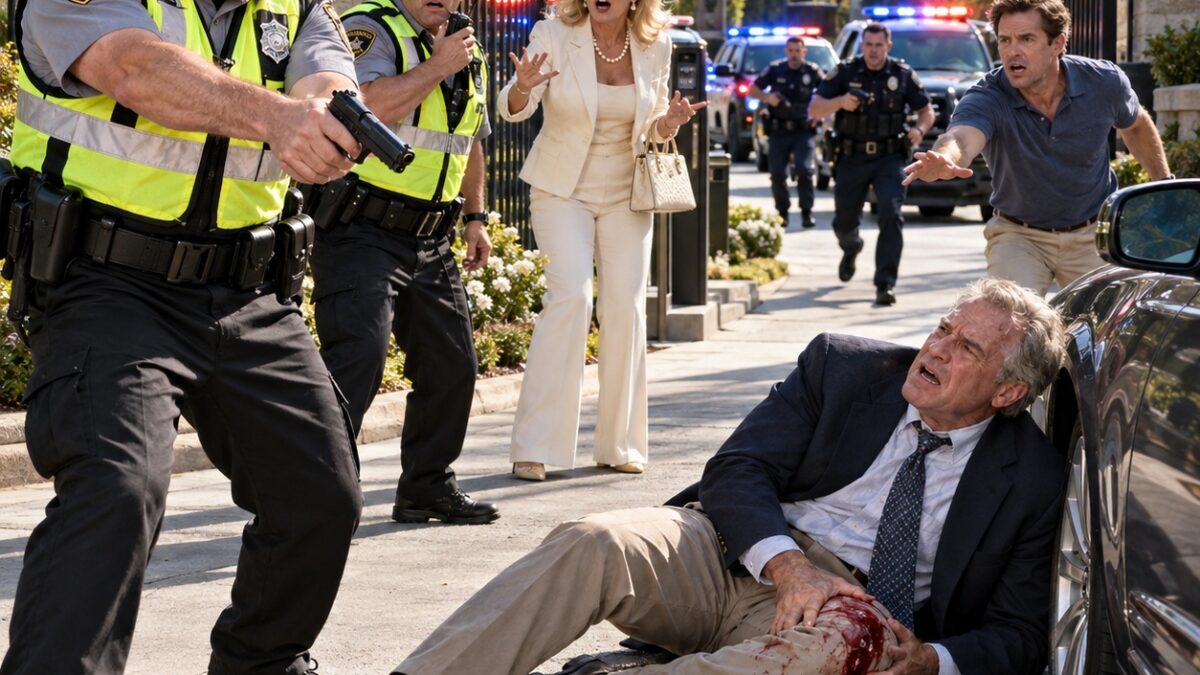
I shoved through the small crowd forming around the gate.
Arthur was on his side beside the driver’s door.
His face was pale.
His jaw clenched.
One hand pressed above his knee.
Blood had already reached the pavement.
“Arthur.”
His eyes found me.
“I’m all right.”
“You’ve been shot.”
“So I’ve noticed.”
Even then.
Calm.
Controlled.
I took off my jacket.
Pressed it against the wound.
Arthur inhaled sharply.
“Sorry.”
“Keep pressure.”
Behind me, somebody shouted:
“Put the gun down.”
I looked up.
The patrolman’s name was Curtis Hale.
I knew him.
Everybody did.
Forty-something.
Former car salesman.
Loved tactical gear.
Had spent the previous year referring to his volunteer shifts as “duty.”
He stood several feet away holding a handgun pointed toward the ground.
His hands shook.
Beside him was another HOA patrol member named Dean Parker.
Dean had no weapon drawn.
He looked terrified.
Curtis looked angry.
That difference mattered.
“What the hell were you thinking?” I shouted.
Curtis straightened.
“He refused a lawful security inspection.”
“No.”
Arthur’s voice was weak but clear.
Curtis looked down at him.
Arthur continued:
“I refused a private citizen’s request to search my automobile.”
“You were instructed to open the trunk.”
“I was not legally required to do so.”
Curtis took one step forward.
Several phones immediately turned toward him.
“Stay back,” someone yelled.
Curtis stopped.
Dean whispered:
“Curtis, put it away.”
Curtis ignored him.
“He reached back into the car.”
Arthur actually laughed once.
Short.
Painful.
“For my phone.”
“You moved suddenly.”
“You had already threatened to detain me.”
Curtis’s face tightened.
“I told you to remain still.”
Arthur looked at me.
“Is this normal here?”
I almost said no.
Then I realized that would have been dishonest.
Maybe not the gunshot.
But everything before it?
Yes.
The commands.
The intimidation.
The certainty that nobody would challenge them.
That was normal.
Sirens arrived within minutes.
Real police.
Three cruisers.
Then an ambulance.
The first officer out of the vehicle took one look at Curtis’s gun and shouted:
“Place the firearm on the ground now.”
Curtis froze.
The transformation was immediate.
Five minutes earlier, he had been giving orders.
Now someone with actual legal authority was giving one to him.
Curtis lowered the weapon.
“Officer, I’m security.”
“Gun. Ground. Now.”
Curtis placed it down.
Another officer moved in.
Kicked it away.
Handcuffed him.
Curtis protested.
“We have a cooperative agreement with the association.”
“Stop talking.”
“We were conducting an authorized vehicle inspection.”
“Stop talking.”
Dean was separated.
Witnesses moved back.
Paramedics reached Arthur.
They cut the fabric around the injury.
One asked:
“Entrance wound only?”
Arthur said:
“I believe so.”
“Sir, let us determine that.”
“Fair.”
Even the paramedic almost smiled.
Then an officer asked for identification.
Arthur looked toward his jacket.
“Inside pocket.”
The officer carefully removed a leather wallet.
Opened it.
Saw the driver’s license first.
Then another credential.
His expression changed.
He looked at Arthur.
Then back at the credential.
“Judge Reed?”
Arthur closed his eyes briefly.
“Yes.”
The officer’s posture straightened.
Not worshipfully.
Not dramatically.
Professionally.
He turned to his sergeant.
Spoke quietly.
The sergeant walked over.
“Sir, are you Judge Arthur Reed of the United States District Court?”
“Yes.”
Curtis heard.
His face drained.
Dean whispered something I couldn’t hear.
The crowd began murmuring.
Federal judge.
The words spread.
I remember looking at Arthur and thinking how absurd it was that his identity suddenly made everyone understand the seriousness more clearly.
He had been an unarmed visitor shot for refusing an unauthorized search before anybody knew his job.
That should have been enough.
Arthur seemed to think the same thing.
As paramedics lifted him onto the stretcher, he looked directly at the sergeant.
“My occupation is not the issue.”
The sergeant nodded.
“No, sir.”
“The shooting is.”
“Yes, sir.”
“Then investigate it that way.”
That told me more about Arthur than his title did.
The ambulance left.
Police remained for hours.
They photographed the gate.
Marked where shell casing evidence was found.
Collected Curtis’s firearm.
Separated witnesses.
Took phones from several residents voluntarily to copy video.
Then they discovered something Brenda Sterling would spend the next several months regretting.
The gate itself had recorded everything.
Four HOA cameras.
Multiple angles.
Audio on two.
Curtis and Dean had been standing outside the booth when Arthur arrived.
The video showed his sedan stopping.
Dean approached first.
Arthur lowered his window.
Dean asked his address destination.
Arthur provided mine.
Curtis joined.
Asked whether Arthur had anything “restricted” in the vehicle.
Arthur said no.
Curtis then ordered him to open the trunk.
Arthur asked:
“Under what authority?”
Curtis replied:
“Community security regulation.”
Arthur said:
“That is not legal authority to search a private vehicle.”
No yelling.
No threat.
No insult.
Curtis leaned toward the window.
“Sir, entry is conditional on inspection.”
Arthur answered:
“Then deny entry. You may not search the vehicle.”
That should have ended it.
If the HOA truly had a lawful gate policy allowing denial of access under certain private contractual conditions, they could have addressed that through the homeowner and governing documents later.
What Curtis could not do was transform a refusal into criminal suspicion.
But that was exactly what happened.
The video showed Curtis stepping in front of the sedan.
“You are not free to leave until this is resolved.”
Arthur opened the driver’s door.
Curtis ordered:
“Stay in the vehicle.”
Arthur stepped out anyway.
Hands visible.
“I am leaving.”
Curtis moved closer.
Arthur took out his phone.
Curtis grabbed his wrist.
Arthur pulled back.
Then Curtis drew the gun.
Dean could be heard saying:
“Curtis, no.”
Arthur stepped backward.
His left hand went toward the open driver’s door.
Gunshot.
Arthur fell.
There was no lunge.
No weapon.
No attempt to strike Curtis.
No mystery.
The HOA’s own cameras had captured their patrolman creating the confrontation he later described as self-defense.
By evening, Curtis was under arrest.
Dean was questioned and released pending further investigation.
Brenda Sterling arrived at the gate around five.
I watched her step from her SUV.
Designer sunglasses.
Clipboard.
Of course.
She marched toward the officers.
“I need to understand why association property has been taken.”
The sergeant stared at her.
“What property?”
“Our security firearm.”
“It is evidence.”
“The patrol radios?”
“Evidence.”
“Our access logs?”
“Potential evidence.”
Brenda looked offended.
“This is a private residential association.”
“Yes.”
“You cannot simply seize our operating materials.”
The sergeant glanced at the warrant paperwork an officer was already preparing with investigators.
“We can collect evidence connected to a shooting.”
Brenda lowered her voice.
“I need to contact association counsel.”
“That sounds wise.”
I was standing twenty feet away.
Brenda noticed me.
“This is exactly why residents should not interfere with security.”
I stared at her.
“Your security officer shot my guest.”
“He allegedly discharged a weapon during a confrontation.”
“Arthur is in surgery.”
“We should wait for facts.”
“The facts are on your cameras.”
That stopped her.
Only for half a second.
But I saw it.
“What cameras?”
“The four cameras your board installed because you wanted everything documented.”
Her face changed.
Then she walked away.
That was when I knew Brenda understood before the rest of us did.
The same surveillance system she had used to intimidate residents had just become the most important witness against her own organization.
Arthur’s bullet had passed through the outer portion of his thigh without striking the femur or major artery.
That was the good news.
The bad news was surgery, significant blood loss, and months of recovery.
I visited the next morning.
He looked exhausted.
“You have terrible neighborhood hospitality,” he said.
“I’ve been told.”
“You should consider a fruit basket instead.”
I sat beside the bed.
“I’m sorry.”
“For?”
“I invited you there.”
Arthur looked at me.
“You did not shoot me.”
“I knew those idiots were getting worse.”
“Did you know they would shoot someone?”
“No.”
“Then stop trying to retroactively become omniscient.”
That sounded like a judge.
I smiled.
Then his expression became serious.
“How long have they been searching vehicles?”
“I don’t know if they’ve actually searched many.”
“Demanding searches.”
“Months.”
“Detaining people?”
“Calling it delaying entry.”
“That wasn’t my question.”
I thought about contractors kept at the gate.
Teenagers questioned.
A moving truck blocked for nearly an hour.
“Yes.”
Arthur nodded.
“Then this is larger than me.”
It became larger very quickly.
By noon, federal judicial security officials had been notified because a sitting federal judge had been shot.
The United States Marshals Service became involved in assessing whether Arthur had been targeted because of his judicial role.
There was initially no evidence of that.
That mattered.
Curtis had apparently not known who Arthur was.
But federal authorities still had a legitimate interest in ensuring the shooting was not connected to threats against the judiciary.
Local investigators handled the core shooting case while federal agencies coordinated on issues within their jurisdiction.
The story online was simpler.
HOA FAKE COP SHOOTS FEDERAL JUDGE.
That headline traveled everywhere.
Television trucks appeared outside our gates.
Residents who had spent years hiding from HOA meetings suddenly wanted interviews.
Brenda released a statement.
It called the shooting:
“An unfortunate incident arising from a visitor’s failure to comply with established community safety procedures.”
Arthur read it from his hospital bed.
Then looked at me.
“She has a lawyer?”
“Association lawyer.”
“He should take her phone away.”
The statement became a disaster.
Because now reporters asked:
What procedures?
Where were they written?
Who authorized vehicle searches?
Who trained armed HOA patrol members?
What authority did they have to detain anyone?
Those were questions we should have asked years earlier.
The answers were ugly.
The HOA bylaws allowed the association to contract for security services.
That was ordinary.
They allowed gate access control.
Ordinary.
They allowed visitor verification.
Also ordinary.
What they did not contain was any authorization for involuntary searches.
No detention power.
No enforcement authority resembling law enforcement.
Brenda’s “security task force” had grown mostly through internal memos.
Some had never been properly approved by the full board.
One memo titled ENHANCED GATE COMPLIANCE PROCEDURE instructed patrol volunteers to “retain noncompliant visitors at checkpoint pending resolution.”
Another told patrol personnel they could request “visual inspection of vehicle compartments when suspicious behavior is observed.”
Request.
Brenda had allowed that word to evolve into order.
Then demand.
Then detention.
Residents began sharing stories.
A plumber said Curtis made him open three toolboxes.
A college student said Dean had searched her trunk after telling her she could not leave until she complied.
A home health nurse said Brenda personally photographed the contents of her vehicle because she carried medical equipment.
A delivery driver produced dashcam video of Curtis threatening to “have him trespassed” because he refused to open a locked cargo compartment.
The pattern grew.
Then former patrol volunteers started talking.
One man named Dennis contacted investigators.
He had quit six months earlier.
Why?
Because Brenda wanted volunteers to behave more aggressively.
Dennis handed over training packets.
Training was a generous term.
Printed materials.
YouTube links.
Brenda’s own presentation slides.
One slide read:
PROJECT AUTHORITY.
Another:
COMMAND PRESENCE PREVENTS RESISTANCE.
Arthur saw a photograph of that slide.
He stared for several seconds.
“Command presence?”
I shrugged.
“You cannot make this up.”
“They tried.”
Investigators discovered that the HOA had purchased radios, tactical flashlights, restraints, body armor, and badge-style identification.
Some items were legal.
Some raised licensing and regulatory questions depending on how they were used.
The major problem wasn’t owning equipment.
It was creating the impression of police authority.
Several patrol members had reportedly introduced themselves as “officers.”
One visitor said Curtis told him:
“We have the same authority inside this community as city police.”
False.
Completely.
Dangerously.
Brenda denied directing anyone to say that.
Then an old HOA meeting recording surfaced.
A resident had asked whether volunteers could legally stop vehicles.
Brenda answered:
“Within our private community, our security personnel function as the first line of law enforcement.”
Arthur listened.
Closed his eyes.
“That phrase is going to become expensive.”
The HOA attorney resigned within the week.
Technically, his firm terminated representation over a conflict.
Residents interpreted that more colorfully.
Emergency meeting notices appeared.
For the first time, Brenda could not control attendance.
The clubhouse overflowed.
People stood outside.
I sat in the second row.
Brenda stood at the podium.
Her voice was still controlled.
“First, I want to remind everyone that this board cannot comment on an ongoing criminal investigation.”
A man behind me said:
“You commented when you blamed the victim.”
Applause.
Brenda stiffened.
“Please maintain order.”
Someone laughed.
Order had always been Brenda’s favorite word.
She continued.
“The patrol program was created for safety.”
I raised my hand.
She ignored me.
I stood anyway.
“Who authorized vehicle searches?”
“We are not conducting litigation here.”
“Who?”
“Please sit.”
“Was there a vote?”
Brenda’s face tightened.
A board member named Susan Keller spoke from the table.
“I never voted on searches.”
Another member looked toward her.
“Neither did I.”
Brenda turned.
“This is not appropriate.”
Susan opened a binder.
“I reviewed minutes for two years. There is no vote authorizing searches.”
The room erupted.
Brenda struck the gavel.
“Order.”
Nobody cared.
For four years, that gavel had silenced people.
That night it sounded like a toy.
Then Dennis, the former patrol volunteer, stood.
“I was instructed by Brenda to treat refusal as probable cause.”
The room went quiet.
Brenda stared at him.
“That is false.”
Dennis held up printed emails.
“I saved everything.”
There it was.
The phrase that destroys bad leadership.
I saved everything.
Investigators eventually received those emails.
One from Brenda read:
VISITORS WHO REFUSE INSPECTION SHOULD NOT BE PERMITTED TO WITHDRAW WITHOUT IDENTITY VERIFICATION.
Another:
A STRONG SECURITY POSTURE REQUIRES SUBJECTS TO UNDERSTAND THAT NONCOMPLIANCE HAS CONSEQUENCES.
Subjects.
We were neighbors.
Visitors.
Contractors.
Friends.
Brenda had turned people into subjects because subjects sounded like something she could control.
Arthur remained in recovery while the scandal expanded.
He hated the attention.
Especially stories implying the HOA patrol deserved more punishment because he was a judge.
During one interview after being discharged, he said:
“I had exactly the same right to refuse an unauthorized search as any other visitor.”
The reporter asked:
“Did your position make the situation more serious?”
Arthur replied:
“My position brought attention. The injury was serious before anyone opened my wallet.”
That line spread almost as widely as the shooting video.
It shifted something.
Residents who had previously spoken only about Arthur began talking about everybody else.
The nurse.
The student.
The delivery drivers.
The contractors.
People whose stories had seemed small because nobody got shot.
Arthur’s injury became the point where years of accumulated misconduct finally became impossible to ignore.
Curtis’s criminal case moved forward.
His attorney argued he believed Arthur was reaching for a weapon.
The video made that difficult.
Arthur’s phone was found near the open driver’s door.
No weapon existed in the car.
Multiple witnesses said Arthur had been calm.
Dean testified that he had told Curtis to stop.
More importantly, Dean admitted neither man had lawful authority to detain Arthur.
Curtis had been trained primarily by the HOA itself.
That opened civil questions.
Who created the policy?
Who knew volunteers carried weapons?
Who supervised them?
What complaints had been filed before the shooting?
That last question became catastrophic for Brenda.
There had been complaints.
Many.
I knew some.
Not all.
A resident named Monica Ellis had written six months earlier:
I am concerned that patrol volunteers are representing themselves in a manner that visitors reasonably mistake for sworn law enforcement.
Brenda responded:
Security effectiveness depends on visible authority.
Another homeowner complained after Curtis blocked his son’s car.
Brenda wrote:
Residents who undermine patrol authority create unnecessary risk.
A third warned specifically:
Someone is going to get hurt if armed volunteers believe they can physically detain visitors.
That email was fourteen weeks old on the day Arthur was shot.
When I read it, I had to put the paper down.
Arthur was still using a cane.
He looked at the email.
Then at me.
“She was warned.”
“Yes.”
“That changes things.”
It did.
Not magically.
Not into some instant conviction.
But it established notice.
Brenda could no longer plausibly say nobody imagined escalation.
Someone had imagined it.
In writing.
She dismissed them.
The HOA’s insurance carrier opened its own investigation.
Then sent a reservation-of-rights letter that frightened the board more than the federal vehicles had.
Coverage might be disputed depending on intentional conduct, unauthorized armed activities, misrepresentation, and policy violations.
That meant residents suddenly understood something else.
Brenda’s fantasy police force wasn’t only dangerous.
It might be financially catastrophic.
Legal bills mounted.
Special meetings multiplied.
Property owners demanded Brenda resign.
She refused.
At first.
“I will not abandon this community during a crisis.”
Susan Keller replied:
“You created the crisis.”
Brenda glared.
Susan did not look away.
That was new.
Fear was leaving the room.
Slowly.
One person at a time.
A recall petition began.
The governing documents required a certain percentage of member signatures to force a special vote.
Brenda had relied for years on residents not knowing procedures.
Now everybody was reading them.
People went door to door.
Not threatening.
Not campaigning with dramatic speeches.
Just:
Here is the section.
Here is the requirement.
Here is the signature line.
Within four days, they had more than enough.
Brenda challenged several signatures.
Residents corrected technical issues and resubmitted.
She claimed notice defects.
A lawyer volunteering for the homeowner group fixed them.
She tried to postpone the meeting.
The governing documents did not give her that power.
Every tactic failed because, for once, people knew the rules better than the person abusing them.
The recall meeting was scheduled for a Thursday evening.
Arthur asked whether he should attend.
I said:
“No.”
“Why?”
“You’re still recovering.”
“I can walk.”
“With a cane.”
“I’ve seen judges with worse mobility.”
“This isn’t your fight.”
Arthur considered that.
Then nodded.
“Good.”
“What?”
“You’re finally learning.”
“Learning what?”
“That my title isn’t your weapon.”
That hit me.
He was right.
After the shooting, residents sometimes talked about Arthur like a secret superweapon.
They shot a federal judge.
Now they’re finished.
But Arthur’s position wasn’t what fixed our community.
Evidence did.
Residents did.
Procedure did.
Real law enforcement did.
Arthur was the person Brenda’s system happened to injure badly enough that everybody stopped looking away.
At the recall meeting, the room was packed again.
Brenda sat at the front.
No gavel this time.
An independent meeting chair had been selected under the bylaws.
Ballots were distributed.
Homeowners voted.
The result wasn’t close.
Brenda was removed.
Three board members aligned with her resigned within minutes.
Susan became interim president only because nobody else wanted the job.
Her first words were:
“We are not creating another security committee.”
The room laughed harder than the joke deserved.
Relief does that.
The patrol program was suspended immediately.
Gate control reverted to a licensed private security company under a carefully limited contract.
No fake badges.
No volunteer armed patrol.
No car searches.
Visitors could be denied access according to lawful private gate procedures where applicable, but nobody would be physically detained except under the narrow circumstances available to any private citizen under actual law.
Most importantly:
Security staff were explicitly prohibited from representing themselves as police.
The metal COMMUNITY PATROL badges disappeared.
Reflective vests went into storage.
Radios were sold.
The little guard office was repainted.
Someone joked that we should turn it into a coffee stand.
I supported the idea.
The investigation continued after Brenda lost office.
Removing someone from an HOA board does not erase evidence.
Records showed questionable spending connected to the patrol program.
Equipment purchases had been approved without full board votes.
Some reimbursements lacked receipts.
That did not turn into the massive financial crime fantasy some residents expected.
There was no secret cartel.
No hidden millions.
Just poor governance, unauthorized expenses, sloppy records, and a culture built around one person’s increasing appetite for control.
That was almost more disturbing.
There wasn’t one giant evil scheme behind everything.
There had simply been years of ordinary people allowing bad decisions to become normal.
Curtis eventually faced serious criminal consequences for the shooting.
The exact legal outcome took time.
Negotiations.
Hearings.
Arguments over intent.
The video remained central.
Dean cooperated.
Arthur testified when required.
He did not perform outrage.
He answered questions.
What did Curtis say?
What did Arthur do?
Where were his hands?
Did he have a weapon?
No.
Did he consent to a search?
No.
Did he attempt to leave?
Yes.
Was he threatened with detention?
Yes.
Simple facts.
Civil litigation followed separately.
Arthur sued Curtis and parties he alleged bore responsibility for the patrol program.
Other residents brought claims of their own over previous incidents.
Not everyone won everything they wanted.
Law rarely gives perfect endings.
But the process forced documents into daylight.
Policies.
Emails.
Complaints.
Board minutes.
Training material.
That transparency changed us more than any settlement figure.
We finally saw exactly how a landscaping association had drifted into pretending it governed a police district.
It began with language.
Neighborhood watch.
Then security initiative.
Then patrol.
Then officers.
Then compliance.
Then detention.
Then a gunshot.
Words had moved first.
Authority followed because nobody challenged what those words implied.
I thought about that constantly.
Curtis had not awakened one morning and randomly decided he was a cop.
We had spent years allowing him to act like one.
Brenda praised him.
The board funded him.
Residents obeyed him.
Visitors couldn’t distinguish his metal badge from something official.
Every successful intimidation became evidence, in his mind, that he really possessed the authority he was pretending to have.
Power does not always begin with law.
Sometimes it begins when everybody behaves as if the costume is real.
Arthur recovered slowly.
The bullet had missed bone but damaged muscle.
Physical therapy became part of his week.
He complained about it constantly.
One afternoon, months after the shooting, he finally returned to my house.
This time there was no checkpoint drama.
The new professional guard checked his name against my visitor list.
No trunk search.
No commands.
Arthur drove through.
I met him outside.
He stepped from the car with a cane.
Looked back toward the gate.
“That was disappointingly normal.”
“I’ll ask them to shoot at you if you want nostalgia.”
He stared at me.
“Too soon.”
“You started the joke.”
“Fair.”
We went inside.
The professional conversation we had originally scheduled took twenty-two minutes.
That almost made me angry.
All of it.
The ambulance.
Federal attention.
HOA collapse.
Months of investigation.
Because Arthur wanted twenty-two quiet minutes at my dining table.
When we finished, I asked:
“Why did you insist on meeting here?”
He looked confused.
“I didn’t insist.”
“You rejected my office and the café.”
“I value privacy.”
“That explanation caused a lot of trouble.”
Arthur smiled.
“Would you like the less polite answer?”
“Please.”
“Your office had glass walls.”
“Okay.”
“The café you suggested is terrible.”
I stared.
“You got shot because you didn’t like my café?”
“That is a very irresponsible summary.”
I laughed so hard I had to sit down.
Arthur laughed too.
For the first time, the incident felt far enough away that humor didn’t feel wrong.
Then he became serious.
“Has the neighborhood changed?”
“Yes.”
“Better?”
“Quieter.”
“That’s usually better.”
We walked outside later.
Arthur paused where the old patrol vehicle used to sit.
“You know what bothered me most?”
“The bullet?”
“Second most.”
I waited.
“The certainty.”
“Curtis?”
“All of them.”
Arthur looked toward the gate.
“They weren’t asking themselves whether they had authority. They had become certain authority followed from obedience.”
I understood.
Because I had seen it.
“People obeyed.”
“Yes.”
“So they believed they were entitled to obedience.”
“Yes.”
He looked at me.
“That is a dangerous feedback loop anywhere.”
The new HOA board became almost aggressively boring.
Monthly financial statements.
Published minutes.
Recorded votes.
Vendor contracts available for inspection.
Actual security issues referred to actual professionals.
Architectural disputes handled as architectural disputes.
Nobody wore body armor to discuss mailbox paint.
Susan Keller served one year as president.
Then refused reelection.
“Power should be temporary,” she said.
Everybody looked at Brenda’s former empty chair.
Point understood.
We rewrote several internal policies.
Not because policies alone prevent abuse.
Because ambiguity had been Brenda’s favorite hiding place.
Visitor procedures were clear.
What gate staff could request.
What they could refuse.
What they could not do.
No physical search of a visitor’s vehicle without voluntary consent where legally permissible and relevant.
No holding someone’s identification beyond legitimate check procedures.
No representing private rules as criminal law.
No weapons for HOA volunteers.
Actually, no HOA patrol volunteers at all.
The neighborhood watch returned to what neighborhood watch should have been.
Call police if you see a crime.
Check on elderly neighbors.
Share camera footage after thefts.
Do not become Batman.
One resident printed that final rule on a T-shirt.
Arthur bought one.
He wore it under a suit jacket when he visited months later.
I called that judicial misconduct.
He called it fashion.
The biggest change was cultural.
People stopped being afraid of meetings.
That sounds small.
It wasn’t.
Under Brenda, meetings had felt like disciplinary hearings.
Residents sat quietly.
Brenda announced.
The board approved.
People left.
Afterward, meetings became messy.
Arguments.
Questions.
Occasional stupidity.
One man spent fifteen minutes complaining that the new gate company smiled “too casually.”
Another demanded a rule against wind chimes.
Someone else asked why we needed rules about anything.
Democracy is exhausting.
I loved it.
Messiness meant nobody controlled the room completely.
The neighborhood stopped looking as perfect too.
A mailbox remained the wrong gray for three months.
Civilization survived.
Someone planted flowers Brenda would have considered “too visually inconsistent.”
Property values did not collapse.
Children chalked sidewalks.
Contractors came through the gate without interrogations.
Arthur’s shooting became a story reporters returned to whenever private security overreach made news.
He hated being described as “the federal judge shot by an HOA cop.”
“I had thirty years of legal work before that idiot found me,” he complained.
“Headlines are cruel.”
“So are neighbors.”
“Former neighbors’ security volunteers.”
“Precision appreciated.”
He eventually returned fully to work.
No cane.
Slight limp after long days.
He never carried bitterness the way I expected.
Anger, yes.
Very precise anger.
But not obsession.
I once asked why.
He thought for a moment.
“Because I don’t want Curtis to occupy more of my life than the bullet already did.”
That stayed with me.
Brenda moved six months after the recall.
No dramatic foreclosure.
No federal prison caravan.
She sold her house.
Packed.
Left.
The morning the moving truck arrived, several residents watched from windows.
Nobody celebrated outside.
I saw her once.
She stood beside her car.
For a moment, our eyes met.
I walked over.
Not sure why.
She looked tired.
Older.
“You got what you wanted,” she said.
“What did I want?”
“Me gone.”
I shook my head.
“No.”
“Don’t pretend.”
“I wanted your patrol to stop acting like police.”
“They were trying to protect people.”
“They shot a man who said no to a search.”
Her jaw tightened.
“One man’s mistake destroyed years of work.”
“No.”
I had thought about this.
“A hundred smaller mistakes built the thing that made his possible.”
She looked away.
“You never liked me.”
“This wasn’t about liking you.”
“Easy to say now.”
I almost argued.
Then stopped.
Brenda still wanted the story to be personal.
Me against her.
Arthur against her.
Ungrateful residents against her.
That explanation protected her from the harder one.
Systems fail when leaders stop accepting limits.
I could not teach her that in a driveway.
So I said:
“Take care, Brenda.”
She looked disappointed.
Maybe she wanted one final fight.
I went home.
That was the last conversation we had.
Years later, the gate still stands.
Same stone pillars.
Different cameras.
Different booth.
If you drove in now, you’d probably think our neighborhood looked ordinary.
That’s the best thing anyone can say about it.
The HOA handles landscaping.
Pool maintenance.
Common-area insurance.
Road issues.
Exactly the boring things it should.
Nobody performs traffic stops.
Nobody orders anyone to open a trunk.
Nobody calls residents “subjects.”
Sometimes a new homeowner hears the Arthur story and assumes it has become exaggerated.
“No way they actually had badges.”
We show them one.
Susan kept a badge from the evidence returned after proceedings concluded.
It sits in a small frame inside the clubhouse.
Below it is a plaque.
Not dramatic.
Just:
PRIVATE AUTHORITY HAS LIMITS.
Arthur visited once and saw it.
He laughed.
“You framed stupidity.”
“Educational display.”
“Fair.”
Then he noticed something else.
Beside the badge was the first page of the rewritten security policy.
He read it.
Nodded.
“That part matters more.”
Of course a judge would say that.
The shooting footage is difficult for me to watch even now.
I’ve seen it too many times.
News.
Court.
Depositions.
The same seven seconds.
Arthur stepping away.
Curtis’s arm lifting.
Dean turning.
Gunshot.
Arthur falling.
You always imagine tragedy as something complicated enough that you could prevent it with enough wisdom.
Sometimes it isn’t.
Sometimes everything comes down to one person believing another human being owes him obedience.
Arthur said no.
Curtis heard challenge.
That was it.
Months later, I apologized to Arthur again.
He rolled his eyes.
“Still doing this?”
“Yes.”
“For what?”
“For not pushing back sooner.”
He considered that answer differently.
“All right.”
“You agree?”
“I agree there is something worth regretting.”
I looked at him.
“But guilt isn’t useful unless it changes future behavior.”
Very judge answer.
“What should we have done?”
“Asked basic questions.”
“Like?”
“Where does this authority come from?”
I nodded.
“Who approved it?”
Another nod.
“What happens if someone refuses?”
Exactly.
Brenda’s system survived because nobody forced it to answer those questions in public.
Residents thought:
It’s easier to open the trunk.
Easier to show identification.
Easier to let them look in the van.
Easier to pay the fine.
Easier not to attend the meeting.
Every easier choice made the next abuse easier too.
I don’t judge those people.
I was one of them.
Most abuses of petty power do not look worth fighting individually.
That’s why they accumulate.
Ten-minute delay.
Fifty-dollar fine.
Rude volunteer.
Unnecessary question.
Then one day you look up and somebody wearing a vest purchased with your HOA dues is standing over a bleeding man explaining that he deserved to be shot because he did not comply.
That was our wake-up call.
A brutally expensive one.
Arthur once told me something else.
“People keep saying I was lucky to be a federal judge.”
“What do you tell them?”
“That I was lucky Curtis was a bad shot.”
I laughed.
He didn’t.
Then I understood.
His title gave him resources.
Attention.
Institutional support.
But the bullet had not cared.
The wound had not cared.
The hospital had not cared.
And if Arthur had been a plumber, driver, salesman, delivery worker, or unemployed cousin visiting someone behind the gate, the shooting would have been just as wrong.
Maybe fewer cameras would have shown up afterward.
That possibility bothered him deeply.
It bothered me too.
So we kept the story honest.
The lesson was never:
Don’t shoot someone because he might secretly be powerful.
The lesson was:
Don’t invent authority you don’t have.
Don’t turn refusal into guilt.
Don’t mistake a uniform for law.
Don’t give private institutions powers because questioning them feels inconvenient.
And never assume the person standing quietly in front of you has fewer rights because you don’t know who he is.
Arthur’s identity changed the attention.
It did not change the principle.
The principle existed before the officer opened his wallet.
That became the line I repeated whenever reporters asked.
Eventually, they stopped asking.
Stories age.
New scandals replace old ones.
Neighbors move.
Children grow.
The pavement where Arthur fell was resurfaced two years later.
The blood stain had been gone much earlier.
The physical place looked ordinary again.
I stood there once during roadwork.
Remembered kneeling beside him with my jacket pressed to his leg.
The contractor asked:
“You okay?”
“Yeah.”
He pointed toward the entrance.
“Crazy story, huh?”
“You know it?”
“Everyone does.”
He laughed.
“Fake HOA cops.”
I didn’t laugh.
Not because he was wrong.
Because “fake cops” sounded funny.
It had always sounded funny.
Until a real bullet came from a fake cop’s gun.
That’s the danger of ridicule.
Sometimes laughing at something makes us underestimate it.
The vests were ridiculous.
The badges were ridiculous.
The radios were ridiculous.
The power behind them became real because people behaved as though it were.
I never laughed at pretend authority the same way afterward.
I questioned it.
That’s healthier.
The current board once proposed adding license-plate recognition cameras.
Reasonable technology.
Security benefit.
The old version of our neighborhood would have approved it after a presentation.
Now residents asked:
Who stores the data?
How long?
Who can access it?
Can it be shared?
What is the deletion policy?
The proposal went back for revision.
Susan, sitting beside me, whispered:
“Arthur would be proud.”
I said:
“Arthur would ask seventeen more questions.”
Probably true.
That’s what changed.
We stopped confusing questions with disloyalty.
Good organizations survive questions.
Bad authority fears them.
The last time Arthur visited, we sat on my porch.
He had retired from the bench.
His hair had gone almost completely gray.
His limp was barely visible.
“You know,” I said, “you’re finally safe to visit.”
“Why?”
“No HOA commandos.”
He looked toward the gate.
“I almost miss them.”
“No, you don’t.”
“Absolutely not.”
We drank coffee.
A delivery van passed.
Guard waved it through after verification.
No search.
No drama.
Arthur watched.
“Perfect.”
“What?”
“Nothing happened.”
I understood.
Nothing happening is underrated.
No confrontation.
No sirens.
No blood.
No residents filming because they fear another disaster.
Just a delivery van entering a neighborhood.
Ordinary life depends on thousands of people understanding the limits of their authority.
The driver understands the lane.
The guard understands the gate.
The HOA understands the covenant.
The police understand the law.
Judges understand the courts.
Nobody gets everything.
That is the point.
Brenda wanted authority without boundaries.
Curtis wanted obedience without lawful basis.
Arthur gave them neither.
Their entire system could have survived that afternoon if they had simply allowed one word to exist.
No.
No search.
Fine.
Turn around.
Call the homeowner.
Check the rules.
Anything.
Instead, they interpreted no as rebellion.
That single mistake exposed every larger mistake beneath it.
The fake badges.
The unauthorized procedures.
The ignored complaints.
The misleading language.
The gun.
The culture.
Years later, when I tell the story, people always lean forward at the same moment.
“And then they found out he was a federal judge?”
Yes.
But that’s not the part I think about most.
I think about the seconds before they knew.
Arthur on the ground.
Curtis still defending himself.
Neighbors filming.
Everyone finally seeing what we had allowed to grow.
Arthur was already entitled to justice before anybody knew his name.
That is the ending our neighborhood had to learn.
Not that we accidentally mistreated an important man.
That we had built a little system where people believed strangers had to prove they were important before their rights mattered.
We dismantled that system.
Slowly.
Legally.
Boringly.
The best way.
Today, visitors pull up to the same gate Arthur did.
A licensed guard asks who they’re visiting.
Checks the resident list.
Raises the barrier.
Cars move through.
Trunks remain closed.
Residents barely notice.
Sometimes I stand at my window and watch.
It makes me strangely happy.
Because the most satisfying ending was never Brenda leaving.
Never Curtis in handcuffs.
Never federal vehicles arriving.
Not even Arthur walking without a cane again.
It was watching authority become ordinary.
Limited.
Accountable.
Almost invisible.
The way it should have been from the beginning.
Arthur once told me that the law is often most important at the exact moment somebody believes it is inconvenient.
I understood what he meant.
At the gate, Curtis found Arthur’s refusal inconvenient.
So he tried to replace law with command.
A gunshot followed.
Our neighborhood spent years repairing what happened in that second.
But we did repair it.
And every time I drive through those stone pillars now, I remember the lesson written more clearly than any HOA covenant ever could.
A badge does not create authority.
A uniform does not create authority.
A gun definitely does not create authority.
And another person’s refusal to surrender a right does not make them a threat.
Sometimes “no” is simply no.
Our HOA learned that only after someone pulled a trigger.
I wish we had learned it when the only thing at risk was a mailbox color.
Arthur does too.
But when he came through the gate one final time before moving out of state, the guard checked his visitor pass and smiled.
“Have a good afternoon, sir.”
Arthur looked toward me.
“That it?”
“That is it.”
“No trunk inspection?”
“Afraid not.”
“No detention?”
“Budget cuts.”
He laughed.
Then drove through.
No sirens.
No raised voices.
No gun.
Just a man visiting a friend’s house.
And after everything our neighborhood had done to make simple things dangerous, watching something simple become simple again felt like the closest thing to justice I had ever seen.








