FULL STORY:The HOA Queen Sent Animal Control for My Guide Dog—She Forgot Every False Report Was Becoming Evidence
FULL STORY CONTINUATION
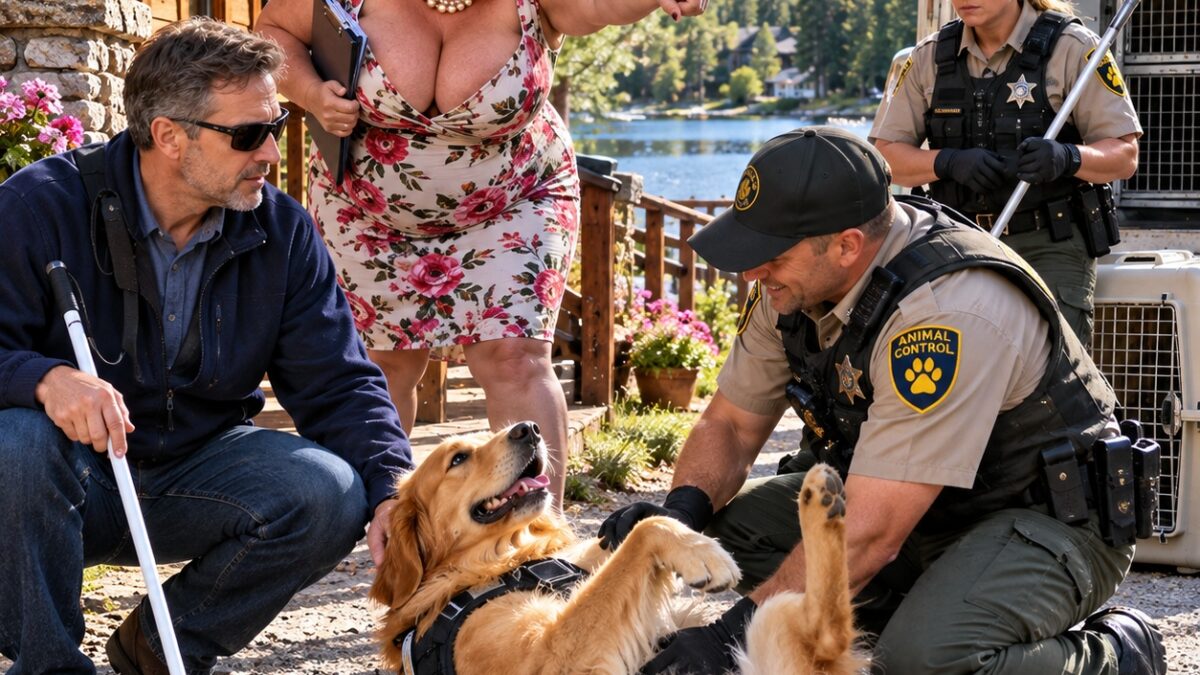
The taller officer introduced himself as Marcus Bell.
His partner was already crouched beside Bailey.
“This is the dangerous dog?” she asked.
Bailey rolled onto his back.
Marcus rubbed his forehead.
“Apparently.”
I stepped aside.
“You’re welcome to come in.”
“We probably don’t need to.”
“I’d prefer you document everything again.”
That made him look at me differently.
“Again?”
“This is the third complaint.”
“I know.”
“No. I mean I want the file to show you were invited inside, that Bailey’s paperwork was produced, that his behavior was observed, and that you found no immediate safety issue.”
Marcus glanced at his partner.
Then nodded.
“Fair enough.”
We sat at my kitchen table.
I produced Bailey’s county license, veterinary records, training records, and the documentation I kept for travel and work situations.
Marcus examined them.
Bailey rested under the table with his chin across my shoe.
“What exactly did she report this time?” I asked.
Marcus hesitated.
Then read from the complaint.
“Repeated aggressive lunging at multiple residents.”
Nothing.
“Roaming uncontrolled.”
I almost laughed.
“Following children near the playground.”
That one changed my expression.
“When?”
“Saturday afternoon.”
I opened my phone.
“My location history and appointment records show I spent Saturday in the city at a neurology appointment.”
“Dog with you?”
“All day.”
Marcus looked toward Bailey.
His partner said, “We can note that.”
“Please do.”
There were advantages to living in a world increasingly covered by timestamps.
Receipts.
Appointments.
Security systems.
Ride records.
Phone location data.
Patricia seemed to believe repetition could transform accusation into fact.
It could not.
But repetition could create something else.
Pattern.
Before leaving, Marcus said, “I’m going to speak with the complainant.”
“Patricia.”
“Yes.”
“This is the third unsupported report.”
He understood what I was asking.
“I’ll document it.”
“Thank you.”
Bailey stood.
Picked up his ball.
Followed us to the porch.
Marcus’s partner threw it once.
Patricia would have been furious.
The officers left around seven-thirty.
At eight-fifteen, Patricia’s voice came through my doorbell camera.
“You embarrassed me.”
I did not open the door.
The camera had audio.
Good enough.
“You there, David?”
Bailey stood beside me.
I pressed the intercom button.
“What do you need?”
“You deliberately performed for those officers.”
“I answered their questions.”
“That animal behaves differently when authorities are around.”
I almost admired the flexibility of her theory.
“What would you like me to do about that?”
“Stop pretending he’s harmless.”
“He is a trained guide dog.”
“I have witnessed aggression.”
“Then provide the video.”
Silence.
That mattered because Patricia had cameras everywhere.
Two on the side of her house.
One facing the shared road.
Another mounted high enough that it captured a portion of my property.
She had openly bragged about collecting evidence of my violations.
If Bailey had truly lunged at her, one would expect the woman obsessed with surveillance to possess footage.
She did not.
“I don’t have to prove myself to you.”
“You’re the one filing the reports.”
“You are impossible.”
She walked away.
Her sandals disappeared down the driveway.
I saved the clip.
File name:
Patricia_After_Animal_Control_3.
Then I opened the folder on my computer.
It was bigger than I expected.
HOA Notices.
Patricia Emails.
Animal Control.
Health Department.
Code Enforcement.
Photos.
Video.
Board Meetings.
Neighbor Statements.
There is something clarifying about organizing harassment chronologically.
Emotion becomes sequence.
Sequence becomes evidence.
The first questionable notice had arrived nine weeks earlier.
The second four days later.
Then came the barking claims.
Patricia said Bailey barked “for prolonged periods.”
My outdoor camera showed the opposite.
He barked when someone approached the property.
Usually once.
Sometimes twice.
One clip captured Patricia walking deliberately along the edge of my driveway.
Bailey barked.
She stopped.
Waited.
When he became quiet, she stepped closer.
He barked again.
She raised her phone.
The footage she later showed the HOA began at the second bark.
Her video omitted everything before it.
That told me something about Patricia’s methods.
She did not invent every piece from nothing.
She preferred fragments.
A bark without the approach.
A photograph without the harness.
A dog near children without showing the children throwing his ball.
A man with a cane described as “unable to maintain control of a large animal.”
Partial truth is easier to defend than complete fiction.
So I collected context.
Mrs. Morrison signed a statement.
Her two children, both old enough to understand Bailey’s job, knew they were never to distract him when his harness was on.
When the harness came off and I gave permission, Bailey transformed.
Guide dog became golden retriever.
He fetched.
Rolled in grass.
Carried sticks too large for his mouth.
Once stole an inflatable flamingo from the Morrisons’ yard and returned it only after extensive negotiation.
Mrs. Morrison wrote:
Bailey has never shown aggressive behavior toward my children. Patricia has repeatedly warned me that I am “putting them at risk,” despite having never observed an incident involving them.
Tom Henderson wrote about the azalea story.
He also gave me one of my favorite pieces of evidence.
His driveway camera covered the path where Patricia claimed Bailey had forced her to “dive into the bushes.”
The video showed Patricia walking normally.
Me and Bailey passing twenty seconds later.
Nobody diving anywhere.
Tom called me after reviewing it.
“You want the clip?”
“Yes.”
“You want the funny version or the lawyer version?”
“What’s the difference?”
“In the funny version I add circus music.”
“Lawyer.”
“Boring.”
I called my friend Daniel Cho.
Daniel was an attorney in the city.
He did not specialize exclusively in housing-discrimination cases, but he knew enough to understand the problem and refer me when necessary.
He reviewed the folder remotely.
When he finished, he said, “David, why have you waited this long?”
“I thought she’d get bored.”
“People like this don’t get bored when the other person keeps complying.”
“I’m not complying.”
“You keep responding individually.”
“What should I do?”
“Stop thinking about each incident separately.”
Exactly what I had begun realizing.
He continued.
“You have a disability.”
“Yes.”
“Bailey performs tasks related to that disability.”
“Yes.”
“You live in housing governed by an association.”
“Yes.”
“And an HOA officer is repeatedly targeting the animal connected to your disability while attempting to restrict how you use your property and common areas.”
“Yes.”
“That is no longer just a dog dispute.”
“What is it?”
“A housing and disability-access problem with a harassment pattern.”
He recommended I send a formal written accommodation and noninterference notice.
Not because Bailey suddenly needed permission to exist.
Because written requests create clear records.
The letter explained my visual disability.
Bailey’s function as a trained guide dog.
My need to use common pathways and community areas with him.
The repeated complaints.
The unsupported claims.
The surveillance.
It requested that the association cease discriminatory interference and route any legitimate safety concern through established board procedures supported by evidence.
Daniel sent it to the full board.
That was when I learned something important.
Patricia was not actually the sole authority she had pretended to be.
Robert Garfield held the formal board-president title in the association’s latest filings.
Patricia chaired the architectural and community-standards committees and had apparently been acting as the public face of enforcement so aggressively that even I had assumed she ran everything.
Robert called me.
He sounded seventy, tired, and deeply confused.
“Mr. Hartley?”
“David.”
“This is Robert Garfield.”
“I know.”
“I received your attorney’s letter.”
“Good.”
“There are references to surveillance cameras.”
“Yes.”
“What surveillance cameras?”
That question changed everything.
“You don’t know?”
“No.”
“Patricia has multiple cameras oriented toward my property. She says she’s collecting HOA violation evidence.”
Long silence.
“She has never received board authorization for that.”
Interesting.
“What about the animal-control complaints?”
“What complaints?”
More interesting.
I sent him the file.
Not all at once.
The clean version.
Timeline.
Notice copies.
Animal-control case numbers.
Health inspection.
Code enforcement.
Photos.
Statements.
Video links.
Robert called the next afternoon.
His voice had changed.
“David.”
“Yes?”
“We need a meeting.”
The emergency board session was scheduled for the following Thursday.
Patricia found out by Wednesday morning.
At 8:03, she emailed me.
Your attempts to undermine lawful HOA governance are noted. I will be presenting evidence of your continuing pattern of intimidation.
I forwarded it to Daniel.
His reply:
Please do not answer.
I didn’t.
At eleven, Patricia posted in the neighborhood Facebook group.
URGENT COMMUNITY SAFETY ISSUE.
She warned that “certain homeowners” were attempting to silence board volunteers who had raised legitimate concerns about dangerous animals.
Comments began immediately.
Some supported her.
Most asked:
Which animal?
Someone posted a photo of Bailey wearing reindeer antlers from the previous Christmas.
Someone else wrote:
Is this the dangerous beast?
Mrs. Morrison replied:
My children survived another afternoon of fetch. Pray for us.
I stayed out of it.
Daniel loved that.
“Never interrupt a bad argument while somebody else is making it for you.”
The Thursday meeting filled the community hall.
I arrived with Bailey in harness.
He guided me to an empty chair near the front.
I could hear whispers.
Not hostile.
Curious.
Patricia was already speaking when Daniel joined remotely on the board’s laptop.
Robert opened the meeting.
“For clarity, tonight’s session concerns complaints alleging improper enforcement, harassment, and unauthorized surveillance associated with Mr. Hartley and his service animal.”
Patricia interrupted.
“Guide dog.”
Robert stopped.
“What?”
“If we’re being technical, he calls it a guide dog.”
Daniel’s voice came through the speaker.
“Guide dogs are service animals.”
The room laughed quietly.
Patricia did not.
Robert continued.
“Mr. Hartley will present first.”
I stood.
Bailey rose automatically.
I rested one hand on his harness.
“I moved here because I wanted less conflict.”
A few people shifted.
“I did not move here to fight the HOA.”
“I did not object to ordinary rules.”
“I did not ask for permission to ignore safety requirements.”
I paused.
“What I asked was for my guide dog to stop being treated as a neighborhood threat without evidence.”
I handed Robert the first notice.
“Patricia claimed Bailey was an aggressive mixed breed before she knew anything about him.”
Second.
“She reported repeated barking.”
Third.
“She reported roaming.”
Fourth.
“She reported him following children.”
Then I played the animal-control audio.
Not private conversation.
The portion of the officer’s visit captured by my doorbell camera.
Bailey’s ball hit the porch.
The officer laughed.
Someone in the meeting chuckled.
Patricia crossed her arms.
“This proves nothing.”
I played the Henderson driveway footage.
Patricia walking calmly.
No dog near her.
Then me passing with Bailey.
Robert said, “This is the day you claimed you had to jump into the Hendersons’ landscaping?”
Patricia’s voice sharpened.
“The footage does not capture the entire event.”
Tom stood.
“My camera covers the whole front yard.”
She ignored him.
I played the barking clip.
Patricia approaching my property.
Waiting.
Stepping closer.
Bailey barking twice.
Then becoming silent.
Robert stared at her.
“Why were you walking up his driveway?”
“I was conducting compliance observation.”
“Were you authorized to enter his parcel?”
“I did not enter.”
Daniel spoke.
“The larger point is that the later video presented to the committee omitted the conduct leading to the barking.”
Patricia pointed toward the laptop.
“This lawyer is twisting everything.”
Daniel remained calm.
“No.”
He said it almost gently.
“I’m putting the pieces back in chronological order.”
That was the sentence that ended her momentum.
Chronological order.
Context.
Full record.
Patricia had spent months controlling fragments.
Now everybody could see the sequence.
Mrs. Morrison spoke next.
Then Tom.
Another homeowner described Patricia stopping him near the mailboxes and warning that Bailey might “snap someday.”
A retired nurse said she had watched Bailey guide me around a fallen branch without reacting to three barking dogs across the street.
Then Robert asked about the cameras.
“Did the board approve surveillance of Mr. Hartley’s residence?”
Patricia hesitated.
“They are mounted on my property.”
“That wasn’t the question.”
“I am entitled to security cameras.”
Daniel interrupted carefully.
“Ordinary security cameras and targeted surveillance conducted in an HOA enforcement capacity are not necessarily the same issue.”
Patricia snapped, “They point where I choose.”
Robert said, “You submitted footage from those cameras as association evidence.”
Silence.
He continued.
“You represented it as HOA monitoring.”
No answer.
Robert asked the secretary to read the relevant board minutes.
No authorization.
Then Daniel explained the legal problem in broader terms.
He did not give the dramatic speech Patricia expected.
No threats of immediate prison.
No guaranteed federal fines.
He simply explained that federal housing-discrimination protections generally require housing providers and associations to avoid disability-based discrimination and to accommodate disability-related needs, including legitimate assistance-animal situations where applicable.
He noted that persistent interference with access, selective restrictions, and harassment tied to disability could expose an association and individuals to serious civil liability.
Then he said:
“What makes this situation especially concerning is the volume of unsupported reports after the association had notice of Mr. Hartley’s disability and Bailey’s role.”
Robert looked ill.
“So the HOA could be liable.”
“Yes.”
“Even if the board didn’t know?”
“That depends on facts, notice, authority, corrective action, and many other questions.”
Patricia leaned forward.
“There. He doesn’t even know.”
Daniel responded.
“I know enough to recommend you stop creating additional evidence tonight.”
The room went silent.
I almost laughed.
Robert called a recess.
Bailey led me outside.
We stood near the lake.
I took off his harness for a few minutes.
He immediately found a stick.
Of course.
“You realize this meeting is about you.”
Tail wag.
“You’re showing very little concern.”
He dropped the stick against my shoe.
I threw it.
A voice behind me said, “David?”
Mrs. Morrison.
“Yes?”
“I’m sorry.”
“For what?”
“I should’ve said something earlier.”
“You did eventually.”
“I watched her do this for weeks.”
“So did everybody.”
“That doesn’t make it better.”
“No.”
I heard Bailey returning through the grass.
Mrs. Morrison continued.
“She used to be annoying.”
“That’s comforting.”
“No, I mean before you moved in.”
She laughed softly.
“She obsessed over patio umbrellas and mailbox paint. We let her because it seemed easier than arguing.”
There it was.
A sentence I had heard in a hundred different forms throughout my life.
We let her because it was easier.
Small power grows inside that sentence.
Bailey pushed the stick into my leg.
I threw it again.
“What changed?”
Mrs. Morrison asked.
“The accident?”
“No.”
“Then?”
I thought about Patricia.
“Being blind taught me how dangerous assumptions are.”
She waited.
“People assume I can’t hear because I can’t see them clearly.”
“They grab my arm without asking.”
“Talk to whoever I’m standing beside instead of talking to me.”
“Decide Bailey is doing everything for me.”
I smiled.
“He’s good. He’s not that good.”
Mrs. Morrison laughed.
“So when Patricia assumed I wouldn’t challenge her…”
I shrugged.
“I’d had practice.”
The meeting resumed.
The vote was not dramatic.
That was what made it powerful.
Robert moved to suspend Patricia from all enforcement authority pending review.
Seconded.
Vote.
Approved.
Then removal from committee leadership.
Approved.
Then a requirement that any HOA-related surveillance material be collected only under formal policy reviewed by counsel.
Approved.
Then an order directing Patricia to stop submitting complaints on behalf of the HOA without board authorization.
Approved.
The cameras were another matter.
The board could not simply rewrite property law by vote.
But after counsel reviewed the setup, Patricia received a formal demand to reorient or remove cameras being used specifically to monitor my private property in connection with association enforcement.
Within three days, they were gone.
Not all security cameras.
The ones pointed at my deck and yard.
The first morning afterward felt strange.
I stepped outside with Bailey.
No lens aimed toward the chair where I drank coffee.
No sense that someone was waiting to turn ordinary movement into evidence.
I did not realize how much tension I had been carrying until it was absent.
Patricia did not disappear.
She lived four houses away.
For two weeks, nothing happened.
Then I received a letter from an attorney representing her.
It accused me of defamation.
Daniel read it.
“Have you publicly called her discriminatory?”
“No.”
“Fraudulent?”
“No.”
“A liar?”
“Not publicly.”
“Good.”
“I have called her Patricia.”
“That is probably safe.”
We responded with a short letter requesting identification of every allegedly defamatory statement.
No answer followed.
Then came something more important.
A regional fair-housing organization contacted me after Daniel referred the matter for consultation.
They reviewed the pattern.
The notices.
Efforts to restrict Bailey.
The common-area complaints.
The unsupported reports.
The fact that Patricia continued after receiving documentation of my disability-related need.
They helped us frame a formal housing-discrimination complaint.
That process was much slower than people imagine.
No federal agents.
No dramatic raid.
Paper.
Interviews.
Responses.
More paper.
The association hired counsel.
Patricia hired separate counsel.
Settlement discussions eventually began.
By then, the HOA board had already taken significant corrective action.
That mattered.
They adopted a written service-animal and assistance-animal policy based on actual legal guidance rather than Patricia’s personal interpretation.
Board members underwent fair-housing training.
Complaints involving animals had to identify specific behavior rather than breed assumptions or vague “safety concerns.”
Accommodation requests went through a defined confidential process.
Nobody was allowed to post disability-related disputes in the community Facebook group.
Most importantly to me, Bailey was explicitly recognized as permitted to accompany me anywhere residents were ordinarily allowed to go, subject to the same genuine safety expectations that applied to everyone.
Not special treatment.
Equal access.
That distinction mattered.
Patricia hated the new policy.
She attended the next open meeting as an ordinary homeowner.
“This goes too far.”
Mrs. Morrison had become acting president after Robert announced he would not seek another term.
She replied, “Following the law feels extreme only if you liked the old system.”
I liked her immediately.
The complaint ultimately resolved without a courtroom trial.
I will not invent a giant government penalty because real settlements are less cinematic and often confidential in parts.
What I can say is this:
My documented legal expenses were addressed.
Patricia agreed to stop interference related to Bailey.
Training became mandatory for the board.
The association adopted permanent reforms.
A contribution was made to an organization supporting guide-dog work.
And Patricia’s attorney apparently convinced her that another unsupported animal-control call would be a very expensive hobby.
There were professional consequences too.
Patricia worked in real estate.
Pine Ridge Lake had been part of her brand.
She marketed herself as the woman who knew every lot, every rule, every neighborhood detail.
That reputation became less useful after residents began telling a different story.
Not because I organized a campaign.
I didn’t.
People simply talked.
A homeowner considering listing asked why Patricia had been removed from HOA enforcement.
Another heard.
Then another.
Real estate runs on reputation.
She lost listings.
Not all of them.
Her career did not vanish overnight.
But the aura of unquestioned authority disappeared.
That may have bothered her more than money.
Three months later, Pine Ridge held annual elections.
Patricia ran for a seat on the architectural committee.
Three votes.
I did not vote against her.
I did not have to.
Mrs. Morrison became president.
Tom Henderson joined the board.
Robert stepped down happily and immediately started fishing more.
The first major project of the new board was not dramatic.
They rewrote sections of the rules.
That sounds boring because it is.
Good governance often is.
They clarified disability accommodation procedures.
Removed ambiguous dog language.
Created an appeal process.
Required factual documentation before the association contacted outside authorities except in genuine emergencies.
Set limits on what individual committee members could do without board approval.
Added a privacy rule regarding cameras and resident monitoring.
Every new policy went through counsel.
Patricia complained that lawyers were “taking over.”
Tom responded, “After what happened, I’m okay with somebody reading the law.”
Pine Ridge became quieter.
Bailey and I finally developed the routine I had moved there for.
Morning walk along the lake.
Harness on.
He guided.
At the open field near the Morrisons’ house, harness off.
He became an idiot.
There is no gentler word.
He rolled in damp grass.
Chased leaves.
Found every stick too large to carry.
The Morrison children still played fetch with him.
They understood the rule.
Never call him when he is working.
Never grab the harness.
Ask before touching.
When he is released from work, prepare for slobber.
Tom Henderson greeted us most mornings.
His azaleas survived every imaginary dog attack.
One day he called out:
“David!”
“Morning.”
“Bailey near my bushes?”
“Not yet.”
“I’m prepared to dive if necessary.”
I laughed.
Patricia lived four houses farther.
When she saw us coming, she usually crossed the road.
The first few times, I thought about saying something.
I did not.
Eventually, her avoidance became just another landscape feature.
Tree.
Mailbox.
Patricia crossing street.
One Saturday, months after the settlement, something unexpected happened.
I was sitting on my deck editing audio.
Bailey slept near my feet.
A voice came from the driveway.
“David?”
Patricia.
I removed my headphones.
“Yes?”
“I need to speak to you.”
I stood.
Bailey stood automatically.
She stopped.
“You don’t need the dog.”
“I always need the dog.”
“You’re at home.”
“I’m standing outside.”
She exhaled.
Already making progress.
“What do you need?”
There was a pause.
“I wanted to say…”
Another pause.
“I may have handled things poorly.”
That was not an apology.
I waited.
She continued.
“I was responsible for safety.”
“Were you?”
“What?”
“Responsible for safety or responsible for Bailey?”
She became defensive immediately.
“This is why talking to you is impossible.”
“You came here.”
Silence.
I almost ended the conversation.
Then she said something quieter.
“My sister was bitten by a dog when we were children.”
I had not expected that.
“Badly?”
“Yes.”
“I’m sorry.”
“She needed surgery.”
That explained something.
Not everything.
Fear can explain behavior without excusing it.
“Was it a golden retriever?”
“No.”
“A service dog?”
“No.”
“I understand being afraid of dogs after something like that.”
She said nothing.
“But you didn’t tell me you were afraid.”
“You would have used it against me.”
“No.”
“You don’t know that.”
“You didn’t know anything about me either.”
That landed.
The lake moved softly beyond the trees.
Bailey sat against my leg.
I continued.
“You decided what he was before you met him.”
“I saw a large dog.”
“You saw what you were afraid of.”
“That doesn’t mean the risk wasn’t real.”
“Potential risk exists with every animal.”
“And every car.”
“And every staircase.”
I rested my hand on Bailey’s head.
“Risk isn’t the same thing as evidence.”
She looked toward him.
I could not clearly see her face.
Tone told me enough.
“I still don’t like dogs.”
“You don’t have to.”
“I’m not petting him.”
“He didn’t ask.”
For some reason, that made her laugh.
Very small.
The first time I had heard her laugh without sharpness.
“I suppose not.”
She left without apologizing properly.
I never received one.
I stopped needing it.
That conversation did not redeem Patricia.
It did not erase months of harassment.
It did remind me of something uncomfortable.
People who abuse power do not always wake up intending to become villains.
Sometimes fear meets authority.
Authority meets certainty.
Certainty meets an institution too passive to push back.
Then suddenly one person’s private discomfort becomes everybody else’s rule.
That was what had happened.
Patricia was afraid of dogs.
Then decided large dogs were dangerous.
Then decided Bailey was dangerous.
Then used her HOA role to turn assumption into enforcement.
Every failed complaint made her double down because admitting she was wrong would have required confronting herself.
Documentation stopped that cycle.
Not anger.
There were days when anger would have felt better.
The morning animal control arrived for the third time, I wanted to walk directly to Patricia’s house and ask what was wrong with her.
Daniel stopped me.
Not physically.
He said:
“If you confront her angry, you give her a story.”
“What story?”
“The unstable blind man with the dangerous dog threatened me.”
I hated how right he was.
So I made a file instead.
That file won.
Years before, when my eyesight deteriorated after the accident, rehabilitation specialists taught me something called orientation and mobility.
You learn how to navigate without assuming the environment will cooperate.
Listen.
Map.
Count steps.
Use tactile information.
Recognize landmarks.
Stop when something does not fit the expected pattern.
Bailey became part of that system.
He was not my eyesight.
People say things like that because they mean well.
Bailey did not replace sight.
He gave me information.
He found safe routes.
Indicated curbs.
Avoided obstacles.
Stopped when I gave an unsafe command.
He and I worked together.
The same principle eventually helped me handle Patricia.
I stopped reacting to her version of the environment.
I mapped it myself.
Notice.
Date.
Claim.
Video.
Witness.
Outcome.
Another notice.
Another date.
Another contradiction.
One step at a time.
People think evidence is dramatic because television presents the final folder.
They do not show Tuesday evening when you rename twelve video files so a lawyer can understand them.
They do not show printing emails.
Scanning envelopes.
Requesting case numbers.
Writing down names.
Asking neighbors whether they are willing to sign what they told you verbally.
That is the boring labor beneath accountability.
I became very good at it.
Bailey was less impressed.
If I spent too long at the computer, he brought me a tennis ball.
One evening, I was organizing the last batch of records when he dropped it directly onto my keyboard.
“You realize this is important.”
Tail wag.
“I’m protecting your civil rights.”
Another wag.
“You don’t care.”
He pushed the ball closer.
We went outside.
That was another thing he taught me.
Do not let the fight become the life.
For several months, Patricia occupied too much of my mental space.
What did she file?
What was she photographing?
What would come next?
Even after the board removed her authority, I kept checking cameras.
Kept listening for her footsteps.
Kept expecting another certified letter.
Harassment trains you to anticipate the next event.
Peace requires unlearning anticipation.
Bailey helped with that too.
He lives almost entirely in the present.
Morning means breakfast.
Harness means work.
Ball means ball.
Lake means smells.
Patricia means apparently nothing now.
Dogs are excellent at refusing to preserve unnecessary enemies.
The refreshed board eventually featured Bailey in the neighborhood bulletin.
I almost declined.
Mrs. Morrison insisted.
The article was called:
WORKING DOGS IN OUR COMMUNITY.
It explained what guide dogs do.
Basic etiquette.
Do not distract.
Do not feed without permission.
Do not grab the harness.
Ask before petting.
Let the handler decide.
There was a photograph of Bailey sitting beside me near the lake.
Patricia complained that featuring him was “political.”
Tom said, “It’s a dog article.”
She stopped attending meetings for a while.
Pine Ridge changed in ways larger than Bailey.
Once residents realized one committee member had operated for months without meaningful oversight, they began asking broader questions.
Who approves enforcement?
What is the appeals process?
Who can contact outside agencies?
How are resident complaints documented?
How long are records retained?
Can one board member speak for the whole association?
Good questions.
The bylaws had always contained answers to some of them.
The problem was nobody had been reading.
Robert admitted that publicly.
At his final meeting he said:
“I let Patricia handle everything because she was willing to do it.”
He paused.
“That was not leadership.”
Nobody booed him.
He deserved credit for admitting it.
He continued.
“A board’s job is not to find the loudest volunteer and hand them the keys.”
I thought about how many institutions operate exactly that way.
Neighborhood groups.
School committees.
Clubs.
Small nonprofits.
Church boards.
Workplaces.
Authority accumulates around people who show up consistently.
That can be good.
It can also become dangerous if nobody checks what they are doing.
The new system required two-person review for significant enforcement.
A homeowner receiving a major violation could request written citation to the exact rule.
Appeals went to people not involved in the original complaint when possible.
Reports to animal control or other agencies on behalf of the HOA required board authorization unless there was a real-time emergency.
Common sense.
Beautiful, boring common sense.
A year after I moved in, I sat at the end of the public dock with Bailey.
His harness was off.
Sunlight moved across the lake.
I could see it only as a broad silver field.
That was enough.
Bailey sat beside me.
Mrs. Morrison’s children were skipping rocks.
Tom shouted advice nobody requested.
Somewhere behind us a lawn mower started.
I realized I had not thought about Patricia all morning.
That felt like victory.
Not her lost committee seat.
Not legal fees.
Not the cameras coming down.
Not the election.
This.
My mind had become mine again.
Bailey nudged my hand.
“What?”
He placed a stick against my leg.
“No.”
Tail wag.
“We are sitting peacefully.”
Another wag.
“You have destroyed the theme.”
He waited.
I threw it.
He launched toward the grass.
One of the Morrison children yelled, “Go, Bailey!”
I listened to his paws hit the ground.
Fast.
Happy.
Free.
There had been a time when Patricia described that exact dog as something the community needed protection from.
Now the community knew him.
That was the difference.
Not everybody loved him.
They didn’t have to.
One neighbor remained nervous around large dogs.
We respected that.
Another disliked animals generally.
Fine.
Disability access does not require affection.
It requires people to separate personal preference from somebody else’s right to live.
That was the lesson Patricia had refused to learn until the consequences became expensive.
Months later, Daniel visited.
He had never met Bailey in person.
The moment he stepped through my door, Bailey approached with a tennis ball.
Daniel looked down.
“This is the litigation?”
“Yes.”
“He seems aggressive.”
“Extremely.”
Bailey dropped the ball.
Daniel threw it badly.
Bailey looked offended.
“You’re a lawyer.”
“What does that have to do with throwing?”
“Coordination.”
We sat on the deck.
Daniel asked whether I regretted filing the complaint.
“No.”
“Even with the stress?”
“No.”
“Would you do anything differently?”
I thought.
“Sooner.”
He nodded.
“That’s common.”
“I kept thinking being reasonable meant absorbing more.”
“That’s also common.”
“I didn’t want to be difficult.”
Daniel looked toward the lake.
“People who depend on others staying polite often redefine resistance as difficulty.”
I remembered that.
Patricia had called me difficult.
Uncooperative.
Hostile.
All because I wanted evidence before surrendering access to my home and my dog.
There is a strange pressure placed on disabled people to be grateful.
Grateful when someone helps.
Grateful when accommodation exists.
Grateful enough not to complain when people cross boundaries.
After the accident, strangers praised me for ordinary things.
Going grocery shopping.
Working.
Traveling.
Existing independently.
Then other strangers ignored me and spoke directly to whoever stood beside me.
Both reactions came from the same mistake.
Seeing disability before personhood.
Patricia made a different version of that mistake.
She saw Bailey before she saw me.
Then she saw my blindness as weakness.
She was wrong twice.
Two years after the original animal-control visit, Bailey and I still live at Pine Ridge Lake.
My migraines improved somewhat.
Not magically.
The quiet helps.
Routine helps more.
I still work in audio.
Bailey still sleeps under the console when I edit.
He is older.
Slower after long walks.
Still obsessed with tennis balls.
The Morrisons’ oldest child has started high school and claims she is too mature to play fetch.
She played yesterday.
Tom’s azaleas remain unharmed.
Robert caught what he insists was a six-pound bass.
Nobody believes him.
Mrs. Morrison is serving her second year as HOA president and already says she will not run again.
“Why?”
I asked her.
“Power corrupts.”
“That quickly?”
“I caught myself caring about mailbox paint.”
“Resign immediately.”
She laughed.
Patricia is still here.
Four houses away.
She no longer crosses the street every single time she sees us.
Sometimes she stays on her side and simply waits.
That counts as progress.
Once, Bailey stopped near her driveway because a branch blocked our path.
Patricia was outside.
For a few seconds, nobody moved.
Then she said:
“There’s a branch in front of you.”
“I know.”
Bailey had already stopped.
She hesitated.
“Do you need help?”
I smiled.
“No.”
Then, because growth should be rewarded:
“But thank you for asking.”
She moved the branch anyway.
Not dramatically.
No apology.
No redemption speech.
She picked it up and placed it near the curb.
Bailey guided me forward.
As we passed, she said, “He really does know where everything is.”
“Most of the time.”
Bailey immediately tried to investigate a trash can.
“Not everything.”
She laughed once.
We continued.
I do not know whether Patricia truly changed.
People want endings where everyone learns exactly the correct lesson.
Life rarely cooperates.
Maybe she simply learned that targeting Bailey created consequences.
Sometimes behavior improves before beliefs do.
I can live with that.
What matters is that Pine Ridge changed.
The association learned that disability accommodation is not charity.
That service animals are not ordinary pet-policy questions.
That unsupported reports have consequences.
That cameras and authority require boundaries.
That a person holding a clipboard is still required to follow rules too.
And I learned something.
When the accident took most of my vision, I believed independence meant needing as little help as possible.
Then Bailey came into my life and ruined that theory.
Independence is not the absence of assistance.
Sometimes independence is having the right assistance and still controlling your own decisions.
Bailey helps me navigate.
He does not decide where I go.
Lawyers helped me challenge Patricia.
They did not decide whether I fought.
Neighbors provided statements.
The board corrected its failures.
Animal-control officers documented the truth.
None of that made me less independent.
It made independence possible.
That is what Patricia never understood.
She thought Bailey represented dependence.
To me, he represents freedom.
He is the reason I can walk alone along the lake at sunrise.
Travel for work.
Move confidently through airports.
Live in a cabin without requiring another person beside me every hour.
The seventy-pound “threat” she wanted restricted is the reason I need fewer restrictions.
Sometimes, early in the morning, we pass Patricia’s house.
I hear her curtains move.
I know she sees us.
Bailey in harness.
Me holding the handle.
Two figures moving down the road together.
No crisis.
No dangerous dog.
No falling property values.
Just a man walking with the help he needs.
At the lake, I remove Bailey’s harness.
He shakes from nose to tail.
Work is over.
Immediately, he becomes ridiculous.
He searches for a stick.
Finds one.
Drops it at my feet.
I can’t see exactly where it lands.
He nudges it until my shoe touches it.
Teamwork.
I bend down.
Pick it up.
Throw.
Bailey runs.
And every time I hear him racing through the grass, I think about that Tuesday morning when animal control stood on my porch because Patricia Cromwell had tried for the third time to convince somebody that this dog was dangerous.
She believed authority meant being believed first.
She was.
For a while.
Then the records caught up.
The videos.
The dates.
The witnesses.
The case numbers.
The full clips instead of edited fragments.
The board minutes.
The accommodation request.
The law.
Facts are slower than accusations.
That can be frustrating.
But when they are documented carefully enough, they have one enormous advantage.
They do not have to stay louder than a lie forever.
They only have to outlast it.
Bailey returns with the stick.
I hear his breathing before he reaches me.
He pushes it against my leg.
I smile.
“Again?”
Tail thump.
Of course again.
I throw it toward the sound of open grass.
And the dog Patricia once tried to have removed from my life takes off beside the lake, completely unconcerned with the woman who spent months trying to make the neighborhood afraid of him.
In the end, that may be the part I like most.
Bailey never needed revenge.
He only needed people to stop getting in his way.








