FULL STORY:The HOA Queen Ordered My Family Barn Opened at Dawn—She Never Read the 1923 Deed Under Her Entire Subdivision
FULL STORY CONTINUATION
Evelyn told me not to get excited.
That was the first thing.
The second was not to tell anyone yet.
We met in her office the next afternoon.
She spread the deed copies, subdivision plats, title documents, and old conveyances across a conference table.
She read everything slowly.
Then she read it again.
Finally she leaned back.
“Well.”
“Well what?”
“Your grandfather was careful.”
“That sounds promising.”
“It means exactly what it says.”
She tapped the reservation language.
“Your family retained certain mineral interests when these surface parcels were conveyed.”
“How much?”
“That is the question.”
The original tract had once covered roughly forty acres in the area closest to my place, but the title chain reached farther through additional family holdings and older conveyances.
Evelyn did not leap to the dramatic conclusion the transcript version of this story would later inspire people to repeat.
Owning mineral rights beneath somebody’s home does not mean you own their house.
It does not mean you can show up with a drilling rig and ruin a backyard.
Surface rights, mineral rights, access agreements, state regulations, lease provisions, setback requirements, severance documents, and prior reservations all matter.
Real property law rarely behaves like internet revenge fantasy.
But the mineral estate had value.
Potentially significant value.
And there was recent leasing activity in the region.
That was the first fact that made Brenda’s behavior look different.
Not criminal.
Not yet.
Different.
Evelyn examined Millbrook’s incorporation documents next.
Then its recorded declaration.
Then the plat.
Then my parcel.
Finally she looked at me.
“The HOA has no contractual authority over your fifteen acres.”
“I knew that.”
“Good. Because their fines are nonsense.”
“Can they lien me?”
“Not based on these HOA fines.”
“Can they force me to repaint the barn?”
“No.”
“Can I send Brenda a framed copy?”
Evelyn smiled.
“Let’s start with a letter.”
Her letter was polite.
Painfully polite.
That is one reason I hired her.
People imagine intimidating legal letters are full of threats.
Good ones often sound boring.
She stated my parcel was not subject to the Millbrook declaration.
Requested that the HOA cease issuing enforcement notices.
Demanded written confirmation that no account, lien, collection record, or enforcement file would be maintained against my property.
Then, almost as an afterthought, she reminded the association that any access to my land required my permission or lawful authority.
Brenda answered personally.
The email was three paragraphs long.
The first said the HOA’s counsel disagreed.
The second said my property’s “physical integration into the Millbrook community” created responsibilities whether I liked them or not.
The third warned that refusing cooperation might affect future county safety proceedings.
I called Evelyn.
“Is physical integration a legal concept?”
“Not the way she’s using it.”
“So she made it up.”
“She dressed up an opinion.”
“What about county safety proceedings?”
“That sounds like a threat she has no authority to make.”
Good.
Another file for the binder.
I did not reveal the mineral-rights issue immediately.
Evelyn was still tracing title.
But I made one mistake.
I mentioned it to Nancy Whitaker.
Nancy lived on Aspen Court and had retired after thirty-six years teaching middle-school English.
She was sixty-eight, five-foot-three, and capable of correcting a person’s grammar with enough force to make it feel like a criminal sentence.
She had stopped by the barn because Brenda’s posts in the neighborhood group bothered her.
“You know she’s taking pictures of this place like you operate a meth lab.”
“I saw.”
“She called the barn a blight.”
“That hurts. I painted the trim last year.”
Nancy stared at me.
“You joke too much.”
“Divorce.”
“What?”
“You either become funny or bitter.”
“You’re both.”
Fair.
I showed her Evelyn’s letter.
Then, because Nancy already knew half the neighborhood and could smell gossip from three blocks away, I told her there was an old mineral reservation.
Her eyes widened.
“Under Millbrook?”
“Possibly some of it.”
“How much?”
“Evelyn’s still tracing.”
“Does Brenda know?”
“I hope not.”
Nancy smiled.
I immediately regretted telling her.
“What?”
“Nothing.”
“Nancy.”
“I’m simply thinking.”
“That’s what scares me.”
She promised not to share it.
To her credit, she kept the promise.
What she did do was start paying attention.
A retired teacher with unlimited time is a dangerous investigative resource.
Within two weeks, Nancy had forwarded me screenshots from the Millbrook Facebook group.
Brenda’s tone had changed.
At first, I had been the stubborn old-property owner refusing beautification.
Then I became a threat to resale values.
Then an unsafe commercial operation.
Then a potential environmental concern.
Each escalation happened after Evelyn challenged her authority.
Around the same time, Richard Cole introduced himself.
Richard was a retired Army mechanic who lived three houses inside Millbrook.
Tall.
Broad shoulders.
Usually looked irritated even when he was happy.
He came into the barn one Saturday carrying a coffee.
“You Elias?”
“Depends.”
He looked around.
“This the dangerous barn?”
“Very.”
I pointed at the table saw.
“That thing has no respect for property values.”
He almost smiled.
“Brenda’s asking questions about you.”
“She has been for months.”
“Different questions.”
“What kind?”
“Whether you have debt.”
I stopped sanding.
“What?”
“Whether the divorce hurt you financially.”
That got my full attention.
“Why would she ask that?”
“Don’t know.”
“Who’d she ask?”
“People at a board dinner.”
He took a sip.
“And her brother was there.”
“Gary?”
“Yeah.”
Gary Sterling.
Brenda’s older brother.
I knew the name because he ran Sterling Land & Resource.
A development and land-acquisition company.
I called Evelyn.
She already knew.
“I was going to call you.”
“That sentence never brings joy.”
“Gary’s company filed an expression of interest tied to mineral leasing in the county.”
“Where?”
“Near your section.”
“How near?”
She gave me the legal description.
I pulled up my old plat.
My stomach tightened.
Not proof.
But close enough to matter.
A week later, Evelyn’s title specialist found a second set of attachments.
The original family mineral reservations extended beyond the forty acres closest to my farm.
Additional conveyances tied back to a larger section.
Not necessarily every molecule beneath every house.
Not absolute control.
But enough surviving interest that Sterling Land & Resource would have needed to deal with the Vance estate before representing clean control of certain mineral interests to any serious operator.
Now Brenda’s fixation made sense.
Maybe she originally hated the barn because she was Brenda.
That was plausible.
But once Gary discovered my family’s retained interests, pressuring me to sell my remaining land could simplify negotiations.
A buyer could attempt to acquire both my surface parcel and whatever mineral estate I controlled.
Evelyn warned me again.
“Motive is not evidence.”
“I know.”
“We can prove Brenda has no HOA authority.”
“Yes.”
“We can prove Gary is pursuing land and leasing activity.”
“Yes.”
“We cannot yet prove she is harassing you because of Gary’s business.”
“I understand.”
“Good.”
I understood.
But I started sleeping lighter.
Then the fake fire inspection arrived.
Official-looking envelope.
County logo.
Language stating my barn had been identified as an immediate fire hazard.
A mandatory inspection date.
Potential closure.
Demolition authorization mentioned in bold.
I knew something was wrong because I had rewired the barn legally and had permits for the major work.
I called the county.
No inspection had been ordered.
No notice had been issued.
The fire marshal’s office asked me to email a copy.
They called back an hour later.
“Mr. Vance, do not allow anyone access based on that letter.”
“So it’s fake.”
“Yes.”
“Can you tell who created it?”
“Not from the paper.”
I scanned it.
The PDF metadata was sloppy.
Author field:
Sterling Real Estate Services.
I stared at the screen.
Then called Evelyn.
“I have something.”
That was the moment this stopped being mostly civil.
The county referred the forged document to the sheriff.
That was how I met David Bradley.
David had been county sheriff for six years.
He looked exactly like a man named David Bradley who had spent most of his career explaining bad decisions to adults.
Gray at the temples.
Calm.
No interest in drama.
He sat at my kitchen table and examined the original envelope.
“You still have every notice they sent?”
“Binder.”
“Emails?”
“Cloud and printed.”
“Camera footage?”
“Not much yet.”
He nodded.
“Get more.”
That afternoon I installed cameras.
Driveway.
Barn.
Orchard.
Mailbox.
Property line.
Cloud backup.
No hidden booby traps.
No confrontations.
Just evidence.
David gave me one instruction.
“If anybody claims to be from the county, call before letting them in.”
I nodded.
“And Elias?”
“Yes?”
“Don’t bait them.”
“I wasn’t planning to.”
“You have that look.”
“What look?”
“The look people get right before they tell me they were ‘just seeing what would happen.’”
I liked him immediately.
Brenda responded to the failed inspection notice by claiming the county had “withdrawn” its concerns because of political pressure.
That lie lasted two days before Nancy obtained written confirmation from the fire marshal that no such inspection had existed.
Residents started asking questions.
Brenda disliked questions.
So she created distractions.
My woodworking business received anonymous complaints.
Industrial operation in residential area.
Noise.
Hazardous materials.
Unlicensed employees.
I had no employees.
My work was lawful under the county rules applicable to my parcel.
Inspectors came.
Looked.
Left.
Then clients began receiving messages warning that my business was under investigation.
Two canceled jobs.
One later apologized.
Another never called back.
Then someone smashed my mailbox.
My cameras caught a dark truck but not a clear plate.
Someone spray-painted one barn camera.
The second camera caught Gary Sterling doing it.
At 1:14 in the morning.
Perfect angle.
Face.
Truck.
Time.
David watched the footage.
“Does his lawyer know his hobbies?”
“I doubt it.”
That led to another report.
Then orchard trouble.
Six young apple trees browned almost overnight.
I assumed disease.
The arborist disagreed.
He found chemical damage concentrated near the fence line.
My camera had been blocked at that angle.
Richard remembered seeing a white utility van there two nights earlier.
No plate.
No direct proof.
We documented.
Did not accuse.
That became my rule.
Document what you know.
Label what you suspect.
Never confuse the two.
Brenda did the opposite.
She sent another “survey.”
According to the new drawing, my barn encroached into a setback associated with Millbrook common property.
Evelyn took one look.
“Wrong monument.”
“What?”
“The surveyor referenced a boundary marker that doesn’t govern your parcel.”
“Accident?”
“Could be.”
Then she checked the license number.
The surveyor named on the document denied preparing it.
Another forgery.
By then, David had enough to involve the district attorney’s office.
Because several documents had been mailed, emailed, and used in attempted financial enforcement, investigators also began discussing whether state and federal fraud statutes could become relevant depending on what the records showed.
That is less dramatic than saying “the FBI showed up because of my barn.”
It is also how cases actually grow.
One piece.
Then another.
Not helicopters.
Paper.
Gary became bolder.
My internet line was cut near the road.
The provider documented tool marks.
Trail cameras caught his truck nearby.
Then an audio camera on my orchard edge captured a conversation.
Brenda and Gary.
Not every word.
Enough.
Brenda said, “He’ll sell when everything becomes too expensive.”
Gary answered, “He just has to believe staying hurts more than leaving.”
I listened twice.
Then stopped.
For months, I had wondered if I was being paranoid.
That recording gave the harassment a purpose.
Evelyn heard it and went very still.
“Do not post this.”
“I wasn’t going to.”
“Do not tell Nancy.”
“That’s harder.”
“Elias.”
“Fine.”
The investigators got a copy.
Then title research finally clarified the mineral issue enough to explain the stakes.
My family retained valuable interests connected to part of the larger section, interests Sterling Land & Resource had been treating in preliminary conversations as though they could eventually control.
They could not simply erase me.
They could negotiate.
Or they could acquire my interests.
Or they could hope I became financially exhausted enough to sell cheaply.
Suddenly, my fifteen acres mattered beyond the barn.
Not because the barn sat directly over a guaranteed fortune.
Mineral value is never guaranteed.
Commodity prices move.
Leases expire.
Regulations change.
Exploration fails.
But landmen had already shown interest.
Offers existed.
Potential lease bonuses and royalty income were real enough to motivate serious people.
Gary’s company had a reason to want my signature.
Brenda had spent months trying to make me desperate enough to give it.
The criminal investigation widened.
Financial subpoenas revealed payments between Gary’s business and entities connected to Brenda’s real-estate company.
Again, not every payment was criminal.
Family members do business together.
But dates mattered.
One consulting payment occurred two days after the fake fire notice.
Another followed the altered survey.
Investigators started asking whether Brenda’s HOA campaign was being used as pressure in a private acquisition effort.
Millbrook residents began turning against her.
Nancy helped.
Not through gossip.
Through minutes.
She attended every HOA meeting.
Requested every record she was entitled to see.
Asked why HOA legal funds were being used to send notices to a property outside the HOA.
Asked who authorized “community protection consulting.”
Asked why Gary Sterling had attended closed board sessions.
Asked whether the board’s attorney had ever issued a written opinion stating my parcel belonged to Millbrook.
Brenda answered less and less.
Richard became useful too.
He had no patience for bureaucracy but excellent eyes.
He noticed Gary’s truck at the clubhouse late at night.
Not illegal.
Noted anyway.
He saw a man photographing my barn from a drainage easement.
Photographed him.
A week later, the same man appeared in a county badge photo Brenda emailed as part of another “inspection team.”
Except the badge was fake.
By late summer, investigators believed Brenda and Gary were planning something larger.
We did not know what.
Then Nancy sent me a screenshot.
Private Millbrook board group.
She had received it from a board member who was finally frightened enough to cooperate.
Brenda had written:
Emergency environmental inspection scheduled Saturday 6:00 a.m. Owner notice waived due to immediate risk.
Evelyn called the county.
No inspection.
Sheriff Bradley called me.
“Anybody contact you?”
“No.”
“Good.”
“What do you think they’re doing?”
“We’ll see.”
That answer bothered me.
Then investigators obtained information suggesting Gary and Brenda intended to enter the barn with a third man.
The plan, as later reconstructed from messages and statements, was to claim authority under an emergency inspection.
Inside, they expected to photograph supposed hazardous materials.
There was also evidence they intended to introduce or reposition items to make the shop appear noncompliant.
Solvents.
Containers.
Improperly stored chemicals.
Anything that could support condemnation pressure.
That was the clean crime David had been waiting for.
Not because investigators needed drama.
Because unauthorized entry with bolt cutters, forged credentials, and prepared evidence bags is difficult to explain away as an HOA misunderstanding.
Friday afternoon, David came to the farm.
“So what happens tomorrow?”
“You stay inside.”
“House?”
“Yes.”
“And you?”
He looked toward the barn.
“I like barns.”
“You’re planning to sit in there?”
“With permission from the owner.”
I smiled.
“Coffee?”
“Black.”
That night I barely slept.
At 4:45 a.m., David arrived quietly with two deputies.
Other investigators staged farther away.
Not thirty federal SUVs.
Not a television crew.
People conducting an operation do not invite Channel 7 before the suspects arrive.
Nancy and Richard had been told to stay home.
Nancy hated that.
At 5:20, the farm was dark.
Frost silvered the fence posts.
My breath showed when I stepped onto the porch.
David was already inside the barn.
One deputy positioned behind the workshop partition.
Another waited out of sight near the equipment shed.
I returned to the farmhouse.
Camera feeds filled my laptop.
5:41.
Headlights stopped down the county road.
A dark SUV.
Then Gary’s truck.
Three people.
Brenda.
Gary.
A man named Leonard Price, who had previously presented himself in emails as an environmental compliance contractor.
He was carrying a hard case.
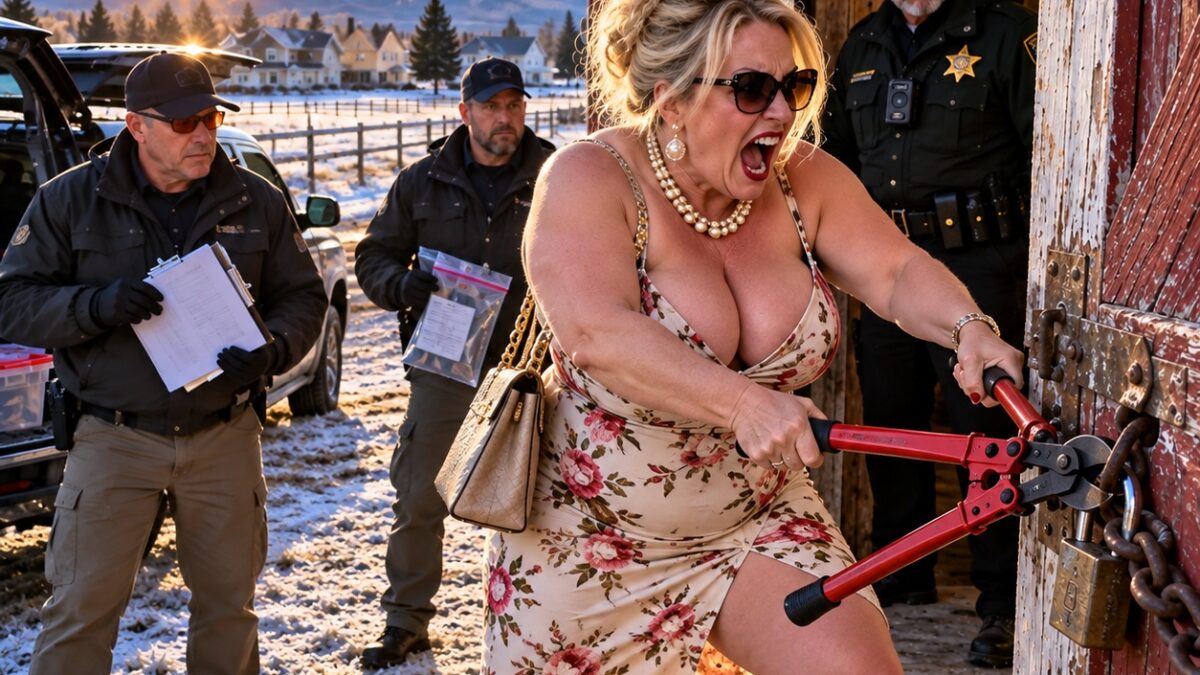
Gary had bolt cutters.
Brenda wore a reflective vest over expensive clothes.
I almost laughed.
Then I remembered the orchard.
The lost clients.
The forged notices.
Months of knowing someone wanted me tired enough to surrender land my grandfather had protected for a century.
Nothing felt funny.
They walked directly to the barn.
No knock at the farmhouse.
No phone call.
No request for permission.
Brenda held a clipboard.
Leonard carried evidence bags.
Gary checked the driveway.
5:47.
Bolt cutters hit the lock.
Metal snapped.
My body went cold.
They opened the red door.
Brenda stepped in first.
I could not hear everything through the exterior camera.
The barn’s internal audio caught it.
Her heels on wood.
Gary muttering something about lights.
Then silence.
David Bradley’s voice.
“Morning.”
Absolute silence.
Then:
“I don’t suppose any of you have an actual warrant for this inspection.”
I watched Brenda stop.
Gary nearly walked into her.
Leonard’s face went blank.
David sat on a hay bale beside my workbench.
Coffee cup in one hand.
Badge visible.
Body camera already recording.
Brenda recovered first.
“We’re acting under HOA emergency authority.”
David stood.
“This property isn’t in your HOA.”
“We have county authorization.”
“Wonderful.”
He held out his hand.
“Let me see it.”
Brenda gave him the paper.
He read it.
Then looked at her.
“Who issued this?”
“The county environmental office.”
“No, ma’am.”
“It’s signed.”
“By a man who retired last year.”
Gary turned toward the door.
The deputy stepped from behind the partition.
“Stay where you are.”
Leonard set the hard case down.
David looked at it.
“What’s inside?”
“Inspection materials.”
“Don’t open it.”
He looked toward Brenda.
“Did Mr. Vance give you permission to enter this barn?”
“This is an emergency.”
“That wasn’t my question.”
She started talking about community health.
David asked again.
“Did the property owner give you permission to enter?”
“No.”
“Did a court issue a warrant?”
“No.”
“Did any county agency authorize you to cut this lock?”
She stopped answering.
David set his coffee on the bench.
That was when the outside team moved.
The arrests were not cinematic.
Nobody ran.
Nobody tackled Derek through a window because there was no Derek.
Gary argued.
Brenda demanded lawyers.
Leonard tried to explain he had been told everything was legitimate.
Deputies separated them.
The hard case was secured.
Inside were labeled bags, sample containers, camera equipment, protective gloves, and several items investigators believed were intended to support the prewritten environmental narrative.
What mattered most was not whether every object was sinister.
What mattered was the forged authorization, forced entry, messages showing coordination, and months of earlier conduct already documented.
By sunrise, the farm was a crime scene.
By noon, Brenda was no longer HOA president.
Not officially yet.
But politically, it was over.
News broke after the sheriff’s office confirmed arrests.
That was when cameras arrived.
Nancy walked up my drive at nine-thirty wearing a red coat and carrying coffee.
“You didn’t call me.”
“Sheriff’s orders.”
“I dislike him.”
“He likes you.”
“Worse.”
Richard followed ten minutes later.
He stared at the broken barn lock.
“Well.”
“Well what?”
“You finally upgraded security.”
I laughed for the first time all morning.
Evelyn arrived later.
She looked at the barn.
Then at me.
“You all right?”
“Yes.”
“Don’t give interviews yet.”
“I wasn’t planning to.”
“Good.”
Nancy said, “I was.”
Evelyn closed her eyes.
The Millbrook board called an emergency meeting that evening.
This time, Brenda wasn’t running it.
Vice President Mark Ellison sat at the front looking as if he had aged ten years since breakfast.
More than a hundred homeowners packed the clubhouse.
Some had supported Brenda.
Some had opposed her.
Most were simply furious that HOA funds and authority might have been used in a private pressure campaign involving property outside the association.
I sat in the back.
Evelyn sat beside me.
Nancy spoke first.
She had prepared six pages.
Of course she had.
She walked through the record.
The first fines against my non-HOA parcel.
Payments for legal enforcement.
The fake fire notice.
The altered survey.
Gary’s appearances.
The board’s lack of written authority.
Residents began asking questions.
“Did we pay for this?”
“Did HOA counsel approve any of it?”
“Why was Brenda’s brother involved?”
“Why were we told Elias owed fines?”
Mark kept saying the audit would determine that.
Correct answer.
Then Evelyn spoke.
She was careful.
No accusation she could not support.
She explained my parcel had never joined Millbrook.
The HOA fines lacked contractual basis.
Forged government documents had been referred to law enforcement.
Investigators were examining whether private development interests had influenced HOA enforcement.
Then she addressed the rumor everybody had heard by then.
Mineral rights.
People turned toward me.
Evelyn said, “Mr. Vance’s family retained certain mineral interests through recorded historic deeds.”
Murmurs.
“Those rights do not mean he owns your homes.”
That was important.
“They do not invalidate your surface ownership.”
Also important.
“They do not allow him to enter your lots at will.”
Nancy whispered, “There goes the fun.”
I elbowed her.
Evelyn continued.
“What they do mean is that certain subsurface interests were never transferred with portions of the surface estate, and those interests may carry significant economic value.”
Someone asked, “How significant?”
Evelyn looked at me.
I stood.
“I don’t know.”
That disappointed people.
“Could be substantial.”
“How substantial?”
“Enough that serious companies have been asking questions.”
Another homeowner stood.
“Did Brenda know?”
“We believe her brother did.”
The room shifted.
Not proof of the entire motive.
But enough for people to understand why the development company might have wanted my cooperation.
Then somebody asked the question I had been waiting for.
“If you own the mineral rights, are you going to drill under our houses?”
I shook my head.
“No.”
“Can you?”
“Not the way you’re imagining.”
“Then what happens?”
I looked around.
“We negotiate responsibly.”
A man in the second row folded his arms.
“With who?”
“Any operator who actually has a lawful project.”
“And you get the money.”
“Some.”
People murmured again.
I could have become defensive.
Instead, I told them the truth.
“My grandfather reserved those rights because he believed land had value beyond the dirt you could see.”
I looked toward the windows.
“Brenda spent eight months telling you my barn was hurting this community.”
I paused.
“I’m not interested in proving her wrong by hurting it another way.”
That quieted the room.
“If the mineral estate produces income, I intend to use a substantial portion of what comes through my family interests for conservation around the remaining open land, local scholarships, and trade training.”
Richard spoke from the wall.
“Veterans?”
“Yes.”
He nodded once.
Someone asked, “Why?”
I thought about my grandfather.
My father.
The orchard.
The barn.
My divorce.
A community that had spent months looking at me like a problem because one woman kept telling them I was.
“Because keeping something doesn’t mean you have to keep all of it for yourself.”
The board voted that night to suspend every enforcement action Brenda had initiated involving my parcel.
Then they commissioned an independent forensic audit.
The next month was ugly.
People like clean endings.
Real investigations are messy.
The audit found that some Millbrook spending had been normal.
Some sloppy.
Some questionable.
Several payments connected to Sterling-associated vendors lacked proper disclosure.
Legal expenses had been used to pursue a nonmember property.
HOA funds had paid consultants involved in the campaign against me.
Emails showed Brenda repeatedly pushed staff and board members to find “leverage.”
Her brother’s land company had communicated with her about my willingness to sell.
That mattered.
Then financial investigators tied the forged documents and pressure campaign to a broader effort to secure my land and mineral interests.
Gary’s company had not been entitled to those rights.
He needed a deal.
I was not giving him one.
Making my life expensive was his alternative.
Charges followed.
Not instantly.
Months later.
Mail and wire fraud associated with false documents and communications.
Conspiracy-related charges.
Forgery.
Attempted unlawful entry.
Property damage counts where evidence supported them.
Gary faced additional exposure tied to business filings and payments.
Leonard cooperated.
That helped prosecutors understand how the fake inspection had been assembled.
Brenda’s attorney insisted she believed the HOA had broad enforcement authority.
That argument might have explained the first ridiculous notice.
It did not explain a forged county seal.
Or a fake inspector.
Or bolt cutters at dawn.
Or her brother discussing how expensive they could make my refusal.
The mineral-rights negotiations continued separately.
This is the part most revenge stories would simplify.
They would tell you I suddenly became a millionaire because oil erupted beneath Brenda’s swimming pool.
That did not happen.
There was no geyser.
No drilling rig behind the clubhouse.
No suburban Beverly Hillbillies sequel.
Instead, a legitimate energy company approached the various rights holders in the area.
Evelyn handled negotiations.
Environmental reviews mattered.
Surface-use protections mattered.
Setbacks mattered.
Access mattered.
I refused any agreement that required unnecessary surface disturbance inside the residential neighborhood.
Eventually, we reached a lease structure involving subsurface development from outside the densest residential area, subject to regulation and technical feasibility.
The signing bonus alone was more money than my woodworking business would produce in many years.
Royalty potential depended on production.
No guarantees.
Still, enough.
I established the Henry Vance Land & Trades Fund.
Nancy said the name sounded like a hardware store.
I told her she was no longer invited to naming meetings.
The first scholarships went to local students entering electrical, plumbing, welding, carpentry, and engineering programs.
Richard helped design a veterans’ retraining grant.
We placed conservation easements on several acres near the orchard and creek corridor.
The old barn got a new roof.
Same red siding.
I refused suggestions to make it “more modern.”
Six months after the arrests, Brenda took a plea agreement.
She received prison time and restitution obligations.
Gary received a longer sentence because the business side of the scheme created additional charges and losses.
Neither outcome felt as satisfying as people expected me to say.
A Denver reporter asked me that directly.
“Does it feel like justice?”
We were standing beside the barn.
Snow on the mountains.
My hands shoved into my jacket.
“I think justice is a word people use when they want an ending to feel cleaner than it is.”
She waited.
“They damaged my business.”
I pointed toward the orchard.
“Killed trees my father planted.”
I looked toward Millbrook.
“Turned neighbors against each other.”
“Forged documents.”
“Used an HOA like private muscle.”
“Prison doesn’t undo that.”
“So what does justice look like?”
I looked at the new barn lock.
Then at children playing near Nancy’s house across the road.
“It looks like making sure they can’t do it again.”
The HOA itself did not literally vanish overnight.
Homeowners debated what to do with it.
Some wanted dissolution.
Others pointed out that Millbrook still had shared landscaping, stormwater features, private amenities, and contractual obligations that required some organized structure.
Eventually, they radically rewrote governance.
The name remained for legal reasons.
The culture changed.
Strict conflict-of-interest rules.
Open records.
Recorded votes.
No president approving family vendors.
Independent financial review.
Homeowners allowed meaningful comment.
Outside counsel required before major enforcement.
No one-person “emergency” authority for property entry.
Nancy joined the board.
I considered moving.
Then decided Millbrook had suffered enough.
Richard became chair of the safety committee.
He hated committees.
That made him perfect.
Once a month, people started coming to my barn on Saturday mornings.
It began because two homeowners asked if Evelyn would explain how deeds and HOA covenants actually work.
She refused to hold legal seminars for free.
So I bribed her with coffee and cinnamon rolls.
Twenty people showed up.
The next month, thirty.
We called them property-rights talks.
No politics.
No screaming.
Bring your deed.
Bring your survey.
Read what you signed.
Ask questions before assuming.
Evelyn taught the first rule.
“A recorded document is not magic just because it looks old.”
The second:
“An HOA has the authority its governing documents and applicable law actually give it—not whatever somebody says at a meeting.”
The third came from Sheriff Bradley.
“Do not solve civil disputes with bolt cutters.”
Everybody laughed.
David raised his coffee.
“I’m serious.”
The barn became busier after the news coverage.
My furniture orders doubled.
I hired an apprentice named Mateo.
Nineteen.
Smart kid.
Could measure twice and still somehow cut the wrong end.
He improved.
The orchard recovered slowly.
Some poisoned trees had to come out.
I replanted.
The first spring after Brenda’s conviction, I stood beside the new saplings with Nancy.
“You know what bothers me?” she said.
“Everything.”
“True.”
She pointed toward Millbrook.
“Half those people believed her.”
“I know.”
“They called you dangerous.”
“I remember.”
“They wanted the barn torn down.”
“Some did.”
“You’re not angry?”
“I was.”
“And now?”
I looked at her.
“People believe confident liars all the time.”
“That sounds forgiving.”
“It isn’t.”
I picked up my shovel.
“It just means I’d rather teach them how to check next time.”
She considered that.
“Still too forgiving.”
“Go home, Nancy.”
She didn’t.
The divorce had brought me back to the farm because I thought I wanted to be left alone.
That turned out to be only partly true.
I wanted peace.
Not isolation.
There is a difference.
By trying to erase my place from the neighborhood, Brenda accidentally tied me more deeply to it.
I knew the people now.
Their children.
Their arguments.
Who needed a cabinet repaired.
Who had a son overseas.
Who had lost a wife.
Who could not bake but continued inflicting cookies on others anyway.
Richard occasionally helped in the shop.
Nancy never helped because she claimed manual labor was “an inefficient use of her gifts.”
Sheriff Bradley stopped by often enough that I eventually bought a second coffee mug specifically for him.
It said WORLD’S OKAYEST SHERIFF.
He hated it.
Therefore it remained.
One October morning, almost exactly two years after Brenda first walked up my gravel drive, I sat on the porch with him.
The barn looked almost exactly as it had.
Same red.
Same slight lean.
Different lock.
Millbrook roofs stretched beyond the orchard.
David sipped coffee.
“You know, the first time I came out here, I thought you were exaggerating.”
I looked at him.
“You never told me that.”
“You were an angry divorced electrician with twelve binders.”
“Thirteen.”
“See?”
I laughed.
“When did you change your mind?”
“Fake fire-marshal letter.”
“Not Gary painting the camera?”
“That helped.”
“What about the barn break-in?”
“That removed nuance.”
We sat quietly.
Then David looked toward the subdivision.
“You ever regret not selling?”
“No.”
“Not even when all this started?”
I thought about it.
“There were nights.”
“Yeah?”
“After the client calls.”
“The orchard.”
“The forged survey.”
“There were nights I thought taking the money would be easier.”
“What stopped you?”
I looked toward the old barn.
“My grandfather built that foundation.”
David nodded.
“My father replaced half those boards.”
I pointed toward the orchard.
“My mother planted the first apple trees.”
Then the farmhouse.
“My marriage ended in there.”
I smiled without humor.
“My life started over in there too.”
I looked back toward him.
“You don’t sell something like that because somebody makes it inconvenient.”
David lifted his mug.
“To inconvenience.”
I tapped mine against it.
Months later, the first large scholarship awards went out.
One recipient was a Millbrook kid.
Seventeen years old.
His mother had once commented online that my barn made the neighborhood look run-down.
At the ceremony, she approached me afterward.
“Mr. Vance.”
“Elias.”
She looked embarrassed.
“I owe you an apology.”
“You don’t owe me anything.”
“I wrote some things.”
“I remember.”
“I believed Brenda.”
“A lot of people did.”
“That doesn’t make it right.”
“No.”
She swallowed.
“Why did you approve my son’s scholarship?”
“I didn’t.”
She looked confused.
“The committee did.”
“You didn’t stop it.”
“Why would I?”
“After what I said.”
I looked toward her son talking excitedly with Richard about welding school.
“Your kid didn’t write Facebook comments about my barn.”
Her eyes filled.
That conversation stayed with me.
Not because I am unusually generous.
I am not.
I hold grudges.
Ask my ex-wife.
But revenge has terrible bookkeeping.
You spend years keeping track of who deserves what.
Eventually, the person who hurt you is still controlling your decisions.
I had already given Brenda eight months.
She was not getting the rest of my life.
The mineral lease eventually began producing modest royalties.
Then better ones.
Nothing like the exaggerated tens of millions people claimed online.
Enough to make a difference.
The foundation grew.
We added a small conservation program.
Helped restore streambank habitat.
Funded tool grants for trade students.
Bought equipment for a veterans’ welding program.
When someone asked why trade education mattered so much to me, I showed them my hands.
“Because somebody still has to build things.”
The old barn became the foundation’s unofficial meeting place.
That was the most satisfying part.
The structure Brenda had called noncompliant became the place homeowners came to understand deeds, contracts, budgets, and property rights.
I never repainted it for Millbrook.
I did repaint it because the south wall genuinely needed paint.
Nancy accused me of surrendering.
I told her the difference between maintenance and compliance was who chose it.
She admitted that was annoyingly good.
Gary’s company disappeared after the criminal case and civil claims.
Several transactions unraveled.
Investors sued.
That had nothing to do with me directly.
Fraud has a way of making former friends suddenly interested in documentation.
Brenda’s real-estate business closed.
The house she and her husband owned in Millbrook was eventually sold.
One afternoon, I saw the moving truck.
I did not go watch.
Nancy did.
Of course.
She came to the barn afterward.
“She looked terrible.”
“Nancy.”
“What?”
“I didn’t ask.”
“I’m reporting facts.”
“You’re celebrating.”
“Quietly.”
I handed her a sanding block.
“What is this?”
“Consequences.”
She left.
Years have passed now.
The orchard is healthy.
Not the same.
Healthy.
The poisoned section never fully came back, but the new trees bear fruit.
That became important to me.
Not restoration.
Continuation.
You cannot always make damaged things exactly what they were.
Sometimes you plant again.
The farmhouse still creaks when the temperature drops.
The barn still leans.
I’m sixty now.
My knees announce weather changes before the forecast.
Mateo runs most of the cabinet work.
He measures correctly almost every time.
Nancy still attends board meetings despite no longer serving.
Richard claims retirement and then volunteers for everything.
David Bradley still drinks coffee in my barn.
The broken padlock from that morning hangs above the workbench.
Not as a trophy.
As a reminder.
People ask why I kept it.
Because it represents the exact moment fake authority met real authority.
Brenda had spent months counting on appearances.
Official letterhead.
Board titles.
A reflective vest.
A badge printed on plastic.
A county seal copied from a website.
Words like emergency.
Compliance.
Inspection.
She assumed most people would surrender before asking one simple question.
Show me where it says you can do that.
My grandfather’s deed mattered.
The mineral reservation mattered.
The cameras mattered.
Sheriff Bradley mattered.
Evelyn mattered.
Nancy and Richard mattered.
But the first real turning point was smaller.
I stopped trusting the tone of the letter and started reading the document underneath it.
That saved my land.
Maybe my business.
Possibly millions in property interests.
Definitely months of additional misery.
There is power in paperwork when the paperwork is real.
There is also power in refusing to be impressed by paperwork that isn’t.
Some mornings, I sit on the porch before sunrise.
Millbrook lights flicker on one house at a time.
School buses eventually move through.
Garage doors rise.
Dogs bark.
Normal life.
The subdivision no longer feels like the enemy.
That surprises people.
A neighborhood is not its HOA president.
Just like a town is not its mayor.
A company is not its worst manager.
An institution can be abused by a person without belonging permanently to that person.
That distinction matters.
Brenda wanted Millbrook to believe protecting her power meant protecting the community.
Once people understood those were different things, she was finished.
The final time a reporter called me, she wanted a dramatic line.
Something about the old barn defeating the HOA queen.
I told her that was not what happened.
“What happened then?”
“A woman tried to use an association she controlled to pressure a nonmember landowner into giving up property interests that benefited her family.”
“That’s less catchy.”
“It’s more accurate.”
She laughed.
“Fine. What’s the lesson?”
I looked through the barn doors.
Sunlight hit the sawdust floating above the workbench.
For a second, I could smell my grandfather’s tobacco even though he had been dead for decades.
Memory does strange things in old buildings.
“The lesson is that power and authority aren’t the same.”
She waited.
“Brenda had power because people obeyed her.”
I touched the broken padlock hanging on the wall.
“But authority has to come from somewhere.”
“A deed.”
“A statute.”
“A contract.”
“A court.”
“A warrant.”
“Something real.”
I smiled.
“And if somebody shows up at five-forty-seven in the morning with bolt cutters and a fake inspection letter, it helps to have a sheriff drinking coffee on the other side of the door.”
That was the line she used.
Fair enough.
The barn is still here.
That matters more.
It survived my grandfather.
My father.
Bad winters.
Bad repairs.
My divorce.
A developer.
An HOA president.
A criminal investigation.
And me.
Someday, somebody else will own it.
That is the thing people forget about property.
We call land ours because legal systems need names on deeds.
But if you hold the same place long enough, you eventually realize you are mostly its temporary caretaker.
My grandfather protected the mineral estate because he believed his descendants might need it.
I protected the barn because I understood what it carried.
The scholarship kids will use money produced by rights reserved before their grandparents were born.
The conservation easement will outlive me.
The orchard will belong to somebody else.
That feels right.
Brenda wanted control.
I wanted continuity.
Those are very different ambitions.
And in the end, continuity won.
Sometimes on cold mornings, when the frost coats the fence wire and the mountains turn pink before sunrise, I walk into the barn and sit on the same hay bale David used that morning.
I pour coffee.
Listen to the building settle.
Then I imagine Brenda opening those doors again.
The confidence.
The clipboard.
The reflective vest.
The absolute certainty that paper she created could overpower a deed recorded before she was born.
Then David’s voice.
Morning, folks.
I still smile.
Not because three people were arrested.
Not because Brenda went to prison.
Not because Gary lost his company.
Those things were consequences.
The satisfying part came later.
Children running through the orchard during foundation events.
Veterans learning welding with equipment our fund purchased.
Families sitting in the barn learning how to read their own governing documents.
Nancy correcting lawyers.
Richard teaching teenagers how not to lose fingers around power tools.
Neighbors who once complained about my property drinking coffee on my porch.
A red barn still standing where Brenda said it didn’t belong.
That is what justice eventually looked like to me.
Not destroying the people who tried to erase this place.
Making the place useful enough that their failure became permanent.
They tried to turn my grandfather’s barn into leverage.
Instead, they reminded me what he had actually left behind.
Not just mineral rights.
Not acreage.
Not timber and old tools.
A principle.
Know what is yours.
Know what it is worth.
Know what the document actually says.
And never hand over your home simply because somebody with a title tells you they have more authority than they do.
Especially not before you check who is waiting inside the barn.








