FULL STORY:The HOA President Said My Mother’s Wheelchair Ramp Was Ruining the Neighborhood—She Had No Idea How Far I Was Willing to Go to Protect Her
FULL STORY CONTINUATION
I didn’t hear about the first confrontation until that evening.
Mom was at the kitchen table when I came home.
She had a cup of tea in front of her and was doing a crossword puzzle.
Normal.
Too normal.
I put my keys on the counter.
“How was your day?”
“Fine.”
“You say that like something happened.”
She didn’t look up.
“Your neighbor came over.”
My stomach tightened immediately.
“Which neighbor?”
She gave me a look.
“The one who dresses like she’s about to audit a lemonade stand.”
“Martha?”
“No, Marcus. The Pope.”
I dropped into the chair across from her.
“What did she want?”
Mom wrote something into the crossword.
“Wanted to explain that my presence has created a community problem.”
I stopped breathing for half a second.
“She said what?”
Mom finally looked up.
“Don’t make the face.”
“What face?”
“The face where you start mentally committing felonies.”
“I don’t have that face.”
“You’ve had it since you were fourteen.”
I pushed back from the table.
“What exactly did she say?”
“Something about the ramp violating standards.”
“She spoke to you directly?”
“Yes.”
“I told her to contact you.”
“She said you’re unreasonable.”
“Good.”
“And that the ramp needed to be removed.”
I could feel heat rising into my face.
“Mom.”
“She left.”
“That’s not the point.”
“It should be.”
“No.”
I stood.
“She had no business coming over here while I was gone.”
My mother closed the crossword book.
“Marcus.”
“What?”
“I am not a child.”
“I didn’t say you were.”
“You are acting like I need you standing guard on the porch.”
“She harassed you.”
“She annoyed me.”
“Same thing when it’s repeated.”
Mom studied me.
“I’ve been annoyed by better people than Martha Higgins.”
That was classic Eleanor.
Minimize danger if acknowledging it might make somebody else worry.
I knew because I did the same thing.
“Did she threaten you?”
“No.”
“Touch you?”
“No.”
“Raise her voice?”
“No.”
“Did anyone hear?”
“Probably not.”
I took out my phone.
“What are you doing?”
“Calling Evelyn.”
Mom sighed.
“You’re making this bigger.”
“No.”
I looked at her.
“Martha is making it bigger.”
Evelyn’s response was immediate.
“Document it.”
“Mom doesn’t want—”
“Your mother doesn’t have to want a lawsuit for you to document harassment.”
“She went onto my property.”
“Write down the date, time if known, what was said.”
I paced the kitchen.
“Can we send her something stronger?”
“I already sent the board a legal notice.”
“And they ignored it.”
“Martha ignored it.”
“Same difference.”
“No.”
Evelyn’s tone sharpened.
“That distinction may become important.”
I stopped pacing.
“What do you mean?”
“The board is not necessarily identical to Martha. If she’s acting beyond whatever authority they’ve given her, I want a clean record.”
“So what do I do?”
“Nothing emotional.”
That sounded impossible.
“Keep the ramp.”
“I am.”
“Keep every letter.”
“I have.”
“Do not pay fabricated fines.”
“Wasn’t going to.”
“And if Martha comes onto your property again, tell her in writing that future communication goes through counsel.”
I looked at Mom.
She was pretending not to listen.
“Fine.”
The next morning, I emailed Martha and copied every HOA board member.
Effective immediately, all communication concerning the ramp, my mother, or alleged architectural violations should be directed to my attorney, Evelyn Reed.
Please do not approach my mother on my property regarding this dispute.
I kept it professional.
Evelyn approved it before I sent it.
Martha replied twenty-three minutes later.
Her response was four paragraphs long.
She accused me of attempting to intimidate volunteers.
Said the HOA had broad authority to preserve neighborhood appearance.
Claimed residents had complained about “visual inconsistency.”
And concluded with:
The Board expects full compliance regardless of personal circumstances.
I forwarded it to Evelyn.
Her response consisted of six words.
Perfect. Don’t answer that.
For the next few weeks, the notices kept coming.
They became almost absurd.
Failure to cure.
Repeated noncompliance.
Escalation fee.
Administrative charge.
One letter threatened that the association could “pursue all remedies available under governing documents.”
The total rose.
$7,200.
Mom found the folder one morning.
She opened it before I could stop her.
“Seven thousand two hundred dollars?”
“It’s not real.”
“It looks real.”
“Evelyn says it’s unenforceable.”
Mom flipped through the pages.
“Marcus, maybe I should go home.”
I stared at her.
“What?”
“My apartment has an elevator.”
“No.”
“You work.”
“No.”
“You’re fighting with these people because of me.”
“No.”
She slammed the folder closed.
“Stop saying no like I’m one of your patients.”
I leaned forward.
“You are not leaving because someone with a clipboard doesn’t like looking at a ramp.”
“This is your home.”
“Exactly.”
“And you’re risking a lien.”
“No, she’s threatening one.”
“What if she follows through?”
“Then Evelyn deals with it.”
Mom looked away.
Her voice got quieter.
“I don’t want to cost you your house.”
That was the first moment I understood what Martha’s harassment was really doing.
The money didn’t scare my mother as much as the guilt did.
The suggestion that her needs were expensive.
Disruptive.
A burden.
I had watched patients absorb that exact poison.
I reached across the table.
“Look at me.”
She didn’t.
“Mom.”
Finally, she did.
“The ramp is staying.”
“Marcus—”
“You are not the problem.”
Her face tightened.
“You needing to enter your son’s house isn’t the problem.”
She blinked quickly.
“This woman deciding the neighborhood looks better if you struggle is the problem.”
Mom looked down at my hand.
I continued.
“I bought this house because I wanted you here.”
“You bought it before I needed the chair.”
“I was thinking ahead.”
“That doesn’t sound like you.”
“I’m offended.”
She smiled despite herself.
Good.
“I want you here.”
“I know.”
“No.”
I squeezed her hand.
“I need you to know.”
She nodded.
That should have been the emotional low point.
It wasn’t.
The confrontation that changed everything happened on a Thursday morning.
I left home just after eight.
Mom was on the porch.
Coffee.
Book.
Wheelchair positioned beneath the oak shade.
She liked sitting there because the morning stayed cool until almost eleven.
I kissed her forehead on my way out.
She waved me off.
“Drive.”
“You need anything?”
“Freedom.”
“Already installed the ramp.”
She rolled her eyes.
Those were the last words I heard from her before the call.
At 9:36, my phone vibrated while I was working with a patient.
I ignored it.
It rang again.
Then again.
I looked at the screen.
Neighbor.
Caroline Perez.
Two houses down.
I excused myself and answered.
“Caroline?”
“Marcus, you need to come home.”
Something in her voice emptied my chest.
“What happened?”
“Your mother fell.”
“What?”
“Martha—”
“What happened to my mother?”
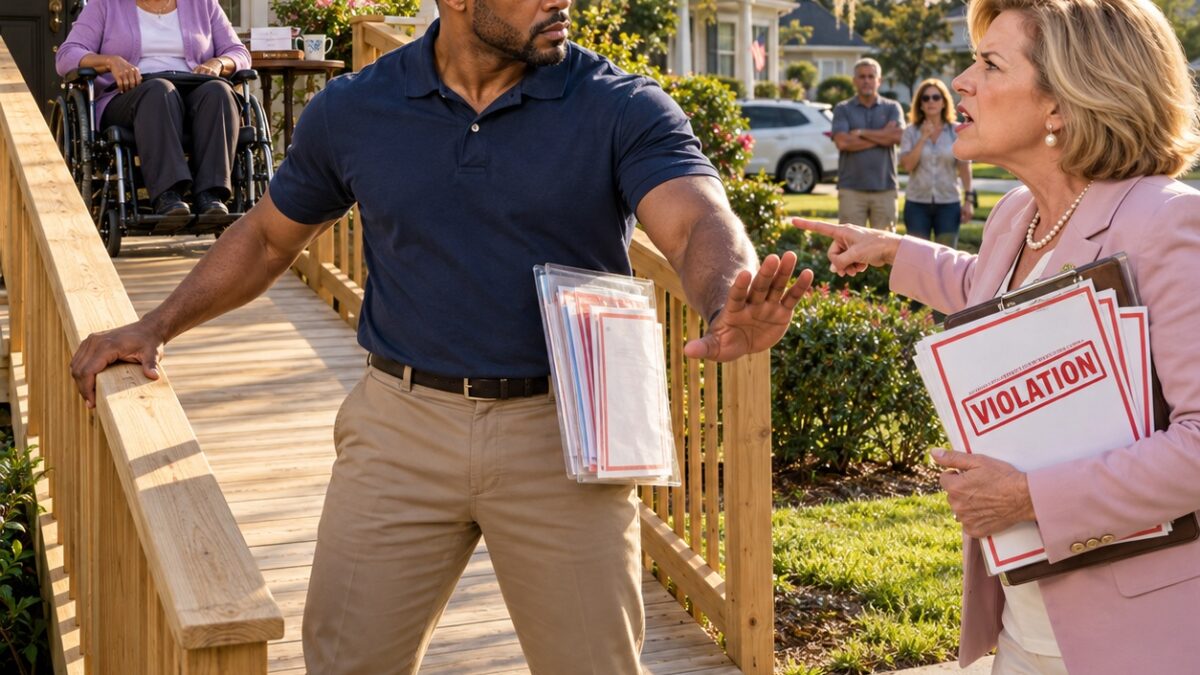
“She pushed her.”
For a second, the room around me didn’t exist.
“What?”
“Paramedics are here.”
I was already moving.
“Is she conscious?”
“Yes.”
“Is she bleeding?”
“Her arm.”
“Did she hit her head?”
“I don’t think so.”
“Martha pushed her?”
“I saw it.”
I stopped at the employee exit.
“You saw her?”
“Yes.”
“Call the police.”
“Someone already did.”
I don’t remember the drive home clearly.
I remember red lights.
My hands crushing the steering wheel.
Calling Evelyn through the car system.
She answered.
“What happened?”
“Martha pushed my mother off the ramp.”
Silence.
Then Evelyn’s voice changed.
“Is Eleanor conscious?”
“Yes.”
“Police?”
“Coming.”
“Witnesses?”
“At least one.”
“Marcus.”
“What?”
“When you get there, do not touch Martha.”
The fact that she needed to say it made me realize how I sounded.
“I won’t.”
“Do not threaten her.”
“I won’t.”
“Do not argue with the board.”
“Evelyn.”
“I’m serious.”
“So am I.”
“Your mother needs you calm.”
That reached me.
“Okay.”
“Call me from the scene.”
I turned onto Willow Creek Drive.
An ambulance blocked part of the street.
Three neighbors stood near my driveway.
Mom’s wheelchair was on its side beside the ramp.
That image nearly ended whatever self-control I had left.
I parked halfway onto the curb.
Ran.
“Mom!”
She was sitting on the ground supported by a paramedic.
Blood streaked her forearm.
Another paramedic had a hand near her hip.
Mom looked up.
“Don’t start yelling.”
I dropped beside her.
“Are you hurt?”
“Obviously.”
“Head?”
“No.”
“Hip?”
“Bruised.”
“Can you move?”
“Marcus, they’re literally checking me.”
I looked at the wheelchair.
Then toward the street.
Martha stood near her own driveway with two police officers.
My entire body went cold.
Mom grabbed my wrist.
“Don’t.”
“I wasn’t—”
“You were.”
“I wasn’t.”
She squeezed harder.
“Stay here.”
So I stayed.
The paramedic asked Mom questions.
Name.
Date.
Pain level.
Any dizziness.
Any medication.
I answered twice before she snapped:
“I can speak.”
Good.
Angry Eleanor meant Eleanor was still Eleanor.
Caroline approached.
Her face was pale.
“I saw the whole thing.”
“What happened?”
She looked at my mother.
Mom nodded.
Caroline spoke.
“Martha came over around nine twenty.”
“On the porch?”
“She came up the ramp.”
I looked toward Martha.
Caroline continued.
“She told Eleanor the ramp was coming down.”
My jaw tightened.
“Mom told her to leave?”
“Yes.”
Caroline swallowed.
“They argued.”
“Did Mom touch her?”
“No.”
“Did she threaten her?”
“No.”
“I heard Eleanor tell her she had no legal right to be there.”
Another neighbor joined us.
Thomas Bell from across the street.
“I saw it too.”
I looked at him.
“Martha put both hands on Eleanor.”
Mom interrupted.
“And pushed.”
Her voice was steady.
No hesitation.
“Hard enough to tip me.”
The wheelchair had gone sideways off the raised edge.
Mom struck the ground with her hip and arm.
I looked at the ramp again.
Imagined it.
Martha’s hands on my mother’s shoulders.
My mother unable to catch herself.
That cold feeling became something darker.
The paramedic said they wanted to take her to Memorial Health for imaging.
“I’m coming.”
Mom frowned.
“You have patients.”
“Not anymore.”
“Marcus.”
“I am going.”
No argument.
The police wanted my statement.
I gave what little I knew.
Then pointed them toward Caroline and Thomas.
When they approached Martha again, I called Evelyn.
“She has three witnesses.”
“Three?”
“At least.”
“Your mother going to hospital?”
“Yes.”
“Photograph everything.”
“I already—”
“Marcus. Everything. Wheelchair. Ramp. Blood if visible. Injuries if your mother consents. Every angle.”
I did.
It felt disgusting.
Clinical.
Turning my mother’s pain into evidence.
But my work had taught me that memory changes.
Documents don’t.
Mom was loaded into the ambulance.
Before they closed the doors, she pointed toward Martha.
“Make sure she doesn’t touch my coffee.”
I stared at her.
She smiled.
I laughed despite everything.
Then the doors closed.
I followed to the hospital.
I didn’t learn about Martha’s arrest until later that morning.
The police had interviewed the witnesses separately.
Their stories matched.
Martha apparently tried to characterize the contact as an attempt to “move Eleanor out of the way.”
That version didn’t survive three eyewitness accounts.
She was arrested.
When Evelyn called me at the hospital, I was sitting beside Mom’s bed waiting for imaging results.
“They took her in.”
“Who?”
“Martha.”
Mom looked over.
I put the phone on speaker.
“For what?” Mom asked.
Evelyn answered, “Battery involving an elderly victim. The exact charging decision will be up to prosecutors.”
Mom’s face remained unreadable.
“You all right?” Evelyn asked.
“I’ve had better Thursdays.”
The imaging showed no fracture.
That was the best news of the day.
Severe bruising near the hip.
A deep cut on her forearm requiring stitches.
Pain.
But no broken bone.
No head injury.
Given her mobility history, it could have been much worse.
That sentence did not comfort me.
Could have been worse is one of those phrases people use because reality frightens them.
I kept imagining worse.
Mom falling differently.
Head against railing.
Hip fracture.
Surgery.
Loss of the limited mobility she’d fought to preserve.
All because somebody found a ramp unattractive.
Evelyn came to the hospital that afternoon.
She carried a legal pad and the calmest anger I had ever seen.
“Eleanor.”
“Evelyn.”
“How are you?”
“Ask the people who keep poking me.”
Evelyn smiled.
Then sat down.
“I need to ask some questions while the details are fresh.”
Mom answered everything.
Martha’s first visit.
The Thursday confrontation.
Exact wording as best she remembered.
The physical contact.
How the chair tipped.
Where she landed.
Who arrived first.
When she finished, Evelyn looked at me.
“Your folder?”
“At home.”
“Every notice?”
“Yes.”
“Emails?”
“Yes.”
“My letter?”
“Yes.”
“Board responses?”
“Yes.”
She nodded.
“This is no longer a ramp dispute.”
Mom looked at her.
“What is it?”
“A pattern.”
That word mattered.
The push was terrible.
But Evelyn wanted the story before the push.
Repeated fines after notice.
Threats.
Selective enforcement.
Direct confrontations with a disabled guest.
Escalation.
Physical assault.
“This didn’t begin this morning,” she said.
“It ended this morning.”
Not quite.
It actually began again the next day.
Evelyn filed suit.
She moved quickly.
The complaint named Martha personally and also named the Oak Ridge Estates HOA board based on the conduct and the board’s handling of it.
The claims centered on Mom’s injuries, the campaign against an accessibility accommodation, and the emotional and financial pressure created by the months of threats.
I didn’t understand every legal theory.
I didn’t pretend to.
What I understood was that Evelyn had been collecting receipts long before we knew how badly we would need them.
The HOA board called an emergency meeting.
For the first time, several members contacted me directly.
I forwarded everything to Evelyn without answering.
One board member left a voicemail.
“Marcus, I had no idea Martha was approaching your mother personally.”
Another:
“We believed this was an architectural dispute.”
Another:
“I never approved those escalating fines.”
That last one interested Evelyn.
Within forty-eight hours, Martha was removed as HOA president by unanimous vote.
Nine years of control ended in one meeting.
Mom’s reaction?
“Good.”
That was it.
I expected satisfaction.
She had none.
“You don’t feel better?”
“I feel sore.”
“Fair.”
“And removing her doesn’t undo what she did.”
“No.”
Mom took a sip of coffee.
She was back on the porch.
Same place.
Same ramp.
That mattered to both of us.
The first morning after the hospital, I suggested she stay inside.
She stared at me.
“Why?”
“So you can rest.”
“I can rest outside.”
“Mom.”
“Marcus.”
I hated when she used my own tone back at me.
“What if Martha—”
“She’s not coming over.”
“You don’t know.”
“She was arrested.”
“People get released.”
“Then she can watch from across the street.”
Mom rolled onto the ramp.
“I am not surrendering my porch.”
That sentence settled it.
I stood beside her while she descended.
Slowly.
Her hip hurt.
Her arm was bandaged.
At the bottom, she turned.
“See?”
“What?”
“Still works.”
She meant the ramp.
I knew she meant more.
The criminal case moved separately from the civil one.
I won’t pretend it was fast or satisfying every day.
Nothing legal ever is.
There were hearings.
Statements.
Requests.
Lawyers.
Insurance representatives.
HOA counsel.
Letters.
Depositions.
Martha hired her own attorney.
Her version of events shifted.
First, she hadn’t pushed.
Then she’d touched Mom but not intentionally.
Then Mom’s wheelchair had been positioned unsafely.
Then the real issue became whether the ramp itself violated community rules.
Evelyn’s response was almost cheerful.
“Let her keep talking.”
I asked why.
“Because every new explanation gives us another inconsistency.”
The HOA board changed completely after Martha’s removal.
Not morally overnight.
Practically.
They hired independent counsel.
Reviewed old enforcement records.
Suspended disputed fines.
Sent residents a notice saying accessibility requests would be handled under a revised policy.
The new acting president, Robert Kim, knocked on my door one evening.
He stood at the bottom of the ramp.
Didn’t step onto it.
Good start.
“Marcus.”
“Robert.”
“Can we talk?”
“If Evelyn says yes.”
He nodded.
“I expected that.”
He handed me an envelope.
“What is this?”
“Formal withdrawal of every violation notice related to the ramp.”
I didn’t take it immediately.
“Why now?”
“Because they should never have been issued.”
“Did you vote for them?”
“No.”
“Did you stop them?”
He looked away.
“No.”
That answer mattered more than excuses.
I took the envelope.
“Anything else?”
He looked toward Mom, who was visible through the window.
“I owe your mother an apology.”
“You do.”
Robert nodded.
“May I speak to her?”
I went inside.
Mom agreed.
She rolled onto the porch.
Robert remained on the walkway.
“Mrs. Thorne.”
“Eleanor.”
“Eleanor. I’m sorry.”
She watched him.
“We should have stopped this earlier.”
“Yes.”
He didn’t flinch.
“The board relied too heavily on Martha.”
“Yes.”
“We failed to review what she was doing.”
“Yes.”
He gave a small, uncomfortable smile.
“You’re not making this easy.”
Mom’s expression didn’t change.
“Was it easy when I hit the ground?”
Robert’s smile disappeared.
“No.”
“Then don’t ask me to make your apology comfortable.”
Silence.
I almost felt sorry for him.
Almost.
Finally, he said, “You’re right.”
Mom nodded.
“That was better.”
He apologized again.
No excuses.
She accepted the apology without offering forgiveness she didn’t feel.
After he left, I said, “You enjoy making grown men sweat.”
“I raised three sons.”
“Training.”
“Exactly.”
The lawsuit continued.
People in the neighborhood divided briefly into camps.
Not over whether Martha should have pushed Mom.
Almost nobody defended that.
The arguments were about blame.
Some residents thought the HOA shouldn’t be financially responsible for one president’s conduct.
Others argued that nine years without oversight made the board responsible for the environment that allowed her behavior.
I stopped attending those discussions.
They were not useful.
My life had already spent enough time orbiting Martha.
I focused on Mom.
Her bruises healed.
The cut scarred.
The emotional part took longer than she admitted.
I noticed she started checking across the street before using the ramp.
Once.
Quickly.
She thought I didn’t see.
I did.
That made me angrier than the fines.
Fear had entered a routine that used to be ordinary.
One morning, I sat beside her on the porch.
“You looked.”
“At what?”
“Martha’s house.”
Mom kept reading.
“I look at lots of things.”
“You check before going down.”
She turned a page.
“Marcus.”
“You’re scared.”
That did it.
She snapped the book shut.
“I am not scared of that woman.”
“Okay.”
“I am cautious.”
“That’s fear with better branding.”
She glared.
I waited.
Then her shoulders dropped.
“I don’t like that she made me feel helpless.”
There it was.
Not the fall.
The helplessness.
“I couldn’t stop the chair.”
“I know.”
“I hate that.”
I didn’t offer some empty line about strength.
I worked with disabled people every day.
Telling someone they’re strong can become another way of asking them not to feel what happened.
So I said:
“That makes sense.”
Mom looked at me.
“I thought you’d give me one of your therapist speeches.”
“Off the clock.”
“Good.”
We sat quietly.
After a minute, she said, “I’m still using the ramp.”
“I noticed.”
“She doesn’t get that.”
“No.”
“And neither do you.”
“What?”
“You keep hovering.”
I laughed.
“I do not.”
“You walk behind me every time.”
“That’s because—”
She raised one eyebrow.
“Fine.”
The next morning, I stayed inside.
Mostly.
I watched through the window.
Mom saw me.
Flipped me off.
Seventy-one years old.
Refined woman.
My mother.
I laughed so hard I spilled coffee.
That was when I knew she was going to be okay.
Months passed.
The civil case eventually reached judgment.
The outcome covered Mom’s medical expenses, legal costs, and damages tied to the harassment and assault.
The HOA’s cooperation after Martha’s arrest reduced some of its exposure, according to Evelyn.
Martha herself carried the largest personal consequences.
Her legal costs mounted.
The criminal matter damaged her standing.
The civil judgment damaged her finances.
I did not celebrate.
That surprised people.
A coworker asked me:
“Doesn’t it feel good?”
“What?”
“That she got what was coming.”
I thought about it.
“No.”
He looked confused.
“I feel relieved.”
Not happy.
Relieved that Mom had been believed.
Relieved that witnesses stepped forward.
Relieved that documentation mattered.
Relieved that the board finally admitted the fines should never have existed.
Relieved the ramp stayed.
But watching someone’s life collapse isn’t joyful just because they caused harm.
Martha’s house eventually entered foreclosure more than a year after the judgment.
I heard about it from a neighbor.
I didn’t drive past slowly.
Didn’t watch movers.
Didn’t post about it.
Mom’s reaction was even less dramatic.
“That’s unfortunate.”
I stared at her.
“Unfortunate?”
“Yes.”
“She threatened to take my house.”
“And losing hers doesn’t improve mine.”
I shook my head.
“You’re a better person than I am.”
“No.”
She sipped her coffee.
“I’m older. Revenge is tiring.”
That may have been the most Eleanor sentence ever spoken.
Oak Ridge changed after Martha.
Not completely.
HOAs do not become utopias because one president leaves.
There were still arguments about fences.
Trash cans.
Paint.
Holiday decorations.
Someone nearly started a civil war over mailbox posts.
But accessibility stopped being treated like an aesthetic favor.
The board adopted a formal process for reasonable accommodation requests.
They hired counsel to review disability-related issues.
They stopped letting one person generate fines without meaningful oversight.
And most importantly to me, nobody ever questioned Mom’s ramp again.
It became part of the house.
That’s what struck me later.
At first, everyone noticed it.
The ramp.
The controversy.
The eyesore.
The federal issue.
The lawsuit.
Then time passed.
Neighbors walked by.
Delivery drivers used the steps beside it.
Mom rolled up and down.
Kids rode bicycles past.
Leaves fell on it.
Rain darkened the wood.
The ramp became ordinary.
Exactly what it should have been from the beginning.
Accessibility only looks disruptive when people are used to environments designed without certain bodies in mind.
Once it’s there long enough, people stop seeing the accommodation and start seeing the person using it.
At least the decent ones do.
Mom stayed all summer.
Then came back the following year.
Same room.
Same porch.
Same coffee.
When she arrived the second time, she paused at the bottom of the ramp.
I noticed.
“You okay?”
She looked up at me.
“You repaint this?”
“Contractor did.”
“Color is better.”
I laughed.
“That is what you have to say?”
“The original stain was ugly.”
“Martha would’ve loved you.”
“Don’t insult me.”
She rolled up.
No hesitation.
That felt better than any courtroom result.
One afternoon, a woman from three blocks over stopped by.
Her husband had recently started using a walker after a stroke.
She looked embarrassed.
“I heard about what happened.”
I stiffened.
“Okay.”
“No, I mean…”
She pointed toward the ramp.
“Who built it?”
I gave her the contractor’s name.
She hesitated.
“Does the HOA give trouble about this kind of thing?”
Mom answered from the porch before I could.
“Not anymore.”
The woman smiled.
Mom rolled closer.
“You need one?”
“Maybe.”
“Get one.”
“It’s expensive.”
“So is a broken hip.”
The woman laughed.
Mom didn’t.
“I mean it.”
She eventually installed a small ramp at her house.
No fines.
No letters.
No war.
Just paperwork and approval.
The first time I saw her husband using it, I thought about Martha.
Not with anger.
With something close to disbelief.
How much suffering had been created over something that could have been handled that simply?
A person needs access.
Make access.
Life continues.
Martha had treated accommodation as surrender.
As though letting one ramp exist would unravel civilization.
Instead, the neighborhood survived.
Property values did not collapse.
The oak trees remained standing.
Children still played.
People still mowed lawns.
The apocalypse failed to arrive.
Mom found that hilarious.
I did too.
There is one moment from the whole ordeal that stays with me more than the arrest or court filings.
It happened months later.
I came home from work early.
Mom was on the porch.
A young boy from across the street had fallen off his bicycle near our driveway.
Nothing serious.
Scraped knee.
He was sitting at the bottom of the ramp crying.
Mom had rolled down to him.
She had tissues.
Bandages.
No idea where she got them.
She was talking him through it.
I stood in the driveway watching.
That ramp Martha called an eyesore had become the place where my mother comforted a kid who fell off his bike.
It wasn’t a legal symbol.
It wasn’t a battlefield.
It was part of a home.
That’s what made the whole fight feel so absurd.
People can turn ordinary dignity into controversy if you let them.
My mother’s ability to enter my house should never have required lawyers.
It should never have required witnesses.
It definitely should never have required an ambulance.
But once Martha chose escalation, there was no version of me that was going to teach Mom the lesson that peace requires disabled people to disappear quietly.
That mattered beyond us.
At the rehabilitation center, I started talking differently with patients.
Not as a lawyer.
I wasn’t one.
But when patients apologized for asking businesses, landlords, or family members for practical accommodations, I stopped letting the apology pass.
One patient, a thirty-six-year-old man recovering from a spinal cord injury, told me:
“I hate making everybody change things.”
I thought of Mom.
“You aren’t making them change things for entertainment.”
He shrugged.
“It still feels like I’m the problem.”
“No.”
I said it more sharply than I intended.
He looked at me.
“The environment is the problem if you can’t use it.”
That became something I repeated often.
Maybe I had always believed it professionally.
After Mom, I understood it personally.
There is a psychological violence in making someone feel like their basic access is an inconvenience everyone else deserves compensation for.
Martha’s fines had done that before her hands ever touched Mom.
The assault was the most obvious line crossed.
But the campaign before it had already been saying:
Your body is ruining our picture.
Your needs are costing us beauty.
You don’t quite belong here.
That’s what made me unable to “just remove the ramp,” even before things became dangerous.
Removing it would not have been compromise.
It would have accepted the premise.
Mom’s dignity was negotiable.
It wasn’t.
One year after the incident, Evelyn came by for coffee.
The legal work was mostly over.
Mom happened to be visiting again.
The three of us sat on the porch.
Evelyn looked at the ramp.
“Still standing.”
Mom snorted.
“Were you expecting it to walk away?”
Evelyn laughed.
“I spent enough hours writing about that thing that I feel personally invested.”
I raised my mug.
“To ugly lumber.”
Mom looked offended.
“It isn’t ugly anymore.”
“You called it ugly last year.”
“The new stain improved it.”
Evelyn looked between us.
“This family is exhausting.”
We sat there for a while.
No crisis.
No police.
No legal strategy.
Just coffee.
Finally, I asked Evelyn:
“Did we get lucky?”
“With what?”
“Witnesses.”
“Yes.”
That answer was immediate.
“Three people seeing the assault changed everything.”
“What if nobody had?”
“It would’ve been harder.”
She didn’t sugarcoat it.
“That scares me.”
“It should.”
Mom looked at her.
“What do you tell people?”
“Document patterns early.”
Evelyn rested her mug on the arm of the chair.
“People wait because they don’t want to seem dramatic. They delete emails. Throw away letters. Don’t photograph things. They hope the problem ends.”
I thought about my folder.
“So my obsessive filing helped.”
“Your mother’s son is a physical therapist who organizes medical paperwork for fun.”
“I don’t do it for fun.”
Mom said, “He does.”
Evelyn smiled.
“Whatever the reason, yes.”
That lesson stayed with me too.
When something feels wrong, document it.
Not because every conflict becomes court.
Most don’t.
But memory weakens under stress.
Paper doesn’t get intimidated.
Dates matter.
Exact language matters.
Patterns matter.
For months, Martha’s individual notices had looked petty.
Together, they told a story.
One fine.
Then another.
Then another after legal warning.
Threats.
Personal confrontation.
Escalation.
The push did not come out of nowhere.
Nothing serious ever feels like it’s going to become serious at the beginning.
That’s why people dismiss beginnings.
I don’t anymore.
Another thing changed.
Our neighborhood started talking to one another more.
Before the incident, Oak Ridge was friendly in the suburban way.
Wave.
Borrow a ladder.
Complain about weather.
Afterward, we knew exactly who had stepped outside when Mom cried out.
Caroline.
Thomas.
Jean from across the street.
People who could easily have said:
Not my business.
Instead, they came running.
They stayed.
They gave statements.
They repeated them later when lawyers asked.
Mom never forgot that.
Every Christmas after, she sent Caroline a card.
Thomas received homemade cookies.
Jean got banana bread.
I asked once why Jean received an entire loaf.
“She had the best statement.”
“That is not how friendship works.”
“It is now.”
We laughed.
The story people told later often centered Martha.
The villain is easy to remember.
HOA president abuses power.
Disabled mother assaulted.
Lawsuit.
Fall from grace.
But I think that’s the least interesting part now.
Martha made choices.
They had consequences.
That’s straightforward.
The more important story is how many people refused to let her version become reality.
Mom refused to leave.
I refused to remove the ramp.
Evelyn refused to treat the fines as harmless.
Neighbors refused to look away.
Police believed evidence.
The board eventually refused to protect Martha.
One person’s power lasted only as long as everyone else kept adjusting themselves around it.
Once people stopped, it collapsed quickly.
That taught me something about bullies.
They often look powerful because systems keep translating their aggression into everyone else’s inconvenience.
Don’t upset her.
Just pay it.
Just remove it.
Just apologize.
Just make this easier.
No.
Sometimes the most destabilizing word in the world is no.
No, I will not remove the ramp.
No, my mother will not leave.
No, your fine is not valid because you printed it on official letterhead.
No, authority does not become unlimited because nobody challenged you yesterday.
No.
Mom had always been good at that word.
I finally understood why.
Boundaries are not aggression.
Sometimes they are the only language aggression respects.
By the second summer after the incident, Mom knew half the neighborhood.
Not because of the lawsuit.
Because she was Eleanor.
She played cards with Caroline.
Argued with Thomas about tomatoes.
Gave Jean unwanted advice about pruning roses.
Sat beneath the oak tree each morning.
Kids waved.
Dogs stopped near the porch because she kept treats.
Nobody looked at the ramp.
That was the victory.
Not Martha losing.
Mom belonging so completely that the piece of wood somebody once used to mark her as an intrusion became invisible.
One morning, I came outside and found her talking to a new family who had moved into Martha’s former house.
I stopped.
That felt strange.
The house had been sold after foreclosure.
A couple with a young daughter bought it.
Nice people.
No idea what history lived across the street.
Mom knew.
Obviously.
She knew everything.
The husband was helping the little girl learn to ride a bike.
Mom was giving instructions from our porch.
“Don’t look at the front wheel!”
The girl shouted, “Why?”
“Because you’ll run into whatever you’re staring at!”
I walked out.
“Mom.”
“What?”
“Let the child’s actual parents handle this.”
The father laughed.
“She knows more than I do.”
“Don’t encourage her.”
The little girl started riding.
Wobbled.
Kept going.
Mom applauded.
For one second, I looked at the old Higgins house.
No anger.
Nothing.
Just another home.
Another family.
That felt healthy.
People move.
Properties change hands.
The neighborhood absorbs history and keeps going.
Martha had spent years trying to freeze Oak Ridge into her idea of what it should look like.
Life defeated her.
Life always changes the picture.
People age.
Bodies change.
Families change.
Homes adapt.
A good community makes room.
A bad one punishes reality for refusing to stay decorative.
I think that’s what the ramp ultimately represented.
Not disability.
Adaptation.
My mother’s life changed.
So we changed the entrance.
That’s it.
The entire conflict should have been that boring.
I’m older now than I was when it happened.
Mom is older too.
She still uses the ramp when she visits.
Slower.
She lets me hover slightly more than she used to.
Not much.
The scar on her forearm faded but never disappeared completely.
Sometimes I notice it when she reaches for coffee.
I still feel anger.
Not the hot rage from that morning.
Something quieter.
A reminder.
Mom catches me looking occasionally.
“Stop.”
“What?”
“Staring at the scar.”
“I wasn’t.”
“You’re a bad liar.”
She covers it with her sleeve.
“It’s just skin.”
I know.
But scars aren’t just skin to the people who remember how they happened.
Still, she refuses to make the scar the main story.
So I try not to either.
The main story is that she stayed.
She stayed that summer.
Returned the next.
Used the ramp.
Read on the porch.
Made friends.
Lived.
That’s the ending I prefer.
Not Martha’s financial collapse.
Not the judgment.
Not even her removal as HOA president.
Those were consequences.
The ending is my mother rolling down the same ramp someone told her did not belong.
Because she did.
She belonged.
The ramp belonged because she needed it.
Nothing more complicated was ever required.
When people ask me whether I would have handled anything differently, I usually say one thing.
I would have installed a camera sooner.
Mom laughs whenever I say that.
“Of course you would.”
“Evidence.”
“You love evidence.”
“Evidence loves me.”
But otherwise?
No.
I would hire the contractor.
Build the ramp.
Ignore the invalid notice.
Call Evelyn.
Save every letter.
Draw the same line.
Maybe I would have been more alert after Martha approached Mom the first time.
That still bothers me.
I knew she was escalating.
I just didn’t believe she would become physical.
People like to imagine there is a visible border between controlling behavior and violence.
Sometimes there isn’t.
Sometimes the border is crossed because the person has spent too long being rewarded for crossing smaller ones.
Martha sent an invalid fine.
Nothing immediate happened.
Another.
Nothing.
She ignored the attorney.
Nothing.
She approached Mom.
Nothing.
Each successful escalation may have taught her the next one was safe.
Until it wasn’t.
That’s why accountability should start early.
Not revenge.
Boundaries.
Clear ones.
Enforced ones.
If I learned anything from my mother, it is that dignity doesn’t need to shout.
That morning, before Martha pushed her, Mom did not threaten.
She did not insult.
She said, essentially:
You’ve been told the law.
You’ve been told the boundary.
Leave.
That should have been enough.
The violence belonged entirely to the person who refused to hear no.
I spent years helping patients regain balance.
Strength.
Movement.
Independence.
After this, I understood another part of rehabilitation better.
People do not only recover bodies.
They recover confidence in space.
Can I go outside safely?
Can I enter this building?
Will someone stare?
Will someone rush me?
Will I be treated like a burden?
Accessibility changes those answers.
So does culture.
You can build a perfect ramp and still make someone feel unwelcome.
Martha proved that.
You can also build an imperfect world and make someone feel they belong.
My neighbors proved that.
I know which community I want.
Today, 17 Willow Creek Drive still has the ramp.
We’ve repaired boards.
Repainted rails.
Replaced two screws and one warped section.
It’s older now.
So am I.
From the street, it looks ordinary.
No plaque.
No marker.
No sign explaining that police once stood beside it.
No mention of lawsuits.
Most people driving through Oak Ridge would never guess that a fight over dignity took place there.
Good.
I don’t need a monument.
I need the ramp to work.
Mom still arrives some summers.
When she does, I meet her at the driveway.
She always complains.
“You think I can’t get up by myself?”
“I know you can.”
“Then move.”
I move.
Mostly.
She wheels herself up.
At the top, she sometimes pauses to catch her breath.
Then she turns.
Looks at the street.
Oak trees.
Children.
Homes.
Normal life.
One morning she said something that stayed with me.
“Martha thought this ramp made the neighborhood look worse.”
I leaned against the railing.
“Yeah.”
Mom smiled.
“Funny.”
“What?”
“It made the neighborhood better.”
I knew what she meant.
Not the boards.
Not the slope.
Everything that followed.
People were forced to decide what kind of place they wanted to live in.
A place where rules existed to protect community.
Or a place where rules became weapons against anyone who did not fit one person’s preferred picture.
They chose, eventually.
Not perfectly.
But clearly.
The neighborhood became better at asking:
What is this rule for?
Who does it protect?
Who does it exclude?
That’s a healthier question than:
Does this look exactly like everything else?
Maybe Martha never understood that.
Maybe she still doesn’t.
I stopped caring.
My mother is here.
The ramp is here.
That’s enough.
Sometimes victory is not destroying the person who tried to push you out.
Sometimes victory is remaining exactly where they said you did not belong.
Mom taught me that.
She did it every morning.
Coffee.
Book.
Wheelchair.
Porch.
Unapologetic.
Home.
And if somebody asks me what I remember most about the entire ordeal, it isn’t the $7,200 in fake fines.
It isn’t Martha in handcuffs.
It isn’t the courtroom.
It isn’t even the moment I saw my mother’s overturned wheelchair.
What I remember most clearly is the morning after she came home from the hospital.
I stood inside the doorway.
She rolled onto the ramp.
Bruised hip.
Bandaged arm.
Still angry.
Still hurting.
I reached forward automatically.
She raised one hand.
“Don’t.”
So I stopped.
Mom moved slowly down the ramp.
One push.
Another.
Another.
She reached the bottom.
Turned the chair.
Looked back at me.
Then she smiled.
Not because she had won.
The legal fight wasn’t even close to over.
She smiled because she had reached the ground under her own power.
Because the ramp still worked.
Because she still lived in a world that somebody had tried to make smaller for her, and that morning, she refused to shrink with it.
I stood there and understood something I should have known from the beginning.
The ramp had never been the ugly thing in our neighborhood.
The ugliness was the belief that my mother should have needed permission to belong.
And that was the one thing we were never going to let stand.








