FULL STORY:The HOA President Charged Me $100 Every Time My Dog Barked—So I Installed a System That Recorded Everything
FULL STORY CONTINUATION
The system arrived two days later.
Professional microphones.
Environmental sensors.
Timestamped logging.
Cloud backup.
More hardware than any reasonable dog owner should need to prove his Labrador was sleeping.
But I was a software architect.
Data made me calmer.
People could argue about impressions.
They could argue about tone.
They could say:
I heard something.
It sounded constant.
It was very disruptive.
Data did not care about any of that.
If Apollo barked, the system would catch it.
If he didn’t, it would catch that too.
I installed four microphones.
One inside near Apollo’s sleeping area.
One on the back patio.
Two outside facing toward the street.
Everything recorded from ten at night until six in the morning.
Every sound above a baseline threshold received a timestamp.
I calibrated it over an afternoon.
Door slams.
Passing cars.
Wind.
Birds.
Apollo barking once because a delivery truck stopped outside.
The software classified the peaks.
I checked manually.
Good enough.
That first night, Apollo slept beside the couch.
I went to bed feeling ridiculous.
At 6:15 the next morning, I pulled the logs.
Two barking events.
One at 1:48 a.m.
Lasted roughly five seconds.
Another at 4:21.
Three seconds.
Neither seemed unreasonable.
I listened to the surrounding audio.
First event: a car door outside.
Second: something metallic, probably a trash can or gate.
Apollo barked.
Stopped.
Normal dog behavior.
I saved everything anyway.
Night two:
Zero barking.
Night three:
One short event.
Night four:
Zero.
I started feeling better.
Then the next violation arrived.
Thirty-one additional barks.
Two nights.
$3,100.
I stood in my kitchen holding the notice while Apollo ate breakfast.
I checked the dates.
Pulled the audio.
Night one:
Apollo barked twice.
2:17 a.m.
Approximately four seconds.
4:50 a.m.
Approximately three.
Night two:
Nothing.
Not one bark.
Brenda had billed thirty-one.
I sat down.
Apollo looked at me.
“This is different.”
He kept eating.
I replayed the files.
Again.
Maybe a microphone missed something.
Maybe the system malfunctioned.
So I checked all four channels.
Inside.
Patio.
Street microphone one.
Street microphone two.
Same answer.
Two barks.
Then zero.
The discrepancy was not subjective.
It was not:
I heard ten, you heard eight.
It was thirty-one versus two.
I opened a spreadsheet.
Date.
Time.
HOA claimed bark count.
Recorded bark count.
Difference.
Fine amount.
Evidence file.
I saved everything locally.
Then uploaded copies to two separate cloud drives.
That afternoon, I called Harrison Clark.
Harrison was a property-rights attorney in Phoenix who had represented homeowners in HOA disputes for more than a decade.
I sent him the notices.
The governing documents.
My audio logs.
The actual recordings.
He called me the next morning.
“This is interesting.”
That was not the reaction I expected.
“I was hoping for illegal.”
He laughed.
“Interesting can become illegal.”
“Can they charge per bark?”
“Not the way this is written.”
“Then we’re done.”
“No.”
His voice became more serious.
“The bigger issue is that her factual claims appear false.”
I looked at the spreadsheet.
“Appear?”
“We don’t say fabricated until we’re comfortable proving intent.”
“So what do I do?”
“Keep recording.”
“For how long?”
“Every night.”
“She can keep sending fines.”
“Good.”
I stared at the phone.
“Good?”
“If she’s wrong once, she can call it mistake.”
Another pause.
“If she’s wrong repeatedly, across documented nights, that becomes something else.”
I understood.
Pattern.
“Should I respond?”
“No.”
“Nothing?”
“Not beyond a formal dispute letter I’ll prepare.”
“She’s threatening to attach these to my deed.”
“I know.”
That part worried me.
Homeownership had been a goal for years.
I had put too much work into 42 Maplewood Drive to let a woman invent five-figure debt against it.
But Harrison was calm.
“Do not pay.”
“I wasn’t planning to.”
“Do not admit the violations.”
“Obviously.”
“And do not confront her.”
I sighed.
“You attorneys take all the fun out of life.”
“I’ve seen homeowners destroy strong cases because they wanted one satisfying conversation.”
“Fine.”
“Document.”
That became the strategy.
Brenda sent a third notice.
Then a fourth.
Each had exact counts.
Specific dates.
Specific totals.
Each count bore little relationship to the recordings.
One night, she claimed seventeen barks.
Apollo barked once.
Another:
Twelve claimed.
Zero recorded.
Another:
Twenty-three claimed.
Three recorded.
The accumulated balance passed $9,000.
Brenda began referencing liens.
She wrote:
Failure to cure the continuing nuisance may result in enforcement against the property, including lien remedies authorized by the association.
I forwarded it to Harrison.
He replied:
Good. Save original envelope.
I did.
By then, the process had become almost scientific.
Notice arrives.
Scan.
Save.
Compare dates.
Extract log.
Export audio.
Back up.
Update spreadsheet.
Send to attorney.
I said nothing publicly.
Neighbors had no idea.
At least I thought they didn’t.
Then something strange appeared in the audio.
Footsteps.
11:47 p.m.
Street-side microphone.
Slow.
Distinct.
Concrete footsteps approaching from the north end of Maplewood Drive.
Apollo was asleep inside.
The footsteps reached the area directly outside my front fence.
Pause.
Apollo barked.
Four seconds.
The footsteps continued.
Then disappeared.
I almost ignored it.
People walked at night.
It was Arizona.
Late evening was often the only comfortable time.
Two nights later:
11:52 p.m.
Footsteps.
Same pace.
Apollo barked.
Six seconds.
The third event happened at 12:08 a.m.
That bothered me.
Nobody in Oakfield Ridge casually walked past midnight very often.
I checked the exterior cameras.
I had installed them long before this dispute.
Security.
Deliveries.
Standard.
I pulled 11:47.
A person entered frame.
Dark clothing.
Walking slowly.
I enlarged the image.
My stomach tightened.
Brenda.
She walked past 42 Maplewood Drive.
No dog.
No phone visible.
No obvious destination.
She reached the end of my property.
Turned around.
Walked back.
Apollo barked once from inside.
She stopped.
Looked toward the house.
Then continued.
I opened the second night.
Brenda again.
11:52.
Same stretch.
Same slow pace.
Third night.
12:08.
Again.
I leaned back from the monitor.
“That is very strange.”
Apollo was lying on the office floor.
He lifted his head.
“You think?”
Tail thump.
I pulled every violation notice.
The three nights Brenda appeared outside my house corresponded to three of the notices.
On two of those nights, Apollo’s limited barking happened immediately after her footsteps approached.
She wasn’t just counting.
At minimum, she was putting herself near the property late at night and generating the exact disturbance she later used as evidence against me.
I didn’t know why.
Control?
Money?
Personal obsession?
Maybe all three.
I packaged everything.
Camera clips.
Audio.
Timestamps.
Violation notice PDFs.
Timeline.
Spreadsheet.
Sent it to Harrison.
He called at 8:07 the next morning.
“We have her now.”
I smiled.
“That’s four words.”
“What?”
“Never mind.”
He sounded almost cheerful.
“This is significantly better.”
“Because she appears on camera?”
“Because the evidence now shows more than inaccurate billing.”
He paused.
“She is personally present outside your property at the time some barking events occur.”
“Can we prove she intentionally caused it?”
“Intent will be argued.”
“Of course.”
“But do we need to overstate it?”
“No.”
“Good.”
He explained the stronger case.
False counts.
Repeated notices.
Financial demands.
Nighttime surveillance.
The appearance that Apollo reacted to footsteps originating from the person billing me for those reactions.
At minimum, extraordinary abuse of enforcement authority.
Potential fraud.
Harassment.
“What’s next?”
“Board meeting.”
I laughed.
“You want me to attend an HOA meeting?”
“I want Brenda to attend one.”
That was different.
Oakfield Ridge held quarterly board meetings at the community center on Maplewood Boulevard.
I had attended exactly one in three years.
It lasted two hours.
Forty minutes were spent debating guest parking stickers.
I had sworn never to return.
Harrison requested presentation time.
The board approved it.
Probably because they assumed he wanted to negotiate.
The meeting took place on a Tuesday evening.
I arrived early.
Apollo stayed home.
I sat in the third row with my laptop.
Harrison sat near the front.
Brenda occupied her usual position at the board table.
HOA lanyard.
Clipboard.
Water bottle.
Perfect posture.
The expression of a person accustomed to controlling agendas.
She glanced at me once.
No smile.
No concern.
I wondered if she knew Harrison had the recordings.
Apparently not.
The meeting opened with routine items.
Budget.
Landscaping.
Security gate upgrades.
I barely listened.
My hands remained folded over my laptop.
Finally, the board secretary said:
“We have counsel for the homeowner at 42 Maplewood Drive requesting time regarding enforcement.”
Harrison stood.
“Thank you.”
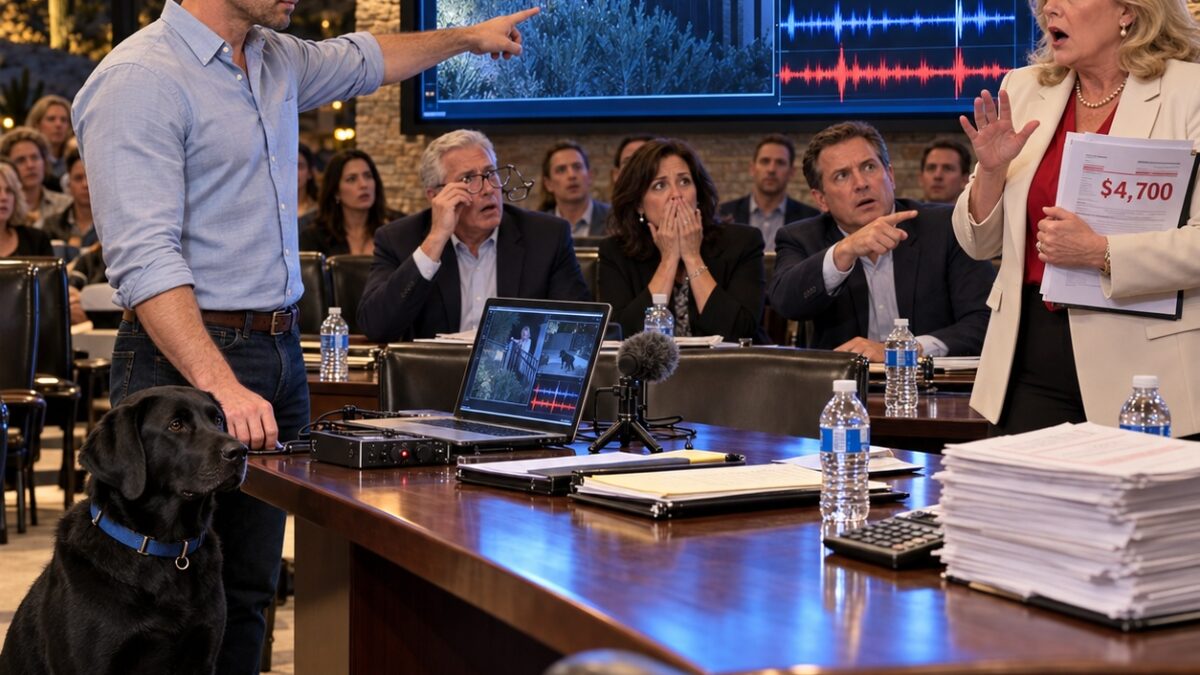
He carried one laptop to the presentation table.
No long introduction.
No emotional speech.
“My client has received multiple violation notices alleging excessive nighttime barking by his dog, Apollo.”
Brenda immediately leaned toward her microphone.
“The violations are documented.”
Harrison looked at her.
“I agree.”
That confused everyone.
Including Brenda.
“They are very well documented.”
He connected his laptop.
The large wall display activated.
A date appeared.
He played the audio.
Ten minutes of near silence.
Air conditioner hum.
Distant vehicle.
Then Apollo barked.
Four seconds.
Silence again.
Harrison paused playback.
“On this night, Ms. Sterling’s notice alleges nineteen individual bark incidents.”
A murmur moved through the room.
Brenda said:
“The recording may not capture all sound.”
Harrison nodded.
“Good point.”
He displayed the system layout.
Four microphones.
Locations.
Calibration logs.
He explained continuous monitoring.
Independent channels.
Cloud preservation.
Then played the second recording.
Zero barks for the cited period.
Brenda had billed twelve.
Third recording.
Three short barks.
Notice claimed twenty-three.
Fourth.
Two.
Notice claimed sixteen.
Harrison never raised his voice.
That was what made it so effective.
No theater.
No insult.
Numbers.
Dates.
Audio.
The room grew progressively quieter.
I watched Brenda.
At first, she looked irritated.
Then defensive.
Then very still.
Harrison put the comparison spreadsheet on screen.
HOA CLAIMED.
ACTUAL RECORDED.
FINES ASSESSED.
The columns ran downward.
Brenda reached for the microphone.
“There are also resident complaints.”
Harrison turned.
“Which residents?”
“Complaints are confidential.”
“Did any resident submit written complaints for the dates shown?”
Brenda’s lips tightened.
“I don’t discuss private reports in open session.”
Harrison nodded.
“Then we’ll address them through discovery.”
That word changed the atmosphere.
Discovery.
This was no longer a homeowner pleading with an HOA.
This was litigation vocabulary.
Harrison continued.
“Now I’d like to show you something else.”
Camera footage.
11:47 p.m.
Brenda appeared on the screen.
Dark clothing.
Walking outside my house.
The room went silent.
Not quiet.
Silent.
Brenda stared at her own image.
Harrison played the synchronized audio.
Footsteps.
Approach.
Apollo barking briefly.
Brenda stopping.
Then walking on.
Second date.
11:52.
Same.
Third.
12:08.
Same.
Harrison froze the third frame.
Timestamp clearly visible.
Brenda’s face in profile.
He looked at the board.
“On each of these nights, Ms. Sterling later filed a violation notice citing barking events against my client’s property.”
One board member shifted in his chair.
Another whispered something to the secretary.
Brenda finally spoke.
“I am allowed to walk in my own community.”
Harrison said:
“Yes.”
Nothing else.
That answer was devastating because it gave her nothing to fight.
She was allowed.
The question was why the HOA president was repeatedly walking outside one targeted homeowner’s property near midnight, then using the dog’s reactions as the basis for financial penalties.
Harrison did not need to decorate it.
Then he opened a folder.
“Mr. Vance is not my only client contact regarding this issue.”
Brenda looked up sharply.
Harrison placed three folders on the table.
“One.”
Another.
“Two.”
Another.
“Three.”
He turned toward the board.
“In the past week, three additional Oakfield Ridge dog owners have provided my office with per-bark violation notices issued by Ms. Sterling.”
I had not known that part.
Harrison had not told me.
I sat forward.
“They each report discrepancies between alleged bark counts and available evidence.”
Brenda said nothing.
“One homeowner has security footage.”
Harrison tapped a folder.
“Another has smart-home audio.”
Second folder.
“The third has a written witness statement from a neighbor who was present during several cited periods.”
Third folder.
One board member asked:
“How long has this been happening?”
Harrison answered:
“At least eighteen months based on the material currently provided.”
The board president seat no longer looked powerful.
It looked exposed.
Harrison closed his laptop.
Then said:
“We will be filing in Maricopa County Superior Court on Friday.”
And sat down.
That was it.
No shouting.
No dramatic exit.
The board called a recess.
The room exploded into whispers.
One resident turned around and looked at me.
“Is that true?”
I said nothing.
Attorney instruction.
Brenda left through the side door during the recess.
She did not return.
The lawsuit was filed Friday morning.
Exactly as Harrison promised.
It named Brenda personally.
It named the Oakfield Ridge HOA board.
The claims included fabricated enforcement notices, harassment, abuse of HOA authority, and fraud based on knowingly inaccurate financial demands.
The nighttime activity formed another central piece.
The three homeowners Harrison had referenced submitted supporting complaints that same week.
Then more people started calling.
That’s how systems of intimidation break.
At first, everyone thinks they are alone.
One homeowner pays $1,200 because fighting seems expensive.
Another pays $2,700 because they fear a lien.
Another removes a dog from a yard after dark.
Another stops letting their animal use the front lawn.
Nobody knows the others are doing the same.
The authority looks legitimate because no one compares notes.
Once people start comparing notes, the entire structure changes.
The following Monday, the Oakfield Ridge board held an emergency session.
It lasted less than twenty minutes before Brenda was removed as president.
Unanimous vote.
Eight years ended before most residents finished their coffee.
The board hired outside counsel separate from Brenda.
That mattered.
Their lawyer immediately recommended an independent audit of her enforcement history.
The audit took weeks.
The results were worse than anyone expected.
Per-bark fines had been issued to eleven different homeowners over three years.
Eleven.
More than $60,000 had actually been collected.
Not merely assessed.
Paid.
Residents had written checks.
Some because they believed resistance was hopeless.
Some because legal counsel would cost more than the fine.
Some because Brenda mentioned liens.
One couple had paid nearly $9,000.
I stared at the audit summary.
“Why would anyone pay this?”
Harrison looked at me.
“Fear.”
“But no rule authorized it.”
“Most people don’t read governing documents carefully.”
“That’s insane.”
“No.”
He leaned back.
“It’s common.”
That bothered me more.
Authority often survives not because it is valid but because it looks official.
Letterhead.
Fine number.
Deadline.
Threat.
Homeowners assume somebody checked.
Nobody did.
The board’s own records showed almost no meaningful review.
Brenda generated notices.
Residents paid.
Money entered HOA accounts.
Everyone apparently treated the process as legitimate because it had been happening for years.
The lawsuit expanded.
The other affected homeowners joined or filed related claims.
Every payment became evidence.
Every notice.
Every timestamp.
Every complaint.
Brenda’s defense became increasingly difficult.
She argued she was enforcing community noise standards.
Harrison’s response was simple:
Then why fabricate numbers?
She argued bark counts were based on personal observation.
Then why were the observations so consistently contradicted by recordings?
She argued late-night walks were personal exercise.
Fine.
Then why were so many of them occurring beside properties she later cited?
She said homeowners were exaggerating retaliation.
But there were eleven.
Patterns are difficult to dismiss.
Apollo, meanwhile, continued being Apollo.
He did not understand that he was now effectively Exhibit A with paws.
At night, he slept.
Sometimes on his bed.
Usually beside mine.
Occasionally, he barked.
Once at a coyote outside the back wall.
Once when a delivery driver somehow appeared at 5:30 a.m.
Once because he had seen his own reflection in the patio glass and temporarily forgot he was looking at himself.
I documented all of it.
By then, the recording system had become routine.
Wake.
Coffee.
Review overnight log.
Most nights:
Zero.
Some:
One.
Rarely:
Two.
Never forty-seven.
My neighbors began asking about Apollo.
A woman across the street named Elena stopped me one morning.
“I’ve lived here two years.”
“Okay.”
“I’ve never heard that dog at night.”
“Apparently Brenda did.”
She rolled her eyes.
“I hear my husband’s snoring through two rooms. If Apollo barked forty-seven times, I would know.”
I laughed.
“Can I quote you?”
“Absolutely.”
I actually sent her statement to Harrison.
He loved it.
Four months after filing, the court ruled in our favor on the central claims.
All fines against my property were declared unenforceable.
Gone.
Every dollar.
The recorded discrepancy between claimed barking and actual barking supported the fraud findings.
The court also ordered repayment of the improperly collected per-bark fines to affected homeowners, with interest.
More than $60,000 going back.
That part mattered more to me than my own $9,000 disappearing.
I had never paid.
Others had.
One retired couple had taken money from savings.
Another family had cut vacation plans for a year.
One man told me he’d almost given up his dog because he believed fines would destroy him financially.
Brenda’s actions had not been annoying.
They had changed people’s lives.
The damages awarded to me covered my legal expenses and additional compensation tied to the sustained harassment and nighttime provocation.
Harrison called the morning the judgment came down.
“We won.”
I was at my desk.
Apollo asleep underneath.
“All of it?”
“All central counts.”
“Fines?”
“Gone.”
“Refunds?”
“Ordered.”
“And Brenda?”
“Personally liable in part.”
I leaned back.
I expected triumph.
Instead, I felt tired.
“That’s it?”
Harrison laughed.
“You sound disappointed.”
“No.”
I looked down at Apollo.
“I think I’m done.”
“That’s a healthy reaction.”
Brenda sold her home on Maplewood Drive before the repayment obligations were fully resolved.
I learned through neighbors.
Legal fees.
Refunds.
Civil damages.
The financial pressure became too much.
I did not watch her move out.
Didn’t care to.
Some residents did.
Humans enjoy endings.
They wanted to see boxes.
Moving trucks.
Brenda leaving the gate.
I stayed home.
Apollo was asleep on the patio.
I sat beside him.
That seemed better.
The story was never really about watching Brenda lose.
It was about refusing to let a lie become expensive just because somebody said it confidently.
The week the judgment became final, I turned off the audio monitoring system.
Four microphones.
Thousands of hours of stored sound.
Months of sleeping under surveillance in my own home because I needed evidence that my dog behaved normally.
I opened the dashboard.
Clicked disable.
The graphs stopped.
It felt strangely emotional.
I stood in the kitchen looking at the blank screen.
Apollo walked over.
“What?”
He wagged.
“You’ve been acquitted.”
More wagging.
“You have no idea.”
I scratched his ears.
That night, I went to bed without any recording running for the first time in months.
At 2:00 a.m., I woke automatically.
Habit.
I listened.
Nothing.
Apollo snored softly beside the bed.
At 4:00.
Still quiet.
At 6:15, sunlight came through the curtains.
Apollo stretched.
No violation notice.
No log.
No spreadsheet.
Just morning.
That normalcy felt enormous.
The HOA changed after Brenda.
Not magically.
Organizations don’t become perfect because one person leaves.
But rules changed.
Fines above certain thresholds required board review.
Noise complaints needed independent corroboration.
No individual board officer could create a new penalty structure without legal review.
Enforcement records became accessible to members.
Appeal procedures were clarified.
The board also contacted every resident affected by Brenda’s per-bark fines.
Formal apologies.
Refund schedules.
I received one.
I kept it.
Not because I needed the apology.
Documentation.
Some habits survive war.
The new HOA president, Daniel Brooks, came by one afternoon.
He stood at my front gate.
“Michael.”
“Daniel.”
“Can we talk?”
“Depends.”
He laughed nervously.
“Fair.”
I let him in.
Apollo greeted him.
Tail wag.
No barking.
Daniel looked at the dog.
“So this is the terrorist.”
“Don’t provoke him. He’ll steal your socks.”
Daniel sat on the patio.
He had only joined the board a year earlier.
He had not been involved in the original bark fines.
Still, he looked embarrassed.
“I wanted to apologize personally.”
“The board already sent a letter.”
“I know.”
He rubbed his hands together.
“But the board let this happen.”
That honesty surprised me.
“Eight years is a long time to let one person operate without oversight.”
“Yes.”
“Why?”
He thought.
“Because she did the work.”
That answer was more interesting than any excuse.
“What do you mean?”
“Nobody else wanted to spend ten hours a week chasing violations.”
“So you let her.”
“Yes.”
He looked toward the yard.
“She knew the documents better than most of us. She was organized. Residents were afraid of her.”
“And the board?”
He gave a tired smile.
“Some board members were too.”
There it was.
Brenda’s power had not come from some extraordinary legal authority.
It came from effort plus everyone else’s avoidance.
She showed up.
Read rules.
Sent letters.
Spoke confidently.
Others preferred not to challenge her.
Over time, confidence became assumed legitimacy.
I thought about that for weeks.
People often imagine abuse of authority requires a powerful system.
Sometimes it only requires a room full of people too tired to ask:
Can she actually do that?
Apollo became famous in the neighborhood.
I hated this.
People started calling him “the hundred-dollar dog.”
Then “Apollo the Auditor.”
Then “Bark Witness.”
I asked everyone to stop.
Nobody listened.
At the next community picnic, someone printed a sign:
APOLLO: CURRENT BARK RATE $0.00.
I pretended to be annoyed.
It was funny.
Apollo accepted hamburger pieces from half the block.
The most unexpected result came from the other dog owners.
Before the lawsuit, I barely knew them.
Afterward, we talked regularly.
Carlos Reyes had a German Shepherd named Rex.
Susan Parker had two terriers.
The retired couple, Ann and Robert, owned a small spaniel named Molly.
All had received Brenda’s per-bark fines.
All had assumed they were individually targeted.
Susan told me:
“I thought maybe my dogs really were worse than I realized.”
That bothered me.
“Were they?”
“No.”
“But you doubted yourself.”
She nodded.
“That’s what official notices do.”
Exactly.
That was the real danger.
Fabricated enforcement doesn’t merely take money.
It changes how people perceive reality.
You know your dog is quiet.
Then a document says otherwise.
Again.
Again.
Exact times.
Exact counts.
Official seal.
You start wondering:
Did I sleep through it?
Am I irresponsible?
Are my neighbors angry?
Maybe they’re right.
Documentation stopped that from happening to me.
Not because I was smarter.
Because I happened to respond with tools.
Had I not installed microphones, I might have spent months defending impressions against invented certainty.
The recordings changed the balance.
From:
Brenda says.
Michael says.
To:
Here is the file.
Timestamp 02:17.
Four seconds.
Done.
That’s why I became almost evangelical about documentation afterward.
Not paranoia.
Not recording every neighbor.
That isn’t healthy.
But if somebody in authority makes specific factual claims carrying financial consequences?
Preserve evidence.
Emails.
Notices.
Dates.
Photos.
Audio where lawful.
Camera footage where appropriate.
Receipts.
The boring material wins cases.
Harrison used to say:
“Outrage gets attention. Records get judgments.”
He was right.
One evening, months after everything ended, I sat outside with Apollo.
Arizona sunset.
Orange light across the stone patio.
He had a tennis ball between his paws.
I looked at him.
“You know you cost somebody a house?”
Apollo chewed the ball.
“Not technically.”
He looked up.
“Fine. You exposed somebody who cost herself a house.”
Tail wag.
I thought about Brenda.
I no longer felt angry.
Not in the way I had.
Anger burns hot when you are under threat.
Once the threat ends, carrying it becomes voluntary.
I didn’t want to.
What Brenda did was wrong.
Financially destructive.
Dishonest.
Obsessive.
Possibly motivated by something I would never understand.
But I didn’t need her to remain central to my life.
The best revenge was boring.
Apollo sleeping.
My deed clean.
My neighbors refunded.
The microphones off.
No one walking past at midnight counting invented barks.
That was enough.
A year later, a new family bought Brenda’s former house.
Parents.
Two daughters.
And, ironically, a dog.
A young Golden Retriever named Waffles.
The name offended Apollo’s dignity.
Waffles barked.
A lot.
Puppy barking.
Excited barking.
Mailman barking.
Leaf barking.
Existing barking.
One evening, I heard him outside around nine.
Three or four sharp barks.
His owner immediately called him in.
I laughed.
Then something interesting happened.
Nothing.
No violation.
No panic.
No invoice.
No $400.
The next morning, I passed the owner near the mailbox.
“Sorry about Waffles last night.”
“For what?”
“He barked.”
“He’s a dog.”
“I don’t want to be that neighbor.”
“You’re fine.”
He smiled.
“Someone told me about what happened here.”
Of course they had.
Oakfield Ridge apparently had oral historians.
He looked embarrassed.
“I hope having a dog in that house isn’t weird.”
“No.”
Apollo sniffed Waffles through the fence.
Waffles lost his mind with joy.
Apollo tolerated him.
Full circle.
The neighborhood did not collapse because a dog barked three times.
Amazing.
Noise rules still existed.
They should.
Nobody wants an animal barking continuously for hours.
Responsible ownership matters.
But reasonable enforcement requires proportion.
Evidence.
Communication.
Opportunity to correct.
Not monetizing every sound.
The difference between governance and harassment is often restraint.
Brenda had none.
The board eventually asked me to join the architectural and compliance committee.
I laughed at the email.
Then deleted it.
Daniel called.
“Seriously.”
“Absolutely not.”
“We need people like you.”
“You need people who read.”
“Same thing.”
“I already have a job.”
“Monthly meetings.”
“No.”
“Free dinner.”
“No.”
Apollo looked at me.
“Stop.”
Daniel said:
“Was that to me?”
“No.”
“Please?”
I eventually agreed to attend one policy review session.
One.
Not join.
I spent ninety minutes asking irritating questions.
Where is this authority stated?
What evidence is required?
Who reviews the fine?
What is the appeal?
What prevents one person from targeting a homeowner repeatedly?
By the end, Daniel said:
“You should have been a lawyer.”
“No. Lawyers have clients like me.”
The revised enforcement policy came out three months later.
Clear limits.
Escalation procedures.
Independent review.
Written evidence standards.
Nothing revolutionary.
Just controls that should have existed all along.
People like Brenda often do not create broken systems.
They discover systems without guardrails.
Then use them.
That distinction matters because replacing one person is not enough.
If the process remains weak, somebody else eventually tries the same thing.
My case forced Oakfield Ridge to strengthen the process.
That may have been the most useful outcome.
Not my damages.
Not Brenda’s removal.
Structure.
One afternoon, I opened the old evidence folder on my computer.
Hundreds of files.
Audio.
Video.
Notices.
Emails.
Spreadsheets.
Court documents.
I clicked the first recording.
Quiet night.
Air conditioner.
Distant car.
Apollo barking twice.
Four seconds.
Three seconds.
Then silence.
That tiny file had started everything.
Or rather, it had revealed everything.
I thought about the first notice.
Forty-seven barks.
$4,700.
At the time, the number felt intimidating because it arrived printed.
Official.
Specific.
But specificity is not the same thing as truth.
That lesson applies far beyond HOAs.
False claims often become more persuasive when they contain numbers.
47 incidents.
$100 each.
11:47 p.m.
Official headings.
Deadlines.
People think:
No one would invent something this exact.
They do.
Exact lies are still lies.
The answer is not automatic distrust.
It is verification.
Show me the rule.
Show me the evidence.
Show me the process.
Those questions saved me.
I deleted none of the files.
Harrison told me to retain them.
So they remain backed up.
Two cloud locations.
External drive.
I am a software architect.
Of course they do.
Apollo is older now.
Gray around the muzzle.
Still steals socks.
Still sleeps most nights.
Sometimes he barks.
When he does, I notice.
Not with anxiety anymore.
Just awareness.
One evening around midnight, he barked suddenly.
I sat up.
For half a second, my body went back to those months.
Violation.
Count.
Notice.
Then I heard movement outside.
I checked the window.
A javelina near the landscaping.
Apollo barked again.
I laughed.
“Approved.”
He looked at me.
“Two free barks.”
Tail wag.
“Don’t abuse it.”
I went back to bed.
That is what recovery from small harassment looks like, I suppose.
You don’t realize how much something affected you until normal behavior briefly feels dangerous.
For months, every bark meant possible money.
Every envelope meant conflict.
Every late-night footstep meant Brenda.
Even after the judgment, my body remembered.
Eventually it faded.
Now a bark is just a bark.
That’s victory.
People occasionally ask whether I regret spending money on the monitoring system.
No.
Best equipment purchase of my life.
Not because technology is magical.
Because I used it to create an objective record before the conflict grew worse.
Had I waited until the lien threat became formal, I would have had less history.
Had I turned off recording after one quiet week, Brenda could have claimed later dates were different.
Consistency mattered.
Harrison drilled that into me.
Every night without exception.
The evidence became persuasive because it was boring.
Continuous.
Routine.
Not cherry-picked.
That is what people misunderstand about strong evidence.
The dramatic clip of Brenda walking past my house mattered.
But the hundreds of quiet hours mattered too.
They proved baseline.
Apollo sleeps.
Street quiet.
Normal.
Normal.
Normal.
Then Brenda appears.
Brief barking.
Notice exaggerates.
Pattern.
Without baseline, a dramatic clip is just a dramatic clip.
With baseline, it becomes context.
That’s why the case held together.
By the time the audit found eleven homeowners and more than $60,000 in collected fines, my individual dispute had become something larger.
Residents started attending meetings.
Really attending.
Reading packets.
Requesting financial reports.
Asking questions.
Voting.
The HOA became less comfortable.
Good.
Community governance should not be comfortable enough to run on autopilot.
One person should never hold eight years of unexamined practical authority because everyone else has better things to do.
We all have better things to do.
That is exactly why checks exist.
I had been guilty of the same disengagement.
For three years, I paid dues.
Ignored meetings.
Assumed somebody responsible was handling things.
As long as my yard looked fine and the gate worked, I didn’t care.
Then the system reached me.
That changed my attitude.
I still do not attend every meeting.
I have limits.
But I read summaries.
Vote.
Review major changes.
Pay attention.
That is enough.
Apollo, naturally, remains politically uninvolved.
He prefers socks.
One afternoon, one of the refunded homeowners, Robert, stopped at my house.
He was seventy-two.
Retired engineer.
He carried an envelope.
“I wanted to show you.”
Inside was the refund check.
Several thousand dollars.
Interest included.
He laughed.
“My wife said I should frame it.”
“You should cash it.”
“We will.”
He looked toward Apollo.
“Can I give him something?”
“Depends.”
He held up a dog treat.
“Approved.”
Apollo accepted.
Robert scratched his head.
“You know, I almost got rid of Molly.”
I remembered.
His spaniel.
“Because of the fines?”
He nodded.
“Brenda told me next offense would double.”
My stomach tightened.
“What stopped you?”
“My wife.”
“Smart woman.”
“Very.”
He looked at the check.
“If you hadn’t fought…”
I interrupted.
“You would have eventually.”
“No.”
His answer was immediate.
“I would have paid.”
That stayed with me.
Not everyone fights.
Not because they’re weak.
Because life already contains enough fights.
Medical bills.
Jobs.
Kids.
Aging parents.
People choose the path that ends stress fastest.
Abusive systems understand that.
Make resistance expensive.
Confusing.
Time-consuming.
Most people will comply.
That’s why documentation plus shared action mattered.
One homeowner fighting is eccentric.
Eleven become evidence.
The community eventually placed term limits on the HOA presidency.
Three consecutive years.
Then mandatory rotation.
I supported it.
Nobody should have eight years to turn a volunteer office into a personal kingdom.
Daniel joked:
“We’re naming this the Brenda Rule.”
I said:
“Do not put that in writing.”
He didn’t.
Probably.
The years moved on.
Brenda became less discussed.
New homeowners arrived who never knew her.
Oakfield Ridge remained annoyingly manicured.
Property values remained high.
The security booth remained staffed.
The world did not end.
My garden grew.
Apollo aged.
I replaced the patio lights.
Life became boring again.
I value boring much more now.
Boring means no legal letters.
No disputed balances.
No midnight footage.
No attorney conference.
Boring means Apollo snoring.
Coffee.
Work.
A clean deed.
Sometimes peace is simply the absence of somebody manufacturing a problem.
That experience also changed how I respond when someone tells me:
“It’s just an HOA dispute.”
Maybe.
Some are.
Fence height.
Paint.
Parking.
Ordinary disagreements.
But any enforcement system can become abusive when someone realizes most people won’t challenge specifics.
The amount is almost irrelevant.
$100.
$4,700.
$9,000.
Once false information is attached to property rights and financial consequences, it is serious.
The moment Brenda threatened liens based on numbers she could not substantiate, this stopped being about barking.
It became about whether fabricated authority could become real through repetition.
My answer was no.
Not because I shouted louder.
Because I recorded.
Verified.
Saved.
Waited.
Then let the evidence speak.
Harrison deserves credit for understanding timing.
I wanted confrontation earlier.
After the second false notice, I was ready.
“Let’s send everything.”
He said no.
“Why?”
“Because she thinks you have no evidence.”
“So?”
“Let her continue.”
That was hard.
Every new notice raised the balance.
Every letter irritated me.
But those later notices destroyed the possibility of innocent mistake.
One inaccurate count?
Error.
Two?
Maybe poor method.
Four?
Six?
Night after night?
Then camera footage?
Then other homeowners?
The story changed.
Patience built the case.
That was difficult for me because software problems reward immediate debugging.
Legal problems sometimes reward observation.
Brenda thought silence meant submission.
It meant collection.
There is a difference.
If I ever write a book, that’s probably the title.
I won’t.
No one needs 300 pages about HOA governance.
Apollo would be the only interesting part.
One evening, I sat on the patio with Harrison after everything had ended.
We had become friendly enough that he occasionally came over for a drink.
Apollo liked him because Harrison always brought treats.
“I have a question.”
Harrison leaned back.
“Go ahead.”
“What would have happened if I hadn’t installed the microphones?”
He thought.
“You still could have challenged the fines.”
“Would we have won?”
“Probably some issues.”
“Fraud?”
“Harder.”
“Provocation?”
“Very hard.”
I nodded.
“So I got lucky.”
“You got methodical.”
“Same thing.”
“No.”
He pointed at me.
“You responded to an unprovable claim by creating a way to prove future claims.”
I laughed.
“That sounds like something a lawyer says when billing.”
“I’m off the clock.”
Apollo rested his head on Harrison’s knee.
“Also your dog is extremely quiet.”
“I’ve been saying that for years.”
Harrison scratched Apollo’s ear.
“Terrible witness, though.”
“Why?”
“He’d sell you out for chicken.”
True.
Today, when I tell the story, people usually laugh first.
“One hundred dollars per bark?”
Yes.
It sounds ridiculous.
That is part of why it worked for a while.
Ridiculous behavior often survives because people assume nobody could be serious.
But Brenda was serious.
People paid.
Real money.
More than $60,000.
The absurdity did not make the consequences imaginary.
That’s another lesson.
Never assume a bad rule will collapse because it’s obviously bad.
Bad systems can persist for years if they are profitable, intimidating, or tedious enough to challenge.
Someone has to test them.
In my case, the test began with a sleeping Labrador and four microphones.
There is an old framed photo of Apollo in my office.
He’s lying beside the mailbox.
The original $4,700 notice is on the ground next to him.
I took it the day the judgment became final.
Not staged elegantly.
Just Apollo looking bored beside the document that started everything.
Under the photo, I wrote:
ACTUAL BARK COUNT: 0.
Harrison saw it and laughed.
“Petty.”
“Yes.”
“I approve.”
The original notice remains in my evidence box.
I occasionally think about throwing it away.
Then I don’t.
Not because I’m angry.
Because it reminds me how quickly official-looking nonsense can become dangerous when nobody asks for proof.
Apollo is sleeping beside me as I write this.
He will probably wake soon.
Stretch.
Steal something.
Maybe bark.
If he does, no one will be standing outside with a clipboard calculating dollars.
No one will walk past at midnight hoping to create evidence.
No one will send fabricated counts the next morning.
He is simply allowed to be a dog.
That sounds like a small victory.
It isn’t.
Eleven homeowners got their money back.
A broken enforcement system was changed.
An HOA president who believed her position placed her beyond scrutiny learned otherwise.
And I learned that when somebody tells you something happened forty-seven times, you do not always need to argue.
Sometimes you just need to press record.








