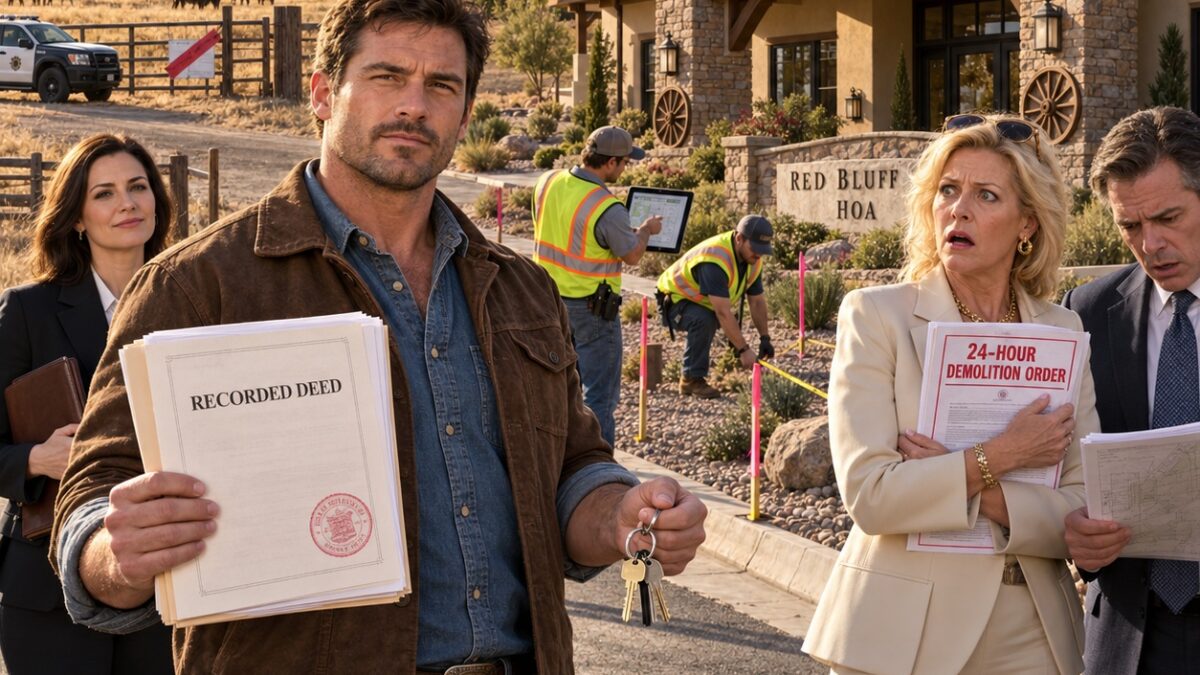
FULL STORY:The HOA Gave Me 24 Hours to Demolish My Family Ranch—Three Days Later, I Owned the Ground Beneath Their Headquarters
FULL STORY CONTINUATION
Most people handed a twenty-four-hour demolition order would call family.
Panic.
Hire a lawyer.
Beg for extensions.
I went to the county recorder.
Not because I was calm.
I wasn’t.
I was furious.
But anger is useful only when you give it something technical to do.
At the recorder’s office, I requested every document tied to Roe Ranch.
Deed history.
Boundary maps.
Old easements.
HOA plats.
Development records.
Complaints.
The emergency order.
Anything connected to adjacent parcels.
The clerk gave me a look over the top of her glasses.
“How much coffee have you had?”
“Not enough.”
She started pulling files.
I spent hours reading.
One thing kept appearing.
Red Bluff Holdings LLC.
A shell company tied to parcels throughout the development.
Not the individual homes.
Underlying land.
Commercial strips.
Rental townhouses.
Common facilities.
The HOA office.
That interested me.
I went back through the original developer filings.
Red Bluff Bluffs had been assembled in phases.
Some homes were sold fee simple.
Others sat on long-term ground leases.
A row of premium rental townhomes near the center of the subdivision did not own the underlying dirt.
Neither did the building housing the HOA office.
Neither did the overflow parking parcel.
The developer had retained those land interests through a separate company.
Then apparently lost them.
A loan default.
Distressed asset sale.
Portfolio transfer.
Eventually, the leases ended up owned by a regional investment group.
I wrote down the contact information.
Then called.
“Hi. My name is Jake Rowe. I have a question about Red Bluff Holdings.”
The receptionist transferred me twice.
Eventually, a man named Trevor answered.
He sounded bored.
Perfect.
Bored people sometimes sell complicated problems cheaply.
“Can we meet today?”
“What about?”
“Ground leases.”
“Which ones?”
“Red Bluff Bluffs.”
Silence.
Then:
“What did that HOA do now?”
I smiled.
“Can I come over?”
An hour later, I sat across from Trevor in a glass-walled office that looked designed to prevent emotional attachment to anything.
I had printed parcel maps.
Lease indexes.
Addresses.
He studied the pages.
“You’ve done your homework.”
“I like homework.”
He looked at me as though nobody had ever voluntarily said that.
I pointed.
“You own the ground under these townhouses?”
“Yes.”
“This office?”
“Yes.”
“Parking?”
“Yes.”
“And the leases are still active?”
“Long-term.”
“Who handles tenant relations?”
“The HOA handles day-to-day issues. We collect ground rent.”
“Profitable?”
“Steady.”
“Then why does your file show internal notes about disposition?”
He leaned back.
“You really did your homework.”
I waited.
Trevor sighed.
“We’ve considered selling the bundle.”
“Why?”
“Low yield.”
Pause.
“And the HOA is annoying.”
I nearly laughed.
“Define annoying.”
“Encroachment letters. Lease interpretation questions. A dispute involving an adjacent agricultural parcel.”
“That would be me.”
His eyebrows rose.
“You’re the ranch guy?”
“Apparently that’s what people call me now.”
Trevor looked amused.
“So what’s your angle?”
“I’ll buy the portfolio.”
That removed the amusement.
“All of it?”
“Yes.”
He studied me.
“You know what that costs?”
“Give me a number.”
He did.
It was painful.
Not impossible.
Painful.
I looked at the figure.
“How quickly can you close?”
He shrugged.
“If funds clear and title is clean? Seventy-two hours.”
“Done.”
He stared at me.
“Do you actually have the capital?”
Not in cash.
But I had equity.
Savings.
Investments.
And one colleague named Daniel Price who had spent years telling me real estate law was more entertaining than television.
I called him from Trevor’s parking lot.
“You busy?”
“Always.”
“I need money.”
“That escalated fast.”
“Remember the HOA trying to force me out?”
“Yes.”
“I found something.”
Twenty minutes later, Daniel stopped laughing and started calculating.
“You can actually buy the land under their office?”
“And several board members’ rental townhomes.”
“You are joking.”
“No.”
Silence.
Then:
“How much do you need?”
That was Daniel.
I used a home-equity line.
Liquidated investments.
Drained savings harder than I liked.
Daniel put in capital through an investment structure we could document cleanly.
We arranged bridge financing.
It was reckless.
Not suicidal.
There is a difference.
Meanwhile, the demolition clock kept ticking.
I had no intention of relying on the real-estate deal alone.
The county order was still a separate threat.
So I hired an independent structural engineer.
Not a friend.
Not someone connected to me professionally.
A licensed engineer with no relationship to the HOA.
He inspected the house.
Barn.
Foundations.
Roof framing.
Posts.
Beams.
Everything.
His conclusion was exactly what I expected.
Aged?
Yes.
Needs maintenance?
Obviously.
Structurally unsound?
No.
Immediate hazard?
Absolutely not.
He wrote a detailed report.
Stamped it.
I submitted it with a formal appeal.
Under county procedure, the appeal automatically stayed the demolition order.
The clerk took my filing.
Stamped it.
Then leaned closer.
“I told them twenty-four hours was ridiculous.”
“Who?”
She gave me a look.
“I enjoy my pension.”
Fair.
The county couldn’t demolish anything while the appeal was active.
That gave me time.
Not much.
Enough.
Two days later, the property acquisition closed.
I sat inside the title company’s conference room staring at signed documents.
Transfer deeds.
Lease assignments.
Ground-interest schedules.
Legal descriptions.
The signatures looked boring.
The implications were not.
I now owned the underlying parcels beneath:
The HOA office.
The overflow parking area.
A row of premium rental townhomes.
Several other rental units controlled through the association’s ecosystem.
Roe Ranch remained mine.
Now so did a strategically inconvenient portion of the world around it.
Daniel sat beside me.
“You understand this is objectively insane.”
“Probably.”
“You leveraged your house.”
“Yes.”
“Liquidated half your portfolio.”
“More than half.”
He winced.
“Thank you for correcting me.”
I looked at the deed.
“Worth it.”
“We haven’t even done anything yet.”
“I know.”
The most interesting clause appeared in the ground leases.
I had noticed it earlier.
Daniel’s attorney confirmed it.
Upon transfer of ownership of the underlying land, lease terms could be adjusted to current market rates at the next renewal, subject to the lease language.
And the renewal date?
Sixty days.
All of them.
I spent one evening studying comparable rents.
Land valuations.
Commercial ground-lease rates.
Replacement costs.
The existing contracts had been signed fifteen years earlier.
Well below market.
Very well below.
Tenfold sounded ridiculous until you looked at what they’d been paying.
Still, I didn’t need tenfold rent.
I needed leverage.
There is a difference.
I requested agenda time at the next HOA board meeting.
Subject:
GROUND LEASE RENEWAL DISCUSSION.
They approved it instantly.
Official-sounding requests made Red Bluff Bluffs very cooperative.
The meeting happened inside the HOA clubhouse.
I wore polished boots.
Pressed shirt.
Clean shave.
The closest thing I owned to revenge attire.
Elaine sat at the head of the long table.
Same posture.
Same clipboard.
Same sense that everyone else was visiting her kingdom.
The treasurer sat nearby.
Other board members filled the table.
Residents occupied folding chairs in the back.
Before my item, I endured twenty-five minutes of discussion over holiday-light standards.
I nearly admired the commitment.
Finally:
“Item four. Ground lease renewal.”
Elaine opened a folder.
“As residents may know, we’ve been negotiating with Red Bluff Holdings regarding several upcoming renewals.”
I stood.
“That’s why I’m here.”
She frowned.
“This portion is a board matter.”
“I know.”
I walked to the table.
Placed a thick folder down.
On top:
Recorded deed.
Elaine looked at it.
Then at me.
“What is this?”
“My name is Jake Rowe.”
“I know who you are.”
“As of last week, I’m the new owner of the ground interests listed in those lease agreements.”
Silence.
The treasurer stopped typing.
One board member leaned forward.
I continued.
“That includes the land beneath this office, your overflow parking lot, and the rental townhomes identified in the attached schedule.”
Elaine laughed once.
Sharp.
Disbelieving.
“That’s absurd.”
I slid the recorded deed toward her.
“County disagrees.”
She picked it up.
Read.
The color slowly left her face.
Behind me, somebody whispered:
“Oh my God.”
Elaine looked back at me.
“You.”
“Yes.”
Her voice lowered.
“The ranch guy.”
I smiled.
“The ranch guy.”
The treasurer began flipping through documents.
“These leases were owned by Red Bluff Holdings.”
“They sold them.”
“They would have notified us.”
“They did.”
I tapped the assignment.
“By accepting my wire transfer.”
A resident laughed.
Elaine shot him a look.
I handed out the proposed renewals.
The treasurer read first.
His expression changed.
Then he grabbed his calculator.
“What is this?”
“Updated market-based lease schedule.”
He stared.
“This is ten times current rent.”
“Approximately.”
“Approximately?”
Elaine snatched the document.
“You cannot do this.”
I sat down.
“Please review page three.”
She did.
The room stayed silent.
Her acrylic nail stopped halfway down the page.
Transfer.
Renewal.
Market adjustment.
Binding dispute procedure.
Recognition of landlord rights.
She looked up.
“This is extortion.”
“No.”
I took a sip of coffee.
The mug Daniel had given me read:
THIS MEETING COULD HAVE BEEN AN EMAIL.
“You are welcome to challenge your landlord.”
I gestured toward the document.
“Though I’d have counsel review the arbitration clause first.”
The treasurer had gone pale.
“At this rate, we’d have to raise dues.”
A resident called from the back.
“How much?”
The treasurer hesitated.
“Substantially.”
“How substantially?”
“Possibly triple.”
The room erupted.
“Triple?”
“Are you insane?”
“We already pay too much!”
Elaine banged the gavel.
“Order.”
Nobody cared.
One man shouted:
“Why did you provoke the ranch owner in the first place?”
That was when I knew I had the board.
Not legally.
Politically.
HOA boards fear many things.
Lawsuits.
Unpaid assessments.
But most of all, a room full of their own residents realizing leadership has created an avoidable financial disaster.
I raised my hand.
“I have an alternative.”
The room settled.
Elaine looked suspicious.
“Of course you do.”
I removed one final document.
Placed it on the table.
EASEMENT AND PERMANENT NON-INTERFERENCE COVENANT.
The treasurer picked it up.
“What is this?”
“The deal.”
Elaine crossed her arms.
“What deal?”
“You sign this, and I replace the tenfold lease schedule with a much more manageable increase.”
The treasurer leaned forward.
“How manageable?”
I gave him the number.
Still higher than before.
Fair.
He calculated.
“That is survivable.”
“Exactly.”
Elaine stared at me.
“What do you want?”
I turned toward her.
Finally.
“Very little.”
She laughed bitterly.
“That’s obviously not true.”
I pointed to the document.
“First: permanent acknowledgement that Red Bluff Bluffs HOA has zero jurisdiction over Roe Ranch.”
Silence.
“No violation letters.”
I continued.
“No appearance complaints.”
“No fence demands.”
“No livestock demands.”
“No attempt to impose architectural standards.”
Another board member began reading.
“Second, the association records a permanent non-interference covenant binding future boards.”
Elaine’s eyes narrowed.
“Permanent?”
“Yes.”
“Third, the HOA formally supports protective zoning for Roe Ranch against compelled redevelopment.”
Her jaw tightened.
“Fourth…”
I looked directly at her.
“The president of this association reads a public statement acknowledging that the board exceeded its authority and recognizing the ranch’s historic value to the area.”
She stared at me.
“You want an apology.”
“I want a record.”
“Humiliation.”
“Documentation.”
A man in the back shouted:
“Let her pay the higher rent herself!”
Several residents laughed.
Another said:
“She started this!”
Elaine looked toward the board members.
None of them met her eyes for long.
The treasurer looked at me.
“If we refuse?”
“The renewal schedule stays as presented.”
“You’d actually enforce it?”
“Yes.”
Elaine snapped:
“This is coercion.”
I stayed calm.
“No. This is a lease negotiation.”
I pointed at the contract.
“Your developer wrote these terms.”
“You’re weaponizing them.”
“Interesting phrase.”
I leaned back.
“For months, your association tried to use county process, legal threats, and property-value arguments to force me to sell land you do not own.”
No one moved.
“I’m simply negotiating from documents I actually do own.”
That landed.
The treasurer returned to the numbers.
“If we accept the lower rate…”
“Yes.”
“And sign the covenant…”
“Yes.”
“We can maintain current operations with cuts.”
“What cuts?” someone asked.
He scrolled.
His eyes paused deliberately.
“Some discretionary expenditures.”
Elaine followed his gaze.
President’s Community Enhancement Fund.
I almost laughed.
The room shifted against her.
Not because everyone suddenly loved Roe Ranch.
Some probably still thought my barn was ugly.
But ugliness stops mattering quickly when dues threaten to triple.
The board requested a closed-session recess.
I waited outside with residents.
People approached me.
One man shook my hand.
Another said:
“I’ve been telling them to leave your ranch alone for years.”
Had he?
Maybe.
People discover courage faster when the outcome becomes clear.
Still, I appreciated it.
Forty minutes later, they reopened the meeting.
The board had voted.
They would negotiate the lower rent.
They would sign the non-interference covenant.
They would support the zoning protection.
And Elaine would read the statement.
Her face made clear she had not voted enthusiastically.
I signed after counsel reviewed everything.
So did they.
The easement and covenant were recorded.
Not just minutes.
Not promises.
Recorded against the relevant HOA-controlled interests.
Future boards would inherit it.
That mattered.
I had spent too long dealing with people who believed verbal boundaries could be reinterpreted later.
Paper.
Deed.
Recording number.
Permanent.
Two weeks later, Elaine stood on a small stage inside the clubhouse.
Cheap LED string lights overhead.
Microphone in hand.
Prepared statement.
Residents filling chairs.
I stood in the back.
She began.
“As president of the Red Bluff Bluffs Homeowners Association, I wish to formally recognize Roe Ranch as a historically significant property and an important part of the broader community’s identity.”
Her voice tightened slightly.
She continued.
“Past initiatives undertaken by this board concerning Roe Ranch were ill-advised and exceeded the Association’s proper authority.”
Someone applauded.
Elaine paused.
Then:
“Going forward, the Association will respect the ranch’s autonomy and support its continued preservation.”
A resident called:
“Does this mean no more emails about his fence?”
Laughter.
Elaine’s jaw tightened.
“Yes.”
More applause.
I should have felt triumphant.
I did.
A little.
But the deeper feeling was relief.
The ranch was safe.
That mattered more than embarrassing Elaine.
The county demolition order died quietly during the appeal.
My independent engineer’s report destroyed the hazard argument.
The county attorney apparently had an uncomfortable conversation with code enforcement about relying too heavily on material generated by an HOA with obvious development interests.
No demolition.
No condemnation.
Instead, Roe Ranch received an added protective zoning designation.
Not absolute immunity from every future regulation.
Nothing is.
But enough layers that forced redevelopment became extremely difficult.
Exactly what I wanted.
Then came the strange part.
Every month, the HOA began paying me.
Ground rent.
For its office.
For rental-townhome parcels.
For parking.
The same office that had once mailed me letters demanding I paint my barn now generated income that helped pay down the financing I used to buy their land.
I found that extremely satisfying.
Daniel called the first month.
“Check arrived?”
“Yes.”
“How does it feel?”
“Capitalism tastes weird.”
He laughed.
“Frame it.”
“I deposited it.”
“Responsible.”
I invested money back into the ranch.
New structural bracing in the barn.
Not because Elaine was right.
Because old buildings still deserve maintenance.
Fresh traditional red paint.
Roof repairs.
Fence work.
A modest riding arena.
I restarted a small horse program.
Then began offering trail rides and beginner lessons.
At the entrance, I installed a sign:
ROE RANCH
ESTABLISHED 1924
SURVIVED DROUGHTS, DEPRESSIONS, AND ONE EXCEPTIONALLY PERSISTENT HOA.
The first morning it went up, I stood at the gate smiling like an idiot.
My father would have loved it.
Or told me the lettering cost too much.
Probably both.
Children from Red Bluff Bluffs started coming for riding lessons.
At first, only a few.
Then more.
Parents who had once viewed the ranch as an aesthetic flaw discovered their kids liked horses.
Funny how quickly perspective changes when something becomes useful.
One mother told me:
“This place actually gives the neighborhood character.”
I nearly fell off the fence.
“Careful.”
She laughed.
“What?”
“That’s dangerously close to admitting the barn isn’t destroying property values.”
She smiled.
“Don’t tell the board.”
Too late.
The new board started mentioning the ranch in community materials.
Historic neighboring property.
Equestrian amenity.
Local heritage.
Marketing language can metabolize almost anything.
Elaine resigned several months later.
Officially, health concerns.
Unofficially, residents had grown tired of paying higher dues because their president had spent years turning one ranch into a personal campaign.
The new board was calmer.
More careful.
When they sent emails, they tended to verify jurisdiction first.
Progress.
A few members even enrolled their children in riding lessons.
That was the part my father would have enjoyed most.
Not the legal reversal.
Not the rent.
The irony.
People once complained about livestock within their visual corridor.
Now they paid me to let their children ride the same horses.
Life is generous that way.
The ranch improved financially too.
I still took engineering work.
I liked engineering.
But the ground-rent income stabilized the property.
Drought no longer felt like immediate catastrophe.
Repairs became manageable.
I began rebuilding a small cattle herd.
Not large.
Enough.
One spring morning, I stood in the pasture watching calves move through new grass.
Red Bluff Bluffs sat beyond the fence.
Rows of clean stucco roofs.
Pools.
Walking paths.
Golf carts.
Roe Ranch beside it.
Old barn.
Windmill.
Dust.
Neither erased the other.
That was all I had wanted from the beginning.
Coexistence.
Elaine had treated difference as failure.
My ranch did not match, therefore it needed correction.
That mindset is dangerous far beyond HOAs.
Not everything beside you has to become you.
Communities can contain different histories.
Different land uses.
Different priorities.
The ranch existed first.
The subdivision came later.
Neither fact meant one had to destroy the other.
The conflict happened because Elaine couldn’t tolerate something outside her authority remaining visibly independent.
Once I understood that, the entire story made sense.
The barn wasn’t the problem.
Control was.
There had been clues from the beginning.
“Adjacent influence authority.”
Meaningless phrase.
But it sounded official.
A lot of power works that way.
Not through actual authority.
Through confident presentation.
Letterhead.
Legal-sounding language.
Threats.
Deadlines.
Most people assume somebody somewhere verified the claim.
That’s why I went to the county.
That’s why I pulled deeds.
That’s why I read leases.
Paper defeats intimidation when the paper is real.
That became the lesson people asked me about afterward.
“How did you think to buy their ground leases?”
I usually gave the simple answer.
“I read.”
The more honest answer is:
I was angry enough to become curious.
Those are not the same thing.
Anger alone makes people reckless.
Curiosity makes them dangerous.
I stopped asking:
How do I stop Elaine?
I started asking:
What does she actually control?
What does the HOA own?
What does the developer own?
Who owns the dirt?
That last question changed everything.
We talk about houses as if the building is the whole asset.
Sometimes it isn’t.
Land.
Ground leases.
Easements.
Water.
Access.
Title.
Those quiet documents determine who can really do what.
Elaine understood rules.
She just assumed I wouldn’t learn the ones that mattered more than hers.
She was wrong.
There was another lesson too.
I came dangerously close to risking too much.
People loved the revenge version of the story.
Twenty-four-hour demolition order.
Rancher buys HOA land.
Rent jumps tenfold.
President forced to apologize.
Great story.
But the financing was real.
I leveraged my house.
Used savings.
Brought in a partner.
Signed serious debt.
If the portfolio economics had been bad, no amount of anger would have justified buying it.
I did not buy useless land solely for revenge.
The leases produced income.
The asset had value.
The terms supported renewal adjustments.
Daniel and I ran the numbers.
Then ran them again.
The satisfying outcome worked because the deal made financial sense even after the emotional motive was removed.
That matters.
Otherwise, revenge becomes self-destruction wearing boots.
The first rent increase I proposed was aggressive by design.
Negotiating leverage.
The final rate was much more reasonable.
Still market-adjusted.
Still higher.
Enough to improve returns without collapsing the association.
I did not actually want Red Bluff Bluffs insolvent.
I lived beside them.
Bankrupt neighbors make terrible neighbors.
What I wanted was a durable agreement.
No harassment.
No demolition attempts.
No future board deciding to resurrect Elaine’s crusade.
Permanent non-interference.
Recorded protection.
That was worth more than one dramatic rent increase.
The public apology mattered less legally.
More psychologically.
Not for me.
For the neighborhood.
Residents needed to hear their board acknowledge that it had exceeded its authority.
Otherwise, years later, someone could rewrite history.
“Just a misunderstanding.”
No.
The board tried to interfere with land it did not control and pushed county action beyond what the facts supported.
The apology preserved that truth.
I kept a copy.
Of course.
I kept everything.
The original HOA notice.
The absurd adjacent-influence email.
The demolition order.
Independent engineering report.
Appeal.
Purchase agreement.
Deeds.
Ground leases.
Covenant.
Elaine’s signed statement.
My father had kept ranch records in old coffee tins and metal boxes.
Cattle receipts from 1978.
Fence invoices.
Water permits.
Handwritten notes.
I used cloud backups.
Same instinct.
Different century.
Land remembers through paper.
That idea became important to me.
People pass.
My great-grandfather.
Grandfather.
Parents.
Eventually me.
Property outlives us if the records survive.
A deed is memory with legal force.
That’s why Elaine’s twenty-four-hour order offended me beyond economics.
She was treating a century of continuity as clutter.
Demolish.
Clear.
Redevelop.
Replace.
Development isn’t evil.
I am an engineer.
I have designed parts of developments.
People need homes.
Infrastructure.
Growth.
But growth that requires erasing anything older than itself is just amnesia with financing.
Roe Ranch didn’t need to remain frozen.
I changed it.
Repaired the barn.
Added the arena.
Reduced cattle.
Added trail rides.
Adaptation is not erasure.
My father would recognize the place.
So would my grandfather.
That is enough.
A year after the conflict, the county zoning officer stopped by.
Same man who had told me to document everything.
He stood near the new sign.
“Cute.”
“I sense judgment.”
“Definitely.”
He looked at the barn.
“Painted.”
“Traditional red.”
“Community-approved shade?”
I laughed.
“Get off my land.”
He laughed too.
Then his expression became more serious.
“You know the twenty-four-hour notice shouldn’t have happened.”
“I know.”
“There was pressure.”
“From Elaine?”
“From several people.”
“The HOA attorney?”
He hesitated.
“I shouldn’t discuss personnel.”
“Convenient.”
He nodded.
“I know.”
I didn’t push.
The appeal had fixed the immediate issue.
The county had tightened review for emergency structural orders afterward.
That was another useful consequence.
No external party’s private report could trigger that kind of action without independent inspection.
Good.
Systems matter.
People like Elaine find gaps.
Close the gaps.
Years later, I was asked to speak at a local land-use meeting.
Not about revenge.
About legacy parcels surrounded by development.
I nearly declined.
Then accepted because the issue mattered.
I told the room:
“If you’re developing around existing agricultural land, don’t treat the older parcel as a drafting error.”
Several people laughed.
I wasn’t joking.
“Buffer it. Plan access. Respect existing rights. Write clear agreements.”
Someone asked about HOAs.
I said:
“Never let an HOA write jurisdiction it doesn’t own into existence through repetition.”
That got more laughter.
Afterward, an older farmer approached me.
His family land was being surrounded by housing.
He said:
“They keep telling me eventually I’ll have to sell.”
“Do you?”
“No.”
“Then eventually is their word.”
He smiled.
That conversation mattered more than Elaine’s apology.
The ranch became useful to other people as proof that refusing one offer did not make you unreasonable.
Sometimes the most rational choice is preserving something because its value is not fully captured by today’s sale price.
I won’t romanticize landownership.
Taxes still come.
Roofs fail.
Wells break.
Insurance increases.
Horses require money with astonishing efficiency.
But the ranch is mine.
Not emotionally alone.
Legally.
That’s what allowed me to protect it.
Property rights cut both ways.
Elaine loved property rights when they meant uniformity.
She hated them when mine blocked her plan.
The irony never stopped amusing me.
She once told me:
“You can’t just do whatever you want because you own land.”
True.
I never claimed otherwise.
Zoning.
Environmental rules.
Safety codes.
All valid.
What she meant was:
You can’t refuse what I want.
Different statement.
I could.
So I did.
The residents ultimately paid somewhat higher dues because the updated ground rent increased operating costs.
That bothered me.
Not enough to change the deal, but enough that I made the rate reasonable.
Some residents complained.
Fair.
They hadn’t started the conflict.
But they had repeatedly elected a board that failed to control Elaine.
Governance has collective costs.
That’s uncomfortable.
Still true.
A few residents blamed me.
One sent an angry email.
“You punished an entire neighborhood because of one woman.”
I replied only once.
“The association signed the leases. The association benefited from below-market rates for fifteen years. The association chose its leadership. The final rate is market-supported and significantly below the rate I was contractually entitled to demand.”
No response.
Most residents eventually moved on.
People always do.
The initial anger faded.
The ranch remained.
Children rode horses.
The HOA paid rent.
No apocalypse.
Ordinary life absorbed the drama.
That may be my favorite part of any conflict.
The point where it stops being the center of life.
I didn’t wake every morning thinking about Elaine.
I woke thinking about fencing.
Engineering deadlines.
Whether the old mare needed shoes.
Whether Daniel had sent the quarterly lease report.
Eventually, Elaine became a story.
Not an enemy.
That’s healthier.
The office her board once used to send me violation letters still stands.
I own the land under it.
Every month, the association’s payment arrives electronically now.
No envelope.
Less satisfying.
Occasionally I pull up the statement anyway.
Ground rent.
Red Bluff Bluffs HOA.
I smile.
Then move on.
The real pleasure is outside.
The barn.
Still standing.
New braces inside.
Fresh siding repairs.
Traditional red paint fading slowly under the desert sun.
Some residents still probably think it is ugly.
Good.
They are allowed opinions.
That’s the beauty of jurisdiction.
You don’t need authority over everything you dislike.
My sign became something of a local joke.
Tourists photograph it.
Riders ask about “the persistent HOA.”
I usually tell the short version.
“They tried to demolish the ranch.”
“What happened?”
“I bought their landlord.”
That line always gets a laugh.
Technically, I became their landlord.
Close enough.
My father would have said I was showing off.
He’d be right.
I earned a little.
One evening, I sat on the porch after lessons ended.
Sunset over the scrubland.
Red Bluff Bluffs beyond the fence.
The development lights came on one by one.
Perfect rows.
My windmill creaked.
A horse moved near the arena.
I thought about the day I received that twenty-four-hour order.
For several minutes, I had been genuinely afraid.
Not of Elaine.
Of losing.
People who inherit land sometimes carry guilt about it.
You’re not just protecting your own asset.
You’re the temporary custodian of everyone who came before.
If you lose it, you feel as though you lost something for them too.
That pressure can become unhealthy.
But it was real.
I imagined bulldozers taking the barn down.
The porch.
The cottonwood near the well.
Then replacing it all with Phase Two.
Cactus Ridge II.
Maybe townhouses.
A decorative sign where my father’s workshop used to stand.
That image made me furious enough to move.
But preservation alone wasn’t the ending.
The ranch needed a future.
Not just a past.
Ground-rent income gave me that.
Lessons.
Trail rides.
Repair money.
Some cattle.
Better water infrastructure.
The place became more viable than before the fight.
That’s the irony Elaine would hate most.
Her attempt to eliminate Roe Ranch made me restructure it into something harder to kill.
Conflict clarified what I had been postponing.
Before Elaine, I was trying to keep the ranch exactly as my parents left it while costs increased.
Afterward, I asked:
How does this place survive another fifty years?
That question changed me.
Preservation requires adaptation.
The barn can remain.
The business model doesn’t have to.
I formed an LLC.
Separated operating accounts.
Set up succession documents.
Created conservation restrictions where appropriate.
My niece became interested in horses.
Maybe one day someone in the family will take over.
Maybe not.
But whoever comes next will receive something protected rather than vulnerable.
That mattered.
The permanent covenant helped too.
Future HOA boards cannot simply revive the old fight.
That is why I insisted on recording it.
People leave.
Documents remain.
A new board president might have never heard Elaine’s name and still be bound.
Perfect.
One new board member once asked:
“Is all this really necessary?”
I pointed uphill.
“Your office exists because I agreed not to charge the maximum rent.”
He nodded.
“Necessary.”
Good man.
The incoming board culture changed.
Less theatrical.
Fewer violation campaigns.
More actual budgeting.
Residents liked them better.
One board member, Mark, enrolled his daughter in lessons.
He stood beside the arena one afternoon watching her ride.
“Can I tell you something embarrassing?”
“Always.”
“I voted for Elaine.”
“Many times?”
“Twice.”
I laughed.
“She seemed competent.”
“She was.”
He looked surprised.
“You’re defending her?”
“No.”
“Then what?”
“Competence and judgment are different.”
He thought about that.
Elaine had been organized.
Persistent.
Detail-oriented.
Willing to work.
Those traits made her effective.
They also made her dangerous once aimed at the wrong goal.
Villains aren’t always incompetent.
Sometimes they’re incredibly competent at pursuing bad premises.
That is worth remembering.
Mark looked toward the barn.
“I used to think this place looked terrible.”
“Used to?”
“My daughter would murder me if I said that now.”
“Fear improves taste.”
He laughed.
“Honestly, I didn’t understand why you wouldn’t sell.”
“Do you now?”
He watched his daughter guide the horse around the arena.
“Yeah.”
That conversation felt better than forcing Elaine to apologize.
Understanding lasts longer than embarrassment.
If there is one thing I would change about the whole story, it is the line I gave when they handed me the twenty-four-hour notice.
I said I had twenty-four hours to make them regret it.
Dramatic.
Felt good.
But regret wasn’t actually the goal.
Protection was.
Those are different.
If I had acted purely to cause pain, I could have pushed the maximum lease increase, watched dues explode, maybe forced relocations.
That would have made a sharper revenge story.
It also would have hurt people who had nothing to do with the demolition effort.
The better outcome was leverage used to create boundaries.
Reasonable increase.
Permanent protection.
Apology.
Done.
Power is most useful when it lets you stop a conflict rather than endlessly punish the other side.
I learned that.
Eventually.
Daniel still thinks we should have charged more.
He’s joking.
Mostly.
The investment performed well.
Better than expected.
Rent.
Property appreciation.
Stable tenants.
It turned out spite can occasionally introduce you to excellent asset classes.
That is not financial advice.
Please do not buy ground leases every time your HOA annoys you.
I was in a very specific situation.
Still, whenever Daniel sends the quarterly report, he titles the email:
BARN REVENGE FUND.
I cannot make him stop.
I also don’t try very hard.
There is another detail people forget.
I could not have done any of this if the county demolition order had remained enforceable during the seventy-two hours needed to close.
The appeal mattered.
Procedure mattered.
The independent engineer mattered.
Buying land did not magically invalidate a county order.
I fought both tracks.
That is important.
Dramatic solutions are rarely enough.
Do the boring legal work too.
File.
Appeal.
Document.
Hire qualified professionals.
Read deadlines.
Get stamps.
The clerk’s stamp probably saved the barn as much as the purchase did.
No one applauds clerks.
They should.
I sent her flowers after everything ended.
She called and said:
“Don’t ever do that again. My husband thinks we’re having an affair.”
I laughed for five minutes.
She deserved the flowers.
So did the independent engineer.
So did Daniel.
Big stories become simple in retelling.
One guy beats HOA.
Reality was a network.
County records.
Title staff.
Attorney review.
Engineering report.
Financing.
Partner.
Clerk.
Residents.
All of it.
I happened to stand at the center because the ranch was mine.
That doesn’t make me a lone genius.
It makes me the idiot who had the strongest motivation.
Motivation counts.
Years later, I found the first HOA letter while cleaning the ranch office.
Noncompliant fencing.
Unsightly outbuildings.
Agricultural equipment visible.
Livestock in visual corridor.
My Sharpie note still across the front:
NOT IN YOUR HOA.
RETURN TO SENDER.
I framed it.
It hangs beside the original ranch deed.
My grandfather would probably ask why trash deserves wall space.
Because it marks the beginning.
Not of the conflict.
Of the moment I understood some things survive only because somebody refuses to treat an absurd demand as inevitable.
No.
Such a small word.
Not selling.
Not repainting.
Not joining.
Not complying with imaginary authority.
No.
Then verify.
Then document.
Then act.
That order matters.
Refusal without knowledge can be stubbornness.
Refusal backed by title records is a strategy.
Elaine underestimated that.
She thought I was just the ranch guy.
A holdout.
Emotional.
Sentimental.
Probably broke.
She saw the weathered barn and assumed the person defending it was unsophisticated.
That was her biggest mistake.
Old land does not imply old thinking.
I knew structures.
Contracts enough to ask questions.
Property enough to follow records.
And when I didn’t know, I hired people who did.
Never confuse appearance with capability.
Another lesson.
One afternoon, years after Elaine left, a real-estate agent drove a couple up near the ranch.
Premium home listing.
The agent pointed toward my land.
I overheard her say:
“And the historic Roe Ranch borders the western edge of the community. They offer riding lessons and trail access.”
Historic.
Amenity.
I laughed.
The same barn that supposedly destroyed property values was now helping sell homes.
Markets are comedians.
The agent noticed me.
“Mr. Rowe?”
“Yes.”
“We were just talking about the ranch.”
“So I heard.”
The buyer smiled.
“My daughter rides.”
“Bring her by.”
They later bought the house.
Their daughter took lessons for two years.
No complaints about visual corridors.
Sometimes the victory is waiting long enough for the language to change.
Eyesore becomes historic.
Nuisance becomes amenity.
Holdout becomes landmark.
Nothing physical changed at first.
Only who controlled the story.
I never needed everyone to love the ranch.
I needed them to stop believing dislike entitled them to remove it.
That’s a much lower bar.
And a much more important one.
These days, I spend less time thinking about the HOA.
The new board sends rent.
I deposit it.
Their office stays where it is.
The townhomes stay occupied.
The ranch stays ranch.
Everyone survives.
Good.
Conflict should end.
That’s the part revenge stories often forget.
If your victory requires permanent war, you haven’t solved much.
Mine ended with boundaries strong enough that nobody needed to keep fighting.
Elaine moved on.
Board changed.
Ranch protected.
Done.
When I stand on the ridge at sunset, I can see both worlds.
Stucco roofs in one direction.
Pasture in the other.
The old barn behind me.
Community pools beyond the fence.
Modern development beside century-old land.
Not matching.
Not coordinated.
Coexisting.
That is what Elaine never understood.
Uniformity is not peace.
Boundaries are.
Her HOA could manage what it owned.
I could manage what I owned.
Neither needed to absorb the other.
Once that principle was recorded in documents neither side could conveniently reinterpret, the conflict vanished.
Simple.
Expensive.
But simple.
The old barn still creaks when the wind changes.
I repaired enough of it that the creaking is now charming rather than concerning.
Mostly.
Sometimes I stand inside and run my hand over beams my grandfather touched.
You can see newer steel plates beside old timber.
Modern bracing around century-old wood.
That’s the whole ranch now.
Old structure.
New reinforcement.
Same identity.
I like that.
One wall contains a small framed copy of the HOA apology.
Below it, Daniel attached a label without permission:
LOAD-BEARING DOCUMENT.
I left it.
He’s ridiculous.
The actual load-bearing documents are elsewhere.
Deeds.
Easements.
Covenants.
Zoning protections.
Lease agreements.
Paper holding up wood.
In a way.
Every month, Red Bluff Bluffs sends money to an entity I control because fifteen years before our fight, their own developer structured the property that way.
Elaine believed contracts were weapons when they pointed outward.
She learned they can point both directions.
That’s probably the cleanest lesson.
If you intend to wield rules against someone, read all of them first.
Especially the ones attached to your own property.
I never asked Elaine whether she learned that.
Didn’t need to.
The checks clear.
That tells me enough.
The last time I saw her was months after her resignation.
Grocery store parking lot.
She saw me loading feed into the truck.
We made eye contact.
I expected hostility.
She looked tired.
Older.
She said:
“How’s the ranch?”
That surprised me.
“Good.”
She nodded.
For a second, I considered saying something sharp.
A line.
A reminder.
Twenty-four hours.
Tenfold rent.
Anything.
Instead, I said:
“Take care, Elaine.”
She nodded again.
Then left.
I felt better than any insult would have made me feel.
Because by then, she no longer mattered to the ranch’s survival.
That’s what winning really felt like.
Irrelevance.
The land was secure regardless of who liked me.
That is power worth having.
Roe Ranch will eventually belong to someone else.
Maybe family.
Maybe trust.
Maybe a future arrangement I haven’t designed yet.
But the protections remain.
The covenant remains.
The zoning remains.
The land remains difficult to force into development.
That gives me peace.
My parents never saw the subdivision fully built.
My father would have complained about the fake split-rail fence.
My mother would have liked the walking paths.
She would also have loved watching Elaine read that apology.
She had a vindictive streak.
I’m comfortable admitting that now.
Sometimes, late in the day, I sit where my father used to sit on the porch.
Coffee.
Boots up.
Horses beyond the fence.
Red Bluff Bluffs visible through cottonwoods.
I think about the twenty-four-hour notice folded in my pocket all those years ago.
At the time, it felt like a threat against everything.
Now it sits framed in my office.
Powerless.
That’s satisfying.
Documents gain power from the systems behind them.
A demolition order without proper support can be appealed.
An HOA notice outside jurisdiction can be ignored and challenged.
A deed properly recorded?
Different story.
Elaine came at me with clipboards.
I answered with title.
That was the difference.
So if people ask what happened after the HOA told me to demolish my family’s ranch, I tell them the shortest version.
I didn’t demolish anything.
I appealed.
I investigated.
I bought the land beneath their office.
I read their leases.
Then I offered them a choice:
Pay full market leverage.
Or acknowledge, permanently, that Roe Ranch was never theirs to control.
They signed.
The barn stayed.
The ranch survived.
And every month, the same association that once told me my property had no place beside their community now sends rent to the ranch they tried to erase.
I don’t need a better ending than that.








