FULL STORY:The HOA Called My Abandoned Factory an Eyesore—They Panicked When I Reopened It Under Rights They Couldn’t Touch
FULL STORY CONTINUATION
The first letter arrived before I had installed a single piece of shop equipment.
FUTURE NUISANCE CONCERN.
That phrase caught my attention.
Future.
I had not opened.
No trucks.
No tools.
No fuel storage.
No mechanics.
Still, the HOA had somehow concluded I was already creating a nuisance.
The letter talked about projected noise.
Possible traffic.
Potential impact on residential values.
No statute.
No ordinance.
No county citation.
Just concern on official HOA letterhead.
I saved it.
Did not answer.
Second letter:
Question regarding heavy vehicle ingress.
Third:
Concern about commercial lighting.
Fourth:
Potential conflict with neighborhood peace standards.
I laughed at that one.
Neighborhood peace standards sounded like something invented by a committee with too much printer ink.
I made a file.
Date.
Sender.
Claim.
Actual status of property.
Related permit.
Any county response.
I was used to documentation.
Fleet work teaches you that if a truck fails after a repair, the first question is always:
What exactly happened?
Not what do you remember happening.
What happened.
So I treated the HOA the same way.
Every letter.
Every email.
Every visit.
Brenda approached me again one afternoon.
I had electricians inside testing the main service.
She stood outside the fence.
“This is progressing quickly.”
“That is usually how construction works.”
“I hope you’ve considered what happens if the county rejects your use.”
“I have.”
“And?”
“I’ll comply with whatever applies.”
She seemed dissatisfied.
“We’ve already raised concerns.”
“I know.”
“They’re significant.”
“To you.”
“To the community.”
“Same answer.”
Her mouth tightened.
“You’re being unnecessarily difficult.”
“No.”
I wiped dust from my hands.
“I’m renovating property I own.”
That sentence irritated her more than anything else I said.
Because ownership was the one fact she could not edit with tone.
The board started showing up physically after that.
Not all at once.
One member parked near the entrance and took pictures through the fence.
Another stood near the rear property line pretending to talk on his phone while watching contractors unload steel.
I saved the security footage.
Then came the cones.
I arrived one morning and found orange traffic cones positioned across the old service road.
Not county cones.
No markings.
No notice.
Placed exactly where a delivery truck would need to turn.
I photographed them.
Moved them.
Called the county access office.
A woman named Denise answered.
“Are there any active restrictions on the service road behind parcel 18-B?”
She checked.
“No.”
“Any temporary closure?”
“No.”
“Can the HOA block it?”
“Why would the HOA block it?”
“Excellent question.”
I emailed photographs.
By lunch, I had written confirmation that the access remained valid.
That was mistake number one.
Brenda probably thought the cones created inconvenience.
What they actually created was documentation.
Then she started calling government offices.
Noise complaints before noise existed.
Fuel-storage questions before I installed tanks.
Traffic complaints before fleet customers arrived.
Requests for zoning review.
Every complaint forced somebody at the county to open the file.
And every time they opened the file, somebody else had to look at what the parcel actually was.
That helped me.
At first, I don’t think Brenda realized that.
She assumed enough complaints would make officials nervous.
Sometimes that works.
Public offices do not enjoy controversy.
But complaints are dangerous when the underlying facts are stronger than the accusation.
Every review created another record.
Another official reading the same history.
Another written response.
Meanwhile, I made sure my side was clean.
Permits displayed.
Contractor licenses current.
Electrical work inspected.
Roof replacement documented.
Fire review scheduled.
No shortcuts.
No unpermitted fuel storage.
No hidden work.
If Brenda looked over the fence, I wanted her to see boring compliance.
That frustrated her.
People who expect chaos don’t know what to do with paperwork.
The building itself began changing.
First, the roof.
Damaged panels came off.
New material went on.
Then windows.
The office side had several panes that looked like they’d been shot with rocks for years.
We replaced them.
Inside, we removed rotten shelving.
Old partitions.
Abandoned machine mounts.
Scrap.
Rusty cabinets.
The floor was worse than it looked.
Oil stains.
Cracks.
Anchor holes.
We cleaned.
Patched.
Sealed.
New LED bay lights went up.
The first night we tested them, the factory changed completely.
No longer abandoned.
Bright.
Square.
Purposeful.
The building had always looked dead because darkness made neglect feel permanent.
Light revealed structure.
Heavy beams.
Clear spans.
High ceilings.
Room.
I stood in the middle of the main floor after everyone left.
The hum of the new fixtures filled the space.
I imagined two heavy lifts near the east wall.
Fabrication in the rear.
Parts cage.
Diagnostic station.
Office cleaned up.
A business.
Not someday.
Soon.
The HOA letters kept arriving.
That was when I decided I needed complete records, not just preliminary copies.
I went to the county records office on a Thursday afternoon.
I expected paperwork.
I got something better.
A clerk named Martin brought out archived maps and old permit packets.
Thick.
Dusty.
The kind of records nobody looks at until something becomes a fight.
He opened a property-history index.
“Your parcel’s interesting.”
“That good or bad?”
“Depends what you’re doing.”
“Diesel repair.”
He nodded.
“Then probably good.”
I leaned closer.
The property had never cleanly lost its industrial standing.
Inactive.
Yes.
Abandoned in practical terms.
Yes.
But its use history had not simply vanished.
Older utility designations remained.
Freight access.
Mechanical equipment use.
Agricultural equipment rebuilding.
Industrial service.
Martin pointed toward one classification note.
“This matters.”
“What?”
“People assume empty property resets.”
“Doesn’t it?”
“Not automatically.”
He explained that prior lawful use, continuing parcel classification, recorded access, and county rules all interacted.
I wasn’t a land-use attorney.
I didn’t pretend to be.
So I met with a county planner afterward.
She went through the file line by line.
“As long as you stay within the allowable use envelope, pass the safety upgrades, and don’t expand into something that triggers a different classification…”
“Can I operate a diesel garage?”
“Yes.”
I sat back.
“Legally?”
She smiled.
“That is generally what yes means.”
I laughed.
“What can the HOA do?”
“Complain.”
“Anything else?”
“Not through our office if they’re not the governing authority over your parcel.”
“What about the service road?”
She pulled up the recorded access language.
“This?”
“Yes.”
“Predates the subdivision.”
“Can they block it?”
“No.”
“What about the drainage strip?”
“Not theirs.”
I stared at the map.
The same strip Brenda talked about as though it were a private residential buffer didn’t belong to the HOA at all.
Then came the utilities.
The old factory had been built for much heavier electrical demand than I expected.
Three-phase capacity.
Legacy industrial feed.
Not fully active in every respect, but enough infrastructure existed to make rehabilitation practical.
I had gone into the records office looking for defense.
I walked out with confirmation that the business plan was better than I thought.
That changed my mood.
Completely.
Fear comes partly from ambiguity.
Brenda had spent weeks telling me things might become difficult.
Maybe access.
Maybe use.
Maybe county action.
Maybe neighborhood impact.
Then I got the records.
No more maybe.
Recorded easement.
Use history.
Utility file.
Permit path.
Official maps.
Once the ground under you is clear, pressure stops feeling like danger.
It starts feeling like noise.
I stopped thinking of the project as renovation.
I started thinking of it as opening.
That change accelerated everything.
The main floor was cleared.
Two heavy truck lifts installed.
Compressed-air lines routed.
Fabrication area framed.
Parts cage built.
Office cleaned.
Break room.
Tool storage.
Safety stations.
Fire extinguishers mounted.
Emergency paths marked.
Outside, gravel crews stabilized the side lot.
Truck movement lanes were striped.
I mounted a proper sign at the gate.
VANCE FLEET & DIESEL SERVICE.
Below it:
Permit numbers.
Contractor information.
Emergency contact.
No mystery.
Brenda drove by twice that day.
Three times the next.
I watched her on the camera.
Slow pass.
Turn.
Slow pass.
A board member came by when our rollback delivered the first disabled fleet truck.
He stood behind the privacy fence pretending to make a phone call.
I could see him watching Bay Two.
I waved.
He turned away.
Petty?
Maybe.
Satisfying?
Absolutely.
Then came sound.
The factory had been silent for nearly a decade.
The subdivision had grown used to that.
My business changed it.
Not illegally.
Not continuously.
But unmistakably.
Impact wrench.
Air compressor.
Diesel idle.
Steel.
Truck doors.
Reverse alarms when vehicles maneuvered.
Work.
The first time we fired an engine inside after repairs, I stood near the bay entrance listening.
Deep diesel rumble.
Controlled.
Functional.
The sound rolled through the building and out across the lot.
Behind the fence, one board member appeared on his patio.
I saw him staring.
For years, that factory had been something residents could ignore.
Now it was alive.
That was what bothered them most.
Not ugliness.
Permanence.
An empty building can be imagined away.
A working business cannot.
By the end of the second week of serious buildout, everything critical had either passed inspection or was scheduled.
Fire.
Electrical.
Access.
Signage.
Structural repairs.
Still, Brenda escalated.
Monday morning.
8:15.
Courier.
A thick packet.
CEASE AND DESIST DEMAND.
Not from the county.
From the HOA’s attorney.
The packet claimed my operation threatened residential peace.
Exceeded allowable use.
Created unacceptable commercial impacts.
Should be halted pending emergency county review.
I read it twice.
The writing was polished.
Expensive.
Also strategically vague.
They circulated word around the neighborhood the same day that county intervention was coming.
I heard that from a contractor who heard it from a resident.
Apparently, the story was:
Garage shut down.
County review.
Possible closure.
Brenda understood narrative.
If she couldn’t stop the building physically, maybe she could create the impression it was doomed.
That can matter.
Vendors get nervous.
Customers hesitate.
Financing tightens.
Projects lose momentum.
I forwarded the packet to my land-use attorney, Rebecca Sloan.
I had hired her once the complaints became serious.
Her answer was short.
“They’re forcing the issue.”
“Bad?”
“For them, maybe.”
We already had the records.
The county scheduled a review meeting.
Two days later.
I spent the evening assembling everything.
Not one dramatic folder.
Several.
Contractor licenses.
Electrical signoff.
Fire inspection.
Building repair permits.
Parcel map.
Recorded access.
Historic-use records.
Utility documentation.
Service-road language.
Photographs.
Timeline of HOA complaints.
County responses to those complaints.
Every complaint Brenda had made had helped populate my file.
That was the irony.
She had been building evidence too.
Just not for herself.
The county meeting took place in a windowless room with bad chairs and fluorescent lighting.
The least cinematic place possible.
Brenda arrived with an attorney and two board members.
Same posture.
Same confidence.
She glanced at my folders.
Then at me.
I smiled.
No reason not to.
The county planner spoke first.
She reviewed the parcel classification.
Historical use.
Allowable use profile.
Then zoning.
Then fire compliance.
Then access.
Each issue the HOA raised received an answer.
Commercial operation?
Within protected historical use boundaries, subject to code.
Safety upgrades?
Completed or approved.
Fire?
Passed.
Electrical?
Approved.
Service road?
Recorded right of access.
Traffic?
No documented violation.
Noise?
No citation.
Brenda’s attorney tried to argue that the surrounding residential character required extraordinary consideration.
The planner looked at him.
“Community preference is not legal authority over a separately governed parcel.”
Silence.
I will remember that sentence for the rest of my life.
Not because it was dramatic.
Because it ended months of invented ambiguity.
Brenda leaned forward.
“So you’re saying residents have no protection?”
The planner shook her head.
“I’m saying the county enforces applicable law. If the business violates a noise ordinance, traffic regulation, environmental standard, or other applicable requirement, enforcement exists.”
She gestured toward the file.
“What we do not have is authority to prohibit a lawful use simply because neighboring property owners would prefer another use.”
That was the whole fight.
Right there.
Not whether I could do whatever I wanted.
I couldn’t.
Nobody can.
The question was whether Brenda’s preference carried legal force.
It didn’t.
Her attorney shifted to access.
The county read the easement aloud.
Older than the subdivision.
Clear.
Uncomfortable.
The service road stayed.
Drainage buffer?
Not HOA property.
Industrial utilities?
Recorded.
Renovation permits?
Valid.
One by one, the exits disappeared.
Brenda tried one final argument.
“This business is fundamentally incompatible with the character residents were promised.”
The planner replied:
“That may be a private concern, but it does not alter the parcel’s lawful status.”
Done.
The emergency request was denied.
The cease-and-desist packet had no independent force.
The meeting ended.
No applause.
No shouting.
Just chairs moving.
Paper being stacked.
Brenda closed her folder.
For the first time since I met her, she did not have something to say.
I packed my documents.
Her attorney approached Rebecca quietly.
They spoke for a minute.
I didn’t listen.
I didn’t need to.
Outside, one of the board members caught up to me.
“Elias.”
I turned.
He looked uncomfortable.
“I hope you understand residents were concerned.”
“I understand.”
“We were never trying to stop legitimate business.”
I stared at him.
“That is literally what the cease-and-desist says.”
He looked away.
“Maybe this got out of hand.”
“Maybe.”
I unlocked my truck.
He asked:
“What happens now?”
I smiled.
“We open.”
Three months later, Vance Fleet & Diesel Service had eight light-duty diesel pickups lined along the side lot before seven in the morning.
Fleet accounts.
Owner-operators.
Farm customers.
Construction companies.
Diagnostics.
Injectors.
Brakes.
Electrical problems.
Cooling systems.
Fabrication.
Rebuild work.
The bays stayed busy.
I hired two mechanics.
Then a third.
A service writer.
An apprentice.
The old office that had smelled like mildew now smelled like coffee, printer toner, and grease tracked in from the shop.
Exactly right.
The first month was exhausting.
Good exhausting.
The kind that comes from building something instead of defending it.
I stopped thinking about Brenda for hours at a time.
Then days.
That was real victory.
Not seeing her lose.
Not making the HOA angry.
Not hearing the planner say they lacked authority.
The business became more important than the fight.
That’s how I knew the fight was actually over.
Customers didn’t care about HOA drama.
They wanted their trucks fixed.
One fleet manager named Curtis brought six units over our first month.
The first time he visited, he walked the shop.
Looked at the lifts.
Electrical setup.
Turnaround.
“Can’t believe this place sat empty.”
“Neither can I.”
“Everyone thought it was useless.”
“Everyone was wrong.”
He laughed.
That became the business in one sentence.
Everyone was wrong.
Developers thought the building was too ugly.
Retail investors thought access wasn’t ideal.
HOA residents thought it would stay dead.
I saw work.
That’s not genius.
That’s experience.
When you’ve spent twelve years crawling beneath diesel equipment in bad weather, you stop caring whether a building photographs well.
You care whether the floor can carry weight.
Whether trucks can enter.
Whether power exists.
Whether the roof can be fixed.
Whether clients can find you.
Utility beats appearance when the invoice comes due.
The HOA had built its entire view around appearance.
Matching mailboxes.
Trim.
Landscaping.
Quiet.
Nothing wrong with those things.
But they started believing appearance was the highest form of value.
It wasn’t.
My factory looked rough.
It produced jobs.
Repairs.
Tax revenue.
Services.
That doesn’t make industry automatically noble.
It makes useful property useful.
Nobody needs the HOA’s aesthetic permission for that.
The fence remained.
That became my favorite part.
Chain-link on my side.
Privacy fencing behind several residential lots.
The board had spent months acting as though I was trapped outside their community.
As though the fence marked where their authority stopped only temporarily.
Reality was the reverse.
The fence marked where their rules ended.
They were inside their system.
I was outside it.
That distinction mattered.
Sometimes residents stood near the back and watched trucks.
Not hostile anymore.
Curious.
One man approached the gate several months after opening.
His name was Kevin.
Lived two houses from the rear boundary.
He had been one of the people who signed an early noise concern letter.
I recognized his name.
He didn’t know that I did.
“Hey.”
“Morning.”
“Do you work on personal trucks?”
“Yes.”
“Duramax?”
“Yes.”
He pointed toward his driveway.
“Mine keeps throwing an emissions code.”
I stared at him for half a second.
Then smiled.
“Bring it around.”
He looked relieved.
We diagnosed it the next day.
Sensor issue.
Nothing huge.
When he came to pick it up, he hesitated.
“Look, about all the HOA stuff…”
“You don’t owe me anything.”
“We were told it was going to be like a truck stop back here.”
I looked around.
Clean bays.
Organized yard.
No trucks idling unnecessarily.
“I figured.”
“It’s not.”
“No.”
He nodded.
“Sorry.”
I accepted it.
Not dramatically.
“Take care of the sensor harness. It rubbed near the bracket.”
He laughed.
“That’s it?”
“That’s it.”
He became a repeat customer.
Life does strange things when conflict ends.
Another neighbor brought a work van.
Then an HOA board member’s son brought a diesel pickup.
I never refused work because of who lived where.
That would have made me no better than people who confused control with principle.
Business was business.
The shop had rules.
Pay the invoice.
Don’t abuse my staff.
We fix your truck.
Simple.
Brenda stayed president for a while.
She stopped coming to the gate.
That was enough.
I occasionally saw her SUV slow near the rear road.
Never stopped.
No more letters.
No more cones.
No more fake urgency.
The board’s attorney sent one final note after the county meeting.
They “reserved all rights.”
Lawyers love that phrase.
Rebecca laughed.
“Everybody reserves all rights.”
“Does it mean anything?”
“It means they paid someone to write a sentence.”
Good.
I filed it anyway.
Old habits.
The binder got thick.
Eventually, I moved it into a cabinet.
Not thrown away.
Just no longer on my desk.
That mattered too.
Evidence is useful.
Living surrounded by evidence after danger passes is exhausting.
At some point you archive the war.
You return to work.
The business grew faster than expected.
The industrial electrical service saved me a fortune.
Had I needed a complete upgrade from scratch, the opening would have taken longer and cost more.
Instead, we adapted existing infrastructure.
That was one of the reasons old industrial property mattered.
Built differently.
Heavier.
Not always efficient.
Not always pretty.
But capable.
The factory’s previous lives helped us.
Old machine-part anchors indicated where heavy loads had once sat.
We reused some floor zones.
An old ventilation path became useful again after upgrades.
Former loading geometry still made sense.
Buildings remember work.
Not emotionally.
Physically.
Columns.
Floors.
Power.
Access.
Everything leaves evidence.
The same was true of the legal history.
Everyone looked at years of vacancy and saw erasure.
The documents showed continuity.
That was the heart of the dispute.
Brenda thought inactivity meant surrender.
It didn’t.
I thought about that often.
Businesses close.
Owners disappear.
Buildings sit empty.
Then people around them become accustomed to absence.
They begin treating absence like a right.
We don’t hear trucks now, therefore we should never hear trucks.
Nobody uses that road now, therefore nobody should.
The factory is dark now, therefore it should remain dark.
But silence isn’t always ownership.
Vacancy isn’t always abandonment of rights.
The county understood that.
The HOA did not.
Or didn’t want to.
One afternoon, Denise from the access office stopped by.
The woman I had contacted about the cones.
She wanted an oil-change recommendation for her husband’s diesel pickup.
I walked her through the shop.
She laughed.
“So this is the famous property.”
“Famous?”
“Your HOA generated a lot of emails.”
“Sorry.”
“Not your fault.”
She looked toward the rear gate.
“They really put cones across the access?”
“I have pictures.”
“I know.”
Of course she did.
Government records live forever.
She shook her head.
“People get weird about roads.”
“People get weird about anything they think they can control.”
She nodded.
Fair.
That incident taught me something important about minor interference.
The cones themselves cost me maybe fifteen minutes.
Easy to dismiss.
Move them.
Continue.
But if I had ignored them, somebody later could have claimed the road was unused.
Contested.
Informally closed.
I don’t know whether that argument would have succeeded.
I wasn’t interested in finding out.
Document small boundary violations early.
Not because every cone starts a lawsuit.
Because clarity is cheap before conflict expands.
That became part of how I ran the business.
Vendor agreements.
Customer authorizations.
Employee policies.
Clear.
Written.
Boring.
Good businesses love boring clarity.
Chaos is expensive.
Six months after opening, we had our first serious operational complaint.
A resident called the county about noise from an engine test at 7:10 a.m.
This time, there was an actual sound.
An actual event.
I checked the ordinance.
Our allowed hours.
The test had started ten minutes after the permitted window opened.
Legal.
Still, I changed shop policy.
No high-idle testing before eight unless urgent.
My foreman asked why.
“We’re allowed at seven.”
“I know.”
“Then why?”
“Because we can be legal without being obnoxious.”
That mattered to me.
Winning against Brenda did not mean I wanted to become the neighbor everyone had feared.
Rights come with judgment.
I had industrial rights.
Fine.
Use them responsibly.
We adjusted truck routing.
No unnecessary idling near the rear fence.
No radio blasting outside.
Keep scrap controlled.
Clean lot.
Shield lighting.
Not because HOA demanded it.
Because good business does not require avoidable hostility.
Some of the neighbors noticed.
Kevin told me:
“People expected you to make it loud on purpose after the fight.”
“Why?”
“Revenge.”
I laughed.
“Revenge doesn’t pay payroll.”
He nodded.
Exactly.
This was never about creating pain.
It was about building.
The point made itself.
That became the phrase I used whenever somebody asked if I bought the factory to antagonize the neighborhood.
No.
I bought it before most of the conflict happened.
I bought it because I saw a shop.
Brenda chose to turn my purchase into a power contest.
I chose not to lose.
Different motive.
Important difference.
If the factory had been a bad business investment, I wouldn’t have bought it just to annoy an HOA.
That’s childish.
The building made economic sense.
Affordable acquisition.
Existing industrial utility.
Space.
Access.
Room for growth.
Near agricultural and construction corridors.
The subdivision behind us was almost irrelevant to the business model.
Almost.
The irony was still enjoyable.
By the end of the first year, we had multiple fleet contracts.
A landscaping company.
Two construction firms.
A regional agricultural supplier.
Several independent operators.
Bay utilization stayed high enough that I started considering expansion.
Not onto residential land.
Within my parcel.
I pulled the county file again before planning anything.
Learned my lesson.
Rebecca laughed when I called.
“You’re becoming paranoid.”
“Prepared.”
“Same haircut.”
We verified everything.
New storage area.
Covered work space.
Drainage.
Signage.
Environmental requirements.
I did it correctly.
No drama.
The HOA didn’t complain.
That surprised me.
Maybe they had learned too.
Brenda eventually left the board.
Not because of me directly, as far as I knew.
Residents got tired of conflict.
Leadership changed.
The new president, Martin Ellis, came over one morning.
Walked to the gate.
Waited.
No folder.
Good start.
“Elias?”
“Yes.”
“I’m Martin. New HOA president.”
“I know.”
He smiled.
“I wanted to introduce myself.”
“Okay.”
He looked at the factory.
“You’ve done a lot.”
“Still doing it.”
“I read the history.”
I said nothing.
“I don’t want that relationship.”
“Neither do I.”
He nodded.
“We may have residents with legitimate concerns sometimes.”
“Send them through the proper channels.”
“We will.”
“And if we’re violating something real, show me.”
“Fair.”
That was it.
A normal conversation between two property interests.
No imaginary supervision.
No intimidation.
No need to become friends.
Just boundaries.
It was almost disappointing how easy things became once both sides understood them.
Martin later called when the HOA wanted to repair a section of privacy fence near the drainage strip.
They asked before contractors crossed close to my line.
I approved temporary access in writing.
Problem solved.
Adults.
Amazing.
The old factory became part of the landscape.
That may be the strongest sign of success.
At first, everybody noticed.
The building.
The trucks.
The argument.
Then it became normal.
Residents stopped staring.
Customers knew where to turn.
Delivery drivers stopped calling for directions.
Employees decorated the break room.
Someone put a terrible motivational poster near the time clock.
The factory wasn’t controversial anymore.
It was Vance Fleet & Diesel.
A workplace.
One afternoon, I stood outside while a flatbed delivered a rebuilt engine.
Same type of scene that had shocked Brenda on opening morning.
Forklift.
Steel.
Diesel smell.
I looked toward the fence.
No board members.
No cameras.
No clipboard.
Just a child bouncing a basketball in a backyard.
Normal.
That felt better than confrontation ever had.
People love the dramatic moment when the county planner told the HOA community preference had no legal authority.
I loved it too.
But the real ending was this:
Nobody cared anymore.
The shop belonged there because it functioned.
Not aesthetically.
Practically.
Legally.
Economically.
The most durable victories eventually become boring.
I started hiring apprentices from the local technical program.
That gave the building another life.
Young mechanics learning diagnostics.
Electrical systems.
Fabrication.
Fleet maintenance.
One apprentice named Luis asked me why I chose such an old property.
“Cheap.”
He laughed.
“Seriously.”
“I am serious.”
Then I pointed upward.
“Look at the ceiling height.”
He did.
“Look at the floor.”
He looked.
“Look at the bay access.”
He nodded.
“Now tell me why I need polished glass.”
He smiled.
“You don’t.”
“Exactly.”
The building taught that lesson visually.
Appearances are expensive.
Function makes money.
Sometimes both matter.
In a diesel shop, I know which one wins.
Luis became one of our best technicians.
Years later, he asked about buying into the business.
That made me proud.
Not the HOA fight.
That.
Building something another person wanted to join.
That’s legacy.
The county eventually updated maps around the property.
Nothing dramatic.
But seeing the active industrial designation clearly reflected felt satisfying.
No ambiguity.
No story somebody could rewrite later.
I kept certified copies of everything.
Of course.
One set at the office.
One digital.
Rebecca accused me of becoming a land-records hobbyist.
Maybe.
Once you’ve watched people attempt to manufacture uncertainty, records become comforting.
Truth is not always self-enforcing.
Sometimes it needs a folder.
There was one moment I never told many people about.
The night before our opening.
I stood alone inside the main bay.
Doors closed.
Lights on.
Everything ready.
Toolboxes.
Lifts.
Parts.
Clean floor.
Fresh striping.
The building smelled like metal and new paint.
I had spent months fighting everyone else’s idea of what the place was.
Eyesore.
Dead factory.
Threat.
Nuisance.
Problem.
That night, for the first time, none of those labels mattered.
It was mine.
More importantly, it had purpose.
I put one hand on the steel column near Bay One.
Not sentimental usually.
But I thought about the people who had worked there decades earlier.
Machine parts.
Farm equipment.
Men and women whose names I didn’t know.
The building had been designed around work.
Then abandoned.
Now work was coming back.
That felt right.
Buildings don’t have feelings.
But people do.
And sometimes bringing useful space back into use feels like correcting waste.
The next morning, we opened early.
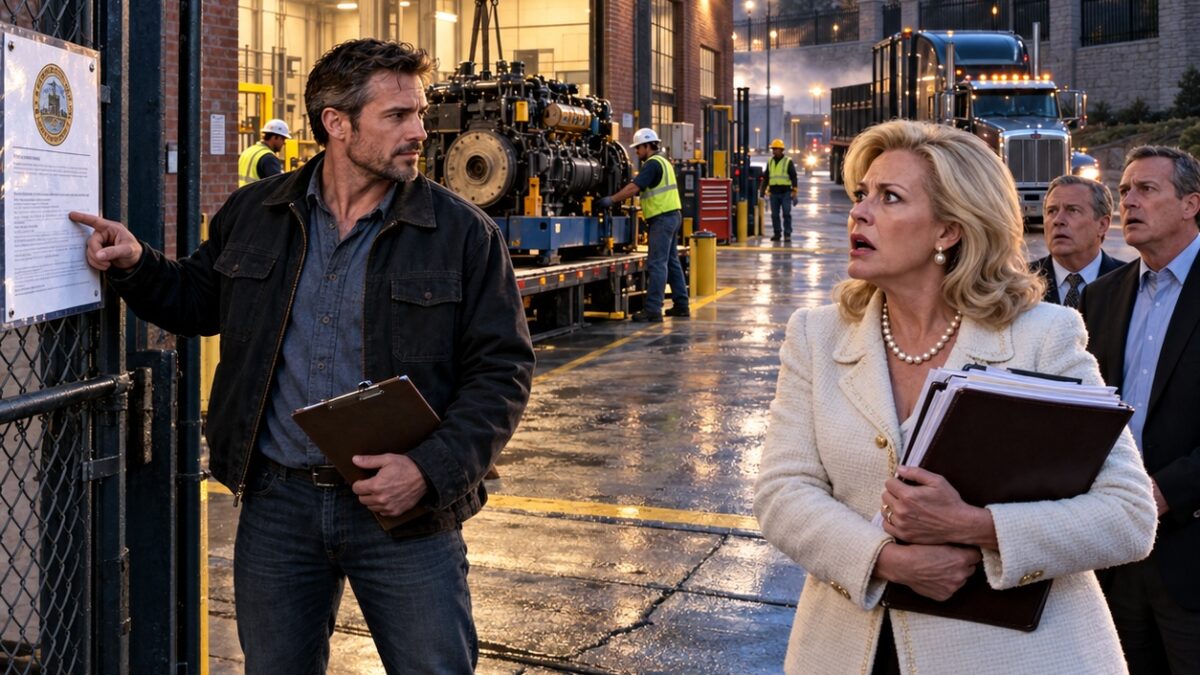
That’s the morning Brenda arrived.
Gray Tuesday.
6:40.
Three board members already near the rear fence.
Watching.
Contractors on site.
Truck arriving.
Flatbed.
Forklift.
Shop lights.
County permit on the gate.
Everything they had spent months implying could never happen.
Brenda drove up.
Got out with a folder.
Walked toward the gate.
Then stopped.
I remember her face.
Not rage.
Calculation.
She was recalculating.
The factory wasn’t theoretical anymore.
If she wanted it gone, she would need actual authority.
Not pressure.
Not letters.
Authority.
And she didn’t have it.
I walked toward her.
“Morning.”
She looked at the permit tag.
Then inside.
“Are you operating today?”
“Yes.”
“You understand we still have serious concerns.”
“I know.”
“We may pursue additional review.”
“You can.”
That answer bothered her.
She expected resistance.
Argument.
Fear.
Instead:
You can.
Because I knew what the review would show.
Confidence feels different when it’s built on documents instead of personality.
Brenda looked at the truck rolling through the bay.
“This is exactly what residents were afraid of.”
I watched the driver straighten.
Mechanic guide him in.
“It’s a repair shop.”
“Behind homes.”
“On industrial property.”
Her jaw tightened.
“You keep saying that like it ends the conversation.”
“It ends your part of it.”
One of the board members looked away.
Brenda stared at me.
Then left.
No dramatic final line.
No collapse.
Just a woman realizing her influence had a boundary.
That was enough.
I spent years afterward being asked whether I hated the HOA.
No.
I disliked Brenda’s behavior.
I disliked the board’s early tactics.
But an HOA, in its proper place, is just a governance structure.
Manage common property.
Collect dues.
Maintain amenities.
Enforce valid covenants within its authority.
Fine.
The problem begins when people mistake local responsibility for universal control.
Their fence was not a horizon.
Their bylaws were not county law.
Their preferences were not zoning.
Their discomfort was not jurisdiction.
Once those distinctions were restored, we could coexist.
That is the entire story in legal terms.
Emotionally, it was harder.
I had put almost everything into the factory.
Savings.
Loans.
Equipment financing.
Contracts.
Months of work.
When Brenda threatened delay, every day mattered.
Construction interest.
Contractor schedules.
Potential customers.
Insurance.
Payroll projections.
A project can die from a thousand delays even when the owner eventually wins on paper.
That’s why I took the fight seriously.
Not because my ego needed victory.
Because uncertainty costs money.
If the board had succeeded in stretching the process six months, I might have lost customers before opening.
Vendors might have changed terms.
Cash reserves could have evaporated.
That is how pressure works in property fights.
You don’t always have to win legally.
You just have to make the other side too tired or broke to continue.
Brenda tried that.
I responded with speed.
Records.
Permits.
Momentum.
Keep building while the fight happens.
That decision mattered.
I never stopped legitimate work just because the HOA complained.
Roof crews moved.
Electricians moved.
Concrete repairs moved.
Every completed inspection reduced uncertainty.
By the time the county meeting occurred, the garage wasn’t an idea.
It was nearly operational.
That changed the psychology.
Officials weren’t being asked:
Should we let this man revive a dead factory?
They were being asked:
Should we stop a substantially compliant project with documented rights because neighbors dislike it?
Much harder case.
Momentum is evidence.
That became another lesson.
I still tell new business owners:
Don’t confuse waiting for certainty with being responsible.
Get enough certainty.
Then move.
I could have spent a year asking whether Brenda might complain.
She would have.
Instead, I built inside the rules.
Let complaints chase the project.
They never caught it.
There were hard days.
I don’t want the story to sound effortless.
The second week, we discovered more roof damage than expected.
Thirty thousand dollars.
One electrical component had to be custom ordered.
Delay.
A lift shipment arrived wrong.
One contractor quit.
A potential fleet customer backed out because the opening date looked uncertain.
I went home some nights convinced I had made a terrible decision.
Then I’d look at the county records.
The property.
The numbers.
The plan.
And remind myself that difficulty does not mean error.
Sometimes it just means construction.
The HOA conflict magnified everything because every setback felt like proof Brenda might have been right.
Maybe the building was a headache.
Maybe I had bought trouble.
Then the first major fleet contract signed.
Then another.
Then revenue started.
Fear quieted.
Results have that effect.
The factory taught me something about reputation too.
When we opened, some residents called us dirty industry.
Six months later, local contractors called us reliable.
A year later, fleets called us before taking equipment anywhere else.
The same physical building.
Different reputation.
Reputation is built through repeated usefulness.
Not brochures.
The HOA had branding.
We had work.
Work won.
A local newspaper eventually ran a short business feature.
OLD FACTORY GETS NEW LIFE AS DIESEL SERVICE HUB.
No mention of Brenda.
I liked that.
The story wasn’t about conflict anymore.
It was about reuse.
Jobs.
Small business.
Industrial history.
That’s the version I preferred.
My mother saved the clipping.
She asked:
“Is this the place the homeowners tried to stop?”
“Yes.”
“Why?”
“They thought it would be noisy.”
“Is it?”
“Yes.”
She stared at me.
I laughed.
“Not illegally.”
She nodded.
“Then why did they think they’d win?”
“Confidence.”
She snorted.
“Common disease.”
Mothers simplify everything.
Years later, I expanded into preventive fleet maintenance.
Less emergency repair.
More scheduled work.
That helped manage noise too.
Trucks came predictable hours.
Operations smoothed.
We invested in better air handling.
Quieter compressors.
Tooling.
Not because the HOA forced it.
Because efficiency saves money.
Sometimes environmental improvements and business improvements align perfectly.
The residents benefited.
So did I.
That is what sane regulation and good management should accomplish.
Not endless fighting.
The business eventually employed nine people.
Nine families getting paychecks from a building the subdivision had assumed should remain empty.
That fact mattered more to me than any board meeting.
When people call unused industrial space an eyesore, sometimes they’re right aesthetically.
But ugliness can be repaired.
Utility is harder to create.
The bones were there.
I saw them.
That’s why I bought it.
I once brought Martin, the newer HOA president, inside.
He had never seen the factory past the fence.
He looked around.
“It’s bigger than I thought.”
“Most things are when you stop looking through a fence.”
He smiled.
Fair point.
He watched a technician diagnose an electrical issue.
Then asked:
“Do you still have all those letters?”
“Yes.”
“Why?”
“Insurance against nostalgia.”
He laughed.
“What does that mean?”
“In ten years, somebody will say the dispute wasn’t that serious.”
He nodded.
“You may be right.”
I probably was.
People soften history once conflict loses urgency.
That can be healthy personally.
Dangerous institutionally.
Remember enough to keep the lesson.
Forget enough to keep living.
That balance matters.
So I kept the binder.
I stopped opening it.
The service road remains in use.
Proper signage.
Truck routing.
The same road Brenda hinted the HOA might restrict.
Every time a delivery comes through, I think briefly about the cones.
Not angrily.
Almost fondly.
That was the moment I learned harassment could accidentally improve my file.
Put a cone on an easement.
I ask for official confirmation.
Official confirmation becomes evidence.
Thank you.
Brenda never understood that each complaint had a cost to her case.
She believed volume created authority.
Sometimes volume creates a record of overreach.
Another useful distinction.
People who know the law rarely need twenty letters saying the same thing.
They show the section once.
People bluffing often bury you in language.
Not always.
But often.
Her letters sounded stronger than they were.
Words like emergency.
Threat.
Peace.
Property value.
Compatibility.
None of them answered the basic question.
What rule gives you control over my parcel?
Nothing.
Everything came back to that.
Boundary.
Who governs what?
Once answered, the rest became manageable.
I think that’s why the planner’s sentence stayed with me.
Community preference was not legal authority over a separately governed parcel.
Beautiful.
Not because community preference is meaningless.
Neighbors matter.
Quality of life matters.
Noise matters.
Traffic matters.
But preferences have channels.
Ordinances.
Permits.
Hearings.
Elections.
You don’t get to invent jurisdiction because the legal channels produce an answer you dislike.
That principle protects everybody.
Including HOA residents.
Without it, whoever shouts loudest governs.
No thanks.
I had spent twelve years repairing machines where every system has a defined role.
Fuel.
Air.
Compression.
Cooling.
Electrical.
Blur the functions and engines fail.
Property systems are similar.
County.
Owner.
HOA.
Easement holder.
Utility.
Each has authority.
Problems happen when one starts impersonating another.
Brenda wanted the HOA to act like zoning authority.
It wasn’t.
Simple.
The fact that the conflict took months did not make the answer complicated.
One summer evening, years after opening, I stood by the back fence after everyone left.
The shop was quiet.
Rare.
Sun low.
Houses beyond the privacy fence.
Someone grilling.
Children playing.
I could smell food.
Hear laughter.
No hostility.
On my side, trucks parked.
Tools cooling.
Metal smell.
Both worlds operating.
That’s what success looked like.
Not defeating them.
Existing beside them.
Different uses.
Different sounds.
Same county.
Boundaries respected.
I wish we had started there.
We could have.
Brenda could have walked to my gate three days after closing and said:
“We’re concerned about future noise. Can we talk about operating practices?”
I would have.
We eventually adopted many practices that benefited residents anyway.
No excessive idling.
Shielded lighting.
Reasonable testing hours.
Truck routes.
Good-neighbor measures.
Instead, she started with:
Think carefully before investing.
Meaning:
We might make this impossible.
That tone made cooperation harder.
Power struggles often begin where conversations could have started.
I learned that too.
Now, when neighboring businesses ask for something, I listen first.
Doesn’t mean yes.
Means listen.
A warehouse across the road once asked us to avoid blocking their delivery turn during certain hours.
Reasonable.
We adjusted.
No attorney.
No binder.
No county meeting.
Imagine.
Most conflict is cheaper before ego enters.
Brenda eventually moved from the neighborhood.
I heard through Martin.
No dramatic downfall.
No foreclosure.
No courtroom humiliation.
She simply sold.
Left.
Life moved.
That felt appropriate.
Not every antagonist needs destruction.
Sometimes they need distance.
The factory outlasted the conflict.
That is enough.
I never bought the building to make a point.
People assume I did because the outcome is neat.
HOA mocks factory.
Owner reopens factory.
HOA fails.
Great narrative.
Reality came first.
I wanted a shop.
I found property.
I studied records.
Bought it.
Resistance followed.
The point made itself later.
Useful property does not need nearby approval to matter.
It needs lawful use.
Sound planning.
Investment.
Work.
That’s less dramatic.
More important.
The first engine stand we rolled through the side entrance still sits near Bay Three.
Different engines.
Same stand.
I sometimes see it and remember that opening morning.
Flatbed.
Forklift.
Brenda at the gate.
County permit moving in the breeze.
I remember thinking:
This is real now.
Not a fight.
Not a proposal.
Real.
That feeling is difficult to beat.
Anyone who has built something knows it.
The moment an idea becomes physical.
Lights turn on.
Door opens.
First customer arrives.
First invoice.
First employee clocks in.
Paper becomes business.
Brenda could fight paper.
She could not argue with a functioning shop backed by the right paper.
That combination was the whole game.
Evidence plus execution.
One without the other is weaker.
Records without action leave property empty.
Action without records leaves you exposed.
Together?
Strong.
That’s what I tell Luis now that he’s part owner.
Yes.
He bought in eventually.
We expanded the company.
He runs more of the daily shop than I do.
The first time I handed him signing authority, I felt older.
Proud too.
He was an apprentice who once asked why I bought an ugly factory.
Now he owns part of it.
That’s the story I care about.
Not Brenda.
Luis.
The workers.
The trucks.
The building.
Continuation.
An abandoned factory became a business again.
That matters.
I keep one photograph framed in the office.
Taken before renovation.
Boarded windows.
Weeds.
Rust.
Dark loading bay.
Next to it, another.
Opening week.
Lights.
Trucks.
People working.
Customers sometimes ask:
“Is that really this building?”
“Yes.”
“No way.”
I smile.
“Bones were good.”
Always the bones.
People underestimate old things because they judge surfaces.
Buildings.
Businesses.
Sometimes people.
Strip away neglect.
Check structure.
You might find something worth rebuilding.
That may be the best lesson the factory gave me.
The HOA saw history as decay.
I saw capacity.
Both perceptions contained some truth.
The building was ugly.
It was also useful.
The question was which truth mattered more.
For me, the second.
For my employees.
My customers.
Eventually, even the neighborhood.
Martin once told me:
“Property values didn’t drop.”
I laughed.
“I wasn’t worried.”
“People were.”
“I know.”
“They actually went up.”
“That’s probably not because of my impact wrenches.”
He smiled.
“No.”
Then added:
“But the old factory isn’t listed as a blight issue anymore.”
That was enough.
The word eyesore disappeared.
Not because the building became beautiful in a conventional sense.
Because it became maintained.
Occupied.
Productive.
Context changes aesthetics.
An empty cracked lot looks neglected.
A working industrial shop looks purposeful.
Same brick.
Different life.
I think Brenda’s mistake was believing she could preserve the neighborhood by freezing everything outside it.
But communities don’t exist in glass cases.
Roads change.
Businesses reopen.
Land gets reused.
People move.
The best you can do is govern what is yours well and deal fairly with what isn’t.
Simple.
Hard for certain personalities.
Today, Vance Fleet & Diesel Service opens before sunrise.
The bay lights come on.
Coffee starts.
First technicians arrive.
Maybe a fleet truck at 6:30.
Maybe a farmer with a fuel issue.
Maybe a contractor needing brakes.
The service road carries them in.
The same road the HOA once tried to obstruct.
Nobody thinks about that now.
Good.
The property is doing what property should do.
Serving a purpose.
Across the fence, residents wake.
Make breakfast.
Take kids to school.
Live.
We work.
They live.
Both happen.
That is the ending.
Not revenge.
Not noise.
Not the board losing.
Function.
I once thought success would feel like standing at the gate watching Brenda realize she couldn’t stop me.
That moment felt good.
I’d be lying if I denied it.
But it lasted maybe five minutes.
Building something durable felt better.
Still does.
Every time a diesel truck rolls through those gates, the old factory proves what the HOA never understood.
The fence did not trap me outside their authority.
It marked exactly where their authority ended.








