FULL STORY:The Golden Retriever Barked at Traffic in a Flooding Storm—She Wasn’t Asking Anyone to Save Her
FULL STORY CONTINUATION
The sound hit me first.
Tiny cries.
Not one.
Several.
High-pitched.
Weak.
Almost swallowed by the rain hammering concrete above us.
The dog ran ahead.
I followed.
Mud sucked at my boots.
Water moved around my ankles, cold and fast.
The farther under the bridge I went, the darker it became.
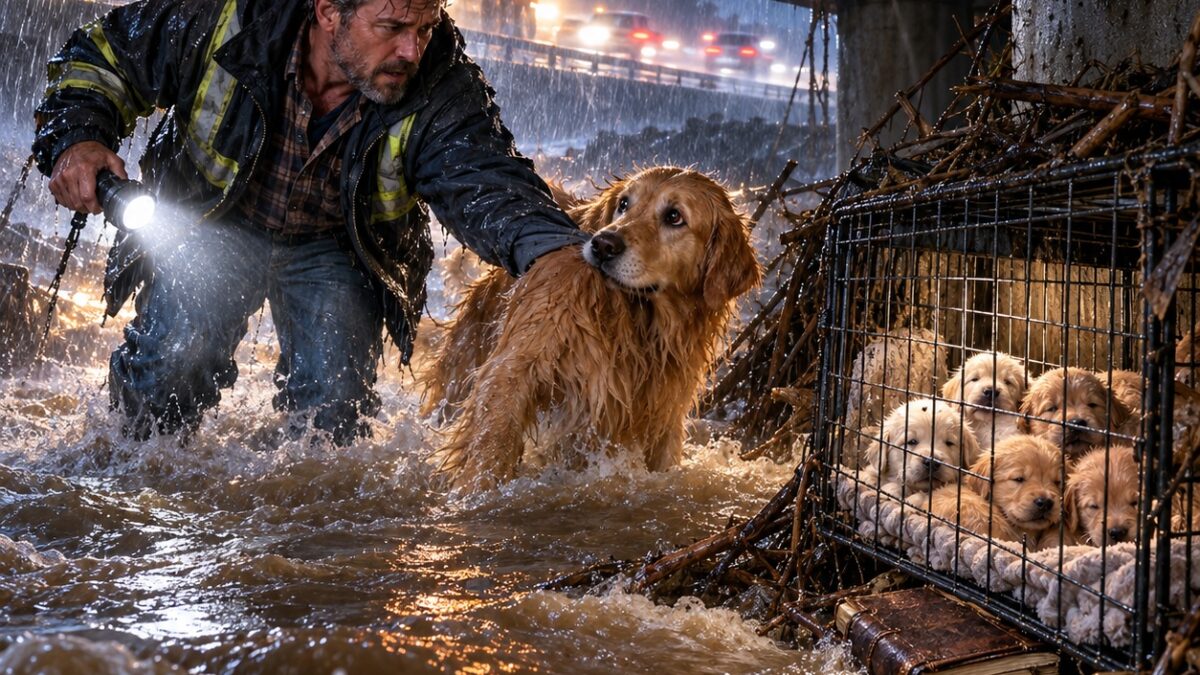
Then I saw the cage.
Metal.
Rust at the corners.
Partially trapped between a concrete support and debris washed against it by the rising river.
Inside were five Golden Retriever puppies.
Young.
Too young to be anywhere near water.
They were pressed together in the only dry corner left.
One was lying partly on top of another.
All shivering.
The mother dog reached the cage and began crying.
Not barking now.
Crying.
She pushed her nose through the wire.
The puppies responded.
My heart dropped.
“Oh, God.”
The water was already touching the bottom bars.
Maybe higher in places.
Another hour of rain and that cage would have been submerged.
Maybe less.
I grabbed it.
Heavy.
Something had snagged underneath.
I pulled.
Nothing.
The mother dog paced beside me.
“Easy.”
She whined.
“I know.”
I pulled again.
The cage shifted half an inch.
One puppy screamed.
The mother lunged toward the sound.
I stopped.
Looked beneath.
A piece of chain had wrapped around driftwood lodged against the frame.
I reached into the muddy water.
Couldn’t see.
Felt metal.
Sharp edge.
My hand slipped.
Cut across one knuckle.
I barely noticed.
Behind the cage, wedged beneath a broken board, was something dark.
Leather.
At first I thought it was a wallet.
I ignored it.
The puppies mattered.
I worked the chain loose.
The river kept rising.
Rainwater poured from the road above in dirty sheets.
The mother stayed beside me.
Every few seconds she looked toward the highway.
Then at me.
As if measuring whether she should go back and find another person in case I failed.
“Not yet.”
I grunted.
“Give me a second.”
The chain freed.
I pulled the cage toward higher concrete.
The puppies tumbled against one another.
The mother immediately shoved her muzzle through the wire.
Licked whatever face she could reach.
That was when I noticed the latch.
Bent.
Secured with wire.
Not an accident.
Someone had wanted the cage closed.
I felt anger rise.
Not useful.
I pushed it down.
Found a small multitool in my pocket.
Worked the wire.
My hands shook from cold.
Maybe fear.
The mother pressed closer.
“Back up.”
She ignored me.
“Ma’am, I am trying to help your children.”
Nothing.
Apparently motherhood outranked instructions from truckers.
Finally, the wire snapped.
I opened the cage.
The mother shoved past my arm.
Immediately began licking puppies.
One tried standing.
Collapsed.
I removed my jacket.
Wrapped the first puppy.
Then another.
They were frighteningly cold.
Too light.
One barely moved when I touched him.
“No.”
I rubbed him gently.
“Come on.”
Tiny breath.
Still there.
I used my phone.
One bar.
Called emergency services.
The signal dropped.
Called again.
Connected.
I explained.
Bridge location.
Flooding.
Five puppies.
Adult dog.
Possible intentional abandonment.
The dispatcher told me rescue personnel were already dealing with storm calls but would send whoever was available.
“How long?”
She couldn’t promise.
The water climbed another inch.
I made the decision.
Couldn’t wait under there.
My truck sat above the embankment.
Warm cab.
Dry towels.
Emergency blankets.
I started carrying puppies.
One at a time.
The mother followed every trip.
First puppy.
Up the mud.
Into the cab.
She climbed onto the step but refused to enter completely until I went back.
Second.
Third.
Fourth.
By the fifth, I was soaked through to underwear.
The smallest puppy felt almost lifeless.
I held him against my chest under my shirt during the climb.
The mother pushed against my legs.
“Move.”
She stayed.
“I’ve got him.”
As though she understood tone more than words, she followed.
Inside the truck, I turned the heat up.
Used towels.
Emergency blankets.
The mother jumped inside finally.
Then counted.
I swear she counted.
Nose to puppy one.
Two.
Three.
Four.
Five.
Then she lay across them.
Whole body curved around the litter.
Shivering harder than any of them.
I called dispatch again.
Rescue team was approaching from the north.
I looked through the windshield.
Rain.
Hazards flashing.
Cars moving slowly past.
And inside my cab, six animals clung together while steam rose from soaked fur.
The mother looked at me.
I had never seen exhaustion like that in an animal.
Eyes half closed.
But watching.
Always watching the puppies.
I reached toward her.
She flinched.
Then stopped herself.
That small hesitation hurt more than if she had snapped.
“What happened to you?”
No answer.
I placed my hand near her shoulder.
She allowed it.
Her fur was colder than I expected.
“You did good.”
Her eyes closed for maybe three seconds.
Then reopened.
Mother first.
Rest later.
When rescue workers arrived, the storm had eased slightly.
Two animal-control officers.
A deputy.
Emergency volunteer.
We transferred the puppies into warmed carriers.
The mother refused to enter hers.
Every time someone moved a puppy away, she fought toward it.
Not aggressive.
Desperate.
So they placed the litter first.
Let her watch.
Then positioned her carrier beside them.
Only then did she enter.
I almost forgot the leather object beneath the bridge.
Almost.
The deputy asked:
“Anything else down there?”
“Cage.”
“Chains.”
I thought.
“And something like a notebook.”
His expression changed.
“Where?”
We went back.
The water had risen significantly.
The cage location was partially submerged now.
Seeing that made my stomach twist.
Another twenty minutes.
Maybe thirty.
The puppies would have had nowhere left to go.
The deputy retrieved the leather book using gloves.
Wet.
Heavy.
Pages swollen with water.
Blue ink bleeding across paper.
He opened it carefully beneath the truck’s awning.
Not a diary.
Columns.
Dates.
Amounts.
Addresses.
Names that were probably not names.
Phone numbers.
Codes.
Repeated abbreviations.
One page listed animals.
Breed.
Sex.
Age.
Price.
My skin went cold again.
The deputy closed it.
“We need to preserve this.”
That was all he said.
Later, Detective Miller became involved.
I met him at the emergency veterinary clinic.
The puppies were being treated for hypothermia, dehydration, and malnutrition.
The mother was not much better.
She had scratches along her legs.
Raw pads.
A small cut near one ear.
The veterinarian believed she had traveled a significant distance before reaching the highway.
Maybe escaped confinement.
Maybe escaped the bridge area.
No one knew.
Detective Miller stood beside a counter with the notebook sealed inside an evidence bag.
Mid-fifties.
Gray hair.
The face of a man accustomed to people lying badly.
He asked me to describe everything.
Where the dog stood.
How she behaved.
Exactly where the cage was.
The wire on the latch.
The notebook.
I told him.
He wrote.
Then asked:
“Did you see any people?”
“No.”
“Vehicles?”
“Traffic.”
“Anything unusual?”
“No.”
He nodded.
I looked toward the treatment room.
“Is somebody going to investigate?”
His eyes moved toward the evidence bag.
“Yes.”
That answer carried more weight than I expected.
“What is it?”
“Too early.”
“But?”
He exhaled.
“The notebook may connect to more than these dogs.”
That was when the evening stopped being only a rescue.
The puppies survived the first night.
All five.
I found out at 4:17 in the morning because I couldn’t sleep and called the clinic.
The receptionist recognized me.
“They’re stable.”
Stable.
Beautiful word.
“What about the mother?”
“She’s resting.”
“Eating?”
“Some.”
“Can I come by later?”
“Yes.”
I parked the truck at a rest stop and slept maybe ninety minutes.
Then drove back.
Dispatch was furious.
I told them there had been an emergency.
My supervisor asked whether the freight had been damaged.
“No.”
“Then get back when you can.”
That was his version of compassion.
At the clinic, the puppies were warmer.
Still fragile.
One had an IV.
Another was sleeping so deeply I had to watch his chest to convince myself he was breathing.
The mother lay behind a kennel door.
She saw me.
Her head lifted.
That alone made me ridiculously happy.
“Hey.”
Tail moved once.
Just once.
I crouched.
“Remember me?”
Another small movement.
She came closer.
Pressed her head toward the bars.
I touched her forehead.
Warm now.
Not highway-rain cold.
“Good girl.”
The veterinarian told me they had no name for her.
“Can we call her something?”
“You found her.”
That felt like too much responsibility.
I looked at her.
The whole night replayed.
Standing beside speeding cars.
Running back to the bridge.
Refusing safety until every puppy was safe.
“Faith.”
The veterinarian smiled.
“Faith?”
“Yeah.”
“Why?”
I looked into the dog’s eyes.
“Because she kept believing somebody would stop.”
Faith.
It stayed.
The puppies got temporary names too.
Storm-related ones at first because veterinary staff become creative under pressure.
Thunder.
Rain.
Cloud.
River.
Sunny.
Sunny was the smallest.
The one I had carried inside my shirt.
He was also the weakest.
For two days, everyone worried about him.
I checked constantly.
Faith did too.
When allowed supervised time near the puppies, she always found Sunny first.
Licked his head.
Lay closest to him.
The other puppies pushed greedily toward milk and warmth.
Sunny struggled.
I sat beside the enclosure one afternoon.
Faith lay on the other side.
Her eyes stayed on him.
“You know.”
I whispered.
She looked at me.
“You know he’s the little one.”
She put her head down.
I wanted to promise he would be okay.
I didn’t.
Animals deserve honesty too, even if they do not understand the words.
“He’s trying.”
Sunny survived.
That sentence still makes me smile.
Slowly.
Ounce by ounce.
Every meal.
Every warm night.
He survived.
So did the others.
While their bodies recovered, Detective Miller’s investigation expanded.
He did not tell me much at first.
Then local news reported warrants.
Properties outside town.
Dogs removed.
More searches.
Eventually Miller called.
“Sam.”
“Yeah?”
“You have time?”
“Depends.”
“We found another site.”
My stomach turned.
“How many?”
He paused.
“Too many.”
The notebook had been real.
Not random numbers.
Not somebody’s private notes.
Records.
Transactions.
Addresses.
Code names investigators eventually tied to people.
Hidden breeding operations.
Animal sales.
Transfers.
Payments.
Sites where dogs were being kept in conditions I still have trouble thinking about.
Faith and her puppies had not been isolated cruelty.
They were evidence somebody wanted gone.
The cage beneath the bridge.
The flood.
The notebook.
Miller believed those things were connected.
The people involved may have thought rising water would erase everything.
Animals.
Paper.
Proof.
But Faith escaped.
How?
Nobody ever knew for certain.
Maybe the cage had another opening before I arrived.
Maybe she had not been caged with the puppies initially.
Maybe she broke free elsewhere.
What mattered was that she got out.
And then did something I still cannot understand without feeling my throat close.
She left her puppies.
Not abandoned.
Left them temporarily because staying beside them meant all six would die unseen.
Imagine what that required from a mother.
Five helpless babies crying beneath a bridge.
Rising water.
She could remain with them.
Or run.
Find help.
There was no guarantee anyone would stop.
No guarantee she would find her way back.
No guarantee humans were safe.
Yet she ran to the highway.
And stood near traffic.
In rain.
Barking.
Again.
Again.
Again.
Car after car passed.
People probably thought:
Stray dog.
Crazy dog.
Get away from the road.
Faith stayed.
Until my truck stopped.
That realization changed how I saw her.
She had not simply been rescued.
She had orchestrated the rescue with the only tools she had.
Voice.
Persistence.
Maternal instinct.
Trust she had almost no reason to possess.
Miller told me the investigation eventually led to more than twenty arrests.
More than a hundred animals were removed from terrible conditions.
I struggled with that number.
One hundred.
I had seen five puppies and one mother.
That was enough to make me sick.
One hundred meant rooms.
Cages.
Years.
Animals whose names nobody knew.
Detective Miller said:
“That notebook changed the case.”
I looked at Faith through the shelter fence.
“No.”
“What?”
“She did.”
He followed my eyes.
Faith was lying in the sun.
Still thin.
But improving.
Miller nodded.
“Yeah.”
“She did.”
The puppies recovered faster once they were out of immediate danger.
Puppies are astonishing that way.
Give them warmth, food, medicine, safety, and suddenly the future begins arriving at high speed.
They became noisy.
Then destructive.
That was the best sign.
Thunder learned to climb.
Rain stole towels.
Cloud chewed one volunteer’s shoelace while it was still attached to the shoe.
River discovered his own reflection and spent twenty minutes challenging it.
Sunny remained smaller.
But determined.
Within weeks, adoption applications came.
That was wonderful.
Also painful.
I hadn’t expected that.
The first puppy left with a family who had two children.
Faith watched through the gate.
The family let her sniff the puppy before leaving.
She licked his face.
Then sat as they carried him away.
No barking.
No attempt to follow.
Just watched.
I stood beside her.
“Your baby got a home.”
Her ears moved.
I do not know what dogs understand about adoption.
Probably not our paperwork.
Maybe scent and absence.
The second puppy left three days later.
Then another.
Each time, Faith watched.
Sometimes she stood.
Sometimes sat.
Always silent.
The shelter director told me:
“She’s doing well.”
I nodded.
But something about her eyes bothered me.
By the time Sunny left, Faith’s kennel felt enormous.
The smallest puppy had been adopted by a couple with a fenced yard and an older Golden Retriever.
They sent photographs later.
Sunny asleep beside the older dog.
Sunny covered in mud.
Sunny stealing a child’s sock.
I cried at the mud picture.
I am not ashamed.
Mud meant puppy.
Not evidence.
Not victim.
Puppy.
All five eventually went home.
Families.
Backyards.
Children.
Couches they were probably not supposed to use.
A few months later, I received an envelope at the trucking company.
Inside was a photograph.
One of the puppies, nearly grown, running across green grass beside two laughing children.
I kept that picture in my truck.
Still have it.
Faith remained.
That part confused everyone.
People applied to adopt her.
She was beautiful.
Golden coat recovering.
Gentle temperament.
Quiet.
But every meeting followed the same pattern.
Potential family entered.
Faith lifted her head.
Looked.
Waited.
Then something inside her seemed to decide:
Not him.
Not them.
She remained polite.
Accepted touch sometimes.
But distant.
Afterward, she returned to the kennel door and watched the hallway.
One shelter employee told me:
“It’s like she’s waiting.”
“For what?”
She gave me a look.
I pretended not to understand.
I was on the road.
That was my excuse.
It was also true.
After the rescue, work piled up.
Routes I had postponed.
A three-week rotation across several states.
I called the shelter more often than I called most human beings.
“How’s Faith?”
“Fine.”
“Eating?”
“Yes.”
“Any adoption?”
“Not yet.”
“Why?”
“You know why.”
“No.”
The director sighed.
“Sam.”
“What?”
“Come visit when you get back.”
The road gave me time to think.
Too much.
Faith in the highway.
Faith beside the cage.
Faith watching each puppy leave.
Faith sitting at the kennel door.
I argued with an idea that nobody had officially proposed.
I cannot own a dog.
I’m never home.
Truck cab too small.
Work schedule impossible.
Dogs need stability.
Yards.
Routine.
People who return every evening.
I provided none of those things.
I told myself I was being responsible.
Maybe I was.
But beneath responsibility was another truth.
Attachment scared me.
That part had nothing to do with trucking regulations.
My father had died when I was young.
Mother later.
A relationship in my thirties ended partly because I was gone too often and partly because I used work to avoid discussing anything difficult.
After that, I simplified life.
Truck.
Routes.
No one waiting.
Nothing lost if nothing is held.
Freedom.
I had called it freedom for years.
Then Faith entered the equation.
On the third week of the rotation, I slept at a truck stop in Kansas.
Rain hit the cab roof.
Not even heavy.
Just rain.
I woke at two in the morning thinking I heard barking.
I sat up.
Nothing.
Then I pictured Faith.
The shelter.
Door opening.
Her lifting her head.
Not me.
Door closing.
I felt something painful in my chest.
“You’re an idiot.”
I said it aloud.
Nobody disagreed.
When the rotation ended, I drove directly to the shelter.
Did not go home.
Did not shower.
Three weeks of highway grime and bad coffee.
Perfect adoption material.
The director saw me through the front window.
Smiled.
Didn’t say anything.
“Where is she?”
“You know.”
I walked down the hallway.
My boots make a particular sound on linoleum.
Heavy heel.
Slight scrape on the right because of an old ankle injury.
Later, the director swore Faith recognized that sound before she saw me.
I reached the kennel corridor.
Several dogs barked.
Faith did not.
Her head lifted.
Then her whole body changed.
She stood.
I stopped outside her enclosure.
“Hey, girl.”
Tail.
Once.
Twice.
Then faster.
The employee opened the gate.
Faith walked toward me.
Not frantic.
Not jumping.
She came with a calmness that somehow hurt more.
Straight to me.
Pressed her body against my legs.
Then placed her head on my knees.
Exactly as she had beneath the bridge after the puppies were safe.
I put both hands around her neck.
“Hey.”
My voice broke.
“Sorry.”
Faith stayed.
I buried my face in her fur.
“She waited for you.”
The director was behind me.
I looked up.
“What?”
“She ate.”
“She rested.”
“She was kind to everyone.”
“But every door…”
The director wiped her face.
“Every time somebody came down this hall, she checked.”
I looked at Faith.
“No.”
The director laughed through tears.
“Sam, it is pointless to keep finding adopters for this dog.”
Faith pushed closer.
“She chose you the night you stopped that truck.”
I stared at her.
Every excuse returned.
“I drive long haul.”
“We know.”
“I live alone.”
“We know.”
“I’m gone.”
“Ask your company.”
“What?”
“Ask.”
The director knew something.
Apparently she had already talked to one of my supervisors after I mentioned company policy weeks earlier.
Not approval.
But possibility.
I called.
Explained.
Dog.
Golden Retriever.
Rescue situation.
Could she travel in the cab?
My manager sighed so loudly I moved the phone away.
“Is this the highway dog?”
“Yes.”
“The famous one?”
“She’s not famous.”
“She’s been on local news.”
“Can I bring her?”
Pause.
“You’re responsible for cleaning.”
“Obviously.”
“No damage.”
“Obviously.”
“Proper restraints.”
“Yes.”
“Vaccines.”
“Yes.”
“And if a customer refuses animals onsite?”
“She stays secured.”
Longer pause.
“Trial basis.”
I looked at Faith.
She had not taken her head off my knee.
“Okay.”
The shelter director smiled.
I hung up.
Then immediately panicked.
“This is insane.”
“Probably.”
“I don’t have a bed.”
“We sell beds.”
“Food.”
“We have food.”
“Bowls.”
“We have bowls.”
“Leash.”
“Sam.”
“What?”
“Stop trying to create problems we can solve in six minutes.”
I laughed.
Then cried again.
Apparently Faith had damaged all remaining masculinity.
Paperwork took less than an hour.
At one point they asked:
“New name or keep Faith?”
I stared.
“Faith.”
No question.
When we walked outside, she stopped beside my truck.
Looked up.
The same enormous vehicle she had forced to stop months earlier.
I opened the passenger door.
She hesitated.
Then climbed.
I had placed blankets beside the passenger seat.
Temporary.
She turned three circles.
Lay down.
Looked at me.
That simple.
I drove home with another heartbeat in the cab.
For the first time in twelve years, the silence felt wrong because it was no longer necessary.
I talked to her.
Constantly.
“You understand you nearly ruined my schedule.”
Faith looked outside.
“Also, I don’t share food.”
Ears moved.
“That is firm.”
She looked at me.
“Fine. Some food.”
At home, she explored every room.
My house was barely a home.
Furniture chosen for function.
Nothing on walls except a highway map.
Fridge containing mustard, eggs, and things with questionable expiration dates.
Faith walked through as if inspecting inadequate accommodations.
“You’re judgmental.”
She found the couch.
Jumped up.
“Absolutely not.”
She lay down.
“Faith.”
Closed eyes.
The couch became hers.
First night, I put a dog bed near my bedroom door.
At two in the morning, I woke.
Faith stood beside the bed.
Quiet.
Watching me.
“What?”
She did not move.
I touched the mattress.
“Come here.”
She placed her front paws up.
Then stopped.
Like permission still surprised her.
I lifted the rest of her.
She lay at the foot of the bed.
Within minutes, asleep.
I remained awake.
Listening.
Soft breathing.
Occasional paw movement.
A small sigh.
Home had always sounded like nothing.
Now it sounded like a dog sleeping.
Our first trip together terrified me.
Probably more than Faith.
Harness.
Restraint.
Water.
Food.
Vet records.
Cleaning supplies.
Portable bed.
Toys.
I packed as though transporting a princess through hostile territory.
Faith climbed into the cab and sat beside me.
Ready.
At the first truck stop, other drivers recognized her.
“That her?”
I frowned.
“Who?”
“The highway dog.”
Faith wagged.
Someone brought a treat.
Then another driver.
Within a month, Faith knew which truck stops had generous employees.
Her manipulation skills grew rapidly.
She became local legend.
Drivers honked when they recognized the gold head in my passenger window.
Fuel attendants asked where she was if she slept.
Children at rest areas wanted to pet her.
I always watched carefully.
At first, Faith stiffened when strangers reached too quickly.
Then improved.
Slowly.
She had boundaries.
I respected them.
That was part of loving her.
Not forcing gratitude.
Not saying:
You were rescued, therefore you should tolerate everything.
Rescue does not erase an animal’s right to say no.
Faith taught me that.
She also taught me schedules.
Dinner matters.
Walks matter.
Stopping somewhere with grass matters.
Apparently sunrise matters because she believed 5:14 a.m. was a reasonable time to place one paw on my chest.
My former life had been organized by freight deadlines.
Now:
Faith needs water.
Faith needs to stretch.
Faith saw a squirrel.
Freight adapted.
The first heavy storm on the road frightened her.
We were parked safely at a truck stop in Missouri.
Rain hit the roof.
Thunder.
Faith went rigid.
Not barking.
Her breathing changed.
She left the passenger area and pressed herself into the narrow space beside my seat.
I understood.
Bridge.
Maybe not consciously.
Body memory.
I sat on the floor of the cab.
Ridiculous position.
Knees against dashboard.
“Hey.”
She trembled.
“You’re here.”
Thunder.
She flinched.
“No bridge.”
I touched her shoulder.
“No cage.”
Another thunderclap.
Faith pushed into me.
“You’re safe.”
We stayed like that almost an hour.
I missed my planned departure time.
Didn’t care.
That was new.
For twelve years, schedule had been king.
Faith was more important.
Eventually rain softened.
Her breathing slowed.
She fell asleep against my leg.
I looked through the windshield.
Water streaming down glass.
Remembered her beside the highway.
How many cars had passed?
How long had she been there?
I imagined drivers seeing her in mirrors.
Maybe some wanted to stop but couldn’t.
Maybe they didn’t understand.
I had been the one who did.
People called that luck.
Maybe.
But there was something else.
Faith had chosen not to give up after every car passed.
That was hers.
Persistence.
She saved the puppies because she kept trying after rejection.
That lesson followed me.
I had spent years reacting to disappointment differently.
One failed relationship?
Leave.
Family loss?
Work.
Loneliness?
Drive farther.
Faith, when the world failed her, stood beside the road and asked again.
Bark.
Car passes.
Again.
Bark.
Again.
Again.
Until someone stopped.
Maybe that was why I named her Faith before knowing she would eventually become mine.
She possessed something I had lost.
Belief that asking one more time might matter.
The criminal investigation continued for months.
Trials.
Charges.
Evidence.
I followed from a distance.
Detective Miller occasionally updated me.
More animals found homes.
Some required extensive rehabilitation.
Others had medical problems that would last.
Not every ending was as clean as Faith’s puppies.
That hurt.
A rescue operation can save bodies without undoing history.
Some animals remained afraid.
Some never became easy pets.
Their lives still mattered.
I learned that too.
We like redemption stories where suffering converts neatly into happiness.
Real healing is uneven.
Faith loved me.
Still feared storms.
Sunny thrived.
Another rescued dog from the network struggled with people for months.
One animal could be both safe and scarred.
Humans too.
Miller once visited us at a truck stop when his work brought him nearby.
Faith recognized him vaguely.
Sniffed.
Accepted a treat.
He sat with me at a picnic table.
“The case is almost done.”
“How many?”
“Animals?”
“Yes.”
He gave me the latest number.
Over a hundred removed.
I stared at Faith.
She was watching a bird.
“Because of a notebook.”
“Because of evidence.”
“Because of her.”
Miller smiled.
“Still giving the dog investigative credit?”
“Yes.”
“She did more field work than you.”
He laughed.
Then became serious.
“We might not have found the notebook if you hadn’t followed her.”
“I wouldn’t have followed if she hadn’t stopped me.”
“Fair.”
I scratched Faith’s neck.
“She brought the case to the highway.”
Miller looked at her.
“I’ve seen informants do less.”
That became our joke.
Detective Faith.
But underneath it was truth.
Five puppies in a cage became more than five puppies.
They led outward.
Other sites.
Other dogs.
Other cages opened.
Sometimes I imagined a line connecting all of them back to Faith barking in rain.
One life insisting.
Then many lives changing.
That idea felt too big.
I preferred practical thoughts.
Breakfast.
Route.
Fuel.
Dog hair everywhere.
Faith shed enough to create another Golden Retriever every week.
My truck became covered.
I complained.
She continued.
Months passed.
Then a year.
Faith gained weight.
Her coat became thick.
Shiny.
The scars were less visible.
She learned the truck completely.
Knew engine sounds.
Knew when we were stopping for fuel versus stopping overnight.
She could sleep through air brakes and diesel engines but still woke instantly if I opened a snack.
Remarkable survival skill.
At home, she claimed the couch.
Then the passenger seat.
Then part of the bed.
My possessions became our possessions.
My life changed in ways nobody could photograph.
I stopped taking certain extra routes.
Spent more time home.
Not because Faith demanded it.
Because I discovered I liked being somewhere.
That was new.
Before her, home had been storage between trips.
Laundry location.
Mailing address.
After Faith, home became the place she raced through the door and checked every room as if confirming it survived our absence.
I bought a rug.
Then another.
Hung one photograph.
Faith with all five puppies at the shelter.
Later, photographs of each puppy sent by adoptive families joined it.
Five separate lives.
Thunder with a family near the lake.
Rain sleeping beside a toddler.
Cloud hiking.
River wearing a ridiculous birthday hat.
Sunny nearly full-grown, still slightly smaller than his siblings.
I displayed them.
People who visited probably thought I had become sentimental.
They were correct.
One photo remained special.
Faith under the bridge?
No.
I never wanted that on my wall.
Faith beside my truck at sunset.
Head raised.
Healthy.
That was her.
Not what was done to her.
Who she became afterward.
There is a danger in defining rescued animals entirely through suffering.
People did that to Faith sometimes.
“Oh, the abused dog.”
“The trafficking dog.”
“The mother from the cage story.”
I started correcting people.
“Faith.”
Just Faith.
Her worst day should not become her permanent surname.
Same with people.
Nobody wants to be introduced forever through the worst thing that happened to them.
Faith was not tragedy with fur.
She was stubborn.
Manipulative about snacks.
Afraid of thunder.
Suspicious of vacuum cleaners.
Excellent at detecting cheese packaging from impossible distances.
She snored lightly.
Hated baths despite having once stood willingly in a flood.
Loved old men at truck stops.
Ignored most tennis balls.
Preferred sticks.
Particularly sticks too large to carry.
She was a dog.
That was the victory.
Not becoming symbolic.
Becoming ordinary.
The puppies grew.
One summer, Mary—the family who adopted River—organized a reunion.
All five.
Faith too.
I expected chaos.
Underestimated it.
Five nearly grown Golden Retrievers seeing each other in a fenced field.
Running.
Rolling.
Barking.
Humans laughing.
Faith stood beside me initially.
Then Sunny approached.
Sniffed.
Faith froze.
He sniffed her face.
She sniffed him.
Then his tail exploded.
Faith began licking him.
One by one the others came.
I do not know what they remembered.
Smell probably.
Familiarity.
Something.
Watching all six together nearly destroyed me.
I remembered carrying those puppies one by one up a muddy embankment.
Now they knocked each other down in grass.
A little girl threw a ball.
Three dogs chased the same one.
Two ignored it.
Faith returned to me occasionally.
Touched her side to my leg.
Then ran back.
Checking.
I was still there.
I always would be if I could help it.
One adoptive father approached.
“You saved them.”
I shook my head.
“She did.”
He looked at Faith.
“She brought you.”
“Exactly.”
He smiled.
“Then you saved each other.”
I wanted to reject that.
Too sentimental.
Too neat.
But maybe there was truth in it.
Before Faith, I had not been in danger physically.
Not under a bridge.
Not caged.
But my life had narrowed.
Work.
Miles.
Avoidance.
I had mistaken absence of attachment for absence of pain.
Faith taught me the cost.
If you never love anything enough to lose it, you also never love anything enough to come home to it.
I had been protecting myself from grief by living without belonging.
That is a quiet kind of cage.
No lock.
Easy to mistake for freedom.
Faith opened mine.
Not dramatically.
Morning by morning.
She needed me home.
Then I started wanting to be home.
Those are different things.
The first time I turned down a profitable route because it would keep us out an extra week, my dispatcher said:
“You’ve changed.”
“Probably.”
“Dog?”
I looked at Faith.
“Yes.”
He laughed.
“Never thought I’d see it.”
“Neither did I.”
The truth was larger.
Faith did not simply add companionship.
She interrupted escape.
You cannot run from your life while walking a dog every morning.
Routine anchors.
Responsibility anchors.
Love anchors.
The road remained.
I still drove.
Still loved it.
But now travel had direction.
Away.
Then back.
That is what home means.
Not never leaving.
Having somewhere that changes the meaning of return.
Faith gave me that.
On our second anniversary together, rain came.
Heavy.
We were home.
Thunder.
Faith still stiffened.
Less than before.
She came to me.
I sat on the floor.
Same routine.
“You’re safe.”
She lay down.
Her head on my knee.
I touched the faint scar near her ear.
“Do you remember?”
Stupid question.
Maybe.
Maybe not.
She sighed.
I remembered enough for both of us.
The bridge.
Puppies.
Notebook.
Water.
Everything after.
I realized something.
For years, I thought the most remarkable part of her story was that she saved five puppies and exposed a criminal network.
It wasn’t.
The remarkable part was that after everything humans had done around her, she still believed one might help.
That was Faith.
Not optimism.
Not innocence.
Courage.
Trust after evidence against trust.
Maybe that was the thing she gave me too.
I had my own evidence.
People leave.
People die.
Relationships fail.
Home becomes empty.
So I chose distance.
Faith’s evidence was worse.
Still, she stood beside a highway and asked another human.
Again.
That humbles me.
Detective Miller eventually told me the major cases had concluded.
Convictions.
Sentences.
Properties seized.
Animals permanently removed.
I asked whether justice felt good.
He thought.
“No.”
That surprised me.
“Why not?”
“It feels necessary.”
He looked tired.
“Good would be none of it happening.”
I understood.
Same with rescue.
People called Faith’s story beautiful.
It became beautiful later.
The beginning was not beautiful.
We should not make suffering necessary to appreciate survival.
The puppies did not need a flood so we could admire maternal love.
Faith did not need criminals so I could find companionship.
Pain is not a gift because something good grows afterward.
Good grows despite it.
That distinction mattered more as time passed.
If I could rewrite the story, I would.
No cage.
No notebook.
No storm.
No barking beside highway traffic.
Faith raises five puppies safely somewhere warm.
Each gets adopted.
I never meet her.
My life remains lonelier.
Fine.
I would choose that if it spared her suffering.
Love should make us willing to erase the circumstances that brought someone to us if those circumstances hurt them.
Even if it means losing the meeting.
That is how I know what I feel for Faith is not gratitude for tragedy.
I am grateful for her.
Not for what happened to her.
There is a difference.
Years later, one reporter contacted me for an anniversary piece.
I refused at first.
Then agreed under conditions.
No dramatic reenactment.
No bridge photographs with Faith posed beneath it.
No treating the trafficking details like entertainment.
Focus on adoption.
Veterinary care.
Reporting abuse.
The reporter asked:
“What is the image you remember most from that night?”
I knew what he expected.
Faith in rain.
Cage.
Puppies.
Instead I said:
“Her counting them.”
He frowned.
“What?”
“In the truck.”
“I carried the puppies up one at a time.”
“When Faith finally got inside, she touched every one with her nose.”
“Five.”
“Then she lay down.”
I swallowed.
“That is what I remember.”
The reporter was quiet.
“Why?”
“Because she didn’t know if they were safe until she counted.”
That became the heart of the article.
Not the criminal network.
A mother counting babies.
Good.
Faith deserved that.
She aged.
Slowly at first.
Gray around the muzzle.
Longer stretches of sleep.
Less jumping into the cab, more waiting for me to lower the portable step I bought her.
I hated the step.
Not because it was inconvenient.
Because it admitted time existed.
Faith still traveled.
Shorter routes.
Then fewer.
Eventually the vet suggested long trips might become uncomfortable.
I adjusted.
Dispatch again.
More local work.
More nights home.
Past Sam would have hated that.
Present Sam discovered evenings had value.
Faith sleeping near the couch.
Coffee on porch.
No engine.
No destination.
The first truly quiet life I had ever enjoyed.
One evening, Sunny’s family visited.
Sunny was older too.
Golden face beginning to gray.
When he saw Faith, tail moving.
They touched noses.
Then lay near each other.
No running now.
No wrestling.
Just close.
I sat with Sunny’s owner.
“We got lucky.”
He said.
“Yes.”
He looked at the dogs.
“My kids don’t remember life before him.”
I smiled.
“That’s good.”
His daughter, now a teenager, sat on the floor between them.
One hand on Sunny.
One on Faith.
Five puppies had become five family histories.
Children growing up with them.
Vacations.
Birthdays.
Illness.
School years.
Those lives all branched from one rainy highway.
Faith could not know that.
Maybe better.
Dogs don’t need legacy.
Humans do.
We search for proof our choices mattered.
Faith’s proof was everywhere.
A hundred animals removed.
Five puppies thriving.
Me home more often.
Yet if Faith cared about any legacy, it probably involved whether dinner was late.
That grounded me.
Toward the end of her life—years after the storm, years after everyone stopped caring about the viral story—Faith became slower.
Arthritis.
Medication.
Good days.
Bad days.
I knew what was coming.
Pretended not to.
That is another human habit.
We accept rescue stories eagerly because they begin with survival.
We struggle with the fact that every rescue still contains mortality.
Saving a life never means saving it forever.
Only giving it time it should have had.
Faith received years.
Good years.
Truck years.
Couch years.
Storms endured.
Puppies revisited.
Thousands of miles.
Treats from strangers.
Home.
That was enough.
More than enough.
Still not enough for me.
Love is greedy.
On one cold morning, she did not want breakfast.
I knew.
Anyone who knows their dog knows.
Something changes.
Not dramatic.
Small.
I called the vet.
We went.
I sat with her through tests.
The doctor spoke gently.
Options.
Comfort.
Time.
Not much.
I listened.
Faith put her head on my knee.
Same place.
Always.
I looked at the dog who once stood beside a highway refusing to give up.
And understood there are moments when refusing to give up can become refusing to let go.
Different courage.
I asked for time.
A day.
We went home.
I cooked chicken.
Faith ate some.
Good.
We sat on porch.
No rain.
Clear evening.
I brought out the photograph of all six dogs from the reunion.
Ridiculous.
Faith could not care less.
I showed her anyway.
“Your kids.”
She sniffed.
Looked away.
“Ungrateful.”
Tail tapped once.
I laughed.
Then cried.
“I didn’t save you.”
She looked at me.
“You know that?”
My voice broke.
“You saved yourself.”
“You found the road.”
“You made me stop.”
“You did all the hard parts.”
Faith shifted closer.
“And then you ruined my life.”
Another tail tap.
“Truck full of hair.”
“Schedule destroyed.”
“Couch stolen.”
I put my forehead against hers.
“Best thing that ever happened to me.”
The next morning, Faith could barely stand.
I helped.
We drove to the clinic.
Not in the big truck.
My pickup.
She lay beside me.
Windows cracked.
Morning air.
I kept one hand on her whenever possible.
I wanted to tell her everything.
Thank you.
Sorry.
Stay.
Go.
Impossible combinations.
At the clinic, they prepared a quiet room.
Blanket.
Soft light.
I sat on the floor.
Faith’s head in my lap.
The vet explained.
I nodded.
Couldn’t speak.
Faith breathed.
Slow.
I touched the scar near her ear.
Remembered rain.
“Good girl.”
Her eyes moved toward me.
“Good girl.”
I said it again.
“You can stop now.”
That sentence almost killed me.
Because her whole life with me began because she refused to stop.
But she had done enough.
More than enough.
“I’ve got it.”
I whispered.
“Your puppies are safe.”
“All five.”
“You did it.”
Tears fell onto her fur.
“I’ve got it from here.”
Faith exhaled.
Her body relaxed.
And eventually, quietly, she was gone.
No highway.
No storm.
No cage.
No fear.
My hands on her.
Warm room.
Safe.
I stayed a long time.
The vet did not rush me.
When I finally stood, my knees barely worked.
I walked outside alone.
The absence beside me felt enormous.
For the first time in years, I drove home without another heartbeat in the vehicle.
I hated every mile.
At home, her bed remained.
Bowl.
Leash.
Hair on the couch.
A half-chewed stick she had somehow carried inside months earlier.
I left everything.
For weeks.
Then months.
Truck cab was worse.
Passenger space empty.
Other drivers asked.
They saw my face.
Stopped asking.
One fuel attendant cried when I told her.
Faith had belonged to more people than I realized.
Not as ownership.
Memory.
She had become part of other people’s routes.
That helped.
Eventually, I received messages from all five puppy families.
Photographs.
Stories.
One family planted a tree.
Sunny’s family sent a picture of him lying beneath it.
I put it beside Faith’s photograph.
Five lives continuing.
I had thought losing Faith would make the years with her feel cruel.
It didn’t.
Painful.
Yes.
But never something I regretted.
That is the price of home.
I had avoided belonging because belonging can be lost.
Faith taught me the opposite.
Loss does not prove belonging was a mistake.
It proves it mattered.
Months after she died, I drove the original highway again.
First time intentionally.
I stopped near the bridge.
Weather clear.
River low.
I climbed down.
Older now.
Carefully.
The concrete looked smaller than memory.
No cage.
No notebook.
No puppies.
I stood where I thought Faith had been.
Couldn’t be sure.
Water moved quietly.
I said:
“You were right.”
No one heard.
Maybe that was appropriate.
“I thought freedom was never needing to come home.”
I looked toward the highway.
“You taught me freedom is knowing where home is.”
Wind moved through grass.
I stayed a few minutes.
Then left.
Not sad exactly.
Not peaceful either.
Something between.
Grief often lives there.
I still drive.
Less long haul.
More regional.
My company eventually removed Faith’s little sleeping platform from the cab because equipment changed.
I kept the old cushion.
It is at home.
A younger driver once asked why.
“Dog.”
“That all?”
“No.”
But I didn’t explain.
Some stories become too large to hand out casually.
Faith’s story belongs partly to the world.
The rescue.
The criminal case.
The puppies.
But parts belong only to me.
The sound she made when dreaming.
How she leaned against my leg during thunderstorms.
The way she looked offended when I ate cheese without sharing.
How she checked the truck before every trip as though ensuring I hadn’t replaced her.
Those are mine.
When people ask what Faith taught me, they expect something profound.
Courage.
Love.
Loyalty.
All true.
But the lesson I think about most is simpler.
Stop.
That was all she needed from me initially.
Stop the truck.
Stop assuming someone else will help.
Stop protecting yourself from attachment.
Stop moving long enough to hear what is asking for you.
My whole life had been movement.
Faith changed it because she stood in the rain and forced me to stop.
That one act led under a bridge.
Into a criminal investigation.
To five puppies.
To more than a hundred rescued animals.
To a shelter hallway where a Golden Retriever waited three weeks for the sound of my boots.
To thousands of miles with dog hair in my coffee.
To a house that finally became home.
To grief, yes.
Eventually.
Love always risks grief.
I would still stop.
Every time.
If I could return to that storm, knowing everything—
the bridge,
the cage,
the notebook,
the arrests,
the puppies,
Faith waiting,
the adoption,
the truck,
the years,
the final morning—
I would still hit the brakes.
Faster.
That is how I know the pain at the end did not erase the gift in the middle.
Faith was never just the dog I rescued.
She was the dog who refused to let six lives disappear beneath floodwater.
The dog who exposed cruelty because maternal love made silence impossible.
The dog who waited after every puppy found a family.
The dog who recognized my footsteps after three weeks.
The dog who chose the cab of a truck over every comfortable stranger because, for reasons I will never fully understand, she decided I was home.
And she was right before I was.
For years, I had thought home was an address.
Faith taught me it could be a presence.
A warm body asleep beside the passenger seat.
A head against your knee.
Someone waiting when the door opens.
Someone worth returning for.
The highway gave me Faith on the worst night of her life.
She gave me a home for the rest of hers.
That was the trade.
Unequal.
I got far more.
Today, the photograph of Faith and her five puppies hangs in my living room.
Below it sits the photograph of all six at their reunion.
Next to those is the picture from Sunny’s family.
Green lawn.
Children laughing.
A Golden Retriever running.
Sometimes visitors ask why I keep so many dog pictures.
I say:
“Family.”
They usually think I’m joking.
I’m not.
Faith had five babies.
Those babies became somebody’s family.
Faith became mine.
And through her, the word family stopped sounding like something life had already taken from me.
It became something that could still happen.
That may be the greatest thing she did.
Bigger than the notebook.
Bigger than the case.
Bigger even than the highway.
She made me believe losing a home once did not mean I had to spend the rest of my life without one.
If you remember anything about Faith, remember the rain.
Not because suffering makes a story beautiful.
It doesn’t.
Remember the rain because she stood in it after car after car failed to stop.
Remember that she kept barking.
Remember that beneath the bridge were five lives depending on a mother who had almost no power except the refusal to quit.
Remember that eventually one truck slowed.
Not because I was special.
Because I happened to listen.
Then remember what happened afterward.
Five puppies grew.
More than a hundred animals were freed.
A lonely trucker learned to come home.
And a dog who had once stood alone beside an interstate died many years later with her head in the lap of the man she had chosen.
Safe.
Loved.
Known by name.
That is the ending I want for her.
Not the cage.
Not the criminals.
Not the storm.
Faith.
Head on my knee.
The same way she rested after saving her puppies.
The same way she greeted me when I returned to the shelter.
The same way she said goodbye.
For most of her life, that was how she told me what she could never say with words:
I found you.
You stopped.
You stayed.
You’re home.
And every time I remember her now, I answer the only way I know how.
You were home too.








