FULL STORY:The Free German Shepherd Puppy I Almost Left Behind Was Carrying a Warning Beneath His Fur
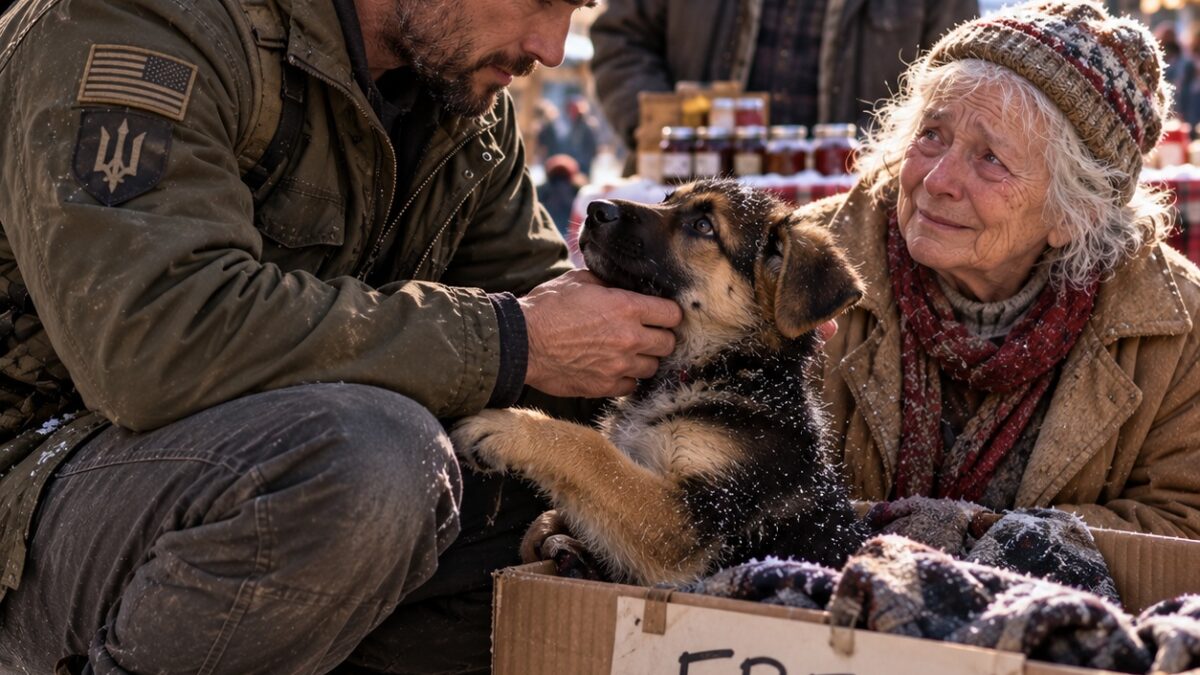
Harlan Kessler was sixty-three, broad through the shoulders, with weathered skin, a gray mustache, and the rough hands of a man who had spent most of his adult life building things that outlasted him.
He wore a brown canvas work jacket with sawdust caught in one seam.
His jeans were faded.
His boots looked old enough to have their own history.
He set the apples on a nearby table and folded his arms.
“I looked after Huxley whenever Ben was gone,” he told Edith. “I’ll look after this little fellow, too.”
Edith didn’t immediately agree.
Good for her.
She asked about my fencing.
My schedule.
Veterinary care.
Who would feed the puppy when I was away.
Whether Harlan understood how demanding a young German Shepherd could become.
I answered the questions I knew.
I admitted when I didn’t know something.
That last part seemed to matter to her.
“You’re not just looking for another Huxley?” she asked.
The question caught me off guard.
I looked down at Micah.
He had begun chewing my bootlace.
“No.”
I paused.
Then corrected myself.
“I don’t think so.”
Edith watched me quietly.
I took a breath.
“I loved Huxley. I still do. But I know this one isn’t him.”
She looked toward Harlan.
My uncle nodded.
“He knows.”
Edith reached into the box.
“Well, Micah? What do you think?”
The puppy struggled over the cardboard edge.
She reached to help.
He landed safely in the snow.
Walked three awkward steps.
Then sat directly on top of my boots.
Harlan laughed.
“Looks like you’ve been outvoted.”
I stared down at the little shepherd.
Micah looked up.
One ear tilted.
His tail moved.
Nothing mystical happened.
No message from Huxley.
No sign that the universe had arranged this moment.
Just a small puppy sitting on a pair of warm boots.
For some reason, that was enough.
By noon, Micah was riding home in my pickup.
The first thing he did was overturn his water bowl.
The second was investigate a chair.
He pushed his head beneath the seat, stepped forward, and discovered he couldn’t easily back out.
He barked.
I lifted the chair.
He escaped.
Then ran away as though I’d been the one causing problems.
An hour later, he stole a sock.
He carried it proudly through the living room.
Then fell asleep with it hanging from his mouth.
I stood over him.
“You have the entire house.”
He opened one eye.
“Why do you need my sock?”
The eye closed.
I laughed.
A real laugh.
It came out so unexpectedly that I stopped moving.
The house hadn’t heard that sound in months.
After Huxley died, silence had become the natural condition of every room.
Now a nine-week-old German Shepherd was snoring in my hallway with one of my socks between his paws.
I looked toward the back door.
Huxley’s collar still hung beside it.
For a moment, guilt moved through me.
Not because I thought loving Micah was wrong.
Because some part of me had begun treating grief like a duty.
As though moving forward would mean I hadn’t loved Huxley enough.
I turned away before I could think about it any longer.
That night, Micah slept beside my bed.
He woke three times.
Needed to go outside twice.
And decided at four in the morning that my shoelaces were the most interesting objects in the known world.
I told him he was a menace.
He wagged his tail.
I hadn’t felt that tired in weeks.
I also hadn’t felt that alive.
On the second day, Micah became quieter.
At first, I assumed he was exhausted.
New house.
New smells.
New routines.
He’d spent his first day trying to investigate everything within reach.
Maybe he’d finally realized sleep was necessary.
Then he left some breakfast untouched.
I noticed immediately.
Huxley had been an enthusiastic eater for most of his life.
Near the end, his appetite had faded.
I’d learned to fear an untouched bowl.
By evening, Micah wasn’t interested in playing.
He lay near the stove.
When I offered him a toy, he looked at it and rested his head again.
I crouched beside him.
“Hey, buddy.”
He opened one eye.
I touched his back.
Nothing obvious felt wrong.
But he wasn’t acting like himself.
That night, I barely slept.
On the third morning, he vomited.
Then came diarrhea.
Within minutes, I had him wrapped in a blanket.
I grabbed my keys.
Carried him to the truck.
And drove straight to the veterinary clinic.
Dr. Tessa Renford met me at the door.
She was forty-three, lean, quick-moving, with dark eyes and brown hair tied low behind her neck.
A white veterinary coat covered a gray sweater.
Her expression was focused.
Not unkind.
But not designed to comfort a frightened man before the facts were known.
She took one look at the puppy in my arms.
“How long has he been like this?”
“Not long.”
“That wasn’t what I asked.”
I tightened the blanket around Micah.
“Two days quieter than normal. Poor appetite since yesterday. Vomiting this morning. Diarrhea afterward.”
She nodded.
“Come with me.”
Micah stood weakly on the examination table.
His golden-and-black coat had lost some of its shine.
His oversized paws spread uncertainly.
One ear still leaned sideways.
But there was nothing funny about it anymore.
Tessa checked his gums.
Hydration.
Temperature.
Abdomen.
Heart rate.
She asked what he’d eaten.
Whether he’d chewed anything.
Whether he’d had access to standing water.
Whether he had been near other animals.
Then her expression became more serious.
“I want to test for parvo.”
I felt the bottom drop out of my stomach.
I knew enough about puppies to understand why.
“How likely?”
“I don’t assign percentages before I have evidence.”
“Tessa—”
“You can call me doctor when you’re trying to intimidate me.”
I stared at her.
“I wasn’t.”
“You have the face for it.”
For one ridiculous second, I almost smiled.
Then Micah leaned against my hand.
The smile disappeared.
I stayed beside him while she collected the sample.
The wait lasted less than twenty minutes.
It felt much longer.
When Tessa returned, she held the test.
“Negative.”
I exhaled.
Not completely.
But enough.
“That’s good,” she said. “It doesn’t mean there isn’t a problem.”
Micah was dehydrated.
She wanted to start fluids and monitor him.
I nodded immediately.
“I’ll stay.”
“You don’t have to.”
“I know.”
She studied me.
Then led me into the treatment area.
Micah lay inside a low kennel lined with clean blankets.
Fluids were started.
His breathing gradually settled.
I pulled a chair close.
Sat down.
And waited.
At first, Tessa seemed to assume I was simply an anxious new owner.
An hour later, she noticed something else.
Every time Micah shifted, I looked up.
Every time his breathing changed slightly, my attention snapped toward him.
I barely moved.
My hands remained clasped.
My mind was somewhere else.
“You’ve done this before,” she said.
I looked toward the kennel.
“Not like this.”
She waited.
I stared at Micah.
Then said, “Huxley stopped eating near the end.”
Tessa leaned against the counter.
I told her about my old shepherd.
His arthritis.
His failing kidneys.
The morning he couldn’t stand.
How I thought understanding the medical facts would prepare me.
It hadn’t.
Six months earlier, I’d sat with Huxley’s head across my leg and watched his breathing slow.
I’d spent most of my adult life believing preparation had value.
Know the terrain.
Know the risks.
Understand what might happen.
Have a plan.
But knowing my dog was dying hadn’t made losing him easier.
And now I was sitting beside another German Shepherd, watching him struggle to recover from an illness I didn’t understand.
Tessa looked toward the kennel.
“This dog isn’t that dog.”
My jaw tightened.
“I know.”
“No,” she said quietly. “You know it intellectually.”
I finally looked at her.
“You’re sitting here waiting for history to repeat itself.”
I wanted to object.
Then Micah shifted.
I looked toward him automatically.
Tessa didn’t need to say anything else.
A little later, Micah woke.
He lifted his head.
Looked around the unfamiliar treatment room.
Then saw me.
For several seconds, he remained still.
Then he stretched one front paw through the kennel bars.
Not toward his water.
Not toward the blanket.
Toward me.
The paw couldn’t reach.
I stared at it.
He’d known me for less than three days.
Yet he’d awakened sick in a strange place and already decided where safety was.
I moved my chair closer.
Placed two fingers against his paw.
Micah relaxed.
No miracle.
No mystery.
Just trust.
Small.
Undemanding.
Complete.
I stayed until he fell asleep again.
By early afternoon, Micah’s hydration had improved.
Additional testing suggested a gastrointestinal bacterial infection.
Tessa was careful about what she said.
She wasn’t certain where the infection came from.
She reviewed possibilities.
Food.
Raw meat.
Standing water.
Contaminated surfaces.
Other animals.
Then she asked, “What water are you giving him?”
“Tap.”
“Municipal?”
“My house is on the Southside community well system.”
Tessa stopped writing.
It was subtle.
But I noticed.
“What?”
“Nothing yet.”
“That wasn’t nothing.”
She sighed.
“In the last two weeks, I’ve seen three other animals from Southside with gastrointestinal symptoms.”
I straightened.
“What animals?”
“Two dogs. One cat.”
“Same infection?”
“Similar symptoms. Not identical confirmed diagnoses.”
“Then why didn’t anyone investigate?”
Tessa looked at me.
“Because three animals with stomach trouble in winter can be three unrelated animals with stomach trouble in winter.”
Her tone sharpened.
“This is where people make mistakes, Ben.”
I leaned back.
“Patterns matter after you establish they’re patterns.”
“What changed?”
She looked toward Micah.
“He makes four.”
Four wasn’t proof.
But it was enough to justify asking questions.
She recommended testing the water.
Not because she knew it was contaminated.
Because it was something we could examine rather than guess about.
Then she printed instructions.
Sterile container.
Proper collection.
No touching the inside of the lid.
No improvising.
“No coffee jar?” I asked.
“No heroic field methods.”
“You’ve formed an opinion of me.”
“I formed it when you tried to turn four sick pets into an operation.”
I almost smiled.
She looked at me.
“Start with the animal currently depending on you.”
That stopped me.
Because she was right.
Micah came home later that afternoon.
He was still tired.
But he was more alert.
Tessa sent us home with medication, feeding instructions, hydration guidance, and an appointment for follow-up.
I listened carefully.
Then listened again.
She looked at me.
“Six o’clock for the next dose.”
“I can read.”
“Good.”
She paused.
“Six o’clock.”
I shook my head.
Then carried Micah to the truck.
Snow had begun falling lightly over Clear Haven.
By the time we reached home, the pines were dusted white.
I prepared his first small meal.
Then realized I didn’t have a proper bowl for him.
The temporary dish I’d been using had already been overturned twice.
I opened one cabinet.
Nothing.
Another.
Nothing suitable.
Then I looked toward the cabinet beside the refrigerator.
I knew what was inside.
I’d known for six months.
Still, I hadn’t opened it.
I stood there.
Micah sat behind me.
He didn’t whine.
Didn’t bark.
He simply waited.
I reached for the handle.
Opened the door.
Huxley’s steel bowl sat exactly where I’d left it.
Clean.
Upside down.
The engraved name rested beneath the rim.
I picked it up.
My thumb moved across the letters.
HUXLEY.
For a moment, I almost put it back.
I could buy another bowl.
Ten minutes in town.
A different dish.
No memories attached.
Then Micah shifted behind me.
A small sound.
His paws against the kitchen floor.
I took the bowl to the sink.
Washed it.
Even though it was already clean.
Dried it.
Measured Micah’s food.
Then set it in front of him.
He approached cautiously.
Sniffed.
Began eating.
I sat on the floor beside him.
The room was quiet except for the small sounds of a hungry puppy eating.
I looked at the engraved name.
Then at Micah.
Two dogs.
Two different lives.
One didn’t erase the other.
And for the first time since Huxley died, I allowed something old to become useful again.
The first laboratory report arrived on Thursday morning.
I was measuring Micah’s medication when my phone vibrated beside the sink.
Micah sat near my boots.
He was stronger now.
His eyes were brighter.
His coat had regained some shine.
One ear stood proudly upright.
The other still refused to cooperate.
I opened the email.
Read the first page.
Then read it again.
The water sample collected from my kitchen tap had tested positive for elevated total coliform indicators.
More concerning, E. coli had been detected.
I stared at the screen.
The quiet in the kitchen changed.
Not physically.
The same stove.
Same counters.
Same puppy sitting patiently beside me.
But the water coming from my faucet suddenly meant something different.
I was reaching for my phone when another message arrived.
The county environmental health office wanted to speak with me.
Dr. Laurel Kettering.
I called immediately.
She asked me to come in.
Laurel Kettering was fifty-one, composed, and unimpressed by urgency.
She had brown hair streaked heavily with silver and gray eyes that seemed built to detect exaggeration.
Her office was neat.
A stack of reports rested beside her monitor.
She placed my results between us.
“This is concerning.”
I waited.
“It is not proof that Clear Haven’s entire water system is contaminated.”
“My tap is connected to the Southside municipal supply.”
“Correct.”
“So we test the system.”
“We test correctly.”
Her voice remained calm.
She explained the possibilities.
Contamination could exist inside my household plumbing.
The sample could have been compromised during collection.
There might be a localized distribution problem.
One section of pipe could be affected.
The community well itself might be contaminated.
Or something broader could be happening.
One result didn’t establish which.
I listened.
She continued.
“We’ll inspect the relevant section of the distribution network.”
I nodded.
“Check maintenance records. Collect confirmatory samples. Include control locations supplied by different lines.”
“How long?”
“As long as accurate work takes.”
My jaw tightened.
Laurel noticed.
“You’re military.”
“Navy.”
“I guessed.”
“Why?”
“Because most civilians don’t look personally offended by laboratory turnaround times.”
Despite myself, I almost smiled.
She slid a form toward me.
“Your job is not to solve this.”
“I know.”
“Do you?”
I met her eyes.
She didn’t blink.
Then said, “Good. Let us do ours.”
Over the next two days, county vehicles appeared around Clear Haven.
Technicians carried sterile collection containers.
Maintenance crews inspected valves and pipes.
Samples were taken from homes and public buildings.
Nothing dramatic was announced.
No one called it a crisis.
My second water sample was collected under controlled conditions.
Different container.
Different procedure.
A county technician supervised.
It returned positive again.
That changed Laurel’s posture.
Not dramatically.
Just enough.
She expanded the sampling area.
I accompanied her only when invited.
Otherwise, I listened.
An elderly man east of my house mentioned his wife had experienced recurring stomach cramps.
A bakery owner said she’d been nauseated but assumed it was holiday stress.
Near Main Street, I stopped at a coffee shop run by Nora Bellamy.
She was fifty-eight, short, broad-shouldered, with curly iron-gray hair and a face shaped by years of early mornings.
She’d known most customers’ orders before they finished speaking.
When I came in, she poured coffee into a paper cup.
“Bottled water,” she said.
I looked at her.
“How long have you been using it?”
“About a week.”
“Why?”
“Tap water tasted strange.”
“How?”
She frowned.
“Not rotten. Not metallic.”
She considered it.
“Just wrong.”
“Did you report it?”
“To who? The coffee police?”
I said nothing.
She sighed.
“I figured winter changed something in the pipes.”
That sentence stayed with me.
Not because it proved anything.
Because it was ordinary.
And dangerous things often survive longest when ordinary explanations remain available.
That afternoon, Laurel spread a temporary map across a conference table.
Colored dots marked abnormal samples.
At first, the locations looked random.
A house.
A café.
Two blocks near the southern edge.
Another location closer to Main Street.
Then she added a normal result farther north.
Another.
Then another.
I leaned closer.
The pattern seemed to bend.
The affected sites weren’t forming a circle around my house.
They followed part of the municipal distribution network.
“Why does it stop here?” I asked.
Laurel looked at the map.
“Those neighborhoods are on a different supply.”
I studied the dots.
“So this isn’t spreading outward from my property.”
“We don’t know how it is moving.”
She paused.
“But we have evidence that the affected areas share water infrastructure.”
For the first time, she didn’t immediately correct my observation.
She folded the map.
“We need someone who understands the groundwater beneath this valley.”
Marin Ellsworth lived seven miles outside town.
She was forty-eight, tall and lean, with wind-browned skin, ash-brown hair tied loosely behind her head, and steady pale-green eyes.
She’d spent sixteen years working as a hydrogeologist for the state before moving into consulting.
Now she lived on a small property with bee boxes near the barn.
We met inside her converted workshop.
A cast-iron stove warmed the room.
Maps covered the workbench.
Marin listened while Laurel explained the samples.
Then she unrolled an old geological survey.
“This is Clear Haven.”
She pointed toward the center of town.
“The downtown and southern districts draw primarily from two deep municipal wells.”
Her finger moved north.
“These neighborhoods use a different supply.”
Then outward.
“Most farms beyond town have private wells.”
Laurel handed over the sample map.
Marin placed it beside the geological survey.
For nearly a minute, she said nothing.
Then she looked up.
“Stop looking at the houses.”
I frowned.
“What?”
“Houses don’t tell you where contamination travels.”
Her finger followed a series of faint contour lines.
“Water does.”
She explained that groundwater didn’t sit motionless beneath us.
It moved.
Slowly.
Through soil.
Gravel.
Fractured stone.
Older geological channels.
Driven by pressure and gradients we couldn’t see from the surface.
The two affected municipal wells appeared to draw from the same aquifer.
The northern system did not.
“So where does the groundwater come from?” I asked.
Marin traced a line southwest.
“Recharge is generally uphill in this direction.”
Her finger crossed forested land.
An old road.
Several abandoned industrial parcels.
Then stopped.
RED BUTTE QUARRY.
I looked at Laurel.
Laurel looked at Marin.
Marin immediately shook her head.
“Don’t.”
I blinked.
“Don’t what?”
“Decide the story before the evidence arrives.”
She tapped the quarry.
“It’s limestone. Highly fractured in some sections.”
“Meaning contamination could move through it?”
“Under the right conditions.”
“So that’s where it came from.”
“No.”
Her answer was so immediate I almost smiled.
She continued.
“Red Butte is one location worth investigating. So are old septic systems, agricultural runoff, storage sites, and other possible sources in the recharge zone.”
I folded my arms.
“You really dislike certainty.”
“Science survives because people understand the difference between certainty and evidence.”
Laurel looked mildly pleased.
I noticed.
“You two rehearse this?”
“No,” Laurel said. “I just appreciate professionals.”
Marin rolled the map.
“We follow the water first.”
That became the rule.
Back home, Micah had improved enough to rediscover appetite with enthusiasm.
Harlan had watched him while I was gone.
When I arrived, my uncle sat on the porch while the puppy attacked one of his bootlaces.
“He’s recovering,” Harlan said.
“I can see that.”
“He also peed beside your woodpile.”
“That I didn’t need to know.”
“You will when the snow melts.”
Micah noticed me.
Released the bootlace.
Then raced across the porch.
He slipped.
Recovered.
And collided gently with my shin.
I crouched.
“Hey, buddy.”
He climbed against my chest.
I scratched beneath his ears.
For several seconds, the investigation disappeared from my thoughts.
There were still samples pending.
Questions about groundwater.
Potential contamination.
A map folded on my kitchen table.
But Micah needed dinner.
His medication.
A short walk.
Clean water.
Rest.
My life had become strangely structured.
Six o’clock feeding.
Small meals.
Careful hydration.
Medication.
Outside.
Inside.
Sleep.
Repeat.
It wasn’t the schedule I’d imagined for my leave.
There were no achievements to record.
No finish line.
No mission complete.
Yet each evening, when Micah curled beside the stove, I noticed something.
My own mind became quieter.
For the first time in years, I was learning that not every problem had to be chased before morning.
Sometimes the responsible thing was to collect one clean fact, feed one small dog, give one dose of medicine on time, then wait until the next step was known.
By the following Monday, Laurel no longer used the word isolated.
More samples had returned.
Not every location showed the same concentration.
Not every household reported illness.
But the pattern was too consistent to dismiss as bad plumbing at my house.
Something had reached part of the groundwater system.
The county notified the state environmental agency.
Additional sampling was scheduled.
Maintenance records were reviewed.
Land-use documents from the southwest recharge area were requested.
Marin studied fracture surveys and old quarry records.
I watched the government process begin moving.
Slowly.
Carefully.
Officially.
It remained maddening.
Marin seemed less troubled.
“The limestone near Red Butte isn’t solid the way people imagine rock,” she explained.
“Some sections are fractured enough for water to move through them much faster than surrounding material.”
“So contamination there could reach the aquifer.”
“Could.”
I’d learned to dislike that word.
She noticed.
“Science survives because of it.”
Then another detail surfaced.
Public road-use records showed Northern Basin Environmental Services had registered regular commercial vehicle traffic along an old county road passing near Red Butte.
Northern Basin handled septic waste, commercial wastewater, and agricultural holding systems across several counties.
The company operated a transfer yard outside Clear Haven.
It employed local workers.
Serviced local businesses.
Paid local taxes.
Nothing in the traffic records proved wrongdoing.
But the route warranted examination.
I wanted the town told immediately.
Laurel resisted naming suspicion as fact.
So I carried my argument to the town council meeting.
That was my first real mistake.
The council chamber occupied the second floor of an old brick building overlooking Main Street.
Folding chairs filled quickly.
Ranchers came in heavy coats.
Shop owners arrived straight from work.
Northern Basin employees sat near the rear, several still wearing work jackets.
Snow tapped against the windows.
At the front table sat Wade Hollister.
He was fifty-seven, heavy through the chest and shoulders, with gray at his temples and a short beard.
He owned Hollister Garage.
He’d served on the town council for nine years.
People trusted him because he didn’t speak like a politician.
His greatest strength was loyalty.
I would soon learn that it could also be his greatest weakness.
Laurel presented the sampling results.
Marin explained the geology.
Then I stood.
“If Northern Basin is using that access corridor regularly, people should know.”
Wade looked at me.
“They know now.”
“They should know the quarry is being examined as a possible source.”
Murmurs spread through the room.
Laurel corrected me immediately.
“One possible area of interest among several.”
I nodded.
“Fine. Then say that.”
Wade leaned forward.
“And then what?”
I looked at him.
“We stop pretending the company isn’t part of the question.”
“No one’s pretending.”
“Then why are we dancing around the name?”
His jaw tightened.
“Because there’s a difference between asking questions and accusing thirty people of poisoning their neighbors.”
“I didn’t accuse thirty people.”
“You say the company name in this room tonight, and by breakfast tomorrow half this town will.”
The chamber grew quiet.
I had expected resistance.
I hadn’t expected reason.
That irritated me more.
“People are drinking from those wells.”
“And people deserve facts,” Wade replied. “Not guesses wearing uniforms.”
The reference was deliberate.
My expression changed.
“Careful.”
Wade didn’t move.
“That’s exactly what I’m being.”
Then a man in a Northern Basin jacket stood near the back.
He wasn’t angry.
That made it harder.
“Mr. Kessler?”
I turned.
The worker was around fifty.
Tired shoulders.
Grease-darkened fingernails.
“My wife works at the pharmacy.”
I waited.
“I drive a vacuum truck.”
His voice shook slightly.
“We drink the same water everybody else drinks.”
Nobody spoke.
“If somebody at the company did something wrong, find them.”
He swallowed.
“But when you say Northern Basin, people don’t hear a manager’s name.”
He looked down.
“They hear mine.”
I had no immediate answer.
The man sat.
For the first time since Micah became sick, I saw the collateral damage before anyone had actually been punished.
Truth mattered.
Safe water mattered.
But truth handled carelessly could hurt people who had never hidden anything.
Wade found me in the hallway afterward.
“Walk with me.”
I almost refused.
Instead, I followed him across Main Street toward Hollister Garage.
The service bays glowed yellow against the blue winter evening.
Tools hung in neat rows.
Two trucks stood on hydraulic lifts.
Wade switched off the air compressor.
The silence felt deliberate.
“You think I’m protecting Northern Basin?”
“Aren’t you?”
“I repair twelve of their trucks.”
“That wasn’t my question.”
Wade stared at me.
Then exhaled.
“Thirty-one people around here get direct paychecks from that operation.”
I remained quiet.
“Another dozen depend on those trucks. My shop. Hauling contractors. Storage yards. Diesel suppliers.”
“None of that makes contaminated water acceptable.”
“I didn’t say it did.”
“Then what are you saying?”
“Consequences don’t wait for court findings.”
He rested both hands against a workbench.
“If the state shuts that transfer yard tomorrow, families lose paychecks before anyone decides who actually did what.”
I studied him.
“You’ve heard something.”
He became still.
“Not guilt. Something strange.”
“What?”
“A few months ago, two drivers complained about runs toward Red Butte.”
My voice lowered.
“What kind of runs?”
“They didn’t say.”
“Did you ask?”
“No.”
“Why not?”
“Because trucks use county roads. Because Northern Basin has legitimate business in that area.”
“You thought it was strange.”
“Yes.”
“And you didn’t ask.”
“No.”
Anger rose inside me.
Controlled.
Cold.
“You suspected something was wrong and decided ignorance was more convenient.”
Wade turned toward me.
“You think this is convenient?”
“I think you didn’t want the answer.”
“You’re damn right I didn’t.”
The admission stopped us both.
Wade continued more quietly.
“I’ve watched this town lose a sawmill, a feed processor, machine shops, and family ranches.”
His eyes hardened.
“Every time someone says it’ll be fine.”
He gestured toward the street.
“Every time the jobs leave, they don’t come back.”
“So you protect a company no matter what?”
“I protect people.”
“They’re drinking contaminated water.”
“And if Northern Basin is responsible, I’ll stand beside you when the evidence says so.”
He stepped closer.
“But you don’t get to burn down thirty livelihoods because your instincts tell you where to point.”
My jaw tightened.
“My instincts have kept people alive.”
“Maybe.”
He held my gaze.
“But you go back to the Navy when your leave ends.”
The words landed harder than I expected.
“You get on a plane,” Wade continued. “You go wherever they send you.”
I said nothing.
“The people who lose their jobs will still be here.”
His voice lowered.
“You get to leave the battlefield, Ben.”
He looked toward the garage door.
“We live on it.”
I left without answering.
That night, snow fell softly over Clear Haven.
The streets glowed beneath orange lamps.
Chimney smoke rose into the cold.
The town looked peaceful.
Exactly as it had before anyone suspected something dangerous beneath it.
At home, Micah greeted me with enough enthusiasm to skid halfway across the kitchen floor.
I fed him.
Measured his medication.
Took him outside.
Then brought him back in before the temperature dropped further.
Later, I sat on the porch.
No paperwork.
No phone.
No map.
Micah waddled outside.
Circled twice beside my boots.
Then settled against my ankle.
Within minutes, he was asleep.
I looked toward the snow-covered pines.
For years, I’d believed hesitation could kill.
That was true in some situations.
But Clear Haven was teaching me something harder.
Acting too soon could wound people, too.
Responsibility wasn’t always knowing what to do immediately.
Sometimes it meant having the discipline to wait until the truth had earned the right to move.
The investigation became quieter as it became more serious.
County vehicles no longer attracted much attention.
State environmental investigators came and went through the municipal building with sealed samples, laptops, and document boxes.
Laurel coordinated water data.
Marin returned repeatedly to groundwater maps.
I was kept exactly where I belonged.
Outside the evidence room.
Laurel made the boundary clear.
“You can help residents document what they personally observed.”
I nodded.
“You can tell people where to report concerns.”
“Understood.”
“You cannot interview witnesses for us, demand company records, or decide what matters legally.”
I almost smiled.
“Anything else?”
“Yes.”
She looked at me.
“Stop looking offended whenever someone competent tells you no.”
For the first time, I laughed.
Then I did what she asked.
I helped elderly residents write down dates.
Directed business owners toward county contacts.
Delivered bottled water to households that had voluntarily stopped using their taps while awaiting official guidance.
Then I went home and cared for Micah.
His appetite returned.
His coat grew fuller.
He developed a habit of carrying my gloves from room to room without damaging them.
One ear stood proudly upright.
The other continued to disagree with the concept.
Some days, I thought that stubborn ear was the finest thing in my house.
The first significant irregularity emerged during a public council update.
Investigators were reconciling the amount of waste Northern Basin reported collecting against documented deliveries to authorized treatment facilities.
The numbers didn’t align cleanly.
There were gaps.
Not enough to establish where missing volumes had gone.
Enough to require further investigation.
Clear Haven responded exactly as Wade predicted.
People began choosing sides before the evidence had finished arriving.
Some blamed Northern Basin immediately.
Others accused the county of trying to destroy a local employer over bookkeeping mistakes.
I avoided both arguments.
Then Dale Wickers came to my house.
It was shortly after dusk.
An old diesel truck idled at the end of my driveway.
Micah lifted his head from the rug.
A man climbed out.
Dale was sixty-one, lean, with thinning gray hair beneath a dark knit cap.
He wore a worn brown work coat and heavy boots stained with winter road salt.
Deep lines ran across his face.
His eyes were the most noticeable thing about him.
Not frightened.
Ashamed.
I opened the door.
“Mr. Wickers.”
He seemed surprised I knew his name.
“Small town,” I said.
He looked past me toward Micah.
“I need to tell somebody something.”
I stepped onto the porch and closed the door behind me.
“If it’s about the investigation, you should talk to the investigators.”
“I know.”
“Then why are you here?”
Dale rubbed his hands together.
“Because I know what people say about you.”
I waited.
“That you don’t scare easy.”
“That doesn’t make me the right person.”
“No.”
He looked toward the snow.
“But maybe you’re the person I can say it to once before I have to say it where it counts.”
That was honest enough for me to stay.
Dale had driven vacuum trucks for Northern Basin for almost fourteen years.
Septic tanks.
Commercial holding systems.
Wastewater pickups.
Most routes were ordinary.
Some were unpleasant.
None had bothered him until the previous winter.
That was when Russell Fain, the regional manager, began redirecting certain loads.
Russell was fifty-two, tall and spare, with dark hair silvering at the temples and a controlled manner that made questionable instructions sound like efficiency.
According to Dale, normal disposal routes became difficult during a period of bad weather and scheduling pressure.
Russell told several drivers to use Red Butte as a temporary holding location.
Just until transportation could be reorganized.
“Did you dump there?” I asked.
Dale stared at the porch railing.
“Yes.”
“How many times?”
“I don’t know.”
I said nothing.
He looked up.
“I mean that. I stopped counting.”
Snow slid softly from the roof behind us.
Dale sat down on the top step.
For several seconds, he looked older than sixty-one.
“The first time, I couldn’t sleep.”
I remained standing.
“The second time, I slept badly.”
He pressed both hands together.
“The fifth or sixth time, I went home, ate dinner, watched television, and forgot about it until morning.”
His voice broke.
“That’s the part I can’t live with.”
I had been waiting for a villain.
Instead, an ordinary tired man sat before me describing the moment wrongdoing became routine.
Dale looked up.
“Nobody threatened me that first night.”
I held his gaze.
“Nobody would have fired me immediately if I’d refused.”
He swallowed.
“Maybe later. I don’t know.”
“Why did you keep doing it?”
“My mortgage.”
A pause.
“My wife’s medication.”
Then:
“Habit.”
I waited.
He looked toward the dark pines.
“Every time you do something wrong and nothing happens, the next time feels less wrong.”
The words stayed between us.
Not an excuse.
Something worse.
An explanation.
I finally sat on the opposite end of the step.
“Dale, you need to tell this to the state investigators.”
“I know.”
“All of it.”
“I know.”
“I’m not taking your statement.”
He nodded.
“And don’t bring me company records.”
That surprised him.
“Why?”
“Because this isn’t mine to build.”
For the first time, relief crossed his face.
The following morning, Dale contacted the investigative team himself.
What followed happened through proper channels.
Investigators widened their review.
They compared dispatch logs.
Waste manifests.
Fuel purchases.
Electronic driver records.
Disposal receipts.
Company documentation obtained through authorized procedures.
The fragments began agreeing.
Not perfectly.
But enough.
Another person became important.
Leona Pikeford.
She was forty-five and had worked in Northern Basin’s dispatch office for nearly twenty years.
Compact.
Careful.
Dark-blonde hair.
Thin-framed glasses.
A woman who had spent years solving scheduling problems for people who rarely thanked her.
Leona’s loyalty to Northern Basin was genuine.
The company had employed her through a divorce, her mother’s final illness, and two economic downturns.
When investigators first spoke with her, she defended it.
Most employees were decent people.
Most routes were legitimate.
Most drivers followed the rules.
All of those statements were true.
Then investigators showed her inconsistencies involving destination codes.
Leona recognized them.
Russell had requested changes.
He’d called them temporary routing corrections.
She’d accepted the explanation.
Now those entries appeared beside dates and routes connected to Red Butte.
They looked different.
Leona didn’t slip documents into my mailbox.
Didn’t secretly contact me.
She returned to the investigators.
And told them what she knew.
Eventually, the outline became difficult to deny.
For months, Russell had permitted Red Butte to be used as an unauthorized holding and disposal location for certain waste loads.
The purpose appeared to be reducing transport pressure, scheduling delays, and operating costs.
There was no evidence he woke each morning intending to poison Clear Haven.
The truth was smaller.
More ordinary.
He had made a bad decision during a difficult period.
Then repeated it.
Then normalized it.
One more truck.
One more night.
One more shortcut.
Until the shortcut became routine without anyone calling it policy.
Northern Basin announced a temporary suspension of its Clear Haven operations while the investigation continued.
The economic consequences came immediately.
Reduced shifts.
Paused contracts.
Uncertain paychecks.
Wade’s garage lost scheduled work.
Two transportation contractors froze hiring.
At the diner, I entered and watched men who usually greeted me fall silent.
Nobody insulted me.
One looked away.
That hurt more.
Outside the grocery store, a Northern Basin employee approached.
His face was exhausted.
“My hours got cut to twelve this week.”
I listened.
“My mortgage doesn’t care who contaminated what.”
I had no answer.
“Who’s paying it next month?”
I could have explained that the investigation was necessary.
Could have said safe water mattered more than corporate convenience.
Both statements would have been true.
Neither answered his question.
“I don’t know,” I said.
He nodded once.
Then walked away.
That evening, I found Micah asleep beside the stove.
One oversized paw rested across my missing glove.
I retrieved it carefully.
He barely stirred.
Outside, the winter moon shone over the snow.
The evidence was finally moving in the right direction.
People were finally telling the truth.
And for the first time in my life, doing the right thing felt nothing like winning.
The public water advisory arrived on a gray morning.
By 7:25, Clear Haven had changed.
Not visibly.
The streets were still white.
The same delivery truck rattled down Main Street.
The bakery lights still glowed behind frosted glass.
Chimney smoke still rose beneath the cold sky.
But inside nearly half the homes in town, people were standing over kitchen sinks and looking at their water differently.
Laurel’s office issued the advisory after confirmatory results showed that the risk could no longer be treated as isolated.
Residents supplied by the two affected municipal wells were told not to use the water for drinking, cooking, preparing food, or giving to pets until further notice.
The northern district remained outside the advisory.
So did certain private wells beyond town.
That mattered.
Clear Haven hadn’t lost all its water.
But thousands of ordinary activities had suddenly become questions.
Could someone make coffee?
Prepare soup?
Fill a dog’s bowl?
Wash vegetables?
How would elderly residents carry enough water for several days?
What about livestock?
By eight, every store selling bottled water had lines.
By nine, shelves were nearly empty.
By ten, I was standing in Wade Hollister’s garage watching cases disappear from the first emergency delivery almost as quickly as volunteers unloaded them.
The garage no longer looked like a repair shop.
One service bay had been cleared.
Folding tables stood beneath hanging work lights.
Maps covered the walls.
Yellow legal pads.
Radios.
Clipboards.
Extension cords.
Half-empty coffee cups.
Wade moved through the room with his jacket unbuttoned.
His shoulders were tight with fatigue.
“County truck’s fifteen minutes late.”
“Which one?”
“South route.”
I checked the board.
“We reroute one pickup from Central.”
“That’s already thin.”
“Then we split the load.”
Wade frowned.
“You always this cheerful?”
“Only during emergencies.”
“Remind me never to vacation with you.”
It was the closest we’d come to joking in days.
Outside, the temperature was dropping.
A deep freeze was expected overnight.
Ice could delay deliveries.
The immediate problem wasn’t where the contamination originated.
It was keeping people supplied with safe water.
Marin entered carrying a rolled map.
Snow dusted her parka.
She told Laurel the state team wanted to inspect another location beyond Red Butte.
My attention shifted immediately.
“Where?”
“Southwest Ridge.”
“Connected?”
“Possibly.”
The old response arrived before I thought.
“I’ll come.”
Laurel looked up.
“No.”
I turned.
“I know the terrain.”
“So do the field staff.”
“Marin might need—”
“Marin isn’t going either.”
Marin lifted an eyebrow.
“Apparently, I’ve been rescued.”
Laurel ignored her.
“The investigators need the area undisturbed and their work documented properly.”
I looked toward the open garage door.
An elderly woman was struggling to lift a case of water into her sedan.
Two volunteers hurried over.
Behind them, another line formed.
Laurel lowered her voice.
“They have people for the investigation.”
She glanced toward the garage.
“They don’t have enough people for this.”
I remained still.
The sentence should have been obvious.
It wasn’t.
For years, whenever a problem grew worse, my instinct had been to move closer to its source.
Find the threat.
Understand it.
Reduce it.
Now the source was already in the hands of qualified investigators.
The consequences were standing ten feet away, asking how much water an elderly couple needed for three days.
I looked at Marin.
She said, “Go where you’re useful.”
Then added, “That may not be where the mystery is.”
I nodded.
Turned back toward the garage.
And started moving water.
By noon, the operation had taken shape.
I divided affected neighborhoods into delivery sectors.
Wade provided local knowledge.
Harlan handled the eastern residential loop using his old truck and utility trailer.
At sixty-three, he moved more slowly than I did.
But he knew every road in town.
“I know these streets better than your map,” he told me.
“Then use both.”
“Bossy.”
“Accurate.”
“That too.”
Tessa established a separate list for animal water needs.
Pets.
Livestock.
Rural properties.
Veterinary clinics.
She refused to let animals become an afterthought.
“If someone tells you a cow can wait until tomorrow, send them to me.”
I looked at her.
“Is that a threat?”
“Yes.”
Dale Wickers arrived shortly after one.
He was driving a clean tanker contracted from a neighboring county.
When he climbed down, he looked different from the man who’d sat on my porch.
Still tired.
Still carrying guilt.
But straighter.
“I can run deliveries.”
“You sure?”
“No.”
That answer made me trust him more.
“I can still drive.”
I assigned him the first bulk route.
He nodded.
Went to work.
No speeches.
No public redemption.
Just a man using the same skill that had once helped cause harm to move something clean in the opposite direction.
Late in the afternoon, a radio call came from Harlan.
“East Four needs another delivery.”
I checked the route sheet.
“They already got one.”
“Yeah.”
A pause.
“Mrs. Brackett gave half of hers away.”
I closed my eyes.
“To whom?”
“Her neighbor.”
“Why?”
“Neighbor’s husband can’t walk well. She figured they needed it more.”
Wade overheard.
For a moment, neither of us spoke.
We’d built the operation around gallon estimates.
Household sizes.
Mileage.
Vehicle capacity.
Delivery schedules.
And an eighty-something-year-old woman had broken the mathematics because she couldn’t stand knowing someone nearby had less.
Wade shook his head.
“People are impossible.”
I looked toward the volunteers loading trucks.
“No.”
I adjusted the route board.
“People are the variable.”
Wade stared at me.
Then smiled faintly.
The realization stayed with me.
A crisis could expose selfishness.
Cowardice.
Silence.
But sometimes it exposed the opposite.
Sometimes people gave away the very thing they’d been told to conserve.
By evening, the garage held more volunteers than I’d expected.
Some had criticized the investigation days earlier.
A Northern Basin mechanic whose hours had been cut loaded jugs into pickups.
A restaurant owner who had complained about county interference brought hot meals for volunteers.
Nobody apologized.
I didn’t ask them to.
The water shortage had simplified the argument.
People needed help.
So other people helped.
Micah arrived near sunset.
Tessa brought him after his examination.
He was recovering well enough that she allowed a short stay in the heated office area away from traffic and the cold.
When I saw him, I smiled before I could stop myself.
“You brought him?”
Tessa shrugged.
“He was offended to be left behind.”
“That sounds medically verified.”
“Absolutely.”
Micah stayed beside my chair for five minutes.
Then noticed Wade’s glove hanging from a bench.
I saw the calculation happen in his eyes.
“Micah.”
Too late.
He grabbed the glove.
Ran.
Not far.
Not gracefully.
But with complete conviction.
He slid beneath a folding table.
Emerged between two volunteers.
Skidded around a stack of empty containers.
Nearly collided with Harlan.
Wade stared.
“That’s my glove.”
Micah accelerated.
For the first time all day, the entire garage turned toward something that wasn’t water.
Wade chased him.
Micah interpreted that as confirmation the game had become official.
He circled a workbench.
Wade followed.
“Drop it!”
Micah did not.
“That’s leather!” Harlan called.
“He’s improving it!”
Someone laughed.
Then another.
By the time Wade cornered Micah beside a stack of cardboard, the glove was soaked in saliva.
Wade held it up.
Micah sat proudly.
The room broke.
Laughter rolled through the garage.
Short.
Tired.
Real.
Even Wade laughed eventually.
Nothing outside had changed.
The water advisory remained.
Jobs were uncertain.
Investigators were working.
The temperature was still falling.
But for thirty seconds, fear loosened its grip.
I stood beside the route board and watched.
Wade holding the ruined glove.
Harlan filling another truck.
Dale checking tanker paperwork.
Tessa kneeling beside Micah.
Marin updating boundary notes.
People who had disagreed.
People who had stayed silent too long.
People who didn’t know whether they’d have jobs next month.
People who still showed up.
I had spent years believing the most responsible person should stand closest to the danger.
Clear Haven was teaching me something else.
Responsibility could be shared.
Strength could be distributed.
A community didn’t become strong because one capable man arrived.
It became strong when enough ordinary people decided not to leave the work to someone else.
I looked around the garage.
I hadn’t saved Clear Haven.
For the first time, that thought didn’t bother me.
It felt like good news.
Clear Haven had begun saving itself.
Winter didn’t end when the investigation established what had happened.
That was perhaps the most disappointing thing about truth.
It didn’t arrive with music.
Didn’t repair pipes overnight.
Didn’t restore paychecks by morning.
Didn’t rinse an aquifer clean because enough people admitted their mistakes.
Three weeks after the water operation began, snow still covered the valley.
The affected municipal wells remained restricted.
Temporary storage tanks stood near the fire station and Southside Community Center.
An interim treatment and supply system had been installed while engineers worked on an emergency connection to safe water outside the affected zone.
Beyond that came slower work.
Monitoring wells.
Remediation planning.
Repeated testing.
Long-term engineering studies.
A proposed new municipal well field.
Marin explained it one afternoon outside the municipal building.
“Groundwater doesn’t care that people want an ending.”
I looked toward the hills.
“How long?”
“For the old aquifer?”
“Yes.”
She considered it.
“Years. Maybe longer in some areas.”
I nodded.
I’d expected the answer.
Still, hearing it mattered.
Some problems could be contained quickly.
Some required years of monitoring.
Some healed on schedules nobody controlled.
People weren’t always different.
Northern Basin remained under investigation.
Russell Fain had been suspended from his regional position.
Civil penalties were possible.
Criminal charges were being considered.
Corporate responsibility was under review.
I never confronted Russell.
There was no dramatic parking-lot argument.
No confession beneath a streetlamp.
No moment when I stood close enough to tell him exactly what I thought of him.
Weeks earlier, I might have wanted that.
Now, it felt unnecessary.
His face mattered less than the system being repaired.
One guilty decision-maker could be removed while leaving every weakness that allowed those decisions to happen still standing.
Wade understood that better than most.
At the next council meeting, he arrived carrying a folder thick enough to make several people groan.
“What?” he said. “I can read.”
Harlan muttered from the back row.
“Recently discovered skill.”
Wade ignored him.
Then presented his proposal.
A permanent water-transparency board.
Not a ceremonial committee.
A working group including residents, technical experts, a county representative, and rotating members from affected neighborhoods.
Future water-quality reports would be publicly available in technical form and plain English.
Testing schedules would be posted.
Changes in water sources or treatment would be disclosed.
Residents could report problems without wondering whether the complaint would disappear inside a locked office.
Marin agreed to serve.
Laurel remained a county liaison rather than a voting member.
Wade looked at me after the vote.
“You joining?”
“No.”
He frowned.
“Why not?”
“Because I’ll be leaving.”
The old tension returned for one moment.
Then I added, “And because you don’t need me on it.”
Wade studied me.
The answer seemed to satisfy him more than yes would have.
Leona continued cooperating.
She didn’t become a town hero.
She didn’t need to.
She’d spent years inside the system without recognizing—or without wanting to recognize—what unusual routing changes might mean.
When the moment came to choose clearly, she told the truth.
Dale did the same.
He gave statements about the routes he’d driven and instructions he’d followed.
Some people forgave him.
Others didn’t.
He never demanded that they do.
One morning, I saw him outside the gas station.
He raised one hand.
I returned the gesture.
That was enough.
Some truths repair relationships.
Others make honest distance possible.
Both have value.
One evening, I found something on my porch.
Not an official notice.
Not evidence.
Not another form from the county.
A small glass jar.
Inside was clear water.
A handwritten label hung from twine tied around the neck.
FROM THE NORTH WELL — FOR MICAH.
No name.
I stood beneath the porch light holding it.
Micah watched from behind the screen door.
His amber eyes were bright.
I wondered who’d left it.
Nora from the coffee shop?
Mrs. Brackett?
One of the Northern Basin workers?
Someone I didn’t know?
Then I realized it didn’t matter.
A few weeks earlier, people had been arguing about who was responsible.
Now someone had walked through the winter darkness carrying safe water for a puppy that wasn’t theirs.
I smiled.
I didn’t give Micah the water.
Laurel would have had my head for using an unverified jar left anonymously on the porch.
Instead, I placed it on the windowsill.
Not as drinking water.
As a reminder that communities sometimes change first through gestures too small to appear in meeting minutes.
Two days later, Edith called from Spokane.
I answered from the living room.
She appeared on the screen wearing a lavender cardigan.
Her silver-white hair was pinned behind her ears.
She looked warmer than she had at the winter market.
No less determined.
“Well?”
I smiled.
“Hello to you, too.”
“Where’s my puppy?”
“Your puppy?”
“Don’t argue with an elderly woman.”
I turned the phone.
Micah lay beside the stove.
He’d grown noticeably.
His chest had broadened.
His legs were longer.
The dark saddle across his golden coat had become more defined.
One ear stood almost perfectly upright.
The other occasionally collapsed sideways when he got tired.
Micah heard Edith’s voice.
He approached.
His nose filled the screen.
She laughed.
“There you are.”
He licked the phone.
“Don’t encourage him,” I said.
Edith smiled.
“You sound happy.”
I looked at Micah.
“That seems medically unconfirmed.”
“I didn’t ask your veterinarian.”
She watched us for several seconds.
Then her expression softened.
“Did he find a home?”
I glanced around the room.
Micah’s bed stood beside the stove.
A half-chewed rope toy lay under the chair.
One of my socks had migrated beneath the coffee table.
Near the front door hung his leash.
Beside it remained Huxley’s old leather collar.
I no longer avoided looking at it.
I looked back at Edith.
“I think we both did.”
She said nothing for a moment.
Then nodded.
The call ended quietly.
My leave had less than a week remaining.
For days, I’d been pretending that date wasn’t approaching.
Now I had to make arrangements.
Micah couldn’t simply follow me to my unit.
He needed stable care.
Routine.
Exercise.
Training.
A home where someone would be there every day.
This time, I didn’t wait until the last moment.
Harlan came over the next morning.
I gave him a detailed schedule.
Feeding.
Veterinary contacts.
Training commands.
Medication history.
Emergency information.
Harlan listened.
Then folded his arms.
“You’re giving me instructions for a dog I’ve already kept alive several times.”
“He has medical records.”
“He finished his medication.”
“I know.”
“Then why’d you write it down?”
“In case.”
Harlan stared at me.
“You realize I’m the man who kept Huxley while you were away?”
I looked down.
“I remember.”
His expression softened.
He understood what I wasn’t saying.
The problem wasn’t whether Micah would be fed.
It wasn’t whether Harlan could handle a German Shepherd.
It was whether I could leave without interpreting leaving as abandonment.
Harlan placed one heavy hand on my shoulder.
“He’ll be here when you come back.”
I nodded.
“So will the house.”
Another nod.
“And probably most of your socks.”
I laughed.
He smiled.
Clear Haven wasn’t a place I could remain forever.
My duty still existed beyond the valley.
But home had never required permanent presence.
Only return.
The final water test arrived the morning before I was scheduled to leave.
Laurel called personally.
“Don’t make this dramatic.”
I smiled.
“I wasn’t planning to.”
“You have a tendency.”
“According to you.”
“According to evidence.”
She told me the emergency connection feeding the southern system had passed its required safety checks.
Approved water was flowing through the temporary replacement supply.
The old affected wells remained offline.
The aquifer beneath them remained under monitoring.
Nobody pretended otherwise.
There was no parade.
No ribbon cutting.
No grand celebration.
Just safe water available again through the replacement system.
I thanked her.
She paused.
“Ben?”
“Yeah?”
“You did good work.”
I looked toward Micah.
He was attempting to steal a dish towel.
“Mostly I moved water.”
“Exactly.”
She hung up.
I stood in the kitchen for several seconds.
Then opened the cabinet.
Huxley’s steel bowl sat inside.
I’d been using it for weeks.
Still, I washed it carefully.
Turned it in my hands.
The engraved name caught the window light.
HUXLEY.
I filled the bowl with water from the newly approved supply.
Micah heard the sound.
He came running.
His paws clicked across the floor.
I placed the bowl down.
He stopped.
Looked up.
Not because he sensed anything extraordinary.
Because I’d been teaching him basic manners around food and water.
He was waiting for permission.
I rested my hand between his ears.
One stood firm beneath my palm.
The other tilted slightly.
“Okay, buddy.”
He lowered his head.
And drank.
The sound was ordinary.
That was what made it beautiful.
Later, I sat on the porch with coffee.
Clear Haven stretched beyond the pines.
Snowfields shone beneath a clean blue sky.
Somewhere beneath town, contaminated groundwater still moved slowly through stone.
It would take years to repair what months of careless decisions had damaged.
People were much the same.
Dale couldn’t undo the routes he’d driven.
Leona couldn’t erase the questions she had failed to ask.
Wade couldn’t reverse his silence.
I couldn’t recover the years Huxley had already lived.
Nothing returned to its original condition.
Maybe healing had never meant that.
Inside, Micah finished drinking.
Wandered toward the rug.
Then lay down.
Huxley’s old collar still hung beside the back door.
Micah’s new leash hung next to it.
For six months, I’d treated Huxley’s memory like a room I had to keep locked to prove it mattered.
Now I understood something different.
Loving Micah didn’t reduce what Huxley had been.
Moving forward didn’t require leaving the dead behind.
Some love became memory.
Some became responsibility.
And sometimes the heart made room for both.
The following morning, I left Clear Haven.
Harlan stood in the driveway.
Micah sat beside him.
The puppy looked confused.
He tried following me toward the truck.
Harlan gently held his collar.
I crouched.
Micah pressed his nose against my hand.
I scratched behind his ears.
“Be good, buddy.”
He wagged his tail.
I stood.
For a moment, leaving felt harder than I’d expected.
Then I looked at Harlan.
He nodded.
“We’ll be here.”
I climbed into the truck.
Started the engine.
As I drove down the gravel road, I checked the rearview mirror.
Harlan remained beside the porch.
Micah sat at his feet.
Watching.
For years, I had believed home was the place where someone waited for me.
Huxley had taught me that.
But that winter, Micah taught me something else.
Home wasn’t only about being welcomed when you returned.
It was about being willing to return.
Willing to love again.
Willing to accept responsibility for something fragile.
And willing to trust other people to care for what mattered when you couldn’t be there yourself.
Clear Haven still had difficult years ahead.
The water beneath the town wouldn’t heal quickly.
People would face consequences.
Businesses would adapt.
Trust would have to be rebuilt.
But the work had begun.
A lonely puppy had led me into a problem I never expected to find.
A veterinarian had recognized a possible pattern.
A health official had insisted on evidence.
A geologist had followed the water instead of the rumors.
A driver had confessed.
A dispatcher had told the truth.
A mechanic had learned that protecting jobs and protecting a town weren’t always the same thing.
And ordinary neighbors had carried water through the snow when other families needed help.
I had come home wanting five quiet weeks.
Instead, I’d found a town learning to stand together.
And a dog who gave me a reason to open a part of my heart I’d been keeping closed.
I looked at the road ahead.
Then smiled.
For once, I wasn’t leaving home feeling that every goodbye was the beginning of another loss.
I was leaving knowing there was someone waiting.
And this time, I intended to come back.








