FULL STORY:The Dog Who Was Returned After One Day Had Stopped Looking at People—Then an Old Man Sat Down Outside Her Kennel
FULL STORY CONTINUATION
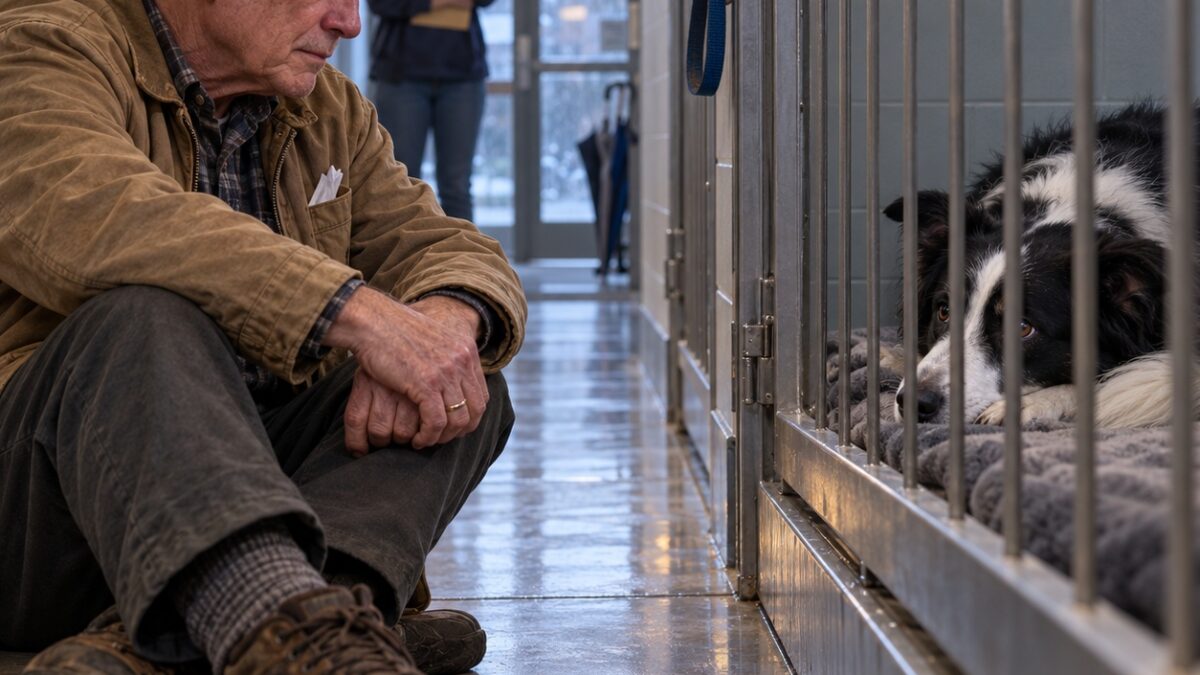
At first, I thought David was speaking for himself.
Maybe that was part of it.
He kept his eyes on Maya, but he never leaned toward her.
Never tried to close the distance she had chosen.
“My wife was named Margaret,” he said.
Maya remained curled against the back wall.
“We were married forty-three years.”
One ear lifted slightly again.
David noticed.
So did I.
He did not react.
“She had a habit of turning every light on in the house.”
His mouth moved into the smallest smile.
“I complained for forty-three years.”
He paused.
“After she died, I stopped turning them off.”
That sentence hit me harder than I expected.
Shelter work exposes you to grief in strange forms.
Animals surrendered after divorces.
Pets left when owners die.
Families who love an animal but cannot afford surgery.
People who cry while signing paperwork and people who do not cry until they reach the parking lot.
I had learned grief has dozens of accents.
David’s sounded like a quiet house.
He continued.
“For months, I’d sit in the living room and think I heard her.”
Maya’s eyes opened.
Just slightly.
“Floorboards.”
He swallowed.
“The kettle.”
“A cabinet door.”
He looked down at his hands.
“Sometimes I’d turn because I was certain she had walked into the room.”
No one else was in the hallway by then.
I had signaled to another employee to cover reception.
I don’t know why.
Maybe because something about that moment deserved protection from ordinary interruption.
David looked back at Maya.
“Waiting is cruel, isn’t it?”
Her eyes were fully open now.
She did not move.
But she was watching him.
For a dog who had spent weeks refusing to look at anyone, that felt enormous.
David said:
“It doesn’t break you all at once.”
He spoke slowly.
“It just removes a little piece each day.”
He rubbed one thumb against the side of his hand.
“Until one morning you realize you’ve built your whole life around listening for something that won’t happen.”
Maya lifted her head.
I had seen her move faster for food.
But that was not the point.
She had chosen to move while he was there.
David still did not reach for her.
That mattered too.
Most visitors want progress they can touch.
A dog comes closer, so they extend a hand.
A dog smells them, so they pet.
A dog relaxes slightly, so they want more.
Human beings have trouble leaving a good moment alone.
David did.
He simply stayed seated.
Then he said:
“I didn’t come here because I need you to love me.”
Maya blinked.
“You don’t have to wag your tail.”
Nothing.
“You don’t have to come over.”
Nothing.
“You certainly don’t have to trust me.”
His voice trembled slightly.
“Not today.”
He took a slow breath.
“I just thought perhaps being lonely together might be easier than being lonely separately.”
I looked away.
Not because I wanted to miss anything.
Because I needed a second.
Outside, rain tapped steadily against the windows.
Phones rang somewhere near reception.
A kennel door opened farther down the hall.
Someone laughed.
Another dog barked.
Life continued around them.
Inside that small section of corridor, almost nothing happened.
That was precisely why I remember it so clearly.
David sat.
Maya watched.
Ten minutes.
Twenty.
Thirty.
At one point, David shifted his leg carefully.
Maya’s body tensed.
He stopped moving.
Waited.
Her shoulders lowered again.
He learned her that quickly.
Not trained behavior.
Permission.
Around the forty-minute mark, I brought him a cup of water.
He whispered:
“Thank you.”
I asked:
“Do you want a chair?”
“No.”
“You’ll regret that tomorrow.”
“Probably.”
Maya’s eyes moved toward me.
Then back to him.
David smiled.
“She’s already decided you’re less interesting.”
“Story of my career.”
He laughed quietly.
That was the first time Maya’s head tilted.
Not much.
A few degrees.
David stopped laughing immediately.
Not because he was afraid.
Because he saw she was listening.
“Sorry,” he whispered.
Maya remained upright.
Then she stood.
I have watched hundreds of shelter dogs stand.
That one movement remains one of the most emotional things I have ever seen.
She unfolded herself cautiously.
Front legs first.
Then back.
Her body was stiff from lying so long.
She stretched once.
David did not move.
Maya took one step.
Stopped.
Looked toward the hallway.
Then at him.
Another step.
She had perhaps eight feet to cross inside the kennel.
It took her several minutes.
Step.
Pause.
Step.
Pause.
David’s breathing became visibly slower, as though he was afraid his chest moving too quickly might frighten her.
Maya reached the front of the kennel.
She did not wag.
She did not press against the bars.
She simply stood there.
David looked at her.
“Hello.”
Her nose moved.
He turned one hand over slowly.
Did not push it through the bars.
Just rested the back of it near the metal.
Maya leaned forward.
Sniffed.
Pulled back.
David stayed still.
She sniffed again.
Longer.
Then something happened none of us expected.
She lowered her forehead against the space between the bars until it touched the back of David’s fingers.
His eyes closed.
He did not pet her.
Not yet.
He simply let his hand exist beneath her head.
Her tail moved once.
Then again.
Slow.
A soft thump against the kennel floor.
David’s mouth tightened.
I could see him trying not to cry.
He failed.
So did I.
Nobody said anything for a while.
Finally, I asked quietly:
“David?”
He looked at me.
“Would you like to spend some time with her in one of our meeting rooms?”
He looked back at Maya.
“If she wants.”
That answer told me nearly everything I needed to know.
We opened the kennel.
Maya immediately retreated two steps.
David remained on the floor.
I attached a leash loosely.
She tolerated it.
We moved into a quiet visitation room.
No other animals.
A chair.
A washable rug.
A low window.
David sat on the floor again.
“I am going to need new knees,” he muttered.
I smiled.
Maya stood near the door.
He did nothing.
Five minutes later she lay down.
Not beside him.
Across the room.
Still progress.
I left them there together.
Checked twice through the small window.
First time, David was talking.
Maya’s head rested on her paws, eyes open.
Second time, he had stopped talking.
Both were sitting in silence.
That impressed me even more.
He didn’t believe silence had to be filled.
People who live alone sometimes learn that.
Or perhaps people who have lost someone do.
After nearly two hours, I went inside.
David looked exhausted.
Maya looked calmer than she had since her failed adoption.
I said:
“You don’t have to decide anything today.”
He looked surprised.
“I thought I’d already decided.”
I laughed.
“There’s an application.”
“Of course there is.”
“We’ll need references.”
“Fine.”
“Veterinary information if you’ve had pets before.”
“My wife and I had two dogs over the years.”
“Good.”
“Both old when they died.”
He looked at Maya.
“I know how that part works.”
That sentence mattered.
Adoption isn’t only love.
It is logistics.
Vet care.
Exercise.
Money.
Home environment.
Patience.
We still had responsibilities.
I explained that Maya might behave differently in a house.
She might hide.
Refuse food.
Have accidents.
Become anxious.
Progress could reverse.
The moment at the kennel did not guarantee anything.
David listened.
Really listened.
Then asked:
“If she spends the first week under a table, what do I do?”
“Let her, mostly.”
“Feed nearby?”
“Yes.”
“Walks?”
“Short. Quiet.”
“Visitors?”
“Minimal.”
He nodded.
“That’s manageable.”
“What if she doesn’t want affection?”
“Then don’t force it.”
“Good.”
He smiled faintly.
“I don’t particularly enjoy people forcing affection on me either.”
Fair.
Our adoption process normally involved time.
In Maya’s case, after the failed adoption, we were especially careful.
David completed the forms.
References checked out.
His veterinarian confirmed decades of responsible pet ownership.
He lived in a quiet home with a fenced backyard.
No other animals.
No children.
He was retired.
He also returned the next morning before we had finished everything.
Rain again.
Same jacket.
This time he brought a book.
He sat outside Maya’s kennel and read.
Not to her.
Just near her.
Maya stayed in the corner for fifteen minutes.
Then moved halfway forward.
David never looked up.
The following day, she came to the gate almost immediately.
That was when I finally allowed myself to think:
Maybe.
Not certainty.
Shelter work punishes certainty.
Maybe.
On the afternoon the adoption became official, David signed his name more carefully than anyone needed to.
Then stared at the paper.
“You all right?”
“Yes.”
He looked toward Maya.
“I am nervous.”
“Good.”
He laughed.
“That is reassuring?”
“People who aren’t nervous usually haven’t thought about what they’re taking on.”
He nodded.
Maya stood near us wearing a plain harness.
Her tail was low.
Not tucked.
Low.
She had entered the lobby voluntarily.
That alone felt enormous.
David took the leash.
But instead of pulling, he waited.
Maya looked toward the front doors.
Rain outside.
Cars.
Unknown world.
She froze.
David crouched as far as his knees allowed.
“No hurry.”
There it was again.
No hurry.
The sentence that defined him.
We waited.
Two minutes.
Three.
Maya stepped forward.
Then another.
We opened the door.
She stopped at the threshold.
David waited.
Eventually she crossed.
No dramatic music.
No leap into a car.
She sniffed the wet pavement.
Looked back toward the shelter.
Then toward David.
He opened the rear door of his car.
Blanket spread across the seat.
Maya did not jump in.
So he sat on the edge of the car.
Waited.
A minute later she put her front paws up.
Then climbed.
He closed the door gently.
Before getting into the driver’s seat, David turned toward me.
His eyes were wet again.
“Thank you.”
I shook my head.
“Call us.”
“I will.”
“For anything.”
“I understand.”
Then:
“I think it’s time we go home.”
I watched the car disappear through the rain.
I did not say:
This one will work.
I wanted to.
Instead, I went back inside.
Cleaned Maya’s kennel.
Folded the blanket she’d slept on.
Removed her name card from the door.
That part always feels dangerous.
Hope has paperwork too.
The first call came that evening.
David.
My stomach tightened before answering.
“Everything okay?”
“Yes.”
Pause.
“She is under the dining table.”
I smiled.
“Good.”
“Good?”
“She found somewhere that feels safe.”
“Oh.”
He sounded relieved.
“She won’t eat.”
“Leave the food nearby.”
“I did.”
“Give her time.”
“She watched me make tea.”
“That’s promising.”
He laughed softly.
“I’ll call tomorrow.”
He did.
Day two:
She ate overnight.
Would not go into the backyard until David opened the door and sat several feet away.
Then she stepped outside.
Day three:
She followed him from the kitchen into the living room.
Not close.
But followed.
Day four:
She slept near the fireplace.
Day five:
She took a treat from his hand.
Day six:
Nothing new.
That was important too.
Healing isn’t a staircase.
Some days are just days.
David seemed to understand better than most.
“She’s quieter today,” he told me.
“Any trigger?”
“Garbage truck.”
“Could be.”
“She went back under the table.”
“Let her.”
“I am.”
Then he added:
“I sat nearby.”
Of course he did.
A week later, Maya wagged when he entered the room.
David called me as if he had won the lottery.
“She moved her tail.”
I laughed.
“Yes.”
“You don’t understand.”
“I do.”
“No.”
His voice broke.
“She was waiting for me.”
That sentence stayed with me.
The man who had spent two years entering a house where nobody waited was suddenly being waited for.
Maybe rescue works in directions we cannot measure.
Several weeks passed.
Then David came back to the shelter.
For one awful second when I saw him enter alone, my heart dropped.
Old reflex.
Returned dog.
Failed adoption.
Another collapse.
Then I saw the envelope in his hand.
And the smile.
“Maya is fine,” he said before I could ask.
I exhaled.
“You almost killed me.”
“Sorry.”
He handed me the envelope.
Photographs.
Real printed photographs.
Who prints photographs anymore?
David, apparently.
The first showed Maya on a thick rug in front of a fireplace.
Not curled tightly.
Stretched.
Comfortable.
Second:
Maya standing in a green backyard, nose buried in wet grass.
Third:
Sitting beside David on the couch.
Not touching him.
But close.
Fourth:
Touching him.
Her head rested against his leg.
Fifth:
Sleeping at the foot of his bed.
The dog in those photographs looked familiar and completely different.
Eyes brighter.
Body softer.
Tail visible instead of tucked beneath her.
David sat across from me.
“You were right.”
“About?”
“The first days.”
He smiled.
“They were slow.”
“How slow?”
“First night, she came out from under the table after I went upstairs.”
I nodded.
“Second night, same.”
He continued:
“Third night I fell asleep in the chair.”
His smile deepened.
“I woke up at three in the morning and she was lying six feet away.”
I felt something tighten in my throat.
“Then?”
“Nothing.”
Good.
“She looked at me.”
He shrugged.
“I went back to sleep.”
Exactly.
Not every moment needs to be harvested.
David continued.
“A week later, she moved closer.”
“Two weeks, she slept beside the chair.”
“Then one afternoon I went to the grocery store.”
His voice changed.
“When I came back…”
He stopped.
“What?”
“She was behind the door.”
Waiting.
He looked down.
“I had forgotten what it felt like to be expected.”
Neither of us spoke.
Then David laughed quietly.
“Do you know how ridiculous I’ve become?”
“I can imagine.”
“I talk to her.”
“Most people do.”
“No.”
He shook his head.
“I tell her everything.”
“What you bought?”
“Yes.”
“What you saw?”
“Yes.”
“Neighbors?”
“Yes.”
“Weather?”
“Yes.”
I smiled.
“That sounds healthy.”
“Margaret and I talked constantly.”
He looked toward the shelter hallway.
“The house was unbearable after she died because there was nowhere for words to go.”
That line lodged in me.
“Now Maya gets them.”
“She is a poor conversationalist.”
“Still.”
He smiled.
“She listens.”
I asked about walks.
His face brightened.
“Every morning.”
“How far?”
“Not far at first.”
“Now?”
“Almost two miles if my knees cooperate.”
“Maya’s influence.”
“Definitely.”
He had lost weight.
Looked more rested.
Not younger exactly.
More present.
That is different.
I asked:
“Any problems?”
“Yes.”
Good.
Perfect rescue stories make me suspicious.
“What?”
“Vacuum cleaner.”
“Common.”
“Hates it.”
“Anything else?”
“Men in hats.”
Noted.
“Doorbell.”
“Also common.”
“She stole half a chicken sandwich.”
I laughed.
“That is not trauma.”
“I suspected criminal intent.”
David became serious again.
“She still has bad days.”
“I expected that.”
“Sometimes she hears something and disappears.”
He looked worried.
“Sometimes she stares at the front door.”
That one hurt.
I wondered whether part of Maya was still waiting for the people who had returned her.
We would never know.
I said:
“Bad days don’t erase good ones.”
David nodded slowly.
“I tell myself that.”
“Tell her too.”
“I do.”
He looked at the photographs.
“Actually, I think she tells me.”
That was the moment I understood their relationship more clearly.
We had been telling ourselves David rescued Maya.
He did.
He gave her a home.
Patience.
Safety.
Choice.
But Maya had also imposed structure on a man whose grief had hollowed out his days.
Morning walk.
Breakfast.
Medication reminders because she somehow learned to stare at him at the time he usually took pills.
Yard.
Dinner.
Company.
Another heartbeat in the house.
Healing rarely arrives as one grand event.
Sometimes it arrives needing to be let outside at six in the morning.
David started volunteering at the shelter twice a month.
Not immediately.
Months later.
He said Maya was comfortable enough alone for short periods.
He did laundry.
Read quietly near nervous dogs.
Fixed loose hinges because apparently old men cannot enter buildings without repairing something.
Maya sometimes came with him for brief visits once she was stable enough.
The first time she returned, I worried.
Would the smell of kennels overwhelm her?
She stopped near the front hallway.
David knelt.
“No hurry.”
She looked at him.
Then continued.
When she reached her old kennel, she froze.
I held my breath.
She stared inside.
Empty now.
Another dog had been moved to an adoption room.
Maya sniffed the gate.
Then turned away.
Went directly back toward David.
That nearly finished me.
People say dogs live in the present.
Maybe.
Maybe not completely.
I don’t pretend to know what memories feel like inside an animal.
But I knew what I saw.
She had a place behind her.
She chose the person in front of her.
David touched the side of her neck.
She leaned into him.
That was enough.
One afternoon, nearly a year after the adoption, David sat beside me at reception while Maya slept at his feet.
A family was walking through the kennels.
Children excited.
Parents asking questions.
David watched.
“You ever worry?”
“Constantly.”
“About?”
“Whether we choose the right home.”
He nodded.
“You chose wrong for her once.”
It wasn’t cruel.
Fact.
“Yes.”
Then:
“And then you chose me.”
“We approved you.”
He smiled.
“You know what I mean.”
I did.
“Does the first one still bother you?”
“Yes.”
He looked at Maya.
“Maybe it had to happen.”
I shook my head.
“I don’t like saying pain has to happen.”
He considered that.
“Fair.”
“Bad things don’t earn goodness afterward.”
“No.”
He nodded.
“But good things can still come after.”
That I could accept.
Maya’s failed adoption did not become good because David came later.
It still hurt her.
Still changed her.
Still may have left fear she carried for years.
David did not erase it.
He gave her enough safe experiences that the bad one stopped defining every new person.
That’s more realistic.
And somehow more beautiful.
David’s grief worked the same way.
Maya did not replace Margaret.
Never.
He kept Margaret’s photographs throughout the house.
Her coat remained in a closet longer than he admitted.
Their wedding picture stayed beside his bed.
Maya slept below it.
Love does not have to evict old love to make room for new attachment.
David once said:
“I worried that feeling happy again was disloyal.”
“To Margaret?”
“Yes.”
“What changed?”
He looked at Maya.
“She doesn’t seem interested in philosophy.”
Fair.
“She needs breakfast whether I feel guilty or not.”
That was probably healthier than any answer I could have given.
Grief wants to make everything symbolic.
Dogs need breakfast.
We laughed.
David eventually planted a small garden again.
He had stopped after Margaret died.
Maya helped by digging up several parts he did not ask her to.
He brought me photographs.
Tomatoes.
Lavender.
Maya asleep between rows.
“She destroyed the parsley.”
“Good.”
“It was excellent parsley.”
“No dog respects parsley.”
He disagreed.
Our friendship grew around the adoption.
Shelter workers sometimes stay in touch with adopters.
Usually updates fade.
David became part of the place.
Not because he owed us.
Because he understood what sitting quietly beside a frightened animal could do.
Once a terrified shepherd mix arrived after an abandonment case.
Would not approach staff.
David sat outside the kennel reading.
I walked by.
“You collecting projects?”
“No.”
“Good.”
He turned a page.
“I’m busy.”
The dog eventually fell asleep near the front.
No miracle.
No adoption that day.
Just safer.
David understood that was enough.
Years passed.
Maya aged.
White appeared around her muzzle.
Border Collies don’t believe in slowing down until their bodies force negotiations.
David slowed too.
Their walks shortened.
Two miles became one.
Then around the block.
Then to the end of the street.
He installed a small ramp beside his back steps because Maya developed arthritis.
A year later, he started using the railing more himself.
“They should have designed it for both of us,” he joked.
Maybe they had.
One winter, Maya developed a medical issue requiring treatment.
David called.
His voice shook.
“I’m not ready.”
Nobody ever is.
The veterinarian believed it was manageable.
Medication.
Monitoring.
Diet changes.
Maya responded.
For a while.
Then age continued doing what age does.
I visited once.
David had invited me.
The house was warm.
Photographs everywhere.
Maya young in the yard.
Maya beside the fireplace.
Maya wearing an absurd holiday scarf.
Maya asleep under David’s chair.
She lay on a padded bed in the living room.
When I entered, her tail moved.
Slow.
Same soft thump I remembered from the kennel.
I sat beside her.
“Hey, girl.”
She raised her head.
Sniffed me.
Then rested again.
David brought tea.
We sat.
Nobody pretended.
He said:
“I think we’re close.”
I nodded.
“Veterinarian?”
“Tomorrow.”
He looked at Maya.
“I promised I wouldn’t make her stay because I’m afraid of the house being quiet again.”
That sentence broke something in me.
David had spent years learning to let Maya choose.
Now the final choice belonged to him.
To protect her from suffering even if it returned him to silence.
The next afternoon, Maya died with David beside her.
At home.
Veterinarian present.
Head in his lap.
I know because David called later.
He did not cry immediately.
He said:
“She was calm.”
Then:
“I told her Margaret would probably complain about the dog hair.”
I laughed through tears.
Then he broke.
Grief returned.
Not the same grief.
There are no identical losses.
But familiar.
The house became quiet again.
For a few months, David stopped volunteering.
We did not push.
People deserve the same patience we ask them to give animals.
Then one rainy Thursday—almost exactly like the afternoon he first walked into the shelter—the front door opened.
David stepped inside.
Older.
More bent.
Same canvas jacket.
No umbrella this time.
He stood near reception.
I walked over.
“Good afternoon.”
He smiled faintly.
“Do you have any dogs that don’t mind quiet?”
My throat tightened.
“You’re ready?”
“No.”
He shook his head.
“Probably not.”
Then:
“But I think Maya would object if I spent the rest of my life sitting alone.”
I laughed.
“That sounds like her.”
He walked with me toward the kennels.
Slowly.
Dogs barked.
Jumped.
Pressed against gates.
David did not hurry.
At one kennel, he stopped.
Inside was an older mixed-breed dog who had been overlooked for months.
Not Maya.
Never would be.
David lowered himself carefully into a chair this time.
His knees had earned it.
He sat.
The dog watched him.
David said:
“Hello.”
Nothing happened.
He smiled.
“No hurry.”
I stood at the end of the hallway.
And for the first time, I understood the full shape of what Maya had given us.
She had not been saved once.
David had not been saved once.
Healing was not a single moment at a kennel gate.
It was a pattern they practiced together.
Stay.
Wait.
Allow.
Trust a little.
Lose.
Grieve.
Try again.
That was the real miracle, if I am willing to use the word.
Not that Maya walked across her kennel that first afternoon.
Not that her tail touched the floor.
Not even that David took her home.
The miracle was that two beings who had every reason to protect themselves from attachment eventually decided the risk of loving again was worth it.
Maya had been adopted once and returned in a single day.
That experience taught her that doors opening could mean abandonment.
David had loved one woman for forty-three years and watched death close that door forever.
Both could have stayed inside what remained.
Neither did.
They did not heal each other by erasing pain.
They made pain less lonely.
That is different.
And far more believable.
I still keep one photograph from David’s envelope at the shelter desk.
Maya on the couch.
David beside her.
Neither looking at the camera.
His hand rests near her shoulder.
Her body leans slightly against his leg.
Nothing dramatic.
If you didn’t know the story, you’d see an old man and a dog.
That’s exactly why I love it.
By the end, that’s what they were.
Not abandoned dog.
Not widower.
Not rescue.
Not broken.
Just family.
Whenever a nervous adopter asks me how long it will take for a frightened dog to trust them, I think of David sitting on that cold floor.
And I tell them:
“I don’t know.”
Because that is the honest answer.
Maybe hours.
Maybe weeks.
Maybe months.
Maybe trust will always look different than you imagined.
Then I add:
“Don’t rush the dog because you’re eager to feel chosen.”
People usually become quiet after that.
Good.
Some lessons need quiet.
Maya taught me that too.
The dog who had stopped looking at people did not need someone to convince her the world was safe.
It wasn’t.
She already knew that.
She needed one person willing to show her that not every unsafe thing repeats forever.
One afternoon.
Then another.
Then another.
David never promised her she would never hurt again.
He promised something smaller.
More useful.
“I am here.”
And for Maya, that was enough to take one step.
Then another.
Until eventually those steps led through the shelter doors, into a quiet house, across a green backyard, beside an old man’s bed, and deep into a life neither of them thought they were going to have again.
Years later, when I think about that rainy Thursday, I no longer remember the barking first.
I remember stillness.
David on the floor.
Maya in the corner.
Two creatures separated by metal bars and different kinds of grief.
No grand gesture.
No promise of instant healing.
Just an old man telling a frightened dog:
“I don’t need you to love me today.”
That may have been the first thing anyone had ever offered Maya that asked absolutely nothing in return.
She answered the only way she could.
She opened her eyes.
And that was where both of their lives began moving again.








