FULL STORY:The Dog Who Was Returned After One Day Had Stopped Looking at People—Then an Old Man Sat Down Outside Her Kennel
PART2
For several seconds, nobody on the bank made a sound.
That was the strangest thing.
The river was still roaring.
Rain was still falling.
Radios were still crackling.
But human voices stopped.
It was as though every person standing there had inhaled at the same time and forgotten how to breathe out.
I stared at the place where Morocho had been.
Empty concrete.
Brown water.
Nothing.
My mind refused to accept the speed of it.
One second there had been a dog.
The next, only current.
Then a firefighter shouted:
“Downstream!”
Everything started moving at once.
Two firefighters ran along the edge.
A police officer pushed people back from the barrier.
Another rescuer pointed toward a lower section.
I ran too.
Not because I could outrun the river.
Because standing still felt impossible.
Someone behind me was crying.
I heard a woman say:
“Oh God.”
Another voice:
“Where is he?”
No one answered.
I looked at the water.
Branches.
Foam.
Trash.
No dog.
Four seconds.
Five.
Six.
It is astonishing how long six seconds can become when you believe something living is underwater.
I remember thinking about Morocho’s lungs.
That was a mistake.
Then about debris.
Another mistake.
Then about how many times frightened animals panic and waste every ounce of energy fighting in the wrong direction.
Stop imagining.
Watch.
Seven seconds.
Eight.
One firefighter farther downstream waved.
“Something!”
We all turned.
A dark shape surfaced between two streaks of muddy foam.
Gone again.
Someone shouted:
“There!”
Ten seconds.
Nothing.
Eleven.
A head broke the surface.
Black ears flattened against the skull.
Eyes wide.
Mouth open.
Morocho.
The bank exploded with voices.
“There he is!”
“Morocho!”
“Come on!”
I put both hands against the wet railing because my knees suddenly felt weak.
He was alive.
For the moment.
That was all.
The river carried him faster than any dog could swim against it.
His front legs thrashed.
His head disappeared.
Returned.
Disappeared again.
The current spun him sideways.
Every time I thought he had found a direction, another surge changed it.
A firefighter yelled:
“He has to angle!”
As if Morocho could hear.
As if he could understand hydrodynamics.
As if instinct itself could be reasoned with while a river tried to pull him apart.
Then something changed.
Maybe luck.
Maybe instinct.
Maybe exhaustion forced the decision.
Instead of trying to move directly against the current, Morocho’s body turned diagonally.
Toward the bank.
He was still being carried downstream.
But now, little by little, he was also moving sideways.
“That’s it.”
I didn’t know I was speaking until I heard myself.
“That’s it, boy.”
Someone beside me repeated it.
Then another.
Soon half the bank was saying variations of the same useless, desperate thing.
Come on.
Come on.
Come on.
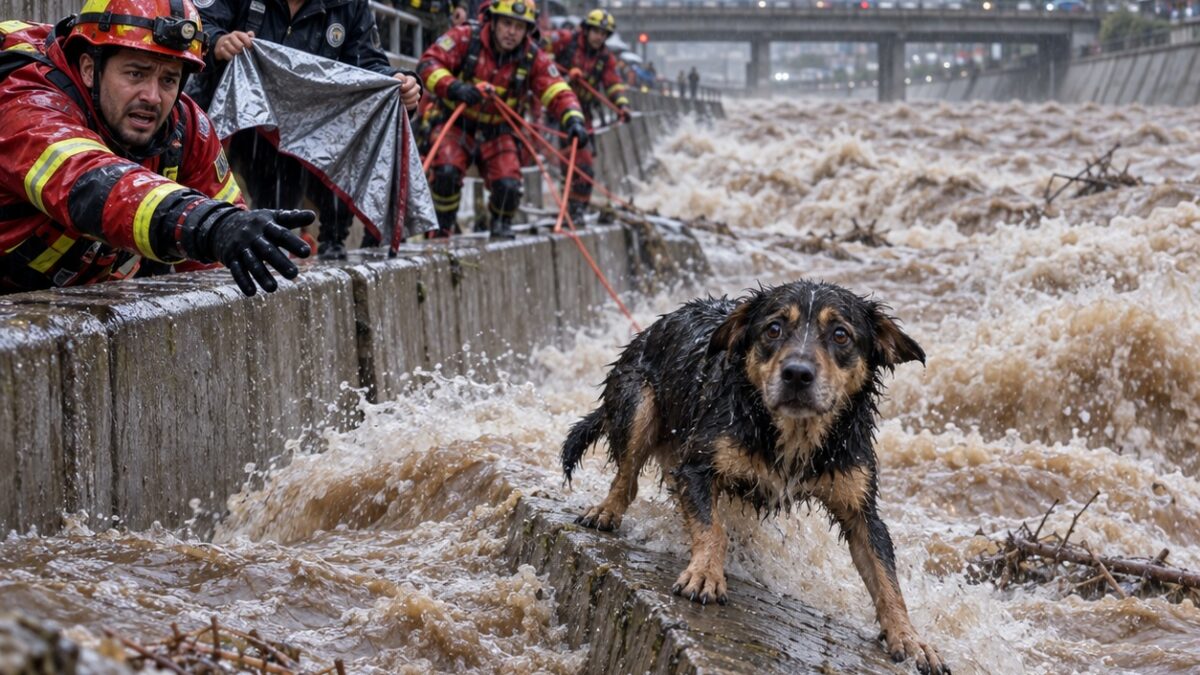
Morocho surfaced closer to the wall.
Then vanished again.
A branch passed where his head had been.
I felt sick.
He appeared five yards farther down.
The rescue teams repositioned.
One firefighter clipped a second safety line to his harness.
Another officer ran to a lower access point.
The Mapocho had concrete slopes in places where water curled differently near the bank.
If Morocho could reach one of those sections, maybe his paws would find something.
Maybe.
Flood rescue depends on that word more than people understand.
Maybe the rope reaches.
Maybe the current shifts.
Maybe the animal keeps fighting ten seconds longer.
Maybe someone is standing in exactly the right place.
Morocho moved closer.
Then the river pushed him away.
A collective groan went through the crowd.
He tried again.
His head was lower now.
That terrified me.
A dog swims differently when strength leaves.
The muzzle rides closer to the surface.
The neck stops lifting.
Legs lose rhythm.
Morocho had already spent hours balancing on concrete.
Now he was fighting a river.
His body had limits.
We could all see him reaching them.
A firefighter near me whispered:
“Please.”
That word broke me more than the shouting.
Professional rescuers do everything they can to build systems between disaster and prayer.
Ropes.
Training.
Positioning.
Equipment.
Plans.
But there comes a point when even trained people have done what they can do.
Then all that’s left is please.
Morocho hit the sloped concrete near the bank.
His front paws scraped.
Slipped.
He was carried several feet.
“No!”
Someone screamed.
The firefighter below dropped onto his stomach.
Another man held his harness from behind.
He stretched one arm down.
Too far.
Morocho fought back toward the wall.
His claws touched again.
Nothing to grip.
He slid.
The current pulled his back half outward.
For a moment his body was almost vertical against the concrete.
Front legs scratching.
Hind legs gone beneath brown water.
The rescuer extended farther.
“Come on, boy.”
Morocho slipped another foot.
Then somehow caught a rough seam in the concrete.
One paw.
Then the other.
He hung there.
The current still pulling.
The firefighter reached.
His fingers missed Morocho’s shoulder by inches.
“Again!”
I have no idea who that was directed at.
Dog?
Rescuer?
God?
Morocho pushed.
One paw rose.
His chest cleared the water for half a second.
The firefighter caught him.
Not securely.
A handful of wet skin and fur near the shoulder.
Enough to interrupt the slide.
Another rescuer grabbed the first man’s belt.
A third moved closer.
Morocho kicked.
The firefighter shouted:
“Got him!”
Not yet.
The river still had half the dog.
Morocho twisted.
His back legs struck the wall.
Found nothing.
The current pulled.
The rescuer nearly slipped forward.
The safety line snapped tight.
Then another pair of hands reached.
They caught Morocho under the chest.
Pulled.
His body came over the edge all at once.
He hit wet concrete.
And didn’t move.
Nobody cheered.
Not immediately.
That is the part television clips rarely capture accurately.
The bank had been desperate to see him out of the water.
But when he finally was, he looked dead.
Flat on his side.
Soaked.
One leg stretched awkwardly.
No visible movement from where I stood.
I ran.
Police opened a path.
My shoes slid on mud.
By the time I reached him, firefighters had formed a loose circle.
“Space.”
One of them held out an arm.
I crouched.
Morocho’s sides moved.
Tiny.
Fast.
Breathing.
I started crying.
I did not notice until rain and tears tasted different at the corner of my mouth.
“He’s breathing.”
A firefighter laughed once.
A broken sound.
“Yeah.”
Morocho lifted his head.
Only a few inches.
Enough.
The crowd behind us heard someone say he was alive.
Then the cheering began.
Loud.
Raw.
People hugged strangers.
A woman near the barrier covered her face with both hands.
One of the officers looked away because he was crying and clearly did not want a camera to catch it.
Morocho heard none of it as celebration.
His ears pressed back.
His whole body trembled.
His breathing was far too fast.
He tried to stand.
His front legs pushed.
Then collapsed.
“Easy.”
We moved carefully.
Extreme stress can make any animal unpredictable.
Pain can make a gentle dog bite.
Fear can turn hands into threats.
So we did not crowd him.
A blanket came over his back.
Someone checked his gums.
Someone else examined the obvious wounds.
Small abrasions.
Scraped paws.
A cut along one side.
Nothing visibly catastrophic.
But floodwater hides damage.
Blunt trauma.
Internal injuries.
Aspiration.
Hypothermia.
Shock.
Exhaustion.
Morocho tried to stand again.
This time he managed two seconds.
Then his legs folded.
That was when one firefighter turned his face away.
I saw his jaw tighten.
All the relief of the rescue had collided with another reality.
Morocho was alive.
That did not automatically mean he would stay alive.
We placed him carefully on a transport blanket.
The crowd quieted as we lifted him.
A little boy behind the barrier shouted:
“Don’t let him die!”
I wish I hadn’t heard that.
The veterinarian clinic had already been warned.
We moved toward the vehicle.
As I climbed in beside Morocho, one of the firefighters leaned through the open door.
“Tell them he fought like hell.”
I nodded.
Then closed the door.
For the first time since arriving at the Mapocho, the river disappeared.
The sound vanished with it.
No roar.
No cameras.
No screaming.
Only rain against the metal roof and Morocho’s breathing.
Fast.
Shallow.
Uneven.
I sat on the floor beside him.
There was a towel beneath his head.
His eyes remained open.
Not looking at me exactly.
Looking through everything.
I had seen that stare in animals after car accidents.
After dog attacks.
After being pulled from burning buildings.
The body survives before the mind understands it has survived.
I rested my hand on the floor beside him.
Not touching.
“It’s over.”
His chest rose.
Fell.
“It’s over, boy.”
Of course it wasn’t.
Not yet.
But I needed to say it.
Maybe for him.
Definitely for me.
The municipal clinic team met us at the entrance.
Morocho was carried inside.
A veterinarian named Paula took control.
“Temperature.”
“Heart rate.”
“Respiration.”
“Check chest.”
“Paws.”
“Abdomen.”
We stepped back.
That is hard during an animal emergency.
You spend an hour trying desperately to reach something.
Then the moment professionals take over, you must become useless.
I stood against the wall.
Water dripped from my clothes onto the tile.
Paula listened to Morocho’s lungs.
Then again.
Longer.
I hated the second listen.
“What?”
She did not look up.
“Let me listen.”
I watched her face.
Veterinarians learn to hide reactions.
Not perfectly.
I saw concentration.
Concern.
Not panic.
Morocho coughed.
Just once.
My stomach dropped.
Possible aspiration.
Paula checked his mouth.
Listened again.
“He may have taken in some water.”
“How much?”
“Don’t know.”
“Is he—”
“Lucía.”
I stopped.
She looked at me.
“Let us work.”
Right.
I nodded.
Stepped back.
Bloodwork.
Oxygen assessment.
Physical examination.
Wounds cleaned.
Muscles checked.
No obvious broken bones.
No major laceration.
No severe abdominal response.
Temperature low but not critically so.
Hydration surprisingly acceptable considering the ordeal.
Paula finally stood.
“General condition is better than I expected.”
I stared.
“Meaning?”
“Meaning he’s exhausted, he’s scraped up, and we need to monitor respiratory status.”
“But?”
“But right now, I am cautiously optimistic.”
Cautiously optimistic.
People outside medicine underestimate the beauty of those words.
Not safe.
Not guaranteed.
Not fine.
But hope with permission.
I walked into the hallway and cried.
Not dramatically.
Quietly.
Back against the wall.
Hands shaking.
A municipal colleague named Andrés found me there.
“He’s okay?”
“For now.”
Andrés exhaled.
Then leaned against the opposite wall.
Neither of us spoke for a while.
Finally he said:
“I thought he was gone.”
“So did I.”
“When he disappeared…”
“I know.”
Eleven seconds.
I had checked the footage later.
Eleven seconds between the moment Morocho vanished and the moment his head became clearly visible downstream.
Eleven.
Long enough to imagine a death.
Long enough to mourn before the body was even found.
That night, Morocho slept under observation.
People kept asking for updates.
Television stations.
Newspapers.
Social media accounts.
Municipal communications.
Residents.
Children.
People from other parts of Chile.
Messages came from outside the country.
Is he alive?
How is the river dog?
Did he break anything?
Does he have an owner?
Can we adopt him?
I became angry at the phones.
Not at the people.
At the speed with which the world wanted a conclusion.
Morocho had just nearly drowned.
He didn’t need to become a story before he had become stable.
So we released only the basics.
Alive.
Under veterinary care.
Minor visible injuries.
Being monitored.
That was all.
At around nine that night, I went back to his recovery area.
Morocho was asleep.
A blanket covered most of his body.
One paw stuck out.
Bandaged lightly.
His breathing had slowed.
Every few minutes, his legs twitched.
I wondered what dogs dream about after terror.
Probably nothing we could recognize.
I sat outside the kennel.
Not speaking.
That was when another detail finally reached me.
Nobody had arrived asking for him.
No frantic owner.
No family running through the clinic doors.
No person shouting his name.
The entire city had watched Morocho fight for his life.
But there was no single person waiting outside his recovery room saying:
He’s mine.
Please let me see him.
That hurt in a way the river had not.
During the rescue, Morocho had become everyone’s dog.
Before it, where had he slept?
Who fed him?
Had someone been searching?
Had he been abandoned?
Had he wandered?
We did not have all those answers.
And I refused to invent them.
But that empty hallway told its own story.
For all the people watching, nobody seemed certain where Morocho belonged.
I looked through the kennel door.
His body rose.
Fell.
Alive.
And I thought:
You fought that hard to get back to a world where nobody is standing here for you.
That was the moment I cried hardest.
Not when the river took him.
After.
When he was safe.
Sometimes heartbreak waits until danger is over because survival leaves room for everything else.
I stayed until someone made me go home.
I slept badly.
Every time I closed my eyes, the concrete slab was empty.
Then Morocho’s head appeared.
Then disappeared.
Morning came anyway.
I returned early.
Paula met me near the desk.
“He’s standing.”
Those two words changed my whole body.
“Eating?”
“A little.”
“Breathing?”
“Good.”
“No delayed complications?”
“Nothing concerning so far.”
I walked toward him.
Morocho was standing inside the enclosure.
Unsteady.
But standing.
His coat looked cleaner.
Dry.
He appeared smaller without river water flattening everything.
Younger.
Two years old looked young again.
He saw me.
Head lifted.
Tail did not move.
Fine.
He approached the front.
Slowly.
Sniffed my fingers through the opening.
I waited.
Then touched the side of his neck.
He did not pull away.
“Good morning.”
His eyes softened.
I laughed.
Then immediately cried again.
“I am becoming ridiculous because of you.”
Morocho yawned.
Perfect response.
Over the next two days, his improvement continued.
The respiratory concern eased.
Abrasions began healing.
Muscle soreness remained.
He slept constantly.
Ate.
Drank.
Then slept again.
The body does that after surviving something it had no business surviving.
The city’s interest did not fade.
If anything, it grew.
People had watched him fall.
Now they wanted to watch him live.
There were offers to adopt him.
Many.
Some emotional.
Some sincere.
Some clearly made in the heat of public attention.
We had to be careful.
A famous rescue does not automatically produce a good home.
Animals need stability after the cameras leave.
Then someone in the municipality raised a possibility.
“What if Santiago adopts him?”
At first, we laughed.
Cities don’t adopt dogs.
Then we stopped laughing.
Why not?
The municipality already had veterinary resources.
Animal-welfare personnel.
Facilities.
Staff who had become attached to Morocho whether they admitted it or not.
There were people available to care for him consistently.
A public story could become something useful.
Not a mascot.
Not entertainment.
An example.
Responsible adoption.
Commitment after rescue.
A safe home after abandonment or uncertainty.
The idea moved through departments.
There were meetings.
Paperwork.
Questions.
Who becomes legally responsible?
Where will he stay?
Who handles veterinary decisions?
Exercise?
Daily care?
Identification?
What happens after media attention fades?
Those were the questions that mattered.
Not:
Would people like the announcement?
They would.
Would it make a good photograph?
Obviously.
The question was:
Would Morocho have a real life?
The answer eventually became yes.
The municipality of Santiago adopted him.
Officially.
I was there when the decision was confirmed.
Andrés read the message.
Then looked at me.
“Well.”
“What?”
“He has a home.”
I thought I would smile.
Instead, I covered my mouth.
Because that sentence contained too much.
The dog who had nearly been washed away with nobody waiting at the clinic now had an entire institution responsible for making sure he would never again be nobody’s problem.
A home.
Maybe unconventional.
But real.
Food.
Veterinary care.
A safe place to sleep.
People who knew when he had eaten.
People who would notice if he limped.
People who would search if he disappeared.
Identification.
Routine.
Belonging.
I went to Morocho.
He was chewing the edge of a blanket.
“Congratulations.”
He continued chewing.
“You have been adopted.”
Nothing.
“By a city.”
More chewing.
I laughed.
He looked up.
Then wagged once.
I decided that counted.
Morocho’s first weeks after adoption were intentionally boring.
That is one of the kindest things we gave him.
No constant appearances.
No endless crowds.
Routine.
Short walks.
Rest.
Food.
Medical follow-up.
Sunlight.
People he saw repeatedly.
He bonded quickly with a municipal employee named Rodrigo.
I still cannot explain why.
Rodrigo was not the firefighter who pulled him from the river.
Not his veterinarian.
Not the first person to feed him afterward.
But the first time Morocho saw Rodrigo carrying paperwork through the courtyard, his entire body changed.
Tail.
Ears.
Little trot.
Straight to him.
Rodrigo looked down.
“What?”
Morocho leaned into his leg.
I said:
“Congratulations.”
“For what?”
“You’ve been selected.”
“By who?”
Morocho pressed closer.
“Management.”
Rodrigo pretended to dislike this.
Within a week, he was bringing chicken.
Within two, Morocho followed him everywhere allowed.
“He likes everyone,” Rodrigo insisted.
“No.”
“He does.”
“Not like that.”
“He’s friendly.”
Morocho rested his head against Rodrigo’s knee.
I raised an eyebrow.
Rodrigo surrendered.
“Fine.”
That relationship mattered.
Dogs recovering from chaos need predictability more than celebration.
Rodrigo became predictable.
Same voice.
Same smell.
Same pace.
Same person coming back.
Morocho learned that.
The first heavy rain after the rescue tested him.
Water struck the roof hard.
Morocho froze.
Head up.
Body tight.
He moved toward the door.
Then away.
Back.
Forth.
Rodrigo sat in a chair several feet away.
Did not call.
Did not grab him.
Did not smother him with comfort.
Just stayed.
Morocho paced.
Thunder rolled.
He flinched.
Then eventually crossed the room.
Lay beside Rodrigo’s chair.
Not touching.
Close.
That was healing.
Not fearless.
Safe enough to remain in the room.
I thought about all the headlines calling him brave.
Brave dog.
Hero dog.
Miracle dog.
Those words are easy when the frightening thing is over.
Recovery is less cinematic.
A dog hearing rain and deciding not to hide.
A dog sleeping through the night.
A dog learning which footsteps belong to someone who comes back.
Those were the victories I cared about.
Weeks later, Morocho attended his first carefully managed municipal adoption event.
By then he had been given a role.
Ambassador for responsible adoption.
Grand title.
His actual responsibilities included:
Walk on leash.
Meet people if he wanted.
Refuse people if he wanted.
Eat treats.
Steal tennis balls.
Attract attention toward dogs who had never appeared on television.
That last part became unexpectedly powerful.
Everyone came asking for Morocho.
Then they saw Luna.
Toby.
Canela.
Bruno.
Old dogs.
Mixed breeds.
Shy dogs.
Dogs without viral rescue footage.
One family arrived with an eight-year-old boy who had watched Morocho’s river rescue.
“I want a dog like him,” the boy said.
I smiled.
“There is only one Morocho.”
He looked disappointed.
Then Bruno leaned against his legs.
Plain brown dog.
No dramatic history.
No television.
The boy looked down.
Bruno looked up.
Twenty minutes later, the family was filling out an adoption application.
I watched Morocho across the room.
He was trying to steal a tennis ball from Rodrigo.
He had no idea.
But his survival had just opened a door for another dog.
That was when I started believing his public role could mean something beyond sentiment.
Morocho became healthier.
The cuts disappeared.
His coat regained shine.
Muscle returned.
Energy exploded.
At two years old, rest was never going to remain his favorite activity.
We discovered he loved running in open fenced areas.
He loved chicken.
He hated umbrellas.
He distrusted metal drainage grates.
He liked tennis balls but did not understand the concept of returning them.
You threw.
He chased.
End of contract.
Rodrigo tried to teach fetch for weeks.
“Morocho.”
Dog watched.
“Bring it.”
Nothing.
“Come on.”
Morocho lay down with the ball.
I said:
“He survived the Mapocho. He does not work for free.”
Rodrigo glared at me.
Morocho won.
Those ordinary details saved me too.
For weeks after the rescue, I had thought of him as the dog disappearing underwater.
Then gradually he became the dog stealing a sandwich.
The dog sleeping upside down.
The dog refusing fetch.
The dog choosing Rodrigo.
Survivors deserve identities larger than the thing that almost killed them.
People do.
Dogs do.
I started correcting journalists when they introduced him only as “the river dog.”
“Yes,” I would say. “But he is also Morocho.”
Some understood.
Some didn’t.
Media needs shorthand.
Life deserves more.
Months after October 6, I returned to the Mapocho alone.
No emergency.
No uniform requirement.
Just me.
The river had dropped.
The same concrete structures sat exposed.
Smaller.
Ordinary.
It was difficult to understand how something so familiar had become deadly.
I stood near the barrier.
Found the section where Morocho had been stranded.
Then the downstream slope where he reached the bank.
The distance looked enormous.
I had watched it happen and still could not understand how he survived.
A firefighter had once told me:
“He saved himself.”
Another said:
“We saved him.”
Both were partly true.
Morocho fought toward shore.
Rescuers positioned themselves.
Someone saw his head.
Someone reached.
Someone held the safety line.
Someone provided veterinary care.
Someone approved his adoption.
Someone fed him afterward.
Rescue is rarely one heroic act.
It is a chain.
If one link fails, the ending changes.
Standing there, I thought about the eleven seconds again.
The eleven seconds when we could not see him.
How quickly the human mind had written the ending.
Dead.
Gone.
Too late.
Then the river returned his head to the surface.
I cried beside the barrier.
Quietly.
A cyclist passed.
Probably thought I was strange.
Fair.
Later that afternoon, I visited Morocho.
He ran past me because Rodrigo had food.
No recognition of my emotional journey.
Good.
Animals keep us from turning their lives entirely into metaphors.
Morocho did not care what the river represented.
He wanted chicken.
By the end of the year, his role as an adoption ambassador had become well known.
Children sent drawings.
Most showed brown water and a black dog.
Some showed firefighters.
Some showed Morocho wearing a cape.
He tried to eat one.
Heroism has limits.
At a school visit, a little girl asked me:
“Was he scared?”
“Yes.”
“You know?”
“No.”
I corrected myself.
“I can’t know exactly what he felt.”
She looked confused.
“But I think most animals would be frightened in that situation.”
“Then he was brave.”
Maybe.
“What does brave mean?” I asked.
She thought.
“Being scared and still doing it.”
“What did he do?”
“Swam.”
“Yes.”
She smiled.
“Then brave.”
Children have efficient philosophy.
Another boy asked:
“Did he save himself?”
“Partly.”
“Did the firefighters save him?”
“Partly.”
He frowned.
“Who is the hero?”
I looked at Morocho.
He was lying on his side while Rodrigo rubbed his chest.
“The ending needed everybody.”
The boy considered that.
Not satisfying.
But true.
A year later, Morocho returned briefly to the veterinary clinic for a routine check.
Nothing wrong.
Vaccinations.
General exam.
He walked through the same doors where he had once entered wrapped in blankets, shaking and nearly unable to stand.
Paula saw him.
“Look at you.”
Morocho wagged.
She crouched.
He leaned into her.
Paula looked at me.
“You remember his lungs that night?”
“Yes.”
“I thought we were going to have a problem.”
“You never told me.”
“You were already a disaster.”
Fair.
She examined him.
Healthy.
Strong.
Maybe slightly too well fed.
She looked at Rodrigo.
“Treats?”
Rodrigo denied everything.
Morocho betrayed him by staring at his pocket.
“Reduce them.”
“He deserves—”
“No.”
I smiled.
The dog who nearly died had reached the ordinary indignity of being told to watch his weight.
Beautiful.
That night, I thought about what the original rescue footage showed.
Danger.
Desperation.
Survival.
What it did not show was everything after.
The paperwork.
The quiet nights.
The first rainstorm.
The careful walks.
The food bowl.
The municipal tag.
The dog sleeping near someone’s chair.
That is the problem with rescue stories.
We tend to stop at the dramatic moment.
Animal pulled from river.
Dog removed from fire.
Puppy found abandoned.
Happy ending.
But getting out of danger is only the opening.
Rescue becomes real when someone shows up the next morning.
And the morning after that.
And after the cameras leave.
Morocho’s story became beautiful not because he survived one river.
Because afterward, people accepted responsibility for his ordinary days.
Someone had to refill the bowl.
Schedule appointments.
Walk him.
Notice his fears.
Laugh at his habits.
Come back.
Belonging is repetitive.
That is why it matters.
I once asked Rodrigo whether he ever thought about what might have happened if Morocho had not found the bank.
He became angry immediately.
“No.”
“You never—”
“No.”
Then quieter:
“Sometimes.”
We sat outside while Morocho slept nearby.
Rodrigo said:
“I saw the video before I met him.”
“Everyone did.”
“When he disappeared, I thought…”
He stopped.
“I know.”
“Now when he sleeps in my office, sometimes I look at him and think about that.”
Morocho twitched in his sleep.
Rodrigo continued:
“He has no idea how close he came.”
“Probably better.”
“Yes.”
Then:
“I do.”
That was the burden we carried.
Morocho got to live forward.
We remembered backward.
Maybe that is our job as people who care for rescued animals.
They do not owe us gratitude.
We owe them the chance not to live forever inside their worst day.
Morocho never needed to understand Santiago loved him because he survived.
He needed to know the person who left the room would come back.
The food would arrive.
The door would open.
Rain could fall without taking him.
Years from now, Morocho’s rescue may become a short paragraph.
October 6, 2026.
Mapocho River.
Heavy rains.
Dog swept away.
Dog survived.
Municipality adopted him.
Ambassador for responsible adoption.
Facts.
Accurate.
But facts flatten time.
They cannot show the silence after he disappeared.
They cannot show the firefighter whispering please.
They cannot show Morocho’s paws sliding down wet concrete.
They cannot show his body lying still after being pulled out.
They cannot show the empty hallway at the clinic when I realized nobody had come asking for him.
They cannot show the first time someone said:
He has a home.
Those are the moments I carry.
Especially the empty hallway.
Because that is where the story became heartbreaking for me.
The river had almost killed Morocho.
But rivers do not choose.
Water is water.
It has no cruelty.
The loneliness afterward felt different.
A living animal had fought until his muscles nearly failed.
He had surfaced when current dragged him under.
He had clawed concrete with bleeding paws.
He had reached hands waiting on shore.
And then he lay in a clinic with no known person waiting outside the door.
That broke me.
Maybe someone had loved him once.
Maybe someone had lost him.
Maybe his history was more complicated.
I will never claim facts we did not know.
But in that specific moment, nobody was there.
Until suddenly everyone was.
That is what Santiago gave him.
Not fame.
Presence.
A city saying:
If nobody else is coming, we will.
I know municipalities are not families in the ordinary sense.
But commitments can take unusual shapes.
Morocho did not care about legal definitions.
He knew people.
Rodrigo.
Paula.
Me.
Others.
Familiar hands.
Familiar steps.
That is family enough for a dog.
One afternoon, long after the flood, I watched Morocho standing at a doorway while Rodrigo left for a meeting.
The door closed.
Morocho sat.
Waited.
Five minutes.
Ten.
I found myself watching him.
Something tightened in my chest.
Then footsteps came down the corridor.
Rodrigo returned.
Morocho stood instantly.
Tail moving.
Whole body alive.
The man who left came back.
Simple.
That scene meant more to me than the river rescue.
Because perhaps the deepest safety an animal can learn is not:
Nothing bad will ever happen.
We cannot promise that.
It is:
Someone comes back.
Morocho had survived a river by refusing to stop moving.
Now he could sit still because he had learned someone would return.
That was his true happy ending.
Not applause.
Not television.
Not the word ambassador printed beneath his name.
Waiting without fear.
There is a photograph from that period that I keep.
Not the famous one.
Not Morocho in the river.
Not rescuers pulling him out.
A boring photograph.
He is asleep on the floor.
Rodrigo’s chair is beside him.
One paw stretched under the desk.
Sunlight across his back.
That’s it.
People scrolling past would never stop.
No drama.
No danger.
I love it.
Because everything the rescue tried to achieve is inside that photograph.
A living dog.
Warm.
Safe.
Unafraid enough to sleep deeply.
Someone nearby.
Nothing happening.
Nothing happening can be a miracle if you have watched the alternative.
Sometimes I still dream about October 6.
In the dream, Morocho slips.
The water takes him.
We run.
I count.
One.
Two.
Three.
Four.
But his head never comes back.
I wake before the dream ends.
Then I remind myself:
He came back.
I saw him.
He survived.
He ate breakfast the next morning.
He stole tennis balls.
He became somebody’s responsibility.
He lived.
Those facts rescue me from the dream.
Maybe that is why I tell his story.
Not because Morocho needs more fame.
Because memory sometimes needs the ending repeated.
The river took him.
And then it didn’t.
The city almost watched a dog die.
Instead, it watched him live.
And then, more importantly, it kept watching long enough to give him somewhere to live.
That distinction matters.
There are thousands of abandoned animals whose stories will never include helicopters, firefighters, television cameras, or roaring rivers.
Their danger is quieter.
Hunger.
Traffic.
Cold.
Disease.
Neglect.
Weeks in shelters.
Months waiting.
No viral moment.
Morocho became an ambassador because his dramatic survival could point toward those invisible animals.
That is the only kind of fame I ever wanted for him.
Attention that travels.
One dog survives.
Another dog gets noticed.
One family watches Morocho’s rescue.
Then adopts a shelter dog nobody filmed.
That is how a story becomes useful instead of merely emotional.
But emotion matters too.
I won’t pretend otherwise.
I loved Morocho.
Most of us did.
Not with the possessive love that says:
He is mine.
With the strange public love created when you watch something almost disappear.
Every ordinary day afterward feels borrowed.
Precious.
One evening near the anniversary of the rescue, rain started over Santiago.
Not severe.
Just steady.
I went to see Morocho.
He was indoors.
Rodrigo sat at a desk.
Morocho lay beneath it.
Rain tapped against the window.
He lifted his head once.
Listened.
Then rested it again.
No pacing.
No panic.
I stood in the doorway.
Rodrigo looked up.
“You okay?”
I nodded.
“You look weird.”
“Just remembering.”
He followed my gaze toward Morocho.
“Yeah.”
We stood quietly.
Outside, water ran along the streets toward drains.
Somewhere farther away, the Mapocho moved through the city.
Morocho slept.
That contrast felt almost unbearable.
I thought about the version of him on that concrete slab.
Legs shaking.
Nobody able to reach him.
I wished I could somehow reach backward through time and tell that dog:
Hold on.
You don’t know this yet.
There are hands downstream.
There is a veterinarian waiting.
There is a man named Rodrigo you haven’t met.
There is a bed you will refuse to use correctly.
There are tennis balls you will steal.
There are children who will draw you badly.
There are dogs you will help find homes without understanding any of it.
There is food tomorrow.
And the day after.
There is a door someone will come back through.
Just hold on.
Of course rescue doesn’t work that way.
Animals in danger do not receive promises from the future.
They get the next breath.
The next surface.
The next foothold.
Maybe that is why Morocho’s survival moved people so deeply.
He had no reason to know the fight would be worth it.
He fought anyway.
The last time I saw him at an adoption event, he was surrounded by children.
Not too close.
We controlled that.
One girl sat several feet away.
Morocho approached her voluntarily.
She touched his shoulder.
Very gently.
“Is this the dog from the river?”
“Yes.”
She looked at him with enormous seriousness.
“Did he know everyone was watching?”
“No.”
“Did he know people loved him?”
I paused.
Interesting question.
“Probably not then.”
“Does he know now?”
I looked at Morocho.
He leaned against the girl’s hand.
“Yes.”
I think he did.
Not millions.
Not citywide love.
Dogs don’t need abstractions.
He knew the small version.
This hand is kind.
This person feeds me.
This place is safe.
This person comes back.
That’s how love becomes understandable.
The little girl smiled.
Then Morocho walked away because Rodrigo opened a bag of treats.
End of philosophy.
Perfect.
When people ask me now what the most painful moment was, they expect me to say the instant the water took him.
That was terror.
The most painful moment came later.
The clinic.
Night.
Morocho asleep.
No owner outside.
That was when I understood how close the world had come to losing a life that, before the river, most of the world did not even know existed.
Think about that.
On October 5, millions of people had never heard his name.
On October 6, they were crying as he disappeared underwater.
His value had not changed.
Only their awareness of it.
Morocho mattered before the cameras.
He mattered before anyone called him brave.
He mattered while standing alone on that concrete slab.
He mattered on whatever ordinary day came before the flood.
Every abandoned animal does.
We just usually do not get eleven horrifying seconds to understand it.
That is the lesson I kept.
Not that Morocho was special because he survived something extraordinary.
That an ordinary dog was always worth saving.
His ordeal merely forced us to see him.
A few months after the rescue, someone asked me whether I wished Morocho had never fallen into the river.
Of course.
Immediately.
Yes.
No inspirational ending makes trauma necessary.
No adoption makes near drowning worthwhile.
We must be careful with stories.
Pain is not good because something beautiful follows.
The river did not rescue Morocho by nearly killing him.
People rescued him afterward.
The city gave meaning to survival.
Different thing.
If I could erase his fear and still give him the safe life afterward, I would.
Without hesitation.
But I cannot change the beginning.
Only honor the ending.
And the ending was not really one event.
It was hundreds of ordinary mornings.
Breakfast.
Walk.
Veterinary visit.
Nap.
Someone saying his name.
Someone filling the bowl.
Someone laughing when he stole a ball.
Someone noticing when rain frightened him less.
Someone coming back.
Those mornings are the opposite of drowning.
Drowning is losing control of everything.
Home is repetition.
Predictability.
Ground beneath your feet.
Morocho earned none of that by suffering.
He deserved it because he was alive.
That is enough.
Years from now, perhaps a new employee will see his photograph hanging somewhere municipal.
“Who’s that?”
Someone will answer:
“Morocho.”
“The river dog?”
“Yes.”
Maybe they will tell the story.
Maybe not.
I hope they remember the whole thing.
Not just the viral moment.
I hope they say:
He was stranded.
He was swept away.
He disappeared.
He came back.
He reached shore.
He survived.
And then people stayed.
That last line is the one that matters.
People stayed.
Rescue teams stayed until he was out.
Veterinarians stayed until he was stable.
Municipal workers stayed after the cameras left.
Rodrigo stayed through storms.
Morocho’s story became a story of survival because somebody remained present at every stage.
Maybe that is all rescue ever is.
Staying long enough for another living thing to reach the next safe place.
I still visit the Mapocho sometimes.
Less now.
Memory softens.
The river looks ordinary again.
Cars move above it.
People walk.
Life passes.
When rain has been heavy, I look at the water differently.
Respect.
Fear.
Gratitude.
Somewhere in the city, Morocho might be asleep.
That thought always brings me back.
The river keeps moving.
So does he.
On October 6, the Mapocho almost decided his last moment.
It didn’t.
For eleven seconds, none of us could see him.
Eleven seconds in which an entire bank believed we had failed.
Then that small head appeared.
He fought toward shore.
One paw.
One breath.
One impossible second at a time.
And when people finally dragged him out of the current, Morocho had no way of knowing that the hardest part of his story was over.
He only knew he was tired.
Cold.
Hurting.
Alive.
Maybe that was enough.
Later came the rest.
A clinic.
A blanket.
A bowl.
A name spoken kindly.
A municipal tag.
A man named Rodrigo.
A safe place during rain.
Children.
Tennis balls.
A role helping other animals.
A life.
That’s why, whenever someone calls the rescue a miracle, I think of something quieter.
I think of Morocho lying asleep beneath Rodrigo’s desk while rain touches the window.
No struggle.
No cameras.
No one screaming.
Just a dog sleeping deeply because, at last, he has learned there is nothing he needs to survive tonight.
And after watching him disappear beneath that river, I don’t think I will ever see anything more beautiful than that.








