FULL STORY:The Dog Everyone Returned for Being “Too Much” Was the Only One Fast Enough to Save My Son
FULL STORY CONTINUATION
I did not adopt Max that day.
That would make a better story.
It would also be irresponsible.
Working at a shelter teaches you that emotion is not the same thing as compatibility.
I had a ten-year-old son.
A modest house.
No giant fenced acreage.
A full-time job.
A schedule that sometimes shifted.
Adopting a high-energy Foxhound because I felt sorry for him could have created a fifth failed home.
Max deserved better than my impulse.
So I waited.
For three days, I spent breaks inside his kennel.
No forcing.
No dramatic bonding.
I read paperwork.
Answered emails.
Sometimes talked.
Max mostly ignored me.
On the fourth day, I brought Leo.
“Stay outside the gate.”
“I know.”
“And no sudden movements.”
“Mom.”
“I’m serious.”
“You say that every time.”
“Because every time you forget.”
Leo sat cross-legged outside the kennel.
Max’s head lifted.
Leo did not call him.
That impressed me.
He simply opened a comic book.
Ten minutes later, Max stood.
Slowly.
Walked toward the gate.
Sniffed.
Leo kept reading.
Max sat.
After another minute, Leo whispered:
“Hi.”
Max’s tail moved once.
That was it.
On the drive home, Leo said:
“He likes me.”
“One tail movement.”
“That’s practically a marriage proposal.”
“Don’t get ahead of yourself.”
“Can we adopt him?”
I had expected the question.
“No.”
Leo’s face fell.
“Why?”
“Because wanting him isn’t enough.”
“We have room.”
“We have some room.”
“I can walk him.”
“You have school.”
“Before school.”
“You hate waking up.”
“I’ll learn.”
I looked at him.
“You understand Max needs more than a walk around the block?”
“Yes.”
“He needs long runs.”
“Training.”
“Structure.”
“He follows scents.”
“He may pull.”
“He may destroy things if bored.”
Leo nodded solemnly.
“So basically he’s you.”
I nearly drove onto the curb.
The kid had timing.
For two weeks, I researched everything as though Max were a medical diagnosis.
Breed behavior.
Exercise.
Scent work.
Enrichment.
Older active dogs.
Escape prevention.
I inspected my own house more critically than any adoption application I had ever reviewed.
Our yard had a four-foot fence.
Not enough.
I got estimates for six feet.
Our morning schedule started at seven.
I moved it mentally to five-thirty.
Our living room had breakable things at tail level.
Those would need moving.
Leo had responsibilities.
So did I.
I brought Max to the shelter’s fenced exercise area every morning.
At first, he trotted.
Then ran.
That was when I finally understood.
Max did not run like an undisciplined dog.
He ran like a creature becoming himself.
Head forward.
Ears flying.
Long stride eating ground.
There was joy in him.
Pure.
Almost painful to watch after seeing him face the kennel wall.
He circled the field.
Again.
Again.
Then came back to me.
Not because he was tired.
Because he wanted to check I was still there.
Touch my hand.
Run again.
He had energy.
Yes.
But energy was not chaos.
It had direction when somebody gave him space.
One morning, I cried.
Stupidly.
Max was sprinting along the fence line.
Sun barely up.
His body moving beautifully.
And I thought:
Four homes saw this and called it a problem.
Maybe because humans like animals best when animals conveniently fit our furniture.
We praise spirit until spirit requires participation.
The adoption application sat on my desk for three days before I signed it.
My supervisor, Joanne, read my name.
Looked at me.
“You sure?”
“No.”
“Good.”
“What?”
“People who are too sure worry me.”
She signed.
Leo made a banner.
WELCOME HOME MAX.
It contained approximately seven pounds of glitter.
I nearly canceled the adoption.
The day we brought Max home, he walked through the front door and froze.
Leo stood six feet away.
I unclipped the leash.
Nothing.
“Go ahead.”
Max did not move.
I stepped into the hallway.
He followed.
Every room became an investigation.
Living room.
Sniff.
Kitchen.
Sniff.
Dining room.
Sniff.
Leo’s bedroom.
Long sniff.
My room.
Then back to the entrance.
He lay down directly beside the front door.
I had bought him an orthopedic bed.
Soft.
Expensive.
Placed near the couch.
Max ignored it completely.
“Come here.”
Nothing.
I pointed.
“Bed.”
He watched me.
Stayed on the hardwood.
Leo whispered:
“He thinks we’re taking him back.”
I turned.
“What?”
“He wants to see the door.”
That sentence landed harder than I expected.
Of course.
Every home had begun with a door.
Every return had too.
Different living rooms.
Different bowls.
Different people promising affection.
Then one day:
Leash.
Car.
Shelter door.
Max had learned homes were temporary.
I sat beside him.
“You’re staying.”
His eyes moved toward me.
“You don’t believe me.”
No response.
“Fair.”
You cannot argue with experience.
That evening, he barely ate.
He followed us but never settled.
When Leo went to bed, Max returned to the front door.
At eleven, I tried leading him to the dog bed.
He followed.
Sniffed it.
Then walked back to the door.
I stood there.
Frustrated.
Then ashamed for being frustrated.
Of course he did not understand.
“Okay.”
I got a blanket.
Pillow.
Lay on the floor beside him.
Max watched.
“This is ridiculous.”
Nothing.
“My back is going to hate you.”
One ear moved.
“I hope you’re happy.”
I switched off the hallway light.
For hours, I slept badly.
Floor hard.
Cold creeping through blanket.
At some point after midnight, I woke because something touched my hand.
I stayed still.
Warm nose.
Max.
His muzzle rested lightly against my fingers.
Not his whole head.
Just the end.
Testing.
Are you still here?
I did not move.
Whispered:
“Yes.”
He sighed.
His nose stayed there until morning.
The second night, I slept on the floor again.
Sarah? Wait no Sarah. We need consistency, Clara single mom maybe no spouse. User source says “I’m shelter employee” and son Leo, no partner. Keep only Clara/Leo. Good.
On night two, Max moved six inches closer.
Night three, he started on the floor by the door.
At two a.m., I woke and found him beside the couch.
Night five, he tried the bed for seven minutes.
Then returned to the door.
By the end of the second week, he slept on the dog bed.
But always facing the entrance.
The anxiety showed in smaller ways too.
If I picked up my car keys, Max stood.
If I touched his leash, he froze.
Not excited.
Fearful.
Leash had become departure.
Departure had become surrender.
So I changed the meaning.
Leash meant field.
Leash meant walk.
Leash meant coming back home afterward.
Every day.
Same pattern.
Keys.
Car.
Adventure.
Home.
Again.
Again.
Again.
Trust is repetition.
One promise means nothing to someone whose history contains four broken ones.
I stopped saying:
You’re staying.
Instead, I showed him.
Morning after morning.
We woke at five-thirty.
Leo complained the first week.
“You said you’d help.”
“I was emotional.”
“You signed a verbal contract.”
“I’m ten.”
“Old enough for accountability.”
He groaned but came.
We drove to open fields outside the neighborhood.
At first, Max stayed on a long line.
Thirty feet.
Then fifty.
We practiced recall.
His nose remained his greatest weakness.
A rabbit scent could make me temporarily irrelevant.
Foxhound.
Not betrayal.
Biology.
So we trained.
Whistle.
Treat.
Return.
Again.
Slowly, his responsiveness improved.
Weeks passed.
His coat shone.
His body filled out.
His confidence returned.
Then came the morning I unclipped the leash in a secure open field.
My hand hesitated.
Max looked at me.
“Don’t make me regret this.”
Clip.
Free.
He stood still.
One second.
Then exploded.
I had never seen joy move that fast.
Across grass.
Over a low ditch.
Through tall weeds.
Back toward us.
Away again.
Leo screamed:
“GO, MAX!”
That made Max run harder.
He leaped through a narrow creek.
Water sprayed.
Chased a butterfly for three seconds.
Lost interest.
Found another scent.
Returned.
His mouth open.
Tongue out.
Eyes bright.
Alive.
I started laughing.
Then crying.
Again.
Apparently adopting Max had destroyed my ability to remain emotionally dignified.
Leo looked at me.
“You okay?”
“Yes.”
“You’re crying.”
“Shut up.”
He laughed.
Max came toward me at full speed.
I braced.
He stopped inches away.
Pressed his shoulder against my legs.
Then ran again.
Watching him that morning, I finally understood the entire tragedy of his returns.
What three families called excessive was contextless.
A high-energy hound trapped inside a sedentary life becomes a problem.
Give him fields.
Purpose.
Work.
Exploration.
Suddenly the flaw becomes beauty.
That lesson stayed with me.
How many times do we call something broken when it is simply misplaced?
Too loud.
Too sensitive.
Too restless.
Too quiet.
Too intense.
Too much.
Sometimes “too much” means:
Too much for the environment I am unwilling to change.
Max wasn’t perfect.
Let’s be clear.
He ate one shoe.
Only one, but my favorite.
Destroyed a throw pillow.
Escaped our yard once before the taller fence was completed.
Stole a roast cooling on the counter.
That crime was sophisticated.
He ignored the vegetables completely.
Leo defended him.
“He needs protein.”
“He needs prison.”
Max showed zero remorse.
But underneath the chaos, his loyalty became enormous.
He slept near Leo’s door when my son was sick.
If Leo cried, Max appeared.
If I came home late, Max waited at the window.
Slowly, the front door stopped being a threat.
It became a place where people returned.
That was the change I had wanted most.
One Sunday, several months after adoption, the morning was unusually beautiful.
Clear sky.
Cool air.
Leo asked if he could bring his bicycle on our walk.
“Helmet.”
“Obviously.”
“Water.”
“Yes.”
“No racing downhill.”
He stared.
“Mom.”
“What?”
“Why would you specifically say that?”
“Because I know you.”
We drove to the trail area near the hills.
Wide paths.
Fields.
A few shallow creeks.
Max’s favorite place.
He recognized the parking area before I stopped.
Whining.
Tail hitting seat.
“Wait.”
He did not wait emotionally.
We started along the trail.
Leo pedaled ahead.
Not far.
Max trotted beside him.
I walked behind.
It was one of those ordinary mornings you never realize will divide your life into before and after.
Leo laughed.
Max barked.
Sun through trees.
My son shouted:
“Race me!”
Max accepted immediately.
Dog won.
Leo accused him of cheating.
I shouted:
“No speeding!”
Then we reached the hill.
Small.
Nothing dramatic.
Trail curved down.
Leo stopped near the top.
Looked back.
“Mom!”
“Yes?”
“Watch this!”
Every parent knows that phrase is usually followed by something medically expensive.
“Leo, slow—”
He pushed off.
The bicycle accelerated.
Max ran alongside.
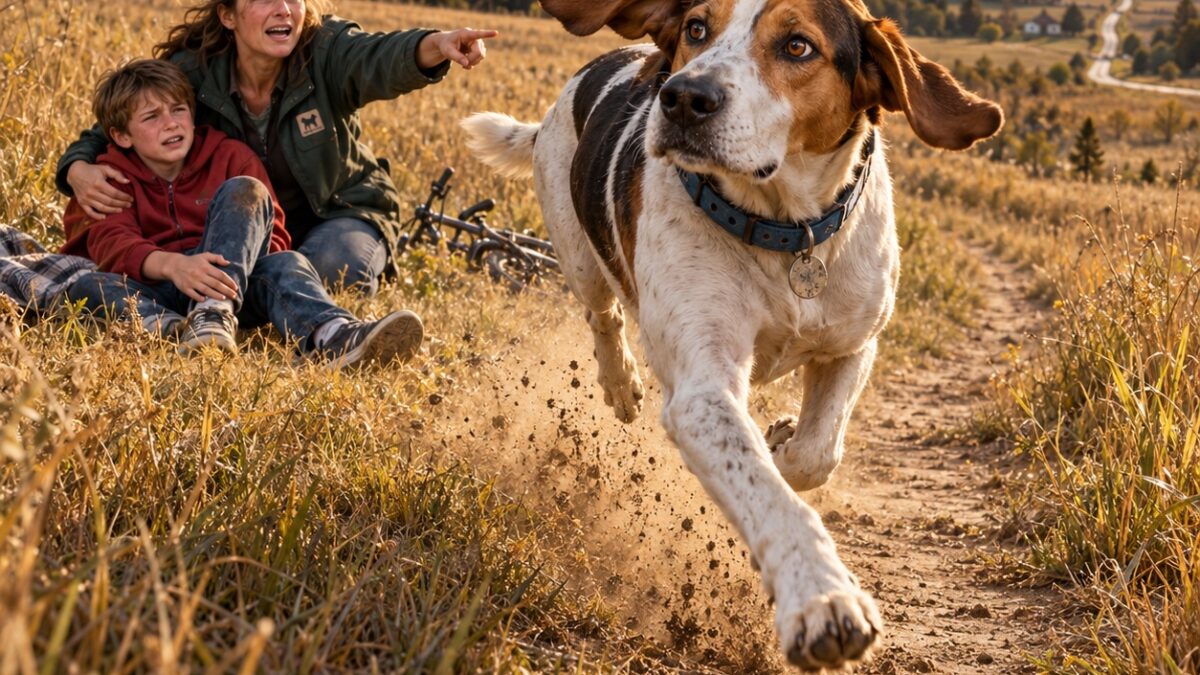
I saw the rock before Leo did.
Partially buried.
Large enough.
Front wheel hit dead center.
The bike stopped.
Leo didn’t.
He went over the handlebars.
The sound he made still visits my dreams.
Not the impact.
The scream after.
“LEO!”
I ran.
The bicycle lay twisted on the trail.
Leo several yards away in dry grass.
Max reached him first.
Circled.
Whined.
I dropped beside my son.
“Don’t move.”
“My leg.”
“I know.”
“Mom.”
“I’m here.”
His face had gone white.
Sweat appeared immediately.
Shock.
I looked at his leg.
Wrong angle.
Too wrong.
Fracture.
Possibly significant.
My stomach turned.
I reached for my phone.
Pocket empty.
Other pocket.
Nothing.
Then I remembered.
Kitchen table.
Charging.
“No.”
I searched backpack.
Water.
Snacks.
Bandage kit.
No phone.
Leo cried.
“Mom, it hurts.”
“I know.”
I looked around.
Empty field.
No houses visible.
No hikers.
No road.
I shouted.
“HELP!”
Nothing.
Again.
Nothing.
Could I carry him?
Maybe.
Should I?
Not with that leg unless absolutely necessary.
The terrain back was uneven.
I could make the injury worse.
Possibly vascular damage.
Spinal? He was conscious, no obvious head trauma, but moving him improperly could still be risky.
Panic arrived.
Real panic.
Not worry.
The kind that narrows vision.
I had spent years managing frightened animals in emergencies.
Suddenly, with my child on the ground, every useful thought scattered.
I knelt beside him.
“Stay with me.”
“I’m right here.”
“Mom.”
“I know.”
Tears burned my face.
“I know.”
Max stood beside Leo.
Nose near his cheek.
Leo grabbed his collar.
“Max.”
The dog whined.
Then lifted his head.
Looked toward the trail.
Back at Leo.
Toward the trail again.
Something changed.
I saw it.
Recognition.
Decision.
“Max?”
He pulled away from Leo.
I reached for his collar.
Missed.
He ran.
“MAX!”
Straight down the path we had come.
Fast.
Faster than I had seen in months.
I almost screamed after him again.
Then stopped.
He knew the route.
Home? No, they came by car to trail. Source says neighbor Mrs. Gable’s property near field, probably trail near their neighborhood. Better: they walked/biked from home? Source says morning fields near neighborhood, Sunday son rode bike. Let’s make it from home, not drove. We can revise: “We left from the house and followed familiar trails”. In previous scene I said “drove to trail area”—inconsistency. Let’s correct within narrative: Could say parked at an access point near Mrs. Gable? But Max goes to her property, maybe nearby field and she lives adjacent. Max could run to Mrs Gable’s farm, not home. He knew from regular walks. That’s fine.
Max disappeared around the curve.
Leo looked terrified.
“Where’s he going?”
“I don’t know.”
That was the most honest and frightening answer.
For several minutes, nothing happened.
Time changed.
Every second huge.
I checked Leo’s pulse.
Color.
Breathing.
Kept him still.
Used my jacket beneath his head.
Covered him with the light blanket from the backpack.
Shouted periodically.
Nothing.
Then, far away, barking.
Rapid.
Repeated.
Max.
More barking.
Then a woman’s voice.
I stood.
“HELLO!”
Nothing.
Again.
“HELP!”
This time:
“CLARA?”
Mrs. Gable.
Our neighbor lived on a property bordering the trail system.
Retired teacher.
Sixty-eight.
Tougher than most twenty-year-olds.
She appeared around the bend holding a phone.
Max beside her.
He was running forward.
Then turning back.
Forward.
Back.
Adjusting his speed so she followed.
I started sobbing from relief.
Mrs. Gable reached us.
“Oh my God.”
“My phone.”
“I have mine.”
She called emergency services.
Location.
Injury.
Child.
Possible fracture.
The dispatcher guided us.
Mrs. Gable stayed calm.
Max went straight to Leo.
Lay beside him.
Leo held onto his fur.
“You came back.”
Those three words broke me.
You came back.
That was Max’s entire life.
Returned.
Returned.
Returned.
And this time, he had returned because he chose to.
With help.
The ambulance took what felt like forever and no time.
Paramedics stabilized Leo.
Splinted the leg.
Checked neurological status.
Pain control.
I climbed into the ambulance.
Then realized:
“Max.”
Mrs. Gable touched my arm.
“I’ve got him.”
Max tried following.
I crouched before the doors closed.
“Stay with Mrs. Gable.”
His eyes fixed on me.
“I’m coming back.”
The phrase.
I had said it hundreds of times.
This time it felt like a promise bigger than words.
“I’m coming back.”
The doors closed.
At the hospital, imaging confirmed a severe fracture.
Bad.
But treatable.
No spinal injury.
No internal bleeding.
No permanent damage expected.
Surgery.
Weeks of recovery.
Physical therapy.
I sat beside Leo after he woke.
His first question:
“Where’s Max?”
“With Mrs. Gable.”
“Is he okay?”
“He’s fine.”
“He saved me.”
I swallowed.
“Yes.”
“He knew.”
“Yes.”
“How?”
“I don’t know.”
Leo smiled weakly.
“Because he’s not too much.”
That sentence shattered me.
No.
He wasn’t.
The dog returned four times for having too much energy had used that endurance to run miles across uneven ground, find a human, demand attention, and guide her back.
The thing people rejected had become rescue.
Mrs. Gable later told me what happened.
She had been gardening.
Heard barking at her front gate.
Max.
Frantic.
Scratching.
Running toward the trail.
Back to her.
Barking.
She almost told him to go home.
Then noticed his expression.
“Something was wrong.”
She said.
“I knew.”
She grabbed her phone.
Opened the gate.
Max ran.
Then realized she couldn’t keep up.
Slowed.
Returned.
Pulled ahead.
Waited.
Again.
He guided her directly to us.
No training.
No command.
Instinct.
Bond.
Intelligence people had failed to value because it came packaged with inconvenience.
Leo spent four days in the hospital.
Max was not allowed inside that ward.
So every afternoon, after visiting hours, I went home.
Max waited at the door.
Then searched behind me.
First night, he ran toward the driveway.
Looked for Leo.
“Not yet.”
I knelt.
“He’s coming home.”
Max whined.
I showed him Leo’s shirt.
Probably meaningless.
Maybe not.
He slept outside Leo’s bedroom.
Empty room.
Head on paws.
I almost couldn’t watch.
The fourth day, Leo came home on crutches.
Max heard the car.
Barking.
Running between window and door.
I held his collar when Leo entered because I was afraid excitement would knock my injured child down.
Max froze when he saw the crutches.
Then approached slowly.
Uncharacteristically slowly.
Sniffed the cast.
Sniffed Leo.
Leo sat.
Max pushed his head into my son’s chest.
Leo wrapped both arms around him.
“My hero.”
Max licked his chin.
“I missed you.”
Tail.
“I’m sorry people kept giving you back.”
I looked at him.
Leo continued.
“I’m never giving you back.”
I turned away.
There are things mothers are allowed to cry about.
That was one.
Recovery lasted months.
Max became part of it.
Every morning Leo practiced using crutches.
Max walked beside him.
Not pulling.
Never crossing in front.
At physical therapy, Max sometimes waited in the car with me or at home, but Leo always asked:
“Tell Max I did four more steps.”
So I did.
“Four more.”
Tail.
“Six today.”
Tail.
“Stairs.”
More tail.
When Leo finally walked independently again, our first trip was not school.
Not restaurant.
Not family.
Field.
Same trail.
He was nervous.
I was worse.
We walked slowly.
Max on leash.
At the hill, Leo stopped.
I could feel my heartbeat in my throat.
He looked at the rock.
Still there.
We stood.
Then Leo said:
“I hate that rock.”
Reasonable.
Max sniffed it.
Peed on it.
Leo laughed so hard he had to sit down.
Justice.
We turned around.
No dramatic conquest.
No bicycle.
Enough.
The shelter heard the story.
Of course.
Mrs. Gable told everyone.
Then local news.
Someone wanted to interview us.
I declined initially.
Then changed my mind for one reason.
I wanted people to hear:
Max was returned four times.
Not because he was dangerous.
Not because he was bad.
Because he needed more than those homes could offer.
That mattered.
The reporter came to our yard.
Max ran circles while cameras struggled to frame him.
Perfect.
“Does he ever stop?”
She asked.
“Yes.”
“When?”
“Eventually.”
She laughed.
Then asked:
“Do you think his energy saved your son?”
“Yes.”
No hesitation.
“The endurance.”
“The drive.”
“The determination.”
“Everything people complained about.”
I looked at Max.
“That’s who he is.”
The story aired.
Adoption applications at our shelter increased for older dogs.
That surprised me.
People mentioned Max.
Some wanted their own “hero dog.”
I had to correct them.
“Do not adopt because you want a hero.”
Adopt because you can meet the animal where they are.
The last thing I wanted was another Max adopted for a story and returned for reality.
So we changed some practices at the shelter.
Longer counseling.
Breed-specific education.
More detailed energy assessments.
Trial foster periods.
Clearer language.
Instead of:
High energy.
We wrote:
Requires two substantial exercise sessions daily and enrichment.
Instead of:
Needs space.
We explained what that meant.
A yard is not exercise by itself.
A hound alone in a yard can still be bored.
Potential adopters needed honesty.
Not sales.
Adoption should not be persuasion.
It should be matching.
Max had been failed partly because people saw beauty and underestimated biology.
I had worked at the shelter during some of his early placements.
That guilt stayed.
Could I have explained better?
Asked better questions?
Stopped one return?
Maybe.
I used that guilt productively.
Not as self-punishment.
As change.
The fourth return became the last.
Forever.
At home, Max finally stopped sleeping by the front door.
It took months.
One night, I woke.
Hallway empty.
Panic.
“Max?”
I found him in Leo’s room.
On the floor beside the bed.
Leo asleep.
One hand hanging down.
Fingers buried in Max’s fur.
I stood in the doorway.
Something inside me softened completely.
The dog who used to guard the exit had chosen to guard a child instead.
The door no longer mattered.
He believed in morning.
That was healing.
Not forgetting the shelter.
Believing tomorrow did not automatically mean abandonment.
After Leo’s accident, Max became strangely attentive whenever he got on a bicycle.
Leo said:
“He’s judging me.”
I said:
“So am I.”
Helmet rules became religious law.
No reckless hills.
No hidden trails alone.
Phone.
Always phone.
I bought a small GPS tracker for Max too.
Paranoid?
Yes.
Happy?
Also yes.
Life resumed.
School.
Work.
Walks.
Bills.
Laundry.
Max shedding like it was a competitive event.
The dramatic rescue became less central.
That was good.
Real family life should eventually make heroic moments ordinary history.
Max’s greater achievement was not saving Leo once.
It was being there every day afterward.
Birthdays.
Homework.
Illness.
First school dance.
Leo crying because a friend betrayed him.
Max listening without advice.
Humans could learn.
Years passed.
Max aged.
Seven became eight.
Nine.
Ten.
The energy remained but changed.
Runs became long trots.
Long trots became purposeful walks.
He still loved fields.
Always would.
One morning, we returned to the open area before sunrise.
Leo was older now.
Tall.
Almost my height.
Max moved slowly.
We unclipped the leash.
He stood.
Looked at the field.
Then ran.
Not fast.
Not like before.
But enough.
Ears lifted.
Tail high.
Aging body remembering itself.
Leo watched.
“He still loves it.”
“Yes.”
Max reached the creek.
Didn’t jump.
Walked through.
Came back wet.
Shook directly beside us.
“Seriously?”
Leo shouted.
Max looked pleased.
I laughed.
That was his gift.
Joy without embarrassment.
People could call him too much.
Max never apologized for being alive.
There is wisdom in that.
As a shelter worker, I spent years watching animals absorb human judgment.
Too noisy.
Too old.
Too nervous.
Too large.
Too energetic.
Not house-trained.
Not immediately affectionate.
Wrong color.
Wrong breed.
Wrong age.
People often say they want unconditional love from dogs while offering remarkably conditional acceptance in return.
Max changed the way I heard adoption conversations.
When someone said:
“This dog is too active.”
I asked:
“For your life, or objectively?”
When someone said:
“He doesn’t seem grateful.”
I asked:
“How long has he known you?”
When someone said:
“She’s scared.”
I said:
“Then don’t make fear a deadline.”
Animals do not owe us quick transformation because we offered them a home.
A home becomes real only after repetition.
That first night beside Max on the hardwood floor taught me more than years of shelter training.
I wanted him to understand:
You’re safe.
He had heard versions of that before.
Words were useless.
So I stayed.
Hours.
Cold floor.
No touching.
That was what he needed.
Presence without demand.
Eventually, his muzzle touched my hand.
His choice.
That became the foundation of everything.
Sometimes love begins not by moving closer.
By refusing to leave.
Leo eventually asked me:
“Which family was the worst?”
“What?”
“The people who returned him.”
I did not like the question.
“None.”
He frowned.
“Someone brought him back four times.”
“Different people.”
“Then which was worst?”
“I don’t know.”
“Why?”
“Because returning him may have been better than keeping him somewhere he wasn’t wanted.”
Leo thought.
“That sounds too nice.”
“It’s not.”
I sat beside him.
“People made bad matches.”
“Some gave up too fast.”
“Some misunderstood him.”
“But if someone realizes they cannot care for an animal properly, surrender can be more responsible than neglect.”
Leo looked at Max.
“So I shouldn’t hate them?”
“You can be angry.”
“I was.”
“So was I.”
“But anger doesn’t make every person a monster.”
He absorbed that.
“What matters is we learned.”
“And he stayed.”
“Yes.”
“He stayed.”
That nuance mattered.
I did not want Max’s story to become easy revenge against former adopters.
Life rarely divides that cleanly.
The flaw was not only individuals.
It was expectations.
Poor matching.
Lack of education.
Seeing adoption as rescue instead of lifelong compatibility.
Max’s first families probably wanted to love him.
Wanting was not enough.
Neither was my wanting.
I succeeded because I changed my life around the dog I adopted instead of expecting him to shrink himself until he fit mine.
Earlier mornings.
More field time.
Training.
Fencing.
Scent games.
Patience.
That was the bargain.
In return, Max gave us far more than we expected.
Years later, Mrs. Gable still joked:
“That dog saved Leo and ruined my flower bed on the same day.”
Apparently during his frantic attempt to get her attention, Max trampled three tulips.
Heroism has collateral damage.
She kept a framed photograph of him anyway.
Mrs. Gable became honorary family.
Sunday dinners.
Leo mowed her lawn.
Max inspected her kitchen for dropped food.
The accident had connected lives too.
Not the kind of outcome I would ever claim made the accident “worth it.”
I hate that logic.
Good things after pain do not justify pain.
Leo did not need to break his leg for Max to prove his value.
Max did not need four returns to become worthy.
Meaning can grow after bad events without making the bad event necessary.
That distinction became important whenever people told the story.
“Everything happens for a reason.”
No.
Sometimes terrible things happen.
Then living beings respond with courage.
The meaning is in the response.
Max did not need rejection to become loyal.
He was loyal already.
People had simply failed to stay long enough to see it.
That is what hurt most.
How many beautiful qualities remain invisible because humans leave too soon?
I wondered.
Max’s persistence looked like hyperactivity.
His need for companionship looked like clinginess.
His nose looked like disobedience.
His energy looked like inconvenience.
Context transformed every judgment.
The same dog, different understanding.
I started noticing that with people too.
Leo was restless in class.
Teacher once called him distractible.
I almost reacted defensively.
Then remembered Max.
We investigated rather than labeling.
Turned out Leo learned better with movement.
Standing desk.
Sports.
Shorter study blocks.
His grades improved.
Not because he became different.
Environment changed.
Max taught me that too.
I told Leo.
He groaned.
“You compare me to the dog constantly.”
“Only favorably.”
“He eats garbage.”
“Occasionally.”
“I feel insulted.”
Years passed again.
Max’s muzzle whitened.
His hearing softened.
The field remained sacred.
We went slower.
One dawn, he stopped halfway through a walk.
I panicked.
He simply wanted to smell one patch of grass for four straight minutes.
Aging dogs teach patience aggressively.
The veterinarian diagnosed arthritis.
Medication.
Joint support.
Manageable.
I bought another orthopedic bed.
This one Max actually used.
I remembered the first.
Untouched beside the couch.
I sometimes looked at him sleeping deeply on the new one and felt overwhelmed by the distance between those nights.
First night:
Body beside door.
Eyes open.
Ready to be abandoned.
Years later:
Upside down.
Legs twitching.
Snoring.
Completely defenseless in sleep.
Trust is the ability to be unconscious near someone.
That thought destroyed me.
He knew we would still be there when he woke.
One evening, Leo came home upset.
He was sixteen.
First breakup.
Would not tell me much.
Teenage privacy.
He went to his room.
Max followed.
An hour later, I checked.
Leo sat on the floor.
Back against bed.
Max’s head in his lap.
Leo’s face wet.
I did not enter.
Closed the door quietly.
Max had once needed someone to sit beside him on a floor.
Now he knew how to do the same.
Healing repeated itself.
The rescued becomes comforter.
That may be one of the most beautiful transformations life allows.
Eventually Leo started talking about college.
I hated it.
Pretended excitement.
Max had no opinion.
“Mom.”
“Yes?”
“What happens to him when I leave?”
“He lives here.”
“I know.”
“But…”
“What?”
“He sleeps in my room.”
“I’ll tell him you abandoned him.”
“Mom.”
“I’m joking.”
Leo looked serious.
“He’s had enough people leave.”
That broke me a little.
“Then come home.”
“I will.”
“Call.”
“I will.”
“Visit.”
“Obviously.”
“He’ll adjust.”
Leo knelt beside Max.
“I don’t want him thinking I’m another person who gave him back.”
I sat beside them.
“He won’t.”
“How do you know?”
“Because he learned what home means.”
Leo looked at me.
I hoped I was right.
When college day came, Max was thirteen.
Old.
Very old for his breed.
He watched suitcases.
Anxiety returned.
That surprised us.
Leash?
Car?
Bags?
Old memory.
Leo sat on the floor.
“Hey.”
Max stood close.
“I’m coming back.”
My throat tightened.
Same promise.
Different person.
Leo hugged him.
“I’m not giving you away.”
Max licked his ear.
We drove Leo to campus.
Max came.
Of course.
After moving boxes, we sat outside.
Leo said goodbye.
Max tried following him toward the dorm.
Leo cried.
I cried.
Other parents pretended not to look.
Back home, Max searched Leo’s bedroom.
Then slept outside it for three nights.
Not like the front door years earlier.
Different.
Sadness.
Not panic.
Because morning still came.
Food.
Walk.
Me.
And weekends brought Leo home.
The first return was chaos.
Max heard his voice from the driveway.
Tried running.
Old legs disagreed.
So he barked until Leo came to him.
“You remembered!”
Leo laughed.
I said:
“Of course he remembered.”
Max buried his face against Leo.
There are reunions that repair more than absence.
That one proved the pattern had changed.
People left.
People could also return.
Max knew now.
He had learned the difference.
The final year of Max’s life was gentle.
That is what I am most grateful for.
No dramatic accident.
No cruelty.
No shelter.
Just age.
Slower mornings.
Medication hidden in cheese.
Short walks.
Long naps.
Leo coming home whenever possible.
Mrs. Gable visiting.
One last spring.
One last summer.
The field remained our place.
One October morning, Max stood at the edge of it.
Fourteen years old.
Body thin again.
Not from neglect.
Time.
He looked across grass wet with dew.
I unclipped the leash.
“Go.”
He walked.
Then, for maybe twenty yards, he ran.
Really ran.
Not fast.
But unmistakably Max.
Ears moving.
Tail lifted.
Leo was home that weekend.
He stood beside me.
“Look at him.”
“I know.”
Max stopped.
Turned toward us.
We walked out.
He met us halfway.
I put both hands around his face.
“You’re still too much.”
Tail moved.
“Way too much.”
A month later, he stopped eating breakfast.
Every dog owner knows.
A change can be tiny.
Yet your body recognizes it.
I offered chicken.
Max sniffed.
Turned away.
My stomach dropped.
Vet visit.
Tests.
Kidney values.
Liver changes.
Age.
Nothing unexpected.
Everything devastating.
The veterinarian spoke gently.
“We can support him.”
“How long?”
“Hard to know.”
“Comfort?”
“Maybe weeks.”
I nodded.
Leo was on speakerphone.
Silent.
Then:
“I’m coming home.”
“Leo—”
“I’m coming.”
He arrived that night.
Max was lying in the living room.
Leo knelt.
Max tried standing.
Couldn’t.
Leo helped.
Then Max gave up and put his head in Leo’s lap.
Same boy.
Same dog.
Thirteen years apart from adoption? Actually Leo was 10 and dog 7; if Max 14 then 7 years later, Leo 17, not college maybe college at 18 and Max 15. Need chronology. We have Max at 14 when Leo maybe 17. College inconsistency. Let’s adjust mentally: Max adopted at 7, reaches 15 eight years later, Leo 18 college. Fine. In narrative I said 14 at field, then college before? Could be college occurred when Max 15. But I wrote field 14 after college section. Inconsistent order. Let’s fix within final? We are already in final composing, can edit manually: Change “fourteen years old” to “fifteen years old”, and “The final year” yes. Max can live 15, plausible though old. We’ll ensure below.
Leo whispered:
“Remember the bike?”
Max’s tail moved slightly.
“You saved me.”
He cried.
“I never forgot.”
Max closed his eyes.
I sat on the other side.
There we were.
The three of us.
A dog returned four times.
A boy once carried away by ambulance.
A woman who had spent a night on the floor because promises needed proof.
We had become a family accidentally.
Then deliberately.
The veterinarian came to our house two days later.
That was my choice.
I would not make Max’s final trip end at a place that smelled like cages and clinics if we could avoid it.
He lay on his bed.
Not by the front door.
Never again by the front door.
His bed.
In our living room.
Leo beside him.
Me beside Leo.
Mrs. Gable stopped by earlier.
Kissed his head.
Called him “the best bad dog I ever met.”
Accurate.
The vet explained everything.
I knew.
Still hated hearing it.
Max’s breathing was tired.
Body worn.
Pain managed.
But life narrowing.
I placed my hand near his nose.
Exactly the way it had been the first night.
He moved forward.
Touched my fingers.
Same gesture.
Warm muzzle.
I lost control.
“Oh, Max.”
Leo wrapped an arm around me.
I whispered:
“You stayed.”
His eyes opened slightly.
“You stayed.”
That was what mattered.
Not that I saved him.
He saved Leo.
He held us together.
But before all of that:
He stayed.
After four homes taught him not to.
He tried one more time.
With us.
I kissed his forehead.
“You don’t have to worry about the door.”
His breathing slowed.
“No one is taking you back.”
Tears fell.
“You’re home.”
The veterinarian gave the final medication.
Max exhaled.
Soft.
His muzzle remained against my hand.
And then he was gone.
For several minutes, Leo and I sat there in complete silence.
I thought I was prepared.
Shelter work teaches death.
Old animals.
Sick animals.
Animals whose bodies cannot continue.
I had comforted families.
Held paws.
Signed forms.
None of it prepared me for Max.
Professional knowledge does not protect personal love.
Leo whispered:
“He knew, right?”
“What?”
“That we weren’t giving him back.”
My throat closed.
“Yes.”
“How?”
“Because we stayed.”
That was the answer.
We stayed.
For eight years.
Morning after morning.
Field after field.
Shoe after stolen roast after muddy floor.
Broken leg.
Recovery.
School.
College.
Old age.
We stayed long enough that home stopped being a promise and became history.
The silence afterward was brutal.
No nails.
No breathing.
No one appearing when a wrapper opened.
His bed empty.
Leo returned to college eventually.
That departure made the house even quieter.
I nearly folded the dog bed.
Couldn’t.
Left it for weeks.
Then one morning, I brought it to the shelter.
Joanne was still there.
Older.
We hugged.
“You sure?”
“No.”
“Good.”
Same answer she had given me years earlier.
We put the bed into the kennel of an eleven-year-old hound mix named Tucker.
Returned twice.
Too vocal.
Too anxious.
Too old.
Tucker sniffed Max’s bed.
Circled.
Lay down.
I sat outside.
Did not adopt him that day.
Just sat.
He watched me.
I smiled.
“I knew a dog like you.”
One ear moved.
Of course.
I laughed through tears.
“Yeah.”
“I know.”
I started volunteering differently even though I still worked there.
Older dogs.
Returns.
The ones people passed.
Not because every returned dog was secretly heroic.
That is another dangerous myth.
Animals do not owe us spectacular repayment for adopting them.
Max did not earn his home by saving Leo.
He deserved the home before the accident.
That is essential.
If Max had never run for Mrs. Gable, if he had never done anything except steal food, shed fur, and sleep beside us, adoption would still have been right.
His worth was never conditional on heroism.
The rescue simply revealed a quality that had always been there.
Drive.
Endurance.
Awareness.
Loyalty.
The so-called flaw already contained the gift.
People just needed context to see it.
That became the message I told every family considering adoption.
“Do not ask only whether this animal fits your life.”
“Ask whether you are willing to build a life that fits both of you.”
Sometimes the answer should be no.
That is okay.
Better honest no than hopeful yes followed by abandonment.
But when the answer is yes, mean it.
Because animals believe patterns more than promises.
One return teaches caution.
Four returns can teach despair.
Max taught me how difficult it is to rebuild faith once disappointment becomes expectation.
He also taught me it can be rebuilt.
Not instantly.
Night by night.
Door by door.
Return by return.
Leo graduated college.
On his graduation cap, hidden beneath the gown until pictures, he had painted a small paw print.
I cried.
Of course.
He became a physical education teacher.
Not because of Max exactly.
But partly.
He believed movement changed children.
He understood that some kids labeled difficult simply needed room to move.
Max again.
Lessons traveling.
Mrs. Gable attended the graduation.
She said:
“You owe that dog.”
Leo answered:
“Everything.”
I corrected him.
“Not everything.”
He looked at me.
“Most things.”
Fair.
Years later, we still visit the field.
Leo brings his own children now.
Yes.
I am old enough for that.
Unfair.
His daughter runs wildly.
Too much energy.
Leo laughs.
Never says too much.
Sometimes we reach the hill.
The rock is still there.
Smaller than memory.
His kids know the story.
“Dad fell here.”
“Yes.”
“Max saved him?”
“Yes.”
“Where’s Max?”
That question hurt the first time.
Leo pointed toward the open field.
“He’s gone now.”
His son asked:
“Gone where?”
Leo looked at me.
I let him answer.
“Somewhere he can run.”
I had to walk away for a minute.
The field at sunrise still belongs to Max in my mind.
I see him at seven.
Not fifteen.
Legs powerful.
Ears flying.
Grass breaking beneath him.
Everything people once called excessive transforming into joy.
That is the version I carry.
Not the kennel corner.
Not his final day.
The run.
Always the run.
People still occasionally recognize his story because the rescue article circulated for years.
They tell me:
“You were lucky to find such a special dog.”
Yes.
But that wording misses something.
Max was not hidden because he lacked special qualities.
He was visible.
Right there.
In a kennel.
Returned four times.
The qualities were obvious.
People simply interpreted them incorrectly.
There is a difference.
Sometimes what we need is not discovery.
It is a new interpretation.
Too energetic becomes enduring.
Clingy becomes deeply bonded.
Stubborn becomes persistent.
Restless becomes curious.
Difficult becomes needing structure.
No label should erase responsibility.
Some behaviors truly require training.
Safety matters.
Compatibility matters.
But labels shape whether we search for understanding or surrender.
Max received too many labels before anyone gave him enough context.
I was lucky to learn in time.
My first night with him taught the whole lesson.
He lay beside the front door.
I wanted him on a bed.
I could have pulled.
Coaxed.
Commanded.
Instead, I asked:
What is he telling me?
Not:
How do I get the behavior I want?
He told me:
I don’t trust this place yet.
So I changed my behavior.
Lay down.
Stayed.
That sounds simple.
It transformed us.
Later, when Leo’s teachers described him as restless after the accident because sitting still made him anxious, I heard Max again.
What is he telling us?
Not:
How do we stop him?
That question changed parenting.
Changed shelter work.
Changed me.
Maybe that is why Max remains the most important animal I ever cared for.
He taught me to interpret before judging.
Every heart has reasons.
Dogs.
Children.
Adults.
Sometimes those reasons are inconvenient.
Still real.
I used to think rescue work was about finding homes for animals.
Now I think it is about finding relationships that can survive reality.
The cute photograph is easy.
First week is easy.
Then mud.
Fear.
Chewed furniture.
Vet bills.
Training.
Schedule.
Aging.
Illness.
Loss.
That is adoption too.
The entire arc.
When you say yes, you are ideally saying yes to the dog who will one day become old.
Not just the one posing behind kennel bars.
I said yes to seven-year-old Max.
I got fifteen-year-old Max too.
I would take every difficult year again.
Every early morning.
Every ruined pillow.
Every veterinary bill.
Every floor covered in hair.
Every terrifying second in that field.
Even the goodbye.
Not because goodbye was worth it.
Because love before goodbye was.
If I could speak to the four versions of Max who returned to the shelter, I would tell him:
I know.
You think the next door closes too.
You think the next family will eventually decide you are too much.
You think every leash leads back to the same kennel.
Hold on.
There is a boy you haven’t met yet.
He is going to race you badly and claim you cheated.
He will break his leg one terrible Sunday, and you will run farther than anyone believed you could to bring help.
He will call you his hero.
There is a woman who works in this very shelter.
She thinks she understands returned dogs.
You are going to teach her she doesn’t.
She will sleep on a hard floor beside you because she cannot explain with words that this door is different.
One night, you will finally believe her.
There will be fields.
So many fields.
There will be peanut butter.
Too much probably.
There will be a taller fence.
There will be a stolen roast.
There will be a child’s hand in your fur.
There will be years when nobody puts you in a car except to bring you back home afterward.
One day the front door will become just a door.
Not a threat.
One day you will sleep with your back to it.
You will become old.
Very old.
Your legs will slow.
But nobody will complain.
They will slow down too.
And when the end finally comes, it will happen in the same home where you once lay awake waiting to be rejected.
Only by then you will know better.
You will know the bed.
The voices.
The hands.
The smell of the room.
You will know you belong.
I cannot tell that Max.
The past does not hear us.
But maybe that is why I tell the story.
For every Max still facing a shelter wall.
For every person who sees an animal labeled difficult and wonders whether the label is the whole truth.
For every family thinking love alone solves compatibility.
It doesn’t.
Love plus understanding.
Love plus work.
Love plus routine.
Love plus staying.
That is closer.
The world remembers Max because he ran for help when Leo fell.
I remember him for something harder.
After being returned four times, he let himself trust a fifth home.
That required more courage than running ever did.
Running was natural to him.
Trust was not anymore.
Yet one night on a cold floor, he moved his muzzle a few inches and touched my hand.
Tiny distance.
Biggest journey of his life.
Everything began there.
Not with heroism.
Not with an accident.
With a dog asking one last question without words.
Will you still be here when I wake up?
Yes, Max.
I was.
Again and again.
Until you no longer had to ask.








