FULL STORY:The Dishwasher Who Fed a Hungry Stranger Was the Only Person Left Who Still Understood the Restaurant’s Forgotten Rule
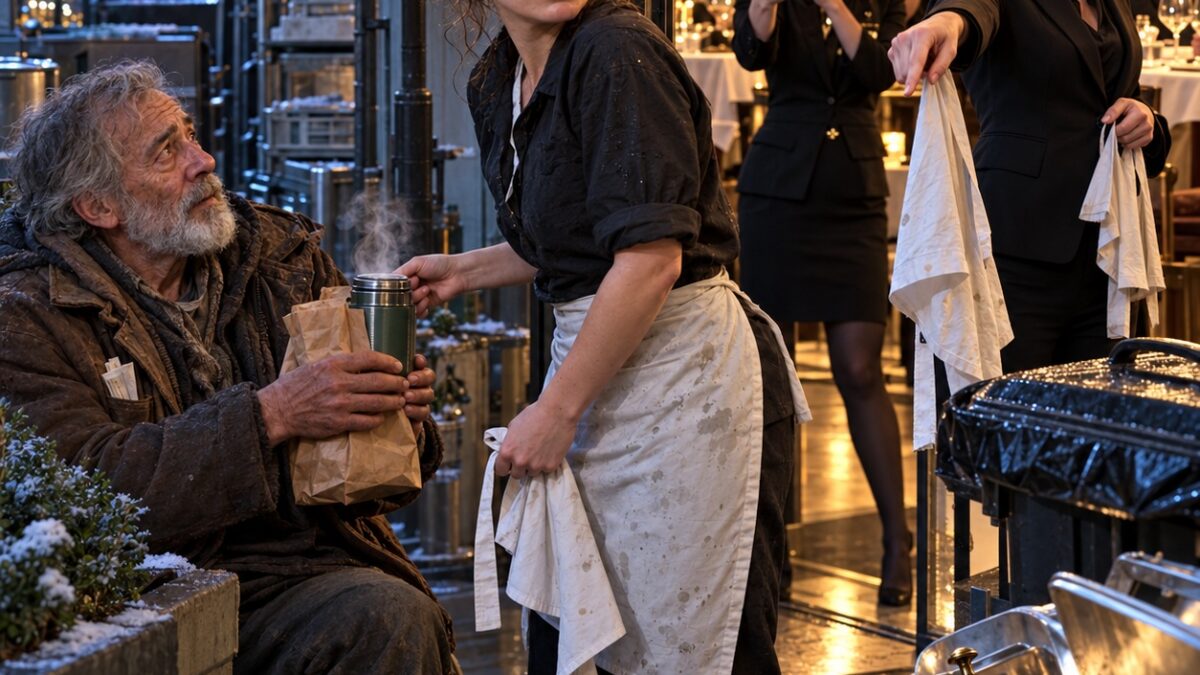
FULL STORY CONTINUATION
“Turn that off.”
Chloe lowered the phone slightly.
“Relax.”
“Delete it.”
Vanessa laughed.
“Why? Embarrassed?”
I looked at her.
“No.”
My voice shook anyway.
I was embarrassed.
Not about feeding Sam.
About needing this job badly enough that Vanessa knew she could humiliate me.
There is a particular kind of power people hold when they know you cannot afford consequences.
Vanessa had always understood that.
If a server objected to an unfair schedule, she reminded them there were twenty applicants waiting.
If a dishwasher complained about staying past midnight, she mentioned overtime had not been authorized.
If someone was sick, Vanessa asked whether they were sick enough to miss rent.
She never needed to threaten anyone directly.
Poverty supplied the threat for her.
I untied my apron.
Placed it in her hand.
“I hope that was worth it.”
Vanessa smirked.
“Tomorrow we’ll hire another dishwasher.”
I walked toward the employee exit.
Sam was waiting near the alley.
“I’m sorry.”
“No.”
“This happened because of me.”
“This happened because Vanessa was looking for a reason.”
“Where will you go?”
“Home.”
I forced a smile.
“My mom’s soup fixes everything.”
He almost smiled back.
Then I saw something beside the dumpster.
A brass bell.
Old.
Heavy.
Dark with age.
Someone had thrown it on top of a broken shelf and two cracked serving trays.
I picked it up.
Sam went still.
“What?”
“Nothing.”
I rubbed dirt from the metal.
A small letter had been carved into the side.
W.
“Somebody threw away a perfectly good bell.”
Sam stared at it.
For a moment, the exhaustion disappeared from his face.
Something else replaced it.
Recognition.
Pain.
But when I looked up, he had hidden it.
“You taking souvenirs?”
He asked.
“Apparently.”
I tucked it into my bag.
“I’ll find somewhere useful for it.”
Sam swallowed.
“I think you should.”
That was the first lie between us.
Not mine.
His.
I didn’t know it yet.
I went home.
Mom knew immediately.
I came through the door at six-thirty instead of midnight.
She was sitting at the kitchen table rubbing one knee.
“You’re early.”
“Dishes ran away.”
She narrowed her eyes.
“Lily Bell.”
I had inherited my terrible ability to lie from someone other than my mother.
“I got fired.”
Her face changed.
“For what?”
“I gave somebody my lunch.”
Mom stared at me.
“That’s it?”
“Pretty much.”
“Was he hungry?”
“Yes.”
“How hungry?”
“He said two days.”
Mom leaned back.
“Then I raised you right.”
I laughed.
Then cried.
That was unfair.
I had been holding everything together until she said exactly the right thing.
Mom opened her arms.
I knelt beside her chair.
“The rent.”
“We’ll figure it out.”
“Your knees.”
“They survived you learning to drive.”
“This is serious.”
“So am I.”
She squeezed my shoulder.
“What’s in the bag?”
I showed her the bell.
“Found it in the trash.”
She turned it over.
“Who throws away a bell?”
“The same people who throw away people.”
Mom looked at me.
“You’re angry.”
“Yes.”
“Good.”
“What?”
“Anger isn’t always bad.”
She tapped my chest.
“Just don’t cook with too much of it.”
I laughed through tears.
Then my phone buzzed.
Twenty-seven messages.
Then forty.
Then sixty-three.
Chloe had posted the video.
DISHWASHER FEEDS BUM ON COMPANY TIME.
The clip showed Sam asking for bread.
Vanessa rejecting him.
Me slipping outside.
Then Vanessa firing me.
Editing transformed cruelty into comedy.
Laughter.
Captions.
Zoomed reaction shots.
By midnight, the video had ten thousand views.
The next morning, fifty thousand.
By lunch, two hundred thousand.
Some people defended me.
Others didn’t.
“Rules are rules.”
“She stole company food.”
“She looks unstable.”
“Maybe the homeless guy is her boyfriend.”
“Imagine getting fired over a sandwich.”
Mom tried reading comments.
I took the phone away.
“Don’t.”
“Somebody called you stupid.”
“Mom.”
“I’d like their address.”
“No crimes today.”
“Coward.”
The video spread.
Vanessa leaned into it.
I learned later she told staff corporate considered it “great publicity.”
Strict manager protects luxury brand.
Chloe posted another clip joking about me becoming famous.
Meanwhile, I applied for jobs.
Dishwasher.
Prep cook.
Cafeteria assistant.
Anything.
One diner manager recognized my face.
“You’re the girl from the video.”
“Yes.”
He looked uncomfortable.
“We’re not hiring.”
The HELP WANTED sign was hanging behind him.
I understood.
Mom did too when I came home.
“What if nobody hires me?”
“Then we open a soup stand on the sidewalk.”
“That’s illegal.”
“Only if they catch us.”
“Mom.”
She smiled.
Then pointed at the bell sitting on our counter.
“St. Agnes.”
“What?”
“The soup kitchen on Fifth.”
“They don’t pay.”
“No.”
“I need money.”
“Yes.”
“So why volunteer?”
Mom’s expression softened.
“When I stopped working at the school, do you know what hurt most?”
“Your knees?”
“That was second.”
“What was first?”
“Nobody needed my food.”
That silenced me.
She continued.
“You need a job.”
“Keep looking.”
“But while you look, go somewhere that remembers food is supposed to feed people.”
I stared at the bell.
“Tomorrow?”
“Tomorrow.”
St. Agnes operated from the basement of an old church.
The kitchen had one industrial stove, two ovens that disagreed about temperature, and a refrigerator that sounded like a tractor.
The woman running it was Dot Marlow.
Seventy-two.
White hair.
Reading glasses on a chain.
Voice strong enough to interrupt weather.
“You must be Lily.”
“How do you know?”
“Your mother called three times.”
“Of course she did.”
“Can you cook?”
“I make soup that makes grown men cry.”
Dot pointed at the stove.
“Then you’re hired.”
I blinked.
“For free.”
“Right.”
“That part hurts.”
“Character building.”
I set the old bell near the serving entrance.
Dot examined it.
“What’s that?”
“For anybody hungry.”
“What happens when they ring?”
“We feed them.”
She smiled.
“Well.”
She picked up a small screwdriver from a drawer.
“Let’s hang it.”
That afternoon, someone rang.
An elderly man.
No coat.
He had four dollars.
Dot refused it.
I filled a bowl.
He ate slowly.
Then another person came.
Then three.
I forgot, for several hours, that I had lost my job.
At six, I heard a familiar voice.
“I heard the soup here makes grown men cry.”
I turned.
Sam.
Same coat.
Same beard.
Maybe slightly worse.
I smiled despite myself.
“Sit.”
He did.
“Eat first.”
“You’re not going to ask where I’ve been?”
“After soup.”
“What if I refuse?”
“Then no soup.”
He surrendered.
That became the pattern.
Sam came almost every day.
At first, he ate.
Then he helped.
Badly.
He stacked bowls wrong.
Held a knife like a man who had only seen knives in decorative blocks.
Was strangely excellent at carrying heavy stockpots.
Dot adored him immediately.
“You married?”
She asked on day three.
Sam nearly inhaled bread.
“No, ma’am.”
“Lily’s single.”
“Dot.”
“What?”
“I’m helping.”
“You’re not.”
Dot looked at Sam.
“Marry her before I do.”
Sam laughed.
That laugh did something irritating to my stomach.
Over the following weeks, I learned pieces of him.
He said his father had died the previous year.
He did not say what he had done before becoming homeless.
When I asked where he slept, he said:
“Here and there.”
“That isn’t an answer.”
“Some shelters.”
“Sometimes the back room here.”
Dot allowed volunteers to sleep there on freezing nights.
I believed him.
Why wouldn’t I?
He wore the same coat.
Same boots.
Never carried more than a small backpack.
He ate like someone unfamiliar with guaranteed meals.
The one thing that didn’t fit was his hands.
Mom noticed later.
But I didn’t.
Not at first.
Sam and I cooked.
Walked home under one umbrella.
Talked on the roof of St. Agnes after closing.
He told me his father fed anyone who came to him hungry.
I told him my dream.
“Small restaurant.”
“How small?”
“Ten tables.”
“Why ten?”
“Twelve means staff.”
“Ten doesn’t?”
“In my fantasy, labor laws are flexible.”
He laughed.
“What else?”
“Warm lights.”
“Soup.”
“Bread.”
“Nobody gets asked whether they can pay before they’re allowed to sit.”
Sam looked toward the city.
“My father would’ve liked that.”
“What do you dream about?”
He took a long time.
“A kitchen where anyone hungry can eat.”
I smiled.
“We have suspiciously similar dreams.”
“Yes.”
He sounded almost sad.
I should have noticed.
Then I took him home to meet Mom.
That was where the bell changed everything.
Mom fed him too much.
Naturally.
She watched him carefully.
At one point she said:
“These aren’t the hands of a man who sleeps outside.”
I nearly died.
“Mom.”
“What?”
Sam looked down.
“They haven’t always been.”
Mom nodded.
“None of us have always been where we are.”
That was the only interrogation she gave him.
After dinner, Sam stood near the door.
Then the bell caught his eye.
He froze.
“Sam?”
He lifted it.
Turned it over.
His thumb stopped on the carved W.
“Where did you get this?”
“In the dumpster behind the Wren.”
“The day they fired me.”
His face went white.
“In the trash?”
“Yes.”
“What’s wrong?”
He looked at the bell as if it had started breathing.
“I knew a man who owned one exactly like this.”
“Who?”
“A cook.”
I smiled.
“Professional?”
“The best.”
He stared at the bell.
“He hung it outside his kitchen.”
“Anybody hungry could ring.”
“He fed them.”
“No questions.”
My chest tightened.
“That’s beautiful.”
Sam looked like he couldn’t breathe.
“What happened to him?”
“He died.”
There was something in his voice I finally understood.
“Your father?”
He looked at me.
But didn’t answer.
“I’m sorry.”
He put the bell down.
“I have to go.”
“Sam.”
He walked out.
Mom watched through the window.
“That boy is carrying something heavy.”
“I know.”
I still did not know how heavy.
Across the city, Sebastian Wren went home.
I learned that later.
Home meant a penthouse I had never seen.
A shower bigger than our kitchen.
Clean clothes waiting.
And a man named Thomas who had worked for the Wren family for thirty years.
Sebastian was not Sam.
Not legally.
His name was Sebastian Wren.
Owner of the restaurant.
Owner of twelve other properties.
He had inherited Wren Restaurant Group after his father died.
His father, Walter Wren, had founded the original Wren forty years earlier.
Walter had started as a cook.
Not a businessman.
A cook.
He had placed a bell beside the kitchen entrance when the restaurant was barely more than a neighborhood dining room.
Ring the bell if you’re hungry.
You eat.
No questions.
No bill.
When success arrived, the tradition stayed.
Until Sebastian became busy expanding the company.
Until Walter grew old.
Until Vanessa became manager.
She removed the bell.
Stopped free meals.
Margins improved.
Profits rose eight percent.
And Sebastian, grieving his father and realizing he barely knew what remained of the original restaurant, did something strange.
He disguised himself.
Old clothes.
Beard.
Sam.
He wanted to know whether Walter’s rule still existed when nobody recognized the owner.
It didn’t.
Not in the restaurant.
It existed in the dishwasher.
Me.
Thomas had apparently tried telling him to reveal himself immediately.
Sebastian refused.
“Not yet.”
He wanted to understand who people were when they believed Sam could give them nothing.
Vanessa showed him.
Chloe showed him.
I showed him something else.
The problem was that the longer he remained Sam, the less the test mattered.
Something real developed.
That was where his decision became unfair.
He kept lying.
Not about everything.
His father was dead.
True.
He felt alone.
True.
He loved soup.
Very true.
He loved spending time with me.
Also true.
But every day he allowed me to worry where he slept.
Every time I handed him food, he knew he had a home.
Every time I defended him, he knew the person I defended did not exist exactly as I understood him.
He kept intending to tell me.
There was always another moment.
Another excuse.
Then the bell appeared.
He knew time was over.
The next morning, a man in a dark suit arrived at St. Agnes.
“Miss Lily Bell?”
“Yes?”
“I have a letter for you from Wren Restaurant Group.”
I almost laughed.
“What do they want?”
“The owner would like to meet you tomorrow at ten.”
Dot whistled.
“Owners don’t send men in suits to dishwashers.”
Mom said the same thing later.
I accepted.
Not because I wanted my job back.
I wanted to tell the owner exactly what Vanessa had done.
Ten o’clock the next morning, I walked through the front doors of the Wren wearing my best blouse.
Vanessa saw me.
Her face hardened.
“What are you doing here?”
“I was invited.”
“By who?”
“The owner.”
She laughed.
Then a door opened behind her.
Sam walked out.
Except Sam was gone.
No dirty coat.
No uneven beard.
Clean-shaven.
Dark suit.
Tailored.
Hair neatly combed.
Thomas beside him.
My entire body went cold.
“Sam?”
Vanessa turned toward him.
Her face changed too.
But for a different reason.
“Mr. Wren.”
I looked between them.
No.
Thomas said:
“Everyone, this is Mr. Sebastian Wren.”
Owner.
The word moved through the dining room.
Sebastian looked directly at me.
“Lily.”
I took one step backward.
Vanessa began talking.
Fast.
“Mr. Wren, we had no idea you were visiting. If we had known—”
“I know.”
His voice was calm.
That made it worse.
He looked at Vanessa.
“Two weeks ago, a hungry man stood outside this restaurant and asked for bread.”
Vanessa froze.
“That man was—”
“Me.”
Chloe appeared near the host stand.
Her phone was not raised now.
Sebastian continued.
“Three hundred thousand people watched a video of you firing a woman for feeding me.”
“Sir, it was a misunderstanding.”
“You threw away my father’s bell.”
Vanessa’s face emptied.
“What?”
“The brass bell.”
He looked at me.
“Lily found it in your dumpster.”
Vanessa stammered.
“I—I didn’t know—”
“That is the point.”
Sebastian stepped closer.
“You didn’t know the hungry man owned the building.”
“You didn’t know the dishwasher would matter to me.”
“You didn’t know the bell belonged to my father.”
He paused.
“You should not have needed to know.”
That sentence landed.
Thomas escorted Vanessa and Chloe from the restaurant.
No screaming.
No dramatic police.
No applause.
Just consequences.
Then the room emptied.
Sebastian and I stood facing each other.
I should have felt vindicated.
Instead, I felt stupid.
Every bowl.
Every worry.
Every walk.
Every time I imagined him sleeping under a bridge.
“You lied to me.”
“I did.”
“You let me think you were homeless.”
“Yes.”
“You let me cry for you.”
His face broke.
“Lily—”
“For a man who didn’t exist.”
“He existed.”
“No.”
My voice shook.
“Sam was hungry.”
“He was.”
“Sam was alone.”
“So was I.”
“You had a penthouse.”
“I know.”
I laughed once.
It sounded ugly.
“You knew exactly how I saw you.”
“Yes.”
“And you used that.”
“I never meant to.”
“Intent doesn’t make it disappear.”
He nodded.
That made me angrier.
“Stop agreeing.”
“I don’t know what else to do.”
“Tell me why.”
He explained his father.
The bell.
The rule.
The disguise.
The restaurant.
Testing people.
At the end, he said:
“You were the only person who saw me.”
I shook my head.
“I saw Sam.”
“Yes.”
“And I liked Sam.”
His eyes met mine.
“He’s still here.”
“Not today.”
He went still.
I picked up my bag.
“I came here to tell the owner what his managers did.”
I looked at him.
“Apparently he already knew.”
Then I left.
Sebastian didn’t follow.
That mattered.
He wanted to.
Later, Thomas told me.
Sebastian started toward the door.
Thomas stopped him.
“Give her time.”
For once, Sebastian listened.
He came to our house three days later.
As himself.
No coat.
No performance.
Mom opened the door.
“You’re the billionaire.”
Apparently subtlety had left the family permanently.
“Yes, ma’am.”
“You lied to my daughter.”
“Yes.”
“Come in.”
Sebastian blinked.
“That’s it?”
“No.”
She pointed.
“Sit.”
He sat.
Mom made tea.
I almost laughed from the hallway.
Sebastian told the whole story.
Not the polished version.
The ugly version.
He had neglected his father’s restaurant while expanding.
Walter died.
Sebastian found old files.
Learned Vanessa had removed the free-meal program.
He became Sam partly from grief and partly from guilt.
He wanted to know whether his father’s values had survived.
He found the answer.
Not where he expected.
Mom listened.
Then said:
“You were wrong.”
“Yes.”
“But you loved your father.”
“Yes.”
“And you care about my daughter.”
Sebastian looked at me.
“Yes.”
Mom turned to me.
“Don’t punish him for the second because you’re angry about the first.”
“Mom.”
“I didn’t say forgive him today.”
She sipped tea.
“I said don’t confuse the two.”
Then Sebastian told me why he had invited me.
“Head chef.”
I stared.
“What?”
“I want you to run the kitchen.”
“I washed dishes.”
“You cook better than half the chefs I employ.”
“That’s not exactly reassuring.”
He almost smiled.
“I tasted your soup.”
“One soup.”
“I’ve eaten at St. Agnes for weeks.”
“That was volunteering food.”
“Exactly.”
I understood what he meant.
Cooking for hungry people had shown him more than a résumé could.
Still:
“I’ve never run a professional kitchen.”
“You can learn.”
“You would put a dishwasher in charge of the Wren?”
“I would put Lily Bell in charge.”
That distinction mattered.
But not enough.
“If I say yes, I have conditions.”
Sebastian sat straighter.
“Name them.”
“The bell goes back.”
He nodded immediately.
“Done.”
“Not decoration.”
“No.”
“It hangs beside the kitchen entrance.”
“Yes.”
“Anybody who rings gets a hot meal.”
He swallowed.
“That was my father’s rule.”
“Then it should still be his restaurant’s rule.”
“Yes.”
“No cameras.”
His face tightened.
“No publicity.”
“Yes.”
“No turning hungry people into some inspirational branding campaign about corporate generosity.”
“Yes.”
“And the staff serving them eats the same food.”
He looked surprised.
“Why?”
“Because charity shouldn’t taste like leftovers.”
He smiled.
“Yes, Chef.”
“I’m still angry at you.”
“I would be worried if you weren’t.”
I accepted.
Not because Sebastian offered enough money to make the hurt disappear.
Because the kitchen was my dream.
And because sometimes refusing an opportunity simply because the person offering it has disappointed you gives disappointment too much authority.
I became head chef at the Wren under probation.
My probation.
Not theirs.
I hired an experienced sous-chef who knew restaurant systems better than I did.
I learned food costing.
Scheduling.
Ordering.
Health inspections.
How many ways a walk-in refrigerator can ruin a Saturday.
How to manage cooks without becoming Vanessa.
That last part mattered most.
I failed sometimes.
Raised my voice once.
Apologized.
Burned an entire stock batch because I got distracted by payroll.
Mom laughed for ten minutes.
The bell went up on the first morning.
Sebastian insisted on hanging it himself.
I stood beneath it.
“Higher.”
He moved it.
“Too high.”
He lowered it.
“Left.”
“Lily.”
“What?”
“My father installed the first one in eleven minutes.”
“Your father was apparently competent.”
Thomas laughed from behind us.
Finally:
“There.”
Sebastian stepped back.
The carved W caught the kitchen light.
For a moment, nobody spoke.
Sebastian whispered:
“Welcome home, Dad.”
The first person rang it that afternoon.
A woman named Theresa.
Fifty-something.
Recently evicted.
She had seven dollars.
I refused it.
“Come in.”
She sat.
Soup.
Bread.
Chicken.
Coffee.
Sebastian watched from the kitchen door.
I pointed at him.
“Don’t stare.”
“I’m not.”
“You are.”
“I’m learning.”
“Then carry plates.”
He did.
Poorly.
But he improved.
The free-meal rule spread slowly.
We did not advertise it.
People knew.
Taxi drivers.
Shelter workers.
Church volunteers.
Police officers sometimes brought someone in after a cold night.
Anybody hungry.
Ring.
Eat.
No proof of poverty.
No humiliation.
Some people abused it.
Of course.
Human systems always include somebody testing generosity.
Sebastian once asked whether we needed rules.
“We have one.”
“What?”
“Nobody leaves hungry.”
He smiled.
“Dad’s rule.”
“Mine now too.”
My relationship with Sebastian rebuilt more slowly.
Good.
Trust repaired too fast usually means somebody skipped steps.
He stopped visiting as Sam.
That identity belonged to truth as much as deception now.
But sometimes late after service, Sebastian would come into the kitchen without a suit.
Roll up his sleeves.
Eat soup at the staff table.
We talked.
He told me about Walter.
How success had changed their relationship.
Sebastian had become obsessed with proving he could grow the family business beyond one restaurant.
Walter kept saying:
“Feed people.”
Sebastian kept saying:
“I’m building something bigger.”
Then Walter died.
Sebastian learned too late that bigger and better are not synonyms.
I told him about my mother.
School cafeteria.
Three hundred children a day.
How she remembered which ones came back for seconds because food at home was uncertain.
Neither Walter nor Mom would have used words like food insecurity.
They simply recognized hunger.
Maybe that was enough.
One night, Sebastian said:
“You know why I kept being Sam?”
I looked at him.
“Cowardice?”
“Partly.”
“Good start.”
He smiled.
“People treat Sebastian Wren according to what they want.”
“Money.”
“Jobs.”
“Introductions.”
“Sam had nothing.”
I stopped chopping onions.
“That made people honest?”
“Yes.”
“And me?”
“You gave me your lunch.”
“I’d give anybody my lunch.”
“I know.”
“That’s why.”
He paused.
“You were the first person in a long time I never had to wonder about.”
That made my chest hurt.
I answered carefully.
“Then don’t ever lie to me again because you’re afraid the truth changes something.”
“I won’t.”
That became our line.
Months passed.
Then a year.
Mom’s knees worsened.
Sebastian arranged nothing behind my back.
Important.
He asked.
Every time.
Could Thomas drive her?
Could he recommend a specialist?
Could Wren insurance cover employees’ dependent caregiving support?
That last question became a policy change across the company.
Not because my mother was special.
Because other workers had mothers too.
That was how Sebastian began honoring Walter properly.
Not random charity.
Systems.
Paid meals during shifts.
Emergency assistance.
Scheduling predictability.
No unpaid “trial days.”
A hospitality hardship fund.
Free-food partnerships.
And most importantly, managers who understood kindness was not insubordination.
Vanessa’s firing made headlines after the old video resurfaced.
We never publicly humiliated her.
Sebastian released a short statement.
Management failed to uphold company values.
Corrective action taken.
That was all.
Chloe removed the video eventually.
Copies remained forever.
Internet.
I stopped caring.
People came to the Wren asking for “the famous dishwasher.”
I hated that too.
I was a chef.
I had spent thousands of hours becoming one.
Not an inspirational clip.
Some customers asked me to recreate “the soup that changed the billionaire.”
I refused to name it that.
On the menu, it became:
Mom’s Soup.
Nothing more.
Mom cried the first time she saw it.
Then criticized the salt.
Naturally.
Dot visited constantly.
She pretended she came for quality control.
Really, she wanted free dessert.
Sebastian adored her.
Dot continued telling him:
“Marry Lily before I do.”
For almost a year, he answered:
“I’m working on it.”
I pretended not to hear.
One rainy evening after service, Sebastian and I stood beneath the terrace awning.
Same place Sam had once begged for bread.
He said:
“Do you ever wish I’d just told you immediately?”
“Yes.”
“That fast?”
“Yes.”
“Anything else?”
I thought.
“I also don’t know whether we’d be standing here if you had.”
He looked down.
“That sounds dangerously forgiving.”
“It isn’t.”
“No?”
“No.”
“You were still wrong.”
“Thank you.”
“But something real came out of something dishonest.”
I looked at the bell through the kitchen glass.
“That doesn’t make the dishonesty necessary.”
He nodded.
He had learned not to turn consequences into destiny.
A year after I became chef, Sebastian planned something.
Poorly.
Everyone knew.
Thomas smiled too much.
Dot arrived wearing perfume.
Mom insisted on coming despite knee pain.
I walked into the dining room after service.
Dark.
Except terrace lights.
The bell rang.
Once.
I looked toward the kitchen entrance.
A man stood there wearing the old brown coat.
I stared.
“Absolutely not.”
Sebastian laughed.
Then removed the hood.
“Could you spare some bread?”
“Sam.”
He walked toward me.
“I heard the chef here feeds anyone who rings.”
“Depends.”
“On?”
“Whether they’ve previously lied to me about owning the building.”
He smiled.
“Fair.”
Then he became serious.
He took my hands.
“Lily Bell.”
I knew.
My heart started pounding.
“You fed me when I was nobody.”
I shook my head.
“You were never nobody.”
His eyes filled.
“That’s why I love you.”
Then he knelt.
“Will you marry me?”
Dot shouted from somewhere:
“FINALLY.”
Mom started crying.
Thomas was laughing.
I looked at Sebastian.
Sam.
The owner.
Walter Wren’s son.
The man who had lied.
The man who apologized.
The man who spent a year proving the apology mattered.
“Yes.”
His whole face changed.
“Yes?”
“Yes, Sam.”
He stood.
Kissed me.
Dot applauded.
Mom yelled:
“Feed her first!”
Some things never change.
We married six months later.
Small ceremony.
St. Agnes catered dessert.
The Wren catered everything else.
The bell hung near the entrance to the reception.
People rang it for fun until I threatened them.
Years later, the Wren is different.
Still expensive.
Still beautiful.
Still serves food I occasionally look at and think no soup should require tweezers, even though I approve every plate.
But the kitchen door has a brass bell.
Anyone can ring it.
Some nights nobody does.
Other nights six people do.
Nobody counts.
The rule is still the rule.
No one leaves hungry.
Young employees ask where the bell came from.
I tell them the truth.
Walter Wren hung the first one because he believed hunger outranked pride.
His son forgot.
A manager threw the bell away.
A dishwasher found it.
Then everybody got a second chance.
Even Sebastian.
Especially Sebastian.
Mom sits at the staff table most Sundays now.
Her knees are worse.
Her opinions stronger.
She still tells me when the soup has too little garlic.
Dot still volunteers at St. Agnes.
Thomas technically retired and continues appearing at the restaurant four days a week, which means he does not understand retirement.
Sebastian runs fewer companies.
By choice.
He comes home for dinner more.
By my demand.
Sometimes I catch him standing beneath the bell.
He touches the W carved into the metal.
I know who he is talking to without asking.
Walter.
Once, late at night, I found Sebastian there alone.
“You okay?”
He nodded.
“Thinking about Dad.”
“What would he say?”
Sebastian smiled.
“He’d tell me the dining room is too fancy.”
“Correct.”
“He’d complain about the prices.”
“Also correct.”
“He’d say the soup is good.”
“Obviously.”
Then his smile disappeared.
“I wasted a lot of time.”
“With him?”
“Yes.”
I took his hand.
“You can’t feed yesterday.”
He looked at me.
“What?”
“Mom says that.”
“Of course she does.”
“You can only feed whoever is hungry today.”
Sebastian looked at the bell.
Then nodded.
That became our rule too.
The restaurant eventually funded meals at shelters across the city.
Quietly.
No viral videos.
No oversized checks.
No naming rights.
Just food.
I insisted.
Sebastian agreed.
Not because wealthy people should be praised for generosity.
Because resources should move toward people who need them.
Simple.
One winter evening, nearly five years after I first met Sam, the bell rang shortly before closing.
I stepped outside.
Young man.
Maybe twenty.
Thin coat.
Embarrassed.
“I’m sorry.”
“No need.”
“They said…”
He pointed toward the bell.
“Is it true?”
“What?”
“Anybody?”
“Yes.”
“I can’t pay.”
“I didn’t ask.”
His eyes lowered.
“Why?”
I opened the kitchen door.
“Because someone once rang that bell and somebody answered.”
He followed me inside.
Sebastian was at the counter drinking coffee.
The young man looked at him.
“Are you the owner?”
Sebastian glanced at me.
Then smiled.
“Tonight I’m washing dishes.”
I laughed.
He actually was.
Marriage had created consequences.
The young man sat.
I served soup.
Bread.
Chicken.
He ate slowly.
At one point, he began crying.
Quietly.
No one stared.
That is another rule.
Hunger is vulnerable enough without spectators.
Afterward, he thanked us three times.
I told him once was plenty.
When he left, Sebastian put an arm around me.
“Your mom’s soup?”
“What about it?”
“Still making grown men cry.”
“Good.”
We turned out the dining-room lights.
The bell reflected softly beneath the kitchen lamp.
Two bells exist in my life now.
The brass one.
And the invisible one I learned to listen for.
Some people never ring anything.
They show hunger differently.
The server taking home untouched bread because groceries are expensive.
The dishwasher working sick because rent is due.
The guest counting dollars before ordering.
The person who asks for water and waits near the kitchen door.
I notice now.
Maybe because I have been them.
Maybe because Mom trained me.
Maybe because Sam once stood outside in a coat he did not need and taught me something neither of us expected.
I used to think kindness meant giving people things.
Food.
Money.
Time.
Now I think kindness begins earlier.
Before giving.
Seeing.
Vanessa saw a homeless man blocking the view.
Chloe saw content.
I saw someone hungry.
Sebastian saw a dishwasher.
Then he saw me.
That difference changed both of us.
And despite everything people later said about the romance, the billionaire, the restaurant, and the surprise reveal, the most important part of my story happened before I knew any of that.
I had one sandwich.
One thermos of soup.
One hungry stranger.
I gave him my lunch.
That was all.
No destiny.
No reward expected.
No owner waiting to promote me.
If Sebastian had truly been homeless, the choice would have been exactly as worthwhile.
Maybe more.
That is what I tell every new employee at the Wren.
You may serve someone powerful tonight.
Or someone completely powerless.
Your job is not to guess which one deserves dignity.
Everyone does.
Nobody is too poor to be fed.
Nobody is too rich to feed someone.
And nobody should need to secretly own the building before we decide they matter.








