FULL STORY:The Black Belt Put His Hands on My Daughter’s Backpack and Told Me I Couldn’t Touch Him—He Had No Idea Who Had Taught Me to Walk Away
FULL STORY CONTINUATION
For a second, nobody moved.
The click of that lock seemed louder than it should have been.
Grant stared at me.
So did the parents.
The receptionist’s eyes widened.
I could almost hear what everybody was thinking.
The angry father just locked the dojo door.
That was not what I was doing.
Iron Gate had an interior emergency release.
The exit remained fully accessible.
Nobody was trapped.
I had checked the mechanism the moment we walked in because years of being responsible for a child had turned me into the kind of person who noticed exits automatically.
I looked at the receptionist.
“If this gets worse, call the police.”
That was the point.
No kids leaving through the front while Grant was angry.
No one wandering into the parking lot in confusion.
No chaos.
Then I turned back.
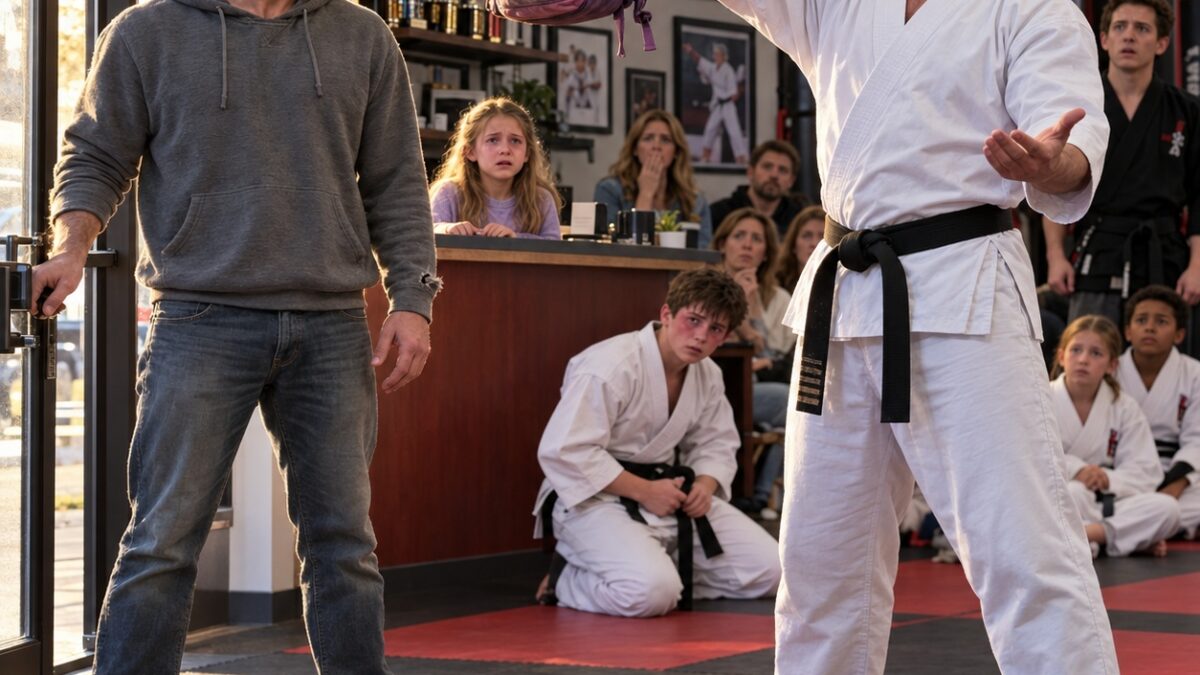
Grant still held Tessa’s backpack.
“I’m giving you one chance.”
His smile returned.
“You don’t give me chances in my dojo.”
“Put my daughter’s backpack down.”
His fingers tightened around the strap.
“And apologize to Evan.”
That did it.
The insult to his authority was apparently survivable.
Being told to apologize was not.
Grant dropped the backpack onto the mat.
Not placed.
Dropped.
The purple bag hit the floor with a soft thump.
Tessa flinched behind the counter.
I looked at her.
“You okay?”
She nodded.
Barely.
Grant rolled his shoulders.
“Fine.”
His voice changed.
Lower.
“You want a lesson?”
“No.”
“I think you do.”
“I want you to calm down.”
Several parents had stood.
One moved toward the door.
The receptionist whispered something to him and pointed toward the emergency release.
Good.
People understood they could leave.
Nobody did.
Grant stepped onto the center mat.
He gestured.
“Come on.”
“No.”
He laughed.
“Still scared?”
“No.”
That answer annoyed him more than if I had insulted him.
I pointed toward Tessa.
“I’m responsible for her. That means I don’t have to prove anything to you.”
“Then stop talking.”
“Stop bullying children.”
His expression hardened.
I had said the word.
Bullying.
Nobody likes hearing a precise description of behavior they have dressed up as philosophy.
Grant took a step.
“You walk in here, criticize my teaching, disrespect me in front of my students—”
“You embarrassed a fifteen-year-old kid because he missed a step.”
“I was correcting weakness.”
“No.”
I glanced at Evan.
He stood near the edge of the mat.
Still.
“You were enjoying yourself.”
Grant followed my eyes.
Evan immediately looked down.
That told me everything.
Grant noticed too.
His jaw tightened.
“You know nothing about discipline.”
“I know enough to recognize fear.”
Grant smiled again.
“Then maybe I should show you the difference.”
He lunged.
People later asked whether I knew he was going to attack.
Yes.
Not because I could read minds.
Because bodies announce decisions before people admit them.
His right shoulder tightened.
Weight shifted.
Front foot loaded.
His breathing changed.
He had spent so much time performing intimidation that he telegraphed aggression like an instructor demonstrating it.
I moved half a step.
Grant’s hand passed through empty air.
His own momentum carried him farther than he expected.
I caught his wrist.
Redirected.
Let go.
No strike.
No throw.
No dramatic impact.
He stumbled two steps and turned around.
The room remained quiet.
Grant looked at his hand.
Then at me.
“What was that?”
“Your balance was already gone.”
Someone near the wall exhaled a laugh before immediately hiding it.
Grant heard.
His face reddened.
That was the danger.
Not losing balance.
Being seen losing balance.
He came again.
Faster.
A short combination.
First hand.
Second.
The type of aggressive sequence that looked impressive to beginners because speed creates confusion.
I blocked the first.
Stepped outside the second.
Moved with his shoulder instead of against it.
One hand guided.
One foot adjusted.
Grant ended up on one knee.
I released him immediately.
He stared at the mat.
Then shot back upright.
“You got lucky.”
“Maybe.”
That answer made him furious.
“You want to stop?”
He looked at me as though I had slapped him.
“No.”
“You should.”
Grant charged a third time.
Harder.
Less controlled.
That happens when ego starts making tactical decisions.
He committed too much weight.
I shifted.
Caught his movement.
Turned with it.
Brought him down into a controlled position.
His shoulder was secured.
His body pinned by structure, not force.
He struggled.
Once.
Twice.
I adjusted only enough to prevent him from injuring himself.
“Stop.”
“Get off me.”
“Stop fighting the position.”
He tried again.
Pain changed his face.
Not because I was hurting him deliberately.
Because his own resistance was loading the joint.
“Grant.”
He froze.
“If you keep forcing it, you’re going to injure your shoulder.”
His breathing was heavy.
The room was silent.
Evan stared.
Tessa had come slightly out from behind the counter.
“Are you done?”
Grant said nothing.
I waited.
His body relaxed.
I let him go.
Immediately.
That mattered.
Real control ends when the danger ends.
I stepped back.
Grant sat upright.
His face was red.
Sweat along his hairline.
Breathing hard.
I extended a hand.
For one strange second, he looked more offended by the hand than by the position he had just been in.
He stood without taking it.
“Who taught you that?”
I glanced at Evan.
He had not moved.
Nobody had laughed at him since the confrontation began.
“Someone who taught me that knowing how to hurt people isn’t the same as knowing when not to.”
Grant stared.
“You’re not some ordinary repairman.”
I looked at the wall clock.
“I have a commercial service call tomorrow morning.”
A few people smiled.
“I’m still a repairman.”
That was true.
It is strange how often people treat identities as if only one can be real.
Repairman.
Father.
Widower.
Former competitor.
Student.
Champion.
None canceled the others.
But I had spent years choosing which one mattered most.
Since Tessa’s mother died, the answer had been simple.
Father.
Everything else fit around it.
The receptionist was staring toward the office.
Not at me.
At a framed photograph partly visible through the doorway.
Then back at me.
Her eyes narrowed.
“Wait.”
Grant looked over.
She walked into the office.
“What are you doing?” he asked.
She did not answer.
She returned carrying an old framed photograph.
Dust around the corners.
Maybe fifteen years old.
A training seminar.
Twenty or thirty martial artists.
Master Daniel Cho stood in the center.
The founder of Iron Gate.
The man who had taught me more about restraint than anybody I ever met.
The receptionist held the frame close.
Then pointed.
“Is that you?”
I did not need to look.
I knew the photograph.
Midwest Defense Institute.
I had forgotten Iron Gate kept a copy.
Grant stepped closer.
The receptionist read the printed caption.
“‘Nolan Briggs. National Defensive Skills Champion.’”
Evan’s eyes widened.
Grant’s face lost color.
One student whispered:
“No way.”
Another leaned toward the photograph.
I rubbed the back of my neck.
This was exactly why I rarely talked about that part of my life.
Not shame.
I simply did not want Tessa growing up believing old trophies made a person important.
Grant looked from the photograph to me.
“You’re Nolan Briggs?”
“I’m Nolan.”
“You trained under Master Cho.”
“Yes.”
“For years.”
“Yes.”
A parent near the wall said:
“What is National Defensive Skills?”
The receptionist knew.
“It was a control-based competition. Practical defense. Restraint. Positioning. Safe disengagement.”
Grant was still staring.
“You won.”
I shrugged.
“Yes.”
He looked almost betrayed.
“You could have told me who you were.”
That sentence irritated me more than his insults had.
I looked at him.
“Would it have made you treat Evan differently?”
Grant opened his mouth.
Nothing came out.
“Would you have stopped humiliating him if I walked in wearing a trophy around my neck?”
Silence.
“Would you have left Tessa’s backpack alone if you knew I could stop you?”
His eyes shifted toward the purple bag.
“You shouldn’t need to know who somebody is before deciding not to mistreat them.”
The room stayed quiet.
That was the part I wanted Tessa to hear.
Not:
Your father was secretly dangerous.
Not:
Bad people deserve to get beaten.
I wanted her to understand something harder.
Decency should not depend on fear of consequences.
Grant should have treated Evan with dignity if Evan’s father was nobody.
He should have left Tessa’s property alone if I had never trained a day in my life.
A person’s weakness does not create permission.
Master Cho had taught that better than anyone.
I first met him when I was nineteen.
Angry.
Strong.
Competitive.
Far too impressed with my own ability to hit things.
He watched me spar once.
I won.
I expected praise.
He said:
“You use ten pounds of force when two would do.”
I thought he meant technique.
He meant character.
For years he trained that out of me.
Or tried.
He would stop drills when somebody became emotional.
Reset.
Again.
If we used unnecessary force, start over.
If we humiliated a training partner, sit out.
If we bragged about winning, he found somebody better.
There was always somebody better.
That was intentional.
He taught that martial skill without self-control was just a more efficient way to become dangerous.
Competition came later.
Regional seminars.
Defensive-skills events.
Eventually the national title.
People saw the trophy.
I remembered Master Cho afterward saying:
“Good.”
That was his entire celebration.
Then:
“Now go clean the mats.”
That kept things clear.
I stopped competing years before Tessa was born.
Her mother, Rachel, met me near the end of that chapter.
She never cared about trophies.
First time she saw one at my apartment, she used it to hang a grocery bag because both hands were full.
I nearly had a heart attack.
She laughed for ten minutes.
That was Rachel.
Nothing remained impressive around her for very long.
Then she got sick.
Long illness.
Months became years.
Hospital visits.
Treatment.
Good weeks.
Bad weeks.
I gradually stopped traveling for training.
Stopped competing.
Took steadier HVAC work.
More predictable hours.
Insurance.
Benefits.
Rachel apologized once.
“For what?”
“For making you quit.”
“You didn’t.”
“You loved competing.”
“I loved you more.”
She cried.
I hated when she cried because it made me feel helpless.
I could control another person’s momentum.
I could repair a rooftop chiller.
I could not negotiate with disease.
After Rachel died, trophies became completely meaningless.
I packed most of them away.
Tessa was six.
She needed breakfast.
Clean clothes.
School rides.
Someone who remembered picture day.
Bedtime.
Comfort when grief arrived at two in the morning.
Competition had trained discipline.
Fatherhood gave that discipline somewhere worthwhile to go.
Grant was staring at the photograph as if it had changed the facts.
It hadn’t.
The receptionist said quietly:
“Master Cho built Iron Gate around restraint.”
Grant’s eyes snapped toward her.
“I know what he built.”
“Then why are parents complaining?”
The question landed hard.
He stared.
“What complaints?”
The receptionist hesitated.
That told everyone there had been complaints.
Grant stepped toward her.
“Who complained?”
I moved between them without touching him.
“No.”
His eyes went to mine.
“Stay out of this.”
“You’re not intimidating her now.”
“I’m not intimidating anybody.”
Several parents exchanged looks.
One woman near the wall spoke.
“My son came home crying twice.”
Grant turned.
She continued.
“You called him lazy in front of the advanced class.”
“I was motivating him.”
“He was eleven.”
Another parent stood.
“You made my daughter hold a squat position while everybody watched because she forgot part of a sequence.”
“Discipline.”
“She couldn’t walk normally the next day.”
Grant looked around.
The room he had controlled through authority was changing.
Not because I defeated him.
Because people were finally discovering they were not the only ones uncomfortable.
That matters.
Silence isolates.
Once one person speaks, somebody else realizes their experience was not private failure.
The receptionist reached for the phone.
“I’m calling the owner.”
Grant said:
“You don’t need to.”
“Yes.”
His expression hardened.
“I said—”
“Yes.”
Simple.
Strong.
Grant looked at me.
This time I did not need to move.
He stepped back.
The dojo owner arrived about twenty minutes later.
Her name was Andrea Kim.
Early forties.
Composed.
She had taken over Iron Gate after Master Cho retired.
I remembered meeting her once years earlier when she was a teenager at a seminar.
She did not remember me immediately.
That was fine.
This was not about reunion.
She spoke first with the receptionist.
Then parents.
Then students.
Then Evan.
Then Tessa.
Then me.
Finally, Grant.
Security cameras covered the main training floor.
Andrea reviewed the footage in the office.
We waited.
Tessa sat beside me with the purple backpack on her lap.
She touched the worn zipper.
“Daddy?”
“Yeah?”
“Were you really a champion?”
I smiled.
“Once.”
“Why didn’t you tell me?”
“I probably did.”
“No.”
“Maybe you weren’t listening.”
She gave me the look.
“Okay. I didn’t tell you.”
“Why?”
I thought about Rachel.
About the trophies boxed in my garage.
“Because it’s not the most important thing about me.”
Tessa looked confused.
“What is?”
“You.”
She rolled her eyes.
“Dad.”
“What?”
“I’m serious.”
“So am I.”
She leaned against my arm.
After a moment:
“Could you have hurt him?”
Children are frighteningly direct.
“Yes.”
“Bad?”
“Yes.”
“Why didn’t you?”
“Because I didn’t need to.”
Tessa looked toward Grant.
He stood alone near the opposite wall.
No students around him.
“What if he kept fighting?”
“Then I would keep you safe and use whatever was necessary to make him stop.”
“But you didn’t hit him.”
“No.”
“Because hitting is bad?”
“Not always.”
She frowned.
Parenting destroys simple answers.
“If somebody is hurting you and you have to protect yourself, sometimes you may need to hit. But the goal is to stop danger. Not punish somebody because you’re angry.”
“Were you angry?”
“Very.”
“You didn’t look angry.”
“That was the important part.”
She thought about that.
Then rested her head against me.
Andrea came out of the office.
“Grant.”
He approached.
Her expression gave nothing away.
“I’m suspending you immediately pending a formal investigation.”
His face tightened.
“For defending my dojo?”
“For escalating a confrontation with a parent, taking a child’s property, initiating physical contact, and conduct toward students that multiple families have now raised concerns about.”
“I never touched him until—”
Andrea held up one hand.
“I watched the footage.”
Grant stopped.
“You are not teaching another class until this is reviewed.”
“You can’t do that.”
“I own the school.”
A few parents looked at one another.
Grant’s own language turned around.
Andrea continued.
“You’ll return fees for students withdrawing because of your conduct. You’ll also participate in a professional conduct review before any discussion about returning to instruction.”
Grant looked at me.
This time there was no sneer.
Only humiliation.
I did not enjoy it.
Maybe a little part of me did.
I am human.
But mostly I saw how close he was to making the same mistake again.
Treating accountability as somebody else’s attack.
He turned toward Evan.
The boy stiffened.
Grant walked closer.
Not too close.
Andrea watched.
So did I.
“I shouldn’t have spoken to you that way.”
The apology sounded painful.
Evan looked uncertain.
“Okay.”
Grant nodded.
That was it.
No hug.
No sudden reconciliation.
Good.
Apologies do not instantly repair trust.
Especially bad apologies.
But it was a start.
Grant gathered his things.
Before leaving, he stopped near me.
“You embarrassed me.”
I held his gaze.
“No.”
His jaw tightened.
“You came into my school and made me look weak.”
“You attacked me three times.”
“You knew you could beat me.”
“I knew I could control the situation.”
“That’s the same thing.”
“No.”
I glanced toward the old photograph.
“That is exactly what Master Cho tried to teach.”
Grant looked at it.
Something moved in his expression.
Anger.
Shame.
Maybe recognition.
I did not know.
“You think you’re better than me?”
“No.”
That answer surprised him.
“I think today you behaved badly.”
He stared.
“That can change.”
He looked toward Evan.
Then at the floor.
For the first time since we arrived, Grant seemed smaller without anybody making him smaller.
There is a difference.
Humiliation attacks the person.
Accountability addresses behavior.
I hoped he eventually understood that.
He left.
The front door shut.
Nobody cheered.
I was glad.
If the students had celebrated Grant’s humiliation, the dojo would have learned nothing.
Andrea gathered everyone.
She apologized.
Not defensively.
Directly.
“I should have responded sooner to the earlier complaints.”
A parent nodded.
Andrea continued.
“Iron Gate was founded on discipline and respect. Neither of those words means public humiliation.”
She looked at Evan.
“You are welcome here.”
His eyes lifted.
“Whether you come back is your choice.”
That mattered too.
No pressure.
No demand that the harmed student prove resilience by returning immediately.
Choice.
Tessa tugged my sleeve.
“Can we go home?”
“Yes.”
I stood.
The afternoon had gone on long enough.
We drove home in silence for the first ten minutes.
Tessa held the purple backpack against her chest.
Eventually she asked:
“Did Mommy know?”
“That I trained?”
“Yes.”
“She knew.”
“Did she see you fight?”
“A few times.”
“Did you win?”
“Sometimes.”
“What did she say?”
I smiled.
“She usually told me my hair looked ridiculous afterward.”
Tessa laughed.
That laugh made something inside me loosen.
For an hour, I had been carrying too much adrenaline.
Parent fear is different from personal fear.
Grant coming at me did not frighten me much.
Grant using Tessa as part of his performance did.
That stayed.
I gripped the steering wheel.
Tessa looked over.
“You okay?”
“Yes.”
“You’re doing the jaw thing.”
“What jaw thing?”
“The thing where you’re mad and pretend you’re not.”
Rachel used to say the same thing.
I glanced at Tessa.
“You really are your mother’s daughter.”
“Is that good?”
“The best.”
At home, I made grilled cheese because complicated parenting days require uncomplicated food.
Tessa sat at the kitchen table drawing.
Purple backpack beside her chair.
I cooked.
Normal sounds.
Butter.
Pan.
Pencil.
The ordinary things felt good.
After dinner, she disappeared into her room.
I opened the garage cabinet where old boxes lived.
Found one.
Inside:
Training certificates.
A couple of belts.
Photographs.
The national trophy.
Dusty.
Smaller than I remembered.
Tessa appeared behind me.
“What’s that?”
“You walk quietly.”
“Is that the trophy?”
“Yes.”
She picked it up carefully.
“Heavy.”
“Not really.”
“It is to me.”
Fair.
She studied my name.
“Nolan Briggs.”
“That’s me.”
“You had more hair.”
“Go to bed.”
She laughed.
Then grew serious.
“Did winning make you strong?”
I sat on the garage step.
“No.”
“What did?”
“Depends what kind of strong you mean.”
She sat beside me.
“Like today.”
I looked at the trophy.
“Today wasn’t about being stronger.”
“You won.”
“Grant lost control before I ever touched him.”
She waited.
“He was angry because somebody questioned him. Then he needed everybody watching to believe he was still in charge.”
“That’s bad?”
“It becomes bad when being in charge matters more than doing the right thing.”
“Like being mean to Evan.”
“Yes.”
She looked down.
“Kids laugh at my backpack sometimes.”
“I know.”
“I don’t care.”
“Sometimes you do.”
She shrugged.
“Sometimes.”
“That’s okay.”
She leaned into me.
“Mommy bought it.”
“I know.”
“That’s why I don’t want a new one.”
“I know.”
That purple backpack carried more grief than most adults would recognize.
Grant had no way to know.
That did not excuse taking it.
You never know what ordinary object carries somebody’s history.
That is another reason respect has to come before understanding.
You do not need the tragic explanation first.
Leave people’s things alone.
Treat kids with dignity.
Simple.
A week passed.
No viral social-media frenzy.
No news crews.
No dramatic lawsuit.
Good.
Reality remained local.
Andrea called me.
“The investigation is continuing.”
“Okay.”
“Several more parents came forward.”
I was not surprised.
“Grant is not teaching.”
“Understood.”
Then:
“I wanted to ask you something.”
I waited.
“Tessa’s introductory class.”
I smiled.
“She still wants to try?”
“That’s what I’m asking you.”
I called Tessa into the kitchen.
Andrea repeated the invitation.
Free introductory class.
Different instructor.
Marisol Vega.
Patient.
Experienced.
Evan had also been invited back if he wanted.
Tessa looked at me.
“What do you think?”
“My opinion doesn’t matter most.”
“Yes, it does.”
“Do you want to go?”
She looked toward her backpack.
Then nodded.
“Okay.”
We returned Saturday.
I expected Tessa to be nervous.
She was.
I was too.
That surprised me.
The smell of the mats brought back Grant’s hand on the backpack.
The lock.
His first lunge.
Memory attaches itself to rooms.
But the atmosphere had changed.
Marisol Vega greeted Tessa at eye level.
Not towering over her.
“First time?”
Tessa nodded.
“Nervous?”
Another nod.
“Good.”
Tessa frowned.
Marisol smiled.
“Being nervous means your brain knows you’re learning something new. We just don’t let nervous make our choices.”
I liked her immediately.
Then I saw Evan.
He stood near the edge of the mat.
Same skinny build.
Same belt.
But his shoulders were not as folded inward.
He noticed me.
Walked over.
“Mr. Briggs?”
“Nolan.”
“My mom says I should call adults Mr.”
“Your mom sounds smarter than me.”
He smiled.
Then:
“Can you show me how you did that move?”
“Which move?”
“The one where Grant went down.”
“Tells me nothing.”
“The first one.”
“That wasn’t a move.”
He looked confused.
“Mostly footwork.”
“Can you show me?”
I looked at Andrea.
She nodded.
I stepped onto the edge of the mat.
“First thing you learn is not how to take somebody down.”
Evan waited.
“How to fall safely.”
His face dropped.
“That’s less cool.”
“Much.”
Tessa laughed from nearby.
For the next twenty minutes, I helped Evan with balance.
Nothing advanced.
How to lower his center.
How to step without crossing his feet.
How to land without throwing out a hand and injuring a wrist.
How to breathe when somebody applies pressure.
Tessa sat beside the mat cheering every time Evan got something right.
“Again!”
Evan laughed.
That sound mattered.
A week earlier, the same mat had been where Grant told him maybe he belonged in the back.
Now Evan was laughing after falling down.
That is what a good training room should allow.
Failure without humiliation.
Correction without shame.
Marisol eventually called everyone together.
Tessa joined the beginner line.
Her purple backpack rested against the wall.
Safe.
I sat where parents were supposed to sit.
This time I watched quietly.
Gladly.
Marisol corrected a student.
“Move your foot.”
The kid tried.
Wrong.
She adjusted him.
“Better.”
No insult.
No speech about weakness.
Another student forgot a sequence.
Marisol reset the group.
Normal teaching.
It was almost boring.
I loved it.
Tessa stumbled twice.
Looked toward me after the first.
I gave her a thumbs-up.
After the second, she did not look.
She simply reset.
Better.
When class ended, she ran over.
Sweaty.
Hair messy.
Eyes bright.
“Daddy?”
“Yeah?”
“Am I good?”
“You had one lesson.”
“So?”
“So no.”
She gasped dramatically.
Evan laughed nearby.
I smiled.
“You’re learning.”
“That means good.”
“Fine.”
She slipped her hand into mine.
We started toward the door.
Then she stopped.
“Daddy?”
“Yes?”
“Are you the strongest person in the room?”
I looked around.
Marisol stacking pads.
Andrea speaking to a parent.
Evan practicing the same footwork again.
Students packing up.
“No.”
Tessa frowned.
“But you beat Grant.”
“I stopped Grant.”
“Same thing.”
“No.”
She waited.
Kids know when adults are turning answers into lectures.
I crouched anyway.
“Being strongest isn’t the point.”
“Then why did you win?”
I thought about the word.
Win.
The trophy in my garage.
Rachel’s illness.
Evan.
Grant.
Tessa’s backpack.
“Because I didn’t need to hurt him to stop him.”
She listened.
“And because when somebody smaller is being treated badly, you don’t have to be the strongest person in the room to stand beside them.”
Tessa stared at me for several seconds.
Then wrapped both arms around my neck.
Eight-year-old hugs do not care about dignity.
I hugged back.
Across the room, Evan was laughing with two other students.
Nobody mocking him.
Nobody telling him he did not belong.
That was the ending I wanted.
Not Grant on the floor.
Not the photograph.
Not the trophy.
Evan still training.
Tessa willing to come back.
The room repaired.
People love stories about hidden champions because they imagine the satisfying part is watching the arrogant person discover he challenged the wrong man.
I understand.
There was satisfaction.
Grant looked at my hoodie and decided I was insignificant.
He saw HVAC work boots and thought they represented weakness.
He believed the black belt around his waist told him more about me than my silence did.
Then reality embarrassed him.
But if that is all you take from what happened at Iron Gate, you miss the point completely.
Grant should not have treated me differently because I happened to be able to defend myself.
He should have treated Evan differently because Evan was a fifteen-year-old kid trying to learn.
He should have treated Tessa differently because she was eight.
He should have treated the receptionist differently because she worked for the school and deserved professional respect.
A dangerous person is not the only person entitled to dignity.
That is the lesson people get backward.
They hear:
Be careful who you bully. They might secretly be stronger than you.
No.
Do not bully people.
Full stop.
The possibility that your target might be dangerous should not be the moral foundation.
Master Cho understood that.
He used to say:
“If you need fear to create respect, you have neither respect nor discipline.”
I was too young to appreciate it.
Grant was old enough.
Still missed it.
The photograph hanging in the office proved Iron Gate had once understood.
Master Cho’s entire philosophy centered on control.
Practical defense.
Minimal necessary force.
Responsibility.
He did not like aggressive demonstrations designed to impress parents.
He said martial arts should make ordinary life safer, not make practitioners feel entitled to dominate ordinary people.
Competition was useful only when it tested control.
That was why the national event I won was not about knocking people unconscious.
Scenarios.
Escapes.
Restraints.
Points deducted for unnecessary force.
Control under pressure.
Grant’s problem was not that his technique was bad.
He was athletic.
Fast.
Probably capable.
His problem was emotional.
Each time something failed, he used more force.
First lunge missed?
Attack harder.
Second exchange ended on one knee?
Call it luck.
Third time?
Commit everything.
That is not martial discipline.
That is ego using martial technique.
Ego makes people predictable.
His body was less dangerous to me than his need to recover status.
The moment I saw that, the goal became simple.
Do not participate in his emotional escalation.
Move.
Redirect.
Release.
Offer him exits.
“You want to stop?”
He could have.
He did not.
That question enraged him because stopping voluntarily would require admitting the situation did not need to continue.
People trapped by pride experience exits as humiliation.
That is how small conflicts become large ones.
I had been like that once.
At nineteen.
Different context.
Same instinct.
Someone challenged?
Answer.
Someone hit harder?
Hit harder.
Somebody watching?
Never back down.
Master Cho spent years dismantling it.
The greatest skill he taught me was not a wrist control.
It was permission to stop.
That sounds ridiculous until you have seen what happens to people who cannot.
Grant could not.
Not that afternoon.
Maybe later.
The source gives us professional conduct review.
Suspension.
Refunds.
A weak apology.
No dramatic redemption.
That is realistic.
People rarely transform on schedule because a story needs closure.
Grant might change.
Might not.
Not my responsibility.
What mattered was Iron Gate stopped allowing him to teach unchecked.
Parents spoke.
Andrea listened.
Security footage supported the facts.
The institution responded.
That is accountability.
Not revenge.
I never wanted to “destroy” Grant.
He did not need destruction.
He needed limits.
Children needed protection.
Those goals are different.
Tessa asked about him once about a month later.
“Is the mean instructor coming back?”
“I don’t know.”
“Would you leave if he did?”
“Depends.”
“On what?”
“Whether he changed.”
“How do you know?”
“You watch what people do.”
“What if he says sorry?”
“Words matter.”
She waited.
“Behavior matters longer.”
She nodded.
I could tell she would remember that.
Maybe.
Children remember strange fragments.
She still forgot socks every morning.
But some lessons stick.
Evan kept attending.
I saw him occasionally when Tessa took another introductory lesson.
He improved.
Still awkward sometimes.
Still skinny.
Still himself.
Good instructors do not erase individuality.
They give people tools.
Marisol gave him room to fail.
He got better because he was willing to keep trying after mistakes.
Grant’s method had done the opposite.
Humiliation makes students protect appearance.
Protection of appearance prevents experimentation.
No experimentation.
No learning.
That is true in martial arts.
School.
Work.
Parenting.
The safest training rooms are not easy.
They can be demanding.
But demand and humiliation are not synonyms.
Marisol pushed Evan.
“Again.”
“Lower.”
“Move faster.”
“Reset.”
Never:
Weak.
Embarrassing.
Maybe you don’t belong.
The distinction changed him.
I noticed it in how he held himself.
He started asking questions.
People ask questions when they do not fear looking stupid.
That may be one of the cleanest measurements of healthy authority.
Can the least confident person in the room say:
I don’t understand.
If yes, maybe the teacher is doing something right.
Grant’s room had been quiet because everyone understood the cost of being wrong.
That silence looked like discipline.
It was fear.
I had seen the difference everywhere.
On job sites.
Training floors.
Hospitals during Rachel’s illness.
Even families.
Authority can create order quickly through intimidation.
But the order is brittle.
The moment the intimidating person loses control, everything hidden surfaces.
That happened at Iron Gate.
One parent spoke.
Then another.
Then another.
Complaints had existed before my confrontation.
Nobody wanted to be the difficult family.
Then the shared pattern appeared.
That part mattered more than my old championship.
Sometimes people do not need a hero.
They need evidence they are not alone.
My role that afternoon was smaller than people later made it.
I challenged Grant verbally.
Protected Tessa.
Defended myself.
The real change happened because other adults finally spoke.
Andrea reviewed footage.
The receptionist called her.
Parents corroborated.
Evan was heard.
That is how organizations improve.
Not one secret champion walking in at exactly the right moment every time.
Systems need people willing to report problems before a dramatic event forces attention.
Andrea admitted that.
“I should have responded sooner.”
I respected her for it.
Leaders often ruin apologies by adding:
But I didn’t know.
But nobody told me enough.
But Grant had good results.
Andrea did not.
She accepted that several parents had already complained.
She changed the situation.
That made bringing Tessa back possible.
If Andrea had defended Grant automatically, we would never have returned.
No amount of free classes would matter.
Trust requires action.
The second class proved it.
Different instructor.
Different atmosphere.
Same mats.
Same building.
That reminded me that places are not permanently contaminated by one bad person.
They can be reclaimed.
Evan reclaimed the mat where he had been embarrassed.
Tessa reclaimed the room where her backpack had been used to frighten her.
I reclaimed nothing.
I had no need.
My history with martial arts was already settled.
Or so I thought.
After Iron Gate, Tessa became more curious.
She asked for stories about Master Cho.
Most were not exciting.
“Did he ever beat up ten people?”
“No.”
“Five?”
“No.”
“Three?”
“Tessa.”
“One?”
“Probably.”
She sighed.
“What did he teach you?”
“How to sweep mats.”
“That’s boring.”
“Correct.”
I told her about drills.
Balance.
Footwork.
Restraint.
How Master Cho made advanced students pair with beginners and measured them partly by how safe the beginner felt.
That interested her.
“Why?”
“Because anybody can look skilled against somebody weaker if they don’t care about hurting them.”
She nodded.
“That’s like Grant.”
“Yes.”
“But you didn’t hurt Grant.”
“That was the idea.”
Tessa smiled.
“So you’re better.”
“No.”
“Dad.”
“I had more control that afternoon.”
“That means better.”
We argued for ten minutes.
She won by being eight.
Around that time, she found Rachel’s old photo albums.
One had pictures from a regional competition.
There I was.
Younger.
Lean.
Uniform.
Rachel standing beside me.
Healthy.
Smiling.
Tessa touched the photograph.
“Mommy looks different.”
“She was younger.”
“No. Happy.”
That hurt.
“She was happy a lot.”
“Even when she was sick?”
“Sometimes.”
Tessa studied the photo.
“Did she like karate?”
“She liked making fun of karate.”
“Why?”
“She said adults wearing pajamas and yelling were funny.”
Tessa laughed.
That sounded exactly like Rachel.
Then:
“Do you miss it?”
The question could mean training.
Competition.
Mom.
Everything.
“Yes.”
I left it there.
Grief teaches you that multiple truths can occupy one word.
I missed Rachel.
Sometimes competition.
Sometimes the person I had been before hospitals.
But I did not regret the life afterward.
Tessa had given meaning to all of it.
Single fatherhood was not heroic.
People use that language too easily.
It was laundry.
Bills.
School emails.
Overtime.
Keeping enough food in the fridge.
Learning which hairbrush did not make Tessa yell.
Remembering to sign permission forms.
Sitting outside her room when she cried about Mom because sometimes entering made it worse.
Doing it again tomorrow.
Martial arts had taught discipline in bursts.
Parenthood demanded it every day.
That was harder.
Grant had mistaken worn clothes for weakness.
I probably would have too when I was nineteen.
Expensive equipment.
Trophies.
Visible success.
All easier to recognize.
Nobody sees strength in a father standing in a grocery aisle comparing prices after working eleven hours.
No applause.
Good.
Real strength rarely requires witnesses.
That was why Grant’s behavior bothered me so much.
Everything was for witnesses.
Evan’s embarrassment was valuable because others saw it.
My challenge threatened him because others heard it.
Taking Tessa’s backpack created an audience moment.
The attack was performance.
Martial arts became theater for his authority.
Once he lost the audience’s admiration, he became desperate.
Master Cho would have hated that.
I imagined what he would say.
Probably:
“You talked too much.”
He said that often.
Maybe he would be right.
I looked him up eventually.
Retired.
Living quietly.
I considered calling.
Did not.
Some teachers remain with you without needing updates.
But Andrea told him what happened.
A month later, I received an envelope.
Handwritten address.
Inside was a small note.
I will not invent exact wording beyond what the source supports because this note does not exist there.
So I’ll stop that branch where reality stops.
That is important.
Stories like this invite embellishment.
Make Master Cho return.
Have him confront Grant.
Let him hand me the dojo.
Make me become an instructor.
None of that happened in the source.
The real ending is quieter.
I remained an HVAC technician.
A father.
Tessa continued exploring martial arts.
Evan came back.
Grant faced review.
That is enough.
I like enough.
People underestimate enough because storytelling trains us to demand escalation.
Someone acts badly.
We want destruction.
Someone has a hidden skill.
We want domination.
Someone gets exposed.
We want public ruin.
But the best possible outcome at Iron Gate was never me knocking Grant unconscious.
Imagine if I had.
Police.
Hospital.
Tessa watching her father lose control.
Evan learning that the answer to humiliation is greater violence.
Students learning technique determines morality.
Everything worse.
Instead, Grant attacked.
I stopped him.
Repeatedly.
Safely.
That gave the room time to see the difference between aggression and control.
That was the demonstration.
Not a fight.
I sometimes replay the third exchange.
Not because I enjoy it.
Because it could have gone badly.
Grant was angry enough to injure himself.
If I had held the shoulder too long—
Damage.
If he landed badly—
Damage.
If another student tried to intervene—
Chaos.
Training does not eliminate risk.
It manages it.
Anybody who says otherwise is selling fantasy.
That is why I was relieved more than proud.
Nobody seriously injured.
Tessa safe.
Evan safe.
Grant safe.
Even Grant deserved safety after becoming the threat.
That sounds contradictory to some people.
It isn’t.
Stopping somebody and protecting them from unnecessary harm can happen simultaneously.
That is restraint.
The black belt around Grant’s waist was real.
He had trained.
He knew techniques.
That made his behavior more concerning, not less.
Skill increases responsibility.
If I own a powerful tool, I need more judgment.
Not permission to misuse it.
The same rule applies everywhere.
Lawyers.
Doctors.
Police.
Parents.
Teachers.
Martial artists.
Authority plus skill should make a person gentler with people who trust them.
Not more arrogant.
Evan had trusted the dojo enough to stand on the mat.
Grant punished that trust.
That was the deepest failure.
A student gives an instructor permission to correct him.
Not humiliate him.
A child gives a parent access to fear.
Not permission to weaponize it.
Relationships create vulnerability.
Good authority protects vulnerability.
Bad authority exploits it.
Tessa understood that in child language.
“Why was that man being mean?”
Simple question.
No philosophy necessary.
Because he could.
Until people stopped allowing it.
That is often the answer.
Afterward, I became more attentive when Tessa described adults.
Teachers.
Coaches.
Activity leaders.
Not suspicious of everyone.
Just listening.
Children often tell you the truth indirectly.
“He always picks the same kid.”
“She gets mad if we ask.”
“He jokes, but nobody laughs.”
Small sentences.
Worth hearing.
I had almost dismissed Iron Gate’s atmosphere at first.
Maybe Grant was strict.
Maybe Evan needed thicker skin.
That is the lazy adult response.
Then I saw the boy’s hands tremble.
Bodies tell stories.
We should listen before demanding perfect language from children.
Tessa saw it immediately.
“Why is that man being mean?”
Eight words.
Correct.
Adults build euphemisms.
Pressure.
Standards.
Toughening up.
Character building.
Sometimes those are real.
Sometimes they are prettier labels for cruelty.
The difference is whether the person being pushed is becoming more capable or merely more afraid.
Evan was afraid.
Grant called that discipline.
He was wrong.
A few months after the incident, Evan successfully completed a demonstration at Iron Gate.
Not the charity event Tessa originally came for—that specific outcome is not provided by the source, so I won’t invent it.
What I know is that he kept training.
That alone mattered.
The boy who nearly learned:
I don’t belong here
instead learned:
One bad teacher does not define the art.
That may have changed more than his karate.
Humiliation teaches people to generalize.
I failed, therefore I am a failure.
One authority figure rejected me, therefore the whole space rejects me.
Returning interrupts that.
Evan came back.
Stood on the same mat.
Learned safer footwork.
Laughed.
That was powerful.
Tessa saw it.
I was glad.
She needed examples beyond me.
Children should not grow up thinking one parent is the only safe adult in the world.
Healthy communities offer many.
Marisol.
Andrea after accountability.
The receptionist.
Evan’s parents.
People who respond.
That network matters.
Single parenthood can make you overprotective.
I had to resist.
After Rachel died, every risk involving Tessa felt larger.
First fever.
School bus.
Sleepover invitation.
Karate class.
Part of me wanted to build a world where nothing could touch her.
Impossible.
Worse than impossible.
Unhealthy.
My job was not to eliminate every difficult person.
It was to teach Tessa how to recognize behavior, trust herself, seek help, leave when needed, and stand beside others when she safely could.
Iron Gate became an unwanted lesson.
She watched me refuse humiliation without escalating first.
Watched me move her behind safety before addressing Grant.
That step mattered more than any technique.
Protect the vulnerable person first.
Do not make them stand inside the confrontation to prove a point.
I never asked Tessa:
Do you want Daddy to fight him?
That would have made her responsible for violence.
I moved her.
Then managed the adult.
Children should not carry adult choices.
Grant had tried to use her as an audience.
That angered me deeply.
“Maybe your little girl should see what happens when her father learns respect.”
I still hated that sentence.
He wanted Tessa to witness my humiliation.
That is why the backpack mattered.
Not the object.
The intention.
He reached through my daughter to control me.
That crossed something.
Still, the response had to remain mine.
Not his.
He could provoke.
He could not choose what I became.
That is another lesson Master Cho taught.
If an opponent controls your emotions, he controls more than your body.
I did not always succeed.
Nobody does.
But that afternoon I did.
Probably because Tessa was watching.
Fatherhood makes restraint easier and harder.
Harder because anger is stronger.
Easier because consequences are visible in a child’s face.
She would remember what I did.
Not what I intended.
That kept me honest.
Years earlier, Rachel once told me:
“You always want Tessa to think you’re strong.”
“She should.”
“No.”
I looked at her.
Rachel was sick by then.
Thin.
Blanket around her.
Still capable of winning arguments.
“She should think you’re safe.”
Those words destroyed me later.
After she died.
I carried them.
Safe.
Not impressive.
Not unbeatable.
Safe.
That was the father I wanted Tessa to have.
Grant’s challenge gave me a choice between looking impressive and staying safe.
Thankfully, the safest response happened to look impressive.
That was accidental.
If walking away had kept everyone safer, I would have walked.
That is the part people do not celebrate.
Sometimes courage is leaving.
Sometimes standing.
Sometimes calling police.
Sometimes saying nothing until children are out.
The art is knowing which moment you are in.
No trophy teaches that perfectly.
Life does.
Tessa eventually asked if she could keep taking classes.
I said yes.
Slowly.
No pressure.
Her interest lasted.
I won’t invent belts or tournament wins beyond the source.
Maybe she continued for years.
Maybe she moved on.
The endpoint only tells us she joined that class and that her backpack rested safely by the wall.
That image is enough for me.
Purple fabric.
Worn zipper.
Her mother’s gift.
Safe.
A week earlier, Grant had held it above his head like leverage.
Now it was just a backpack again.
When trauma loses symbolism, that is healing.
I had something similar with dojo doors.
For a while, whenever I heard a lock click inside a training space, my body remembered.
Not fear.
Readiness.
Then it faded.
Normal sounds become normal again.
That is good.
People sometimes asked why I locked the door at all.
I want to be precise.
I did not lock people in.
Emergency release remained available.
I made sure of that.
The receptionist could call police.
People could leave.
The purpose was to stop the room from becoming uncontrolled while a hostile instructor escalated around children.
In hindsight, I might have simply taken Tessa and left earlier.
That is worth admitting.
Once Grant touched her backpack and escalated, my protective instincts took over.
The safest ideal outcome would have been no confrontation.
But reality already contained one.
My job became managing it.
I am not interested in portraying every decision as perfect because the ending worked.
Good outcomes can follow imperfect judgment.
That honesty matters.
Would I do every step exactly the same again?
I don’t know.
I would definitely protect Tessa.
Definitely stop Grant if he attacked.
Definitely speak for Evan.
The lock?
Maybe.
Experience does not erase uncertainty.
Anybody who claims complete certainty after conflict is selling a cleaner story than life provides.
Still, the source itself clarifies that the emergency exit remained accessible and police were to be called if Grant would not calm down. That is important because restraint includes preserving exits and outside help.
Grant initiated every physical exchange.
Also important.
I did not accept his earlier invitation to fight.
I refused repeatedly.
He lunged.
I moved.
That distinction determines whether the story is about self-defense or ego combat.
I had no interest in proving I could still perform techniques after years away.
The body remembers more than people think.
But age also changes things.
Thirty-eight is not old.
It is old enough to know a strained shoulder ruins work.
I had service calls.
Bills.
A child.
Getting injured to win a dojo argument would have been spectacularly stupid.
Grant did not consider that because his identity was tied to the mat.
Mine was not.
I could lose a martial arts argument and still go home as Tessa’s father.
That gave me freedom.
Grant seemed to believe losing the argument meant losing himself.
That is why ego is dangerous when identity gets too narrow.
If you are only the strongest person in the room, every stronger person becomes an existential threat.
If you are teacher, father, friend, worker, student, neighbor—
One failure remains one failure.
Not annihilation.
I had learned that through grief.
Rachel’s death destroyed one identity.
Husband.
I survived because others remained.
Father.
Worker.
Friend.
Eventually simply Nolan.
Grant had not yet learned to separate his black belt from his worth.
Maybe the professional review helped.
I hope.
Not because he deserves a perfect redemption arc.
Because future students benefit if he changes.
Punishment without learning has limited value.
But learning cannot be forced.
Andrea could suspend him.
Review him.
Require conditions.
Grant still had to decide whether discipline meant controlling others or controlling himself.
That choice belonged to him.
Mine belonged to me.
I went back to work Monday.
Commercial building on the east side.
Rooftop unit with a failing compressor contactor.
My coworker asked:
“Heard you beat up some karate guy.”
“No.”
“That’s what I heard.”
“I did not beat anybody up.”
“You dropped him three times.”
“I redirected him.”
He laughed.
“That sounds like martial-arts lawyer language.”
“I’m an HVAC tech.”
“Apparently national champion HVAC tech.”
I groaned.
News traveled.
Not viral internet news.
Local acquaintances.
Parents.
Dojo circles.
Enough.
Someone at work found an old competition result.
Pinned it near the break room.
I took it down.
They put it back.
This continued for three days.
Eventually I surrendered.
The printed page stayed.
Under my name somebody wrote:
ASK NOLAN BEFORE TOUCHING HIS BACKPACK.
I laughed despite myself.
Tessa thought it was hilarious.
“Do you have a backpack?”
“No.”
“You should get purple.”
“Absolutely not.”
“Mom would make you.”
She was right.
Some memories stop hurting sharply and begin warming the edges.
That was one.
Rachel would have enjoyed the entire absurdity.
Not the conflict.
The discovery.
She loved exposing hidden parts of me.
If Grant had told her:
Your husband wouldn’t last ten seconds,
she probably would have said:
Please make him exercise.
Then watched.
God, I missed her.
The dojo incident brought old life and new life into the same room.
Competition Nolan.
Father Nolan.
For years I kept them separate.
Maybe unnecessarily.
Tessa knowing I had trained did not suddenly make her obsessed with violence.
Children learn what you emphasize.
I showed her the trophy.
Then told her what mattered.
Restraint.
She understood more than I expected.
Maybe because she had already watched it.
Actions explain philosophy better.
A month later she got into an argument at school.
Another girl took a marker from her.
Teacher called.
I braced for trouble.
Tessa apparently said:
“Give it back.”
Girl refused.
Tessa got the teacher.
That was it.
On the drive home she said:
“I didn’t need to hurt her to stop her.”
I almost drove off the road laughing.
“That is not exactly the same situation.”
“I know.”
“Good.”
“But I did what you said.”
“You did.”
She looked proud.
So was I.
Not because she used my sentence.
Because she sought help.
Children sometimes interpret strong-parent stories as instructions to handle everything themselves.
I wanted the opposite.
Safety is collaborative.
Receptionist.
Police.
Owner.
Parents.
Teachers.
You ask for help.
Strength includes knowing when a problem belongs to someone with authority.
Iron Gate ultimately improved because Andrea used hers.
Grant had authority and misused it.
Andrea had ownership authority and used it to protect students.
Same concept.
Different ethics.
Authority itself is not bad.
The question is what it serves.
Grant’s served Grant.
Andrea’s served the school.
Marisol’s served learning.
Master Cho’s served discipline.
Those distinctions became clearer to Tessa through experience.
I wish the lesson had come cheaper.
Still, she was safe.
That matters most.
Evan’s mother thanked me one day.
We were outside Iron Gate after class.
“You didn’t have to say anything that first day.”
“Yes, I did.”
“No.”
She smiled sadly.
“Most people didn’t.”
I knew what she meant.
She continued.
“Evan wanted to quit.”
“I figured.”
“He thinks he’s weak.”
“He isn’t.”
“You barely know him.”
“I watched him come back.”
She went quiet.
Then nodded.
Returning after public embarrassment takes courage.
Different from fighting.
Maybe harder.
Grant’s strength was obvious.
Evan’s was quieter.
If you only recognize strength when somebody dominates another person, you miss most of it.
Evan retied his belt with shaking hands.
That was strength.
Tessa stood beside the mat after watching a frightening confrontation and came back a week later.
Strength.
Receptionist called the owner despite Grant’s authority.
Strength.
Parents spoke after staying silent.
Strength.
Andrea admitted she should have acted sooner.
Strength.
None looked like a trophy.
Maybe that is why people misunderstand it.
We like visible victories.
I won a national title once.
Nice.
Rachel endured illness while still helping Tessa with spelling words.
Stronger.
No contest.
She never got a trophy.
Life is unfair that way.
When Tessa asked who was strongest in the room, that was what I thought.
Strength depends on the problem.
Grant might lift more.
Marisol might have better technique in some areas.
Andrea had institutional responsibility.
Evan had courage to return.
Tessa had trust after loss.
I had experience with defensive control.
No one person needed to own the word.
That is a healthier room.
Grant’s dojo had required one strongest person.
Him.
That created fear.
Good communities distribute competence.
Someone teaches.
Someone learns.
Someone corrects.
Someone protects.
People trade roles.
Nobody’s worth depends on never losing.
That was the room a week later.
Evan laughing.
Tessa cheering.
Marisol teaching.
Me watching.
Andrea overseeing.
Purple backpack by the wall.
I think Master Cho would have approved.
Probably after telling us to clean the mats.
The old photograph remained in the office.
Andrea offered it to me.
“You want it?”
“No.”
“You’re in it.”
“It belongs here.”
She nodded.
That felt right.
My past did not need to come home.
The photo belonged to the lineage of the dojo.
A reminder of what Iron Gate had been founded to teach.
Maybe Grant saw it differently after the incident.
Maybe future instructors would.
Objects can become standards if people remember what they represent.
The trophy at home meant less to me.
Tessa eventually put it on a bookshelf.
Not prominently.
Between school photos and a ceramic cat she made in art class.
Perfect.
National championship beside a lopsided cat.
Correct hierarchy.
Once, a visitor noticed.
“You won this?”
“Long time ago.”
Tessa answered for me.
“He doesn’t like talking about it.”
Visitor laughed.
“Why?”
Tessa said:
“Because being strong isn’t about beating people.”
I looked at her.
She shrugged.
“What?”
“Nothing.”
Maybe some lessons stick better than socks.
That was worth everything.
Grant’s phrase from the beginning also stayed with me.
“You can’t touch me.”
He said it with absolute certainty.
Not technical certainty.
Social certainty.
I am the black belt.
This is my dojo.
You are wearing work boots.
Therefore the hierarchy is settled.
That hierarchy collapsed not because I was secretly more valuable.
Because the hierarchy itself was false.
A belt indicates training.
Not human superiority.
A job indicates work.
Not weakness.
A torn hoodie indicates fabric failed.
Nothing more.
People make enormous mistakes by turning visible symbols into complete biographies.
Grant did.
I have too.
Everybody has.
The correction is curiosity.
Who is this person?
What do I not know?
More importantly:
Even if I know nothing impressive, what treatment do they deserve anyway?
That last question protects you from needing hidden champions.
Treat the repairman well because he is a person.
Treat the janitor well.
Beginner.
Child.
Receptionist.
You should not need later discovery to justify earlier decency.
That became the story I told if anyone asked.
People wanted:
Tell us how shocked he looked when he saw the photo.
I said:
Yes, he was shocked.
Then:
That should not have mattered.
Eventually they understood.
Or got bored.
Both acceptable.
My life returned to normal.
School pickup.
Grocery bills.
HVAC calls.
Tessa’s homework.
Some nights I trained lightly again.
Not competition.
Garage.
Footwork.
Mobility.
Old habits.
Tessa sometimes joined.
She copied movements badly.
I corrected gently.
If she got frustrated, I stopped.
That mattered to me.
“Again?” I would ask.
Her choice.
Sometimes yes.
Sometimes:
“Can we get ice cream?”
Also valid.
I never wanted to become Grant in a softer voice.
Parents can turn their own history into pressure.
I had been good at martial arts.
That did not obligate Tessa to care.
She was allowed to try.
Leave.
Return.
Choose something else.
The introduction to Iron Gate was hers.
Not inheritance.
Rachel would haunt me otherwise.
I could hear her:
Let the child pick her own hobbies, Nolan.
Fine.
I did.
The strongest father is not the one who builds a daughter in his own image.
It is the one who can watch her become someone else without making that feel like rejection.
I am still learning.
Single fatherhood never stops teaching.
That is why I laugh when people frame the dojo story as the day I taught everybody a lesson.
I learned too.
I learned Tessa was watching what I did with anger.
I learned I had hidden part of myself from her unnecessarily.
I learned rooms can change when one person speaks.
I learned my body still remembered training.
My knees complained afterward.
Very important lesson.
The next morning I woke sore.
Shoulder tight.
Hip worse.
I made coffee and walked like an old man.
Tessa watched.
“You okay, champion?”
I stared.
“Your mother would be proud of how disrespectful you are.”
She smiled.
Worth it.
No story about a thirty-eight-year-old former competitor should end without mentioning anti-inflammatory medication.
Reality matters.
Grant might have been younger in training terms.
Adrenaline covered my soreness in the moment.
Sunday reminded me.
I worked Monday anyway.
Commercial HVAC does not care about hidden backstories either.
Compressor still broken.
Customer still waiting.
I liked that.
Ordinary responsibility keeps ego from inflating.
One day you control a black belt on a mat.
Next day you are lying behind a rooftop unit searching for a dropped screw.
Balance.
Master Cho would call it spiritual development.
I called it Tuesday.
Years from now, Tessa may remember the confrontation differently.
Children compress memory.
Maybe Grant becomes taller.
Maybe the backpack hangs higher.
Maybe she remembers me locking the door and forgets why.
That concerns me slightly.
So occasionally, when the story comes up, I emphasize the parts I want preserved.
“I told him no first.”
“I moved you somewhere safe.”
“He attacked.”
“I stopped when he stopped.”
“Other adults helped.”
“Grant was not a monster. He behaved badly and faced consequences.”
That nuance matters.
Turning people into monsters teaches children danger is easy to identify.
It is not.
Grant looked like an instructor.
Qualified.
Confident.
Belonged there.
Bad behavior often comes from normal-looking people in legitimate roles.
The signal is behavior.
Not costume.
Likewise, safe people do not always look impressive.
Gray hoodie.
Scuffed boots.
Repairman.
That is part of the lesson too.
Tessa once said:
“You looked like a dad.”
I smiled.
“What should a dad look like?”
“You.”
Best compliment I ever got.
No trophy close.
The source story ends with me watching Tessa join class, purple backpack beside the wall.
That is exactly where I want to end too.
Because everything after would be invention.
No future black-belt promotion.
No rematch.
No dojo ownership.
No Grant returning as a transformed saint.
We do not need any of it.
The ending is restoration.
Tessa enters.
Evan remains.
No one mocks him.
The backpack is safe.
The room teaches restraint again.
And I am back where I intended to be at the very beginning.
Watching my daughter.
That afternoon, I had entered Iron Gate expecting nothing more than an introductory lesson.
I almost got dragged into somebody else’s idea of masculinity.
Prove yourself.
Fight me.
Show your daughter what respect means.
Grant thought respect flowed toward whoever could dominate the room.
I had spent enough life learning the opposite.
Respect begins with what you choose not to do when you have power.
I could have told Grant about my past when he first insulted me.
Would have changed his behavior.
Probably.
“National champion.”
Maybe he backs off.
Then what has he learned?
Treat dangerous-looking histories carefully.
Not enough.
He needed to reveal who he was when he thought I was ordinary.
That happened without strategy.
I truly did not plan some hidden-identity reveal.
The receptionist found the photograph.
But I am glad it happened after.
First, Grant showed the principle.
Then the biography arrived.
That order exposed the problem.
“You could have told me who you were.”
No.
He could have treated me properly without knowing.
More importantly, Evan deserved dignity without a champion standing beside him.
That remains the heart of it.
What happens to people who do not have Nolan Briggs in the lobby?
That is why Andrea’s action mattered.
The system had to change.
Not merely Grant’s treatment of me.
A good outcome cannot depend on every bullied kid having a secretly trained adult nearby.
Parents spoke.
Owner intervened.
New instructor.
Review.
That is sustainable.
Hero moments are not.
When I think about the confrontation now, the first image is not Grant on the mat.
It is Evan looking at the floor.
Fifteen years old.
Hands shaking.
Trying to disappear.
That was the actual emergency.
Not physical.
Psychological.
A kid learning that authority and humiliation belong together.
If nobody challenged it, maybe he quits.
Maybe he carries the lesson elsewhere.
Boss humiliates him someday?
Normal.
Coach?
Normal.
Partner?
Normal.
No.
Sometimes standing beside somebody interrupts more than one afternoon.
I do not know how much it changed Evan.
I will not claim too much.
He returned.
That is enough evidence.
The second image is Tessa behind the reception counter.
Purple backpack gone from the rack.
Eyes frightened.
That was the moment my priorities became crystal clear.
Not winning.
Safety.
The third image is her one week later.
Same room.
Hand in mine.
Asking:
“Are you the strongest person in the room?”
No.
I never want to be.
Strongest becomes another prison if you need it constantly.
I want to be the person who knows what strength is for.
That answer took me years.
Master Cho started it.
Rachel deepened it.
Tessa keeps teaching it.
Strength is for carrying.
Protecting.
Repairing.
Holding steady.
Stopping harm when necessary.
Then letting go.
That last part is hardest.
Letting go.
Of the wrist.
The hold.
The ego.
The trophy.
The version of yourself that needs to be admired.
Sometimes grief.
Not completely.
Never completely.
Enough to keep living.
Grant held too tightly to authority.
I released every hold when resistance stopped.
That physical difference mirrored everything else.
He thought letting go meant losing.
I had learned letting go was often the point.
So when Tessa asked why I won, I did not tell her I was faster.
More experienced.
Better balanced.
All technically relevant.
Not what I wanted her to carry.
I told her:
“Because I didn’t need to hurt him to stop him.”
She frowned.
Eight-year-old processing.
Then I added the part I hoped would last longer.
“When someone smaller is being treated badly, you don’t have to be the strongest person in the room to stand beside them.”
She hugged me.
Across the room, Evan laughed.
Marisol corrected another student.
Andrea spoke quietly with a parent.
Nothing dramatic.
No cheering.
No revenge.
Just a room behaving the way it should have behaved all along.
Tessa eventually let go of my neck and ran toward the other kids.
Her purple backpack remained beside the wall.
Worn.
Faded.
Safe.
I stood there watching her join the class and thought about Rachel.
She would have loved seeing Tessa on that mat.
Probably would have laughed at my worried face.
Relax, Nolan.
I could hear it.
I tried.
Tessa took her place.
Evan shifted over to make room.
Marisol began the next drill.
Nobody mocked his stance.
Nobody told him he belonged in the back.
Nobody asked me to prove anything.
Perfect.
I had entered Iron Gate thinking the most important thing I could do was watch my daughter try something new.
I left understanding she had watched me too.
Not learning how to fight.
Learning when not to.
When to stand up.
When to move someone you love out of danger.
When to ask for help.
When to walk away.
And when another person is too frightened or too young to stand alone—
how to make sure they don’t have to.








