FULL STORY:The Black Belt Ordered Me to Bow in Front of My Daughter—He Had No Idea Why I Refused
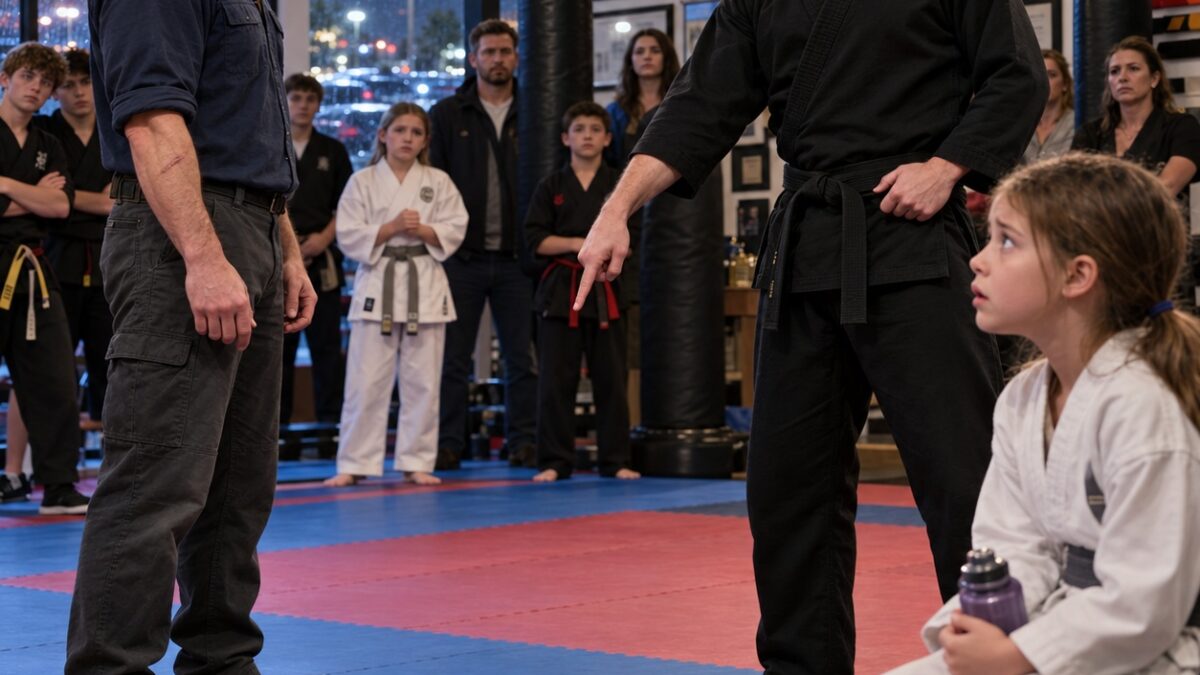
FULL STORY CONTINUATION
Trent looked satisfied.
That was the first thing that told me he had misunderstood completely.
He thought getting me onto the mat meant he had won.
Men like Trent often confuse compliance with victory.
I removed my work jacket.
Underneath, I wore an old gray T-shirt.
The sleeve rode up slightly.
One of the older students near the wall noticed the faded insignia on the fabric.
“Is that Army?”
I ignored him.
Trent didn’t.
His eyes flicked toward my sleeve.
Then back to me.
“Army?”
“Former.”
“What’d you do?”
“Worked.”
A few students laughed.
Trent didn’t.
He was studying me differently now.
Good fighters notice posture.
Hands.
Balance.
Where somebody carries weight.
I had spent years trying not to look like what I had once been.
Some habits don’t disappear.
I stood comfortably.
Feet under me.
Hands low.
No fighting stance.
Trent raised both hands.
“Last chance.”
“For?”
“Show respect.”
“I already did.”
“Then bow.”
“No.”
He exhaled through his nose.
“You’re really going to do this in front of your daughter?”
I looked toward Laya.
She sat with both hands in her lap.
Watching.
“Yes.”
Trent misunderstood that too.
I wasn’t saying yes to fighting.
I was saying yes to being watched.
Children learn more from what we refuse than what we claim.
Trent stepped forward.
“Fine.”
He threw the first technique quickly.
Not a full-power strike.
A testing motion.
Fast enough to surprise somebody inexperienced.
His hand moved toward my upper chest.
I shifted half a step.
That was all.
His fingers passed through empty space.
He turned.
Confusion.
I was already at a different angle.
No counter.
No touch.
No smile.
Nothing.
Trent’s cheeks reddened.
“You got lucky.”
“Maybe.”
I heard Laya inhale softly from the bench.
Trent came again.
Faster.
A straight hand.
Then a turning motion.
I moved around it.
He reset.
The room became quieter.
Technique is strange.
Beginners see large movements.
Experienced people see wasted ones.
Trent was fast.
Strong.
Well trained.
He also wanted everyone in the room to see how fast and strong he was.
That creates openings.
He stepped forward again.
This time he reached for my shoulder.
I caught his wrist.
Not hard.
Turned slightly.
Redirected his momentum.
Guided him toward the mat.
He landed on one knee with his free hand braced safely against the floor.
No slam.
No impact.
No pain.
Just gravity and surprise.
The entire room went silent.
I released him immediately.
Trent stood.
“What was that?”
I said nothing.
His eyes narrowed.
Then:
“Again.”
“No.”
That answer irritated him more than the movement.
He stepped forward.
“You come onto my mat, make me look stupid, and now you’re done?”
“I didn’t make you do anything.”
His face hardened.
Laya said quietly:
“Dad?”
I looked at her.
That one word brought everything back into focus.
Not Trent.
Her.
I lowered my hands.
“It’s okay.”
Trent heard.
“You’re telling her it’s okay?”
I looked at him.
“Yes.”
“Why?”
“Because it is.”
That was the truth.
Nothing dangerous had happened yet.
Embarrassing?
For Trent.
Dangerous?
Not yet.
He changed that.
Trent moved toward me again.
Harder this time.
Anger alters mechanics.
His right shoulder tightened before the attack.
Weight shifted too early.
I saw it.
He committed forward.
I stepped outside.
Caught the arm.
Stopped the elbow.
Turned enough that he could feel how little movement it would take to put him somewhere he did not want to be.
Then I leaned close enough that only he could hear.
“You’re teaching these kids that being feared makes you strong.”
He froze.
I continued quietly:
“It’s making you sloppy.”
His jaw tightened.
I released him.
Stepped away.
Then said loud enough for everyone:
“And you’re wrong.”
Nobody cheered.
Thank God.
I did not want cheering.
Humiliation was already the problem.
Trent stood still.
Breathing harder than the exchange justified.
He looked down.
Then at me.
Then toward Laya.
She was not smiling.
Not impressed.
Not triumphant.
Disappointed.
That did more damage than anything I could have done physically.
He lowered his hands.
“What were you?”
I picked up my jacket.
“A father.”
“Before that.”
“Doesn’t matter.”
One instructor near the wall was staring at my forearm.
My sleeve had pulled farther up during the movement.
A small tattoo sat near the inside.
Coordinates.
Old deployment marker.
He said:
“Those coordinates military?”
I covered them with the sleeve.
“Yes.”
Trent looked at the instructor.
Then at me.
“Special operations?”
I said:
“Not important.”
His confidence shifted again.
That bothered me.
Because suddenly he was treating my refusal differently based on what he thought I had once done.
I pointed toward the students.
“This is important.”
He followed my gaze.
Children.
Teenagers.
Adults.
All watching.
I said:
“You asked me to prove something.”
Trent said nothing.
“I don’t need to.”
He looked toward Laya.
Then finally said:
“I was trying to keep control of my school.”
I nodded.
“Then control yourself first.”
The room stayed silent.
For the first time since I had walked into Calder Combat Academy, Trent Calder looked uncertain.
Good.
Uncertainty is where learning sometimes starts.
I put on my jacket.
Went toward Laya.
“Ready?”
She stood.
“Yes.”
We had almost reached the door when Trent said:
“Wait.”
I turned.
His face had gone red.
Not angry now.
Embarrassed.
“I owe you an apology.”
I said nothing.
He looked toward Laya.
“And her.”
Laya stepped slightly closer to me.
Trent continued:
“I turned a disagreement into a challenge because I didn’t like being questioned.”
That was more honest than I expected.
Then he looked around the room.
“And I owe the class one too.”
Nobody moved.
Trent seemed to realize nobody was going to rescue him from the silence.
Good.
He took a breath.
“I talk a lot about respect.”
He swallowed.
“I wasn’t showing any.”
That mattered.
Not because apologies erase behavior.
Because this one named the behavior accurately.
I nodded once.
Then left.
Outside, rain had started again.
Laya and I walked toward the truck.
She climbed into the passenger seat.
Didn’t buckle immediately.
I sat behind the wheel.
Waited.
Finally she asked:
“Were you going to hurt him?”
“No.”
“Could you?”
Children ask direct questions adults avoid.
“Yes.”
Her eyes widened.
I regretted answering too fast.
Then she asked:
“Why didn’t you?”
I looked through the windshield.
Rain streaked the glass.
“Because I didn’t need to.”
She thought about that.
“Was he trying to hurt you?”
“At the end, maybe a little.”
“Then why didn’t you hit him?”
I started the truck.
“Because stopping somebody isn’t the same as punishing them.”
She looked down at her hands.
“Was Mom right?”
“About what?”
“Strong people not needing to scare everybody.”
I smiled.
“She usually was.”
Laya leaned back.
Then said:
“He was mean.”
“Yes.”
“Are we coming back?”
That surprised me.
“You want to?”
She nodded.
“Brooke is there.”
Friendship.
The most powerful training contract imaginable.
I said:
“If Trent understands what happened tonight, yes.”
“How do we know?”
“We watch what he does.”
That became the lesson.
Not what somebody says after being embarrassed.
What they do next.
The following week, I expected awkwardness.
I got it.
Trent met us at the entrance.
No performance.
No belt tied dramatically.
Just gym pants and a black T-shirt.
“Mason.”
“Trent.”
He looked at Laya.
“Laya.”
She nodded.
He said:
“I owe you a direct apology.”
She looked at me.
I stayed quiet.
Trent crouched slightly so he wasn’t towering over her.
“I made the class about me last week.”
Laya watched him.
“And I made your dad feel like he had to respond to me.”
She said:
“He didn’t fight you.”
Trent winced slightly.
“No.”
“Good.”
I nearly laughed.
Trent nodded.
“Good.”
Then he stood.
“I’ve changed tonight’s class.”
I raised an eyebrow.
“We’re doing de-escalation.”
That interested me.
“Not because of you,” he added quickly.
“Then why?”
“Because I should’ve been teaching more of it already.”
Better answer.
Class started.
No shouting.
Not silent either.
Trent was still Trent.
Firm voice.
High standards.
But something had shifted.
When Brooke apologized after bumping another student, Trent did not tell her to stop.
He said:
“Good. Reset.”
Small.
Important.
When one boy became frustrated and threw his gloves down, Trent didn’t embarrass him.
He made him take two minutes.
Then return.
Laya looked toward me once.
I nodded.
We came back the next week.
Then another.
I never joined.
Trent asked once.
“You should train.”
“No.”
“Why?”
“Because I’m forty-one and my knees have opinions.”
He laughed.
That was the beginning of something less hostile.
Not friendship.
Not yet.
Mutual understanding.
Laya loved the class.
She learned quickly.
Not because she was naturally aggressive.
Exactly the opposite.
She was cautious.
Thought before moving.
That suited defensive training.
One month later, she struggled with a drill.
Again.
Again.
Again.
She missed the movement.
Frustration filled her eyes.
Old Trent might have barked:
Faster.
Stop hesitating.
New Trent crouched.
“What’s happening?”
“I keep messing up.”
“Yes.”
She looked offended.
He smiled.
“That’s what practice is for.”
She frowned.
“I hate messing up.”
“So do I.”
I looked at him from the doorway.
He noticed.
Didn’t look away.
Trent continued:
“Slow it down.”
Laya repeated the movement slowly.
Better.
“Again.”
Better.
“Again.”
Correct.
Her face lit up.
She looked toward me.
I smiled.
That moment meant more than anything that happened on the mat between Trent and me.
He had changed the way he used authority.
That was real progress.
After class, he walked over.
“You were watching.”
“I’m a parent. That’s what we do.”
He nodded.
Then said:
“I’ve been thinking about what you said.”
“Dangerous.”
He almost smiled.
“Being feared.”
I waited.
“I built this place from nothing.”
“Okay.”
“I thought if students stopped being intimidated by me, they’d stop respecting me.”
I looked toward the mat.
“Do you respect people you’re afraid of?”
He thought.
“Sometimes.”
“No.”
He looked at me.
“You obey them.”
That landed.
I continued:
“Respect and obedience can look the same from across a room.”
“But they’re not.”
“No.”
We stood quietly.
Then Trent asked:
“Were you really special operations?”
I sighed.
“Why does that matter?”
“Curiosity.”
“Army.”
“What unit?”
“No.”
He laughed.
“Worth trying.”
I appreciated that he stopped.
Boundaries improve quickly when people actually respect them.
Laya did not.
Children consider parental privacy a design flaw.
One night while I washed dishes, she asked:
“Where were you stationed?”
“Lots of places.”
“Like?”
“Fort Bragg.”
“Where else?”
“Other places.”
She leaned on the counter.
“Were you special operations?”
I stopped washing.
“Did Trent tell you to ask?”
“No.”
“Brooke.”
“Maybe.”
I dried my hands.
“Come sit.”
We sat at the table.
Sarah’s photograph stood on the shelf.
Laya looked serious.
“I don’t want to know bad things.”
That broke my heart a little.
“Okay.”
“I just want to know you.”
That broke it more.
I took a breath.
“I spent part of my Army career in special operations.”
Her eyes widened.
“Like movies?”
“No.”
“What did you do?”
“Worked with good people in difficult places.”
She waited.
“That’s not enough.”
“You are definitely your mother’s daughter.”
She smiled slightly.
I told her some.
Training.
Travel.
Teamwork.
Responsibility.
Not combat details.
Not things a nine-year-old needed.
She listened.
Then:
“Did you ever get scared?”
“Yes.”
“Really scared?”
“Yes.”
“Then how did you do stuff?”
That question mattered more than units and deployments.
“You do the job while you’re scared.”
She frowned.
“So brave means scared?”
“No.”
I smiled.
“Brave means fear doesn’t get the only vote.”
She thought about that for a long time.
The next class, Trent taught exactly that without knowing our conversation.
A student asked:
“What if I’m scared?”
Trent said:
“You probably will be.”
Parents looked up.
Good answer.
He continued:
“Self-defense is not about becoming fearless.”
He glanced toward me.
“It’s about making good decisions under stress.”
I nodded.
He was learning.
Months passed.
Calder Combat Academy changed.
Not dramatically.
Technically, classes still looked similar.
Warmups.
Drills.
Sparring.
Conditioning.
But the language changed.
Don’t humiliate your partner.
Control the technique.
Stop means stop.
Walk away if you can.
No one wins a street fight just because they land more punches.
Trent started ending children’s classes with a question:
“What is the first goal?”
Kids answered:
“Go home safe.”
That one I liked.
He invited a local counselor to speak about bullying.
Brought in a police officer to discuss when to call adults.
Added verbal boundary drills.
Some students left.
A few parents complained the academy was becoming “soft.”
Trent told them:
“Control isn’t softness.”
Good.
One father wanted his son taught to “dominate bullies.”
Trent said:
“Your son needs confidence, not permission to become another bully.”
I almost applauded.
Didn’t.
Would have embarrassed him.
Growth deserves room too.
My relationship with Trent became strange.
He occasionally asked for advice.
I rarely gave the advice he wanted.
“How do you get students to listen without raising your voice?”
“Say something worth listening to.”
“Helpful.”
“Glad.”
“How do you know when to step in during sparring?”
“Before ego becomes the drill.”
“That is annoyingly vague.”
“Judgment usually is.”
He called me old.
I called him theatrical.
We managed.
Laya earned her first belt promotion.
Then another.
At the ceremony, Trent tied the new belt.
He said quietly:
“This doesn’t make you better than the student behind you.”
Laya nodded.
“It means I know more.”
“And?”
“I have to be careful.”
Exactly.
Afterward she ran to me.
“Did you see?”
“No.”
“Dad.”
“I was asleep.”
She punched my shoulder.
Lightly.
“Violence.”
She laughed.
Saturday pancakes became Sunday sometimes because classes changed our schedule.
Laya complained.
Traditions are serious.
We adapted.
I burned them anyway.
One morning, while we ate, she asked:
“Why did you really leave the Army?”
Hard question.
I put down my fork.
“Lots of reasons.”
“Injury?”
“Partly.”
She had seen scars.
Sarah had explained some before she died.
“What else?”
“Time.”
She frowned.
“I spent too much of my life leaving.”
That was true.
Deployments.
Training.
Schools.
Temporary assignments.
Sarah had carried more than I admitted.
Laya had been small but aware.
“When I came home for good, I wanted to stay.”
“Because of Mom?”
“Yes.”
“And me?”
“Yes.”
She smiled.
Then:
“Do you miss it?”
“People.”
“Fighting?”
“No.”
That answer came easily.
She seemed surprised.
“Never?”
I thought.
“I miss being younger.”
She laughed.
“That doesn’t count.”
It absolutely counted.
Trent eventually learned more of my history accidentally.
An instructor named Evan had served in the Army National Guard.
He recognized one of the deployment coordinates on my arm.
Asked a former teammate.
Names traveled.
One evening Trent approached after class.
“You were in the 75th?”
I looked at him.
“That is not information you need.”
He nodded.
“Understood.”
Then paused.
“Sorry.”
That was all.
No dramatic reveal.
No room falling silent.
No salute.
I preferred it.
The story inside the academy became smaller over time.
Some students knew I had served.
Few knew more.
Good.
I did not want Laya’s place becoming “the gym where that secret operator dad trains.”
I did not train.
I sat.
Read.
Watched.
Occasionally fixed broken things because apparently being a father means free maintenance everywhere.
One evening a heavy bag mount started squeaking.
I tightened it.
Trent walked over.
“You repair elevators and now my ceiling?”
“Invoice coming.”
“How much?”
“Respect.”
He bowed sarcastically.
I stared.
He froze.
Then laughed.
“So that’s still sensitive?”
“Very funny.”
We could joke about it now.
That surprised me.
Time can take humiliation and make it harmless if everyone involved learned what they were supposed to.
Not always.
Sometimes wounds remain.
But this one became useful.
A year after our confrontation, Trent hosted an open-house demonstration.
Parents packed the studio.
Laya participated.
Trent asked me to speak.
“No.”
“I didn’t finish.”
“No.”
“Two minutes.”
“No.”
“Why?”
“Because I am here as a parent.”
He sighed.
“Fine.”
He opened the event himself.
No speech about belts.
No stories about dominance.
He said:
“A martial-arts school should teach you how to protect yourself.”
Then:
“If it teaches you to need fights, it has failed.”
I stood in the back.
Proud of him.
Would never say it.
He knew anyway.
During the demonstration, a teenage student became overexcited during a controlled drill.
Hit too hard.
Partner stepped away.
Old Trent might have barked.
New Trent stopped the drill.
“Check your partner.”
The teenager looked confused.
“What?”
“Ask if he’s okay.”
He did.
Partner nodded.
Trent said:
“Now apologize.”
The teenager did.
“Reset.”
Simple.
Brooke, standing beside Laya, whispered something.
Both girls smiled.
I remembered the first class.
Brooke stepping on Laya’s foot.
Sorry.
Trent saying stop apologizing.
Full circle.
Afterward, Laya asked:
“Did Mr. Calder get better because of you?”
“No.”
“You fought him.”
“I did not.”
“Whatever that was.”
“I controlled him briefly.”
She rolled her eyes.
“Did you change him?”
“No.”
“But—”
“He changed himself.”
That distinction mattered.
I could show Trent a contradiction.
He had to decide whether to defend it or correct it.
People do not change because the right person defeats them.
They change because eventually they become honest enough to see themselves.
I wanted Laya to understand that too.
Otherwise every story becomes about the stronger person forcing goodness onto someone weaker.
That is just dominance with nicer branding.
Trent chose.
That was his credit.
Two years passed.
Laya turned eleven.
Then twelve.
She became more confident.
Not loud.
Confidence is often mistaken for volume.
Laya still hated speaking in front of groups.
Still needed time before answering strangers.
But if someone crossed a boundary, she could say:
“No.”
Clearly.
That was enough.
One afternoon she came home upset.
A boy at school had grabbed her backpack.
“What happened?”
“I told him to stop.”
“Did he?”
“No.”
“What did you do?”
“Turned.”
She showed me a simple grip break.
“Then?”
“He tried again.”
“And?”
“I stepped back and yelled for the teacher.”
I smiled.
“You okay?”
“Yes.”
“Good.”
She looked disappointed.
“That’s all?”
“What?”
“You don’t want to know if I could’ve thrown him?”
“No.”
“Why?”
“Because you solved the problem.”
Her expression softened.
That was self-defense.
Not winning.
Ending danger.
Trent understood that by then.
He had become almost irritatingly committed to it.
A parent once complained that their child did not get enough “realistic fight training.”
Trent said:
“Realistic means teaching them not to stay in a fight for entertainment.”
The parent left.
I said:
“You just lost money.”
Trent shrugged.
“Cheaper than losing the point.”
I smiled.
“Careful. You’re becoming tolerable.”
“High praise.”
Sarah would have liked him eventually.
That thought surprised me.
She disliked arrogance.
But she loved people who could admit being wrong.
One night after class, Trent noticed me looking at Laya.
She was helping a younger student tie a belt.
“You okay?”
“Yeah.”
“You look weird.”
“Thanks.”
“Thinking about your wife?”
That surprised me.
“How did you know?”
“Your face.”
I looked away.
“Yes.”
He nodded.
No awkward sympathy.
No speech.
Good.
Then:
“She’d be proud.”
I swallowed.
“You don’t know that.”
“No.”
He looked toward Laya.
“But I know I’d be proud.”
That was enough.
Grief changes shape.
At first, every good moment hurts because the missing person is not there.
Later, the hurt and the good coexist.
Laya doing well.
Sarah absent.
Both true.
I learned not to demand one erase the other.
Three years after the first confrontation, Laya earned an advanced belt.
Not black.
Not yet.
Trent held promotion testing on a Saturday.
During one drill, she froze.
Forgot the sequence.
Old embarrassment flashed across her face.
I watched from the wall.
Trent walked over.
“Breathe.”
She did.
“What happened?”
“I forgot.”
“So?”
“So I messed up.”
“No.”
He shook his head.
“You discovered what you don’t know under pressure.”
She frowned.
“That’s messing up.”
“Only if you don’t learn it.”
He reset the drill.
She tried again.
Correct.
After testing, she passed.
In the car she said:
“I thought he was going to yell.”
“So did I.”
“Would old Mr. Calder yell?”
“Yes.”
She smiled.
“You call him old Mr. Calder like he had a villain version.”
“He did.”
“Dad.”
“What?”
“You were kind of scary too.”
That caught me.
“When?”
“The mat.”
“I barely did anything.”
“That was the scary part.”
Children see too much.
I asked:
“Did I scare you?”
She thought.
“A little.”
That hurt.
“I didn’t want to.”
“I know.”
She looked out the window.
“But then you stopped.”
That saved me.
“That’s what I remember.”
I drove in silence.
That was when I understood something important.
I had thought the lesson for Laya was that strength meant restraint.
But children don’t learn abstraction.
They remember sequence.
Dad could hurt him.
Dad stopped.
That was the lesson.
Stopping.
Not superiority.
I was grateful I had chosen correctly.
Because if I had humiliated Trent, even safely, Laya might have learned something else.
If someone is arrogant enough, violence becomes satisfying.
Dangerous lesson.
The older I got, the more I realized children learn permission faster than principles.
If they see adults insult, they learn insult is allowed.
If they see adults humiliate, humiliation becomes a tool.
If they see force used for pride, they learn pride can justify force.
I wanted Laya to learn a harder thing.
Capability does not create entitlement.
You can know how.
Still choose not to.
That principle became central at Calder Combat Academy too.
Trent eventually wrote it on the wall.
Not those exact words.
His version:
SKILL CREATES RESPONSIBILITY.
I approved.
Did not tell him.
He showed me anyway.
“What do you think?”
“Font’s too large.”
He stared.
“That’s all?”
“Maybe center it better.”
“You are impossible.”
“Correct.”
He left it.
Years passed.
I stopped feeling like the Army was a secret.
Not because I talked about it more.
Because I stopped treating silence like hiding.
There is a difference.
I had served.
Proudly.
I had done difficult things.
Lost friends.
Made mistakes.
Helped people.
Then that part ended.
It did not need to follow me into every room demanding recognition.
My life after service was not smaller.
It was quieter.
Quiet is not the same as small.
Repairing an elevator so hospital staff can move patients safely matters.
Raising a child matters.
Cooking dinner matters.
Listening to Laya explain a science project I barely understand matters.
The world does not divide into heroic and ordinary.
Ordinary is where most worthwhile responsibility lives.
Trent once asked me:
“Do you miss people knowing your rank?”
“No.”
“That fast?”
“Yes.”
“Why?”
“Because rank solves problems that only exist inside structures where rank matters.”
He laughed.
“Very military answer.”
“True.”
He continued:
“Did it feel strange becoming nobody?”
I looked at him.
“I didn’t become nobody.”
He winced.
“Bad wording.”
“Yes.”
Then he understood before I explained.
That was progress too.
I was Dad.
Employee.
Neighbor.
Customer.
Man in line at the grocery store.
Identity had widened.
Rank had narrowed it before.
Necessary then.
Not now.
One evening after advanced class, Trent received a phone call.
His father had died.
Suddenly.
Heart attack.
I watched him change in real time.
The instructor disappeared.
The black belt disappeared.
Thirty-five-year-old son remained.
He sat on the edge of the mat.
Hands shaking.
Students had already left.
I sat beside him.
Didn’t touch him.
Didn’t speak.
After several minutes, he said:
“I don’t know what to do.”
“Yes, you do.”
He looked at me angrily.
“No, I don’t.”
“Call your family.”
He breathed.
“Then?”
“Go home.”
His eyes filled.
“That’s it?”
“For tonight.”
He looked down.
“I hate not knowing what to do.”
“I know.”
We sat.
Eventually he called his sister.
I drove him home because he shouldn’t have been driving.
No martial-arts lesson.
No wisdom.
Just presence.
Months later he said:
“You could’ve given me advice.”
“Wouldn’t have helped.”
“Probably.”
Grief humbled him in ways our mat confrontation never could.
I did not wish that on him.
Pain is not a teaching tool we should romanticize.
But because it happened, he became gentler.
Students noticed.
Parents did too.
His school became more successful.
Ironically, the less he tried to dominate the room, the more people respected him.
He told me once:
“That makes me angry.”
“Why?”
“I spent years doing it backward.”
“That usually irritates people.”
He laughed.
When Laya finally earned her black belt, she was sixteen.
Seven years after that first rainy Thursday.
Same academy.
Different culture.
Brooke stood beside her.
Trent tied Laya’s belt.
Before stepping away, he said:
“What does it mean?”
Laya answered:
“That I know enough to understand how much I don’t know.”
Trent smiled.
“And?”
She looked toward me.
“That I don’t use it just because I can.”
My chest tightened.
“Good.”
Trent stepped back.
Everyone applauded.
I did too.
Laya ran over afterward.
“Dad.”
“Congratulations.”
She held up the belt.
“Think you could still beat me?”
I stared.
“Immediately returning it.”
She laughed.
Then hugged me.
“You’re crying.”
“No.”
“You are.”
“Building leak.”
“Dad.”
“Dust.”
“Inside?”
“Advanced dust.”
She laughed harder.
I held her.
Sarah should have been there.
I felt that absence sharply.
Then Laya whispered:
“Mom would’ve loved this.”
“Yes.”
We stood that way for a while.
Later that night, she asked again.
The question she had asked years earlier.
“Where were you really stationed?”
I smiled.
“That is a very long story.”
She grinned.
“Good.”
Then she sat on the kitchen counter like she was still nine.
“We have all night.”
So I told her more.
Not everything.
Enough.
About people.
Not violence.
Friends.
Training.
Bad coffee.
Long nights.
Fear.
Responsibility.
A mission where coordinates tattooed on my arm came from.
She listened.
At one point she asked:
“Did you kill people?”
I closed my eyes.
Older now.
Ready for more truth.
“Yes.”
She swallowed.
“How do you live with that?”
There are no good answers.
Only honest ones.
“By remembering why I was there.”
I paused.
“And by accepting that some things stay heavy.”
She nodded slowly.
“Is that why you hate fighting?”
“I don’t hate fighting.”
“What then?”
“I hate treating it like nothing.”
That was the most accurate answer I had ever given.
Violence is sometimes necessary.
That does not make it trivial.
Martial arts can teach beautiful things.
Discipline.
Health.
Confidence.
Courage.
They become ugly when they teach students that power itself deserves worship.
That was Trent’s mistake.
Bow down.
He thought the belt gave him ownership of respect.
Years later he understood the belt should have made him more responsible for how he treated people, not less.
He eventually stopped requiring formal bows to him personally.
Students still bowed entering the mat.
To partners.
Tradition.
Mutual respect.
Never submission.
One new student once asked why.
Trent said:
“Respect goes both directions here.”
I heard from the lobby.
Smiled.
He caught me.
“What?”
“Nothing.”
“Say it.”
“No.”
“You’re pleased.”
“Do not ruin this.”
He laughed.
The academy celebrated its fifteenth anniversary when Laya was in college.
Trent invited former students.
Parents.
Instructors.
Me.
I went reluctantly.
He gave a speech.
I feared the worst.
Then he told a story.
Not names.
Not mine.
He said:
“Years ago, someone came into this school and showed me that knowing how to control another person means nothing if you cannot control yourself.”
People listened.
“I thought respect could be demanded.”
He looked around.
“I was wrong.”
Then:
“This place became better the day I learned that.”
No reveal.
No military past.
No embarrassing details.
I appreciated that.
Afterward he handed me a glass of water.
“Too much?”
“No.”
“Really?”
“Almost.”
“That’s basically praise.”
Laya joined us.
“What’s basically praise?”
“Your father liked my speech.”
“I did not say that.”
Trent smiled.
“He did.”
Laya looked at me.
“You’re getting soft.”
“Both of you leave.”
They laughed.
That was family in a strange form.
Trent never replaced anyone.
Not Sarah.
Not old Army friends.
But he became part of the structure around our lives.
Humans do that.
Conflict introduces people.
Choice decides what follows.
Ours could have ended in resentment.
Instead, he apologized.
I allowed the apology to matter.
Both actions were necessary.
Forgiveness is sometimes misunderstood as pretending something was acceptable.
No.
Trent’s behavior was wrong.
He admitted it.
Changed it.
I stopped requiring him to remain the man who had once said bow down.
That was my work.
Years later, I asked him whether he remembered the moment clearly.
“Every second.”
“What part?”
He laughed.
“The floor.”
“What?”
“The second you moved.”
I smiled.
“You were confused.”
“I thought you got lucky.”
“You said that.”
“I was an idiot.”
“Yes.”
He looked toward the empty mat.
“But that’s not the part I think about most.”
“What?”
“What you whispered.”
I remembered.
“You’re teaching these kids that being feared makes you strong.”
He nodded.
“I hated you for saying it.”
“For how long?”
“About twelve seconds.”
“Good recovery.”
“Then I looked at Laya.”
His face softened.
“She looked disappointed.”
I knew.
“That destroyed me.”
I nodded.
“Kids are efficient.”
He laughed.
Then:
“I realized if a nine-year-old could see what I was doing, I didn’t have an excuse.”
That was honest.
I appreciated it.
Eventually Laya moved away for college.
The house became too quiet.
I hated it.
Never told her.
She called often.
Sent messages.
Visited.
Still, quiet.
I took more work.
Bad habit.
Then Trent started inviting me to help with adult beginner safety workshops.
I said no.
Repeatedly.
He kept asking.
Eventually I agreed.
Thirty minutes.
No fighting demonstrations.
I taught awareness.
Exits.
Distance.
Verbal boundaries.
Basic principles.
One participant asked:
“What’s the most important technique?”
“Leaving.”
He laughed.
I didn’t.
“No, seriously.”
“So am I.”
That workshop became occasional work.
I enjoyed it more than expected.
Not because it connected me to my old life.
Because it connected everything.
Military training.
Fatherhood.
Repair work.
Grief.
Martial arts.
All had eventually taught the same thing.
Prevention beats recovery.
In elevators, you inspect before failure.
In combat, you plan before contact.
In parenting, you teach before crisis.
In self-defense, you leave before fighting if leaving is available.
People love dramatic solutions because prevention looks boring.
Boring is underrated.
Trent built that into the school.
He started telling students:
“If your story ends with nothing happening, congratulations.”
That was good.
The first night I walked into Calder Combat Academy, I thought Trent understood strength badly.
I was right.
But I also misunderstood something.
I thought people like him rarely changed.
I was wrong.
Arrogance can be corrected if the person underneath it values truth more than ego eventually.
Not everyone does.
Trent did.
He became a better instructor because one evening he looked stupid in front of his students.
More importantly, because afterward he refused to protect the stupidity.
That is rare.
I respected him for it.
Laya eventually became a physical therapist.
Worked with injured athletes.
Funny.
She kept training recreationally.
One day she called.
“Dad.”
“Yes?”
“I have a patient who thinks pain means weakness.”
“Okay.”
“I told him pain is information.”
“That sounds intelligent.”
“I stole it from you.”
“Then it’s brilliant.”
She laughed.
Then:
“Do you know how annoying it is realizing your parents were right?”
“Yes.”
“Grandma?”
“My father.”
“What was he right about?”
“Everything.”
“Did you tell him?”
“Never.”
She laughed.
Some traditions matter.
I am older now.
Retired from elevator work.
Still help at Calder Combat Academy sometimes.
Trent has more gray hair.
I enjoy mentioning it.
He claims mine disqualifies me.
Fair.
The mat has been replaced twice.
The wall colors changed.
The philosophy stayed.
Respect.
Control.
Responsibility.
Laya visits and sometimes teaches workshops.
Children adore her.
Trent calls her his best success story.
I remind him she had a father.
He reminds me she had instructors who could actually teach technique.
We argue.
Nobody bows to anybody personally.
Good.
The original moment has become almost funny now.
“Bow down.”
Every few years Trent repeats it sarcastically when he wants me to carry equipment.
I answer:
“Try again.”
He laughs.
The phrase lost its power because the man who said it changed.
That is a good ending.
Better than me knocking him unconscious.
Better than revenge.
Better than a viral humiliation.
He kept his school.
Improved it.
Laya stayed.
Students benefited.
I went home.
That was enough.
If you ask me what I wanted my daughter to learn that night, I know now.
Not that her father had a dangerous past.
Not that a black belt could be beaten.
Not that arrogant men secretly fear stronger ones.
Those are shallow lessons.
I wanted her to understand boundaries.
A person can ask for respect.
He cannot demand worship.
A teacher can expect discipline.
He cannot use humiliation as proof of authority.
A skilled person can defend himself.
He does not need to punish every insult.
And being calm does not mean you are incapable of violence.
Sometimes calm comes from understanding violence better than the person trying to provoke you.
Laya learned.
So did Trent.
So did I.
The Army taught me how to fight.
Sarah taught me there was more to life than fighting.
Laya taught me why control mattered after the uniform came off.
And Trent—without meaning to—gave me one evening where all three lessons met in the same room.
He told me to bow.
I refused.
He tried to turn refusal into a contest.
I refused that too.
When force finally came toward me, I used only enough to stop it.
Then I let go.
That sequence matters.
Years later, Laya asked:
“Were you proud of what you did?”
I thought.
“Some of it.”
“What part?”
“Stopping.”
She smiled.
“Not winning?”
“There was no fight to win.”
She rolled her eyes.
“You’re impossible.”
Probably.
But I meant it.
Winning implies an opponent.
Trent was never really my opponent.
Pride was.
His.
Mine.
The room’s expectation.
The old part of me that knew exactly how easily the situation could become something else.
That was what I had to control.
And when I did, Laya saw what I hoped she would.
A man does not prove strength by accepting every invitation to use it.
Sometimes strength is standing barefoot on a mat while another man tries to make you feel small.
Sometimes it is hearing laughter and refusing to answer with humiliation.
Sometimes it is having the ability to put somebody down and choosing instead to leave him enough dignity to stand back up and become better.
That was the lesson.
Not bowing.
Not the belt.
Not my military past.
Choice.
Always choice.
And when Laya finally asked me years later what my old Army life had taught me that mattered most, I did not tell her about deployments, units, weapons, or missions.
I told her the truth I had learned long after all of those things.
“The strongest person in a room isn’t always the one who can make everyone else submit.”
She smiled.
“I know.”
I looked at her.
“Then who is it?”
She answered without hesitation.
“The one who can control himself.”
I smiled.
Sarah would’ve liked that.
So did I.








