FULL STORY:The Billionaire Mocked Me for Being a Waiter—Then He Saw the Man Who Had Saved His Father’s Life
FULL STORY CONTINUATION
That question changed the air.
Not because it frightened him.
Grant Holloway was not the sort of man who became frightened because a waiter challenged him.
It offended something deeper.
His certainty.
For most of the evening, the relationship had been simple in his mind.
He was the customer.
I was the server.
He possessed money.
I needed it.
Therefore the balance between us was obvious.
My question made the arrangement less comfortable.
I turned toward the service station.
Behind me, Grant said:
“Wait.”
I stopped.
Every instinct told me not to turn around.
I was already imagining the manager.
The complaint.
The lost shifts.
Possibly the lost job.
Maisie’s school tuition payment was due next week.
Rent after that.
Pride is expensive when you are raising a child alone.
I turned.
Grant had reached inside his coat.
For one uncomfortable second, I wondered if he was pulling out cash.
That would have been worse somehow.
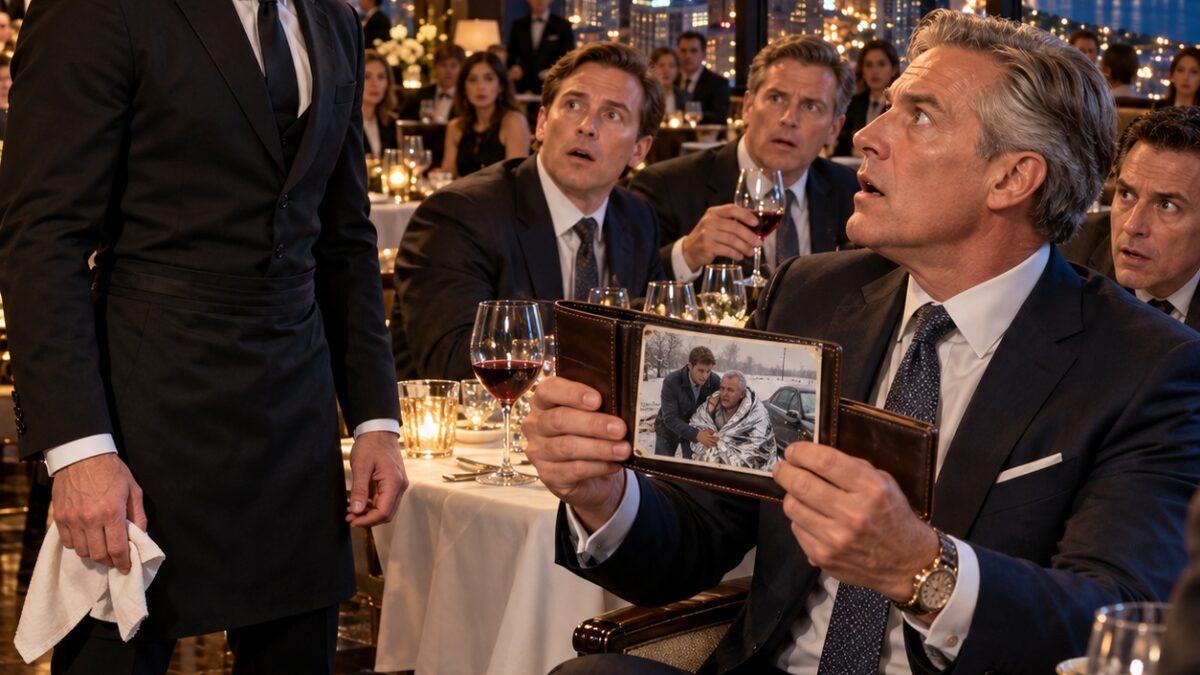
Instead, he took out a black leather wallet.
He opened it.
Not toward me initially.
He was searching for something.
Then I saw the photograph.
Small.
Old.
Slightly bent at one corner.
A younger Grant stood beside an older man in a navy-blue overcoat.
The older man had silver hair.
Broad smile.
A scar near the left side of his chin.
I forgot the restaurant.
Forgot the broken plate.
Forgot the executives.
I stared.
Grant noticed.
“What?”
I stepped closer.
“That man.”
His expression changed.
“What about him?”
“Who is he?”
Grant looked at the photograph.
“My father.”
My mouth went dry.
“Your father’s name?”
He stared at me.
“Arthur Holloway.”
The name landed.
Eleven years disappeared.
Wisconsin.
January.
Twenty-five years old.
Community-college classes during the day.
EMT shifts at night and weekends.
Too much coffee.
Not enough sleep.
I had been driving back toward Milwaukee after helping a friend move.
The storm came harder than predicted.
Snow blowing sideways.
Road visibility disappearing.
I saw the car because one hazard light was still blinking through the snow.
Luxury sedan.
Half on the shoulder.
Driver-side door closed.
No one outside.
I almost kept going.
Then training overruled convenience.
I pulled over.
Hazards on.
Coat zipped.
I fought through the wind to the car.
The driver was slumped behind the wheel.
Awake.
Barely.
Older man.
Gray skin.
Sweating despite the cold.
Breathing badly.
One hand pressed against his chest.
I knocked.
He unlocked the door.
I opened it.
“Sir, can you hear me?”
He nodded.
Tried to speak.
Couldn’t get enough breath.
No reliable phone signal.
Mine had one bar that disappeared every time I tried calling.
His phone was dead.
I checked what I could.
Asked questions.
Name.
Medications.
History.
Arthur.
Cardiac problems.
Pain radiating.
He needed advanced care.
Now.
But the storm had shut down traffic farther ahead.
We were trapped in that miserable space where you know what should happen and cannot make it happen faster.
I stayed with him.
Kept him upright.
Kept him calm.
Managed what my level of training allowed.
Tried emergency dispatch repeatedly until the call connected.
Then waited.
Thirty-eight minutes.
Maybe forty.
Longest forty minutes of my life at that age.
The ambulance finally arrived from the opposite direction.
Before they moved him, Arthur grabbed my wrist.
“You saved my life.”
I told him:
“No, sir. They haven’t saved it yet.”
He smiled weakly.
“Smart-ass.”
That made me laugh.
Then they took him.
I never learned what happened afterward.
Until that night at table fourteen.
I looked at Grant.
“Eleven years ago.”
His expression tightened.
“What?”
“Winter storm outside Milwaukee.”
His face went pale.
I continued.
“Your father’s car broke down.”
Grant stopped breathing for a second.
“He was having a cardiac emergency.”
The executives looked between us.
“He had no signal.”
I pointed toward the photograph.
“I stayed with him until the ambulance came.”
Grant’s voice became almost inaudible.
“What did he say to you?”
That detail told me he already knew.
I answered anyway.
“He said I saved his life.”
Grant sat down slowly.
One executive whispered:
“Jesus.”
Grant looked at me.
“My father talked about that night for years.”
I didn’t know what to say.
“He tried to find you.”
I shook my head.
“There wasn’t anything to find.”
“He contacted the ambulance service.”
“I didn’t work for them.”
“What?”
“I was off duty.”
He looked stunned.
“I happened to be driving by.”
Grant stared at the photograph.
“My father thought it was an EMT crew member.”
“No.”
“He never got your name?”
“I may have told him.”
I almost smiled.
“He was having a rough night.”
Grant rubbed his thumb over the edge of the picture.
“He called you the stranger in the storm.”
That hurt in a strange way.
Not badly.
Just unexpectedly.
For eleven years, Arthur Holloway had existed to me as a forty-minute emergency.
For him, apparently, I had remained part of the story.
Grant looked up.
“You saved my father’s life.”
I shook my head.
“I stayed until help arrived.”
“He had emergency surgery that night.”
“I didn’t know.”
“Doctor said another half hour…”
Grant stopped.
His eyes shifted toward the broken plate still on my tray.
Then toward his executives.
Then back to me.
The arrogance had disappeared.
Not softened.
Gone.
“I mocked the man who saved my father.”
I said nothing.
There are moments when silence is kinder than agreement.
Grant stood.
He walked around the table.
Every person in the room seemed to be listening.
I hated that.
I had spent my whole adult life doing jobs where attention usually meant something was wrong.
Grant stopped in front of me.
Then extended his hand.
I looked at it.
“You don’t have to do that.”
“I know.”
His hand remained there.
I took it.
Firm grip.
Nothing theatrical.
Then he said:
“I owe you an apology.”
I nodded.
“You do.”
One of the executives looked uncomfortable.
Good.
Grant took a breath.
“I’ve spent a long time believing people are valuable because of what they build.”
He glanced toward the windows.
“What they own.”
“The rooms they can enter.”
“The people who return their calls.”
He looked at my uniform.
“And apparently I’ve spent even longer forgetting that the person pouring my wine might have lived an entire life I know nothing about.”
“That happens more often than you’d think.”
He almost smiled.
“I imagine.”
The restaurant manager finally approached.
Mr. Delaney.
He looked like a man who had been informed his waiter had just confronted the most valuable customer in the building and was deciding whether cardiac medication might be necessary.
“Everything all right?”
Grant turned.
“No.”
Mr. Delaney stiffened.
Grant continued.
“Your employee has been treated badly at this table.”
The manager looked at me.
Then Grant.
“I see.”
“No, I don’t think you do.”
Grant pointed toward the broken plate.
“I pushed that onto the floor.”
Mr. Delaney’s face changed.
“And my guests mocked him while he cleaned it.”
One executive said:
“Grant, come on.”
Grant looked at him.
“No.”
The man stopped.
Grant continued.
“Everett did nothing wrong.”
Mr. Delaney looked relieved and horrified simultaneously.
“I appreciate you clarifying that.”
Grant turned back to me.
“Everett.”
“Yes?”
“Your daughter.”
I didn’t like where this was going.
“Is she okay?”
Emotionally or financially?
Physically?
Since Hannah died, that question had become difficult.
“She will be.”
Grant nodded slowly.
That answer stayed between us.
Then I finished the table.
That surprises people when they hear the story.
They assume I walked out.
Or Grant insisted I sit down.
Or everybody applauded.
Real life is not structured that way.
I still had tables.
The dining room did not vanish because one billionaire had an epiphany.
I replaced the broken plate.
Reset the table.
Cleared dessert dishes.
Brought coffee.
Grant did not insult anyone again.
Neither did his executives.
The one who made the dishwasher comment could barely look at me.
When I presented the check, Grant signed without examining the total.
Then he wrote something on the tip line.
I did not look immediately.
Policy.
Always remove the folio first.
Check away from guests.
When I reached the service station, I opened it.
The tip was enormous.
More than my rent.
I stared at it.
Then closed the folder.
That bothered me.
Not because I didn’t need money.
God, I needed money.
But after everything that happened, a massive tip felt dangerously close to buying absolution.
I found Mr. Delaney.
“I want the gratuity adjusted.”
He stared at me.
“Why?”
“It’s too much.”
“Everett.”
“I’m serious.”
“It is a legal tip.”
“I know.”
“You have a child.”
“I know.”
“Hospital debt.”
“How do you know that?”
He looked guilty.
Staff gossip.
Of course.
I continued.
“I’m not refusing it because I’m noble.”
“Then why?”
“Because if I take that amount tonight, I will spend the next year wondering whether I let him pay for the apology.”
Mr. Delaney studied me.
“What amount would you accept?”
“The standard auto-gratuity.”
“Eighteen percent?”
“Yes.”
He exhaled.
“You are the worst financially motivated employee I have.”
“I’m aware.”
The adjustment required Grant’s approval.
Mr. Delaney called him before he left the building.
Grant returned to the host stand.
“You rejected the tip.”
“I reduced it.”
“Why?”
“I told you.”
“You didn’t tell me.”
Right.
I explained.
Grant stared at me.
Then nodded.
“That’s fair.”
No argument.
That impressed me more than the apology.
People used to power often respond badly when generosity is refused.
Grant simply signed the revised amount.
Before leaving, he asked:
“Can I contact you?”
I immediately said:
“Why?”
The question surprised him.
Then he smiled.
“Fair.”
“I want to understand more about my father’s night.”
I considered that.
“That’s okay.”
I gave him my number.
Not address.
Not Maisie’s school.
Just the number.
Then he left.
I got home at 1:18 in the morning.
Maisie was asleep at my sister Leah’s apartment downstairs.
We lived in the unit above hers.
That arrangement had saved us after Hannah died.
Leah worked mornings.
I worked nights.
Between us, Maisie always had somebody.
I carried her upstairs.
She woke halfway.
“Daddy?”
“Yeah.”
“You smell like restaurant.”
“That is because I work at a restaurant.”
“Did rich people behave?”
I stopped.
Where had she learned that phrase?
Probably Leah.
“Mostly.”
She opened one eye.
“Mostly means no.”
“Go back to sleep.”
She wrapped both arms around my neck.
“Love you.”
“Love you too.”
I put her in bed.
Then sat alone at the kitchen table.
Opened my wallet.
Pulled out her picture.
DAD DON’T WORK TOO MUCH.
Behind it were two medical bills.
I laughed quietly.
Then cried.
Not because of Grant.
Not really.
Because Hannah should have been there.
She would have loved the absurdity.
A billionaire mocking me.
His father.
The photograph.
The apology.
She would have listened, then said:
“Did you at least get a good tip?”
And when I told her I reduced it, she would have thrown a dish towel at me.
I missed that woman.
Grief after two years is strange.
People expect it to become smaller.
It doesn’t.
It becomes less central.
There is a difference.
At first, grief is the entire house.
Later, it becomes a room you walk into unexpectedly.
That night, I walked straight into it.
The next morning, Mr. Delaney called.
I assumed I was fired.
Not because Grant complained.
Because luxury restaurants survive by avoiding scenes.
“Everett?”
“Yes?”
“Can you come in before your shift?”
“Am I fired?”
“What?”
“Just tell me.”
“No.”
I relaxed slightly.
“Then why?”
“I have something for you.”
When I arrived at three, Mr. Delaney sat in the office with an envelope.
He pushed it toward me.
I did not touch it.
“What is that?”
“I don’t know exactly.”
“You opened it?”
“No.”
“Then how do you know it’s for me?”
“Your name is on it.”
Fair.
I opened the envelope.
Inside was a handwritten note and several pages from a law firm.
The note came first.
Everett,
You were right to reduce the tip.
I would have wondered the same thing.
This is not payment for my father’s life.
It is not payment for the way I behaved.
Neither can be priced.
My father believed education was the one opportunity nobody could take back once it had been given.
If you are willing, I would like to establish an education account for Maisie.
It will remain entirely hers and cannot be conditioned on anything from you.
No publicity.
No photographs.
No obligation to me or my company.
If you say no, I will respect it.
—Grant Holloway
I stared at the paperwork.
Education trust.
Contributions.
Independent administrator.
No requirement that Maisie attend a particular school.
No Holloway company branding.
No public announcement.
I closed it.
“I can’t accept this.”
Mr. Delaney smiled.
“He said you’d say that.”
“That doesn’t make it less true.”
“He also said not to pressure you.”
“Good.”
I put the documents back.
Then took them home.
For three days, they sat on my kitchen counter.
I did not call Grant.
Leah eventually noticed them.
“What’s this?”
“Nothing.”
She read the first page.
Then looked at me.
“Nothing?”
“I haven’t accepted.”
“Why?”
“It feels wrong.”
“To have help?”
“That isn’t what I mean.”
“Then what do you mean?”
“I don’t want Maisie growing up funded by some rich man’s guilt.”
Leah folded her arms.
“Is the account funded by guilt?”
“Yes.”
“How do you know?”
“Look at what happened.”
She sat down.
“Everett.”
“What?”
“When Mom helped you with EMT school, was that guilt?”
“No.”
“When I take Maisie four nights a week, is that pity?”
“No.”
“When you stayed with that old man eleven years ago, were you expecting anything?”
“Of course not.”
“Then maybe stop turning accepting something into moral failure.”
I hated when Leah made sense.
“She could go to college without debt.”
“I know.”
“Maybe medical school.”
“She wants to be a marine biologist.”
“She is eight.”
“Committed eight.”
Leah smiled.
“Then expensive fish school.”
I looked at Maisie’s drawing on the refrigerator.
Octopus with seven arms.
Apparently anatomy was still developing.
“I don’t want Grant thinking he owns something.”
“Ask him.”
So I called.
He answered himself.
“Everett.”
“You knew it was me?”
“I saved the number.”
“About the account.”
“Yes.”
“I don’t like it.”
“I expected that.”
“Don’t do that.”
“Do what?”
“Act like you understand me.”
Silence.
“Fair.”
I took a breath.
“If I accept this, it does not mean I forgive what you said.”
“I know.”
“It doesn’t mean I owe you.”
“I know.”
“You don’t get access to Maisie.”
“I understand.”
“No publicity.”
“None.”
“No scholarship event.”
“No company newsletter.”
“Agreed.”
I waited.
Then:
“Why are you doing it?”
Grant was quiet for a long time.
“My father left me everything.”
“Money?”
“Money.”
“Companies.”
“Properties.”
“A reputation.”
He exhaled.
“But the thing he talked about most near the end was that storm.”
I listened.
“He said the stranger who stopped had no reason to stop.”
“He was wrong.”
“What?”
“I had a reason.”
“What?”
“Someone needed help.”
Silence again.
Grant said:
“That is exactly what he meant.”
I sat down.
“He spent years trying to identify you.”
“I never knew.”
“He wanted to pay you.”
I almost laughed.
“That sounds familiar.”
“He eventually realized that was probably why you had not come looking.”
Grant’s voice became softer.
“My father grew up poor.”
“I didn’t know.”
“Very.”
“Chicago South Side.”
“He built everything from nothing.”
“He was proud of that.”
“Too proud sometimes.”
I could hear Grant thinking.
“He taught me money was freedom.”
“That if you had enough, nobody could humiliate you.”
I looked at my uniform hanging near the kitchen.
“And what did you learn from that?”
“The wrong part.”
Honest answer.
“He meant money gave you choices.”
“I turned it into a ranking system.”
“People with more mattered more.”
“That is what you believed?”
“Maybe not consciously.”
“That’s usually how the worst beliefs work.”
He laughed once.
“Probably.”
I looked again at the papers.
“This account has to be hers.”
“It is.”
“Not mine.”
“Yes.”
“If I quit the Belmont tomorrow?”
“Still hers.”
“If I insult you again?”
“Still hers.”
“That may happen.”
“I assumed.”
I smiled despite myself.
“And no conditions?”
“None beyond legal administration.”
“Fine.”
Grant paused.
“Fine meaning?”
“I’ll accept it.”
He exhaled.
“Thank you.”
“No.”
“What?”
“You don’t thank me for accepting money.”
“Right.”
He laughed again.
“Still learning.”
Maisie found out that evening.
I explained the account in child language.
“A man is putting money aside for school.”
“Why?”
“He knew somebody I helped a long time ago.”
“Were you a paramedic?”
“EMT.”
“Same.”
“Not same.”
She ignored me.
“Did you save him?”
“I helped.”
“Did he die?”
“Years later.”
She thought.
“Is the money because he died?”
“No.”
“Because you helped?”
“Kind of.”
“Can I use it for dolphin school?”
“Marine biology?”
“Yes.”
“Maybe.”
Her whole face lit up.
“Then say yes.”
“I did.”
“Good.”
Simple.
Children often solve our moral knots by asking whether the outcome helps someone without hurting anybody.
Sometimes adults need more complexity.
Sometimes we manufacture it.
Grant called occasionally after that.
Not often.
At first, mostly about his father.
Arthur had survived the cardiac event.
Emergency surgery.
Then twelve more years.
He met grandchildren.
Traveled.
Eventually died at seventy-eight.
Not young.
Not unfairly.
Grant sent me a copy of a letter Arthur had written near the end of his life.
One paragraph mentioned me.
I still think about the young man in the snow sometimes. I never learned his name. I hope he built a life worthy of the kindness he gave a stranger.
I had to stop reading after that.
Because I wasn’t sure I had.
Not yet.
My life looked small from the outside.
Waiter.
Rental apartment.
Debt.
No degree beyond unfinished community college.
But I had Maisie.
I had stayed through Hannah’s illness.
Held her hand.
Raised our daughter.
Worked.
Survived.
Maybe worthy did not always look impressive.
That was another lesson Grant and I were both learning from Arthur.
Weeks passed.
Grant returned to the Belmont.
Same table.
Different executives.
I almost asked another server to take him.
Didn’t.
I approached.
“Good evening.”
“Everett.”
No jokes.
No comments about work.
Just:
“How are you?”
“Fine.”
“How’s Maisie?”
“Planning dolphin school.”
He smiled.
“I hear that is competitive.”
“Very.”
I poured water.
Then he did something important.
Nothing else.
No grand apology.
No envelope.
No performance.
He treated me like a professional doing a job.
Respect can feel almost invisible when it is present.
That may be why its absence is so loud.
The executives followed his lead.
That bothered me slightly.
Not because they were rude.
Because they demonstrated the same behavior from the opposite direction.
When Grant mocked me, they laughed.
When Grant respected me, they did too.
People talk a lot about powerful men.
Not enough about the people around them who make power easy.
Months later, I saw one of the executives from that first dinner at another table.
His name was Peter Lang.
He recognized me immediately.
I served him.
At the end of the meal, he stopped me.
“Everett.”
“Yes, sir?”
“I owe you an apology too.”
I waited.
“I laughed.”
“Yes.”
“I knew he was being cruel.”
That mattered.
“Why did you laugh?”
Peter looked embarrassed.
“Because he was my boss.”
“Is he still?”
“Yes.”
“Then what changed?”
Peter exhaled.
“I did.”
Good answer.
Not perfect.
Useful.
“I’m sorry.”
“Thank you.”
No dramatic forgiveness.
Just recognition.
That was enough.
Grant’s change was slower.
As it should have been.
One apology cannot rewrite character.
People who have spent decades treating status like morality do not become humble because a waiter has a compelling backstory.
He still interrupted people.
Still expected fast answers.
Still pushed hard in negotiations.
Still entered rooms knowing the room would react.
But certain things changed.
He started learning names.
That sounds embarrassingly small.
It was.
At the Belmont, busser staff noticed.
Valets noticed.
He began thanking people while looking at them.
Not through them.
He stopped snapping fingers for service.
Once, I watched him pick up a napkin he dropped.
I said:
“Careful.”
He looked up.
“What?”
“You’re becoming dangerously self-sufficient.”
He laughed.
“Don’t tell the board.”
We had reached the point where jokes were possible.
Not friendship.
Not yet.
Then, about a year after our first encounter, Grant called me.
“I need advice.”
“That sounds expensive.”
“I’m serious.”
“About what?”
“My company.”
“I carry plates, Grant.”
“You used to work emergency medicine.”
“Eleven years ago.”
“You understand people better than some consultants I employ.”
“That is not reassuring.”
He laughed.
Then explained.
Holloway Holdings had a tuition-reimbursement program.
Good on paper.
Almost nobody in service-level positions used it.
Housekeepers.
Maintenance crews.
Restaurant staff in his hotel portfolio.
Security.
People supposedly eligible for education assistance were not applying.
“Why?”
He asked.
“I don’t know.”
“What would stop you?”
That question was better.
“Schedule.”
“Explain.”
“If classes happen when I work, reimbursement means nothing.”
He wrote something down.
“Childcare.”
More writing.
“Up-front cost.”
“But we reimburse.”
“After.”
Silence.
“Oh.”
“Exactly.”
“If somebody doesn’t have two thousand dollars first, promising to return it three months later does not help.”
More writing.
“What else?”
“Fear.”
“Of school?”
“Of changing jobs.”
I explained.
“Somebody making twenty dollars an hour with a child cannot always gamble on training for something that might not pay more.”
Grant was quiet.
“What would make the program useful?”
“Pay up front.”
“Offer schedule flexibility.”
“Include certification programs, not only four-year degrees.”
“Childcare support.”
“Let people train without requiring them to stay five years afterward.”
“That last part protects our investment.”
“It also turns education into handcuffs.”
He did not like that sentence.
I could tell.
Good.
Months later, his company changed the program.
Not exactly as I suggested.
Close.
Participation tripled the next year.
Grant called.
“You were right.”
“Record that.”
“I will deny it.”
That was probably the moment our relationship became something like friendship.
We still came from worlds that barely touched.
He flew private.
I took the train.
He owned hotel floors.
I argued with my landlord about a radiator.
But his questions improved.
He stopped asking:
Why don’t people do better?
Started asking:
What makes better harder?
That difference matters.
Maisie grew.
Nine.
Ten.
Eleven.
The education account grew too.
I tried not to look at the statements obsessively.
Impossible.
By eleven, Maisie had temporarily abandoned marine biology for veterinary medicine.
At twelve, architecture.
At thirteen, marine biology again.
Grant sent her one birthday card a year.
Nothing expensive inside.
Usually a joke about dolphins.
The first time, I considered returning it.
Then Maisie said:
“Dad, normal people can send cards.”
Fair.
She knew him eventually.
Under conditions I controlled.
Not because of the money.
Because by then he had become part of the story.
The first meeting happened at a public charity event.
Maisie was ten.
Grant crouched slightly when she approached.
Not because she was little.
Because he wanted eye level.
“Maisie.”
“You’re Grant.”
“I am.”
“You were mean to Dad.”
I closed my eyes.
Grant nodded.
“I was.”
“Why?”
Excellent question.
He thought before answering.
“Because I thought having more money meant I understood more about people.”
Maisie frowned.
“That doesn’t make sense.”
“No.”
“It doesn’t.”
She looked at me.
“Why was he that dumb?”
“Maisie.”
Grant laughed so hard he had to look away.
“I like her.”
“You don’t get to encourage this.”
Too late.
Years later, she still referred to that evening as the day she “interviewed the billionaire.”
Grant never tried to become family.
That boundary mattered.
He was simply a man whose father I once helped.
Then a man who behaved badly.
Then a man who tried to behave better.
People kept wanting the story to become cleaner.
News eventually found out.
Not from us.
Someone at the restaurant talked.
A local magazine called.
WAITER WHO SAVED BILLIONAIRE’S FATHER GETS LIFE-CHANGING REWARD.
I hated the headline before the article existed.
I refused the interview.
Grant refused too.
That impressed me.
His communications director apparently begged.
He told her:
“If Everett doesn’t want the story used, we don’t use it.”
Good.
The magazine ran a shorter piece anyway.
Public records.
Anonymous staff.
Minimal details.
Maisie came home from school annoyed.
“People think we’re rich now.”
“We are not.”
“I know.”
“Did you tell them?”
“Yes.”
“What did they say?”
“They said college fund is rich.”
I considered that.
“They may have a point.”
She rolled her eyes.
Money changes things even when it does not enter your checking account.
The education fund removed one fear.
That mattered.
But rent remained.
Groceries.
Work.
Life.
I stayed at the Belmont for several more years.
People asked why I did not suddenly quit.
Quit and do what?
A trust for Maisie did not feed us.
I still needed income.
Still had debt.
Still had a child.
Eventually I moved into restaurant management.
Not because Grant arranged it.
That point mattered enough that I verified it.
Mr. Delaney recommended me.
I had trained half the new servers already.
The promotion increased my salary.
Reduced tips.
Improved predictability.
That helped with parenting.
On my first night as floor manager, Grant arrived.
He saw the suit.
Smiled.
“Look at you.”
“Careful.”
“What?”
“That sounds dangerously close to being impressed by status.”
He laughed.
“Fair.”
Then:
“Congratulations.”
“Thank you.”
No:
Finally moving up.
No:
Better than serving.
He had learned.
Work should not need a prestige ladder before it deserves respect.
When Maisie was fourteen, we finally paid the last medical bill connected to Hannah.
I sat at the kitchen table holding the confirmation.
Paid in full.
Seven years after her death.
The cruelty of illness sometimes has an accounting department that outlives the patient.
I cried.
Maisie found me.
“What happened?”
I showed her.
She understood enough.
“Mom’s bills?”
“Yes.”
“All gone?”
“Yes.”
She hugged me.
“That means you can work less.”
I laughed.
“Not exactly.”
She pulled away.
“Her picture said not to work too much.”
I stared.
“What picture?”
“The one in your wallet.”
“How do you know about that?”
“I’ve seen it.”
Children know everything eventually.
I pulled out the old photograph.
She was older now than the girl in it.
The yellow sweater photograph had softened at the corners.
The purple message still visible.
DAD DON’T WORK TOO MUCH.
Maisie smiled.
“I had terrible handwriting.”
“You were eight.”
“I was still right.”
“Yes.”
Maybe I finally listened.
I cut one shift.
Then another after the management promotion.
For the first time since Hannah got sick, I had two full evenings a week at home.
Maisie barely knew what to do with me.
“Why are you here?”
“I live here.”
“On a Wednesday?”
“I’ve always lived here.”
“Not emotionally.”
Teenagers are vicious.
We cooked.
Badly.
Watched television.
Argued.
Normal things.
Those evenings were worth more than any tip Grant ever tried giving me.
Grant changed in his own world too.
Not saintly.
I want to be honest.
He still owned billion-dollar companies.
Still laid people off when businesses failed.
Still fought competitors.
Still possessed the kind of wealth that creates ethical questions a single changed attitude cannot resolve.
But at least inside his control, certain habits changed.
Entry-level workers gained representation in internal advisory meetings.
His tuition program expanded.
Hotel staff received emergency childcare support after a pilot program.
He started insisting executives spend one day each year working alongside operational teams.
That initiative created chaos the first year.
One vice president lasted forty minutes in hotel laundry before admitting he had never understood the workload.
I laughed for a week.
Grant called.
“You enjoying this?”
“Immensely.”
“You’re cruel.”
“Money doesn’t decide what a man is worth.”
“Are you ever going to stop using that against me?”
“No.”
“Fair.”
One afternoon, years after the Belmont incident, Grant invited me to his office.
I rarely went.
Different atmosphere.
Top-floor suite.
Art I did not understand.
Windows looking down at the city.
On his desk was the old photograph.
Arthur beside younger Grant.
I picked it up.
“Why this one?”
“My father hated pictures.”
“He looks happy.”
“He was.”
Grant sat.
“He changed after the heart attack.”
“How?”
“Slowed down.”
“That sounds good.”
“He thought it was.”
Grant smiled.
“He started calling employees directly.”
“Why?”
“To ask what annoyed them.”
I laughed.
“That sounds terrifying.”
“It was.”
“He said almost dying made him realize executive reports contain surprisingly little reality.”
I looked at the photograph.
“He talked about you until the end.”
“That still feels strange.”
“He would have liked Maisie.”
“Everyone likes Maisie until she asks follow-up questions.”
Grant laughed.
Then became serious.
“My father wanted to create some kind of scholarship for EMT trainees.”
“I didn’t know.”
“He never did.”
I waited.
“I’m thinking about doing it now.”
“Your money.”
“I want your opinion.”
“Why?”
“Because naming a scholarship after a rich man saved by an EMT feels slightly backward.”
That made me smile.
“What are you proposing?”
“Arthur Holloway Emergency Service Scholarship.”
“No.”
He frowned.
“Why?”
“Too much Holloway.”
“It was his idea.”
“Then fund people who actually do the work.”
“So?”
“Community-college EMT students.”
“Paramedics.”
“Fire science.”
“People working while studying.”
Grant wrote.
“Include living expenses.”
He stopped.
“Not just tuition?”
“No.”
“When I was twenty-five, tuition wasn’t what nearly made me quit.”
“What was?”
“Rent.”
“Gas.”
“Missing shifts for clinical hours.”
“Food.”
Grant nodded slowly.
“Again.”
“What?”
“I keep designing programs around costs wealthy people can see.”
“Yes.”
“And missing the costs poor people actually feel.”
“Yes.”
“That was blunt.”
“You called me here.”
The scholarship launched the next year.
No giant gala.
No check presented to me.
Arthur’s name remained.
I agreed to that after Grant showed me a line from his father’s journals:
The stranger stopped because he believed a life mattered before he knew who I was.
That deserved preservation.
The program funded training plus living stipends.
People completed EMT and paramedic programs who otherwise might not have.
Grant wanted me on the board.
I declined.
Then Maisie said:
“You should.”
I asked:
“Why does everybody in my life volunteer me for things?”
“Because you complain and then do them.”
Unfair.
True.
I joined.
At our first meeting, one applicant essay stopped me.
Single mother.
Twenty-eight.
Hotel housekeeper.
Wanted to become a paramedic.
Worked nights.
Could afford tuition with grants.
Could not afford unpaid clinical rotations.
Exactly.
I approved her.
Two years later, she became a licensed paramedic.
Grant attended graduation.
Quietly.
No press.
Afterward he said:
“I think my father would’ve liked this.”
I looked at the new paramedic hugging her daughter.
“Yes.”
That was better than a giant tip.
Better than an apology even.
Not because it erased the original cruelty.
Nothing does.
But real change leaves infrastructure.
Habits.
Policies.
Opportunities somebody else can use.
Maisie eventually chose biomedical engineering.
Not dolphins.
Not veterinary medicine.
Not architecture.
She blamed me.
“You always fix things.”
“I carry plates.”
“Not anymore.”
“I fix schedules.”
“Same personality.”
The education trust covered most of her undergraduate costs.
She earned scholarships too.
She insisted on working summers.
Grant found out she had a campus job.
He called me.
“She doesn’t need to work.”
“She wants to.”
“Why?”
“Because apparently rich people don’t understand jobs.”
Silence.
Then:
“That was deserved.”
Maisie graduated without student debt.
That was the day the education fund finally felt real.
Not paperwork.
Not redemption.
A young woman in a cap and gown.
Her mother’s necklace around her neck.
My sister Leah crying louder than necessary.
Grant seated three rows back because Maisie had invited him.
Not front.
Not VIP.
Three rows back.
When her name was called, I shouted.
Completely inappropriate volume.
Maisie later said:
“You embarrassed me.”
“Legally required.”
She smiled.
Hannah should have been there.
That absence never stops.
Success does not fill the chair of the person who died before seeing it.
After graduation, we visited Hannah’s grave.
Maisie placed a photograph beside the stone.
Cap and gown.
Then whispered something I did not ask about.
On the drive home, she said:
“Dad?”
“Yeah?”
“Do you ever wish that night with Grant never happened?”
Interesting question.
“Yes.”
She looked surprised.
“Really?”
“He humiliated me.”
“Right.”
“You were eight.”
“I was tired.”
“Scared about bills.”
“Angry at everything.”
“I would happily remove that evening.”
“But then the college fund.”
“We would’ve found another way.”
“The scholarship program.”
“Maybe it wouldn’t exist.”
“Then you don’t wish it away.”
I smiled.
“Life doesn’t work like equations.”
She waited.
“Something good growing out of something ugly doesn’t make the ugly necessary.”
She looked out the window.
“So you’re glad about what came after.”
“Yes.”
“Not what caused it.”
“Exactly.”
She nodded.
“I like that.”
So did I.
Grant and I became friends eventually.
Real friends.
It took years.
Friendship requires equality.
Not financial equality.
We never had that.
The kind where either person can tell the other he is being an idiot.
I developed that right early.
He learned to use it on me too.
When I overworked, he said:
“Maisie’s note.”
I hated him for remembering.
When he became dismissive in meetings, I would say:
“Table fourteen.”
He hated me for that.
Useful friendship.
He never stopped being wealthy.
I never became wealthy.
That was important too.
Stories like ours often want wealth to transfer.
Billionaire discovers worthy poor man.
Poor man receives fortune.
Then dignity becomes easier because he no longer has to be poor.
That misses the point.
I was not worthy because Grant later helped my daughter.
I was worthy when I was carrying the tray.
I was worthy when I needed tips.
I was worthy when I crouched beside his broken plate.
The reveal changed Grant’s perception.
It did not change my value.
That distinction became the most important part of the story.
If Arthur had not been in the photograph, Grant still would have been wrong.
If I had never worked as an EMT, he still would have been wrong.
If I had done nothing heroic in my entire life, he still would have been wrong.
Service work does not reduce a person.
Poverty does not.
Debt does not.
Uniforms do not.
Job titles do not.
That was the lesson Grant struggled with longest.
Years after we met, he admitted something.
We were sitting at a small diner.
His choice.
Not mine.
He had discovered grilled cheese at age fifty-eight and behaved as if he had invented it.
“I think I would have apologized even if you hadn’t recognized my father.”
I looked at him.
“No, you wouldn’t.”
He frowned.
“You don’t know that.”
“I do.”
“How?”
“Because you only stopped after the photograph.”
He sat quietly.
Then nodded.
“You’re right.”
“That’s the problem.”
“What?”
“You needed me to become exceptional before you treated me as equal.”
He looked at his sandwich.
“That is uncomfortable.”
“Good.”
He thought.
“What would have happened if I hadn’t taken out the wallet?”
“I probably would’ve finished the table.”
“And then?”
“Gone home.”
“You would’ve hated me.”
“For a while.”
“Then forgotten me.”
“Probably.”
He smiled sadly.
“That may be worse.”
“For you?”
“Yes.”
“Why?”
“Because I would have gone on being the same man.”
That was honest.
We ate.
Around us, servers moved between booths.
A teenage busboy dropped silverware.
Nobody laughed.
Grant picked up a fork that rolled near his shoe.
Small thing.
Nobody noticed.
I did.
That is how change looks most of the time.
Boring.
Unobserved.
Real.
Arthur Holloway’s photograph still sits on Grant’s desk.
My old Maisie photo still sits in my wallet.
Different copy now.
The original is in a frame because it nearly disintegrated.
DAD DON’T WORK TOO MUCH.
I finally learned.
Maisie is grown.
I manage hospitality operations for a smaller restaurant group now.
Ironically, I spend much of my career training managers.
The first lesson I give new supervisors has nothing to do with service.
I place a server apron on the table.
Then ask:
“What does this tell you about the person wearing it?”
People answer:
They work here.
Exactly.
Nothing about intelligence.
Education.
Family.
History.
Debt.
Ambition.
Trauma.
Kindness.
Courage.
Nothing.
A uniform tells you the role someone is performing while you are looking at them.
It does not tell you the life they return to when they take it off.
I learned that from being invisible.
Grant learned it by discovering too late that the waiter he had been mocking once held his father’s hand in a snowstorm.
We both wished he had learned sooner.
But he learned.
That matters.
A few years ago, Grant and I returned to the Belmont.
The restaurant had changed ownership.
Different furniture.
Same view.
We sat at table fourteen.
He requested it.
A young waiter approached.
Probably twenty-two.
Nervous.
Dropped a spoon.
Apologized three times.
Grant said:
“It’s a spoon.”
The young man looked surprised.
Grant smiled.
“No one died.”
The waiter relaxed.
After he left, I looked at Grant.
“What?”
“You’ve come a long way.”
“Do not get emotional.”
“I wasn’t.”
“You had the face.”
“What face?”
“The father face.”
“You sound like Maisie.”
“That concerns me.”
Dinner went well.
At the end, Grant asked the waiter:
“Are you in school?”
The young man stiffened.
Maybe he expected judgment.
“Yeah.”
“What for?”
“Nursing.”
Grant nodded.
“Good luck.”
That was all.
No scholarship.
No business card.
No life-changing offer.
Just respect.
I liked that more.
Because sometimes rich people learn the wrong lesson from redemption.
They start solving every uncomfortable encounter with money.
Money is useful.
It can change lives.
Maisie’s education proved that.
The EMT fund proved it.
But dignity should not require a benefactor.
Sometimes the correct response is simply:
Thank you.
Please.
I’m sorry.
What’s your name?
Basic words.
Strangely powerful.
When we left, Grant stood near the elevator.
“You remember what you said that night?”
“Unfortunately.”
“Mock me again.”
I groaned.
“I sounded ridiculous.”
“You scared my executives.”
“Good.”
He smiled.
“Do you remember what I asked?”
“Why I was acting brave.”
He nodded.
“And your answer.”
“Money doesn’t decide what a man is worth.”
Grant looked toward the restaurant.
“I hated that sentence.”
“I know.”
“Still do sometimes.”
“Good.”
The elevator arrived.
We stepped inside.
He said:
“My father would have liked you.”
I smiled.
“Your father called me a smart-ass.”
Grant stared.
“You never told me that.”
“He did.”
“When?”
“Before the ambulance took him.”
Grant started laughing.
The elevator doors closed.
For a moment, I could see Arthur’s face in my memory.
Pale.
Frightened.
Still joking.
I wondered what he would think if he knew what came from those forty minutes.
His son.
Maisie.
The scholarship program.
Me.
All connected because one night a car stopped in a snowstorm.
People call that fate.
I don’t know.
I think most lives are built from smaller decisions than fate.
Stop the car.
Stay with a stranger.
Go to work.
Swallow an insult.
Then decide not to swallow the next one.
Apologize.
Accept an apology without pretending it erases anything.
Offer help.
Accept help.
Change.
Repeat.
No single decision made Grant a better man.
No single act made me one either.
That is another thing people misunderstand about heroes.
They imagine identity as a dramatic moment.
Mostly, character is repetition.
What do you do again?
And again?
And again?
Arthur remembered me because I stayed.
Hannah trusted me with Maisie because I stayed.
Maisie knew I loved her because I kept showing up.
Grant became someone I respected because after apologizing once, he behaved differently the next time.
And the next.
That is the only redemption I believe.
Not surprise.
Pattern.
I still work more than Maisie thinks I should.
She still reminds me.
She recently gave me a new wallet.
Inside, before giving it to me, she placed the old photograph.
Yellow sweater.
Missing tooth.
Terrible braids.
On the back, beneath her eight-year-old message, she added a second one in adult handwriting:
SERIOUSLY, DAD. I MEANT IT.
I laughed so hard I had to sit down.
Then I called her.
“You’re obnoxious.”
“Genetic.”
“From your mother.”
“Obviously.”
After the call, I kept the photograph in my hand.
For years, I had believed everything I endured at the Belmont was for Maisie.
The hours.
The insults.
The exhaustion.
Mostly true.
But children should not become excuses for parents to accept limitless disrespect.
That night with Grant taught me that too.
There is a difference between swallowing pride and surrendering dignity.
I had crossed that line more times than I should have because fear makes people obedient.
Fear of rent.
Fear of losing a job.
Fear of another bill.
Fear of being the only parent.
“Mock me again” was not heroic.
It was exhausted.
A man reaching the point where staying silent cost more internally than whatever consequences speaking might create.
I am lucky the story ended the way it did.
The photograph.
Arthur.
Grant’s apology.
Most workers who stand up to wealthy customers do not discover a magical connection that changes the room.
That is why the real lesson cannot be:
Maybe the waiter once saved your father.
The lesson has to be:
It should not matter.
The waiter is a person before you know his story.
The housekeeper.
The driver.
The cashier.
The dishwasher.
The security guard.
The executive assistant.
The maintenance worker.
The man cleaning broken porcelain while you laugh.
You do not need evidence that someone is extraordinary before treating them as human.
Grant learned that because coincidence forced him to.
I hope the rest of us can learn it without needing a photograph.
That night, the billionaire thought the important reveal was that I had saved his father.
It wasn’t.
The important reveal was what he had been willing to do to me before he knew.








