FULL STORY:”Please Save the Dog Before They Take Him” the Elderly Woman Begged—What the SEAL Did Moved Everyone
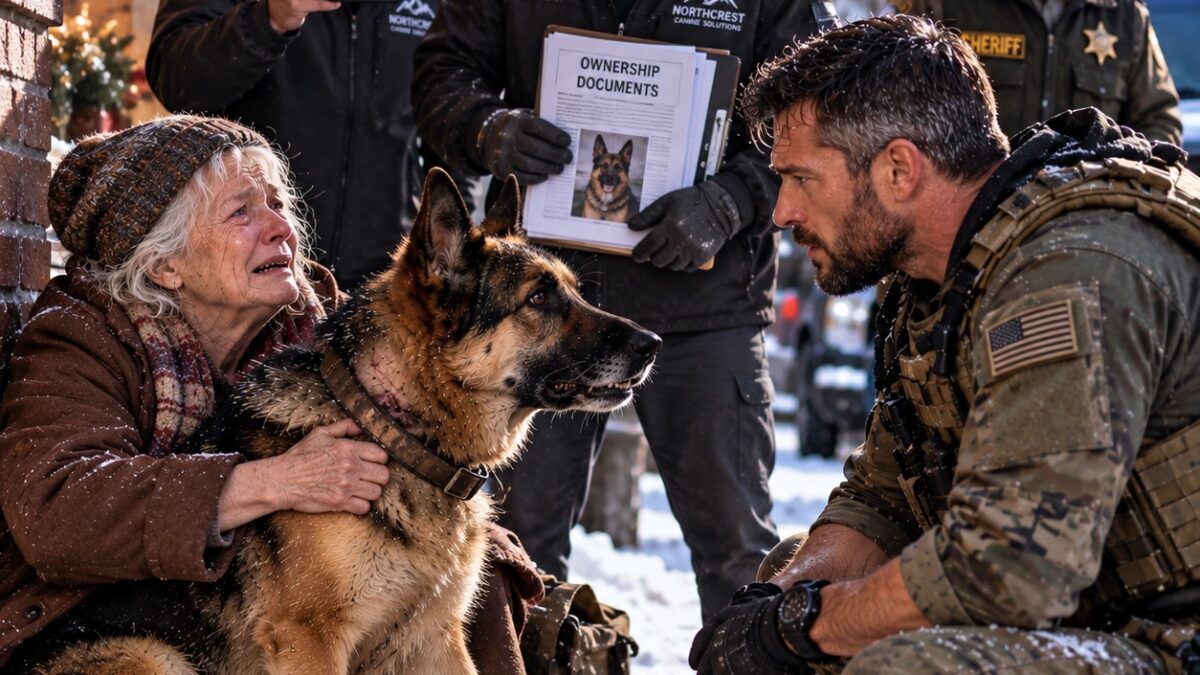
Sheriff Lowell Bexley didn’t rush into the alley.
That was the first thing I respected about him.
He stepped out of his vehicle, closed the door, and took several seconds to study the scene before saying anything.
He was in his early sixties, broad-faced, with silver hair and a heavy brown winter coat.
His expression was tired, but his eyes were sharp.
He noticed Pierce’s phone.
Benton’s gloves.
My position.
The woman’s bent paper cup.
And the dog standing protectively in front of her.
“Nobody moves closer,” he said.
Benton lowered his hand.
Vesper didn’t relax.
His eyes continued tracking the man.
Lowell looked toward Pierce.
“Turn that camera off.”
Pierce hesitated.
“Sir, we’re documenting a dangerous animal.”
“Then you should have plenty documented already.”
Pierce lowered the phone.
Lowell turned toward the woman.
“Ma’am, what’s your name?”
“Eudora Finch.”
“Do you live in town?”
“Currently, I seem to live wherever people stop asking me to leave.”
Lowell sighed.
I almost smiled.
Even frightened, she had enough spirit left to be difficult.
He questioned everyone separately.
Pierce explained that Northcrest had purchased the dog, trained him, registered his microchip, and reported him missing.
Benton said the dog had become unpredictable.
Eudora refused to explain exactly where she’d found him.
When Lowell asked about the broken chain, she tucked it farther beneath her coat.
“Mrs. Finch,” he said carefully, “if this dog belongs to Northcrest, I need to know why you have him.”
She looked down at Vesper.
“If you send him back, he’ll die.”
Pierce made an irritated sound.
“That’s an outrageous accusation.”
Lowell ignored him.
“What happened to the dog?”
Eudora’s jaw tightened.
“I’ve said what I can say.”
I watched the sheriff.
He wasn’t dismissing her.
But he couldn’t make ownership documents disappear because she believed something terrible would happen.
“All right,” he said eventually.
“Everyone comes to the station.”
Benton looked relieved.
Eudora looked as though somebody had read her a death sentence.
Vesper pressed closer to her knees.
I leaned down just enough for her to hear.
“I’m not leaving.”
She looked up.
“You don’t even know me.”
“No.”
“Then why?”
I glanced toward the dog.
“Because I don’t think this is finished.”
At the sheriff’s station, the situation became more complicated.
Northcrest sent copies of its records.
A purchase agreement.
Microchip registration.
Training documents.
The dog was listed as NC-17, registered name Rexler.
The records appeared legitimate.
The company’s ownership claim was real.
That fact mattered.
I wasn’t about to pretend otherwise simply because I disliked the men holding the documents.
But other facts mattered, too.
There was no court order authorizing immediate recovery.
No completed animal-control evaluation.
No evidence that Vesper had bitten anyone.
And no formal examination of the scars hidden beneath his collar.
Eudora sat against the wall with Vesper pressed to her knees.
Every time Benton shifted, the shepherd’s ears moved.
But he didn’t bark.
Didn’t lunge.
Didn’t attack.
He simply watched.
Lowell studied the paperwork.
Then looked at Eudora.
“Mrs. Finch, I need the truth.”
She stared at her hands.
“I’ve been telling the truth.”
“Not all of it.”
She said nothing.
A county community coordinator named Nadine Farrow arrived shortly afterward.
She was in her mid-fifties, with dark hair threaded with silver and a composed manner that immediately made Eudora less defensive.
Nadine arranged a temporary shelter bed.
Then discovered the shelter wouldn’t accept Vesper.
His size, guarding behavior, and unresolved ownership made him ineligible.
The county kennel couldn’t take him without an animal-control assessment, which wasn’t available until morning.
“And she won’t go without him,” Lowell said.
Eudora gave him a dry look.
“Congratulations, Sheriff. Your investigative training remains intact.”
To my surprise, he almost smiled.
I looked at Vesper.
Then at Eudora.
Then at the temporary housing form in Nadine’s hand.
My uncle’s cabin stood outside town.
No close neighbors.
A secure mudroom.
A guest room.
Enough space to keep the dog separated if necessary.
It wasn’t ideal.
But it was better than forcing a terrified animal into a situation nobody had properly evaluated.
“I can take them tonight,” I said.
Lowell looked at me.
“You understand this is temporary?”
“Yes.”
“One night. The dog stays on private property. Veterinary evaluation tomorrow. You return when requested.”
“Understood.”
He studied me.
“You’re assuming responsibility for both the accommodation and the animal’s immediate care.”
I nodded.
I had signed responsibility forms throughout my career.
Some had involved equipment worth more than the cabin.
Others involved tasks where lives depended on precise procedures.
This form looked simple.
But as Eudora rose from her chair and Vesper moved beside her, I had the uncomfortable feeling I’d agreed to something much larger than a single night.
The ride to my cabin was quiet.
Eudora sat beside me.
Vesper occupied the space behind the seats.
He watched my hands in the rearview mirror.
When I moved toward the heater controls, his ears lifted.
When I returned my hand to the wheel, he settled slightly.
Snow-covered fields passed outside.
After several miles, I spoke.
“Why does Northcrest want him badly enough to follow you through town?”
Eudora watched the frozen lake appear between the pines.
“Some men aren’t afraid a dog will bite them.”
I waited.
“They’re afraid he’ll remember what they did.”
I looked at her.
“Remember?”
Her fingers touched the broken chain beneath her coat.
She didn’t answer.
I let the silence remain.
My cabin had belonged to my late uncle.
It stood among tall pines above a frozen lake.
I’d been there eleven days and had barely made it suitable for one person.
The dining table was covered with tools.
Measuring tape.
Roofing nails.
Sandpaper.
Three chairs stood upside down against the wall.
Dust covers hung over the furniture.
The refrigerator contained mustard, half a carton of eggs, two bottles of water, and a jar of pickles I wasn’t entirely sure was safe.
Eudora stared inside.
“I’ve seen better-stocked refrigerators in abandoned motels.”
“I wasn’t expecting company.”
“No sensible man ever does.”
She glanced toward the pantry.
“That’s why women invented canned soup.”
I sighed.
She was going to be trouble.
Vesper entered cautiously.
He inspected the kitchen.
The hallway.
The open doorways.
The stairwell.
He moved with a slight hitch in his right rear leg.
When he reached the guest room, he returned to Eudora and walked beside her until she entered.
Then he lay across the threshold.
I approached with blankets.
He stood.
I stopped.
Returned with water.
He stood again.
No growling.
No teeth.
But no invitation either.
I began understanding something.
He wasn’t trying to dominate the room.
He was making sure he could see what happened to her.
I carried a folding cot downstairs and placed it near the fireplace after Eudora refused the guest room.
“Why won’t you sleep in a proper bed?”
She studied the clean blankets.
“Because people who expect to leave before morning learn not to disturb much.”
The answer silenced me.
I finished making the cot.
Then heated tomato soup.
Vesper refused his food until Eudora began eating.
I noticed it immediately.
I’d placed a clean bowl of water beside him and offered a modest meal of eggs and bread because I had no dog food in the cabin.
He ignored both.
Then Eudora raised the first spoonful of soup to her mouth.
Vesper lowered his head and ate.
Every few bites, he looked toward her.
When she ate again, he continued.
I watched.
“Does he always do that?”
Eudora nodded.
“He waits.”
“For permission?”
“For proof.”
“Of what?”
“That I’m eating, too.”
I looked down at the dog.
Then back at her.
They had developed a system around each other’s survival.
That was the only way I could describe it.
Vesper wouldn’t take care of himself until he knew Eudora was doing the same.
And Eudora seemed to move through the world by making sure the dog had what he needed.
Neither knew how to stop worrying about the other.
Over dinner, she told me the first part of her story.
Four months earlier, she’d been living in a trailer outside Priest River, Idaho.
The trailer belonged to her.
Very little else did.
She earned small amounts of money repairing clothing.
Hems.
Zippers.
Old sewing machines.
Anything that still had life in it.
One October night, she heard something strike the underside of her trailer.
At first, she thought it was a raccoon.
Then she heard breathing.
She took a flashlight outside.
Found Vesper beneath the metal steps.
He was thinner then.
Mud covered his belly.
His rear leg was bleeding.
A length of broken chain hung from a leather collar rubbed raw against his neck.
“He didn’t come to me,” she explained.
“He came to the darkness beneath my trailer. I just happened to be living above it.”
She placed water near him.
Went inside.
By morning, the bowl was empty.
The next evening, she left scraps of chicken.
On the third night, he allowed her to sit on the steps while he ate.
“Why Vesper?” I asked.
“He only came out after sunset.”
She smiled faintly.
“I was thinking about evening prayers. Vesper sounded less dramatic.”
For three months, she’d cared for him.
Cleaned his wound.
Removed the chain.
Helped him learn that raised hands didn’t always mean pain.
At first, he slept beneath the trailer.
Then beside the door.
Then inside during a freezing rain.
She looked toward him.
“He was beginning to trust again.”
“What happened?”
“A woman at the campground took his picture.”
The woman meant well.
She thought somebody might be searching for a lost dog.
She posted it online.
Someone recognized the damaged ear.
Two days later, a Northcrest truck arrived.
The men had paperwork.
Photographs.
A microchip number.
They called him Rexler.
At the sound of the name, Vesper’s whole body changed.
His legs stiffened.
His breathing stopped for a beat.
His damaged ear flattened.
Eudora set down her spoon.
“Vesper.”
He looked at her.
“You’re here.”
He exhaled.
Slowly.
I watched the reaction.
The name hadn’t merely attracted his attention.
It frightened him.
Eudora admitted she’d left Idaho after the men found her.
She’d traveled through Spokane, Coeur d’Alene, and farther east.
She’d stayed in shelters when they’d accept both her and Vesper.
A truck driver named Emmett Holcomb eventually gave them a ride toward Montana.
She believed Northcrest had followed them.
She’d seen company vehicles more than once.
“Why didn’t you call the police?” I asked.
She looked at me.
“Because the men had papers saying the dog belonged to them.”
“That doesn’t mean they could hurt him.”
“No.”
She folded her hands.
“But it meant I would have to prove they had.”
I sat back.
“Did you take him to a veterinarian?”
“Yes.”
“A clinic?”
“In Spokane.”
“What happened?”
“They scanned his chip. Northcrest was listed as the owner.”
She swallowed.
“When the technician stepped outside to make a call, Vesper tried climbing beneath a metal bench.”
“You left?”
“Yes.”
“That made you look guilty.”
She met my eyes.
“I was guilty of taking him away from people who said he belonged to them.”
I felt my jaw tighten.
The ownership issue wasn’t simple.
But neither was the dog lying at her feet.
Before I could ask more, Eudora rose.
Too quickly.
Her hand caught the table.
The other pressed beneath her collarbone.
“Are you all right?”
“I’m old.”
“That wasn’t the question.”
“It’s frequently the answer.”
Her face had gone pale.
Vesper stood immediately.
I stepped toward her.
He moved into my path.
Not aggressively.
Just preventing me from closing the distance too quickly.
I stopped.
“Fine.”
I lowered my hands.
“She sits. I stay here.”
Eudora sank into the chair.
After a minute, her breathing steadied.
She insisted she’d merely stood too fast.
I wasn’t convinced.
But she refused further help.
That night, I banked the fire.
Left water near her cot.
And went upstairs.
Sleep came in fragments.
Sometime after midnight, I heard claws against wood.
Three slow scratches.
Then silence.
I opened my bedroom door.
Vesper stood in the hallway.
His ears were raised.
He looked toward the stairs.
Then back at me.
I followed.
Eudora was sitting partly upright on the cot.
One hand gripped the blanket.
The other pressed against her chest.
Her breathing was shallow.
Her face had lost its color.
I was beside her immediately.
“Eudora?”
“I’m fine,” she whispered.
“No.”
I called emergency services.
Gave the address.
Unlocked the door.
Cleared the path between the cot and the entrance.
Vesper paced once.
Then returned to her.
He pressed his nose against the green sewing bag beneath her blanket.
I opened it.
Inside were medicine bottles.
Folded papers.
A needle case.
And a card identifying a heart rhythm condition.
Twelve minutes later, the ambulance arrived.
The paramedics wouldn’t let Vesper ride.
He watched from the doorway as Eudora was taken outside.
Then he turned toward me.
For the first time, he looked uncertain about what I intended to do.
I grabbed my keys.
“Come on.”
At the hospital, Vesper waited outside the emergency entrance.
Snow fell beneath the yellow security light.
He refused water.
Ignored the bread I offered.
Wouldn’t lie down.
Even when his injured leg began trembling.
I stood beside him.
Didn’t promise everything would be okay.
I didn’t know that.
I’d spent years hearing people make promises simply because silence was uncomfortable.
I wasn’t going to do that to a dog who had already experienced too many broken assurances.
So I stayed.
Nearly an hour later, Eudora appeared behind the glass.
She was sitting in a wheelchair.
Arguing with a nurse.
Vesper saw her.
His front legs folded.
He lowered himself into the snow.
Then released a long breath.
It sounded almost like relief.
The doctor described exhaustion, dehydration, and a manageable episode of cardiac arrhythmia.
She needed rest.
Reliable medication.
Follow-up care.
Nadine helped arrange the necessary appointments and paperwork.
By morning, Eudora was back at the cabin.
Wrapped in a hospital blanket she’d somehow insisted on keeping.
I heated oatmeal.
She complained.
Vesper waited beneath the table until she ate.
Then began his own breakfast.
The rhythm returned.
But now I understood something I hadn’t before.
The dog wasn’t merely protecting Eudora from strangers.
He was monitoring her.
Watching whether she ate.
Whether she drank.
Whether she became too still.
Whether her breathing changed.
He had made himself responsible for a woman who had once crawled into the mud to cut a chain from his neck.
I looked at them.
And wondered what would happen if the law separated them.
The veterinary appointment was that morning.
Dr. Rhea Montrose met us at her clinic.
She was forty-three, with reddish-brown hair cut near her jaw and gray-green eyes behind rectangular glasses.
She didn’t approach Vesper the way people usually approached dogs.
No exaggerated voice.
No sudden hand extended toward his face.
No demands to sit.
She simply watched him.
Then asked, “Which spaces does he avoid?”
Eudora nodded toward a narrow hallway.
“Those.”
Rhea accepted the answer immediately.
“Then we won’t start there.”
She led us through a side entrance into a larger treatment room.
Rubber mat.
Two chairs.
No examination table in the middle.
Equipment pushed against the wall.
Vesper entered cautiously.
Rhea sat several feet away.
She looked at her clipboard.
“No one is waiting for him to perform.”
I watched him investigate the room.
He approached.
Stopped.
Looked back toward the yard.
Eudora didn’t pull the leash.
Neither did I.
After several minutes, he entered fully.
The examination took nearly an hour.
Rhea watched him walk.
Turn.
Sit.
Rise.
She noted the shortened stride in his right rear leg.
The way he shifted weight away from it.
The way his body tightened when someone approached his neck.
When she finally examined him, she moved slowly.
A hand near the shoulder.
Pause.
Fingers along the ribs.
Pause.
Each movement waited for his breathing to settle.
Then Eudora removed the collar from behind.
The fur beneath it was thinner.
Rhea separated the coat carefully.
I saw the scars.
A band of thickened skin.
Small healed lesions.
Uneven regrowth.
I felt my stomach turn.
“Pressure injury?” I asked.
“Possibly.”
She examined the marks more closely.
“The pattern is also consistent with prolonged use of a contact collar.”
“An electronic training collar?”
“Potentially.”
She looked up.
“I can describe what these wounds resemble. I cannot tell you who caused them or exactly when without more evidence.”
She continued.
One rib had healed with a slight ridge.
The right rear leg showed evidence of an old injury.
A narrow scar near the shoulder changed the direction of the fur.
None of the wounds was fresh.
All were real.
Then she switched on the microchip scanner.
It made a faint electronic chirp.
Vesper recoiled so quickly the rubber mat folded beneath one paw.
His tail tucked.
His body moved backward.
His eyes fixed on the scanner.
Rhea immediately turned it off.
The room grew quiet.
Eudora moved near him.
“Vesper.”
He looked at her.
“You’re here.”
After several minutes, Rhea used a different scanner with the sound disabled.
The chip number appeared.
Northcrest Canine Solutions.
NC-17.
Registered name Rexler.
Eudora stared at the screen.
“The machine knows who owns him,” she whispered.
I watched Vesper.
He was staring at her face.
Rhea printed the record.
“Legally, Northcrest has a documented ownership claim.”
“And medically?” I asked.
“Medically, he has old injuries, conditioned fear, and a strong attachment to Mrs. Finch.”
“Enough to stop them taking him?”
“Enough to justify requesting further review.”
She paused.
“Not enough to prove Northcrest caused those injuries.”
Eudora looked toward the window.
“So his wounds count only if they can tell you who made them.”
Rhea’s expression softened.
“The wounds count.”
She chose her next words carefully.
“But wounds cannot answer every question the law needs answered.”
I hated that answer.
Because it was true.
At the sheriff’s office that afternoon, Northcrest’s operations director was waiting.
Preston Wile.
Forty-four.
Clean-shaven.
Neatly dressed.
Dark-blonde hair perfectly arranged.
A blue-black company jacket bearing the silver Northcrest emblem.
An attorney stood beside him.
Preston looked at Vesper before he looked at us.
“Rexler.”
The shepherd froze.
Preston turned toward Lowell.
“As you can see, he recognizes me.”
Rhea spoke from behind me.
“He recognizes something.”
Preston looked toward her.
“Dr. Montrose.”
“Mr. Wile.”
Their greeting could have frozen the lake.
Preston explained that Northcrest had purchased the dog lawfully.
Trained him professionally.
Registered him.
And reported him missing.
He spoke politely about Eudora.
That disturbed me more than an insult would have.
He described her as an elderly woman who had formed an emotional attachment to an animal she found under unusual circumstances.
He said she might genuinely believe she was protecting him.
But belief didn’t override ownership.
And a defensive dog of that size could pose a public safety concern when handled by someone with fragile health.
He never called her a liar.
He never raised his voice.
He simply reduced her from a person making a moral decision into an elderly woman whose judgment could be questioned.
I looked toward Eudora.
Her hands had tightened around the leash.
“Vesper hasn’t bitten anybody,” I said.
Preston gave me a courteous look.
“Not yet.”
“That phrase can be used against every dog alive.”
He remained calm.
“Not every dog obstructs trained staff attempting to recover company property.”
I felt anger rise.
Rhea stepped in.
She described the injuries.
The conditioned fear.
The scanner reaction.
The need for further evaluation.
She remained precise.
No unsupported accusations.
No claims she couldn’t prove.
Preston’s attorney promised to provide whatever documents were lawfully required.
It sounded cooperative.
It wasn’t much of a promise.
Eventually, Lowell granted a temporary delay.
Forty-eight additional hours.
Vesper could remain with Eudora and me while animal-control review continued.
After that, unless new evidence justified protective custody, Northcrest could seek his return.
Forty-eight hours.
I had planned operations within shorter windows.
My mind immediately began working.
Northcrest sat six miles outside town.
There would be roads.
Fences.
Buildings.
Access points.
Ways to observe.
Ways to find out what was happening.
Rhea looked at me.
“You’re planning something illegal.”
I stared at her.
“You read minds?”
“No.”
She folded her arms.
“I’ve met enough men who think trespassing becomes reconnaissance when they call it that.”
I almost smiled.
She didn’t.
“If you enter that property unlawfully, provoke a confrontation, or obtain evidence improperly, Preston’s attorney will turn the entire case into a story about you.”
I remained silent.
“And if dogs are being harmed, your mistake could give the people responsible time to destroy evidence.”
That stopped me.
Rhea continued quietly.
“Restraint is also an action, Gus.”
I looked toward the truck.
Eudora sat inside.
Vesper beside her.
For most of my life, restraint had been the time between deciding and moving.
I had never thought of it as something useful in itself.
Nadine helped Eudora begin sorting out her own situation.
Expired identification.
Benefits still directed toward her old Idaho address.
Medical records scattered across different locations.
No permanent housing.
No reliable access to medication.
Eudora hated every minute of the paperwork.
“I need help with the dog,” she told Nadine, “not with reorganizing my existence.”
Nadine remained calm.
“Right now, every missing document gives somebody else more power to decide what happens to you.”
Eudora stopped arguing.
For a moment.
Then complained about the pens.
Nadine handed her another.
“That one’s worse.”
“Then we’ve identified our first crisis.”
I almost laughed.
Eudora glared at me.
“Don’t encourage her.”
At the Morning Lantern diner, we learned something else.
The owner, Iona Crest, brought coffee and a plate of food.
She was broad-shouldered, with dark curls pinned loosely behind her head and the kind of brisk warmth that comes from feeding people through funerals, divorces, and blizzards.
She glanced toward Vesper.
Then toward a Northcrest festival poster near the door.
“Truckers stop here late,” she said quietly.
“Delivery drivers, too.”
Lowell, who had joined us, looked up.
“And?”
“Some say they hear dogs behind the Northcrest property after midnight.”
“What kind of sounds?”
“Crying. Metal doors. Engines.”
Lowell opened his notebook.
“Names?”
Iona hesitated.
Then looked toward the festival poster again.
Northcrest sponsored the winter celebration.
Purchased lunches for employees.
Supported local businesses.
She finally sighed.
“Knowing something feels different when speaking about it could cost your staff their hours.”
Nobody accused her.
That seemed to make her feel worse.
Lowell asked her to identify anyone willing to give a statement.
She nodded.
I looked at Vesper beneath the table.
He had curled around Eudora’s boots.
His head rested near her ankle.
The clock above the diner counter moved forward.
One minute.
Then another.
Forty-eight hours.
I didn’t know whether that would be enough.
The first crack in Eudora’s story appeared the next morning.
I found a pair of red-handled pliers on the cabin’s mudroom floor.
Small.
Old.
One jaw slightly nicked.
Dark metal dust near the hinge.
Eudora’s green sewing bag lay open above them.
I picked up the pliers.
“These yours?”
She stood at the sink.
“They haven’t learned to answer for themselves.”
I placed them on the table.
Beside the broken chain.
“The chain.”
Her hands stopped moving.
I examined the damaged link.
It hadn’t simply snapped.
One side had been crushed and cut.
I looked at her.
“You didn’t just remove the chain from his collar.”
She shut off the faucet.
“You cut him loose.”
Silence filled the kitchen.
Vesper raised his head.
Eudora turned slowly.
“I told you I removed the chain.”
“You told me he appeared beneath your trailer already injured.”
“He did.”
“That wasn’t the whole story.”
“No.”
Her answer came without resistance.
That made me angrier.
I’d expected denial.
An excuse.
Another sharp joke.
Instead, she dried her hands.
Sat down.
And said, “You’d better hear the rest.”
Northcrest had operated a temporary training field behind the campground.
Not the main facility.
An empty logging lot rented for private evaluations.
One October night, sleet struck the roof of Eudora’s trailer hard enough to wake her.
Then engines moved along the access road.
She assumed workers were unloading equipment.
Until she heard a dog cry out.
Not barking.
Crying.
She put on her coat.
Followed the sound through the trees.
From behind stacked timber, she saw portable floodlights illuminating a training area.
Three men.
Two dogs.
One dog in a crate.
The other Vesper.
Benton Crowell controlled him on a long line.
A padded man stood in the center wearing a heavy bite suit.
Another trainer held a remote device.
“They made the man shout and rush him,” Eudora said.
Vesper responded.
Caught the padded sleeve.
Brought the man down.
Then the man stopped fighting.
“And Vesper released,” she whispered.
I understood.
He’d responded to the threat.
Then stopped when the threat ended.
The judgment trainers should have wanted.
But Benton became angry.
He ordered the dog to re-engage.
Vesper refused.
The other trainer pressed the remote.
Vesper collapsed against the line.
Eudora’s voice shook.
“His whole body tightened.”
I looked toward Vesper.
He was watching us.
“They dragged him upright,” she continued.
“When he wouldn’t attack again, they used it a second time.”
Then Benton struck him across the ribs with a flexible training baton.
I felt anger rise.
Cold.
Precise.
Eudora continued.
Vesper pulled backward.
The chain caught around a metal stake.
Something gave.
The clasp or chain broke free.
She couldn’t tell which.
He ran blindly through the trees.
The men searched the campground.
Eudora waited until their vehicles passed.
Then crawled beneath her trailer steps carrying food, a blanket, and the pliers.
Vesper warned her.
But he didn’t bite.
She sat in the mud for nearly an hour.
Eventually, he let her approach.
She cut through the weakened chain.
Wrapped it in an old towel.
And hid the dog inside.
By sunrise, she had packed what she could carry.
I stared at her.
“You knew exactly where he came from.”
“Yes.”
“You knew they were looking for him.”
“Yes.”
“And you didn’t tell the sheriff.”
She met my eyes.
“Because I had trespassed, hidden their dog, cut their equipment, and fled across state lines.”
I stood.
“You let me sign responsibility papers without telling me any of this.”
“I let you sign for a frightened dog and an old woman who needed one safe night.”
“You decided which facts I was allowed to know.”
Her eyes hardened.
“And you decided you understood everything after standing in that alley for five minutes.”
“That doesn’t make lying acceptable.”
“No.”
She folded her hands.
“But if I’d approached you and said I stole a valuable dog from a company with lawyers and crossed state lines with him, how much of the next sentence would you have heard?”
I didn’t answer.
She continued.
“When people like Preston have papers, people like me survive by choosing which truth gets them through the next door.”
My voice rose.
“You don’t know what this could do to my career.”
“And you don’t know what sending him back would do to his body.”
The room changed.
Vesper stood.
Moved between us.
Not protecting Eudora from me.
Not threatening me.
Trying to interrupt the escalation.
He looked from one face to the other.
His breathing quickened.
For one ugly moment, I saw the scene through his eyes.
A large man standing over a smaller person.
Anger filling a room.
Hands tightening.
Voices rising.
He didn’t know why we were arguing.
He only knew what that kind of posture had meant before.
I lowered my hands.
Then my voice.
“I’m not going to hurt either of you.”
Vesper continued pacing.
I stepped back.
Sat down.
The movement cost me pride.
That was probably why it mattered.
I looked at Eudora.
“I’m still angry.”
“You’re entitled to be.”
“You were still wrong.”
“Yes.”
The simple admission softened something.
Then she looked toward Vesper.
“But I’d do it again.”
I believed her.
That was the problem.
And maybe, somewhere beneath my anger, the reason I still wanted to help her.
My phone vibrated.
Unknown number.
I answered.
For several seconds, nobody spoke.
Then a man said, “You need to stop asking questions about Northcrest.”
Pierce Latham.
I recognized his voice.
“Where are you?”
“Not over the phone.”
He told me Preston knew Eudora had spoken to the veterinarian.
He knew the sheriff was asking for medical records.
Pierce wanted to meet.
Alone.
At an abandoned agricultural supply store near the rail yard.
I refused.
“Public place.”
He cursed.
“Too many cameras.”
“That’s the point.”
Eventually, he agreed to the back lot behind Morning Lantern.
Pierce arrived late.
Without his company jacket, he looked younger.
Tired.
Dark circles beneath his eyes.
He kept his hands in his pockets.
I stood beneath the security light.
“What do you want?”
He looked toward the diner window.
“I handled records.”
I waited.
“Medication logs. Transport schedules. Evaluations.”
“Assisted how?”
“Sometimes I held lines.”
“For Benton?”
“For whoever was running the session.”
I felt my jaw tighten.
“Did you hold Vesper’s line?”
Pierce looked down.
That answered enough.
“Did you activate the collar?”
“No.”
“Did you stop him?”
Silence.
Then:
“No.”
I wanted to grab him.
Make him look at the scars.
Force him to say the words clearly.
Instead, I remained still.
Pierce began talking faster.
Northcrest used electronic collars above manufacturer recommendations.
Dogs that failed aggression evaluations were sometimes sedated afterward.
Medical complaints were documented as transport injuries or breeder defects.
He described a secondary kennel area.
Internally called the recovery annex.
It wasn’t on the public licensing map.
“How many dogs?” I asked.
“I don’t know.”
“You worked there.”
“I handled records.”
“You also held lines.”
He flinched.
“I know some things. Not everything.”
“What do you have?”
“Logs. Names. Dates.”
“Take them to Sheriff Bexley.”
“Not until I know what happens to me.”
I stared at him.
“That’s not mine to decide.”
“You have influence.”
“I’m a Navy SEAL. That gives me no authority over a county investigation.”
Pierce gave a bitter laugh.
“It means people listen when you enter a room.”
“Then listen now.”
I took one step closer.
“If you participated, you may face consequences.”
His face tightened.
“Telling the truth doesn’t erase what you did.”
Pierce looked away.
“So I ruin my life?”
I held his gaze.
“You already helped ruin theirs.”
He recoiled.
I saw anger replace shame.
“I knew you’d do this.”
“Do what?”
“Pretend you’re clean because you showed up late.”
I said nothing.
He was wrong about many things.
But not everything.
People don’t become innocent simply because they eventually stand on the correct side.
Pierce walked back to his car.
“You get nothing.”
Then drove away.
By afternoon, Preston’s response had begun.
A video appeared online.
It showed Eudora near her Idaho trailer cutting the chain from Vesper’s collar.
The footage was taken from a distance.
No training field.
No shock collar.
No baton.
No injured dog fleeing through trees.
Only an elderly woman cutting metal and guiding a German Shepherd inside.
The caption described her as a transient woman who had stolen a valuable animal.
Another post questioned why an active-duty serviceman was interfering in a private property dispute.
My phone began ringing.
Some callers supported us.
Others left angry messages.
One man accused me of thinking military service placed me above the law.
Another said Eudora was a criminal.
She listened to part of the criticism.
Then turned off her phone.
“I should leave,” she said.
“No.”
Her eyes flashed.
“You don’t get to say that and expect everyone to obey.”
“They want you to run.”
“I’m already discredited.”
I looked at her.
“Not beyond repair.”
She looked away.
Vesper stood beside her.
I went outside to split firewood.
I needed something with a beginning and an end.
Something I could do with my hands.
When I returned, Eudora was gone.
Her coat.
Her boots.
Her green sewing bag.
All gone.
Vesper stood near the front door.
He pushed his nose against the latch.
I opened it.
Snow fell in slow flakes.
At the end of the driveway, Eudora walked toward the road.
“Edora!”
She kept walking.
Vesper ran after her.
Then stopped.
He turned toward me.
Looked back toward her.
Then toward me again.
For the first time, the dog’s loyalty had two directions.
I wanted to run after them.
Take the bag.
Bring Eudora inside.
Make a plan.
Decide what happened next.
Instead, I remained on the porch.
“You can leave,” I called.
She stopped.
Looked back.
“I’m not keeping you here.”
She stared at me.
“But if you run, Preston’s version becomes the only story anyone hears.”
Eudora’s shoulders tightened.
“You may lose your career.”
“That’s mine to risk.”
I looked toward Vesper.
“And him?”
She followed my gaze.
I continued.
“He shouldn’t have to spend the rest of his life running because every human around him is afraid of losing something.”
Snow gathered along the dog’s back.
Eudora looked down the road.
Then toward the cabin.
I didn’t move.
Didn’t call her again.
For once, I gave her something I had nearly taken away.
The right to choose.
After a long moment, she turned.
Walked back slowly.
Vesper met her halfway.
Moved beside her.
Not in front.
When she passed me on the porch, she said, “Don’t mistake this for confidence in your plan.”
“I don’t have a plan.”
She looked at me.
“That’s the first reassuring thing you’ve said.”
Near midnight, Iona called.
“Pierce is here.”
I sat upright.
“At the diner?”
“Back entrance.”
She paused.
“He looks like a man who argued with himself and lost.”
I drove into town with Eudora and Vesper.
Pierce stood beneath the security light holding a thick brown envelope.
His face was pale.
Snow had melted into his hair.
He handed it toward me.
Then hesitated.
For a moment, he couldn’t release it.
Inside were copied medication logs.
Transport dates.
Identification codes.
Records associated with the secondary recovery annex.
I looked at him.
“I’m taking this to Bexley.”
He nodded.
“You’ll have to give a statement.”
“I know.”
“You may be charged.”
“I know.”
His hand finally opened.
The envelope became mine.
He looked through the window toward Vesper.
“I don’t want anyone calling me brave.”
I studied him.
“No one has.”
He almost smiled.
Then his expression broke.
“I’m not trying to become a good man.”
He stepped backward into the snow.
“I just don’t want to be the man who knew everything and stood still one more day.”
By seven the next morning, Morning Lantern’s back room had become an improvised meeting space.
Iona cleared away coffee filters and spare supplies.
A long table stood beneath fluorescent lights.
Wet coats hung near the door.
Lowell sat with his notebook open.
Rhea reviewed the veterinary records.
Nadine arrived with housing paperwork.
Pierce sat near the end of the table.
Eudora sat beside me.
Vesper lay beneath her chair.
The brown envelope rested between us.
No one treated it like a magical solution.
Documents don’t become proof merely because someone delivers them dramatically.
Lowell examined each one.
Medication quantities.
Transport schedules.
Animal identification codes.
Dates.
Locations.
Several entries included the abbreviation SRA.
“Secondary Recovery Annex,” Pierce explained.
Lowell looked up.
“Where?”
“Behind the licensed kennels. Farther uphill.”
“Why isn’t it on the inspection map?”
“Because internally, it’s listed as equipment storage.”
Rhea studied the medication records.
“These quantities are concerning.”
“Proof of misuse?” Lowell asked.
“Not by themselves.”
She turned another page.
“We need prescribing records, administration logs, and information identifying the veterinarian responsible.”
Pierce looked down.
“Sometimes there wasn’t one.”
“Sometimes?”
He rubbed his face.
“Most times.”
Silence followed.
Lowell wrote carefully.
Then closed the folder.
“We verify everything.”
Pierce looked toward the window.
“How long?”
“As long as accurate work takes.”
“There are dogs there now.”
Lowell met his eyes.
“And if we act too early without sufficient grounds, they may close the annex, move those animals, and call the entire investigation harassment.”
I hated waiting.
But I understood.
A poorly handled rescue could protect the very people responsible for the suffering.
The next several hours changed the case.
Emmett Holcomb, the truck driver who had helped Eudora, confirmed seeing Northcrest vehicles following her along the route.
A pharmaceutical delivery worker remembered unusual quantities of canine sedatives.
A local electrician named Warren Sykes produced invoices for heaters, floodlights, drainage, and electrical work in a building supposedly used to store tools.
“Wardhouses don’t generally need twelve heated individual bays and washable walls,” he said.
Lowell compared the new information with older complaints.
Late-night traffic.
Dogs crying.
A loose animal on Timber Road.
The two injured Northcrest dogs Rhea had previously treated.
Transport dates.
For the first time, the pieces began fitting together.
I watched Lowell study his own old notes.
His expression changed.
“You had reports,” I said quietly.
He nodded.
“Scattered reports.”
“And you didn’t connect them.”
“No.”
He looked toward the papers.
“I told myself each one was too small.”
He swallowed.
“Maybe I was being careful.”
“Maybe.”
He shook his head.
“Maybe I was being comfortable.”
I looked at him.
He continued.
“Preston employed people. Sponsored events. Supported merchants.”
His voice lowered.
“Every complaint was easy enough to explain away.”
No one had protected Northcrest alone.
Dozens of small decisions had helped.
Someone heard dogs crying but said nothing.
Someone delivered medication and trusted the paperwork.
Someone built a specialized kennel and accepted the description on the invoice.
Someone recorded an injury under an explanation he knew might be false.
Nobody had needed to announce a conspiracy.
They only had to stop asking questions.
By late afternoon, Lowell had enough to request an emergency administrative inspection.
The request went to a judge.
We waited.
While the others worked, I noticed Eudora growing quiet.
She avoided standing.
Kept her hands close to the table.
Vesper rose.
Took the strap of her green bag in his teeth.
Dragged it toward her knee.
She tried pushing it away.
“Not now.”
He brought it back.
I leaned forward.
“You’re dizzy.”
“I’m seated. Falling from a chair would require effort.”
“How long?”
She glared.
Nadine answered.
“Since she arrived.”
Eudora turned toward her.
“Betrayal has become very fashionable.”
Rhea checked her pulse and asked questions.
The episode wasn’t severe.
But it was another reminder that exhaustion, inconsistent medication, and poor hydration were taking a toll.
I looked at Vesper.
All morning, we’d talked about him as evidence.
A victim.
Registered property.
A possible witness without words.
But he was also watching the woman who had saved him.
He knew when her breathing changed.
When she became too still.
When she needed the bag containing her medication.
And I realized something uncomfortable.
I’d spent so much time asking what Northcrest had done that I hadn’t asked what would happen to Eudora after the investigation.
I sat beside her near the diner window.
“What do you want?”
She frowned.
“For lunch?”
“After Northcrest.”
Her expression changed.
For the first time, she seemed uncertain.
“I don’t know whether we win.”
“That wasn’t my question.”
She recognized her own words.
Gave me a reluctant smile.
Then looked toward the street.
“A room with a door I can close.”
I waited.
“A window.”
Another pause.
“Enough space for a sewing table.”
Her voice softened.
“People who bring me torn sleeves because they believe I can still fix something.”
I looked at her.
“You don’t want to be alone.”
“I didn’t say that.”
“You described neighbors.”
“I described customers.”
The distinction mattered to her.
So I let it stand.
Nadine joined us with a brochure.
Pine Thread House.
A subsidized senior residence on the north side of town.
Private rooms.
Independent living.
Weekly nursing visits.
Shared craft room.
Eudora inspected the photograph.
“Everybody is smiling.”
Nadine nodded.
“Yes.”
“Deeply suspicious.”
I almost laughed.
Nadine explained that nothing would be final unless Eudora visited and agreed.
“I am not moving somewhere old people wait politely for death.”
Iona passed with a tray.
“My grandmother lived there eight years.”
Eudora looked up.
“She cheated at cards every Friday and accused the washing machines of political bias. Death had to wait because she was busy winning quarters.”
A laugh escaped Eudora.
Brief.
Unexpected.
Then she looked down at the brochure.
“I’ll look.”
Nadine nodded.
“Looking isn’t agreeing.”
Eudora held the paper.
“Good.”
The inspection order was signed shortly after sunrise.
But at noon, Bright Pine Crossing was preparing for its Winter Lantern Festival.
The square glittered with hanging lights.
Lanterns shaped like stars, pinecones, and little winter houses swung above the snow.
Vendors sold hot cider.
Scarves.
Maple pastries.
Coffee.
At the center stood a demonstration platform bearing Northcrest’s silver emblem.
Preston Wile had brought his best-looking dogs.
Healthy coats.
New collars.
Perfectly controlled movements.
No frightened animals.
No visible scars.
Nothing that suggested what might exist behind the main training buildings.
He stood beneath a white canopy speaking into a microphone.
“A reliable protection dog must respond without hesitation.”
Applause moved through the square.
“Trust comes from consistency. Safety comes from control.”
I stood near the rear with Eudora and Vesper.
I’d argued against coming.
She insisted.
“I have spent six weeks being moved away before anyone could look at me properly.”
She lifted her chin.
“Today, I’d like to be visible on purpose.”
I couldn’t argue with that.
So we stayed near the edge.
Far enough from the speakers to give Vesper space.
His breathing remained uneven.
He watched the crowd.
The handlers.
The dogs onstage.
The narrow spaces between vendor booths.
Then a handler raised a silver electronic whistle.
The sound was thin.
Sharp.
Vesper reacted before I fully heard it.
His body dropped backward.
The leash pulled taut for a moment.
Then went slack as I stepped with him instead of against him.
His breathing changed.
Short.
Violent.
His eyes searched for an exit.
But everywhere he looked were people.
Boots.
Stalls.
Phones.
Somebody said, “That’s the stolen dog.”
More people began recording.
Preston stopped speaking.
For one suspended second, the square offered me something we’d been desperate to obtain.
A visible reaction.
A frightened animal responding to equipment associated with Northcrest.
Dozens of witnesses.
Cameras.
I could keep Vesper there.
Make the crowd watch.
Force Preston to explain.
Call Rhea.
Turn his suffering into evidence.
It would be useful.
That was the thought that frightened me most.
Useful.
The word men use when they’re about to turn somebody else’s pain into material for a purpose.
Vesper twisted toward a narrow gap between two stalls.
His claws slipped on the packed snow.
I moved in front of the nearest phones.
“Not the dog.”
A man stepped back.
“Give him room.”
Someone shouted, “He recognizes the whistle!”
I didn’t answer.
I guided the leash toward a quieter side street.
Eudora walked beside him.
“You’re here, Vesper.”
The dog stumbled once.
“You’re here.”
Behind us, Preston resumed speaking.
His voice followed through the loudspeakers.
Smooth.
Unchanged.
We turned behind an old pharmacy where the buildings blocked the sound.
Vesper pressed himself against a brick wall.
I stopped several yards away.
Lowered the leash.
Kept it safely secured so he couldn’t bolt toward traffic.
No commands.
No demands.
Eudora sat on a wooden crate.
For several minutes, nobody tried to fix anything.
Vesper trembled.
Paced.
Breathed too quickly.
Then slowly, his movements became less frantic.
Eudora opened one hand.
Not toward his collar.
Toward the empty space beside her.
He approached.
Rested his head against her knee.
His breathing gradually lengthened.
I stayed where I was.
Eudora looked at me over the dog’s back.
“You could have used that.”
I nodded.
“Yes.”
“Why didn’t you?”
I looked at Vesper.
Then toward the festival.
“Because Preston already thinks fear is a tool.”
She said nothing.
But something changed in her expression.
Not gratitude.
Recognition.
While Northcrest performed obedience for the festival crowd, three state vehicles turned onto the timber road leading to its facility.
Sheriff Lowell Bexley accompanied animal-welfare inspectors.
Rhea followed with medical supplies and representatives from a court-approved rescue organization.
They carried legal authority to inspect animal housing, treatment, training, and storage areas covered by the order.
Benton Crowell met them at the gate.
He was angry.
Demanded to read every page.
Asked questions designed to delay entry.
The lead inspector remained patient.
The licensed kennels were clean.
Water bowls full.
Floors washed.
Dogs groomed.
Records arranged neatly.
But the medication quantities didn’t match the administration logs.
Then the inspectors followed the service road behind the final building.
Fresh tire tracks marked the snow.
At the top stood a long metal structure.
No Northcrest sign.
Listed as a tool warehouse.
Heated bays.
Floor drains.
Washable walls.
And barking behind the doors.
The inspector turned toward Benton.
“Open it.”
He refused.
Lowell stepped forward.
“The order includes this structure.”
“You don’t know what’s inside.”
Lowell met his eyes.
“That’s generally why inspections involve opening doors.”
Benton finally produced a key.
The smell reached them first.
Disinfectant.
Urine.
Damp fur.
Sedatives.
Inside were rows of individual enclosures.
Some dogs barked.
Others retreated to the rear.
Several wore electronic collars despite being inside locked kennels.
Rhea moved slowly.
She found pressure wounds.
Sores beneath collar contact points.
Untreated dental injuries.
Animals showing signs consistent with recent sedation.
Kennel cards didn’t match some of the medical records.
At the far end, inspectors found modified remote collars with nonstandard power units.
Preliminary testing raised further concerns.
Then Rhea reached the final kennel.
An older German Shepherd stood inside.
Gray muzzle.
Clouded left eye.
Its enclosure door was unlocked.
A rescue worker opened it.
Stepped aside.
The dog didn’t move.
She placed food near the threshold.
Nothing.
She moved farther away.
Still nothing.
Rhea crouched several feet from the opening.
Watched the dog’s body.
Each time he lifted a front paw toward the doorway, his neck tightened.
Then he withdrew.
She examined the metal threshold.
Contact points were embedded in the frame.
The dog appeared to have learned that crossing without permission could bring pain.
The rescue worker sat outside.
Didn’t pull.
Didn’t order.
Didn’t call repeatedly.
She simply waited.
Minutes passed.
The older dog lifted one paw.
Extended it toward the opening.
Touched the floor beyond the kennel.
Nothing happened.
His paw remained there.
That was all.
No dramatic escape.
No sudden transformation.
Just one paw crossing a boundary his body had learned to fear.
The door had opened.
The dog wasn’t yet ready to believe it.
Back at the festival, Preston received a phone call.
He stepped away from the microphone.
Listened.
Then returned to the platform.
Twenty minutes later, Lowell arrived.
He crossed the snow toward the demonstration area.
The crowd noticed.
Phones lifted.
Preston descended the steps.
“Sheriff.”
Lowell kept his voice steady.
“Northcrest’s operations are being temporarily suspended.”
The crowd quieted.
“Animals are being transferred into protective custody pending further evaluation.”
Preston’s expression remained composed.
“On what basis?”
“Unlicensed animal housing, record discrepancies, medication concerns, and immediate animal-welfare issues.”
“These are administrative interpretations.”
“You’ll have the opportunity to challenge them.”
Preston looked beyond him.
Saw Eudora.
Then Vesper.
Then me.
His expression hardened.
“You’ve turned a professional training dispute into public theater.”
I almost answered.
Eudora did first.
“You brought the stage.”
A few people heard.
Preston ignored her.
He faced the phones.
“Northcrest uses specialized tools to produce dependable protection animals.”
His voice remained controlled.
“Every method has a purpose.”
Rhea approached.
Her boots were stained from the kennel floor.
She looked directly at him.
“What about Vesper?”
Preston turned.
“Was his hesitation the reason he was punished?”
He looked toward the shepherd.
Vesper moved closer to Eudora.
But didn’t retreat.
Preston’s jaw tightened.
“A protection dog does not have the right to decide who deserves to be bitten.”
Silence followed.
He seemed to believe the sentence defended him.
Instead, it exposed everything.
He wasn’t training judgment.
He was demanding obedience without conscience.
I looked toward Vesper.
The dog had once been punished because he stopped attacking when the threat ended.
A dog who had shown restraint.
Who had chosen not to continue harming somebody.
That was the behavior Preston considered a failure.
I looked at the phones around us.
At the people who had arrived expecting a festival demonstration.
At Eudora standing beside the animal she’d spent months protecting.
Then at Preston.
For perhaps the first time, I didn’t need to confront him.
The evidence was finally being handled by people with lawful authority.
His own words were doing enough.
By evening, Northcrest had been suspended.
The animals were transferred to veterinary clinics, rescue partners, and secure foster placements.
Preston and Benton faced investigations into animal cruelty, falsified records, improper drug practices, and licensing violations.
No one pretended they’d been convicted that afternoon.
The process would take time.
Pierce gave another recorded statement.
His cooperation was documented.
So was his participation.
Nobody allowed him to hide behind the excuse that he had only followed instructions.
That night, Morning Lantern filled with townspeople.
It wasn’t exactly a celebration.
Some came because they were ashamed.
Others wanted answers.
A few merchants quietly removed Northcrest posters from their windows.
Lowell spoke with state inspectors near the counter.
Rhea took calls about temporary animal placements.
Nadine worked through housing paperwork with Eudora.
I sat against the wall.
Vesper lay beneath the table.
His head rested across my boot.
His body remained close enough for Eudora to touch.
Iona brought stew.
Then sliced roast beef.
Eudora offered Vesper a small piece.
He accepted immediately.
She frowned.
“After everything we’ve been through, you still haven’t learned the courtesy of pretending to refuse someone else’s dinner.”
I laughed.
Not the short breath I used when trying to interrupt tension.
A real laugh.
It came before I could control it.
Iona looked over from the counter.
No one else stopped talking.
No one stared.
And that was the beautiful part.
For the first time since returning to Bright Pine Crossing, I sat in a room full of people without measuring the exits.
Without calculating how soon I could leave.
Without feeling that my only useful purpose was to take charge.
Nothing was finished.
Vesper’s ownership remained unresolved.
The rescued dogs had only begun recovering.
The investigation could last months.
But Eudora was eating without being reminded.
Vesper was sleeping against my boot.
And uncertainty no longer felt quite so much like emptiness.
Winter began loosening its grip before the first major hearings.
Snow still covered the mountains.
But meltwater ran along the roads.
Icicles dropped from roofs.
Thin bands of water appeared near the frozen lake’s edge.
Northcrest no longer operated.
Its license had been revoked pending further legal proceedings.
The dogs removed from the property were placed with a court-appointed rescue organization specializing in rehabilitation.
Some entered foster homes.
Others needed extended veterinary care.
A few still couldn’t tolerate someone standing near an open kennel door.
Vesper remained in a temporary shared-care arrangement.
Rhea documented that another abrupt transfer could worsen his fear responses.
The rescue organization approved a plan allowing him to stay with Eudora during the day and occasionally return to my cabin.
The arrangement didn’t fit neatly into any form.
It worked anyway.
Eudora moved into Pine Thread House on a clear Tuesday morning.
The building stood on the northern edge of town.
Pale brick.
Dark green shutters.
Covered porch.
Tall pines beyond the windows.
It wasn’t luxurious.
It wasn’t bleak.
The hallway smelled of coffee, furniture polish, and somebody’s lavender hand cream.
Eudora inspected her room as if evaluating a business contract.
Narrow bed.
Private bathroom.
Small closet.
One large window overlooking trees.
Iona had found an old sewing table and arranged delivery.
It leaned slightly left.
Eudora examined it.
“So do I.”
She set down her green bag.
“We’ll compensate for each other.”
Nadine completed the housing arrangements and helped redirect her benefits.
Medical follow-up visits were scheduled.
Eudora paid part of the rent from her assistance.
She accepted the arrangement after confirming nobody could evict her for insulting the wallpaper.
Within three days, two residents had brought coats to her room.
One needed a real repair.
The other had a loose button that could have been fixed in less than a minute.
That woman stayed almost an hour.
Drank tea.
Talked about her former husband.
Eudora understood what was happening.
She didn’t discourage it.
People had begun finding reasons to visit.
And she had finally found a place where her hands were still needed.
Vesper adjusted slowly.
At first, he inspected every doorway.
Stood whenever footsteps entered the hall.
Slept between Eudora’s chair and the entrance.
Never completely relaxed.
But Pine Thread House had no electronic whistles.
No narrow metal training passages.
No handlers demanding performance.
Residents learned not to reach toward his collar.
They greeted Eudora first.
Let him decide whether to approach.
Gradually, his body stopped treating the entire building as a threat.
At my cabin, his changes were smaller.
And in some ways, more surprising.
The first night he stayed without Eudora, he paced between the front door and guest room until dawn.
I didn’t close him in.
Didn’t force him onto a bed.
Didn’t demand he settle.
I left the hallway light on and repaired a cabinet hinge at the kitchen table.
On the second visit, he slept twenty minutes outside my bedroom.
By the fourth, I woke to find one of my gloves beside the bed.
The other remained near the back door.
I stared at them.
Then at Vesper.
“You’re becoming a thief.”
He looked away with the solemn dignity of the falsely accused.
I laughed.
It wasn’t much.
But it was something.
During walks around the lake, he began exploring several steps ahead.
Sometimes he investigated animal tracks.
Sometimes windblown branches.
Then returned to check where I was.
He still startled at certain electronic sounds.
Still avoided narrow utility passages.
Still carried memories in his body.
But distance from Eudora no longer meant catastrophe.
She hadn’t become less important.
He was learning that love could survive an absence of several hours.
A week before I was due to return to Virginia, the rescue organization scheduled a permanent-placement meeting.
Rhea attended.
Nadine sat beside Eudora.
A representative named Amelia Ross explained the options.
A specialized rehabilitation center.
An experienced family living in a quiet rural environment.
Or I could apply to adopt Vesper, subject to behavioral and home evaluations.
I looked at the documents.
Then at Eudora.
“He stays with her.”
She turned sharply.
Amelia folded her hands.
“The bond between them is not in question. But we need to consider long-term care, exercise requirements, emergency plans—”
“She saved him,” I interrupted.
“Yes.”
“He protects her.”
Eudora’s expression hardened.
“Stop.”
I looked at her.
She spoke quietly.
That made it worse.
“You’re discussing me as though I’ve left the room.”
“I’m trying to make sure nobody takes him from you.”
She stared at me.
“That’s exactly what Preston said about ownership.”
I frowned.
“That’s not what I mean.”
“Maybe not.”
Her hands settled over the green bag.
“But you’re still deciding what love gives you the right to control.”
I couldn’t answer.
She continued.
“I’m seventy-eight years old, Gus.”
A tired smile touched her mouth.
“My heart has developed opinions. My knees conduct private rebellions.”
I looked at Vesper.
He rested near the wall.
Watching.
“He needs miles of walking,” Eudora said.
“Not a woman who negotiates with stairs.”
“You can manage him.”
“Today.”
The single word changed the room.
She looked down.
“My greatest fear isn’t being without him.”
Her voice broke slightly.
“It’s falling one night and leaving him beside somebody who won’t wake up.”
Silence.
Then she continued.
“I didn’t save Vesper so he could spend the rest of his life afraid to lose me.”
I looked at the adoption application.
For weeks, I’d believed refusing it was an act of respect.
Now I realized it could also be a way of avoiding responsibility while calling it loyalty.
I picked up the pen.
“I’ll apply.”
Eudora nodded once.
Vesper lowered his head.
For the first time, I understood that protecting him didn’t mean making sure he never had to leave her.
It meant helping both of them reach a future they could live with.
The evaluation took several days.
Rhea observed Vesper at Pine Thread House.
At the cabin.
In the clinic yard.
During quiet walks.
She didn’t test him with aggressive commands.
Didn’t force him into distress to prove whether he’d recover.
She watched how he responded when surprised.
How quickly he settled.
Whether he could tolerate Eudora leaving a room.
Whether I understood the difference between refusal and fear.
Her final report was direct.
Vesper wasn’t suitable for military work.
He wasn’t suitable for protection training.
He wasn’t ready for therapy work involving crowds, strangers, or unpredictable touch.
He needed stable routines.
Gradual exposure.
Veterinary care for his injured leg.
And a handler willing to respect what his body was communicating.
I read every word.
Rhea watched.
“You look disappointed.”
“I’m not.”
“Good.”
She closed the file.
“Because he doesn’t need a career.”
I glanced toward Vesper.
He was lying in a patch of winter sunlight.
His damaged ear rested sideways.
His eyes were half closed.
“No,” I said.
“He needs a life.”
Rhea smiled faintly.
“That’s the first intelligent thing you’ve said without being forced.”
The cabin inspection passed.
I’d arranged suitable housing outside the Virginia base.
Veterinary care.
A quiet environment.
A schedule appropriate for Vesper.
He wouldn’t be taken into restricted military facilities.
He wouldn’t be used for training.
He wouldn’t be expected to earn his keep.
Two days before my departure, the rescue organization approved the adoption.
I stared at the document.
For most of my life, I’d thought of responsibility as something measured by performance.
A job done.
A task completed.
A problem solved.
But this dog didn’t need me to make him useful.
He needed me to be trustworthy.
That felt like a much larger commitment.
On the final morning, light snow fell over Pine Thread House.
No crowd gathered.
Iona remained inside with coffee.
Eudora had threatened to cancel the farewell if anyone turned it into a ceremony.
Nadine stood near a hallway window pretending to review paperwork.
I waited beside my truck.
Vesper stood with Eudora beneath the porch roof.
He wore a soft blue-gray fabric collar with his name.
The old brass buckle from his first collar had been attached beside the new tag.
Eudora held the leash loosely.
Then unfastened it.
She didn’t place the handle in my hand.
I looked at her.
Then at the dog.
I stepped several feet down the walkway.
Vesper followed.
After four steps, he stopped.
Turned back.
Eudora remained beneath the porch.
He ran to her.
Pressed his muzzle into her palm.
She bent with difficulty.
Placed both hands gently against the sides of his face.
Careful to avoid the sensitive skin around his neck.
For a moment, her forehead rested against his.
“You were never the thing I owned,” she whispered.
Her voice trembled.
“You were the life that stayed.”
I looked away.
Eudora straightened.
Released him.
Vesper stood between us.
She looked toward me.
Then back at the dog.
“Go on.”
Her eyes shone.
“I taught you how to stay.”
A fragile smile touched her lips.
“Maybe it’s his turn to teach you how to move forward.”
I didn’t call him.
Didn’t reach for the leash.
Didn’t demand a decision.
I simply waited.
Vesper looked at Eudora once more.
Then crossed the distance.
By himself.
When he reached me, he pressed his shoulder against my leg.
I rested one hand against his back.
Then looked toward Eudora.
She smiled through tears.
And I understood something I’d spent an entire career learning the hard way.
Sometimes love means holding the line.
Sometimes it means opening your hand.
Months later, Virginia carried a different kind of winter.
Snow was rare near the coast.
When it fell, it usually melted before noon.
I worked at a naval training center, helping experienced personnel prepare for roles requiring judgment as much as physical endurance.
I lived in a modest house outside the base.
Vesper lived with me.
He never became military property.
Never wore a service vest.
Never participated in protection training.
Never performed some miraculous rescue to prove he deserved the home he’d been given.
He was simply a dog.
A dog who needed care.
Routine.
Patience.
Safe spaces.
And people who didn’t punish him for being frightened.
Some mornings, he still stopped at a narrow doorway.
I waited.
Some days, an electronic sound made him flinch.
I gave him space.
Sometimes he wanted to investigate a new room.
Sometimes he didn’t.
I learned not to treat hesitation as a challenge to my authority.
After months of rehabilitation, I occasionally brought him to small, quiet gatherings for service members adjusting after difficult assignments.
He stayed beside me.
No crowd.
No unpredictable handling.
No expectation that he comfort anyone.
Sometimes a man spoke.
Sometimes nobody did.
I learned not to fill every silence.
And the strangest part was how much better I became at listening.
Back in Bright Pine Crossing, Rhea established the Open Threshold Program.
It helped animals removed from abusive environments receive veterinary care, behavioral evaluation, and appropriate foster placement.
Community donations supported the work.
After my uncle’s cabin sold, I contributed part of the proceeds.
My name didn’t appear on the program.
I didn’t want it there.
Lowell changed how his office tracked animal-welfare complaints.
Instead of filing every report separately and forgetting the pattern, complaints could be linked by facility, ownership, dates, and related incidents.
Pierce completed the legal obligations imposed for his role and cooperation.
He later volunteered at a rehabilitation facility under supervision.
Nobody called it redemption.
He cleaned kennels.
Prepared food.
Learned to sit near frightened animals without demanding they come closer.
Some things could be repaired.
Others could only be acknowledged.
At Morning Lantern, Iona turned the first Monday evening of every month into a fundraiser for rescued animals.
Eudora repaired the tablecloths.
Then criticized the stitching on the new ones.
Then fixed those, too.
She made friends at Pine Thread House.
Not because she wanted to be the center of attention.
Because she finally lived somewhere people appreciated what she could do.
Sometimes she called me just to complain.
About the wallpaper.
The elevator.
A man who played television too loudly.
The terrible coffee served during a residents’ meeting.
And every call ended with the same question.
“How’s my boy?”
I always knew which boy she meant.
In early spring, a package arrived at my house.
No dramatic markings.
No special delivery.
Just a small box addressed in Eudora’s careful handwriting.
Inside was a scarf.
Cream-colored.
Slightly crooked.
Far too long for a German Shepherd.
A line of uneven gold stitching ran along one edge.
Vesper sniffed it.
Then looked at me.
I laughed.
“She’s still sewing for you.”
A folded note rested at the bottom of the box.
I opened it.
Read it once.
Then again.
Do not teach him to save the whole world. Let him teach you that returning is also a mission.
I sat down.
For several seconds, I simply looked at the words.
I thought about the woman I’d found shivering beneath the bakery awning.
Her wet boots.
The broken chain.
The way her voice trembled when she asked me to save the dog.
I remembered how convinced I’d been that I could fix everything if I moved fast enough.
Confront the men.
Take control.
Remove the danger.
But none of that had been enough.
What saved Vesper was much less dramatic.
People willing to tell the truth.
Professionals willing to do their jobs carefully.
A sheriff willing to reconsider his assumptions.
An old woman brave enough to describe what she’d seen.
A frightened employee willing to accept consequences.
A veterinarian who refused to turn speculation into evidence.
And a dog who eventually learned that a person reaching toward him didn’t always mean pain.
I looked at the scarf.
Then toward Vesper.
He was lying beside the living-room window.
The morning sun warmed the golden fur along his chest.
I tied the scarf loosely around his neck.
He examined it.
Looked faintly insulted.
Then settled beside my chair.
Outside, the final traces of winter were disappearing into the grass.
Water moved beneath the gutters.
A bird began testing a song it hadn’t used for months.
Vesper circled once.
Lay down.
Then closed his eyes.
He didn’t face the front door.
Didn’t lift his head at every passing vehicle.
Didn’t position himself so he could watch every entrance.
He simply slept.
For a long time, I sat beside him.
Listening to the ordinary sounds of a safe house.
The refrigerator humming.
A branch moving against the window.
A distant car passing on the road.
Vesper’s slow breathing.
I realized I had spent most of my life believing protection meant placing myself between danger and the people who couldn’t fight it.
That kind of protection still mattered.
Sometimes desperately.
But it wasn’t the only kind.
Sometimes protecting someone meant making sure the truth could stand on its own.
Sometimes it meant giving frightened people choices instead of instructions.
Sometimes it meant refusing to exploit fear even when doing so might help you win.
And sometimes it meant letting go of someone you loved because keeping them close wasn’t the same as keeping them safe.
I thought about Eudora in Montana.
Her sewing table.
Her little room overlooking the pines.
The neighbors who brought her torn sleeves because they knew she could fix them.
I thought about the rescued dogs slowly learning how to step through open doors.
About Pierce cleaning kennels.
About Rhea waiting patiently beside animals who couldn’t yet trust a human hand.
About Lowell reviewing complaints that once would have remained separate.
Then I looked down at Vesper.
His damaged ear rested against the rug.
The scars beneath his collar had faded, but they hadn’t disappeared.
His injured leg would always need care.
There would still be difficult days.
Unexpected sounds.
Narrow doorways.
Memories his body couldn’t explain.
Healing hadn’t erased what happened to him.
It had given him something different.
A life no longer organized around the expectation of pain.
I reached down.
Rested my hand gently against his shoulder.
He opened one amber eye.
Looked at me.
Then closed it again.
Trust.
Not commanded.
Not purchased.
Not forced.
Given freely.
And I finally understood what the old woman had been asking me that afternoon behind the bakery.
She hadn’t asked me to make Vesper mine.
She hadn’t asked me to prove I was stronger than the men who hurt him.
She’d asked me to make sure he had a chance.
A chance to live somewhere his fear wasn’t useful to anybody.
A chance to rest.
A chance to choose where he belonged.
A chance to become a dog instead of somebody’s property, weapon, evidence, or project.
That was all.
And after everything we’d been through, it turned out to be enough.
Vesper shifted closer to my chair.
His breathing remained slow and even.
For the first time since I’d met him, he wasn’t keeping watch.
He didn’t have to.
I was there.
And this time, I knew that simply staying could be the most important thing I would ever do.








