FULL STORY:My Neighbors Drove Away at Dawn and Left Their Golden Labrador Waiting by the Gate—He Never Understood They Weren’t Coming Back
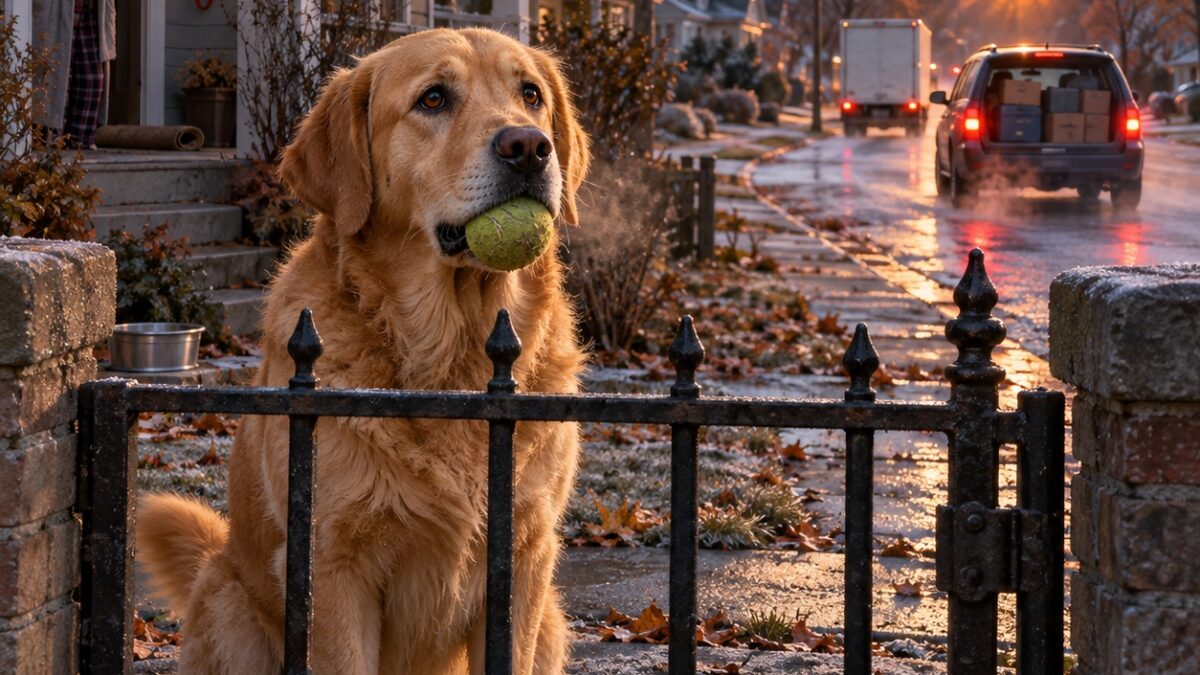
PART2
I crossed the street carrying a bowl of water and something from my refrigerator I thought he might eat.
Sirius knew me.
That should have made approaching easy.
It didn’t.
When I reached the gate, his head lifted.
For one second, hope lit his face so visibly that I stopped walking.
Not because he was happy to see me.
Because he thought I was someone bringing them back.
His tail struck the ground once.
Then he recognized me.
It stopped.
I had never seen disappointment on a dog’s face so clearly before.
People argue about projecting human emotions onto animals.
I understand the caution.
Dogs are not people.
Their minds are not ours.
But they experience attachment.
Expectation.
Fear.
Stress.
And whatever Sirius felt when he realized I was not his family, it made his entire body seem heavier.
“Hey, boy.”
His ears moved.
I opened the gate carefully.
He did not stand.
I put the water near him.
He sniffed.
Didn’t drink.
I placed food beside it.
Nothing.
“Sirius.”
He looked past me.
Toward the street.
That became the pattern.
I would speak.
He would hear me.
Then an engine somewhere would make his head jerk up.
A car would approach.
His body would rise halfway.
Car passes.
Not them.
He would sink again.
The first day, I convinced myself somebody might still come.
The second day, anger began replacing disbelief.
I called numbers I had for the Calloways.
No answer.
Sent messages.
Nothing.
Knocked at the empty house, which was absurd, but grief makes people do unnecessary things.
The place was bare.
Curtains gone.
Driveway empty.
Sirius still slept by the front step.
That night it rained.
A cold October rain.
I tried leading him toward my garage.
He would not go.
He resisted without aggression.
Not pulling wildly.
Just planting his paws and turning back toward the house.
So I brought a tarp.
Blankets.
Water.
Food.
I sat near him beneath an umbrella.
At around midnight, headlights moved down the street.
Sirius jumped up.
Actually jumped.
For the first time all day, energy returned to his body.
He rushed toward the gate.
Tail moving.
Head high.
A dark SUV slowed near us.
Sirius made a sound I will never forget.
A breathy, hopeful whine.
The SUV continued past.
His tail stopped.
He watched the red taillights disappear.
Then walked back toward the door.
Lay down.
Pressed his muzzle against the bottom edge as if he could smell the people who had once lived behind it.
That was when I cried.
Not quietly.
I sat on the wet porch across from a dog who had no idea why loyalty had suddenly become useless, and I cried because there was no explanation I could give him that would not sound cruel even if he understood every word.
They aren’t coming back.
How do you say that to an animal whose entire life has taught him they always do?
On the third morning, Sirius finally drank deeply.
Food took longer.
He ate a little from my hand.
Then stopped when a truck passed.
By then, I had contacted local animal services and a rescue organization.
I wanted to bring him into my house immediately.
But Sirius was technically abandoned property, and I wanted the process handled correctly.
More importantly, I wasn’t sure forcing him away from the house while he was still obsessed with waiting was the safest thing.
A rescue vehicle arrived shortly before noon.
A young woman in green scrubs stepped out.
Her name was Ana.
She approached slowly.
Sirius barely looked at her.
“Has he shown any aggression?”
“No.”
“Eating?”
“Very little.”
“Drinking?”
“Yes.”
“Has he moved away from the door?”
“Only a few feet.”
Ana crouched.
“Hi, Sirius.”
Nothing.
She glanced toward me.
“How long have you been here with him?”
“Too long.”
She smiled sadly.
Then she waited.
That impressed me.
No grabbing.
No immediate leash.
No urgency for the sake of efficiency.
She tossed a small treat several feet away.
Sirius ignored it.
Another closer.
Nothing.
Finally she sat on the pavement.
We remained there almost thirty minutes.
Then Sirius looked at her.
Ana softly slipped a lead over his neck.
He allowed it.
Getting him to stand was another matter.
He rose only when I moved toward the gate.
Then immediately tried turning toward the front door.
The lead tightened.
He froze.
Ana loosened it.
Sirius looked at the house.
Then at me.
That expression followed me for months.
It felt like accusation.
Not because I had harmed him.
Because I was helping take him away from the last place he believed his family might return to.
“I’m sorry,” I whispered.
Dogs forgive us for things they don’t understand.
Sometimes that makes it worse.
We walked toward the rescue van.
Sirius turned back after every few steps.
House.
Gate.
Door.
House.
Gate.
Door.
At the vehicle, he stopped completely.
Ana opened the side entrance.
Soft bedding.
Crate secured inside.
Sirius backed away.
I sat near him.
“This is okay.”
He looked at me.
I wanted to promise something.
You’re going somewhere safe.
You’ll be loved.
You’ll find another family.
But I had become wary of promises humans make for animals without knowing the future.
So I said:
“I’ll follow you.”
That promise I could keep.
Sirius eventually entered.
Ana closed the door.
The rescue vehicle pulled away.
And instead of returning to my own house like a sensible person, I got into my car and followed.
I couldn’t let him disappear from my street and become somebody else’s problem.
Not after watching him wait.
The shelter stood about twenty minutes away.
Large building.
Concrete.
Metal.
The moment Sirius stepped from the vehicle, his body changed again.
New smells.
Dogs barking.
Doors clanging.
People.
Disinfectant.
Fear.
So much accumulated animal fear has a smell of its own.
At the entrance to the main kennel corridor, Sirius stopped.
His paws shook.
I had seen him frightened during the previous days.
This was different.
The house had been grief.
The shelter was terror.
He tried to reverse.
Ana immediately loosened the leash.
No pulling.
No command.
She sat on the concrete floor.
Sirius stood.
Ten minutes.
Fifteen.
Twenty.
Staff moved around us.
People stepped over hoses.
Dogs barked behind doors.
Nobody rushed Ana.
That told me something good about the place.
Finally, Sirius took one step.
Then another.
Not into the hallway.
Toward Ana.
He lowered his huge head.
Placed it on her knees.
Ana’s face changed.
She rested one hand beside him, not touching at first.
Sirius closed his eyes.
That was the first moment I understood his deepest injury had nothing to do with food or weather.
His trust had collapsed.
He had spent his life believing people were permanent.
Then the people at the center of his world had driven away while he watched.
He needed something solid.
Any solid thing.
At that moment, Ana’s knees were enough.
The first kennel they prepared for him was clean.
Blanket.
Water.
Bed.
Quiet corner.
Sirius entered reluctantly.
Then pressed his back into the farthest wall.
Positioning himself so nothing could approach from behind.
He did not investigate.
Did not smell the bed.
Did not drink.
His eyes remained fixed on the kennel door.
Every time footsteps came down the corridor, his head rose.
Door opens.
Person appears.
Not them.
Head lowers.
Again.
And again.
Watching it became unbearable.
I stayed until evening.
Before leaving, I knelt outside the kennel.
“Sirius.”
He looked at me.
“I’ll come back tomorrow.”
His ears moved.
I had no way to explain what tomorrow meant.
So I went home.
Across the street, the Calloway house stood dark.
For the first time, I hated it.
Buildings are innocent.
But grief attaches itself to objects easily.
The empty porch looked cruel.
The gate looked cruel.
The driveway.
Everything.
That night I looked out my window repeatedly.
Some part of me expected to see Sirius lying across the road again.
I slept badly.
The next afternoon, I returned.
Sirius was in the same corner.
Ana said:
“He ate overnight.”
“Good.”
“Only after staff left.”
“Did he sleep?”
“Some.”
“Has he interacted?”
“Not really.”
I sat outside the kennel.
Had brought a book.
I don’t know why.
Maybe because talking directly to him felt too demanding.
It was an old novel I’d been reading.
I opened to where I had stopped.
Started reading aloud.
Quietly.
Sirius ignored me.
For an hour.
I left.
Next day, same.
Then again.
It became ritual.
Every afternoon after work, I drove to the shelter.
Sat sideways near his kennel.
Opened a book.
Read.
I did not call him.
Did not put my fingers through the bars.
Did not ask him to come closer.
I wanted my presence to mean nothing would be required.
At first, Sirius stared at the hallway.
Especially the entrance.
Doors fascinated him.
Every opening produced the same terrible sequence.
Head up.
Hope.
Person enters.
Recognition fails.
Head down.
I began hating doors.
Week one.
No visible change.
Week two.
One ear occasionally turned toward my voice.
Week three.
He started lying on his side while I read.
Not fully.
Still facing the entrance.
But less tightly folded.
Once I stopped reading to drink water.
Sirius lifted his head.
I stared.
He was listening.
So I continued.
By week four, I had finished one book and started another.
I chose calmer stories.
Not because Sirius understood plots.
Because rhythm mattered.
The same voice.
Same chair.
Same time.
Predictability.
I would enter.
Sit.
Read.
Close book.
Say:
“Tomorrow.”
Leave.
Then return.
I became obsessed with keeping that promise.
Traffic could be terrible.
Work ran late.
Once I had a fever.
I still came.
Not heroism.
Fear.
I had watched one set of people leave him.
I needed my pattern to be different.
On the thirtieth day, I finished a chapter.
Closed the book.
“That’s enough for today.”
Sirius stood.
I froze.
He had moved while I was reading before.
Never toward me.
He crossed half the kennel.
Stopped.
Then the rest.
I raised one hand slowly.
Palm relaxed.
Sirius pushed his muzzle through the bars.
Touched my fingertips.
Barely.
A second.
Maybe two.
Then withdrew.
I began crying so abruptly I laughed at myself.
Ana, watching farther down the corridor, smiled.
“He did that himself.”
“I know.”
That mattered.
No treat.
No lure.
No command.
Choice.
I sat another ten minutes.
Sirius did not approach again.
Fine.
One touch was enough.
A few days later, Ana suggested we use the outdoor yard.
Sirius tolerated a leash better now.
Still nervous.
But movement was returning.
We sat in the grass.
Autumn leaves turning.
Cold sun.
Sirius stayed close to the fence.
I sat several feet away.
No book.
Just silence.
Then a small boy walking past outside the shelter fence stopped.
His mother was several yards behind.
The boy looked at Sirius.
Raised one hand.
Waved.
Sirius stared.
The boy didn’t approach.
Didn’t squeal.
Just waved again.
And Sirius’s tail moved.
Tiny.
I almost thought I imagined it.
One slow sweep.
Then another.
The boy smiled.
Sirius tilted his head.
Tail again.
That was the first wag I had seen since the morning his family left.
A month of shelter life.
Hundreds of doors.
Thirty days of reading.
And joy returned as two inches of tail movement toward a child he had never met.
I turned away because I knew if I looked at Ana, both of us would lose composure.
That evening, I filled out adoption paperwork.
People later asked whether that moment made me decide.
Not exactly.
I think I had decided long before I admitted it.
Maybe when I followed the rescue van.
Maybe the first night in the rain.
Maybe when I promised tomorrow and realized I was terrified of breaking the word.
The paperwork merely caught up.
Shelters are careful about emotional decisions.
They should be.
I went through the same process as anyone else.
Home check.
References.
Questions.
Routine.
Finances.
Veterinary planning.
Sirius’s needs.
Possibility of separation anxiety.
Fear responses.
Adjustment.
We discussed everything.
Especially the fact that moving him into my house might trigger another emotional collapse.
Home had already betrayed him once.
A new home would not automatically feel safe.
I prepared anyway.
A large bed near the windows overlooking my backyard.
Bowls in a quiet corner.
Several toys.
Baby gates so he could have limited space initially.
Nothing overwhelming.
The morning I brought him home, Sirius walked from the shelter entrance beside me.
Slowly.
He saw my car.
Stopped.
My heart tightened.
Cars meant departure.
I opened the rear door.
Waited.
Sirius sniffed.
Then climbed in.
On his own.
I sat in the driver’s seat for almost a minute before starting.
Looking at him in the mirror.
He sat upright.
Watching the road.
Not panicking.
Not relaxed.
Moving forward.
We reached my street.
My hands tightened around the steering wheel.
The old house would be there.
Of course.
We passed it.
Sirius’s head turned.
His whole body became still.
I slowed without meaning to.
He stared through the window.
Front yard.
Gate.
Door.
Everything.
For a second, I wondered whether bringing him so close had been a terrible idea.
Then we continued to my driveway across the street.
I opened the car.
Sirius jumped down.
His eyes went back to the old house.
I held the leash loosely.
No pulling.
He stared.
Long.
Then walked toward my door.
That felt like hope.
Inside, he explored almost nothing.
The bed I had bought might as well not exist.
The bowls were inspected.
Water taken.
Food ignored.
Sirius spent most of the afternoon near my front door.
Watching it.
When I moved toward another room, he watched me.
When I returned, his body softened.
By evening, I understood what he was doing.
Guarding the exit.
Not to protect me.
To make sure I didn’t leave without him.
I sat on the floor.
“You don’t have to do that.”
Sirius remained near the door.
At bedtime, I tried encouraging him toward the bedroom.
He refused.
I could have placed his bed near the door.
Instead, I did something ridiculous.
I brought my pillow.
Two blankets.
Lay on the hardwood about three feet from him.
If Sirius believed the door required guarding, then neither of us would sleep alone.
Around midnight, my hip hurt.
At one, my back hated me.
At two, I wondered whether love always required orthopedic consequences.
At some point, I fell asleep.
Warm breath woke me.
I opened my eyes.
Dark room.
Sirius stood over me.
His face inches away.
I stayed still.
He stared.
Then slowly lowered himself.
His massive head settled on my chest.
Full weight.
Heavy enough to make breathing inconvenient.
I didn’t care.
One front paw touched my arm.
His body pressed against my side.
And for the first time since I’d met him, Sirius voluntarily surrendered control of where the door was.
He closed his eyes.
I put one hand against his shoulder.
Very lightly.
His heart beat fast at first.
Then slower.
Mine did too.
I don’t know how long we slept like that.
My arm was completely numb when morning came.
Best pain of my life.
Sirius woke first.
Lifted his head.
Looked toward the door.
Then at me.
I smiled.
“Still here.”
His tail tapped the floor.
The second night, he slept near the door again.
I slept in bed.
Around three in the morning, I heard nails on the hallway floor.
Sirius appeared in the bedroom doorway.
He did not enter.
I patted the rug near the bed.
“Your choice.”
He left.
I tried not to be disappointed.
Ten minutes later, he returned.
Lay in the doorway.
Third night, halfway into the room.
Fourth, beside the foot of the bed.
By week two, his large cushion had migrated to the bedroom.
Not because I moved it.
Sirius gradually started using it when I was there.
He still checked the front door before sleeping.
Progress.
Not perfection.
The first time I went grocery shopping after adopting him was awful.
I prepared carefully.
Short absence.
No drama.
I left music playing.
Food puzzle.
Safe room.
Walk before.
Everything.
When I picked up my keys, Sirius changed.
Eyes wide.
Body tense.
He followed me immediately.
Front door.
Keys.
Shoes.
Old pattern.
Someone is leaving.
His breathing quickened.
I knelt.
“I’ll come back.”
The phrase felt inadequate.
His first family could have said anything.
Words meant nothing.
I had to leave anyway.
If I never left, we would only create another prison.
So I walked out.
Closed the door.
I stood on the porch crying like an idiot.
Through the window, Sirius remained by the entrance.
Waiting.
I drove to the store.
Bought half what I needed because I couldn’t focus.
Returned twenty-two minutes later.
When my car entered the driveway, Sirius appeared at the window.
Then vanished.
I opened the door.
He hit me with his whole body.
Not aggression.
Relief.
Tail beating.
Whining.
Jumping badly because nobody had taught him polite greetings.
I sat on the floor.
He climbed halfway into my lap despite being far too large.
“I came back.”
I repeated it.
“I came back.”
That became another ritual.
I would leave briefly.
Return.
Never sneaking away.
Never dramatic goodbye.
Time stretched gradually.
Twenty minutes.
Forty.
An hour.
Two.
Sirius learned.
Not through reassurance.
Through evidence.
I leave.
I return.
Again.
Again.
Again.
Dogs understand patterns better than promises.
Months passed.
Sirius changed.
Slowly.
His coat became richer.
Muscles returned.
Eyes softened.
He discovered the backyard.
At first, he stayed close to the house.
Then ventured farther.
Then ran.
The first real sprint shocked me.
He exploded across the grass one morning, turned near the fence, raced back toward me, then looped around a tree with the clumsy joy of a much younger dog.
I laughed.
Sirius ran faster.
Apparently laughter was encouragement.
He stopped beside me panting.
Tongue out.
Tail high.
For one second, I forgot the dog at the abandoned doorway.
Maybe he did too.
He learned toys.
A rope toy became favorite.
He didn’t retrieve balls reliably.
Why should he?
He learned the sofa was allowed.
That took less time.
The first day he put his front paws on it, he looked at me for permission.
I moved over.
“Come on.”
He climbed.
Turned.
Lay down.
Within two weeks, he believed sixty percent of the sofa was legally his.
Healing sometimes looks like entitlement.
Wonderful entitlement.
Doors remained harder.
Any unexpected slam made Sirius flinch.
Front doors especially.
If a visitor left quickly, he sometimes rushed after them.
Not trying to escape.
Trying to understand departure.
So I built rituals.
People said goodbye.
I stayed visible.
Door closed.
Nothing terrible.
One day a delivery driver shut the gate loudly.
Sirius lifted his head.
Then went back to sleep.
I stood in the kitchen staring at him.
No reaction.
Ordinary.
That was huge.
Nights changed too.
At first, any sound woke him.
Eventually his sleep deepened.
He started dreaming.
Paws moving.
Soft sounds.
Once, his tail wagged in his sleep.
That made me cry.
I hoped dreams had changed too.
Not that I knew.
I never wanted to invent inner stories for him just because they felt poetic.
But his body looked peaceful.
That was enough.
The shelter remained part of our life.
We visited Ana after a few months.
I worried Sirius would panic returning.
He hesitated at the entrance.
I let him decide.
He looked at me.
Then walked in.
Ana came around the desk.
She crouched.
Sirius stared.
Tail wag.
Then he rushed toward her.
Ana buried her face in his fur.
I looked away.
Privacy.
Mostly.
“You look good,” she whispered.
Sirius leaned into her.
She looked at me.
“So do you.”
I hadn’t realized I’d changed.
Maybe I had.
Before Sirius, my routines had been quiet.
Work.
Home.
Books.
Occasional dinner with friends.
Nothing wrong.
But quiet can slowly become absence without you noticing.
Sirius forced structure.
Morning walks.
Meals.
Weather checks.
Vet appointments.
Park.
Training.
I knew neighbors better because everyone stopped to greet him.
Children knew my name.
I spent less time staring at screens.
More outside.
I had told myself I rescued him.
That became less accurate over time.
He had disturbed my loneliness before I had admitted it existed.
That doesn’t mean we “saved each other” in some mystical sense.
I provided safety he needed.
He provided companionship I hadn’t known I missed.
Both can be true without turning trauma into destiny.
The painful part of Sirius’s story never disappeared.
Sometimes we’d hear a moving truck.
His body changed.
Less than before.
Still.
One spring morning, neighbors down the block moved.
Boxes.
Truck.
People walking between house and driveway.
Sirius stopped during our walk.
Stared.
I felt fear rise inside me.
Memory.
He watched a family load furniture.
A dog appeared beside them.
Small terrier.
One of the movers opened the car.
Owner lifted the terrier inside.
Door closed.
Family got in.
Sirius watched.
The car drove away.
Terrier went with them.
Sirius looked at me.
Then continued walking.
I had to stop a few houses later because I was crying.
Not because anything happened.
Because something normal happened correctly.
Dog included.
No one left behind.
Sirius had seen another ending.
Maybe it meant nothing to him.
It meant something to me.
About six months after adoption, I made a mistake.
I was late for work.
Rushed.
Forgot something inside after starting my car.
Ran back.
Opened front door fast.
Sirius was there.
The moment I opened it, he ducked.
Flattened slightly.
That old movement.
Not as severe as shelter days.
Still there.
I stopped.
Time folded.
All progress suddenly felt fragile.
Then Sirius recognized me.
Tail wagged.
He approached.
I knelt.
“Sorry.”
No damage.
But the moment reminded me healing isn’t erasure.
The old paths remain in the nervous system.
New paths simply become stronger.
That is why patience cannot have an expiration date.
People often ask:
“How long until a rescued dog is normal?”
Wrong question.
Normal according to whom?
Sirius became himself.
That’s what mattered.
A year after the abandonment, October returned.
Cool mornings.
Leaves turning.
Sirius had been with me long enough that home no longer felt like a temporary arrangement.
He slept near my bed.
Waited near the window when I worked.
Knew grocery days.
Knew Ana’s car.
Knew which neighbor carried treats.
He greeted me after errands with ridiculous enthusiasm.
Front doors no longer automatically meant loss.
Then one morning, our walking route took us toward the old house.
I usually avoided it.
Not consciously after the first few months.
Maybe consciously.
The property had remained empty for a while.
Then sold.
New owners renovated.
Different car.
Different curtains.
Different people.
That morning, nobody was outside.
Sirius walked beside me.
Loose leash.
Head up.
We reached the house.
I realized where we were before he did.
My body tensed.
Sirius stopped.
He looked.
Gate.
Yard.
Front door.
The exact place where he had slept.
Where I had placed water.
Where rain had fallen while he waited for headlights.
I felt myself stop breathing.
His ears moved.
He took one step toward the property.
My heart sank.
I imagined everything returning.
The waiting.
The fixation.
The old family.
Dogs remember places.
Scent.
Patterns.
Maybe some part of him would always belong to that doorstep.
Sirius stared for several seconds.
Then turned his head.
Looked up at me.
His tail moved.
Not nervous.
Happy.
He took one step in my direction.
Then another.
The leash became slack toward home.
He wanted to continue.
I stood frozen.
Sirius looked back.
Tail wagging harder.
As if asking:
Are we walking or not?
I laughed.
Then cried.
Naturally.
I crouched.
He pressed his head into me.
I wrapped my arms around his neck.
Across the street from the house where someone had decided he could be left behind, Sirius chose to move forward.
I don’t know what he thought.
I will not pretend he understood the symbolism.
Maybe the place simply no longer mattered.
That itself was enough.
The house was an address.
Home was somewhere else.
We continued walking.
Sirius did not look back.
I did.
Once.
Then stopped too.
That moment changed something in me.
For a year, I had carried anger toward his previous owners.
Still did, if I’m honest.
Abandonment has consequences.
Their decision caused suffering.
But I realized I had been allowing them too much space in Sirius’s story.
They were the beginning of the wound.
They did not deserve to own the ending.
Sirius’s life had become bigger than the morning they left.
Shelter.
Ana.
Books.
The boy at the fence.
My house.
Night on the floor.
Backyard.
Walks.
Toys.
Sofa.
Grocery returns.
All the mornings after.
Abandonment was one chapter.
A devastating one.
Not the whole book.
The older Sirius became, the more ordinary his life grew.
I loved ordinary.
Vet appointments.
Baths he hated.
Muddy paws.
Hair everywhere.
The strange ability Golden Labradors have to produce enough fur to create a second dog every week.
He stole bread once.
A full loaf.
I found him in the backyard with the bag.
No shame.
I laughed until I couldn’t stand.
The dog who had stopped eating from grief now committed carbohydrate crimes.
Perfect.
He learned to wait near the kitchen at exactly 5:37 every evening because dinner came at six and apparently twenty-three minutes constituted reasonable advance notice.
He discovered snow.
Rolled in it.
Discovered sprinklers.
Declared war.
Discovered ducks.
Nearly dislocated my shoulder.
Ordinary.
Beautiful.
The first summer after his adoption, I took him to a quiet lake.
Not crowded.
He had never shown fear of water.
Still, I let him choose.
He walked to the edge.
Sniffed.
One paw in.
Then another.
Within minutes he was swimming.
Golden Labrador.
Of course.
He came out soaked.
Shook directly beside me.
I shouted.
He looked delighted.
That afternoon he slept in the sun.
I thought about his first days at the shelter.
Back to wall.
Eyes on door.
How narrow the world becomes when you are waiting for one person.
Then I looked at him sleeping near the lake.
World wide again.
Not because he forgot.
Because new experiences accumulated.
That is how healing often works.
Not deleting the wound.
Building around it until it is no longer the largest thing.
Sirius became especially attached to children.
Maybe because of the little boy at the shelter.
Maybe he had always liked them.
A girl two houses down named Emma started visiting.
She was seven.
Parents asked first.
Emma would sit on my porch reading aloud.
That made me laugh.
The same thing I’d done.
Sirius lay beside her.
Sometimes listening.
Mostly sleeping.
Full circle.
One day Emma asked:
“Why is his name Sirius?”
“I didn’t name him.”
“Who did?”
“The family who had him before.”
She thought.
“Do you want to change it?”
I looked at the dog.
Sirius lifted his head.
“No.”
“Why?”
“It’s his name.”
Simple.
His past didn’t need erasing for his future to be good.
He could keep the name given by people who failed him and still belong to me.
Identity doesn’t have to be purified.
Just continued.
Years passed.
Sirius grayed around the muzzle.
Golden fur lightened around his eyes.
Our walks slowed.
He remained joyful.
But age negotiated the pace.
We shortened routes.
Added joint supplements.
Then medication.
Rug runners appeared over slippery floors.
A ramp for the car.
Sirius hated the ramp initially.
Used it once.
Then decided jumping was more dignified.
Eventually his body overruled pride.
We adapted.
The old house across the street changed owners again.
By then, Sirius hardly glanced at it.
I did more than he did.
Funny.
We carry animals’ trauma after they have changed relationship with it.
Maybe because humans build narrative.
Dogs build routines.
One evening, years after adoption, a severe storm rolled through.
Thunder.
Wind.
Doors rattling.
Sirius woke from sleep.
For a moment, old fear returned.
He paced toward the front door.
I sat on the floor.
Same as always.
No command.
No forcing.
Sirius looked at me.
Then walked over.
Lay down.
Head on my thigh.
I touched his ears.
Storm outside.
Safe inside.
There is no more powerful contrast.
I thought about that first rainy night on the abandoned porch.
Same dog.
Same sound.
Different meaning.
Rain no longer meant waiting outside.
A door no longer meant someone had disappeared.
Change.
That is what love can do when it repeats itself long enough.
Not erase weather.
Change what happens around it.
Sirius eventually stopped sleeping exclusively near my bed.
Sometimes couch.
Sometimes hall.
Sometimes near the window.
That independence made me happier than constant attachment.
Trust is not clinging.
Trust is knowing separation is survivable.
He could sleep in another room because he believed I would still exist in the morning.
That’s huge for an abandoned animal.
The first time I woke and realized he hadn’t followed me to bed, I panicked.
Found him asleep upside down on the sofa.
Snoring.
I stood there smiling.
He had stopped guarding me.
Stopped guarding doors.
Stopped guarding against loss.
He was simply comfortable.
One winter, a friend asked whether I ever thought about what would have happened if I hadn’t looked out my window that October morning.
I hated the question.
Because there were too many possible answers.
Maybe another neighbor would have noticed.
Maybe animal control.
Maybe Sirius would have survived.
Maybe not.
I said:
“I try not to think about it.”
But I did.
Especially after seeing abandoned dogs in shelters.
So many Sirius stories without witnesses.
Animals tied behind houses after tenants leave.
Dogs dumped near roads.
Cats left inside empty apartments.
People think abandonment is just physically leaving.
The deeper wound is teaching an animal their understanding of safety was false.
Food used to come.
Now it doesn’t.
Door used to open.
Now it stays shut.
Person used to return.
Now nobody does.
That is why rescue afterward requires more than food.
Reliability.
Presence.
Repetition.
Sirius didn’t need me to be extraordinary.
He needed me to keep returning.
That became the central lesson of our life.
Stay.
At the shelter, I stayed an hour.
Next day, returned.
Then again.
At home, grocery store.
Return.
Work.
Return.
Dinner with friends.
Return.
Every return corrected the first departure by a fraction.
Not because I replaced those people.
You don’t replace attachment like furniture.
But I created a new pattern.
Sirius could hold more than one truth eventually.
Someone left.
Someone else stayed.
The second truth became larger.
That’s recovery.
When he was older, Sirius developed a habit of sleeping near the window facing the street.
At first, that would have terrified me.
Is he waiting?
Not anymore.
He watched.
People walked.
Cars passed.
Dogs.
Bicycles.
Mail truck.
He enjoyed the world.
One afternoon, a moving van parked across the street.
New neighbors again.
Sirius lifted his head.
Watched boxes come out.
A family.
Two kids.
A black dog.
Everyone went inside.
Sirius sighed.
Put his head down.
No tremor.
No fixation.
I sat beside him.
“You’re okay.”
He opened one eye.
Obviously.
I laughed.
Sometimes recovery becomes so complete you are the one still asking the old question.
The dog has moved on.
Years after the first day, Ana visited my house.
She hadn’t seen Sirius for months.
He greeted her as if she had returned from war.
Full body wiggle.
Golden hair everywhere.
Ana sat on the floor.
Sirius climbed halfway onto her.
She laughed.
“You remember me?”
Of course he did.
Maybe scent.
Maybe voice.
Maybe simply another safe person.
We drank coffee while Sirius slept between us.
Ana asked:
“Do you remember when he wouldn’t enter the kennel hallway?”
“Yes.”
“I thought we’d be sitting there all night.”
“He put his head in your lap.”
“I know.”
She looked at him.
“He looks completely different.”
“Still him.”
“Better version?”
I thought.
“No.”
She looked at me.
“Safer version.”
That was better.
Traumatized animals are not damaged versions waiting to become “better.”
They are themselves under different conditions.
Safety allows different behavior.
Sirius had always contained joy.
Abandonment buried it.
Consistency let it surface again.
That distinction became important to me.
When people praised me for “saving” Sirius, I felt uncomfortable.
I had helped.
Ana helped.
The shelter helped.
Sirius did a lot of work himself.
He took risks.
Approached.
Touched my hand.
Entered the car.
Slept beside me.
Allowed me to leave and return.
Trust requires vulnerability from the one who was hurt.
That’s courage.
One morning, Sirius woke and could not stand easily.
Age.
Arthritis.
My heart jumped.
The veterinarian adjusted medication.
Nothing catastrophic.
Still, the scare forced me to confront something I’d avoided.
One day, there would be a final departure.
Not abandonment.
Death.
I hated that thought.
After everything Sirius had survived, the idea of him leaving me felt unfair.
Then I realized the irony.
I had spent years teaching him departures were survivable.
Now I was afraid of his.
Love does that.
No escape.
The goal was never avoiding grief.
It was making the years before it worth grieving.
So I stopped counting too aggressively.
We walked as far as he wanted.
Sat in the yard.
Emma, older now, still visited.
Sirius got more beds because old joints deserve options.
He became increasingly skilled at getting cheese.
I let him.
Veterinarian said moderation.
I interpreted generously.
One autumn morning, almost exactly on the anniversary of his abandonment, I took him on our usual route.
Sirius was slower.
Very gray.
But happy.
We approached the old house.
I considered crossing the street.
Didn’t.
Sirius walked past.
No pause.
None.
Didn’t even turn his head.
Instead, he stopped ten yards farther and sniffed a mailbox.
That made me laugh so hard a passing jogger stared.
Imagine carrying a trauma like sacred history only to watch the animal involved prefer another dog’s urine on a mailbox.
Perspective.
The old house had become irrelevant.
I finally let it.
That evening, Sirius slept at my feet.
I thought about home.
I used to define it structurally.
Address.
Walls.
Possessions.
Then Sirius taught me another definition.
Home is the place where your nervous system stops preparing for disappearance.
Where doors can close without ending love.
Where sleep can be deep.
Where someone leaves and returns.
Where a bowl will be filled tomorrow.
Where your body is expected.
That is home.
Sirius had lived in a house across the street for years.
It had stopped being home the morning nobody made space for him in the vehicle.
My house became home slowly.
Not when the adoption papers were signed.
Not when he crossed the threshold.
Maybe when I slept beside the door.
Maybe when he put his head on my chest.
Maybe the twentieth time I returned from groceries.
Maybe no single moment.
Homes are built through repetition too.
Today, when I tell Sirius’s story, people often focus on the abandonment.
The image is powerful.
Golden Labrador waiting beside a moving truck.
Family drives away.
Dog doesn’t understand.
Heartbreaking.
It was.
But I don’t want that to be the image that owns him.
I want people to remember the month of reading.
The first nose through the bars.
The tail wag toward the boy.
The car ride home.
The door.
My pillow on hardwood.
His head on my chest.
The grocery return.
The run across the yard.
The sofa.
The old house becoming just another house.
Those moments are Sirius too.
More Sirius, perhaps, because he chose them.
The morning his family left was something done to him.
Everything after contained choices he got to make.
Approach.
Trust.
Walk.
Sleep.
Play.
Love.
Freedom is not only absence of restraint.
It is the presence of choice.
Sirius regained that.
Maybe that’s why the scene in front of the old house affected me so deeply.
I expected the past to pull him.
He chose the road ahead.
One day, Emma asked me:
“Do dogs forgive people?”
I thought about it.
“I don’t know.”
“Did Sirius forgive his old family?”
“I don’t know.”
“Did you?”
That question surprised me.
“No.”
She nodded solemnly.
“That’s okay.”
Children are efficient.
Then she asked:
“Is he happy?”
I looked toward Sirius.
Sleeping in sunlight.
One paw twitching.
“Yes.”
“That matters more.”
She went back to reading.
Maybe she was right.
Forgiveness is not always necessary for healing.
Sometimes you just stop living toward the person who hurt you.
Sirius did not need the Calloways to return.
Eventually, he stopped needing an explanation.
He had today.
And today was kind.
That’s enough for a dog.
Maybe enough for people too.
If there is one moment I would change, it is that first morning.
Obviously.
I would open their gate before the truck left.
Ask:
“What about Sirius?”
Force the issue.
Call someone sooner.
Do anything.
But memory gives you knowledge you did not have in real time.
I genuinely believed another vehicle was coming.
That belief still bothers me.
How normal abandonment can look for a few minutes.
A dog waiting.
A truck leaving.
Nothing obviously violent.
That is why people need to pay attention.
Neglect isn’t always blood.
Abandonment isn’t always someone throwing an animal from a car.
Sometimes it is a locked door.
A moving truck.
A tail still wagging because the victim doesn’t understand yet.
That image never fully left me.
Sirius taught me that betrayal is most painful when trust lasts longer than the person deserves.
He waited because he loved them.
His loyalty caused the waiting.
That is heartbreaking.
But I also learned loyalty can be given somewhere new.
Not transferred like ownership.
Rebuilt.
He learned my car sound.
My footsteps.
My schedule.
When I returned, he stopped checking whether somebody else might be behind me.
I became the person at the door.
Then eventually even that mattered less.
Because home had become bigger than one person.
Bed.
Yard.
Routine.
Neighbors.
Ana.
Emma.
Safety.
A network.
That is stronger than dependence.
I wanted Sirius to love me.
Of course.
But I wanted more for him than attachment to another single human who might disappear.
I wanted confidence in the world.
Some of that came.
Not all.
Enough.
Years later, when he could no longer run as before, he still loved sitting in the yard.
I would take a chair.
He would lie beside me.
Leaves.
Birds.
Afternoon light.
Nothing happening.
The kind of scene nobody photographs.
Those were my favorite.
Because for Sirius, nothing happening had once been dangerous.
Waiting.
Listening.
Hoping.
Now nothing happening meant peace.
No truck driving away.
No shelter door.
No fear.
Just existing without anticipating loss.
That’s healing.
One October evening, rain started.
Sirius was old enough that getting up took effort.
He lifted his head.
Looked at the front door.
Then at me.
I thought of the first rainy night.
I walked over.
Opened the door to the porch.
He stood.
Slowly.
Came beside me.
We watched rain fall across the street.
Old house lights on.
Different family inside.
Sirius leaned against my leg.
I placed my hand on his head.
“You made it, boy.”
He exhaled.
We stood there.
Then he turned away from the rain.
Walked toward his bed.
No interest in waiting.
I closed the door.
That’s the ending I keep.
Not the truck.
Not the empty driveway.
Not the shelter.
A door closing.
And Sirius not afraid.
He knew everyone who mattered was already inside.








