FULL STORY:My Neighbor Poured a $62,000 Patio Six Feet Onto My Land While I Was Away—He Forgot I’m a Licensed Surveyor and My Cameras Never Left
FULL STORY CONTINUATION
Emily was still holding her travel bag when she came around the side of the house.
She stopped beside me.
For several seconds, neither of us spoke.
You spend twenty years surveying land and your eye develops a kind of geometric sensitivity.
You notice grade changes.
Offsets.
Alignment.
Something six inches out of place can look loud.
Six feet looks like an alarm.
Bryce’s new patio was enormous.
Stamped concrete.
Herringbone pattern.
Exposed aggregate border.
Built-in fire-pit surround on his side.
Footings for what appeared to be an outdoor kitchen.
Beautiful work.
Expensive work.
And a significant portion of it sat on my property.
Emily finally said:
“Jake.”
Just my name.
That was enough.
I pointed.
“That’s over the line.”
“How far?”
“At least six feet.”
She looked toward the corner.
“Your posts are gone.”
That made my stomach tighten more than the concrete.
Concrete can be misplaced by a contractor.
Posts do not accidentally disappear.
I walked to the garage.
Opened the equipment cabinet.
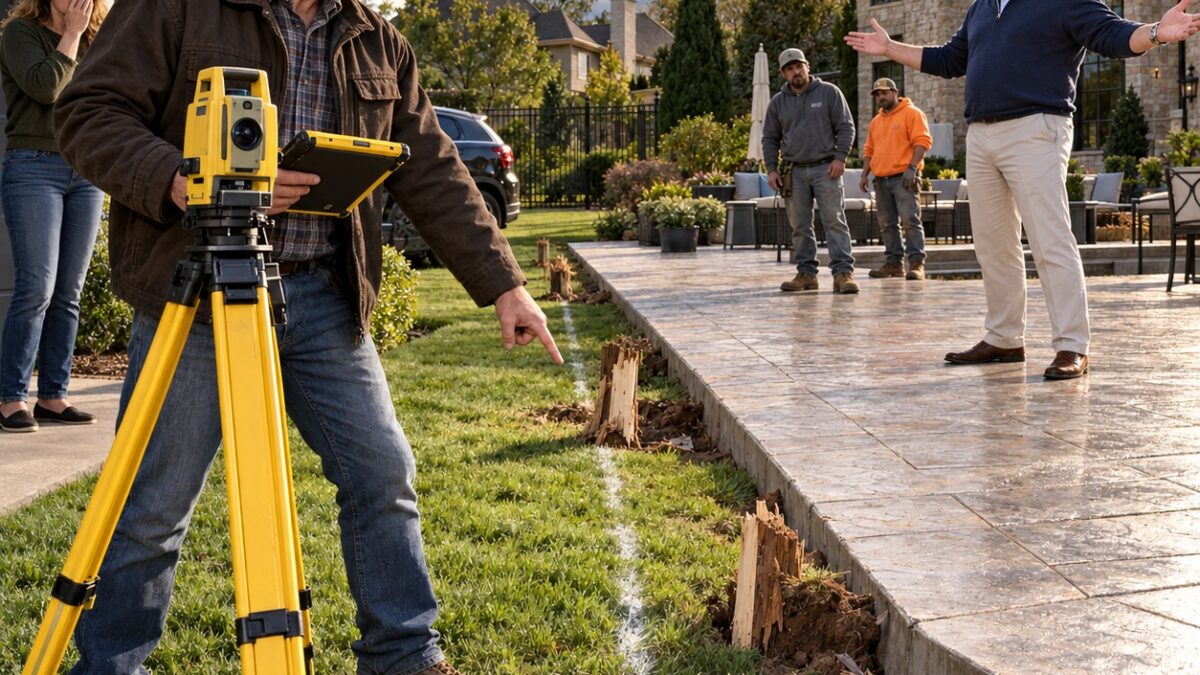
Pulled out my Trimble S7 total station.
Emily followed.
“What are you doing?”
“Measuring it.”
“You already know.”
“I know where the line is.”
I looked toward Bryce’s patio.
“Now I’m going to prove exactly how far he crossed it.”
At 5:04 that evening, I set the instrument.
I started from the southeast iron pin established in 1987.
It was still there.
Twelve inches below grade.
Undisturbed.
Bryce had removed the visible posts I installed.
He had not known about the actual monument.
That distinction was about to become expensive.
I shot the corner.
Verified coordinates.
Then worked north.
Every point where concrete met grass.
Every change.
Every projection.
The numbers came back clean.
Maximum encroachment:
Six feet, four inches.
Length:
Approximately forty-eight feet.
Average encroachment:
About five feet, nine inches.
Area:
Roughly 308 square feet.
Three hundred eight square feet of my property buried under reinforced stamped concrete.
Emily stood behind me when I finished.
“Well?”
I showed her.
She stared at the red shaded area on the screen.
“That’s not close.”
“No.”
“Not a contractor mistake.”
“Not likely.”
I printed the survey.
Added the 1987 subdivision plat.
Our recorded deed.
County data.
Photos.
Put everything in a manila folder.
Then I walked next door.
Bryce answered holding a bourbon.
Langford Auto Group polo shirt.
Cargo shorts.
Expensive leather slides.
“Jake!”
He said my name with the loud warmth of someone who believed familiarity could remove tension before it started.
“How was Asheville?”
“Good.”
I held up the folder.
“We need to talk about your patio.”
His expression changed maybe ten percent.
“Sure.”
He moved aside.
“Come in. Want a drink?”
“No.”
We stayed near the doorway.
“Your concrete extends six feet four inches onto my property.”
He frowned.
“That’s not possible.”
“It is.”
I opened the survey.
“Three hundred eight square feet.”
He looked at the page for maybe three seconds.
Not enough to understand it.
Enough to decide he did not like it.
Then he shifted.
I had watched enough salespeople to recognize closing mode.
Body opens.
Voice softens.
Problem gets reframed.
“Jake, I think there was some confusion. Contractor told me the line sat farther back.”
“My boundary posts marked it.”
He waved one hand.
“Those little wood posts?”
“Yes.”
“I think those were off.”
“I set them.”
He paused.
“Right.”
“I’m a licensed surveyor.”
“I know, I know.”
“No, Bryce.”
I pointed at the page.
“You seem not to.”
His grin thinned.
Then he tried money.
“Look, we’re neighbors. No reason to make this ugly.”
“It is already ugly.”
“How about I write you a check?”
“For what?”
“Five grand.”
I stared at him.
“Call it an easement fee. Goodwill. Whatever makes you comfortable.”
“For my land.”
“For a strip of yard.”
“My land.”
“Come on, Jake.”
He looked almost amused.
“You weren’t using it.”
That sentence removed whatever patience I had left.
“I was using it.”
“For what?”
“Ownership.”
He stared.
I continued.
“The concrete on my property needs to be removed.”
His face changed.
“Removed?”
“Yes.”
“You know what that patio cost?”
“No.”
“Sixty-two thousand dollars.”
“Then somebody made an expensive mistake.”
“I am not tearing up sixty-two grand worth of concrete over six feet.”
I closed the folder.
“You have thirty days.”
He laughed once.
No humor.
“Jake.”
“Remove everything on my side of the boundary. Restore the land.”
“You can’t be serious.”
“I am.”
“If you want more money, name a number.”
“The land isn’t for sale.”
That confused him.
Some people are genuinely unsettled when money fails to turn a no into a maybe.
Bryce looked at me differently.
Not as a neighbor.
As a failed negotiation.
“You’re being ridiculous.”
“I gave you the survey.”
“You’re making a federal case out of a few feet.”
“Thirty days.”
I turned.
Behind me:
“Jake, come on. Let’s talk like adults.”
I kept walking.
Monday morning, I called Rebecca Cho.
Rebecca specialized in property litigation.
Fifteen years.
Boundary disputes.
Easements.
Real estate.
I had worked with her as an expert witness on seven cases.
Five feet two.
Reading glasses on a chain.
Calm enough to make everybody else in a room nervous.
I sat in her Raleigh office.
Put the folder on the table.
She went through it in twelve minutes.
Then looked up.
“He knew.”
“I think so.”
“Visible boundary posts?”
“Four.”
“Gone?”
“All four.”
“Iron monuments?”
“Still there.”
“He didn’t know about them.”
“No.”
She removed her glasses.
“Do you have security footage?”
“Yes.”
“Have you watched it?”
“Not yet.”
She gave me a look.
“Why?”
“I was busy.”
“Jake.”
“I know.”
“Review it tonight.”
She tapped the survey.
“Because if the cameras show him removing those posts before the pour, this stops being a believable boundary mistake.”
Her certified letter went out Wednesday.
Two pages.
The short version:
Your concrete sits on Mercer property.
Remove it within thirty days.
Restore the land.
Bryce responded eleven days later through Greg Stanton.
Greg was Bryce’s existing dealership attorney.
Automotive franchise work.
Manufacturer compliance.
Financing.
Lemon-law defense.
Not boundary litigation.
His letter said Bryce believed the line was disputed and reserved rights to challenge my survey.
Rebecca read the three pages.
Then placed them on her desk.
“He hired his car lawyer.”
“Yes.”
She nodded.
“Good.”
Meanwhile, Bryce behaved as though the concrete had already won the argument.
He installed an outdoor dining set.
Teak.
Eight chairs.
Part of it on my property.
Then a Big Green Egg smoker.
Four feet seven inches beyond the line.
Landscape lighting.
Transformer on his side.
Fixtures on mine.
Every day I looked through my kitchen window and watched him furnish an encroachment.
Emily said it one evening.
“He thinks this is a negotiation.”
“It isn’t.”
“I know.”
She looked toward the patio.
“But he doesn’t.”
Then she said quietly:
“That’s going to cost him.”
Bryce also started working the neighborhood.
According to Jim Callaway, Bryce told people I was unreasonable.
That I was obsessing over a few feet.
That I cared more about a property line than being a decent neighbor.
Jim told me this while standing in my driveway.
“I’m not taking sides, Jake.”
“Okay.”
“But he’s pretty convincing.”
I looked at him.
“If somebody poured three hundred square feet of concrete in your yard while you were out of town, then offered you money instead of removing it, would you call yourself unreasonable for saying no?”
Jim thought.
“No.”
“Then don’t let somebody else’s confidence do your thinking.”
He nodded.
Walked home.
Two weeks after we returned from Asheville, I finally pulled the memory cards from the cameras.
The file changed everything.
I opened Wednesday.
The morning Emily and I left.
Scrolled.
5:47 a.m.
Bryce appeared.
He wore a Langford Auto Group polo.
Athletic shorts.
New Balance shoes.
In one hand:
Claw hammer.
In the other:
Plastic Home Depot bucket.
I leaned closer.
He approached the first white boundary post.
Put both hands around it.
Rocked it.
Back.
Forward.
Back.
Forward.
The soil loosened.
Then he pulled.
Post came out.
Orange top.
Aluminum plaque.
Concrete collar.
Everything.
He dropped it into the bucket.
I stopped breathing normally.
Second marker.
Same thing.
Third.
Fourth.
Six minutes and fourteen seconds.
He carried all four to the Escalade.
Loaded the bucket.
Drove away.
Forty minutes later, he returned without it.
I sat motionless in front of the screen.
This was no contractor misunderstanding.
No bad measurement.
No ambiguous fence.
Bryce woke before sunrise while we were gone.
Removed my clearly marked boundary posts.
Disposed of them.
Then came back.
At 8:55 a.m., the first concrete contractor arrived.
Flatbed.
Concrete pump.
Six workers.
Forms.
Rebar.
Laser levels.
No boundary posts because Bryce had removed them.
I called Rebecca.
“Found it.”
“What?”
“5:47 Wednesday morning.”
Pause.
“Tell me.”
“He removes all four posts.”
“Personally?”
“Yes.”
“Camera clear?”
“Perfect.”
“Original files?”
“Yes.”
“Back them up.”
“Already doing it.”
Another pause.
“Jake.”
“Yes?”
“This is very good evidence.”
That was Rebecca’s version of shouting.
I replayed the footage.
Then tracked down the concrete foreman.
Hector Ruiz.
Twenty-two years in the business.
It took three days.
When I explained the dispute, he was cautious.
Then I told him about the video.
His tone changed.
“Mr. Mercer, I didn’t know.”
“I believe you.”
“He told me where the line was.”
“What exactly did he say?”
“He said everything up to your fence was his.”
“What fence?”
“Your side fence. He said the property had never been formally surveyed.”
I closed my eyes.
“What did he show you as the boundary?”
“Orange spray paint.”
There it was.
Bryce had removed my posts.
Then spray-painted a fake line approximately six feet inside my property.
Same orange color I had used on the marker tops.
Not an accident.
A substitute.
A visual lie.
Hector sounded sick.
“I’ve never knowingly poured on another person’s land.”
“You were lied to.”
“I should have asked for a survey.”
“Yes.”
“Am I in trouble?”
“No.”
I paused.
“But I need you to put what he told you in writing.”
He did.
Sworn affidavit.
Rebecca read it.
Then watched the footage twice.
When she shut the laptop, she said:
“We’re going to bury him.”
For Rebecca, that was basically fireworks.
We proceeded methodically.
First:
Wake County Building Inspections.
The patio exceeded the threshold requiring permits and site review.
Bryce had pulled none.
No site plan.
No setback confirmation.
No approval.
County inspector Howard Price came out.
Measured.
Checked records.
Issued a notice of violation and stop-work order.
Fine:
$2,500.
Bryce called me that evening.
I let voicemail take it.
Six minutes.
Angry.
County bureaucracy.
Bad neighbors.
Overreaction.
He said I had embarrassed him.
I saved the message.
Next:
Complaint concerning destruction of the survey markers.
Rebecca submitted the footage.
My professional certification.
Documentation of the markers.
Four separate removals.
The criminal matter moved on its own track.
Then:
Civil suit.
Mercer v. Langford.
Trespass.
Willful encroachment.
Destruction of boundary markers.
Unjust enrichment.
Injunctive relief compelling removal.
Compensatory damages.
Punitive damages.
Rebecca also requested a temporary restraining order.
Granted within forty-eight hours.
That created an interesting situation.
Bryce’s expensive patio furniture, smoker, and lighting remained partly on my property.
But he was now legally restricted from doing anything that worsened the encroachment.
The process server delivered the complaint at 2:15 on a Thursday afternoon.
Melody happened to be filming an Instagram patio reveal.
Her phone caught part of Bryce receiving the papers.
She uploaded it before realizing what the document was.
Deleted the post.
Too late.
Neighbors had screenshots.
Ridgewood Oaks remembered that moment for months.
Bryce escalated his financial offers.
First:
$15,000.
Cash.
Drop everything.
Then:
$20,000.
“Think about your kids.”
Then:
$30,000.
“Final offer.”
He called himself the bigger man.
I returned none of the calls.
I saved every voicemail.
Five.
Fifteen.
Twenty.
Thirty.
A man convinced he had done nothing wrong does not usually multiply his offer six times in a few weeks.
Then he tried influence.
Bryce had donated to Wake County Commissioner Dale Hewitt over several election cycles.
He asked whether there was an administrative way to “resolve” the problem.
Dale called me.
He sounded uncomfortable.
“Jake, Bryce asked whether there’s some process we can use here.”
“Did he tell you he removed my survey markers before sunrise?”
Silence.
“No.”
“Did he tell you he poured more than three hundred square feet of unpermitted concrete onto my property?”
Another silence.
“No.”
“Did he mention the criminal complaint?”
“No.”
“That sounds like Bryce.”
The conversation ended.
Hewitt did not contact me again.
He also returned Bryce’s most recent campaign contribution.
That got around the neighborhood quickly.
Money had failed at my door.
Then at the county commissioner’s.
Bryce did not understand why.
Melody tried a different route.
She called Emily.
Emily was cooking chicken and rice for Ben.
Phone on speaker.
“Emily, I wanted to reach out woman to woman.”
I was in the doorway.
Emily kept stirring.
“This is tearing Bryce apart. He can’t sleep. The dealerships are suffering. Can you talk to Jake?”
Emily said nothing for several seconds.
Then:
“About what?”
“Finding a compromise.”
“My husband already gave Bryce the compromise.”
“What?”
“Remove the concrete he put on our land.”
Melody sighed.
“You know Bryce will never do that voluntarily.”
Emily stirred the rice.
“Then I guess we’ll find out what happens involuntarily.”
“Emily—”
“Your husband removed our property markers while we were out of town. He lied to the contractor. He poured concrete on our property. Then he offered Jake money instead of fixing it.”
Silence.
“And when money didn’t work, he called a politician.”
Melody started to respond.
Emily cut in.
“You asked me about the human side.”
She lowered the spoon.
“The human side is that your husband violated our property and our trust and has done everything except remove what he put there.”
She ended the call.
Then went back to dinner.
I stood in the doorway.
She looked at me.
“What?”
“Nothing.”
“Set the table.”
That was Emily.
The Superior Court hearing came in November.
Wake County.
Courtroom 4B.
Judge Patricia Kenny.
Nineteen years on the bench.
Excellent memory for property law.
Bryce arrived in a navy suit.
Gold tie.
Rolex.
Greg Stanton beside him.
Still using the dealership attorney.
Rebecca brought one banker’s box.
That was it.
No theatrical stack.
She did not need volume.
She had evidence.
Greg made three arguments.
First:
The boundary was ambiguous and Bryce acted in good faith.
Second:
Removal of the patio would create unreasonable hardship.
Third:
An equitable solution would force me to accept financial compensation.
Rebecca started with “good faith.”
She played the video.
5:47 a.m.
Bryce enters.
First post.
Second.
Third.
Fourth.
The courtroom was quiet.
Six minutes and fourteen seconds.
Then Hector’s affidavit.
Then my credentials.
Then the original 1987 plat.
Recorded deed.
Current survey.
County mapping.
Rebecca stood.
“Your Honor, this was not a boundary misunderstanding.”
She indicated the paused image of Bryce carrying the posts away.
“Mr. Langford removed the markers that showed the true line and replaced them with a painted line that benefited him.”
She let the image sit.
“That is not good-faith reliance.”
Next:
Hardship.
Greg emphasized the expense.
Sixty-two-thousand-dollar patio.
Demolition costly.
Wasteful.
Disproportionate.
Rebecca introduced the demolition estimate.
Approximately $38,000.
Then the original patio invoice.
$62,000.
“The hardship exists because Mr. Langford deliberately constructed the encroachment.”
She looked toward Bryce.
“He created the condition he now asks this court to protect.”
Then:
Forced sale.
Greg argued I could simply be compensated for 308 square feet.
Rebecca cited North Carolina appellate cases rejecting the idea that an intentional trespasser should be able to force the owner to sell merely because removal became expensive.
Her point was simple.
If deliberate encroachment created a right to purchase afterward, then every wealthy person with concrete could move a boundary first and negotiate later.
Bryce testified.
That was his worst decision after pulling the posts.
Rebecca started calmly.
“Mr. Langford, before the patio was installed, had you ever hired a surveyor to examine the property line?”
He hesitated.
Then admitted:
Yes.
Six weeks before the pour.
Bryce said the survey had been inconclusive.
Rebecca lifted a document.
Subpoenaed report.
The survey showed essentially the same line mine did.
No ambiguity.
She handed it to the judge.
Then came the text message.
Bryce had sent it to Melody on the day the patio was poured.
Rebecca read it.
The substance was unmistakable:
The patio was going down while the Mercers were in Asheville.
By the time I returned, the job would be finished.
And, according to Bryce, nobody would tear up sixty thousand dollars of concrete over a few feet.
No one moved.
Judge Kenny looked at Bryce over her reading glasses.
“Mr. Langford.”
He looked up.
“You did not make a mistake.”
Pause.
“You executed a plan.”
That sentence ended the argument.
The ruling came two weeks later.
Fourteen pages.
Item one:
Every piece of concrete, rebar, footing, or related construction on my property had to be removed at Bryce’s expense within sixty days.
Item two:
Soil remediation.
Regrading.
Topsoil.
Sod.
Drainage restoration.
His expense.
Item three:
Destroyed boundary markers replaced with permanent monuments.
His expense.
Item four:
Attorney fees and court costs.
His expense.
Then damages.
$15,000 compensatory.
$10,000 punitive for willful, premeditated conduct intended to create an encroachment Bryce apparently assumed would be too expensive to undo.
People liked simplifying the judgment to:
$100,000.
That was roughly right.
But the actual meaning becomes clearer when you see the pieces.
Demolition alone:
About $38,000.
A crew from Carolina Demolition arrived with hydraulic breakers, a concrete saw, skid steer, and dump trucks.
It took four days.
Four days to destroy something Bryce believed was too expensive to remove.
I stood in my backyard the first morning.
The hydraulic breaker hit the stamped surface.
Boom.
Concrete cracked along the herringbone pattern.
Another strike.
Another.
The sound traveled through the ground.
Birds left the water oaks.
Chunks broke away.
Beautiful sealed concrete became rubble.
Bryce watched from his kitchen window.
Emily noticed him.
Coffee in hand.
Motionless.
I wondered whether he remembered his text.
Nobody tears up sixty grand of concrete over a few feet.
The crew did.
Not because I wanted revenge.
Because a judge ordered restoration of the boundary.
Nineteen truckloads eventually carried broken concrete to disposal.
The part on Bryce’s property also had to be modified substantially because the encroaching section had been integrated into the overall slab.
By the end, his giant patio was no longer giant.
Just expensive history.
Soil remediation:
Approximately $8,000.
Twelve cubic yards of topsoil.
Regrading.
Six hundred square feet of Bermuda sod.
Drainage correction.
The land had been covered in reinforced concrete for months.
You do not simply remove a slab and call it restored.
Compaction had changed.
Grade had changed.
Runoff had changed.
Everything had to be repaired properly.
New markers:
About $2,500.
This time I did not use painted wooden posts.
Steel rebar.
Three feet deep.
Aluminum caps stamped with my professional license number.
Concrete collars.
GPS coordinates documented to one-hundredth of a foot.
You could remove them with equipment.
But you could not erase where they had been.
The record would remain.
Attorney fees:
Approximately $22,000.
Every hour documented.
Approved.
Court costs:
About $4,500.
Compensatory damages:
$15,000.
Punitive:
$10,000.
Roughly one hundred thousand dollars in the judgment and required restoration costs.
Then came the other consequences.
The criminal charge concerning the markers resolved separately.
Class 3 misdemeanor.
$500 fine.
Twenty-four hours of community service.
Criminal record.
For most people, a misdemeanor is unpleasant.
For Bryce, whose identity and business reputation revolved around dealerships, licenses, bonds, and professional credibility, it was something he would have to explain again.
And again.
Then the county building violation.
$2,500.
Then rebuilding a smaller patio on his side of the line.
This time:
Permits.
Site plan.
Setbacks.
Everything legal.
Approximately $35,000.
By the time all the consequences were counted, Bryce’s decision to steal six feet of my yard had cost him around $138,000.
For land I had never offered to sell.
For a boundary he had already paid a surveyor to identify correctly.
That was the part I kept coming back to.
He knew.
If he had been confused, the story would have been different.
Neighbors make honest mistakes.
Contractors misread plans.
Old fences sit in wrong places.
Survey monuments disappear.
Reasonable people fix those problems.
Bryce did not make an honest mistake.
He ordered his own survey.
Learned the line.
Waited until we left town.
Removed the visible markers.
Painted a false boundary.
Told the concrete crew the land had never been formally surveyed.
Then poured.
Intent changed everything.
That was why Rebecca never had to shout.
The timeline shouted for her.
5:47.
Posts removed.
8:55.
Concrete crew arrives.
Fake orange line.
Patio poured.
Days later:
$5,000 offer.
Then higher offers.
Then politician.
Then hardship argument.
Every step fit the same idea.
Bryce believed a finished condition would become leverage.
He thought concrete would change the conversation from:
Why are you on my land?
to:
Surely you won’t make me tear this out.
That was his real strategy.
Create a fact on the ground.
Then force me to negotiate with the cost of undoing it.
What he misunderstood was that courts notice who created the hardship.
You cannot deliberately make your own violation expensive and then ask the victim to rescue you from the price.
At least not in our case.
Bryce and Melody did not move away.
They stayed in the Langford estate.
Their new patio sat entirely on their side.
Smaller.
Properly permitted.
Properly located.
Bryce stopped looking at me.
If he backed the Escalade out while I was checking mail, eyes forward.
No wave.
No nod.
Nothing.
Melody walked their standard poodle on the opposite side of the street.
Every time.
Her Instagram went silent for about six weeks.
When it returned, the content changed.
No backyard.
No patio.
No “building our forever.”
Kitchen corners.
Throw blankets.
Candles.
Interior remodeling.
Camera angles carefully avoiding the rear windows.
Eventually the old patio photos disappeared.
The internet moved on.
Neighbors changed too.
Jim Callaway watched demolition from his porch.
When I passed later, he called:
“Jake.”
I stopped.
“I guess I was wrong about who was being unreasonable.”
I nodded.
That was enough.
Donna Washington brought Emily a pecan pie.
The note said:
For the family that stood their ground.
Emily read it.
Then cried.
Not dramatically.
Just one of those quiet moments when months of tension finally find somewhere to go.
She set the note beside the pie.
“I didn’t know anyone noticed.”
“They noticed.”
“They didn’t say much.”
“No.”
She wiped her face.
“People usually don’t.”
Ben discovered a chunk of stamped concrete caught in the hedge after demolition.
Herringbone texture still visible.
He carried it inside.
“Can I keep this?”
Emily stared.
“Why?”
He grinned.
“Hundred-thousand-dollar rock.”
I laughed.
“Fine.”
He put it on his bookshelf beside a baseball glove and a geode from Umstead State Park.
Emily later pointed at it.
“Most expensive object in this house.”
She was not far off.
The new markers mattered more to me.
Steel.
Permanent.
Surveyed.
Recorded.
Every corner aligned with the 1987 plat.
Our deed.
Wake County records.
Exactly where the line had always been.
In December, Emily planted Leyland cypress along the boundary.
Privacy, she said.
That was partly true.
Green wall.
Living fence.
Patient.
Steady.
Every month, the trees made the line more obvious.
I watched them once from the porch.
Emily came outside with coffee.
“You like them.”
“I do.”
“Better than the white posts?”
“Those posts had character.”
“Those posts got stolen.”
“Fair.”
She looked toward Bryce’s side.
“The trees are harder to put in a Home Depot bucket.”
I laughed.
“Also fair.”
Life returned to normal.
I went back to work.
Trimble cleaned.
Charged.
Waiting in the garage.
Emily went back to the pediatric ICU.
Chloe made varsity volleyball.
Ben’s Lego city continued occupying the dining room like a hostile annexation.
The backyard became quiet again.
That quiet felt different after the case.
More valuable.
Before Bryce, I believed a clear property line created peace by itself.
I was wrong.
A line on paper is only part of the protection.
Someone also has to respect it.
And when they do not, somebody has to be willing to defend it.
Not with shouting.
Not threats.
Not escalation for the pleasure of escalating.
With evidence.
Bryce wanted emotion.
Every offer carried it.
Be reasonable.
Think about the kids.
Don’t make this ugly.
A few feet.
A little yard.
Good neighbors compromise.
Those phrases all tried to move attention away from one fact:
His concrete was on my property.
Rebecca kept bringing us back.
Where is the line?
Here.
Did he know?
Yes.
Did he remove markers?
Yes.
Did he mislead the contractor?
Yes.
Did he build anyway?
Yes.
Everything else was decoration.
That discipline saved me from getting pulled into Bryce’s preferred arena.
He sold cars for thirty years.
Talking was his sport.
Reframing.
Negotiating.
Making customers feel they were unreasonable for wanting something different.
I was not going to beat him at his game.
I did not need to.
My instrument measured the line.
The camera showed the act.
His text showed the plan.
Hector showed the lie.
Done.
People later told me:
“You must have loved watching the patio get destroyed.”
Not exactly.
There was satisfaction.
Of course.
But not because I enjoyed seeing $62,000 wasted.
Waste bothered me.
The crew had done beautiful concrete work.
Hector and his men built exactly what they were instructed to build.
Material.
Labor.
Time.
Then four days of demolition turned it into landfill.
That was Bryce’s waste.
Not mine.
Every breaker strike represented a moment where he could have chosen differently.
He could have respected the survey he ordered.
Could have asked whether I would sell an easement.
Could have redesigned the patio.
Could have stayed inside his lot.
Could have apologized when I came home.
Could have removed the encroaching section voluntarily.
Could have hired a proper property attorney.
Could have stopped escalating.
He chose none of those.
By the time the demolition started, the expensive path had been selected months earlier.
That is one reason the sound did not feel like revenge.
It felt like consequence finally becoming physical.
Concrete had been his leverage.
Then concrete became the thing he had to pay to remove.
The irony was enough.
I did not need to add anything.
The case also changed how Chloe and Ben understood my job.
Before, surveying was Dad walking around with expensive equipment and making everybody wait because “one more shot” was never actually one more shot.
Afterward, Ben asked:
“So you can tell where every yard ends?”
“No.”
“Why not?”
“Because I have to research it first.”
He frowned.
“But you have the machine.”
“The machine measures.”
“So it knows?”
“No.”
“Then what does it do?”
I thought about how to explain.
“It tells me very accurately where something is.”
“And you decide whose it is?”
“Documents help decide that.”
He nodded as though this was unnecessarily complicated.
“Why don’t people just stay on their side?”
I laughed.
“Excellent question.”
Chloe understood differently.
She had watched Bryce work the neighborhood.
He was rich.
Connected.
Confident.
Adults listened.
Then evidence changed the social story.
One evening she asked:
“Did people believe him because he has money?”
“Some probably did.”
“That’s stupid.”
“Money makes confidence look like credibility sometimes.”
“But he was wrong.”
“Yes.”
“So how are you supposed to know?”
I pointed toward my office.
“Check.”
“Everything?”
“When it matters.”
That was the lesson I wanted them to keep.
Not distrust.
Verification.
Bryce’s confidence was not the problem by itself.
Confidence is useful.
The danger was confidence replacing evidence.
He told the contractor the line had never been surveyed.
False.
Told neighbors the dispute concerned a few feet.
Technically true, deliberately incomplete.
Told his attorney the boundary was ambiguous.
False.
Told himself nobody would tear up $60,000 of concrete.
Very false.
Every statement worked because he expected nobody to inspect the foundation.
Then we did.
People sometimes ask whether his first $5,000 offer could have been a reasonable settlement.
Not to me.
Maybe another owner would have accepted.
Property has value.
People sell strips.
Grant easements.
Adjust boundaries.
Nothing inherently wrong with that.
But a sale requires willingness from both sides.
My land was not for sale.
The fact that Bryce wanted it did not create a market obligation.
That is something people with money sometimes misunderstand.
They hear:
No.
Then translate it as:
Not enough.
Bryce increased his offers because he thought every refusal meant the number was wrong.
Five.
Fifteen.
Twenty.
Thirty.
He never understood the answer was not numerical.
It was categorical.
No.
That is an uncomfortable word for somebody accustomed to closing deals.
But land ownership contains the right to say it.
Emily understood immediately.
She never asked why I did not take the money.
Never suggested compromise for peace.
She grew up on a farm.
Land was not abstract to her.
Boundary meant boundary.
That did not make her hostile.
It made her clear.
Her conversation with Melody captured it better than anything I said during months of litigation.
“What would fix it?”
“Remove the concrete.”
That was always the solution.
Bryce kept trying to buy an alternative.
There wasn’t one I wanted.
The permanent markers became almost symbolic after the case, although I tried not to become dramatic about them.
I had them installed properly.
Documented.
Licensed.
Recorded.
No wooden post to pull quietly before dawn.
Of course, even permanent markers can be disturbed.
Nothing physical is invincible.
That is why records matter.
Coordinates.
Monument descriptions.
Reference ties.
Photographs.
A property line is not safe because steel exists in the ground.
It is safe because evidence allows the line to be reconstructed accurately even if steel disappears.
Bryce thought removing the posts removed the truth.
That was perhaps the most surveyor-specific mistake he could have made.
He erased the thing he could see.
The actual evidence remained.
Iron pins.
Recorded plat.
Deed.
Coordinates.
County data.
My field notes.
Then the cameras showed who removed the visible posts.
By trying to destroy evidence, he created better evidence.
I appreciated the symmetry.
The case also reminded me why honest contractors ask questions.
Hector became uncomfortable the moment he understood.
He did not defend himself by saying:
I just followed instructions.
He admitted he should have asked for documentation.
Then he gave us an affidavit.
That distinguished him from Bryce.
People make mistakes based on bad information.
Character shows after correction.
Hector helped fix what he could.
Bryce fought.
The county commissioner did something similar.
He called because a donor asked.
Once he heard the facts, he backed away.
Returned money.
No second call.
Again:
Correction.
That matters.
I never turned him into part of a conspiracy.
There was no evidence for that.
Bryce tried influence.
It failed.
End of that part.
Precision matters in stories too.
If I exaggerated one thing, Bryce could point at the exaggeration and try to contaminate everything else.
So Rebecca trained me relentlessly.
“Don’t say stolen land.”
“Why?”
“He encroached intentionally. Say that.”
“Same thing emotionally.”
“Not legally.”
“Fine.”
“Don’t call the contractor part of the plan.”
“He poured it.”
“He was deceived.”
“Fine.”
“Don’t say Bryce destroyed legal monuments unless we can classify each marker accurately under the relevant statute.”
“He removed them on camera.”
“Then say exactly that.”
Annoying woman.
Brilliant lawyer.
By court, our story was almost boring.
That is why it worked.
Date.
Time.
Measurement.
Video.
Document.
Affidavit.
Text.
No need for adjectives.
Judge Kenny’s ruling was devastating because Bryce supplied most of the facts himself.
His survey.
His removal.
His fake painted line.
His instruction to Hector.
His text to Melody.
His refusal to remove the slab.
The best cases are often the ones where the other side insists on documenting intent.
Bryce’s text was almost unbelievable.
By the time he gets back, it’ll be done and he’ll have to deal with it.
That was the entire plan in one sentence.
Create irreversible condition.
Force accommodation.
He underestimated two things.
First:
How reversible concrete actually is when a judge orders breakers.
Second:
How stubborn a surveyor can be about six feet.
I joke about the second.
But the principle was serious.
If I accepted the encroachment because removal was expensive, what exactly would the boundary mean?
Bryce could buy it by violating it.
That is not negotiation.
That is a reward for intentional trespass.
Rebecca’s forced-sale argument was the part of the case I found most important.
Not personally.
Systemically.
If wealth lets someone pour first and compensate later, poorer owners do not truly own their land against richer neighbors.
They merely hold it until someone decides they can afford the damages.
That is why the judge’s decision mattered beyond my 308 square feet.
The line was either enforceable or it was not.
In our case, it was.
I did not expect to become a neighborhood symbol.
I did not want to.
People began stopping when I worked in the front yard.
“Still got that survey equipment?”
“Yes.”
“Can you check my fence?”
“No.”
They would laugh.
“Seriously?”
“Call the office.”
I was not doing free boundary surveys for Ridgewood Oaks because Bryce made everybody suddenly interested in geometry.
Emily thought it was hilarious.
“You’re famous.”
“Within three blocks.”
“Try to stay humble.”
“Difficult.”
“Very.”
Jim eventually asked me professionally to look at his rear boundary before replacing a fence.
He paid normal rate.
The survey showed the old fence roughly eighteen inches inside his lot.
He stared at the result.
“So I’ve been giving my neighbor a foot and a half for twelve years?”
“Basically.”
“Can I just move it?”
“Talk to them first.”
He laughed.
“Lesson learned.”
Exactly.
Talk first.
Everything in Bryce’s case could have been avoided with one conversation before construction.
“Jake, here’s my patio plan. Survey says line is here. I’d like more room. Would you consider selling me a strip?”
No.
Then redesign.
Done.
Instead, he saw consent as weakness.
He preferred certainty after the fact.
He had lived in a commercial world where enough sunk cost creates pressure to finish the transaction.
Cars.
Buildings.
Deals.
Property boundaries do not care.
His patio cost $62,000.
The law did not move one inch.
That difference fascinated me.
A $62,000 object can be more temporary than a rusted iron pin worth five dollars.
One represents money.
The other represents a legal location supported by records.
Value and authority are not the same.
Bryce confused them.
Maybe because in his world, money had successfully solved most practical problems.
This one required respect.
He tried money instead.
Failed.
Connections.
Failed.
Legal bluster.
Failed.
Hardship.
Failed.
Then demolition arrived.
I never saw Bryce outside during the four days.
He watched from windows.
Once his Escalade left before the crew arrived and returned after they stopped.
That was probably easier.
I did not judge him for avoiding it.
Watching your own plan get broken apart must feel terrible.
Even deserved consequences can hurt.
I had no need to stand at the line smiling at him.
I had work.
At one point Emily brought the demolition crew cold water.
Bryce watched that too.
She asked me later:
“Do you think he hates us?”
“Probably.”
“You care?”
“No.”
She nodded.
“Good.”
That was all.
Hate was Bryce’s business.
Restoration was mine.
When the sod went down, I cared more about grade than emotion.
The drainage needed to match pre-patio conditions.
Runoff from Bryce’s yard could not be redirected toward our foundation.
Topsoil depth.
Compaction.
Slope.
Everything checked.
The remediation contractor probably regretted having the property owner be a surveyor.
I measured.
He adjusted.
Then measured again.
By the time they left, the yard looked almost normal.
Not immediately.
Fresh sod always looks like a patchwork blanket.
But months later, seams disappeared.
Grass grew.
The physical scar faded.
The cypress hedge grew faster than I expected.
Emily was right.
It became a living line.
The kids barely noticed after a while.
That is how I knew we were past it.
Children measure household tension accurately.
During the lawsuit, Ben knew not to ask about Bryce at dinner.
Chloe noticed if a new letter arrived.
Afterward, they stopped caring.
Good.
A property dispute should not become family culture.
We defended the line.
Then moved on.
The “hundred-thousand-dollar rock” remained on Ben’s shelf.
That was enough mythology.
One evening, about a year after demolition, I sat in the garage cleaning the Trimble.
Emily came in.
She leaned against the workbench.
“You still happy we didn’t take the money?”
I looked at her.
“Which offer?”
“Any of them.”
“Yes.”
She nodded.
“Me too.”
“You were always more stubborn than I was.”
“Incorrect.”
“Jake.”
“You married me.”
“Temporary lapse in judgment.”
I laughed.
Then she looked toward the boundary through the garage window.
“You know what bothered me most?”
“What?”
“Not even the concrete.”
I waited.
“He waited until we left.”
That was the part that had bothered me too.
Intent is personal in a way a mistake is not.
Bryce could have misunderstood a line.
Could have trusted a bad contractor.
Could have read an old fence incorrectly.
Instead, he watched us leave.
Then woke before sunrise.
That meant he knew our presence would stop him.
That knowledge sat underneath everything.
He did not merely believe the land was his.
He knew I would object.
He timed the work to eliminate my chance.
That was why the case stayed with us longer than a normal encroachment.
The patio was physical.
The betrayal was social.
Neighbors depend on small assumptions.
Nobody removes your markers while you travel.
Nobody pours across your lot.
Nobody uses the fact that you are away to create leverage.
Once that assumption breaks, home feels different.
The cypress hedge helped.
Not because it was necessary legally.
Psychologically.
A little separation.
Privacy.
Time.
Eventually, Bryce became another house next door.
Nothing more.
No ongoing feud.
We did not exchange Christmas cards.
We also did not scream across the line.
That was fine.
Peace does not require friendship.
Sometimes it requires a well-marked boundary and mutual disinterest.
I came to appreciate that.
The criminal record affected Bryce’s dealership paperwork, just as the source of the dispute predicted.
I did not follow every renewal.
That was his problem.
The misdemeanor existed because he chose to remove boundary markers intentionally.
The building fine existed because he chose to build without the required permit.
The civil judgment existed because he chose to encroach.
The rebuild cost existed because he wanted another patio afterward.
Each cost had a cause.
People collapsed them into:
Jake cost Bryce $138,000.
No.
Bryce cost Bryce $138,000.
I measured where.
That distinction matters.
I did not invoice him for ego.
I did not set the demolition price.
Did not invent attorney rates.
Did not create county fines.
Did not assign punitive damages.
Institutions looked at his choices and applied consequences.
That is different from revenge.
He tried turning me into the villain because I refused to absorb the cost of what he did.
That framing is common.
A person harms you.
Fixing it costs them.
Suddenly your insistence on repair becomes cruelty.
No.
The original act created the expense.
I remind myself of that whenever somebody says:
“Was six feet really worth all that?”
Six feet was not worth $138,000 to me.
I never asked him to spend it.
Six feet was worth not surrendering my property through deliberate misconduct.
Bryce decided how expensive his method would become.
I only refused to subsidize it with my land.
There is another question people ask.
“What if he had offered $100,000?”
Still no.
Maybe that sounds stubborn.
But the yard was not a commodity in that moment.
If Bryce had asked before construction, maybe an absurdly high offer could have created a conversation.
Different context.
After removing markers and pouring intentionally?
Selling afterward would have taught exactly the lesson he expected.
Do it first.
Pay later.
I wanted no part of that.
Principles are easiest when they cost nothing.
That one cost time.
Stress.
Legal risk.
Months of looking at his patio.
Still worth it.
My father visited after the new markers went in.
He walked the line.
Looked at the aluminum caps.
“Three feet?”
“Yes.”
“Overkill.”
“Probably.”
He nudged one with his boot.
Then smiled.
“Good.”
My mother cared less about surveying.
She wanted to know whether Bryce apologized.
“No.”
She shook her head.
“Then he wasn’t raised right.”
End of analysis.
Parents have efficient legal systems.
Dad walked back toward the house.
“You know,” he said, “when I bought this place, nobody cared where the line was.”
“Vacant lot.”
“Exactly.”
“Lines matter most when somebody wants what’s on the other side.”
He nodded.
That was true.
For decades, the boundary existed quietly.
No fence.
No dispute.
No reason to defend it.
Then value changed.
Development.
Patio.
Outdoor kitchen.
Suddenly six feet mattered intensely.
Property lines are strange that way.
Invisible when respected.
Everything when challenged.
That is why I still perform perimeter checks.
Emily still teases me.
Less than before.
Sometimes she even asks:
“Everything where you left it?”
“Yes.”
“Good.”
The cypress trees make the line obvious now.
Roots on our side.
Branches thick.
Green wall between yards.
They do not legally establish anything.
But they communicate.
This line is occupied.
Observed.
Known.
No confusion.
That is useful.
Surveyors often say the best boundary is the one both parties understand and respect.
The permanent monument is evidence.
The social boundary is behavior.
Bryce now respects it.
Maybe not philosophically.
Practically.
Good enough.
I still keep the original camera footage.
Multiple backups.
Probably unnecessary now.
But deleting it feels strange.
Six minutes and fourteen seconds.
The entire case hidden inside an ordinary gray morning.
Bryce pulling post after post.
No audience.
No argument.
Just intent.
Whenever I teach younger surveyors about documentation, I sometimes think of that file.
Not because every client needs cameras.
Because field evidence disappears.
A post can be removed.
Paint fades.
Grading changes terrain.
Construction covers ground.
If something matters, document before disturbance.
Photos.
Coordinates.
Notes.
Records.
That is what allowed me to rebuild truth after Bryce tried to erase the visible line.
The original iron pin mattered.
But so did everything tied to it.
One monument alone can be challenged.
A chain of evidence is stronger.
This dispute reminded me why our profession is slow.
People hate surveyors sometimes.
We ask for old deeds.
Compare bearings.
Search for monuments.
Measure twice.
Return days later instead of giving an instant answer.
Clients want:
Where’s my line?
They want us to point.
Sometimes we can.
Sometimes history needs reconstruction.
Accuracy takes patience.
Bryce skipped all of that.
He had an accurate survey already and rejected it because the result interfered with his design.
That may be the most dangerous kind of ignorance.
Chosen ignorance.
Information exists.
You dislike it.
So you manufacture another answer.
Fake painted line.
His own contractor believed it.
For a few hours, the lie became concrete.
Then evidence caught up.
Every time I see new construction, I think about that.
Concrete feels permanent.
It is not.
Legal rights can be much more permanent than physical work.
A bulldozer can remove a patio.
A judge can order restoration.
A fraudulent condition does not become legitimate because curing it is expensive.
That was the lesson Bryce purchased for $138,000.
He probably would phrase it differently.
That is fine.
The county file phrases it well enough.
The case file sits in a cabinet in my garage office.
Survey.
Photographs.
Video references.
Hector affidavit.
Letters.
Complaint.
Order.
Judgment.
Invoices.
I labeled it:
MERCER / LANGFORD ENCROACHMENT.
Rebecca saw the label once.
“Very exciting.”
“I’m a surveyor.”
“I know.”
“No emojis?”
“Tragic.”
We both laughed.
Records do not need drama.
The story already had enough.
If somebody opened that file fifty years from now, they would understand.
Boundary.
Encroachment.
Intent.
Remedy.
No need to know Bryce’s personality.
Or his Rolex.
Or Melody’s Instagram.
Those details make the story human.
They do not establish the line.
The line exists independently of character.
That is another thing I appreciate.
Property law does not need me to be likable.
I hope I am.
But my deed does not become weaker if a neighbor thinks I am stubborn.
Bryce tried social pressure because he thought reasonableness was decided by popularity.
Neighbors whisper:
Jake is difficult.
Jake overreacts.
Jake cares too much about a few feet.
None of that changes ownership.
That separation protected me.
You can be socially unpopular and legally right.
Ideally, do not seek either conflict.
But if they arrive, know which arena matters.
Jim’s opinion mattered to me as a neighbor.
It did not matter to the property line.
County records did.
The judge did.
Evidence did.
Once Jim saw more facts, his opinion changed anyway.
Truth often catches up socially after it catches up formally.
Not always.
But enough.
Melody never apologized.
Also fine.
Emily did not need it.
She got her vegetable garden view back.
Actually, the cypress eventually blocked some of Melody’s view of the tomato stakes.
So in a strange way, she finally got the privacy hedge she once suggested.
Emily realized that before I did.
She looked toward the cypress one summer.
“You know what’s funny?”
“What?”
“Melody wanted a privacy hedge.”
I stared.
Then laughed so hard I nearly dropped the watering hose.
Life has better punch lines than I do.
The hedge grew.
Ben grew.
Chloe grew.
The neighborhood moved on.
Bryce still ran dealerships.
We still lived in the ranch.
No dramatic final collapse.
No mansion sold.
No bankruptcy.
That is important.
Real accountability does not always destroy somebody.
It corrects behavior.
Bryce lost money.
Gained a record.
Had to remove the encroachment.
Then continued living his life.
So did we.
That is enough.
Stories often want punishment to keep escalating until the antagonist has nothing left.
I never wanted that.
I wanted my land back.
I got it.
The judge could have awarded another zero and it would not have changed the essential win.
Grass where his patio had been.
Boundary monuments in place.
No one pretending the line was negotiable.
That was the outcome.
One evening, long after the lawsuit, Ben carried the hundred-thousand-dollar rock into the garage.
“Dad?”
“What?”
“When I move out, can I take this?”
I looked at the concrete chunk.
“Why?”
“It’s cool.”
“It’s rubble.”
“It’s historic rubble.”
He had me there.
“Fine.”
He grinned.
“What if it’s worth money someday?”
“It’s concrete.”
“You said concrete was expensive.”
“Not like that.”
He put it back.
For him, the whole thing had already become family folklore.
That was healthy.
Children turn trauma into objects faster than adults.
Maybe I should learn from him.
The rock was not Bryce anymore.
It was just something funny on a shelf.
The boundary itself required less thought too.
That is the sign of a good resolution.
Before conflict:
Invisible.
During conflict:
Everything.
After resolution:
Invisible again.
Property lines should not dominate life.
They should quietly organize it.
You mow here.
I mow there.
Your tree.
My tree.
Your patio.
My grass.
No drama.
Simple until someone refuses simplicity.
Bryce did.
Then the system became visible.
Surveyors.
Attorneys.
Inspectors.
Prosecutor.
Judge.
Demolition contractor.
All because one man looked at six feet and thought:
He’ll deal with it.
I did.
Just not the way he expected.
The sentence Judge Kenny used stays with me.
You didn’t make a mistake. You executed a plan.
Intent defined the case.
Had the facts been different, mercy might have made sense.
Contractor accidentally crosses ten inches.
Neighbor apologizes.
Offers removal.
You work it out.
Not every encroachment belongs in Superior Court.
Most should not.
People can solve things.
But compromise requires two people recognizing reality.
Bryce wanted compromise to mean:
I keep what I took, and you accept money.
That was not compromise.
It was surrender with a check attached.
I refused.
Rebecca understood why.
Emily understood instantly.
The judge eventually understood too.
That was enough.
Today, the new patio next door stops comfortably inside Bryce’s property.
I know because I measured.
Not professionally.
Habit.
Emily caught me looking one afternoon.
“Jake.”
“What?”
“Did you survey his new patio?”
“No.”
She stared.
“Range pole was already out.”
“Go inside.”
“Jake.”
“Fine.”
I had checked.
It cleared by more than the required amount.
“Happy?”
She smiled.
“Very.”
Then she went inside.
I looked at the line one more time.
Cypress.
Steel monument.
Grass.
Bryce’s concrete ending where it should.
Everything quiet.
For thirty-eight years, the idea of a property line and the idea of peace had belonged in the same sentence for me.
Bryce separated them for a while.
Then the court put them back together.
I never wanted his money.
Never wanted his patio.
Never wanted a lawsuit.
I wanted a line.
And peace.
Eventually, I got both.
The Trimble still sits in the converted garage.
Clean.
Charged.
Ready.
The permanent monuments still agree with the original 1987 plat, our recorded deed, and county records.
The cypress grows thicker every season.
Emily still works nights at the ICU sometimes.
Chloe still leaves volleyball shoes where someone can trip on them.
Ben’s Lego developments remain far less respectful of dining-room boundaries than anything Bryce ever attempted.
And that piece of stamped concrete still sits on his bookshelf.
The hundred-thousand-dollar rock.
A reminder that some things look permanent only because nobody has challenged them yet.
Concrete can be broken.
Money can be spent.
Influence can fail.
Confidence can collapse.
But a properly established boundary does not move because the neighbor on the other side thinks his project matters more than your ownership.
Bryce believed six feet was too small to fight over.
Then he believed $62,000 of concrete was too expensive to remove.
Then he believed $5,000 could solve it.
Then fifteen.
Then twenty.
Then thirty.
He was wrong every time for the same reason.
He kept treating the boundary like an opening offer.
It never was.
Some things you negotiate.
Some things you sell.
Some things you compromise on because the relationship is worth more than being technically correct.
And some things you measure carefully, mark clearly, document thoroughly, and defend when somebody tries to erase them before sunrise.
A property line is one of those things.
Bryce found that out at 5:47 on a Wednesday morning.
The cameras simply made sure the judge found out too.








