FULL STORY:My Cat Disappeared Every Day at 3:45 and Came Home Smelling Like Roses and Tears—Then I Followed Him
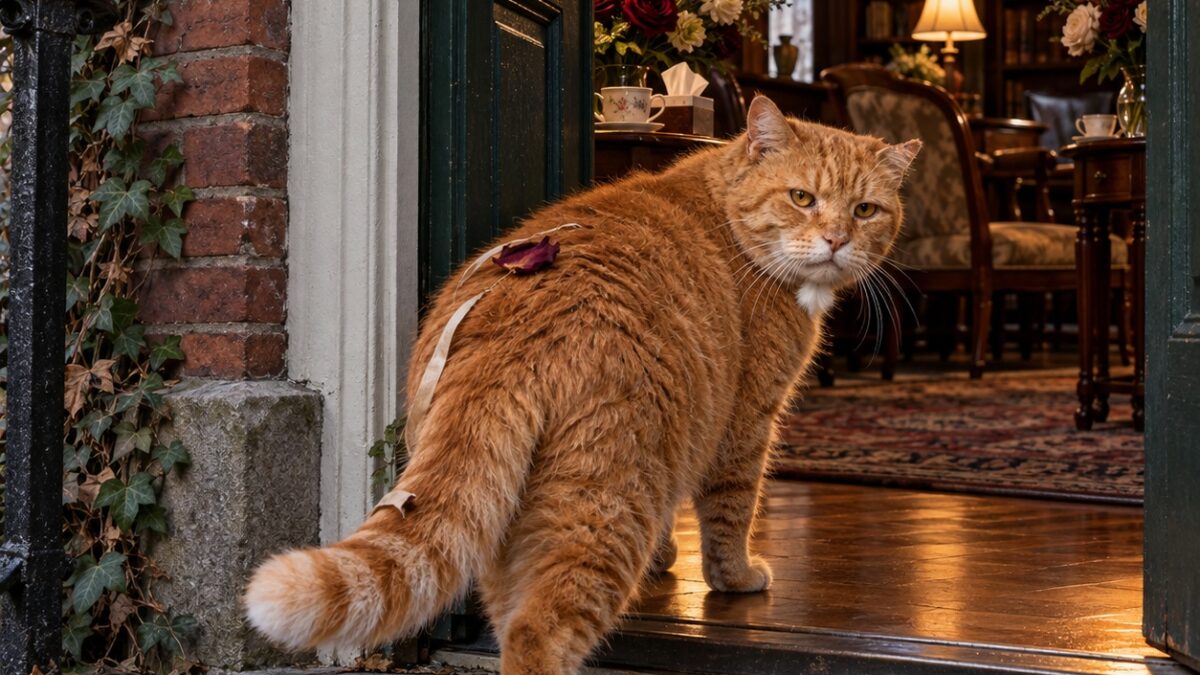
FULL STORY CONTINUATION
For several seconds, I considered turning around.
That sounds ridiculous now.
My cat had just entered a funeral home.
Surely that required investigation.
But embarrassment arrived before curiosity.
My imagination immediately produced every possible version of Walter behaving badly in a building where bad behavior was uniquely inappropriate.
Walter walking across a casket.
Walter stealing sandwiches from a reception tray.
Walter knocking over a standing spray of flowers worth several hundred dollars.
Walter settling himself in the lap of someone who hated cats.
Walter wandering into a private family room and refusing to leave.
He had once pushed a ceramic bowl off my kitchen counter while making eye contact with me.
There was precedent.
I stood there thinking:
How many grieving families have I unknowingly allowed my animal to terrorize?
Then another thought arrived.
They probably know where he lives.
Maybe they had been trying to figure out which irresponsible woman kept letting the orange menace return.
I nearly left.
Then Walter’s tail appeared briefly in a hallway window.
Gone again.
“No,” I muttered.
“If I’m going to apologize, I’m going to apologize properly.”
I walked to the main entrance and knocked.
The woman who answered looked to be in her sixties.
Silver hair pinned neatly back.
Dark dress.
No elaborate jewelry.
Her face had the soft, attentive expression of someone who had spent years learning how to receive people on days when ordinary conversation felt impossible.
“Can I help you?”
“I’m terribly sorry.”
That was how I began.
No introduction.
No context.
Just immediate guilt.
“My cat came inside.”
For a second, she looked confused.
Then her face softened into a smile.
“Walter?”
I stared at her.
“You know his name?”
“Of course.”
My stomach dropped.
Of course.
Which meant this was not his first visit.
“How long has he been doing this?”
“He’s here nearly every afternoon.”
“Nearly every—”
I stopped.
Six months of rose petals.
Coffee.
Perfume.
Tissues.
Barely touched dinners.
“Oh no.”
The woman’s smile widened.
“Why oh no?”
“Because he’s been bothering people.”
She gave a small laugh.
“No, dear.”
I looked past her into the foyer.
Warm lamps.
Dark wood.
A floral arrangement near the staircase.
Nothing like the cold, theatrical funeral homes in movies.
The building felt quiet rather than grim.
There was coffee somewhere.
Fresh flowers.
Something faintly woody and old.
Books, perhaps.
The air seemed to carry layers of things people brought with them.
Perfume.
Rain from coats.
Paper.
Grief.
The woman opened the door wider.
“Quite the opposite.”
Then she said:
“Come see.”
I followed.
We moved down a carpeted hallway.
Every instinct told me to keep my voice low even though nobody had asked.
Funeral homes create their own volume.
Not silence exactly.
Respect.
People whisper because sadness is already loud enough.
We passed a small room where two women stood beside a table of photographs.
Another doorway revealed folded chairs.
A coffee station.
A rack of tissues.
Then the woman stopped.
Walter was curled on a loveseat near one of the visitation rooms.
Beside him sat an elderly man in a black suit.
The man’s eyes were red.
His shoulders seemed to have collapsed inward.
He was not speaking.
Walter was not doing anything remarkable.
No purring performance.
No dramatic affection.
He had simply pressed his body against the man’s thigh.
The man’s hand moved slowly through the orange fur.
Again.
Again.
Again.
Walter’s eyes were half closed.
His expression was the same mildly dissatisfied expression he wore at home.
And yet the entire scene felt intimate enough that I immediately looked away.
The silver-haired woman spoke quietly.
“His wife passed away last week.”
I nodded.
There was nothing useful to say.
The man continued stroking Walter.
He stared at the floor.
Walter stayed.
That was all.
No tricks.
No special training.
No sound.
Just weight.
Warm fur.
Presence.
The woman introduced herself as Margaret.
She was the funeral director.
I introduced myself, though I felt strangely secondary.
Apparently I was no longer Walter’s most knowledgeable human.
“How long?” I asked again.
“Almost six months.”
I looked at Walter.
“Six months?”
Margaret nodded.
“The first time he came in, we were gathering for a visitation.”
“What did he do?”
“Walked in like he owned the building.”
“That sounds accurate.”
She smiled.
“There was a woman sitting alone in the hallway. She was crying. Walter went over, climbed onto the chair beside her, and stayed nearly an hour.”
“He climbed onto a chair?”
“Yes.”
“He barely does that for me.”
Margaret glanced at me.
“I wouldn’t take it personally.”
“I already have.”
That made her laugh quietly.
She explained that the staff had tried sending him away.
Once.
Twice.
Several times.
Walter always returned.
Eventually people began recognizing him.
Then expecting him.
Some families asked:
“Is the orange cat here today?”
Visitors looked for him.
Children found him during long hours when adults were busy greeting people.
Older people sat beside him when conversation became too exhausting.
Sometimes Walter remained in the hallway.
Sometimes beside a loveseat.
Sometimes under a chair.
“He doesn’t go to everyone,” Margaret said.
I watched him.
The elderly man’s hand had stopped moving.
It rested on Walter’s side.
Walter did not leave.
“How does he choose?”
Margaret’s expression changed.
Not sad exactly.
Thoughtful.
“I honestly don’t know.”
Then she looked toward him.
“But somehow he always knows.”
That sentence reached something in me I had kept closed for a decade.
I had lost my husband ten years earlier after a short illness.
The illness itself had happened so quickly that I spent the first weeks after his death feeling as though somebody had removed a wall from the house without warning.
Everything familiar remained.
Furniture.
Dishes.
Books.
Coats.
His chair.
And yet the structure of my life no longer made sense.
People were kind.
So kind.
I received casseroles until my freezer could hold nothing else.
Cards.
Flowers.
Phone calls.
People told me they were sorry.
People told me he was at peace.
People told me I was strong.
People said they were there if I needed anything.
Then, gradually, everybody returned to their own lives.
Which is what they had to do.
No resentment.
Life continues.
But grief does not follow the same schedule.
The first few weeks are crowded.
Then comes silence.
That was the part I remembered most clearly.
The empty evenings.
The chair across the room.
Reaching for a second coffee mug before remembering.
Turning because I thought I heard him in another room.
The instinct to tell him something funny.
Then the correction.
No one there.
People think grief needs words because words are what people can give.
But some evenings, words felt unbearable.
I did not want explanations.
I did not want to be encouraged.
I did not want someone telling me how to move forward.
I wanted another living thing in the room.
Someone who did not need me to perform recovery.
Walter had not belonged to me then.
He came later.
But standing in that funeral-home hallway, watching him beside a man who had lost his wife, I suddenly understood exactly what Walter was doing.
He was staying.
Nothing more.
That was enough.
I remained another twenty minutes.
The elderly man eventually stood.
He rubbed Walter once between the ears.
“Thank you, buddy,” he whispered.
Walter looked up.
One slow blink.
Then the man left.
Walter stretched.
Turned.
Saw me.
His expression did not change.
No surprise.
No guilt.
Not even the smallest acknowledgment that I had spent six months believing he was cheating on me with another family.
He stepped off the loveseat.
Walked toward Margaret.
Paused near her shoes.
Then moved down the hall.
I followed him.
“Does he know where the kitchen is?”
Margaret smiled.
“Yes.”
“Of course he does.”
I found him sitting beside the coffee station.
Not eating.
Just watching.
A woman standing there wiped her eyes.
She noticed Walter.
Bent slowly.
“Hi, sweetheart.”
Walter allowed her fingertips to touch the top of his head.
Then he walked away.
That was when I realized something else.
He was not going there for food.
At least not primarily.
He did not behave like a cat working a room for treats.
He did not beg.
Did not circle.
Did not search plates.
He moved through the place as if he had a job no one had hired him to do.
At 7:12 that evening, he walked to the side door.
Margaret opened it.
Walter stepped outside.
I stared.
“He leaves himself?”
“Usually between seven and eight.”
“And walks home?”
“Yes.”
“That’s why he’s never hungry.”
Margaret hesitated.
“We do occasionally give him a little something.”
“Aha.”
“Very little.”
“So there is another food source.”
She laughed.
“Would you like coffee?”
“I’m too betrayed.”
I walked home behind Walter.
He never once looked back.
By the time we reached my street, darkness had settled.
He went through our gate.
Waited at the back door.
I opened it.
He entered the kitchen.
I filled his bowl.
He sniffed.
Ate perhaps four bites.
Then walked into the living room and climbed onto the sofa.
A small white petal clung to his shoulder.
I brushed it away.
“Apparently you’ve been very busy.”
Walter closed his eyes.
I sat in the chair across from him.
For the first time in years, the silence in my house felt connected to something outside it.
Walter had another life.
Not another family.
Another purpose.
That should have made me proud.
Instead, I became practical.
And perhaps a little frightened.
The next afternoon at 3:45, Walter assumed his usual position beside the back door.
I looked at him.
“No.”
He stared.
“The streets are busy.”
Nothing.
“You are fourteen years old.”
One paw tapped the door.
“The funeral home is not your responsibility.”
Scratch.
“Walter.”
He walked away.
For one brief, foolish moment, I thought I had won.
Then he sat in the center of the kitchen floor.
Stared.
I tried treats.
He ignored them.
I rolled one of his old toys toward him.
He watched it pass as though embarrassed on my behalf.
I offered dinner early.
Nothing.
Four o’clock.
Four fifteen.
Four thirty.
Walter remained near the door.
At five, I said:
“You are being ridiculous.”
He did not move.
At five thirty, the phone rang.
I almost ignored it.
Then I saw the local number.
“Hello?”
“Hi. It’s Margaret.”
I looked at Walter.
His ears moved.
“How did you get my number?”
“You wrote it down yesterday.”
“Right.”
I had forgotten.
Margaret sounded apologetic.
“I’m sorry to call.”
“What happened?”
“There’s a woman here today.”
A pause.
“She keeps asking whether the orange cat is coming.”
I looked down.
Walter was staring at me.
Waiting.
Expecting.
Knowing something I did not.
Margaret continued.
“She was here once before. Walter sat with her then.”
I closed my eyes.
“This is absurd.”
“I know.”
“He’s a cat.”
“I know.”
“He’s fourteen.”
“I know.”
“He belongs at home.”
Margaret’s voice softened.
“Yes.”
That did it.
Not argument.
Not guilt.
She agreed.
Walter did belong at home.
But perhaps home did not need to mean confinement.
Perhaps loving him meant admitting that he had decided some part of his life for himself.
I opened the back door.
Walter rose immediately.
No hesitation.
He trotted out.
Not quickly by young-cat standards.
But with purpose.
He disappeared through the gate.
Margaret heard the door.
“Is that him?”
“Yes.”
“I’ll let her know.”
I stood there holding the phone.
“Margaret?”
“Yes?”
“Make sure he leaves before eight.”
She laughed.
“I’ll do my best.”
The next day, I went with him.
Not secretly this time.
Walter left at 3:45.
I followed at a respectful distance.
He still ignored me.
Downtown was busier than I liked.
Cars.
Delivery trucks.
People leaving shops.
Walter navigated it all with the confidence of someone who had apparently done the route hundreds of times.
I hated that.
Loved it.
Mostly hated it.
When we reached the funeral home, Margaret held the side door open.
“For both of you.”
Walter walked in first.
Of course.
I entered behind him.
Then I sat in a chair near the back hallway.
I told myself I would stay twenty minutes.
I stayed nearly four hours.
That afternoon changed the way I saw grief.
Not because I learned grief was complicated.
I already knew.
I learned how different it looked on different people.
Some cried openly.
Some became very still.
Some talked continuously.
Some laughed too loudly because silence frightened them.
Some wandered toward the coffee every fifteen minutes even though they did not seem to drink it.
Children became restless.
Adults apologized for children being restless.
Elderly visitors sat alone because standing through another conversation had become exhausting.
And Walter moved among them without any concern for the social rules humans impose on sorrow.
He did not care whether someone was crying appropriately.
Did not care whether a person had said the right condolence.
Did not care whether a child understood death.
He simply noticed people.
At least that was what it looked like.
An older woman sat near a window with both hands wrapped around a coffee cup.
Walter approached.
Stopped.
Looked up.
She lowered one hand.
He leaned against her shin.
Her fingers moved through his coat.
She did not speak.
Walter stayed perhaps fifteen minutes.
Then left.
A child sat under a side table reading a picture book while adults gathered in another room.
Walter lay a few feet away.
Eventually the child turned the book around.
Showed him a page.
Walter stared at it with the expression of a cat deeply unimpressed by literature.
The child smiled.
That smile changed the whole face.
Another woman came down the hall quickly, then stopped as if she had forgotten where she was going.
She put one hand against the wall.
Walter was beneath a bench.
He stepped out.
Sat near her shoes.
She looked down.
Bent.
Touched his head.
Breathed.
Continued walking.
Was Walter choosing grief?
Or stillness?
Was he responding to body language?
Scent?
Voice?
Maybe people who sat alone were simply easier targets for an old cat who preferred quiet humans.
I did not know.
I still do not.
I stopped needing an explanation.
What mattered was that people experienced his presence as comfort.
That was real whether Walter understood it or not.
Margaret brought me coffee.
“Now you see.”
“I do.”
“He’s unusual.”
“He’ll be unbearable if you keep praising him.”
She smiled.
“Does he act different at home?”
“Worse.”
Walter slept near a pair of polished shoes.
Margaret and I watched.
“How many families ask for him?”
“A surprising number.”
“He’s not officially part of this place.”
“No.”
“No insurance forms?”
She laughed.
“No.”
“No employment paperwork?”
“Walter refuses administrative tasks.”
“That sounds correct.”
Eventually the staff put an orange cushion near the hallway window.
Not immediately.
Weeks later.
Walter had developed a habit of resting there between visits.
The cushion became his spot.
No sign.
No plaque.
Nothing announcing him as a service animal or therapy cat.
He was neither in any official sense.
Just Walter.
The funeral-home staff jokingly called him their grief counselor.
Margaret once said:
“Our counselor has terrible bedside manners.”
“He has no bedside manners.”
“Still effective.”
Families began bringing photographs of pets they had lost.
That surprised me.
A dog.
A gray cat.
A rabbit.
A parakeet.
Pictures sometimes appeared near the coffee area or tucked beside condolence cards.
Perhaps Walter made it easier to talk about animals during human grief.
Pets occupy strange places in mourning.
They are part of family.
Then suddenly the family changes.
Animals notice absence too.
Children began reading to Walter.
He tolerated this as long as no one attempted to put a costume on him.
One little girl tried placing a paper flower crown on his head.
Walter walked away before coronation.
I approved.
Over the following months, I stopped accompanying him every day.
I could not.
And he would not have wanted me to.
But I went often enough that the funeral home became part of my own routine.
Sometimes I helped Margaret set out coffee.
Sometimes I sat near the back.
Sometimes I simply walked Walter there and continued downtown to the library.
It felt strange at first.
For ten years, I had avoided funeral homes unless absolutely necessary.
They brought back too much.
The smell of flowers.
Coffee.
Furniture polished too carefully.
Soft voices.
Men in dark suits.
All of it carried me instantly to my husband’s funeral.
For years I had believed avoiding those things protected me.
Walter brought them back into my life gently.
No demand.
No ceremony.
Just repeated exposure.
A room.
Coffee.
A grieving stranger.
An orange cat.
And slowly, the smell stopped belonging only to my loss.
Roses could belong to someone else’s wife.
Coffee to another family’s long afternoon.
A tissue to somebody’s father.
Perfume to a daughter.
The old books in Margaret’s office to Margaret.
Grief expanded beyond me.
That sounds obvious.
It did not feel obvious.
Loss can make the world feel personally altered.
You understand intellectually that other people hurt.
But your own absence occupies so much space that everything gets measured around it.
Walter showed me a building where grief passed through every week.
Different people.
Different stories.
Same need.
Company.
I began remembering the first weeks after my husband’s death differently.
Not less painfully.
Just with more compassion for myself.
I had thought there was something wrong with me because people’s words irritated me.
They meant well.
Still, I wanted silence.
I wanted presence without conversation.
At the time, I interpreted that as withdrawal.
Maybe it was simply a need nobody knew how to meet.
Walter knew how.
Or accidentally provided it.
The distinction no longer mattered.
One afternoon, I asked Margaret:
“Do people ever complain?”
“About Walter?”
“Yes.”
“Occasionally someone is allergic or doesn’t like cats.”
“What do you do?”
“We keep him out of that room.”
“And he listens?”
She gave me a look.
“No.”
I laughed.
“We close the door.”
That sounded more realistic.
“He has to remain a choice,” she said.
That sentence mattered.
Comfort cannot be imposed.
Walter might help one person and make another uncomfortable.
The funeral home understood that.
No family was forced to interact with him.
No one advertised him.
He simply existed nearby.
Available.
People chose him too.
That mutuality made the whole arrangement feel right.
I also became less defensive about him leaving home.
At first, I had been hurt because I imagined another family had become more interesting than me.
That was loneliness talking.
Possession becomes strange when you are lonely.
You start measuring love by exclusivity.
Walter slept in my house.
Ate from my kitchen.
Glared at me every morning.
Allowed me to scratch beneath his damaged ear.
He was mine in the ordinary language people use for animals.
But his affection was not a resource I needed to keep entirely for myself.
He had room for more than one relationship.
So did I.
That realization may have been Walter’s greatest gift to me personally.
I started talking to people again.
Not dramatically.
I did not suddenly become social.
I remained someone who preferred quiet evenings.
But Margaret became a friend.
Not because we bonded over death.
Because we drank bad coffee and complained about Walter.
She knew every family story in town and repeated none of them.
That impressed me.
Funeral directors carry private worlds.
Margaret had learned how to be present without claiming other people’s stories as her own.
Walter had somehow mastered the feline version.
He never tried to fix anyone.
That was what people loved about him.
Humans are often uncomfortable around grief because we want to improve the situation.
We search for useful sentences.
Everything happens for a reason.
They’re in a better place.
At least they didn’t suffer.
You’re strong.
Time heals.
Some of those words help some people.
Others land like stones.
Walter offered none.
He had no theology.
No timeline.
No advice.
No expectation that a person become less sad because he had arrived.
If someone cried, he stayed.
If someone stopped crying, he stayed.
If someone talked to him, fine.
If they said nothing, fine.
There is enormous freedom in being allowed to feel without managing the comfort of the person beside you.
Animals can give that.
Walter did.
His age probably helped.
He was slow.
Unhurried.
He did not bound through the hallways like a kitten.
His movements matched the building.
Measured.
Quiet.
At fourteen, every step looked deliberate.
He climbed onto furniture only when worthwhile.
He did not waste energy performing friendliness.
People trusted that.
If Walter stayed beside them, it felt chosen.
Margaret told me visitors sometimes asked:
“Why me?”
She never had an answer.
Neither did I.
Maybe sadness has body language.
Maybe Walter followed people who were still.
Maybe grief changes scent.
Maybe he liked expensive perfume.
Maybe he was an opportunist with excellent public relations.
All possible.
But I watched him ignore people holding food and cross a room toward somebody empty-handed.
More than once.
That made pure opportunism difficult to defend.
One winter afternoon, snow had begun falling heavily before three.
I told Walter:
“No.”
He looked at the door.
“Absolutely not.”
Tap.
“Look outside.”
Scratch.
“Walter, you are fourteen years old and shaped like a loaf of bread. You are not walking downtown in snow.”
He sat in the kitchen.
I called Margaret.
“Is anyone expecting him?”
She laughed.
“Probably.”
“No.”
“I didn’t say send him.”
“Good.”
That day he stayed home.
He was furious until dinner.
I sat on the sofa.
He sat at the opposite end, back turned toward me.
“You are alive because I am responsible.”
One ear moved.
“Ungrateful.”
He slept.
I appreciated that our relationship still contained ordinary arguments.
Walter was not transformed into a saint because he comforted grieving people.
At home, he remained demanding.
He knocked my reading glasses onto the floor once.
Stole my chair.
Refused a new brand of food with such conviction that I wondered whether it had insulted his family.
He scratched the back-door frame despite having trained me years earlier.
His funeral-home role did not make him magical.
That made me love the story more.
Extraordinary things can emerge from ordinary creatures without erasing what makes them ordinary.
Walter was still Walter.
That mattered.
Three years passed.
Not quickly.
Not slowly.
The way years do once you reach my age—somehow both.
Walter changed.
His orange coat remained bright along his back, but white spread around the muzzle.
His steps became slower.
His naps became longer.
He paused before jumping onto the sofa.
Eventually he stopped making one of the higher jumps altogether.
I placed a small stool nearby.
He ignored it for two weeks because it had been my idea.
Then began using it when he believed I was not watching.
At 3:45, though, the ritual remained.
Back door.
Stare.
Tap.
Scratch.
Judgment.
His walk downtown took longer.
I accompanied him more often because fourteen had become fifteen, then sixteen, then seventeen.
Age changes freedom.
I did not want to take his routine away.
I also could not pretend traffic posed no risk.
So sometimes I walked beside him.
Sometimes several feet behind.
He disliked obvious supervision.
I respected his dignity as much as possible.
Margaret aged too.
So did I.
That is what three years does.
The funeral home remained warm.
Flowers.
Coffee.
Old books.
Quiet hallways.
The orange cushion became flatter.
Walter preferred it anyway.
Families continued asking for him.
Some had heard about the cat from friends.
Others knew nothing until they saw him.
There was no social-media campaign.
No sign proclaiming:
WALTER, CERTIFIED GRIEF CAT.
I would have objected.
Walter would have objected more.
He remained unofficial.
That felt right.
One afternoon, I arrived later than usual.
Walter was lying beside a woman near the hallway window.
Her hand rested lightly on his back.
I recognized the look on her face.
Not because I knew her story.
Because grief eventually teaches you certain expressions.
She looked exhausted by being spoken to.
People had probably been saying kind things all day.
Her eyes were swollen.
Her mouth had that fixed polite shape grieving people learn to hold when strangers approach.
Walter lay beside her.
No conversation.
I did not interrupt.
Twenty minutes later she got up.
Before leaving, she bent toward him.
“I needed that.”
Walter yawned.
Perfect.
I smiled.
There was something almost merciful about his indifference.
He helped without needing praise.
Humans often struggle with that.
We want confirmation that our comfort worked.
We say:
Are you okay?
Do you feel better?
Did that help?
Now the grieving person must reassure us.
Walter never asked.
He stayed.
Then left when he wanted.
That simplicity made space.
I began practicing it myself.
Not perfectly.
But when someone at the funeral home started telling me about a loss, I stopped reaching immediately for a reply.
I listened.
Sometimes I said:
“I’m sorry.”
Then nothing else.
It felt inadequate at first.
Silence feels like failure when you have spent a career teaching.
Teachers fill silence.
We explain.
Prompt.
Guide.
Correct.
Grief often needs the opposite.
Walter taught a retired teacher when not to teach.
That may have been his most impressive achievement.
The scent mystery disappeared once I understood his routine.
Roses came from arrangements.
Coffee from the reception area.
Perfume from people leaning over him.
Old books from Margaret’s office or the library room near the hall.
Tissues came from everywhere.
And tears—
I had never literally smelled heartbreak.
Not really.
That was simply the name I eventually gave to the combination.
Flowers.
Coffee.
Paper.
Perfume.
Rain.
Human skin.
The peculiar stillness a house of mourning carries.
Walter brought it home in his fur.
At first, I brushed it away.
Later, I became more careful.
I still brushed him.
He was old and needed help with parts of his coat.
But I no longer thought:
Where have you been?
I knew.
Instead:
Who needed you today?
He never answered.
Naturally.
Sometimes a rose petal fell onto my floor.
I left it until morning.
Not as a ritual.
Just because removing it immediately felt unnecessary.
Once, another little paper ribbon came home tangled near his tail.
I untied it gently.
“Occupational hazard.”
Walter glared.
His tolerance for grooming had not improved with age.
I warmed his dinner.
That became our evening pattern.
He returned.
I opened the door.
Sometimes before he scratched because I learned the timing.
He stepped inside carrying whatever the day had left on him.
I touched his head.
Not too long.
Filled the bowl.
He ate more slowly than he used to.
Then slept.
There were evenings I wondered whether continuing the walk was becoming too much.
I watched his gait carefully.
His breathing.
His recovery after returning.
I did not want the romance of his routine to override his aging body.
That would have been unfair.
Walter was not responsible for the town’s grief.
He was my cat.
His health came first.
Some afternoons he did not go.
Bad weather.
Fatigue.
A day when he simply slept through 3:45.
Margaret never pressured me.
That mattered.
The funeral home adapted.
People grieved whether Walter arrived or not.
Of course.
He was comfort.
Not treatment.
Not necessity.
The woman who called that first day had asked for him because he had helped before.
But no one should make an aging animal carry emotional responsibility he cannot understand.
We kept that boundary.
Walter went because Walter wanted to go.
That was the arrangement.
As long as he stood beside the door at 3:45, I knew the decision still belonged partly to him.
Three years after I first followed him, I sometimes stood behind the glass and watched him approach the gate.
His body older.
Head lower.
Same purpose.
He would pause.
Look at me.
That was new.
Maybe checking that I was coming.
Maybe merely annoyed I had not opened quickly enough.
I preferred the first interpretation.
I would say:
“Ready?”
He tapped the door.
Obviously.
We walked downtown.
Past the pharmacy.
Past the coffee shop.
The barking dogs had grown older too.
One no longer barked.
Walter ignored them.
At the funeral home, Margaret opened the side door whenever she saw us.
“There he is.”
Walter entered.
I followed.
Sometimes.
Other times I continued down the street.
There is comfort in knowing where someone you love is going.
Not because you control it.
Because you understand it.
That was the difference between the first months and later years.
At first, Walter’s disappearance felt like rejection.
Eventually, his leaving became something I admired.
He returned every night.
That mattered.
Love did not require him to spend every hour beside me.
I had learned that badly through human relationships too.
Divorce once taught me one version.
Widowhood another.
Walter somehow taught a gentler one.
Someone can leave the house and still belong to it.
Someone can give comfort elsewhere and still come home.
Those truths sound simple.
Loneliness makes them harder.
Walter expanded my world instead of reducing his.
Because of him, I gained Margaret.
Familiar faces.
A reason to walk downtown.
A renewed capacity to sit near grief without immediately fleeing.
He did not replace my husband.
Nothing does.
He did not cure loneliness.
Life does not work like that.
But he showed me loneliness did not have to make me close the door.
Literally.
Every afternoon, the door opened.
Walter went out.
Something outside remained connected to us.
That was enough.
I sometimes thought about the woman from Walter’s first visit.
The one Margaret said had been crying alone in the hallway.
I never met her.
Did not know whom she lost.
Walter sat beside her almost an hour.
That small event began everything.
She probably had no idea.
Maybe she remembered the orange cat afterward.
Maybe not.
Comfort does not need to become important in memory to have mattered in the moment.
That is another thing Walter taught me.
People want legacy.
Results.
Stories.
Sometimes help is temporary.
A warm body beside you for forty-five minutes on the worst day of your life.
Then gone.
Still worthwhile.
Walter had no idea he was building a reputation.
No plan.
No mission statement.
He did what he did.
Humans added meaning afterward.
Perhaps that is why his comfort felt so clean.
No agenda.
No expectation.
At the funeral home, people occasionally asked whether Walter was trained.
Margaret would say:
“Absolutely not.”
If I was nearby, I added:
“He has resisted all education.”
Then I would explain.
He found the place himself.
He chose the schedule.
No one taught him to sit beside grieving people.
That answer always surprised them.
It surprised me too, even after years.
Maybe there was a perfectly ordinary behavioral explanation.
Probably.
Cats notice quiet spaces.
Warm rooms.
People who sit still.
Walter had learned those environments were safe.
People who were grieving often remained seated longer.
They stroked gently.
The funeral home smelled familiar.
Habits formed.
That may explain everything.
And if it does?
Nothing changes.
The elderly man’s wife was still dead.
His hand still rested on Walter.
He still had another living creature beside him for a few minutes.
Behavioral mechanism does not erase emotional effect.
Understanding rain scientifically does not make rain less wet.
Walter did not need supernatural empathy for his presence to matter.
I became protective of that distinction.
People liked saying:
“He knows exactly who is grieving.”
Maybe.
Maybe not exactly.
I preferred:
“He goes where he goes, and people feel less alone.”
That was factual.
Enough.
There is danger in turning animals into spiritual symbols.
They are animals.
They deserve to have needs independent of ours.
Walter’s value did not come from helping humans.
He had value when he was just my grumpy orange cat knocking things off tables.
His funeral-home routine was extraordinary because it happened.
Not because it justified his existence.
If he had stopped at any point, I still would have loved him.
That mattered especially as he aged.
I never wanted people to expect a performance.
Walter owed nobody comfort.
Some afternoons he slept on the orange cushion and ignored everyone.
Good.
Retirement within retirement.
Margaret once said:
“Our counselor is taking a mental-health day.”
I laughed.
Walter snored.
Perfect.
Children still read to him.
Photographs of lost pets still appeared.
Families still asked after him.
The building absorbed him into its culture without trying to own him.
I appreciated that.
Margaret never called him “our cat” in a way that displaced me.
She usually said:
“Our afternoon visitor.”
That was accurate.
He belonged at home.
Visited there.
Both places mattered.
And every evening he returned carrying the day in his fur.
Flowers.
Perfume.
Coffee.
Paper.
Sometimes the faint musty smell of old upholstery.
Sometimes rain.
Sometimes the clean soap scent of someone who had held him.
Sometimes a tissue.
Always something.
I stopped being jealous.
Mostly.
Once Margaret admitted someone had given him roast chicken.
I said:
“Absolutely not.”
Walter turned away.
“You are undermining household discipline.”
Margaret said:
“He’s seventeen.”
“Exactly.”
“He deserves chicken.”
“He has kidney-friendly food at home.”
That ended the debate.
Aging cats require less romance and more veterinary instructions.
Walter hated that.
So did I.
Still, love becomes practical as bodies age.
You adapt.
He walked slower.
I adjusted the route.
He needed brushing.
I brushed.
He slept longer.
I let him.
He wanted the funeral home.
When safe, I opened the door.
That was our agreement.
I knew one day the ritual would stop.
I did not know when.
I refused to write the ending ahead of him.
That is something grief had taught me.
Do not lose someone before they are gone.
Fear tries to do that.
You notice gray fur.
Slower steps.
Long naps.
You begin rehearsing absence.
Then the living animal is right there, irritated because you have not opened the door.
Be present.
Walter was.
I tried.
Three years after that first Tuesday, one autumn afternoon, he stood at 3:45.
White had spread almost completely around his muzzle.
His left ear still carried the old nick.
The crooked bow tie under his chin looked more silver than white now.
I knelt.
“Do you really want to go?”
Walter tapped the door.
Of course.
I opened it.
We walked.
I stayed beside him that day.
Not behind.
He did not object.
Downtown smelled like fallen leaves and coffee.
The pharmacy door chimed as someone entered.
Cars moved slowly.
Walter crossed the parking lot.
Passed the coffee shop.
Reached the Victorian building.
Margaret had already opened the side door.
Walter entered.
The hallway was quiet.
Fresh roses stood near one room.
Somebody had brewed another pot of coffee.
The orange cushion waited under the window.
Walter did not go to it.
He walked farther down the hallway.
An older woman sat alone.
Hands folded.
Eyes lowered.
He stopped near her.
She looked down.
“Oh.”
That single syllable held surprise and relief together.
Walter sat beside her shoe.
She reached.
Touched his head.
He leaned just enough to let her know she could continue.
I stayed near the doorway.
Margaret stood beside me.
Neither of us spoke.
The woman began crying.
Not loudly.
Walter remained.
His old body settled onto the carpet.
Her hand rested on his back.
There it was again.
Nothing dramatic.
No miracle.
No solution.
Just someone hurting.
Something warm staying.
I thought about my husband.
The empty chair.
The casseroles.
The flowers.
The long evenings.
The person I had been ten years before Walter first found this building.
I wished, briefly, that somebody had brought me an old orange cat.
Then I realized perhaps that was not the point.
Comfort rarely arrives in the exact shape you imagine.
Sometimes it arrives years later and teaches you retroactively what you needed.
Walter did that.
The woman eventually dried her face.
She whispered something to him.
I could not hear.
Walter closed his eyes.
Margaret touched my arm.
“You okay?”
I nodded.
“Yes.”
And I was.
Not because grief had ended.
Grief does not end neatly.
It changes scale.
Changes location.
Becomes part of the furniture of a life rather than the entire house.
My husband remained gone.
Walter had not changed that.
But sitting in a funeral home no longer felt like entering the worst year of my life.
It felt like entering a place where people were allowed to have the worst day of theirs.
That difference mattered.
I could stay.
Walter had taught me.
At seven thirty, he woke.
Stretched slowly.
Walked toward the side door.
Margaret opened it.
“Good night, counselor.”
Walter ignored her.
I followed him outside.
The evening was cool.
We took our time.
No urgency.
By the time we reached home, it was dark.
Walter stopped at the back door.
I opened it.
He went inside.
I warmed his dinner.
He ate slowly.
Then climbed onto the sofa using the stool he pretended not to need.
I sat beside him.
Not touching.
That was his preference.
After a while, I scratched beneath the worn edge of his left ear.
Walter allowed exactly six seconds.
Then moved his head away.
Boundary established.
“Fine.”
He closed his eyes.
His fur smelled faintly of roses.
Coffee.
Old books.
Someone’s perfume.
And that old scent I had never really been able to name.
Heartbreak, maybe.
Not because heartbreak has a smell.
Because Walter carried home the evidence of rooms where people had been broken open and then briefly made less alone.
I no longer brushed those traces away immediately.
They belonged to his day.
The same way sawdust belongs to a carpenter.
Chalk once belonged to my sleeves when I taught.
Walter’s work, unofficial as it was, left flowers and tears in his coat.
I warmed his food.
Checked his water.
Turned down the lamps.
The house became quiet.
But not empty.
There is a difference.
It took me years to learn it.
Maybe Walter knew all along.
Most people spend their lives searching for something useful to say when another person is grieving.
We fear silence because silence makes us feel helpless.
So we offer explanations.
Advice.
Hope.
Anything to fill the space.
Walter never tried.
He simply entered the space.
Sat down.
Stayed.
That was his entire method.
No words.
No promises.
No attempt to make death smaller than it was.
Just:
I am here.
For a while.
That may be why people loved him.
Grief does not always need to be solved.
Sometimes it only needs to be witnessed.
And sometimes the greatest comfort does not come from someone who understands exactly what happened.
Sometimes it comes from someone who asks for nothing, explains nothing, and refuses to leave simply because the room has become sad.
Walter figured that out long before I did.
Every afternoon, he still stands by my back door.
His steps are slower now.
His naps are longer.
The orange in his face is fading under white.
But at 3:45, he looks toward me with the same impatient certainty.
I open the door.
Some days I go with him.
Some days I watch him disappear through the gate.
And every evening, when he returns carrying roses, coffee, paper, perfume, and somebody else’s sorrow in his fur, I let him inside.
I warm his dinner.
Brush his coat gently.
Scratch beneath the old nick in his ear.
And I thank him.
Not for being extraordinary.
Not for being some mystical creature who can heal grief.
For something simpler.
For reminding me that comfort does not always require answers.
That love does not have to speak.
That loneliness is not the same thing as silence.
And that sometimes the most generous thing any living creature can do is sit beside someone whose world has just changed—
and stay.








