FULL STORY:Luna Waited Eleven Months for Someone to Choose Her—By Nightfall, She Was Back in the Same Cage
**FULL STORY CONTINUATION**
At first, I told myself she just needed time.
Dogs rebound.
That is one of the reasons people underestimate what they feel.
We see an animal eating again, walking again, responding again, and decide the damage is over.
But survival and trust are not the same thing.
Luna survived.
She ate when we put food in front of her.
She went outside when we clipped on her leash.
She allowed us to examine her.
She never snapped.
Never growled.
Never created a problem.
In some ways, she became the easiest dog in the building.
That terrified me.
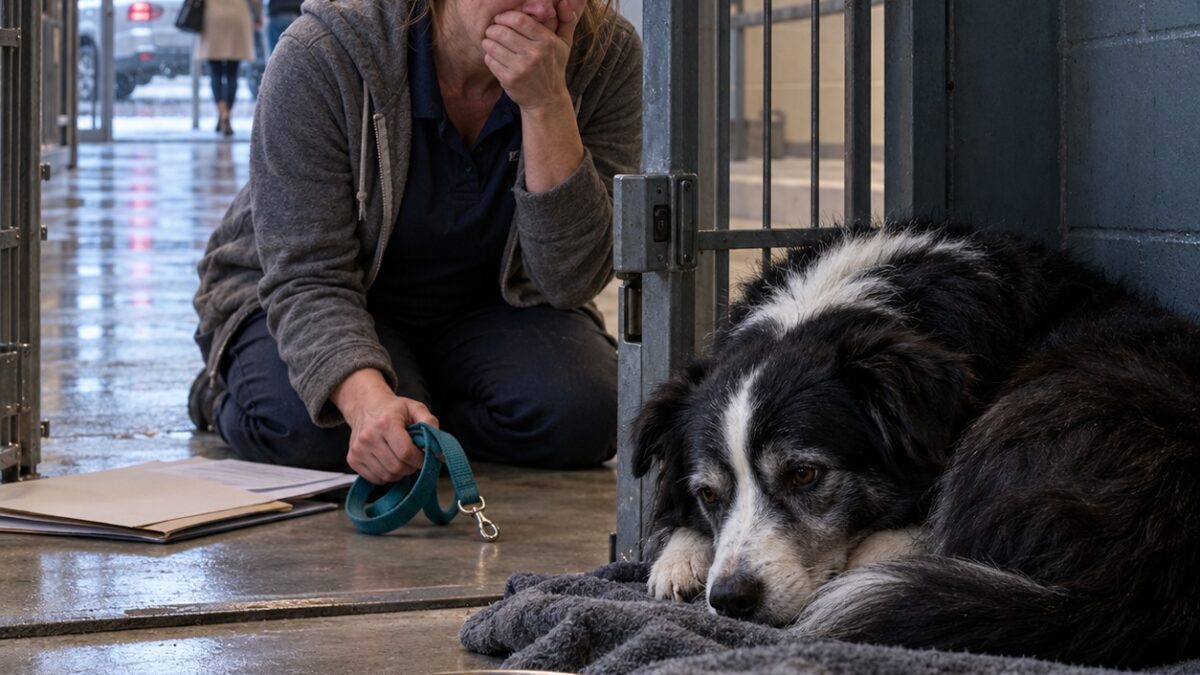
Before the adoption, Luna used to raise her head whenever the front door opened.
Afterward, she didn’t.
Before, when families passed her kennel, her eyes followed them.
Afterward, she slept.
Before, she would sometimes carry a faded red ball to the gate when someone stopped long enough.
Afterward, the ball remained untouched beneath her bed.
People often imagine heartbreak as noise.
Luna’s heartbreak was silence.
My name is Claire Bennett.
At the time, I had worked at Hawthorne County Animal Rescue for almost nine years.
I had seen animals arrive with broken bones, infected wounds, matted fur, scars from chains, and fear so deep that even a raised hand across the room could send them scrambling beneath furniture.
I knew how to deal with visible injuries.
You called the veterinarian.
You cleaned wounds.
You gave medication.
You built weight back slowly.
You created routines.
Emotional wounds were harder.
Especially the kind created by hope.
Luna had learned to survive being unwanted.
Then, for one afternoon, she had been told she belonged somewhere.
That was what broke her.
One of our volunteers, Jasmine, noticed it too.
She was twenty-three, studying veterinary technology, and had been in love with Luna from the week she arrived.
One afternoon, she sat beside me at the front desk.
“Has she played at all?”
“No.”
“Not even with the red ball?”
“No.”
Jasmine looked toward the kennel corridor.
“She used to bring it to me.”
“I know.”
“Do you think she misses those people?”
That question made me angry in a way I didn’t expect.
“Probably not them specifically.”
“Then what?”
I looked down at the intake forms on my desk.
“The idea.”
Jasmine frowned.
“What idea?”
“That somebody had finally chosen her.”
That was the cruelty of what happened.
Rebecca and her husband probably told themselves they had simply discovered the adoption wasn’t a fit.
Maybe that was true.
Maybe keeping Luna while resenting her would have been worse.
I understood all of that intellectually.
But Luna didn’t.
She didn’t know what compatibility meant.
She didn’t understand adjustment periods.
She didn’t know Rebecca’s husband had barely slept because Luna had paced between the bedroom and front door.
She didn’t understand that Rebecca had called us at six in the morning saying Luna seemed “too anxious.”
All Luna knew was that after nearly a year behind bars, someone had opened the door.
Then they had closed it again.
For the next two months, adoption inquiries came and went.
A retired couple liked Luna but chose a younger spaniel.
A woman with two children said Luna seemed “sad.”
A man interested in Border Collies asked whether she could still run five miles a day.
“She’s eight,” I told him.
“So probably not?”
“Not every day.”
He never returned.
Another family spent fifteen minutes outside her kennel.
Luna never stood up.
“She doesn’t seem friendly,” the father said.
“She’s cautious.”
“She doesn’t even care that we’re here.”
I almost laughed because it was painfully untrue.
Luna cared too much.
That was the problem.
She had simply learned not to show it.
After they left, I opened her kennel and sat beside her.
“Listen,” I said.
She didn’t lift her head.
“You’re making my job difficult.”
One ear moved.
“That’s right. I know you can hear me.”
Her eyes opened.
“You cannot sit here looking like somebody just canceled Christmas every time an adopter walks in.”
Nothing.
“You are a Border Collie. You’re supposed to be manipulative.”
One slow blink.
I smiled despite myself.
“You used to be good at this.”
I touched the floor beside her paw.
She tolerated me being there but didn’t move closer.
“We’ll find somebody.”
I said it more confidently than I felt.
“We just need the right person.”
That phrase is shelter language.
The right person.
We use it when a dog has behavioral challenges.
When a cat hides from everyone.
When an animal has been returned.
When weeks become months.
We say the right person is out there because the alternative is admitting we don’t know.
Luna had already been with us thirteen months by then.
Eight-year-old dogs did not become easier to adopt with time.
The shelter was full.
It was always full.
I began worrying about things I hated thinking about.
Budget.
Kennel space.
Long-term stress.
Quality of life.
Hawthorne County was not a high-kill shelter, but that did not mean time was irrelevant.
A shelter is still a shelter.
Concrete floors.
Metal doors.
Constant barking.
Strangers.
Schedules.
No matter how loving the staff is, it is not a home.
Luna was physically healthy, but I watched her world shrink.
She no longer rushed outside.
She walked.
She no longer investigated new scents.
She stood beside me until it was time to go back.
She no longer cared about other dogs unless one came too close.
Everything she did looked like obligation.
One Wednesday evening, after closing, I found myself sitting on the floor outside her kennel.
The building was finally quiet.
Most dogs had settled.
Rain tapped against the roof.
Luna lay in her corner.
“You know,” I told her, “I’m starting to take this personally.”
Her eyes opened.
“I have spent more money advertising your face than my own mother spent on my high school graduation photos.”
Nothing.
“You’ve been on Facebook.”
Ear twitch.
“Instagram.”
Another twitch.
“Local television.”
That got no reaction.
“A fourth-grade class made you a poster.”
Her eyes closed again.
I sighed.
“Fine.”
I rested my head against the kennel door.
“I’m tired too.”
That was the truth.
Shelter work can make you feel as though compassion is a bucket with a hole in the bottom.
You pour everything into it.
Time.
Money.
Sleep.
Patience.
And every morning more suffering arrives.
Another stray.
Another abandoned litter.
Another owner surrender because somebody moved.
Got divorced.
Had a baby.
Lost a job.
Bought a dog without thinking.
Sometimes the reasons were unavoidable.
Sometimes they made me furious.
But the animals didn’t care about reasons.
They only knew the door closed behind the person they trusted.
I looked at Luna.
“If I could explain it to you, I would.”
Her breathing remained slow.
“They were wrong for you.”
That sounded weak even to me.
“Maybe it’s better they brought you back quickly.”
Still weak.
“You deserve somebody who understands that one bad night isn’t your whole personality.”
Luna finally lifted her head.
For a moment, our eyes met.
Then she lowered it again.
I swallowed.
“I just wish you still believed that.”
The next morning was Thursday.
It was raining.
Not a storm.
Just that steady gray rain that turns parking lots into mirrors and makes every sound inside a shelter seem louder.
I was at the front desk filling out vaccination records when the door opened.
An older man stepped inside.
He closed a dark umbrella carefully and placed it near the entrance.
Then he wiped his shoes on the mat before going farther.
That small detail made me notice him.
Most visitors entered looking immediately toward the dogs.
This man looked around the room first.
Slowly.
As if getting his bearings mattered.
He was tall but slightly stooped.
Gray hair.
Weathered face.
An old brown jacket with a folded handkerchief visible in the breast pocket.
Maybe seventy.
Maybe older.
His eyes were pale gray.
He looked tired.
Not physically tired.
The kind of tired that settles behind the eyes after life has taken something you cannot replace.
I stood.
“Good morning.”
He nodded.
“Morning.”
“How can I help you?”
For several seconds he didn’t answer.
Then he cleared his throat.
“I’d like to adopt a dog.”
There was hesitation in the sentence.
Not uncertainty about wanting a dog.
Uncertainty about saying it out loud.
“Absolutely.”
I pulled an information sheet toward me.
“Have you owned dogs before?”
“Yes.”
“What kind?”
“Mostly mutts.”
He smiled faintly.
“My wife called them accidental breeds.”
Something about the way he said wife caught me.
Past tense without actually using past tense.
“What kind of dog are you looking for?”
He looked toward the kennel door.
“I don’t know.”
“Size?”
“Doesn’t matter.”
“Age?”
“No.”
“Male or female?”
“No preference.”
“High energy? Calm?”
He thought.
“Someone who could stand a quiet house.”
That answer was different.
Most people told us what they wanted from the dog.
Jogging partner.
Good with children.
Low shedding.
Protective.
Small.
Young.
House-trained.
This man described what he could offer.
A quiet house.
“What’s your name?”
“Henry Wallace.”
“I’m Claire.”
I pushed the paperwork aside.
“Come on, Henry.”
We entered the kennel wing.
Immediately, dogs started barking.
A shepherd mix jumped against his door.
Henry smiled but kept walking.
A young beagle howled.
A pit bull named Daisy brought a rope toy to the front of her kennel.
Henry stopped long enough to speak softly to her.
“Hello there.”
But he moved on.
I showed him a gentle Labrador mix.
A small terrier.
An older hound.
Each time, Henry looked carefully.
Never dismissively.
But something wasn’t connecting.
I began asking questions.
“Do you have a yard?”
“Small one.”
“Fence?”
“Yes.”
“Other pets?”
“No.”
“Children visiting?”
“My daughter sometimes. She’s forty-six.”
I laughed.
“Probably less concerned about her pulling a dog’s ears, then.”
Henry almost smiled.
“She might still try.”
We kept walking.
Then we reached Luna.
She was in the back corner.
Head on her paws.
Eyes closed.
I nearly passed.
Henry stopped.
I took another step before realizing he was no longer beside me.
I turned.
He was standing in front of Luna’s kennel.
He said nothing.
Luna didn’t move.
I waited.
A full minute passed.
Then two.
Most visitors became uncomfortable when Luna didn’t acknowledge them.
Henry seemed perfectly comfortable with silence.
Finally, he asked, “What’s her name?”
“Luna.”
“How old?”
“Eight.”
“How long has she been here?”
I hesitated.
“Fourteen months.”
Henry looked at me.
“Fourteen?”
“She was adopted once.”
His attention sharpened.
“What happened?”
“Returned the next morning.”
He looked back at Luna.
“Why?”
“They said she didn’t settle quickly enough.”
His jaw tightened.
“She’d spent almost a year here?”
“Eleven months.”
“And they gave her one night.”
“Yes.”
Henry went completely still.
Then he said, so quietly I almost missed it:
“I know what it means to wait for someone who doesn’t come back.”
I didn’t respond.
His eyes remained on Luna.
“My wife died two years ago.”
There was no dramatic break in his voice.
That somehow made it heavier.
“Forty-three years.”
“I’m sorry.”
He nodded.
“Her name was Margaret.”
Luna’s ear moved.
Just slightly.
Henry noticed.
So did I.
He crouched.
His knees clearly did not appreciate it.
I started to offer him a chair.
He raised one hand.
“I’m fine.”
Then he lowered himself all the way to the floor.
On the other side of the kennel door, Luna remained curled up.
Henry rested his arms loosely over his knees.
“Hello, Luna.”
No reaction.
“My name is Henry.”
Her ear moved again.
“I don’t know if they’ve told you anything about me.”
I covered my mouth to hide a smile.
“They probably haven’t.”
Luna opened one eye.
Henry continued.
“I had somebody too.”
The humor disappeared from his face.
“Somebody I expected to be there when I woke up.”
Luna’s eye remained open.
“One morning she wasn’t.”
I felt something tighten in my throat.
Henry wasn’t performing.
He seemed almost to have forgotten I was standing there.
“For a long time,” he said, “I kept doing things like she might come back.”
His voice softened.
“I bought too much milk.”
Luna opened both eyes.
“Left her side of the closet alone.”
Her head lifted slightly.
“Kept the porch light on.”
I glanced away.
“There’s no reason for a porch light when nobody’s coming home.”
Henry rubbed his thumb across one knuckle.
“But I kept turning it on.”
Luna was watching him now.
Not moving.
Watching.
Henry nodded as though she had answered.
“So I understand waiting.”
The shelter around us continued operating.
Phones rang.
A dog barked from the next row.
Someone rolled a cart of laundry past the entrance.
But that small piece of hallway became strangely separate from everything else.
Henry stayed on the floor.
“I’m not going to ask you to like me.”
Luna blinked.
“I’m not going to ask you to trust me either.”
Another blink.
“Seems rude to ask that from somebody who just met me.”
For the first time in weeks, I saw Luna’s nose twitch toward a stranger.
Henry smiled faintly.
“I have a house that is too quiet.”
Her ears lifted.
“There’s a yard.”
Henry looked toward me.
“Not a big yard.”
“Plenty big,” I whispered.
He returned his attention to Luna.
“I walk every morning. Slowly.”
Luna’s head was fully raised now.
“I talk to myself more than I should.”
He paused.
“I suppose you could pretend to listen.”
I felt tears gathering and hated myself for it.
Shelter employees cry more than we admit.
But I didn’t want Henry to feel observed.
So I stepped back.
Ten minutes passed.
Henry never reached through the gate.
Twenty minutes.
He never called her repeatedly.
Thirty.
He simply talked.
About rain.
About the garden Margaret used to keep.
About the oak tree behind his house.
About how he burned toast every morning because the toaster had two settings: raw and smoke alarm.
Sometimes he said nothing for several minutes.
He seemed comfortable with that too.
Luna slowly shifted from her curled position into a sit.
That alone was significant.
Henry noticed but didn’t react.
Good.
People ruin fragile moments by celebrating too quickly.
After almost an hour, Luna stood.
My breath caught.
She stretched.
Then took one step toward the front of the kennel.
Stopped.
Henry remained motionless.
Another step.
Stop.
Luna looked directly at him.
Henry whispered, “Take your time.”
She came closer.
Three feet.
Two.
One.
Then she stood against the kennel door.
Henry still did not reach for her.
Luna lowered her nose toward the gap.
She sniffed his sleeve.
Henry breathed carefully.
Then it happened.
Her tail moved.
Once.
A tiny movement.
So small I almost convinced myself I imagined it.
Then again.
Henry looked at me.
His eyes were wet.
I was already crying.
Neither of us spoke.
I unlocked the kennel.
“Would you like to meet her properly?”
Henry nodded.
I opened the door.
Luna did not rush out.
She stood at the threshold.
Henry remained seated.
She smelled his shoes.
His knees.
His hands.
Then his face.
Henry closed his eyes.
Luna stepped closer.
And very slowly, she lowered her head into his lap.
Henry made a sound then.
Not a sob exactly.
A broken breath.
His hand hovered above her head.
He looked at me.
“Can I?”
“She came to you.”
He rested his palm on her head.
He didn’t stroke her.
Didn’t pull her closer.
Just rested his hand there.
Luna closed her eyes.
For nearly a minute, nobody moved.
Finally Henry whispered, “I think we might understand each other.”
I wiped my cheeks.
“I think you might.”
The adoption process at Hawthorne County was never instantaneous.
Especially with a dog who had already been returned.
I refused to let emotion make us careless.
I sat Henry in the consultation room.
Luna followed.
That fact alone nearly destroyed my professionalism.
She had spent months refusing to leave her kennel willingly for strangers.
Now she followed Henry as though they had an appointment.
I went through everything.
“Luna may pace the first few nights.”
Henry nodded.
“She may not eat normally.”
“Okay.”
“She may have accidents.”
“Fine.”
“She may be afraid when you leave.”
“I don’t go many places.”
“You’ll need to eventually.”
“Then we’ll practice.”
I looked at him.
“She cannot be expected to become Margaret.”
His face changed.
Not offended.
Hurt.
“I know.”
“I have to say it.”
“I understand.”
“She isn’t here to fix your grief.”
Henry looked down at Luna.
“No.”
His hand rested near her paw.
“I think maybe we can just have it in the same room together.”
That answer stayed with me.
I continued.
“Why now?”
“Excuse me?”
“Your wife died two years ago. Why adopt now?”
Henry sat back.
“My daughter has been asking me for a year.”
“She suggested a dog?”
“She suggested therapy.”
I smiled.
“And?”
“I tried it.”
“And?”
“Therapist suggested a dog.”
That actually made me laugh.
Henry smiled.
“Margaret and I always had animals. After she died, I said I didn’t want another.”
“Why?”
His smile faded.
“Because everything leaves.”
Luna looked up at him.
Henry’s eyes dropped to hers.
“Eventually.”
A long silence.
“Then I realized that’s not an argument against loving something.”
He swallowed.
“It’s just the price.”
I approved the adoption.
Not because I believed in miracles.
Because Henry listened.
He asked questions.
He accepted every warning.
He did not romanticize Luna.
When I told him about her return, he did not say, “She’ll never do that with me.”
He said, “What should I do if she paces?”
When I told him she might take months to trust him fully, he said, “I’m not in a hurry.”
When I told him she might always struggle with abandonment, he said, “So do I.”
We completed the paperwork.
Luna remained beside his chair.
At one point Henry reached for a pen and she flinched.
He immediately stopped.
“Sorry.”
Luna studied his hand.
Henry placed it flat on the table.
Waited.
A minute later, she rested her chin against his knee.
I thought of Rebecca.
One night.
That was all Luna had been given.
Henry had already waited almost two hours just to touch her.
When everything was signed, I handed him the leash.
He stared at it.
“You sure?”
“That’s usually the part where adopters take the dog.”
“No, I mean…”
His voice faltered.
“You’re sure she wants to go?”
I looked at Luna.
She was standing beside him.
Not pulling toward the kennel.
Not watching the hallway.
“For today,” I said, “she wants to stay beside you.”
Henry nodded.
“That’s enough.”
We walked to the entrance.
The rain had softened.
Henry opened his umbrella but then seemed to realize juggling it with Luna might be difficult.
He closed it.
“You’ll get wet,” I said.
“So will she.”
“She doesn’t care.”
“Neither do I.”
Luna paused outside.
That was the moment I became afraid.
The last time she had crossed that threshold with an adopter, she had returned the next morning.
She stood beneath the gray sky staring at Henry’s car.
Her body stiffened.
Henry did not pull.
He waited beside her.
“Take your time.”
Five seconds.
Ten.
Thirty.
Then Luna stepped forward.
Henry opened the rear passenger door.
She looked inside.
He didn’t lift her.
Didn’t coax.
Didn’t insist.
Finally, she climbed in.
Henry fastened the seat belt attachment we provided.
Then he stood beside the car looking at me.
“What time do you open tomorrow?”
My heart stopped.
“Why?”
His eyebrows rose.
“In case I have questions.”
I laughed so hard it came out through tears.
“Eight.”
“Good.”
He opened the driver’s door.
“I’m not bringing her back.”
He said it quietly.
Not like a promise he wanted credit for.
Like a fact.
Luna watched me through the window.
I touched the glass.
“Okay, sweetheart.”
Henry started the car.
They drove away.
I stood outside in the rain until the taillights disappeared.
The next morning at seven forty-five, I was already watching the parking lot.
I hated myself for it.
Every silver car made my stomach tighten.
Eight o’clock.
Eight fifteen.
Eight thirty.
No Henry.
At nine twelve, the phone rang.
I grabbed it too quickly.
“Hawthorne County Animal Rescue.”
“Claire?”
Henry.
My stomach dropped anyway.
“Henry. Is everything okay?”
“Yes.”
A pause.
“I think.”
“What happened?”
“She didn’t sleep.”
Here we go.
“She walked around most of the night.”
“That’s normal.”
“She kept checking the front door.”
“Also normal.”
“She ate half her breakfast.”
“That’s actually excellent.”
“Oh.”
I heard him exhale.
“I thought maybe I’d done something wrong.”
“No.”
There was silence.
Then Henry said, “I sat on the kitchen floor at three in the morning.”
I smiled.
“And?”
“She sat across the room.”
“Good.”
“For an hour.”
“Good.”
“She came closer eventually.”
“How close?”
“Put her paw on my slipper.”
My eyes filled.
“Henry?”
“Yes?”
“You had a very good first night.”
He was quiet.
“Did we?”
“Yes.”
Another pause.
“Margaret would’ve liked her.”
I closed my eyes.
“I think so.”
Henry called almost every day that first week.
Not because he wanted to return Luna.
Because he wanted to understand her.
“Is it normal that she waits outside the bathroom?”
“Yes.”
“She followed me to the mailbox.”
“On leash?”
“Yes.”
“Then yes.”
“She won’t sleep on the bed I bought.”
“Where does she sleep?”
“Next to it.”
“Normal.”
“I bought a very expensive bed.”
“That guarantees she will never use it.”
By the fifth day, Henry’s voice sounded different.
Lighter.
Luna had begun eating full meals.
She still paced at night, but less.
She followed him from room to room.
She refused to go into Margaret’s old sewing room.
Henry didn’t force her.
On the seventh day, he called at six thirty in the evening.
“She barked.”
“Congratulations?”
“I hadn’t heard her bark.”
“What happened?”
“Mailman.”
“That sounds appropriate.”
“She scared both of us.”
I laughed.
“So she’s settling.”
“I think she thinks this is her house.”
The emotion beneath the sentence made me stop smiling.
“Henry.”
“Yes?”
“It is.”
Silence.
“I suppose it is.”
Three weeks passed.
Then one afternoon Henry came through the shelter doors carrying a manila envelope.
Alone.
My stomach clenched automatically.
“Where is Luna?”
“At home.”
I exhaled.
“Do you enjoy terrifying shelter workers?”
“What?”
“Never mind.”
He grinned.
That grin was new.
He looked different.
Same jacket.
Same gray hair.
Same slight stoop.
But his face had more life in it.
“I brought pictures.”
Jasmine practically ran from the back room when she heard.
Henry spread the photographs across the desk.
Luna in his backyard.
Luna lying beneath the oak tree.
Luna sitting beside the kitchen table.
Luna on the couch with one paw across Henry’s leg.
Luna holding a tennis ball.
I picked that one up.
“She plays?”
“Every afternoon.”
My throat tightened.
The dog in the photograph looked different from the one in our kennel.
Her mouth was open.
Tongue out.
Eyes bright.
Her tail was blurred from movement.
“You know what else?” Henry said.
“What?”
“She sleeps in my bed.”
I raised an eyebrow.
“You bought her a bed.”
“Apparently I bought myself a very expensive floor decoration.”
“Told you.”
“She snores.”
“Border Collies deny that.”
“I have evidence.”
He sat across from me.
For a moment, we simply looked at the photographs.
Then Henry said, “She talks.”
I smiled.
“Barks?”
“No. Talks.”
“How?”
He leaned back.
“Little sounds.”
I knew exactly what he meant.
“Especially when she wants something.”
“Yes.”
“Congratulations. She owns you.”
Henry laughed.
Then his expression softened.
“She sits with me at dinner.”
His finger rested on one photograph.
“She follows me outside in the morning.”
Another photograph.
“She waits by the bathroom.”
I smiled.
“Still.”
“Still.”
He looked down.
“And I talk to her.”
“That’s allowed.”
“No.”
He shook his head.
“I mean I really talk.”
Something changed in his voice.
“For two years after Margaret died, the house was so quiet.”
I stopped joking.
“I thought I liked it that way.”
He rubbed his hands together.
“It felt respectful somehow.”
“To Margaret?”
“Yes.”
“As if being happy would mean you missed her less.”
Henry looked at me sharply.
“Exactly.”
He stared at the photographs.
“I stopped inviting people over.”
“Why?”
“Didn’t want them moving things.”
“Things?”
“Her chair. Her coffee mug. Little things.”
He shrugged.
“My daughter would visit and open curtains. Drove me crazy.”
I smiled gently.
“Sounds serious.”
“I know how ridiculous that is.”
“It doesn’t sound ridiculous.”
Henry went quiet.
Then he said, “Luna knocked Margaret’s mug off the table.”
I froze.
“Oh no.”
Henry nodded solemnly.
“Broke the handle.”
“What did you do?”
“I shouted.”
My heart sank.
“Not at her exactly.”
He looked ashamed.
“She ran into the hallway.”
“What happened?”
“I picked up the mug.”
His eyes became wet.
“And I sat on the floor holding the pieces like an idiot.”
“You’re not an idiot.”
“Felt like one.”
“What did Luna do?”
Henry smiled sadly.
“Came back.”
Of course.
“She sat ten feet away at first.”
He swallowed.
“Then five.”
“Then?”
“Put her head against my shoulder.”
I looked away because I knew I was going to cry.
“I realized I’d spent two years protecting that mug.”
Henry laughed once.
“A mug.”
“It was hers.”
“Yes.”
“That matters.”
“But Margaret wasn’t in the mug.”
His voice broke.
“Margaret wasn’t in the chair.”
Silence.
“She wasn’t in the sewing room. She wasn’t in the curtains being closed.”
Henry wiped his eyes.
“I was treating the house like a museum because I was afraid if anything changed, she’d disappear more.”
I didn’t say anything.
“Luna broke one mug.”
He looked at me.
“And somehow the whole place started becoming a house again.”
That afternoon, after Henry left, I taped one of the photographs inside Luna’s old kennel.
Not where another dog could chew it.
High on the wall outside.
Luna standing beneath the oak tree.
Happy.
I needed it there.
Shelter work can distort your memory.
You remember the returns.
The abandoned animals.
The people who fail.
You need reminders that some people stay.
Months passed.
Henry visited regularly.
Sometimes with Luna.
The first time she came back, I worried the building would upset her.
She paused at the entrance.
Her ears lowered.
Henry waited.
Then Luna looked at him.
He said, “We’re visiting.”
She walked inside.
When she saw me, she ran.
Actually ran.
I dropped to my knees.
She hit me hard enough to push me backward.
“You remember me?”
Her entire body wiggled.
Jasmine cried.
I cried.
Henry pretended not to cry.
Luna greeted several staff members.
Then something interesting happened.
She walked toward her old kennel.
Stopped.
Looked inside.
A young mixed-breed dog was sleeping there now.
Luna watched him for several seconds.
Then turned away.
No trembling.
No pulling.
No collapse.
She returned to Henry.
She was done with that room.
The past still existed.
It just no longer owned her.
Henry changed too.
His daughter, Emily, started coming with him.
The first time I met her, she hugged me without warning.
“You gave me my father back.”
I stiffened.
“No. Luna did that.”
Emily smiled.
“He leaves the house now.”
Henry rolled his eyes.
“I left the house before.”
“To buy groceries.”
“Groceries are outside.”
Emily ignored him.
“He goes to the park. Talks to neighbors. He joined the gardening club again.”
Henry muttered, “They needed help.”
“He had people over for dinner.”
“Two people.”
“Four.”
“Two couples.”
Emily looked at me.
“This man had not invited anyone into his house for twenty-six months.”
Henry focused intensely on Luna’s collar.
I smiled.
“Sounds like progress.”
He grumbled.
Luna leaned against his leg.
They did that often now.
Not because Luna was afraid.
Because contact had become their language.
I saw them together through seasons.
Summer.
Autumn.
Winter.
Another spring.
Luna’s muzzle grew whiter.
Henry’s walking became slower.
They adjusted to each other.
When Henry tired, Luna waited.
When Luna’s hips became stiff, Henry shortened their walks.
They moved at the same speed.
One afternoon, nearly two years after Henry adopted Luna, he called me from the veterinary clinic.
My heart immediately sank.
“She’s fine,” he said before I could ask.
“Don’t do that to me.”
“Sorry.”
“What happened?”
“Arthritis.”
“That’s manageable.”
“Vet says so.”
He went quiet.
“Claire?”
“Yes?”
“She’s getting old.”
“Yes.”
“I don’t like it.”
I understood what he was really saying.
Everything leaves.
Eventually.
“Henry.”
“I know.”
“You knew this when you adopted her.”
“I know.”
“You told me once that it wasn’t an argument against loving something.”
Silence.
“You remember that?”
“I remember everything people say when they adopt dogs I worry about.”
Henry sighed.
“She saved me.”
“I know.”
“What happens when—”
He couldn’t finish.
I leaned back in my chair.
“You’ll hurt.”
“That’s not very comforting.”
“I could lie.”
“No.”
“You’ll hurt badly.”
He breathed.
“But that isn’t happening today.”
“No.”
“So don’t turn today into that day.”
Another silence.
“Margaret used to say something like that.”
“She sounds smarter than me.”
“She was.”
“Rude.”
Henry laughed.
I smiled.
“Take Luna home.”
“I will.”
“Give her whatever the vet prescribed.”
“Yes.”
“And don’t start mourning her while she’s still trying to steal your dinner.”
“She doesn’t steal.”
“Henry.”
“Fine.”
A year later, Henry sent me a Christmas card.
On the front was a photograph of him sitting in an armchair.
Luna beside him.
Both wearing ridiculous red scarves.
Inside, Henry had written:
Still here. Both of us.
I kept that card on my desk.
Not forever.
Nothing lasts forever.
But for as long as I needed it.
Luna had entered our shelter because somebody could no longer care for her.
She stayed eleven months because people wanted easier dogs.
She was chosen.
Returned.
And for a while, something in her seemed to decide that hope itself was dangerous.
Then Henry came through the door on a rainy Thursday.
He did not rescue her by being charming.
He did not fix her in an afternoon.
He sat down.
He waited.
He did the one thing Luna had needed most.
He stayed long enough for her to make the choice.
Years later, whenever new volunteers asked me which adoption I remembered most, I never talked about puppies.
Puppies always made good stories.
I talked about Luna.
Because Luna taught me something more complicated than “every dog deserves a home.”
Of course every dog deserves a home.
But not every home deserves every dog.
Being chosen is not enough.
Someone can choose you impulsively.
Love you for a weekend.
Love the idea of you.
Love you while you’re easy.
Luna had already experienced that.
What changed her life was not being chosen.
It was being understood.
Henry never demanded joy from her.
He never required gratitude.
He never treated adoption like a transaction where food and shelter entitled him to affection.
He offered presence.
That was all.
And because he did, Luna eventually gave him everything.
Her trust.
Her ridiculous Border Collie stare.
Her tennis ball.
Her side of the bed.
Her habit of following him to the mailbox.
Her quiet company at dinner.
Her head against his knee on evenings when Margaret’s absence became heavy again.
Henry gave her a home.
Luna gave him life inside it.
I used to think successful rescue work could be measured.
Adoption numbers.
Return rates.
Medical outcomes.
Days in care.
Those statistics matter.
Shelters need them.
But statistics cannot show what happened when Henry opened his curtains again.
They cannot measure Luna sleeping deeply enough that she stopped checking doors.
They cannot record the first time Henry laughed alone in his kitchen because she stole something from his plate.
They cannot calculate the distance between surviving and living.
I saw that distance in photographs.
I saw it in Henry’s posture.
I saw it in Luna’s eyes.
Most of all, I saw it the final time they visited together.
Luna was almost twelve.
Her steps were slow.
Her muzzle nearly white.
Henry was moving carefully too.
They came through the shelter entrance side by side.
I walked around the desk.
“Well, look who it is.”
Luna’s tail moved.
Not wildly.
She no longer had wild movements.
But it moved.
She came to me.
I knelt.
“Hi, beautiful.”
She pressed her forehead against my chest.
Henry smiled.
“She remembers.”
“Of course she remembers.”
We sat in the lobby.
Luna rested between us.
After a while, Henry looked toward the kennel hallway.
“Do you remember what I said the first day?”
“You said a lot.”
“About waiting.”
I nodded.
“I know what it means to wait for someone who doesn’t come back.”
“Yes.”
He looked at Luna.
“I don’t wait for Margaret anymore.”
His words could have sounded cruel if you didn’t understand them.
I understood.
“I miss her.”
He touched Luna’s ear.
“Every day.”
“But?”
“But I don’t wait.”
I felt tears gather.
“There’s a difference.”
“Yes.”
“I talk to her sometimes.”
“Margaret?”
“Yes.”
“What do you say?”
Henry smiled.
“Mostly complain about the dog.”
I laughed.
Luna opened one eye.
“Apparently Luna snores.”
“She does.”
“Traitor.”
Henry grew serious again.
“I tell Margaret I’m okay.”
He looked at me.
“I wasn’t for a long time.”
Luna shifted closer to him.
“I am now.”
That may have been the last thing Henry ever needed to tell me.
Not thank you.
Not you saved us.
Just:
I am okay now.
Because that is what healing looks like when it is real.
Not forgetting.
Not replacing.
Not pretending the worst thing never happened.
Being able to say, eventually:
It happened.
It changed me.
I still hurt.
And I am okay.
Henry stood to leave.
I helped him with his jacket.
Luna waited beside the door.
Before he walked out, Henry turned.
“You know, Claire?”
“What?”
“I came here thinking I was lonely because Margaret died.”
I waited.
“I was wrong.”
“How?”
“I was lonely because after she died, I stopped letting anything reach me.”
He looked down at Luna.
“She didn’t cure loneliness.”
He smiled.
“She just refused to let me hide inside it.”
Then they left.
I watched through the glass as Henry opened the passenger door.
Luna climbed in slowly.
He adjusted something inside.
Probably the blanket he always kept on the seat for her.
Then he closed the door, walked around the car, and drove away.
This time I didn’t feel afraid watching them leave.
The first time Luna drove out of our parking lot, I prayed she wouldn’t come back.
She did.
And I thought that return had destroyed the ending she deserved.
I was wrong.
Sometimes being returned is not the end of a story.
Sometimes it reveals who was never capable of holding your trust in the first place.
Sometimes losing the wrong home makes space for the right one.
I would never tell myself Luna needed what happened to her.
She didn’t.
She didn’t need eleven months in a shelter.
She didn’t need one night of hope followed by rejection.
Pain does not become good simply because something good eventually follows it.
But what happened after mattered.
When Luna could no longer believe in people, Henry did not demand belief.
When Henry could no longer believe life held anything new for him, Luna did not demand optimism.
They simply occupied the same quiet space.
Two wounded creatures.
One old man.
One aging dog.
Two beings who understood that waiting can hollow you out.
Then, gradually, they stopped waiting.
They started living.
And that is why, whenever somebody asks me why I still work in rescue after all these years, I think of a rainy Thursday.
I think of Henry lowering himself painfully onto a concrete floor.
I think of Luna opening one eye.
I think of one tiny movement of a tail that had seemed permanently still.
I think of the photograph beneath the oak tree.
I think of a broken coffee mug.
A reopened curtain.
A house becoming a home again.
I think of an old dog who had spent eleven months hoping someone would choose her, only to discover that being chosen was never the most important thing.
Being kept was.
Being understood was.
Being allowed to take time was.
Being loved after the excitement of adoption day faded was.
That is the promise people make when they bring an animal home, whether they realize it or not.
Not that every day will be easy.
Not that the animal will instantly understand the rules.
Not that trauma will disappear because a new collar looks pretty.
The promise is simpler and harder.
I will still be here tomorrow.
Henry understood that because he knew exactly what tomorrow felt like when the person you expected was gone.
So he gave Luna the thing he himself had lost.
Consistency.
And Luna gave it back.
Every morning she was there.
Every evening she was there.
Every quiet dinner.
Every walk.
Every night beside his bed.
Every morning waiting for him to wake.
Neither could promise forever.
None of us can.
But they could promise today.
Then another today.
And another.
Until enough todays became a life.
Luna no longer sat in the back corner of a kennel with her head between her paws.
She no longer watched cars leave wondering whether somebody might return.
She no longer needed to perform happiness to convince strangers she was worth taking home.
She had a yard.
A tennis ball.
A place beside Henry at dinner.
A bed she mostly ignored.
A side of Henry’s mattress she apparently considered legally hers.
She had somebody who talked too much.
Somebody who walked slowly.
Somebody who knew silence could be heavy but also knew silence was easier when shared.
And Henry no longer lived in a museum dedicated to a life that had ended.
Margaret’s photographs remained.
Her memory remained.
His love for her remained.
But the curtains opened.
People came to dinner.
The garden grew again.
There were dog hairs on the couch.
Bowls in the kitchen.
A leash near the door.
Noise.
Movement.
Life.
That was Luna’s gift to him.
Not replacing his wife.
Reminding him that loving someone who was gone did not require disappearing with them.
I still keep photographs from successful adoptions.
Not all of them.
There are too many now.
But Luna and Henry have their own little place in the drawer beneath my desk.
On difficult days, I open it.
There is Henry beneath the oak tree.
Luna beside him.
There is Luna holding the ball she once refused to touch.
There is the ridiculous Christmas scarf.
There is one photograph Emily sent me of Henry asleep on the couch with Luna’s head resting against his shoulder.
Two gray heads.
One human.
One dog.
Both at peace.
I look at those pictures when we get another return.
When someone says, “He wasn’t what we expected.”
When someone says, “She cried at night.”
When someone says, “We thought he’d be calmer.”
When I have to walk another confused animal back toward a kennel it thought it had escaped.
Those are the days I need Luna most.
Because she reminds me not to confuse a bad chapter with an ending.
I kneel beside the frightened dog.
I open the kennel.
I put down fresh water.
And sometimes, when nobody else can hear me, I say the same thing I once said to Luna.
“We just need the right person.”
I don’t say it casually anymore.
I know what those words cost.
I know the right person may take months.
I know sometimes they never come.
Rescue work does not guarantee miracles.
But sometimes a gray-haired widower opens the door on a rainy Thursday.
Sometimes he stops in front of the dog everyone else has learned to walk past.
Sometimes he recognizes a silence because it sounds like his own.
Sometimes he sits down.
Sometimes the dog opens her eyes.
Sometimes a tail moves.
And sometimes two lives that seemed finished are not finished at all.
They were only waiting for someone willing to stay.








