FULL STORY:I Told the Dog Who Had Been Chained for Ten Years, “This Bed Is Yours”—He Was Too Afraid to Lie Down
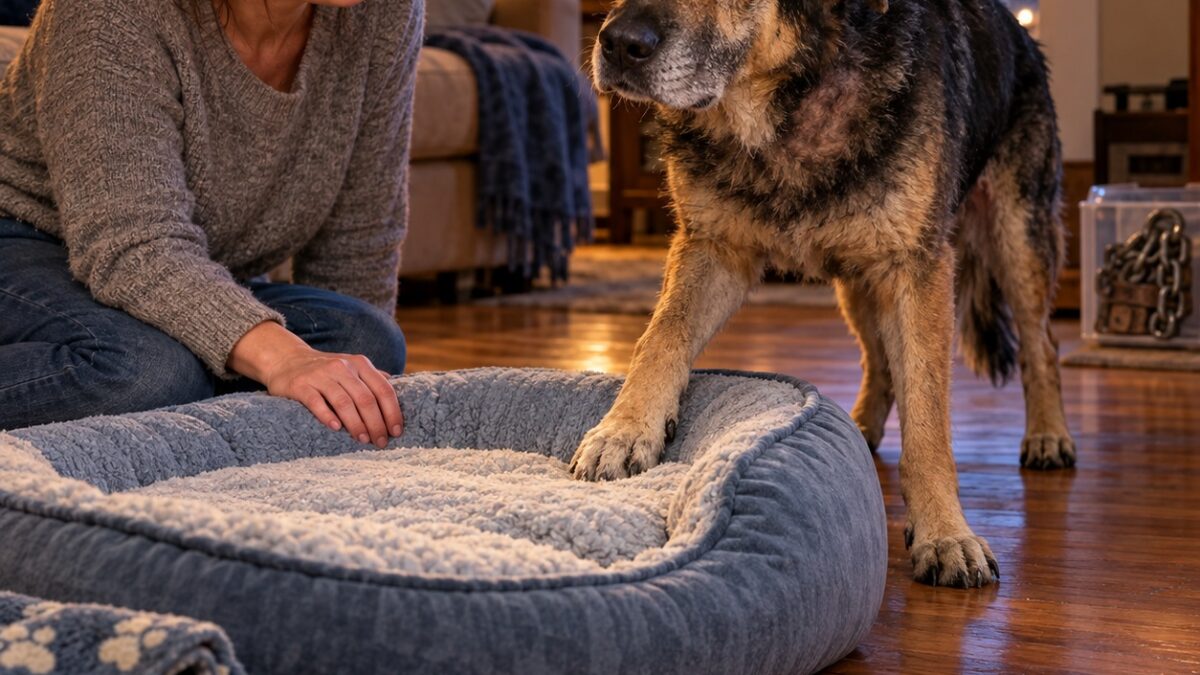
PART2
I barely slept.
Not because Titan made noise.
Because he didn’t.
At two in the morning, I walked into the hallway and looked toward the living room.
He was still there.
Same position.
Head on his paws.
Body curled carefully in the center of the bed as though afraid that spilling over the edge might violate some rule.
At four, I checked again.
Still there.
At six-thirty, morning light came through the curtains.
Titan had not moved.
Not once that I could tell.
For one irrational second, I panicked.
I crossed the room quietly.
Then stopped before touching him.
His chest rose.
Fell.
Deep.
Steady.
Sleeping.
Really sleeping.
Not the shallow vigilance I had seen at the rescue facility where every footstep brought his eyes open.
He was asleep deeply enough that I could stand six feet away without waking him.
I crouched.
Watched.
And began crying.
Rescue work does that.
You can stay composed through wounds.
Neglect reports.
Veterinary examinations.
Intake paperwork.
Then one animal sleeps peacefully and suddenly you are sitting on your own floor wiping your face with your sleeve.
I don’t know how long I stayed there.
Eventually Titan’s eyes opened.
His head came up immediately.
His body tightened.
The trust of night vanished in one second.
Morning had arrived.
And with it, apparently, a new question.
Was yesterday still true?
He stared at me.
Then at the bed.
Then at me again.
I could almost see the uncertainty.
Did “yours” expire overnight?
Had he been allowed comfort only because no one noticed?
Would daylight bring the rules back?
I placed my hand against the outer edge of the cushion.
“Still yours.”
Titan watched.
“Good morning.”
His shoulders lowered slightly.
I did not pet him.
Not then.
He was not ready.
I went into the kitchen.
Breakfast became our next lesson.
I filled a bowl with kibble and added warm water.
Nothing fancy.
The warmth brought out the smell and made it easier for an older dog whose teeth showed years of poor care.
I placed the bowl several feet from the kitchen doorway.
Then moved away.
Titan appeared.
Slowly.
He had learned during the night that the hallway would not hurt him.
The kitchen was new territory.
He stopped at the threshold.
Sniffed.
Food changed something.
He stepped forward.
Once.
Twice.
Reached the bowl.
And froze.
Not the way a picky dog hesitates.
Titan wanted that food.
His nose trembled.
Saliva gathered at one side of his mouth.
But he would not lower his head.
He looked at me.
Food.
Me.
Food.
Me.
I sat at the table.
“Mange.”
Wrong language.
I laughed softly at myself.
“Eat, Titan.”
Nothing.
I turned my body slightly away.
Some frightened dogs find direct attention pressure.
He lowered his head halfway.
Stopped.
Looked at me again.
I said:
“It’s yours.”
That phrase again.
I was beginning to understand how little the words meant yet.
Yours.
A concept built through repetition.
Not language.
Experience.
I looked away.
After nearly a minute, I heard the first piece of kibble move.
Then another.
I did not turn.
Titan ate slowly.
Nothing like the frantic food guarding people sometimes associate with starved dogs.
His fear worked differently.
He ate as though expecting interruption.
One bite.
Pause.
Listen.
Another.
Look at me.
Another.
At one point, I stood to refill my coffee.
Titan jumped backward from the bowl.
Hard.
He retreated almost three feet.
Head low.
My stomach tightened.
I stopped.
“Sorry.”
I sat again.
He stared.
The bowl sat untouched between us.
I waited.
Five minutes later, he returned.
That first meal took almost half an hour.
When he finished, a few pieces remained.
Titan stood over them.
I thought he might guard them.
Instead, he walked away.
Then stopped.
Turned back.
Looked.
As if memorizing where food existed.
The first week exposed wounds no veterinarian could photograph.
Titan did not understand doors.
The sound of one opening made him flinch.
The sound of one closing made him crouch.
A spoon dropped into the sink and he bolted into the hallway.
My washing machine entered the spin cycle and he pressed himself into a corner.
A delivery truck stopped outside.
Titan froze.
He never barked.
That worried me more than barking would have.
Dogs should complain about things sometimes.
Titan behaved as if making noise itself might be dangerous.
He moved along walls.
Always.
If a room allowed him to walk through the center, he still chose the perimeter.
Furniture became cover.
Doorframes became checkpoints.
He never entered a space unless I had gone first.
The first time I accidentally walked quickly toward him with laundry in my arms, Titan flattened himself.
Not crouched.
Flattened.
Elbows on the floor.
Head turned away.
Eyes half closed.
Waiting.
I stopped so fast the laundry fell.
“Oh, Titan.”
He remained there.
I sat down.
Not close.
My chest hurt.
That position told a history nobody needed to narrate.
An animal doesn’t learn to make himself small like that without reason.
I wanted to cross the room.
Hold him.
Tell him he would never be hurt again.
Those impulses are human.
Not always useful.
So I stayed where I was.
Ten minutes.
Fifteen.
Eventually Titan lifted his head.
Then stood.
Walked away.
Trust was not a straight line.
Some mornings he approached me.
That afternoon he avoided me for hours.
We started again at dinner.
Same bowl.
Same place.
Same words.
“It’s yours.”
The first toy confused him completely.
A soft rubber ball.
Blue.
I rolled it gently across the carpet.
Titan watched it.
The ball stopped.
He looked at me.
Then at the ball.
Nothing.
I rolled it again.
He moved away.
I left it on the floor.
Three days later, I found it two feet from where I had left it.
Maybe he had touched it.
Maybe I had kicked it accidentally.
I decided not to investigate.
The biggest heartbreak came in the backyard.
I had been waiting for a dry morning.
Titan had gone outside on leash for bathroom breaks, but I wanted to see what he would do with actual freedom.
My yard was fenced.
Green grass.
A maple near the back.
Lavender beside the patio.
Enough room for a large dog to run if he wanted.
I opened the sliding glass door.
Titan stood beside me.
Wind came through.
His nose lifted.
That was one of the first moments I saw something like curiosity.
Birds.
Grass.
So many smells.
He stepped outside.
One paw.
Then another.
I unclipped the leash.
Titan felt the weight disappear.
He looked at me.
Then walked.
One step.
Two.
Three.
He stopped.
I thought he had smelled something.
Then I noticed where he was standing.
Approximately two meters from the patio.
He turned.
Walked sideways.
Stopped again.
Two meters.
Tried another direction.
Stopped.
Same distance.
My throat tightened.
There was no chain around him.
No stake in the ground.
No post.
No rope.
Nothing.
But Titan had traced the boundary anyway.
A circle.
Invisible.
Perfectly learned.
Ten years.
Two meters.
That was the size of his world.
And his body still believed it.
I walked across the yard.
Titan watched.
I sat in a chair near the maple.
Thirty feet away.
He did not follow.
I called gently.
“Titan.”
His ears moved.
I opened my hands.
Nothing.
He looked down at the grass.
Then toward the patio.
Then at me.
“Come on.”
I hated myself for saying it immediately.
Too much pressure.
So I stopped.
I sat.
Looked at the trees.
Waited.
A bee moved through the lavender.
Cars passed somewhere beyond the fence.
Titan stood inside his invisible circle.
Five minutes.
Ten.
Then he lifted one front paw.
Held it.
The paw came down beyond whatever line his mind believed was there.
He jerked backward.
I covered my mouth.
He tried again.
One step.
Stopped.
Another.
His whole body shook.
Nothing touched him.
No chain snapped tight.
No punishment came.
Titan looked behind himself.
Then forward.
Another step.
He was leaving a prison that no longer physically existed.
That may have been the saddest thing I ever watched.
People imagine freedom as immediate relief.
Open the cage.
Remove the chain.
Problem solved.
But Titan taught me that sometimes captivity continues inside the body after the object is gone.
He took another step.
Then another.
By the time he reached me, my face was wet.
He stopped beside the chair.
Didn’t lean.
Didn’t ask for touch.
Just stood.
Then slowly sat near my feet.
I put my hand on the grass.
Not him.
A minute passed.
Titan lowered his head.
His shoulder touched my knee.
Barely.
Accidental, perhaps.
I stayed still.
He did not move away.
Then I laughed.
Not loudly.
Relief escaped before I could stop it.
Titan lifted his head.
Tilted it.
The expression was so genuinely confused that I laughed again.
His ears moved.
For the first time, his tail tapped the grass.
Once.
That was all.
I cried harder.
After that, the yard became our classroom.
Every day, Titan tested the old boundary.
Some days he crossed immediately.
Other days he stopped.
One rainy morning he refused completely.
I didn’t force him.
Trauma does not care about schedules.
On day nine, he walked halfway to the maple without looking behind.
Day twelve, he reached the back fence.
I watched him touch his nose to the wood.
He sniffed.
Looked at me.
Then walked along the fence as though discovering geography.
The first time he ran happened accidentally.
A bird dropped from the grass.
Titan startled.
Then followed.
Three quick strides.
He stopped abruptly.
Looked down at his own legs.
I laughed so hard I had to sit.
He had run maybe fifteen feet.
To me, nothing.
To him, a continent.
Food improved faster.
By the end of the second week, I could enter the kitchen while he ate without Titan abandoning the bowl.
I still gave space.
No need to test trust aggressively.
I could reach for my coffee.
Open the refrigerator.
Walk past.
Titan noticed.
But he stayed.
One morning, I put the bowl down.
He looked at me.
Then began eating immediately.
No waiting for permission.
I stood at the counter and cried into my coffee.
Again.
I was becoming a very hydrated person through grief.
Walks were harder.
Leash meant history.
The first time I clipped it on, Titan’s body went rigid.
A chain is not a leash.
But metal near the neck does not explain distinctions to a nervous system.
So we used a harness.
Still difficult.
Outside the property, the world was enormous.
Cars.
Children.
Dogs.
Trash cans.
Wind.
Bicycles.
Titan tried to retreat whenever anything approached.
Our first walk lasted four minutes.
End of driveway.
Two houses.
Back.
The second reached three houses.
The third was worse because someone dropped a garbage lid.
We came home immediately.
Progress includes retreat.
People dislike that idea.
They want each day better.
Animals don’t heal to satisfy narrative structure.
We walked anyway.
Slowly.
At Titan’s pace.
I carried treats.
He refused them outside for almost two weeks.
Fear overrode appetite.
Then one morning, near the maple-lined corner, Titan accepted a piece of chicken from my hand.
A cyclist passed twenty feet away.
He flinched.
But ate.
That combination felt enormous.
Fear and food existing at once.
It meant his brain was beginning to allow more than survival.
By the third week, the walk had become something Titan seemed to anticipate.
Not enthusiastically.
Not yet.
When I picked up his harness, his ears rose.
That was enough.
We discovered he loved trees.
Not in the ordinary dog way of sniffing everything for information.
Titan would stand beneath them and smell the air.
Long breaths.
As if scent itself were proof the world was bigger.
He liked cool mornings.
Hated motorcycles.
Ignored squirrels.
Watched other dogs from a distance.
One elderly beagle named Chester became his first canine acquaintance.
Chester had no concept of personal space.
His owner apologized constantly.
The first time Chester approached, Titan froze.
I asked the owner to stop.
We let Titan choose.
He sniffed from six feet.
Then five.
Four.
Chester sat down.
Probably by accident.
Titan moved closer.
Nose touch.
Back away.
Then his tail moved.
Tiny.
The next morning, Titan looked down the street where Chester usually appeared.
Waiting.
That was another form of hope.
At home, he still did not play.
The blue ball remained ignored.
I added a stuffed sheep.
Titan looked at it with deep suspicion.
I left it beside his bed.
Three nights later, I woke to a sound in the living room.
I came down quietly.
Titan was standing over the sheep.
One paw on it.
He saw me.
Dropped his paw instantly.
Retreated.
I pretended I had seen nothing.
Went to the kitchen.
Got water.
Returned upstairs.
The next morning, the sheep had moved into Titan’s bed.
I said nothing.
By the end of that week, one ear was missing.
Progress.
The bed itself became sacred.
Titan returned to it throughout the day.
At first, always the same tight position.
Never stretched.
Never upside down.
Never fully relaxed.
Then little changes.
One leg outside.
Head over the edge.
Side sleeping.
Each new posture told me something.
Bodies reveal safety before behavior sometimes does.
His face changed too.
The muscles around his eyes loosened.
Mouth opened more often.
Ears found neutral positions instead of living halfway back.
People who visited noticed.
I kept visitors minimal.
Titan did not owe anybody a meet-and-greet because his story was sad.
My sister came first.
She entered.
Ignored him.
Sat at the table.
We drank coffee.
Titan watched from the hallway.
Twenty minutes later, he moved into the living room.
My sister did not look.
Ten minutes later, he lay down.
That was success.
When she left, she whispered:
“I wanted to hug him so badly.”
“I know.”
“Would that have been terrible?”
“Probably.”
She smiled sadly.
“Okay.”
Sometimes loving an animal means doing less.
Week three gave me the moment I will never forget.
I was on the sofa reading.
Titan’s bed was several feet away.
He was not in it.
That itself had become normal.
He walked around the room more freely now.
He approached the coffee table.
Sniffed.
Walked past.
Then stopped in front of me.
I lowered the book.
“Hi.”
Titan stared.
His eyes moved toward the sofa.
Then me.
I understood.
I also didn’t.
Had he ever been on furniture?
Almost certainly not.
He lifted one paw.
Set it on the edge of the cushion.
Immediately removed it.
His ears went back.
I stayed still.
“You can.”
I hated that the words had to exist.
A dog should not need permission to find comfort in a home built for him.
But Titan did.
He tried again.
Paw on cushion.
Then second.
His hind legs remained on the floor.
Body stretched.
Trembling.
I did not touch.
He climbed the rest of the way.
Stood beside me.
Four feet on the sofa.
Eyes wide.
I smiled.
“It’s yours too.”
Then I realized I’d said it.
The phrase.
Yours.
Titan turned once.
Slowly lowered himself.
His body settled against my thigh.
His head remained up.
After a minute, he lowered it.
Right into my lap.
I stopped breathing.
The book slid to the floor.
Titan didn’t care.
His head was heavy.
Warm.
I could feel his breathing through my jeans.
I placed one hand lightly against his neck.
He flinched.
Not away.
Just reflex.
I stopped.
He stayed.
A few seconds later, I tried again.
One finger.
Then palm.
No pressure.
Titan exhaled.
A long, deep sigh.
His eyes closed.
That sound destroyed me.
It was not dramatic.
No cry.
No whine.
Just air leaving a body that had spent ten years braced against life.
I sat there for almost two hours.
My foot went numb.
My back hurt.
I needed the bathroom.
Nothing mattered.
If Titan wanted his head in my lap, civilization could wait.
That night he returned to his bed.
By morning, I found him in a position I had not seen before.
On his back.
Four legs loose.
Belly exposed.
Mouth slightly open.
Snoring.
I stood in the doorway with both hands over my face.
There are moments in rescue when language becomes insulting.
You don’t want to narrate.
You just witness.
Titan, who had once slept on cold dirt attached to steel, was sprawled upside down on a cushion with his most vulnerable body exposed to a room full of morning light.
Nothing happened to him.
That was the miracle.
Nothing.
No chain.
No shout.
No danger.
He slept.
The transformation was not complete.
That is important.
Happy stories often lie by ending at the first relaxed nap.
Titan still had nightmares.
I knew because he woke suddenly.
Legs scrambling.
Eyes wide.
Sometimes a sound came from him.
Low.
Broken.
Once, his body slammed against the side of the bed before he fully woke.
I sat on the floor several feet away.
“Titan.”
No touch.
“It’s okay.”
He panted.
Looked around.
For several seconds, he seemed not to know where he was.
That broke me every time.
Then his eyes found me.
The room.
The bed.
Reality returned.
I whispered:
“You’re home.”
Eventually his breathing slowed.
On those nights, I sometimes remained on the floor until he went back to sleep.
He never crawled into my lap.
Never needed dramatic reassurance.
Presence was enough.
That’s what I learned.
Traumatized animals often need fewer promises and more consistency.
Same breakfast.
Same door.
Same voice.
Same person.
No surprise hand grabbing.
No punishment for fear.
No forced affection.
Just repetition.
The past had been repeated for ten years.
Healing needed repetition too.
Some days, Titan surprised me.
A garbage truck passed and he barely noticed.
A door slammed and he only lifted his head.
A stranger walked by during a walk and Titan remained beside me.
Then the next day something smaller could send him backward.
A broom falling.
A man’s raised voice across the street.
Rain hitting metal.
Healing never asked whether I thought he should be “over it.”
I stopped asking too.
Month one ended.
The rescue coordinator called.
“How is he?”
I laughed.
“How much time do you have?”
We discussed medical care.
Weight improving.
Coat.
Muscle tone.
Mobility.
Behavior.
Then she asked the practical question.
“Any adoption interest?”
Silence.
I had known that question would come.
Titan was technically my foster.
Temporary.
My job was to help him become ready for a permanent home.
That model saves lives.
Foster.
Recover.
Adopt.
Make space.
Next dog.
I believed in it.
I still do.
But the moment she asked about applications, something inside me became unexpectedly defensive.
“He’s not ready.”
“I didn’t say he was leaving tomorrow.”
“I know.”
“We have people asking.”
“How many?”
“Three serious inquiries.”
I looked across the room.
Titan was asleep on his bed.
Stuffed sheep beneath one paw.
“Do they understand him?”
“We explain.”
“Do they have other dogs?”
“One does.”
“No.”
“Claire.”
“He barely handles Chester.”
“We know.”
She paused.
“This is what fostering is.”
I knew.
That was the problem.
After the call, I sat beside Titan.
He opened one eye.
“You are making my life complicated.”
Tail thump.
I laughed.
“Manipulative.”
He went back to sleep.
I told myself I could let him go when the right home came.
I believed that for another three weeks.
Then summer arrived.
Warm evenings.
Long light.
Titan had begun spending time in the backyard voluntarily.
Not within the old two-meter circle.
Everywhere.
He had favorite spots.
Shade beneath the maple.
Warm patch near the garden bed.
A place beside the fence where Chester sometimes sniffed from the other side.
One evening I carried my chair into the yard.
Titan followed.
No hesitation.
That detail caught me.
He followed.
Not because of leash tension.
No food.
No fear.
Choice.
He lay in the grass beside me.
Sunset turned the sky orange.
Titan looked toward the far end of the yard.
Then rested his head near my shoe.
I thought about applications.
About another house.
Another transition.
A new person.
It might have gone beautifully.
Dogs adapt.
People love deeply.
A different home could have become his.
I knew that intellectually.
Emotionally, the idea felt wrong.
Not because I owned his healing.
Because Titan had already chosen his map.
Kitchen.
Bed.
Backyard.
Sofa.
Me.
And if I was being honest, I had chosen him too.
I placed my hand on his shoulder.
“Titan.”
He looked up.
“I think we’re done pretending.”
Head tilt.
“No more foster.”
His tail moved.
“This is your house.”
I laughed.
“You hear me?”
He stood.
Came closer.
Pressed his shoulder against my knee.
That was all.
No dramatic jump.
No barking.
No kiss.
Just weight.
Trusting weight.
I put my arm around him.
“Forever.”
Two days later, I signed the adoption papers.
The rescue coordinator smiled.
“I knew.”
“You could have told me.”
“I tried.”
“Three applications was emotional terrorism.”
She laughed.
Titan became officially mine.
Or I became his.
More accurate.
We celebrated with a new collar.
He hated it.
Good.
Normal dog problems.
Month three looked nothing like week one.
Titan’s coat began shining.
Nutrition helped.
Brushing helped.
Reduced stress helped most.
His body filled out.
The sharpness along his hips softened.
He developed muscle from walking.
His gait changed.
Head higher.
Stride longer.
The invisible chain in the yard disappeared gradually.
One afternoon he ran from the patio all the way to the back fence.
Not startled.
Running because he wanted to.
Then turned.
Ran back.
Again.
I stood on the patio laughing.
Titan circled me.
His mouth open.
Tail high.
For maybe twenty seconds, the old dog looked like a puppy.
Then he stopped.
Apparently remembered he was old.
Collapsed in the grass.
I sat beside him.
“You had ten years of that stolen.”
The words came out before I could stop them.
Titan panted.
Happy.
That thought still makes me angry.
Rescue stories can become too sweet.
People see the after picture and say:
Look how happy he is now.
Yes.
I am grateful.
But happiness afterward does not make what happened before acceptable.
Titan lost ten years.
We could give him safety now.
We could not return his youth.
That grief never fully disappeared for me.
Sometimes I watched him struggle to rise because of arthritis.
And thought about a younger Titan who should have spent those years running.
Learning.
Playing.
Sleeping inside.
Being someone’s dog.
He didn’t get that.
Love cannot refund time.
That is one of rescue’s hardest truths.
What we could do was refuse to waste what remained.
So we walked.
Every day.
Slow when necessary.
Titan discovered fallen leaves.
Snow came months later.
The first snow frightened me.
Cold had been part of his old life.
Would it trigger something?
Titan stepped outside.
Sniffed.
One paw touched snow.
He recoiled.
Then sniffed again.
Touched it.
Walked forward.
Ten minutes later he was pushing his nose through the powder.
I cried.
Of course.
Snow itself had never been cruel.
Being left in it had been.
That distinction mattered.
Afterward, Titan came inside.
Towel.
Warm room.
Bed.
That was how new associations formed.
Cold outside.
Warmth after.
Choice.
Return.
Home.
He learned play slowly.
The stuffed sheep became beloved.
The blue ball took longer.
One day I rolled it.
Titan followed.
Nudged it.
The ball moved.
He startled.
Then chased.
He caught it near the coffee table.
Stood over it.
Looked at me.
I clapped once.
Bad idea.
He flinched.
My heart dropped.
“Sorry.”
He stared.
Then picked up the ball.
Actually picked it up.
Walked toward me.
Dropped it three feet away.
I didn’t clap.
I smiled.
“Again?”
Tail.
I rolled.
He followed.
That was how Titan learned fetch at eleven years old.
Badly.
He brought the ball back only when he felt like it.
Which is correct dog behavior, regardless of what retrievers claim.
He developed preferences.
Beef treats over chicken.
Sofa over bed during rain.
Bed over sofa at night.
Front porch in cool weather.
No bicycles.
No men carrying ladders.
No vacuum cleaner under any circumstances.
He learned my schedule.
By month four, Titan waited near the kitchen before breakfast.
He no longer stared at the bowl for permission.
I could set it down.
He ate.
Sometimes I touched the countertop near him.
Nothing.
Eventually I could pass behind him.
Nothing.
I never intentionally took food away to “test” him.
Trust does not need pop quizzes.
The biggest change happened with hands.
At first, Titan tolerated touch selectively.
Neck.
Shoulder.
Never top of head if he saw it coming.
No leaning over.
No paws.
Over time, he started asking.
He would stand beside my chair.
Wait.
Then press his head beneath my hand.
That first deliberate request for petting broke me almost as much as the bed.
He wanted contact.
Not merely tolerated it.
A dog who had learned humans brought confinement now approached a human because touch felt good.
That’s enormous.
One afternoon, a woman stopped us during a walk.
Older.
Soft voice.
She admired Titan.
“He’s beautiful.”
I smiled.
“Thank you.”
“Can I say hello?”
I looked at Titan.
He stood neutral.
I explained:
“Let him choose.”
The woman crouched sideways.
Did not reach.
Titan sniffed.
Then stepped closer.
Her hand remained low.
He touched it with his nose.
She gently scratched beneath his chin.
Titan stayed.
Then licked the back of her hand.
The woman smiled.
I cried before we reached home.
Not because licking a hand is extraordinary.
Because affection had traveled full circle.
Titan had received safety.
Now he had enough trust to give something back.
That does not mean rescued dogs owe the world affection after being loved.
They don’t.
A dog can heal and remain cautious forever.
Titan happened to become social.
That was his path.
His choice.
Another dog’s may be different.
At home, he became almost ridiculous.
Once comfort stopped frightening him, Titan embraced it with enthusiasm.
Three beds.
One in the bedroom.
One living room.
One near my desk.
He used all of them.
The dog who once feared one cushion now became offended when a blanket was folded incorrectly.
The first time he pawed at his bed because I had placed a pillow where he didn’t want it, I laughed for five straight minutes.
“You have standards now?”
Titan stared.
Apparently.
He learned to steal my sofa spot.
He slept on his back.
Snored.
Kicked during dreams.
Demanded the patio door open even when he had no intention of going outside.
He discovered cheese.
That was a mistake.
Nothing could be done in the kitchen afterward without supervision.
Ordinary problems.
I treasured all of them.
But nights remained complicated.
Nightmares did not disappear completely.
Some months were better.
Then a storm.
Metal sound.
Cold rain.
Titan woke shaking.
I sat on the floor.
Same place.
Same voice.
“You’re home.”
Eventually, he started seeking me after waking.
At first, he stayed on the bed while I sat nearby.
Later, he’d stand.
Come to me.
Press his head against my chest.
Those moments hurt.
Trust can be painful to receive when you understand what it cost the animal to give.
I never knew exactly what Titan remembered.
And I refused to invent detailed thoughts for him.
But bodies remember.
His did.
The startle.
The circle in the yard.
The food hesitation.
The flattening.
Those behaviors came from somewhere.
We didn’t need a dramatic story beyond the documented neglect.
Ten years chained was dramatic enough.
His recovery became less visible over time.
That is a good sign.
No daily miracle.
Just life.
Vet appointments.
Arthritis treatment.
Nail trims.
Walks.
Meals.
Nap.
Ball.
Sheep.
Sofa.
I stopped taking pictures of every “first.”
At some point, first became normal.
That’s the goal.
A rescued dog should not remain a rescue story every morning.
He should become a dog.
Titan did.
About a year after he arrived, the rescue organization asked whether they could share an update.
I agreed.
They used a photograph of him asleep upside down in his bed.
The caption mentioned his transformation.
People responded emotionally.
Many said:
Love healed him.
That phrase bothered me.
Love helped.
Safety helped.
Veterinary care helped.
Nutrition.
Pain control.
Routine.
Choice.
Patience.
Time.
No single thing healed Titan.
And I wouldn’t claim he became perfectly healed.
Some scars remained.
The prettier story would say love erased ten years.
It didn’t.
It gave the remaining years something else to contain.
That is more beautiful to me.
One evening, I sat in the yard.
Titan beside me.
Older now.
Gray around the muzzle.
Sunset through the maple.
He was looking toward the far corner.
The place he once could not reach.
I thought about that invisible circle.
Two meters.
The old prison.
I walked across the lawn and stood roughly where the edge would have been.
Titan watched.
Then got up.
Slowly.
Arthritic.
Walked toward me.
Crossed that line without hesitation.
Stopped.
Continued.
All the way to the fence.
He sniffed.
Turned.
Looked at me.
I don’t know why that moment hit so hard after all that time.
Maybe because the trauma had once been visible there.
A dog physically free but mentally chained.
Now the line truly meant nothing.
I sat in the grass.
Titan returned.
Lowered himself beside me.
Head against my leg.
I whispered:
“You made it.”
His eyes closed.
He had no idea what I meant.
That’s okay.
Some sentences are for us.
Years passed more quickly than I wanted.
Age is cruel after rescue because you already feel time has been stolen.
Every gray hair feels like another demand from a clock that has already taken too much.
Titan’s arthritis progressed.
Walks shortened.
We adjusted.
Five miles had never been necessary.
Then three.
Then one.
Then around the block.
Eventually, some mornings, just the yard.
He still wanted the world.
His body negotiated the terms.
We used rugs on slippery floors.
A ramp for the car.
Medication.
Supplements.
Vet monitoring.
Soft bedding became medical care as much as comfort.
I thought about the first night often.
The bed he feared.
Now he had orthopedic foam because apparently retirement had benefits.
“Look at you,” I’d say.
Titan would sigh.
Unimpressed.
The stuffed sheep survived impossibly long.
Patched three times.
One eye missing.
Tail gone.
Titan still carried it sometimes.
The blue ball was replaced many times.
He lost interest in fetch before losing interest in possessing it.
Normal aging.
I loved normal aging.
People might think that’s strange.
But after ten years of neglect, growing old in a safe home felt like a privilege.
He was not dying on a chain.
He was aging.
There is dignity in that difference.
One winter morning, Titan could not stand.
My heart stopped.
He tried.
Back legs slipped.
I helped with a support harness.
We reached the yard.
He relieved himself.
Then looked tired.
At the veterinarian, I feared the conversation every old-dog owner fears.
Instead:
Arthritis flare.
Medication adjustment.
Rest.
We came home.
Titan slept.
I sat beside him.
That evening he stood independently.
Two steps.
Then three.
Relief.
But the scare changed me.
I started counting time.
Bad idea.
How many months?
How many winters?
How many mornings?
Love can become anxious when it knows loss exists.
Then I remembered the lesson Titan had learned before me.
Don’t refuse comfort because it might disappear.
He had spent the first night afraid to move in his bed because maybe softness was temporary.
Now I was doing the emotional version.
Afraid to enjoy the present because eventually it would end.
Titan had taught me better.
So I stopped counting.
Mostly.
We took each day.
One day he ate well.
Good.
One day he wanted the yard.
Good.
One day he slept most of the afternoon.
Fine.
One day he carried the sheep to my desk.
Excellent.
His world had begun as two meters.
His final years became whatever distance his body could comfortably choose.
That was enough.
The sentence “It’s yours” evolved.
At first:
Bed.
Then bowl.
Toy.
Yard.
Sofa.
Eventually it meant:
Life.
This is yours.
Not borrowed.
Not conditional.
Not something you’ll lose because you used it wrong.
Titan never understood those English words.
He understood the pattern.
Nothing disappeared as punishment.
Food returned.
Beds remained.
Doors opened.
I came back.
That is how animals learn promises.
Not language.
Repetition.
There was one afternoon near the end of his life—not the last day, but close—that I remember more than almost anything.
Warm.
Early fall.
Titan slept in the yard.
I sat nearby.
A gust moved leaves through the grass.
He woke.
Lifted his head.
Then pushed himself up.
Slowly.
Walked toward the far fence.
Very slow.
I almost helped.
Stopped myself.
He wanted to go.
He reached it.
Stood there.
Nose in the air.
Then turned.
The whole yard behind him.
No chain.
No circle.
No fear.
His coat gray.
Body old.
Eyes soft.
For one second, I saw both dogs.
The one who had arrived.
And the one standing there.
Same animal.
Different life.
Titan walked back.
Sat beside me.
I scratched under his chin.
His eyes closed.
I whispered:
“Everything here is yours.”
The sentence felt different.
Not ownership.
Belonging.
That’s what I had been trying to teach from the beginning.
You belong somewhere.
No one is waiting to chase you out.
The couch can hold your body.
The bowl will be filled again.
The yard extends farther than two meters.
The door opens both directions.
Hands can bring comfort.
Sleep can be deep.
Morning doesn’t cancel safety.
That may be the hardest lesson for an animal who has survived long neglect.
Morning doesn’t cancel safety.
The next day can still be kind.
And the next.
And the next.
Titan lived long enough to know that.
That is what matters to me.
Not that he became fearless.
He didn’t.
Not that trauma vanished.
It didn’t.
Not that every human became trustworthy.
Of course not.
What changed was the balance.
Fear stopped being the only thing in his world.
There was curiosity.
Then comfort.
Then routine.
Then play.
Then affection.
Then preference.
Then entitlement.
Wonderful entitlement.
The dog who had once feared a bed eventually groaned when I asked him to move over on the sofa.
I celebrated every inconvenience.
The dog who once hesitated over food eventually stared at me if dinner was three minutes late.
Perfect.
The dog who once stayed inside an invisible chain radius eventually ignored me from the far end of the backyard because something smelled more interesting.
Beautiful.
People sometimes asked:
“Was it worth it?”
The money.
Vet bills.
Fostering.
Time.
Emotional work.
The inevitable heartbreak of adopting an old dog.
I never understood the question.
Worth what?
Titan was not an investment.
He was alive.
He needed somewhere to be alive safely.
I had room.
That is enough arithmetic for me.
If anything, I got more from him than he owed.
He taught me that freedom can frighten someone who has never had it.
That kindness may need to be repeated before it feels real.
That a gift is not truly a gift if the recipient fears using it.
That healing is not becoming the creature you would have been without trauma.
Sometimes healing is simply becoming able to live fully with what happened behind you.
Titan never became the puppy he had been denied the chance to be.
He became Titan.
Older.
Cautious.
Funny.
Stubborn.
Gentle.
Obsessed with soft beds.
And loved.
That was enough.
More than enough.
When I think about his first night now, I see that raised paw.
Suspended above the cushion.
The hesitation.
The tremble.
He had no way of knowing the rules had changed.
Ten years had taught him one thing.
One evening could not undo it.
So he tested.
One paw.
Nothing bad.
Second paw.
Nothing bad.
Lie down.
Nothing bad.
Sleep.
Wake up.
Bed still there.
Eat.
Food remains safe.
Step past the invisible line.
Nothing bad.
Go farther.
Come back.
Door opens.
Climb on sofa.
Nothing bad.
Ask for touch.
Hand is gentle.
Again.
Again.
Again.
Hundreds of repetitions.
Thousands.
That is how the chain finally came off.
The metal had been removed before Titan entered my house.
The real chain took months.
Maybe longer.
Maybe some link always remained.
But it stopped defining the distance he could travel.
That’s healing.
Not forgetting the chain.
Learning it no longer decides how far you may go.
And if I had to reduce everything Titan taught me to one moment, I would still choose that bed.
Not the first run.
Not the first toy.
Not even the first time he climbed beside me on the sofa.
The bed.
Because that was the first time I saw what ten years had done to his understanding of kindness.
He wanted comfort.
And feared it.
Imagine that.
Imagine being so accustomed to deprivation that softness itself looks dangerous.
That’s what broke my heart.
And that’s why the words mattered.
“This is yours.”
Not borrow it.
Not earn it.
Not maybe.
Yours.
The first night he didn’t believe me.
The second morning, maybe one percent.
A week later, more.
A month later, enough to stretch.
A year later, he owned every cushion in the house.
That was my favorite form of victory.
Today, when someone tells me they have adopted a traumatized dog and asks how long trust will take, I give them the answer people hate.
“I don’t know.”
They want three weeks.
Six months.
One year.
Healing doesn’t sign contracts.
Then I tell them:
“Don’t measure only the big things.”
Did the dog eat while you moved?
Did she sleep on her side?
Did he stop scanning the door for thirty seconds?
Did he choose the middle of the room instead of the wall?
Did his tail rise?
Did he come back after a sound frightened him?
Those are not small things.
Those are entire arguments inside a nervous system being decided differently.
Titan taught me to celebrate inches.
One paw on a bed.
One step beyond an invisible chain.
One bite taken without permission.
One head placed in a lap.
One exposed belly.
One stranger’s hand licked.
One quiet night after a nightmare.
The world calls them little miracles.
I don’t.
Miracle makes it sound instant.
They were work.
Titan’s work.
His courage.
His nervous system slowly learning that evidence had changed.
My responsibility was to keep giving him honest evidence.
Morning after morning.
Nothing taken.
Nothing forced.
No surprise cruelty.
Same home.
Same bed.
Same person.
Until safety stopped feeling like an exception.
That’s what I wanted for him.
Not gratitude.
Not a beautiful rescue story.
Normalcy.
To wake up and not wonder whether kindness still applied today.
And eventually, he did.
Sometimes I’d enter the living room in the morning and Titan wouldn’t even lift his head.
At first, I thought:
He trusts me enough to sleep.
Later:
He is ignoring me.
Wonderful.
Trust had become boredom.
What a gift.
A traumatized dog should someday find your harmlessness boring.
That’s success.
So if you had seen Titan near the end—sleeping upside down, snoring, stuffed sheep trapped beneath one paw—you might never have guessed how he began.
You might see an old dog spoiled beyond reason.
Correct.
That’s what I wanted you to see.
Not the chain.
Not the dirt.
Not the hollow eyes.
Those things were part of him.
But they were no longer the first thing.
He was not “the chained dog” forever.
He was Titan.
My dog.
The old man who stole sofa space.
The dog who waited for Chester.
The dog who hated motorcycles.
The dog who knew exactly which kitchen cabinet contained cheese.
The dog who once needed twenty minutes to step onto a bed and later refused to sleep anywhere that wasn’t adequately cushioned.
That is the ending I choose to carry.
Not because it erases the ten lost years.
Nothing can.
But because suffering should not be allowed to own every sentence that comes afterward.
Titan’s first decade belonged to a chain.
His remaining years belonged to himself.
That difference was everything.
And every night before I turned out the living-room light, I would look at him in his bed and say the same words I had said on that first terrified evening.
“Good night, Titan.”
Then:
“That’s yours.”
By then, he no longer looked up to check whether I meant it.
He already knew.








