FULL STORY:I Recognized the Dog Curled Up in a Subway Corner—He Used to Be the Happiest One in Our Shelter
FULL STORY CONTINUATION
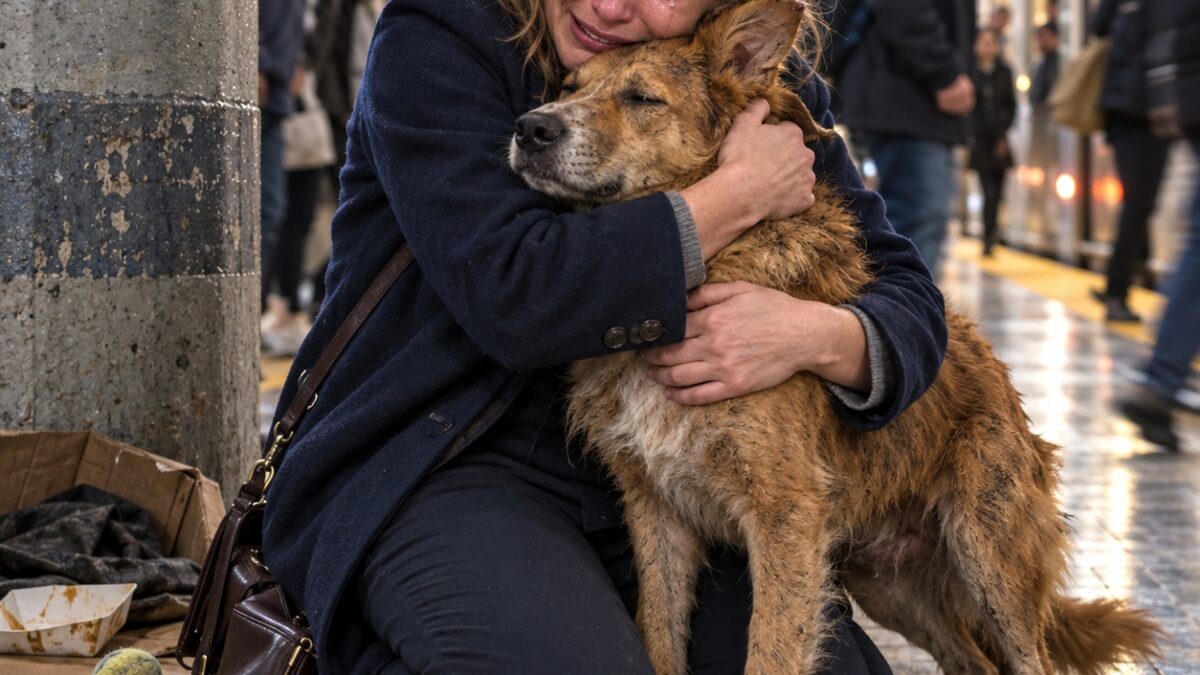
I put both arms around him.
For a few seconds, the station disappeared.
The trains.
The announcements.
The footsteps.
People moving around us.
All of it became background noise.
There was only Max.
He smelled like wet concrete and old rain.
His ribs pressed beneath my hands.
When I touched his neck, I felt no collar.
“Where have you been?”
He pushed his face deeper against me.
“Max.”
My voice broke.
“What happened to you?”
He obviously couldn’t answer.
But someone nearby could.
“Excuse me.”
I looked up.
Two transit security officers were approaching.
My first reaction was protective.
I tightened my arms around Max.
The older officer noticed immediately.
“It’s okay,” he said. “We’re not here to take him from you.”
His name tag read HARRIS.
The second officer, younger, stood several feet back so he wouldn’t crowd the dog.
Officer Harris crouched carefully.
“You know him?”
“I used to.”
Max lifted his head but didn’t leave my arms.
“I worked at a shelter. He was there.”
The officer’s expression changed.
“His name is Max?”
“Yes.”
He looked toward the younger guard.
“Well, at least now we know that.”
My stomach tightened.
“How long has he been here?”
Officer Harris sighed.
“About three months.”
I stared at him.
“Three months?”
“He lives around the station.”
“No.”
I looked at Max.
“No, he doesn’t.”
Officer Harris’s face softened.
“I wish I could tell you otherwise.”
He pointed toward the corner where I’d found him.
“He sleeps there most nights.”
“You’ve been feeding him?”
“We tried.”
“Tried?”
“At first he wouldn’t eat if anyone stayed nearby. We’d put food down, he’d just freeze.”
The younger officer nodded.
“Eventually we learned to leave it and walk away. He’d eat after the platform cleared.”
That didn’t sound like Max.
Nothing about this dog sounded like Max.
“He used to love people.”
Officer Harris looked at him.
“Not anymore.”
The words hurt.
“He won’t let anyone close. We called animal control twice, but he’d disappear down the service corridor whenever they came.”
“Why didn’t they catch him?”
“They tried.”
Officer Harris hesitated.
“He wasn’t aggressive. Just terrified.”
Max’s head rested across my arm.
“But he’s not afraid of you.”
I looked down.
“No.”
He wasn’t.
That somehow made everything worse.
I had been gone from his life for years.
Yet one familiar voice was enough to make him crawl out of three months of fear.
I stroked his dirty cheek.
“You remembered me.”
His eyes closed.
Officer Harris said quietly, “Looks like he did.”
I called my old shelter before I even stood up.
A receptionist answered.
“Hawthorne Animal Rescue.”
For a second, hearing the name nearly took me backward in time.
“This is Sarah Mitchell.”
A pause.
“Sarah?”
“Yes.”
“Oh my God. Hi.”
It was Jessica.
She had been working there longer than I had.
“Jessica, I need help.”
Her tone changed immediately.
“What happened?”
“I found Max.”
Silence.
“What?”
“Max.”
“What Max?”
“You know what Max.”
A longer silence.
Then very softly:
“Where?”
“Downtown subway station.”
“What do you mean you found him?”
“He’s been living here.”
Jessica cursed.
I had never heard her swear at work.
“Bring him in.”
“He’s terrified.”
“Bring him anyway. We’ll prepare a quiet room.”
I looked at Officer Harris.
“I can take him?”
“If he’s willing to go with you, yes. We’ll document that you’re transporting him to the shelter.”
“How am I supposed to get him upstairs?”
Officer Harris looked at Max.
“Based on what I’m seeing?”
He smiled sadly.
“I don’t think he’s planning to let you out of sight.”
He was right.
I stood.
Max stood with me.
No leash.
No collar.
Nothing.
Officer Harris found a spare slip lead used by animal control.
I showed it to Max.
He flinched.
I stopped.
“Okay.”
I let him smell it.
His body trembled.
“I’m not leaving.”
That sentence came out instinctively.
Max looked at me.
I slid the loop gently over his head.
He didn’t resist.
We walked through the station.
Slowly.
People stared.
Max stayed pressed against my leg.
When a train entered the platform, the noise made him drop low.
I stopped immediately.
“It’s okay.”
His breathing became fast.
I crouched.
“We can wait.”
He leaned into me.
The train left.
Only then did he stand again.
Upstairs, daylight seemed to overwhelm him.
He squinted.
Stayed close.
I called a rideshare, then canceled it when I realized how frightened he was of approaching vehicles.
Officer Harris came outside.
“Need a ride?”
“You don’t happen to have a van?”
“Security vehicle.”
“Are dogs allowed?”
He smiled.
“Today.”
Max climbed into the back only because I climbed in first.
He pressed himself into the corner beside me.
During the twenty-minute drive to the shelter, I watched him.
His eyes stayed open.
His head rested against my thigh.
Every time the vehicle slowed, his body tensed.
As if he expected a door to open and someone to leave him again.
I kept one hand on him.
“I’m here.”
I don’t know how many times I said it.
Maybe twenty.
Maybe fifty.
I’m here.
We pulled into the shelter parking lot.
Max lifted his head.
Immediately, something changed.
He recognized it.
I knew he did.
Dogs remember smells in ways we can barely imagine.
The disinfectant.
Food.
Other animals.
Grass.
Concrete.
That strange combination of fear and safety unique to shelters.
Max stood.
His ears moved.
The front door opened.
Jessica came outside.
She froze.
“Max?”
He stared at her.
Jessica’s hands went to her mouth.
“Oh my God.”
She approached slowly.
Max stayed against me.
“Hey, baby.”
His ears lifted.
Jessica crouched.
“You remember me?”
For a moment, I thought he might retreat.
Then he stepped forward.
One step.
Two.
Jessica held out her hand.
Max sniffed it.
His tail moved.
Not like before.
Barely.
But it moved.
Jessica started crying.
“That’s him.”
I couldn’t speak.
“He remembers.”
Max moved closer and rested his head on her knee.
Jessica wrapped one arm around him.
“Where have you been?”
Another employee appeared.
Then another.
Everyone who had known him stopped.
“Is that Max?”
“No way.”
“Max?”
The dog who had been too frightened to let station workers within five feet of him allowed these people to touch him.
Not all at once.
We kept it calm.
But he remembered.
That broke my heart in a new way.
He hadn’t stopped loving people.
He had stopped trusting strangers.
There was a difference.
We put him in the quiet intake room.
No kennels yet.
A soft blanket.
Water.
Small amount of food.
The shelter veterinarian examined him.
Dehydrated.
Underweight.
Fleas.
A minor skin infection.
Pads worn raw in places.
But no major injuries.
“He’s lucky,” Dr. Owens said.
I looked at Max lying on the blanket.
“Lucky?”
She immediately understood.
“Medically.”
“Right.”
“Emotionally is another story.”
That was what I feared.
Jessica began searching the records.
I sat on the floor beside Max.
His head rested across my legs.
He had eaten a little.
Not much.
Drank water.
Now exhaustion seemed to be winning.
“Found it.”
Jessica stood in the doorway holding a tablet.
My stomach dropped.
“What?”
“His adoption.”
I had left the shelter before Max was adopted.
That had always bothered me.
When I quit, he was still there.
One of the happiest dogs in the building, but somehow always passed over.
Too old for people wanting puppies.
Too energetic for some.
Too ordinary-looking for others.
I had asked Jessica to tell me when he found a home.
Months later, she emailed:
MAX GOT ADOPTED!!!
There had been a photo.
Max sitting between a smiling couple and their teenage son.
Everyone looked happy.
I remembered crying when I saw it.
I thought that was the ending.
Jessica sat beside me.
“The Reynolds family.”
“I remember.”
“Adopted him six months after you left.”
“What happened?”
“We’re checking.”
The paperwork looked perfect.
Home ownership.
Veterinary references.
Employment.
Fenced yard.
Two adults.
One teenager.
No other pets.
Multiple meetings with Max.
They hadn’t made an impulsive decision.
Everything had been done correctly.
“That doesn’t make sense.”
Jessica scrolled.
“No complaints.”
“No follow-up calls?”
“Initial thirty-day check says everything was good.”
“What about six months?”
“They didn’t answer.”
My stomach turned.
“When was that?”
“About eight months after adoption.”
“Then?”
“We sent email. No response.”
“And nobody followed up?”
Jessica looked at me.
“We try, Sarah.”
The defensiveness in her voice stopped me.
Of course.
I knew shelter reality.
Hundreds of animals.
Limited staff.
Adoption agreements.
Calls.
Emergencies.
You do what you can.
“I know.”
I rubbed my face.
“Sorry.”
She nodded.
“We’re going to contact them.”
They didn’t answer.
Phone disconnected.
Email bounced.
The home address brought the first real clue.
Sold.
The Reynolds family had moved.
When?
Four months earlier.
My chest went cold.
Four months.
Max had been at the station three.
Jessica looked at me.
“No.”
“Yes.”
We contacted neighbors through the shelter’s investigation officer.
By evening, the basic story had emerged.
The family moved out.
Max remained.
One neighbor remembered seeing him sitting beside the front door after the moving truck left.
For several days.
Another had put out water.
Someone thought the family was coming back.
They didn’t.
Max waited.
Of course he waited.
He knew what families were.
People leave in the morning.
Then return.
Cars drive away.
Then come back.
Doors close.
Then open.
He had no reason to understand that one departure could be permanent.
For days he stayed near the house.
Then apparently wandered.
The old neighborhood was about five miles from the subway station where I found him.
I tried to imagine the journey.
Busy intersections.
Alleys.
Rain.
Traffic.
People.
Hunger.
Night.
A dog who had once greeted every stranger learning, one frightening experience at a time, that approaching humans might not be safe.
Eventually he reached the station.
Warm enough.
Covered.
Food scraps.
A quiet corner.
Then he waited there too.
For three months.
That evening, I sat on the floor with Max’s head in my lap.
My hands were shaking.
Jessica sat against the opposite wall.
“I want their names blacklisted.”
“They will be.”
“I want every shelter in the state notified.”
“We’ll report them.”
“They abandoned him.”
“Yes.”
“They opened a door and left.”
“I know.”
“How do you do that?”
Jessica didn’t answer.
I wasn’t really asking.
Rage came easier than grief.
I was furious at the Reynolds family.
Furious at myself.
Furious at the shelter.
Furious at everyone who had walked past Max in that station.
Then immediately ashamed because security officers had fed him.
People had tried.
Animal control had tried.
The shelter hadn’t known.
I hadn’t even worked there anymore.
Still, guilt doesn’t care about logic.
“I should’ve kept checking.”
Jessica looked at me.
“Sarah.”
“I knew him.”
“You worked here.”
“I loved him.”
“You left before he was adopted.”
“I could’ve—”
“No.”
Her voice was firm.
“You don’t get to take responsibility for something people deliberately did after passing every adoption check.”
I looked down at Max.
“I promised him he’d find a family.”
“You didn’t promise him that family would be perfect.”
“He trusted us.”
Jessica’s face softened.
“He still does.”
I looked at Max’s brown eyes.
No anger.
No accusation.
That almost made it worse.
“I failed you.”
His tail touched the floor once.
Jessica said, “He doesn’t think that.”
“You don’t know.”
“No.”
She stood.
“But look at him.”
Max pushed his head closer against my stomach.
Jessica left us alone.
I cried.
Not gently.
I had cried over animals before.
Everyone in shelter work does.
But this was different.
This wasn’t death.
This was betrayal.
Max had done everything right.
Trusted.
Loved.
Adapted.
Belonged.
Then one morning, his family decided their future didn’t include him.
No shelter call.
No surrender appointment.
No effort to rehome.
They simply left.
I pressed my face against his head.
“I am so sorry.”
Max licked my wrist.
That was when I made the decision.
Not rationally.
Not after a list.
Not after checking my schedule.
“I’m taking you home.”
Max looked up.
“Yes.”
Tail movement.
“I’m serious.”
Another tiny wag.
“You’re done.”
I wiped my face.
“No more waiting for people who don’t deserve you.”
The next morning, I discovered good intentions do not override shelter policy.
“I can’t just take him?”
Jessica stared at me.
“You worked here six years.”
“I know.”
“You literally trained new staff on adoption procedures.”
“I know.”
“And you’re asking me to violate every one of them.”
“Yes.”
“No.”
“Jessica.”
“No.”
“He knows me.”
“I know.”
“He needs me.”
“Probably.”
“So?”
“So you fill out the application.”
I stared at her.
“Seriously?”
“Very.”
“I know all of you.”
“Doesn’t matter.”
“You’ve been in my apartment.”
“Years ago.”
“I have no criminal history.”
“Congratulations.”
“I worked here.”
“And now you don’t.”
I was irritated.
Then I realized she was doing exactly what I had spent years telling people the shelter should do.
No exceptions because someone seems nice.
The Reynolds family had seemed nice.
That thought shut me up.
“Give me the paperwork.”
Jessica smiled.
“That’s my girl.”
The application was absurdly emotional.
Do you rent or own?
Rent.
Landlord approval?
Yes.
Work schedule?
Hybrid.
Hours dog may be alone?
Four at most, with flexibility.
Experience with animals?
Six years working here, Jessica.
I crossed that out.
Six years professional shelter experience.
Better.
Then came:
Why do you want to adopt this animal?
I stared at the question for a long time.
Because I know him.
Too simple.
Because I found him.
Not enough.
Because somebody broke his trust and I want to prove the world can still be safe.
That sounded self-important.
Eventually I wrote:
Because Max already knows me, and I am willing to give him the time, stability, patience, and permanent home he needs without expecting him to become the dog he was before.
Jessica read it.
Her eyes lifted.
“Good answer.”
“I hate you.”
“Also noted.”
There was a home visit.
My apartment was on the third floor, which raised concerns because Max had sore paws and uncertain confidence with stairs.
I arranged a ground-floor transfer through my landlord.
That delayed things.
I hated every day of it.
Max remained at the shelter during the process.
I visited morning and evening.
He panicked the first time I left.
Not barking.
Worse.
He stood at the door.
Watching.
Jessica called me fifteen minutes later.
“You need to come back.”
“What happened?”
“He hasn’t moved.”
I returned.
Max was exactly where I left him.
When he saw me, his body loosened.
That nearly destroyed me.
From then on, staff helped establish a routine.
Sarah leaves.
Sarah comes back.
Again.
Again.
Again.
I would leave for ten minutes.
Return.
Twenty.
Return.
One hour.
Return.
Max watched every departure.
But eventually he stopped shaking.
He still expected loss.
We were teaching him repetition instead.
The adoption committee interviewed me.
I knew two members personally.
They still asked hard questions.
“What if Max develops severe separation anxiety?”
“I’ll work with a behaviorist.”
“What if he damages your apartment?”
“I’ll manage the environment and pay for damage.”
“What if his behavior never fully normalizes?”
“Then it doesn’t.”
“What if he becomes fearful around guests?”
“I won’t force guests on him.”
“What if he needs expensive medical care?”
“I’ve budgeted for it.”
One member asked, “What if Max never becomes the dog you remember?”
That question stayed with me.
I looked through the glass wall toward the room where Max was resting.
“I don’t want the dog I remember.”
Everyone went quiet.
“I want the dog he is now.”
I swallowed.
“If the old Max comes back, wonderful. But he doesn’t owe me that.”
Three days later, my phone rang.
Jessica.
“You approved me?”
“Hello to you too.”
“Jessica.”
“Yes.”
I stood in my kitchen.
“Seriously?”
“Seriously.”
I started crying.
Immediately.
Embarrassingly.
“Sarah.”
“I know.”
“You spent six years making fun of adopters who cried on approval calls.”
“I was a terrible person.”
Jessica laughed.
“You can take him tomorrow.”
“No.”
A pause.
“No?”
“Today.”
“We close in two hours.”
“I’ll be there in twenty minutes.”
“You live thirty-five minutes away.”
“Watch me.”
“Drive safely.”
I arrived in thirty-two.
Max was in the staff office.
When I entered, his tail moved.
Then faster.
Not the old helicopter tail.
But real.
I sat on the floor.
“Guess what.”
Max came to me.
“You’re stuck with me.”
He placed his head against my chest.
Jessica handed me his paperwork.
“Official.”
I looked at the name.
MAX MITCHELL.
That did it.
I cried again.
Jessica groaned.
“You’ve become unbearable.”
“Shut up.”
I signed.
The staff gathered near the front entrance.
Several had known Max before his first adoption.
Some had known him only since his return.
Everyone understood what this departure meant.
No cheering.
We didn’t want to overwhelm him.
Just quiet smiles.
Claire from medical hugged me.
“Call us.”
“I know.”
“For anything.”
“I know.”
“Don’t disappear.”
That sentence landed differently now.
“I won’t.”
I crouched beside Max.
“Ready?”
He looked toward the glass doors.
His body stiffened.
The last time he had left this shelter with a family, the story ended on a subway floor.
I waited.
“No rush.”
Jessica stood behind us.
Max looked at me.
Then stepped toward the door.
I walked beside him.
Outside, he stopped.
Traffic passed.
A bus hissed.
Someone dropped something metal across the street.
Max flinched.
I stayed still.
He looked up.
“Car’s right there.”
We walked slowly.
At my car, he froze.
That made sense.
Vehicles meant departure.
Departure meant uncertainty.
I opened the rear door.
Didn’t pull him.
“I’ll sit with you.”
I climbed into the back seat.
Max stared.
Then climbed in.
He pressed himself against me.
Jessica shut the door carefully.
I looked through the window.
She was crying now.
I pointed.
“Hypocrite.”
She laughed.
The drive home was quiet.
Max watched the window.
Every stoplight made him tense.
I talked softly.
“This is different.”
He looked at me.
“You don’t know that yet.”
I appreciated that truth.
“So I’ll prove it.”
When we arrived at my new ground-floor apartment, Max wouldn’t enter.
He stood outside the doorway.
I put his leash down loosely and sat on the floor inside.
My neighbors must have thought I was insane.
“Take your time.”
Five minutes.
Ten.
Max sniffed the threshold.
Fifteen.
Then one paw entered.
He retreated.
I didn’t react.
Another try.
Two paws.
Back.
Finally, he crossed.
He stood in the entryway.
Looked at everything.
Couch.
Kitchen.
Windows.
Dog bed.
Water.
I had deliberately kept the apartment simple.
No crowd.
No welcome party.
No toys everywhere.
Max walked to the farthest corner of the living room.
Curled up.
That hurt.
But I expected it.
“Okay.”
I sat on the couch.
“That can be your corner.”
For the first evening, he stayed there.
I put food six feet away.
He didn’t touch it.
I moved it closer after an hour.
Still nothing.
I left the room.
When I returned, some was gone.
Station behavior.
Survival behavior.
I reminded myself:
Do not make eating a performance.
Water was the same.
I didn’t watch.
He drank.
At bedtime, I placed a dog bed beside mine.
Max didn’t use it.
Instead, he lay on the floor directly beside the mattress.
Head on paws.
Eyes open.
I turned off the light.
An hour later, I opened my eyes.
He was still watching me.
“Go to sleep.”
No response.
“I’m not leaving.”
His eyes stayed open.
At two in the morning, still watching.
At four, still awake.
I reached down.
Slowly.
My fingers touched his head.
Max closed his eyes.
Then opened them again.
“I’m here.”
I left my hand resting against him.
Just before sunrise, his breathing changed.
Deepened.
His muscles loosened.
He finally slept.
I stayed awake because I was afraid moving my hand would wake him.
That first night told me what the next months would require.
Max didn’t need commands first.
He needed evidence.
Evidence that doors reopened.
Evidence that food remained.
Evidence that sleep was safe.
Evidence that people could leave a room without leaving his life.
The first week, he followed me everywhere.
Bathroom.
Kitchen.
Bedroom.
Laundry.
If I closed a door, panic.
So I stopped closing doors.
Privacy became theoretical.
When I showered, Max lay outside the glass.
When I brushed my teeth, he watched.
When I cooked, he positioned himself between me and the apartment exit.
When I sat at my desk, he slept against the chair wheels.
The first time I took trash to the hallway, he lunged after me.
I came back immediately.
“Max.”
He pressed against my legs.
“I was gone twelve seconds.”
His body trembled.
I stopped joking.
“Okay.”
We started departure training.
Shoes on.
Sit down.
Keys in hand.
Put them down.
Open door.
Close door.
Stay inside.
Open door.
Step outside.
Return in one second.
Again.
Three seconds.
Five.
Ten.
I worked with a behaviorist named Dr. Lauren Kim.
She came to the apartment twice a week initially.
Her first rule was simple.
“Stop reassuring him like he’s fragile.”
I frowned.
“He is fragile.”
“No.”
She watched Max lying against my chair.
“He’s scared.”
“Difference?”
“Fragile means you build life around avoiding every stress.”
“And scared?”
“You teach him he can survive manageable stress.”
I hated the distinction.
Then I understood it.
We couldn’t make the world silent.
We had to teach Max that noise didn’t always mean danger.
We couldn’t promise I’d never leave.
We had to teach him leaving wasn’t abandonment.
Tiny exposures.
Tiny successes.
Elevator bell from a distance.
Traffic.
New person sitting quietly in the apartment.
Leash near the door.
Walk to the end of the hallway.
Back.
No forcing.
No dramatic praise.
Consistency.
That was our life.
The first month was exhausting.
There were accidents.
Two destroyed cushions.
A scratched door.
One terrifying afternoon when a delivery driver knocked loudly and Max wedged himself behind the couch shaking.
I sat on the floor nearby.
Didn’t drag him out.
Didn’t flood him with affection.
Waited.
Twenty minutes later, his nose appeared.
Then his head.
Then the rest.
He approached.
I offered my hand.
He touched it.
“Good.”
That was enough.
There were also beautiful moments.
Tiny.
The first time he ate while I stood in the kitchen.
The first time he slept on his side instead of tightly curled.
The first time he stretched in the morning.
Animals don’t expose their stomachs easily when they feel unsafe.
One morning I found Max sleeping upside down, legs ridiculous, mouth slightly open.
I took a photo.
Sent it to Jessica.
She replied:
THAT’S MAX.
I stared at the words.
Not:
He’s back.
Just:
That’s Max.
Because the dog had always been there.
Fear had covered him.
It hadn’t erased him.
A month after the adoption, we attempted the park.
Early morning.
Few people.
Wide paths.
Max had managed neighborhood walks, but open spaces made him uncertain.
At first, he stayed glued to my left leg.
Every sound made his ears move.
Bike.
Child.
Distant dog.
I let him choose direction.
Then he smelled grass.
Really smelled it.
He stopped.
Nose down.
Moved three feet.
Five.
Ten.
He found something fascinating beneath a tree.
Probably another dog’s urine.
I almost cried.
Imagine being emotional because a dog smelled pee.
That was my life now.
We walked farther.
Max’s body loosened.
His tail lifted.
A squirrel crossed the path.
Max froze.
His ears shot forward.
Then he ran.
Only three steps because the leash stopped him.
But he ran.
I laughed.
He looked back.
For the first time, his mouth opened in that relaxed dog expression people call smiling.
“Hi.”
His tail moved.
“Where have you been?”
I crouched.
Max ran toward me.
He jumped.
Actually jumped.
Front paws against my shoulders.
I fell backward onto the grass.
“Max!”
He licked my face.
I laughed so hard I couldn’t stop.
People walked past.
I didn’t care.
For a few seconds, I saw the shelter dog I remembered.
The ridiculous dog who loved everybody.
Then a cyclist passed too close.
Max startled.
Jumped away.
The moment ended.
And that was okay.
Healing wasn’t a straight line.
I learned that.
Good morning.
Hard afternoon.
Good week.
Bad noise.
Progress.
Regression.
Progress again.
The goal wasn’t to recover a perfect past.
The goal was a safe present.
Max became my shadow.
Bathroom door.
Kitchen floor.
Desk.
Couch.
But over time, the distance increased.
At first, physical contact constantly.
Then three feet.
Five.
Different side of the room.
Eventually, I could shower with the bathroom door partially closed.
A major human achievement.
I called Jessica.
“He let me use the bathroom alone.”
“Congratulations on your dignity.”
“You’re jealous.”
“Deeply.”
Two months in, I left the apartment for twenty minutes.
Max stayed home.
We had a camera.
I watched from a coffee shop down the street.
The first five minutes, he stood by the door.
My stomach hurt.
Minute six.
Pacing.
Minute eight.
He walked to the window.
Minute ten.
Back to door.
I almost returned.
Dr. Kim had warned me not to interrupt unless distress escalated.
Minute twelve.
Max lay down.
I stopped breathing.
Minute fifteen.
Head down.
Minute twenty.
Still lying.
I ran home.
Not literally.
Almost.
When I opened the door, Max stood.
His tail wagged.
He approached.
No shaking.
No panic.
I sat on the floor.
“You did it.”
He sniffed my jacket.
“You stayed.”
Tail wag.
“And I came back.”
That became the most important lesson in our house.
I come back.
Again.
Again.
Again.
Some promises are learned only through repetition.
Three months after I found Max, I drove to the neighborhood where the Reynolds family had lived.
I almost didn’t.
Part of me thought it was unhealthy.
Part wanted to see where he had waited.
Max came with me.
When we turned onto the street, he stood in the back seat.
His whole body changed.
Recognition.
I regretted coming immediately.
“We can leave.”
But Max was watching.
The house had new owners.
Different car.
Children’s bikes.
Flowers.
Nothing belonged to his old life.
I parked across the street.
Max whined.
My hands tightened around the steering wheel.
“That’s where they left you.”
His ears moved.
I hated them again.
Strongly.
I had spent months trying not to fantasize about confronting people I might never find.
Demanding an explanation.
How do you move away from a dog?
How do you shut the door?
Did he watch your car leave?
Did anyone look back?
I wanted answers.
Max didn’t.
He simply watched the house.
After a minute, he sat.
Then lay down.
I expected drama.
Nothing.
Maybe scent told him the people were gone.
Maybe the house no longer mattered.
I don’t know.
I looked at him in the mirror.
“Ready?”
Max looked toward me.
His tail moved once.
I drove away.
That was the last time we returned.
I stopped caring what happened to the Reynolds family.
Not because what they did was acceptable.
It wasn’t.
They were reported.
Their information circulated through regional shelters.
But anger was no longer useful.
They had lost Max.
That became enough.
People often say animals forgive.
I’m not sure.
Forgiveness is a human concept loaded with judgment.
Max didn’t sit around thinking about whether the Reynolds family deserved peace.
He lived forward.
Dogs are better at that.
They remember fear.
Absolutely.
But they do not build identity around resentment in the way humans sometimes do.
Max taught me that recovery did not require hatred.
It required safety.
Four months after the adoption, I took him back to Hawthorne.
Not to surrender.
That distinction mattered enough that I spent days preparing.
We arrived during a quiet hour.
Max stopped in the parking lot.
Looked at the building.
Then at me.
“Just visiting.”
His body stiffened.
I knelt.
“We leave together.”
I had no idea whether those words meant anything.
Still.
“We leave together.”
We entered.
Jessica saw him first.
“Oh my God.”
Max’s tail started wagging.
Then Claire appeared.
Then David from kennels.
Then Maria from reception.
Everyone gathered slowly.
No rushing.
Max greeted each.
He let Jessica scratch his chest.
Claire hugged him lightly.
David brought a tennis ball.
The second Max saw it, something amazing happened.
He barked.
One sharp bark.
Everyone froze.
David threw the ball down the hallway.
Max ran.
Not cautiously.
Ran.
He grabbed it.
Turned.
Came back.
The staff erupted.
Max dropped the ball.
David threw again.
For ten minutes, the dog who once curled inside a subway station ran through the shelter hallway chasing a yellow tennis ball.
I leaned against the wall and cried.
Jessica came beside me.
“Good tears?”
“Yes.”
She handed me a tissue.
“He was always in there.”
“I know.”
“No.”
She looked at me.
“You know now.”
She was right.
Before, I had thought trauma destroyed the dog I knew.
It hadn’t.
Trauma taught Max to hide.
Safety gave him permission to come out.
That day, we walked past the kennel where he used to live.
Max sniffed it.
A new dog occupied it.
Young shepherd mix.
Terrified.
Pressed against the back.
Max stood at the gate.
The shepherd stared.
Max wagged.
Just once.
The shepherd’s nose moved.
Something about the scene tightened my throat.
I had no mystical explanation.
Max wasn’t consciously telling another dog everything would be okay.
He was simply being a dog.
Still, I found meaning.
Maybe because I needed it.
We left the shelter together.
Outside, Max hesitated at the car.
Only briefly.
Then jumped inside.
No shaking.
No coaxing.
I laughed.
“That’s right.”
He sat in the passenger-side back seat.
“We’re going home.”
The word home became important.
Not because Max understood English the way I did.
Because routine gave the word weight.
Home meant the apartment door.
His bed.
My shoes by the entrance.
The kitchen.
The window where afternoon sun landed.
My desk.
His water bowl.
The ridiculous stuffed elephant Jessica bought him.
Me.
For months, Max had treated every door as a possible disappearance.
Eventually, doors became ordinary.
I could leave to buy groceries.
Return.
Go to work.
Return.
Visit a friend.
Return.
He stopped standing every time I touched my keys.
Stopped sleeping against the front door.
Stopped watching me through the shower glass.
Mostly.
Privacy remained negotiable.
One evening, almost a year after I found him, I came home after a difficult day.
Nothing dramatic.
Work stress.
Family disagreement.
Just one of those days where the world seems heavier than it deserves to.
I opened the apartment.
Max came running.
Full speed.
Tail swinging.
Tennis ball in his mouth.
He slammed into my knees.
I laughed.
“Hi.”
He dropped the ball.
“Not now.”
He picked it up.
Dropped it again.
“Max.”
Stare.
I threw it.
He chased.
Returned.
Again.
After five throws, I was sitting on the floor.
Max collapsed beside me.
His body pressed against mine.
I thought about the station.
That first embrace.
How desperately he had held onto me.
This contact was different.
Not fear.
Choice.
He didn’t need proof I was staying.
He just liked being close.
That difference is almost impossible to explain to someone who hasn’t watched an animal recover from abandonment.
At first, attachment can be panic.
Where are you going?
Are you leaving?
Will I be alone again?
Later, attachment becomes comfort.
You’re here.
Good.
I can sleep.
That was Max now.
He slept deeply.
Sometimes so deeply I had to check his breathing.
He sprawled.
Dreamed.
Kicked his legs.
Barked softly.
I wondered what he dreamed.
Maybe the shelter.
Maybe the old house.
Maybe nothing meaningful.
I hoped he dreamed of the park.
Tennis balls.
Dinner.
Me coming through the door.
I eventually framed two photographs.
The first was an old shelter photo.
Max standing on his hind legs, paws against the gate, mouth open, tail blurred from wagging.
The second was taken about eighteen months after his adoption.
Max asleep on my couch.
One paw over his nose.
Completely relaxed.
Visitors always preferred the first.
“He looks so happy.”
He was.
But I preferred the second.
The first showed excitement.
The second showed trust.
Trust was harder won.
People at work began calling me “the dog woman.”
Fair.
I talked about Max constantly.
I showed photographs.
I adjusted meetings around his behavior appointments during the first months.
Eventually, a coworker said, “You saved him.”
I hated that sentence.
“No.”
She looked surprised.
“You literally found him homeless.”
“I found him.”
“Same thing.”
“No.”
I thought about it.
“Saving makes it sound like one event.”
I remembered Officer Harris.
Jessica.
Dr. Kim.
The shelter.
Every meal Max eventually ate.
Every departure exercise.
Every return.
“He recovered because a lot of people kept showing up.”
That felt more accurate.
Officer Harris visited once.
I had kept his contact information.
A year after the rescue, I sent him a photo of Max running in the park.
He replied:
IS THAT OUR STATION DOG?
I invited him to meet Max properly.
He came on a Saturday.
When he entered the apartment, Max hesitated.
Old uniform memory, perhaps.
Officer Harris sat on the floor.
“Hey, buddy.”
Max approached.
Sniffed.
Then wagged.
Officer Harris looked at me.
“He wouldn’t get within twenty feet of me before.”
“I know.”
Max accepted a treat.
Officer Harris laughed.
“Unbelievable.”
He looked around the apartment.
“You did good.”
“So did you.”
He waved that off.
“You fed him for months.”
“We left food.”
“You noticed him.”
That mattered.
Millions of people had passed through that station.
Somebody noticed enough to leave food.
Somebody noticed enough to remember how long he had been there.
Sometimes survival depends on strangers doing small things.
Not heroic things.
Food.
Water.
Patience.
Reporting.
Not chasing.
Giving space.
Max’s story changed the way I understood rescue.
I had worked in a shelter and thought rescue meant getting animals adopted.
It does.
But adoption isn’t the finish line.
A signature doesn’t create commitment.
A smiling photograph doesn’t guarantee safety.
The Reynolds family taught me that painfully.
The real finish line is years of ordinary responsibility nobody photographs.
Feeding a dog when you’re tired.
Training when progress is slow.
Finding housing that allows pets.
Calling the shelter if life changes.
Not abandoning an animal because moving him is inconvenient.
Love is easy on adoption day.
Commitment is what happens three years later when the dog needs medication and you are late for work.
I became more outspoken about that.
I volunteered at Hawthorne again.
Only weekends.
I thought returning would hurt.
Instead, it helped.
I spoke with adopters.
Especially people drawn to dogs with abandonment histories.
I told them the truth.
“They may not be grateful.”
People disliked that phrase.
They expected rescued dogs to understand rescue.
Animals don’t owe us gratitude.
“They may chew your door.”
“They may hide.”
“They may panic when you leave.”
“They may take months.”
Then I told them:
“If you’re not ready for the inconvenient version of love, don’t sign the paper for the easy photograph.”
Max sometimes came with me as an ambassador dog.
That was ironic.
The station dog afraid of humans became good at meeting nervous shelter dogs.
He didn’t perform miracles.
Again, I refuse to romanticize it.
But he was calm.
Social.
Respected space.
With people, he regained almost all his old friendliness.
Not indiscriminately.
He became more selective.
I liked that.
He no longer believed every human deserved instant trust.
Honestly, neither did I.
One afternoon, a family met a shy dog named Bella.
The children became impatient.
“Why won’t she play?”
The mother looked frustrated.
Max was lying beside my chair.
Bella peeked from behind a volunteer.
I said, “Because she just met you.”
The father asked, “How long until she acts normal?”
I hated that question.
“Normal for who?”
He shrugged.
“We want a friendly dog.”
I looked down at Max.
Then back at them.
“If you need friendliness immediately, Bella may not be the right match.”
They chose another dog.
Good.
A younger version of me might have considered that adoption failure.
Now I understood fit mattered more than placement.
Max deserved a family once.
He got one.
It wasn’t enough.
He needed the right kind of staying.
By the second year, Max had become almost absurdly comfortable.
He slept on my bed.
This was not my decision.
I lost that battle gradually.
First beside bed.
Then front paws up.
Then “only during thunderstorms.”
Then entire dog.
One morning, I woke with six inches of mattress and Max stretched diagonally across the rest.
“You have your own bed.”
He opened one eye.
“It cost more than my nightstand.”
Nothing.
“Move.”
Tail wag.
I laughed.
He did not move.
That dog had once slept against subway concrete.
I let him have the mattress.
The first thunderstorm after adoption had been terrible.
Max hid in the bathroom.
Shaking.
Panting.
Wouldn’t eat.
By his third year with me, storms still bothered him, but he came to find me.
No hiding.
He leaned against my leg.
I wrapped him in a blanket.
Not because he needed rescue.
Because comfort was allowed.
That was another lesson.
Independence isn’t the opposite of fear.
Trust lets you seek help.
Max had spent months surviving alone.
Healing meant learning he didn’t have to.
Three years after I found him, I returned to the station.
Without Max.
I wanted to see the place.
Officer Harris had retired.
The younger guard still worked there.
He recognized me.
“Max lady.”
“I have a name.”
He smiled.
“How is he?”
“Spoiled.”
“Good.”
He walked me toward the old corner.
Someone had installed a vending machine nearby.
The exact place Max used to sleep was barely visible.
People rushed past.
Nobody stopped.
I stood there.
For three months, Max had built his entire world inside those few square feet.
I imagined him dirty.
Hungry.
Watching shoes pass.
Sleeping lightly.
Eating only after people left.
Waiting.
For what?
The Reynolds family?
Someone from the shelter?
Me?
Maybe no one specific.
Maybe waiting becomes a habit after abandonment.
I touched the concrete pillar.
The guard said, “We thought he’d die here.”
I looked at him.
“Why didn’t you tell me that before?”
“Didn’t seem useful.”
Fair.
“He was getting worse.”
“I know.”
“One morning he didn’t get up for food.”
My chest tightened.
“When?”
“A week before you found him.”
I swallowed.
“What happened?”
“He ate later.”
He paused.
“But yeah.”
He looked toward the tracks.
“You came at a good time.”
That sentence stayed with me.
Not destiny.
Not fate.
Timing.
A different train.
Five minutes later.
Looking at my phone instead of the wall.
I might have missed him.
That thought frightened me.
But it also made me think about how often rescue is accidental.
One person notices.
One person recognizes.
One person chooses not to keep walking.
We cannot save everything.
That truth used to burn me out.
Now I think differently.
You do not have to save everything.
You have to respond to what is in front of you when you can.
That day, Max was in front of me.
So I stopped.
Years have passed now.
Max’s muzzle is grayer.
He runs slower.
He still loves tennis balls, but after three throws he sometimes decides carrying the ball back is unnecessary labor.
He leaves it and expects me to retrieve it.
We disagree about the rules.
He usually wins.
He still follows me from room to room, but not because he thinks I’ll vanish.
I know that because sometimes he stays asleep when I leave the kitchen.
That tiny act still feels like victory.
When I go to work, he watches from the couch.
No pacing.
No scratching.
When I return, he greets me at the door.
Not with panic.
Joy.
That was the part of Max I thought had disappeared forever.
It hadn’t.
Joy returned differently.
Wiser.
Less reckless.
Maybe love works that way after betrayal.
The first time, Max gave trust freely.
The second time, trust had to be earned.
I’m honored he gave it again.
I don’t know what happened to the Reynolds family after they moved.
I stopped looking.
There was a time I wanted them punished.
Wanted explanations.
Wanted to make them see pictures of Max at the station.
Wanted them to understand exactly what their convenience cost him.
Maybe that anger was justified.
But eventually I realized Max did not need me living in rage on his behalf.
He needed walks.
Dinner.
Veterinary appointments.
A calm home.
Someone who returned.
So I chose that.
Sometimes justice is accountability.
Sometimes it is refusing to let someone else’s cruelty define what comes next.
The Reynolds family abandoned Max.
That is part of his story.
It is not the ending.
The ending is Max asleep on my couch with his legs twitching in a dream.
The ending is his leash hanging beside my door.
The ending is a tennis ball beneath my desk.
The ending is him recognizing Jessica at the shelter and climbing into her lap.
The ending is Officer Harris feeding him a treat.
The ending is Max walking past a subway entrance without trying to hide.
The ending is home.
One night recently, I sat on the couch with Max’s head on my lap.
I was looking through old shelter photographs.
There he was.
Young.
Bright-eyed.
Tail blurred.
Then I looked at the dog beside me.
Older.
Scarred.
Safe.
I thought about the question people sometimes ask:
Did he become the old Max again?
No.
And yes.
He became something more honest.
The old Max loved because he had never learned not to.
The Max beside me loves despite knowing exactly what humans can do.
That feels different.
More precious.
He survived abandonment without becoming incapable of connection.
He learned caution without losing tenderness.
He became afraid without becoming cruel.
That humbles me.
We humans love to imagine animals need us because we’re more intelligent.
Sometimes I look at Max and question which species understands forgiveness, trust, and presence better.
He doesn’t wake up thinking about betrayal.
He wakes up thinking about breakfast.
Then the park.
Then whether I’m going to share toast.
Maybe that’s wisdom.
The night I found him, I thought I was bringing Max back to the shelter.
Really, I was bringing him back into my life.
And he brought me back into something too.
Shelter work had made me cynical.
I left because I thought caring too much was destroying me.
Max taught me the answer wasn’t caring less.
It was caring with boundaries.
With patience.
With realism.
Not everyone deserves trust.
But some do.
Not every adoption succeeds.
But some become family.
Not every story ends well.
But that doesn’t mean we stop trying to change the ones we can.
Max and I still visit Hawthorne.
He walks through the doors like he owns the building.
Everyone knows him now.
New employees hear the story.
I always correct the dramatic parts.
“No, he wasn’t chained in the subway.”
“No, he didn’t survive without food.”
“No, I didn’t magically cure him.”
Stories grow when people love them.
I understand.
But I want Max’s story told accurately.
Because reality is more meaningful than a miracle.
A dog was abandoned.
He became afraid.
Kind strangers kept him alive.
Someone who knew him found him.
A shelter did its job.
A behaviorist helped.
A home became predictable.
Time passed.
Trust returned.
That’s enough.
It should be enough.
One afternoon at the shelter, a new volunteer asked me, “How did you know he was yours?”
I laughed.
“I didn’t.”
She looked confused.
“When I found him?”
“Yes.”
“I just knew I couldn’t leave him there.”
“Same thing.”
“No.”
I thought about it.
“I decided he was mine later.”
“When?”
I looked at Max.
He was asleep beneath my chair.
“Probably the first night.”
“What happened?”
“He stayed awake watching me until sunrise because he was afraid I’d disappear.”
The volunteer smiled sadly.
“So you knew?”
“No.”
I touched Max’s head.
“I realized I wanted to spend however long it took proving I wouldn’t.”
That was the promise.
Not forever in some abstract sense.
Dogs don’t understand legal contracts.
They understand repetition.
Morning.
Evening.
Door opens.
Door closes.
Door opens again.
Person leaves.
Person returns.
Food comes.
Water stays.
Bed is safe.
Hands are gentle.
Tomorrow resembles today.
That is how trust gets rebuilt.
Not through declarations.
Through evidence.
Max gave me the privilege of providing that evidence.
Day after day.
Month after month.
Year after year.
And now, sometimes, I leave the apartment while he’s deeply asleep.
I watch him on the camera.
He doesn’t even raise his head.
Some people might see that and think it means he cares less.
I know better.
That is trust in its purest form.
He doesn’t have to watch the door.
He knows I’m coming back.
I cannot describe what that means to me.
The subway dog could not sleep deeply because survival required vigilance.
My dog snores.
Loudly.
Sometimes with his back toward the door.
That is victory.
A few weeks ago, I woke before sunrise.
Max was beside the bed.
Not panicked.
Just staring.
“What?”
Tail wag.
“It’s five thirty.”
More wagging.
“You’re old. You’re supposed to sleep.”
He placed his chin on the mattress.
I scratched behind his ears.
“Park?”
His ears lifted.
I laughed.
“Fine.”
We went outside.
The city was quiet.
Morning light just beginning.
We walked toward the park.
Max sniffed every tree as though nothing in the world had ever been more important.
At the open field, I unclipped his long training lead.
He looked at me.
Then started running.
Slow now.
Age has changed his body.
But he ran.
I watched him cross the grass.
For a moment, I saw the young shelter dog.
Then Max stopped.
Turned.
Checked for me.
I raised my hand.
“I’m here.”
He ran back.
That phrase had become ours.
I’m here.
I said it in the station.
In the car.
The first night.
During storms.
At the front door.
During training.
When he woke from nightmares.
I’m here.
The words themselves were never enough.
What mattered was making them true.
Over and over.
Max reached me and leaned against my legs.
I knelt.
His face had gone almost white around the muzzle.
I held his head in both hands.
“You know something?”
He licked my nose.
“Disgusting.”
Tail wag.
I laughed.
“We got lucky.”
That is how I see it now.
Not that Max was lucky I found him.
I hate that version.
I was lucky I recognized him.
Lucky he remembered me.
Lucky the shelter gave us a second chance to get his story right.
Lucky that despite everything, he was willing to trust one more person.
Max is my dog.
But “my dog” feels too small.
He is family.
Routine.
Responsibility.
History.
He is proof that betrayal can change a heart without permanently closing it.
He is proof that fear is not personality.
He is proof that an animal curled in a corner is not necessarily broken.
Sometimes he is waiting for enough safety to unfold again.
I used to think Max had been lost in that subway station.
Now I think the truth is more complicated.
He knew exactly where he was.
He had created the safest life he could from what was available.
He ate when people left.
Slept where nobody bothered him.
Avoided hands.
Avoided doors.
Avoided promises.
He adapted.
That’s not being lost.
That’s survival.
What he had lost was the belief that belonging could last.
That took longer to restore.
But we did.
Together.
The people who abandoned him probably thought leaving a dog behind was one decision.
Drive away.
Done.
They were wrong.
Their decision continued inside Max for months.
Every loud sound.
Every closing door.
Every absence.
Every night he watched me instead of sleeping.
Actions echo.
So does kindness.
Officer Harris leaving food echoed.
Jessica recognizing him echoed.
The shelter committee being careful echoed.
Dr. Kim teaching me patience echoed.
Every time I returned echoed.
Eventually those echoes became louder than the abandonment.
That is what healing looked like.
Not forgetting the terrible thing.
Building enough good things afterward that the terrible thing stopped controlling everything.
Today, when Max sleeps beside me, there is no subway in his body.
No concrete corner.
No moving truck.
No empty house.
At least not in that moment.
There is warmth.
A full stomach.
My hand on his side.
Home.
And if there is one thing I wish people understood from Max’s story, it is this:
Animals do not become disposable when your life changes.
Moving is not an excuse.
Inconvenience is not an emergency.
Fear is not bad behavior.
A frightened animal is not ungrateful.
Adoption is not a trial run unless you are honest enough to work with the shelter when things go wrong.
There are always better options than abandonment.
Always.
Max deserved that phone call.
He never got it.
So he waited beside a door.
Then he waited in a subway.
Then one day, by chance, I walked past.
He looked up.
I said his name.
And after everything humans had taught him about leaving, Max made one more impossible decision.
He came toward me.
Sometimes I still think about that moment.
What if he had run?
What if he had forgotten me?
What if fear had won?
But he didn’t run.
He remembered.
He came.
And I spent the rest of our life making sure that choice was never something he had to regret.
At night, Max sleeps at the foot of my bed.
Some nights he moves closer.
Sometimes his head ends up on my ankle.
I lie awake listening to him breathe.
I think about the dirty dog curled against the subway wall.
The joyful shelter dog he had been.
The family who left.
The people who fed him.
The day he pressed himself into my arms.
There are versions of this story where I am the hero.
I reject them.
Max is not my proof that I am good.
He is my reminder to stay.
That’s harder.
Heroes arrive dramatically.
Family stays when the dramatic part is over.
I found Max in one afternoon.
I earned his trust over thousands of ordinary ones.
That is the part I’m proud of.
Not finding him.
Coming back.
Again.
Again.
Again.
Until he finally stopped asking the question every time I touched the door.
Are you coming back?
Yes, Max.
Always when I can.
That was the promise.
And for the rest of his life, I kept it.








