FULL STORY:I Inherited 912 Acres in Rural Texas—Then the HOA Sent Me 12 Violations and Learned What Their Entire Neighborhood Was Draining Through My Land
PART2
Brenda looked exactly like the kind of person who had never misplaced a document in her life.
Early sixties.
Pressed khaki pants.
Pale blue collared shirt.
Silver hair cut neatly around her jaw.
No wasted movement.
She introduced herself with a calm smile.
“Mr. Cole?”
“Yes.”
“Brenda Sterling. I’m president of the Willow Creek Ridge Homeowners Association.”
I looked past her toward the county road.
Willow Creek Ridge was the subdivision southeast of my property.
Forty-three houses.
Paved internal streets.
Stone entrance sign.
Decorative pond with a fountain.
Nice place.
I had driven through once.
But it was clearly separate from my land.
“I think you have the wrong address.”
Her smile did not change.
“No.”
She handed me a thick packet.
“I’m here regarding several compliance issues.”
I looked at the first page.
NOTICE OF VIOLATIONS.
“Compliance with what?”
“The governing covenants.”
I looked at her again.
“Your HOA doesn’t govern this property.”
Brenda’s expression remained patient.
“I understand why you might think that.”
That sentence irritated me instantly.
“Why would I think that?”
“Because the acreage is outside the residential core.”
“It’s also outside the subdivision.”
“Geographically, yes.”
I frowned.
“That usually matters.”
“The original development agreement included surrounding-parcel continuity provisions.”
I looked at the packet.
Then her.
“You’re telling me my farm is in your HOA?”
“Not exactly.”
“That sounds like no.”
She opened the packet.
Page one.
Then another tab.
Page fourteen.
Her finger landed on a paragraph.
“Surrounding parcels retained by the original grantor remain subject to aesthetic continuity and community-impact standards where visible from or affecting Willow Creek Ridge.”
I read it.
Then read it again.
Legal language has a special ability to make ordinary words feel dangerous.
Original grantor.
Surrounding parcels.
Aesthetic continuity.
Arthur’s name appeared in the referenced agreement.
Recorded 2003.
Brenda turned back to the violation list.
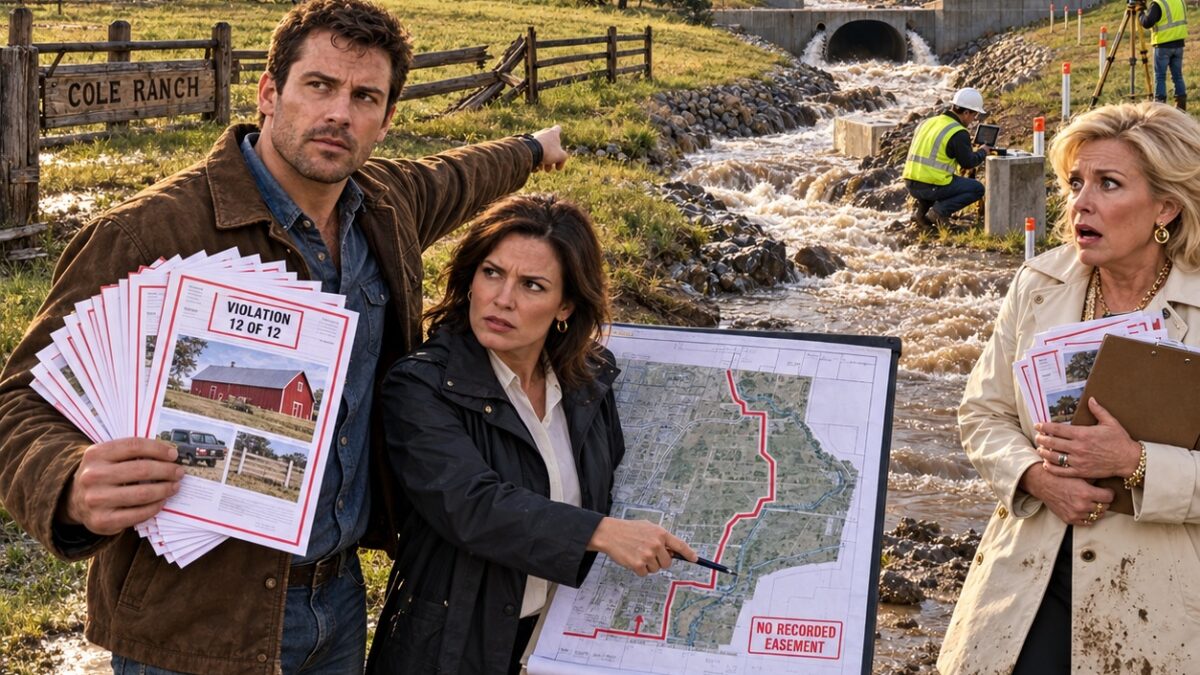
“There are twelve current issues.”
“Twelve?”
She nodded.
“The tractor parked near the south barn is visible from the subdivision road.”
“It’s a tractor.”
“It needs to be stored inside a structure when not in active use.”
I stared at her.
She continued.
“The barn paint is not an approved exterior color.”
“It’s red.”
“Yes.”
“It has been red since before I was born.”
“That does not make it compliant.”
I laughed once.
Not because it was funny.
“What else?”
She pointed.
“The split-rail fence along the east meadow has two broken rails.”
“That one is true.”
“Your pickup truck is being treated as a commercial vehicle because of the equipment rack.”
“It’s my personal truck.”
“It has work equipment.”
“I’m repairing the house.”
She continued.
“Unscreened utility trailer.”
“Seasonal equipment visible from the road.”
“Unapproved exterior storage.”
By violation eight, I had stopped listening emotionally and started listening strategically.
I asked:
“Are fines already running?”
“Not yet.”
“Good.”
“This is a courtesy compliance period.”
“How courteous.”
Brenda ignored that.
“You have fourteen days.”
I closed the packet.
“Where can I get the complete governing documents?”
She looked slightly surprised.
“I can email them.”
“Please do.”
“You may also want to attend the next board meeting.”
“I may.”
She smiled.
“I’m glad we can handle this cooperatively.”
I looked past her at my eighty-year-old red barn.
“So am I.”
Then I closed the door.
Not slammed.
Closed.
I spent the rest of that day at Arthur’s kitchen table.
Deed.
Survey.
Estate papers.
The 2003 sale agreement.
The CC&Rs.
County records I could access online.
Yellow legal pad.
By midnight, I had four pages of notes and one uncomfortable conclusion.
Brenda was not obviously bluffing.
Arthur had sold approximately sixty acres along the southeast corner in the early 2000s.
A developer built Willow Creek Ridge.
As part of the deal, Arthur signed a declaration containing a strange, broad clause tying certain standards to the land he retained.
Why?
I had no idea.
Maybe the developer insisted.
Maybe Arthur wanted the sale badly enough to sign.
Maybe he skimmed it.
Arthur was the kind of man who could rebuild a hydraulic pump from memory and still ignore six pages of legal language because he considered lawyers a temporary inconvenience.
The clause had been recorded.
That mattered.
I slept badly.
The next morning, I called an Austin real-estate attorney named Evelyn Reed.
Her website said she handled rural property disputes, restrictive covenants, easements, and title issues.
Her voice was calm in a way that made problems sound sortable.
I emailed everything.
She called that afternoon.
“The covenant is real.”
Not what I wanted to hear.
“Enforceable?”
“That’s more complicated.”
“How complicated?”
“Enough that I wouldn’t advise you to ignore it.”
I walked onto the porch.
“So they can tell me what color to paint an eighty-year-old barn?”
“Maybe.”
“That’s ridiculous.”
“Ridiculous and enforceable are not mutually exclusive.”
I respected her immediately.
She continued.
“The language is broad. Poorly drafted. There are arguments about scope, changed conditions, reasonableness, waiver, whether specific standards adopted later can attach to your acreage.”
“That sounds better.”
“Don’t celebrate yet.”
“I wasn’t.”
“I also found something else.”
Her tone changed.
“What?”
“The drainage system.”
“What drainage system?”
“The subdivision’s storm-water plan.”
I had seen culverts near the southeast boundary.
Never thought about them.
Evelyn explained.
Willow Creek Ridge sat higher on one side and lower toward a natural drainage channel crossing the corner of my property.
During heavy rain, water from the subdivision flowed through a reinforced ditch and buried culvert system before entering an old natural swale on Arthur’s land.
The developer had obtained Arthur’s permission.
I asked:
“So?”
“So I can’t find a properly recorded easement.”
I stopped walking.
“Meaning?”
“There’s mention of access and drainage in correspondence.”
“But?”
“No final recorded instrument granting perpetual rights.”
“Is that good?”
“It is leverage.”
I leaned against a porch post.
“Explain leverage.”
“The HOA is asserting the recorded covenant against you.”
“Right.”
“You appear to own land their drainage infrastructure uses under something closer to an informal or defective arrangement.”
“Can I block it?”
“Do not do that.”
“I didn’t say I would.”
“I heard the idea forming.”
I laughed.
“What can I do?”
“First, nothing impulsive.”
“Okay.”
“Second, let me investigate notice, title history, plat references, and whether the HOA can claim any easement by implication, prescription, necessity, or other theory.”
“That sounds less exciting.”
“Good law often is.”
“What if they start fining me?”
“Then we respond.”
I thanked her.
For three weeks, nothing happened.
I repaired part of the farmhouse.
Replaced a porch beam.
Cleaned one barn.
Moved no tractor.
Repainted nothing.
Fixed neither broken fence rail.
I wanted to know the rules before I behaved as if Brenda had the final word.
Then the second HOA letter arrived.
Different tone.
FORMAL NOTICE OF NONCOMPLIANCE.
Fine schedule attached.
Some charges were small.
Twenty-five dollars a day for barn color after the deadline.
Forty dollars a day for visible equipment.
The tractor line looked like $140 per day once escalating penalties applied.
I read the totals twice.
If Brenda enforced everything aggressively, the fines could become thousands very quickly.
I called Evelyn.
“They escalated.”
“Send me the notice.”
I did.
She called back an hour later.
“I’m ready.”
“For?”
“To introduce them to their drainage problem.”
The letter she drafted was only four paragraphs.
No threats.
No insults.
No dramatic language.
That made it more effective.
Paragraph one acknowledged receipt of the alleged violations.
Paragraph two disputed applicability and scope of several restrictions.
Paragraph three identified the subdivision’s storm-water infrastructure and the apparent absence of a properly recorded easement binding me as successor owner.
Paragraph four stated that any aggressive covenant enforcement would be evaluated alongside all rights and obligations concerning the drainage facilities currently benefiting Willow Creek Ridge.
I read it.
“That sounds polite.”
“It is.”
“It also sounds dangerous.”
“Good.”
“What exactly happens if they don’t have an easement?”
“We negotiate before answering that.”
She was cautious.
I liked that.
A few days later, I drove to the HOA office.
Calling it an office was generous.
One meeting room attached to the clubhouse.
Brenda sat at the table with two board members.
Gary Turner.
Late fifties.
Balding.
Clicking a pen constantly.
Nancy Price.
Maybe fifty.
Expression of someone who had agreed to volunteer for one small task and somehow ended up in a property-law confrontation.
I sat.
Brenda folded her hands.
“Mr. Cole.”
“Brenda.”
Gary clicked.
Nancy smiled faintly.
Brenda said:
“We received your attorney’s letter.”
“I assumed.”
“The board views the reference to drainage as retaliatory.”
“I’m not the lawyer.”
“Do you intend to interfere with the storm-water system?”
“No.”
Gary stopped clicking for one second.
I continued.
“I intend to understand what rights exist on both sides.”
Brenda’s eyes narrowed slightly.
“The drainage has been there for nearly twenty years.”
“So has the red barn.”
Nancy looked down.
Gary resumed clicking.
Brenda said:
“The drainage is essential infrastructure.”
“So is my tractor.”
“That’s not comparable.”
“I agree.”
I slid Evelyn’s letter onto the center of the table.
“One of them carries water from forty-three houses across land I just inherited.”
Silence.
Gary stopped clicking again.
Brenda took the letter.
Even though she had clearly already read it, she read it again.
I watched her face.
That was when I understood something important about Brenda.
She was not stupid.
Controlling, maybe.
Rigid.
Possibly overconfident.
But intelligent.
She recognized leverage immediately.
Her voice changed.
“What are you asking for?”
“Reasonableness.”
“That’s vague.”
“So is aesthetic continuity.”
Nancy coughed into her hand.
Possibly hiding a laugh.
Brenda looked at her.
Nancy became very interested in a notepad.
I continued.
“I’m willing to repair the broken fence rails.”
Brenda nodded.
“The tractor?”
“I use it constantly.”
“When not in use?”
“I can store it in the main barn once I clear enough room.”
“The truck?”
“Stays where I need it while I’m working.”
“That violates the vehicle provision.”
“My attorney disagrees that provision applies to personal work use on 912 agricultural acres.”
Gary finally spoke.
“What about the barn?”
I looked at him.
“It stays red.”
Brenda leaned back.
“That color is not on the approved palette.”
“It was painted red decades before there was a palette.”
“Continuity—”
“Brenda.”
She stopped.
“I’m not painting an eighty-year-old barn beige so people in a subdivision built in 2003 can experience visual continuity.”
Gary’s pen stayed still.
Nancy smiled.
Barely.
Brenda looked at me for a long time.
Then she said:
“We’ll need counsel.”
“Good.”
“We’re not conceding anything.”
“Neither am I.”
I stood.
She said:
“Mr. Cole.”
I turned.
“If the drainage issue is being used as a threat—”
“It isn’t.”
“It feels like one.”
I looked at her.
“So do daily fines.”
Then I left.
The next two weeks taught me more about property law than I had learned in thirty-four years.
Evelyn investigated title records.
The HOA hired counsel named Thomas Bell.
Thomas and Evelyn spoke directly.
That helped.
Lawyers are expensive, but sometimes expense buys emotional distance.
Instead of Brenda and me arguing over a tractor, two professionals discussed recorded covenants, easement notice, successor liability, maintenance responsibilities, and reasonableness.
The drainage issue turned out to be exactly what Evelyn suspected.
Arthur had signed a temporary construction-access permission during development.
Later correspondence showed he had verbally allowed the finished drainage outfall to remain.
But no final permanent easement had been properly recorded.
The subdivision had relied on the system for almost two decades.
That did not mean I could casually shut it off.
Evelyn emphasized that repeatedly.
“They may have equitable arguments.”
“Meaning?”
“Do not imagine you can put a wall across the ditch and become king.”
“I don’t want to.”
“Good.”
“What I want is for them to stop fining me over a red barn.”
“That is much easier to communicate.”
The more we looked, the more obvious it became that both sides had something to lose.
The HOA did have a recorded covenant with language broad enough to create trouble for me.
I owned land supporting drainage the HOA badly needed, with incomplete documentation.
Neither side had a clean, effortless victory.
That is where negotiations become possible.
Two weeks after the clubhouse meeting, we sat around the same table again.
This time, both attorneys joined by conference call.
Brenda.
Gary.
Nancy.
Me.
Thomas Bell representing the HOA.
Evelyn Reed representing me.
Thomas started.
“We’ve reviewed the applicable documents.”
Evelyn said:
“So have we.”
Brenda looked at the speakerphone like she disliked lawyers taking over her meeting.
I enjoyed that more than I should have.
Thomas continued.
“The association is prepared to discuss a comprehensive resolution.”
Evelyn answered:
“That’s our preference.”
We went line by line.
Fence.
I would repair the two broken rails within thirty days.
Easy.
They were broken.
They looked bad.
No principle required me to defend broken wood.
Tractor.
I would keep it inside the main barn when not in active use for extended periods.
Not every lunch break.
Not every evening when I was using it the next morning.
But if it sat unused, it went inside.
Also reasonable.
Truck.
No special restriction beyond ordinary applicable law.
It was personal transportation used for property work.
I could park it where needed.
Barn.
The red stayed.
Brenda objected.
Hard.
“The exterior-color standard is clear.”
Evelyn responded:
“The barn predates the standard by decades and is part of the historic agricultural character of the parcel.”
Thomas asked:
“What if it requires repainting later?”
I said:
“Red.”
Evelyn added:
“Comparable traditional agricultural red.”
Brenda sighed.
Nancy looked relieved.
The red stayed.
Utility trailer.
Screened when stored long term.
Fine.
Then drainage.
My turn.
Evelyn outlined the proposed solution.
A properly surveyed, recorded, limited storm-water easement.
Thirty-year term.
Defined location.
Defined use.
No expansion without my written approval.
HOA responsibility for maintenance of installed infrastructure serving its subdivision.
Reasonable access for inspection with notice except emergencies.
Damage repair obligations.
No transfer of broader property rights.
At the end of thirty years, renewal or modification by agreement.
Brenda frowned.
“Why not permanent?”
I said:
“Because it’s my land.”
Thomas interrupted before she could answer.
“Thirty years provides sufficient stability for the association.”
Brenda looked at him.
Apparently that was lawyer language for stop talking.
Gary clicked once.
Then stopped himself.
We also added a clause requiring mutual written notice before either side took enforcement action likely to materially affect the other.
Evelyn suggested it.
Thomas agreed.
I liked it.
Less surprise.
Less escalation.
Everyone reviewed the draft.
Brenda eventually said:
“I still think the tractor should always be screened.”
I said:
“And I still think your pond fountain is too loud.”
She stared.
“That isn’t relevant.”
“Exactly.”
Nancy laughed.
Actually laughed.
Brenda gave her a look.
Nancy said:
“I’m sorry.”
She was not.
The final agreement was signed the following week.
All pending fines dismissed.
All citations withdrawn.
Fence repaired.
Tractor stored reasonably.
Barn red.
Truck unrestricted.
Drainage easement recorded properly.
Thirty years.
Clear rights.
Clear maintenance.
Clear boundaries.
When the last signature was complete, Thomas said over the phone:
“That should resolve the matter.”
Evelyn replied:
“Agreed.”
Gary shook my hand.
Nancy shook mine with both hands.
“Thank you.”
I smiled.
“You looked worried.”
“You have no idea.”
Brenda stood across from me.
For a second, neither of us moved.
Then she held out her hand.
I took it.
“We’re clear?” she asked.
“We’re clear.”
She nodded.
No apology.
No triumph.
No humiliation.
Just an agreement.
That surprised me.
Some part of me had expected a dramatic ending.
Maybe because conflict makes you imagine victory.
One side loses.
One side wins.
Reality gave us something better.
Predictability.
I drove home.
Parked my truck beside the barn.
Looked at the tractor.
Then the barn door.
“Fine.”
I drove the tractor inside.
It took ten minutes.
Brenda had been right about one thing.
It did look cleaner.
I hated that.
I repaired the fence rails the next morning.
Arthur had left spare cedar rails stacked behind the machine shed.
They fit perfectly.
While I worked, I wondered whether he would have laughed at the entire situation.
Probably.
I could hear him:
“Should’ve read what I signed.”
That was Arthur.
He had left me 912 acres and apparently one legal booby trap.
Fair trade, I suppose.
Over the next several months, I settled into the land.
The timber lease generated enough income to cover taxes and much of the maintenance.
My remote job became part-time consulting.
Eventually I left it altogether.
There was always work.
Fence.
Culvert.
Barn roof.
Pasture mowing.
Creek crossing.
Equipment maintenance.
People think inheriting land means receiving wealth.
Sometimes.
It also means inheriting everything that breaks.
Arthur had kept detailed notebooks.
Not legal documents.
Working notes.
Fuel use.
Rainfall.
Timber thinning.
Where he bought tractor parts.
Which gate sagged every spring.
I found an entry from 2003.
Sold southeast tract. Developer people talk too much. Signed papers. Need money for tax/debt. Hope I don’t regret it.
I sat at his kitchen table reading that line.
He had regretted it.
Maybe not selling the land itself.
The covenant.
The subdivision.
The complicated relationship.
I found another entry years later.
HOA woman complained barn too red. Told her barns are supposed to be red.
I laughed so hard I nearly spilled coffee.
Brenda was not even the first.
Apparently the issue predated both of us.
I wondered if Arthur had received violation notices.
Evelyn later found evidence of occasional letters, but nothing sustained.
Why?
Because Arthur ignored them.
Not a legal strategy I recommended.
But apparently his reputation helped.
People knew him.
He had lived there forever.
I was new.
The HOA saw ownership change and decided to test the boundaries.
That was logical from their perspective.
Still annoying.
One morning about six months after the agreement, I was repairing a gate near the county road when Brenda drove past.
She slowed.
Window down.
“Morning.”
“Morning.”
She looked toward the barn.
Still red.
Then toward the machine shed.
Tractor inside.
“Fence looks good.”
“It does.”
Pause.
Then:
“Have a good day.”
“You too.”
That became our relationship.
Wave.
Occasional sentence.
No friendship.
No war.
Strangely, that felt mature.
Gary became more social.
He lived near the subdivision entrance and occasionally walked the road.
One afternoon, he stopped near my gate.
“Can I ask you something?”
“Sure.”
“Were you actually going to shut off our drainage?”
“No.”
His shoulders relaxed.
“I didn’t think so.”
“I wanted it documented.”
He nodded.
“We should’ve done that twenty years ago.”
“Yes.”
“That developer cut corners.”
“So did Arthur.”
Gary smiled.
“Fair.”
He looked toward the creek.
“You know during big storms, half the lower subdivision drains through there.”
“I know now.”
“Scary.”
“Exactly why we needed paperwork.”
He nodded.
Then asked:
“Want to join the HOA board?”
I stared at him.
“My property isn’t actually a lot in the HOA.”
“We could create an advisory seat.”
“No.”
“You’re good with documents.”
“No.”
“Budget committee?”
“Gary.”
“Fine.”
He left laughing.
Nancy came by once with banana bread.
That made me suspicious.
“What’s this for?”
“For not suing us.”
I laughed.
“I wasn’t planning to sue.”
“Still.”
She handed me the loaf.
Then looked at the farmhouse.
“This place is beautiful.”
“Thank you.”
“I’m glad the board didn’t make you paint the barn.”
“So am I.”
“Brenda hates admitting it, but I think she is too.”
That surprised me.
“Why?”
“People like the red barn.”
“People?”
“Residents.”
I raised an eyebrow.
“Turns out traditional rural character is good for property values.”
I almost choked.
“So my noncompliant barn is an amenity now?”
“Basically.”
“Tell Brenda.”
“I enjoy living.”
She left.
I stood there laughing.
A year passed.
Then another.
The agreement became ordinary.
That is the best thing that can happen to a legal dispute.
The drainage easement was recorded.
Surveyed.
Mapped.
Maintenance schedule established.
The HOA paid for reinforcement near the outlet after erosion developed.
They notified me first.
Workers entered through the designated access path.
Fixed it.
Left.
No argument.
I used the tractor.
Stored it when idle.
Not because Brenda had defeated me.
Because keeping expensive machinery under a roof is sensible.
Sometimes a demand can be obnoxiously delivered and still contain a reasonable idea.
Learning to separate those things saved me a lot of energy.
The fence stayed repaired.
The barn stayed red.
My truck went wherever work required.
Life continued.
One spring afternoon, an enormous storm hit.
Texas rain that seemed to fall sideways.
The creek rose quickly.
I put on boots and walked the southeast boundary.
Water from Willow Creek Ridge poured through the drainage system exactly where the recorded easement said it should.
No flooding in the subdivision.
No erosion beyond expected limits.
No argument over who could access what.
Brenda and Gary arrived in a utility cart with the HOA maintenance contractor.
She saw me near the outfall.
“You okay?”
“Fine.”
“Any damage?”
“Not yet.”
The contractor checked the structure.
Everything held.
Standing in rain beside Brenda, I thought about how different that moment could have looked if we had chosen war instead of negotiation.
I could have treated the unrecorded easement like a weapon.
They could have treated the covenant like one.
Lawyers.
Injunctions.
Court.
Tens of thousands in fees.
Neighbors angry.
Drainage uncertain.
Instead, we had paper.
Good paper.
The water went where it needed to.
Everyone went home.
That storm taught me what Evelyn meant when she said problems were puzzles.
The goal was not winning.
The goal was building an answer sturdy enough to survive bad weather.
A few months later, I called her.
“Do lawyers enjoy being right?”
“Constantly.”
“You were right.”
“About?”
“Recording the easement.”
“I’m putting this call on speaker so my staff can hear.”
“Never mind.”
She laughed.
Then asked how the land was doing.
“Expensive.”
“That means normal.”
“Arthur left out that part.”
“They usually do.”
I eventually learned more about why Arthur chose me.
His attorney found a handwritten note inside the estate file.
Not emotional.
Of course.
Arthur wrote:
Nathan asks questions before he speaks. Might be useful if he gets the place.
That was it.
My inheritance explanation.
Not love.
Not destiny.
I apparently asked questions.
I smiled for ten minutes.
Then got strangely emotional.
Arthur and I were never close.
But he had noticed me.
Sometimes that is enough.
I started taking the responsibility more seriously after that.
I learned the timber contract.
Property tax classifications.
Wildlife exemptions.
Water rights.
Access rights.
Mineral rights.
Old easements.
Utility agreements.
I mapped every boundary.
Photographed every monument.
Digitized Arthur’s records.
Evelyn reviewed the important ones.
Never again would I stand in my own doorway holding a packet from somebody else and have no idea what rights existed under my feet.
That lesson was expensive.
Worth it.
The hardest part about owning land is that boundaries exist in more than fences.
Legal descriptions.
Recorded restrictions.
Utility rights.
Drainage.
Water.
Minerals.
Access.
A person can look across a pasture and think:
Mine.
Law may answer:
Mostly.
I had inherited acreage.
I had also inherited agreements made before I was old enough to vote.
That humbled me.
Ownership is never as simple as possession.
Neither is authority.
The HOA learned that too.
They had rights under the covenant.
Not unlimited rights.
I had rights over my land.
Also not unlimited.
Once both sides stopped pretending one document erased the other, the solution became obvious.
Compromise is an unpopular word when people tell property stories.
Nobody wants to hear:
Then both attorneys negotiated a limited recorded easement and everyone behaved reasonably.
They want:
Then I destroyed the HOA.
But destroying your neighbors is a poor long-term strategy when everybody plans to stay.
I had 912 acres.
They had forty-three homes.
None of us were moving.
Peace had economic value.
Practical value too.
That did not mean surrender.
I did not paint the barn beige.
That line mattered.
Not because red paint is sacred.
Because the demand was unreasonable.
The barn predated the HOA.
It fit the agricultural landscape.
Changing it served no meaningful purpose besides demonstrating compliance.
I refused that.
The tractor was different.
Leaving it exposed all the time was unnecessary.
Storing it protected the machine and improved the view.
Fine.
Fence rails?
Obviously repair them.
Truck?
I needed it.
No concession.
Good negotiation depends on knowing which things are principles and which things are habits.
I had been tempted to defend everything simply because Brenda demanded it.
That would have made me as rigid as she was.
Two years after I moved in, Brenda stopped at the gate while I was replacing a mailbox post.
She parked.
Got out.
No clipboard.
That was notable.
“You doing that yourself?”
“Trying.”
She looked at the leaning post.
“Needs another two inches on the left.”
I stared at her.
“Is that an HOA requirement?”
She almost smiled.
“No.”
I adjusted it.
She was right.
Annoying.
We stood quietly.
Then she said:
“I owe you something.”
“That sounds dangerous.”
“An apology.”
I stopped working.
She folded her hands.
“When you first moved in, I assumed you were going to ignore every obligation Arthur had signed.”
“I almost did.”
“I know.”
“You fined me before asking.”
“Yes.”
She looked toward the barn.
“I came in too hard.”
“You did.”
Again, no easy rescue.
If somebody apologizes, let them finish.
She said:
“I spent years dealing with people who only responded after notices became penalties.”
“So you treated me like them.”
“Yes.”
“I wasn’t.”
“No.”
She exhaled.
“I should have started with a conversation.”
I nodded.
“I should have read the documents before moving.”
That surprised her.
“You’re admitting that?”
“Yes.”
“Careful.”
“We both made assumptions.”
She looked relieved.
Not absolved.
Relieved.
I held out my hand.
She shook it.
That was the closest we became to friends.
Later that year, Willow Creek Ridge held a community picnic near their pond.
Gary invited me.
I almost declined.
Nancy called.
“You have to come.”
“Why?”
“Brenda already ordered enough food for eighty people.”
“So?”
“We have forty-three houses.”
“Sounds like an HOA problem.”
She laughed.
I went.
People asked about the property.
Some had never seen beyond my east fence.
I ended up offering a small guided walk for residents who wanted to see the creek and old barn from the legal access road.
Brenda came.
Of course.
At the barn, one woman said:
“I love this color.”
I looked at Brenda.
Brenda looked at the woman.
The woman had no idea.
Gary nearly collapsed laughing.
Brenda finally said:
“It’s historic.”
I respected that.
The next HOA newsletter featured a photograph of the red barn under a section titled LOCAL HISTORY NEAR WILLOW CREEK RIDGE.
I mailed a copy to Evelyn.
She replied:
FRAME IT.
I did.
Not because the HOA surrendered.
Because irony deserves preservation.
The land changed me in ways I had not expected.
I became patient.
Partly because rural work punishes rushing.
Fence posts do not care about your calendar.
Weather certainly does not.
I learned that problems rarely appear one at a time.
Tractor battery dies the same week a pipe leaks.
Storm knocks down a tree while timber inspectors are coming.
Creek floods after you just repaired a crossing.
The land constantly reminds you that control is partial.
Maybe that helped me understand Brenda.
She liked rules because rules create an illusion of predictability.
If every truck is hidden.
Every barn matches.
Every fence is repaired.
Every yard fits the standard.
Then the world feels ordered.
I understood the comfort.
But land is not a subdivision.
Cattle break fences.
Mud happens.
Equipment moves.
Paint fades.
Trees fall.
Trying to make 912 acres behave like forty-three landscaped lots was never going to work.
The agreement eventually reflected reality.
That was why it lasted.
Three years after I inherited the place, Gary became HOA president.
Brenda chose not to run again.
I asked why.
She said:
“I’m tired.”
Fair.
Gary’s first call to me was about the drainage easement.
“Nothing bad.”
“Then why are you calling?”
“We want to clean the outlet channel.”
“Okay.”
“Notice says seventy-two hours.”
“You read it?”
“I’m president now. Apparently that involves reading.”
“Condolences.”
Workers came.
Did the maintenance.
No issue.
Gary later told me:
“You know the recorded easement makes this much easier.”
“I’ve heard.”
“Brenda fought the thirty-year term.”
“I remember.”
“I think you were right.”
“Don’t tell her.”
“I enjoy living.”
Nancy’s line had become community policy.
I eventually restored Arthur’s second barn.
Not because I needed it immediately.
Because I wanted to save it.
The structure leaned.
Roof leaked.
Foundation stones had shifted.
A contractor told me demolition would be cheaper.
I refused.
He asked:
“Sentimental?”
“Maybe.”
We stabilized it.
Replaced bad framing.
Kept as much original timber as possible.
Painted it.
Red.
Of course.
When Brenda saw it, she stopped her car.
I waited for the joke.
She said:
“Looks good.”
I smiled.
“Approved color?”
She rolled her eyes.
Progress.
The timber lease ended in year five.
I renegotiated it myself with professional advice.
Arthur had accepted lower rates than market because he valued long-term relationships with the forestry company.
At first I thought that was foolish.
Then I met the company owner.
He had worked with Arthur for twenty years.
They managed the stand carefully.
Selective cutting.
Regeneration.
Firebreaks.
No clear-cutting.
I kept them.
Not every decision should be optimized for immediate revenue.
Another thing Arthur had understood.
In the attic, I found more of his notes.
Complaints about taxes.
Complaints about weather.
Complaints about lawyers.
Complaints about people building “fancy houses where cows used to stand.”
I laughed.
Then found a note from shortly after the subdivision opened.
Kids from new houses came to see creek. Told them stay away from north bank. Nice kids.
That softened the picture.
Arthur complained about the development.
Still welcomed the children.
People are rarely as consistent as our memories make them.
One summer, a family from Willow Creek Ridge asked if their son could fish the creek.
I said yes with conditions.
Then another family.
Eventually I set aside one Saturday each month for neighbors to walk a marked path to a safe fishing area.
No fee.
Sign-in.
Liability waiver Evelyn insisted on.
The HOA helped with cleanup.
The same subdivision that once mailed me twelve violations became part of the land’s wider community.
Not owners.
Not decision-makers.
Neighbors.
Important distinction.
I never joined their HOA.
Never wanted to.
But I attended one annual meeting most years because drainage and boundary issues occasionally overlapped.
I became, as Gary called me, “the foreign ambassador.”
Ridiculous.
Useful.
At one meeting, a new homeowner complained that my barn was visible from her upstairs window.
The room went silent.
I watched Gary close his eyes.
The woman said:
“Is there any requirement about exterior agricultural structures?”
Gary looked at me.
I looked at Brenda.
Brenda was sitting in the second row.
She raised her hand.
Gary called on her.
Brenda said:
“That barn has been red longer than any of us have lived here.”
The homeowner said:
“I understand, but—”
Brenda continued:
“And it is staying red.”
I almost applauded.
Afterward, I found her near the door.
“Who are you?”
She laughed.
“People can learn.”
“Apparently.”
“You’re welcome.”
“For what?”
“Saving you from another legal bill.”
“Fair.”
We shook hands.
Again.
Arthur’s original covenant stayed recorded.
The agreement did not erase it.
But later, when the HOA updated its governing documents, the board worked with me to clarify how standards applied to the retained acreage.
They created explicit exemptions for active agricultural use.
Historic barns.
Ordinary farm equipment.
Necessary work vehicles.
Existing fences.
That mattered beyond me.
If I ever sold the property, the next owner would not have to repeat the same fight.
Evelyn reviewed the amendment.
“Better.”
“Perfect?”
“No legal document is perfect.”
“What do lawyers write, then?”
“Future work for lawyers.”
I laughed.
She probably charged me for the joke.
By my fortieth birthday, I had lived on Arthur’s land six years.
Longer than I had stayed in any apartment after college.
The farmhouse no longer felt borrowed.
I refinished the floors.
Updated plumbing.
Restored the porch.
Kept Arthur’s old kitchen table.
That table had held:
Estate documents.
The CC&Rs.
My first violation packet.
Evelyn’s letter.
Maps.
Drainage plans.
The final agreement.
Later:
Tax forms.
Timber contracts.
Birthday cakes.
Thanksgiving dinners.
Ordinary mail.
That is how places become yours.
Not because a deed says so.
Because your life accumulates there.
I met someone too.
Her name was Claire.
A veterinarian from the next county.
Our first date happened after her truck got stuck near my creek while she was responding to a livestock call.
Not romantic in the conventional sense.
She eventually moved into the farmhouse.
Then married me.
Then we had a daughter.
So much for no wife, no kids, no reason to stay.
Life changes fast once you stop pretending temporary is permanent.
When our daughter, Emma, was four, she called the red barn “Grandpa Arthur’s barn.”
Technically great-great-uncle Arthur’s barn.
Not worth correcting.
One evening, Brenda drove past while Emma and I were painting a small chicken coop.
Red.
Obviously.
Brenda stopped.
“You’re doing it on purpose now.”
I said:
“Tradition.”
Emma asked:
“Who’s that?”
I said:
“Brenda.”
Brenda crouched slightly.
“I used to tell your dad what color buildings should be.”
Emma looked horrified.
“Why?”
Brenda laughed so hard she had to hold the car door.
Good question.
Children strip bureaucracy down quickly.
Years passed.
The thirty-year drainage term still had decades remaining.
But the fact that it had an end date mattered psychologically.
Both sides maintained the relationship because renewal was not automatic.
Every few years, we reviewed the infrastructure.
Maintenance.
Flow.
Erosion.
No surprises.
Good agreements do not eliminate future conversation.
They structure it.
I learned that from Evelyn.
She eventually retired.
Before she did, I drove to Austin and bought her lunch.
“You realize you saved me from doing something stupid.”
“What were you going to do?”
“I don’t know.”
“Exactly.”
She smiled.
“Your best move was calling before acting.”
“Arthur probably would’ve parked the tractor in front of the clubhouse.”
“Arthur would have been my nightmare client.”
“Definitely.”
She asked if I still had the first violation packet.
“Yes.”
“Keep it.”
“Why?”
“Because someday somebody will say the dispute wasn’t that bad.”
She was right.
Memory softens bureaucracy.
I kept everything.
By then, I understood the value of records.
Not because I expected another fight.
Because land outlives conversations.
Owners die.
Boards change.
People forget.
Paper remains.
Recorded paper remains better.
That became almost a family joke.
Whenever Claire asked where some document was, I would say:
“Filed.”
She would say:
“Arthur would hate what you’ve become.”
Probably.
But Arthur’s signature had taught me.
Read first.
Sign second.
Ask what it binds.
Ask who benefits.
Ask what happens after you die.
Those questions sound paranoid until someone inherits the answer.
The most important conversation I ever had with Brenda happened nearly ten years after I moved in.
We were standing near the east fence.
She was preparing to sell her house.
Move closer to her grandchildren.
She looked at the property.
“You know, when you arrived, I thought you were going to be a problem.”
“I thought the same about you.”
“I was.”
“Sometimes.”
“So were you.”
“Sometimes.”
Fair.
She touched the top rail of the fence.
The same stretch that had once generated a violation.
“Do you know why I pushed so hard?”
“You liked rules.”
“Yes, but not only.”
She looked toward Willow Creek Ridge.
“The developer promised people the surrounding acreage would remain visually consistent.”
I frowned.
“That phrase again.”
“It was a sales point.”
“Meaning?”
“People bought houses believing the open land around them wouldn’t turn into junkyards, factories, or heavy commercial use.”
That made more sense than anything she had said at my front door years earlier.
“So when Arthur died…”
“I worried you’d divide it.”
“Build?”
“Mobile-home park. Industrial storage. Who knew?”
“And instead you found a tractor.”
“Visible tractor.”
I laughed.
She smiled.
“I overreacted.”
“Yes.”
“But I wasn’t completely inventing the concern.”
“No.”
That was the mature answer.
Two truths.
The HOA had a legitimate interest in what the old covenant actually protected.
I had a legitimate interest in using agricultural land as agricultural land.
Conflict came because both sides began at the farthest possible interpretation.
Twelve violations.
Daily fines.
Drainage leverage.
Attorneys.
Eventually we found the middle.
Brenda asked:
“Do you regret the agreement?”
“No.”
“Even storing the tractor?”
“I should’ve been storing it anyway.”
She looked delighted.
“Finally.”
“Don’t enjoy this.”
“I waited ten years.”
We laughed.
Then she became serious.
“You handled it better than Arthur would have.”
I looked at her.
“You knew him well?”
“Enough.”
“What would he have done?”
“Ignored every letter.”
“That sounds right.”
“Then yelled when fines arrived.”
“Also right.”
“He once told me the HOA could regulate his barn color when we could ‘paint the sunset first.’”
I stared.
“That sounds exactly like him.”
“I hated that man.”
“You’re smiling.”
“He was impossible.”
“He left me the same problem.”
“No.”
She looked at me.
“He left you the chance to solve it better.”
I did not expect wisdom from Brenda Sterling.
Life enjoys embarrassing certainty.
She sold her house that fall.
Before leaving, she gave me her old HOA clipboard.
As a joke.
I still have it.
Claire wanted to throw it away.
I hung it in the machine shed.
Underneath, I wrote:
READ THE DOCUMENTS FIRST.
Brenda sent a photograph to Nancy.
Nancy called me.
“You’re insane.”
“History.”
“No. That’s trauma.”
Maybe both.
When Emma was old enough to ask about the clipboard, I told her the story.
Not the exaggerated version.
The real one.
Great-Uncle Arthur sold land.
Signed a covenant.
Died.
I inherited it.
HOA enforced the covenant.
Attorney found drainage problem.
Both sides negotiated.
Emma looked disappointed.
“That’s it?”
“Yes.”
“Nobody went to jail?”
“No.”
“Nobody got arrested?”
“No.”
“Did Brenda lose her house?”
“No.”
“Did you win?”
I paused.
“That’s the wrong question.”
She frowned.
“How?”
“We still live here.”
“Yes.”
“They still have drainage.”
“Yes.”
“The barn stayed red.”
“Yes.”
“The tractor goes inside.”
“Yes.”
“Everybody stopped fighting.”
She thought.
“So everybody won?”
“Mostly.”
“That’s boring.”
“Very.”
She ran outside.
I smiled.
Children eventually grow into the value of boring.
So do adults, if lucky.
I am older now than Arthur was the first time I remember meeting him.
That realization bothered me.
The land looks different.
Some timber harvested and regrown.
New fencing.
Restored barns.
Better creek crossings.
The subdivision trees are taller.
Their little pond fountain still runs.
New families live in many houses.
Gary moved.
Nancy stayed.
The HOA has gone through several presidents.
Most barely know the original dispute.
Good.
Conflict should not become identity.
The 2003 covenant still exists, but clarified.
The drainage easement still exists, properly recorded.
Everything is where it belongs.
Every spring, when heavy storms come, water leaves Willow Creek Ridge through the same corner of my property.
It flows into the swale.
Then toward the creek.
I sometimes stand there and watch.
What once felt like leverage now feels like infrastructure.
That transition means we succeeded.
A weapon became an agreement.
That is better.
Arthur left me acreage.
But the more important inheritance was complexity.
He left decisions he had made.
Signatures.
Debt history.
Relationships.
Boundaries.
Benefits.
Problems.
That is what inheritance really is.
People talk about receiving property as if it appears cleanly.
It does not.
You inherit unfinished things.
A roof somebody meant to fix.
A fence somebody patched badly.
A legal clause somebody signed twenty years earlier.
A neighbor’s expectations.
A drainage arrangement built on a handshake.
You inherit consequences.
Then you decide what to do with them.
I almost treated Arthur’s covenant like an insult.
How could he sign this?
Then I found his debt records.
Early 2000s had been rough.
Low timber revenue.
Medical bills.
Tax pressure.
He needed the subdivision sale.
The developer had leverage.
Arthur signed.
Suddenly his choice looked less careless.
Still imperfect.
Understandable.
Context does that.
It makes blame less satisfying.
Brenda also became easier to understand with context.
She was responsible for a community promised certain standards.
Then a new owner from Colorado arrived with a truck, tractor, visible equipment, and no knowledge of the governing documents.
From her perspective, maybe she saw a problem beginning.
She responded badly.
Too aggressively.
But not from nowhere.
Evelyn taught me to separate facts from feelings.
That saved me more than the drainage easement did.
Fact:
Covenant existed.
Feeling:
This is outrageous.
Fact:
Some provisions might apply.
Feeling:
They cannot tell me anything.
Fact:
Drainage right was defective.
Feeling:
Now I can crush them.
Fact:
HOA needed water flow.
Fact:
I needed clarity.
Solution:
Negotiate.
Simple on paper.
Harder when pride is involved.
I learned not to confuse leverage with victory.
Leverage gets you to a table.
What you do there determines whether people leave with a future.
That principle helped me later in business.
Marriage.
Parenting.
Land deals.
You do not use every advantage simply because you have it.
Sometimes the strongest position is the one that lets both sides step back without humiliation.
Brenda could tell her residents she protected aesthetic standards.
I could tell myself the barn stayed red and agricultural use remained intact.
The HOA received secure drainage rights.
I received documented limits on those rights.
Everybody gave something.
Nobody gave everything.
That is why it lasted.
One afternoon, decades after Arthur’s letter changed my life, I sat at the old kitchen table with Emma.
She was now in college.
Environmental law.
I blame Evelyn.
Emma had a stack of property documents.
She was helping me prepare for an estate-planning update.
“You really need to organize these.”
“They are organized.”
“You have three folders called IMPORTANT.”
“Different levels.”
“That is not organization.”
I smiled.
She found the original HOA packet.
Twelve violations.
She read them.
“Barn color?”
“Yes.”
“Tractor visibility?”
“Yes.”
“Truck?”
“Yes.”
She looked out the window.
Barn still red.
Tractor currently inside.
Truck near the barn.
“So you compromised.”
“Yes.”
“You always tell the story like you discovered the secret easement and won.”
“I do not.”
“Grandpa Gary does.”
“Gary isn’t your grandfather.”
“He acts like it.”
Fair.
She read Evelyn’s first letter.
Then the final agreement.
“This is actually pretty balanced.”
“That was the point.”
She looked at me.
“You could’ve made their drainage situation ugly.”
“Yes.”
“Why didn’t you?”
“Because forty-three families lived there.”
“They weren’t Brenda.”
“Exactly.”
She sat back.
That answer mattered to her.
It still matters to me.
Institutions are made of people.
Punishing everyone for one board president’s aggressiveness would have been easy to justify emotionally.
Harder to justify morally.
If I blocked drainage and homes flooded, would I have felt victorious?
No.
So we did not play that game.
We fixed the paperwork.
Evelyn once told me:
“Do not solve a legal inconvenience by creating a human disaster.”
I wrote that down.
Arthur would have rolled his eyes.
Then probably agreed.
Eventually, I rewrote my own estate plan.
The land will not be divided automatically.
There are instructions.
Surveys.
Easements.
Covenants.
Timber agreements.
Maps.
Maintenance records.
Every document indexed.
Emma laughed when she saw the binder.
“Dad.”
“What?”
“This is obsessive.”
“Good.”
“Who needs six pages explaining the drainage easement?”
“You do.”
“I’m literally studying law.”
“Then you know better.”
She smiled.
I pointed to the first page.
In large letters:
READ EVERYTHING BEFORE YOU AGREE TO ANYTHING.
Emma said:
“Subtle.”
“Learned the hard way.”
I also wrote a letter.
Not like Arthur.
Longer.
I explained the history.
The subdivision.
Brenda.
The covenant.
The easement.
Why the barn stayed red.
Why the tractor concession was reasonable.
Why the drainage agreement mattered.
Why a property right is not valuable because you can use it to hurt someone.
Why boundaries protect relationships as much as land.
I told Emma she did not have to keep the acreage forever.
That surprised her.
“You’d be okay if I sold?”
“It would hurt.”
“Then why say it?”
“Because inheritance should be responsibility, not a trap.”
Arthur chose me.
I was grateful.
But I never wanted gratitude to become obligation for the next generation.
“If you keep it,” I told her, “know what you own.”
“If you sell it, know what you’re selling.”
She nodded.
“And keep the barn red?”
“Nonnegotiable.”
She laughed.
Some principles survive.
The first Tuesday letter from Arthur’s lawyer is still in my files.
I reread it occasionally.
The sentence that changed everything:
Mr. Arthur James Cole has designated you as sole beneficiary of the remaining real property comprising approximately 912 acres…
At thirty-four, I read that and thought:
I inherited land.
I understand it differently now.
I inherited obligations.
History.
Rights.
Limitations.
A community I had never met.
An old man’s choices.
And a chance to make better ones.
Brenda’s first packet taught me something too.
Never assume scale protects you from paperwork.
Nine hundred acres can still be bound by one paragraph.
A red barn can become a legal question.
A drainage ditch can become leverage worth more than years of arguments.
The physical size of what you own does not make the legal details smaller.
Sometimes the smallest clause controls the largest property.
So now, when someone tells me:
“I’m buying land.”
I ask:
“Did you read the title?”
They say yes.
“The survey?”
Usually yes.
“Easements?”
Pause.
“Restrictions?”
Longer pause.
“Water?”
“What about water?”
Exactly.
I sound like Arthur now.
That may be the final joke.
I once thought old landowners were paranoid because they kept every document.
Now I have fireproof storage.
Digital backups.
Survey copies in two locations.
Evelyn would be proud.
Arthur would call me ridiculous.
Both would be right.
The farmhouse still looks across the same western meadow.
Sun turns it gold in late afternoon.
Creek still runs cold in August.
Deer cross near the timber edge.
Barn still red.
Fence rails break occasionally.
I fix them.
Tractor sleeps indoors more often than not.
Not because an HOA won.
Because equipment lasts longer under a roof.
I can admit that now.
The Willow Creek Ridge fountain still sprays into the little pond.
Sometimes at night, standing on my porch, I can see subdivision lights through the trees.
I do not resent them.
They are part of the landscape now.
Not mine.
Nearby.
Neighbors.
That word eventually became accurate.
I think Arthur understood it before I did.
He sold part of the land.
Then complained about what came.
But he also let their kids visit the creek.
Allowed drainage.
Waved at residents.
People are inconsistent because life requires it.
Rigid principles sound clean.
Real communities survive through negotiated edges.
That is what Brenda and I eventually built.
An edge.
Clear enough that nobody had to keep fighting over it.
If she were standing here now, she would probably remind me the east fence still needs painting.
I would remind her it is not in the agreement.
She would tell me it looks bad.
I would look at it.
Then probably paint it.
Not because she ordered me.
Because she might be right.
That is what changed.
Once power left the conversation, advice could become advice again.
Years ago, when she first stood on my porch, every sentence felt like a threat.
Later, we could disagree without assuming the other person intended conquest.
That took paperwork first.
Trust second.
In that order.
I still have the clipboard she gave me.
Rusting metal clip.
Scratched black board.
Hung in the machine shed.
Underneath the note:
READ THE DOCUMENTS FIRST.
Emma wants it someday.
“Why?”
“Family history.”
“It belonged to Brenda.”
“Exactly.”
I shake my head.
Apparently every family turns conflict into artifacts eventually.
Maybe that is healthy.
Better a clipboard on a wall than resentment in the blood.
When people hear the short version of my story, they usually focus on the acreage.
Nine hundred twelve acres?
Someone just left you that?
Yes.
That is what surprised me too.
But the acreage was never the strangest part.
The strangest part was discovering that ownership did not mean freedom from everyone else.
The land came with connections.
Some recorded.
Some forgotten.
Some poorly drafted.
Some buried in county files.
That is true of almost everything adults inherit.
Property.
Businesses.
Families.
Institutions.
You receive a thing and also the relationships attached to it.
Ignoring those relationships does not erase them.
Arthur did not tell me that.
Brenda did.
Evelyn definitely did.
The final lesson took longer.
Knowing your rights is important.
Knowing where they end is just as important.
The HOA had no right to control every detail of my agricultural property.
I had no right to create drainage chaos simply because their easement paperwork was defective.
They had legitimate interests.
So did I.
Once we stopped pretending only one side mattered, the answer appeared.
That sounds obvious.
It was not obvious while daily fines were arriving.
Nothing is obvious when pride gets involved.
So if I could go back to the day Brenda first knocked, I would change only one thing.
I would not assume she had no authority simply because it sounded absurd.
I would still question her.
Still hire Evelyn.
Still protect the barn.
Still demand proper drainage documentation.
But before saying:
Your HOA has nothing to do with me,
I would open the documents first.
That was my mistake.
Arthur’s too, maybe.
A signature outlives the person holding the pen.
I know that now.
Every agreement I sign today, I imagine Emma reading thirty years from now.
Does this make sense?
Is this clear?
Who maintains what?
Who pays?
Who enters?
How long?
What happens when ownership changes?
Boring questions.
Powerful questions.
The kind that keep future strangers from standing at a kitchen table at midnight wondering what their great-uncle accidentally signed away.
Maybe that is the best thing I can leave behind.
Not just acreage.
Clarity.
Arthur gave me the land.
I had to discover the boundaries.
Literal and otherwise.
I still live there.
The barn is still red.
The tractor is in the barn tonight because I am not using it tomorrow.
The truck is parked exactly where I need it.
The east fence is repaired.
The storm-water easement is recorded.
Willow Creek Ridge still drains safely across one narrow piece of my property when Texas rain comes down hard.
Brenda moved away years ago, but when she passes through town, she sometimes stops.
We drink coffee on the porch.
She complains that my porch rail needs repainting.
I tell her she lost jurisdiction.
She says:
“I’m not speaking as the HOA.”
And I tell her:
“Then you might be right.”
We laugh.
That is how the story really ended.
Not with one of us destroyed.
With both of us understanding the map better.
Arthur left me 912 acres.
For a while, I thought the lesson was that ownership meant defending every inch.
It was not.
The lesson was knowing exactly what belonged to me, exactly what obligations came with it, exactly what belonged to somebody else, and exactly where the line ran between them.
Once I learned that, the land stopped feeling like a problem I had inherited.
It became home.








