FULL STORY:I Inherited 912 Acres in Rural Oregon—Then an HOA President Showed Up With 12 Violations and One Clause I Wish I’d Read Sooner
FULL STORY CONTINUATION
I sat at the kitchen table with a yellow legal pad until after midnight.
Deed.
Recorded covenants.
Harrison’s original sale documents from 2003.
Subdivision plat.
Title paperwork.
Every reference I could find.
At first, I assumed there had to be an obvious escape.
Wrong parcel.
Expired clause.
Unsigned amendment.
Something.
Instead, the deeper I went, the more uncomfortable I became.
Harrison really had signed it.
The covenant really had been recorded.
The language really did reference surrounding acreage.
I kept hoping for the moment when legal nonsense revealed itself.
It never came.
At 12:17 a.m., I wrote across the top of the fourth page of notes:
SHE MAY ACTUALLY BE RIGHT.
I hated that sentence.
Not because the requirements were catastrophic.
Repairing two fence rails was reasonable.
Moving the tractor inside when I wasn’t using it was annoying but possible.
What bothered me was scale.
My land was not a quarter-acre subdivision lot.
It was 912 acres of working rural property.
If the HOA could interpret “aesthetic continuity” broadly enough to dictate where equipment could sit, what color an eighty-year-old barn could be, or where my truck could park, where did that stop?
Could they regulate hay storage?
Farm gates?
Livestock shelters?
Timber operations?
I needed somebody who understood property law better than I understood project schedules.
The next morning, I called Sarah Jenkins.
Portland real-estate attorney.
I got her name from a lawyer who had handled part of Harrison’s estate.
Her voice was calm in the way you want a lawyer’s voice to be when you’re explaining that an HOA may have discovered jurisdiction over nearly a thousand acres you inherited a month ago.
“Send me everything.”
“I already scanned it.”
“Good.”
“Does that make me the easiest client you’ve had today?”
“No.”
“What would?”
“Not calling before you’ve done something stupid.”
Fair.
I sent the documents.
Waited.
Walked the property.
Tried not to think about it.
Failed.
Sarah called late that afternoon.
“The clause is real.”
Not my preferred opening.
“But?”
“But it’s a mess.”
Better.
“What does that mean?”
“It means I don’t love how broadly it’s written, and I don’t love how aggressively they’re apparently interpreting it.”
“So they can enforce it?”
“Maybe some of it.”
I leaned against the kitchen counter.
“That is not the answer I wanted.”
“It is the answer you need.”
That was Sarah.
No theater.
“The enforceability of every demand is not identical. Aesthetic covenants can be enforceable, but application matters. Scope matters. History matters. Notice matters. The nature of your parcel matters.”
“So what do I do?”
“We investigate before fighting.”
I hated how reasonable that sounded.
Sarah continued.
“Your uncle sold the subdivision parcel, correct?”
“Yes.”
“And some infrastructure for that development appears to interact with the retained acreage.”
I straightened.
“What infrastructure?”
“Storm-water drainage.”
I hadn’t noticed that part.
She had.
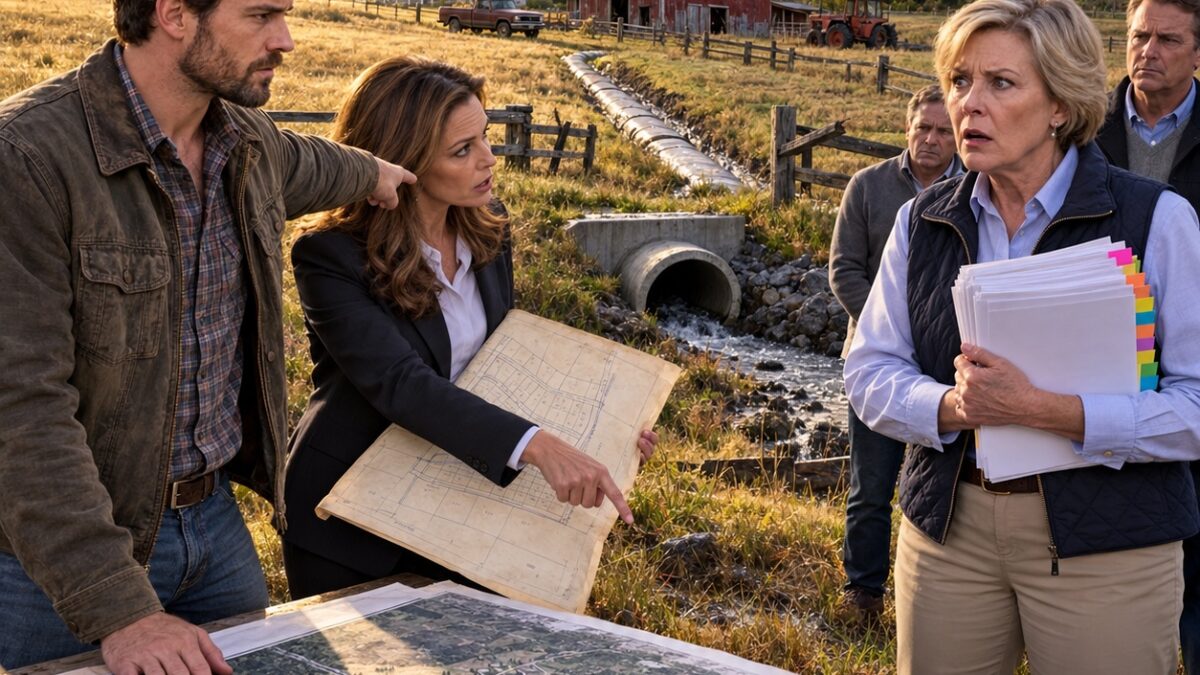
The original development maps showed storm-water flow crossing a corner of Harrison’s retained land.
Not a huge section.
But important.
Runoff from part of Pinehaven Ridge moved through a drainage corridor before joining a lower natural channel on my property.
“That sounds bad for me.”
“Maybe not.”
I waited.
“I can’t find a properly recorded easement.”
“What?”
“The developer clearly used the drainage path. Harrison appears to have allowed it.”
“Why?”
“Maybe because he had just sold them land. Maybe they agreed informally. Maybe everyone assumed it would be recorded later.”
“Was it?”
“Not in the records I have.”
My pulse changed.
“What does that mean?”
“It means we need a title search and a deeper review before I promise anything.”
“Sarah.”
“Yes?”
“What does it mean practically?”
She was quiet for a second.
Then:
“It means you have leverage.”
That was the first good sentence I’d heard all week.
I didn’t cheer.
Because leverage is not victory.
And Sarah made that very clear.
“Do not block drainage.”
“I wasn’t planning to.”
“Do not dig anything.”
“Okay.”
“Do not threaten them with flooding.”
“That had not crossed my mind until you just said it.”
“Forget I said it.”
“Too late.”
She sighed.
“What I’m telling you is that their development may rely on a property right they never formalized correctly, while simultaneously trying to enforce a very broad covenant against you.”
“So we trade.”
“Potentially.”
“That’s it?”
“What were you hoping for?”
“I don’t know. A dramatic legal loophole.”
“Real property disputes usually end in documents and compromise.”
“That sounds less satisfying.”
“It is considerably cheaper.”
That sentence turned out to be important.
Three weeks passed.
I did not repaint the barn.
I did repair one section of fence because it was genuinely broken and bothering me anyway.
I kept working.
Cynthia didn’t return.
Then the second HOA packet arrived.
This one was formal.
No introductory language.
Fines.
Tractor visibility:
$40 per day.
Barn color:
$25 per day.
Other items carried their own amounts.
Left alone, they could climb into thousands.
That irritated me more than the first visit.
Not because Cynthia had surprised me.
Because now both sides had counsel available and the board had chosen escalation before resolving the legal uncertainty.
I called Sarah.
“I got the fines.”
“Send them.”
“They’re charging forty dollars per day for a tractor.”
“I can read numbers, Ethan.”
“And twenty-five for the barn being red.”
“Yes.”
“The barn was red before the HOA existed.”
“I know.”
“I’m going over there.”
A pause.
“Are you asking permission?”
“No.”
“Then don’t say anything stupid.”
“I’ll bring your letter.”
“That is smarter.”
“See? Growth.”
She ignored me.
The Pinehaven Ridge HOA office was not impressive.
Small room attached to the community clubhouse.
Conference table.
File cabinets.
Community bulletin board.
Coffee machine that had probably committed several health-code violations.
Cynthia sat at the table.
Two other board members were there.
Gary.
Middle-aged.
Pen in hand.
Click.
Click.
Click.
Click.
Martha.
Late fifties maybe.
She looked like she wished she’d chosen any other volunteer activity.
I introduced myself.
Gary nodded.
Cynthia gestured toward a chair.
“Mr. Cole.”
I sat.
Then placed Sarah’s letter on the table.
Cynthia looked at it.
“From your attorney?”
“Yes.”
Gary clicked his pen.
Cynthia opened the letter.
Four paragraphs.
No threats.
No insults.
Just facts.
Sarah outlined the drainage corridor crossing my land.
She noted that our search had not identified a properly recorded easement securing the HOA’s use against a new owner in the usual way.
She noted that enforceability of any claimed unrecorded interest required further analysis.
Then came the important sentence.
Any aggressive enforcement of the aesthetic-continuity covenant would be evaluated in the broader context of all rights and obligations between the surrounding parcel and the Pinehaven Ridge development.
Gary stopped clicking.
Completely.
Martha looked at Cynthia.
Cynthia read the letter again.
I said nothing.
That silence probably did more good than anything clever I could have said.
Finally, Cynthia looked at me.
“Are you threatening to interfere with the drainage system?”
“No.”
“Then what exactly is this?”
“A reason for both sides to stop pretending only one of us has paperwork problems.”
Gary’s eyes moved toward me.
Martha looked down.
Cynthia remained composed.
I respected that.
She understood.
“You’re saying the HOA’s drainage depends on your cooperation.”
“I’m saying our attorneys should determine exactly what rights exist before your board keeps stacking daily fines against my property.”
“The covenant is recorded.”
“Yes.”
“And signed by your predecessor in title.”
“Yes.”
I did not deny it.
That mattered.
I wasn’t going to stand there and pretend the clause didn’t exist because I hated it.
“But the drainage arrangement matters too.”
She folded Sarah’s letter.
“What do you want?”
There it was.
The useful question.
Not:
Who wins?
What do you want?
I answered honestly.
“I want to use this property as a rural agricultural property without getting a violation every time farm equipment becomes visible.”
Cynthia’s tone remained even.
“And the HOA wants the edge of the subdivision maintained in a way that doesn’t materially degrade appearance.”
“That phrase is where we disagree.”
Gary began clicking again.
Martha looked at him.
He stopped.
I continued.
“I’m not asking to turn the east meadow into a junkyard.”
“No one said that.”
“You’re fining me for parking a tractor.”
“Visible storage.”
“It’s a farm.”
“It is also adjacent to forty-three homes subject to recorded standards.”
I sat back.
This was the first moment I understood Cynthia differently.
I had expected a caricature.
Power-hungry HOA president.
Clipboard.
Rules.
Battle.
But she wasn’t stupid.
And she wasn’t pretending Harrison had never signed anything.
From her perspective, the developer had sold homeowners a community with recorded protections.
She had been elected to enforce them.
The problem was not that she had zero argument.
The problem was how far that argument could reasonably stretch across 912 acres.
That changed my approach.
“I think our lawyers should talk.”
Cynthia nodded.
“I agree.”
Gary looked mildly disappointed.
Maybe he wanted conflict.
Martha visibly relaxed.
Two weeks later, we held a formal negotiation around the same table.
I was in person.
Cynthia.
Gary.
Martha.
Sarah on speaker.
The HOA’s attorney, Daniel Mercer, on another line.
No courtroom.
No shouting.
No triumphant speech.
Just people going through clauses.
Sarah began with the surrounding-parcel covenant.
“We acknowledge its existence.”
I had told her beforehand I wanted that said clearly.
No games.
Daniel replied:
“And we acknowledge questions concerning the drainage easement.”
Good.
Then we worked down the list.
Tractor.
The HOA wanted it stored when not in use.
I wanted the right to operate farm equipment normally.
Compromise:
When not actively being used, the tractor would be stored in the barn or equipment area.
When I was using it for work, it could sit wherever practical.
Reasonable.
Truck.
They wanted it treated as a commercial vehicle.
I objected.
It was my personal pickup used around the property.
I could park it where I needed.
They dropped that issue.
Fence.
Two broken rails on the east meadow.
I agreed to fix them.
Honestly, I should have fixed them anyway.
Barn.
Cynthia’s attorney raised the paint issue.
I interrupted.
“No.”
Sarah laughed quietly through the speaker.
Daniel said:
“Can we discuss—”
“No.”
Cynthia looked at me.
“The covenant does include exterior appearance.”
“That barn has been red for approximately eighty years.”
“We understand.”
“It predates the subdivision.”
“Yes.”
“It predates half the people at this table.”
Martha smiled.
Gary did not.
I continued.
“I’ll maintain it. I’ll replace rotted boards. I’ll paint it.”
Pause.
“Red.”
Cynthia looked at her attorney.
Daniel said:
“I think historic continuity is a reasonable basis for an exception.”
I liked him immediately.
Cynthia nodded.
“The barn stays red.”
Done.
Then drainage.
That was the big one.
The HOA needed certainty.
I understood why.
Storm-water infrastructure cannot depend forever on neighborly goodwill.
I didn’t want the subdivision wondering every year whether I would suddenly dispute access.
At the same time, I did not want to grant an unrestricted permanent easement affecting future owners of my land without limits.
Sarah proposed thirty years.
Defined corridor.
Specific purpose.
Maintenance responsibilities.
No expansion without written agreement.
No conversion into general access.
No new facilities beyond defined storm-water needs without negotiation.
At the end of thirty years, the parties could renegotiate.
The HOA’s attorney asked for permanent.
Sarah said no.
They asked fifty.
She said thirty.
Cynthia looked at me.
“Would you honor the existing drainage during that term?”
“Yes.”
“Allow maintenance access?”
“Within the defined corridor and with notice except emergencies.”
Sarah said:
“Exactly.”
Daniel conferred with the board.
Gary whispered something.
Martha responded quietly.
Then Cynthia nodded.
“Thirty years.”
That was it.
Not dramatic.
But important.
Pending fines?
Dismissed.
All of them.
Aesthetic notices?
Resolved under the agreement.
Future enforcement?
Limited by the written terms we were creating.
Farm operations?
Recognized.
Barn?
Red.
Truck?
Mine to park.
Tractor?
Stored when not being used.
Fence?
Repaired.
Drainage?
Recorded properly for thirty years.
Everybody signed.
I read every page before I did.
Every page.
Twice.
Sarah stayed quiet while I read.
At one point, Cynthia smiled.
“Taking your time?”
“Yes.”
“Good.”
I looked at her.
“That wasn’t sarcasm?”
“No.”
She tapped the covenant.
“We’d probably both be better off if more people did that.”
I thought about Harrison.
Maybe she was right.
I signed.
Cynthia signed for the association.
Gary.
Martha.
Attorneys confirmed.
Documents went for recording.
Then something almost disappointing happened.
We shook hands.
No insults.
No defeated villain.
No victory speech.
Just:
“Good luck, Mr. Cole.”
“You too.”
Martha exhaled so loudly I laughed.
She looked embarrassed.
“Sorry.”
“No, I agree.”
Gary finally put his pen down.
I drove home.
Parked my truck beside the barn.
Looked at the red boards.
Nothing had changed physically.
Yet everything felt different.
The first month had taught me to see the property as an inheritance.
After the HOA dispute, I began seeing it as a system of rights and obligations.
Not romantic.
Necessary.
The land had boundaries.
Deeds.
Recorded interests.
Unrecorded habits.
Historic agreements.
Neighbor dependencies.
You cannot own acreage intelligently without understanding those things.
Harrison apparently had.
Or hadn’t.
That remained unclear.
I found no note explaining why he signed the aesthetic covenant.
Maybe the developer offered more money.
Maybe he thought it applied only near the subdivision edge.
Maybe he intended to cooperate and assumed future owners would too.
Maybe he simply didn’t read.
That possibility annoyed me.
Then humbled me.
Because I nearly made the opposite mistake.
I almost assumed the covenant could not possibly apply because the idea felt ridiculous.
Emotion is not title law.
Neither is common sense.
Documents matter.
Sarah repeated that often.
“Land doesn’t care what you think is fair.”
At first, I disliked the phrase.
Then I understood it.
Rights exist because they are created, recorded, limited, challenged, interpreted.
Fairness matters.
But only after you know what the documents actually say.
The next spring, I repainted the barn.
Red.
Same general shade.
I took a picture and sent it to Cynthia.
No message.
She replied:
Looks good.
I showed Sarah.
“She has a sense of humor?”
“Possibly.”
“Disturbing.”
The tractor moved into the barn when I wasn’t using it.
That turned out to be smart.
Less weather exposure.
Less rust.
No reason for it to sit outside constantly.
The first time I put it away voluntarily, I felt irritated on principle.
Then realized I was behaving like a child.
Reasonable compromises remain reasonable even when somebody annoying first suggested them.
That was another lesson.
I repaired the fence rails.
Took half a day.
Cost almost nothing.
The east meadow looked better.
I had spent weeks thinking every HOA request represented an attack on independence.
Some did overreach.
Some were just maintenance.
You have to separate the two.
The drainage easement required more work.
Surveyor.
Exact metes and bounds.
Maintenance terms.
Recording fees.
Maps.
But once completed, the relationship improved immediately.
The HOA no longer had uncertainty over storm-water access.
I no longer had uncertainty over where their rights ended.
Clarity calmed everybody.
That matters.
Conflict often survives because boundaries remain vague.
Each side imagines the worst.
They’ll take more.
He’ll block access.
They’ll fine everything.
He’ll destroy drainage.
Write the limits down and suddenly people can live again.
Two years passed.
I stayed.
That surprised me.
Initially, I imagined the inheritance as a disruption.
Temporary.
Clean things up.
Understand value.
Maybe sell.
Return to Seattle.
Instead, I changed my job arrangement.
Kept working remotely.
Learned the property.
I leased some grazing ground to a neighbor.
Maintained the timber agreement.
Repaired part of the farmhouse.
Replaced ancient plumbing.
Learned more about fencing than I ever wanted.
The creek became my favorite part.
Cold even in August.
Harrison had been right to stay.
Or maybe I simply became the kind of person who understood why he had.
Pinehaven Ridge remained next door.
Forty-three homes.
Paved road.
Pond fountain.
Residents walking.
Kids biking.
From part of my eastern boundary, I could see their roofs.
At first, that bothered me.
I wanted the rural illusion of isolation.
But they existed.
Had existed for twenty years.
Pretending otherwise was pointless.
Cynthia drove the county road occasionally.
She waved.
I waved back.
We were not friends.
I did not want coffee with her.
She did not invite me to HOA barbecues.
Perfect.
We were neighbors.
There is dignity in a relationship that does not require affection to function.
One summer, heavy rain tested the drainage corridor.
Water moved exactly where it was supposed to.
I stood near the edge watching runoff pass through the defined easement.
No flooding.
No argument.
No emergency calls.
Just infrastructure working.
That moment gave me strange satisfaction.
The same drainage path that had become legal leverage was now simply drainage again.
That is what good agreements do.
They turn conflict back into ordinary function.
Sarah called once a year to check in.
Or maybe to remind me she remained billable.
“You still reading documents?”
“Every one.”
“Before signing?”
“Twice.”
“Good.”
“I hate that this made you right forever.”
“I was already right forever.”
Lawyers.
Harrison’s estate files stayed in my office.
One winter afternoon, I went through them again.
Receipts.
Old tax statements.
Timber contracts.
Handwritten notes.
I found the original 2003 sale folder.
Inside was a yellowed copy of the developer agreement.
Harrison had underlined several sections.
Not the aesthetic-continuity clause.
Of course.
But he had noticed price adjustments.
Access.
Utility responsibilities.
At the bottom of one page, he had scribbled:
Need cash. Don’t love this.
That was all.
I sat with the paper for a long time.
He had sold land because he needed money.
Not because he wanted a subdivision.
Not because he wanted an HOA.
Life had forced a choice.
He signed documents to solve a problem in 2003.
Twenty years later, I inherited their consequences.
That didn’t make Harrison foolish.
It made him human.
Every contract solves one moment and shapes another.
You cannot predict all future circumstances.
That’s why precision matters.
The broad aesthetic clause had probably seemed harmless.
The unrecorded drainage arrangement had probably seemed friendly enough.
Both became leverage later.
One too formal.
One not formal enough.
Interesting symmetry.
I started taking records more seriously after that.
Not obsessively.
Responsibly.
When I leased grazing rights, Sarah reviewed the agreement.
When timber terms came up for renewal, I read every clause.
When a neighbor wanted seasonal access across a track, we wrote down what that meant.
Not because I distrusted everyone.
Because written clarity protects good relationships too.
People think contracts indicate suspicion.
Sometimes they prevent suspicion.
I came to understand Cynthia better as well.
Not agree with everything.
Understand.
She had inherited a different kind of obligation.
Not land.
Governance.
Residents expected her to enforce recorded standards.
If she ignored the covenant entirely, homeowners could accuse the board of selective enforcement.
From her chair, my arrival created uncertainty.
New owner.
Large parcel.
Old recorded clause.
Visible farm activity.
Her instinct was enforcement.
Too aggressive, in my opinion.
But not entirely irrational.
When I stopped casting her as the villain, the story became more useful.
Two sides had imperfect rights.
Two sides had leverage.
Two sides could hurt each other if they wanted.
The HOA could drag me into enforcement litigation.
I could challenge their drainage arrangement.
Both would spend money.
Both would create risk.
Or we could define terms.
We chose the second.
That is not a satisfying internet revenge story.
It is a satisfying life.
I kept my barn.
They kept their drainage.
Nobody went bankrupt.
Nobody lost a house.
No board president got arrested.
I consider that a success.
One morning, about eighteen months after the agreement, Gary stopped his car near the east fence while I was replacing a post.
He rolled down his window.
“Ethan.”
“Gary.”
“You know that tractor looks better inside.”
I stared at him.
He smiled.
I pointed the hammer.
“Keep driving.”
He laughed and did.
Even I had to laugh.
Martha resigned from the board eventually.
Not because of our dispute.
She moved closer to her daughter.
Before leaving, she mailed me a note.
Very short.
Glad we worked it out.
Take care of the place.
That surprised me.
I kept it.
Maybe because she had looked miserable through every meeting and was the person most relieved when compromise arrived.
Cynthia stayed president.
Her style softened around me.
Or maybe my defensiveness softened.
Hard to know.
Once, a storm knocked down part of a tree near the subdivision boundary.
I called her before clearing it because some debris crossed close to common land.
She answered:
“Thanks for letting me know.”
“That easy?”
“What did you expect?”
“A violation packet.”
She laughed.
“I left the clipboard at home.”
Progress.
The property itself changed me more than the legal dispute did.
Seattle had taught me efficiency.
The ranch taught me time.
Fence work takes however long weather allows.
Trees don’t care about calendar invites.
Water moves according to grade, not deadline.
An eighty-year-old barn does not become urgent just because a project manager makes a spreadsheet.
I still made spreadsheets.
Of course.
But the land refused to respect them entirely.
That was healthy.
I began to understand Harrison’s quiet life.
He had not been lonely in the way I first imagined.
He knew his land.
Neighbors.
Creek.
Weather.
Work.
Maybe that had been enough for him.
It became more than enough for me.
I kept the remote job.
Eventually reduced my workload.
Income from timber and agricultural leases helped.
The farmhouse stopped feeling like Harrison’s house.
Slowly became mine.
New roof.
Refinished part of the floor.
Kept his kitchen table.
Couldn’t explain why.
Probably because that was where I first understood the HOA might actually have a case.
That table had become a symbol of learning before reacting.
Whenever I signed something important, I sat there.
Read.
Then signed.
Sometimes twice.
I never again wanted someone standing at my door pointing to a clause I had never bothered to notice.
That lesson cost less than it could have.
Much less.
The fines disappeared.
The barn stayed red.
The tractor gained shelter.
Fence improved.
Drainage became legally secure.
Nobody got everything.
That may be why the agreement lasted.
Deals where one side feels humiliated have a way of becoming future wars.
Ours did not.
The thirty-year term gave both sides certainty without pretending circumstances could never change.
Thirty years is a long time.
At the end, I might not even be the owner.
Cynthia certainly may not be president.
Different people will sit at that table.
They can renegotiate based on the world that exists then.
That is reasonable.
Permanent solutions sound attractive.
Sometimes time-limited ones are more honest.
Sarah taught me that.
“Don’t solve fifty years of hypothetical problems if thirty years solves the actual one.”
Good advice.
The HOA occasionally sent general notices to surrounding owners.
Wildfire preparedness.
Road work.
Nothing targeted.
I read them.
Filed what mattered.
Ignored what didn’t.
No more panic.
Because I knew where their rights began and ended.
That phrase became important.
Know your boundary.
Not emotionally.
Legally.
People talk constantly about property rights as though they are slogans.
My land.
My rules.
Not quite.
Property ownership is a bundle.
Rights.
Restrictions.
Easements.
Covenants.
Access.
Water.
Utilities.
Public regulation.
Neighbor rights.
The strength comes from knowing the actual bundle.
Not chanting ownership louder.
I had 912 acres.
That sounded powerful.
Then one recorded clause made me realize acreage alone did not equal total freedom.
The HOA had forty-three homes and recorded covenants.
That sounded powerful too.
Then one missing easement reminded them their subdivision also depended on somebody else’s land.
Everyone is connected somehow.
The law mostly exists to define how.
Once I understood that, I stopped feeling threatened by the idea of compromise.
Compromise is not surrender when both sides exchange real value.
I stored the tractor.
They abandoned the barn-color demand.
I repaired fence.
They canceled fines.
I granted drainage.
They narrowed interference.
Balanced.
That word matters.
I still tell people the story occasionally.
Usually when they hear I inherited 912 acres.
They expect something romantic.
“What was it like?”
I say:
“First month, an HOA tried to fine my tractor.”
They laugh.
Then I explain that the HOA wasn’t completely wrong.
That ruins the story for some people.
Everyone wants clean sides.
Hero.
Villain.
But reality is usually more annoying.
Harrison signed a covenant.
The HOA overreached with it.
The developer failed to properly record drainage rights.
I inherited leverage.
We used it to negotiate.
That’s the truth.
It’s better than revenge because I still live next door to these people.
Internet stories end.
Neighbors remain.
That changes what victory should mean.
If I had gone to war, maybe Sarah could have attacked the covenant.
Maybe the HOA could have defended it.
Maybe we would have spent tens of thousands.
Maybe a judge would narrow some obligations and uphold others.
Maybe drainage litigation would follow.
Maybe resentment would last years.
For what?
A red barn?
A tractor?
Two fence rails?
Sometimes being right is too expensive.
I don’t mean surrender important rights.
I mean define what actually matters.
My list was short.
Keep agricultural use practical.
Keep historic barn color.
Keep truck freedom.
Prevent endless aesthetic micromanagement.
Their list was also short once lawyers stripped away posturing.
Maintain visible edge reasonably.
Don’t leave equipment sitting permanently in view when it could be stored.
Repair obvious fence damage.
Secure drainage.
Those lists could coexist.
So we made them coexist.
Two years after settlement, I stood outside one late afternoon watching the meadow turn gold.
Same view that convinced me not to sell immediately.
Tractor was inside.
Truck beside the barn.
Fence rails intact.
Red paint glowing in low sun.
Beyond the eastern edge, I could just see rooftops from Pinehaven Ridge.
Nothing about the scene felt compromised.
That surprised me.
I had once thought any concession would make the property less mine.
It didn’t.
Ownership is not weakened by being a reasonable neighbor.
If anything, knowing the limits made the land feel more secure.
No ambiguity.
No unopened legal threat lurking in an old file.
Everything important now had a place in the record.
I wished Harrison had done the same with the drainage easement.
Then again, if he had, I might have had much less leverage.
Life is strange.
His sloppiness helped correct his other sloppiness.
Maybe that’s not the lesson lawyers want.
I won’t tell Sarah.
The timber lease continued paying.
I learned enough about forestry to ask better questions.
Not enough to pretend I was a forester.
I hired people.
Another lesson from the dispute.
Know what you don’t know.
Hire expertise early.
Sarah probably saved me far more money than her bill cost.
Without her, I might have gone to the HOA office waving the deed and shouting about constitutional rights.
Then discovered the covenant in front of their attorney.
Bad look.
Or worse, I might have blocked drainage in anger.
That could have created genuine liability.
Expertise prevented emotion from becoming stupidity.
Worth paying for.
I became less suspicious of professionals after that.
Surveyors.
Attorneys.
Foresters.
Engineers.
People who know specific things.
Land ownership teaches humility quickly because 912 acres contain more systems than one person can master.
Water.
Soil.
Timber.
Structures.
Access.
Taxes.
Law.
Wildfire.
You learn or pay someone who has.
Sometimes both.
One winter, Cynthia called me.
First time she’d ever initiated a normal neighbor conversation.
“Ethan?”
“Yes?”
“Water is backing up near the upper drainage inlet.”
I looked outside.
Heavy rain.
“I’ll walk down.”
“You don’t have to—”
“It’s on my land.”
I put on boots.
Met their maintenance contractor near the defined easement.
Branches had collected at a culvert.
Nothing dramatic.
We cleared them.
Water moved.
Cynthia stood under an umbrella.
“Thank you.”
I looked at her.
“This is exactly why we wrote the agreement.”
“Yes.”
“No emergency board meeting.”
“No.”
“No daily fines.”
She smiled.
“Disappointing, I know.”
I laughed.
Then walked home soaked.
That moment captured the whole point.
A problem occurred.
The document told us who could enter, for what purpose, and where.
We solved it.
No argument.
Rules can create conflict.
Good rules can also remove it.
The difference is precision.
I thought a lot about “aesthetic continuity” after that.
The phrase had scared me because it was vague.
Vague rules invite maximum interpretation.
A red barn can become a violation.
A truck.
A tractor.
A fence.
Anything visible.
Specificity protects both sides.
Our settlement converted vague conflict into specific obligations.
Store tractor when inactive.
Repair defined fence section.
Barn retains historic color.
Truck unrestricted for normal property use.
Drainage corridor mapped.
Thirty years.
Notice rules.
Maintenance rights.
Much better.
If I ever sell the land, the next owner won’t have to guess.
They’ll know.
That’s part of taking care of property too.
Not just repairing roofs.
Leave cleaner records than you received.
That became one of my goals.
Harrison left me extraordinary value.
Land.
House.
Timber.
Creek.
But his paperwork had gaps.
I could improve that for whoever comes after me.
Maybe family.
Maybe not.
I haven’t decided.
I’m thirty-six now.
Plenty of time.
At least I hope.
But estate documents no longer feel abstract.
I’ve seen what one signature can do twenty years later.
I will not leave someone a mystery if I can help it.
Sarah is helping me structure things properly.
Of course she is.
She charges appropriately.
I complain appropriately.
Our system works.
Sometimes I imagine Harrison watching all this.
He’d probably think I made too much fuss.
Maybe he’d say:
Just put the tractor in the barn, kid.
He would have a point.
Then I’d ask why he signed the covenant without securing the drainage agreement.
He’d probably change the subject.
Family privilege.
The barn is still red.
That matters to me more than it logically should.
Not because red is beautiful.
Because continuity can matter without becoming stubbornness.
The barn belonged to the landscape before Pinehaven Ridge existed.
Keeping it red cost the HOA nothing.
Forcing a neutral color would have gained them almost nothing while making me feel erased.
Good compromise identifies symbols worth leaving alone.
Cynthia eventually seemed to understand that.
Once, while driving past, she stopped.
I was touching up paint near the lower boards.
She rolled down the window.
“Still red.”
“Still red.”
“You’ve got thirty years.”
I laughed.
“That’s the drainage agreement.”
She smiled.
“Worth trying.”
Then drove away.
Not friends.
Definitely neighbors.
That phrase means more to me now.
A good neighbor is not someone who agrees with everything you do.
It’s someone who knows where their needs end and yours begin.
Someone who raises real issues without manufacturing power.
Someone willing to compromise when rights overlap.
I wasn’t that person at the beginning either.
I was prepared to dismiss Cynthia entirely because I hated the concept of an HOA touching rural land.
She forced me to read.
Sarah forced me to think.
The records forced everyone to negotiate.
I came out better.
Not just legally.
More mature.
That sounds annoyingly wholesome.
Still true.
I inherited 912 acres expecting the hardest part would be learning the land.
In some ways, the hardest part was learning ownership itself.
You don’t own land by standing on it and feeling attached.
You own it through title.
Boundaries.
Responsibilities.
Knowledge.
Maintenance.
And the willingness to defend real rights without inventing ones you don’t have.
Cynthia had to learn that.
So did I.
There is a framed map in my office now.
Not decorative.
Survey map.
Roe property.
Pinehaven Ridge.
Drainage corridor.
Boundary lines.
I keep it where I can see it.
People ask why.
Because that map explains more about peace than any photograph of the meadow.
Lines.
Clear lines.
This is mine.
That is theirs.
This corridor is shared for a defined purpose.
Everything else follows.
When lines are unclear, personalities fill the space.
Bad idea.
One afternoon, a friend from Seattle visited.
He stood on the porch looking across the meadow.
“You seriously left the city for this?”
“Yes.”
“And the HOA?”
“Still there.”
“I thought you hated them.”
“I hated not knowing what they could do.”
He looked confused.
“Difference?”
“Big one.”
Fear thrives in uncertainty.
Once the settlement was signed, I stopped fearing the HOA.
Even when I disagreed with Cynthia.
We both knew the rules.
That’s freedom too.
Not absence of every restriction.
Absence of ambiguity about who controls what.
That understanding took me months.
Harrison probably learned it decades earlier.
Then ignored part of it.
Human.
I still work remotely.
Less than before.
Some mornings I take calls from the farmhouse office with the creek visible through the window.
Other days I spend hours fixing something I did not know existed a week earlier.
Rural property is creative that way.
There is always a hinge.
Pipe.
Gate.
Pump.
Fence.
Roof.
Something.
My colleagues in Seattle joke that I’ve become a farmer.
I tell them owning a tractor does not create competence.
Still learning.
Probably always will be.
The tractor, by the way, genuinely lasts better inside.
Cynthia gets no credit.
Absolutely none.
That is between me and the weather.
If there is one thing I would tell anyone inheriting property, it is not:
Fight the HOA.
It is not:
Never compromise.
It is not even:
Hire a lawyer.
Though yes, often hire a lawyer.
The first thing is simpler.
Read everything.
Deed.
Covenants.
Easements.
Leases.
Restrictions.
Old agreements.
Recorded maps.
Not summaries.
Not what someone says they mean.
The documents.
Then figure out what matters.
If I had done that before Cynthia arrived, she would not have surprised me at my own front door.
I would have known the aesthetic clause existed.
I might even have called the HOA first.
Imagine how different the first conversation could have been.
“Hi, I’m Ethan. I inherited Harrison’s land. I see there’s an old surrounding-parcel covenant. Let’s discuss practical application.”
Boring.
Excellent.
Instead, I learned under pressure.
Also effective.
Less pleasant.
The second lesson:
Look at the other side’s dependencies.
Not to exploit cruelly.
To understand the full relationship.
The HOA had leverage through the covenant.
I had leverage through drainage.
Neither side was powerless.
That balance made negotiation possible.
People often assume leverage means revenge.
It doesn’t.
Leverage means the other party has a reason to hear you.
What you do after they start listening determines whether you solve anything.
We solved it.
The third lesson:
Don’t confuse symbolic victory with practical success.
I could have fought to leave the tractor outside forever.
Why?
I had a barn.
Storing it inside protected equipment.
The truck mattered more because I used it constantly.
The barn color mattered because it was historic and changing it served no meaningful purpose.
Fence repair was reasonable.
Pick battles based on impact, not ego.
I wish I had learned that younger.
The fourth:
Do not weaponize infrastructure unless you enjoy lawsuits.
Sarah would insist I include that.
So there it is.
The drainage system was leverage because the rights were uncertain.
We did not block water.
We did not threaten homes.
We formalized access.
That distinction is the difference between negotiation and recklessness.
Finally:
A neighbor you dislike can still become someone you can live beside.
Cynthia waves.
I wave.
Sometimes that’s enough.
We don’t need a movie ending.
No one needed to defeat anyone.
The old barn still stands.
The subdivision still drains.
The tractor works.
The creek runs cold.
The HOA has rules.
I have land.
And we all know where the lines are.
Two years after that first knock, I sat on the porch near sunset with Harrison’s old sale papers beside me.
The meadow had gone gold again.
The same view I saw when I first arrived.
I read his handwritten note one more time.
Need cash. Don’t love this.
I smiled.
“Yeah.”
I looked toward Pinehaven Ridge.
“You left me an interesting one, old man.”
Wind moved through the grass.
No answer.
Probably appropriate.
Harrison had left me 912 acres.
But acreage was only the obvious inheritance.
He also left me his contracts.
His compromises.
His mistakes.
His unfinished legal relationships.
And, unintentionally, the leverage to straighten them out.
That may have been the more valuable lesson.
Land is never just land.
It is history recorded in boundaries.
Promises recorded in deeds.
Needs recorded in easements.
And mistakes waiting quietly until someone finally reads the fine print.
I read it.
Eventually.
The barn stayed red.
The tractor went inside.
The drainage agreement got recorded.
And life got quiet again.
That was all I wanted.
Not revenge.
Not control.
Just enough clarity to know that when I stood on my porch looking over those 912 acres, I understood exactly what belonged to me—and exactly what I had agreed to share.








