FULL STORY:I Found a Chained Dog Deep in the Woods—But the Two Strays Guarding Her Were What Stopped Me Cold
FULL STORY CONTINUATION
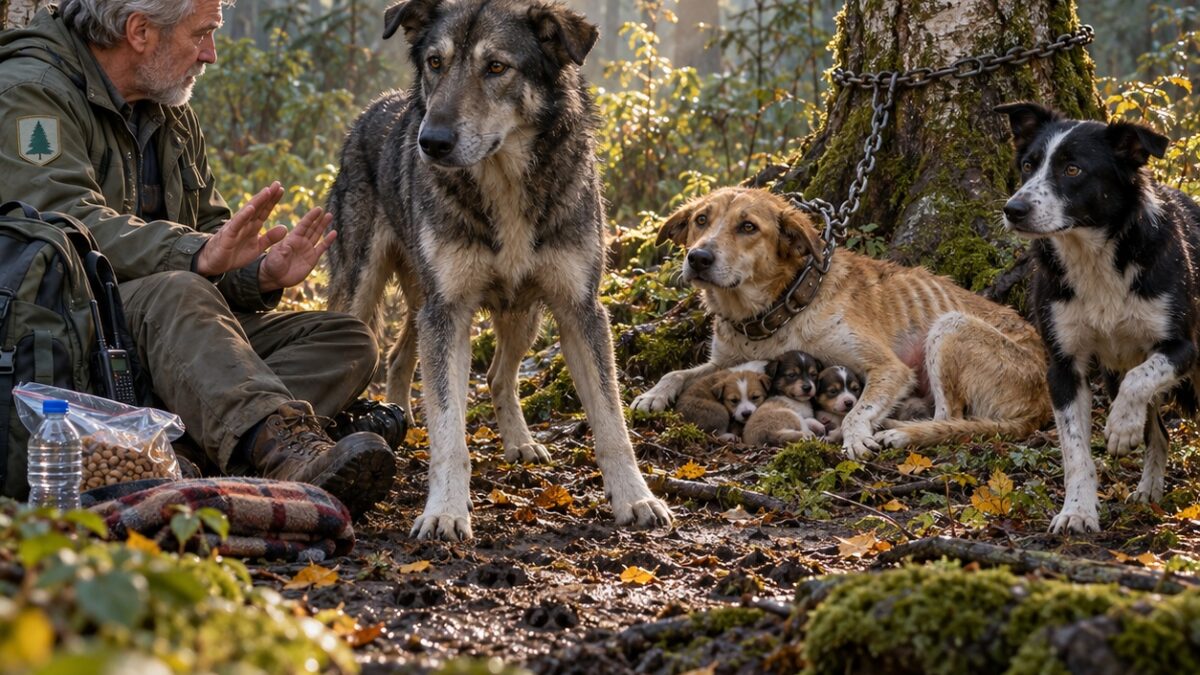
At first, the gray dog remained standing.
I would later name him Bailey.
That morning, he was simply the larger one.
He had the body of a dog who had once been strong.
Deep chest.
Long legs.
Gray coat with darker hair along his back.
But he was thin too.
Not nearly as emaciated as the mother, but thin enough that his hips showed.
His ears remained forward.
His attention never left me.
The black-and-white dog was smaller.
Maybe forty pounds.
Quick movements.
Nervous energy.
He shifted from paw to paw.
Every few minutes, he let out one low bark.
Not frantic.
A reminder.
I see you.
The mother barely moved.
Later, I would call her Rosie.
At that moment, all I knew was that she looked exhausted beyond anything I had seen in a living animal.
She kept her body curled protectively around the puppies.
One tiny pup crawled beneath her front leg.
Rosie lowered her head and nudged it closer.
Her chain scraped against the roots.
The sound made my stomach twist.
Someone had put her there.
This wasn’t an accident.
The chain had been looped deliberately around the tree.
There was no collar tag.
No bowl.
No shelter.
Nothing except a torn piece of cloth beneath the puppies and an overturned plastic container several feet away.
I had worked enough cruelty investigations to know I needed to preserve what I could.
But I also knew paperwork would mean nothing if the dogs panicked and somebody got hurt.
So I stayed still.
The forest around us continued as though nothing unusual was happening.
Leaves.
Birds.
Wind.
A distant woodpecker.
I could hear my own breathing.
Bailey watched every movement.
I slowly slid my backpack from one shoulder.
Immediately, his body tightened.
The black-and-white dog barked.
I froze.
“Okay.”
I kept my voice low.
“No problem.”
Bailey took one step toward me.
Not charging.
Warning.
I waited.
His paw remained forward.
My hands stayed visible.
After maybe thirty seconds, he settled back.
I moved again.
An inch.
Pause.
Another.
Eventually, I opened the bag.
I always carried emergency supplies.
Water.
Protein bars.
First-aid kit.
Rope.
A small bag of dry dog food had been in my vehicle from an earlier call involving a lost Labrador.
I had grabbed it before walking the trail, not because I expected to find dogs, but because Emily had been very specific.
Dogs crying.
Sometimes children hear what adults dismiss.
That morning, she had been right.
I took the food out slowly.
Bailey watched.
Pepper—that became the black-and-white dog’s name later—sniffed the air.
Rosie’s eyes followed the bag.
I poured a small amount onto a clean cloth.
Then placed the food on the ground halfway between us.
I backed up.
Sat again.
Nothing happened.
Five minutes.
Ten.
Bailey looked at the food.
Then me.
Then Rosie.
Pepper took one step.
Stopped.
Another.
His body was so low his belly nearly touched the ground.
He approached the food sideways, prepared to run.
I didn’t move.
Pepper reached it.
Sniffed.
I expected him to eat.
He didn’t.
He picked up several pieces.
Then backed away.
He turned.
Walked directly to Rosie.
And dropped the food in front of her.
I felt my throat tighten.
Rosie looked at Pepper.
Then at the food.
Pepper sat beside her.
He didn’t take one piece.
Rosie lowered her head.
She ate.
Slowly.
Her jaws moved carefully.
The puppies squirmed against her belly.
I stared at Pepper.
“You brought it to her.”
He looked toward me.
Something inside me changed.
Until that moment, I had been approaching the scene professionally.
Assess.
Avoid bites.
Call support.
Document.
Remove animals.
But watching that hungry dog carry food to a nursing mother instead of eating it himself stripped all the procedure away.
This was family.
Not necessarily blood.
I had no idea how they were related.
Maybe they weren’t.
But they had organized themselves around survival.
Bailey guarded.
Pepper brought food.
Rosie kept the puppies alive.
I sat there feeling strangely humbled.
After several minutes, I placed more food down.
Again, I backed away.
Pepper approached first.
This time he ate one piece.
Then carried several to Rosie.
Bailey waited.
Only when Rosie had eaten did he approach.
He took food quickly but never stopped watching me.
“Fair.”
I nodded.
“You don’t trust me.”
Bailey’s stare remained fixed.
“You shouldn’t.”
That seemed important to say.
Humans have a bad habit of expecting abused animals to recognize good intentions immediately.
As though they owe us trust because we happen to be the person arriving after someone else failed them.
They don’t.
Trust should be earned.
So I waited.
Eventually, I took out my water bottle.
That got more tension.
I found a shallow plastic lid in the emergency kit.
Poured water into it.
Placed it closer to the food.
Backed away.
Pepper smelled it.
Bailey didn’t move.
Rosie watched.
Her tongue appeared briefly.
She was thirsty.
Painfully thirsty.
Still, she would not leave the puppies.
I poured more water into the lid and slid it a little closer.
Not too close.
Bailey stepped between us.
“All right.”
I stopped.
“I’ll leave it.”
I went back to the tree.
Twenty minutes passed.
Pepper drank.
Then Bailey.
Rosie did not move.
I could see her breathing.
Shallow.
Fast.
I worried about dehydration.
Nursing three puppies on almost no food or water could kill her even if the chain never did.
I had to get help.
But walking away felt wrong.
I had only just convinced them I wasn’t advancing.
Now I had to leave.
I looked at my watch.
Almost two hours.
My radio signal in that part of the forest was unreliable.
I needed to get back toward the trail.
I stood slowly.
Bailey rose instantly.
Pepper barked.
Rosie lifted her head.
“I’m leaving.”
Of course they didn’t understand.
“I’ll come back.”
Bailey watched.
“I promise.”
I don’t use that word lightly.
Not with people.
Not with animals.
My wife used to tell me I was too serious about promises.
She died nine years earlier.
Cancer.
Maybe that had something to do with it.
There are promises you cannot keep no matter how desperately you want to.
I’ll always be here.
Everything will be okay.
When life teaches you that, you become careful with promises you actually have control over.
This one I could keep.
“I’ll come back.”
I backed away.
Step by step.
I didn’t turn until brush separated us.
Then I heard one bark.
Deep.
Bailey.
Not aggressive.
One sound.
I looked back, though I couldn’t see him.
“I know.”
I walked faster.
By the time I reached the ranger vehicle, my shirt was damp with sweat.
I called the county animal rescue.
Megan answered.
She had worked with us on wildlife-adjacent domestic animal cases before.
“County Rescue.”
“Megan, it’s Thomas Reed.”
“Hey, Thomas.”
“I need a team.”
Her tone changed.
“What happened?”
“Three adult dogs. Three puppies.”
“Location?”
I gave coordinates.
“One female chained to a tree. Nursing.”
Silence.
“Condition?”
“Bad.”
“How bad?”
“Emaciated. Dehydrated. Neck injury from chain. Puppies alive.”
“And the other two?”
“Loose.”
“Aggressive?”
“No.”
I thought about Bailey.
“Protective.”
“Can you contain them?”
“I don’t want to try alone.”
“Good.”
That word annoyed me slightly.
“I’ve been doing this job thirty-eight years.”
“Which is why you know not to be stupid.”
Fair.
“We’ll get a team.”
“When?”
“First light tomorrow.”
“Tomorrow?”
“We need proper transport, veterinary intake, and staff.”
“They may not have another day.”
Megan went quiet.
“I can send one officer now, but getting all six safely out after dark would be risky.”
I knew she was right.
I hated it.
“I’ll go back with food and water.”
“Thomas.”
“I won’t approach.”
“Thomas.”
“They trusted me enough to eat.”
A sigh.
“Do not attempt to cut the chain.”
“I won’t.”
“Do not try to catch the loose dogs.”
“I know.”
“Do not—”
“Megan.”
“What?”
“I said I know.”
She paused.
“Fine. We’re meeting at your station at five-thirty.”
“Good.”
I returned that evening.
I brought more water.
Food appropriate for nursing dogs.
Blankets.
A flashlight I kept pointed at the ground.
The dogs were where I left them.
That sight gave me relief and sorrow at the same time.
Pepper noticed me first.
He barked once.
Bailey emerged from behind the tree.
This time, he did not advance.
“See?”
I crouched.
“I came back.”
Rosie lifted her head.
I placed food and water.
Then sat.
Darkness came.
I stayed until I was certain Rosie had eaten.
Pepper again carried pieces to her.
Bailey eventually drank.
The puppies remained close.
At one point, Rosie tried to stand.
Her legs shook.
She made it three steps toward the water, drank for nearly a full minute, then slowly returned to the puppies.
“You’re tough.”
She looked at me.
“Too tough.”
Sometimes endurance becomes dangerous because everyone assumes the strong one can keep enduring.
I had seen that in people.
Apparently dogs too.
I left around nine.
Bailey watched me go.
“I’ll be back in the morning.”
This time, he didn’t bark.
The next morning, Megan arrived with two shelter employees.
Carlos and Jenna.
Both experienced.
We loaded crates.
Blankets.
Slip leads.
Gloves.
Bolt cutters.
Puppy warming supplies.
Water.
Emergency nutrition.
A portable stretcher.
Dr. Evans at the shelter clinic was already waiting for us.
As we walked the trail, Megan asked me to explain the dogs’ behavior again.
“Gray dog blocks approach.”
“Bailey.”
She looked at me.
“You named them?”
“Temporarily.”
“And the black-and-white one?”
“Pepper.”
“The mother?”
“Rosie.”
“You named all three.”
“Names are easier than ‘gray dog.’”
Megan smiled.
“Sure.”
When we reached the clearing, Bailey appeared almost immediately.
His body stiffened at the sight of strangers.
Pepper barked repeatedly.
Rosie pulled the puppies tighter beneath her.
Megan stopped.
“Okay.”
Carlos whispered, “Protective group.”
“I told you.”
“I believed you.”
Bailey looked at me.
Then at them.
Back to me.
I stepped forward.
“Let me go first.”
Megan nodded.
“Slow.”
I removed my hat.
Crouched.
“Bailey.”
His ears shifted.
“It’s me.”
Pepper barked.
“I know.”
I sat down in almost the exact place from the day before.
Then I waited.
Ten minutes.
The shelter team remained behind me.
No one spoke.
Bailey relaxed fractionally.
I took food from my pocket.
Placed it down.
Pepper approached.
Took it.
Instead of carrying it to Rosie, he ate.
That made me smile.
“Good.”
He came again.
Then Bailey.
Rosie watched.
I moved a little closer.
Bailey stood.
I stopped.
“Okay.”
Wait.
Another foot.
Stop.
It took nearly forty minutes to close half the distance.
My knees hated me.
Eventually, I was close enough that Rosie could smell my hand if she stretched forward.
I didn’t reach.
“Hi, girl.”
Her eyes were exhausted.
But clearer than the day before.
“I’m Thomas.”
I smiled.
“We should’ve done introductions sooner.”
Rosie sniffed.
I lowered my hand.
She moved her nose toward my fingers.
Barely touched.
Then withdrew.
Bailey watched from five feet away.
No intervention.
“That okay?”
Rosie looked at him.
I found that interesting.
Maybe I was anthropomorphizing.
Maybe not.
I moved my hand closer.
Rosie sniffed again.
Then, slowly, she lowered her head onto my knee.
I stopped breathing.
Behind me, I heard Jenna whisper something I couldn’t make out.
Rosie’s entire body trembled.
Not fear.
Exhaustion.
Pure exhaustion.
I put one hand lightly against her head.
No pressure.
“That’s enough.”
She closed her eyes.
“Good girl.”
Bailey sat.
That was the signal.
I looked toward Megan.
“Come.”
She approached sideways.
Slow.
Rosie lifted her head but didn’t retreat.
“This is Megan.”
Megan gave me a look that said she did not require introduction to a dog.
I ignored it.
“She helps animals.”
Rosie watched.
Pepper moved behind Bailey.
Carlos and Jenna stayed farther back.
We spent another half hour building enough tolerance to work.
Then Carlos examined the chain.
“It isn’t padlocked.”
“What?”
“Wired shut.”
Heavy wire had been twisted around the connection near Rosie’s collar.
“Can you cut it?”
“Yes.”
“Will the sound scare them?”
“Probably.”
Megan looked at me.
“Stay with Rosie.”
Carlos positioned the cutter.
One sharp snap.
Pepper barked.
Bailey jumped forward.
I raised my voice.
“Bailey.”
He stopped.
Not because I commanded him.
Because my tone interrupted the reaction.
I remained beside Rosie.
“Okay.”
Another cut.
The wire loosened.
Carlos removed it.
The chain fell away.
Rosie looked down.
Then at me.
For the first time in who knew how long, nothing attached her to that tree.
I expected her to bolt.
She didn’t.
She stayed with her head beside my knee.
I felt tears in my eyes.
“You’re free.”
Megan touched my shoulder.
“We need to move quickly now.”
Right.
Emotion later.
Puppies first.
Jenna prepared a warmed carrier.
One at a time, we transferred them.
Rosie watched closely.
I let her smell each blanket.
Every puppy remained within sight.
No unnecessary separation.
Then Rosie.
She tried to stand.
Collapsed.
I caught her under the chest.
Bailey immediately moved closer.
“Easy.”
He smelled Rosie.
She licked his nose.
Megan brought the stretcher.
We placed Rosie carefully on it.
Pepper followed within inches.
Bailey paced beside us.
When we reached the vehicle, we loaded the puppies.
Rosie entered next.
Bailey resisted the crate.
No panic.
Just refusal.
He wanted to stay beside Rosie.
“We can crate them adjacent,” Megan said.
We positioned his crate directly beside hers.
Once Bailey saw Rosie, he entered.
Pepper followed Bailey into a separate adjacent crate after some encouragement.
Nobody fought.
Nobody snapped.
It felt as if, at some level, they had collectively made a decision.
If we go, we go together.
During the drive, I sat in the back.
Rosie could see me through the crate door.
She watched trees slide past the windows.
Maybe I imagined meaning in her expression.
But I kept thinking:
This might be the first time she’s traveled anywhere without a chain waiting at the end.
At the shelter clinic, Dr. Evans took over.
The examinations lasted hours.
Rosie was the most concerning.
Severely underweight.
Dehydrated.
Anemic.
Skin infection around her neck.
Fleas.
Intestinal parasites.
Nutritional deficiencies.
Her milk production was low but present.
The puppies were underweight but surprisingly stable.
Bailey had several old scars.
Pepper had an infected paw wound.
All three adults were dehydrated.
No microchips.
No identification.
No easy explanation.
The county opened an investigation.
I was interviewed.
Photographs taken.
Site documented.
We never discovered with certainty how Bailey and Pepper had come to be there.
Rosie’s chain clearly indicated human involvement.
Someone had abandoned her.
That much was obvious.
Had Bailey and Pepper belonged to the same person?
Had they escaped?
Were they strays who found Rosie afterward?
We couldn’t prove it.
What we could prove was that they had stayed.
That mattered to me more.
During the first week, Rosie remained in the medical wing.
The puppies stayed with her whenever safe.
Bailey and Pepper were housed in kennels directly across from her.
They became distressed if moved farther away.
Bailey especially.
He paced.
Refused food.
Watched the corridor.
Megan eventually rearranged space so all three adults could see one another.
Immediate improvement.
“They’re bonded,” she said.
“You sound surprised.”
“I’m not.”
She smiled.
“I’m telling you officially.”
I visited three days after the rescue.
Rosie recognized me.
I know people argue about how much recognition dogs attach to individual humans after short encounters.
I can only tell you what happened.
She stood.
Weakly.
Tail moved.
Then she walked toward me.
I sat on the floor.
Rosie placed her head in my lap.
Exactly as she had in the clearing.
I cried again.
Apparently retirement age had destroyed my emotional discipline.
Bailey approached his kennel gate.
Pepper jumped against his.
“Everybody’s alive.”
Pepper barked.
“Yes.”
I laughed.
“I know.”
I started visiting every week.
Then twice a week.
Then more often than I intended.
The staff stopped asking why I was there.
Rosie gained weight slowly.
Her neck healed.
Her coat changed from dull and tangled to soft and bright.
She became affectionate in ways the frightened dog in the forest had never had the energy to be.
She leaned against people.
Liked her ears scratched.
Discovered beds.
Real beds.
The first time I saw her sleeping upside down with all four legs partly in the air, I took a picture.
Megan laughed.
“You’re becoming one of those people.”
“What people?”
“People with six thousand dog photos.”
“I have twelve.”
“You were here twenty minutes.”
Bailey was slower to trust strangers.
With me, he eventually relaxed.
Still serious.
Still observant.
He reminded me of myself, which Megan said was not a compliment to either of us.
Pepper became chaos.
Once his infected paw healed and his weight improved, apparently all the anxiety in his body converted directly into mischief.
He stole gloves.
Dragged towels through the hallway.
Learned how to open one kind of cabinet.
One afternoon, I entered the shelter and found an employee chasing him.
Pepper had a roll of paper towels in his mouth.
“I thought he was traumatized.”
“He contains multitudes,” the employee shouted.
I laughed harder than I had in months.
The puppies grew.
Three of them.
Two mostly tan.
One black and white.
The black-and-white pup reminded me of Pepper enough that everyone joked Pepper might be the father.
No genetic testing was done.
Maybe.
Maybe not.
Again, some answers didn’t matter.
What mattered was health.
All three puppies grew quickly once Rosie was properly fed.
Their first attempts at walking were pathetic.
Tiny legs.
Large heads.
No coordination.
Then suddenly, within weeks, they were everywhere.
Running.
Biting each other’s ears.
Attacking shoelaces.
Falling asleep in piles.
Rosie transformed as they gained independence.
She played.
That surprised me.
The first time she chased a ball, I almost didn’t recognize her.
The dog I met beneath the birch had looked ancient.
She wasn’t.
Malnutrition and exhaustion had aged her.
Healthy, she seemed years younger.
Bailey occasionally joined.
Pepper always joined.
For short periods, all three adults would race through the shelter yard while the puppies attempted to follow.
I watched from the fence.
Megan stood beside me once.
“Thinking about taking all six home?”
“No.”
“You paused.”
“I did not.”
“You absolutely paused.”
“My house is too small.”
“So that’s the only problem?”
I looked at her.
“No.”
She laughed.
The truth was, I loved them.
All of them.
But loving an animal and being the right home are not identical.
I still worked long days.
My house had stairs.
I traveled between districts.
I could not realistically take a bonded group of three adults and three puppies.
Rescue taught me that good intentions are not enough.
What I could do was remain part of their transition.
So I did.
Months passed.
The puppies became old enough for adoption.
That brought complicated feelings.
The adults had built their survival around keeping those pups alive.
Now the pups were healthy enough to leave.
Would Rosie panic?
Would Bailey and Pepper?
The behavior team handled introductions carefully.
Rosie surprised all of us.
She watched the first puppy leave with a family.
Sniffed them.
Then returned to Bailey.
Not distressed.
It was as though the emergency phase of motherhood was over.
She had done her job.
The second puppy found a home a few weeks later.
That left the black-and-white one.
A male.
Energetic.
Curious.
Somebody named him Scout.
I hated the name.
It stayed.
Rosie, Bailey, and Pepper were listed as a bonded trio.
That drastically reduced possible adopters.
One dog is easy.
Two is harder.
Three adult dogs?
Very difficult.
Megan warned me.
“They may be here a while.”
“Then they’re here a while.”
“We’ll find something.”
“Together.”
“Yes.”
She agreed immediately.
“Together.”
I respected the shelter for that.
They had survived because they stayed.
Separating them simply to improve statistics felt wrong.
Applications came.
One family wanted Rosie alone.
Declined.
Another wanted Bailey.
Declined.
A man with acreage offered to take Bailey and Pepper but not Rosie.
No.
I began worrying.
Months in shelter environments can wear animals down even in good facilities.
Then a couple named Rachel and Ben applied.
They lived forty-five minutes outside town.
Six fenced acres.
No children at home.
Experience with rescue dogs.
They specifically asked about all three.
I attended their introduction.
Technically, there was no reason for me to be involved.
Megan allowed it because by then everyone had accepted I was emotionally incapable of being normal about these dogs.
Rachel sat on the ground.
Didn’t call them.
Didn’t reach.
Perfect.
Pepper approached first.
Naturally.
Bailey watched.
Rosie came next.
Ben threw no toys.
Offered no food.
Waited.
Eventually Bailey approached too.
By the end of the visit, Rosie had her head on Rachel’s knee.
I swallowed.
Megan glanced at me.
“Don’t start.”
“I didn’t do anything.”
“Your eyes are wet.”
“Allergies.”
“Inside?”
“Powerful pollen.”
The home visit went well.
Veterinary references.
Fence.
Shelter.
Everything.
The adoption was approved.
All three.
Together.
I should have felt only joy.
Instead, I felt something dangerously close to grief.
I had been visiting them for months.
They had become part of my week.
Rosie’s head in my lap.
Bailey’s quiet stare.
Pepper stealing things.
Their leaving was success.
Still loss.
Both can be true.
The morning they went home, I arrived early.
Rosie greeted me.
Bailey leaned against my leg.
Pepper stole my hat.
Typical.
Rachel and Ben arrived with a vehicle set up safely for all three.
I walked them outside.
Rosie climbed in.
Pepper immediately followed.
Bailey paused.
He looked toward me.
Then at Rosie.
Then stepped inside.
Of course.
Always together.
I closed the door.
Rosie looked through the window.
I touched the glass.
“You did it.”
Her tail moved.
“Go live.”
Rachel hugged me.
“Come visit.”
“I will.”
“You better.”
The vehicle pulled away.
I stood in the parking lot long after it disappeared.
Megan joined me.
“You okay?”
“No.”
“Good.”
I looked at her.
“What does that mean?”
“Means you cared.”
I nodded.
“I hate caring.”
“No, you don’t.”
She was right.
A month later, I visited.
Rosie was heavier.
Bailey had claimed a porch chair.
Pepper had dug a hole roughly the size of a small swimming pool.
Ben looked exhausted.
“Good choice?”
He laughed.
“Ask me after I fill the crater.”
Rosie ran toward me.
Not slowly.
Ran.
She put her head against my waist.
Bailey came next.
Pepper had mud on his face.
They were home.
Really home.
I drove away lighter.
Scout remained at the shelter.
The final puppy.
By then, he was several months old.
I visited him too.
He was friendly.
Smart.
Too energetic.
A black-and-white blur.
Then my granddaughter Emily came with me.
Emily was five.
Different Emily from the child whose father had originally called about the dogs.
Coincidence.
I always found that funny.
My Emily had loved animals since before she could say the word animal properly.
My daughter was cautious about dogs.
Not afraid.
Responsible.
When I asked if Emily could visit the shelter, she agreed under strict supervision.
The moment we entered, my granddaughter wanted to see everything.
“Slow down.”
“Grandpa, look!”
“I see.”
“Puppies!”
“Yes.”
“Cats!”
“Yes.”
“Another puppy!”
“You’ve discovered the fundamental structure of a shelter.”
She ignored me.
Then Scout approached his kennel gate.
Emily stopped.
So did he.
For once, Scout wasn’t bouncing.
He stared at her.
Emily crouched.
“Grandpa.”
“What?”
“He’s looking at me.”
“Yes.”
“He likes me.”
“You have been standing there four seconds.”
“He likes me.”
Scout’s tail moved.
Emily put her fingers near the gate.
I stopped her.
“Ask first.”
An employee opened the meeting area.
Scout entered.
He walked directly toward Emily.
Sniffed her shoes.
Then sat.
No jumping.
I couldn’t believe it.
This dog jumped on everybody.
Emily sat cross-legged.
Scout approached.
Placed one paw on her knee.
She giggled.
My chest tightened.
Something about the scene took me back to the forest.
Rosie over her puppies.
Pepper carrying food.
Bailey standing guard.
This little animal had started life beneath a chained mother in an abandoned clearing.
Now he was looking at my granddaughter.
Safe.
Fed.
Curious.
No idea what his beginning had almost cost him.
My daughter looked at me.
“No.”
“I didn’t say anything.”
“Your face did.”
“What face?”
“Dad.”
Emily hugged Scout.
“Mommy, can he come home?”
My daughter closed her eyes.
“No one in this family has any respect for process.”
I smiled.
We did not take Scout home that day.
That mattered.
Children fall in love quickly.
Dogs deserve adult decisions.
My daughter and son-in-law discussed it.
They considered work schedules.
Training.
Expenses.
Their yard.
Their older cat.
We arranged proper meetings.
A home visit.
No shortcuts.
Three weeks later, Scout officially became theirs.
Emily renamed him Charlie.
Apparently democracy had limits.
The first night, she wanted him in her bed.
Her parents said no.
Charlie slept outside her bedroom door.
Within a month, he was in the bed.
I pretended surprise.
Watching them grow together became one of the quiet pleasures of my life.
Emily learned patience.
Charlie learned manners.
Eventually.
Mostly.
He attended obedience classes.
Chewed one kitchen chair.
Destroyed several stuffed animals.
Dug up half a flower bed.
My son-in-law occasionally called me.
“This is your fault.”
“Technically your wife approved him.”
“You started this.”
Fair.
Charlie also slept beside Emily when she was sick.
Waited near the school bus stop every afternoon.
Followed her through the yard.
Let her read books aloud to him.
When she cried, he came close.
Not because he had some mystical understanding of human sadness.
Maybe because he had learned her sounds.
Her routines.
Her presence.
Whatever explanation you prefer, he stayed.
That was enough.
I remained in contact with Rachel and Ben.
Rosie, Bailey, and Pepper thrived.
They still functioned as a unit.
Rosie became the social one.
Bailey the watcher.
Pepper the criminal.
Some personalities survive everything.
The first winter, Rachel sent a photograph.
All three dogs asleep in front of a fireplace.
Rosie in the middle.
Bailey pressed against one side.
Pepper on the other.
I printed it.
Put it in my office.
A ranger named Kyle asked me why I had a photo of somebody else’s dogs.
“Long story.”
“Your dogs?”
“No.”
“Family?”
I thought.
“Yes.”
Not legally.
Not in the conventional sense.
But yes.
Family.
Because family is partly made from responsibility.
Who stays.
Who protects.
Who returns.
Those dogs had shown me that before I ever gave them names.
Years of working in the forest had trained me to think in terms of systems.
Habitat.
Territory.
Food.
Weather.
Population.
Cause and effect.
Rosie, Bailey, and Pepper reminded me that relationships are also survival systems.
Rosie could nurse the puppies because Pepper brought food.
Pepper could search because Bailey guarded.
Bailey could protect because Rosie remained with the litter.
They distributed responsibility.
Without language.
Without planning meetings.
They simply stayed.
People often asked whether I believed dogs understand loyalty.
I stopped answering.
The word understand causes unnecessary arguments.
Did they philosophically conceptualize loyalty?
Probably not.
Did they behave loyally?
Undeniably.
Pepper was free to leave.
He stayed.
Bailey was free to leave.
He stayed.
Rosie could not leave.
They did not abandon her.
That’s enough.
I also thought often about trust.
The first day, Bailey watched me for two hours.
Two hours.
I couldn’t blame him.
Someone had chained Rosie to a tree.
Whatever human contact preceded that clearing had taught them caution.
I wanted trust immediately because I knew my own intentions.
They didn’t.
That distinction matters far beyond animals.
We often become offended when hurt people do not instantly believe we are safe.
Why should they?
Trust is not owed to the next person simply because the last person caused harm.
Trust belongs to the one risking it.
Bailey taught me patience.
Sit down.
Stop proving.
Wait.
Let your actions repeat.
Food.
Water.
Distance.
Return.
Again.
Then maybe.
Rosie taught me something different.
Strength is often mistaken for capacity.
She had survived because she had no alternative.
That did not mean she should have been asked to survive one more day.
When I first saw her, I admired her toughness.
Later, I understood toughness had nearly killed her.
Sometimes the kindest thing you can do for someone strong is remove the burden they have become too accustomed to carrying.
Pepper taught me generosity.
He was hungry.
He brought food to Rosie.
No audience.
No reward.
No certainty that more food was coming.
I think about that whenever people talk about giving from abundance.
Giving when you have plenty is good.
Giving when you have little reveals something else.
And the puppies?
They taught me how quickly a beginning can stop defining a life.
Charlie does not remember the chain.
At least not consciously in any way we can know.
He does not remember that clearing.
His first meaningful memories probably involve shelter blankets.
Emily.
A backyard.
Toys.
School buses.
That comforts me.
Not all scars need become identity.
Some lives get a second chapter early enough that the first becomes only history.
As for me, people occasionally called me the man who rescued the dogs in the forest.
I never liked that.
I found them.
That matters.
I called people.
That matters too.
I sat still long enough for frightened animals to decide I wasn’t immediately dangerous.
Then a whole network did the real rescue.
Emily Foster spoke up.
Her father listened.
I followed the trail.
Megan organized the team.
Carlos cut the chain.
Jenna handled the puppies.
Dr. Evans treated them.
Shelter staff rehabilitated them.
Rachel and Ben adopted three adults.
My daughter and her family adopted Charlie.
No hero.
A chain of people choosing not to look away.
That’s how most rescues actually happen.
One person notices.
Another responds.
Another treats.
Another stays.
Years later, I returned to the old trail.
The county had cleared part of it.
The birch tree was still there.
The chain was gone.
Of course.
But I recognized the roots.
I stood in the clearing alone.
No dogs.
No whining.
Just leaves.
I walked to the place where I had first sat.
Lowered myself against the tree.
My knees were less cooperative than before.
I stayed there for a while.
Two hours had once felt like forever.
Now they seemed tiny compared with everything that followed.
Rosie gaining weight.
Bailey sleeping on a porch.
Pepper digging criminal holes.
Puppies growing.
Emily laughing while Charlie chased her across the yard.
I thought about what would have happened if I had rushed Bailey that first morning.
Maybe he would have attacked.
Maybe I would have retreated.
Maybe Rosie would have panicked and injured herself against the chain.
Maybe nothing terrible.
We’ll never know.
Sometimes restraint changes a story as much as action.
That is difficult for people like me.
Rangers are trained to respond.
Assess.
Intervene.
Solve.
But that day, the first useful thing I did was sit down.
Wait.
Respect fear.
I wish more people understood that.
Not every crisis needs immediate closeness.
Sometimes help begins at a distance.
Charlie grew into a strong dog.
Bigger than anyone predicted.
Black and white like Pepper, with Rosie’s eyes.
At least I always thought so.
Emily grew too.
When she was nine, she asked me where Charlie came from.
She knew the simplified version.
“Forest.”
“Your grandpa found him.”
But children eventually ask better questions.
“Why was his mommy chained?”
I paused.
We were sitting on my porch.
Charlie asleep beside her.
“Someone left her there.”
Emily frowned.
“Why?”
“I don’t know.”
“Did they not love her?”
That question was harder.
“I don’t know.”
“Did Rosie do something bad?”
“No.”
“Then why?”
I looked at Charlie.
“Sometimes people fail animals for reasons that have nothing to do with the animal.”
Emily thought about this.
“That’s stupid.”
“Yes.”
She scratched Charlie’s ear.
“Bailey and Pepper stayed.”
“They did.”
“So they were her family.”
I smiled.
“Exactly.”
She looked at me.
“Even though they weren’t married?”
I laughed.
“No paperwork was filed.”
She rolled her eyes.
“Grandpa.”
“Yes. They were family.”
“Because they stayed?”
“Yes.”
Emily nodded.
That answer satisfied her.
It still satisfies me.
Family is complicated.
Blood.
Marriage.
Adoption.
Friendship.
Animals don’t care about our categories.
They care who shows up.
Who sleeps nearby.
Who shares food.
Who protects.
Who returns.
When I found Rosie, she had almost nothing.
No shelter.
No food.
No freedom.
But she had Bailey.
Pepper.
Her puppies.
She wasn’t alone.
That may be why she survived long enough for me to arrive.
Years later, Rosie died peacefully at Rachel and Ben’s farm.
She was older than we first estimated.
Rachel called me.
I drove out.
Bailey and Pepper were still alive then.
Rosie lay on her favorite blanket near the porch.
I sat beside her.
Her body was thin again, but from age this time.
Not starvation.
There is a difference.
A life had happened between those two kinds of thinness.
Open fields.
Warm beds.
Vet care.
Food.
People.
Years.
Rosie lifted her head when I arrived.
Whether she truly recognized me after all that time, I cannot prove.
But she moved toward my hand.
I placed it beneath her chin.
“Hey, girl.”
Her tail moved once.
Rachel cried.
I did too.
“You did good.”
Rosie closed her eyes.
Bailey lay nearby.
Pepper beside him.
Still together.
She died the next morning.
At home.
Not chained.
Not afraid.
Her family beside her.
That ending hurt.
But it was not tragedy.
Tragedy would have been the birch tree.
This was life completed.
Bailey lived another year.
Pepper nearly two.
Rachel and Ben stayed faithful to the promise they made.
Together until the end.
I attended both goodbyes.
Each time, I remembered the clearing.
Each time, the pain came with gratitude.
They had been given time.
That is what rescue really gives.
Not immortality.
Time in safety.
Time in sunlight.
Time to become annoying.
Time to trust.
Time to sleep.
Time to be loved beyond survival.
Charlie remained.
The next generation.
Emily once asked whether Rosie knew one of her puppies had ended up with her.
“No.”
“That’s sad.”
“Maybe.”
I looked at Charlie racing around the yard.
“Or maybe she didn’t need to know.”
“Why?”
“Her job was to keep him alive long enough for his life to become his.”
Emily considered that.
Then smiled.
“He has a good life.”
“Yes.”
“He sleeps on my pillow.”
“I know. Your mother complains.”
“He likes it.”
“Your mother owns the pillow.”
“Charlie disagrees.”
There it was.
Life.
Ordinary.
Ridiculous.
Perfect.
I retired from the forest service after forty-one years.
On my last day, the station held a small gathering.
Nothing elaborate.
Cake.
Coffee.
Speeches I would have preferred to avoid.
Kyle brought up the Rosie story.
He said it showed what kind of ranger I was.
I interrupted.
“Actually, it showed I know how to sit under a tree.”
Everyone laughed.
But I meant part of it.
That day reshaped how I thought about my work.
For decades, I believed protecting the forest meant protecting land.
Trees.
Wildlife.
Water.
Trails.
It does.
But landscapes contain lives moving through them.
Sometimes human.
Sometimes wild.
Sometimes three exhausted domestic dogs who turn an abandoned clearing into a family home because they have no better option.
Protection begins with noticing what doesn’t belong.
A chain around a tree did not belong.
Newborn puppies on bare ground did not belong.
Two starving dogs keeping watch because no human had come did not belong.
So I responded.
Not heroically.
Appropriately.
That word matters more to me now.
Do the appropriate thing.
Sit when advancing would frighten.
Move when delay would harm.
Call people who know more.
Accept help.
Return when you said you would.
The older I get, the more I think character is mostly repetition.
Anybody can be compassionate for five dramatic minutes.
Can you return tomorrow?
Can you stay when progress is slow?
Can you care after the photograph?
Those dogs stayed.
So I learned to stay too.
I’m sitting at home as I tell this now.
Emily is older.
Charlie is no longer a puppy.
He is a broad, confident dog with white appearing around his muzzle.
He still follows Emily from room to room when she visits.
She is preparing for college.
The thought apparently concerns Charlie greatly.
He watches suitcases.
Follows packing.
I told her recently:
“You’d better explain you’re coming back.”
She laughed.
“Grandpa, he’s a dog.”
I raised an eyebrow.
She stopped laughing.
“Okay.”
She sat on the floor.
Charlie immediately came to her.
She wrapped her arms around him.
“I’ll come back.”
I watched.
Memory folded over itself.
A chained mother.
Two dogs refusing to leave.
A child with a puppy.
Now a young woman promising that puppy, grown old, that temporary absence was not abandonment.
Maybe that is how good things travel forward.
Not as grand lessons.
As changed behavior.
We learn.
Then someone else benefits.
I still think about Bailey most when I think about that morning.
The way he stood between me and Rosie.
Not attacking.
Assessing.
He gave me a chance.
That’s what people forget.
Trust is sometimes courage from the frightened one.
Bailey risked not driving me away.
Rosie risked touching my hand.
Pepper risked approaching the food.
Each tiny choice created the next.
Eventually, Rosie put her head in my lap.
Eventually, the chain fell.
Eventually, the vehicle door closed behind all of them together.
Freedom did not arrive in one moment.
It arrived through a sequence of permissions.
You may sit there.
You may leave food.
You may come closer.
You may touch me.
You may bring others.
You may cut the chain.
I will follow.
That is one of the most profound things I have ever witnessed.
Not because animals are magical.
Because trust is.
I have been asked whether I would do anything differently.
Yes.
I would bring better food.
My emergency kibble was terrible.
Megan still mocks me for it.
But otherwise?
No.
I would sit beneath that birch again.
Two hours.
Ten if necessary.
I would let Bailey decide.
Because the purpose was never to overpower him.
It was to convince him he no longer had to protect everyone alone.
That may be the deepest form of help.
Not taking control.
Sharing responsibility.
Rosie no longer had to keep puppies alive on an empty stomach.
Pepper no longer had to find food alone.
Bailey no longer had to stand guard every second.
Someone else had arrived.
That is what I hope they understood.
Someone else is here now.
Rest.
People sometimes say the forest saved me that day.
I understand why I once used those words.
I had been lonely for years after my wife died.
Work kept me functional.
Routine kept me moving.
But Rosie and the others broke through a part of me I had kept carefully controlled.
They reminded me that being needed and being connected are not the same thing.
My job needed me.
Those dogs trusted me.
Different.
Trust asks more.
It changes you.
After them, I became softer in ways I did not expect.
More patient.
Less embarrassed by tears.
More willing to admit when something mattered.
Emily noticed.
“You hug more.”
“I’ve always hugged.”
“No.”
“Your memory is unreliable.”
She laughed.
Maybe she was right.
I spent decades believing strength meant remaining composed.
Bailey changed my definition.
He was strong because he stayed.
Rosie was strong because she trusted when she finally could.
Pepper was strong because hunger did not erase generosity.
Strength had many forms.
So did family.
That is what I carry from the clearing.
Not the cruelty.
Not the chain.
The response to it.
A mother covering her puppies.
A gray dog standing guard.
A black-and-white dog bringing food to someone weaker.
Three animals building a family in the middle of abandonment.
And a human arriving late enough to understand that the family already existed.
I did not create it.
I was invited into it.
Briefly.
Long enough to help.
Long enough to be changed.
Long enough to make sure they left the forest together.
That was enough.
More than enough.
Every so often, I walk the old trail.
The birch is aging.
One large branch came down in a storm.
The clearing is filling with young growth.
Nature closes over evidence.
Good.
The forest does not need to preserve suffering for us.
I remember.
That’s sufficient.
I stand where Rosie had been chained.
There is no mark now.
No chain scar.
No blanket.
Nothing.
Only grass.
That absence makes me happy.
A place of confinement returned to being simply a place.
One afternoon, Charlie came with me.
Emily too.
We reached the clearing.
Charlie ran across it.
Sniffed everything.
No recognition, of course.
He had been too young.
Emily asked:
“Is this really where he was born?”
“Yes.”
She looked around.
“It’s pretty.”
I smiled.
“It wasn’t that day.”
Charlie found a stick.
Brought it to her.
She threw it.
He raced after it.
I watched the black-and-white dog run freely across the place where his mother had once been chained.
I could not imagine a better ending.
Not because the past disappeared.
Because the future contradicted it.
That is what hope looks like to me now.
Not pretending the chain never existed.
Watching the puppy born beside it grow into a dog who runs where the chain once ended.
Charlie brought the stick back.
Emily threw again.
He ran.
I sat against the old birch.
Exactly where I had sat years earlier.
This time, no one was afraid of me.
No one was starving.
No one needed rescuing.
There was only my granddaughter laughing.
A dog running.
Leaves moving overhead.
And a quiet forest doing what forests do best.
Growing over what hurt.
Making room for what comes next.
I closed my eyes.
For one second, I could almost see them all again.
Rosie beneath the tree.
Bailey standing guard.
Pepper carrying food.
Three tiny puppies hidden beneath their mother.
Then I opened my eyes.
Charlie was racing back toward us.
Free.
That was enough.
I had spent thirty-eight years protecting the forest before that day.
But on that abandoned trail, the forest taught me the most important thing I ever learned about protection.
Sometimes protecting someone means fighting.
Sometimes it means cutting a chain.
Sometimes it means calling for help.
And sometimes the bravest thing you can do is sit still long enough for someone who has every reason to fear you to decide that maybe, just maybe, you are safe.
I sat.
They trusted.
We left together.
And I have never regretted staying.








