FULL STORY:I Came Home to Find Another Family Living in the House I Had Just Bought—Then the HOA President Called Me the Trespasser
FULL STORY CONTINUATION
I stood on the walkway and stared at her.
There are moments when anger comes so fast you almost don’t feel it.
Not heat.
Cold.
That was what I felt.
Cold.
Susan walked toward the porch as if I were the inconvenience she had been summoned to remove.
She wore cream pants, a navy blouse, sunglasses on top of her head, and the same HOA badge I had seen at closing when the neighborhood disclosure packet was explained to me.
She carried herself with the confidence of someone who had spent years watching people move aside when she approached with official-looking paper.
“Stop harassing this family,” she said.
I looked at Emily.
Then David.
The children were still behind them.
Nobody looked comfortable.
“I am not harassing anyone.”
Susan raised her chin.
“You are refusing to leave private property.”
“My private property.”
She made a disgusted sound.
“This home was abandoned.”
“No.”
“I handled the transfer.”
“You handled nothing involving my deed.”
“You don’t have a valid deed.”
I reached toward my backpack.
Emily flinched.
I stopped immediately.
“I’m getting paperwork.”
David put a hand lightly on his wife’s shoulder.
Susan stepped between us.
“You don’t need to show them anything.”
I looked at her.
“They live in my house.”
“They own the house.”
“No.”
Her voice sharpened.
“You need to leave.”
I almost asked whether she understood how insane that sounded.
Then she pulled out her phone.
“What are you doing?”
“Calling the police.”
For one second, nobody moved.
Then I said:
“Please do.”
That answer surprised her.
She expected protest.
Fear.
Maybe me leaving before officers arrived.
Instead, I stepped onto the edge of the lawn and waited.
Susan dialed 911.
Her performance began instantly.
“Yes, I need officers sent to 214 Willow Bend Court in Whispering Oaks Estates.”
She looked directly at me.
“There is an aggressive trespasser refusing to leave a family’s property.”
My jaw tightened.
“I am not aggressive.”
She kept speaking.
“He’s claiming the home belongs to him.”
David looked down at his documents.
For the first time, I saw doubt enter his face.
Susan emphasized:
“The homeowners have children present.”
That was deliberate.
She wanted urgency.
Threat.
A picture in the dispatcher’s mind before police arrived.
I took out my phone.
Opened the county property portal.
My name appeared.
MARCUS THORNE.
Recorded deed.
Closing date.
Parcel number.
I saved screenshots.
Then opened the digital copy of my closing package.
Susan finished her call.
“They’ll be here shortly.”
“Good.”
“You should go before this gets worse.”
“It already got worse.”
She crossed her arms.
“You think paperwork makes you entitled to intimidate residents?”
I stared at her.
“Paperwork is literally what makes me the owner.”
She rolled her eyes.
I looked at David.
“Can I ask you something?”
He hesitated.
Susan interrupted.
“No.”
I ignored her.
“When did you buy this place?”
“Three weeks ago.”
“Through a realtor?”
He glanced at Susan.
“No.”
“Title company?”
His face tightened.
“Susan handled the transaction.”
“Attorney?”
“She said it was an HOA-controlled property.”
“County recording?”
Susan stepped forward.
“You don’t need to interrogate them.”
I looked at David.
“Did you receive a recorded deed?”
He held up several papers.
“We received transfer documents.”
“From the county?”
Silence.
Emily looked at him.
“David?”
He swallowed.
“Susan said the HOA had taken possession because the previous owner forfeited it.”
I felt sick.
“Previous owner?”
“Yes.”
“I closed on this house five weeks ago.”
Emily’s face went pale.
Susan laughed loudly.
“See? Now he’s changing his story.”
“No.”
I looked at Emily.
“My deed was recorded five weeks ago. I was finishing a work contract out of town before moving.”
Susan waved one hand.
“That’s convenient.”
I turned toward her.
“Convenient is having county records.”
Sirens sounded in the distance.
Susan smiled.
Not a nervous smile.
Satisfied.
She genuinely believed police arrival would solve her problem.
That told me how deeply she trusted her own authority.
Two patrol cars turned onto Willow Bend Court.
No dramatic lights at first.
Then one activated briefly as it pulled behind Susan’s SUV.
Neighbors began appearing.
Doors opening.
People pretending to check mail.
Curtains moving.
Two officers stepped out.
The first was a tall man in his forties.
Name tag:
HAYES.
The second was a woman, younger, calm, scanning before anyone spoke.
EVANS.
Susan rushed toward them.
“Officers, thank goodness.”
Officer Hayes lifted one hand.
“Ma’am, let us get situated.”
“That man is trespassing.”
She pointed.
“He is threatening this family and refusing to leave.”
Officer Evans looked at me.
Then at the family.
Then at Susan.
“Has anyone been injured?”
“No.”
“Any weapons?”
Susan hesitated.
“I don’t know.”
I answered immediately.
“No.”
Evans nodded.
“Everybody stay where you are.”
Officer Hayes approached me.
“Sir, your name?”
“Marcus Thorne.”
“Can I see identification?”
“Yes.”
I pulled my wallet slowly.
Handed him my license.
Address still listed my former apartment.
Of course.
Susan made a small noise.
“See?”
Hayes ignored her.
“What is your connection to this property?”
“I purchased it five weeks ago.”
“Do you have proof?”
I almost smiled.
“Yes.”
I opened my backpack.
Pulled out the closing folder.
Original certified copies.
Recorded deed.
Settlement statement.
Wire confirmations.
Title insurance.
County recording receipt.
The kind of paperwork people complain about carrying until one afternoon it becomes the most valuable thing in their possession.
Hayes and Evans reviewed it together.
Susan hovered.
Evans looked up.
“Ma’am, give us some space.”
“I can explain.”
“We’ll ask.”
Susan backed off.
Reluctantly.
Officer Hayes compared the parcel number to the address.
Checked my ID.
Looked at the county stamp.
Then turned to David.
“Sir, do you have your documents?”
David nodded.
His hands shook slightly.
He went inside.
Returned with a folder.
Emily stood beside him.
Her daughter Sophie was crying quietly now.
The boy, Jack, kept asking whether they had to leave.
That was the moment my anger became complicated.
Because I could see what I looked like to those kids.
A strange man arriving with luggage saying their home belonged to him.
They weren’t part of Susan’s scheme.
They were trapped inside it.
David handed his folder to Officer Evans.
She opened it.
I watched her expression change.
First page.
Second.
Third.
She looked at Hayes.
He took one sheet.
No county stamp.
Generic transfer language.
HOA letterhead.
A typed statement claiming Whispering Oaks HOA had acquired the property after abandonment and was authorized to transfer occupancy and ownership interest.
Handwritten signatures.
One notarization block that looked suspiciously homemade.
Hayes asked:
“Who prepared these?”
David pointed toward Susan.
“She did.”
Both officers turned.
Susan immediately started talking.
“The HOA had authority because the property was vacant.”
Officer Evans said:
“No.”
One word.
Flat.
Susan blinked.
“We absolutely do.”
“No HOA has automatic authority to sell privately owned real property because it appears vacant.”
Susan’s face flushed.
“There were unpaid obligations.”
I said:
“There were no unpaid obligations.”
She snapped:
“You weren’t here.”
“That doesn’t make it abandoned.”
Officer Hayes raised a hand.
“Everybody stop.”
He looked at David.
“How much did you pay?”
David gave him the amount.
It was substantial.
Life-savings substantial.
Emily covered her mouth.
Hayes asked:
“Who received the funds?”
David stared at Susan.
“She gave us wiring instructions.”
The entire street seemed to go quiet.
Officer Evans asked:
“To an HOA account?”
David swallowed.
“I thought so.”
“Do you have confirmation?”
“Yes.”
“Get it.”
Susan stepped backward.
Only one step.
But Officer Hayes noticed.
“Ma’am, remain here.”
She stopped.
For the first time, her confidence cracked.
The Mitchells brought out bank records.
Emails.
Messages.
Receipts.
Officer Evans reviewed the transfer destination.
Her eyebrows tightened.
She showed Hayes.
He looked toward Susan.
“Is this the association’s account?”
Susan crossed her arms.
“The association uses multiple financial vehicles.”
That phrase sounded prepared.
Hayes asked again.
“Is this an HOA account?”
Susan’s mouth opened.
Closed.
“I would need to verify.”
I almost laughed.
Twenty minutes earlier, she supposedly had enough authority to sell my house.
Now she could not identify the account receiving the money.
Officer Evans stepped aside and called someone.
County records.
Dispatch.
Maybe a supervisor.
I don’t know.
What I do know is that within minutes, she returned holding her phone.
“County ownership records show Marcus Thorne as the current recorded owner.”
David sat down hard on the porch step.
Emily whispered:
“No.”
Susan immediately said:
“The county database must be delayed.”
Evans looked at her.
“The deed was recorded five weeks ago.”
Susan pointed at me.
“He forged it.”
Hayes stared.
“The county record?”
“Yes.”
“The title company?”
Susan’s voice rose.
“You don’t understand how these people operate.”
There it was again.
Not my name.
Not Marcus.
These people.
Officer Evans heard it.
So did everyone else.
Her expression hardened.
“What people, Ms. Abernathy?”
Susan realized the mistake.
“You know exactly what I mean.”
“No.”
Evans stepped closer.
“Explain.”
Susan shook her head.
“This is ridiculous.”
I felt every muscle in my jaw tighten.
Emily looked at me.
Then at Susan.
Something changed in her face.
Not just fear anymore.
Recognition.
She was beginning to understand that Susan hadn’t simply sold them property she didn’t own.
She had built the lie around an assumption that I could be dismissed.
David whispered:
“We paid her everything.”
Emily looked at him.
“Our savings?”
He nodded.
She sat beside him.
Sophie climbed into her lap.
Jack stood frozen.
I wanted to hate them.
For living in my house.
Using my kitchen.
Sleeping in my rooms.
But watching Emily hold those children, I couldn’t.
They had been conned.
Different wound.
Same criminal.
Officer Hayes said:
“Ms. Abernathy, do not leave.”
Susan laughed nervously.
“Of course I’m not leaving.”
Hayes stepped toward his cruiser.
Raised the radio.
Requested a supervisor and fraud investigator.
That was the moment Susan ran.
Not gracefully.
Not cleverly.
She simply turned.
Clutched the clipboard under one arm.
And moved toward her SUV.
Officer Evans shouted:
“Ma’am, stop.”
Susan kept going.
Hayes turned.
“Stop!”
She reached the driver’s side.
I was standing closer to the vehicle than the officers.
Instinct made me step sideways into the path.
Not touching her.
Just blocking the door.
Susan nearly collided with me.
“Get out of my way.”
“Police told you to stop.”
“You have no right.”
“Neither did you.”
She shoved the clipboard toward my chest.
I caught her wrist reflexively.
Not twisting.
Just stopping the motion.
Officer Hayes reached us immediately.
“Let go, sir.”
I did.
He took her arm.
Evans secured the other.
Susan started screaming.
“This is harassment!”
Handcuffs clicked.
“I’m the HOA president!”
Hayes said:
“Stop resisting.”
“I run this neighborhood!”
That sentence echoed down the street.
People were fully outside now.
Watching.
Neighbors who had probably obeyed Susan for years.
Trash-can notices.
Parking rules.
Paint.
Grass.
Suddenly they were watching their president being handcuffed beside a house she had apparently sold without owning it.
Susan kept shouting.
“He’s trespassing!”
Officer Evans said:
“No, ma’am.”
Susan’s voice rose.
“He does not belong here!”
That sentence hit differently.
Not because it surprised me.
Because now everyone heard what had been underneath the entire situation.
I looked toward Emily.
She looked ashamed.
Not for herself.
For having believed Susan.
Officer Hayes guided Susan toward the cruiser.
She resisted enough to slow him.
“Everyone should be thanking me,” she shouted. “I was protecting property values.”
No one answered.
“I was protecting this neighborhood.”
Hayes opened the rear door.
“Get in.”
“This community deserves better than him!”
Hayes’s voice finally sharpened.
“Enough.”
Susan went silent.
Not calm.
Stunned.
Like no one had spoken to her that way in years.
Backup arrived minutes later.
Another patrol unit.
Then an unmarked vehicle.
Detective Robert Vance introduced himself.
Fraud investigations.
He separated us.
That was smart.
Separate stories before people have time to unconsciously align details.
I sat in my own front yard giving a statement about the house I hadn’t even moved into yet.
Purchase date.
Closing attorney.
Title company.
Work trip.
Why the home had been vacant.
When I arrived.
What Susan said.
Exactly.
Especially the comments.
Detective Vance wrote everything.
“Do you have copies of communications with the HOA before today?”
“Very little.”
“Any dispute?”
“No.”
That seemed to interest him.
“So no foreclosure notices?”
“No.”
“Assessment delinquency?”
“No.”
“Lien?”
“No.”
“Demand letters?”
“No.”
“Did Susan ever tell you the house was at risk?”
“No.”
He nodded.
Then interviewed the Mitchells.
I couldn’t hear most of it.
I could see David handing over his phone.
Emily providing emails.
Printed messages.
A document packet.
Receipts.
Eventually, Detective Vance came back.
“This isn’t looking like a misunderstanding.”
“I know.”
He glanced toward Susan in the cruiser.
“I don’t think this is her first time.”
That got my attention.
“Why?”
“The paperwork is too organized.”
I looked at him.
“What does that mean?”
“People making one impulsive bad decision usually improvise.”
He nodded toward the Mitchell folder.
“This was a process.”
That word chilled me.
Process.
A system.
Not one house.
Maybe not one family.
Detective Vance asked where HOA records were kept.
Two neighbors immediately answered.
Small office behind the community pool.
Susan controlled access.
That phrase came up more than once.
Controlled access.
The board treasurer apparently had some financial files.
Secretary had meeting minutes.
But Susan kept enforcement records.
Transfer notices.
Delinquency packages.
“Abandonment” cases.
Detective Vance contacted whoever he needed.
Within an hour, officers were at the HOA office.
By then, the whole street had become a scene.
Patrol cars.
Neighbors.
My realtor.
She arrived after I called her and nearly lost her mind.
“You own this house.”
“I know.”
“I handled the closing.”
“I know.”
“Who are these people?”
“Victims.”
She stopped.
That answer surprised her.
Then she looked at the Mitchell children.
“Right.”
My closing attorney joined by phone.
Title company verified everything again.
No competing deed.
No foreclosure.
No association acquisition.
No legal transfer.
Nothing.
County record showed exactly one legitimate ownership chain.
Seller to me.
Done.
The Mitchell paperwork had no legal transfer value.
It was fabricated enough to look official to people who didn’t buy houses every week.
That was the scam.
Susan did not need to fool attorneys.
She needed to fool people who trusted her position.
The authority came first.
The paper came second.
Nobody expects an HOA president to be secretly selling houses.
That absurdity became camouflage.
Around dusk, officers returned from the HOA office carrying boxes.
I remember watching Susan through the cruiser window.
The second she saw the boxes, she stopped moving.
Detective Vance opened the first one on the hood of a patrol car.
Folders.
Homeowner names.
Violation notices.
Debt calculations.
Letters.
Some legitimate HOA business.
Some not.
Then they found forged abandonment notices.
Fake lien-related documents.
Properties marked as “vacant.”
Lists of owners who traveled frequently.
Elderly residents.
Rental homes.
People in probate.
Properties where no one was physically present for long stretches.
I felt sick.
Susan hadn’t randomly chosen my house.
My work trip had created an empty property.
New Black homeowner.
Not fully moved in.
Maybe she assumed I would have trouble proving ownership quickly.
Maybe she believed police would believe her first.
Maybe racism made the fraud feel safe to her.
Maybe all of it.
Detective Vance did not speculate in front of me.
He didn’t need to.
Susan’s own words had already told everyone plenty.
One officer found what appeared to be template letters.
Same structure as the Mitchell paperwork.
Different addresses.
Different names.
Some transfers completed.
Some attempts abandoned.
Some debt demands.
A notebook with dollar figures.
Accounts.
Payments.
Detective Vance looked through several pages.
Then turned toward the Mitchells.
“She did this intentionally.”
David looked like he had been punched.
“For how long?”
“We’re going to find out.”
Emily cried again.
Quietly this time.
She walked toward me.
I stood.
She stopped several feet away.
“Marcus.”
“Yeah.”
“I am so sorry.”
I shook my head.
“You didn’t know.”
“We were living in your house.”
“You thought it was yours.”
“But your things—”
“My things weren’t here yet.”
She wiped her face.
“Susan told us the previous owner abandoned it.”
“I know.”
“She said…”
Her voice broke.
“What?”
Emily looked toward the cruiser.
“She said the previous owner wasn’t someone who would fight legally.”
I felt that cold anger again.
“Did she say why?”
Emily’s eyes filled.
“She said people like that usually disappear when police get involved.”
There are moments when somebody confirms something you already knew and it still hurts.
I nodded.
Not because it was okay.
Because I didn’t trust myself to speak.
Emily whispered:
“We believed her.”
“You believed the HOA president handling what looked like official paperwork.”
“That doesn’t make it better.”
“It makes you a victim.”
She looked toward her children.
“We put everything into this.”
I knew.
The worst part of fraud is that money is never just money.
It is time.
Overtime.
Canceled vacations.
Years of saving.
Security.
Plans.
College funds.
Emergency reserves.
The Mitchells had emptied themselves into a house that wasn’t theirs.
I had spent years saving to buy the same house legitimately.
Susan had found a way to injure both sides at once.
Detective Vance eventually came over.
“Mr. Thorne.”
“Yes.”
“County has confirmed the deed.”
“I know.”
“The title company confirmed.”
“Yes.”
“The documents provided to the Mitchell family are not valid instruments.”
David closed his eyes.
Vance continued.
“The fraudulent transfer will not affect your ownership.”
I looked toward my front door.
“My house?”
“Legally, yes. It remains yours.”
There was no joy.
Not yet.
Just relief.
“What happens to them?”
Vance looked at the family.
“They’ll need assistance relocating while the investigation proceeds.”
Emily lowered her head.
I asked:
“Tonight?”
He nodded slowly.
“Technically, once it’s established they do not have lawful occupancy rights—”
I interrupted.
“They have children.”
Vance waited.
“I don’t need them thrown onto the street tonight.”
David looked up.
“Marcus—”
“No.”
I turned to him.
“You were scammed today too.”
Technically, I had every right to demand immediate possession.
Emotionally, I couldn’t do it.
Not with Sophie and Jack standing there.
We arranged something temporary.
Police documented my consent for a short period while the Mitchells found somewhere to stay.
My attorney hated that decision initially.
Then we documented it carefully.
No tenancy created.
No ownership concession.
Temporary permission.
Everything written.
I stayed in a hotel.
Again.
After finally buying a house.
Life has a sense of humor.
Susan did not go home that night.
Detective Vance formally advised her she was under investigation for fraud, forgery, fraudulent property transfer, identity-related offenses, and potentially conspiracy depending on who else had participated.
When officers brought her out of the cruiser for transport, the performance was gone.
Mascara streaked.
Hair loosened.
Clipboard nowhere in sight.
She looked smaller.
Not sympathetic.
Just human.
That mattered.
People in power often look enormous only while everyone agrees to treat their costume like authority.
Susan without the badge, clipboard, SUV, and board table was simply a woman in handcuffs facing questions she could not control.
She looked at me once.
No apology.
No anger either.
Just disbelief.
As if the part she couldn’t understand was not that she had committed fraud.
It was that the fraud had failed.
The next morning, I met my attorney, Linda Grant.
She specialized in real estate litigation.
I’d known her exactly twelve hours.
She already looked exhausted with me.
“You permitted them to remain?”
“Temporarily.”
“Marcus.”
“They have two kids.”
“I understand compassion.”
“Good.”
“I also understand adverse-possession myths, tenancy arguments, insurance exposure, and how quickly good intentions become legal messes.”
“We documented it.”
“Because I stayed up until one in the morning drafting the document.”
“Thank you.”
She glared.
“You’re welcome.”
Linda reviewed everything.
My deed was clean.
Title insurance active.
No recorded adverse instrument.
Susan’s paperwork never reached legal recording.
That was critical.
She had apparently been operating in the space between appearance and law.
Convince a buyer.
Collect money.
Deliver possession.
Maybe try to manipulate association records.
Maybe hope no legitimate owner appeared quickly.
Whatever the full mechanism, she had not succeeded in creating a valid deed.
“Can she actually sell a house through the HOA?”
I asked.
“Not like this.”
“Could an HOA ever foreclose?”
“In some circumstances under governing documents and state law, but that involves notice, process, recorded liens, statutory requirements, often judicial or power-of-sale procedures depending on the situation.”
“So not Susan printing a letter and giving someone keys.”
“No.”
Linda looked at me.
“Not even close.”
“How did the Mitchells get keys?”
“That’s part of the investigation.”
I already suspected.
Susan had access to HOA records.
Possibly emergency keys for some properties.
Maybe a locksmith had been misled.
My locks had been changed after closing.
Yet the Mitchells possessed keys that worked.
That detail bothered everybody.
Police eventually discovered Susan had used a locksmith by claiming association authority over an “abandoned” property.
She showed fabricated documentation.
The locksmith cooperated once contacted.
Another paper trail.
Another person who had trusted official-looking nonsense.
By the end of the first week, the story expanded.
More homeowners came forward.
A widow named Janet Lewis had received fabricated delinquency notices for months.
Susan demanded “settlement” payments to prevent enforcement.
An investor who owned two rentals was told one property faced abandonment proceedings because it had been vacant between tenants.
A military family stationed overseas had been threatened with HOA seizure over landscaping violations.
Most of those cases had not resulted in full property transfers.
But money had moved.
Thousands.
Sometimes through accounts associated with companies Susan controlled.
Sometimes through supposed HOA “resolution fees.”
The Mitchell transaction was simply the largest and most reckless.
My house had brought the whole thing into the open because I came back before Susan expected.
Timing.
That’s what Detective Vance said.
“She thought she had more time.”
I asked:
“How much?”
“Maybe enough to create another layer of paperwork.”
“Would that have worked?”
“Probably not legally.”
He paused.
“But it could have made the dispute uglier.”
That frightened me more than I liked.
Imagine arriving months later.
Family fully established.
Utilities in their name.
Mail.
Insurance.
Children enrolled nearby.
Susan presenting an entire narrative that I had abandoned the property.
It still wouldn’t defeat a valid deed easily.
But practical reality can make legal truth expensive.
Ten minutes mattered.
Documents mattered.
Showing up with a folder mattered.
I started sleeping with the closing folder in the hotel safe.
Ridiculous.
Necessary emotionally.
Three days after the confrontation, the Mitchell family moved out.
I helped.
Linda told me I was incapable of maintaining proper adversarial boundaries.
I told her they weren’t my adversaries.
David carried boxes.
Emily cleaned rooms they didn’t have to clean.
The kids looked miserable.
Sophie had decorated one bedroom with glow-in-the-dark stars.
When she removed them, little patches remained on the ceiling.
She stood looking up.
“Sorry.”
I crouched.
“Leave them.”
Her mother looked at me.
“Marcus.”
“Seriously.”
Sophie asked:
“You don’t mind?”
“No.”
She smiled for the first time I’d seen.
Those stars stayed for years.
I never took them down.
Maybe that sounds sentimental.
Fine.
That room became my guest room.
At night, tiny green stars glowed on the ceiling.
They reminded me that legal conflicts have innocent people standing inside them.
David apologized every fifteen minutes.
Eventually, I stopped him.
“If you apologize again, I’m charging you.”
He almost laughed.
“How much?”
“One hundred dollars.”
“Fair.”
“No.”
I put down a box.
“Listen to me. You did not steal my house.”
“We lived here.”
“Because somebody lied to you.”
“We should have used a lawyer.”
“Yes.”
He winced.
“Sorry.”
“There. You owe me a hundred.”
He laughed.
Good.
The Mitchells moved into a short-term rental.
Their financial situation was terrible.
Much of their savings had been transferred through Susan’s scheme.
Police and prosecutors froze accounts connected to the fraud as quickly as possible.
Some money was recovered.
Not instantly.
Nothing in criminal financial recovery is instant.
The source transcript version of events would make it sound as if a government office handed them a check the next morning.
Reality was slower.
But the investigation confirmed they were victims.
That mattered.
No trespassing charges.
No criminal accusation.
No stigma.
Just people fooled by somebody weaponizing trust.
Whispering Oaks exploded politically.
The HOA board called an emergency meeting.
Susan was removed from every leadership function immediately.
That part happened fast.
Nobody wanted her near records.
The vice president, Raymond Cole, called me personally.
“Mr. Thorne, I want to apologize.”
“For which part?”
Silence.
Fair question.
“We did not know.”
“How did your president access enough records to do this?”
“We’re investigating.”
“Bad answer.”
“I know.”
“What financial controls did you have?”
He sighed.
“Apparently not enough.”
That was at least honest.
I attended the meeting with Linda.
Not because I wanted a scene.
Because I wanted answers.
The clubhouse was full.
Standing room.
People angry.
Afraid.
Some carrying folders.
Everybody suddenly wondered whether their own violation notices were real.
That’s what fraud does to institutions.
It destroys trust beyond the direct crime.
A legitimate letter becomes suspicious because illegitimate letters used the same logo.
A real board action becomes questionable because one person forged others.
The HOA’s attorney stood at the front and explained that an external forensic audit would examine enforcement records, financial accounts, lien-related notices, property files, and Susan’s authority.
Residents shouted questions.
“How did no one know?”
“Who signed checks?”
“Did she have access to our personal information?”
“How many homes?”
“Was my fine real?”
The board had few answers.
Linda leaned toward me.
“Watch.”
“What?”
“This is what organizational failure looks like after the person holding everything together turns out to be the problem.”
Susan had been efficient.
That was part of how she survived.
She handled difficult homeowners.
Enforcement.
Paperwork.
Complaints.
Board members let her.
People mistake competence for trustworthiness when the work they don’t want to do keeps getting done.
Then nobody checks.
Until checking becomes unavoidable.
The audit revealed that Susan had built a private shadow system around legitimate HOA operations.
Real violation processes mixed with fabricated ones.
Real homeowner information used to create false claims.
Selective targeting.
Off-book accounts.
Fake settlement demands.
She knew which properties sat empty.
Who traveled.
Which residents were elderly.
Who rented.
Who might not respond quickly.
The discrimination component of my case also drew attention.
Her messages concerning me contained language that made her assumptions difficult to deny.
She had apparently told others I was “unlikely to last” in the neighborhood.
One email questioned whether my purchase was “credible.”
Another described me as potentially using the home “for unsuitable occupancy.”
No evidence.
Just prejudice dressed as concern.
When Linda showed me those emails, I sat in her office for a long time.
“You okay?”
“No.”
“Do you want to stop?”
“No.”
She waited.
“What hurts most?”
I looked at the page.
“Nothing I did mattered to her.”
“What do you mean?”
“I spent twenty years building a career.”
I tapped the email.
“Credit score. Savings. Job. Closing. Every legal requirement.”
My voice tightened.
“She saw me and decided none of it was real.”
Linda nodded.
“That’s what discrimination does.”
I hated hearing it stated so plainly.
Not because she was wrong.
Because she was right.
Susan didn’t know my life.
She knew a category she had placed me into.
Then used that category to justify believing my ownership was impossible.
That prejudice helped make the scam feel safe.
She expected police to look at me and believe her.
That was part of the plan.
It failed.
But the expectation itself stayed with me.
Officer Evans called weeks later.
Not officially.
Just checking in.
I thanked her.
“For what?”
“For asking questions.”
She was quiet.
“That’s our job.”
“I know.”
Still.
The first question she asked was not:
Why are you here?
It was:
What is happening?
Small difference.
Massive consequence.
She looked at the papers.
Not Susan’s confidence.
Not my skin.
Papers.
Evidence.
I respected that.
Detective Vance built the larger case over months.
Forgery.
Fraud.
Identity-related crimes.
The unlawful property transfer attempt.
Financial transactions.
Potential co-conspirators.
The locksmith had been deceived.
The Mitchells deceived.
Some board members negligent, perhaps, but not criminally involved.
Others became witnesses.
Susan’s private records were the strongest evidence.
She kept notes.
That amazed me.
People engaged in long-running schemes often believe organization protects them.
Sometimes organization becomes the prosecution’s index.
Dates.
Amounts.
Targets.
Property statuses.
She had documented herself.
The criminal case took time.
Again, real cases do.
There were hearings.
Motions.
Account tracing.
Interviews.
Forensic document analysis.
The neighborhood kept functioning meanwhile.
Garbage pickup.
Pool schedules.
Lawn crews.
Life’s indifference to drama can be comforting.
I finally moved into my house.
Actually moved.
Boxes.
Furniture.
Coffee maker eventually located.
The first night felt strange.
I sat alone in the living room.
The Mitchell family’s couch was gone.
My own couch sat against the wall.
No television mounted yet.
The house echoed slightly.
I had imagined the first night for years.
A glass of bourbon.
Maybe music.
A sense of achievement.
Instead, I kept thinking:
Someone sold this while I was gone.
I checked the locks twice.
Then three times.
At 1:00 a.m., I checked county records from my phone.
My name still there.
I laughed at myself.
Then checked again the next morning.
Fraud changes your relationship with certainty.
Even when the law is clear, your body remembers how quickly reality seemed to disappear.
For months, every HOA envelope annoyed me.
Even legitimate notices.
Pool closure.
Annual meeting.
Landscaping reminder.
I would see the logo and feel tension.
Raymond eventually asked whether I’d consider serving on a homeowner oversight committee.
I nearly hung up.
“No.”
“We need residents who—”
“No.”
“Understood.”
Two weeks later, I reconsidered.
Not because I wanted authority.
Because I wanted visibility.
I agreed to a temporary records-reform committee.
Six months.
No longer.
Our recommendations were boring.
Those are often the best reforms.
Dual authorization for certain financial actions.
Independent review of property-related enforcement.
No unilateral legal notices from a single board member.
Clear separation between HOA violation authority and any lien or foreclosure process.
Annual external audit.
Centralized document retention.
Resident access to governing records.
Mandatory board approval before outside counsel acted on property-level enforcement.
None of those rules were dramatic.
All of them would have made Susan’s scam harder.
That’s how prevention works.
Not inspirational speeches.
Controls.
The Mitchells eventually recovered a significant portion of their money through seized funds, insurance-related processes, restitution mechanisms, and civil action.
Not overnight.
But enough to start rebuilding.
David called me the day they closed on another house.
A real one.
With a title company.
Attorney.
Recorded deed.
Every check imaginable.
He laughed.
“I annoyed everyone.”
“How?”
“I asked to see the recording confirmation three times.”
“Only three?”
“Emily asked four.”
“Good.”
They invited me to the housewarming.
I went.
Sophie showed me her bedroom.
No glow-in-the-dark stars.
I brought a box.
She opened it.
Stars.
Emily laughed.
“Seriously?”
“They belong to her.”
Sophie hugged me.
That moment repaired something I didn’t know remained broken.
The Mitchell family was not part of the worst thing that happened to me.
They became part of what came after.
Important distinction.
Susan’s case eventually produced consequences serious enough that she never returned to HOA leadership.
The neighborhood stopped treating her name as a synonym for authority.
It became a warning.
New residents heard the story.
Usually exaggerated.
One version claimed she sold six houses.
Another claimed she had a fake judge.
Someone told a new neighbor that she owned a secret title company.
People love turning fraud into folklore.
I corrected stories when they involved me.
“No. She did not legally sell my house.”
That distinction mattered.
“She pretended to.”
“But another family moved in.”
“Yes.”
“How?”
“Fraudulent documents and manipulated access.”
“Did the police really arrest her in your driveway?”
“Yes.”
“That part is true?”
“Yes.”
People usually smiled.
I didn’t.
The driveway scene was memorable.
But the interesting part was everything that made it possible before that.
Years of unchecked authority.
Residents believing official-looking paperwork.
A board delegating too much.
Prejudice helping her identify someone she thought would be easy to dismiss.
The crime was spectacular.
The conditions were ordinary.
That’s why the story mattered.
I changed my own habits after that.
Every property document digitally backed up.
Recorded deed confirmation saved.
Title policy accessible.
Important contracts stored securely.
Not because I became paranoid.
Because evidence is easier to keep before you need it.
The closing folder I happened to carry that day saved hours of confusion.
Maybe more.
Had it been buried in storage, county records would still have proven ownership.
But the confrontation might have become uglier first.
Susan had called me an intruder.
Police arrived primed by that report.
I handed them certified documents immediately.
Narrative met evidence.
Evidence won fast.
That matters.
People sometimes ask what I would have done if police had believed Susan.
I don’t know.
That is the truthful answer.
I’d like to say I’d remain perfectly calm.
Call my lawyer.
Wait.
Maybe.
I was furious.
Scared too.
Because ownership feels solid until someone in authority points at you and says:
He doesn’t belong here.
For a few minutes, I understood how fragile truth can feel before someone verifies it.
That changed me.
Not into a cynic.
Into someone who respects process when process works.
Officer Hayes reviewed.
Officer Evans questioned.
County confirmed.
Title company confirmed.
Detective investigated.
The system did not magically protect me.
People inside the system chose to check.
That’s the difference.
Years later, the house feels fully mine.
Not legally.
It was legally mine that first day.
Emotionally.
My furniture.
Pictures.
Books.
A scratched section near the hallway from moving a desk badly.
Backyard grill.
Neighbor conversations.
The small tree I planted.
Time makes ownership physical.
Susan had tried to make my absence equal abandonment.
Now nobody could look at the place and pretend I wasn’t there.
That feels good.
Not because a house proves worth.
It doesn’t.
But because I worked for this one.
There is a photograph in my office from closing day.
Me standing outside 214 Willow Bend Court holding the keys.
Huge smile.
At the time, I thought that photo represented arrival.
Now I understand arrival came later.
The first real moment might have been the night after the Mitchells left.
I sat on the porch alone.
No police.
No Susan.
No strangers.
Just quiet.
A neighbor named Mrs. Alvarez walked past with her little dog.
She waved.
“Good evening, Marcus.”
Not sir.
Not homeowner.
Marcus.
I waved back.
That tiny normal interaction mattered.
Belonging usually arrives quietly.
Not through deeds.
Through repetition.
Hello.
Morning.
Package for you.
Your trash can blew over.
We’re grilling Saturday.
Those ordinary things defeated Susan’s vision of the neighborhood more completely than any conviction could.
She had believed she got to decide who belonged.
Turns out neighborhoods decide that every day through actual life.
Most people in Whispering Oaks were embarrassed by what happened.
Some apologized to me for things they didn’t do.
I told them to stop.
Others admitted Susan intimidated them.
One older man said:
“She fined me $250 for leaving my son’s truck overnight.”
“Did you fight it?”
“No.”
“Why?”
He shrugged.
“Wasn’t worth dealing with her.”
That sentence explained half her power.
Not worth dealing with her.
Ten dollars here.
Two hundred there.
One threatening letter.
One questionable notice.
Everyone adjusts.
She learns nobody pushes back.
Then the boundary moves.
A house.
That’s the lesson I remember most.
Abuse of authority rarely begins at maximum scale.
It grows where resistance seems expensive.
That’s why small accountability matters.
Not every petty HOA fine hides criminal fraud.
Obviously.
But any organization where one person can issue, collect, record, threaten, and control information without review has built an invitation.
Whispering Oaks eventually understood.
The board became almost annoyingly transparent afterward.
Monthly reports.
Audit summaries.
Open records.
Formal complaint channels.
Members joked that they received more governance emails than weather alerts.
Good.
Boredom is cheap compared with fraud.
I never joined the board permanently.
No chance.
I served my six months.
Left.
Went back to being a homeowner.
Perfect.
The racial part of the story didn’t disappear.
I wish it had.
Some residents wanted to treat Susan’s comments as incidental.
“She’s awful to everybody.”
Maybe.
People can be generally awful and specifically racist.
Those facts coexist.
Her statements about me were not generic.
Someone like you.
These people.
He doesn’t belong here.
Those words mattered.
So did the way she expected police to interpret me.
I didn’t let that aspect become invisible simply because the financial fraud was larger.
Linda encouraged me to preserve it in the civil record.
“Why?”
“Because motive matters.”
I hesitated.
“I don’t want to be reduced to race.”
“You aren’t.”
She leaned forward.
“But you also don’t have to erase discrimination to make other people comfortable.”
That was useful.
I had spent much of my career learning how to move through rooms where I was one of few Black men.
Professional.
Controlled.
Prepared.
I knew the unwritten rule:
Be twice as calm when someone else is allowed to be emotional.
Don’t confirm stereotypes.
Don’t raise your voice.
Don’t make sudden movements when police arrive.
I hated that those calculations entered my driveway on the day I was supposed to move into my home.
But they did.
Acknowledging that didn’t make the story about victimhood.
It made it honest.
What Susan expected failed because facts contradicted her prejudice.
Not every person gets that clean an outcome.
I know.
That’s partly why I tell the story carefully.
The Mitchells and I stayed loosely connected.
Not best friends.
Something stranger.
We had been tied together by fraud.
Every Christmas, Emily sent a card.
Kids growing.
Sophie eventually became taller than her mother.
Jack started baseball.
Their new house had a big oak tree.
One year, the card included a photo of Sophie with glow-in-the-dark stars visible on her ceiling.
I laughed.
I still had mine.
Two houses.
One stupid box of plastic stars.
A reminder that people can come out of the same crime without remaining enemies.
Susan had needed us to see each other as threats.
That was part of the scam.
If I blamed the Mitchells, she gained distance from her own role.
If they saw me as the aggressor, same.
The first thing fraudsters often do is redirect anger sideways.
Victim against victim.
We refused that.
Not perfectly.
I was angry at them for a few minutes.
They were afraid of me.
But documents clarified the truth.
Then choice mattered.
We could keep fighting one another.
Or identify the person who caused the situation.
We chose the second.
That may have saved all of us additional damage.
Years after the case, Detective Vance retired.
He stopped by my house one afternoon.
Not official.
He was visiting someone nearby.
I invited him in.
He looked around.
“Feels different.”
“You saw it when the Mitchells lived here.”
“That’s what I mean.”
I made coffee.
We sat on the porch.
I asked him:
“Were you serious that day when you said you thought she’d done it before?”
“Yes.”
“How did you know?”
He took a sip.
“Complex fraud leaves habits.”
“What habits?”
“Templates.”
He counted on his fingers.
“Repeated language. Organized records. Confidence dealing with questions. Preplanned explanations.”
He looked at me.
“Susan wasn’t scared when police arrived.”
“No.”
“She became scared when we compared documents.”
That was true.
“She trusted her performance more than the evidence.”
“Exactly.”
I thought about that.
Confidence is persuasive until verification begins.
Then confidence without facts becomes noise.
That principle traveled with me beyond the HOA.
Work.
Contracts.
News.
Disputes.
Whenever somebody speaks with absolute certainty, I ask:
What would prove this?
Not cynically.
Practically.
The answer matters.
Sometimes certainty is justified.
Sometimes it’s Susan holding a clipboard.
The house appreciated in value over the years.
People joked that I should thank her because Whispering Oaks became infamous and then invested heavily in governance reform and security.
I declined.
No gratitude.
But I did appreciate one unexpected result.
The neighborhood became more diverse.
Not because of the scandal alone.
Cary was changing anyway.
New families.
Different backgrounds.
Different professions.
But after Susan, people were much less tolerant of coded language about “fit.”
The board revised communications policies.
Fair-housing training became mandatory for certain roles.
No more informal comments about who looked like they belonged.
Rules don’t erase prejudice.
They can make acting on it harder.
That matters.
A Black couple moved in three houses away a few years later.
First week, the husband knocked on my door.
“Are you Marcus?”
I laughed.
“Depends who sent you.”
He grinned.
“Nobody. Realtor told us to introduce ourselves.”
His name was Terrence.
His wife Nadia.
Two daughters.
He asked eventually:
“Is the HOA really as bad as the internet says?”
I looked toward the clubhouse.
“Not anymore.”
“What happened?”
“Long story.”
“I heard something about a fake house sale.”
“That’s the long story.”
He laughed.
Then became serious.
“Should we be worried?”
“No.”
I meant it.
That felt like progress.
Not because bad things could never happen.
Because one bad system had been exposed and changed.
Terrence later joined the board.
I told him he was insane.
He said someone had to do it.
Fair.
He became treasurer.
Every financial report arrived on time.
Annoyingly thorough.
Perfect.
There is an old temptation in stories like mine to make the ending about Susan losing everything.
People want punishment.
They want numbers.
Years.
Money.
Public humiliation.
I understand.
Consequences matter.
But if I measure my recovery through her suffering, she stays central.
I refuse that.
The meaningful ending is not Susan in handcuffs.
It’s me drinking coffee on my own porch without wondering who believes I belong there.
It’s the Mitchell family owning a legitimate home.
It’s an HOA with controls that make the same scam harder.
It’s Sophie growing up knowing adults can correct terrible mistakes.
It’s Officer Evans looking at documents instead of accepting Susan’s story.
It’s neighbors using my name.
Life afterward.
That is the part fraud could not steal.
Sometimes I stand in the doorway where Emily first opened the door.
I remember that moment vividly.
Her face.
My confusion.
The children behind her.
If either of us had reacted differently, everything could have become ugly.
Imagine if I had forced my way inside.
Imagine if David had assumed I was trying to hurt his family.
Imagine if Susan had succeeded in provoking a physical confrontation before police arrived.
That could have changed everything.
Instead, we waited.
Police came.
Documents spoke.
The truth surfaced.
Not glamorous.
Good.
Calm is not weakness.
Sometimes calm is what keeps another person’s lie from acquiring the chaos it needs.
I learned that too.
I also learned never to leave a house empty for weeks immediately after closing without cameras.
That is the less philosophical lesson.
I installed cameras.
Good ones.
Front.
Driveway.
Back.
Doorbell.
Cloud backup.
Linda approved.
“Now you’re learning.”
“I hate that you’re right so often.”
“That’s why you pay me.”
“I stopped paying you.”
“You still call.”
True.
My closing folder eventually moved from the hotel safe to a fireproof cabinet.
Then digital copies.
Multiple locations.
I no longer check the deed at night.
That took time.
But certainty returned.
Fraud can make you feel reality is negotiable.
Healing is realizing it isn’t.
The house is mine.
The law said so before Susan’s lie.
During her lie.
After.
Her confidence changed nothing.
Only my perception temporarily.
That’s powerful to remember.
Falsehood can create confusion.
Expense.
Pain.
Delay.
But it does not automatically rewrite truth.
Especially when truth is documented.
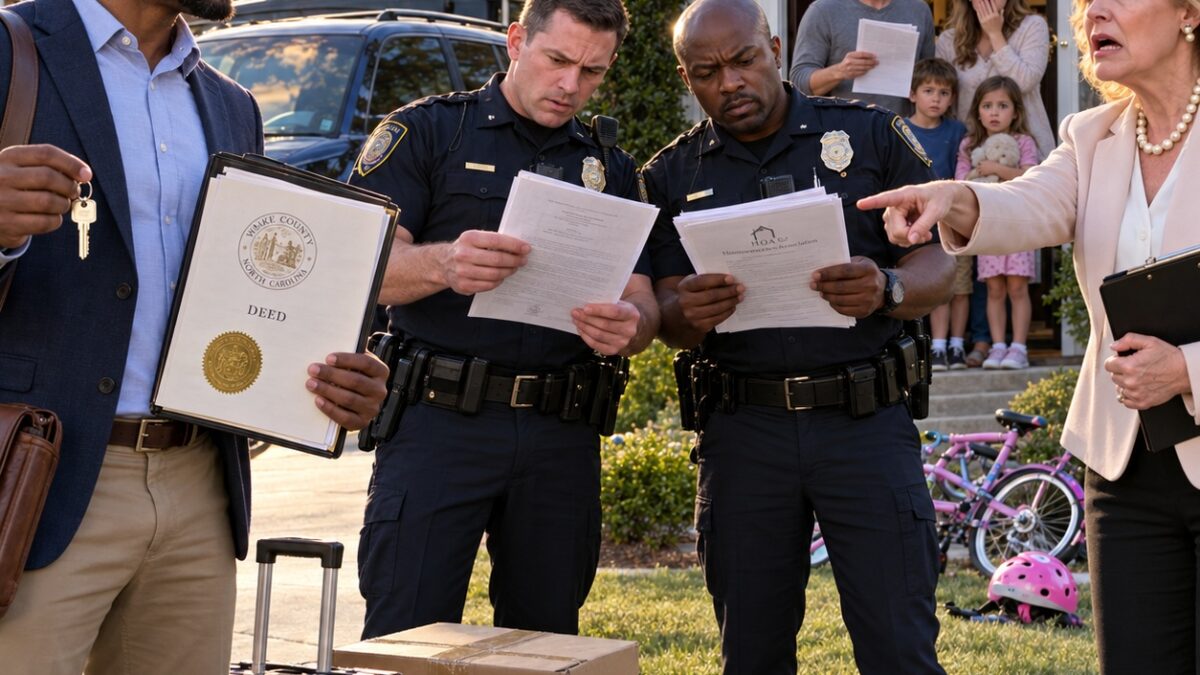
If I had to reduce the entire ordeal to one image, it would not be Susan being placed in the cruiser.
It would be Officer Hayes standing on my driveway holding two sets of documents.
Mine in one hand.
The Mitchells’ in the other.
My deed:
County seal.
Recorded instrument number.
Title company.
Verified chain.
Their packet:
HOA letterhead.
Generic paper.
False signatures.
No county record.
No legal transfer.
For weeks, Susan had built a world around those fake pages.
She convinced a family.
Moved them in.
Took their money.
Called police.
Pointed at me.
Claimed authority.
Then evidence met evidence.
Ten minutes.
That was all it took for the story to reverse.
Not because justice is always fast.
It isn’t.
The larger case took months.
Recovery took longer.
But the central lie collapsed quickly because it could not survive comparison.
That is why documentation matters.
That’s why process matters.
And that is why confidence should never be mistaken for ownership.
Susan had a clipboard.
I had the deed.
In the end, only one of those came with the house.








