FULL STORY:HOA Queen’s Son Stole and Totaled My $130,000 Audi—She Blamed Me for the Crash, but Her Own Messages Were Waiting in Discovery
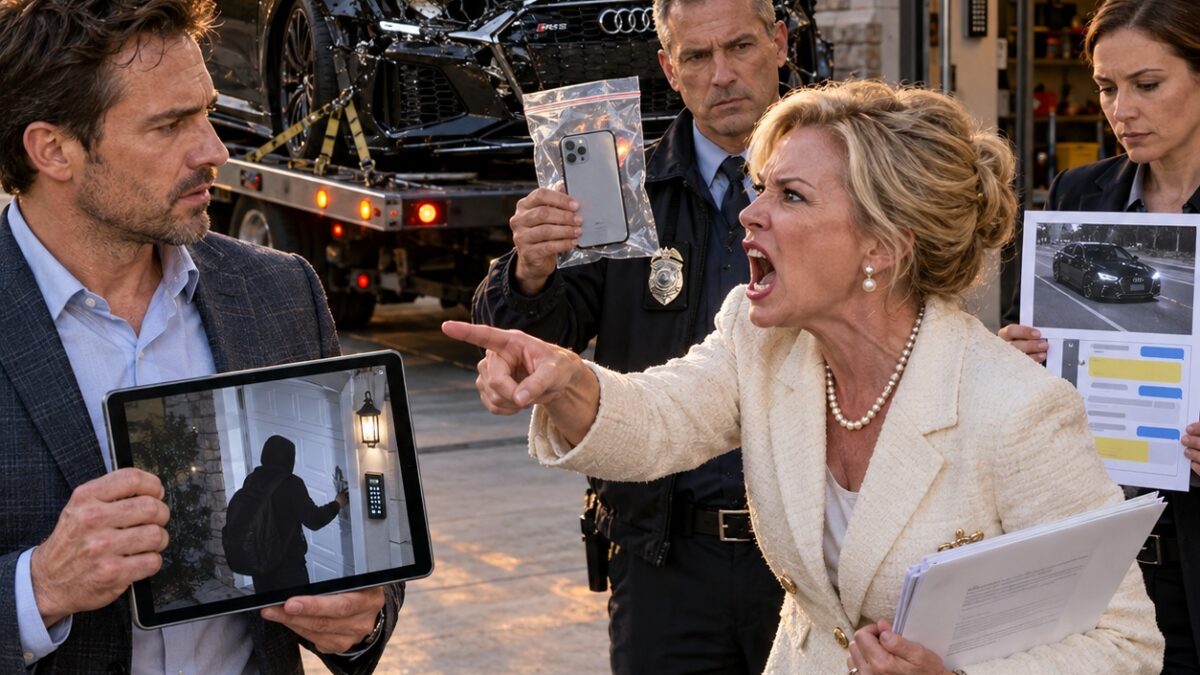
FULL STORY CONTINUATION
Brenda did not finish the call.
She barely seemed capable of holding the phone.
Her hand dropped.
Her face went white.
Then she moved.
Fast.
Not the controlled, theatrical pace she used when walking up somebody’s driveway with an HOA notice.
She shoved her chair backward hard enough that it scraped across the floor, grabbed her purse, and rushed toward the exit.
Someone called after her.
She ignored them.
I was already moving.
The meeting dissolved behind us.
“What happened?”
“Was that Kyle?”
“Whose car?”
I did not answer anybody.
I ran toward the parking lot.
My hands were shaking so badly I dropped my keys once before getting the door open.
For half a second I froze.
My car.
If the RS7 was gone, what had I driven to the meeting?
My older daily driver.
Thank God.
I got inside.
The woman who had called me had given me the location.
A highway several miles beyond our neighborhood.
Somewhere Kyle had no legitimate reason to be.
I drove there with one thought repeating in my head.
No.
No.
No.
There had to be some mistake.
Maybe the plate had been read incorrectly.
Maybe somebody was using a similar car.
Maybe the caller had misunderstood ownership.
The RS7 was locked.
Garage closed.
Key inside the house.
Kyle could have known the garage code, maybe.
But the car itself?
Then I remembered.
Keyless entry.
The key was usually kept inside a drawer near the mudroom.
Not far from the garage.
Accessible if someone knew exactly where to look.
My stomach dropped.
By the time I saw the flashing lights ahead, I already knew.
Cars slowed near the scene.
Police vehicles.
Ambulance.
A fire engine.
People standing behind a temporary barrier.
And in the middle of it all was what remained of the RS7.
I pulled over where an officer directed me.
For several seconds I could not get out.
I sat gripping the steering wheel.
Years.
That was what I saw twisted against the barrier.
Not metal.
Not an insurance value.
Years.
Overtime when everyone else went home.
Vacations I told myself I would take later.
Money put aside instead of spent.
The endless private promise that one day I would buy the car I had wanted since the first time I saw one.
Now its entire front half was destroyed.
Airbags blown.
Glass scattered.
Smoke or steam still lifting from somewhere beneath the hood.
The driver’s side looked crushed.
My knees nearly gave out.
Then I saw Kyle.
He was sitting on the curb.
Alive.
A paramedic had wrapped a blanket around his shoulders.
His face was bruised.
There was blood near his hairline.
One arm looked badly injured.
But he was conscious.
He kept staring at the ground.
I walked toward the nearest officer.
“That’s my car.”
The officer looked at me.
“You’re the registered owner?”
“Yes.”
“Were you driving?”
“No.”
I pointed at Kyle.
“He stole it.”
The officer’s expression sharpened.
“You know him?”
“He lives in my neighborhood.”
“What’s his name?”
“Kyle. His mother is our HOA president.”
The officer looked toward him.
“We’re still establishing exactly what happened.”
“My car was inside a locked garage.”
“You gave him permission to drive it?”
“No.”
“Access to it?”
“No.”
“Has he driven it before?”
“Never.”
The officer began taking notes.
“When did you last see the vehicle?”
“Before I left for the HOA meeting.”
“Approximately?”
I gave him the time.
“Any idea how he got into the house or garage?”
“The garage uses a keypad.”
“Would he know the code?”
I thought about the afternoon Brenda blocked the driveway.
The slow garage door.
The four beeps.
Kyle standing there.
“I think he watched me enter it.”
The officer looked up.
“You believe he memorized your garage code?”
“Yes.”
“And the key?”
“Inside the house near the garage.”
“House door unlocked?”
“The interior garage door sometimes is when I’m home.”
“But you were at a meeting.”
I closed my eyes.
Had I locked it?
I always thought I did.
Maybe Kyle did not need it.
Depending on proximity, the fob might have been close enough for the car system to detect.
I did not know yet.
“I have security cameras.”
That got the officer’s attention.
“Exterior?”
“Garage and entryway.”
“Don’t delete anything.”
“I won’t.”
“We’ll need copies.”
“You’ll get everything.”
Another officer joined us.
He had been talking to witnesses.
“Vehicle came through at a very high rate of speed,” he said. “Possible racing or aggressive acceleration. We have multiple calls from earlier on the route.”
“What route?”
He named roads leading farther away from our neighborhood.
Kyle had not stolen the car for one lap around the block.
He had gone driving.
Really driving.
Pushing it.
The RS7 was a serious machine.
Enough horsepower to reward somebody who knew what he was doing.
Enough to punish somebody who did not.
“Any other passengers?”
“No.”
I exhaled.
At least that.
The first officer nodded toward Kyle.
“He’s lucky.”
I looked at the wreckage.
“Yes.”
Lucky.
The word felt offensive and completely accurate at the same time.
The RS7 had sacrificed itself in a way the car magazines never talk about.
Crumple zones.
Airbags.
Engineering.
Everything I loved about the machine had become secondary to the fact that the teenager who stole it was still breathing.
Then Brenda arrived.
She abandoned her SUV crooked near the shoulder and came running.
“Kyle!”
An officer intercepted her.
“Ma’am, stay behind the line.”
“That’s my son!”
“He’s being treated.”
“What happened?”
She saw me.
The transition was instant.
Grief became rage.
“You!”
She pointed.
“This is your fault!”
Every head near us turned.
I stood there staring.
“Excuse me?”
“You gave him access to that car!”
“No, I didn’t.”
“He has talked about it for weeks!”
“That isn’t permission.”
“You knew he was obsessed with it.”
“Kyle stole my car, Brenda.”
“He is a child!”
“He is old enough to know stealing a six-figure vehicle is illegal.”
She tried moving toward me.
An officer stepped between us.
“You should never have had something like that sitting there where kids could see it.”
I almost thought I had misheard.
“Where kids could see it?”
“You knew what that car could do!”
“So did your son, apparently.”
“Don’t you dare.”
The officer raised his voice.
“Ma’am. Enough.”
Brenda turned toward him.
“He needs to be held responsible.”
The officer blinked.
“For what?”
“For leaving a dangerous vehicle accessible to minors.”
The officer’s expression changed.
Not dramatic.
Just the look of a man who had suddenly realized the conversation would require more patience than expected.
“Was the vehicle unlocked?”
Brenda opened her mouth.
I answered.
“No.”
“Was your son given a key?”
“No.”
“Was he given permission?”
“No.”
“Then we’ll investigate unauthorized use and possible theft.”
Brenda stared.
“You can’t charge him. He’s injured.”
“Those are separate issues.”
“He could have died!”
“Yes, ma’am. Which is why we’re going to determine exactly how he obtained the vehicle and what happened before the collision.”
Then one officer mentioned traffic cameras.
“We should have coverage along several parts of the route.”
Brenda went still.
It lasted maybe one second.
But I saw it.
Something about cameras frightened her.
At the time, I assumed it was because footage would prove Kyle had been speeding.
Later, I understood that she was worried about much more than speed.
Kyle was taken to the hospital.
I stayed long enough to finish an initial statement.
The RS7 was removed.
I watched the tow operator pull pieces from the road before loading what remained.
One of the headlights was sitting fifteen feet from the vehicle.
I remember that detail for some reason.
One headlight.
Perfectly designed.
Completely useless.
A metaphor if you want one.
At the hospital, Kyle’s injuries were serious but not immediately life-threatening.
He had fractures, cuts, bruising, and a concussion.
He would need significant treatment.
But he was alive.
I was grateful.
I was also furious.
Both things can exist.
People sometimes act as though anger at a teenager who nearly kills himself automatically means you wish he had been hurt worse.
I did not.
I wanted Kyle alive.
I also wanted him held accountable.
Those are not opposites.
I barely slept.
Around three in the morning I went into the garage.
The empty space where the Audi had been felt enormous.
Nothing had been stolen from the shelves.
Tools untouched.
Bicycles still hanging.
Only the car.
I reviewed the camera system.
The footage made my stomach turn.
Kyle approached the side of my house alone.
He looked around.
Entered the garage code.
The door opened.
No hesitation.
He walked directly toward the RS7.
Not curiosity.
Not spontaneous stupidity.
He had planned it.
Another angle showed him inside.
He knew where he was going.
The car lights came on.
Then the garage door opened wider.
He drove away.
Timestamp.
Clean.
Clear.
Undeniable.
I copied the footage to three separate locations.
Then I watched it again.
Kyle’s movements bothered me.
Too confident.
He was not figuring things out.
He knew the code.
Knew how to start the car.
Knew I would be away.
That last part hit me hardest.
The HOA meeting.
Brenda had insisted on it.
It had dragged longer than usual.
Kyle’s chair next to her had been empty.
Had she known?
I stopped myself.
Do not jump.
Evidence first.
I emailed the footage to the investigating officer.
Then I sat at the kitchen table until sunrise.
At 8:12 a.m., somebody knocked.
I assumed police.
Instead, a man in business clothes stood outside holding an envelope.
“Are you—”
He confirmed my name.
“You’ve been served.”
I actually laughed.
Not because I was happy.
Because there is a point where absurdity becomes physically funny.
I signed.
Closed the door.
Opened the papers.
Brenda was suing me.
Not threatening to.
Not posting on neighborhood social media.
Actual lawsuit.
She claimed my negligence had caused Kyle’s injuries.
The allegations included unsafe property practices, negligent storage of a high-performance vehicle, emotional distress, and a phrase about “attractive and enticing luxury machinery” that sounded like someone had tried to transform an Audi into an unsecured swimming pool.
She wanted medical expenses.
Damages for Kyle’s trauma.
Damages for her emotional distress.
Legal costs.
I read the complaint twice.
Then a third time because I thought I must be missing some hidden legal theory that would make it less insane.
I wasn’t.
I called my lawyer.
He answered on the fourth ring.
“Morning.”
“I’ve been sued.”
“Congratulations.”
“Brenda.”
Pause.
“The HOA Brenda?”
“Her son stole my Audi last night and totaled it.”
Longer pause.
“Start over.”
I did.
Garage code.
Theft.
Crash.
Hospital.
Police.
Then:
“She served me this morning.”
“You already have a complaint?”
“Yes.”
“That was fast.”
“Impressively.”
“Send it.”
I scanned everything.
His response came ten minutes later.
This is one of the stupidest complaints I have ever read.
I called.
“So we’re good?”
“No lawyer should ever say that on day one.”
“Understood.”
“But her facts are going to have a problem.”
“I have camera footage of Kyle entering my garage.”
“Excellent.”
“Police have it.”
“Better.”
“They also mentioned traffic cameras.”
“Even better.”
“I also think she knew something.”
Silence.
“Why?”
“Her reaction when they mentioned cameras.”
“That is not evidence.”
“I know.”
“Anything else?”
“She scheduled the HOA meeting that kept me away. Kyle was normally there. He wasn’t.”
“Still not evidence.”
“I know.”
“Good.”
He sighed.
“Do not contact her. Do not respond personally. Do not post online. Preserve every HOA email, every message, every camera file, every interaction involving Kyle and the car.”
“I already keep records.”
“I know. That’s why I like you.”
Insurance became the next problem.
The car was almost certainly a total loss.
The policy covered theft and collision circumstances, but claims take time.
There was depreciation.
Deductibles.
Questions about modifications and valuation.
I had protected the car properly.
That did not make losing it painless.
People kept saying:
“Insurance will cover it.”
As if insurance could return the exact object.
As if I had wandered into a dealership on impulse and bought something replaceable without emotional value.
Maybe that sounds materialistic.
Fine.
It was a car.
But it was also a goal.
Something I had used to mark the end of years of sacrifice.
Seeing it destroyed hurt in a way that had nothing to do with transportation.
Then Brenda’s lawsuit made it worse.
Because she was trying to transform my loss into evidence against me.
Within forty-eight hours, the police investigation began giving us the timeline.
Traffic cameras had captured the Audi.
Multiple locations.
Kyle drove away from the neighborhood.
Accelerated aggressively.
Exceeded speed limits repeatedly.
A gas-station camera showed him stopping.
He got out.
Two teenagers at the station recognized the car.
Witness statements said he bragged about it.
One said Kyle told them it was “basically his” because I “never drove it hard anyway.”
That sentence made me clench my jaw.
Another witness remembered him showing off the interior.
Then he got back on the road.
More cameras.
More speed.
The final stretch showed exactly what investigators expected.
Too much speed.
Too little experience.
Loss of control.
Barrier.
End.
No mechanical failure had been identified.
No mystery acceleration.
No evidence the car somehow seduced him into crashing.
Kyle chose speed.
The first major blow to Brenda’s lawsuit came from my own security footage.
Her attorneys received it in discovery.
Kyle entering the code.
Opening the garage.
Taking the car.
No invitation.
No accidental access.
No ambiguity.
Then police reports confirmed the vehicle had been reported as stolen or unauthorized once I learned what happened.
Brenda’s claim that I negligently “entrusted” the car to a minor became almost impossible to maintain.
But she did not stop.
That was Brenda’s defining trait.
Reality could defeat the argument.
She would simply find another one.
Her attorney amended parts of their theory.
Maybe I knew Kyle had an unusual fascination with the vehicle.
Maybe I should have changed the garage code after allowing him to see it.
Maybe owning a performance car created some special foreseeable risk.
Maybe the key should have been stored farther away.
My attorney looked at me across his conference table.
“They’re trying to turn foreseeability into permission.”
“How well is that going?”
He smiled.
“Poorly.”
Then discovery reached Brenda’s phone.
That was when everything changed.
The texts came through subpoena.
At first, many were ordinary.
HOA complaints.
Neighborhood arguments.
Messages to friends.
Then Kyle.
A message sent several days before the crash.
Kyle:
You think he’d ever let me drive it?
Brenda:
He treats that thing like a museum piece.
Kyle:
I could handle it.
Brenda:
You can barely handle my SUV.
Kyle:
I know the garage code.
There was a pause in the thread.
Then Brenda replied:
Of course you do.
Another message later:
Don’t be stupid.
On its own, that could have helped her.
A mother telling her son not to do something reckless.
Except the conversation continued.
Kyle:
He’ll be at the meeting Thursday right?
Brenda:
Everyone will if I keep the agenda full.
Kyle:
lol
Brenda:
I said don’t be stupid.
Kyle:
Just borrowing.
Brenda:
If you get caught I don’t know anything.
I read that line repeatedly.
If you get caught I don’t know anything.
My lawyer did too.
“She knew.”
“Yes.”
“She knew he was considering taking the car.”
“Yes.”
“And she intentionally kept the HOA agenda long.”
“That’s what the messages suggest.”
He leaned back.
“Her lawsuit just became very interesting.”
More texts appeared.
Brenda joking with someone else that Kyle was “obsessed with the stupid Audi.”
Another message:
Maybe if he gets one drive out of his system he’ll shut up about it.
There was no text where Brenda explicitly said:
Steal his car.
That mattered.
We kept the story honest.
She had warned Kyle not to be stupid.
But she also knew he had my garage code.
Knew he was talking about taking the Audi.
Knew I would be at the HOA meeting.
And instead of warning me, changing circumstances, or telling Kyle unequivocally that entering my garage would be theft, she joked around the edges.
After the crash, she sued me.
That was devastating to her credibility.
Then came the HOA emails.
The morning after the crash, before I had even spoken publicly about insurance, Brenda sent messages to board members.
One subject line:
COMMUNITY LIABILITY EXPOSURE.
She claimed my insurance action could “negatively implicate HOA operations.”
Why?
Because the theft occurred while I was attending an HOA meeting.
That argument was already ridiculous.
Then she suggested the board should issue compliance penalties unless I agreed to “resolve matters privately.”
My lawyer looked delighted in the way only lawyers can look delighted by ugly documents.
“This is good.”
“Good?”
“For us.”
An email from Brenda to the HOA treasurer was worse.
If he pushes insurance or criminal theft angle, hit him with every outstanding exterior violation we can document.
I stared at the screen.
“She wrote that?”
“Yes.”
“She literally documented retaliation?”
“Yes.”
“She’s been president how long?”
“Apparently too long.”
The HOA board learned about the emails through the legal process.
Their mood changed immediately.
Until then, several board members had tried to keep distance.
Private dispute between neighbors.
Teenage misconduct.
Insurance issue.
Now the president was using HOA enforcement as leverage against a homeowner pursuing a legitimate theft claim.
That implicated them.
The board suspended Brenda pending an internal investigation.
She lost access to HOA systems.
Someone else took over meetings.
The neighborhood reacted the way neighborhoods always do when authority suddenly becomes vulnerable.
People started talking.
Stories surfaced.
Fines that felt personal.
Exceptions granted to Brenda’s friends.
Odd reimbursements.
Unexplained expenses.
Theft had opened the door.
The lawsuit kicked it wider.
Now an audit began.
Brenda blamed me.
Of course.
She confronted me once near the sidewalk after her suspension.
“You’re destroying my life.”
I stopped.
“No.”
“You’re feeding the board lies.”
“Your emails are your emails.”
“You manipulated context.”
“Did I type them?”
“You know what I meant!”
“I know exactly what you wrote.”
Her eyes filled.
For half a second, she looked like a mother rather than an HOA president.
“My son could have died.”
“I know.”
“You don’t care.”
“That is not true.”
“Then drop the counterclaim.”
There it was.
The emotion had a destination.
I said:
“Kyle stole my car.”
“He made a mistake.”
“He committed a crime.”
“He is seventeen!”
“And alive.”
She flinched.
I continued more quietly.
“I am glad he’s alive. I mean that.”
She stared.
“But being injured doesn’t erase what he did.”
“He has nightmares.”
“I lost a car I worked years for.”
“A car.”
“Yes, Brenda. A car. My car. Inside my garage.”
She looked disgusted.
“You care more about money than a child.”
“No. I’m capable of caring about two facts at once. Kyle’s crash was terrible. Kyle stealing the car was wrong.”
“You caused the temptation.”
That again.
I looked at her.
“If I had a swimming pool, would breaking into my yard make drowning my fault?”
She had no answer.
“If I owned expensive jewelry, could Kyle break in and take it because he admired it?”
Nothing.
“Your son does not get permission to steal something because he wanted it badly.”
She shook her head.
“You’re heartless.”
“No. I’m done.”
I walked away.
My attorney was furious when I told him we had spoken.
“I said no contact.”
“She came to me.”
“You can still say nothing.”
“I did not say much.”
“You gave a closing argument on a sidewalk.”
“Short one.”
He pinched the bridge of his nose.
“Please let me bill you before you create more work.”
Court eventually arrived.
By then, Brenda’s original story had collapsed.
The basic facts were no longer seriously disputed.
Kyle knew the code.
Entered my garage.
Took the RS7.
Drove it without permission.
Went miles from home.
Stopped at a gas station.
Bragged.
Drove dangerously.
Crashed.
The judge listened to Brenda’s attorney attempt to preserve her negligence claims.
The argument centered on whether I had somehow created a foreseeable danger by keeping a powerful vehicle on my property after knowing Kyle admired it.
My attorney stood.
“Your Honor, admiration is not consent.”
Simple.
That line cut through everything.
He continued.
The vehicle was stored in a private residential garage.
Access required a memorized security code.
Kyle intentionally entered.
He had not been invited.
He was not authorized to use the car.
He was not given the key.
He was not entrusted with the vehicle.
He took it while I was away at a meeting.
Then he drove at extreme speeds and crashed.
The judge asked Brenda’s attorney:
“Are you asking this court to hold that an owner of lawful private property assumes liability when a minor intentionally steals that property because the minor finds it attractive?”
Silence.
The attorney tried.
“That oversimplifies—”
“It appears to simplify it accurately.”
Brenda sat rigid.
The negligence claims were dismissed.
Not gently.
The emotional-distress theories tied to my alleged negligence went with them.
The “enticing luxury machinery” language did not survive judicial scrutiny.
My counterclaims did.
Property loss.
Uninsured amounts.
Associated expenses.
Legal fees where recoverable.
And additional claims related to Brenda’s retaliatory HOA conduct.
Insurance covered a substantial portion of the RS7 loss.
Not everything.
That is how these situations work.
There were valuation disputes and gaps.
But Brenda and Kyle were ultimately held responsible for the remaining damages connected to the theft and destruction.
Kyle faced separate juvenile or criminal consequences for vehicle theft and reckless driving.
The source of this story described them broadly as charges, and that is where I leave the specifics.
I did not sit inside every proceeding.
I did not need to invent a dramatic jail sentence.
What mattered was that the crash was no longer being treated as something that happened to Kyle without cause.
His own decisions were recognized.
His age was relevant.
His injuries were relevant.
So was the theft.
Accountability does not require pretending a teenager is an adult.
It also does not require pretending a teenager has no agency.
Kyle had both consequences and support.
Mandatory counseling.
Community service.
Restitution obligations.
The kind of structured aftermath designed to make sure one catastrophic decision did not become the beginning of worse ones.
I hoped it worked.
Honestly.
I did not want Kyle ruined.
I wanted him changed.
There is a difference.
The HOA audit was less generous to Brenda.
Financial records revealed irregularities.
Expenses she had authorized did not always line up cleanly with legitimate association purposes.
Some funds had been misused.
Not millions.
Not some giant criminal empire.
Enough that the board took it seriously.
Combined with the retaliatory emails and the embarrassment of the lawsuit, Brenda’s position became impossible.
The board called a special meeting.
I attended because part of the agenda related directly to enforcement practices used against me.
The room was packed.
Brenda sat near the front but not at the president’s position.
That image alone told the story.
The vice president opened.
“There has been a motion regarding removal of the current president.”
No one needed clarification.
Discussion began.
One homeowner described years of selective enforcement.
Another complained about fines appearing immediately after disagreements with Brenda.
A third mentioned reimbursements.
Someone else brought up the email threatening to use violations against me if I pursued insurance and theft claims.
Brenda stood.
Her voice shook.
“This is a coordinated attack.”
Nobody responded.
“You are all forgetting everything I have done for this neighborhood.”
A man near the middle said:
“We remember.”
Not loudly.
Worse.
Brenda turned.
“You’ve had perfectly maintained common areas for years because I enforced standards.”
Someone else:
“This isn’t about flower beds.”
She pointed at me.
“This is about him.”
I did not move.
“He has had a vendetta against me since I enforced a trash violation.”
I almost smiled.
Of course the trash can returned.
Brenda continued.
“My son nearly died, and instead of showing compassion, this man has done everything possible to destroy our family.”
I stood only when the board chair recognized me.
I kept it short.
“Kyle’s injuries were serious, and I have never said otherwise. I am glad he survived.”
Brenda stared.
“My issue has always been simple. He entered my garage without permission, stole my vehicle, and crashed it. When I pursued the normal legal and insurance consequences of that theft, Brenda sued me and used HOA enforcement as leverage to pressure me to stop.”
I looked toward the board.
“You have the emails.”
No speech could improve on that.
The vote was unanimous.
Brenda was removed as HOA president.
No dissent.
No abstention.
Unanimous.
For a person who had built her identity around authority, the silence after the result looked heavier than shouting would have.
She gathered her papers.
For years, she had made other people stand in rooms while she explained what they had violated.
Now she stood while a board explained that she no longer represented them.
I did not cheer.
Nobody needed to.
The outcome was enough.
The audit findings produced additional financial consequences.
Restitution.
Fees.
Repayment.
Legal bills.
Brenda’s attempt to turn Kyle’s theft into my liability had exposed far more than she expected.
That was the irony.
If she had done nothing after the crash except focus on her injured son, the rest of her life might have remained intact.
Kyle still would have faced consequences.
Insurance still would have handled the car.
But Brenda might have kept her position.
Her reputation.
Perhaps even the financial irregularities would have taken longer to surface.
Instead, she sued.
She made allegations.
Litigation opened discovery.
Discovery opened messages.
Messages opened HOA emails.
HOA emails opened governance questions.
Governance questions opened the books.
One bad choice pulled the thread.
Everything attached to it came loose.
My lawyer once said:
“She should have hired counsel before filing.”
I laughed.
“She did.”
“She should have hired better counsel before filing.”
Fair.
Even good lawyers cannot rescue bad facts forever.
Brenda tried changing the story repeatedly.
First:
I had given Kyle access.
Then:
The garage was insecure.
Then:
The car itself created temptation.
Then:
The technology was too dangerous for teenagers.
Then:
I had psychologically baited him by showing off.
Then:
The lawsuit was only about medical fairness.
Every version had the same problem.
The security footage.
Kyle entering my code.
That image was impossible to argue with.
He knew he was entering property not his own.
He knew I was absent.
He drove away.
Intent is not always easy to prove.
Sometimes a camera records it walking through your garage.
Brenda hated that footage.
In deposition, she tried saying Kyle might have believed I would not mind.
My lawyer asked:
“Did Mr. — give your son permission?”
“No.”
“Had he ever allowed your son to drive the Audi?”
“No.”
“Had he ever offered?”
“No.”
“Did your son tell you he knew the garage code?”
Brenda hesitated.
“Yes.”
“Before the crash?”
“Yes.”
“Did your son discuss taking the Audi?”
“He joked.”
“Did he specifically ask whether our client would be at the HOA meeting Thursday?”
“It was not serious.”
“You answered that everyone would be there if you kept the agenda full. Correct?”
Her attorney objected.
The question was rephrased.
The text remained.
Words do not become unserious simply because their consequences turn serious later.
That was another lesson Brenda learned.
She kept insisting that Kyle had been joking.
Maybe at first.
Teenagers joke about stupid things.
Parents hear stupid things.
But once your child says:
I know the garage code.
And:
He’ll be at the meeting, right?
The joke has crossed into information you should take seriously.
At minimum, warn somebody.
Change the code.
Tell your son plainly that entering that garage is theft.
Do something.
Brenda did not.
Her failure to stop Kyle did not make her legally responsible for every movement he made.
I am careful about that distinction.
Kyle stole the car.
Kyle drove.
Kyle crashed.
His actions remained his.
But Brenda’s knowledge destroyed her attempt to portray me as the negligent adult who should have foreseen everything.
She had more warning than I did.
That was the hypocrisy.
She sued me for not anticipating the exact act she had texts suggesting she knew he was contemplating.
Once people understood that, sympathy changed direction.
Initially, neighbors saw a mother with an injured child.
Understandably.
People brought food.
Asked about Kyle.
Some believed my insurance should “just cover everything” to keep peace.
I never resented them.
They did not know the full timeline.
Once the messages surfaced, conversations shifted.
One neighbor approached me.
“I owe you an apology.”
“For what?”
“I thought you were being hard on them.”
“You were worried about a kid.”
“I still am.”
“So am I.”
He looked surprised.
“You are?”
“Kyle nearly killed himself.”
“I thought you hated him.”
“I hate what he did.”
That distinction surprised a lot of people.
The internet loves clean roles.
Villain.
Victim.
Punishment.
Real life is more uncomfortable.
Kyle did something terrible.
He also ended up on a curb bleeding and concussed.
I could be furious about my car and still feel sick imagining the call his mother received.
Brenda did terrible things afterward.
She was also a terrified parent.
Her fear explained some behavior.
It did not excuse weaponizing the HOA or filing claims without factual support.
Understanding motive is not forgiveness.
Accountability is not hatred.
I learned to hold both.
That helped me move on.
The empty garage took longer.
For weeks, I hated opening the door.
The space looked wrong.
I had built little rituals around the Audi.
Saturday washing.
Checking tire pressure.
Occasionally taking it out early when roads were quiet.
Nothing reckless.
Just enjoying the machine I had worked to buy.
Now those habits had nowhere to go.
Friends told me to replace it.
Insurance money would help.
Maybe.
I did not want another one immediately.
People assumed buying the same model would make everything normal.
It wouldn’t.
Grief over an object sounds shallow until you understand what the object represented.
The RS7 had been connected to effort.
Its destruction made that effort feel briefly wasted.
Eventually I understood it wasn’t.
The overtime paid for more than metal.
It proved I could set a ridiculous personal goal and reach it.
Kyle could destroy the car.
He could not retroactively erase the years that produced it.
That realization helped.
I kept one small item from the wreck.
Nothing dramatic.
A piece that could be safely retained after the insurance process.
I put it in a cabinet.
Not displayed.
I did not need a shrine.
Just evidence that it had existed.
Eventually, another car occupied the garage.
Not immediately.
And not because I was trying to prove anything to Brenda.
By then, she had enough problems.
The neighborhood changed after her removal.
Meetings became shorter.
That was the first miracle.
The new president apparently believed an HOA meeting should end before residents began aging visibly in their chairs.
Violation notices became less theatrical.
The board created clearer review processes.
One person could not weaponize fines as easily.
Auditors continued sorting through old financial issues.
Some questionable charges were corrected.
The entire association seemed to realize that a clipboard did not require a personality disorder.
People joked more.
Lawns survived.
Property values did not collapse because Brenda no longer patrolled trash-can lids like border security.
Her house became quieter.
For a while, she rarely came outside.
When she did, people were polite but distant.
The source story said doors closed when she approached.
That may sound melodramatic, but socially, something similar happened.
People stopped treating her as the center of neighborhood life.
Invitations disappeared.
Conversations shortened.
The authority that had once guaranteed attention was gone.
Without the title, Brenda discovered how much of her social influence had belonged to the office rather than to her.
I did not enjoy watching it.
There was something sad about it.
But it was also self-created.
Reputation is cumulative.
So is mistrust.
For years, Brenda had turned ordinary neighbor interactions into opportunities for enforcement.
Then, when she genuinely needed community support, people remembered how she had used power.
That is an expensive way to learn the difference between fear and respect.
Kyle eventually returned home.
I saw him for the first time weeks after the crash.
He moved carefully.
Still recovering.
One arm had been through significant treatment.
His face looked younger somehow.
Maybe because the swagger was gone.
He saw me across the street.
Stopped.
I stopped too.
For a second, I expected him to turn away.
He crossed over.
Slowly.
“Can I talk to you?”
I nodded.
Brenda was nowhere in sight.
Kyle stared at the ground.
“I’m sorry.”
I did not respond immediately.
He swallowed.
“For the car.”
“Yes.”
“And everything.”
I crossed my arms.
“Why did you do it?”
He looked toward the garage.
“I don’t know.”
“That isn’t true.”
He rubbed one hand over the other.
“I wanted to drive it.”
“I know.”
“I thought I could.”
“Why?”
“I’ve driven fast before.”
“In what?”
“My friend’s car. Mom’s SUV.”
“Not the same thing.”
“I know that now.”
The answer irritated me.
“Everybody knows that before wrapping an Audi around a barrier.”
He flinched.
I regretted the phrasing immediately.
Not because it was false.
Because his injuries did not need to be used as a weapon.
I exhaled.
“Did you think I’d let you?”
“No.”
“Then why take it?”
He was quiet.
Finally:
“Because I figured I’d put it back before you knew.”
There.
The childish logic beneath a very adult consequence.
Borrow without asking.
Return before discovery.
Therefore somehow not theft.
“How far were you planning to go?”
“Not that far.”
“You drove miles out of town.”
“I kept going.”
“Why?”
He looked ashamed.
“People at the gas station were impressed.”
That explained more than I expected.
Attention.
A teenager inside a car that made strangers look.
He had experienced in twenty minutes the feeling I had earned over years and mistaken possession for identity.
“You told people it was yours.”
He nodded.
“I know.”
“Why?”
Another pause.
“It felt good.”
At least that was honest.
I looked at him.
“You almost died trying to impress people who don’t care about you.”
He stared at the pavement.
“I know.”
“Your mom sued me.”
His face tightened.
“I told her not to.”
That surprised me.
“You did?”
“After I woke up properly.”
“Why?”
“Because I took it.”
I studied him.
“Did she know you were planning it?”
He looked uncomfortable.
“She knew I talked about it.”
“That’s not what I asked.”
“I don’t know what she thought.”
Fair.
I did not interrogate him.
That was for lawyers and investigators.
Kyle said:
“I have to pay restitution.”
“I know.”
“I don’t know how.”
“You work.”
His mouth twisted.
“That’s going to take forever.”
I almost laughed.
“Do you think I bought that car in an afternoon?”
He looked at me.
“No.”
“I worked for years.”
That landed harder than yelling.
Kyle nodded.
“I know.”
“No. I don’t think you did.”
Silence.
“You saw the car.”
I pointed toward myself.
“You didn’t see the overtime.”
He looked away.
“You saw something you wanted. You decided the wanting mattered more than the work behind it.”
I kept my voice quiet.
“That is the part you need to understand.”
Kyle nodded.
I do not know whether the conversation transformed him.
Real life is not that neat.
People rarely receive one speech and become better forever.
But he listened.
Before leaving, he said again:
“I’m sorry.”
This time I said:
“I believe you’re sorry.”
He looked up.
“That doesn’t erase what happened.”
“I know.”
“But it matters what you do next.”
He nodded.
Then went home.
I never became his mentor.
Did not hire him.
Did not create some sentimental redemption subplot.
He had parents, counselors, court requirements, school, and his own life.
My role was simpler.
Victim of his theft.
Neighbor.
Occasionally the person he had to face and remember why restitution existed.
That was enough.
Brenda and I never had the same conversation.
She remained convinced for a long time that she had been persecuted.
When consequences accumulated, she described them as coordinated retaliation.
Lawsuit dismissed?
Biased judge.
Counterclaim?
Vindictive lawyer.
HOA removal?
Disloyal board.
Audit?
Political attack.
Kyle’s charges?
Authorities making an example of him.
There is comfort in a worldview where every consequence is persecution.
You never need to change.
Only survive enemies.
I think Brenda lived there.
That fantasy world was what had frightened me from the beginning.
Before the crash, it merely produced annoying HOA rules.
After the crash, it nearly made me financially responsible for the crime committed against me.
That was when fantasy became dangerous.
The legal system eventually forced facts back into the center.
Security footage.
Camera timestamps.
Police reports.
Speed data.
Texts.
Emails.
Financial records.
Brenda could interpret motives however she wanted.
Documents remained documents.
The settlement and judgments did not repair my car.
They did restore the basic narrative.
I had not caused the crash.
I had not entrusted Kyle with the car.
I had not enticed him in any legally meaningful sense.
Kyle took it.
Kyle drove recklessly.
Brenda’s attempt to punish me for pursuing legitimate claims was improper.
The board’s audit found separate misuse issues.
Facts.
Once those were established, I stopped needing Brenda to agree.
That was freeing.
People waste extraordinary energy trying to make unreasonable people admit they are unreasonable.
Sometimes they never will.
You can still win the practical conflict.
You do not need their confession.
You need boundaries.
Records.
Consequences.
Then distance.
My lawyer understood that.
After the final major hearing, I said:
“She still thinks this is my fault.”
He closed his file.
“So?”
I looked at him.
“So?”
“Do you need her agreement to buy groceries?”
“No.”
“To insure your next car?”
“No.”
“To live in your house?”
“No.”
“Then stop litigating inside your own head.”
Annoying man.
Correct.
That sentence helped.
I stopped replaying driveway arguments with imaginary better answers.
Stopped fantasizing about one sentence that would finally make Brenda understand.
No sentence could.
Her worldview had been built specifically to prevent that.
Instead, I looked at outcomes.
Suit dismissed.
Counterclaims successful.
Insurance resolved most of the vehicle loss.
Additional liability placed where it belonged.
Kyle under legal consequences.
Brenda removed.
HOA audit.
Misused funds uncovered.
Restitution.
Reforms.
That was closure whether Brenda emotionally accepted it or not.
One Saturday, several months later, I was cleaning the garage.
The new vehicle—much more ordinary—sat outside.
A neighbor stopped.
“You miss the Audi?”
I looked at the empty space where it had once lived.
“Yes.”
“You getting another?”
“Eventually.”
He nodded.
Then:
“I never told you this, but Kyle used to talk about that car all the time.”
“I know.”
“He told some kids he was going to drive it.”
I stopped.
“When?”
“Before the crash. I thought he was joking.”
“So did everyone.”
He looked guilty.
“Should I have told you?”
Maybe.
But blaming every adult who heard teenage bragging would become its own form of hindsight fantasy.
“You didn’t know he had the code.”
“No.”
“Then no.”
He nodded.
“I still feel bad.”
“Brenda knew more.”
He did not answer.
By then, the texts were not secret.
The neighborhood knew enough.
That conversation reminded me how easy it is to reconstruct danger afterward.
Every strange question becomes a warning.
Every lingering look.
Every joke.
Before the event, they are ambiguous.
After, obvious.
I had done it too.
Kyle watching the keypad.
Kyle asking about keyless access.
Garage alarms.
Code resets.
In hindsight, it looked like a checklist.
At the time, I thought:
Teenager likes car.
That is why I resisted Brenda’s argument that I should have foreseen the theft.
Yes, I noticed his interest.
No, interest alone did not reasonably require me to treat a neighbor’s son as a burglar.
Neighborhoods require some baseline trust or everyone ends up living inside a bunker.
Kyle violated that trust.
The answer was accountability.
Not rewriting normal life so every admiration becomes probable cause.
I did change the garage code afterward.
Obviously.
I upgraded the cameras.
Added an interior lock routine.
Moved car keys farther from the garage.
Those were reasonable improvements after experience.
Doing them did not mean I had been negligent before.
People often confuse:
You can make something safer.
With:
It was legally unsafe before.
Not the same.
My garage had been closed.
The vehicle locked.
No permission given.
Kyle intentionally defeated the boundary by memorizing the code.
Security can always improve.
Responsibility for bypassing it still belongs to the person doing the bypassing.
That principle mattered to me.
Otherwise every theft becomes:
Why wasn’t the victim harder to steal from?
Why didn’t the shop have stronger glass?
Why wasn’t the bicycle chained twice?
Why did the homeowner have valuables?
There is a place for reasonable precautions.
There is also a point where victim-blaming becomes absurd.
Brenda sprinted past that point.
Her lawsuit tried to make ownership itself negligent.
You owned a powerful car.
A teenager wanted it.
Therefore you caused the crash.
No.
The court saw through it.
So did almost everyone else eventually.
The financial consequences piled up for Brenda.
Legal fees.
Restitution connected to HOA findings.
Her own attorney costs.
Loss of status.
The story damaged her socially.
I never kept a running total.
I did not need one.
The source says her reputation collapsed faster than my engine had.
That is dramatic language.
But there was truth inside it.
Before the crash, Brenda could stand in a room and everyone listened because she was president.
Afterward, people fact-checked her.
That is a brutal loss for someone whose authority depended on unquestioned confidence.
A neighbor once described it perfectly.
“Before, Brenda would tell you something and you’d assume there was a rule somewhere. Now everybody asks her to show them the rule.”
That was probably the healthiest change in the neighborhood.
Show me.
Not because every authority figure lies.
Because legitimate authority can survive verification.
Brenda hated verification.
That should have told us something earlier.
The new HOA board published clearer policies.
Fines required documented review.
Conflicts of interest had disclosure procedures.
Financial approvals required more than one signature in certain situations.
The board separated complaint intake from final enforcement decisions more carefully.
Boring reforms.
Good reforms.
The kind nobody cares about until one person demonstrates why checks exist.
I never ran for the board.
Several people asked.
Absolutely not.
After months of Brenda, the last thing I wanted was a clipboard.
I preferred paying my dues, following legitimate rules, and living my life.
That was the irony.
I was never anti-HOA.
I was anti-Brenda using the HOA as her personal extension.
A well-run association can coordinate shared expenses and common property.
A badly run one can become a personality with a bank account.
Ours had gotten too close to the second.
The audit pushed it back.
I was glad.
Kyle’s restitution payments began small.
That made sense.
He was young.
No significant income.
The obligation was partly financial and partly symbolic.
You destroyed something.
You contribute toward making the victim whole.
The first check arrived through the formal process.
I stared at it.
The amount was almost laughably small compared with the RS7.
But I respected it more than I expected.
Not because the money mattered that month.
Because consequences had become tangible.
A few weeks later, I saw Kyle working at a local business.
Not glamorous.
Exactly the sort of job teenagers do.
He noticed me.
Looked embarrassed.
I nodded.
He nodded back.
That was all.
I liked that ending for him better than public shame.
Work.
Payment.
Counseling.
Time.
Maybe years later he would remember the crash as the worst decision of his adolescence rather than the beginning of a criminal identity.
I hoped so.
He had been stupid.
Dangerously stupid.
That did not mean he had to remain stupid forever.
Brenda’s consequences were different because she was an adult.
She knew better.
She did not steal the car herself, based on the facts available.
I never claimed she did.
But once it happened, she had choices.
Focus on Kyle.
Cooperate with police.
Accept insurance and criminal processes.
Apologize for anything she knew beforehand.
Instead, she attacked.
Sue the victim.
Threaten HOA fines.
Manipulate the board.
That escalation was hers.
Adults do not get teenage leniency for deliberate retaliation.
That was why I could forgive parts of Kyle’s behavior sooner than hers.
He acted from impulse, ego, and immaturity.
She acted from control.
Both harmful.
Different.
I replaced the Audi almost a year later.
Another RS7.
People assume I did it as a statement.
A giant middle finger to Brenda.
Maybe a tiny part of me enjoyed the symbolism.
Mostly, I bought it because I still loved the car.
Kyle had already stolen enough from me.
I was not going to let the crash permanently remove something I had wanted simply because owning it reminded me of what happened.
When the new one arrived, I did not announce it.
No gathering.
No social-media post.
I drove it home.
Pulled into the garage.
Closed the door.
Changed the code again because paranoia has practical benefits.
Then I stood there.
Same shape.
Same low stance.
Different car.
For a moment, the memory of the wreck came back.
Barrier.
Smoke.
Glass.
Kyle on the curb.
Brenda screaming.
I put one hand on the roof.
Then I walked inside.
Later that week, I took it out early on a Sunday.
Empty roads.
No racing.
No proving anything.
Just driving.
The engine sounded exactly the way I remembered.
For the first time, the car stopped being connected only to theft.
It became mine again.
That mattered.
A neighbor saw it when I returned.
His eyes widened.
“You actually bought another one.”
“Yes.”
“Brenda seen it?”
“I don’t know.”
“You hope she does.”
I smiled.
“I hope she learns to mind her own business.”
He laughed.
That was enough.
Brenda eventually did see it.
I know because she was walking toward her mailbox when I pulled in.
She stopped.
Looked at the car.
Looked at me.
There were a thousand things either of us could have said.
She said none.
I said none.
I opened the garage.
Drove inside.
Entered a new code she had never seen.
Door closed.
That might have been the cleanest ending possible.
No confrontation.
No victory speech.
A boundary.
My car.
My garage.
My life.
The neighborhood eventually stopped talking about the crash every week.
Other dramas replaced it.
A fence dispute.
Somebody’s contractor parking in the wrong place.
A dog escaping repeatedly.
Normal problems.
Good.
I wanted normal problems.
There is peace in being annoyed by something small again.
For months, every knock at the door had carried legal anxiety.
Every HOA email made my stomach tighten.
Then one day an email arrived about landscaping schedules and I realized I had not felt anything.
Progress.
Brenda no longer dominated the board.
The new president was less theatrical.
Meetings actually had time limits.
Kyle gradually disappeared back into the ordinary life of school, work, court requirements, and recovery.
My insurance case closed.
The lawsuits closed.
Restitution schedules continued.
The audit concluded.
Everything that had felt enormous became paperwork stored somewhere.
That is how life heals.
Not through one dramatic moment.
Through the number of days after the dramatic moment continuing to increase.
One month.
Three.
Six.
A year.
The crash becomes:
Remember when.
The lawsuit becomes:
That file.
The empty garage fills.
Your body stops expecting conflict.
Peace sneaks back in.
I sometimes think about the exact second I entered the garage code with Kyle standing nearby.
Four beeps.
Nothing happened.
That is the cruelest thing about hindsight.
The important moment often does not feel important while it is occurring.
Had dramatic music played, perhaps I would have covered the keypad.
Changed the code later.
Asked why he was standing so close.
But life gives no soundtrack.
A neighbor’s kid stood beside his mother.
I entered my own garage.
Normal.
Then it wasn’t.
I refuse to blame myself for not predicting the abnormal.
I learned from it.
That is enough.
The second thing I think about is Brenda’s reaction when the officer mentioned traffic cameras.
That tiny freeze.
At the time, I noticed without understanding.
Later, after the texts surfaced, it made sense.
She knew enough to know cameras could build a timeline.
Maybe she did not know exactly how far Kyle planned to go.
Maybe she thought he would make one lap.
Maybe she believed he would not actually do it.
The messages never proved she ordered the theft.
I will not claim they did.
What they proved was uncomfortable enough.
She had warning.
She knew the garage-code issue.
She knew he was talking about “borrowing” the Audi.
She knew I would be at the meeting.
And when everything went wrong, she tried making me responsible instead.
That is the betrayal at the center of the story.
Not simply Kyle stealing the car.
Brenda trying to convert her own failure to intervene into my negligence.
That is what made me fight.
Had she arrived at the crash scene and said:
“I am so sorry.”
Had she focused on Kyle.
Had she let police and insurance do their work.
I would still have been angry.
There still would have been consequences.
But there might have been humanity between us.
Instead:
You caused this.
That sentence ended any chance of quiet resolution.
Then the process server arrived.
Some people cannot tolerate guilt, so they turn it outward.
If everything is someone else’s fault, you never have to ask what you could have done differently.
Brenda became excellent at that.
The lawsuit was guilt converted into paperwork.
The court returned it to sender.
I wish I could say the experience made me perfectly wise about possessions.
It didn’t.
I still like cars.
Still admire engineering.
Still enjoy owning something beautiful after working for it.
The lesson was never:
Material objects do not matter.
They matter as much as the meaning we attach to them.
Just not more than people.
When I saw Kyle alive, I was relieved before I was angry.
That tells me my priorities were fine.
When I saw my destroyed RS7, I was devastated.
That also does not make me immoral.
Human beings can value life and still mourn what was taken.
Brenda tried using one against the other.
How can you care about a car when my son is hurt?
Because both events happened.
Your son can deserve medical care.
I can deserve compensation.
He can deserve compassion.
He can also deserve consequences.
Life is not a courtroom argument where acknowledging one fact requires deleting another.
That may be the biggest thing I learned.
I no longer needed simple villains or perfect victims.
Kyle was reckless and injured.
Brenda was terrified and retaliatory.
I was wronged and angry.
The HOA was badly governed and still capable of reform.
The insurance company was frustrating and necessary.
The police were procedural and helpful.
The court was slow and ultimately clear.
Real life is made of overlapping truths.
The outcome can still be satisfying.
Brenda lost the control she had worshipped.
Not because I destroyed her.
Because her own choices made that control impossible to trust.
Kyle learned that security codes are not magic spells erasing ownership.
A garage opening does not mean permission.
A keyless ignition responding does not mean the car belongs to you.
Technology can make theft easier.
It cannot make theft innocent.
The HOA learned that leadership without oversight becomes dangerous.
Neighbors learned that complaints can be questioned.
I learned to cover the damn keypad.
Everybody got an education.
Some more expensive than others.
A year after the crash, I attended an HOA meeting.
Voluntarily.
That alone proved things had changed.
The new president moved through the agenda efficiently.
Budget.
Landscaping.
Security lighting.
No twenty-minute monologue on decorative gravel.
Near the end, someone raised a question about garage security.
A few people looked at me.
I looked at the ceiling.
The president said:
“We’re considering offering optional code-change assistance and reminders.”
Optional.
That word mattered.
No mandate.
No fines.
No theatrical enforcement.
Someone asked whether the HOA would require cameras.
“No.”
Another:
“Can residents use any compatible system?”
“Yes.”
I almost applauded.
Functional governance.
What a concept.
Afterward, an older neighbor stopped me.
“Good meeting?”
“Shockingly.”
He smiled.
“You miss Brenda?”
I looked at him.
He laughed before I answered.
Outside, I walked back home.
My RS7 sat inside the garage.
Invisible from the street.
Not because Brenda had taught me shame.
Because I liked having it secured.
The house was quiet.
No legal documents on the counter.
No process server.
No angry mother in the driveway.
I opened the garage from inside.
The car looked back at me the way cars do when people project feelings onto machines.
I remembered the first one.
Then closed the door.
Peace does not roar like an engine.
That is true.
It is quieter.
It sounds like nothing happening.
No phone call.
No crash alert.
No lawsuit.
No emergency board meeting.
No police lights.
No one screaming that your property became their tragedy because you dared to own it.
Just ordinary life.
I once thought the RS7 would be the reward at the end of years of hard work.
I was partly right.
The first car was a reward.
Then it became a lesson I never wanted.
The second one felt different.
Less like proof.
More like reclaiming choice.
Kyle had chosen to take the first.
Brenda had tried to choose how I would respond.
The court tried to determine who would pay.
The HOA chose to remove her.
Eventually, I got to choose again.
That was the part I valued.
Choice.
I could buy another one.
Or not.
I could forgive Kyle partly.
Or keep distance.
I could attend HOA meetings.
Or skip them.
I could stop caring what Brenda believed.
That last choice was the best.
The final time she tried to speak to me about the case, long after the major rulings, she caught me near the driveway.
“You got what you wanted.”
I looked at her.
“What did I want?”
“Me removed.”
“No.”
She laughed bitterly.
“Don’t pretend.”
“I wanted my car not stolen.”
Her face changed.
“I wanted your son not to crash it.”
Silence.
“I wanted you not to sue me.”
She looked away.
“I wanted the HOA not used to threaten me for reporting a theft.”
Nothing.
“Almost everything I wanted was incredibly boring, Brenda.”
Her eyes watered.
“You hate me.”
“No.”
She looked surprised.
“I don’t trust you.”
That was different.
“I don’t think about you enough to hate you.”
Cruel perhaps.
True.
She stepped backward.
I said:
“I hope Kyle turns out okay.”
Her face softened involuntarily.
“He’s trying.”
“Good.”
Then I went inside.
That was our last meaningful conversation.
No victory.
No applause.
I meant what I said about Kyle.
He had time.
A terrible mistake at seventeen did not have to define sixty years.
Brenda also had time, though whether she used it differently was not my concern.
Her presidency was gone.
Financial consequences remained.
Community trust was damaged.
She could decide what kind of person existed after that.
Not my job.
There is freedom in realizing accountability and revenge are not the same.
Accountability has an endpoint.
The debt is defined.
The court rules.
The position is lost.
The payment schedule exists.
You can go home.
Revenge asks you to keep going.
Watch suffering.
Measure humiliation.
Seek another loss.
I did not want that.
I had already lost enough.
So I stopped.
The new Audi did not need Brenda to see it.
Kyle did not need me to punish him every time we crossed paths.
The HOA did not need me becoming its new tyrant.
I wanted my life back.
I took it.
People still tell the story wrong sometimes.
They say:
“Remember when Brenda’s kid borrowed your Audi?”
Stole.
He stole it.
Words matter.
Or:
“Remember when your car made that kid crash?”
No.
A driver crashed a car he took without permission.
Or:
“Brenda lost everything because of you.”
Also no.
Brenda lost authority because her own emails, litigation choices, and financial conduct became evidence.
I defended myself.
That is not the same as destroying someone.
Victims are not responsible for consequences created when they report what happened.
That may be the final lesson.
Brenda’s first accusation contained the whole problem.
You caused this.
No.
Sometimes people cause their own consequences.
Kyle caused the crash through theft and reckless driving.
Brenda caused the lawsuit disaster by filing claims contradicted by evidence.
She caused her HOA collapse by using association power as retaliation and mishandling its trust.
Auditors caused nothing by finding records.
Courts caused nothing by reading them.
Police caused nothing by documenting the theft.
I caused nothing by keeping camera footage.
Evidence is not the cause of misconduct.
It is the reason misconduct becomes difficult to deny.
I think about that whenever someone says I went too far.
What should I have done?
Deleted the garage video because Kyle was hurt?
Ignored traffic cameras because Brenda was scared?
Dropped the insurance claim because she threatened fines?
Paid her son’s bills because he happened to survive stealing my car?
Allowed HOA retaliation because fighting it embarrassed her?
No.
Compassion does not require surrendering reality.
I could hope Kyle healed.
And still tell the truth.
That is exactly what I did.
The neighborhood eventually forgot the details.
New families moved in.
Kids who had watched the first RS7 arrive grew older.
Some probably remember only that there was once a spectacular crash involving a neighbor’s car.
That is fine.
Stories shrink.
The people inside them move on.
My garage code has changed several times since.
I shield it automatically now.
Habit.
Maybe a little trauma.
The second RS7 remains beautiful.
I drive it.
I do not keep it hidden like a museum piece, despite Brenda’s old message.
Sometimes I take it out on quiet roads and enjoy what it was built to do within the law.
I no longer feel guilty about that.
A machine does not become dangerous because someone once misused another one.
Ownership does not become irresponsible because theft happened once.
Fear does not get to redefine the rest of my life.
The first Audi ended against a barrier.
That was its ending.
Mine continued.
Kyle’s continued.
Even Brenda’s continued.
The HOA continued.
That is what people forget when they want stories to end at judgment.
Life keeps going after consequences.
The interesting question is what everyone builds afterward.
I built peace.
The board built better oversight.
Kyle, I hope, built judgment.
Brenda—
I do not know.
And I am finally comfortable not knowing.
Some mornings I open the garage before work.
Sunlight reaches the car.
For half a second, I remember the first day neighbors gathered around the original.
Phones out.
Kids circling.
Kyle staring.
Brenda standing behind him.
If I could go back, would I hide the car?
No.
Would I shield the garage code?
Absolutely.
Would I change anything else?
Maybe I would trust my uneasiness around Kyle’s questions earlier.
But I refuse to rewrite myself into someone responsible for his theft simply because hindsight makes warning signs brighter.
I was allowed to own something beautiful.
Allowed to park it on my own property.
Allowed to assume my neighbors would not steal it.
Those are normal expectations.
Kyle broke them.
Brenda tried to punish me for having them.
Neither succeeded permanently.
The car was lost.
But the story she tried to write about it was not.
That belonged to evidence.
And evidence told the truth.
Kyle entered my garage.
Kyle took the Audi.
Kyle drove away.
Kyle lost control.
Brenda knew more about his obsession than she initially admitted.
Brenda sued me anyway.
Her own messages surfaced.
Her own HOA emails surfaced.
The board investigated.
The court dismissed her claims.
The audit found more problems.
Consequences followed.
Nothing supernatural.
No brilliant trap.
No secret revenge switch.
Just the slow, heavy machinery of documentation catching up with people who thought confidence could outrun facts.
That is why the final image I remember most is not the wreck.
Not anymore.
It is my driveway months later.
Quiet.
No Brenda.
No lawyers.
No tow truck.
No police.
The garage closed.
My home peaceful.
For years, I thought success would sound like an RS7 engine starting.
After everything that happened, I learned success could sound like something else.
Silence.
The kind that means nobody is stealing from you.
Nobody is suing you for being stolen from.
Nobody is weaponizing an HOA because you refuse to lie down and accept blame.
Just a quiet driveway.
A closed garage.
A life that belongs to you again.
And somewhere behind that door, a car I chose for myself—
not a trophy Brenda could control,
not a temptation Kyle could claim,
not evidence in somebody else’s fantasy—
just mine.








