FULL STORY:HOA Queen Weaponized Police Over My Legal Propane Tank to Grab a Fuel Corridor Across 86 Acres—$6.1 Million Was Already Riding on Her Story
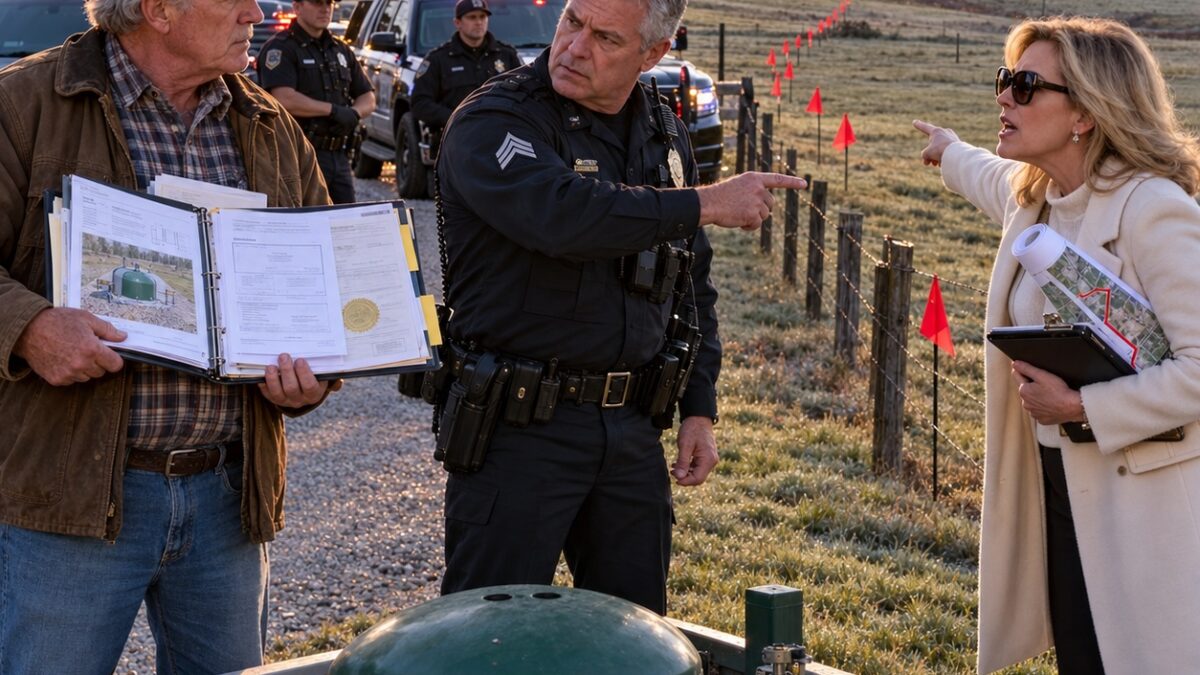
FULL STORY CONTINUATION
Patricia stepped forward immediately.
“Because there is.”
Sergeant Cole held up one hand.
“Ma’am, let me finish.”
She stopped.
That alone was unusual.
For as long as I had known Patricia Holloway, interruption was usually something she did to other people.
She was president of the Cedar Ridge Community Association, and she carried herself like the title expanded beyond the subdivision map whenever she needed it to.
My property had never been part of Cedar Ridge.
Not one acre.
I paid no dues.
Signed no declaration.
Used no association roads except the public ones everyone used.
My house sat on private land that existed long before the development.
Yet Patricia behaved as if proximity created jurisdiction.
Now she had escalated from laminated HOA notices to police cruisers.
Sergeant Cole looked toward the propane enclosure.
“Who reported the emergency?”
“The Cedar Ridge Community Association.”
“You personally called dispatch?”
“I called on behalf of the association.”
“What exactly did you report?”
“A potentially unauthorized fuel-storage installation affecting residential safety and a regional infrastructure project.”
There it was.
Regional infrastructure project.
Sergeant Cole looked at me.
“Do you have the installation permit?”
I handed him the folder Daniel had prepared.
He opened it.
Original county permit.
Licensed installer.
Inspection record.
Service invoices.
Diagram.
He turned a few pages.
“This is the same system currently in the ground?”
“Yes.”
“Modified?”
“No.”
“Moved?”
“No.”
“Any leak?”
“No.”
“Any recent service issue?”
“No.”
He handed the papers to another officer.
Patricia said:
“You’re missing the larger issue.”
Sergeant Cole looked at her.
“What larger issue?”
“The location of the tank interferes with proposed emergency fuel access.”
I almost smiled.
She had spent weeks calling my propane the hazard.
Now, standing in front of officers, she had finally admitted the tank mattered because somebody wanted the land around it.
Sergeant Cole noticed too.
“Emergency access for what?”
“A regional distribution project.”
“Who owns the property?”
“That’s complicated.”
“No,” Sergeant Cole said. “It isn’t.”
Patricia’s jaw tightened.
“Cedar Ridge has historical authority over that corridor.”
“Recorded easement?”
She hesitated.
“We have access documentation.”
“Recorded where?”
“Our attorney has it.”
“Do you have it with you?”
“No.”
He looked at me.
“Mr. Mercer, have you authorized construction?”
“No.”
“Survey access?”
“No.”
“Temporary entry?”
“No.”
Patricia interrupted.
“He was informed.”
Sergeant Cole turned.
“Being informed isn’t permission.”
That changed the mood.
Patricia had expected uniforms to make me defensive.
Instead, the oldest officer in the driveway was asking her for the same thing I had asked from the beginning.
Authority.
She pointed toward the tank.
“The emergency fuel system depends on that property.”
Sergeant Cole looked at her carefully.
“Then you should probably stop treating the property owner like the problem.”
Nobody spoke.
A younger officer looked down to hide what might have been a smile.
Patricia stared at Sergeant Cole.
“This affects thousands of people.”
“Then it deserves proper documentation.”
She turned toward me.
“You’ve just made this much bigger.”
I said:
“You made it bigger when you called the police.”
She got into the white SUV.
Drove away.
The officers remained long enough to document the complaint and verify there was no immediate propane emergency.
Sergeant Cole returned my folder.
“I don’t see anything here requiring law-enforcement action against you.”
“Thank you.”
He glanced west toward the flagged pasture.
“If somebody tries construction without your permission, call us before confronting equipment.”
“I will.”
He started walking away.
Then turned back.
“One more thing.”
“Yes?”
“If this really is tied to an emergency fuel project, the call may trigger another review.”
“Why?”
“Dispatch used infrastructure-hazard language.”
He shrugged.
“Different departments get notified automatically.”
At the time, I thought that was a bureaucratic detail.
One hour later, Daniel called.
“Frank.”
“Yes?”
“Sergeant Cole wasn’t kidding.”
“What happened?”
“Patricia’s police report hit county emergency management.”
I stood in my kitchen.
“And?”
“They pulled the regional fuel plan.”
“Is that bad for me?”
“No.”
Pause.
“It could be very bad for Patricia.”
Daniel told me to meet him at the county records building.
When I arrived, Ethan was already there with his laptop.
A woman named Sarah Cole stood beside him.
No relation to Sergeant Cole.
She worked for county emergency management and had spent nearly fifteen years around regional infrastructure planning.
A large map covered the table.
Three major fuel-storage sites.
Multiple routes.
Colored lines.
One crossed my western property.
But it was not labeled as a new Blue Valley propane spur.
REGIONAL EMERGENCY FUEL DIVERSION ROUTE.
Sarah pointed.
“This is the original network.”
“How old?”
“Parts date back more than twenty years.”
Daniel slid another document toward me.
A county emergency plan.
Old.
Marked with handwritten notes.
Beside my parcel was a sentence:
DO NOT ALTER PRIVATE FUEL ACCESS WITHOUT OWNER CONSENT.
Underneath was the signature of the engineer who originally designed the county’s emergency fuel contingency system.
That had been the document Daniel found the night before Patricia called police.
Now Sarah had the full archive.
She zoomed in on the northern end.
A transfer station appeared.
“What’s that?”
“Old emergency transfer facility.”
“Operating?”
“Officially closed in 2008.”
“Officially?”
She opened a decommissioning report.
“Most of it was taken offline.”
“Most?”
“One buried transfer line remained connected.”
Ethan leaned closer.
Sarah continued.
“The line was designed to redirect fuel between storage sites if one terminal became inaccessible.”
“So Blue Valley isn’t actually creating everything from scratch.”
“No.”
“They’re trying to reconnect to an old emergency network.”
“Yes.”
Daniel looked at me.
“And the only surviving route between the southern and northern sections crosses your land.”
That explained urgency.
Not deception.
Not yet.
A legitimate emergency network could still require private property.
There are lawful ways to handle that.
Negotiation.
Recorded easement.
Condemnation proceedings where legally available.
Compensation.
Formal emergency authority where appropriate.
What did not belong on that list was:
Invent propane violations until the landowner stops resisting.
I asked:
“Why did Blue Valley file it as a commercial distribution spur?”
Sarah looked uncomfortable.
“That’s something we’re reviewing.”
The visible project was commercial.
The underlying connection had emergency value.
Two overlapping purposes.
One application that had not clearly explained both.
Then Ethan noticed another discrepancy.
He compared Blue Valley’s public engineering diagram with a more detailed submission.
“Wait.”
He rotated the screen.
“What?”
“The temporary route and permanent route are different.”
“How?”
He pointed.
The survey flags Patricia had placed across my pasture followed a construction corridor.
The permanent valve station sat almost nine hundred feet farther south.
Right beside an old concrete structure I had ignored for years.
I knew it.
Small.
Weathered.
Half hidden by brush.
I had always assumed it was an abandoned irrigation shed.
Sarah entered the coordinates.
Her expression changed.
“That’s not irrigation.”
“What is it?”
She hesitated.
“Emergency isolation vault.”
I stared.
“On my property?”
“Yes.”
“What does it isolate?”
She pulled up the asset inventory.
Regional bypass equipment.
County emergency infrastructure located on Mercer parcel.
The county retained operational authority over the equipment.
The land underneath remained privately owned.
Mine.
I leaned back.
“I’ve owned this place almost eleven years.”
Sarah nodded.
“Contingency assets aren’t always shown on public utility maps.”
“Why?”
“Security. Also because many are dormant unless needed.”
“Patricia knew?”
Daniel answered.
“Looks like she knew enough.”
I looked at the map.
“So they don’t merely want to cross my property.”
“They want access to an emergency control point.”
“Yes.”
“And she turned my propane tank into a safety complaint because—”
Sarah gave a tired smile.
“Because your tank was the easiest visible fuel system to point at.”
That sentence clarified everything.
They had not discovered a propane hazard.
They needed leverage near a corridor.
My tank gave Patricia a story.
Unsafe fuel.
Community danger.
Emergency access.
Once those phrases were connected, she could pressure me while pretending the dispute had started with safety rather than land.
Daniel requested the full Blue Valley project file.
Two hours later, we received the engineering package.
Capacity estimates.
Valve designs.
Pressure calculations.
Construction schedule.
Environmental notes.
Then finances.
Blue Valley Energy had already committed more than $3.4 million.
North Ridge Communities had committed another $2.7 million because the planned emergency storage facility would also support future development.
$6.1 million already riding on the project.
I stared at Daniel.
“They committed that before getting my signature?”
“Yes.”
“Bold.”
“Or stupid.”
Then Sarah pointed at another entry.
Cedar Ridge Community Association.
Corridor Coordination Fee.
$780,000.
Daniel stopped.
“What exactly is corridor coordination?”
Sarah shook her head.
“It isn’t a county term.”
Ethan scrolled.
More payments.
$240,000.
$185,000.
$92,500.
Descriptions:
Infrastructure coordination.
Emergency planning.
Corridor administration.
But the recipient was not Cedar Ridge itself.
Cedar Infrastructure Solutions.
Daniel opened the state corporate registry.
He stared at the screen.
Then looked at me.
“Guess who owns it.”
I did not have to.
“Patricia’s brother.”
Daniel nodded.
Sarah folded her arms.
“More than half a million dollars to a family-connected company?”
“Just over $517,000 from what we can see so far.”
I did not feel the explosion of anger people might expect.
I felt relief.
Not because anything was good.
Because the chaos finally had a shape.
The propane tank was not the issue.
The corridor was.
The corridor had money behind it.
Patricia had treated my land like a missing signature she could work around.
And her family had a financial connection to the project.
That did not prove every payment was improper.
Daniel said that immediately.
“Related-party payment is not automatically illegal.”
“I know.”
“We need board authorization, invoices, services, disclosure.”
“I know.”
“But it explains motive.”
“Yes.”
He searched HOA minutes.
Fourteen months earlier:
President Holloway recommends continuing administrative coordination of Western Emergency Corridor until permanent access structure is finalized.
No parcel number.
No dollar amount.
No attachment.
No vote specifically authorizing the HOA to sell access across my land.
Then a note from the association attorney:
Association authority over Mercer parcel remains unverified.
Patricia’s initials sat beside it.
Underneath:
Proceed while verification is pending.
I read the sentence twice.
“How old?”
“Eighteen months.”
“So she knew the HOA couldn’t prove authority.”
“She knew counsel had raised the issue.”
“And continued taking corridor money.”
“Looks like it.”
Ethan was still studying the infrastructure diagrams.
“Dad.”
“What?”
“Come here.”
Two buried lines left the emergency vault.
One headed south toward the proposed Blue Valley facility.
The second went west across my property toward an old treatment site.
Sarah frowned.
“That line was supposed to be abandoned in 2008.”
Ethan zoomed.
“Apparently not.”
Sarah opened a 2019 system-test record.
Pressure detected in Western Line.
Not full operating pressure.
Enough to prove connection.
“Where does it end?” I asked.
At the far western side of my land.
Mercer Field Emergency Bypass.
Daniel leaned forward.
“So Frank’s parcel isn’t just part of the route.”
Sarah nodded slowly.
“It’s the only location where the regional network can be manually isolated and redirected between the northern and southern sections.”
I looked at the map differently.
For years, I thought that western corner was scrub pasture and an abandoned concrete shed.
Patricia had seen control.
If the northern terminal failed during a winter emergency, fuel could be redirected through the bypass on my property.
Three counties depended on the contingency network.
Not continuously.
Not every day.
But in the kind of failure nobody cares about until temperature drops and the normal system goes down.
That made the equipment valuable.
It also made the next thing Patricia did incomprehensible.
Three days later, Blue Valley crews arrived at my western boundary.
Excavator.
Construction trailer.
Utility trucks.
A notice posted on my fence.
EMERGENCY MAINTENANCE AUTHORITY.
I called Daniel.
He arrived within twenty minutes.
Patricia arrived five minutes after him.
Cream blazer again.
Folder again.
Same confidence.
“I told you this was going to become bigger.”
Daniel looked at the notice.
“Did you authorize this work?”
“The association has emergency coordination authority.”
“No, it doesn’t.”
“You’re interfering with protected infrastructure.”
“We’re stopping unauthorized excavation on private property.”
Patricia turned toward the crew.
“Continue.”
The excavator operator started the engine.
I stepped forward.
“Stop.”
He hesitated.
Patricia raised her voice.
“You have authorization!”
Then another vehicle came down the road.
County emergency management truck.
Sarah stepped out.
Behind her came Sergeant Cole.
Then a man I had never seen before wearing a dark jacket with a regional emergency-services insignia.
He walked directly toward the excavator.
“Who authorized excavation of the Mercer bypass?”
Patricia stepped forward.
“I did.”
The man looked at Sarah.
She gave one small nod.
Then he turned back.
“You’re going to want to explain that.”
Patricia’s confidence shifted.
“What?”
He held up a document.
“This bypass is a protected regional emergency asset.”
She stared.
“Your association has no authority to activate it, modify it, obstruct it, or authorize construction affecting it.”
Patricia looked toward me.
For the first time, I did not see anger.
I saw fear.
The man introduced himself.
Michael Reeves.
Regional emergency fuel coordinator.
He had been pulled into the review because Patricia’s original police complaint claimed an active gas hazard connected to an emergency infrastructure project.
Her call.
Her language.
Her escalation.
That was what brought the one office into the case she should have wanted nowhere near it.
Michael pointed toward the old concrete structure.
“Mr. Mercer, we need to inspect that vault.”
“Why?”
“If the historic maps are correct, your property contains the only manual bypass capable of keeping the emergency network supplied across three counties if the northern storage terminal fails.”
I stared toward the shed.
Eleven years.
I had driven past it.
Cut brush around it.
Ignored it.
I thought it was useless concrete.
Patricia knew enough to treat it like a commercial asset.
Daniel opened the maintenance records.
Then stopped.
“What?”
He handed the page to Michael.
Six months earlier.
Unauthorized valve access suspected.
Physical lock configuration differs from county records.
Everyone looked toward the vault.
I turned toward Patricia.
She said nothing.
The story had changed again.
Now the question was not simply whether Patricia had misrepresented HOA authority.
Someone had physically altered access to protected emergency infrastructure.
Sarah crouched beside the vault.
Photographed the lock.
Compared it with old county maintenance images.
“The original was a county heavy-duty assembly.”
Ethan pointed.
“This one’s commercial.”
“Yes.”
“Recent?”
“Relatively.”
Michael looked at Patricia.
“When was the lock changed?”
“I don’t know.”
“The county received a discrepancy report six months ago.”
“I wasn’t involved.”
Daniel stepped forward.
“Then you shouldn’t object to the HOA producing records relating to corridor access.”
She looked at him.
“What records?”
“The ones showing who coordinated the project.”
No answer.
Sarah called for a county locksmith.
Within an hour, the replacement lock came off.
Inside the vault was a steel valve assembly.
Pressure gauges.
Bypass controls.
Communications panel.
A metal tag:
AUTHORIZED COUNTY OPERATORS ONLY.
Michael inspected every component.
“This system is operational.”
“After all these years?”
“Yes.”
He pointed toward one buried line.
“If the northern terminal goes offline, fuel can be redirected here.”
“How much?”
“Enough to maintain emergency distribution priorities across the three-county network.”
Fire stations.
Emergency facilities.
Backup heating sites.
Critical response locations.
Suddenly I understood why everybody had been willing to spend millions.
My property was not just a convenient shortcut.
It contained the manual choke point.
Daniel asked:
“Who controls physical access?”
“The landowner controls ordinary property access. County operators retain emergency authority over the protected equipment.”
“So Cedar Ridge?”
“No authority.”
None.
That word felt good.
Not because I wanted to shut down emergency infrastructure.
I didn’t.
If three counties genuinely needed access during a crisis, they would get it.
The argument had never been about blocking emergency services.
It was about Patricia pretending emergency importance allowed the HOA to become the owner.
It did not.
Sarah opened another record.
County inspection eighteen months earlier.
Original lock still present.
Six months later:
Replacement discovered.
No county work order.
No emergency authorization.
Michael looked at Sergeant Cole.
“Somebody entered a protected facility without authorization.”
Sergeant Cole nodded.
“If we identify who changed it, that becomes a separate investigation.”
Patricia finally exploded.
“You’re making this sound criminal.”
Michael looked at her.
“I’m describing records.”
“This is exactly what I warned you about, Frank.”
I stared at her.
“Me?”
“You turned a community project into something enormous.”
I pointed toward the vault.
“No, Patricia.”
She went quiet.
“You did that.”
The emergency meeting was called for that evening.
Not an ordinary HOA meeting.
County emergency management attended.
Fire department.
Blue Valley Energy.
North Ridge Communities.
County engineers.
Sergeant Cole.
Michael Reeves.
Daniel.
Ethan.
Me.
Residents packed the clubhouse.
Patricia sat at the front table but did not chair the meeting.
The HOA attorney did.
That detail mattered.
The attorney opened:
“The purpose of tonight’s meeting is to determine Cedar Ridge Community Association’s authority concerning the Mercer property and the regional emergency fuel corridor, and to address related financial and infrastructure concerns.”
Patricia raised her hand.
“This is unnecessary.”
The attorney did not acknowledge her.
Sarah presented first.
Original emergency plan.
2008 partial decommissioning.
2019 pressure test.
Current contingency map.
Asset registry.
Parcel map.
Each document said essentially the same thing.
The emergency bypass crossed private Mercer land.
County retained emergency operating authority over the protected equipment.
No document gave Cedar Ridge ownership of my land.
No HOA document granted authority to sell commercial construction access.
Then Thomas Bell from North Ridge sat at the witness table.
Daniel asked:
“How much money did North Ridge commit to this project?”
“Approximately $2.7 million.”
Murmurs.
“What did North Ridge believe it was purchasing?”
“Development support, access coordination, and infrastructure participation.”
“Did you see a recorded easement across Mr. Mercer’s land?”
“No.”
“A deed?”
“No.”
“Written authorization from Mr. Mercer?”
“No.”
“Then why did North Ridge believe Cedar Ridge could coordinate access?”
Thomas looked uncomfortable.
“The association president represented that Cedar Ridge had historical control over the western corridor.”
Every eye went toward Patricia.
She leaned toward the microphone.
“That representation was based on long-standing community use and emergency planning.”
Daniel said:
“Community use isn’t ownership.”
The HOA attorney said:
“Please keep the questions focused.”
Daniel nodded.
He did not need a speech.
The records were enough.
Then Margaret Lewis, the HOA treasurer, came forward with a binder.
Her hands shook slightly.
Daniel asked about Cedar Infrastructure Solutions.
Margaret swallowed.
“The company received multiple payments associated with corridor planning.”
“How much?”
“Just over $517,000.”
“Who owns it?”
She looked toward Patricia.
“President Holloway’s brother.”
A resident in the back whispered:
“Of course.”
Patricia snapped:
“That relationship was disclosed.”
Margaret looked down.
“Not consistently in every approval packet.”
“How many payments?”
She listed them.
$240,000.
$185,000.
$92,500.
Additional smaller amounts brought the total above half a million.
Services were described as infrastructure coordination, emergency planning, and corridor administration.
Daniel did not claim fraud.
Neither did I.
That would be for an audit.
But people now understood why Patricia had more than civic pride invested in the corridor.
Then Margaret turned to the $780,000 payment.
“Corridor coordination fee.”
“Paid to Cedar Ridge?”
“Yes.”
“Approved by the full board?”
“Not in the form ultimately recorded.”
Patricia stood.
“This is ridiculous.”
The HOA attorney said:
“Sit down.”
She stayed standing.
“Everyone here benefits from this project. Emergency fuel availability. Development. Property values. I am the only person in this room who has actually been trying to protect this community.”
A resident stood.
“Then why did you tell everybody Frank’s propane tank was dangerous?”
Patricia froze.
Another voice:
“Why did you call the police?”
Another:
“Why did you put survey markers on land we don’t own?”
Another:
“Why did your brother get half a million dollars?”
The room became loud.
The attorney struck the table with his hand.
“Order.”
Patricia looked toward him as though expecting help.
He said:
“Please answer the questions.”
She sat.
Daniel projected the board minutes from eighteen months earlier.
Association authority over Mercer parcel remains unverified.
Below:
Proceed while verification is pending.
He asked:
“Did you write that instruction?”
Patricia stared at the screen.
“I don’t remember.”
Margaret spoke.
“Your initials are beside it.”
Patricia looked at her.
Margaret did not look away.
That was the moment Patricia truly lost the room.
Not because anyone shouted her down.
Because every explanation she had offered for three weeks now had a document sitting behind it.
Safety concern?
My tank was permitted.
Emergency authority?
The county held it, not the HOA.
Historical control?
Unverified.
Commercial access?
No easement.
Family consulting company?
Payments existed.
Police emergency?
Unsubstantiated.
Survey permission?
None.
Michael Reeves stood.
The room quieted.
“I need the board to understand something.”
He explained the bypass.
Regional contingency.
Three counties.
Emergency redirection.
Protected manual control.
Then:
“Unauthorized modification to the vault or its access controls is not a private HOA matter.”
He looked directly at Patricia.
“It creates a public-safety concern.”
That was the truth that ended every remaining attempt to use my propane tank as the centerpiece.
My tank had never been the emergency.
The emergency system was.
Patricia had used a legal residential fuel system to manufacture pressure around a commercial project approaching protected county infrastructure.
Sergeant Cole asked to speak.
He explained the police response.
“Dispatch received a report of an active gas hazard associated with a regional infrastructure matter.”
He paused.
“That reported hazard was not substantiated.”
Then:
“However, the call triggered discovery of a separate issue involving protected emergency equipment.”
He looked toward Patricia.
“That matter will be referred through appropriate channels.”
Her shoulders dropped.
No one applauded.
Good.
It was too serious for that.
The HOA attorney called a recess.
People spilled into hallways.
Thomas Bell found me near the exit.
“Mr. Mercer.”
“Yes?”
“I owe you an apology.”
“You don’t owe me one personally.”
“We should have verified title.”
“Yes.”
He nodded.
“We still need the bypass.”
“I know.”
“Without access, our storage project is delayed.”
“That’s your problem.”
He almost smiled.
“Fair.”
I looked at him.
“I told Patricia the answer weeks ago.”
“What?”
“If somebody needs my land, talk to the person who owns it.”
Thomas nodded.
“What would you want?”
“Proper agreement.”
“Temporary access?”
“Maybe.”
“Long-term?”
“If the terms are reasonable.”
“And Cedar Ridge?”
“Not part of it.”
“Understood.”
Negotiations began the next morning.
That is where the story became less dramatic and more useful.
No police.
No shouting.
Lawyers.
Engineers.
Surveyors.
Insurance representatives.
County emergency staff.
Environmental review.
Exactly how the project should have started.
Blue Valley needed a corridor supporting both commercial equipment and protected emergency access.
The county needed uninterrupted authority to operate the contingency bypass when necessary.
North Ridge wanted the storage project because it supported future development and regional capacity.
I owned the land.
Everyone finally sat at the same table with the correct roles.
I refused to sell ownership.
No permanent transfer.
No vague “historical control.”
No HOA administrative authority.
Daniel drafted terms around a limited license.
Twenty-five years.
Specific footprint.
Specific equipment.
Blue Valley could install and maintain only the authorized infrastructure.
County retained emergency operating authority over the bypass.
My ownership remained unchanged.
Blue Valley paid construction costs.
Maintenance.
Inspection.
Road restoration.
Environmental protection.
Liability insurance.
Any future expansion required a new written agreement.
Additional line?
New agreement.
Larger valve station?
New agreement.
Higher commercial capacity affecting the property footprint?
New agreement.
No automatic authority.
No informal expansion.
No “we’ve always used it” twenty years later.
One clause mattered especially to me.
Cedar Ridge Community Association possesses no ownership, assignment, amendment, or operational authority under this license.
Nobody could pretend later.
The agreement also prohibited any HOA officer or employee from representing the association as landowner or access grantor.
Daniel looked at me when he read that section.
“Personal?”
“Preventive.”
He smiled.
“Same thing sometimes.”
The financial negotiation was substantial.
Blue Valley had already committed millions.
Rerouting would cost more.
Delay would threaten the storage project and winter readiness.
The bypass was uniquely located.
All of that created value.
Not because I threatened to shut down emergency services.
I never did.
If a genuine emergency occurred before the agreement, county authority over the protected equipment remained a separate matter.
I was negotiating commercial and routine access.
Eventually, Blue Valley offered:
$2.35 million upfront.
Annual corridor payments paid directly to me.
Escalation provisions.
Restoration guarantees.
Insurance.
Environmental monitoring.
County emergency access protected.
Twenty-five years.
I accepted.
Some neighbors later called it revenge money.
It was not.
It was the price of access once everybody stopped pretending the land was free.
Blue Valley signed.
I signed.
County acknowledged.
North Ridge restructured its participation.
Cedar Ridge was not a party.
That part may have hurt Patricia more than anything.
For months, she had acted as though the HOA controlled the corridor.
The final agreement treated the association exactly as property law treated it.
Irrelevant to ownership.
North Ridge withdrew its corridor reservation payment from Cedar Ridge and negotiated separately with the actual parties.
The $780,000 already paid to the HOA became part of an independent financial review.
So did payments to Cedar Infrastructure Solutions.
The review did not automatically declare every dollar criminal.
Some work may have been performed.
Some invoices existed.
Other payments required more explanation.
That distinction mattered.
I wanted facts, not a story made stronger by exaggeration.
The HOA board met again.
Motion:
Suspend Patricia Holloway’s authority to sign property, infrastructure, commercial, or emergency-related agreements pending independent investigation.
Vote:
Nine to one.
Patricia voted against.
Nobody else did.
The following week, she resigned.
No arrest scene.
No handcuffs.
No screaming in the parking lot.
Paperwork.
I liked paperwork.
Three months later, the western corner of my property looked different.
The old gravel road had been repaired.
The emergency vault had a county-approved access system.
The commercial replacement lock was gone.
A sign stood beside the gate.
PRIVATE PROPERTY
EMERGENCY ACCESS BY AUTHORIZED COUNTY PERSONNEL ONLY
Clear.
Beautiful.
My propane tank remained exactly where it had been.
Same tank.
Same enclosure.
Same buried line.
Same permit.
Nothing about it had ever been illegal.
One evening, Ethan came out while I checked the western fence.
He looked toward the tank.
“You know what’s funny?”
“What?”
“This whole thing started because Patricia called the cops over your propane.”
I smiled.
“She probably wishes she hadn’t.”
“She accidentally brought Sergeant Cole into it.”
I shook my head.
“No.”
He looked at me.
“No?”
“The important thing wasn’t Sergeant Cole.”
“Then what?”
I pointed toward the emergency vault.
“The system.”
He waited.
“Patricia thought power meant knowing who to call.”
I leaned against the fence.
“She thought police cruisers would make me explain myself.”
Instead, the call used words that triggered emergency management.
Emergency management pulled old records.
Old records revealed the bypass.
The bypass revealed title.
Title revealed unauthorized corridor assumptions.
Financial records revealed millions committed.
HOA records revealed payments.
Maintenance records revealed an altered lock.
Every question came from the call Patricia had made to strengthen her position.
She had picked up what she thought was a weapon.
It became a flashlight.
That was the best description I ever found.
She pointed it at my propane tank.
The beam swung backward.
And suddenly everybody could see the things sitting behind her.
Months later, the first official annual bypass test took place.
A county truck arrived at the gate.
The operator called.
“Mr. Mercer?”
“Yes.”
“We’re here for the scheduled emergency bypass inspection.”
“I have the notice.”
“We should be about forty minutes.”
“Gate’s opening.”
That interaction meant more to me than the money.
Ask.
Identify yourself.
State purpose.
Use documented authority.
Simple.
The county team inspected the vault.
Checked valves.
Tested communication equipment.
Verified pressure isolation.
Secured everything.
The operator handed me an inspection sheet.
“Everything passed.”
I folded it.
Put it in my pocket.
Then looked toward the house.
My underground propane tank sat quietly where it always had.
Ordinary.
Domestic.
Legal.
The thing Patricia had tried to transform into a public menace because she needed a reason to claim urgency around my land.
I thought back to the first time she came to the gate.
“You can’t keep that there.”
How confident she had sounded.
That was Patricia’s real problem.
Not ignorance.
Everyone is ignorant about something.
Her problem was treating confidence as evidence.
She did not know the propane system violated anything.
She said it did.
She did not know Cedar Ridge owned corridor rights.
She acted as if it did.
She knew association counsel had questioned authority.
She proceeded anyway.
She represented control to companies willing to spend millions.
Then she tried to pressure the one person whose signature was actually missing.
Me.
I had never been opposed to the regional fuel project itself.
That surprised some people.
“After what they did, why let Blue Valley build anything?”
Because the infrastructure could serve a legitimate purpose.
Because emergency fuel redundancy matters.
Because commercial development is not automatically evil.
Because my property could support a project without ceasing to belong to me.
The issue was consent.
Always.
Had Blue Valley come to me first with engineers, maps, compensation and a clear explanation of the emergency bypass, I might have negotiated months earlier.
Maybe the price would have been different.
Maybe the design would have changed.
But there would have been no police.
No fake hazard.
No unauthorized flags.
No emergency meeting.
No scandal.
Patricia had turned negotiation into war because negotiation required admitting I had authority.
She wanted control without having to ask.
That is a personality problem before it becomes a legal one.
Daniel said it best after we signed.
“You know what all this cost them?”
“The $2.35 million?”
“No.”
He closed the folder.
“Delay.”
He was right.
Money had already been budgeted.
Projects expect land costs.
What had not been budgeted was chaos.
Legal review.
Emergency infrastructure investigation.
Stopped work.
Board crisis.
Financial audit.
Title correction.
Reputational damage.
Months lost.
All because somebody decided requesting permission looked weaker than manufacturing authority.
That is an expensive kind of pride.
North Ridge learned too.
Thomas visited the ranch after the final agreement.
No suit this time.
Work jacket.
We walked the corridor.
He said:
“We should’ve run our own title verification.”
“Yes.”
“We trusted Cedar Ridge because they’d coordinated infrastructure around the development for years.”
“Coordinating your own streets is not the same as owning my pasture.”
“I know that now.”
“You knew that before.”
He sighed.
“Fair.”
That honesty improved my opinion of him.
People make mistakes.
Organizations make assumptions.
What matters is whether they keep lying after evidence appears.
Thomas stopped.
Patricia didn’t.
Blue Valley’s project director was more technical.
He cared about route geometry.
Valve access.
Pressure.
Construction sequence.
Once the legal structure became clear, working with him was easy.
Engineers usually like defined constraints.
Here is the property line.
Here is the licensed corridor.
Here is the protected vault.
Here is the access road.
Build inside it.
Done.
No need for politics.
The old concrete shed was upgraded but not erased.
County wanted the emergency vault clearly identifiable to authorized operators without advertising technical details publicly.
We cleared brush.
Improved drainage.
Repaired the road.
Placed secure fencing far enough away for maintenance.
The first time I watched a county engineer open the new access system, inspect the valves, and lock it again, I felt something unexpected.
Pride.
Not in owning a strategically important piece of land.
In knowing exactly what was there.
For eleven years, part of my property had contained infrastructure I did not understand.
That bothered me after the fact.
Ownership without knowledge creates vulnerability.
I updated my records.
Parcel maps.
Utility layers.
Emergency easements.
License boundaries.
Environmental obligations.
Ethan helped digitize everything.
No future Mercer should look at that concrete structure and think:
Old irrigation shed.
Daniel made sure the new agreement required notice if the county ever materially changed the emergency designation.
No secret evolution of purpose.
If the system changes, the landowner knows.
I learned from Patricia’s favorite tactic.
Ambiguity.
She had lived inside ambiguity.
Historical authority.
Community coordination.
Emergency planning.
Regional benefit.
All phrases that sounded meaningful while avoiding the only question that mattered.
Where is the recorded right?
When asked directly, the language collapsed.
There wasn’t one.
I began noticing how often power hides behind vague nouns.
Access.
Coordination.
Authority.
Safety.
Community.
Emergency.
None are meaningless.
But each can become camouflage when nobody asks for the document underneath.
Which access?
Granted by whom?
What authority?
Created how?
What safety violation?
Verified by which agency?
What emergency?
Controlled by whom?
Questions are not hostility.
They are maintenance.
The same way you inspect a propane regulator instead of simply trusting the word “safe.”
Patricia hated questions because questions slowed her down.
That should have warned more people.
Margaret Lewis apologized to me months later.
We were both leaving a county meeting.
“Frank.”
“Yes?”
“I should have questioned the corridor payments earlier.”
“When did you know Cedar Ridge’s authority was unverified?”
“Not until the review.”
“Then what would you have questioned?”
“The amount.”
“Maybe.”
She looked embarrassed.
“Patricia handled most outside infrastructure negotiations.”
“That was the governance problem.”
Margaret nodded.
The board later changed approval rules.
Large infrastructure agreements required independent title verification.
Related-party consulting relationships required disclosure and recusal.
High-value outside payments required full-board approval.
Signing authority became narrower.
Good.
That was how the HOA could recover.
Not by pretending Patricia was uniquely magical and no system change was needed.
Unchecked authority had helped her.
Fix that.
Several residents told me they felt betrayed.
I understood.
Patricia had framed everything as public service.
Emergency readiness.
Property values.
Safety.
All of those goals can be real while the process underneath becomes corrupted by self-interest.
That is why transparency matters most when the stated goal sounds noble.
Nobody questions “emergency planning” as quickly as they question “private profit.”
Combine the two and you need stronger controls, not weaker ones.
The $517,000 in payments connected to Patricia’s brother became the focus of a separate financial review.
I did not follow every detail.
That was not my job.
Some invoices corresponded to actual consulting work.
Others required more support.
Investigators and auditors handled it.
I stopped caring once my land rights were corrected and protected infrastructure was back under proper control.
That may disappoint people who want revenge stories to continue until every antagonist is homeless, bankrupt and publicly humiliated.
Real life does not need that.
Patricia lost her signing authority.
Lost the presidency.
Resigned.
Her family-linked contracts came under scrutiny.
The HOA had to restructure.
The commercial parties stopped treating Cedar Ridge as the land-access authority.
That matched the problem.
Enough.
I did not need her destroyed.
I needed her unable to sign my land away.
Achieved.
The propane company came for a routine refill later that winter.
Driver pulled up.
Checked the gauge.
Connected.
Nothing happened.
No police.
No white SUV.
No laminated HOA notice.
Just propane.
I stood outside watching because the absurdity pleased me.
The system Patricia had called dangerous was functioning exactly as designed.
The driver noticed me.
“Everything okay?”
“Perfect.”
He looked confused.
“Okay.”
Sometimes normality is the most satisfying ending to conflict.
My tank did not become a monument.
It remained a tank.
That is what I wanted.
The 25-year corridor license changed my finances considerably.
I will not pretend otherwise.
$2.35 million upfront is real money.
Annual payments too.
But I did not see it as a jackpot.
Blue Valley was paying for something valuable.
Specific access to private land.
Commercial infrastructure footprint.
Maintenance rights.
Proximity to a unique emergency bypass.
Reduced rerouting cost.
Regional network connectivity.
We exchanged value.
That is a contract.
Patricia’s model had been different.
She wanted other parties to pay Cedar Ridge for “coordination” while treating my ownership as an administrative inconvenience.
That was never sustainable.
Once the property owner entered the negotiation, the price changed because the structure became real.
People sometimes said:
“You made millions because Patricia made a mistake.”
No.
Patricia’s mistake exposed the fact that access was worth millions to others.
The value existed before her police call.
I simply was not being included in it.
Important distinction.
If your land is the only practical route to critical infrastructure, the value comes from geography and legal rights.
Not revenge.
I still paid taxes.
Maintained the land.
Accepted obligations under the agreement.
Blue Valley did not give me money for being offended.
They paid for use.
That clarity kept me from turning the story into personal mythology.
I was not a genius who baited an HOA queen into calling police.
I wanted the whole thing to stop.
Patricia escalated.
Her escalation triggered review.
Then I read documents.
Good lawyer.
Smart son.
Competent county staff.
A police sergeant who asked basic questions.
A regional coordinator who understood the emergency system.
All of them mattered.
Nobody wins complicated land disputes alone.
Daniel prevented me from making several mistakes.
The first week, I wanted to rip out the survey flags.
He told me:
“Leave them.”
“Why?”
“They prove somebody entered.”
Good advice.
When the fake safety notice vanished, I wanted to confront Patricia publicly.
He said:
“No. Save the pictures.”
When Blue Valley arrived with equipment, I wanted to park a tractor across the access lane.
He said:
“Call first.”
Restraint creates clean evidence.
That lesson repeated throughout the dispute.
Every time Patricia grew louder, our paperwork got quieter.
Photograph.
Save.
Request.
Compare.
Record.
People often underestimate boring discipline.
It wins.
Ethan provided the technical eye I lacked.
I knew farms.
Equipment.
Property.
Propane enough to maintain my home.
I did not know emergency fuel bypass architecture.
He saw contractor markings.
Read engineering legends.
Compared routes.
Noticed the second line.
Recognized the difference between temporary and permanent construction alignment.
That mattered.
I never felt embarrassed about not knowing.
Nobody should.
The problem is not ignorance.
The problem is pretending expertise you do not have.
Patricia did that.
I did not want to.
Sarah taught me the emergency side.
Michael explained protected operations.
Daniel handled land rights.
I asked questions.
Good enough.
The first severe cold snap after the agreement tested the system’s relevance.
Nothing failed.
The bypass was not activated.
Still, county crews performed heightened checks.
One called before entering.
Properly.
I opened the gate.
Watched them inspect.
For the first time, I understood what the equipment might someday do.
If the northern terminal failed while temperatures dropped, emergency fuel could be redirected.
Hospitals and fire operations would not depend solely on one route.
That was worth preserving.
I was glad the system existed.
That feeling removed the last temptation to see the infrastructure itself as the enemy.
Tools are not politics.
A valve does not care who the HOA president is.
It either opens under proper conditions or it does not.
The governance around it matters.
Keep emergency control with trained county personnel.
Keep land rights with the landowner.
Keep commercial obligations in recorded agreements.
Everybody inside lane.
Safe.
Patricia had tried blending the lanes until she could stand in the middle.
HOA president.
Project coordinator.
Safety complainant.
Access authority.
Commercial facilitator.
Family-connected consultant relationship.
Too many roles.
No independent check.
That was where danger grew.
One afternoon, I found the original county note again.
DO NOT ALTER PRIVATE FUEL ACCESS WITHOUT OWNER CONSENT.
Twenty years old.
Someone had understood the issue long before us.
Emergency importance did not erase private ownership.
It required coordination.
That sentence could have prevented the entire conflict if everybody had respected it.
I had Daniel place a copy in the permanent property file.
Then I showed Ethan.
“Remember this.”
He read.
“Pretty clear.”
“Clarity has a short half-life when money arrives.”
He laughed.
“I’ll remember.”
I was only half joking.
Future development would come.
Cedar Ridge would grow.
North Ridge might build more.
Blue Valley’s system might expand.
Twenty-five years would pass.
People who remembered Patricia might move away.
Then someone new would look at a map.
See an established corridor.
Assume it was permanent general access.
That is how history repeats.
So our agreement anticipated it.
No implied easement beyond recorded footprint.
No expansion by historical use.
No assignment without notice and specified conditions.
No HOA rights.
No automatic renewal.
Future negotiation required.
My father had taught me something similar years ago.
Land rights given casually are difficult to recover.
Use precise language.
I had not expected to need that lesson for an emergency fuel network.
Life rarely asks permission before changing the subject.
Patricia eventually disappeared from Cedar Ridge leadership completely.
Her white SUV stopped showing up.
The first few weeks felt strange.
I had become conditioned to spotting it.
Then one day I realized I had not thought about her in almost a month.
That was better than victory.
Irrelevance.
Conflict takes up mental acreage too.
For weeks, Patricia had occupied more of mine than she deserved.
Tank.
Flags.
Police.
Meetings.
Documents.
Once the agreements were done, I wanted that space back.
Fence repairs.
Weather.
Family.
Actual work.
She could become somebody else’s concern.
I never received an apology.
Did not expect one.
People like Patricia often reinterpret consequences as betrayal.
Maybe she believed she had been protecting Cedar Ridge.
Maybe she believed project benefits justified the shortcuts.
Maybe she believed the payments to her brother were legitimate compensation.
Maybe all three.
Motives can be mixed.
Results still need accountability.
You can believe you are helping and still exceed authority.
Good intentions do not record an easement.
Public benefit does not create private title.
Emergency importance does not make an HOA a county agency.
Those facts remain.
One Cedar Ridge resident came to me months later.
Older man.
We had waved before but never talked.
He stopped by while I worked near the drive.
“Frank.”
“Morning.”
“I owe you an apology.”
“For what?”
“I believed Patricia.”
“About the tank?”
He nodded.
“She told us you had an unsafe commercial fuel installation.”
I laughed.
“Commercial?”
“That’s what she implied.”
“House propane.”
“I know now.”
He looked embarrassed.
“I thought you were one of those property-rights guys who fights everything.”
“I am a property-rights guy.”
He laughed.
“You know what I mean.”
“I do.”
He looked toward the western field.
“We never knew the association was taking corridor money.”
“I figured.”
“Some people are furious.”
“Be furious productively.”
“What does that mean?”
“Read your budgets.”
He smiled.
“Fair.”
That conversation reminded me not to treat Cedar Ridge residents as Patricia.
Most were ordinary homeowners.
They had jobs.
Families.
Mortgages.
They did not spend evenings studying infrastructure minutes.
They relied on leadership.
That is why leadership owes more transparency, not less.
The residents were not my enemy.
Neither were the construction crews.
The excavator operator stopped when asked.
He had been told paperwork existed.
Blue Valley engineers had been told access was coordinated.
North Ridge relied too much on representations, but they corrected.
Responsibility differed by role.
I tried to keep that straight.
Anger likes simplicity.
Evidence rarely does.
Sergeant Cole returned once after the initial investigation phase.
Not officially.
He was in the area.
He stopped near the driveway.
“How’s the famous gas tank?”
“Still terrorizing the valley.”
He laughed.
“Good.”
I pointed west.
“Want to see what your call uncovered?”
“My call?”
“Patricia’s call. You were the unfortunate recipient.”
We walked to the vault.
He looked at the new county access system.
“Hard to believe.”
“I drove past it for eleven years.”
“Shows you.”
“What?”
“You never know what’s under the boring shed.”
I smiled.
“Or behind the HOA complaint.”
He laughed.
Then became serious.
“You handled it well.”
“I had good advice.”
“A lot of people would’ve turned that first morning into a shouting match.”
“I considered it.”
“I know.”
“How?”
“You had the face.”
“What face?”
“The face men get right before paperwork saves them from doing something stupid.”
I laughed.
Police wisdom, apparently.
He was right.
Had I screamed at Patricia in front of officers, nothing good would have happened.
Had I blocked police access aggressively, she might have gained the story she wanted.
Instead, I handed over the permit.
The tank passed the only test that mattered.
Documents.
From there, she had to explain herself.
That became the pattern.
I stopped trying to defeat Patricia.
I made her support her claims.
Much easier.
“Illegal tank.”
Show violation.
“Historical corridor.”
Show easement.
“Emergency authority.”
Show statute.
“HOA access.”
Show deed.
Every time:
Nothing.
Confidence evaporates when asked to produce the page.
That is a useful life lesson beyond property disputes.
When somebody says:
We have authority.
Ask where it is written.
If legitimate, they should be able to explain.
If not, the irritation itself becomes informative.
The commercial project eventually began construction under our agreement.
This time, survey crews called first.
Blue Valley sent schedules.
Environmental fencing went up.
Topsoil separated for restoration.
The corridor stayed inside recorded limits.
I watched excavators cut into my property.
Strange feeling.
Same kind of machines that had once represented trespass.
Now authorized.
Consent changes the entire character of an act.
Without permission:
Intrusion.
With permission and compensation:
Project.
The dirt did not know the difference.
I did.
The crews restored the land afterward.
Seeded.
Regraded.
Repaired drainage.
The road improved.
Annual inspection schedule established.
No surprises.
That was all I had wanted.
The emergency vault remained county-controlled.
Blue Valley could not simply open it for commercial convenience.
That separation was important.
Commercial benefit could coexist with emergency infrastructure without private developers controlling contingency operations.
Michael insisted on that.
So did I.
Patricia’s approach had blurred everything.
She spoke as if “emergency” made every project urgent.
Michael corrected that.
Real emergency authority is narrow.
Specific.
Documented.
A future possibility is not the same as a current emergency.
You cannot declare every construction deadline a public-safety crisis because the completed system might someday serve emergency needs.
That principle probably prevented future abuse more than anything else.
Cedar Ridge’s board adopted similar language after the scandal.
No officer could invoke emergency authority on behalf of county infrastructure without actual county authorization.
It is embarrassing that such a rule needed writing.
Many good rules begin as embarrassing reminders of something everyone assumed was obvious.
Do not sell access to land you do not own.
Do not alter locks on protected emergency vaults.
Do not call police over a legal propane tank to improve negotiating leverage.
Basic.
Yet there they were.
Policies.
Minutes.
Training.
Institutional scar tissue.
Useful.
I never learned conclusively who changed the vault lock.
The investigation continued through appropriate channels, but the source records I had access to did not establish enough for me to claim a specific person.
That distinction matters.
People around Cedar Ridge speculated.
Patricia.
Her brother.
A contractor.
Someone tied to the project.
I refused to repeat it as fact.
The lock had been changed without a county work order.
That was proven.
Who physically did it?
Different question.
I had seen enough damage caused by people turning suspicion into certainty.
I was not going to copy Patricia’s method.
Say what you can prove.
Stop there.
That became my rule.
The same applied to the consulting payments.
$517,000 connected to Patricia’s brother’s company was real.
Whether every dollar represented improper conduct required review.
The $780,000 corridor payment to Cedar Ridge was real.
Whether board procedures had been violated across every step required audit.
Patricia’s authority over my parcel was unverified.
That was documented.
Her decision to proceed anyway was documented.
Those facts were strong enough.
No need to decorate.
The irony of the whole story remained the police call.
Had Patricia simply continued sending HOA letters, the dispute might have stayed local longer.
Daniel and I would still have challenged the corridor.
County eventually would have discovered the bypass issue during proper review.
Maybe.
But her 911-style escalation accelerated everything.
She used words like active gas hazard and emergency fuel infrastructure.
Those words activated systems she did not control.
Dispatch.
Police.
Emergency management.
Regional coordination.
Once those systems began talking to each other, her local narrative became irrelevant.
That is what she had misunderstood about real authority.
She thought authority was hierarchical.
HOA president calls police.
Police pressure homeowner.
Problem solved.
Actual authority was distributed.
Police verify hazard.
County verifies permit.
Emergency management checks network.
Regional coordinator checks protected assets.
Recorder checks title.
Landowner controls land.
Attorney checks contract.
Treasurer checks payments.
No single person owns the whole system.
That is healthier.
Harder to manipulate.
Patricia succeeded only while information stayed separated.
The police call connected it.
If I had to reduce the entire story to one sentence:
She created the review that exposed her.
That is why revenge was unnecessary.
I did not need to manufacture a counterattack.
Her own escalation did the work.
I simply stayed still long enough for facts to assemble.
By the second year of the agreement, annual corridor payments had become routine.
Deposit.
Statement.
Accounting.
No emotional charge.
Good.
Money should become boring after a contract.
The western field looked mostly normal again.
Grass over buried lines.
Protected access around the vault.
Occasional county vehicle.
A few markers.
Nothing like the chaos of the first month.
That is infrastructure at its best.
Reliable enough that nobody thinks about it.
My propane tank remained reliable too.
I had it inspected again on schedule.
Technician checked regulator.
Pressure.
Connections.
Everything passed.
I asked for a written copy.
He laughed.
“You really like paperwork.”
“You have no idea.”
He handed it over.
Into the file it went.
Trouble usually arrives asking if you still have the paperwork.
I planned to.
Ethan eventually started teasing me about the vault.
“Your secret regional fuel command center.”
“It is not mine.”
“It’s on your land.”
“County equipment.”
“Still.”
“Do not call it a command center.”
“Fuel bunker?”
“No.”
“Strategic Mercer node?”
I stared.
He laughed.
Children remain children even when they are adults.
Still, I was glad he knew the system.
Someday the property might become his responsibility.
He would understand every layer.
Private land.
County emergency equipment.
Blue Valley commercial license.
North Ridge participation.
Environmental obligations.
Access schedule.
Expiration date.
That knowledge was part of inheritance.
More important than the $2.35 million.
Money spends.
Clear records prevent future people from being cheated.
I updated my estate plan accordingly.
No ambiguity about corridor rights.
No accidental transfer of more than intended.
Daniel enjoyed that project far too much.
“You’re finally becoming fun.”
“Your definition of fun is disturbing.”
“Title schedules are beautiful.”
“Go home.”
He did not.
We spent three hours on exhibits.
Worth it.
Because I had learned what happens when someone says historical control often enough that people stop asking what document created it.
Future ownership needed a paper trail no Patricia could blur.
The twenty-five-year term would eventually expire.
What then?
Renegotiate.
Or not.
Depending on value, public need, technology, land use, and whoever owns the property.
That is how it should work.
No forever rights hidden inside temporary agreements.
No administrative drift.
No “we’ve always used it.”
A date.
An endpoint.
Choice returns.
That mattered to me.
Patricia had treated access like something that could become permanent through repeated assumption.
Our agreement rejected that idea.
Use is not ownership.
Coordination is not ownership.
Emergency planning is not ownership.
Payment is not ownership.
Only actual recorded rights establish the scope.
The county understood.
Blue Valley understood.
North Ridge understood.
Eventually Cedar Ridge did too.
I saw Patricia once after she resigned.
Hardware store.
Same place where half of rural disputes probably pause for ten minutes beside fasteners.
She was near the checkout.
We noticed each other.
She looked away first.
I bought gate hinges.
That was it.
No confrontation.
No:
How does it feel?
No:
You cost yourself everything.
No:
Remember my illegal tank?
Nothing.
I was relieved.
There was nothing I wanted from her.
Not apology.
Not humiliation.
Not admission.
Her beliefs no longer affected my property.
That was freedom.
Revenge keeps the other person important.
Boundaries make them optional.
I preferred optional.
Cedar Ridge itself changed.
New president.
More legal review.
Residents requested detailed financial disclosures.
Related-party contracts received scrutiny.
Infrastructure agreements required parcel verification before signature.
Some people complained the new process was slower.
Good.
Certain decisions should be slow.
If you are spending hundreds of thousands and representing rights over land, take the extra week.
Ask the extra question.
Order the title search.
Slowness can be safety.
Patricia had treated speed as competence.
Get project moving.
Solve resistance later.
That culture created the entire mess.
The new board reversed it.
Verify first.
Proceed second.
Boring.
Beautiful.
The county changed too.
Sarah told me they updated how emergency-network references appeared in commercial project review.
Protected contingency assets triggered direct emergency-management signoff earlier.
No more hiding an emergency connection inside what looked like an ordinary commercial spur.
Again, the failure was systemic, not only personal.
Patricia exploited gaps.
Blue Valley trusted representations.
North Ridge failed to independently verify enough.
County systems separated records.
Everyone learned.
That mattered because blaming one woman without fixing the gaps would invite another version of the same problem.
Accountability without reform is theater.
I had no interest in theater.
The first time the bypass was actually placed on elevated winter readiness after our agreement, Michael Reeves called me personally.
“We’re not activating.”
“Okay.”
“We may have crews checking twice daily for the next forty-eight hours.”
“Use the gate procedure.”
“Already arranged.”
That interaction demonstrated the difference between legitimate emergency authority and Patricia’s version.
Michael had actual authority.
He still communicated.
Why?
Because respecting the landowner and executing public responsibility were not mutually exclusive.
People who truly hold authority usually understand its limits better than people who merely want it.
Patricia had needed everyone to feel her power.
Michael needed the valve to work.
Different orientation.
One is ego.
One is function.
I trusted function.
Sometimes neighbors asked whether I worried about having critical infrastructure on my property.
More after the story became known.
The answer was yes and no.
I respected it.
Security.
Access control.
Maintenance.
But I did not live in fear.
The equipment had been there before I knew.
Knowledge made me safer.
Clear responsibility made me safer.
The county now knew the access issue.
The lock was corrected.
Records matched reality.
The dangerous condition had been ignorance and unauthorized interference.
Not the existence of the system.
Same with propane.
People fear fuel because fuel can burn.
Fair.
But regulated systems exist to manage risk.
Permits.
Depth.
Regulators.
Inspections.
Maintenance.
Patricia used fear of gas as theater.
Actual safety depends on boring compliance.
My tank had boring compliance.
The bypass eventually had it again.
That was the real public-safety outcome.
The first winter after Patricia resigned, snow covered the western pasture.
Only the access gate and small warning markers showed anything below.
I walked out there one evening.
Cold enough that my breath hung in front of me.
Cedar Ridge lights glowed in the distance.
I thought about Patricia saying:
This affects thousands of people.
She had been right about one thing.
The infrastructure did matter to thousands.
That did not justify what she did.
Public importance can create legal mechanisms.
It does not create personal authority.
That distinction may be the most important one in the story.
People often hear:
Emergency.
And assume normal rules disappear.
Sometimes, in an actual emergency, certain powers activate.
But Patricia was not a county official.
Not an emergency manager.
Not operating during a fuel outage.
She was an HOA president involved in preconstruction negotiations.
Calling future benefit an emergency did not turn her into government.
The county itself respected ownership more than she did.
That irony said everything.
I rested my hand on the gate.
The sign read:
PRIVATE PROPERTY.
Four years earlier—no, we shouldn’t invent. Months earlier—the HOA had behaved as though those words were an obstacle to be managed.
Now the sign sat beside county emergency access language.
Both true simultaneously.
Private property.
Authorized emergency access.
That was mature governance.
Rights can overlap without erasing each other.
I owned the land.
County could operate protected equipment under defined authority.
Blue Valley could use a licensed corridor.
North Ridge could participate commercially through proper agreements.
Nobody needed absolute control.
Patricia had wanted absolute control.
That was why she ended with none.
There is a lesson in that.
The $6.1 million already committed before my signature still amazes me.
Not because of the amount alone.
Because sophisticated companies had gotten that far while one basic property question remained unresolved.
Do we actually have the corridor?
Complex organizations can miss simple things.
Everyone assumes someone else checked.
Development assumes legal checked.
Legal assumes project team received title work.
Project team assumes HOA coordination includes land rights.
HOA president speaks confidently.
Money moves.
Then an old man with a propane folder says:
Show me the easement.
Entire chain stops.
Never underestimate simple questions.
They are dangerous to complicated assumptions.
That became something Ethan repeated whenever we reviewed future proposals.
“What’s the Frank question?”
“Excuse me?”
“The question so obvious everyone forgot to ask it.”
I laughed.
Good framework.
Who owns it?
Who authorized?
What expires?
What changes?
Who gets paid?
What happens if someone says no?
Basic.
Ask early.
Save millions.
Blue Valley certainly learned.
Its future land agreements came through earlier title verification.
At least on our regional projects, according to the people I dealt with.
Good.
I did not want them afraid of landowners.
I wanted them competent around land rights.
Business works better when parties know who has authority.
Conflict shrinks.
So do legal bills.
Daniel disliked that last part.
He said:
“Please don’t discourage legal bills.”
I told him the $2.35 million agreement had already bought him enough dinners.
He disagreed.
Lawyers.
One day, years from now, the new Cedar Ridge residents may know none of this.
They will see the storage facility.
Maybe benefit from improved emergency redundancy.
Drive past my property.
Never know police once came over a propane tank.
That is fine.
The best resolution does not require permanent memory.
It requires structures that remain correct after memory fades.
Recorded license.
County asset records.
HOA restrictions.
Audit reforms.
Emergency access protocol.
Those last longer than gossip.
I would rather future homeowners ask:
“Why is there a rule saying the HOA cannot represent itself as owner of outside property?”
and receive:
“Something happened years ago.”
than have the same thing happen again because nobody preserved the lesson.
The propane tank eventually needed routine service.
A regulator component replaced.
Legitimate.
Licensed technician.
County rules followed.
I smiled while signing the invoice.
Once, Patricia had tried making routine fuel maintenance evidence of danger.
Now I had another receipt.
Into the folder.
Paper armor.
Not dramatic.
Effective.
Sometimes I think about the laminated notice she tied to my fence.
SAFETY INSPECTION REQUIRED.
No authority.
I still have the photograph.
The physical notice vanished before I returned from town.
Who removed it?
Probably somebody from the HOA.
I never proved it.
Did not matter.
The photo existed.
That small episode taught me something before the larger records did.
People who know their authority is weak often prefer temporary symbols.
Notice.
Flag.
Sticker.
Uniform-looking paper.
They create the feeling that a decision has already been made.
Many people comply rather than ask.
I did not.
Not because I am unusually brave.
Because at sixty-eight, I have become annoyingly comfortable asking:
Why?
That one word creates work for bullies.
Why?
Why can’t I refill my tank?
Why is the notice here?
Why are survey flags on my land?
Why does the HOA have corridor authority?
Why did your brother receive payments?
Why was the lock changed?
Why did you call police?
People with good answers usually answer.
People with bad answers often attack the question.
Patricia attacked questions.
Eventually everyone noticed.
Her resignation was not a dramatic scene.
That mattered to me.
No shouting.
No homeowners cheering while she carried a cardboard box.
She submitted notice.
Leadership changed.
Life continued.
Consequences do not require spectacle to be real.
She lost the position from which she had tried to claim my land.
That was enough.
Her brother’s company faced review.
The HOA’s money faced review.
Contracts changed.
My property rights were recorded more clearly than before.
The emergency system became more secure.
Project moved forward lawfully.
That is a better ending than destruction.
Everybody except Patricia’s authority actually came out stronger.
County network stronger.
Blue Valley project legally stronger.
North Ridge title position clearer.
Cedar Ridge governance improved.
My land records improved.
Even residents got better financial oversight.
One person’s abuse exposed weak points.
Then systems repaired them.
That is what accountability should do.
Ethan once asked whether I would have taken less money if Blue Valley had approached me honestly from the beginning.
I thought about it.
“Probably.”
He laughed.
“Seriously?”
“Yes.”
“How much less?”
“Not telling you.”
“Why?”
“Because it would ruin my reputation.”
But it was true.
Early cooperation has value.
No legal chaos.
No delay.
No uncertainty.
No emergency review triggered by false complaint.
No title dispute.
A straightforward land license might have cost less because risk was lower.
Patricia’s method increased the price indirectly.
The project became urgent.
Their sunk costs grew.
My leverage clarified.
Professional fees accumulated.
Trust disappeared.
Trying to avoid asking me probably cost everyone more than asking me.
That is often how shortcuts work.
They save the uncomfortable conversation.
Then create ten expensive ones.
If I had a single piece of advice for anyone in a similar property dispute, it would not be:
Fight harder.
It would be:
Document earlier.
Take pictures before moving markers.
Keep notices.
Save emails.
Pull county records.
Get maps.
Separate what you know from what you suspect.
Do not exaggerate.
Do not threaten.
Force the person claiming authority to define it.
That is exactly what worked for me.
Patricia operated through atmosphere.
Urgency.
Fear.
Community language.
I responded with documents.
Atmosphere loses against recorded facts eventually.
Not always quickly.
But reliably.
The funniest part, if anything in this was funny, remained my original propane system.
After all the meetings, lawyers, police, emergency coordinators, millions of dollars, auditors and construction crews, the tank stayed.
It had been legal at the beginning.
Legal in the middle.
Legal at the end.
Nothing about it changed except the amount of paperwork I now kept beside the original permit.
Patricia had built an entire campaign around something that never required correction.
That is almost elegant.
The false problem stayed exactly the same.
The hidden problem was forced into daylight.
One evening, I was standing beside the propane enclosure when Ethan arrived.
Same place the police had stood.
He leaned on the fence.
“Still dangerous?”
“Extremely.”
“Should I call three cruisers?”
“Only if you want a county audit.”
He laughed.
Then looked west.
The sunset caught the repaired access road.
“Do you ever think she knew how big it would get?”
“No.”
“Not at all?”
“She thought big meant police.”
“What does that mean?”
“She understood escalation as adding pressure.”
I pointed toward the vault.
“She didn’t understand that larger institutions bring larger questions.”
An HOA can control its own meeting.
It cannot control a police sergeant.
Police cannot define county infrastructure rights.
County staff cannot transfer private title.
A developer cannot substitute coordination for ownership.
The larger the issue became, the less Patricia’s personal confidence mattered.
That was what she had not anticipated.
She wanted more authority in the room.
Instead, she brought in authorities she could not dominate.
Sergeant Cole asked for the recorded right.
Sarah checked the permit.
Michael protected the bypass.
Daniel checked title.
Margaret checked money.
Different people.
Different roles.
Same result.
Her story could not survive independent review.
That is the difference between power and control.
Patricia had control over a small system.
She mistook that for power everywhere.
Then independent systems met.
Control disappeared.
I think about that whenever somebody uses a title too aggressively.
President.
Manager.
Director.
Chair.
Titles describe a role.
They do not erase boundaries around the role.
Patricia’s title gave her authority over Cedar Ridge according to its governing documents.
That was real.
It did not give her authority over Mercer property.
That part she invented.
Everything after followed from defending the invention.
If she had admitted the boundary early, none of the later disaster was necessary.
“Frank, we need your land for a regional project.”
Fine.
Show me.
Let’s talk.
Instead:
Your tank is unsafe.
That lie required another.
Then another.
Then police.
Once you build strategy on a false premise, every escalation becomes maintenance.
Eventually the structure becomes too large to hide.
Patricia reached that point at 7:18 on a Tuesday morning.
Three cruisers.
White SUV.
Cream blazer.
Pointing at my tank.
“That’s the illegal gas installation.”
I remember Sergeant Cole’s face.
Not hostile.
Careful.
That careful look mattered.
He did not immediately believe me either.
Good.
He checked.
Permit.
Inspection.
Maintenance.
Facts.
Then he checked Patricia.
Recorded authority?
Nothing.
That is fairness.
Not choosing the quieter person automatically.
Verification.
I respected him for it.
The best authorities are not the ones who agree with you instantly.
They are the ones whose process reaches the right answer.
That morning, process saved me from becoming “the difficult landowner with dangerous gas.”
Months later, process also saved a regional emergency system from informal private control.
Worth remembering.
My property still looks mostly like it did before Cedar Ridge expanded.
House near the south side.
Fields.
Old road.
Propane enclosure.
Western pasture.
The infrastructure is more visible if you know what to look for.
Markers.
Gate.
Vault access.
But a stranger driving past would never guess the arguments buried under that grass.
Land does that.
It absorbs human drama.
Trenches close.
Grass returns.
People resign.
Paper remains.
That is why records matter.
Grass makes everything look settled even when rights are not.
The land can appear peaceful while paperwork underneath is wrong.
Correct both.
Then peace is real.
I kept the final agreement in a fire-resistant cabinet.
Digital copies too.
Ethan has them.
Daniel’s office has them.
County recorder has the relevant instrument.
Blue Valley has it.
No one will need Patricia’s memory.
That is success.
The first agreement Patricia relied on was mostly implication.
Historical coordination.
Unverified authority.
Internal notes.
The final agreement was the opposite.
Precise.
Twenty-five years.
Named parties.
Defined corridor.
Defined rights.
Defined payments.
Defined emergency role.
Defined exclusions.
Defined expiration.
Good contracts are boring because ambiguity has been removed.
I had developed a strong appreciation for boring.
Boring propane.
Boring annual tests.
Boring payments.
Boring county calls.
After weeks of crisis, boring felt luxurious.
The first annual payment arrived.
I glanced at the statement.
Filed it.
That was it.
No champagne.
The $2.35 million upfront had already changed financial planning for the property.
I put part toward improvements.
Set aside tax obligations.
Strengthened reserves.
Worked with advisers.
Did not buy a yacht.
Ethan joked about that.
“Missed opportunity.”
“I live in a valley.”
“Trailerable.”
“Go home.”
Money should improve stability, not create another performance.
Patricia had loved visible displays of authority.
I had no interest in responding with visible displays of wealth.
The most valuable thing I gained was control over decisions concerning my property.
I already legally had that.
Now everyone else understood it too.
That clarity was worth more than a flashy purchase.
North Ridge eventually developed the project it wanted.
Homes expanded.
Emergency storage came online.
Winter preparedness improved.
The world did not end because someone respected my deed.
That fact may be the strongest argument against Patricia’s entire strategy.
Proper process did not kill progress.
It delayed it because she avoided proper process.
Once we negotiated, progress continued.
People sometimes frame property rights and public infrastructure as enemies.
They do not have to be.
Conflict arises when one side assumes importance eliminates consent.
It does not.
There are legal tools for essential projects.
Use them.
There are markets for voluntary access.
Use them.
There are emergency powers for actual emergencies.
Use them when conditions justify.
Do not invent an illegal propane tank.
Simple.
I never became anti-development.
I became anti-shortcut.
That is a healthier position.
The county later used our agreement as an example in internal training.
Sarah told me that.
“Your case?”
“Unfortunately.”
“What do they teach?”
“Verify parcel authority before accepting community coordination letters.”
I laughed.
“That seems like something professionals should already know.”
She smiled.
“Most training exists because something obvious failed once.”
Fair.
Cedar Ridge’s rules about outside property similarly became more explicit.
Again:
Obvious lessons turned into policy.
Good.
Future people benefit from past embarrassment.
That is civilization in miniature.
Patricia’s name eventually faded from daily conversation.
The board talked about budgets again.
Landscaping.
Road maintenance.
Pool rules.
Normal HOA things.
Good.
An HOA should not be brokering emergency fuel corridors across nonmember ranches.
Return to mulch.
I mean that sincerely.
Mulch is safer.
My interactions with the new HOA president were almost nonexistent.
Once, he called.
“Mr. Mercer, I wanted to introduce myself.”
“Hello.”
“I also want to make clear we have no claim over your property.”
“Excellent opening.”
He laughed nervously.
“We’re reviewing old practices.”
“Good.”
“If any future coordination touches your boundary, we’ll contact you directly.”
“Perfect.”
Conversation over.
Healthy governance often produces fewer conversations, not more.
Because nobody is manufacturing problems.
The propane tank needed refilling.
I called propane company.
Truck arrived.
Filled it.
Left.
No board notice.
No safety review.
Beautiful.
One winter morning, I walked outside around the same time Patricia had first brought police.
7:18.
I noticed because the clock in the kitchen had caught my eye.
Cold.
Frost.
No cruisers.
No HOA SUV.
The tank cover had a little ice.
I stood beside it for a moment.
Then laughed at myself.
This was where the story had appeared dramatic.
Police.
Accusation.
Illegal gas.
But the real story had been nine hundred feet away near the vault.
And even that was only the physical center.
The true center sat in documents.
Unverified authority.
Proceed anyway.
That line caused more damage than the survey flags.
Proceed while verification is pending.
There is a whole philosophy inside that sentence.
Move first.
Hope legitimacy catches up.
If challenged, use momentum.
Money is already committed.
Project already started.
Public benefit already promised.
Landowner becomes the person “blocking” something that exists only because people ignored him earlier.
I hated that tactic more than Patricia personally.
It appears everywhere.
Build enough expectation and the person whose consent was skipped becomes unreasonable for withholding it.
No.
Sequence matters.
Permission first.
Commitment second.
If you reverse them, the pressure is your creation.
Blue Valley committed $3.4 million before resolving access.
North Ridge committed $2.7 million.
That was their risk.
Not my moral debt.
I told Thomas that during negotiation.
He said:
“I know.”
Good.
Once he understood, we could negotiate honestly.
Patricia never reached that point.
She treated sunk costs as authority.
Then used emergency language to make them seem like obligation.
That was why I insisted on a clause requiring future expansion approval before capital commitment dependent on my land.
Do not come back in ten years saying:
We already spent ten million, so you have to agree.
No.
Ask early.
Again.
Institutional learning.
My son appreciated that clause.
“Future-proofing against emotional blackmail.”
“Legal blackmail is a strong phrase.”
“Project-pressure manipulation?”
“Better.”
We laughed.
Humor returns when danger leaves.
That is another measure of recovery.
For weeks, nobody joked.
Every new vehicle near the western field raised my blood pressure.
Months later, county trucks became routine.
Blue Valley crews waved.
The gate worked.
Normal.
Your nervous system learns boundaries too.
Once I knew nobody would arrive pretending an HOA letter authorized excavation, I stopped watching every road.
That mattered.
Home should feel like home.
A property dispute can contaminate that feeling quickly.
Every fence becomes contested.
Every marker suspicious.
Every knock potentially legal.
I did not realize how tense I had become until it ended.
The first evening I sat on the porch without mentally reviewing corridor documents felt like an accomplishment.
No court victory needed.
Just peace.
Patricia had once accused me of making everything bigger.
She was wrong.
I spent the entire dispute trying to make it smaller.
What exact right?
What exact corridor?
What exact payment?
What exact authority?
Specificity shrinks chaos.
Her language made everything bigger.
Community safety.
Regional emergency.
Thousands of people.
Historical control.
Broad words.
Broad fear.
Broad power.
When Daniel forced each claim into specifics, most dissolved.
That became my final lesson.
When someone uses the size of a problem to overwhelm you, reduce it.
One parcel.
One document.
One signature.
One permit.
One payment.
One lock.
Solve facts.
Big stories are often collections of small verifiable things.
Patricia’s big story was:
Dangerous landowner obstructs emergency fuel.
Small facts:
Tank legal.
Property private.
HOA authority unverified.
Survey unauthorized.
Family-linked payments.
Vault lock altered.
Commercial commitments made before land agreement.
Once those facts were visible, her story disappeared.
Mine did not need replacing with another dramatic narrative.
I was simply the owner.
That was enough.
The annual bypass test became a routine I oddly enjoyed.
County calls.
I open gate.
They inspect.
Everything passes.
I file sheet.
One year, a younger operator arrived.
First time on the site.
He looked at the sign.
Then at me.
“Mr. Mercer?”
“Yes.”
“They told me never to enter without contacting you unless it’s an active emergency.”
“Good training.”
He smiled.
“I also heard there’s a story.”
“There’s always a story.”
“Something about the HOA?”
“Do your inspection.”
He laughed.
Better.
Let the next generation know the procedure, not necessarily the gossip.
Procedure prevents recurrence.
Gossip merely entertains it.
When the team finished, he handed me the sheet.
“All good.”
I folded it.
Same gesture as the first year.
Then looked toward the propane tank.
Still there.
If Patricia could see that scene, maybe she would understand the irony.
County emergency personnel legally accessing protected infrastructure with the owner’s cooperation while the “dangerous” tank continued serving the house normally.
Everything she claimed required force was achieved through agreement.
That is the ending I like.
Not her resignation.
Not the money.
Agreement.
The county can do its job.
Blue Valley can operate.
North Ridge can develop.
I can own my land.
No contradiction.
Only roles.
I was sixty-eight when this started.
Old enough to know most fights are less satisfying than people imagine.
Winning usually means returning to things you cared about before the fight.
For me:
Property.
Family.
Quiet.
Work.
The western field.
I did not want a permanent feud.
I wanted people to stop attaching unauthorized notices to my tank.
That is a modest goal.
It took police, emergency management, engineers, lawyers, auditors and millions of dollars to get there.
Absurd.
But we got there.
Sometimes I open the original photo folder.
Laminated notice.
Red flags.
White HOA SUV.
Police cruisers.
Old commercial lock.
Meeting slides.
Then final gate.
County sign.
Inspection sheet.
Chronology.
It reminds me how quickly a ridiculous complaint can expose something real if you follow evidence instead of emotion.
The first notice was ridiculous.
Had I simply torn it down and thrown it away, I would still have discovered the flags.
Probably.
But saving it established intent.
Patricia was creating a safety narrative before the corridor confrontation became public.
Details matter.
Pictures matter.
Dates matter.
That is why I tell people:
Photograph before arguing.
You can argue later.
Evidence does not remember itself for you.
I am grateful Daniel told me not to remove the notice immediately.
Good lawyers are annoying in useful ways.
He made me slow down when I wanted action.
Slow turned out to be faster in the long run.
Patricia acted quickly.
Lost control.
We documented slowly.
Gained leverage.
There is irony there too.
Ethan eventually framed one thing for me.
Not the $2.35 million agreement.
Not the HOA vote.
The original propane permit.
He put it in a cheap black frame.
I stared.
“What is this?”
“Your certificate of criminal gas possession.”
“Get out.”
He laughed.
I hung it in my office.
Private joke.
Nothing more.
The actual permit copy remained in the file.
But the frame reminded me not to become too solemn about the whole thing.
A legal propane tank nearly became the excuse for an HOA to pressure access to a regional emergency network.
That sentence is objectively ridiculous.
Humor helps keep ridiculousness from becoming bitterness.
Patricia does not deserve my bitterness.
Bitterness would mean she still gets acreage in my head.
No.
She lost the corridor.
She loses that too.
Today, if I walk from the house to the western field, I pass the tank first.
Then pasture.
Then repaired gravel road.
Then controlled gate.
Then the vault.
Each piece tells a different version of authority.
My tank:
Private residential utility.
My pasture:
Private land.
Road:
Licensed commercial access.
Vault:
Public emergency equipment on private land.
Gate:
Shared protocol.
No single label replaces the others.
That complexity is manageable because everyone finally acknowledges it.
Patricia tried to flatten everything into:
HOA emergency corridor.
That simplicity served her.
Reality was layered.
Law often is.
Respect the layers and people can coexist.
Ignore them and someone eventually calls police.
The new agreement will outlast Patricia’s presidency by decades.
That pleases me.
Not because my name matters.
Because the rights are clear.
Maybe twenty years from now, someone at Blue Valley will discover an expansion opportunity.
They will open the license.
See:
Separate written agreement required.
Then call whoever owns Mercer property.
Perfect.
No rediscovering old fights.
No historical authority myth.
No surprise excavation.
Just negotiation.
That is how a dispute becomes infrastructure.
Legal infrastructure, not just steel and valves.
Rules carrying memory.
A few months after the first annual test, I stood at the gate with Ethan.
He looked at the county sign.
“Private property. Authorized personnel only.”
“Yes.”
“You know what Patricia’s biggest mistake was?”
I expected:
Calling police.
The altered lock.
The payments.
Instead he said:
“She thought because the project was important, you weren’t.”
I looked at him.
That was better than my answer.
Yes.
The project served thousands.
Millions invested.
Emergency value.
Future development.
All true.
Then one farmer’s signature seemed small.
Easy to work around.
Patricia treated small as irrelevant.
But property systems are built from small rights held by individual people.
A giant project can depend on one narrow strip.
One valve.
One signature.
Scale does not erase the person at the point of dependency.
It makes dealing honestly with that person more important.
Patricia forgot.
Or never believed it.
Either way, the project taught everyone.
My propane tank was still there.
The bypass still worked.
The storage facility eventually served the region.
Nothing required pretending I did not own the ground.
That is what she should have understood from the beginning.
One final thing stayed with me from Sergeant Cole’s first visit.
After Patricia said the emergency system depended on my property, he answered:
“Then you should probably stop treating the owner like the problem.”
That was the whole case.
Every document afterward merely proved it.
I was not the obstacle.
I was the missing party.
There is a difference.
An obstacle is something you remove.
A party is someone you negotiate with.
Patricia tried removal.
The law forced negotiation.
Once that happened, everything moved.
I think about that whenever somebody describes a resistant person as “the problem.”
Maybe they are.
Sometimes.
Or maybe they are the person everyone forgot to ask.
Before you escalate, check.
It is cheaper.
Trust me.
I have the paperwork.
The final inspection sheet from the county sits in the same file as the original tank permit.
Two systems.
Two kinds of fuel.
Two completely different legal relationships.
Both clear.
That clarity is the real ending.
Not the money.
Not the resignation.
Not the white SUV disappearing.
Clarity.
My house uses propane.
My land remains mine.
The county controls emergency operation of its protected bypass.
Blue Valley holds a limited 25-year license.
North Ridge participates under proper agreements.
Cedar Ridge has no authority over my parcel.
Nothing hidden.
Nothing implied.
Nothing dependent on Patricia Holloway’s interpretation.
And every year, when the county calls before opening that gate, I remember the morning Patricia thought three police cruisers would finally force me to explain why I had a legal propane tank on my own land.
Instead, the officers checked my permit.
The county checked the emergency system.
The lawyers checked the title.
The board checked the money.
And everybody ended up asking her the question she had spent weeks trying to avoid.
What gave you the right?
She never had a good answer.
I did.
The deed was mine.








