FULL STORY:HOA Queen Used My Access Code to Help Burn 13,000 Acres of My Ranch—She Never Knew What the Fire Would Expose Beneath Her Entire Development
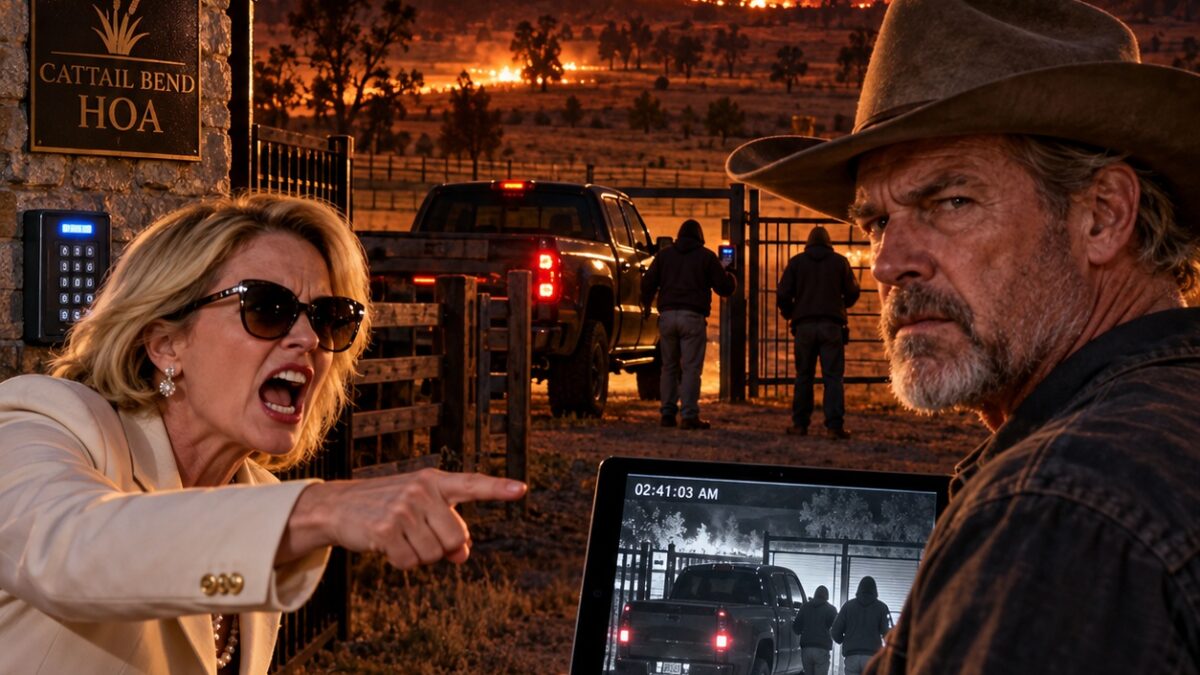
FULL STORY CONTINUATION
We landed while smoke still hung over the western fields.
The fire had been contained by then.
Contained is not the same as extinguished.
Crews were still working hotspots.
Blackened pasture stretched farther than I could see from ground level.
Entire wheat sections were gone.
Fence lines had sagged or melted.
Some irrigation systems were warped into useless shapes.
Several storage buildings had been reduced to steel frames.
One roof had collapsed completely.
Millions.
That calculation entered my mind automatically.
Then I pushed it aside.
My security chief was waiting beside two vehicles.
He looked as though he had not slept.
Neither had I.
“Any injuries?”
“No.”
“Livestock?”
“Moved successfully from the western sections.”
“Good.”
That mattered more than buildings.
I looked toward the smoke.
“Show me the ignition pattern.”
He handed me a tablet.
Three markers.
Separate points.
Almost simultaneous.
All positioned where wind would push flames toward the center of the western property.
“Whoever did this knew the terrain.”
“Yes.”
“Not casually.”
“No.”
“They understood wind.”
“Yes.”
“They understood our roads.”
“Yes.”
“They had an access code.”
“Yes.”
I enlarged the image.
“What did they want?”
“We don’t know.”
I looked toward the burned center.
Something bothered me.
Fire normally destroys visually.
Buildings gone.
Crops gone.
Fences down.
But standing there, I had the opposite feeling.
Like the fire had revealed an absence.
Something should have been in that section.
Or someone expected something to be there.
I started walking.
My security chief followed.
The ground was still warm.
Ash crunched under my boots.
Smoke carried the smell of burned vegetation and melted plastic from irrigation tubing.
We passed one collapsed structure.
Then another.
I kept going.
“Where exactly did the cameras fail?”
He pointed.
“Around this area.”
I stopped.
“Bring the survey crew.”
He frowned.
“Why?”
“I want subsurface scanning.”
“For what?”
“I don’t know.”
That was the truth.
But arsonists had directed fire toward one place.
People had used an HOA code to enter that place.
A camera covering that place had gone dark.
Those three facts were enough to justify curiosity.
Our private survey team arrived within the hour.
Ground-penetrating systems.
Mapping equipment.
Technicians.
At first, nothing unusual appeared.
Soil.
Old utility lines.
Natural variation.
Then one technician called me.
“Sir.”
I walked over.
He pointed at a screen.
“There’s a structure.”
“How deep?”
“Approximately twenty feet.”
“What kind?”
“Not enough data yet.”
They ran another pass.
Then another.
The shape became clearer.
Long.
Rectangular.
Reinforced.
My attorney arrived while we were scanning.
He had flown separately as soon as he heard about the fire.
He looked at the image.
“What am I looking at?”
“I was hoping you could tell me.”
He studied it.
“Basement?”
The technician shook his head.
“No surface structure above it.”
“How large?”
“Large enough to be intentional.”
My attorney looked at me.
“Did your family ever build underground storage?”
“Not that I know of.”
“Storm shelter?”
“Not there.”
“Cold storage?”
“No.”
We needed historical records.
My security chief pulled archived county maps.
Nothing recent showed any structure.
Then he found a 1978 map.
Western parcel.
One small notation.
No name.
No utility description.
Just a reference symbol.
My attorney stared at it.
“That’s strange.”
“Why?”
“Because there’s no corresponding recorded structure.”
“Could the county record be incomplete?”
“Of course.”
“But?”
He zoomed in.
“If this was a permitted underground facility of that size, there should be more documentation.”
“So someone built it off record.”
“Possibly.”
We excavated carefully.
By late afternoon, the top of a reinforced concrete hatch appeared beneath soil and ash.
Twenty feet down.
Fire had burned everything above it.
The hatch looked almost untouched.
Thick concrete surround.
Heavy steel cover.
Industrial locking system.
I climbed down with my security chief and attorney.
On the front of the metal was a scratched symbol.
My security chief stared.
“What?”
“I’ve seen that.”
“Where?”
“Original ranch documents.”
My attorney looked at him.
“What does it mean?”
“We never figured it out.”
That was not reassuring.
“Open it.”
The security team cut through the lock.
Cold air moved upward when the hatch opened.
Below was a concrete stairwell.
No active electricity.
No obvious lights.
We descended with portable lamps.
The corridor was narrow enough that our shoulders nearly brushed the walls.
Dry.
Dusty.
Undisturbed.
At the first room, our lights swept across metal containers.
Dozens.
Some open.
Some sealed.
Old industrial storage units.
One carried a faded date.
My attorney ran a hand over the metal.
“What was this place?”
“No idea.”
Then he saw a wall cabinet.
Inside were documents.
Maps.
Contracts.
Old surveys.
Photographs.
Folders.
One file carried my family name.
That changed the temperature of the room for me.
I opened it.
First page:
Survey.
Second:
Ownership agreement.
Third:
A handwritten note.
I recognized my grandfather’s writing from old letters.
One sentence.
If anyone ever discovers this place, do not trust the people who claim they want the ranch.
I read it twice.
My attorney took the page carefully.
“Who wanted the ranch?”
“He never told me.”
“Maybe he expected someone to.”
Before we could say more, my security chief’s phone rang.
He stepped away.
When he returned, his expression had changed.
“What?”
“We found the maintenance truck.”
“Where?”
“Abandoned several miles away.”
“Registered owner?”
“A development company.”
I knew the name immediately.
They had approached me twice during the previous year.
Large company.
Aggressive expansion plans.
They wanted a significant portion of my western acreage.
I had refused.
“How much did they offer?”
My attorney answered because he had handled the proposal.
“Thirty-two million.”
I almost laughed.
Not because thirty-two million is small.
Because the land was worth substantially more based on location, water access, future development pressure and agricultural value.
Their offer had been an attempt to buy strategic land cheaply.
I had declined without much drama.
Now one of their trucks had entered my ranch before an arson fire.
Using an HOA access code.
I looked around the underground room.
“They already knew this place existed.”
My attorney nodded slowly.
“That would explain the targeted burn.”
“They weren’t trying to discover it through the fire.”
“No.”
“They wanted something inside destroyed.”
“That would be my assumption.”
I turned to my security chief.
“Pull every camera record from the last thirty days.”
“All active feeds?”
“All feeds.”
“Inactive cameras too?”
“Especially those.”
One advantage of overbuilding ranch security is redundancy.
Surface cameras can be disabled.
Some of ours had buried backup units.
Low profile.
Independent storage.
Normally unnecessary.
That night, unnecessary became essential.
Around 9:00 p.m., my chief called me to the security office.
“We found the truck three nights before the fire.”
Same maintenance vehicle.
Same western route.
Different driver.
The buried camera had captured his face.
We enhanced the frame.
I recognized him.
Not from the development company.
From the HOA.
Board member.
Two weeks earlier, that man had attended a meeting where the HOA discussed my ranch as a “community safety concern.”
At the time, I had considered it irritating politics.
Noise complaints.
Access concerns.
Arguments about land management near residential development.
Now I saw a different possibility.
Paper trail.
Unsafe ranch.
Hazardous property.
Community concern.
Fire.
Damage.
Another purchase offer.
If I refused?
Declare portions unusable.
Push regulatory pressure.
Create public narrative that the ranch had become dangerous or abandoned.
My attorney leaned against the desk.
“They’re manufacturing conditions.”
“Yes.”
“The HOA complaints give the developer cover.”
“Yes.”
“And the fire makes the property look distressed.”
“Yes.”
I closed the underground folder.
“Call the HOA president.”
My security chief dialed.
She answered immediately.
I took the phone.
“Did you authorize one of your board members to enter my ranch three nights before the fire?”
Silence.
“I don’t understand.”
I sent the photograph.
One minute passed.
Then my phone rang.
Her voice was no longer confident.
“That man told us he was investigating a safety complaint.”
“Who authorized him?”
“I did.”
“Who asked you to?”
Silence.
“Who?”
Finally:
“The development company.”
My attorney looked at me.
There.
Connection.
But not motive.
Not enough.
“Why?”
“They said they needed documentation related to fire hazards.”
“Before a fire that began three days later?”
“I didn’t know about any fire.”
“Did they give your association anything in exchange?”
Another pause.
“We have a consulting arrangement.”
My attorney started writing.
Before I could continue, my security chief entered holding another tablet.
He pointed at the screen.
Black SUV.
Captured near the north boundary shortly before ignition.
“Plate?”
“Registered to a company under another name.”
My attorney searched corporate records.
His face tightened.
“This company owns the land behind the ranch.”
“How much?”
“All of it.”
I looked at the map.
Development company west.
Shell company north.
HOA east.
My ranch between strategic holdings.
They did not just want my acreage.
They wanted continuity.
Access.
Something connecting everything.
I returned to the underground map.
Maybe my grandfather’s warning was not about land value.
Maybe the land controlled something.
I looked at my chief.
“Prepare the helicopter.”
“Where?”
“County archives.”
My attorney gathered the historical file.
“If your grandfather knew people would come after this place, he may have left records somewhere official.”
We were halfway to the pad when my phone rang again.
HOA president.
I almost ignored it.
Answered.
“You need to come back.”
“I haven’t left.”
“I mean the clubhouse.”
“Why?”
“There are people here.”
“Who?”
Her voice dropped.
“The same people who paid for the fire.”
I stopped.
“How many?”
“I don’t know.”
“What do they want?”
“Your ranch.”
“That answer is too broad.”
“They’re asking about old maps.”
My attorney heard enough.
We turned immediately.
Security teams moved ahead.
By the time I reached the HOA clubhouse, my people had surrounded it.
The HOA president ran toward me.
Her face was pale.
“Inside.”
“How many?”
“Six.”
“Armed?”
“Yes.”
My security chief stepped forward.
“We’ll evacuate everyone else.”
“Do it.”
Within minutes, employees and HOA members were moved out.
My attorney came with me inside.
The six men stood around a conference table.
Maps were spread everywhere.
Satellite images.
Property boundaries.
Historical surveys.
None of them appeared surprised to see me.
That bothered me more than weapons.
The man in the center smiled.
“You’re finally here.”
“You started the fire.”
He did not deny it.
“You have something we need.”
I looked down.
A red line crossed from the underground chamber beneath my ranch toward neighboring parcels.
“What is this?”
He smiled.
“You really don’t know?”
“No.”
“Your grandfather never told you.”
My attorney moved closer.
“What exactly are you talking about?”
The man ignored him.
“Your family has owned that ranch for generations.”
“Yes.”
“But land isn’t what made the western section valuable.”
He tapped the map.
I stared at the red line.
“Water?”
Silence.
Then he said:
“An underground aquifer.”
My attorney immediately started searching available records.
The man continued.
“Large enough to supply the valley.”
I looked at him.
“So the development company wanted water rights.”
“We wanted control.”
That wording mattered.
Not access.
Control.
Suddenly the pieces rearranged.
The offers.
Surrounding parcels.
HOA access.
Paper trail.
Underground chamber.
Fire.
My grandfather’s warning.
“What was the chamber?”
“Access control.”
“To the aquifer?”
“To the historical water system.”
“What records were you searching for?”
“The original water-rights documents.”
My attorney looked up.
“Those documents could determine who controls extraction and access.”
The man nodded.
“Exactly.”
“And you believed they were stored underground.”
“We knew they were.”
“Then why burn the ranch?”
He looked at me.
“Because searching openly was impossible.”
“You burned thirteen thousand acres to hide trespass?”
“No.”
His expression hardened.
“We burned the ranch because we wanted you to leave.”
There it was.
Not damage for damage’s sake.
Pressure.
Destroy the economic function of the ranch.
Blacken crops.
Damage infrastructure.
Create safety complaints.
Push me to relocate.
Then shell companies could acquire strategic pieces.
Control roads.
Control access.
Control groundwater.
A legal and physical squeeze.
The HOA president had entered behind us.
She was crying.
“I didn’t know about the water.”
The man turned.
“Don’t lie.”
“You told us it was a development project.”
“It was.”
“You never told us there was an aquifer.”
“Because you didn’t need to know.”
That sentence told me exactly where the HOA stood in his hierarchy.
Useful.
Paid.
Expendable.
I looked at my security chief.
“Did you get that?”
He held up his phone.
“Every word.”
For the first time, the man’s face changed.
He stepped toward me.
“You don’t understand what you’re dealing with.”
“No.”
I looked at the phone.
“You don’t understand what you just gave me.”
I made one call.
“Send the helicopters.”
My chief looked at me.
“All three?”
“All three.”
Rotor noise reached us minutes later.
People at the clubhouse windows looked upward.
Three aircraft approaching low.
Two carried additional security and investigative personnel.
The third brought legal and forensic support.
The man in front of me tried to recover his smile.
“You think helicopters scare me?”
“No.”
I stepped closer.
“I want you to understand what you burned.”
He glanced toward the smoke still visible over the ranch.
“Millions of dollars in crops and infrastructure.”
He smiled.
“But the evidence is gone.”
I shook my head.
“You burned the surface.”
His smile disappeared.
“You didn’t burn what was underneath.”
My security team had continued searching the chamber.
Behind the first storage room, they found another reinforced doorway.
Inside:
A steel safe.
My grandfather’s initials were etched into the front.
We returned immediately.
The lock took time.
When the safe opened, the first documents were exactly what the men had been looking for.
Original water-rights records.
Historical agreements.
Survey control documents.
Family ownership.
Access limitations.
Records establishing who held legal authority over the aquifer infrastructure.
My family.
Still.
But underneath those documents sat something nobody had mentioned.
A ledger.
Old.
Thick.
Dates.
Names.
Amounts.
Meeting references.
I started reading.
Development-company payments.
Consulting transfers.
HOA board members.
Intermediaries.
Instructions.
Dates matching land-use complaints.
Dates matching access discussions.
Payments before specific HOA actions.
My attorney leaned over my shoulder.
“This is enough to trigger everything.”
“No.”
I turned another page.
“Not yet.”
Near the back was the funding chain.
One name at the top.
CEO of the largest development company in the state.
Powerful.
Connected.
Exactly the sort of person capable of coordinating shell companies and land acquisitions across an entire valley.
Then beneath his name—
Another signature.
I recognized it immediately.
My family’s former attorney.
The man who had handled my grandfather’s estate.
For more than twenty years.
I stared at the signature until the letters blurred.
My attorney said nothing.
He did not need to.
Suddenly the impossible knowledge made sense.
How did outsiders know there was an underground chamber absent from modern records?
Former family attorney.
How did they know the documents had been hidden?
Former family attorney.
How did they know exactly which western acreage mattered?
Former family attorney.
How did they know enough about my grandfather’s arrangements to build a two-decade strategy around them?
Former family attorney.
My grandfather’s note returned to me.
Do not trust the people who claim they want the ranch.
I had assumed he feared developers.
People outside.
He had feared betrayal closer than that.
Someone with access.
Someone paid to protect family interests.
Someone who knew where every legal weakness and hidden asset sat.
I called him.
He answered calmly.
“Hello?”
“Did you think I would never find out?”
Silence.
Long enough.
Then:
“You don’t understand.”
“I understand the ledger.”
Another silence.
“You’re making a mistake.”
“No.”
I looked at his signature.
“You made the mistake twenty years ago.”
He hung up.
By the next morning, investigators had arrived.
Not my private people.
Government investigators.
The development company was raided.
Financial records seized.
Bank accounts frozen pending investigation.
HOA financial files taken.
Board members questioned.
The man who had admitted involvement in the fire tried to leave the state.
He did not make it.
Arrested before he crossed.
The CEO became the center of a larger investigation.
My former family attorney’s role was exposed through decades of records.
Everything accelerated because the conspirators had made the same mistake powerful people often make after years of success.
They believed previous silence proved future safety.
It does not.
Sometimes it means evidence is still waiting.
The HOA president requested counsel before additional questioning.
Smart.
I did not blame her for that.
What I blamed her for came earlier.
She had authorized ranch access because a developer asked.
Accepted the “community safety” justification.
Allowed board members to create a paper trail targeting property outside HOA authority.
Whether she understood the aquifer or not did not erase participation.
She had asked too few questions because money and development interests aligned with what she wanted.
That was her responsibility.
My problem was different.
Thirteen thousand acres looked burned.
Not every single foot had been equally destroyed, but the western agricultural system was devastated.
Millions in crops.
Infrastructure.
Fencing.
Equipment.
Storage structures.
I flew over it again after the arrests.
From the air, black land looks final.
That is deceptive.
Fire destroys.
It also leaves ground.
My attorney sat across from me in the helicopter.
“You’ll rebuild.”
It sounded like a statement.
“No.”
He looked up.
“No?”
“No.”
“You’re selling?”
“No.”
“Then what?”
I pointed toward the eastern boundary.
“Buy it.”
He frowned.
“What?”
“The development parcels.”
“All of them?”
“All strategic parcels around the ranch.”
He stared.
“Why?”
“Because I am done allowing someone else to build a trap around this property.”
He looked down at the maps.
That was the lesson of the conspiracy.
The developer had not needed to own my ranch immediately.
They had been building leverage around it.
Acquire neighboring land.
Control roads.
Control access points.
Use the HOA.
Create regulatory pressure.
Force a distressed sale.
I would reverse the geometry.
Over the next six months, we purchased aggressively.
Land behind the ranch.
Road parcels.
Access corridors.
Properties the development company intended to use for expansion.
Small investor-owned lots positioned near future water infrastructure.
Some owners sold willingly.
Some had been holding only because they expected the large development to raise values.
Once the criminal investigation froze that project, their incentives changed.
One by one, strategic parcels became mine.
The planned billion-dollar development disappeared from county maps.
Not overnight.
Legally.
Contract by contract.
Survey by survey.
Closing by closing.
The HOA clubhouse remained.
But the underlying parcel became part of the property network I controlled.
That created an irony even I had not predicted.
For years, the HOA had treated my ranch as an obstacle to its future.
Now its own physical future depended on land controlled by the person its leadership had helped target.
The HOA president came to my office one final time.
No entourage.
No board.
No developer.
She looked exhausted.
“I owe you an apology.”
“Yes.”
She blinked.
Maybe she expected me to soften it.
I did not.
“I didn’t know what they were planning.”
“You should have asked.”
“I know.”
That answer mattered more than a speech.
She looked through the window toward the valley.
“Why didn’t you destroy us?”
I almost laughed.
Not because the question was funny.
Because it showed how completely the old power structure understood conflict through domination.
Win.
Destroy.
Acquire.
Force.
Control.
“I didn’t have to.”
She looked back.
“Your development is dead.”
Her eyes dropped.
“And the clubhouse?”
“Still standing.”
Relief appeared.
“For now.”
It vanished.
I handed her a document.
She read slowly.
New property agreement.
The HOA would not be evicted immediately.
I was not demolishing the clubhouse.
Residents were not losing their homes.
But the rules changed.
No new development.
No unauthorized construction.
No entering my land.
No interference with ranch operations.
No assumption of access.
No pretending an HOA rule created property rights beyond its legal boundary.
The existing community could remain under strict private-property conditions.
Or leave the arrangement.
Her decision.
She looked at me.
“Why give us a choice?”
“Because I don’t want revenge.”
I paused.
“I want control.”
That word had been used against me in the clubhouse.
The developers wanted control of water.
Control of access.
Control of land.
Now I understood the only safe answer was to control what was legally mine well enough that nobody could quietly build another scheme around it.
She nodded.
Then left.
I never needed her humiliation beyond that.
Her exhausted walk out of the office did nothing for my burned wheat.
Did nothing for melted irrigation lines.
Did nothing for the betrayal sitting in my grandfather’s ledger.
Revenge would have been emotionally expensive.
Control was practical.
That evening, I walked across the western field.
The ground was still black in places.
Ash.
Damaged fence posts.
Twisted remnants of infrastructure.
But between dark patches, green shoots had already started emerging.
Small.
Bright.
Almost offensively alive.
My security chief walked beside me.
For a while, neither of us spoke.
Then:
“Sir.”
“What?”
“The new survey is complete.”
“And?”
He smiled.
That was unusual enough to get my attention.
“The aquifer is larger than the original records suggested.”
“How much larger?”
“Potentially enough to supply the entire valley for generations.”
I looked toward the mountains.
For days, everyone had been talking about what the fire destroyed.
Millions.
Maybe far more once long-term agricultural loss was calculated.
But the fire had exposed something larger.
Not created it.
Exposed it.
Water beneath the ranch.
Historical control.
Original rights.
A resource my family had protected without my fully understanding why.
My grandfather had known.
He had buried the records physically and legally.
Probably because he understood what would happen once development pressure reached the valley.
Water changes land politics.
A dry piece of land can be valuable.
Land controlling water can become strategic.
The developers had known.
My grandfather’s former attorney had helped them know.
That betrayal stayed with me more than the fire.
A stranger burning your field is an enemy.
Simple.
A trusted attorney spending decades helping outsiders dismantle protections your family paid him to preserve?
Different injury.
Betrayal corrupts memory.
I started questioning old transactions.
Old meetings.
Every recommendation.
Had my grandfather suspected him specifically?
The note did not name anyone.
Maybe he knew something was wrong but not who.
Maybe he deliberately hid the safe because he trusted paper more than people.
The source does not give those answers.
I never found a neat emotional explanation.
What I had was the ledger.
Facts.
Sometimes facts are enough.
The development company’s plan became clearer as investigators reconstructed records.
They needed the aquifer.
Their future projects required reliable long-term water.
Owning land around my ranch was useful.
Controlling the infrastructure and rights beneath my ranch was essential.
The original $32 million offer had never reflected true strategic value.
It was an opening attempt.
If I sold voluntarily, excellent.
If not, pressure.
HOA complaints.
Safety narrative.
Encroachment.
Access.
Eventually disaster.
Then distressed acquisition.
The fire was not spontaneous rage.
It was a business tactic taken into criminal territory.
That bothered me because of how cold it was.
Nobody had to hate me.
They only had to value control more than law.
Sometimes the most dangerous people are not emotional.
They are calculating.
Thirteen thousand acres becomes a line item.
Burn.
Claim hazardous.
Acquire.
Develop.
Extract.
Profit.
Human beings become obstacles.
Family history becomes delay.
The ranch becomes “underutilized.”
Water becomes “resource.”
Words clean up violence.
I stopped allowing that vocabulary around me.
My ranch was not an underperforming asset.
It was land.
Living system.
Business, yes.
Home, yes.
History, yes.
And now the legal control point for an aquifer large enough to affect an entire valley.
That last fact created responsibilities I had not asked for.
My attorney warned me immediately.
“Once this becomes public, pressure changes.”
“How?”
“Government.”
“Developers.”
“Utilities.”
“Municipalities.”
“Everyone.”
I nodded.
“Then we document everything.”
He smiled.
“Your grandfather would approve.”
Maybe.
I hoped so.
Water rights are complicated.
I did not suddenly own every drop beneath the valley merely because the ranch sat above part of the aquifer.
The source does not support that kind of legal simplification, so I will not invent it.
What we did have were original rights documents and infrastructure control positions important enough to determine access and development possibilities.
That was powerful.
Power demands precision.
The same greed that brought developers to the ranch could infect anybody, including me, if I started treating discovery as license to do whatever I wanted.
I did not want that.
Control the asset.
Protect the ranch.
Negotiate legally if future agreements made sense.
Do not repeat their mistake.
That became the principle.
My grandfather’s warning stayed in my office.
Not framed dramatically.
Stored securely with copies.
I had the original preserved.
One sentence.
It had survived underground longer than people who wrote many of the development plans.
There is something satisfying about old handwriting defeating modern arrogance.
The developers had helicopters.
Law firms.
Shell companies.
Political connections.
Consultants.
HOA relationships.
Millions moving through accounts.
My grandfather had a steel safe and distrust.
He won.
Eventually.
Not without damage.
But the records survived.
That is why documents matter.
The men at the clubhouse believed fire could destroy evidence because they pictured paper near the surface.
They did not understand redundancy.
The chamber.
The hidden room.
The safe.
Buried rights.
Backup cameras.
Their plan depended on knowing almost everything.
Almost killed it.
They knew the chamber existed.
Did not know the safe was protected.
They knew cameras covered the ranch.
Did not know underground backups continued recording.
They knew the HOA had an access code.
Did not know access logs would become evidence.
They knew my family’s former attorney.
Did not know my grandfather had documented their relationships.
Complex conspiracies fail at small unknowns.
That became another lesson.
Do not need to outsmart every part.
Preserve enough truth that one mistake exposes the rest.
They made several.
The HOA code.
Board member face.
Black SUV.
Recorded confession.
Safe.
Ledger.
Any one created problems.
Together?
Collapse.
The raids moved quickly after that.
I watched news coverage only briefly.
Headlines focused on development corruption.
Arson.
Water rights.
Financial conspiracy.
The HOA name appeared constantly.
Residents were furious.
Some had known nothing.
Most likely.
The president had known the development company was paying for cooperation.
She admitted authorizing an investigation.
But knowing the full criminal plan?
She insisted no.
The man in the clubhouse accused her of lying.
I cannot resolve what existed in her private mind.
I only judge what the source gives.
She enabled access.
She failed to ask enough questions.
She helped create the paper pressure.
She later admitted wrongdoing indirectly through apology.
That is enough responsibility.
I did not need to invent her as mastermind.
The true scheme already had enough masterminds.
CEO.
Fire organizers.
Paid board members.
Shell companies.
Former family attorney.
Turning every HOA resident into a villain would make the story less credible.
And emotionally easier.
Reality is usually messier.
A few people plan.
Some people benefit.
Others look away.
Many know almost nothing.
Then consequences spread anyway.
The homeowners lost the development future they expected.
Property assumptions changed.
Traffic plans changed.
Clubhouse rights changed.
Some probably blamed me.
Fine.
I did not burn the ranch.
I did not create their dependency.
I did not pay board members.
Accountability often feels unfair to people who enjoyed benefits without seeing the machinery.
That does not make the machinery lawful.
The new property agreement around the clubhouse was deliberately strict.
No ambiguity.
No “customary access.”
No informal expansion.
No construction creep.
No infrastructure installed first and permission negotiated later.
Everything in writing.
My security chief joked:
“Not very neighborly.”
“I’ve learned.”
He smiled.
He had been with me through fire.
He understood.
Neighborliness without boundaries is an invitation to people who view generosity as weakness.
I was not closing myself off.
I was ending assumption.
If the HOA needed something?
Ask.
If I said no?
No.
If the answer could be yes under conditions?
Contract.
Simple.
The fire damage itself took months to understand.
Agricultural loss is not one number.
Crop gone.
Fence.
Irrigation.
Storage.
Soil condition.
Equipment.
Future planting schedules.
Labor.
Lost yield.
Replacement.
Insurance questions.
Environmental assessments.
We mapped everything.
Some acres recovered naturally faster than expected.
Others required intervention.
The first green shoots arrived almost immediately.
That image became symbolic whether I wanted it to or not.
Black soil.
Green.
People love saying fire creates rebirth.
Careful.
Fire also destroys.
Do not romanticize arson because grass returns.
The green did not make the crime useful.
The aquifer discovery did not make the loss worth it.
My family should not have needed thirteen thousand acres burned to expose betrayal.
The fact that something valuable emerged from disaster does not convert disaster into a gift.
I held that distinction tightly.
People told me:
“In a way, the fire was the best thing that could have happened.”
No.
It was not.
The fire was terrible.
We were fortunate it exposed rather than erased.
Different.
Good outcomes after harm do not justify harm.
My grandfather’s former attorney tried communicating through counsel eventually.
I did not speak with him directly again.
No point.
The emotional conversation people imagine never happened.
No:
How could you betray us?
No confession scene.
No explanation involving desperation.
The source gives us none.
Evidence existed.
Investigators handled it.
I did not need a man who lied for twenty years to suddenly give me emotional truth.
That is an underrated form of freedom.
Stop expecting closure from the person who created the wound.
Documents can be closure.
Action can be closure.
Distance.
I already understood enough.
He had access.
He used it.
He profited or participated.
He signed.
Done.
My grandfather’s trust had been exploited.
I would not repeat it by giving the same man another chance to shape the story.
The CEO was different.
I had never trusted him.
He had always appeared through representatives.
Polished acquisition letters.
Market analyses.
Development synergy.
Thirty-two million dollars as though he were doing me a favor.
I remember one earlier meeting.
His team talked about “unlocking the value of underdeveloped land.”
I said:
“The land is developed.”
They looked confused.
“Crops.”
“Pasture.”
“Water systems.”
“Ranch infrastructure.”
To them, development meant concrete.
Homes.
Commercial sites.
Revenue density.
Different worldview.
Neither automatically evil.
The evil began when my no became something to engineer around.
That is the recurring pattern in property conflicts.
A person wants something.
Owner says no.
Healthy response:
Negotiate or walk.
Unhealthy response:
How do we make the no impossible?
They chose the second.
First offer.
Then surrounding acquisition.
Then HOA pressure.
Then infiltration.
Then fire.
Each step more extreme because the original boundary remained.
The tragedy is that legal negotiation might have worked around water access without transferring my entire ranch.
Maybe.
We will never know.
They wanted control too badly to ask honestly.
Control makes people impatient with consent.
That was their undoing.
I did not forget the phrase the man at the clubhouse used.
“We wanted control of the water.”
There it was.
Not partnership.
Control.
Then months later, I told the HOA president:
“I want control.”
Same word.
Different meaning.
That bothered me for a while.
Was I becoming them?
My attorney answered.
“You want control of what you own.”
“They wanted control of what they didn’t.”
Difference.
Important.
Property rights are not the same as domination.
Control has boundaries too.
I bought surrounding parcels legally.
Voluntary sales.
Recorded transfers.
I did not forge access.
Burn property.
Threaten.
If an owner declined to sell, we moved to another strategy.
No fire.
No false safety claim.
That should be obvious.
Yet after seeing what others did, I made a point of it.
Win legally or do not win.
That kept me from becoming consumed by retaliation.
I had the money to make their lives difficult.
Private security.
Aircraft.
Legal teams.
Land acquisitions.
Money can become intoxicating when paired with justified anger.
You start believing consequences should continue because you can afford them.
I stopped myself.
I bought what protected the ranch.
Not random properties to punish homeowners.
Kept clubhouse standing.
Did not evict families.
That was enough.
The HOA president asked why.
I said I did not want revenge.
That was true.
Revenge would have made her the center of my decisions.
I wanted the ranch at the center.
That shift saved me time.
Maybe sanity.
The security team changed procedures after the fire.
Every access code reviewed.
HOA credentials revoked.
Service gates upgraded.
Multi-factor access.
Cameras hardened.
More buried backups.
Someone joked we were turning the ranch into a military base.
I did not laugh much.
Fire changes security psychology.
Before:
Prevent theft.
Trespass.
Vandalism.
After:
Assume coordinated attack.
That is not healthy forever.
But some changes were reasonable.
No third party keeps broad access codes.
Emergency services get narrow controlled credentials.
Logs monitored.
The exact security architecture is not important to the source.
What mattered was we stopped confusing convenience with trust.
Again.
Same lesson.
The underground chamber was professionally stabilized and documented.
We did not treat it like a mystery bunker anymore.
Engineers.
Surveyors.
Water specialists.
Attorneys.
County review where necessary.
Once secrecy ends, structure should become boring.
Boring is safer.
The original containers were cataloged.
Some empty.
Some records.
Nothing magical.
The safe contained the important pieces.
That was enough.
People online eventually invented stories.
Of course.
Secret government facility.
Gold storage.
Military tunnel.
Water pipeline to another state.
No.
Aquifer-related infrastructure and records.
Historical control.
A family hiding documents from people they distrusted.
Reality already good enough.
I dislike embellishment when truth carries consequences.
Same with the three helicopters.
People later described them like a military assault.
They were assets I ordered because the situation demanded personnel and forensic capability quickly.
Impressive visual?
Yes.
But helicopters did not solve the conspiracy.
Ledger did.
Recording did.
Camera did.
Documents did.
Aircraft moved people.
Evidence moved law.
Important distinction.
The man at the clubhouse looked out at rotor blades and tried to act fearless.
“You think this scares me?”
I did not care whether he was scared.
Fear is temporary.
Evidence lasts.
That became a theme.
The fire looked powerful.
Thirteen thousand acres burning.
Evidence under concrete survived.
Their intimidation looked powerful.
Armed men.
Recorded confession survived.
Developer looked powerful.
Largest company in state.
Bank accounts frozen.
Former attorney looked powerful because he controlled hidden knowledge.
Ledger exposed him.
Power without clean records eventually becomes vulnerable to records.
My grandfather knew that.
Maybe that was why he buried paper deeper than people would think to look.
I often wondered what he felt when he created that safe.
Fear?
Anger?
Suspicion?
Did he know betrayal had already begun?
The note sounded certain.
Do not trust the people who claim they want the ranch.
Not:
Be careful.
Not:
Check documents.
Do not trust.
Strong.
He was warning someone.
Maybe me specifically.
Maybe any descendant.
He knew he might not be alive when the threat matured.
That hits differently.
Land planning happens across generations.
He protected a future occupant he might never meet.
I inherited not only ranch acreage.
I inherited an unfinished defensive strategy.
That realization changed how I thought about ownership.
A large property is not merely wealth you possess.
It is something you temporarily control between past and future.
My grandfather protected it.
Then my family.
Now me.
Someday someone else.
The aquifer may outlive all of us.
That creates responsibility beyond personal victory.
I began discussions with hydrologists and legal experts about sustainable use.
Again, the source does not give a final water-management plan, so I will not fabricate one.
What matters is the survey showed capacity far larger than expected.
Enough to affect the entire valley for generations.
That is not something a responsible owner casually monetizes because revenge story demands billion-dollar payoff.
The actual payoff was control and discovery.
That is stronger.
Money can disappear.
Water rights and secure land position shape generations.
The new green growth across the western acreage became easier to look at over time.
At first every shoot sat beside memory of flames.
Later it became pasture again.
Some crop areas took longer.
Some infrastructure had to be rebuilt despite my earlier “no” answer to the attorney.
What I meant when I said no was:
I would not simply restore the old system and continue as if nothing had changed.
We were restructuring.
Acquiring.
Protecting.
Replanning.
The ranch itself would continue.
Of course.
Land does not become useless because you refuse to rebuild one exact version.
That nuance matters.
The property remained.
We adapted.
Sometimes the best rebuild is not reconstruction.
It is redesign.
I had learned what the western acreage concealed.
Learned where vulnerabilities existed.
Learned what neighbors planned.
I would not restore ignorance.
The new ranch operation had to reflect new reality.
More secure.
More documented.
Strategically surrounded.
The billion-dollar development plan died.
That removed immediate pressure.
For the first time in years, western boundary planning became mine again.
Not reactive.
That felt enormous.
Before the fire:
Respond to offer.
Respond to HOA complaint.
Respond to survey request.
Respond to access issue.
After:
I chose.
Buy parcel.
Secure road.
Protect chamber.
Set terms.
Control returned.
That was the deeper revenge, if people insist on using that word.
Not destroying their property.
Restoring my agency.
I found myself less angry once agency returned.
Helplessness feeds rage.
Choice reduces it.
The HOA president remained in contact because clubhouse property arrangements required administration.
Our conversations became short.
Professional.
She stopped making assumptions.
Good.
Once, she asked:
“Do you hate me?”
I did not answer immediately.
The source does not include that exchange, so I will not pretend it happened.
That is how easy it is to expand emotional conflict beyond evidence.
Better to stay with what we know.
She apologized.
I told her she should have asked.
She asked why I did not destroy them.
I said they already destroyed themselves.
That is enough.
We do not need forgiveness theater.
The new agreement tells you everything.
I allowed continued existence.
Under conditions.
That is practical mercy.
No speech required.
The residents had homes.
Children.
Mortgages.
Lives.
Destroying the clubhouse would mostly punish people far removed from the arson scheme.
I had no interest.
I also had no interest in restoring expansion opportunities.
Their development plans had been built inside a corrupt system.
Dead.
Stay within current footprint.
No unauthorized construction.
No interference.
Clear.
I slept better after those terms were signed.
Not because the HOA became trustworthy.
Because trust mattered less when rights were clear.
Documents reduce the amount of faith required.
That is a good thing after betrayal.
Some people romanticize handshakes.
I had a former family attorney in a ledger proving handshakes can become weapons when memory dies.
Write it down.
Everything.
Water.
Roads.
Access.
Boundary.
Security.
If somebody calls documentation hostile, ask why clarity threatens them.
My attorney loved that sentence.
Probably because it creates more billable documents.
I reminded him.
He did not deny.
We laughed.
That mattered.
Laughter returned gradually after the fire.
At first, everyone was too tense.
Security team blamed themselves.
I stopped that.
“Someone used an authorized code.”
“We should have caught it.”
“They disabled a camera.”
“We should have—”
“No.”
Responsibility belongs where action began.
Improve systems.
Do not confuse improvement with guilt.
The perpetrators planned carefully.
Our team responded quickly enough to prevent injuries.
No one died.
Livestock moved.
Evidence survived.
That mattered.
Could security have prevented fire entirely?
Maybe.
Impossible to know.
We made changes.
Moved forward.
Blame without improvement is useless.
Improvement without accountability is also incomplete.
We had both.
Investigators for them.
System review for us.
Balance.
One evening, my security chief and I stood near the restored perimeter.
He looked toward the new cameras.
“Think they’ll try again?”
“Those people?”
“No.”
“Someone?”
“Eventually someone always wants something.”
He smiled slightly.
“Optimistic.”
“Realistic.”
Land with valuable water beneath it attracts interest.
That will not end.
But future interest can be legitimate.
Not every developer is arsonist.
Not every HOA corrupt.
Not every attorney traitor.
Trauma tempts you to universalize.
Do not.
If I assume everyone is an enemy, the conspiracy still controls me.
Better:
Verify.
Document.
Trust gradually.
Keep evidence.
That is different from paranoia.
Maybe.
Some days the line feels thin.
The valley changed after the scandal.
Development slowed.
County reviews intensified.
Water-right questions became public.
Some people thanked me for exposing corruption.
I did not feel heroic.
I found a hidden chamber because criminals burned my land.
That is not investigative genius.
It is circumstance plus curiosity.
The people who deserve credit include technicians who scanned, security staff who preserved footage, attorney who followed records, investigators who acted, and whoever in my family decided evidence belonged in a steel safe.
Success is usually collective.
The viral version focuses on one wealthy ranch owner with jets and helicopters.
Looks dramatic.
Fine.
But private jets do not read ledgers.
People do.
Money bought speed.
Truth did the work.
That distinction keeps the story from becoming billionaire fantasy.
If I had money but no records?
Fire wins.
If I had helicopters but no backup cameras?
Denial.
If I had security but no water-right documents?
Long litigation.
The hidden value was not hardware.
It was documentation accumulated across generations.
Grandfather understood.
The fire crew also deserves respect.
Without containment, flames could have moved farther.
No injuries because people acted.
Security moved livestock.
Emergency responders created control.
The source begins with destruction because that creates tension.
The actual event involved hundreds of practical decisions.
That is always true.
Disaster stories compress labor.
Real life expands it.
I remember walking past irrigation equipment twisted by heat.
A worker stood nearby.
He had maintained that system for years.
He looked at me.
“We can replace it.”
Simple.
No speech.
That attitude carried the ranch.
Replace.
Repair.
Survey.
Rebuild selectively.
Land returns.
Evidence stays.
People continue.
Green shoots.
The final irony became clearer with time.
They wanted the fire to make me abandon value.
Instead, the fire revealed value they had been hiding.
Not because flames magically created an aquifer.
Because the attack exposed the targeted location.
Their precision became a clue.
If they had burned randomly, maybe nobody scans.
If they had simply sabotaged a barn, maybe no underground chamber.
They knew too much.
That knowledge pointed us where they did not want us looking.
There is a principle in investigations:
Behavior reveals priorities.
They burned where it mattered to them.
So I looked there.
Found why.
That simple logic unraveled twenty years.
Their sophistication contained its own signature.
The same applies to the HOA.
Why had they suddenly intensified safety complaints around western land?
Priority.
Why send a board member inside at night?
Priority.
Why provide access codes?
Priority.
Follow what people are unusually determined to control.
Often the motive sits underneath.
Literally, in this case.
I sometimes walked above the chamber afterward.
Knowing twenty feet below sat the place where everything turned.
The surface looked ordinary again eventually.
Grass.
Survey markers.
Security points.
Nothing dramatic.
That made me smile.
Powerful things do not always advertise themselves.
Aquifer underground.
Documents in safe.
Betrayal in ledger.
Camera under soil.
The criminals relied on visible control.
Fire.
Weapons.
Development scale.
The things that beat them were hidden and boring.
Excellent.
My grandfather would probably enjoy that.
The CEO’s name on the ledger still angered me less than the attorney’s.
Strange.
The CEO was enemy by position.
Former attorney had relationship.
Trust multiplies betrayal.
I eventually stopped rereading that page.
No benefit.
Evidence copied.
Handled.
I did not need to reopen wound.
That is another kind of control.
Choose what you look at.
Some stories keep villains alive because victims revisit them daily.
I had ranch work.
Land acquisitions.
Security.
Water studies.
Enough.
Let investigators stare at his signature.
I looked at green fields.
The HOA clubhouse stayed.
That decision confused some people around me.
“Why not tear it down?”
“Because I can.”
“That’s not an answer.”
“It is.”
Having power does not create obligation to use maximum force.
The developers misunderstood that.
They had power.
Used all of it.
Escalated until criminal.
I wanted opposite.
Minimum necessary control.
Keep residents stable.
Stop expansion.
Protect land.
Done.
A bulldozer would be emotionally dramatic and strategically stupid.
No need.
People sometimes assume mercy means weakness.
Actually, restraint is easiest when you are secure.
I could leave the clubhouse standing because it no longer threatened anything.
That felt better than demolition.
Every morning residents saw a clubhouse existing because I chose lawful continuity over revenge.
I did not need to remind them.
Property agreement did.
The president’s relief when I said “still standing” told me enough.
Then “for now.”
I will admit I enjoyed that moment slightly.
Human.
But the final agreement was not designed as humiliation.
It was designed as boundary.
No development.
No unauthorized access.
No construction.
No interference.
Clear.
If followed, peace.
Simple.
The aquifer survey report sat on my desk for weeks before I fully processed the scale.
Enough to supply the valley for generations.
That is enormous.
Also uncertain depending on extraction rates, recharge, infrastructure, law.
I did not start announcing ownership of valley water.
That would repeat the arrogance we had just defeated.
Instead, we protected legal position.
Commissioned experts.
Slow.
Water outlives business cycles.
No need to rush.
Developers rush because financing has timelines.
Landowners with generations behind them can think differently.
My grandfather did.
Twenty years means little compared to an aquifer.
That perspective reduced urgency.
The CEO had been trying to capture future value quickly.
I could afford to preserve.
Sometimes patience is competitive advantage.
The burned wheat could be replanted.
The water could not be recreated once mismanaged.
That priority became obvious.
The ranch’s future changed after discovery.
Not fully defined.
But different.
Agriculture remained.
Security stronger.
Development boundaries controlled.
Water protected.
I think my grandfather would recognize the intent even if technology changed.
Keep control with family.
Do not let outsiders use secrecy against us.
I did.
That was enough.
The final time three helicopters crossed the property during the period covered by this story, my security chief looked up.
Same aircraft that had been part of the chaotic day everything broke open.
“Should we bring them in?”
I looked toward the sky.
“No.”
“Why?”
“Let them fly.”
No emergency now.
No armed men.
No forensic rush.
Just aircraft crossing.
I turned toward the western field.
Still patches of black.
More green than before.
The fire had taken crops.
Buildings.
Equipment.
Money.
It had taken sleep for a while.
Trust.
Certain illusions.
But it had failed at its true purpose.
I had not left.
The ranch remained mine.
The chamber remained.
The documents remained.
Water rights remained.
The conspirators lost control.
Then, by buying the surrounding strategic parcels, I removed the geometry they had spent years building around us.
The development plan died.
Their shell companies lost purpose.
The HOA’s expansion died with it.
The ranch stopped being encircled.
That mattered more to me than headlines.
A map can make you feel trapped.
Their map once showed my ranch surrounded by interests waiting for one final acquisition.
Six months later, my map showed something different.
My property.
My access.
My surrounding parcels.
Protected water infrastructure.
HOA contained within fixed boundaries.
No Phase Two.
No secret corridor.
No pressure ring.
Space.
That is what I bought.
Space.
Control.
Not revenge.
I sometimes wonder whether the CEO understood the irony.
He spent years acquiring land around me to create leverage.
His collapse allowed me to acquire many of the same strategic parcels.
He built the blueprint.
I reversed ownership.
No illegal tactic required.
Market transactions.
Recorded deeds.
Perfect.
He tried to make my ranch depend on his network.
His network ended up dismantled while my ranch absorbed the critical positions.
That is consequence.
Clean.
I did not need to visit him.
Did not need a final speech.
Maps tell the story.
The HOA president understood enough.
The clubhouse remained only because I allowed a legal framework.
That shifted their culture immediately.
Assumption disappeared.
They asked before doing anything near my land.
Wonderful.
Amazing what legal clarity accomplishes.
Some residents resented strict private-property rules.
They adjusted.
Same principle as every other HOA story.
Convenience is not ownership.
Your development ending at my boundary is not oppression.
It is geography.
My ranch did not become community property because houses arrived nearby.
The aquifer did not become HOA property because pipes might serve them.
If future water agreements occur, they occur through law.
Not because someone burns wheat.
Simple.
I wish the story could end without loss.
Cannot.
Thirteen thousand acres burned is not a small prologue.
Millions disappeared.
Years of agricultural work erased in hours.
You do not fully recover that.
Insurance can pay replacement values.
Does not return a harvest.
Does not erase smoke.
Some destroyed storage held equipment with history.
Gone.
I allowed myself to be angry.
Then rebuilt what made sense.
Left some blackened remnants long enough to remember.
Eventually removed them.
A ranch cannot become a memorial to attack.
It has to function.
That helped emotionally.
Use land.
Do not worship damage.
Plant.
Repair.
Walk.
Future.
Green shoots showed me first.
I followed.
One morning, months later, I crossed the western side before sunrise.
No security emergency.
No investigators.
Just inspection.
Grass damp.
Some newly planted sections taking hold.
The underground hatch secured beneath controlled access.
I stopped above it.
Twenty feet below, that room had held evidence capable of collapsing a billion-dollar development scheme.
Above?
Bird landed on a fence.
Did not care.
Good.
Nature does not honor legal drama.
That humility felt useful.
We build empires.
Create schemes.
Burn land.
Freeze bank accounts.
Grass grows anyway.
The aquifer moved beneath all of us before the HOA existed, before my grandfather, before any company.
Human control is temporary.
Legal control matters because temporary stewardship still requires order.
But none of us created the water.
Remembering that kept ego manageable.
I did not “win” the aquifer.
I discovered responsibility my family had been protecting.
Different.
The final survey expanding estimated size was not a lottery ticket.
It was a warning:
Be careful.
More valuable means more people will come.
Prepare.
We did.
Security chief asked whether I wanted additional armed presence permanently.
“Not everywhere.”
“Why?”
“I refuse to live inside a fortress.”
Balanced upgrades.
Visibility where needed.
Privacy preserved.
Another lesson.
Attack can make you surrender peace voluntarily by turning every future stranger into threat.
I would not let them take that too.
The ranch needed protection.
It also needed to remain a ranch.
Workers moving.
Animals.
Equipment.
Fields.
Not checkpoints every fifty feet.
We designed security around function.
My chief approved eventually.
He is professionally paranoid.
Useful trait in moderation.
The first time I saw an unknown vehicle near the western service road after everything, my body reacted instantly.
Heart.
Alert.
Security checked.
County utility inspector with appointment.
Fine.
I laughed afterward.
Trauma has access codes too.
You have to revoke them.
Slowly.
Normal activity returns.
I stopped checking cameras every hour.
Trusted my team again.
Slept.
That was another rebuild.
The HOA president faded from daily contact.
Good.
The new rules did their work without conversation.
No unauthorized entry.
No new construction.
No development pressure.
Silence.
Residents lived.
I lived.
The greatest property agreement is one you stop thinking about because everyone follows it.
Eventually ours became that.
I never joined the HOA.
Obviously.
I had thirteen thousand acres and no interest in architectural review.
That is a joke.
But also true.
Their authority stopped where their property stopped.
Exactly where it should.
The clubhouse standing on land in my network created legal dependence, but I did not micromanage residents.
Again, control of boundary.
Not their lives.
Distinction.
I did not become the HOA president above the HOA president.
That would be absurd.
They ran their internal affairs.
I protected external land.
Done.
Some people wanted a more punitive ending.
“Raise their lease.”
“Shut the clubhouse.”
“Force them out.”
No.
Why?
Because revenge consumes opportunities for peace.
I already had everything I needed.
Development dead.
Water protected.
Land secured.
Conspiracy exposed.
Former attorney finished professionally.
Arsonist arrested.
Company raided.
What would evicting homeowners add?
Suffering unrelated people.
Not justice.
I refused.
That refusal made me understand my own line.
I did not want to hurt people.
I wanted nobody capable of hurting the ranch that way again.
Very different objective.
The CEO and his people wanted control as end.
I wanted control as protection.
That difference is ethical only if I keep remembering it.
So I do.
The ledger remains evidence.
Also warning.
Money can pull institutions away from purpose.
HOA exists to manage shared community matters.
Payments turned some board members into tools against neighboring property.
Attorney exists to protect client interests.
Money turned one into collaborator against his own client family.
Developer exists to build legally.
Ambition turned leadership toward criminal acquisition.
Institutions are only as clean as incentives people refuse.
That ledger was not just names.
It was compromised boundaries.
I strengthened ours.
The HOA eventually hired new counsel unrelated to anyone in the conspiracy.
Good.
Fresh review.
Everything boring.
I welcomed boring.
My own legal team audited historical family records for other surprises.
Nothing comparable.
A few outdated easements.
Routine fixes.
The process was still emotionally exhausting because each old document felt potentially dangerous.
Then I learned most old paperwork is exactly what it looks like.
Boring.
Thank God.
Not every dusty file hides a conspiracy.
That would be unbearable.
My grandfather’s note remained the exception.
I sometimes imagined him writing it.
Late night?
Office?
After meeting with attorney?
No idea.
I will not invent.
The handwriting tells only the sentence.
That sentence did its job.
Generational messages do not need explanations if phrased clearly enough.
Do not trust people claiming they want the ranch.
I obeyed.
Maybe too broadly at first.
Later refined:
Do not trust claims.
Verify people.
Better.
Blind distrust can become another prison.
Grandfather lived in his context.
I live in mine.
Use warning, not fear.
That honors him more.
The ranch is still mine.
That is how the source ends.
Simple.
But after everything, those words feel heavier.
Mine does not mean nobody else has legitimate rights.
County regulations exist.
Emergency obligations.
Water law.
Taxes.
Employees.
Contracts.
Mine means title and control have not been stolen.
Choice remains.
That was what they attacked.
They did not need every acre physically.
They wanted decision-making power.
Water.
Access.
Future development.
I kept it.
That is victory.
My security chief and I stood at the western field as the helicopters crossed.
He asked if they should land.
I said no.
Let them fly.
They disappeared toward the horizon.
Rotor noise faded.
Wind returned.
That mattered.
At the beginning of the story, aircraft meant emergency.
I was flying toward fire.
Later helicopters meant confrontation.
Personnel arriving.
Evidence teams.
Security.
At the end, helicopters could simply pass.
No action.
The same object losing its emergency meaning.
That is how you know crisis is ending.
The ground beneath us still contained everything they wanted.
Water.
Infrastructure.
History.
But now none of it was secret from me.
Secrecy had been their advantage.
Knowledge removed it.
I looked at the new green shoots in black soil.
Not inspirational because fire was good.
Inspirational because destruction failed to become permanent.
Different.
The CEO thought forcing me away would make the ranch available.
The former attorney thought hidden knowledge would remain his leverage.
Paid board members thought HOA authority could create cover.
The arsonists thought fire would erase records.
Every plan depended on me not discovering enough in time.
But they aimed too precisely.
Three fires.
Same direction.
One central target.
And that gave me the first question that mattered.
What is underneath this?
Everything followed.
Underground chamber.
Grandfather’s warning.
Truck.
Board member.
HOA connection.
Shell company.
Clubhouse map.
Aquifer.
Safe.
Water rights.
Ledger.
Attorney.
They burned thirteen thousand acres trying to hide a secret.
Instead, the fire drew a circle around it.
That is the counterattack they never anticipated.
Not a trick I planned.
Their own destruction pointing directly at what they feared.
Sometimes people lose because they leave clues.
Sometimes they lose because their entire plan is itself a clue.
I did not defeat them by being more ruthless.
I looked where they did not want me looking.
Then I kept the evidence.
That is enough.
The western side will carry traces for years.
Trees.
Fence replacements.
Different crop patterns.
Maybe satellite images show scars longer than ground level does.
Fine.
Scars do not erase ownership.
The underground hatch remains controlled.
The safe is no longer used to conceal original documents.
Those are secured elsewhere now with multiple copies.
Lesson learned.
Never one location.
My grandfather had hidden them because secrecy protected them in his era.
In mine, redundancy protects them better.
Digital.
Physical.
Legal record.
Trusted counsel.
No single betrayal can erase everything.
That may be the most modern thing I added to his strategy.
He left one safe.
I created a system.
Future heir should not need a fire to learn what is under the ranch.
They will know.
That is how generational stewardship improves.
Do not merely preserve assets.
Preserve knowledge.
The former attorney had exploited information imbalance.
Never again.
I updated estate documentation.
Detailed infrastructure maps.
Water rights.
Surrounding parcel ownership.
Security protocols.
Why certain HOA restrictions exist.
Everything.
Future family might think I am paranoid.
Good.
Then they can read the ledger.
Context.
I hope they never need the lesson.
The best defensive system is the one descendants call excessive because nobody successfully attacks it.
My grandfather’s warning looked excessive until 3:14 a.m.
Then it looked prophetic.
I prefer boring preparedness.
One day, long after smoke disappeared, I drove across the western road alone.
No convoy.
No helicopter.
No security escort directly behind me.
Just truck.
The fields were green enough that if you did not know where to look, you might not understand how much had burned.
I stopped near the center.
Stepped out.
The hatch lay secured somewhere beneath layers of earth and engineered access.
No visible symbol.
I looked toward the surrounding parcels.
Many now mine.
The development company had wanted to box me in.
Now their routes ended at land I controlled.
The HOA clubhouse sat in the distance.
Still standing.
Residents going about their lives.
No expansion crews.
No survey flags.
Good.
I thought about the $32 million offer.
At the time, it seemed merely insulting.
Now I understood it as an attempt to buy control of something far more valuable without revealing why.
What would have happened if I accepted?
Maybe I never learn about the aquifer.
Maybe original documents disappear.
Maybe development begins.
Maybe water control leaves family permanently.
That thought chilled me more than fire.
One signature can erase generations if signed without full information.
Always understand what people are buying.
Not just what they say they want.
They said western land.
They wanted water.
They said development.
They wanted control.
They said safety.
They wanted paper trail.
Language concealed structure.
The fire exposed structure.
That lesson will stay.
I sometimes wonder whether my grandfather refused similar offers.
Probably.
Not in source.
No need to invent.
His warning suggests pressure.
Enough.
He protected the ranch in his way.
I protected it in mine.
Different tools.
Same line.
His:
Hidden chamber.
Safe.
Written note.
Mine:
Security systems.
Survey crews.
Aircraft.
Forensic accounting.
Land acquisitions.
Technology changes.
Boundary principle does not.
People wanting something valuable may tell you they want something else.
Verify.
That is the inheritance.
The legal investigations continued beyond the emotional endpoint.
Cases take time.
I will not fabricate sentences, convictions, courtroom speeches, or final penalties the source does not provide.
We know the development company was raided.
Accounts frozen.
Records seized.
Board members questioned.
Fire organizer arrested.
Former attorney exposed.
That is enough.
Anything beyond belongs to another chapter not present here.
My chapter ends on land.
It should.
Property conflict begins and ends there.
Blackened field.
Green shoots.
Mountains.
Water beneath.
Three helicopters in distance.
Security chief beside me.
“Bring them in?”
“No.”
“Why?”
“Let them fly.”
He looked at me.
I looked across thirteen thousand acres.
The people who started the fire believed they were destroying wealth.
They destroyed crops.
Equipment.
Structures.
Millions.
Real losses.
But the wealth they truly wanted was not wheat.
It was not barns.
Not even the surface land by itself.
It was control beneath.
Water.
Rights.
Future.
They failed.
Worse for them, their fire revealed the thing they had spent decades hiding.
It revealed why my grandfather was afraid.
It revealed who had betrayed him.
It revealed why the development company kept circling my land.
It revealed the HOA’s role.
It revealed the shell companies.
It revealed the ledger.
It revealed everything.
And once I knew, I did what they had never expected.
I did not sell.
I did not run.
I did not beg to rebuild the world exactly as it had been.
I changed the map.
I bought the access points.
I bought the strategic parcels.
I shut down the development geometry.
I preserved the ranch.
I protected the water.
I gave the HOA exactly one path forward:
Respect private property or leave.
No revenge speech.
No bulldozer through their clubhouse.
No dramatic eviction.
Just boundaries.
The kind they should have respected from the beginning.
The wind moved through the new grass.
My security chief looked toward the western edge.
“Hard to believe what this looked like six months ago.”
“I remember.”
“Think you always will?”
“Yes.”
That did not bother me.
Memory is not the enemy.
Being controlled by memory is.
I can remember fire without living inside it.
Remember betrayal without distrusting everyone.
Remember destruction without rebuilding my entire identity around revenge.
The ranch teaches that.
Season after season.
Damage.
Repair.
Growth.
Not erasure.
Continuation.
I started walking.
He followed.
Under our feet, the aquifer stretched farther than we had known.
Enough water for generations, according to the new survey.
Above it, green pushed through black earth.
The contrast felt too obvious.
I almost resented it.
Life insisting.
Fine.
Let it.
The helicopters became small shapes in the distance.
Then disappeared.
No emergency required them.
No enemies waiting at the clubhouse.
No armed men.
No one demanding my documents.
For the first time since 3:14 that morning, everything under the ranch was known to the one person who should have known it all along.
Me.
My grandfather had protected the truth.
My enemies tried to burn it.
Their fire failed.
The ranch was still mine.
And now so was the knowledge of exactly what they had been willing to destroy thirteen thousand acres to take.








