FULL STORY:HOA Queen Turned My Private Lake Into a $45 Tourist Attraction After I Warned Her About a 12-Foot Gator—Then the Sunset Tour Reached His Shore
FULL STORY CONTINUATION
Miranda Voss did not look dangerous the first time you met her.
That was part of what made her effective.
She looked expensive.
Forty-four years old and could pass for thirty-two if the light was friendly.
Honey-blonde hair refreshed every six weeks at a salon in Winter Park.
Cream linen blazers.
Fitted dresses.
Hermès scarves.
Oversized Chanel sunglasses.
White Mercedes GLE.
Perfect nails.
Perfect teeth.
A smile that arrived exactly long enough to make you feel acknowledged before you realized nothing behind it had warmed.
Ruth Anne once described her as “beautiful the way a Venus flytrap is beautiful.”
That was accurate.
Miranda had spent fifteen years in travel and hospitality marketing.
She spoke like every sentence had been run through a branding department.
Stakeholder alignment.
Experiential value proposition.
Brand positioning.
Community-forward strategy.
She could describe a picnic blanket on grass as an immersive lifestyle activation and somehow keep a straight face.
When she became president of Cypress Landing, the HOA stopped sounding like an association and started sounding like a luxury hotel launch.
She fined a retired firefighter $350 because his “God Bless Our Troops” garden flag did not match the community’s aesthetic profile.
A family with three children had to repaint a burgundy front door because Miranda said it interrupted “the visual narrative of the streetscape.”
An eighty-year-old woman named Edna Sels received a certified warning because her birdhouse was not architecturally harmonized.
Edna’s grandson happened to work in county code enforcement.
He called Miranda and explained that Florida did not require architectural approval for birdhouses.
At the next governing-document revision, Miranda added a birdhouse provision.
That was her relationship with reality.
If reality disagreed with her, she tried to revise reality.
The subdivision eventually adopted the slogan:
LIVE THE LEGACY
What legacy?
Nobody seemed certain.
The land had been scrub pine and abandoned citrus groves before a developer cleared it.
But Miranda did not care about history.
She cared about perception.
And Beckett Lake photographed beautifully.
I still remember the letter.
Heavy cardstock.
Embossed logo.
COMMUNITY ENHANCEMENT PROPOSAL
LAKEFRONT RECREATION AND NATURE EXPERIENCE INITIATIVE
Floating dock.
White sand beach.
Kayak and paddleboard rentals.
Gravel parking.
Cedar benches.
Fire pit.
Paved nature trail.
The lake was described as an “underutilized natural asset adjacent to the community.”
Adjacent.
That word did a lot of dishonest work.
My pickup is adjacent to the grocery store when I park there.
That does not make it theirs.
I drove straight to the HOA office.
Deed.
Survey.
Tax receipts back to 1957.
My field notebook.
Thirty years of gator sightings.
Miranda sat at the head of the conference table.
Lavender diffuser humming behind her.
I explained ownership first.
Ninety-five acres.
Lake entirely within the Beckett boundary.
No easement.
No public-access right.
No HOA interest.
Then safety.
“Seven to nine alligators at last count.”
She barely looked down.
“The dominant male is twelve feet.”
Still nothing.
“Over five hundred pounds.”
Her expression remained professionally patient.
“I’ve watched him take a grown deer.”
She raised one manicured hand.
“We appreciate the historical context.”
Historical context.
Like I had brought her an antique farm tool.
“This community was sold with a nature-forward lifestyle promise.”
“That promise has nothing to do with my property.”
“Our homeowners purchased with the expectation of access to natural amenities.”
“No.”
“I’m confident we can find a solution that creates value for everyone.”
“The solution is nobody goes near my lake.”
Her head tilted.
“That’s not really a solution.”
“It is if you want everybody to go home with the same number of limbs they arrived with.”
Her smile thinned.
“That’s a missed opportunity.”
I slid the deed toward her.
She did not touch it.
The survey.
Ignored.
My alligator notebook.
Ignored.
Instead she set the Birkin bag on top of the whole stack.
Conversation over.
On my way out, I passed a large aerial photograph of Cypress Landing in the lobby.
Glossy.
Sunset.
Roofs.
Curving streets.
In the upper corner, Beckett Lake.
Dark water.
Cypress.
Spanish moss.
And if you looked closely enough, there was a long black shape on the clay south bank.
Anybody looking at the picture casually would call it a log.
I would not.
Three weeks before that meeting, Miranda had registered Cypress Nature Experiences LLC.
Outdoor recreation and ecotourism.
She had already decided what my lake was going to become.
My warning was not information she intended to use.
It was an obstacle she intended to ignore.
Four months passed.
Then one afternoon I heard diesel engines from the south boundary.
Heavy equipment.
I was checking fence along the east side when the sound reached me.
I climbed into my truck.
By the time I reached the lake, six men in hard hats were standing on my property.
Mini excavator.
Flatbed.
Dump truck full of white sand.
Forty yards of my barbed-wire fence lay on the ground.
The same fence my father had strung in 1976.
The excavator had already scraped a rectangle of south-bank clay flat.
Orange spray paint marked one area.
DOCK
I found the foreman.
“This is private property.”
He held up a work order.
Cypress Landing Estates HOA.
Lakefront Nature Experience Phase One.
Signed:
Miranda Voss.
“She said there’s an easement.”
“There isn’t.”
He looked uncertain.
“I need you to stop.”
He called her.
I could hear Miranda through the phone.
Bright voice.
Calm.
Confident.
She did not ask to speak with me.
She told the foreman to continue because the “access arrangement was under legal review.”
That phrase almost impressed me.
It sounded legal enough to fool someone standing beside an excavator.
It meant nothing.
I called the sheriff.
A deputy arrived thirty-five minutes later.
He reviewed my deed.
The work order.
Property map.
Then told the crew to leave.
They did.
What remained looked terrible.
Fence cut.
Clay scraped.
Tracks through the bank.
The orange word DOCK painted on ground my family had owned for sixty-seven years.
I photographed everything.
Every post.
Every track.
Every section of disturbed soil.
Ruth Anne called twice while I worked.
“You haven’t done anything stupid?”
“No.”
“Good.”
“I’m considering several options.”
“None involving machinery?”
“Not yet.”
“You’re too stubborn to give Miranda the satisfaction.”
She was right.
My attorney, Katherine Alvarez, added the trespass to our file.
Photos.
Sheriff report.
Work order.
Witnesses.
Her strategy was simple.
Document first.
Move through court.
The law was slower than Miranda.
That became the problem.
Two weeks later, I was in town meeting Katherine.
A different crew entered from the west.
There was a gap in that side of my fence where a fallen pine had knocked down two posts.
I had not repaired it yet.
They came through there.
They worked fast.
When I got home at 3:15 p.m., I stopped my truck and stared.
A forty-foot wooden dock extended into Beckett Lake.
Twenty tons of imported white sand covered the south bank.
A pressure-treated shed stood nearby.
Eight yellow kayaks.
Four stand-up paddleboards.
Two cedar benches.
Gravel parking for roughly twelve vehicles.
And a polished wooden sign.
WELCOME TO CYPRESS LANDING NATURE RESERVE
AUTHENTIC FLORIDA WILDERNESS EXPERIENCE
Then, smaller:
OPERATED BY CYPRESS NATURE EXPERIENCES LLC
Reservations required.
Website address below.
Miranda had built a commercial tourist attraction on my property.
No permission.
No easement.
No commercial recreation permit.
No environmental review.
No FWC consultation.
No wildlife-management plan.
And no warning anywhere that alligators lived in the lake.
I walked down to the dock.
The surface boards still smelled fresh.
Saw dust gathered near the posts.
Out over the water, the lake looked beautiful.
That was the danger.
Clear northern water.
Cypress reflection.
Afternoon light.
Somewhere beneath it all, Diesel.
I knew enough about him not to pretend I knew exactly where he was every minute.
That is one of the rules.
Wild animals do not check in.
Miranda’s booking operation began within a week.
Professional website.
Staged photographs.
Matching life jackets.
Instagram.
Third-party adventure listings.
Partnerships with Orlando tour operators.
Her captions were exactly what you would expect.
PADDLE INTO PARADISE
FLORIDA’S HIDDEN GEM
BOOK YOUR ESCAPE TODAY
Price:
$45 for guided kayak tour.
$35 for nature walk.
$25 for lakeside picnic experience.
The picnic included a blanket and a Costco cheeseboard repackaged into wicker as “locally curated provisions.”
Ruth Anne laughed at that until I reminded her people were eating cheese beside Diesel’s basking bank.
Then she stopped laughing.
Tourists arrived.
Ohio.
Minnesota.
Quebec.
Orlando hotel shuttles.
Flip-flops.
Swimsuits.
Sun hats.
GoPros.
People expecting an off-the-beaten-path Florida experience.
They parked on my property.
Walked through the hole Miranda had cut.
Signed waivers at the shed.
Collected paddles.
Launched into my lake.
One morning Ruth Anne stood beside me on the porch.
A shuttle arrived.
Six tourists.
One guide.
“How many?”
“Six plus the guide.”
“Does the guide know about Diesel?”
“I doubt she knows what county she’s in.”
Ruth Anne gave me that teacher look.
“Are you going down there?”
I thought about it.
Every instinct in me wanted to walk down and tell them.
But Katherine was preparing an injunction.
The sheriff already had the trespass report.
Miranda had been directly warned.
The construction had been documented.
And I understood one ugly legal reality.
If I spent every morning personally confronting tourists, Miranda could turn the story into:
Aggressive rancher harasses guests.
I had already told the person responsible.
Repeatedly.
I sat back down.
“I’m going to wait.”
Ruth Anne opened a notebook.
She started counting.
That was Ruth Anne.
Twenty-six years as a science teacher.
Data collection was practically affection.
Three weeks.
412 individual visitors.
Twenty-eight guided tours.
Eleven picnic bookings.
Seven shuttle vans from Orlando hotels.
Not one alligator warning that we could see.
College-age guides made roughly twelve dollars an hour.
No meaningful wildlife briefing.
A laminated script.
Basic nature facts.
Bird-identification card.
The card did not mention alligators.
Most tours remained near the north half of the lake.
That reduced risk somewhat.
The water there was clearer.
The cypress roots made the southern shallows difficult for kayaks.
But alligators are not assigned zones by booking companies.
Tourists posted reviews.
4.7 stars.
“Hidden gem.”
“So peaceful.”
“Real Florida.”
One review mentioned a floating log near the dock that looked exactly like an alligator.
It was not a log.
The incident happened on a Thursday evening.
Sunset tour.
Fourteen paying guests.
An Ohio group.
A New Jersey family.
A couple from Quebec.
Two college students from Georgia.
Their guide was Tyler.
Twenty-three.
Eleven days on the job.
His previous wildlife experience had been a summer camp in North Carolina.
At 6:15 p.m., they launched.
The light was almost painfully beautiful.
Orange sun.
Flat water.
Spanish moss moving in the breeze.
The kind of scene Miranda had probably used in every piece of promotional material.
They paddled south.
Laughing.
Taking pictures.
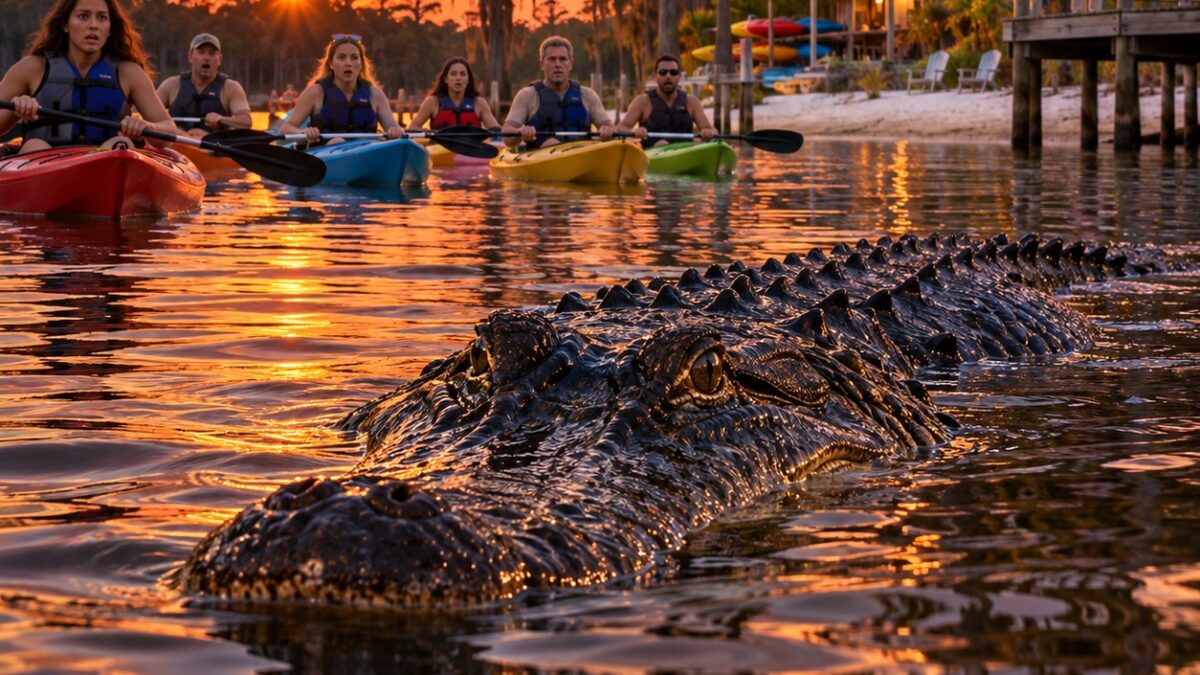
At 6:37, my trail camera captured the moment.
The surface fifty feet ahead of the lead kayak went still.
Not calm.
Still.
There is a difference.
People who spend their lives around Florida water learn it without needing language.
Then two eyes broke the surface.
A ridge of snout.
Nothing else.
Diesel.
He remained motionless for six seconds.
The first kayaker was a woman named Diane from Akron.
She stopped paddling.
Her kayak kept drifting.
Thirty-five feet.
Maybe slightly more.
Then Diesel exhaled.
A slow hiss.
Diane screamed.
I heard it from the porch.
Not a short scream.
A full, continuous human alarm.
I set my coffee down.
The next ninety seconds were chaos.
Paddles flailing.
Kayaks colliding.
One boat overturned.
Sandra Kowalsski from Trenton went into the water and struck a dock piling with her wrist.
She heard the break before the pain caught up.
Tyler shouted directions he had never been trained to give.
The Quebec couple abandoned their kayaks and swam for the dock.
Swam.
Through alligator water.
Another parent jumped waist-deep to pull his nine-year-old son onto the dock.
Then a chocolate Lab wearing a bandana jumped in.
Because Labrador retrievers are wonderful animals and sometimes possess the survival instincts of furniture.
The dog started swimming toward Diesel.
Diesel did not charge.
Did not lunge.
Did not attack anyone.
He floated.
Watching.
The dog’s owner waded chest-deep and grabbed the bandana.
Later, an FWC officer told me that may have been the most dangerous thing anyone did that night.
Splashing animal.
Murky water.
Agitated adult alligator nearby.
Predatory stimulus everywhere.
The dog came out.
The owner came out.
Everyone survived.
That is important.
The margin between that outcome and another one was not large.
Somebody called 911.
Dispatcher asked how big the alligator was.
Caller said fifteen feet.
Diesel was twelve.
Fear adds footage.
Sandra’s wrist was broken badly enough to require medical treatment.
Four pins eventually.
Three other tourists were treated for cuts and bruises.
The nine-year-old boy shook for almost two hours.
His mother told the responding deputy:
“Nobody said there were alligators.”
That sentence became the entire case emotionally.
Nobody said anything.
They had been sold a nature reserve.
They had received photographs.
Waivers.
Bird cards.
Kayaks.
Guides.
Booking confirmations.
Nobody told them the most basic fact about the ecosystem they were paying to enter.
I sat on the porch as ambulance lights reflected red and white through the cypress.
Ruth Anne beside me.
Neither of us spoke at first.
Then she said:
“I counted four hundred twelve people.”
“I know.”
“Every one of them was within sixty feet of Diesel at some point and didn’t know.”
“I know.”
“This was always going to happen.”
“I know.”
She looked at me.
“You warned her.”
“I know that too.”
“What now?”
I watched the emergency crews.
“Exactly what I’ve been doing.”
“What’s that?”
“Let the lake tell the truth.”
The news arrived before the ambulance left.
Orlando affiliate.
Reporter standing beside Miranda’s polished Nature Reserve sign while caution tape crossed the dock.
The story was irresistible.
A commercial ecotour business sent paying tourists kayaking on a private lake with alligators.
The owner said he had warned the operator.
My phone rang constantly for three days.
Ruth Anne unplugged the landline after the second morning.
Regional news became statewide news.
Then national.
One headline summarized it more efficiently than anything I could have said:
Florida eco-tour operator charged visitors $45 to paddle alligator habitat on someone else’s property.
FWC issued a public advisory.
Natural freshwater in Florida should be assumed to contain alligators.
Commercial recreation operators have wildlife-safety obligations.
They did not need to mention Miranda by name.
Everybody knew.
While television reporters focused on Diesel, Katherine Alvarez focused on numbers.
That was where Miranda’s real problem grew.
Cypress Nature Experiences LLC had been operating for eight months.
More than 4,000 individual bookings.
Gross revenue:
$187,000.
Not community revenue.
Not HOA revenue.
Miranda’s LLC.
Meanwhile, a Cypress Landing homeowner named Jim Destapano had been asking for financial transparency for months.
Jim was a retired forensic accountant.
The worst possible kind of neighbor for someone quietly moving money.
He found $74,000 of HOA dues spent on:
Dock construction.
Beach.
Kayak equipment.
Shed.
Gravel parking.
Trail work.
Professional photography for the booking site.
Homeowners had paid to build Miranda’s private commercial operation.
Miranda kept the revenue.
No county commercial-recreation permit.
No liability insurance appropriate for the tourist operation.
No FWC consultation.
No property-owner authorization.
No alligator disclosure.
Nothing on the waiver.
Nothing on the booking page.
Nothing in the laminated safety materials.
The community meeting took place Monday night.
One hundred sixty-eight homeowners.
Standing room only.
Somebody taped a screenshot of Miranda’s booking website to the clubhouse door.
Under it, handwritten:
YOUR DUES AT WORK
Miranda arrived in a navy blazer.
Hair perfect.
Posture perfect.
She opened with a prepared statement.
“Unforeseen wildlife interaction.”
“Regrettable misunderstanding regarding property boundaries.”
“Community-forward approach.”
“Moving forward.”
She said “moving forward” four times.
Not once:
I was warned.
Not once:
I used your money.
Not once:
The lake was never ours.
I sat in the fifth row.
Work boots.
Ranch khakis.
Sun-faded cap.
I removed it indoors because my mother raised me correctly.
When I stood, Miranda’s expression changed.
“Mr. Beckett is not a resident of this community.”
From somewhere behind me:
“Let him speak.”
Then another.
Then twenty voices.
Then dozens.
A woman near the back stood.
“He owns the lake. He has more right to talk than you do.”
That ended Miranda’s procedural objection.
I walked to the front.
Set a thick folder on the podium.
“My name is Darren Beckett.”
No marketing voice.
No slides.
“My family has owned Beckett Lake since 1957.”
I held up the deed.
“I personally warned your HOA president that the lake contains a resident alligator population.”
The survey.
“She ignored that warning.”
My field notebook.
“She built a commercial dock, beach, parking lot and rental operation on my property without consent.”
The LLC filing.
“She charged tourists forty-five dollars each to kayak there.”
Revenue records.
“Cypress Nature Experiences generated approximately $187,000.”
Then Jim’s numbers.
“Your dues paid roughly $74,000 to build the infrastructure.”
People started murmuring.
“She kept the commercial revenue.”
Silence followed.
I showed them the booking material.
Tourist reviews.
No gator warnings.
Then the trail-camera photograph.
Diesel climbing onto the dock in morning light.
Jaw open.
His entire body filling the frame.
Somebody near the front whispered:
“Oh my God.”
A woman stood.
Patricia Kowalsski.
Sandra’s sister-in-law.
“My sister broke her wrist on that dock.”
Her voice shook.
“She has four pins in her arm.”
Nobody moved.
“My nephew is nine years old and won’t go near water now.”
She turned toward Miranda.
“And she charged us forty-five dollars for that?”
Then Jim stood.
“I’ve been asking for financial transparency for eight months.”
Miranda stared at him.
“You told me my questions weren’t constructive.”
He held up his report.
“Seventy-four thousand dollars of our money built your private business.”
He looked around the room.
“I’d call that a pretty constructive question.”
The silence that followed was different from the earlier one.
People were no longer confused.
They were counting.
Dues.
Bookings.
Risk.
Lies.
The recall vote:
162 to 2.
Four abstentions.
Miranda voted for herself.
Brian voted the other way in her favor.
Two people.
After two years of acting like the entire subdivision was an extension of her personal brand, her presidency ended almost unanimously.
She walked out into the parking lot.
Captain Luis Garza from the Florida Fish and Wildlife Conservation Commission was waiting beside an agency truck.
I had contacted him before the meeting.
“Ms. Voss,” he said, “I need to discuss operation of a commercial recreation business in documented alligator habitat without a wildlife-management plan, agency consultation or hazard disclosure.”
He recommended she have an attorney.
Her Mercedes stayed in the parking lot overnight.
After that, agencies started arriving in layers.
County code enforcement.
Unpermitted commercial construction inside a waterway-buffer area.
Retroactive penalties.
Source total:
$258,000.
FWC:
Unauthorized recreation operation inside known alligator habitat without required consultation or wildlife disclosure.
$68,000.
Florida business regulators began reviewing the unlicensed commercial operation and lack of proper liability coverage.
Then the civil claims.
Sandra first.
Broken wrist.
Four pins.
Medical bills.
Eleven additional tourists followed.
The Quebec couple hired counsel.
The parents of the nine-year-old retained a child-advocacy attorney.
Katherine filed my case.
Trespass.
Property destruction.
Unauthorized construction.
Commercial exploitation of private property.
Statutory enhanced damages.
My claim:
$29,400 plus legal fees.
The sheriff’s office opened a fraud investigation.
That investigation documented the same core financial pattern we had been looking at.
$74,000 in HOA funds used for Miranda’s private operation.
$187,000 in undisclosed commercial revenue.
Miranda became the sole subject.
The charges included organized fraud, grand theft and misuse of fiduciary funds.
She ultimately pleaded no contest.
Two years probation.
Full restitution.
Two hundred hours of community service.
The judge required that the service involve wildlife-conservation education.
I admit that detail made Ruth Anne and me laugh.
Not because the situation was funny.
Because Miranda Voss, who had dismissed my alligator records without reading a single page, was now under court order to spend two hundred hours participating in wildlife education.
Ruth Anne said:
“I hope they give her a laminated card.”
Miranda was permanently disqualified from serving on any HOA board in Florida.
She sold the Mercedes.
She and Brian listed their house about eight weeks later.
The listing called them “motivated sellers.”
Nothing about lakeside living.
Nothing about the nature reserve.
Nothing about the private ecotourism company.
The booking site was taken down the same night as the community meeting after multiple attorneys sent cease-and-desist demands.
The dock came down too.
Condemned.
Demolished.
The HOA paid roughly $22,000 for removal, environmental cleanup and debris extraction.
The imported white sand was hauled away.
The kayaks were auctioned.
The equipment shed was dismantled board by board.
The Nature Reserve sign came out of the ground.
A maintenance worker named Dale later told me he had watched a six-foot alligator walk across the gravel parking lot the previous Tuesday.
He had apparently been wondering how long it would take before somebody got killed.
That sentence chilled me.
Because he was not being dramatic.
Everyone around Florida freshwater understands the possibility.
That is why the lack of disclosure mattered so much.
The new HOA board was led by Jim Destapano.
The forensic accountant Miranda had dismissed as unconstructive.
His first formal communication with me was an apology.
Not a branded initiative.
Not a “community-forward resolution.”
A simple written apology.
The HOA reimbursed the fence damage.
Then we signed a permanent boundary agreement.
They installed chain-link fencing along the property line.
Signs every twenty-five feet.
PRIVATE PROPERTY
ACTIVE ALLIGATOR HABITAT
DO NOT ENTER
That was all I had asked for from the beginning.
Respect the line.
Understand the water.
Leave it alone.
An independent audit later found another $19,000 in vendor payments Miranda had authorized without proper oversight.
Every booking partnership was cancelled.
Every tourism platform got certified notice.
Cypress Landing Nature Reserve did not exist.
It had never been properly licensed.
It had operated on private property.
It contained documented dangerous wildlife.
The polished story disappeared surprisingly quickly once the paperwork caught up.
Miranda’s Instagram posts vanished.
The tours stopped.
The shuttle vans disappeared.
The gravel parking lot emptied.
No more matching sun visors.
No more GoPros.
No more guides reading bird facts from laminated sheets.
The lake became quiet again.
Not truly quiet.
Beckett Lake has never been quiet if you listen correctly.
Herons.
Osprey.
Owls.
Wind through cypress.
Water from the spring.
Bullfrog calls.
And, in warm months, Diesel.
The new board decided not to jackhammer one part of Miranda’s project.
The concrete slab that had supported the kayak-equipment shed.
Removing it would have cost more money.
It did not threaten anything.
So they left it.
Diesel claimed it.
Every morning, he crawled out of the south shallows, crossed the cleared patch where Miranda’s imported beach used to be, and stretched himself across the concrete.
Twelve feet of dark hide.
Five hundred fifty pounds.
Jaw cracked open.
Tail across warm slab.
Sun on his back.
The neighborhood children on Heron Drive could see him through the new chain-link fence.
They gave him a new name.
The Bouncer.
I heard one kid explain it to another.
“You can book whatever you want, but he decides who gets in.”
I did not correct them.
The tourists’ old reviews stayed online for a while.
Some were unintentionally accurate.
Saw incredible wildlife.
Once-in-a-lifetime experience.
Got way closer to nature than expected.
No argument from me.
The funniest thing about all of it was that Diesel had never done anything unusual.
Not once.
He had not invaded the HOA.
Had not entered Miranda’s clubhouse.
Had not attacked a tourist.
Had not changed his routine.
He had lived in the same lake for more than twenty-two years.
Basked in the same areas.
Patrolled the same water.
Made the same territorial calls.
Everything around him had changed.
Subdivision.
Marketing.
Dock.
Kayaks.
Tourists.
News cameras.
Agents.
Lawsuits.
Diesel remained Diesel.
That was what Miranda never understood about the word nature.
Nature is not scenery.
It is not a neutral backdrop for a brochure.
It is not something waiting for a marketer to assign a price.
It is a living system.
It does not become safer because the website has good photography.
Does not become private because somebody creates an LLC.
Does not become cooperative because people paid forty-five dollars.
And it certainly does not become empty because an HOA president decides predator disclosure would hurt bookings.
I had not kept my gator notebook for thirty years because I thought Diesel was charming.
I kept it because knowledge matters.
Sightings.
Location.
Behavior.
Size.
Nesting areas.
That information told me where not to stand.
When not to approach.
How to manage cattle near the lake.
When to give the south bank more space.
People sometimes think coexistence with dangerous wildlife means losing fear.
It means respecting what the animal is.
I never trusted Diesel.
I understood him.
Big difference.
He was predictable within the limits of a wild animal.
Miranda was the unpredictable one.
She had been told.
That remains the hardest part for me.
If she truly had not known about the alligators, the story would be negligence.
Still serious.
But different.
I sat across from her with thirty years of records.
I gave her the number.
Seven to nine.
I gave her the dominant male’s length.
Twelve feet.
Approximate weight.
Over five hundred pounds.
I told her I had watched him kill a deer.
She chose not to open the notebook.
That was not ignorance.
It was rejection of information because the information complicated her plan.
Ruth Anne understood that immediately.
Teachers see it all the time.
A student gets the warning.
Does not like the warning.
Pretends the warning therefore does not exist.
Except thirteen-year-olds usually learn after losing ten points on a lab assignment.
Miranda placed strangers in alligator water.
The consequences were different.
I struggled with whether I should have physically gone down and warned every group.
For a while after the incident, that thought bothered me.
Four hundred twelve people.
I watched them.
Could I have stopped it personally?
Maybe some.
But Miranda had built a staffed business.
Every tour would have become a confrontation.
I had called law enforcement.
Filed trespass.
Hired an attorney.
Prepared an injunction.
Warned the operator directly.
The legal process existed for a reason.
And ultimately the person responsible for operating the tours carried the safety duty.
Ruth Anne told me something after I admitted the guilt.
“You cannot become the unpaid safety officer for somebody else’s illegal business simply because she refuses to have one.”
She was right.
Still bothered me.
Then I remembered Diesel never attacked anyone.
We were lucky.
Luck is not a safety system.
Miranda had built a business out of luck and called it luxury.
That is why the tourists were so angry.
Not because Florida has alligators.
Most adults understand that.
Because Miranda had intentionally packaged wild Florida in a way that removed the information necessary to make an informed choice.
People might still have booked.
Some probably would.
But they deserved to know.
Natural freshwater.
Known alligator habitat.
Wildlife risk.
That warning changes behavior.
People keep pets away.
Do not swim.
Do not paddle at dusk without proper controls.
Do not panic and jump into the water because they had never considered an alligator might appear.
Information matters before danger.
Afterward, it becomes explanation.
Tyler, the guide, was another person I felt sorry for.
Twenty-three.
Eleven days in.
Paid twelve dollars an hour.
Given a branded polo and a laminated script.
Then fourteen frightened adults and children expected him to manage an emergency he had never been trained for.
He did not design the business.
He did not hide the gators.
He was another person Miranda had placed inside a risk she refused to describe.
That is what happens when businesses replace expertise with presentation.
Matching life jacket.
Logo.
Nice website.
Young friendly guide.
Looks organized.
Safety is invisible until missing.
Training is invisible until panic.
Insurance is invisible until injury.
Permits are invisible until an agency asks.
Wildlife planning is invisible until two eyes surface thirty-five feet from a customer.
Miranda invested heavily in everything people could photograph.
Almost nothing in the systems that kept those photographs from becoming evidence.
That was her whole leadership style.
Appear competent.
Sound certain.
Keep moving.
Do not let details slow the vision.
The same habit that let her fine a birdhouse because it disrupted an “aesthetic profile” let her ignore a twelve-foot animal because it disrupted an “experiential value proposition.”
Different scale.
Same mind.
After the scandal, several Cypress Landing homeowners apologized to me.
I did not need them to.
Most had never known the lake was private.
That surprised me.
The developer’s marketing had used it so aggressively that people assumed some access arrangement existed.
Drone footage.
Renderings.
Paddleboards.
Sunset imagery.
When you buy a house next to something advertised as part of the lifestyle, you naturally assume somebody cleared the rights.
The failure began before Miranda.
Marketing blurred ownership.
Miranda converted blur into action.
That is another reason the permanent boundary agreement mattered.
No more assumptions.
Fence.
Signs.
Clear line.
You live there.
I live here.
Your community can enjoy the view.
It cannot build businesses on my side.
Simple.
Once Jim’s board took over, there was no further argument.
That tells you something.
Same subdivision.
Same lake.
Same homeowners.
Different president.
Peace.
Bad leadership often convinces people conflict is inevitable.
Then leadership changes and suddenly the “impossible” problem is solved with a fence, a check and a written agreement.
I liked Jim.
Not because he was entertaining.
He was not.
Forensic accountants rarely are.
That was the point.
He asked where money went.
Wanted receipts.
Wanted approvals.
Wanted the board to act like a fiduciary body instead of a personal branding platform.
He opened the books.
Found the additional $19,000.
Cancelled partnerships.
Sent certified notices.
Boring work.
Excellent.
I would take boring governance over Miranda’s “community branding summit” forever.
Ruth Anne joked that the new board’s slogan should be:
LIVE THE RECEIPTS
Jim did not think that was funny.
I did.
The fraud case moved through its process without needing me to turn it into revenge.
Miranda pleaded no contest.
Probation.
Restitution.
Community service.
Permanent HOA-board disqualification.
That was enough.
I did not need prison.
Did not need her ruined beyond recovery.
The point was not to destroy Miranda Voss.
The point was to stop her from using other people’s property and money as raw material for private ambition.
The system did that.
The civil penalties did more.
Agency penalties.
Tourist claims.
Restitution.
My property claim.
Dock removal.
All of it created consequences tied directly to decisions she had made.
That felt cleaner than vengeance.
I did enjoy the wildlife-education requirement.
I am human.
Ruth Anne’s laminated-card joke still makes me laugh.
The tourists’ injuries stayed with me longer.
Sandra’s wrist especially.
Four pins.
A preventable injury.
Not from Diesel biting her.
From panic caused by discovering a danger nobody had disclosed.
That is important.
People sometimes hear “alligator incident” and imagine attack.
There was no attack.
Diesel surfaced.
Hissed.
Stayed where he was.
Human beings created the chaos.
Because they were surprised.
Surprise is dangerous around wildlife.
Training and warnings reduce surprise.
Miranda removed both.
The nine-year-old bothered me too.
Theme parks one day.
“Nature sanctuary” the next.
Then hours of shaking because he had no mental framework for what he saw.
A child should not be used as collateral for somebody’s tourism experiment.
His mother believed she had purchased a managed experience.
What she received was unmanaged risk.
Words matter.
Protected sanctuary sounds supervised.
Guided tour sounds trained.
Nature reserve sounds regulated.
None of those labels matched reality.
Miranda understood marketing well enough to know exactly what expectations those words created.
That made the omission worse.
She sold confidence she had not earned.
I think about the four thousand bookings.
Not because every tourist nearly died.
They did not.
Most tours happened without incident.
That fact actually explains how operations like Miranda’s continue.
Nothing happens.
Day one.
Safe.
Day ten.
Safe.
Day one hundred.
Safe.
People begin treating the absence of catastrophe as proof of competent management.
It is not.
Sometimes you are simply accumulating exposure.
One guide paddles near a gator and never notices.
Fine.
Another group passes the south bank.
Fine.
One dog stays home.
Fine.
Then one evening a twelve-foot bull surfaces in the wrong place at the wrong time and fourteen people learn simultaneously that your safety plan consisted of luck.
The 4.7-star rating became almost absurd afterward.
Stars measure satisfaction.
Not risk.
A dangerous operation can have excellent reviews until the day danger becomes visible.
Diesel did not care about reviews.
That is why I loved Ruth Anne’s line later.
Every morning after the cleanup, Diesel climbed onto the concrete slab.
The slab had been poured for Miranda’s equipment shed.
Homeowners had indirectly paid for it.
Tourists had indirectly funded her business around it.
Now the shed was gone.
Kayaks gone.
Beach gone.
Sign gone.
Only slab.
And Diesel.
Ruth Anne came out one Wednesday morning carrying two mugs.
She handed one to me.
Looked through the binoculars.
“He’s on the slab again.”
“Every morning.”
She watched him.
Jaw open.
Eyes half closed.
Tail stretched behind him.
Then she smiled.
“You know what the funniest part is?”
“Tell me.”
“She spent seventy-four thousand dollars building all that infrastructure.”
“Homeowners did.”
“Fair correction.”
She pointed.
“She made one hundred eighty-seven thousand dollars sending tourists down there.”
“Until the tourists met him.”
“And now the only one who uses that concrete is the one resident who never paid a dime and was never asked to leave.”
I laughed.
“That’s why I named him Diesel.”
“I thought you named him Diesel because he’s loud.”
“Both.”
She lifted her coffee.
“Loud and permanent beats polished and temporary every time.”
We watched sunrise move across the water.
Black.
Bronze.
Gold.
Herons working the shallows.
Osprey circling.
Diesel warming himself.
The lake doing what it had done before Cypress Landing existed.
There is a comfort in that.
Human beings make plans.
Create companies.
Elect presidents.
Build docks.
File articles of organization.
Write booking copy.
Collect fees.
Call things assets.
Then the water continues being water.
The gator continues being a gator.
A cypress root does not know the difference between a $420 monthly HOA dues structure and my grandfather’s cash deed from 1957.
Nature is indifferent to the language we use to make ourselves feel in control.
That does not mean rules do not matter.
Human rules mattered very much here.
Property deeds mattered.
Permits mattered.
Wildlife regulations mattered.
Fiduciary duty mattered.
The problem was Miranda had confused branding with reality in both worlds.
She treated the lake as though naming it a reserve made it one.
Treated my land as though describing it as an amenity granted access.
Treated HOA money as though community purpose could be whatever her private LLC needed.
Treated wildlife as though failure to mention it somehow removed it from the product.
Nothing disappears because you edit the brochure.
That may be the best summary of her mistake.
You can crop an alligator out of a photograph.
You cannot crop him out of the lake.
You can leave property ownership off the website.
The deed remains.
You can bury a $74,000 expense inside an HOA budget.
A forensic accountant can still follow it.
You can call a commercial business a “community initiative.”
Revenue still enters a private account.
Eventually, reality catches up with language.
It did.
The neighborhood kids probably understood the whole thing better than any adult.
They watched Diesel through the fence.
Called him the Bouncer.
No complicated explanation.
No branding.
He lives there.
You do not.
Stay behind the fence.
Perfect.
Some parents worried the sight of a twelve-foot alligator would scare them.
Good.
A healthy amount of fear around large wild predators is useful.
Not panic.
Respect.
Ruth Anne used to teach the same thing about snakes.
Teach children what they are seeing.
Teach distance.
Teach behavior.
Mystery produces panic.
Knowledge produces caution.
I never wanted Diesel removed because tourists had been sent into his habitat.
That would have been another injustice.
He had done nothing wrong.
FWC agreed there was no basis to treat him as a nuisance animal based on the incident.
He surfaced.
Displayed himself.
Remained in his lake.
No attack.
Why punish the animal for a human marketing failure?
The solution was obvious.
Remove the commercial operation.
Control access.
Post warnings.
Leave the wildlife where it belongs.
That is what happened.
The south bank gradually looked like itself again.
The imported sand disappeared.
Clay returned.
Vegetation started reclaiming disturbed areas.
The dock piles came out.
Shed gone.
Parking empty.
Some marks took time to fade.
The concrete slab remained.
I did not mind.
Diesel liked it.
Maybe the county’s most expensive alligator basking pad.
The tourists’ old reviews were still funny occasionally.
One said:
Got way closer to nature than expected.
That person was correct.
Miranda’s entire mistake was assuming nature was something she could control the distance to.
Close enough for photos.
Far enough not to interfere.
Nature does not sign that agreement.
The more years I live beside the lake, the less I believe people actually want wilderness.
Most people want the appearance of wilderness with hospitality controls.
Parking.
Reservations.
Clean bathrooms.
Predictable animals.
Sunset timing.
A safe amount of unpredictability.
Real Florida does not care.
Heat.
Mosquitoes.
Snakes.
Gators.
Storms.
Muck.
Beautiful water.
Danger and beauty living in the same place.
You cannot separate them completely without changing the thing you claim to be selling.
That was my grandfather’s relationship with the lake.
He loved it without needing to make it useful.
The previous owner had called it too gator-heavy to fish and too deep to fill.
Granddad thought that was perfect.
He wanted water he could look at.
That was enough.
Sixty-seven years later, a woman with a hospitality-marketing background looked at the same water and saw unused revenue.
That difference tells you everything.
One person sees value because something exists.
Another sees value only when something is monetized.
Miranda called it underutilized.
I never understood that.
The lake was being used every second.
Fish.
Birds.
Otter.
Alligators.
Spring.
Trees.
Cattle drinking where permitted.
My family sitting on the porch.
Not every use creates a receipt.
That does not make it wasted.
Diesel certainly never thought the lake lacked purpose.
He had territory.
Food.
Warm bank.
Twenty-two years of continuity.
Cypress Landing arrived yesterday in ecological time.
Miranda arrived five minutes ago.
That perspective made her confidence almost comical afterward.
She acted as though she was introducing purpose to a place that had supported life longer than anybody’s mortgage.
The morning after the permanent fence went in, I walked down the property line.
Chain link.
Warning signs.
Every twenty-five feet.
Clear.
No marketing.
ACTIVE ALLIGATOR HABITAT
That sign was more respectful of nature than every glossy Cypress Nature Experiences advertisement combined.
It told the truth.
That is what safety usually looks like.
Plain.
Not exciting.
Truthful.
The new HOA board also reimbursed my destroyed fence.
That mattered because my father had installed the original.
Money could replace wire.
Not history.
But replacement was still responsibility.
I did not demand Cypress Landing residents apologize individually.
They had been misled too.
Some had paid HOA dues honestly believing the dock would become a community amenity.
Then learned their money financed Miranda’s private LLC.
Imagine buying into her “nature-forward” vision and discovering the nature belonged to the neighbor and the profits belonged to the president.
They were angry for good reason.
That anger removed her faster than my property complaint ever could.
162 to 2.
Four abstentions.
The number remains remarkable.
Power looks stable when people feel isolated.
Then evidence aligns everybody.
Miranda had spent two years convincing homeowners their individual complaints were personal failures.
Paint.
Flags.
Birdhouses.
Each person dealt with her alone.
The lake scandal connected them.
Money.
Safety.
Dishonesty.
Suddenly everybody could see the pattern at once.
Authoritarian little systems depend heavily on keeping grievances separate.
Jim’s accounting ended that.
Patricia’s testimony humanized it.
My documents connected ownership.
Together, the picture became undeniable.
That is why Miranda’s prepared statement failed.
She wanted to control framing.
“Unforeseen wildlife interaction.”
No.
The wildlife was documented.
“Regrettable misunderstanding regarding property boundaries.”
No.
I had brought the deed personally.
“Community-forward resolution.”
No.
Private LLC.
Revenue.
The euphemisms collapsed because facts were specific.
Twelve-foot gator.
$74,000.
$187,000.
4,000 bookings.
412 visitors in three weeks.
One broken wrist.
Four pins.
Specificity beats spin.
Katherine always said that.
“Give me dates, Darren.”
I would tell her Miranda lied.
Katherine would answer:
“What date?”
I would say Miranda trespassed.
“What time?”
Miranda built a dock.
“Who signed the work order?”
Lawyers love details because details survive tone.
Miranda had tone.
We had details.
Same with my alligator notebook.
People laughed gently when they heard I named Diesel and kept a census.
Ruth Anne included.
But that field notebook demonstrated something important.
I had not invented a giant alligator after the accident.
I had records.
Years.
Locations.
Approximate lengths.
Behavior.
Sightings.
Miranda had been handed the information before construction.
That transformed her defense.
She could not plausibly say:
Who could have known?
Me.
I knew.
And I told her.
That sentence became the heart of everything.
I told her.
She chose marketing over warning.
The judge in the criminal matter apparently saw enough of the pattern to impose wildlife-education service.
I did not attend every proceeding.
I did not need to.
Once the legal process took over, I returned to the ranch as much as possible.
Cattle still needed attention.
Fence.
Equipment.
Feed.
Real life does not stop because your neighbor becomes statewide news.
That helped.
Miranda existed loudly for a while.
News calls.
Attorneys.
Investigators.
Then less.
Then almost not at all.
That is how I prefer antagonists to end.
Not with endless fascination.
With irrelevance.
She moved.
Her house listed.
Mercedes gone.
HOA role gone.
Business gone.
The lake remained.
My family remained.
Diesel remained.
Permanent things beat polished temporary things.
Ruth Anne was right.
I would not say Diesel is permanent in the literal sense.
No animal is.
He is old for a wild bull.
Someday he will be gone.
Maybe another male will take the territory.
The lake will continue.
That is the larger permanence.
Systems outlast personalities.
Water moves.
Cypress grows.
Animals come and go.
Humans do too.
That is why ownership should include humility.
My deed says the lake belongs to me.
Legally.
But I do not control every life inside it.
I manage access.
Protect habitat.
Use the property.
Pay taxes.
Make decisions.
Diesel does not recognize my deed.
He recognizes territory.
Both realities coexist.
Miranda failed because she assumed legal and ecological control were the same as marketing control.
They are not.
She had none of the three.
No property right.
No wildlife plan.
Only branding.
Branding evaporates quickly when a twelve-foot animal surfaces.
The kids still watch him.
Sometimes I hear them from across the fence.
Excited whispers.
“There he is.”
“The Bouncer.”
Parents tell them to stay back.
Good.
The fence turned Diesel from secret hazard into visible education.
That is better.
Knowledge.
Distance.
Respect.
No paddleboards.
No sunset tour.
No one selling curated provisions.
Just an animal being watched from the correct side of a boundary.
The most expensive slab in the county lies under him.
Maybe not literally.
Still.
It makes me smile.
Every morning he climbs onto it without paying.
No reservation.
No waiver.
No booking confirmation.
No review.
The resident Miranda never consulted became the only consistent customer.
If she had understood the lake from the beginning, she would have known that joke was inevitable.
I still sit in the same porch chair.
Twenty-eight years.
Coffee.
South view.
Spring head.
Water turning amber.
Cypress shadows moving.
Sometimes Diesel bellows during mating season.
You feel it through limestone.
The coffee trembles.
Ruth Anne still occasionally comes outside thinking something mechanical started.
Then remembers.
“Your boyfriend’s loud today.”
“He’s not my boyfriend.”
“You talk about him more than most people.”
“I monitor him.”
“You named him.”
“Scientific identification.”
“Of course.”
Marriage survives through selective tolerance.
I kept the field notebook going.
Not because litigation required it anymore.
Because I always had.
That may be the thing Miranda would understand least.
Some work matters without being monetized.
Observe.
Record.
Know the place.
No audience.
No logo.
No website.
Thirty years of handwriting mattered more in court than her entire marketing campaign.
That feels appropriate.
I also repaired the section of fence my father had put up in 1976.
Not exactly the same wire.
Could not be.
New posts where needed.
Proper tension.
Ruth Anne helped hold the roll.
We worked slowly.
At one point she asked:
“Think your dad would approve?”
“He’d complain about the new wire.”
“Then approve?”
“Eventually.”
She smiled.
That is family tradition.
The fence is stronger now.
Not symbolic.
Practical.
The permanent boundary agreement gave it legal clarity too.
Physical line.
Written line.
Everybody knows.
That should prevent a repeat.
If Cypress Landing wants to advertise water views?
Fine.
Take pictures from their land.
If residents want to observe wildlife?
Fence.
Binoculars.
If somebody wants to paddle?
Find a legal operator on water where paddling is allowed and properly managed.
Beckett Lake is not a commercial amenity.
Never was.
The developer’s original brochures should not have implied otherwise.
That was another lesson.
Marketing can create expectations property law does not recognize.
Buyers should check what “access” means.
View?
Public easement?
Private membership?
Nearby?
Future plan?
Words in brochures are cheap.
Deeds are better.
Miranda exploited that expectation.
Residents thought the lake belonged emotionally to the neighborhood because they had seen it in every ad.
She converted emotional assumption into physical trespass.
That is how these disputes grow.
Nobody asks the first boring question.
Who owns it?
Ask that early.
Saves a lot of money.
In Miranda’s case:
Hundreds of thousands.
Maybe more once every tourist claim and agency penalty was finished.
I never calculated the complete total.
Did not need to.
The important amount was zero.
Zero future tourists.
Zero unauthorized kayaks.
Zero HOA claim to my lake.
That was the balance I cared about.
The $29,400 civil claim handled my direct damages.
Fence.
Land disturbance.
Unauthorized commercial use.
Legal fees.
The broader financial consequences belonged to other systems.
Homeowners.
Tourists.
Agencies.
Court.
Not me.
That helped keep anger from becoming revenge.
I did not need to cause every consequence personally.
People often exhaust themselves trying to punish someone who wronged them.
Sometimes the better move is evidence.
Then let each affected party pursue its own right.
Sandra had her claim.
HOA had its money.
State had its fraud case.
FWC had wildlife violations.
County had unpermitted construction.
I had trespass.
Miranda had created liabilities in every direction.
Nobody needed to exaggerate.
She had done enough.
The media moved on eventually.
Thank God.
For a few weeks, strangers slowed on the county road trying to glimpse Diesel.
I hated that.
The sheriff increased patrols briefly.
People wanted photographs.
Somebody shouted from a car:
“Where’s the gator?”
I yelled:
“Florida!”
Ruth Anne told me that was rude.
Accurate though.
Attention can become another form of trespass if you let it.
The permanent fence helped.
News cycle passed.
Road quiet again.
Diesel never cared.
That may be why I found him calming.
People around me were upset about reputation.
Money.
Liability.
Votes.
Charges.
He cared about sun angle and water temperature.
Simpler life.
Dangerous.
But simple.
One morning after the news had mostly faded, I watched an osprey dive near the north end.
Fish came up in its talons.
At the same time Diesel was on the slab.
Heron at the shallows.
For a few seconds I could see three layers of the food web at once.
That was the “nature experience” Miranda had tried to package.
No admission fee.
No branded polo.
You just needed to sit still.
She did not know how to sit still.
That was probably part of the problem.
Everything had to become initiative.
Program.
Revenue.
Lifestyle.
Some places resist that.
Good.
I think my grandfather understood instinctively.
He bought the property partly because nobody else wanted the lake.
Too gator-heavy.
Too deep.
He saw peace where another man saw uselessness.
Miranda saw a market where I saw home.
Different measures of value.
That conflict was never really about alligators.
Diesel simply made the difference visible.
When Ruth Anne said:
“Loud and permanent beats polished and temporary every time,”
I wrote it in the back of my notebook.
Not the gator sightings.
Different page.
She rolled her eyes.
“Now who’s branding?”
Fair.
But I kept it.
The sentence reminds me that presentation is temporary.
Land.
Records.
Boundaries.
Habitat.
Those endure longer.
Miranda’s slogan was “Live the Legacy.”
Now nobody uses it much.
My grandfather never had a slogan.
He built a house.
Raised cattle.
Paid taxes.
Watched the lake.
That is an actual legacy.
No summit required.
Diesel became part of Cypress Landing lore despite never being theirs.
The Bouncer.
I imagine the story will get exaggerated.
Twelve feet becomes fourteen.
Fourteen kayakers become thirty.
Someone eventually claims he chased the tour.
He did not.
I correct that when I hear it.
Truth matters even when exaggeration makes your side more dramatic.
Diesel surfaced.
Hissed.
Stayed put.
The humans panicked.
That is enough.
Making him more aggressive would weaken the lesson.
Wild animals do not need to attack to be dangerous.
Presence is enough when people are unprepared.
Miranda’s failure was not that she sent tourists into a guaranteed attack.
She sent them into known habitat without disclosure or planning.
Risk management exists because certainty does not.
The fact that Diesel did not bite anybody does not prove the operation was safe.
Same principle as a driver running red lights for a year without crashing.
Luck is not compliance.
Four thousand bookings are not proof of safety.
They are four thousand exposures before the incident that finally forces examination.
That is how professionals think.
Probability.
Consequence.
Mitigation.
Miranda thought in bookings.
Different math.
After retirement, Ruth Anne started helping local schools occasionally with science programming.
When alligator safety came up, teachers asked whether she would bring Diesel photos.
She did.
No children came to the lake.
Good.
Photographs.
Classroom.
Correct distance.
She taught:
Do not feed them.
Do not approach.
Keep pets back.
Assume freshwater can contain alligators.
Respect basking areas.
I listened once from the back.
She never mentioned Miranda.
Did not need to.
Education is better when it is not revenge.
The same information Miranda ignored became useful somewhere else.
I liked that.
Maybe her court-ordered service did similar good.
I hope so.
Consequences should repair something if possible.
Not only punish.
The new HOA board repaired what it could.
Fence.
Agreement.
Money.
Audits.
They could not undo Sandra’s wrist.
Could not remove the nine-year-old’s memory.
Could not erase eight months of unauthorized operation.
But they stopped it.
Sometimes accountability is imperfect.
Still necessary.
I did not expect an HOA apology after the first letter.
Miranda had made Cypress Landing feel like one person wearing a navy blazer.
Jim’s board reminded me it was actually 208 households.
Most had been sold a story too.
That helped me separate the institution from the president.
I do not hate the subdivision.
I do not hate the families.
Their roofs are still visible beyond the trees.
Kids ride bikes.
People walk dogs.
Life.
They know the fence now.
They know Diesel.
We coexist.
That is enough.
I have no desire to join.
They have no desire to build docks.
Excellent neighbor relations.
Sometimes the best agreement is distance clearly understood.
The lake remains exactly eighteen acres.
Miranda could not expand its meaning.
That was her mistake.
Property can be adjacent to community without becoming community property.
Nature can be visible without being accessible.
Something can be beautiful without being available for purchase.
Those distinctions feel obvious after everything.
They were not obvious to her.
Or she believed they were inconvenient enough to ignore.
Same result.
The concrete slab still warms quickly in morning sun.
Diesel knows.
On cooler mornings he comes later.
On hot ones earlier.
Sometimes he stays partly in shade.
I record him.
Date.
Time.
Approximate position.
Old habit.
Ruth Anne says the notebook will confuse future archaeologists.
“Why?”
“They’ll think Diesel was mayor.”
“Better record than most.”
She does not laugh enough at that joke.
I still make it.
One morning a heron stood three yards from his tail.
Neither cared.
That image would have made an excellent Miranda brochure.
I almost wished she could see it.
Then realized she would probably add a premium sunrise package.
Better she does not.
The photograph stays on my phone.
No filter.
No caption.
Some things are allowed to exist undocumented for profit.
That might be the biggest thing I learned from watching somebody try to sell my lake back to strangers.
Ownership did not make me obligated to maximize it.
The lake could simply be lake.
The ranch could simply be ranch.
Granddad understood that.
Dad understood.
I finally understood how rare that attitude had become.
People look at open land and ask:
What could go there?
At water:
What could we do with it?
At wildlife:
How could we monetize the experience?
Sometimes the answer is:
Nothing.
Leave it.
That is not wasted potential.
Preservation is an active choice.
Miranda used the phrase “missed opportunity” when I told her no.
She was right in one narrow sense.
I missed the opportunity to earn money from tourists.
Gladly.
I also missed the opportunity to send a child into gator habitat under a misleading waiver.
Gladly.
Not every opportunity is worth taking.
The ability to say no is one of the main reasons property rights exist.
She treated no as a negotiation stage.
That is why everything escalated.
Letter.
Meeting.
Trespass crew.
Second crew.
Commercial operation.
The legal system moved too slowly to stop each immediate action.
But documentation accumulated.
Eventually her speed became evidence.
Every aggressive move created another record.
Work order.
LLC.
Payments.
Bookings.
Photos.
Revenue.
Reviews.
Incident reports.
By the community meeting, the story was not my word against hers.
It was a stack of paper.
Thick enough, as I said, to prop open a barn door.
Miranda had branding.
We had chronology.
Chronology won.
I still think about the first day she put her handbag on my deed.
The gesture irritated me more than it should have.
At the time I thought it was arrogance.
Later I realized it summarized her whole philosophy.
The document establishing ownership existed.
She physically covered it with a status symbol.
That was Miranda.
Reality underneath.
Image on top.
Eventually you have to pick up the bag.
The deed is still there.
Captain Garza did not care about Chanel.
The judge did not care about Mercedes detailing kits.
Jim did not care about “experiential value.”
Katherine did not care about community slogans.
Sandra’s wrist certainly did not care.
Facts are rude to branding.
Good.
We need some things that cannot be marketed into changing.
Property boundaries.
Wildlife behavior.
Money trails.
Broken bones.
Those create accountability.
I wish it had happened before anyone got hurt.
That remains the one part of the ending I cannot make satisfying.
A woman broke her wrist.
A child carried fear.
Other tourists were injured.
No legal victory removes that.
Diesel basking on the slab is funny.
The outcome as a whole is not comedy.
It was preventable.
That is why I kept the warning signs.
Not because the HOA required them.
Because information should be visible.
If somebody somehow approaches that boundary now, they know immediately.
Private.
Alligators.
Do not enter.
No ambiguity.
I do not want another person learning through panic.
The tourists were victims of omission.
Future trespasser should have to ignore a direct warning.
Different.
I have never charged anybody to see Diesel.
That question came up after the news.
People asked whether I would offer safe viewing from outside the fence.
No.
Maybe a conservation organization could someday create something lawful somewhere appropriate.
Not my interest.
The lake is home.
Not an attraction.
The neighborhood children already have the best viewing platform available.
Their own side of the fence.
Free.
Distance.
Parents nearby.
Perfect.
Sometimes they leave little drawings clipped to their side.
Alligator pictures.
I do not collect them.
They belong to the kids.
Diesel does not review them.
I did hear one child tell another:
“He’s older than our neighborhood.”
Correct.
That made me smile.
Twenty-two years minimum in my records.
Cypress Landing barely existed.
That timeline matters.
New development often behaves as though arrival creates priority.
It does not.
Older uses.
Older ecosystems.
Older rights remain unless law changes them.
The developer could build houses next door.
Fine.
What it could not do was retroactively turn my lake into common amenity.
Miranda tried.
Failed.
The permanent agreement ensures nobody repeats it casually.
Paper again.
People mock paperwork until they need memory that survives personalities.
My grandfather’s deed.
My survey.
My tax records.
My notebook.
Jim’s financial statements.
Katherine’s filings.
Sandra’s medical record.
All of them said:
This happened.
Miranda’s marketing said:
Paradise.
One version lasted longer.
The best mornings now are uneventful.
Ruth Anne and I sit.
Coffee.
No news van.
No calls.
No tourist shuttle.
Sometimes a delivery truck goes to Cypress Landing.
Kids wait for buses.
My cattle move.
Water shifts color with the sun.
Diesel may appear.
May not.
That unpredictability is the real nature experience.
No reservation required.
The morning Ruth Anne made the “most expensive sunning platform” joke, Diesel stayed on the slab almost two hours.
At one point he opened his jaw wider.
Classic thermoregulation.
To somebody unfamiliar, it looks like threat.
To me, ordinary.
That is the thing expertise gives you.
Not control.
Context.
Miranda never wanted context because context made the product complicated.
She wanted a clean story.
Hidden gem.
Protected sanctuary.
Paradise.
Context:
Private ranch.
No easement.
Known alligators.
Commercial permitting obligations.
Less marketable.
More truthful.
Truth is often less photogenic.
Still preferable.
I sometimes imagine Miranda doing her wildlife-conservation service.
Not because I enjoy imagining humiliation.
I genuinely hope somebody explained the biology well.
Territoriality.
Nesting.
Feeding behavior.
Seasonal activity.
How dogs trigger predatory interest.
Why dusk matters.
Why splashing matters.
Why a twelve-foot bull does not need to charge to create a high-risk environment.
If she learned any of that, good.
Maybe court-ordered education prevented another bad decision somewhere else.
That is more useful than shame.
Ruth Anne says I am being generous.
Maybe.
Age helps.
I do not have energy to hate someone forever.
Fences need checking.
Cattle need attention.
Life is too short.
Miranda became a file in Katherine’s office.
Diesel remains part of my morning.
I know which one deserves more thought.
Every now and then, an old review resurfaces online.
Somebody sends it to me.
“Five stars! We saw a huge alligator!”
I delete the message.
Not because it bothers me.
Because the joke has run its course.
The lake does not need to become internet folklore either.
It has survived marketing once.
I am not replacing Miranda’s branding with my own.
That would miss the point.
No official Diesel merchandise.
No shirts.
No paid tours.
No “Bouncer Experience.”
Ruth Anne threatened to divorce me if I ever used that phrase seriously.
Fair.
He is an alligator.
Let him be an alligator.
That is respect.
The property is quieter now than before Cypress Landing was built in some ways.
Not literally.
Two hundred eight houses create traffic.
But the conflict noise is gone.
No letters.
No crews.
No sand trucks.
No tourists.
No lawyer calls every morning.
The fence line is stable.
The lake reflects the sky.
I can sit in Granddad’s tradition without feeling like somebody is planning a business while I drink coffee.
That is the kind of victory people rarely put in headlines.
Quiet restored.
No revenge scene.
No dramatic final confrontation.
Just nobody trespassing anymore.
Perfect.
Miranda’s Nature Reserve sign was destroyed during cleanup.
I did not keep it.
Somebody asked whether I wanted it as a souvenir.
No.
Why would I hang another person’s lie on my property?
The slab staying was enough.
Not as monument to her.
As useful warm concrete for Diesel.
Purpose reassigned by the only resident who never read the project plan.
That is poetic enough.
The lake itself erased the rest.
Rain softened disturbed soil.
Plants returned.
Cypress dropped needles.
Tracks disappeared.
Eventually somebody unfamiliar would not know where the imported beach ended.
Land is good at moving on when people stop interfering.
I tried to do the same.
The only permanent additions were better boundary fencing and truthful warning signs.
That feels right.
Damage led to clarity.
Not gratitude for damage.
Clarity after it.
Important difference.
I still own the same ninety-five acres Granddad bought.
Same eighteen-acre lake.
Ruth Anne still runs the books better than I ever could.
Diesel still appears in my notebook.
The children next door still call him the Bouncer.
Sometimes I hear his territorial bellow before sunrise.
Low.
Deep.
The sound travels through water and limestone.
You feel it in the porch boards.
In your mug.
In your ribs if the air is still enough.
No branding can improve that.
No website photograph can reproduce it.
Real places do not need taglines.
They need people willing to understand what they are.
Granddad wanted land.
Dad wanted cattle ground.
I want continuity.
Diesel wants whatever Diesel wants.
Fish.
Warm concrete.
Territory.
None of us needed Miranda’s vision.
That may sound harsh.
It is simply true.
She saw an “underutilized natural asset.”
I saw a place already occupied by every life that belonged there.
The final morning I think about most is ordinary.
Ruth Anne beside me.
Two mugs.
Sun over cypress.
Diesel stretched across the slab.
Heron fishing.
No tourists.
No cameras.
No sirens.
Ruth Anne lowered the binoculars.
“He’s got the whole thing to himself again.”
“His slab.”
“Your slab.”
“HOA slab.”
She smiled.
“Not anymore.”
Fair.
We sat.
Diesel barely moved.
The sunlight warmed his back.
The lake changed from black to bronze.
Then gold.
It existed completely on its own terms.
Miranda looked at that water and saw revenue.
The developer saw lifestyle photography.
Tourists saw a 4.7-star adventure.
I saw home.
Diesel saw home too.
That was the difference.
Nobody told the tourists about the alligators.
But the alligators did not need to be told about the tourists.
They had been there first.
They would probably be there after most of us were gone.
And every morning now, I get to watch the most honest resident on the property enjoy the most expensive sunning platform anybody ever accidentally built for a twelve-foot reptile.
Some things cannot be branded.
Some things cannot be booked.
Some things do not care what your HOA voted for.
And some lakes have residents who never read the reviews.
They just keep living there.








