FULL STORY:HOA Queen Tried to Tow My Work Truck Off My Own Driveway—Then I Found Out Why She Needed My 3 Acres Gone
FULL STORY CONTINUATION
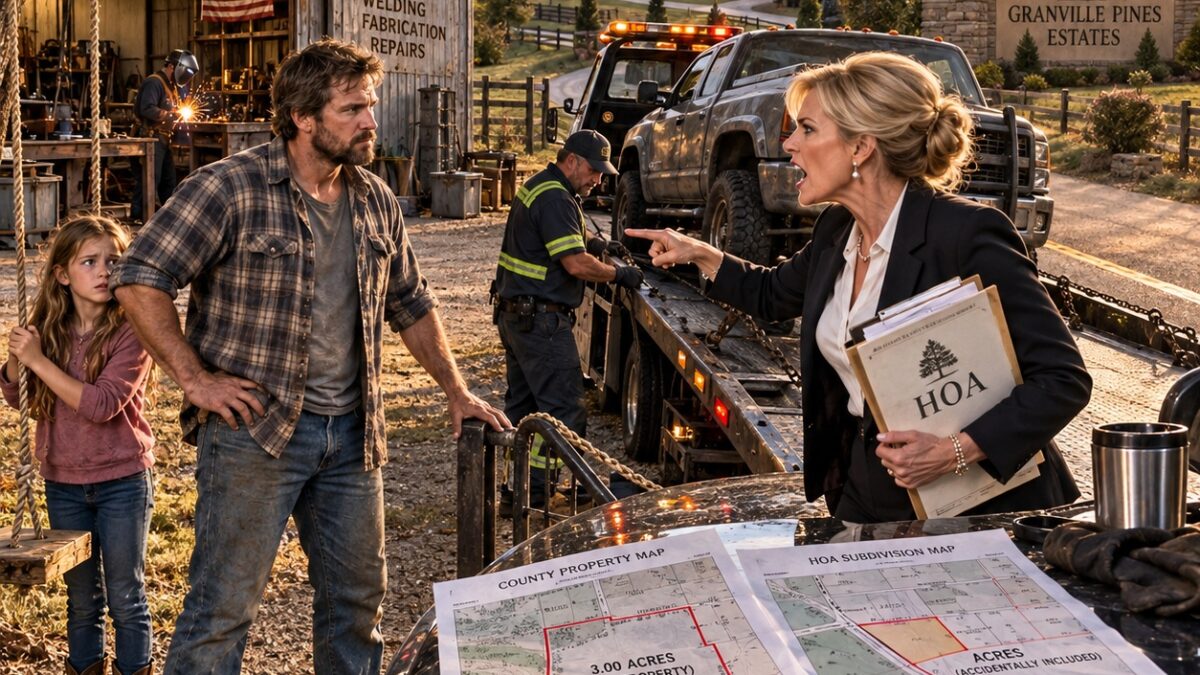
The tow truck left first.
Its driver barely looked at Brenda before climbing into the cab.
I could not blame him.
He had arrived expecting a normal HOA tow.
Instead he had discovered the HOA president had sent him onto property she did not control to remove a truck she did not own.
Two neighbors stood across Bell Haven Road watching.
Nobody said anything.
Brenda did.
“You cannot park commercial equipment in a residential neighborhood.”
“I don’t live in your neighborhood.”
“You live beside it.”
“Correct.”
“And your property affects our values.”
“Still not your property.”
She held the latte against her hip.
Her face stayed pleasant.
That was something I learned about Brenda quickly.
She could make a threat sound like an invitation.
“I think you should consider being more cooperative.”
“I think you should get off my grass.”
For the first time, the smile disappeared completely.
Only for a second.
Then it returned.
“We’ll see.”
She walked to the Escalade.
Drove away.
I stood in the driveway looking from my truck to the barn.
Everything I used to support Lily was on those three acres.
The shop.
Equipment.
Steel.
Tools.
The house.
The truck.
Somebody had just tried to physically remove one of those things because she disliked seeing it.
That changed the problem.
Until then, Brenda had been irritating.
Now she was willing to act.
The next complaint came through Granville County.
Hazardous industrial noise.
Toxic welding fumes.
Structural vibrations.
The language made my one-man fabrication shop sound like a steel mill.
County Code Enforcement sent Warren.
Quiet man.
Clipboard.
Decibel meter.
He checked the ventilation system.
Reviewed my home-occupation permit.
Measured the sound level at the property boundary while I ran the grinder.
Sixty-two decibels.
Normal conversation is around sixty.
Warren looked at the meter.
Then looked toward Granville Pines.
“Everything’s in order.”
“No violation?”
“None.”
He signed the report.
I put it into a folder in my kitchen drawer.
That folder became important later.
At the time, I thought it was simply something to keep in case Brenda complained again.
She did.
An email went to all 142 Granville Pines homeowners.
Subject:
URGENT SAFETY HAZARD ON BELL HAVEN ROAD
My property was described as an industrial eyesore.
Clear and present danger.
Children at risk.
Property values threatened.
She attached photographs of my barn.
Truck.
Steel tubing.
All sitting legally on my land.
Three residents called the county afterward.
Every complaint was investigated.
Every complaint dismissed.
I was beginning to run out of ways to be found legal.
Brenda was not running out of ways to accuse me.
Then Lily came home from the school bus stop.
She put her backpack beside the kitchen table.
Opened her math book.
Then said:
“Daddy?”
“Yeah?”
“A lady told Mrs. Patterson our house is dangerous.”
I stopped.
“Which lady?”
“The blonde one with the white car.”
Brenda.
Lily did not cry.
That made it worse.
She looked at me with Sarah’s brown eyes.
“Is she going to make us move?”
I sat across from her.
“Nobody is making us move.”
“She said our house doesn’t belong here.”
“This is Grandpa Ray’s land.”
She nodded.
“Our family had it before Granville Pines existed.”
Another nod.
“You’re safe.”
She looked down at her worksheet.
“Okay.”
Then went back to fractions.
I watched her pencil move.
Something in me changed.
Adult harassment was one thing.
Using a nine-year-old child as part of a neighborhood pressure campaign was another.
That night, after Lily was asleep, I sat in Sarah’s old chair on the back porch.
The cushion was faded.
On still nights I could almost convince myself it retained the smell of her lotion.
The oak creaked.
Somewhere beyond the property line, a coyote called.
I held cold coffee and thought about Brenda talking about my home at a school bus stop.
I was not angry in the way people expect anger to look.
No pacing.
No shouting.
I started paying closer attention.
A few days later, I drove past the subdivision entrance.
GRANVILLE PINES ESTATES — EST. 2015
My deed said 1968.
That difference sat in my head.
Forty-seven years between my grandfather buying the property and the first Granville Pines house.
Boundaries are supposed to mean something.
I began wondering whether Brenda understood ours.
Saturday morning answered that.
Three orange traffic cones and a wooden sawhorse blocked the county road leading to my driveway.
A hand-painted sign had been zip-tied across it.
GRANVILLE PINES AUTHORIZED RESIDENTS ONLY
I stood there in sweatpants holding coffee.
Bell Haven Road was County Road 1140.
Maintained with county money.
Public road.
The HOA no more owned it than it owned the moon.
I moved the cones.
Went to work.
Eight hours later, they were back.
Same position.
Same sign.
Straighter than before.
That was when I called the sheriff’s non-emergency line.
Deputy Tom Stokes arrived twenty minutes later.
Forty-one.
Crew cut.
Calm.
The kind of officer who looked like very little surprised him anymore.
He read the sign.
Looked at the road.
Then sighed.
Brenda’s Escalade arrived before he finished.
She stepped out.
“Officer, that man’s property is a hazard to this community and I have every right—”
Stokes raised a hand.
“Ma’am, is this County Road 1140?”
“It’s an HOA access road.”
“No, ma’am.”
He pointed toward the pavement.
“This is county-maintained roadway.”
Brenda stared.
“You cannot block it with private signs.”
Her mouth opened.
Closed.
“Remove the barriers or I’ll cite you for obstruction.”
For the first time since I had met her, Brenda could not convert the situation into another speech.
She picked up the cones.
Carried them to the Escalade.
Loaded the sawhorse.
Left.
Stokes watched her go.
“She do this often?”
“First roadblock.”
“First?”
“There was a tow truck.”
He looked at me.
“Call if anything else happens.”
Two days later, something else happened.
A petition.
Brenda asked the Granville Town Council to annex parcel 7842-B into Granville Pines Estates.
My parcel.
She had collected eighty-nine signatures.
That was when Hank Jennings got involved.
Hank owned the next non-HOA parcel.
Seventy-four years old.
Retired county surveyor.
He had lived there before Granville Pines existed anywhere except a developer’s imagination.
We sat on his porch drinking coffee.
“She can’t just annex you into an HOA because eighty-nine people sign a petition.”
“I know.”
“She needs a legal basis.”
“Does she have one?”
Hank looked toward the subdivision.
“Go pull the plat.”
“What am I looking for?”
“Boundary.”
He took another sip.
“Something didn’t look right last time I saw it.”
The next morning I drove to the Granville County Clerk’s Office.
I pulled the recorded subdivision documents.
There were two plat maps.
The first dated 2015.
Original Granville Pines Estates.
Parcel 7842-B sat clearly outside the HOA boundary.
No ambiguity.
A black line stopped on the west side of my three acres.
My property was separate.
Exactly as my deed said.
Then I opened the second map.
Same subdivision name.
Same general format.
Same county recording system.
But one thing had changed.
The eastern boundary had moved.
Not by accident.
Not a few feet.
Exactly far enough to swallow parcel 7842-B.
My grandfather’s land had been redrawn inside Granville Pines.
I sat staring at the screen.
Then I checked who filed the amendment.
Callaway Development Group.
Owned by Doug Callaway.
Brenda’s husband.
I pulled the Planning Commission minutes.
Doug had been serving as a member when the amended plat came up.
He voted to approve it.
Nothing in the minutes disclosed that his own company had filed the amendment.
I read the record again.
Same answer.
His company submitted the map.
He sat on the commission.
He voted.
No disclosed conflict.
I requested every property-related record I could find.
Three days later, another envelope arrived.
This one changed everything.
Eighteen months after Sarah died, when medical debt was still sitting on me and the business had barely stabilized, a company called Bell Haven Partners LLC contacted my mortgage lender about purchasing my loan note.
Managing member:
Douglas W. Callaway.
I stopped reading.
Then started again.
Bell Haven Partners.
Doug.
Mortgage note.
Then I found the development concept.
Twelve townhomes.
Three acres.
My three acres.
The tow truck suddenly looked different.
So did the violation letters.
Noise complaint.
Environmental complaint.
Road blockade.
Annexation petition.
Brenda had not become obsessed with my truck because she disliked a muddy Dodge.
She and Doug needed my property.
The existing Whitfield parcel interrupted what they considered the next phase of development.
And when Sarah died, they apparently decided a widowed welder with a young daughter, medical debt, and an old barn might be easier to pressure than somebody who understood what was happening.
I sat in my truck in the clerk’s parking lot holding a copy of the 1968 deed.
Ray Whitfield’s signature at the bottom.
Careful handwriting.
My hands shook.
Not fear.
Clarity.
That is a different feeling.
When you finally see why every strange thing has been happening, the confusion disappears.
You still have a problem.
But now it has a shape.
I called Linda Marsh.
Hank recommended her.
Real-estate attorney in Henderson.
Forty-six.
Short hair.
No jewelry.
Direct handshake.
I laid everything across her conference table.
1968 deed.
2015 plat.
2021 plat.
Planning Commission minutes.
Mortgage inquiry.
Violation notices.
Linda read silently.
Compared maps.
Read the commission record twice.
Then looked at me.
“This isn’t an HOA dispute anymore.”
“What is it?”
“Potential fraud involving a public land record.”
She tapped Doug’s vote.
“And a conflict problem.”
She clicked her pen.
“We need everything.”
She filed the records request.
Eleven days later, forty-three pages arrived.
Emails between Doug Callaway and a planning-office employee named Stevens.
Most ordinary.
Three were not.
One:
Just get it filed before the quarterly audit. Nobody checks these.
Another asked that the amendment be expedited without committee review.
The third referred to the Whitfield parcel as:
the last piece of the Phase 2 puzzle.
I read that phrase three times.
Last piece.
My daughter’s swing.
My grandfather’s barn.
My shop.
Sarah’s porch chair.
Three acres reduced to the last piece in somebody else’s development puzzle.
Linda put the email down.
“He handed us intent.”
“What now?”
“We keep building.”
That word made sense to me.
Building was something I knew.
So while Linda built the legal case, I built cameras.
Six of them.
Hardwired.
Weatherproof housings fabricated in my own shop from scrap steel.
Flat-black powder coating.
One on the barn.
One on the house.
Two facing driveway and road.
Two on the HOA side.
Cloud backup.
Ninety-day storage.
Conduit buried along the fence.
I had spent six years in the Seabees.
We were taught to build things that kept working under conditions where pretty did not matter.
My system was not pretty.
It worked.
I also started a binder.
Three-inch rings.
Heavy gauge.
The 1968 deed first.
Then 2015 plat.
2021 plat.
Doug’s commission attendance.
Vote.
Emails.
Brenda’s letters in chronological order.
Warren’s clearance forms.
Noise measurements.
Sheriff report from the roadblock.
Photographs.
Mortgage records.
Everything tabbed.
Everything dated.
Four pounds of paper.
Then I built the gate.
Stress does strange things to people.
Some drink.
Some run.
Some go to therapy.
I went into my barn after Lily fell asleep and welded an eight-foot wrought-iron gate.
Quarter-inch steel letters.
Plasma-cut.
Ground smooth.
Welded across the top.
WHITFIELD EST. 1968
Hank came by while I was grinding the final welds.
Sparks moved across the floor.
He watched for a while.
“I surveyed this section in 2014.”
“I know.”
“Your parcel wasn’t inside that HOA.”
“I know.”
“You need me to testify?”
I stopped grinding.
“Will you?”
He nodded once.
Then left.
The first physical retaliation caught by the new cameras came on a Wednesday.
I returned from a Wake Forest job to find the entrance to my driveway buried beneath roughly three tons of crush-and-run stone.
Not spilled.
Deliberately dumped across the full width.
I parked along Bell Haven Road.
Opened the camera app.
10:14 a.m.
White Escalade.
Brenda.
Six minutes later, dump truck.
She pointed toward my driveway entrance.
The driver backed up.
Raised the bed.
Dropped the load.
I saved the footage.
Cloud copy.
Local copy.
Printed still frame.
Binder.
Then somebody shut off our water.
The kitchen faucet coughed.
Then nothing.
I traced the supply.
The shutoff valve sat inside a utility easement along the property line.
Closed hard.
Camera footage showed a man wearing a Granville Pines maintenance polo arriving at 5:47 that morning.
He opened the valve box.
Turned the handle.
Walked away.
County water utility sent a technician.
He confirmed the connection predated Granville Pines by forty-seven years.
The HOA had no authority over it.
Unauthorized tampering with the public water system.
Another report.
Another still photograph.
Another binder tab.
Letters had become towing.
Towing had become road obstruction.
Then gravel.
Then utility interference.
The escalation was no longer subtle.
Doug joined more directly when somebody asked the county to reclassify my welding business from a home occupation to light industrial use.
That could have forced rezoning and potentially shut down my work during review.
Warren came back.
Same inspector.
He checked everything again.
Shop square footage.
Client traffic.
Permits.
Operations.
Still legal.
Before leaving, he stopped at the new gate.
“Mr. Whitfield.”
“Yeah?”
“Somebody with influence is pushing these complaints.”
“I figured.”
“I’ve cleared you twice.”
“I appreciate it.”
“I’ll clear you again if that’s what the facts support.”
He looked at the gate.
“Nice work.”
“Thanks.”
“I hear you’re a welder.”
That almost made me smile.
Brenda’s Facebook post arrived Sunday night.
Seventeen photographs.
My truck.
Barn.
Steel.
Tools.
One close-up showed Lily’s bicycle against the porch railing.
That bothered me most.
The post called my property an illegal junkyard operating next to children.
She tagged county code enforcement.
Sheriff’s department.
Local news.
Residents split in the comments.
Some supported her.
Others pushed back carefully.
I screenshotted everything.
Binder.
Then came the call that changed my patience into something harder.
Granville County Department of Social Services.
Child Protective Services.
Anonymous report.
Minor child allegedly living near dangerous industrial materials and unsupervised heavy machinery.
I stood inside the shop holding the phone.
Grinding dust still on my shirt.
For several seconds I could not speak.
Then I said:
“You can inspect today.”
The caseworker arrived at three.
Ellen.
Professional.
Calm.
She walked through the house.
Lily’s bedroom.
Kitchen.
Bathroom.
Living room.
Homework on the table.
Dishes done.
Then the shop.
I showed her the locked separation gate.
Safety barriers.
Fire extinguishers.
Ventilation.
Tool cabinets.
Concrete curb.
Forty-two feet between shop and house.
She wrote everything down.
Then closed the notebook.
“Your daughter is clearly well cared for.”
“Thank you.”
“No safety concern.”
She paused.
“I’ve done this fourteen years.”
I waited.
“I can usually tell when somebody calls because they’re worried about a child.”
Another pause.
“And when somebody uses the system as a weapon.”
She left.
Case closed.
I stood in the doorway after her car disappeared.
The shop was quiet.
That silence hit differently.
Brenda and Doug had tried to tow my truck.
Fine.
They had tried to shut down the shop.
Fine.
They had blocked the road.
Turned off the water.
Dumped gravel.
Redrawn a map.
But somebody had dragged Lily into it through a government system designed to protect abused children.
That crossed every line I had left.
I went into the house.
Lily was asleep later that night when I sat beside her bed.
Hair across the pillow.
One arm around the stuffed dog she had owned since she was four.
Sarah’s face existed in hers in little ways.
The eyes.
Shape of the mouth.
Expression when concentrating.
I sat there thinking about Granddad.
Sarah.
The barn.
Oak.
Lily’s swing.
Four generations touching three acres.
The Town Council annexation hearing was twelve days away.
That was where I wanted the story to stop being private.
I called Linda the next morning.
“We’re ready.”
“The whole binder?”
“Every page.”
The last two weeks moved fast.
Linda and I rehearsed.
Hank contacted a reporter named Phil Huitt at the Granville County Register.
Phil started asking questions around town.
I finished installing the gate.
Lily helped paint the posts.
The brush was too big for her hands.
She refused a smaller one.
When we finished, black iron framed the driveway.
WHITFIELD EST. 1968
Brenda drove past that afternoon.
Slowed.
Lowered the window.
Stared for about ten seconds.
Then continued.
The hearing took place the first Tuesday of the month.
Granville Town Council.
By 6:15, the parking lot was full.
More than sixty people came.
HOA residents.
Non-HOA neighbors.
Others who apparently heard enough rumors to want seats.
Deputy Tom Stokes stood against the back wall.
Phil sat in the second row with a notebook.
Councilwoman Patricia Voss opened the meeting at seven.
Silver hair.
Reading glasses on a chain.
She reached agenda item four.
“Petition for annexation of parcel 7842-B into Granville Pines Estates Homeowners Association.”
Brenda stood.
Cream blazer.
Laptop.
Fourteen slides.
She spoke twelve minutes.
Community standards.
Property-value protection.
Eighty-nine resident signatures.
My truck described as blight.
My property described as persistent nuisance.
Then she projected the 2021 amended plat.
The fake boundary.
The one putting my land inside her HOA.
She smiled through the entire presentation.
Polite applause followed.
Voss adjusted her glasses.
“Response from the property owner?”
I stood.
Work boots.
Clean flannel shirt.
Binder under my arm.
I put it on the podium.
Four pounds of paper sounded heavier in that room.
“I’d like to show two maps.”
First:
2015 plat.
Projected on the wall.
Granville Pines boundary.
Parcel 7842-B clearly outside it.
“This is the original recorded subdivision plat.”
I pointed.
“That is my property.”
Then:
2021 amendment.
Side by side.
People could see the line had moved.
“This amendment shifts the boundary east and places my parcel inside the HOA.”
Doug sat in the fourth row.
Polo shirt.
Pressed khakis.
I turned toward him.
“The amendment was filed by Callaway Development Group.”
Several heads turned.
“Owned by Doug Callaway.”
Now the room looked directly at him.
“Mr. Callaway was sitting on the Planning Commission when this amendment came for approval.”
Linda passed me the minutes.
“He voted to approve it.”
I held up the record.
“I can find no disclosed conflict in these minutes.”
The room went silent.
Then I read Doug’s emails.
Just get it filed before the quarterly audit. Nobody checks these.
I looked up.
“Somebody checked.”
A sound moved through the room.
Not laughter exactly.
Recognition.
Linda stood.
Presented Bell Haven Partners LLC.
Doug as managing member.
The inquiry into my mortgage.
The plan for twelve townhomes.
Then she spoke clearly.
“This was not a disagreement over aesthetics.”
She placed a document on the evidence table.
“This was a coordinated effort to pressure Mr. Whitfield off land his family has owned since 1968 so an affiliated developer could acquire it at a distressed value.”
Whispers became voices.
I opened the binder again.
Tow attempt.
Code reports.
Road-block incident.
Gravel dump.
Water interruption.
CPS investigation.
All documented.
I returned to the microphone.
“I’m not in Granville Pines.”
Then:
“I have never been in Granville Pines.”
Brenda sat motionless.
“No fake map, tow truck, pile of gravel, closed water valve, violation letter, or child-welfare complaint can change my deed.”
I closed the binder.
The metal rings snapped shut.
Councilwoman Voss removed her glasses.
“The petition is denied.”
The room went quiet again.
“The 2021 plat amendment is being referred to the county attorney for immediate review.”
She looked toward Doug.
“Mr. Callaway, you are suspended from the Planning Commission pending investigation.”
Doug stood.
Deputy Stokes took two steps forward.
“Sir, remain here.”
Doug sat.
Brenda did not move.
Phil Huitt’s pen was moving so fast I could hear it against the paper.
Someone began clapping.
Then another.
Then most of the room.
I picked up the binder.
Returned to my chair.
Hank sat behind me.
He gave one nod.
The same one he had given in the barn.
Nothing more needed saying.
The fallout moved quickly.
Doug was formally removed from the Planning Commission.
The county attorney opened an investigation into the plat amendment.
Within a month, Doug faced a felony charge tied to the false filing affecting real property.
His development license was suspended while the case moved forward.
Bell Haven Partners dissolved.
The attempt involving my mortgage note was voided by a judge.
Brenda faced separate consequences tied to trespass, the gravel dumping, water tampering, and the false CPS report.
Her attorney negotiated.
The final outcome included community service.
Restitution.
And a permanent no-contact order protecting Lily and me.
The Granville Pines HOA acted before the legal cases finished.
One hundred four residents voted to remove Brenda.
Twelve voted to keep her.
A new board took over.
Nobody came to my house carrying an embossed compliance guide.
That helped.
Three residents eventually knocked on my door to apologize.
Gail, a retired teacher from the corner house, brought pie.
“I knew those letters were wrong.”
I looked at her.
“Why didn’t you say anything?”
She looked down.
“I was afraid she’d start sending them to me.”
That answer hurt more than I expected.
Not because I blamed Gail.
Because it showed what Brenda’s presidency had become.
People living in a neighborhood association had become afraid to disagree with the neighborhood association.
Gail held up the pie.
“I’m sorry.”
I took it.
“The pie’s enough.”
Callaway Development Group settled the civil case for $285,000.
That money covered harassment damages.
Lost income from jobs I had missed.
Linda’s legal fees.
And the emotional harm associated with everything that happened, including CPS showing up at the home of a father raising his daughter alone.
It was more money than Granddad had paid for the land.
I did not buy a new truck.
The Ram still worked.
Did not remodel the house.
Did not pave the gravel driveway so somebody else would approve.
I used part of the settlement to create the Whitfield Workshop Scholarship.
Trade-school education for children of military veterans.
Welding.
Electrical.
Plumbing.
HVAC.
The jobs that build houses.
Fix systems.
Keep water moving.
Keep gates standing.
The first recipient was announced at the Granville County Fair that October.
Nineteen-year-old kid from Fort Bragg.
Father had served two tours in Iraq.
Mother worked night shifts at a textile plant.
He wanted to become a pipe fitter.
I watched him accept the scholarship and remembered being nineteen behind Ray Whitfield’s barn with a borrowed welder.
Bad first beads.
Burned gloves.
Granddad telling me to try again.
There are many ways to answer greed.
I liked that one.
Doug and Brenda sold their house three months after the hearing.
Quietly.
No open house.
No big announcement.
One morning, the Escalade disappeared from Bell Haven Road.
I never asked where they went.
Hank and I sat on his porch drinking coffee.
He looked toward the empty Callaway driveway.
“Took her long enough.”
That was all.
Saturday, I hosted a cookout.
Lily helped set up folding tables under the oak.
Hank brought cast-iron cornbread.
People came from Granville Pines.
People came from outside it.
Kids ran through the grass.
Somebody played Creedence Clearwater Revival loud enough to reach Bell Haven Road.
Nobody filed a complaint.
Lily got on the swing.
Pumped higher.
Higher.
For one second I had the usual father’s instinct to tell her to slow down.
Then she came back down laughing.
Exactly like always.
I stood under the oak listening.
That was the sound I had protected.
Not the truck.
Not the barn.
Not even the deed by itself.
That.
A nine-year-old girl feeling safe enough to fly over red clay in the yard her great-grandfather bought.
Phil’s story ran the following week.
HOA president and developer husband exposed in land-grab scheme at town hearing.
Other outlets picked it up.
Brenda declined to comment.
I went back to work.
That mattered more.
A church in Durham needed a railing.
Family in Cary wanted a fire pit.
The blue-white welding arc returned to being the brightest thing in my evenings.
Through the open barn door I could see Lily’s swing.
The gate beyond it.
WHITFIELD EST. 1968
For months, Brenda had spoken as though age made my property obsolete.
Gravel.
Old barn.
Work truck.
Welder.
Things she believed lowered the value of what surrounded us.
She never understood that value and polish are not the same thing.
Granddad’s barn did not need to resemble an HOA clubhouse to matter.
The Dodge did not need to be clean enough for a sales brochure to earn money.
My shop did not need luxury finishes to support a family.
Red clay did not become worthless because somebody built expensive homes beside it.
That was the first error.
The second was jurisdiction.
Brenda’s title mattered inside Granville Pines.
That did not make her mayor.
Sheriff.
Judge.
Utility operator.
County engineer.
Planning authority.
Landowner.
She kept stepping outside the limits of her actual power because every previous success made the next one feel possible.
Send a violation.
Nobody pushes back.
Send another.
Call code enforcement.
Pressure a resident.
Block a road.
Order a tow.
Dump gravel.
Shut off water.
Call CPS.
Once people start treating “no” as something they are entitled to overcome, escalation becomes easy.
That is what happened.
The first time I told Brenda my parcel was outside the HOA, the correct answer would have been:
Let me check.
She never checked.
The tow operator did.
Deputy Stokes did.
Warren did.
Ellen did.
Hank did.
Linda did.
I did.
Eventually the Town Council did.
Every time somebody neutral examined the record, Brenda’s authority got smaller.
But she was not merely stubborn.
That was the part the county files revealed.
Doug had a financial reason my land needed to become vulnerable.
Twelve townhomes.
Three acres.
My three acres.
The altered 2021 plat was not somebody misreading an old boundary.
The emails removed that possibility.
Nobody checks these.
Four words.
Doug had built the whole scheme around an assumption that ordinary people do not read records.
He was almost right.
Most people do not visit the clerk’s office unless they have a reason.
Most do not compare two versions of a subdivision plat side by side.
Most do not request commission minutes.
Most do not search LLC registrations.
People have jobs.
Children.
Bills.
Life.
That is exactly why public systems depend on officials behaving honestly.
You should not need a retired surveyor living next door to tell you a plat boundary was moved.
Hank gave me the question.
The county record gave me the answer.
Linda turned the answer into a legal case.
The process mattered.
If I had confronted Brenda the day I discovered the map, she would have denied it.
Doug would have lawyered up immediately.
Maybe records would still exist.
Maybe not all of them.
Instead, we documented quietly.
That was another thing the Seabees taught me.
Do not start building before you understand the ground.
Same with a case.
Foundation first.
Granddad’s deed.
Original plat.
Amended plat.
Minutes.
Emails.
Mortgage inquiry.
Development concept.
Then every act of pressure layered over those documents.
By the hearing, Brenda’s presentation about aesthetic standards looked tiny beside the paper trail.
That was why the binder mattered.
Not theatrically.
Practically.
For months, she had controlled the story through letters.
The binder placed all her letters into chronology.
That changes things.
One complaint might look legitimate.
Five after repeated county clearance look different.
One road sign might look like confusion.
Road blockade after tow attempt looks different.
One maintenance worker closing a valve might look like error.
Placed beside the other conduct, it becomes part of a pattern worth investigating.
Chronology gives behavior context.
I learned that the hard way.
So did Brenda.
The CPS report remained the part I had the most trouble forgiving.
Not because Ellen believed it.
She did not.
Not because Lily was removed.
She was not.
The case closed immediately.
But somebody had used a system designed for children in actual danger as leverage against a family in a property dispute.
That kind of act damages more than the target.
Caseworkers have limited time.
Real children need them.
Ellen spent part of an afternoon walking through a safe house because somebody wanted to increase pressure on a widower.
That should bother anyone.
It bothered the judge.
It bothered Linda.
It bothered me.
I never told Lily every detail.
She knew a woman came to make sure the shop was safe.
That was enough for a nine-year-old.
Children do not need adult warfare dumped into their laps.
She had already lost Sarah.
I refused to make her carry Brenda too.
When I established the scholarship, Lily helped me choose the name.
I suggested something generic.
Granville County Trades Fund.
She hated it.
“Use our name.”
“Why?”
“Because Grandpa Ray built stuff too.”
That ended the discussion.
Whitfield Workshop Scholarship.
She was right.
The fund belonged to the same story as the land.
Ray used his hands.
My father grew up under that oak.
I went into the Seabees.
Came home.
Welded.
The scholarship was not about proving trades were better than college.
They are not.
It was about respecting the people who make things work.
The same kinds of people Brenda looked down on.
Tow operators.
Welders.
Utility workers.
Pipe fitters.
Electricians.
Construction crews.
People whose boots are dirty because their jobs happen in the physical world.
The first recipient understood that.
I shook his hand at the county fair.
Strong grip.
Nervous smile.
He said:
“Thank you, sir.”
I said:
“Build something good.”
That was all the speech I had.
Hank approved.
At least he nodded.
Hank’s nod was basically applause.
Granville Pines changed after Brenda left.
Not overnight.
People who had spent years worrying about fines needed time to realize disagreement was allowed again.
The new board reviewed procedures.
Stopped sending notices outside HOA boundaries.
That sounds absurd when written down.
It should have been obvious.
But obvious boundaries are the ones people sometimes ignore first.
No one asked to absorb my parcel afterward.
No one tried moving the map.
My gate settled into the entrance like it had always belonged there.
Black iron.
Raised steel letters.
WHITFIELD EST. 1968
I did not build it as a threat.
It was a reminder.
To myself as much as anyone.
This existed before them.
Sarah had loved the old driveway.
She once told me not to pave it.
“Gravel sounds like home when tires come in.”
I thought she was sentimental.
Then after she died, I understood.
You learn the sound of the people you love arriving.
Her car used to crunch up that drive around five-thirty.
Lily would run to the window.
I would hear the kitchen door two seconds later.
That sound disappeared after Sarah.
Maybe that was one reason Brenda’s tow truck bothered me so deeply.
She saw a gravel driveway and muddy truck.
I saw arrivals.
Work.
Family.
History.
People do not get to measure your home using only what it looks like from the road.
They do it anyway.
That is human.
But judgment does not create jurisdiction.
Brenda repeatedly confused taste with authority.
My barn looked ugly to her.
Therefore it should disappear.
My truck looked commercial.
Therefore she could tow it.
My gravel looked cheap.
Therefore Granville Pines should control it.
My shop produced sparks.
Therefore my daughter must be unsafe.
Every conclusion began with:
I don’t like this.
Then ended with:
Therefore I have power over it.
That is the dangerous leap.
Power should come from law.
Contract.
Ownership.
Actual responsibility.
Not preference.
The new board understood that better after paying the cost of Brenda’s approach.
One Granville Pines resident who had signed the annexation petition came to my cookout.
He stood near the barn holding a plate.
“I signed it.”
“I know.”
“You know?”
“The petition was public.”
He looked embarrassed.
“She told us your property was already legally inside the HOA and you were exploiting a loophole.”
“That wasn’t true.”
“I know that now.”
He looked at the gate.
“I should’ve checked.”
I shrugged.
“So should a lot of people.”
He waited.
Maybe expected anger.
I handed him another rib.
That was enough.
Holding 142 residents personally responsible for Brenda and Doug would have been ridiculous.
Many had been lied to.
Some believed what their HOA president told them because that is what people do with institutions they assume are operating normally.
Once the truth came out, 104 voted her out.
That matters.
People are allowed to be wrong and then correct themselves.
I would want the same grace.
Gail’s pie became part of the joke in our house.
Lily loved it.
When it was nearly gone, she said:
“Do you think she’ll apologize again?”
“Why?”
“So she brings another pie.”
That sounded like Sarah.
I laughed harder than the joke deserved.
Grief works that way.
Some small phrase unexpectedly carries the dead back into the room.
Not as sadness every time.
Sometimes as humor.
Those moments became more frequent as Lily got older.
That helped.
The land helped too.
Roots matter after loss.
Not metaphorically alone.
Actual roots.
Oak roots.
Property lines.
A place that stays when everything else changes.
After Sarah died, selling would have been financially understandable.
Medical debt was real.
Business slowed.
Doug knew that.
That was why Bell Haven Partners approached the lender.
Maybe he believed I would eventually fold.
Maybe another person would have.
No shame in that.
Three acres are not sacred simply because family once owned them.
People sell land for good reasons every day.
What made Doug’s behavior wrong was not wanting the property.
He could have knocked on the door.
Made an offer.
I could have said yes or no.
Instead, the scheme tried to manufacture distress.
That is completely different.
Choice matters.
He wanted my no to become expensive enough that I would eventually say yes.
Brenda supplied the pressure.
Doug supplied the development objective.
The fake map supplied the appearance of authority.
Once those three pieces aligned, everything else made sense.
My favorite part of the hearing was not the applause.
It was the moment Voss put the two maps side by side.
People could see it.
No lawyer needed.
No complicated argument.
A line in 2015.
A different line in 2021.
Some truths become powerful because they are simple.
Why did the boundary move?
Who filed it?
Who voted?
Who benefited?
Answer those four questions.
The whole structure appeared.
Doug’s email made it worse.
“Nobody checks these.”
I thought about that sentence often afterward.
Institutions weaken when people assume nobody checks.
Good systems depend on somebody checking.
Auditors.
Clerks.
Reporters.
Attorneys.
Neighbors.
Citizens.
A county map seems boring until someone tries to steal three acres with one.
Records matter because memory can be challenged.
Granddad had told me the land was ours.
Fine.
The deed proved it.
Hank remembered the survey.
Fine.
The 2015 plat proved it.
I believed Brenda ordered the gravel.
Fine.
The camera proved it.
I believed someone shut off the water.
Camera plus utility technician.
Proof.
Anger is not evidence.
That became my rule.
Every time something happened, I wanted to react.
Instead:
Save video.
Print still.
Get report number.
Date it.
Binder.
It did not feel heroic.
It felt tedious.
That is what most successful defense looks like.
Tedious until the room needs facts.
Linda understood.
She never encouraged me to retaliate.
When I asked whether we could sue immediately, she said:
“We can do a lot of things immediately.”
Then:
“That doesn’t mean we should.”
She wanted the complete record.
By the time the hearing happened, we had it.
The civil settlement came later because the same record supported that case.
Lost work was documented.
Harassment was documented.
CPS visit documented.
Legal costs documented.
Everything Brenda and Doug treated as momentary inconvenience became part of a financial calculation.
$285,000.
That number got attention.
But money was not the part that mattered most.
The no-contact order did.
Lily no longer needed to see Brenda at the bus stop.
No more Escalade slowing near the drive.
No maintenance worker near the valve.
No notices.
Peace has economic value that never appears on settlement statements.
The first month after they left, I noticed how quiet Bell Haven Road felt.
No tension every time a white SUV appeared.
No checking cameras every hour.
I still kept the system.
Useful.
But eventually I stopped opening the app unless an alert appeared.
That was recovery.
You know stress is leaving when you stop scanning.
Lily stopped asking whether anybody could make us move.
She asked normal questions again.
Could she paint the swing seat purple?
Could she have a friend sleep over?
Could we get a dog?
Those were better problems.
I said yes to the purple.
Maybe to the sleepover.
No to the dog at first.
I lost that vote eventually.
Nine-year-olds are surprisingly effective negotiators without needing an HOA.
The shop continued.
The home-occupation permit stayed what it had always been.
Legal.
The barn did not become cleaner because Brenda left.
Steel still sat where steel belongs.
The truck still got muddy.
Sometimes the grinder was louder than sixty-two decibels closer to the machine.
That is what grinders do.
Warren occasionally passed on county work.
He would wave.
Once he stopped when I was installing a railing onto a trailer.
“How’s business?”
“Busy.”
“Any complaints?”
“Only from customers waiting.”
He nodded toward the gate.
“Still like that.”
“Thanks.”
Then left.
Ordinary interactions started feeling luxurious.
No accusation.
No agenda.
Just two people talking.
The Callaways had occupied so much emotional space that their absence took getting used to.
People who create conflict can trick you into organizing your entire life around them.
Do not.
That became another lesson.
For months, my evenings were binder, camera, lawyer, records.
Necessary.
Then it ended.
I made myself stop adding tabs.
The case belonged to Linda and the courts.
The property belonged to us.
Those needed to become separate again.
So I welded.
Cooked for Lily.
Sat in Sarah’s chair.
Had coffee with Hank.
Built scholarship paperwork.
Normal life.
Doug’s charges and licensing problems moved forward without me needing to watch every step.
Brenda’s legal outcome moved forward.
Community service.
Restitution.
No contact.
Enough.
I did not need a prison sentence invented for drama.
I did not need public humiliation beyond what the official record already created.
The objective had been simple.
Stop.
Stay off my property.
Leave my child alone.
Correct the false boundary.
Protect the business.
Everything else was secondary.
Once those things happened, obsession would have turned victory into another kind of prison.
Sarah would have hated that.
She was practical.
When something was finished, she moved on.
One of her favorite phrases was:
“Okay. What needs doing next?”
After cancer, that phrase haunted me.
Because eventually there was nothing left medicine could do next.
Then, after she died, life kept asking it anyway.
Lily needs breakfast.
What next?
Client needs gate.
What next?
Bills.
What next?
The Callaways.
What next?
Hearing.
What next?
Scholarship.
What next?
Living.
That is the part no one tells you about grief.
Continuing is mostly task management until it starts feeling like life again.
The Whitfield property gave me tasks.
Oak limbs.
Shop roof.
Driveway.
Swing hardware.
Fence.
Gate.
Ordinary maintenance kept me attached to the future.
That was what Doug misread.
He saw a widower under financial pressure.
He probably thought attachment to the land made me sentimental and therefore weak.
The land made me stubborn because it contained responsibilities.
Not because it was magical.
Because people trusted me with it.
Granddad.
Sarah.
Lily.
I could sell someday.
Maybe Lily will.
That will be her choice if it becomes hers.
But nobody was going to pressure us off it using a fake plat.
That was the line.
At the county fair, after the scholarship ceremony, Lily stood beside me eating something covered in powdered sugar.
She looked at the recipient walking away with his parents.
“Are you paying for his school?”
“Some of it.”
“Because of Brenda?”
I thought about that.
“The money came from the settlement.”
“So yes.”
“Sort of.”
She licked sugar off her thumb.
“That’s funny.”
“How?”
“She tried to make us leave and now somebody gets to go to school.”
I looked at her.
Children can summarize moral outcomes with embarrassing efficiency.
“Yeah.”
She smiled.
“Good.”
Then asked for lemonade.
That became the way I thought about the settlement.
Not compensation alone.
Conversion.
Someone tried using money and influence to shrink our life.
Part of that money now expanded someone else’s.
Better use.
The first pipe-fitter student would probably never meet Brenda.
No need.
He had his own future.
That is how consequences should move eventually.
Away from the offender.
Toward something useful.
The cookout under the oak worked the same way.
Granville Pines residents and non-HOA neighbors in the same yard.
The subdivision had physically surrounded us for years.
Brenda tried turning that geography into hostility.
The cookout reversed it.
People crossed from both sides because invited.
No annexation needed.
No covenant.
No boundary dispute.
Ownership and community are not the same thing.
That is another mistake Brenda made.
She assumed if my property affected Granville Pines, Granville Pines should control it.
But neighbors can affect one another without owning one another.
Smoke travels.
Noise travels.
Views cross property lines.
That creates duties of reasonableness.
Not automatic authority.
If my welding shop actually exceeded county limits, I would have fixed it.
If I dumped chemicals into a ditch, regulate me.
If the truck blocked public traffic, move it.
But none of that happened.
Every neutral inspection confirmed it.
The facts mattered more than feelings.
My place did not match Brenda’s preferred appearance.
That is allowed.
Different is not illegal.
Old is not blight.
Working land is not a defect simply because luxury houses arrived next door.
The original 2015 plat understood that.
The development ended at the line.
Everything would have been fine if the Callaways had respected it.
Doug wanted twelve more townhomes.
That made the line inconvenient.
Inconvenient boundaries are still boundaries.
Surveyors know that.
Hank knew.
That was why his quiet suggestion changed everything.
“Check the plat.”
No dramatic speech.
No conspiracy theory.
Just:
Look at the record.
I owe him more than coffee for that.
He would never accept more.
Retired surveyors are strange that way.
Give them a boundary problem and they consider solving it entertainment.
He testified when needed.
Confirmed his 2014 survey.
That support mattered.
Memory plus professional history.
Another independent piece.
Nobody beat the Callaways alone.
Linda.
Hank.
Stokes.
Warren.
Ellen.
Voss.
Phil.
Records clerks.
Utility technician.
Each person did a small part correctly.
That accumulated.
People like Brenda often appear powerful because they are visible.
Their opposition is distributed.
A caseworker here.
Deputy there.
Clerk.
Attorney.
Neighbor.
Reporter.
Nobody looks dramatic individually.
Together, they create accountability.
That is a healthier kind of power.
I appreciated it more after the case.
The new HOA board eventually sent me a letter too.
Not a violation.
Acknowledgment that parcel 7842-B was outside Granville Pines and not subject to its governing documents.
I gave it to Linda.
She laughed.
“Frame it.”
“I already have a gate.”
“Fair.”
I put the letter in the binder anyway.
Last tab.
Then I closed it.
For good.
The binder sits on a shelf in my office now.
Granddad’s original deed is back in safer storage.
The binder contains copies.
Sometimes I see it when looking for invoices.
I do not open it.
The better record is outside.
Three acres.
Barn.
Oak.
Swing.
Gravel.
Gate.
That is what survived.
Late afternoons are still my favorite.
If I am finishing a project, the barn door stays open.
Welder flashes blue-white.
Metal glows.
Outside, the sun hits the raised letters on the gate.
WHITFIELD EST. 1968
Lily’s swing moves under the oak.
Sometimes she is on it.
Sometimes wind moves it.
I still think of Sarah.
That never stopped.
It changed.
At first every memory was a cut.
Later some became warmth.
The porch chair.
Her voice.
The way she hated when I left welding gloves on the kitchen counter.
Lily’s eyes.
The land holds those things without needing a plaque.
That may be why Brenda’s campaign felt so invasive.
She was not arguing about three acres in the abstract.
She was stepping into a life she had not bothered to understand.
Then calling it ugly.
People can survive insults.
What matters is stopping insults from becoming control.
The first violation went into recycling.
Looking back, I should probably have saved it.
I saved everything after.
That became the practical lesson.
When somebody with institutional power repeatedly acts outside their authority, do not rely on memory.
Keep the letter.
Save the email.
Screenshot the post.
Get the inspection report.
Ask for the map.
Request the minutes.
Know your parcel number.
Know your deed.
Know the actual boundary.
You do not need to become paranoid.
You need records.
Brenda had confidence.
I had records.
By the hearing, confidence had nowhere to stand.
The image I remember most clearly is not Doug being suspended.
Not Brenda sitting silent.
Not applause.
It is the two maps on the screen.
One line moved.
That line contained the whole story.
On one side:
My actual property rights.
On the other:
What somebody powerful wanted people to believe.
Truth did not look dramatic.
Black ink.
White background.
Parcel number.
Sometimes that is enough.
The Callaways left.
Granville Pines remained.
Most residents turned out to be normal people who wanted to raise families and not think about HOA politics.
My property remained outside it.
Exactly where it had always been.
No grand annexation.
No Phase Two townhomes.
No crushed work truck.
No closed shop.
No child removed from home.
Just the life Brenda had called an eyesore continuing without her approval.
That felt right.
One evening, Lily came into the barn while I was finishing a railing.
She stayed behind the safety line.
Always.
I lifted the hood.
“Need something?”
She pointed toward the driveway.
Sun was setting through the oak branches.
The iron gate glowed along the top edge.
“Do you think Grandpa Ray would like it?”
“The gate?”
She nodded.
I looked at the letters.
“Yeah.”
“Do you think Mom would?”
That answer took longer.
Sarah had never liked anything too ornate.
Eight-foot wrought iron with steel lettering might have been pushing it.
“She’d say it was too much.”
Lily smiled.
“Then she’d tell everybody you made it.”
“Exactly.”
Lily looked toward the swing.
Then back at me.
“Can I go outside?”
“Homework done?”
“Mostly.”
“That means no.”
She groaned.
Normal.
Beautifully normal.
I lowered the welding hood again.
Sparks scattered across the concrete Ray Whitfield had poured decades earlier.
Outside, Granville Pines sat beyond the property line.
One hundred forty-two houses.
Nothing wrong with them.
Nothing wrong with mine.
Different.
Separate.
Neighbors.
That was all it ever needed to be.
Brenda Callaway’s first mistake was believing an HOA presidency gave her jurisdiction over anything she could see.
Doug’s was believing a county record could be quietly changed because nobody would bother looking.
Both mistakes depended on the same assumption.
That an old welder on three acres of red clay would be easier to move than a boundary line.
They were wrong.
The truck stayed.
The barn stayed.
The oak stayed.
Lily stayed.
And every evening, when the last sunlight catches the black iron over my driveway, the answer is still welded into the steel where anyone passing Bell Haven Road can read it.
WHITFIELD EST. 1968.








