FULL STORY:HOA Queen Told a 52,400-Lb Dump Truck to Ignore My 5-Ton Bridge Limit—She Had No Idea the Road Beneath It Was Wired to 14 Agencies
FULL STORY CONTINUATION
Tessa made the next move before my attorney and I could make ours.
Three days after I confronted her about the concrete truck, a thick manila envelope appeared in my mailbox.
Sixteen pages.
The title read:
AMENDMENT TO THE SOURWOOD CREEK CROSSING EASEMENT
I stood at my kitchen counter and read the first page twice because I genuinely thought I had misunderstood what they were attempting.
The document claimed to “modernize” the 1971 easement.
The original prohibition against commercial traffic?
Removed.
The weight-limit reference?
Removed.
The language restricting the crossing to residential traffic?
Replaced with a broad clause granting Eagle Ridge all “reasonable access necessary for community development and improvement.”
Then I reached the signature page.
Tessa Hulcom.
Roland Hulcom.
Felton Brackett.
Daria Pell.
Four people associated with the HOA.
Four signatures.
One problem.
None of those people owned my land.
I did.
An easement running across private property is not something the beneficiary can rewrite because its old limitations have become inconvenient.
I could no more amend the deed to Tessa’s house than she could unilaterally amend the recorded crossing rights on mine.
I scanned every page.
Sent everything to my attorney, Whitlock Trent, a slow-talking land-use lawyer in Asheville who had spent twenty-seven years handling property disputes across western North Carolina.
He called me eight minutes later.
“Brennan.”
“Yes.”
“This is gold.”
“That’s not the word I was using.”
“No, listen to me. Do not get angry. Do not answer them.”
“They just sent me sixteen pages pretending they rewrote my easement.”
“Exactly.”
“So I should answer.”
“No.”
“Whitlock.”
“This document is evidence.”
I went quiet.
He continued.
“They signed it. Four officers. On letterhead. They put in writing that they believe they can alter your property rights without your consent.”
“They can’t.”
“I know.”
“They know that.”
“Good.”
I waited.
Whitlock said:
“Every commercial crossing after this becomes stronger evidence of deliberate bad-faith trespass.”
That changed the way I looked at the envelope.
Until that moment, I wanted to write a five-page response explaining every clause they had gotten wrong.
Whitlock wanted the opposite.
Silence.
“Let her dig,” he said.
I looked at Tessa’s signature.
“What if she thinks silence means I accepted it?”
“She probably will.”
“And?”
“That is her problem.”
The trucks kept coming.
My cameras documented every one.
Concrete.
Roll-off dumpsters.
Equipment trailers.
Hulcom Paving vehicles.
Third-party contractors.
License plates.
Dates.
Times.
I built a folder.
Then Tessa did something that changed the dispute completely.
She went after Tully.
It happened on a Wednesday afternoon.
Tully was at an after-school pottery class at Waynesville Elementary.
Tessa entered the front office and signed herself in as a “family friend.”
She told the office assistant she wanted to see my daughter before pickup.
The assistant, Jenny Eubanks, had a printed sign on her desk stating that visitors needed parent or guardian authorization.
Jenny told her she would need to call me.
According to the school’s report, Tessa raised her voice.
Not enough to cause a scene.
Enough that the principal came out.
Mrs. Greer was not a woman easily impressed by blazers, Range Rovers, HOA titles, or anybody else’s idea of importance.
She asked one question.
“Mrs. Hulcom, what is your specific business with this child?”
Tessa tried explaining that she needed to speak with Tully “about her father.”
Mrs. Greer asked her to leave.
Then Jenny called me.
The bridge dispute had been property.
Engineering.
Law.
The moment Tessa tried approaching my eleven-year-old daughter at school, it became something else.
I called the Haywood County Sheriff’s Office.
Deputy Carmine Doyle took the report.
Carmine had known my father since they both volunteered with the fire department in 1989.
He came to my engineering office that evening carrying coffee.
He sat across from me.
“Brennan, I knew Wendell thirty-five years.”
I nodded.
“He’d be sitting right here if he could.”
That one hurt.
Carmine looked at the folder on my desk.
“Tell me what you need.”
I gave him everything.
The original easement.
The fake amendment.
Truck photographs.
Inspection records.
The school report.
He read quietly.
The next morning, he drove his cruiser to Carver Mill Bridge and parked beside the approach with his lights on.
Two hours.
That was all.
Three Hulcom trucks came down the road.
Each saw the cruiser.
Each turned around.
Funny how quickly people rediscover caution when somebody with a badge is watching.
By the end of that week, Adrienne called me.
Tully’s mother.
We had divorced in 2021.
No scandal.
No hatred.
No endless war over our daughter.
We co-parented like grown adults.
Tully lived primarily with me and spent every other weekend in Asheville with Adrienne.
For five years, neither of us had ever asked the other to suddenly change a weekend because we were afraid of what somebody else might do.
That week, Adrienne did.
“I want her here the next two weekends.”
I sat in my truck.
“Okay.”
“Until this settles down.”
“Okay.”
She went quiet.
Then:
“Brennan, you’re a good dad.”
I closed my eyes.
She continued.
“Tell her grandfather when you talk to him at the bridge that he raised a good son.”
I cried for ten minutes after the call ended.
Not dramatically.
No sobbing speech.
I sat in the truck with my phone still warm in my hand and let grief come back in the way it sometimes does when somebody mentions the dead at exactly the wrong time.
When I finally reached my driveway, Tully was sitting on the porch with a library book.
She saw my face.
She did not ask what was wrong.
She walked to the truck.
Opened the passenger door.
Climbed in beside me.
Sat there until I was ready to move.
That night, after she went inside, I called Whitlock.
“I’m done waiting.”
“Meaning?”
“Declaratory judgment.”
“All right.”
“FMCSA.”
Pause.
“All right.”
“EPA too.”
Longer pause.
Whitlock asked:
“Brennan, are you preparing for trial or war?”
“Both.”
The declaratory judgment petition went into Haywood County District Court that Monday.
Twenty-eight pages.
Forty-three exhibits.
Original easement.
Photographs.
Tessa’s messages.
Bridge inspection history going back to my father’s rebuild in 2008.
The stress-fracture logs.
Everything.
By Wednesday, Eagle Ridge had retained an Atlanta lawyer.
Whitman Cross.
Tall.
Polished.
Expensive watch.
Expensive Range Rover.
The kind of patient smile that communicates one thing clearly:
I have spent years making people with less money than my clients wish they had never objected.
He drove onto my property Friday afternoon without an appointment.
He walked directly into my barn office.
“Mr. Carver.”
I kept working.
“May I have ten minutes?”
“You may have five.”
He sat across from my desk without being invited.
“I represent Eagle Ridge Mountain Estates.”
“I know.”
“I have been authorized to make a generous settlement proposal.”
That got my attention.
He placed a folder on my desk.
“Two hundred twenty thousand dollars.”
“For?”
“The bridge.”
“No.”
He had not finished.
“The HOA purchases Carver Mill Bridge. It replaces the bridge with a modern steel-and-concrete structure at its expense. You retain ownership of the riverbank. You are released from all future maintenance obligations. The litigation ends.”
I stared at him for perhaps twelve seconds.
He mistook silence for consideration.
It wasn’t.
“Mr. Cross, Carver Mill Bridge is on the North Carolina Historic Structures Registry.”
He nodded.
“I’m aware.”
“It is not for sale.”
His smile became thinner.
“The offer is substantially above the value of an obsolete private timber span.”
I looked at him.
“The lawsuit is not about the price of lumber.”
He stayed quiet.
“It is about whether your clients can run commercial trucks across a 101-year-old bridge in direct violation of a recorded easement and posted engineering limit.”
“Mr. Carver—”
“If they stop, the dispute stops.”
He leaned back.
“And if they don’t?”
“The case continues.”
Cross placed his card on my desk.
“I have buried larger men than you over smaller disputes.”
I looked at the card.
“I’m asking politely now,” he continued. “I will not be polite the second time.”
Then he left.
I called Whitlock.
Read the card.
Repeated the threat.
Whitlock laughed for almost a full minute.
“What?”
“Whitman Cross is expensive intimidation in a suit.”
“That supposed to comfort me?”
“Yes.”
“Why?”
“Because Tessa’s HOA reserve fund is under fifty thousand dollars.”
“And Roland?”
“Credit lines are not infinite.”
“So?”
“Cross bills around three hundred an hour. He’ll chew through them faster than he chews through you.”
The trucks continued.
That became the strangest part.
They had hired a high-priced lawyer.
They knew I had filed.
They knew the bridge was being documented.
Still, Roland’s vehicles kept crossing.
By the third week in November, I had forty-one commercial crossings.
Forty-one.
Each photographed.
Each timestamped.
Each plate recorded.
Forty-one separate trespass events according to our legal theory.
Forty-one documented overweight crossings.
I crawled beneath the bridge again on a cold Sunday morning with Tully home from Asheville.
Three more stress fractures.
One timber connector had backed almost three-quarters of an inch from its hole.
The center chord showed a hairline split that had not been present in October.
I sat on a rock in the creek bed.
Looked upward.
The bridge groaned slightly with the wind.
Tully stood above me holding my notebook.
“Daddy?”
“Yeah?”
“What does it sound like when a bridge gives up?”
I stared at the old oak.
My father had once told me.
“A slow groan.”
“Like what?”
“Like an old dog lowering itself onto a porch.”
She thought.
Then shook her head.
“The bridge isn’t going to give up.”
I smiled faintly.
“You sure?”
“Granddad would be mad.”
That night, I started building the trap.
Not because I knew exactly what the trap would become.
Not yet.
The missing piece walked into my office in December.
His name was Pernell Brigham.
Seventy-three years old.
Retired Forest Service hydrologist.
Thirty-eight years in the Pisgah National Forest District walking watersheds with a notebook and water-testing equipment.
He wore a faded olive Forest Service jacket issued to him in 1991 and apparently considered retirement an insufficient reason to return it.
He placed a thick green folder on my desk.
“Mr. Carver, I read about your lawsuit.”
“All right.”
“I have been waiting two years for somebody to take Tessa and Roland Hulcom to court.”
That got my attention.
He opened a topographic map.
Pointed toward a hollow on the back side of Eagle Ridge Mountain.
Inside the HOA boundary.
Not shown clearly on public development plats.
Then he laid out aerial photographs.
Twenty-two months of them.
At first, the hollow looked normal.
Later photograph:
A mound.
Next:
Larger.
Then larger.
Demolition debris.
Drywall.
Painted lumber.
Old asphalt.
PVC piping.
Construction waste.
By the final photograph, it covered nearly three acres.
“What is that?”
Pernell looked at me.
“An unpermitted construction-and-demolition landfill.”
He tapped the map.
“And that hollow is a headwater seep feeding Sourwood Creek.”
I stared.
The creek running under my bridge.
The creek my family had built the bridge to cross.
The creek running through the property Tully and I walked.
Pernell continued.
“Roland Hulcom is bringing demolition waste from Atlanta jobs.”
“Across my bridge.”
“Yes.”
“And dumping it there.”
“Yes.”
“For what?”
“Money.”
He had numbers.
Twelve to fifteen loads weekly.
Roughly three hundred tons.
Roland charged contractors below legitimate landfill rates.
Collected tipping fees.
Pernell estimated about $21,000 a week.
Roughly $91,000 a month.
Around $1.1 million over twenty-two months.
Mostly cash.
Then he pulled out the water tests.
Lead.
PCB contamination.
Old paint residue.
Asbestos fiber.
Repeated samples.
Different months.
Dry weather.
After rain.
Chain-of-custody records.
Not rumor.
Not one jar scooped by an angry neighbor.
Work built to survive scrutiny.
Three downstream wells drew from the same shallow aquifer.
Two served families with young children.
I stared at him.
“How long have you been doing this?”
“Two years and four months.”
“Why didn’t you turn it in?”
“I had evidence.”
He folded his hands.
“I didn’t have a plaintiff positioned at the bridge.”
He pointed toward me.
“Now I do.”
The trucks crossing my bridge had not only been damaging century-old timber.
They had been carrying contaminated demolition waste toward an illegal dump above my creek.
That changed everything.
I called Whitlock.
“Add seven agencies.”
Silence.
Then:
“How many are we at now?”
“Enough that nobody can bury this.”
The trap took eleven days.
Ridgeline Instruments sent two engineering specialists.
Cordelia Hatchett led them.
Mid-fifties.
Gray streak in her hair.
Twenty years installing weigh-in-motion systems.
Her assistant, Jasper Whitlow, was twenty-six, FAA Part 107 licensed, and could fly a quadcopter through spaces I would hesitate to throw a baseball through.
We embedded four piezoelectric weigh-in-motion sensors into the asphalt approaches on both sides of the bridge.
Axle weight.
Gross vehicle weight.
Speed.
Direction.
Accuracy within about two percent.
Fresh blacktop concealed the equipment.
No visible scale.
No checkpoint.
A cable ran to a weatherproof box behind a cedar stump.
Then six high-resolution license-plate cameras.
Two east.
Two west.
Two focused on the deck.
Each fed back to a small server in my barn.
Timestamp.
Location.
Plate.
Frame archive.
Twelve motion-triggered 4K cameras went along the dirt route from the bridge toward Pernell’s documented dumping hollow.
Then Jasper installed a remote drone hangar on the high point of my farm.
Camouflaged.
Preset flight route.
Trigger.
Launch.
Sixteen minutes of 4K aerial recording.
Return automatically.
Finally:
The alert system.
If any vehicle crossed over five tons, the WIM sensors triggered.
Cameras captured the plate.
System compared the plate against our watch list of Hulcom Paving and associated contractor vehicles.
On a match, the evidence package assembled automatically.
Weight.
Axles.
Speed.
Plate.
Crossing footage.
Route toward the hollow.
Drone footage of the dumping area.
Pernell’s downstream sampling records.
One coordinated packet.
Then one email went out.
Actually, fourteen.
Same second.
Same evidence.
No opportunity for one agency to quietly say:
Not our jurisdiction.
Because twelve others would already be looking at the same file.
The distribution list included North Carolina transportation and motor-carrier authorities.
State environmental regulators.
Attorney General environmental staff.
Haywood County Sheriff.
Federal Motor Carrier Safety Administration.
EPA Region 4 Criminal Enforcement.
EPA Inspector General.
Department of Justice environmental prosecutors.
IRS Criminal Investigation.
Forest Service law enforcement.
And press.
Local newspaper.
Asheville television.
Regional public radio.
Whitlock came to my barn on day eleven.
Watched the dashboard run a test.
Green boxes.
Plate capture.
Weight.
Everything.
Then he looked at me.
“Brennan.”
“Yes?”
“When this thing fires, every agency will see the evidence at the same minute.”
“That is the idea.”
“They will all start calling each other.”
I nodded.
“Then they’ll start calling Tessa.”
“Probably.”
“By lunch, she won’t know whether to answer her phone, hide it, or throw it into Sourwood Creek.”
I smiled for the first time all day.
“When do we arm it?”
Whitlock’s expression changed.
“Pernell has been watching Roland’s dispatch.”
“And?”
“Largest load of the month comes next Tuesday.”
“How large?”
“Forty-six-thousand-pound dump load from an Atlanta demolition job.”
I felt my jaw tighten.
“And Roland?”
“Scheduled to be at the Eagle Ridge site.”
“Tessa?”
“Also.”
“Good.”
“One more thing.”
“What?”
“Channel 13 already scheduled a lifestyle feature on Eagle Ridge that morning.”
I stared at him.
“You arranged that?”
“No.”
“Pernell?”
“No.”
“Sheriff?”
“No.”
He smiled.
“Pure coincidence.”
I looked toward the dashboard.
“Arm Monday at midnight.”
The system went live at 11:58 p.m.
Tully was upstairs asleep.
The kitchen smelled like oatmeal cookies she had baked after math homework.
Outside, a cold front was moving down from the Smokies.
My laptop showed every subsystem green.
Sensors.
Cameras.
Drone link.
Evidence server.
Distribution list.
Somewhere on a highway south of Atlanta, a Hulcom Paving dump truck was headed toward Haywood County.
I went to bed at 1:14.
Slept badly.
By six the next morning, I was beside the bridge in the dark.
Thermos.
Laptop.
Radio.
Pernell stood on the upstream bank.
Jasper waited at the drone hangar.
Whitlock monitored remotely from Asheville.
Granger Pellum at DOT had been briefed.
EPA Special Agent Larkin Boswell had agents coming from Atlanta.
Carmine Doyle had cruisers parked two miles away.
Close enough.
Not visible.
Then Tessa made one more decision.
7:14 a.m.
Her white Range Rover pulled into my driveway.
I was not home.
Tully was.
The doorbell camera recorded everything.
Tessa knocked for two minutes.
When Tully finally opened the door, she still had cereal in one hand.
Sweatshirt.
One mismatched sock.
Tessa crouched to eye level.
“Sweetie, is your daddy home? I have a wonderful surprise for him.”
Tully stared at her.
Then said exactly what I had told her to say if Tessa ever came near her again.
“Ma’am, my dad said if you come within twenty feet of me again, he is going to read your name into the record at his next court hearing.”
Tessa’s smile held.
Her eyes didn’t.
Tully added:
“He said you can wait on the porch. He’ll be home in three hours.”
Then she closed the door.
Tessa returned to her Range Rover.
She did not go home.
At 7:42, my system logged her plate crossing Carver Mill Bridge.
4,400 pounds.
Legal.
She drove to lot 28.
Roland was waiting there in a high-visibility vest with a clipboard.
At 8:01, Channel 13’s van entered Eagle Ridge.
Reporter Felicity Atherton was there to film the infinity pool and lifestyle amenities.
Wrong morning for a pool segment.
At 8:14, the dump truck crested a hill three miles away.
Pernell’s voice came over my radio.
“Brennan, six minutes.”
I looked at the screen.
“All stations.”
My thumb pressed transmit.
“Trap is hot.”
The truck came around the final curve.
Yellow-gray cab.
Hulcom logo.
Cody Reams driving.
He had crossed my bridge thirty-seven times since October.
Roland had spent two years telling him the five-ton limit was “a paper rule.”
Cody had a wife.
Two kids.
He was trusted with the biggest load because he was considered reliable.
That mattered later.
At the time, he was simply the driver of a commercial vehicle rolling toward a posted historic bridge carrying far more than the structure was designed to handle.
I watched him approach.
“Pernell.”
“Yes?”
“Drone.”
“Launching.”
The hangar opened.
Jasper’s quadcopter lifted.
By the time the dump truck reached the bridge, the drone was already climbing toward the back hollow.
At 8:19 a.m., Cody’s front wheels reached the asphalt apron.
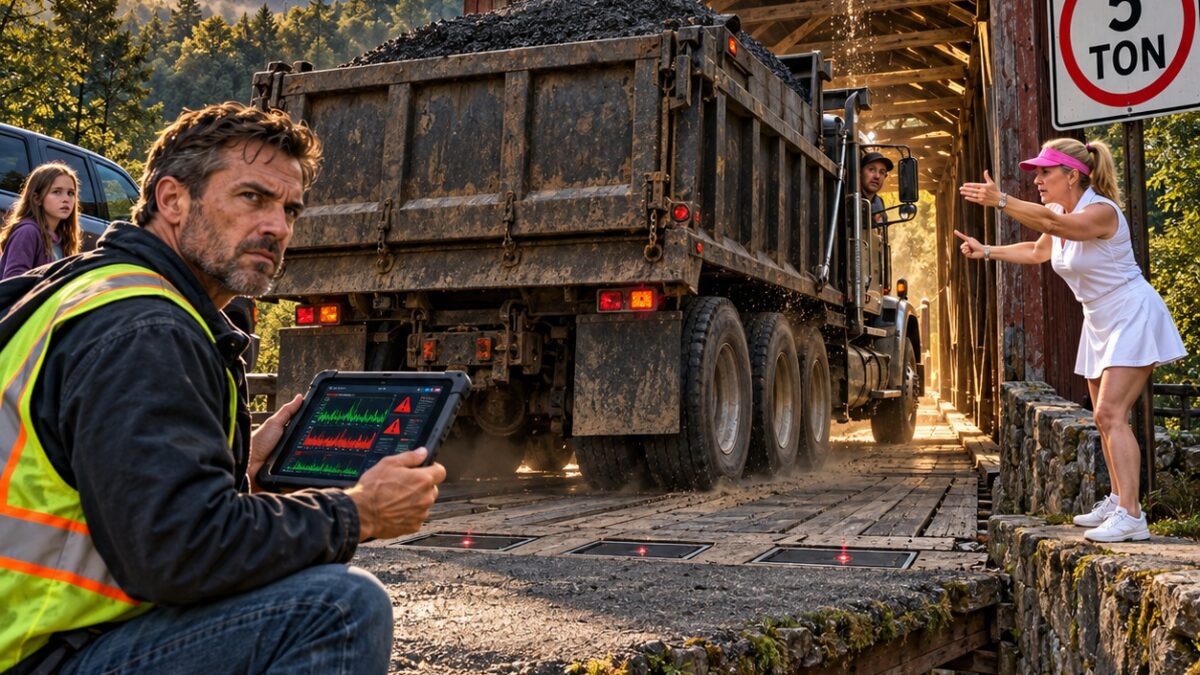
I stood thirty yards downstream behind the cedar stump that concealed the equipment box.
Laptop open on a tripod.
Pernell had binoculars upstream.
The truck rolled over the buried sensors.
My screen flashed.
GROSS VEHICLE WEIGHT: 52,400 LB
5.24 times the bridge’s posted limit.
Plate captured.
HULCOM PAVING DT14
Watch-list match.
The system fired.
Fourteen emails left inside the same six-second window.
Green confirmation after green confirmation.
Within thirty seconds, eleven servers acknowledged receipt.
Within ninety seconds, my phone began ringing.
EPA.
DOT.
Sheriff.
Channel 13.
I let every call go to voicemail.
I did not need to explain anything.
The data was explaining itself.
Then I heard the crack.
8:20 a.m.
Deep.
Not sharp like a board snapping.
A heavy timber failure.
The sound of old wood carrying a load it had warned everybody not to put there.
Cody heard it too.
Through the cab.
I saw the brake lights.
For half a second, I thought he might stop.
Instead, he panicked.
Accelerated.
Worst possible choice.
The second crack was louder.
The rear right axle broke through the decking thirty-two feet beyond the south portal.
The truck dropped.
Forty-six thousand pounds of demolition material shifted inside the bed.
The rear wheels disappeared into broken planking.
Front axle barely held.
The entire truck leaned about twelve degrees.
South truss bowed visibly under the load.
Broken timber connectors hung below like loose teeth.
I did not celebrate.
That bridge was my family.
Watching it fail hurt physically.
Even though I had spent weeks preparing for the possibility.
Even though the trap had been designed to document exactly this.
Cody opened the cab door.
Looked at the bridge.
Looked at his truck.
Then climbed down.
His boot slipped on frozen wood.
He caught himself.
Ran.
North.
Toward Eagle Ridge.
Pernell came over the radio.
“Drone is over the hollow. Two trucks are dumping. Roland is on his phone. Tessa is moving.”
“Copy.”
At 8:23, Tessa’s white Range Rover came around the access-road curve.
She stopped near the north portal.
Door flew open.
White tennis clothes.
Pink visor.
Her face looked gray.
First she saw the dump truck.
Then the destroyed deck.
Then the bowed truss.
Then me.
I stepped out from behind the cedar stump.
She pointed.
“You did this!”
I did not answer.
Sirens had already begun somewhere in the distance.
Three directions.
Channel 13’s van moved down from the clubhouse.
The cameraman was preparing before the vehicle even stopped.
I looked at my laptop.
Green.
Green.
Green.
The evidence was already beyond both of us.
Sheriff Carmine Doyle arrived at 8:31.
He parked sideways across the north approach so nothing else could enter.
Got out.
Looked at the truck.
Looked at me.
“You all right?”
“I’m fine.”
“The bridge?”
“No.”
“Driver?”
“Ran north.”
Carmine keyed his radio.
Deputies found Cody at the half-mile marker.
Sweating.
Limping.
Done running.
He surrendered.
Handed over his commercial driver’s license.
Then asked quietly whether he would still be able to make his daughter’s seventh birthday on Saturday.
That question stayed with me.
Because drivers are not corporations.
Not HOAs.
Not villains by job description.
Cody had ignored the sign repeatedly.
That was his responsibility.
But Roland had spent years telling employees the bridge could handle it.
Tessa had encouraged commercial traffic.
Cody was part of the machine.
Not the architect.
EPA Special Agent Larkin Boswell arrived at 8:39 with two agents.
They went straight to the creek.
Samples.
Tamper-evident bags.
Times.
Witnesses.
Pernell handed over his green folder.
Two years of evidence.
Larkin opened it.
Read the first page.
Looked back at him.
“Mr. Brigham, I’m going to need you in Atlanta.”
“How long?”
“Potentially two weeks.”
Pernell shrugged.
“I’m retired.”
Granger Pellum reached the bridge at 8:47.
DOT.
Notebook.
Camera.
He immediately closed the span to all traffic.
Walked carefully onto the deck.
Photographed fractures.
Broken planking.
Bowed south truss.
He came back to me.
“Repairable.”
I breathed.
“But not quickly.”
“How long?”
“Commercial traffic stays off ninety days minimum while we stabilize and evaluate.”
I looked at him.
“Commercial traffic was supposed to stay off forever.”
He nodded.
“I know.”
By 8:51, Felicity Atherton was live-recording a standup at the south portal.
She had footage of the truck.
The deck failure.
Cody running.
Sheriff arriving.
Then Tessa made the last mistake she needed to make.
She stepped directly in front of Channel 13’s camera.
“This is a setup.”
Felicity did not interrupt.
Tessa pointed toward me.
“Brennan Carver sabotaged his own bridge and lured an innocent driver across because he has been harassing our community for two years.”
Felicity tilted her head slightly.
“Mrs. Hulcom, are you currently president of Eagle Ridge Mountain Estates?”
“I am.”
“Are you married to Roland Hulcom of Hulcom Paving and Excavation?”
“Yes.”
“Is the truck currently broken through Mr. Carver’s bridge owned by Hulcom Paving?”
“Yes, but—”
“Was that truck carrying demolition debris from an Atlanta site toward a hollow inside Eagle Ridge?”
Silence.
Long enough for the camera to capture every second.
Tessa swallowed.
“I’d like a lawyer.”
Felicity stayed calm.
Before she could say anything else, Special Agent Larkin Boswell entered the frame.
“Mrs. Hulcom.”
Tessa turned.
“You are under arrest.”
The list that followed was longer than any HOA president should ever hear beside a broken covered bridge.
Federal environmental conspiracy.
Waste-disposal violations.
Motor-carrier violations.
Tax-related charges.
Tessa began talking immediately.
Trying to explain.
Correct.
Reframe.
The pink visor came off.
Her hair fell loose.
Her voice changed.
Agents cuffed her gently.
At almost the same moment, a second EPA team entered the illegal dump site.
Jasper’s drone was already above them.
Roland stood near two Hulcom trucks with their beds still raised over the landfill.
Agents arrested him beside the waste pile.
All of it recorded.
The same footage later became evidence.
But standing beside Sourwood Creek that morning, I was not thinking about federal trials.
I was looking at the bridge.
The cedar siding still stood.
The south truss bowed.
Truck trapped.
Deck broken.
My father’s work injured.
My great-grandfather’s structure holding on.
Again.
At 9:14 a.m., the operation that Tessa and Roland had spent twenty-two months running across my family bridge was finished.
The damage they left took much longer.
Carver Mill Bridge required six months of restoration.
Granger Pellum worked with three timber-span specialists out of Asheville.
The south chord was rebuilt.
Eleven deck planks replaced.
Forty-seven new timber connectors driven.
The dark-red cedar siding was restored to match the color Augustus had used a century earlier.
I was there through the work.
Of course.
Some mornings I stood beside the crew and heard my father in everything.
Check the joint again.
Don’t force old timber.
Measure twice.
If you don’t know, stop.
Dad had spent his life teaching me that structures communicate before they fail.
The cracks had spoken.
Tessa simply did not want to listen.
Federal forfeiture paid for the restoration from seized Hulcom assets.
The same empire that had damaged the bridge funded its repair.
That part felt right.
The illegal landfill was another matter.
EPA supervision.
Containment.
Remediation.
The cost reached approximately $9.2 million, also paid from seized Hulcom assets.
Six contractors involved in paying Roland for illegal dumping were indicted in a parallel case.
Pernell’s samples mattered.
His photographs mattered.
Two years walking a watershed while almost nobody knew.
Quiet work.
The federal case took months.
Eight months after the bridge failure, the trial reached its conclusion.
Jasper’s drone footage became Exhibit 41.
The landfill.
Roland.
Trucks.
Everything.
A juror later told a reporter that watching those trucks dumping into the headwater seep was one of the most arrogant things she had ever seen.
Tessa received fourteen years in federal prison.
Roland received eighteen.
Hulcom Paving and Excavation was dissolved.
Their business was finished.
The dump was capped.
Water remediation continued.
Whitman Cross, the Atlanta attorney who had told me he buried men like me, withdrew three days after the arrests.
I never heard directly from him again.
That suited me.
Eagle Ridge faced its own reckoning.
The HOA board went through a recall election.
Tessa gone.
Old leadership discredited.
A retired high-school history teacher named Lucinda Garner became president.
Sixty-five.
No Range Rover diplomacy.
No fake easement amendments.
No speeches about “community development rights.”
Her first day in office, she mailed me a handwritten note.
It said, in essence, that the forty-two households of Eagle Ridge hoped to be the friendliest neighbors in Haywood County and would not send anything heavier than ordinary residential vehicles over the bridge.
I framed it.
It hangs in my office beside a photograph of my father standing on Carver Mill Bridge during the 2008 restoration.
Not because Lucinda’s note has legal force greater than the easement.
It doesn’t.
I framed it because after everything, somebody finally understood how simple the situation had always been.
Respect the bridge.
Respect the agreement.
Be neighbors.
That was all.
Pernell Brigham testified in three federal trials.
A newspaper later asked which part of the case made him proudest.
Not the arrests.
Not national attention.
Not helping bring down a million-dollar illegal operation.
He said it was the two years he spent quietly photographing a hollow nobody wanted to see.
I understood.
Documentation rarely looks heroic while you are doing it.
It looks repetitive.
Boring.
Obsessive.
Take another photograph.
Write another date.
Record another plate.
Test another water sample.
Mark another fracture.
Then one day, all the boring pieces line up and the person who kept saying nobody could stop them discovers that boring evidence has more power than arrogance.
That lesson changed what I did next.
During the bridge restoration, Tully and I started talking about what had happened before us.
Granger had told me there were other small historic bridges across the region facing similar pressure.
Private owners.
Old easements.
Commercial traffic.
Developments using bridges they did not maintain.
Owners being told:
Replace it.
Sell it.
Adapt.
Get out of the way.
My father had spent his life caring for one bridge.
Maybe we could help more.
Using part of the restoration-related resources available to us, we established the Carver Heritage Bridge Trust.
We named it for Wendell Carver.
My father.
The trust offered free engineering consultation to owners of historic timber spans in North Carolina, Tennessee, Virginia, and Georgia who were facing structural threats from overweight commercial use.
Inspection support.
Legal referrals.
Monitoring equipment when owners needed documentation.
By the end of the first year, we had assisted nineteen historic bridges across the southern Appalachians.
Three, I was told, were close to structural failure when we became involved.
That gave what happened to Carver Mill a purpose I had not expected.
I want to be careful with that.
Tessa and Roland did not do us a favor.
The damage was real.
The creek contamination was real.
My bridge nearly failed.
Families downstream had contamination risks they never asked for.
Cody’s life changed.
My daughter was frightened.
My father’s work was broken.
Nothing about that becomes “worth it” because we built something useful afterward.
Good outcomes do not retroactively make harm good.
But once damage exists, you get to decide what you build with what remains.
We built the trust.
Tully made sure we built something else.
Upstream from the bridge was a clearing that caught late-afternoon sun.
She had been talking about putting a bench there almost from the day of the arrests.
Not just any bench.
During restoration, part of the damaged south chord had to be removed.
Old timber.
My father had installed portions of that member during the 2008 work.
Tully wanted some of the salvage saved.
So we did.
The memorial garden came together slowly.
Burr oaks.
Mountain laurel.
Carolina rhododendron.
Then the bench.
Made from replaced south-chord lumber.
On the back, a small bronze plaque:
WENDELL CARVER
HE BUILT THINGS TO LAST.
SO DID HIS SON.
The first time I saw the finished plaque, I had to walk away for a few minutes.
Grief does not leave because federal agents win.
It does not care about verdicts.
My father was still dead.
The bridge restoration did not bring him back.
Sometimes repairing what someone you love built only reminds you that they are not there to see it.
That was difficult.
Tully handled grief differently.
Children do.
She missed Granddad.
But she also thought he remained part of every bolt, plank, notebook entry, and piece of advice I repeated without noticing.
Maybe she was right.
On the first anniversary of the morning the trap fired, about ninety people gathered on the upstream bank.
Adrienne came from Asheville with her husband.
No awkwardness.
No family drama.
She hugged me.
Then hugged Tully.
Pernell arrived in his faded Forest Service jacket.
Granger wore his DOT polo.
Whitlock came with his wife.
Carmine Doyle gave the opening remarks.
Neighbors from Eagle Ridge attended too.
Not all of them had supported Tessa.
Some had simply been residents trapped inside a board conflict they barely understood.
I never wanted to treat forty-two households as copies of one president.
That would have made me no better at understanding power than Tessa had been.
Lucinda stood among them.
Quiet.
Respectful.
Then Tully walked to the bench.
She was twelve by then.
Navy dress.
My father’s old field watch around her wrist.
Too big.
She had written four lines on a note card.
I had asked to read them before the ceremony.
She refused.
“Granddad didn’t let you inspect everything.”
“He absolutely did.”
“Not this.”
I let her win.
At the dedication, she unfolded the card.
Looked toward the bridge.
Then read.
“This is a bridge.
“This is also a promise.
“The Carvers do not break promises.
“Neither does the bridge.”
Silence.
About three seconds.
Then somebody clapped.
Then everyone.
I looked at the bridge.
New cedar stain.
Repaired south truss.
Water moving under it.
Exactly where it had been moving when Augustus Carver decided in 1923 that a neighbor should not have to die trying to get home.
That bridge had survived floods.
Storms.
A fallen tree.
A century of traffic.
And then an HOA president who believed a five-ton sign was just paper.
People sometimes ask whether I planned for the truck to break through the bridge.
No.
Absolutely not.
I built a documentation system.
I knew failure was possible.
That was the entire reason I had been begging them to stop.
My goal was never to destroy my own bridge.
The WIM sensors did not weaken anything.
The cameras did not create stress fractures.
The drone did not break decking.
Fifty-two thousand four hundred pounds on a bridge rated for ten thousand did that.
Forty previous commercial crossings helped.
The cracks documented before the trap proved deterioration existed.
The failure was not theater.
It was engineering.
That distinction matters.
Tessa’s first instinct was:
You did this.
Of course it was.
People who ignore warnings often blame the warning system when the warned-about consequence finally happens.
The speed-limit sign caused the crash.
The scale caused the overloaded truck to be illegal.
The inspection caused the building to fail.
No.
Data does not create physics.
It reveals it.
Carver Mill had been speaking through fractures for months.
Tessa kept sending trucks.
The bridge eventually answered in a language she could not ignore.
Timber.
Gravity.
Weight.
That is why I sometimes think the entire conflict could have ended in October.
First concrete truck.
I tell Tessa:
Sixty-four thousand pounds will damage this bridge.
She says:
I understand.
Truck turns around.
Done.
No lawsuit.
No fake amendment.
No school incident.
No federal trap.
The landfill still would have needed to be discovered and stopped eventually.
Pernell was already documenting it.
But our private conflict did not need to become part of it.
Tessa made it part because every boundary sounded like a challenge to her authority.
That was her fatal weakness.
She confused “HOA president” with “owner of everything residents use.”
Eagle Ridge had a right to residential passage.
That did not mean unlimited passage.
The easement contained limits.
Those limits mattered precisely because the bridge was old.
My grandfather had not written the restriction to annoy future homeowners.
He was protecting a structure.
Roland wanted the restriction gone because his business depended on treating the crossing as infrastructure somebody else would pay to maintain.
That was the economic heart of the fight.
If I sold the bridge for $220,000?
HOA gets modern span.
Roland gets commercial access.
Future development becomes easier.
Maintenance shifts.
Historic structure disappears.
Everyone who wanted expansion wins.
Except my family.
Except the bridge.
Whitman Cross thought money would make that irrelevant.
He underestimated what the bridge represented.
I am an engineer.
I understand replacement.
Sometimes old structures should come down.
If a historic bridge becomes unsafe beyond practical repair, sentiment cannot substitute for physics.
But Carver Mill was not failing from age alone.
It was being abused.
That is a different problem.
You do not demolish a healthy century-old structure because somebody insists on driving six times its design load across it.
You stop the abusive load.
That was all I wanted from day one.
The landfill made the moral stakes larger.
I still remember Pernell’s first water-test sheet.
Lead.
PCB.
Asbestos.
Those words made my bridge dispute feel small.
My daughter had spent years near Sourwood Creek.
Families downstream drew from the same shallow aquifer.
Roland’s trucks were not merely overweight.
They were carrying material into a headwater system and dumping it illegally for cash.
Once I understood that, I stopped thinking of the trap as personal.
This was not Brennan versus Tessa anymore.
It was evidence preservation.
Coordination.
Make sure no single person could bury the case.
That was why fourteen recipients mattered.
Jurisdiction can become a hiding place.
One agency says:
Transportation issue.
Another says:
Environmental.
Another:
Tax.
Another:
Private easement.
Another:
Local dumping.
The person committing the wrongdoing survives inside the gaps.
So we removed the gaps.
Same evidence.
Same moment.
Everyone sees.
Everyone calls everyone else.
No quiet dismissal.
Whitlock understood immediately.
“So nobody owns the whole case,” he said.
“Exactly.”
“And nobody can pretend the others didn’t see it.”
“Exactly.”
The press tier was controversial.
I thought about it.
A lot.
I did not want publicity for drama.
But Tessa had already used public narrative as leverage.
She called me obstructive.
Harasser.
Anti-community.
The factual record deserved daylight.
Channel 13 happened to be there anyway.
That coincidence made the morning almost absurd.
They arrived to film infinity pools and mountain living.
Instead they recorded a federal arrest beside a dump truck broken through a historic covered bridge.
You cannot script reality that cleanly without making it unbelievable.
Yet there it was.
Tessa in tennis whites.
Pink visor.
Camera.
Federal agent.
Sometimes vanity schedules its own witness.
The hardest person for me to think about afterward was Cody.
People wanted to call him an idiot.
Maybe.
He ignored the sign.
Repeatedly.
He had crossed thirty-seven times.
No one forced his foot onto the accelerator after the first crack.
His choices mattered.
But when Carmine told me Cody had asked whether he could make his daughter’s birthday, I saw something I had been too angry to see earlier.
Roland had normalized the violation.
Two years of:
The sign is paper.
The bridge can take it.
We’ve done it before.
Nothing happened.
Success creates false evidence.
Crossing number one works.
Therefore safe.
Crossing ten works.
Therefore safe.
Thirty-seven works.
Therefore sign wrong.
That is not engineering.
That is gambling with cumulative damage.
Cody believed the absence of immediate collapse proved capacity.
Every crack under the bridge said otherwise.
He did not crawl underneath with me.
Did not read inspection logs.
Did not calculate stress.
Roland did not want him to.
I do not excuse him.
I understand him more.
That distinction matters.
Tessa and Roland built an environment where employees were rewarded for ignoring limits.
Then physics collected the debt.
That pattern exists far beyond bridges.
I saw it later in some of the cases our trust handled.
Old bridge.
Posted restriction.
Construction deadline.
Driver says:
Boss told me it’s okay.
Owner says:
It isn’t.
Developer says:
We crossed last week.
Everything becomes normal until structure fails.
Our trust tried to intervene earlier.
Inspect.
Document.
Send professional letter.
Install monitoring if needed.
Get an attorney before deck planks become evidence.
Three bridges we helped were close.
That frightened me.
Carver Mill was not unique.
Granger had told me that before I believed him.
Developments need access.
Small private bridges become bottlenecks.
Instead of building their own appropriate infrastructure, some interests overload somebody else’s structure until replacement becomes inevitable.
Not every developer.
Not every HOA.
Important.
I met good HOA boards after Eagle Ridge.
Good developers too.
The problem is incentives.
If destroying the old bridge is cheaper than negotiating a new route, somebody eventually decides the weight sign is “just paper.”
That is when owners need records.
My father understood documentation long before I did.
The inspection notebook started in 1989.
Every repair.
Every crack.
Every flood.
Every replaced board.
Every unusual load he knew about.
Dates.
Weather.
Handwriting.
When Whitlock built the case, those old pages became powerful because they established a baseline.
The bridge did not suddenly become weak because I was angry with Tessa.
We had thirty years of history.
Then a sharp increase in damage after commercial crossings began.
That timeline mattered.
My father gave me evidence without ever knowing I would need it.
That is stewardship too.
Maintain the structure.
Maintain the memory of the structure.
I continued the notebook after restoration.
New section.
Fresh pages.
First entry after reopening:
South truss restored. Commercial restrictions reaffirmed. Residential traffic resumed.
I sat with the pen for a while before writing the last line.
Bridge remains in service.
That made me cry more than I expected.
Bridge remains in service.
Dad would have understood.
He never cared about dramatic language.
He cared whether something worked.
It worked.
Lucinda’s note stayed framed because it represented another repaired thing.
Not timber.
Neighbor relationship.
Eagle Ridge itself had not been evil.
Forty-two homes.
Families.
Kids.
People who wanted roads to work.
Tessa became the HOA.
That was the mistake residents made.
Organizations become dangerous when people stop distinguishing leader from institution.
After the recall, Eagle Ridge became boring.
Good.
Residential vehicles crossed.
Under limit.
No commercial paving trucks.
No construction equipment.
People waved.
I waved back.
No war.
That proves the original conflict was never inevitable.
Same houses.
Same bridge.
Different leadership.
Peace.
One Subaru at a time.
Tully enjoyed Lucinda.
Probably because Lucinda treated her like a person rather than leverage.
The first time they met, Lucinda said:
“I hear you know more about covered bridges than most adults.”
Tully answered:
“Most adults don’t listen.”
I pretended not to hear.
Lucinda laughed.
Dad would have liked her.
Maybe.
He distrusted HOA presidents on principle after what happened.
Actually, that is me projecting.
The source does not give my father an opinion about HOAs beyond bridge care.
So I will leave him where I truly know him.
Engineer.
Builder.
Volunteer firefighter.
A man who mowed the creek bank himself at sixty-eight.
The memorial bench mattered because Tully chose the words.
“ He built things to last.”
That described more than cedar.
He built habits.
My career.
The notebook.
Standards.
The expectation that if your name is attached to something, you care for it properly.
Tessa’s entire approach was opposite.
Use first.
Repair later.
Rewrite restrictions.
Threaten owner.
Pay for lawyer.
If structure fails, replace.
That mentality is cheaper until it isn’t.
The morning of the collapse, it became very expensive.
Not just legally.
Environmentally.
Financially.
Personally.
Fourteen years.
Eighteen years.
Company dissolved.
Landfill remediation.
Contracts indicted.
HOA recalled.
Those consequences were much bigger than anything I planned.
I had not sat in my barn plotting prison sentences.
I wanted evidence.
Authorities decided what evidence supported.
Courts decided guilt and punishment.
That line matters to me.
Private citizens should not confuse documentation with sentencing.
I built the file.
The system took over.
That is also why I did not answer my phone when the alert emails went out.
The temptation was enormous.
EPA calling.
Sheriff.
DOT.
Reporter.
But I had spent weeks making sure the package could speak without me.
If evidence needs a dramatic narrator to make sense, it is weaker evidence.
Weight:
52,400.
Bridge limit:
10,000.
Truck:
Hulcom Paving.
Destination:
Illegal dump.
Drone:
Active dumping.
Water tests:
Contamination.
Recorded easement:
Commercial traffic prohibited.
No speech needed.
The green dashboard was almost beautiful because it represented facts leaving my control and entering official systems.
Once sent, Tessa could not bully me into deleting them.
Roland could not buy the bridge.
Whitman Cross could not threaten the server.
Fourteen inboxes.
Redundancy.
My engineering brain appreciated that.
Design for failure.
Always.
One component fails?
Others hold.
Bridge truss.
Evidence network.
Same principle.
That is another reason the bridge survived the truck.
Town lattice construction distributes load through interconnected members.
The structure was injured badly.
But redundancy helped prevent total collapse.
My great-grandfather probably did not use the word “redundancy” the way modern engineers do.
He understood the idea.
Build so one failure does not kill everything.
I unknowingly built the trap the same way.
WIM sensor.
Camera.
Drone.
Trail cameras.
Pernell’s historical evidence.
Water samples.
Sheriff records.
Court filing.
If one piece were challenged, another remained.
That is how you handle someone with money and an aggressive lawyer.
Not one perfect proof.
Many independent proofs.
Whitman Cross’s threat bothered me less after the arrests.
At the time, though?
I would be lying if I said I was fearless.
A man like that tells you he has buried larger people and part of you wonders:
Can he?
I had a daughter.
A business.
Mortgage obligations.
Clients.
I was not a billionaire land baron.
Litigation consumes time and money.
That is how intimidation works.
The threat does not need to be legal.
It needs to make the cost of resisting feel larger than the cost of surrender.
$220,000 for bridge.
Tempting to someone who wants conflict gone.
Modern replacement included.
No maintenance.
Walk away.
I understood why people accept offers like that.
Peace has value.
But I knew what replacing Carver Mill actually meant.
The old span disappears.
The easement changes in practice.
Commercial traffic becomes permanent.
Roland’s business gets exactly what he wants.
And my father’s bridge becomes a line in an engineering report saying “removed.”
I could not do it.
Not because every old object is sacred.
Because they were trying to force the outcome by damaging the thing they wanted replaced.
Reward that once and every old private bridge becomes vulnerable to the same strategy.
Granger’s case files proved it.
Our trust later confirmed it.
Sometimes one owner saying no matters beyond his property.
I did not know that at the beginning.
I only knew Dad had rebuilt that truss.
Tully thought Granddad would be mad if it gave up.
Good enough.
The illegal dump also changed how I thought about “community improvement.”
That phrase appeared constantly in Tessa’s documents.
Development.
Improvement.
Modernization.
Behind the polished entrance, infinity pool, decorative gates, and custom homes sat a three-acre pile of demolition waste leaking contamination toward Sourwood Creek.
Appearance and stewardship are not the same.
Eagle Ridge looked perfect from the road.
The hollow nobody photographed publicly was the cost.
Pernell photographed it.
For two years.
That retired hydrologist may have been the most patient person in the entire story.
He watched.
Sampled.
Labeled.
Maintained chain of custody.
Did not post rants online.
Did not confront Roland with a phone camera.
He built evidence.
Then waited for a legal opening.
People sometimes think patience means weakness.
Pernell weaponized patience more effectively than anybody I have met.
By the time he walked into my office, his folder already contained the bones of a federal case.
He only needed a bridge—literally and legally—between the trucks and the dump.
I had that.
Our evidence sets fit together because reality was connected.
Traffic across bridge.
Waste in hollow.
Water below.
Money above.
Once connected, the whole enterprise became visible.
That was the trap’s real purpose.
Not tricking Cody into crossing.
He was already scheduled.
We did not invite him.
We did not tell Tessa to wave him forward.
They chose.
The trap observed.
That distinction is essential.
A legitimate evidence operation documents anticipated illegal conduct.
It should not create danger.
I still wish the bridge had not failed that morning.
If the truck had crossed without structural collapse, the package would still have fired.
Agents would still have had evidence.
The investigation would still have moved.
Maybe arrests happen differently.
Maybe no dramatic television footage.
Fine.
I would have preferred intact decking.
The collapse was proof of exactly why the limit existed.
It was not the goal.
Tessa never understood that.
“You did this.”
No.
Her entire worldview depended on turning consequences into attacks.
Sheriff watches bridge?
Harassment.
Owner sues?
Anti-community.
Sensor records overweight vehicle?
Trap.
Bridge breaks under excessive load?
Sabotage.
EPA tests contamination?
Government overreach, perhaps.
At no point:
Maybe we should stop doing the thing.
That inability eventually destroyed her.
Healthy leadership can admit new information.
We were wrong.
Stop.
Recalculate.
She only escalated.
Concrete truck.
Fake amendment.
School visit.
Lawyer.
More trucks.
Largest load.
Even that final morning, Tessa could have stood at the north portal and told Cody:
Stop.
The sign says five tons.
The lawsuit is active.
DOT is watching.
Don’t cross.
Instead, she wanted him forward.
That image became the symbol everybody remembered.
Pink visor.
Hand waving.
“Punch it, Cody.”
She was not merely ignoring risk.
She was directing it.
Toward my bridge.
Toward her own driver.
Toward the creek.
Toward herself.
Twenty-two minutes later, handcuffs.
That timeline became part of the media coverage.
People liked the symmetry.
Months of conduct collapsing in minutes.
Reality often takes longer than justice stories imply.
Our case did.
Two years of Pernell’s work.
Months of crossings.
Weeks of legal preparation.
Eleven days building the system.
Then yes:
Twenty-two minutes from first crack to the moment federal custody became real.
The public sees twenty-two minutes.
The invisible work is everything before.
That is why I founded the trust around preparation.
Most historic bridge owners will never get a dramatic arrest.
They should not need one.
They need an inspection before failure.
A clear easement.
Accurate signage.
A letter from counsel.
Maybe sensors.
Maybe cameras.
Enough to stop escalation while the bridge still looks boring.
Boring bridges are healthy bridges.
That became one of my favorite sayings.
Tully hates it.
She says:
“Dad, nobody has a favorite bridge saying.”
I do.
Engineer.
We are allowed.
She turned twelve before the memorial dedication.
That year changed her too.
I worried about that.
She had seen adults behave in ways children should not need to understand.
An HOA president arriving at school.
Sheriff reports.
Court.
Her father crying in a truck.
A historic bridge breaking under a dump truck.
Federal arrests.
Media.
I tried to keep her out of the details.
She noticed anyway.
Children do.
What helped was giving her ordinary life around it.
Homework.
Pottery.
Cookies.
Weekends with her mother.
Books.
No child should become a soldier in a parent’s property dispute.
That is why Tessa’s school visit infuriated me.
She tried to make Tully part of adult leverage.
After that, I was careful not to do the same in reverse.
Tully came to the bridge because it was part of our family life.
She helped inspect because she was curious and trusted me.
She did not sit in strategy meetings.
She did not monitor federal agents.
The line mattered.
Her four-line dedication proved she understood the story in a cleaner way than I did.
Bridge.
Promise.
Carvers keep promises.
Simple.
My promise was to protect what I inherited long enough to pass it forward.
Not unchanged forever.
Structures need repair.
Timber gets replaced.
Deck planks wear.
But continuity can survive replacement.
The south chord partly replaced in 2008.
Again after the truck.
Is it still Augustus’s bridge?
Yes.
Identity is not every original board.
It is design.
Purpose.
Place.
Memory.
Care.
That helped me accept restoration without feeling we had lost authenticity.
My father had never worshiped original material if original material was unsafe.
He restored honestly.
We did too.
Eleven deck planks.
Forty-seven connectors.
South chord.
Same dark-red cedar stain.
Not fake antiquing.
Not theme-park reconstruction.
A working historic bridge maintained as a working historic bridge.
That was the promise.
The federal forfeiture funding had poetic justice, but I care more that the work was done correctly.
Granger understood.
We walked the bridge together after final inspection.
He tapped one repaired joint.
“Your dad would complain about my paperwork.”
“He complained about everyone’s paperwork.”
“True.”
Then he stood in the middle of the span.
Looked downstream.
“He’d like this.”
I nodded.
Couldn’t answer.
Grief again.
Always waiting.
That is why the bench mattered.
The bridge was Dad’s public legacy.
The bench gave us a quieter place for him.
Tully chose the upstream bank because afternoon light hit there.
She planted one of the burr oak saplings herself.
Crooked.
We straightened it.
She objected.
“Trees don’t grow straight.”
“New saplings need support.”
“Sounds controlling.”
“Go do homework.”
Parenthood restored.
Excellent.
At the dedication, seeing Eagle Ridge residents there affected me more than I expected.
Some had once believed Tessa’s version.
That I was difficult.
Anti-development.
Trying to block their community.
I did not need each person to apologize.
Their presence was enough.
Lucinda had made the HOA’s position clear.
Respect the easement.
No commercial overloading.
Neighbor relations reset.
That was justice at the community level.
Not permanent hostility.
Organizations can recover after bad leadership.
I believe that.
If I had treated every Eagle Ridge homeowner as an enemy after the recall, Tessa would still have controlled the relationship through absence.
She would have poisoned neighbors permanently.
I refused.
Residential car under the limit?
Come across.
Wave.
Good morning.
That was the easement.
That was always the easement.
Forty-two households did not need punishment for the Hulcom empire.
They needed leadership that could read.
Lucinda could.
History teacher.
Probably helped.
Her handwritten note hangs beside Dad because both represent continuity.
Dad:
Maintain the bridge.
Lucinda:
Respect the bridge.
Enough.
Pernell’s later interviews brought attention to environmental enforcement.
He hated attention.
The national radio piece used Jasper’s drone footage.
Pernell’s voice sounded almost annoyed.
They asked why he had spent two years documenting one hidden hollow.
He said because water runs downhill whether developers want to think about it or not.
That sounded like him.
Hydrologists and engineers are cousins in temperament.
Physics does not care about branding.
Water flows.
Weight loads.
Timber fractures.
Waste leaches.
You can ignore those systems socially.
You cannot vote them away.
That was perhaps the real enemy in Tessa’s approach.
She believed authority could redefine reality.
HOA says access.
Therefore access.
Roland says weight limit is paper.
Therefore safe.
Contractor says dump is fill.
Therefore not landfill.
Board signs amendment.
Therefore easement changed.
No.
A title does not alter physical or legal facts by confidence alone.
Eventually reality sends a bill.
The $9.2 million remediation bill was one.
Six months of bridge restoration another.
Prison another.
Business dissolution another.
They had saved money by avoiding permitted landfill fees.
Then paid everything.
That is how shortcuts work when the hidden cost arrives.
The illegal tipping operation had apparently generated around $1.1 million over twenty-two months.
Large money.
Not enough to justify what followed.
That difference is almost unbelievable.
A million-dollar illegal business exposed a nine-million-dollar cleanup obligation, criminal charges, asset forfeiture, and prison.
Greed often has terrible arithmetic.
Roland should have understood construction costs.
He still chose the cheaper illegal path until the illegal path became the most expensive thing he ever built.
Tessa’s arithmetic was similar.
Why fund alternate access or restrict trucks when my bridge existed?
Use it.
If owner objects, pressure him.
If bridge eventually fails, replace it.
Cheap now.
Catastrophic later.
Short-term optimization is a dangerous religion.
My great-grandfather’s bridge represented the opposite.
Build for people you may never meet.
Augustus did not know me.
He built something I would maintain a century later.
My father rebuilt it knowing somebody after him would inherit the work.
The trust continued that idea.
Help bridges we do not own.
Help owners we may never meet.
Long horizon.
That felt like the right response to people who had lived inside short-term extraction.
We assisted nineteen bridges the first year.
Each different.
Different ownership.
Different law.
Different structure.
I will not invent individual rescue stories the source does not provide.
The only fact I need is that three were reportedly near collapse.
That number frightened me enough.
Imagine three families experiencing what Tully asked beside Sourwood Creek:
“Is the bridge going to break?”
If our inspections helped answer earlier, good.
That is enough.
I kept working at Carver Engineering Services.
That also matters.
I did not become a full-time crusader.
Historic bridge restoration remained my profession.
The trust supplemented.
Life continued.
Bills.
Clients.
School pickup.
Tully’s pottery.
Co-parenting.
Normal.
The dramatic case ended.
Good.
I wanted normal more than publicity.
For months after the arrests, reporters called.
Some wanted “the engineer who took down an HOA empire.”
I hated that phrase.
I did not take down an empire.
An engineer documented load violations.
A retired hydrologist documented pollution.
A lawyer preserved the legal claims.
A sheriff protected the site.
Agencies enforced laws.
A drone recorded.
The Hulcoms supplied the illegal conduct.
That last part is important.
People who get caught often attribute too much power to the person who documented them.
Tessa called it a setup.
But every decisive action remained hers and Roland’s.
Nobody forced illegal dumping.
Nobody forced the fake easement amendment.
Nobody forced Tessa into Tully’s school.
Nobody forced forty-one crossings.
Nobody forced Cody’s truck onto the bridge.
Nobody forced Tessa to go on camera.
The trap did not manufacture arrogance.
It timed the evidence.
That is all.
I sometimes wonder what would have happened if Tessa had listened to the first deputy-like warning she got from me.
Not even law enforcement.
Just one engineer saying:
This truck is six times the safe load.
Could have saved everything.
The saddest conflicts are not the ones with no solution.
They are the ones with obvious solutions refused for reasons of ego.
Stop commercial trucks.
Use another construction route.
Dispose of waste legally.
Renegotiate if you want change.
Four basic choices.
Instead:
Push.
Threaten.
Lie.
Continue.
That escalation cost years of freedom.
Not because I was clever.
Because limits eventually become consequences.
The five-ton sign at Carver Mill was physically simple.
Black letters.
White background.
Nothing dramatic.
Tessa treated it as an obstacle.
But that number had engineering behind it.
My father’s calculations.
Professor Ashby’s consultation.
Inspection history.
Material properties.
Geometry.
Age.
Condition.
A posted sign can look like bureaucracy.
Sometimes it is compressed expertise.
Ignoring it because you cannot see the calculations is dangerous.
That is another thing our trust teaches owners.
Explain why.
Not to people determined to violate.
To normal users.
Why five tons?
Because truss members.
Joints.
Fatigue.
Decking.
Safety.
Once people understand the sign protects them and the structure, most comply.
Roland knew enough construction to understand.
He chose not to care.
That is why the case feels different from ignorance.
Forty-one crossings after written notice.
Bad faith.
Whitlock had said it.
He was right.
The fake amendment remains one of the strangest documents I own.
I kept the original.
Evidence archive.
Sometimes new lawyers at the trust ask to see it.
I show them.
The lesson is not that amateur paperwork is funny.
It is that people often create the best evidence against themselves when they are trying to make wrongdoing look official.
Letterhead.
Signatures.
Retroactive date.
Formal clauses.
All designed to intimidate me.
Instead, it established intent.
Whitlock’s advice was one of the best pieces of strategy I received:
Do not correct your opponent out of a useful mistake.
If somebody hands you a document proving their position and their bad faith, preserve it.
You can answer through court later.
That required restraint.
I wanted to fire back immediately.
Engineers love correcting errors.
It is practically a disease.
Whitlock stopped me.
Good lawyer.
Annoying man.
He came to the memorial dedication with cookies.
Tully forgave him everything.
The school incident also stayed in the legal file.
Not because it directly proved bridge violations.
Because it showed escalation beyond normal property negotiation.
Mrs. Greer’s handling prevented something worse.
She did not allow Tessa’s title or confidence to bypass school policy.
One question:
What is your specific business with this child?
No answer.
Leave.
That is institutional boundary-setting done properly.
I wrote her a thank-you letter later.
Not in the source as a formal event, so I will not build a scene around it.
What matters is she protected Tully.
I remain grateful.
Parents cannot be everywhere.
You depend on other adults respecting procedure.
Tessa’s attempt to use “family friend” as a label failed because someone checked.
Labels do not create authority.
Same lesson again.
HOA president.
Family friend.
Community easement.
Improvement amendment.
Words.
Check actual permission.
The whole story keeps returning to that.
Authority must come from somewhere real.
Deed.
Parent.
Law.
Engineering.
Not from saying the title confidently.
Carmine Doyle understood too.
When he parked beside the bridge, he did not need to arrest anybody.
Presence changed behavior.
Three trucks turned around.
That proved the drivers knew, on some level, that crossing was questionable.
If they truly believed the easement legally authorized unlimited commercial traffic, why turn away because a sheriff was watching?
Exactly.
That detail mattered to me.
Compliance appeared whenever accountability was visible.
That is not confusion.
That is calculated behavior.
The trap made accountability permanently visible.
Sensors do not get tired.
Camera does not look away because driver waves.
Drone does not accept “Roland said it was fine.”
Data.
That impartiality protected me too.
No accusation based on memory.
Exact gross weight.
Exact timestamp.
Exact plate.
I could not exaggerate even if I wanted to.
The system did not care.
That is how evidence should work.
52,400 pounds.
That number still makes me angry.
More than five times the limit.
Not close.
Not a driver slightly overloaded.
Not debate over uncertainty.
Five times.
A 101-year-old timber bridge.
Posted.
Litigation active.
Tessa onsite.
Roland onsite.
No ambiguity.
When the rear axle broke through, the visual finally matched the engineering reality they had denied.
The bridge had been absorbing damage invisibly.
Now damage became visible.
That is what made the camera footage so powerful.
People trust what they see after ignoring what experts say.
Frustrating.
But useful.
The bowed south truss looked terrifying.
Yet it held long enough for Cody to get out.
That mattered most.
No one died.
I need to repeat that.
A truck broke through my family bridge.
No one died.
Augustus built Carver Mill because a neighbor drowned trying to get home.
A century later, despite abuse beyond anything he designed for, the bridge still gave a driver enough time to climb out.
I think about that more than prison sentences.
Structure did its job until the end of the event.
Held.
That is why Tully’s dedication line is not sentimental to me.
“Neither does the bridge.”
Technically, bridges can break.
We had just proven that.
Her meaning was different.
The promise did not break.
The Carvers repaired.
Again.
That is continuity.
You can damage a promise without ending it if somebody is willing to rebuild honestly.
The south chord bench embodies that too.
Material no longer safe in bridge service became a place to remember the person who installed it.
Nothing wasted emotionally.
Not pretending broken timber was still structurally useful.
Giving it new purpose.
Engineers and grieving families both learn that lesson.
Some things cannot return to original function.
You can still honor them.
Dad’s lumber became bench.
Dad’s bridge kept going with new material.
My relationship with him became memory.
Still useful.
Different load.
I think he would laugh at that metaphor.
Or tell me it was terrible.
Probably both.
The first anniversary ceremony was the only large public gathering I wanted.
After that, Carver Mill returned to being a bridge.
That was perfect.
People drove to homes.
Maybe slowed to look.
No federal agents.
No cameras besides normal security.
Sourwood Creek below.
Our monitoring stayed.
Not the fourteen-agency automatic trap.
That operation ended.
But reasonable bridge monitoring remained.
Weight protection matters.
Lucinda made sure HOA contractors used alternate routes.
Development changed.
Responsibility clarified.
The trust encouraged similar arrangements elsewhere.
Prevention.
That is the ending engineers prefer.
Not heroic failure.
Maintenance.
I kept Tessa’s pink-visor image out of my office.
People thought I should frame a newspaper front page.
No.
I framed Lucinda’s note.
Dad.
Bridge.
Why give wall space to the person who tried to damage it?
Consequences do not require worshipping the antagonist.
Tessa had already occupied enough time.
Her fourteen-year sentence was not something I celebrated daily.
Roland’s eighteen either.
Prison is serious.
Their conduct was serious.
Court handled it.
I moved on.
That is healthier than turning another person’s ruin into your identity.
The trust mattered more.
Tully mattered most.
One evening after the dedication, we sat on the bench.
Nobody else.
Water moving.
Bridge upstream.
She had changed into jeans.
My father’s field watch still on her wrist.
“You know,” I said, “your poem wasn’t technically accurate.”
She looked at me.
“What?”
“Bridges absolutely can break.”
She frowned.
“You know what I meant.”
“I’m an engineer. Precision matters.”
She elbowed me.
“Granddad liked my poem better than you.”
“Probably.”
We sat quietly.
Then she asked:
“Do you think he saw it?”
I knew what she meant.
The dedication.
The repaired bridge.
The trust.
I do not pretend to know things I cannot know.
So I said:
“I think if there’s any way he could, he would’ve been there.”
She nodded.
Good enough.
Then she looked at the bridge.
“Dad?”
“Yeah?”
“Can I help with inspections when I’m older?”
I looked at her.
“You already do.”
“Real inspections.”
“You mean you want paperwork?”
“No.”
“Then no.”
She laughed.
Normal again.
That was the ending I wanted for her.
Not federal-arrest memory.
Future.
Maybe engineer.
Maybe not.
Her choice.
But knowing the bridge belonged partly to her story.
Not as burden.
As promise.
My family had kept Carver Mill standing for a century.
Augustus.
Cyrus.
Wendell.
Me.
Eventually someone else.
Maybe Tully.
Maybe a trust.
Maybe another caretaker.
Structures outlive names if people keep doing the work.
HOA boards change in elections.
Law firms withdraw.
Companies dissolve.
Even criminal empires disappear.
A well-maintained bridge can remain.
That perspective changed how I remember Tessa.
For a while, she felt enormous.
Powerful.
Rich development behind her.
Attorney from Atlanta.
Paving company.
Board authority.
Construction schedule.
Forty-two homes depending on crossing.
I was one man with a historic bridge and a daughter.
She said exactly that in different words.
You’re one homeowner.
We’re an association.
At the time, meant to intimidate.
Years later, it sounds silly.
Numbers do not determine ownership.
Forty-two homes cannot vote themselves into my easement.
A board cannot sign my name.
A lawyer cannot threaten timber into carrying extra weight.
A paving company cannot negotiate with gravity.
An empire built on ignoring boundaries is weaker than one accurate document.
That is what she never understood.
I did not need more people.
I needed correct facts.
Deed.
Easement.
Inspection log.
Weight.
Plate.
Water sample.
Camera.
Truth scales surprisingly well.
Fourteen agencies were not there because I was important.
They came because evidence touched fourteen areas of responsibility.
That is the distinction.
People facing powerful organizations sometimes assume they need equal power.
Not always.
They need jurisdiction.
Documentation.
Persistence.
Know what authority actually applies.
The source of power matters more than the size of the logo opposing you.
That became something the Heritage Bridge Trust tried to teach owners.
Not legal advice from engineers.
Referral.
Professional inspection.
Get the right lawyer.
Get the right agency.
Do not scream at a truck from the road and hope.
Build the file.
Because when one historical structure fails, the story becomes about safety and money.
Better to make the story about compliance before timber breaks.
We were lucky Carver Mill remained repairable.
Granger said that often.
The south chord could have failed differently.
Truck could have rolled.
Cab could have gone through.
Creek.
Injury.
Death.
The weight trap gave us evidence.
It did not make the crossing safe.
That is why I never recommend anybody recreate the dramatic part.
Document from distance.
Use courts.
Use enforcement.
Do not wait for collapse if you can stop it.
We had tried.
Declaratory judgment was active.
Sheriff presence had temporarily deterred.
Tessa still sent trucks.
The largest crossing happened before legal process could fully stop it.
That is the tragedy.
Law can move slower than heavy equipment.
Sometimes evidence catches up barely in time.
That morning, it did.
Tessa’s arrest on camera made the story famous.
The bridge restoration made it meaningful.
The trust made it useful.
The memorial made it ours again.
That is the order I prefer.
Not arrest as climax and prison as final word.
Because if the story ends with Tessa, she still owns it.
The real ending belongs upstream.
Burr oak saplings.
Mountain laurel.
Rhododendron.
Bench from replaced timber.
My father’s name.
Tully reading four lines.
Neighbors clapping.
Carver Mill standing in the background.
That is where consequence became continuity.
A year earlier, Tully had asked whether the bridge would break.
I told her it might if we could not stop them.
She answered:
“Then we stop them.”
We did.
Not soon enough to prevent every crack.
Soon enough to preserve the bridge.
That is life more often than people admit.
You rarely save something untouched.
You save what remains.
Repair.
Document.
Learn.
Build stronger systems.
Carry forward.
The cedar siding on Carver Mill still carries the same dark-red tone my family used.
When afternoon sun hits, the color warms.
Creek reflects underneath.
From a distance, most people cannot see where the south chord was rebuilt.
I can.
Of course.
I know every repaired section.
Every new connector.
Every replaced plank.
Scars, if you want that word.
Engineers call them repairs.
Better.
Scars sound passive.
Repairs are work.
That is what my family does.
When something worth keeping is damaged, we work.
No speeches necessary.
Augustus did it after flood took a neighbor.
Dad did it after a fallen tree damaged the truss.
I did it after a 52,400-pound truck punched through the deck.
Different century.
Same answer.
Build.
The five-ton sign remains at both approaches.
New.
Clear.
Same number.
I thought about replacing it with something larger.
Maybe flashing lights.
Maybe giant warning.
Then decided ordinary was enough.
People who respect rules do not need theater.
People determined to ignore them will ignore larger signs too.
Monitoring handles the rest.
The sign does not need to shout.
It tells the truth.
Five tons.
That is the safe number.
Not negotiable because somebody has a construction deadline.
Not changed by an HOA amendment without owner consent.
Not softened by a lawyer.
Not overruled by a pink visor.
Just weight.
If Carver Mill could talk, maybe that is all it would say.
I can carry this much.
No more.
Healthy boundaries often sound exactly like that.
I can carry this much.
No more.
The bridge had one.
I had one.
Tessa ignored both.
The structure failed before I did.
Then the system answered.
Fourteen agencies.
Twenty-two minutes.
Handcuffs.
Years of consequences.
But my favorite number from the whole story is not fourteen.
Not forty-one.
Not 52,400.
Not fourteen years or eighteen.
It is one hundred and one.
The age of Carver Mill when Tessa thought it was expendable.
A century of people had kept that span standing.
One HOA presidency nearly destroyed it in two years.
Then people who cared repaired it.
That contrast keeps me humble.
Maintenance is slow.
Destruction can be fast.
That means stewardship must be stubborn.
I am.
So was Dad.
So is Tully, unfortunately.
Especially when she thinks she is right.
Which is often.
Healthy family trait.
The Carver Heritage Bridge Trust grew from that stubbornness.
Nineteen bridges first year.
Maybe more later.
The source ends within that period, so I will not invent future numbers.
Nineteen is enough.
Nineteen owners who did not have to start from zero.
Three bridges reportedly close to collapse.
Maybe one family somewhere sits on a creek bank now and does not have to ask what a bridge sounds like when it gives up.
That thought matters more than anything Whitman Cross ever said to me.
He tried to make me feel small.
One homeowner.
One private bridge.
One lawsuit.
Fine.
Small things connect.
One bridge connects two sides of a creek.
One water sample connects waste to a watershed.
One photograph connects a truck to an illegal crossing.
One owner connects nineteen others through a trust.
One eleven-year-old’s sentence can explain an entire family better than a forty-three-exhibit court filing.
“This is a bridge.
“This is also a promise.
“The Carvers do not break promises.
“Neither does the bridge.”
I used to correct the last line in my head.
Now I don’t.
She was right in the way that mattered.
The bridge did not break its promise.
Even when timber broke.
It kept the driver out of the creek.
It survived.
It was repaired.
It carried people home again.
That was what Augustus built it for.
Home.
Not development convenience.
Not illegal landfill traffic.
Home.
A century later, purpose remained.
Maybe that is why I defended it so hard.
The bridge was not valuable because it was old.
Age alone is not enough.
It was valuable because it still did the thing it was built to do.
Safely, within limits.
Historic does not have to mean obsolete.
Old does not mean available for abuse.
A structure can deserve preservation and still be useful.
Carver Mill proved it.
So when somebody asks me what Tessa Hulcom lost, I do not start with prison.
She lost her assumption that authority could substitute for ownership.
Roland lost his assumption that repeated success made an illegal operation safe.
Whitman Cross lost the leverage of intimidation.
The old HOA board lost residents’ trust.
Hulcom Paving lost the business.
The landfill lost the secrecy that allowed it to grow.
But none of those is the part I carry every day.
I carry Dad’s photograph.
Lucinda’s note.
Inspection notebook.
Tully’s four lines.
The smell of cedar.
The sound of Sourwood Creek.
The memory of placing my forehead against the siding two days after my father’s funeral because I did not know what else to do with grief.
I had thought that morning that I inherited a bridge.
I was wrong.
I inherited a promise.
Maintain what others built.
Respect its limits.
Do not let convenience destroy it.
Pass it forward.
That is what stewardship means to me now.
One winter morning after the restoration, Tully and I walked across Carver Mill before sunrise.
No traffic.
Frost silver on the approach.
Creek low and clear.
She ran one hand along the cedar siding.
“Smells like Granddad.”
I stopped.
It did.
Cedar tar.
Cold air.
Creek water.
The inside of Dad’s old truck, somehow.
We stood in the middle.
The repaired south truss beneath us.
No visible drama.
Just a bridge doing its job.
Tully looked at the five-ton sign through the south portal.
“Think anybody will ignore it again?”
“Eventually somebody will think they’re special.”
“What happens then?”
I smiled.
“We keep the receipts.”
She laughed.
We finished crossing.
Behind us, Carver Mill stayed where Augustus built it in 1923.
Ahead of us, morning light reached the road.
No dump trucks.
No sirens.
No television crew.
No federal agents.
Just home.
Exactly what the bridge had been built to help people reach.








