FULL STORY:HOA Queen Sent Chainsaws for My 300-Year-Old Tree to Clear a Million-Dollar Road—She Never Checked Who Had Protected It First
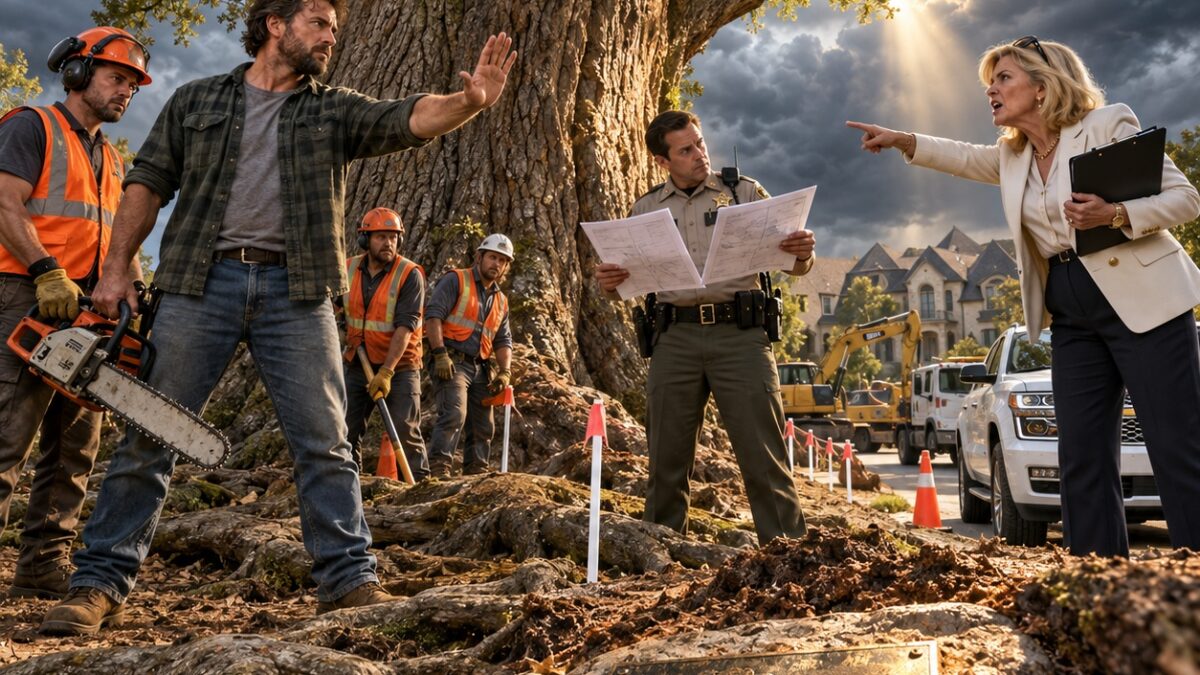
FULL STORY CONTINUATION
The deputy looked from Karen’s document to mine.
Then back again.
His expression changed in a way I had learned to recognize.
Not surprise exactly.
Professional irritation.
The kind that appears when somebody has called law enforcement hoping a badge will turn a weak private claim into authority.
“Ma’am,” he said, “these boundaries don’t match.”
Karen folded her arms.
“Our surveyor determined the community access boundary.”
The deputy tapped my document.
“This is county recorded.”
“We’re dealing with an HOA boundary.”
“Property boundaries aren’t determined by HOA preference.”
Karen stared at him.
I almost smiled.
Not because the situation was funny.
Because I had spent months saying versions of the same sentence in emails and certified letters.
Hearing someone in uniform say it out loud felt strangely satisfying.
She immediately changed arguments.
“The tree is a safety hazard.”
The deputy looked toward it.
The canopy was full.
Leaves healthy.
Trunk solid from every visible side.
“What hazard?”
Karen pointed upward.
“That branch.”
We all looked.
The branch was green.
No visible split.
No deadwood.
No obvious weakness.
The deputy asked:
“Do you have an inspection?”
Karen hesitated.
“No.”
“Certified arborist report?”
“No.”
“County order requiring removal?”
“No.”
He closed his notebook slowly.
“Then nobody cuts anything today.”
Karen’s jaw tightened.
“But the HOA board approved removal.”
“That does not give the board authority to remove property it does not own.”
For the first time, she looked nervous.
Only for a second.
Then the familiar confidence returned.
She turned toward me.
“You think this is over?”
“No.”
I looked at the chainsaw crew.
“I think it’s just starting.”
She got into the SUV.
Before closing the door, she looked up at the tree.
Then at me.
“You have no idea what that tree is sitting on.”
I watched her drive away.
At the time, I assumed she meant the planned drainage channel.
Maybe a utility line.
Maybe some engineering problem connected to the road.
I was wrong.
That evening, I called my attorney.
Daniel Reed had handled property matters for me for years.
He was the kind of lawyer who did not raise his voice because documents usually did enough work for him.
I sent him photographs.
The HOA stakes.
Karen’s survey.
My recorded survey.
The tree.
The chainsaw crew.
About forty-five minutes later, he called.
“I need you to do something.”
“What?”
“Don’t touch the tree.”
“I wasn’t planning to.”
“No. I mean don’t trim it. Don’t move debris around it. Don’t let contractors near it.”
I sat down.
“Why?”
“I found something in the county records.”
“What?”
“I’m not sure yet.”
“Daniel.”
“Your grandfather’s deed isn’t the oldest document tied to that parcel.”
That caught me.
“What is?”
“A protection order.”
I looked through the kitchen window.
The Old Sentinel filled part of the evening sky.
The last sunlight was breaking through the upper branches.
“What kind of protection?”
“At first I thought environmental.”
“And?”
“It’s older than that.”
“How old?”
“More than a hundred years.”
I sat forward.
“Who filed it?”
“That’s what I’m trying to determine.”
“What does it protect?”
He paused.
“The tree.”
I looked outside again.
Three hundred years old.
Standing there like it had no idea people were suddenly digging through files because of it.
Daniel continued.
“Someone went out of their way to attach a permanent restriction to the parcel.”
“So Karen can’t remove it.”
“If the restriction is what I think it is, she can’t even materially alter it without formal review.”
“Good.”
“Maybe.”
I did not like that word.
“What’s the bad part?”
“The HOA’s lawyers may already know.”
That bothered me more than it should have.
If they had simply made a bad boundary call, that was one thing.
If they knew the tree was protected and sent chainsaws anyway?
Different.
The next morning, I went outside before breakfast.
Fresh tire tracks crossed the shoulder near the tree.
Someone had been there during the night.
Not on my drive.
Near the trunk.
I walked around carefully.
A small orange survey flag had been pushed into the soil.
Not one of the white HOA stakes.
This one carried a county seal.
On the back was a handwritten number.
I called Daniel.
He went silent when I read it.
“What?”
“Don’t send that number to anyone.”
“I wasn’t planning to.”
“Especially Karen.”
“Why?”
“Because I just found the original reference.”
“And?”
“Meet me at the county records office.”
“What happened in 1847?”
“Come here.”
Twenty minutes later, I was driving toward town.
Before leaving, I stopped beneath the tree.
The place felt different.
Yesterday, the Old Sentinel had been family history.
Today, it felt like evidence.
Daniel was waiting with photocopies spread across one of the long tables inside the records office.
He tapped the first page.
“Original transfer history.”
The paper image was old enough that some handwriting had nearly disappeared.
The parcel had changed hands several times before my grandfather’s family ever acquired it.
Daniel moved to another sheet.
“This is the 1847 document.”
I leaned closer.
At first it looked like a standard legal description.
Then I saw two words.
Protected landmark.
“What does that mean?”
“It means someone deliberately designated the tree for preservation.”
“Who?”
“That gets complicated.”
He turned the page.
A name was partially faded.
Underneath was a county seal.
“This wasn’t just a private request,” Daniel said. “The county recorded it as a permanent restriction tied to the parcel.”
“So it can’t be removed.”
“Not without formal review and whatever approvals are required under the protected interest.”
I leaned back.
“Then Karen was completely wrong.”
Daniel gave me a look.
“She wasn’t completely wrong.”
“What does that mean?”
“She knew.”
I stared at him.
“How?”
He pulled out an HOA planning map.
Silver Ridge Estates.
Three years earlier.
Proposed access improvements.
New residential section.
Commercial connection.
And at the exact location of the Old Sentinel—
A large red circle.
Underneath:
REMOVE TREE.
I felt my jaw tighten.
“They’ve been planning this for three years.”
“Look at the bottom.”
A note.
County protected landmark. Verify removal requirements.
I read it twice.
“That doesn’t prove Karen personally saw it.”
Daniel slid another page across.
Email chain.
Board members.
Engineering consultant.
One message highlighted.
The consultant warned the board that the tree appeared protected under an old county restriction.
Karen’s response sat underneath.
Short.
Direct.
Proceed with removal. We will address the paperwork afterward.
I read it three times.
“They knew.”
“Absolutely.”
“They brought the chainsaw crew knowing this.”
“Yes.”
“Why?”
Daniel pointed toward the planning map.
“Because the tree is not the real problem.”
“The road.”
He unfolded another survey.
This one showed the proposed expansion in detail.
I had assumed Silver Ridge wanted to widen its existing entrance.
They didn’t.
Not exactly.
The new alignment shifted west.
Across my property.
“How much?”
“About sixty feet at the widest point.”
“That’s their big prize?”
“For a road, sixty feet matters.”
Then he pointed farther down.
A corridor ran along my western side.
Connected the new subdivision entrance to a proposed commercial project.
“They want a direct route.”
“Across my property.”
“Yes.”
“No easement.”
“No.”
I laughed once.
Bitter.
“Of course.”
Daniel remained serious.
“There’s more.”
Financial documents.
The HOA had signed a development agreement with a private construction company.
Millions involved.
Silver Ridge would receive a percentage of new development fees.
The developer gained a faster access road.
More lots became usable.
Traffic flow improved.
And none of that worked while the tree remained.
Suddenly Karen’s urgency made sense.
The Old Sentinel was not dangerous.
It was inconvenient.
My land was not hazardous.
It was in the way.
Daniel gathered the paperwork.
“We need to file before they try again.”
“They won’t.”
He looked up.
“How do you know?”
I pointed toward the window.
Karen’s SUV was parked across the street.
She had followed me.
I called the sheriff.
Another deputy arrived.
Karen approached before he had fully closed his cruiser door.
“This man has stolen confidential HOA documents.”
The deputy looked at me.
“What documents?”
I held up copies.
“County records.”
Daniel stepped forward.
“Everything my client is holding is public property documentation.”
Karen glared.
“This is harassment.”
Daniel’s voice stayed calm.
“No. It’s research.”
The deputy looked at Karen.
“Why are you here?”
She ignored him.
Instead, she looked directly at me.
“You really believe some ancient piece of paper is going to stop this neighborhood?”
I said nothing.
She stepped closer.
“You’re one homeowner.”
Then the smile.
“We’re an association.”
Daniel looked at her.
“An association does not override recorded property rights.”
Karen got back into the SUV.
“You’re going to lose.”
Then she drove away.
The deputy watched.
“I’d keep those documents somewhere safe.”
“I plan to.”
“She doesn’t seem finished.”
“No.”
She wasn’t.
That evening, a letter was taped to my gate.
Not HOA letterhead.
Law firm.
It accused me of obstructing “community infrastructure.”
Demanded removal of my private fencing.
Demanded access to my western property.
Gave me seventy-two hours to comply.
At the bottom:
Threat of emergency court action.
Daniel read it and laughed.
“What’s funny?”
“They just helped us.”
“How?”
He pointed to a paragraph.
“They admitted in writing that they need access to your land.”
“So?”
“They’re claiming historical access rights.”
“There aren’t any.”
“I know.”
“Then why claim them?”
“Because they need some theory that gets them across the boundary without buying anything.”
He leaned back.
“And desperation makes people put bad theories in writing.”
The next morning, county inspectors arrived.
The tree had been reported as an immediate public-safety hazard.
We both knew who made the report.
The inspector walked around the trunk.
Checked exposed roots.
Examined several branches.
Looked for decay.
Twenty minutes.
He handed me the report.
“No immediate hazard.”
“Thank you.”
He left.
I thought maybe that would finally force Karen to stop.
At 6:42 that evening, engines came down the road.
Three HOA trucks.
Then an excavator.
Not a small one.
A machine large enough to move serious earth.
Karen stepped out.
I walked toward her.
“You were told not to touch that tree.”
She smiled.
“We’re not here for the tree.”
“Then why the excavator?”
“Drainage.”
“You don’t have permission to excavate my property.”
She produced a paper.
“Emergency access authorization.”
I photographed it.
Sent the image to Daniel.
He arrived faster than I expected.
Read it.
His face changed.
“What?”
“This is not county authorization.”
Karen called from across the yard:
“We have lawful emergency authority.”
Daniel held up the document.
“This is an HOA board resolution.”
I actually laughed.
“They authorized themselves?”
“Yes.”
Karen pointed toward my truck.
“You have ten minutes to move your vehicle.”
I looked at the excavator.
Then her.
“No.”
She pulled out her phone.
“Fine.”
Sheriff again.
Different deputy this time.
He got out, recognized the property, then immediately looked at Karen.
“Ma’am, you were told to stay off this land.”
She started explaining.
He raised a hand.
“I read the county report.”
She stopped.
“Turn the excavator around.”
Karen stared at him.
“You don’t understand.”
“No. I understand exactly.”
She argued.
Community infrastructure.
Drainage safety.
Emergency authority.
The deputy pointed at the machine.
“If that equipment crosses the recorded property line, I’m stopping the operator.”
Karen’s face turned red.
She finally walked toward her SUV.
Then stopped.
Looked at the tree.
And smiled.
That smile stayed with me.
She was not looking at the Old Sentinel like someone who had lost.
She was looking at it like someone with another move.
At 11:18 that night, Daniel called.
“You awake?”
“Yes.”
“Good.”
His voice sounded different.
“What happened?”
“I found the rest of the 1847 record.”
I sat up.
“There was more?”
“Second page.”
“What does it say?”
“A handwritten declaration.”
“From who?”
“That’s where this gets strange.”
“Daniel.”
“Your family didn’t create the original protection.”
“I know that.”
“But I found the later renewal too.”
“From who?”
“I’m still confirming.”
He lowered his voice.
“Tomorrow morning, we’re meeting someone who has been trying to trace this record for thirty years.”
“Who?”
“I’ll explain then.”
“That is not an answer.”
“One more thing.”
“What?”
“The HOA is not the first development group that tried to remove that tree.”
I stared into the dark room.
“What happened to the last one?”
Silence.
Then:
“They disappear from the property record.”
The call ended.
I barely slept.
At sunrise, I walked outside.
The Old Sentinel stood exactly where it had stood the night before.
Wind moving gently through the canopy.
Then I noticed something at the base.
Metal.
Almost completely buried.
I crouched.
Brushed soil away.
Six words were engraved into the plate.
THIS TREE SHALL STAND FOREVER.
Underneath:
A name.
Samuel Carter.
My grandfather.
For several seconds, I simply stared.
He had taught me to ride.
Repair fence.
Read contracts.
Never sign something because the other person claimed there was no time.
Yet he had never told me about this marker.
The date beneath his name:
That made even less sense.
I called Daniel.
“You need to get here.”
“I know.”
I froze.
“What?”
“I found Samuel’s name last night.”
“You knew?”
“Not until the second page.”
He arrived twenty minutes later.
Crouched beside the marker.
“This is original.”
“You’re sure?”
“Yes.”
He brushed away more soil.
Another line became visible.
PROTECTED IN TRUST FOR FUTURE GENERATIONS OF THE CARTER FAMILY.
I read it slowly.
“So my grandfather renewed the protection.”
“Exactly.”
“Why?”
Daniel opened the old file.
The 1847 owner had designated the tree a protected landmark.
The restriction followed the parcel.
Decades later, after the land passed through multiple hands, my grandfather formally renewed and strengthened the protection in 1948.
Why?
He had discovered a development company wanted to clear the area.
Then Daniel pointed at the critical sentence.
No owner, association, developer, or successor may remove, destroy, or materially alter the protected tree without county authorization and documented approval of the protected interest holder.
“So nobody can cut it.”
“Correct.”
“Move it.”
“No.”
“Authorize someone else to remove it.”
“No.”
“And Karen knew.”
Daniel looked toward the road.
“She knew enough to know she needed permission.”
“Who told her?”
“That part I don’t know.”
We did not wait long to see what she would do next.
That afternoon, Karen announced a special HOA meeting.
“Community emergency.”
Nearly fifty homeowners came to the Silver Ridge clubhouse.
Emily came with me.
She squeezed my hand before we entered.
“Try not to get arrested.”
“That is unfair.”
“You’ve had the sheriff out here three times.”
“For her.”
“Still.”
We sat near the back.
Karen stood at the front with a microphone.
Confident.
Perfectly composed.
“Our community is being held hostage by one homeowner.”
Murmurs.
I raised my hand.
Ignored.
“The protected—”
She corrected herself.
“The tree is blocking necessary infrastructure expansion.”
I looked at Daniel.
He leaned closer.
“She’s about to make a mistake.”
“What kind?”
“Public.”
Karen put the engineering map on a large screen.
Red road.
Drainage.
Tree circle.
“This obstruction must be removed.”
I stood.
“No.”
The room went quiet.
Karen looked at me.
“You have had your say.”
“No, I haven’t.”
Daniel followed me toward the front.
I held up the 1847 document.
“This tree is protected by a permanent recorded restriction.”
Karen smiled.
“That is your interpretation.”
I raised another page.
“This is the county’s.”
Smile gone.
Then the 1948 declaration.
Samuel Carter.
Protected in trust.
The room became completely quiet.
One homeowner stood.
“Karen, did the board know?”
She hesitated.
“We knew there was a historical notation.”
“You said the tree was HOA property.”
“I said the HOA had authority over the access corridor.”
“That’s not what you told people.”
Another homeowner:
“Did you order the chainsaw crew?”
Karen’s expression hardened.
“I authorized removal of a dangerous obstruction.”
I looked at Daniel.
He opened his briefcase.
Pulled out the email.
Karen saw it.
Her face changed before he read one word.
Daniel quoted only the part that mattered.
“Proceed with removal. We will address the paperwork afterward.”
The room erupted.
“Karen, you knew?”
“What were you thinking?”
“You sent workers anyway?”
She raised both hands.
“This is being taken out of context.”
Daniel placed the development agreement on the table.
“Then here is the context.”
That quieted them.
He explained.
The road was not primarily about safety.
It enabled the next residential phase and commercial development.
Millions of dollars.
HOA revenue.
Development fees.
The new road could not be built with the tree standing where it was.
Then the last document.
County warning letter.
Six months earlier.
The county had specifically told Silver Ridge not to alter the tree or adjacent protected corridor without formal authorization.
Signed delivery.
Karen Whitmore.
No denial available.
I looked at her.
“You knew.”
She stared back.
Then said the words that ended the argument for me.
“We had no choice.”
I shook my head.
“You had a choice.”
The room stayed quiet.
“You just didn’t like the one that cost you money.”
The next morning, Daniel filed for an emergency injunction.
The county joined.
That changed things dramatically.
This was no longer one homeowner arguing with an HOA president.
The county had its own interest in enforcing a recorded protected landmark.
The developer’s lawyers appeared too.
They were furious.
Not at me alone.
At the HOA.
Their contract had deadlines.
Road completion.
Infrastructure milestones.
If those milestones failed, the developer could walk away.
The court hearing came quickly.
Less than an hour.
Judge reviewed:
Recorded property survey.
1847 protection.
1948 trust declaration.
County warning.
HOA emails.
Development contract.
No mystery.
The judge looked directly at Karen.
“Did the association authorize removal of this tree?”
Her attorney started.
The judge stopped him.
“I asked the president.”
Karen swallowed.
“Yes.”
“Knowing the county had warned the association?”
Pause.
“Yes.”
“Knowing the property owner did not consent?”
Another pause.
“Yes.”
The judge leaned back.
“Then this appears remarkably straightforward.”
Karen’s lawyer argued belief.
The HOA believed it possessed authority over the access corridor.
The judge responded with the sentence that ended up repeated everywhere afterward.
“An association’s belief does not create property rights.”
Work stopped immediately.
Road expansion suspended.
HOA prohibited from entering my property.
Association ordered to cover costs associated with illegal work.
But winning the hearing did not solve everything.
Karen had already done damage.
On that first day, the chainsaw crew had managed to cut into several major branches before I arrived.
Not enough to fell the tree.
Enough to hurt it.
A certified arborist spent almost three hours examining the Old Sentinel.
Trunk.
Canopy.
Stress points.
Cut surfaces.
Potential infection.
Structural balance.
Finally, he looked at me.
“If you had arrived ten minutes later, we’d probably be talking about a dead tree.”
I looked up.
The branches carried scars where steel had entered wood that had been growing before this country existed in its current form.
Ten minutes.
That stayed with me.
Karen had come within ten minutes of destroying something three centuries old because a contract deadline made preservation inconvenient.
The arborist designed a treatment plan.
Wound management.
Structural monitoring.
Selective stabilization.
Ongoing inspections.
The county issued a formal restoration order.
The HOA paid.
Every treatment.
Every damaged limb.
Every inspection.
Every stabilization measure.
The developer eventually walked away.
No road.
No deadline compliance.
No expansion.
The multimillion-dollar project collapsed.
That should have ended the HOA crisis.
Instead, the homeowners started asking another question.
What else had Karen not told them?
An independent audit was ordered.
Within weeks:
Consultant payments tied to the development company.
Invoices approved without proper board votes.
Development-related expenses disguised inside “safety improvements.”
The road project had been marketed to residents as necessary infrastructure.
The actual financial purpose was expansion.
More lots.
More fees.
More revenue.
Karen resigned before the next board meeting.
No apology.
She blamed the board.
Board members blamed the developer.
Developer blamed county restrictions.
County officials blamed everybody who had ignored recorded protections.
I did not care anymore.
Because the tree was still standing.
Months later, Emily and I stood beneath it.
The damaged branches had been treated.
New growth had appeared around healthier sections.
Birds had returned.
One nest sat high enough that I could barely see it.
Emily looked up.
“Your grandfather would be happy.”
I smiled.
“He’d probably tell me I should have checked the paperwork years ago.”
She laughed.
“That too.”
Then she looked toward the road.
“Do you think they’ll ever try again?”
I looked down at the metal marker.
Samuel Carter.
THIS TREE SHALL STAND FOREVER.
“No.”
“Why?”
“Because now everybody knows what is attached to it.”
Not just emotional history.
Legal history.
That distinction saved it.
The strangest part came later.
I was going through boxes from my grandfather’s belongings.
Old photographs.
Receipts.
Ranch records.
Envelopes.
One black-and-white photograph showed Samuel standing beside the Old Sentinel as a young man.
The trunk already huge.
He looked almost small next to it.
On the back, in his handwriting:
Some things belong to the future, not to us.
I sat with that sentence for a long time.
That was why he protected the tree.
Not timber value.
Not real-estate value.
Not because it made the property prettier.
Responsibility.
He believed ownership was temporary.
Stewardship continued past whoever happened to hold the deed.
That idea changed the whole fight for me.
At first, I had defended the tree because it was mine.
Karen’s people trespassed.
My survey controlled.
My deed.
My property.
All legally correct.
Necessary.
But the deeper history said something slightly different.
The Old Sentinel was not mine in the same way a truck or tractor was mine.
I held responsibility for it.
My grandfather had done the same.
The 1847 owner before him.
Someone had looked at that tree nearly two hundred years earlier and decided:
This should outlive us.
That legal decision moved through generations.
Karen saw obstacle.
The developer saw delay.
The HOA saw unused leverage.
My grandfather saw future.
That was why the documents mattered so much.
People like to believe old trees protect themselves through size.
They do not.
Chainsaws do not care about age.
Excavators do not care about family stories.
Contracts do not care how many children played beneath branches.
If nobody records a protection, sentiment can disappear under machinery very quickly.
The Old Sentinel’s greatest defense had never been the trunk.
It was paper.
County record.
Restriction.
Renewal.
Signature.
Marker.
Warning letter.
Every generation leaving enough evidence for the next one to say:
No.
Karen had assumed paper was something she could “address afterward.”
That email told the whole story.
Proceed first.
Fix legality later.
That mentality destroys things that cannot be restored later.
A road alignment can change.
A development contract can be renegotiated.
A three-hundred-year-old tree cannot be replaced on a project timeline.
You can plant another.
You cannot plant three hundred years.
That seems obvious.
Money makes obvious things negotiable in strange ways.
Once the audit started, several Silver Ridge residents contacted me.
Most were embarrassed.
A few angry.
One man said:
“We were told the road would reduce congestion.”
“It probably would.”
He looked surprised.
“So you agree?”
“I agree a wider road might make traffic easier.”
“Then why fight it?”
“Because easier traffic doesn’t transfer my land to your HOA.”
He paused.
That distinction should not be difficult.
A project can be useful and still unlawful.
Community benefit does not create private-property authority.
Safety arguments do not automatically erase title.
The HOA could have approached me.
Asked.
Offered to purchase land.
Proposed a legal easement.
Maybe I would have refused.
Maybe there was an alternative alignment.
The problem was never that Karen wanted a road.
The problem was that she decided wanting it was enough.
That mindset contaminated everything.
Fake urgency.
Selective survey.
Hazard claims.
Emergency resolutions.
Chainsaws.
Excavator.
The more I said no, the more she tried to convert her internal authority into external ownership.
HOA boards can create many rules.
Parking.
Common areas.
Amenities.
Architectural standards inside their jurisdiction.
They cannot vote themselves onto somebody else’s land.
That sounds basic.
Karen still needed a judge to explain it.
Silver Ridge changed leadership after the resignation.
The new board contacted Daniel first.
Smart.
They wanted a clean boundary review.
Not another “HOA-approved survey.”
Actual county alignment.
We agreed.
Professionals reset several markers.
The old tree sat where it always had.
On my land.
No ambiguity.
The HOA officially abandoned the road expansion plan.
Maps changed.
The drainage design moved.
The commercial connection disappeared.
Traffic problems remained Silver Ridge’s problem to solve within Silver Ridge.
Exactly as they should have been.
The old access road stayed narrower.
People survived.
That became one of my favorite parts of the aftermath.
For months, Karen had spoken as though removing the tree was inevitable.
Infrastructure demanded it.
Safety demanded it.
Growth demanded it.
Without removal, disaster.
Then removal became legally impossible.
And guess what?
Civilization continued.
People drove.
Homes remained.
Roads functioned.
Nothing collapsed except the development deal.
A lot of “necessity” is simply somebody’s preferred option wearing a hard hat.
I became suspicious of the word.
Necessary for whom?
Necessary for what?
Necessary because no alternative exists?
Or necessary because the alternative costs more?
Karen’s “no choice” had really meant:
No choice that protects our profit.
Different.
The court saw it.
Residents saw it eventually.
Even some former board members admitted later they had relied too heavily on Karen’s summaries.
That was their mistake.
Board service includes reading what you sign.
“Karen said” is not governance.
The audit taught them.
Expensively.
I did not follow every internal consequence.
Not my association.
That was one boundary I enjoyed.
Daniel occasionally updated me because records overlapped our case.
Consultant payments.
Approvals.
Disclosure failures.
Enough to explain why Karen left before the next meeting.
I had no interest in destroying her financially.
The source does not give us a criminal case.
No arrest.
No dramatic lawsuit wiping her out.
Good.
Reality did enough.
She lost the project.
Lost the presidency.
Lost credibility.
Had to live with the fact that her own email became proof she knowingly proceeded despite warnings.
That is consequence.
I did not need more.
The Old Sentinel needed time.
That mattered more.
The arborist returned regularly.
Each visit made me nervous.
Tree health operates on slower timelines than litigation.
A judge can sign an order in an afternoon.
A three-hundred-year-old organism responds across seasons.
The first new growth near damaged areas brought relief.
Not guarantee.
Relief.
Some branches remained permanently altered.
Scars visible.
I hated them at first.
They felt like vandalism left in public.
Later, I saw them differently.
Not beautiful.
Not symbolic.
Just healed damage.
The tree remained a tree.
Birds nested.
Leaves returned.
Shade remained.
That was enough.
Emily helped me stop staring at the scars.
One evening she said:
“You keep looking at the cuts.”
“They almost killed it.”
“But they didn’t.”
“I know.”
“Then look up.”
I did.
Canopy.
Green.
Simple correction.
I had spent months focused on what Karen damaged.
The tree was busy continuing.
I tried to follow.
We brought two chairs beneath it again.
The same place we had sat before the dispute.
No paperwork.
No survey.
No sheriff.
Just evening.
That may have been when the property felt like home again instead of evidence.
Conflict does that.
It converts ordinary places into legal exhibits.
Tree becomes protected landmark.
Road becomes contested corridor.
Grass becomes survey line.
Eventually, if you are lucky, they become ordinary again.
Tree.
Road.
Grass.
I wanted that.
The metal marker remained visible now.
I did not rebury it.
Daniel suggested documenting its location and leaving it accessible.
We photographed it professionally.
Recorded condition.
Coordinates.
Copied every associated county document.
I created physical and digital archives.
Emily laughed when she saw the folders.
“How many copies?”
“Enough.”
“Your grandfather would approve.”
“He hid a metal marker for seventy years.”
“True.”
I became the kind of property owner who scanned everything twice.
Karen did that.
Not intentionally.
Another consequence.
When you discover somebody has been willing to ignore records, you start making records impossible to ignore.
The new board received certified copies of the 1847 protection and 1948 renewal.
County updated cross-references.
Future title searches would surface them clearly.
No one should ever again be able to claim:
We didn’t know.
That mattered more than winning one injunction.
Good legal protection should survive people.
Karen was temporary.
So am I.
Records continue.
That was what my grandfather understood.
His note on the photograph made more sense every month.
Some things belong to the future, not to us.
I thought about ownership differently after that.
People say:
“My land.”
“My tree.”
“My property.”
Necessary legal language.
But “mine” can become arrogant if you forget time.
The tree existed before my family.
With luck, it will exist after me.
I am one caretaker in a long sequence.
My legal power includes the power not to destroy.
That is a responsibility.
Karen treated ownership as the right to optimize.
If land stood in the way of growth, modify it.
If tree blocked drainage, remove it.
If property line complicated road, reinterpret line.
Her worldview had no room for the idea that some things should remain inefficient because their value is not financial.
The Old Sentinel took up space.
Dropped leaves.
Required a road to bend.
Good.
Not every obstacle is a problem.
Sometimes an obstacle is the thing forcing development to respect reality.
The new engineers rerouted.
Imagine that.
They found another drainage solution after Karen spent months claiming there was no alternative.
More expensive?
Probably.
More inconvenient?
Yes.
Still possible.
That made me angry again for a while.
If they could redesign after the injunction, they could have redesigned before the chainsaw.
The difference was cost.
That was all.
Ten more minutes with a saw to avoid design costs.
Three hundred years against a project spreadsheet.
That ratio stayed with me.
I started talking more with the arborist.
Not because I planned to become a tree expert.
Because once you almost lose something, curiosity increases.
He estimated the tree’s age from size, growth patterns and historical reference.
Three centuries was plausible.
Maybe exact age impossible without invasive methods.
We did not need exact.
Old enough.
Protected enough.
Alive.
He explained how mature trees respond to cuts.
How large branch removal can destabilize canopy balance.
How decay enters.
How stress appears slowly.
That last part scared me.
Damage today can show consequences years later.
So the restoration order included monitoring.
Not one visit.
Long term.
Another reason HOA liability continued beyond the hearing.
Actions have timelines.
Karen wanted to cut now and “address paperwork later.”
Trees do the opposite.
Damage now.
Consequences later.
Law needed to account for that.
The county did.
I was grateful.
The local news picked up the judge’s quote.
AN ASSOCIATION’S BELIEF DOES NOT CREATE PROPERTY RIGHTS.
For a week, everybody seemed to repeat it.
Feed store.
Coffee shop.
Online comments.
People sent me screenshots.
I eventually stopped reading.
Public validation feels good for about fifteen minutes.
Then strangers begin arguing facts they do not understand.
Some people insisted the HOA must have had some authority.
No.
Some claimed I should have donated the sixty feet for community benefit.
Why?
Others wanted Karen arrested.
Also not supported by the case.
Internet prefers extremes.
The legal answer was boring.
Recorded boundary.
Protected landmark.
No consent.
No authority.
Stop work.
Pay costs.
That was enough.
Daniel enjoyed the news coverage more than I did.
“You know that sentence is going into HOA forums for years.”
“Congratulations.”
“I didn’t say it.”
“You wanted to.”
“Absolutely.”
He had been right from the start.
Paper beat volume.
Karen had more meetings.
More board votes.
More letters.
More trucks.
The county restriction still won.
A rule inside one organization cannot overrule superior property records.
Hierarchy of authority.
Basic.
Yet every property story eventually becomes about someone pretending their internal rules travel farther than they do.
The HOA said:
Our board approved it.
Deputy said:
Not your property.
That should have ended everything on day one.
Instead, Karen treated the deputy’s refusal as delay.
That mentality exposed more.
Each escalation produced another document.
Threat letter admitted access goal.
Emergency resolution showed internal overreach.
Engineer email showed knowledge.
County warning showed deliberate disregard.
Development agreement showed financial motive.
The more she pushed, the clearer the case became.
Sometimes the best thing an unreasonable opponent does is continue writing.
Daniel said that.
“Never interrupt someone who is documenting your claim for you.”
Good lawyer humor.
I learned.
The 72-hour demand letter went into our evidence binder.
So did every photo.
Every sheriff incident number.
Inspection report.
No-hazard finding.
Excavator photographs.
Public meeting recording.
By the hearing, Karen’s intentions were not something we needed to infer from one event.
Pattern.
That made the judge’s decision easy.
Less than an hour.
I appreciated that.
Court should be dramatic only when facts are complicated.
These were not.
Did they own the land?
No.
Did they have easement?
No.
Was tree protected?
Yes.
Did they know?
Yes.
Did owner consent?
No.
Did board vote anyway?
Yes.
Stop.
Everything after was consequence.
The developer walking away may have hurt Silver Ridge more than the restoration costs.
Their whole expansion strategy depended on timing.
Contract deadlines do not care that an HOA president misread her authority.
The road failed.
Project failed.
Money disappeared.
Homeowners who had been promised future amenities began asking why.
That anger drove the audit.
Interesting chain.
Karen tried to remove one old tree to protect a development contract.
Instead she exposed governance failures that killed the contract.
The tree became a bottleneck she tried to eliminate.
It became the point where the whole plan broke.
I never planned that.
Neither had my grandfather, exactly.
He had simply protected something.
Good protections create leverage for people in the future without knowing the future conflict.
That impressed me.
The 1948 renewal mattered because old restrictions can be challenged, forgotten, obscured.
Samuel refreshed it.
Trust language.
Future generations.
He thought ahead.
That made me feel both grateful and embarrassed.
I had owned the property for years without knowing.
How many protections do families lose because nobody reads old records?
Too many.
I spent months afterward organizing everything.
Not just tree.
Boundary history.
Road access.
Any easement.
Old mineral records.
Water lines.
Utility permissions.
I did not find another century-old legal surprise.
Good.
One was enough.
But the process changed how I approached land.
Ownership has memory.
Documents are that memory.
If memory is not preserved, someone else writes a new version.
Karen tried.
Small white stakes.
HOA survey.
She physically placed a competing reality into the ground.
That image stays with me.
White stakes are just wood or plastic.
But once lined up, people assume official.
Visual authority.
The county survey existed on paper.
Karen’s stakes existed where everyone could see them.
That was why I removed none at first.
Photograph before touching.
Evidence.
Later, once legally cleared, we pulled them.
Every one.
I kept one.
Emily asked why.
“Reminder.”
“Of what?”
“That confidence is not the same as accuracy.”
She laughed.
I put it in the barn.
Not displayed.
Just there.
The orange county flag with 1847 mattered more.
That number opened history.
I later learned the county survey activity had been part of a review triggered by the conflicting claims.
Nothing mystical.
Good.
I like bureaucratic explanations.
They are less exciting and usually safer.
The marker at the tree base had been there all along.
Soil.
Leaves.
Time.
Hidden because nobody needed it visible until conflict forced us to look.
Another theme.
Evidence exists.
Crisis changes what you notice.
Maybe my grandfather expected someone in the family would find it sooner.
Maybe not.
Source does not tell us.
I will not invent instructions he never gave.
The photograph note gives enough.
Some things belong to the future, not to us.
That is his voice.
Everything else can remain unanswered.
One afternoon, months after Karen resigned, a former board member stopped by.
He looked uncomfortable.
“I owe you an apology.”
“You were at the meeting.”
“Yes.”
“You voted for removal?”
He nodded.
“Why?”
“We were told county approval was procedural.”
I said nothing.
“We were told the tree was technically in the access corridor.”
“Did you read the engineer’s warning?”
“No.”
“Then that’s why.”
He looked down.
“I trusted Karen.”
“Trust doesn’t remove board responsibility.”
“I know.”
That was enough.
He did not need me to forgive him ceremonially.
He had learned.
Maybe future boards would too.
The new Silver Ridge leadership adopted a requirement that any project affecting external property receive independent title review.
Sensible.
They also separated expansion financing from routine safety budgets.
Also sensible.
I did not participate in drafting internal HOA rules.
Their problem.
But I was glad residents demanded something different.
Bad governance should produce better governance when possible.
Otherwise the pain teaches nothing.
Karen had concentrated too much authority around her version of urgency.
The new board slowed decisions down.
Probably frustrating.
Also safer.
Speed is not always competence.
Sometimes speed means nobody checked.
That lesson fit the tree perfectly.
Three hundred years versus ten-minute chainsaw window.
Slow things deserve slow decisions.
I became more patient too.
At first, every passing HOA vehicle made me tense.
Then leadership changed.
Vehicles stopped near the tree only with permission.
County inspectors scheduled.
Arborist scheduled.
No surprises.
My body gradually stopped treating engines as threat.
Peace returned.
The tree did not need me standing guard forever.
That mattered.
For several weeks after the first confrontation, I checked it constantly.
Morning.
Night.
Security camera.
Ridiculous maybe.
Karen had proven willingness to act after warnings.
I could not trust restraint.
After injunction, that changed.
Court order created a line stronger than my presence.
Security cameras remained.
But I slept.
Boundaries should free you from constant vigilance.
If they require nonstop defense forever, the system is broken.
The injunction repaired that.
The road stayed as it was.
Narrower.
Curved.
One section still passed beside the Old Sentinel.
Drivers slowed slightly there.
Good.
A three-hundred-year-old tree can make traffic slow.
Maybe that is not inefficiency.
Maybe that is appropriate.
I began noticing how development language frames speed as unquestioned good.
Wider.
Straighter.
Faster.
More lots.
More access.
More revenue.
All legitimate goals in some contexts.
But land is not blank paper.
Old trees.
Creeks.
Property lines.
History.
Good development responds to those.
Bad development erases.
Karen wanted erasure.
The replacement planners adapted.
That is what professionals should do.
The old expansion agreement was dead, so the scale changed.
No commercial connection.
No sixty-foot incursion.
Silver Ridge remained within itself.
I found that satisfying.
Not because growth is inherently wrong.
Because growth had been used as excuse for theft.
Let legal growth continue where legal.
No issue.
Stay off my land.
Simple.
Emily once asked whether I would have sold them the sixty feet if they had approached correctly from the beginning.
I thought about it.
“No.”
“Never?”
“Probably not.”
“Because of the tree?”
“Yes.”
“What if road could avoid it?”
“Maybe.”
She smiled.
“So you’re not completely unreasonable.”
“High praise.”
That conversation mattered.
Consent does not guarantee agreement.
People sometimes believe asking politely should earn yes.
No.
Asking preserves dignity.
Answer remains free.
Silver Ridge might have been disappointed if I refused.
They would still need another plan.
That is property ownership.
Karen wanted certainty before asking.
So she skipped asking.
That made everything worse.
The legal fees alone probably exceeded what a negotiation study would have cost.
I never saw total.
Did not care.
The HOA paid our ordered costs tied to illegal work.
Restoration.
Inspections.
Specialized arborist.
The developer absorbed its own losses.
Money went where decisions led.
Consequences do not need to be theatrical.
Invoices are effective.
Karen’s development vision disappeared from the maps.
That was the huge loss.
She wanted more homes.
More lots.
More dues.
More influence.
One protected tree stopped the route.
Not because it possessed magic.
Because documents tied rights to it.
The plan had been designed around the assumption those rights could be ignored until after construction.
Once court rejected that assumption, economics collapsed.
That is why paperwork matters before machinery.
Once a road is built, people talk about sunk costs.
Momentum.
Necessity.
My grandfather’s protections prevented them from creating that leverage legally.
Karen tried to create it physically by cutting first.
“Address paperwork afterward.”
The court refused.
Good.
Otherwise every wealthy developer could treat penalties as project costs.
Destroy now.
Pay later.
Some things cannot be restored with money.
A three-hundred-year-old tree is one.
The arborist said survival looked strong after several months.
Not guaranteed forever.
Trees die eventually.
Storms.
Disease.
Time.
The legal protection never promised immortality.
“This tree shall stand forever” is aspiration.
Not biology.
That actually made it more meaningful.
My grandfather knew forever was impossible.
Still, he wrote toward future.
Protect as long as we can.
Not because we can defeat time.
Because we do not need to accelerate destruction.
That is stewardship.
A storm may someday take the Old Sentinel.
Fine.
Nature.
Age.
But not an HOA board cutting it for development fees while lying about property rights.
That distinction matters.
I stood beneath it during the first big storm after restoration.
Probably stupid.
From the porch, not directly under branches.
Wind bent the canopy.
Rain hammered leaves.
I worried.
The tree survived.
Of course.
Three centuries of storms.
Karen had been more dangerous than weather for about ten minutes.
What an absurd thought.
Afterward, broken twigs covered the ground.
Normal.
No major limb loss.
The next morning, I walked out.
Touched the trunk.
Not because it needed reassurance.
I did.
Human beings are sentimental.
Trees tolerate us.
Emily found me there.
“You checking?”
“Yes.”
“It’s fine.”
“I know.”
“Come inside.”
I did.
Life.
The Old Sentinel returned to background eventually.
That was the best outcome.
For months, it had been the center of conflict.
Later, I could drive by without thinking about court.
That meant healing.
The metal marker still caught sunlight sometimes.
If I noticed, I remembered Samuel.
Not Karen.
That was important.
I did not want the most recent enemy to overwrite the deeper history.
The tree belonged emotionally to family.
Future.
Karen was an interruption.
Temporary.
I refused to let her become the main story.
The photograph helped.
Grandfather as young man.
Same tree.
His note.
That became the piece I valued most.
Legal documents saved the tree.
The photograph explained why.
Law answers what is protected.
Family memory answers why someone cared enough to protect it.
Both needed.
Without law, emotion has weak enforcement.
Without emotion, law can feel arbitrary.
Together, strong.
I made copies for future family records.
Maybe decades from now, someone else will own the property.
Maybe family.
Maybe not.
The restriction follows the parcel.
That is the point.
Stewardship should not depend entirely on bloodline.
The 1847 owner protected it before us.
My grandfather renewed.
County recorded.
Future holder inherits obligation.
That comforts me.
If my family eventually sells, the Old Sentinel’s protection should not vanish with our name.
Some things belong to future, not us.
Exactly.
Silver Ridge’s developers had seen only one project cycle.
My grandfather saw beyond his lifetime.
Different time horizons create different ethics.
Quarterly deadlines versus generations.
Karen’s contract deadline made ten minutes feel acceptable.
Samuel’s trust made centuries relevant.
The court chose recorded long-term rights over short-term project urgency.
As it should.
I think about that whenever people call preservation anti-growth.
Sometimes preservation is a choice about what kind of growth we want.
Trees grow too.
Slowly.
Roads grow through capital.
Neighborhoods grow through construction.
One does not automatically outrank the other.
Law decides boundaries.
Values decide what we fight for within them.
I fought for the tree because both aligned.
The road could move.
The tree could not.
Simple.
There was no dramatic reconciliation with Karen.
I never sat across from her later.
No tearful apology.
No request for forgiveness.
Source says she resigned without apologizing.
That is where I leave her.
She blamed board.
Board blamed developer.
Developer blamed county.
Everyone looked outward.
Common after failure.
I did not need her to admit everything.
Her email did.
Her signature on county warning did.
Her courtroom answers did.
Evidence can apologize for people who refuse.
Not emotionally.
Practically.
It establishes reality.
That was sufficient.
One homeowner asked whether I felt vindicated.
“Yes.”
“Happy?”
“About what?”
“Winning.”
I looked at the tree.
“I’m happy it’s alive.”
That answer sounded too sentimental.
Still true.
Winning meant continuation.
Not Karen’s embarrassment.
The local news moved on.
Good.
The tree stayed.
More important.
The independent audit eventually finished.
Additional irregularities.
Related consultant payments.
Improper approvals.
Misrepresentation of project purpose.
I kept only copies relevant to our property matter.
Did not collect gossip.
I had enough.
There is temptation after someone wrongs you to become archivist of their collapse.
Every rumor.
Every setback.
Every friend lost.
That keeps them in your life.
No.
I saved legal evidence.
Discarded drama.
Healthier.
Daniel approved.
Emily approved more.
She had tolerated months of me discussing surveys at dinner.
One night she said:
“If you say ‘protected interest holder’ one more time, I’m sleeping in another room.”
I laughed.
Stopped.
Marriage survived.
Another success.
The story often focuses on property owner versus HOA.
Spouses carry it too.
Calls.
Stress.
Late-night attorney messages.
Security worry.
Emily stood beside me through all of it.
Source only gives her at the end, so I will not invent a major role she was never assigned.
But her presence under the tree matters.
It makes the final scene about life resuming.
We stood together.
No meeting.
No microphones.
No board.
Just home.
The Old Sentinel’s new growth moved in the breeze.
Birds.
That was enough.
She said:
“Your grandfather would be happy.”
I believe so.
Maybe he would also be annoyed the protection had almost been forgotten.
He believed in reading things twice.
I had inherited that habit incompletely.
The fight corrected me.
I now read deeds like thrillers.
Most are terrible.
Still.
I check.
The 1847 document became professionally preserved.
County had copies.
We had copies.
Marker photographed.
Grandfather’s 1948 renewal cross-indexed.
No future HOA president should need Daniel spending a night in archival records to find it.
That felt like my contribution.
Samuel protected.
I clarified.
Future generation inherits less confusion.
That is stewardship too.
Not only physical care.
Information care.
A protection nobody can find is weaker than one everybody can verify.
Karen exploited obscurity.
No more.
The new board’s property attorney sent us a final letter acknowledging:
Tree on my property.
Protected landmark.
No HOA ownership interest.
No access easement through the disputed sixty-foot corridor.
No future work without written permission and county compliance.
I framed that?
No.
Filed.
Important papers belong in files.
The photograph of my grandfather got framed.
Priorities.
The white HOA survey stake stayed in barn.
Occasionally I saw it and laughed.
One little stake representing an entire philosophy:
Put something in the ground and hope everyone accepts it.
The county marker at tree represented the opposite:
Document.
Record.
Preserve.
One was appearance of authority.
One was durable authority.
The difference can decide millions.
The road project had been worth enough that Karen apparently convinced herself rules were obstacles.
Money does that.
I tried to remember I was not immune.
If someday someone offered me millions to remove the tree, what then?
Protection would still apply.
County review.
Trust interest.
Future generation.
Good.
Legal restraint sometimes protects us from our future selves.
My grandfather knew descendants might not share his values.
So he did not merely write a sentimental note.
He recorded a restriction.
Smart.
Love with enforcement.
That is real planning.
I found myself respecting him differently after the fight.
As a child, he was simply grandfather.
Old truck.
Work gloves.
Stories.
As an adult, I saw strategy.
He had discovered previous development pressure.
Responded not by threatening everyone forever.
He used law.
Renewed protection.
Marked the tree.
Trust language.
He gave future family tools.
That is mature defense.
Karen’s method was opposite.
Act first.
Paper later.
Samuel:
Paper first so future action stays lawful.
Two generations of decision-making meeting at one tree.
Samuel won decades after death.
Remarkable.
The developer likely considered the project dead because one route failed economically.
They could have proposed a different plan.
Maybe someday somebody will.
Fine.
The tree’s existence does not prohibit all progress.
It imposes conditions.
Good conditions improve planning.
I would listen to lawful proposals.
Maybe.
No promise.
The trauma had not turned me against all change.
Just dishonest change.
That distinction matters.
Silver Ridge remained.
Home values did not collapse because the road stayed narrow.
Another thing Karen had implied.
Community would suffer.
Instead, life adjusted.
Their internal roads handled traffic.
Some complaints.
Then normal.
Projects often market themselves as essential after enough money has already been spent planning them.
Sunk cost becomes rhetoric.
The judge was immune.
Property right first.
Thank God.
That hearing taught residents more civics than a hundred HOA newsletters.
Association belief does not create property rights.
I repeat it because it is useful.
A group agreeing among itself that something belongs to them does not bind the actual owner.
Simple.
Internal democracy cannot vote external ownership into existence.
Fifty homeowners could vote unanimously to use my backyard.
Still no.
That limit protects everyone.
Imagine if neighboring landowners could vote on your house.
Absurd.
Yet road urgency made Karen behave as though scale of support mattered.
It did not.
Title mattered.
Consent mattered.
County protection mattered.
The incident improved my relationship with the sheriff’s department too.
At first I hated needing deputies for property disputes.
Felt ridiculous.
Then I understood law enforcement’s role was partly preventing private conflicts from becoming physical.
First deputy stopped chainsaw.
Second stopped excavator.
No confrontation escalated beyond words.
Good.
I am grateful.
Workers also deserve mention.
The chainsaw operator shut down when I stepped in.
He did not challenge me.
The excavator operator never crossed once deputy ordered stop.
Contractors often get hired into conflicts they did not create.
I did not blame them.
Karen authorized.
Board contracted.
The workers followed until authority became disputed.
Then stopped.
Responsibility should stay where decisions happen.
Another lesson.
I never wanted to turn this into:
evil workers attack beloved tree.
No.
They were people doing a job under representations from the client.
Once challenged, at least the first operator hesitated immediately.
That hesitation may have saved minutes.
Those ten minutes mattered.
The arborist said so.
Sometimes a worker’s discomfort is a safety system.
Listen to it.
Karen saw hesitation and told him to proceed.
Leadership failure again.
Good leaders stop when professionals look uncomfortable and ask why.
Bad leaders interpret hesitation as disobedience.
She chose speed.
The tree paid.
Almost.
When new growth appeared, I sent a photo to Daniel.
Caption:
“Still here.”
He replied:
“Unlike the development contract.”
Lawyers do occasionally achieve humor.
I gave him credit.
Months passed.
The scars darkened.
The bark around them changed.
Season turned.
Leaves fell.
Winter came.
I worried again.
Older trees can hide stress.
Arborist checked.
Stable.
Spring returned.
Buds.
That was the real verdict.
Not court.
Biology.
The court could protect opportunity.
Tree still had to survive.
It did.
When first spring leaves opened, Emily brought coffee outside.
We sat beneath it.
The shadow was thinner on one side where branches had been removed.
Still shade.
I looked up.
She said:
“Stop counting what’s missing.”
I smiled.
“Do you have a phrase for everything?”
“Yes.”
“What’s this one?”
“Drink your coffee.”
I did.
Good advice.
The photograph of Samuel eventually hung in my study.
Back inscription visible in a scanned copy beside it.
Some things belong to the future, not to us.
Visitors asked.
I told shortened version.
Tree older than house.
Protected.
HOA tried.
Court stopped.
That was usually enough.
Not everyone needs eighty-four lines of legal conflict.
Life becomes manageable when you can summarize trauma.
At first story required every detail.
Later:
We saved the tree.
That is progress.
Silver Ridge’s new president once sent a holiday card.
No road proposal inside.
I checked.
Emily laughed.
“You’re impossible.”
“Learned behavior.”
We kept the card a week.
Normal neighbor relations.
I did not join HOA.
Obviously.
Our property remained separate.
They controlled their common areas.
I controlled mine.
Perfect arrangement.
No need for hatred.
A boundary is enough.
One afternoon I watched a maintenance crew from Silver Ridge stop at the property line.
They needed to inspect drainage on their side.
One worker checked map.
Stayed entirely outside.
No call necessary.
No confrontation.
That small scene felt almost luxurious.
People respecting lines without sheriff.
That is what functioning property relations look like.
Boring.
I loved boring.
The Old Sentinel stood several feet beyond.
Nobody approached.
Progress.
The original road plan became a historical file.
No red circle in current plans.
I liked that too.
For three years, engineers had drawn “remove tree.”
Now maps bent around it.
Physical reality corrected design.
Sometimes plans should change instead of landscapes.
Developers hate redesign because money.
Nature does not care.
Neither did the county restriction.
That forced creativity.
Good.
The broader commercial development proceeded differently or not at all; the source says the specific expansion was canceled, so I will not invent later replacement projects.
The important thing:
Karen’s plan ended.
Tree did not.
That is the clean comparison.
Multimillion-dollar contract temporary.
Three-hundred-year organism continued.
The phrase “entire expansion plan came down instead” almost sounds poetic.
Accurate enough.
Their plan depended on one assumption.
Tree removable.
It wasn’t.
Engineering dominoes fell.
Road impossible under agreed terms.
Deadline missed.
Developer walks.
Audit.
Resignation.
All from one incorrect assumption about authority.
That fascinates me.
Large systems can fail because one small legal premise is false.
Build enough around it and collapse becomes expensive.
Due diligence exists for a reason.
The developer had seen the protected-tree note.
Their engineering consultant knew.
Why did they proceed?
Perhaps they believed HOA could solve it.
Karen certainly behaved that way.
Maybe she promised.
The source does not tell us private conversations.
No need to invent.
Their own documents showed enough knowledge to make the risk reckless.
They bet on removing first and litigating later.
Lost.
Future developers will probably read titles more carefully.
Good.
The county also improved record visibility.
At least cross-references became clearer through our case.
That helps everyone.
No future buyer should discover 1847 protection during chainsaw conflict.
Better title systems reduce fights.
The case became a reminder that old records remain legally alive even when forgotten socially.
Age does not automatically make a restriction meaningless.
Karen treated “ancient paper” as weakness.
Judge treated recorded paper as authority.
Correct.
Old can mean durable.
The tree itself proved that.
The more I thought about it, the more absurd Karen’s phrase at the records office became.
“You think some ancient piece of paper is going to stop this neighborhood?”
Yes.
That is exactly what recorded property law does.
It stops later groups from pretending history began when they arrived.
Silver Ridge was new.
Our parcel history was not.
The county did not erase older rights because newer homes paid dues.
That principle protects new homeowners too.
Their deeds rely on records just as mine does.
If old documents can be ignored when inconvenient, nobody’s title is safe.
Karen’s argument would eventually destroy the system she depended on.
She never seemed to understand that.
Maybe later.
Not my concern.
I sometimes walked visitors to the metal marker.
Not everyone.
People interested.
Showed Samuel’s name.
The six words.
“This tree shall stand forever.”
They usually smiled.
One person called it romantic.
I said:
“It’s legal too.”
That was the power.
Romance plus recording.
My grandfather understood sentiment alone is not enough when money arrives.
Get it notarized.
County seal.
Success.
Emily joked we should put that on family crest.
“GET IT NOTARIZED.”
Not bad.
The Old Sentinel became more meaningful after the crisis without becoming sacred in an unhealthy way.
Kids still climbed low roots.
Birds still made mess.
Leaves still clogged things.
It remained a tree.
That matters.
Protection should not turn living things into museum exhibits.
The arborist advised normal care.
No construction compaction near root zone.
Monitor.
Otherwise let it live.
Good.
We did.
One autumn, acorns—or seeds appropriate to its species; the source never identifies species, so I will not invent—covered the ground.
I gathered a few fallen seeds absentmindedly.
Then stopped.
Future.
I laughed at myself.
Grandfather’s note had infected me.
Emily saw.
“Planning three hundred years ahead?”
“Maybe.”
“Start with dinner.”
Reasonable.
Owning land invites time scales that can become ridiculous.
Still, planting future trees is not a bad idea.
I added several native trees elsewhere on the property.
Not replacements.
No tree replaces another.
Just future shade.
That felt consistent with Samuel’s message.
Again, source does not mention a planting program, so I will not build this into a major outcome.
The central future remains the Old Sentinel itself.
Still standing.
That is enough.
I kept thinking about the first day.
If traffic delayed me ten more minutes.
If I stopped for fuel.
If the worker ignored me.
If deputy took longer.
Different ending.
We like to believe protected things are safe because law exists.
Law must be invoked in time.
That sobering fact made me less complacent.
Legal protection is strongest when people know it.
That motivated updated records, markers, security.
Not paranoia.
Maintenance of rights.
A fence is maintained physically.
A legal protection is maintained informationally.
Both can decay if ignored.
My grandfather renewed.
I renewed visibility.
Future person will do something else.
Chain.
The HOA conflict is over.
That sentence took months to believe.
No appeals changing outcome.
No new chainsaw.
No excavator.
No road contractor.
Karen gone.
Development contract dead.
Audit complete enough.
The Old Sentinel healing.
One evening, I stood beneath it alone.
Placed my hand against bark.
Not because the tree needed thanks.
I did.
I thought about generations.
People who had stood there before.
1847 owner.
Samuel.
My parents.
Me.
Emily.
Future people unknown.
Ownership suddenly felt small.
You can hold a deed.
You cannot own time.
The tree had experienced more history than any of us.
That was why Samuel’s words were right.
Some things belong to the future.
Our job is not always to maximize what we can extract from them while we hold legal control.
Sometimes our job is to pass them forward intact.
Karen saw no value in that because her horizon was the development deadline.
Her power lasted one board term.
The tree outlasted her.
That is not moral superiority on the tree’s part.
It is perspective.
Most human urgency expires quickly.
The road expansion was once described as essential.
Now nobody talked about it.
The Old Sentinel remained.
People still lived.
That should humble us.
I wish Karen had understood before damage.
She didn’t.
The restoration scars remain as proof.
Maybe that is enough.
Not punishment.
Memory.
A reminder to future boards:
Read before cutting.
Ask before entering.
Property records before board resolutions.
County law before internal rules.
Do not confuse majority vote with universal authority.
Do not call profit “safety” because safety sounds nobler.
And never assume something old is unprotected simply because nobody has challenged you yet.
Those are expensive lessons.
Silver Ridge paid.
The tree almost paid more.
Thankfully not.
The final time I discussed the matter with Daniel, we stood near the road.
He held a folder.
“Everything’s updated.”
“Everything?”
“County cross-reference. Trust language. Survey. Marker documentation. Restoration records.”
“Copies?”
“Multiple.”
“Digital?”
“Yes.”
“Offsite?”
He looked at me.
“You’re becoming annoying.”
“Good.”
He handed me the folder.
“Samuel would be proud.”
“Emily says he’d tell me I should’ve done it sooner.”
“She’s probably right.”
Everyone agrees with my wife.
Unfair.
I put the folder away.
Then returned outside.
No point spending life defending future if you never enjoy present.
The tree cast shade over part of the yard.
I sat.
That was what Samuel had preserved too.
Not merely legal principle.
A place to sit.
Cooler air.
Birds.
Memory.
Those small benefits become invisible when people talk about development values.
How do you price shade from something older than the road?
You can.
Arborists and appraisers can assign values.
Useful in damages.
Still not complete.
Some value resists reduction.
Law sometimes recognizes that through preservation.
Good.
The court’s order was not sentimental.
It was legal.
But the result protected sentiment too.
That is one reason property law matters.
It allows individuals to preserve things market pressure would otherwise erase.
Not always.
Sometimes public need overrides.
Eminent domain exists.
Regulation.
Formal processes.
Karen bypassed all of that.
She wanted board vote to perform the work of lawful acquisition.
No.
If the road genuinely served overriding public need, use public process.
Compensation.
Review.
Protection analysis.
Instead, she used HOA authority and fake urgency.
Judge rejected.
Correct.
That distinction should reassure anyone who thinks the story opposes infrastructure.
It does not.
It opposes taking.
Infrastructure must still obey law.
Growth must still ask.
Safety claims need evidence.
A green branch is not hazard because your map needs space.
Simple.
The county inspector’s no-hazard report became another important piece.
Karen’s safety justification collapsed before court.
No arborist report.
No county removal order.
Nothing.
Then development contract showed motive.
Pattern again.
If she had obtained a legitimate arborist finding severe danger, the case would become more complicated.
Tree protection may include procedures for hazards.
But she did not.
Because hazard was never actual reason.
That is why documents mattered.
Motive does not always need mind-reading.
Follow what people prepared and what they skipped.
They prepared road plans.
Development contract.
Payment structure.
They skipped hazard evidence.
Answer.
The Old Sentinel’s first restored season ended well.
Leaves changed.
Fell.
Normal cycle.
I remember watching them on ground and thinking:
Karen called this an obstruction.
Maybe.
Nature obstructs neat plans constantly.
Rivers bend roads.
Hills change grades.
Trees move drainage.
Good engineering adapts.
Entitlement demands landscape move instead.
Silver Ridge had chosen entitlement.
Court forced engineering.
Better.
I hope future board remembers.
If not, records remain.
That is the comforting part.
Individuals forget.
Documents wait.
The exact thing Karen thought she could “address afterward” became what addressed her afterward.
Poetic enough.
True.
I still have the original photograph of Samuel.
Protected now.
Scanned.
Back note preserved.
I sometimes read it when property decisions feel too immediate.
Some things belong to the future, not to us.
Useful beyond trees.
Land.
Water.
Family records.
Reputation.
Maybe communities.
Leadership should leave things usable for people who come after.
Karen optimized for herself.
Samuel optimized for descendants.
One lost position.
One still speaks through paper almost eighty years later.
That is legacy.
Not wealth alone.
Instructions that remain useful.
I hope I leave some.
Maybe not six words engraved in metal.
Too dramatic.
Clear files.
Good protections.
Trees alive.
Enough.
Months later, Emily and I returned beneath the Old Sentinel on a warm evening.
The repaired road section was quiet.
No construction equipment.
No orange cones.
No white HOA stakes.
Just our property.
She leaned against me.
“Remember when you thought this was about drainage?”
“Yes.”
“You were wrong.”
“Thank you.”
“I’m just saying.”
“You enjoy this.”
“Very much.”
We looked up.
New growth around branches that had been treated.
Birds moving.
The scars still visible if you knew where.
She asked:
“What do you think your grandfather meant by future?”
I thought.
“Us.”
“And after us?”
“Someone else.”
She nodded.
That was it.
No dramatic revelation.
The whole meaning.
Us.
Someone else.
Ownership passing.
Responsibility passing.
Karen had wanted one road.
The tree had already survived centuries of people wanting things.
It would survive this too.
If we did our part.
I no longer say it will stand forever.
Nothing does.
Even Samuel’s metal words eventually corrode.
But we can preserve intention.
Stand as long as nature allows.
Not fall because someone ignored a deed for a development bonus.
That is reasonable.
That is enough.
The strangest thing about the entire fight is that Karen actually did expose what defeated her.
Had she never sent the chainsaw crew, I might not have called Daniel.
Had Daniel not searched deeper, we might not have found 1847 record.
Had we not followed the number, maybe marker stayed buried.
Had marker stayed buried, 1948 renewal might remain obscure.
Her aggression forced us to reconstruct the history she hoped nobody would use.
Every move designed to erase the tree strengthened the record protecting it.
That is the irony.
She believed action created momentum.
Instead, action created scrutiny.
Scrutiny found documents.
Documents stopped action.
The louder she pushed, the harder the legal boundary became.
That is why I no longer regret that first confrontation.
I regret the damaged branches.
Absolutely.
But once conflict existed, the process left the protection stronger than before.
Future HOA president will not claim ignorance.
Future developer will see restrictions during due diligence.
Future family owner will find organized records.
That is useful.
Again, not a gift from Karen.
A repair after damage.
Important distinction.
We do not need to thank people who hurt things because we became more prepared afterward.
Preparation is ours.
Harm is theirs.
I think Samuel would understand.
His 1948 renewal came after another development threat.
Same pattern.
Pressure.
Protection strengthened.
History repeating.
Maybe that is why Daniel said the previous group “disappeared from the property records.”
Not mysteriously.
Their plan failed.
The protected interest continued.
Temporary developer vanished from chain.
Tree remained.
Silver Ridge joined the same pattern.
Project plan came.
Project plan went.
Tree remained.
That is the long view.
Very calming.
Most bullies feel permanent while you are inside conflict.
Then records become history.
Karen’s name eventually becomes one more line in board minutes.
The tree keeps growing.
Perspective.
I stopped checking Silver Ridge social-media pages.
Never useful.
People argue.
Some still thought I blocked progress.
Fine.
Others defended me too aggressively.
Also unnecessary.
A court order does not need likes.
Property line does not shift with comments.
I had spent enough time reacting to opinion.
Samuel protected the tree without knowing whether future neighbors would approve.
I could do same.
Public approval is unstable.
Recorded rights better.
That lesson freed me.
If someone in Silver Ridge complains road could be better if tree were gone?
Allowed.
They can think that.
Tree stays.
Freedom works both ways.
Opinion for them.
Property for me.
No conflict necessary until action crosses line.
Healthy.
The sheriff no longer came.
Best sign.
Daniel’s phone calls became normal matters.
Emily stopped threatening to ban phrase “protected interest holder.”
Mostly.
Life returned.
The Old Sentinel became an old tree again.
That is the ending I wanted.
Not permanent courtroom drama.
Ordinary shade.
The final photograph in my mind is not Karen with clipboard.
Not chainsaw.
Not judge.
It is Samuel in black and white.
Young.
Standing beside a tree already older than him.
On the back:
Some things belong to the future, not to us.
He could not know my name perhaps when he first renewed that protection.
Could not know Silver Ridge.
Karen.
Road contract.
Email chain.
Excavator.
Judge.
He did not need to.
He knew temptation repeats.
Land becomes valuable.
People want shortcuts.
Old things look expendable to people planning new things.
So he did something simple.
He made the boundary harder to erase.
Then decades later, when Karen Whitmore arrived with chainsaws and an HOA resolution, Samuel’s signature was still waiting.
Not loud.
Not powerful-looking.
Ink.
Metal marker.
County record.
Enough.
Karen had board votes.
Developer money.
Engineers.
Trucks.
Lawyers.
A multimillion-dollar agreement.
Samuel had a sentence.
A recorded protection.
And time.
Time won.
When the judge ordered Silver Ridge to stop, people called it my victory.
It wasn’t entirely.
I benefited.
The tree benefited.
But the real victory belonged to every person who had treated ownership as stewardship before me.
1847 owner.
Samuel.
County officials who recorded.
Daniel who searched.
Deputy who stopped work.
Arborist who kept it alive.
Law works through chains of ordinary responsibility.
So does preservation.
Nobody saved the Old Sentinel alone.
That makes me like the story more.
It is not about one homeowner defeating a giant HOA.
It is about systems functioning when people finally use them correctly.
Survey.
Record.
Inspection.
Court.
Restoration.
Audit.
Those systems had been ignored by Karen because they were inconvenient.
Once activated, her personal authority became very small.
As it should.
No HOA president should be stronger than title law.
No developer should be stronger than recorded protections.
No property owner, including me, should be able to destroy protected interests merely because I hold title.
That is rule of law.
It protected me this time.
It might restrain me another time.
Good.
Consistency is the point.
One evening, years of history compressed into a few seconds.
I stood by the marker.
Ran my finger lightly across Samuel Carter’s name.
Not the tree.
The metal.
The words below:
This tree shall stand forever.
I looked up.
The canopy moved.
Scars nearly hidden by new growth.
Road bending where it always should have bent.
Silver Ridge rooftops beyond.
No construction.
No excavator.
No Karen.
Emily called from the house.
Dinner.
I turned.
That simple.
Future protected.
Present calling.
I left the tree standing.
Exactly what Samuel intended.
And exactly what the HOA had once believed nobody could stop them from changing.








