FULL STORY:HOA Queen Secretly Built a Commercial Pipeline Across My 3,760-Acre Ranch and Collected Millions—She Bet Everything on One Expired 1990 License
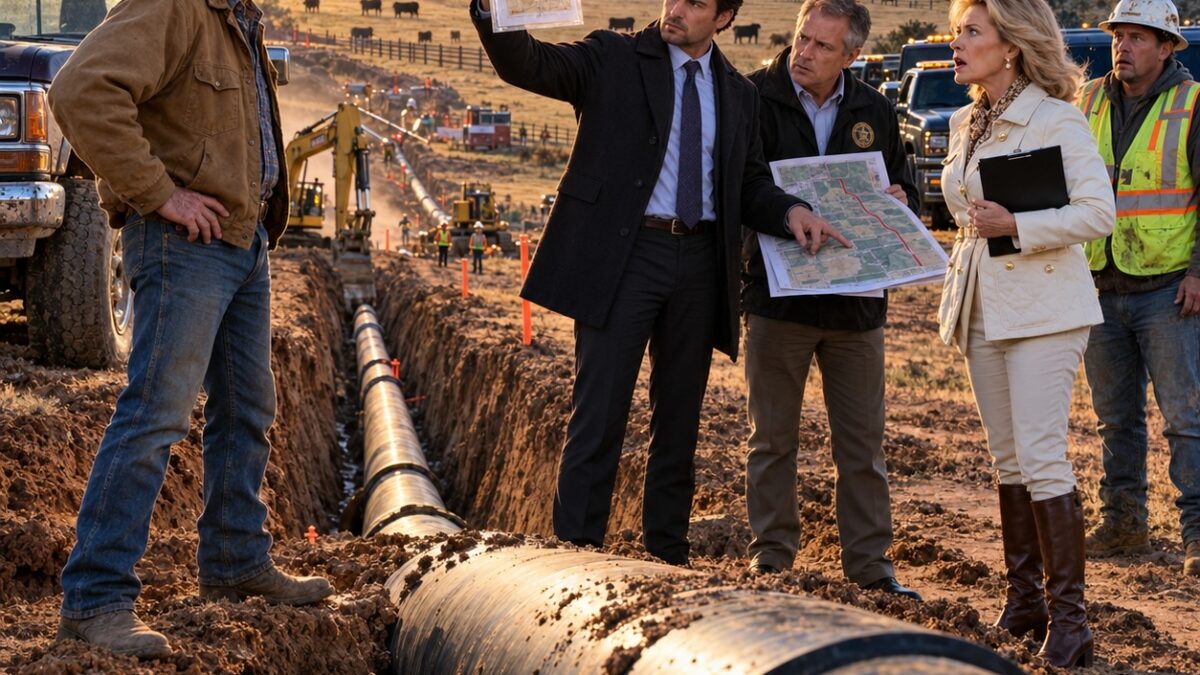
FULL STORY CONTINUATION
Daniel kept digging.
The more records he opened, the less the situation resembled any ordinary easement mistake.
North Ridge Communities owned the residential development around Cedar Ridge Estates.
North Ridge Energy was a related infrastructure company.
Different corporate entity.
Same investment group.
The pipeline on my ranch continued from the processing facility toward a regional transmission network.
Daniel found a filing dated 2024.
“Pipeline Capacity Reservation Agreement.”
The parties listed were North Ridge Energy and Cedar Ridge Community Association.
I read the names twice.
“Why is an HOA signing an energy contract?”
Daniel leaned back.
“That is an excellent question.”
“Does an HOA normally do that?”
“Not like this.”
He tapped the page.
“This isn’t landscaping. This isn’t road maintenance. This is commercial infrastructure.”
My phone rang that afternoon.
Patricia.
I looked at Daniel.
He nodded toward speaker.
I answered.
“Frank, I understand there’s been some confusion.”
“There’s a pipeline on my property.”
“It’s part of the regional infrastructure plan.”
“You don’t own my property.”
“We have historical infrastructure rights.”
“You’ve never shown me those rights.”
“They’ve existed for years.”
“Where’s the easement?”
Silence.
Not long.
Maybe two seconds.
Enough.
“Frank, this isn’t the time to be difficult.”
I looked at Daniel.
His eyebrows lifted.
“Where’s the easement, Patricia?”
She sighed.
“The association has coordinated infrastructure through that area for decades.”
“That isn’t an answer.”
“You’re making this a much bigger issue than necessary.”
“Then send me the document.”
She hung up.
Daniel looked at the phone.
“She doesn’t have one.”
“You sure?”
“If she had a recorded commercial easement, she’d have shoved it down our throats before breakfast.”
I drove home that evening angry enough that I barely noticed the ranch around me.
That bothered me.
This land usually calmed me.
I had spent most of my life measuring seasons through grass, cattle, rainfall, fence work, and timber.
Now every acre felt like evidence.
I barely slept.
At daylight I went back to the northern pasture.
That was when I noticed something I had missed the first morning.
There were two parallel lines.
The larger pipeline.
Then a smaller one.
I photographed both.
A few hours later, my son Ethan arrived.
Ethan was thirty-eight and worked in agricultural and environmental construction.
He knew industrial sites better than I did.
He climbed down into a safe section beside the trench, crouched, studied the coating and layout, and looked up at me.
“Dad.”
“What?”
“This isn’t just a distribution line.”
“How do you know?”
He pointed.
“Coating. Valve spacing. Pressure-control arrangement. Whatever they’re moving through this, it’s going somewhere under pressure.”
“Natural gas?”
“Could be.”
“What else?”
“Condensate. Processed water. Carbon dioxide. Refined product. We need the specs.”
He photographed the marker.
NRPL7.
“Give me a few hours.”
That evening, Ethan came to the house with his laptop.
He had found a regional infrastructure map.
The line was not municipal water.
Not a neighborhood gas main.
Not something serving Cedar Ridge homeowners.
The larger pipeline was classified as liquid hydrocarbon transmission.
I stared at the screen.
“What exactly does that mean?”
“It means they’re moving industrial product.”
“Across my land.”
“Yes.”
“For what?”
“Commercial transmission.”
“How commercial?”
“I don’t know yet.”
He zoomed out.
“But look.”
The pipeline did not end at North Ridge’s facility.
It connected farther on to a regional transmission hub.
I sat back.
“So they’re moving product across my property.”
“Yes.”
“And eventually selling it.”
“Yes.”
For years, Patricia had described my ranch as undeveloped acreage.
North Ridge representatives had called it peripheral property.
Low strategic value.
Unused corridor.
Empty land.
Apparently, that description changed once they needed thirty inches of steel buried under it.
The next morning, Daniel returned to county records.
That was when he found the first document that mattered.
A 1989 survey.
It showed an old utility corridor along the far northern edge of the ranch.
At first, I thought Patricia might finally have something.
Then Daniel read the description.
Municipal water.
Not energy.
And the underlying agreement had expired.
He kept searching.
Then he found the original license.
Dated 1990.
Signed by my father.
The title read:
TEMPORARY UTILITY ACCESS LICENSE.
Thirty years.
Limited purpose.
No ownership transfer.
No commercial pipeline rights.
No assignment without written landowner consent.
I stared at my father’s signature.
It had been years since I had seen his handwriting.
That did something to me.
For a moment, the legal argument disappeared.
I was looking at Dad.
His name.
The way he formed the M in Mercer.
Then Daniel pointed lower.
Expiration date:
December 31, 2019.
He looked at me.
“Frank, this matters.”
“Because it expired.”
“Because it expired, and because even while it was active, it didn’t authorize what they built.”
He turned another page.
“There’s an assignment clause.”
I read.
Any transfer to another operator required written approval from the Mercer property owner.
No approval existed.
“So the HOA couldn’t assign it.”
“No.”
“North Ridge couldn’t use it.”
“Not under this license.”
“And commercial hydrocarbon transmission?”
“Explicitly outside the purpose.”
I leaned back.
Something changed inside me.
Until then, I had been reacting.
Pipeline.
Trucks.
Patricia.
Contractors.
Now we had a foundation.
Paper.
The kind my father had signed thirty-five years earlier.
People think land disputes are about who sounds most certain.
They are not.
They are about documents.
Patricia appeared at the ranch that afternoon.
This time, she brought Thomas Bell from North Ridge.
Thomas looked like a man who had realized his day might cost somebody millions.
Patricia looked like Patricia.
Cream blazer.
Controlled expression.
Folder in hand.
“Frank, we’re here to resolve this.”
I looked past her at the pipeline trench.
“You’re late.”
She ignored that.
“The pipeline is part of a regional infrastructure initiative using established access.”
“Show me.”
She opened the folder.
Map.
Engineering drawings.
Colored corridor overlays.
No recorded easement.
No valid current license.
I handed it back.
“This proves where you want the pipeline. It doesn’t prove you have the right to put it there.”
Her expression hardened.
“The HOA has managed infrastructure throughout this area for decades.”
“That’s not ownership.”
She turned toward Thomas.
“Tell him.”
Thomas looked at me.
“We were advised the corridor was legally available.”
“By whom?”
He looked at Patricia.
“The association.”
“What is running through the pipe?”
Patricia answered for him.
“Industrial utility material.”
I stared at her.
“That phrase means nothing.”
Thomas looked away.
Daniel had arrived behind me by then.
He stepped forward.
“Is it liquid hydrocarbon?”
Thomas went quiet.
Patricia’s face changed.
Tiny.
A tightening around the eyes.
Daniel saw it too.
Ethan stepped closer.
“How much capacity?”
Thomas did not answer.
Daniel smiled slightly.
“You don’t need to. County filings might.”
Patricia snapped the folder shut.
“Frank, you’re turning this into a legal dispute.”
I looked toward the trench.
“No. You did that when you built a commercial pipeline across my ranch.”
She stepped closer.
“You have 3,760 acres.”
“Yes.”
“Most of it is unused.”
“No. Most of it is land.”
“You don’t use the northern corridor.”
I stared at her.
“That does not make it yours.”
She exhaled impatiently.
“Three hundred thousand dollars.”
I almost laughed.
“For what?”
“Permanent infrastructure access.”
“No.”
“Five hundred.”
“No.”
“Seven hundred fifty thousand.”
Daniel glanced at me.
I shook my head.
Patricia looked genuinely irritated.
“You’re refusing three-quarters of a million dollars?”
“I’m refusing to sell rights I don’t understand.”
Her expression changed.
Not anger this time.
Frustration.
Then she said:
“You don’t understand what you’re sitting on.”
Everybody went quiet.
I looked at her.
“Neither do you.”
She turned and walked toward her SUV.
Thomas stayed.
He waited until Patricia was far enough away that she could not hear.
Then he said:
“Frank.”
“Yes?”
“I think you should get independent advice.”
“I already have it.”
He nodded.
“The pipeline is more important than the HOA is telling you.”
“How important?”
He hesitated.
“Very.”
Then he left.
That sentence changed the entire tone.
Not because it was precise.
Because he was a North Ridge representative warning me about the people supposedly speaking for North Ridge access.
That night, Ethan came to my office carrying a thick binder.
He dropped it on the desk.
“I found the capacity report.”
I opened it.
The projected throughput was 18,000 barrels per day.
I stared.
“Eighteen thousand.”
“Yes.”
“Per day.”
“Yes.”
Then another contract.
Transportation reservation.
North Ridge Energy and a regional distributor.
Projected annual transportation value:
More than $14 million.
I looked at Ethan.
“Fourteen million?”
“Transportation value.”
“Every year?”
“Projected.”
That put Patricia’s $750,000 offer into perspective instantly.
She had not been trying to buy access across worthless ranch land.
She had been trying to secure a corridor supporting a contract worth millions annually.
Ethan turned one more page.
Old engineering map.
Handwritten note.
Mercer Ranch — owner consent required before commercial use.
Underneath:
Do not rely on HOA access history.
Daniel had returned by then.
He read it.
Closed the binder slowly.
“Frank.”
“What?”
“I think we just learned why they kept calling your land worthless.”
He tapped the revenue figure.
“Because if you understood what they were using it for, nobody could buy your consent cheaply.”
My phone rang.
Margaret Lewis.
She was a member of the HOA board.
Her voice was low.
“Frank, I found the pipeline records.”
I looked at Daniel.
“What did you find?”
“A payment schedule.”
“How much?”
Silence.
“Margaret?”
“Patricia has been collecting money from the pipeline for years.”
I stood.
“How many years?”
“Since the commercial test phase.”
“How much?”
Another pause.
Then:
“Over four million dollars.”
The room changed.
The pipeline was no longer merely unauthorized infrastructure.
Somebody had been monetizing access across my land.
And Patricia—the woman who kept calling those acres worthless—might have understood exactly how valuable they were the entire time.
Margaret did not come to the ranch until after dark.
Headlights crossed the front windows.
She parked close to the house and got out carrying two binders and a flash drive.
She looked exhausted.
“I shouldn’t have taken these.”
Daniel met her at the door.
“What are they?”
“Pipeline records.”
We went to my office.
She placed the first binder on the desk.
NORTH RIDGE INFRASTRUCTURE REVENUE — PRIVATE.
Monthly payments.
North Ridge Energy.
Red Valley Processing.
Prairie Transmission.
Cedar Ridge Utilities.
Some months were eighteen thousand dollars.
Others nearly seventy thousand.
Daniel turned pages.
“Date range?”
“2021 through 2026.”
“Total?”
Margaret looked at me.
“Four point three seven million.”
The number sounded unreal.
“Paid to the HOA?”
“That’s what the records show.”
I sat down.
“Where did it go?”
Margaret opened another section.
The early entries looked ordinary enough.
Road work.
Landscaping.
Security.
Insurance.
Then money began flowing into separate entities.
Cedar Infrastructure Advisory.
Mercer Corridor Consulting.
North Ridge Community Development Services.
Daniel stopped.
“Mercer Corridor Consulting?”
Margaret nodded.
“Patricia’s brother owns it.”
“How much?”
“Three hundred twelve thousand over three years.”
Another page.
A company connected to Patricia’s husband.
One hundred eighty-four thousand.
I leaned back.
“The HOA collected millions from a pipeline on my ranch and paid Patricia’s family.”
Margaret nodded.
“Yes.”
Daniel closed the binder.
“We need the original agreement they were relying on internally.”
Margaret handed him the flash drive.
“That’s why I came.”
We plugged it in.
Hundreds of files.
Engineering reports.
Invoices.
Emails.
Survey drawings.
Payment confirmations.
One folder stood out.
MERCER — DO NOT DISTRIBUTE.
Daniel opened it.
There was the 1990 utility license.
My father’s document.
Then a newer file.
2019 internal legal memorandum.
MERCER RANCH CORRIDOR — EXPIRATION AND RENEWAL REQUIREMENTS.
Daniel read silently.
Then looked at me.
“This is the one.”
“What?”
“The HOA’s own attorney told them the license expired December 31, 2019.”
He turned the screen.
The memorandum could not have been clearer.
Any commercial pipeline use after expiration required a new agreement with the Mercer property owner.
No automatic renewal.
No historical exception.
No transfer of ownership.
No right to commercial expansion without consent.
I looked at Margaret.
“When did Patricia receive this?”
“February 2020.”
“So she knew.”
“Yes.”
“And they started collecting commercial pipeline money after that?”
“The first payment I found was March 2021.”
Silence.
I could feel something cold settle behind my ribs.
Daniel searched the folder.
Then opened an email.
March 18, 2020.
Subject:
PIPELINE REVENUE — KEEP INTERNAL.
From Patricia.
To HOA counsel.
The message was short.
Do not reopen the Mercer corridor issue. Continue collection under Administrative Infrastructure Authority. Mercer has not requested documentation.
Daniel read it twice.
I stared.
“She knew I hadn’t been told.”
“Yes.”
“She knew the license expired.”
“Yes.”
“She knew the HOA didn’t own the commercial rights.”
“Yes.”
“And she kept taking money.”
Daniel nodded.
Margaret whispered:
“There’s more.”
She opened a spreadsheet.
Phase 4 expansion.
The pipeline would increase capacity from 18,000 barrels per day to 27,000.
Projected transportation revenue would nearly double.
North Ridge had already paid the HOA a future reservation fee.
$1.15 million.
I stared.
“They already paid it?”
“Yes.”
“When?”
“Four months ago.”
“Before I signed anything.”
Margaret looked at me.
“You never signed anything.”
“Exactly.”
Ethan walked in carrying another survey.
“Dad, we’ve got another problem.”
I laughed without humor.
“Of course we do.”
“The pipeline doesn’t only cross the northern pasture.”
He spread the map.
“There are two corridors.”
One for the main product line.
Another for pressure-control infrastructure.
Monitoring.
Emergency shutoff equipment.
Valve systems.
The second corridor cut through an eastern wooded section of the ranch I rarely visited.
“How long has that been there?”
“Records say 2021.”
I looked at Margaret.
“Did the HOA know?”
“Yes.”
“Patricia?”
“She signed the access coordination documents.”
Daniel leaned forward.
“County permits.”
Ethan already had them.
The county approved installation based on a certification submitted by Cedar Ridge Community Association.
The certification stated:
Applicant possesses sufficient access authority for installation and maintenance.
Daniel stared.
“They certified authority they could not prove.”
“Can we challenge that?” I asked.
“Yes.”
“Why didn’t anybody before?”
He looked at me.
“Because nobody knew the title defect.”
That phrase stayed with me.
Title defect.
A sterile phrase for what was happening.
Someone had taken an expired temporary license, stretched it into permanent commercial authority, certified rights they did not own, collected millions, paid related entities, and counted on the landowner never asking the right questions.
The next morning, Thomas Bell returned.
This time, North Ridge sent an attorney with him.
They sat across from Daniel and me in my office.
Thomas looked tired.
“I owe you the full story.”
“I already know most of it.”
He nodded.
“Then I’ll confirm what I can.”
He placed documents on the table.
North Ridge had paid the HOA $1.15 million for future expansion rights.
They had also paid an earlier $840,000 reservation amount.
Total:
$1.99 million.
I looked at him.
“Why didn’t you come to me?”
“We were told Cedar Ridge controlled the corridor.”
“By Patricia.”
“Yes.”
“Did you verify?”
His attorney answered.
“Our title review relied on association representations and historical access records.”
Daniel looked at him.
“That isn’t a title search.”
The attorney did not argue.
“No.”
Thomas looked out the window.
“The alternative route costs six to eight million dollars.”
I stared.
“So my land saves you millions.”
“Yes.”
“Patricia knew that.”
“Yes.”
“Then why did she offer me seven hundred fifty thousand?”
Thomas did not answer.
His attorney did.
“That was the amount authorized for landowner settlement.”
I almost laughed.
“Settlement.”
“Yes.”
“Not compensation for past use.”
“No.”
“Not value for the commercial rights.”
“No.”
“Just settlement.”
“Yes.”
I looked at Daniel.
He shook his head.
Thomas said:
“We want to negotiate directly.”
“Now?”
“Yes.”
“After you already installed the line.”
He nodded.
“We can’t remove it without major disruption.”
“That isn’t my problem.”
“I understand.”
“What are you offering?”
Preliminary proposal.
Twenty-year infrastructure license.
$1.25 million upfront.
Annual corridor fees.
Restoration obligations.
Insurance.
Emergency access.
Future expansion compensation.
Daniel read it.
Handed it back.
“Incomplete.”
Thomas frowned.
“How?”
“You have not addressed past use.”
Thomas looked at me.
“You want compensation for the existing line?”
“I want the record corrected.”
Daniel added:
“And the HOA removed from the chain of authority.”
Thomas nodded.
“That can be done.”
Before they left, I asked:
“What exactly are you carrying?”
Thomas looked at his lawyer.
The attorney said:
“Refined liquid hydrocarbons.”
“What kind?”
“We can’t disclose commercial formulation.”
Ethan, sitting near the wall, finally spoke.
“You can disclose classification.”
The attorney looked at him.
Ethan continued.
“The line pressure and transmission specs indicate high-value refined product.”
Nobody answered.
That silence was enough.
The HOA had not just been collecting access money for a pipe.
They had been monetizing a corridor carrying valuable commercial product through my property.
And that still was not the biggest thing we found.
Later that afternoon, Ethan and I drove into the eastern woods.
He had identified a concrete structure on old engineering drawings.
We found it beside an overgrown service road.
Metal cover.
Buried under leaves.
Marker:
NRPS7 PRESSURE STATION.
Ethan cleared brush.
“This is newer.”
“How much?”
“Maybe two years.”
He opened his tablet.
The station connected to the main line and a smaller underground branch.
“Where does the smaller line go?”
He traced it.
Stopped.
“South.”
“Toward what?”
“The old Mercer water corridor.”
We drove.
Near the edge of another wooded section sat a fenced concrete building I had passed before without much thought.
No company sign.
No obvious logo.
Old steel door.
Ethan checked the county mapping.
“Dad.”
“What?”
“This isn’t just a valve station.”
“What is it?”
“Storage.”
I stared at the building.
“How much storage?”
“Engineering estimate says around 1.8 million gallons.”
I looked at him.
“There is a million-plus-gallon industrial storage facility on my ranch?”
“Potentially.”
“And they connected it to the pipeline.”
“Yes.”
I could barely process the scale anymore.
Half-mile trench.
Two pipeline corridors.
Pressure station.
Storage facility.
Regional transmission route.
All across family land.
None of it authorized by me.
That night, Daniel pulled environmental records.
The storage permit had been issued in 2021.
Applicant:
Cedar Ridge Community Association Infrastructure Division.
Description:
Community emergency liquid reserve.
That was the first lie.
Engineering documents classified it as commercial balancing and storage.
Part of North Ridge Energy’s transmission system.
The county permit required landowner authorization.
There was none.
Then Daniel found the application.
Bottom of the page.
Patricia’s signature.
I stared.
“She signed it.”
“Yes.”
“Using the HOA.”
“Yes.”
“For commercial infrastructure.”
“Yes.”
“On my property.”
“Yes.”
Then he found the final page.
County engineer notation:
Landowner consent document not located in submitted materials. Applicant advised to provide before commercial operation.
Below that:
Proceed pending documentation.
I felt my blood pressure rise.
“They were warned.”
Daniel nodded.
The county had asked for the exact document that did not exist.
Somewhere between warning and operation, everyone continued anyway.
The next morning, I called the county.
A communications and infrastructure engineer named Sarah Cole agreed to meet us.
She came to the ranch.
Reviewed maps.
Inspected the pressure station.
Checked the corridor.
Spent nearly two hours comparing county files to what physically existed.
Finally, she looked at me.
“Mr. Mercer, this is a serious title and permitting issue.”
“How serious?”
“The county never received a valid commercial landowner license.”
“So how did they operate?”
“Based on the HOA’s certification that it possessed sufficient access authority.”
Daniel asked:
“Can the county shut it down?”
Sarah hesitated.
“Not immediately.”
I understood before she explained.
This was no longer a local line.
It was tied into a broader regional network.
An abrupt shutdown could create operational problems far beyond my ranch.
That was important.
The pipeline’s importance did not erase my rights.
But my rights did not require me to behave recklessly either.
I did not want to trigger some regional supply disruption just to make a point.
I wanted a lawful agreement.
Sarah continued.
“There’s another issue.”
Of course there was.
She showed us a 2022 inspection report.
The line had been operating below intended capacity.
A bottleneck existed at the pressure station on my property.
To increase throughput from 18,000 barrels per day to 27,000, North Ridge needed modifications.
A second control line.
Expanded pressure-management equipment.
That work required my written consent.
Without it, Phase 4 could not legally proceed.
I looked at Daniel.
“That’s why Patricia suddenly offered money.”
“Yes.”
“And why she wanted access from the beginning.”
“Yes.”
“And why they kept calling the northern pasture worthless.”
Daniel nodded.
“Because they needed you to believe that.”
Patricia called that afternoon.
Her voice had changed.
Less confident.
“Frank.”
“Yes.”
“We should meet.”
“Why?”
“There’s been misinformation regarding the pipeline.”
“Yes.”
Silence.
“About the four point three seven million.”
More silence.
“About Cedar Infrastructure Advisory.”
Nothing.
“About the expired license.”
She finally spoke.
“You don’t understand the consequences of interfering with regional infrastructure.”
I looked through my office window.
Pasture.
Fence.
Open land.
“I haven’t interfered with anything.”
“You could delay Phase 4.”
“I am asking you to produce a legal agreement.”
“You’re sitting on an asset affecting thousands of people.”
I answered calmly.
“No, Patricia.”
Pause.
“You’re sitting on an asset you thought I wouldn’t understand.”
She hung up.
That evening, Margaret sent one final file.
Board memorandum.
Dated six months before the first commercial pipeline payment.
One sentence highlighted:
If Mercer learns the corridor generates commercial transportation revenue, he is unlikely to accept the proposed settlement.
Below it was Patricia’s handwritten response.
Three words.
He won’t learn.
I read them twice.
Then again.
He won’t learn.
I looked around my office.
Maps everywhere.
Contracts.
Revenue schedules.
Photographs.
Permits.
My father’s license.
Three thousand seven hundred sixty acres.
A pipeline capable of moving eighteen thousand barrels every day.
Millions in transportation value.
Commercial storage.
Pressure infrastructure.
An HOA that had been quietly collecting money from all of it.
They had never believed my ranch was worthless.
They had needed me to believe it.
That was different.
The next morning, the county called an emergency infrastructure hearing.
North Ridge had submitted its application for Phase 4 expansion.
For the first time, the application required a signature nobody else could manufacture through historical practice or HOA certification.
Mine.
The hearing was scheduled for Thursday at nine.
By 8:30, the county administration building was packed.
North Ridge brought attorneys.
Pipeline engineers.
County staff.
Cedar Ridge board members.
Patricia sat in front wearing the cream blazer she favored whenever she expected to dominate a room.
Margaret sat several chairs away.
Thomas Bell was near North Ridge’s legal team.
I walked in with Daniel and Ethan.
I carried no speech.
No threat.
No dramatic demand.
Just documents.
The 1990 utility license.
The expiration clause.
The 2019 internal memorandum.
Pipeline payment records.
County permits.
Engineering maps.
My father’s handwritten note.
The county engineer opened the hearing.
“We are here to address three issues: land ownership, infrastructure authorization, and the proposed expansion of the North Ridge transmission system.”
Patricia raised her hand before the engineer finished settling her papers.
“We believe the association has long-standing infrastructure rights within the corridor.”
The county engineer looked at her.
“Please provide the recorded instrument establishing those rights.”
Patricia’s attorney stood.
“We have extensive historical documentation.”
Daniel said:
“Then let’s see it.”
The attorney put documents on the table.
Old maintenance agreements.
Coordination letters.
HOA meeting minutes.
Infrastructure schedules.
None transferred ownership.
None created a permanent commercial easement.
None gave Cedar Ridge the right to sell pipeline capacity.
None allowed the HOA to collect millions for commercial transmission across Mercer land.
The engineer reviewed them.
“These documents establish maintenance and coordination history.”
She paused.
“They do not establish ownership.”
Patricia shifted.
Daniel placed my father’s 1990 license on the table.
“This is the original instrument.”
He pointed.
“Thirty-year term. Limited utility purpose. No transfer of ownership. No commercial expansion without landowner consent.”
The engineer nodded.
“That is consistent with county records.”
Patricia’s attorney said:
“We believe subsequent administrative practice extended these rights.”
Daniel turned.
“Where is the extension?”
Silence.
“The recorded renewal?”
Nothing.
“The Mercer signature?”
Nothing.
He looked at the panel.
“There isn’t one.”
Patricia leaned toward her attorney.
Whispered.
Then spoke.
“The HOA has managed the corridor for decades.”
The county engineer answered immediately.
“Management is not ownership.”
The room became still.
That sentence cut through years of assumption.
Management is not ownership.
I thought of every time Patricia had acted as though coordinating access somehow transformed the land underneath it.
It had not.
Then Margaret stood.
Patricia turned sharply.
“Margaret.”
Margaret ignored her.
“I need to correct the financial record.”
She carried the binders.
“The association collected approximately $4.37 million in pipeline-related revenue between 2021 and 2026.”
A murmur went through the room.
Thomas looked down.
Margaret continued.
“The revenue included payments for access, transportation coordination, pressure-station use, storage access, and commercial infrastructure reservations.”
The county engineer looked at Patricia.
“Did the HOA own those rights?”
Patricia answered:
“We had historical authority.”
Margaret shook her head.
“No.”
Patricia stared.
Margaret placed the HOA lawyer’s memorandum on the table.
“The association’s counsel warned the board in 2020 that the Mercer license expired and any commercial use required a new landowner agreement.”
Patricia snapped:
“That is not the full context.”
Margaret added the email.
Patricia’s own message.
Do not reopen the Mercer corridor issue.
Continue collection under Administrative Infrastructure Authority.
Mercer has not requested documentation.
No one spoke.
Daniel placed another document beside it.
“$312,000 paid to Cedar Infrastructure Advisory.”
He looked at the panel.
“Owned by Patricia Holloway’s brother.”
Patricia’s attorney answered quickly.
“Those were consulting arrangements.”
Margaret said:
“The full board was never given supporting invoices for all of them.”
Daniel turned another page.
Additional payments connected to Patricia’s husband.
By then, the hearing was no longer simply about whether a pipeline could expand.
It was about how the HOA had been operating.
Thomas Bell stood.
“North Ridge relied on the association’s representations.”
Daniel looked at him.
“And paid nearly two million dollars based on those representations.”
“Yes.”
“You now acknowledge Cedar Ridge did not own the commercial rights.”
Thomas inhaled.
“Yes.”
Patricia turned.
“Thomas.”
He looked at her.
“You told us the corridor was available.”
“I believed it was.”
“You told us the association had historical control.”
“Yes.”
Daniel asked:
“You did not verify title independently.”
Thomas looked down.
“No.”
Then Daniel opened the county survey.
The corridor was drawn clearly through Mercer property.
Beside it was the note from 1990.
Landowner approval required for commercial use.
Daniel pointed toward my father’s signature.
“Silas Mercer executed the original limited license.”
Then he pointed toward the modern pipeline records.
“There is no subsequent Mercer signature.”
Patricia’s attorney sat very still.
Finally, he said:
“We cannot produce one.”
That was the moment.
No fireworks.
No judge slamming a gavel.
Just an attorney admitting he could not produce the single document necessary to support years of claims.
I owned the land.
The HOA did not own pipeline rights.
The old license had expired.
The commercial operation had continued without a new agreement.
The county ordered a formal title and permitting review.
The pipeline could continue operating temporarily under safety restrictions because an abrupt shutdown posed broader infrastructure concerns.
But Phase 4 stopped.
No additional line.
No increased pressure capacity.
No new commercial connections.
No additional corridor.
Nothing until a proper landowner agreement existed.
Mine.
The hearing adjourned.
People poured into the hallway.
Thomas came toward me.
“I want to make a serious offer.”
“I’ll listen.”
He handed Daniel a proposal.
Twenty-five-year infrastructure license.
$2 million upfront.
Annual corridor fees.
Historical disturbance compensation.
Full restoration obligations.
Environmental monitoring.
Liability insurance.
Maintenance responsibility.
Emergency county access.
And a provision explicitly stating the HOA had no authority to assign, control, or sell the rights.
Daniel read slowly.
Then looked at me.
“Much closer.”
I looked at Thomas.
“One more issue.”
“Past revenue.”
“Yes.”
He nodded.
“We know.”
“How do you propose to handle it?”
His attorney said:
“North Ridge will not accept responsibility for funds already collected by the HOA.”
“That’s not what I asked.”
Thomas stepped in.
“We’ll restructure all commercial payments going forward so they are paid directly to you. We’ll provide complete records for the independent audit of the prior collections.”
That was reasonable.
I was not asking North Ridge to pay the same revenue twice.
I wanted the chain corrected.
Who owned the land?
Me.
Who had authority to negotiate?
Me.
Who had collected the previous money?
The HOA.
Who had represented the rights?
The HOA.
Who would receive future compensation?
The landowner.
Simple.
The final agreement took three weeks.
Daniel made sure every paragraph meant what it was supposed to mean.
Twenty-five years.
Two million dollars upfront.
Annual corridor payments tied to pipeline capacity.
Restoration.
Maintenance.
Environmental inspection.
Insurance.
Any expansion required written consent from me.
Any new line required a new recorded instrument.
The HOA had no authority.
The county retained emergency access rights.
Every commercial payment came directly to the Mercer property owner.
North Ridge accepted the deal because redesigning the route would cost millions and years.
The pipeline operator accepted it because the route remained usable.
The county accepted it because the broader infrastructure could stay online under a valid framework.
Everyone got something.
More importantly, everybody stopped pretending.
Patricia did not escape the fallout.
Immediately after the hearing, the HOA board suspended her signing authority.
Two weeks later, she resigned.
The independent audit continued for months.
It confirmed approximately $4.37 million in pipeline-related revenue had been collected.
It also identified more than $500,000 in payments tied to Patricia’s family businesses and affiliated consultants.
Some expenses had documentation.
Others did not.
I stayed careful about that distinction.
Not every dollar connected to a relative automatically meant fraud.
The audit had to determine what was legitimate.
But the pattern was serious enough that the board changed how it operated.
The $1.15 million Phase 4 reservation payment was reclassified.
Part of it was returned through the settlement structure.
New rules required independent legal verification before Cedar Ridge could claim ownership, easement rights, or infrastructure authority over anyone else’s land.
The county corrected its records too.
MERCER RANCH CORRIDOR — PRIVATELY OWNED.
My father’s 1990 license attached.
Expiration date noted.
New commercial license recorded directly between North Ridge and me.
A month later, construction crews returned.
This time, I stood beside the surveyors.
No surprise trucks at dawn.
No secret orange flags appearing overnight.
Every marker corresponded to the recorded agreement.
Every work area was defined.
Every restoration requirement written.
Ethan walked beside me.
“You know what I still can’t believe?”
“What?”
“That they kept telling you 3,760 acres were worthless.”
I smiled.
“They didn’t think it was worthless.”
He looked over.
“They knew exactly what it was worth.”
The line disappeared underground again.
Quiet.
Almost invisible.
That was one of the strange things about the entire fight.
Millions of dollars could move beneath pasture while cattle grazed above it and almost nobody noticed.
Value does not always announce itself.
A few months later, the first annual corridor payment arrived.
It was larger than anything Patricia had ever offered me before I learned the truth.
Still, the money was not the part that mattered most.
The best part was opening my ranch records.
My father’s old license on one side.
The new agreement beside it.
The old one said:
Temporary access.
Limited purpose.
The new one said:
Commercial use by permission of the landowner.
Those two ideas looked simple on paper.
The difference between them represented years of assumptions.
Patricia had assumed historical access could become permanent control.
North Ridge had assumed HOA representations were enough.
Contractors assumed permits settled ownership.
County personnel assumed missing consent would eventually appear.
I had assumed nobody would build commercial infrastructure across my ranch without asking.
Every one of those assumptions failed.
Only one of us owned the ground.
That mattered in the end.
Daniel came out to the ranch one evening.
We stood near the fence overlooking the northern pasture.
Pipeline markers were visible at intervals.
He said:
“Your father would have liked this.”
I looked at him.
“What?”
“That his old agreement still mattered.”
I nodded.
“He knew something.”
“What?”
“That land isn’t valuable because somebody tells you it is.”
I looked across the pasture.
“It’s valuable because of what people want to do with it.”
Daniel smiled.
“And apparently a lot of people wanted to do things with yours.”
I laughed.
For years, Patricia called my ranch empty acreage.
North Ridge called it peripheral land.
The HOA treated it like blank space on a development map.
But beneath it ran infrastructure capable of moving thousands of barrels per day.
A pressure station.
A storage facility.
A regional transmission connection.
Millions of dollars in commercial value.
The HOA discovered that before I did.
Then they made one mistake.
They assumed I would never look.
That was the real insult underneath everything.
Not merely taking the access.
Underestimating me.
They looked at an older ranch owner and assumed I would not understand transportation contracts.
Assumed title law would overwhelm me.
Assumed pressure ratings and capacity numbers would mean nothing.
Assumed millions moving through corporate entities would remain invisible if nobody used the word “pipeline” too loudly.
Patricia’s three handwritten words said it best.
He won’t learn.
She built an entire strategy around that sentence.
I did not need to outsmart her.
I did not need to threaten anyone.
I needed to read what my father had signed.
That was all.
Once the original license was on the table, the rest became a chain of questions.
Did it allow permanent access?
No.
Did it allow commercial hydrocarbon transmission?
No.
Did it permit transfer without landowner approval?
No.
Was it still active?
No.
Had I renewed it?
No.
Had I signed any modern commercial agreement?
No.
Everything Patricia built rested on the hope nobody would ask those questions.
Then I did.
People later called what happened revenge.
I never thought of it that way.
Revenge would have been shutting the pipeline down simply because I could create pain.
I did not want that.
The county explained that immediate shutdown could affect broader service.
I listened.
North Ridge admitted the title failure.
I listened.
They offered a lawful structure.
We negotiated.
That was not revenge.
That was correction.
The consequence for Patricia came because once records were opened, what she had been doing could no longer survive in private.
The board saw the legal memorandum.
The payment schedules.
The family-linked entities.
The hidden revenue.
The expired license.
The internal email.
The handwritten memo.
He won’t learn.
You can call that bad luck if you want.
I call it documentation.
Paper does not care how confidently you speak.
The ranch looked exactly the same after the dispute ended.
That pleased me.
Grass.
Fence.
Cedar hills.
The old roads.
Cattle moving slowly in the distance.
If you drove through without knowing the story, you would never guess there was a commercial transmission network beneath the ground.
That is part of why Patricia thought the arrangement could remain hidden.
Invisible infrastructure creates invisible value.
Until someone asks who owns the dirt.
That question changed everything.
The money changed things too, of course.
I will not pretend two million dollars upfront was insignificant.
It was real compensation.
Annual corridor payments were real.
The ability to negotiate future expansion had real financial value.
But I never saw the settlement as winning some lottery.
They were using land.
They were paying for that use.
That is how it should have happened from the beginning.
North Ridge should have come to me.
Explained the project.
Disclosed the value.
Offered terms.
Allowed me to negotiate.
Maybe I would have said yes.
Maybe no.
The point was that the decision belonged to me.
Property rights are not about automatically refusing every use.
They are about the right to choose.
Patricia replaced my choice with assumption.
That was the central wrong.
Everything else flowed from it.
The county hearing mattered because it restored the question everyone had skipped.
Who can say yes?
Not the HOA.
Not North Ridge.
Not the contractor.
Not a historical maintenance committee.
The landowner.
Me.
That answer gave all future discussions a structure.
After Patricia resigned, Cedar Ridge changed.
I did not become involved in HOA politics.
It was not my association.
That distinction had always mattered.
Margaret told me the board became much more careful.
Infrastructure claims required counsel.
Conflict-of-interest reviews became stricter.
Large outside revenue streams required broader disclosure.
Good.
I had no need to punish the entire community.
Most homeowners in Cedar Ridge had no idea their HOA was collecting pipeline money.
They were mowing lawns, raising kids, paying dues, going to work.
The pipeline dispute was not really them versus me.
It was a governance failure involving people who had treated private land like an internal administrative asset.
Once that stopped, I had no feud with the neighborhood.
Patricia remained a different matter.
She never came to apologize.
I did not need one.
Some people need apologies because they want emotional acknowledgment.
I already had something stronger.
Her own email.
Her own handwriting.
The audit.
The county record.
The resignation.
An apology could be denied later.
Documents were harder.
I saw her once months after she stepped down.
We were both at a local hardware store.
She noticed me near the counter.
I saw recognition hit.
For a second, I thought she might walk over.
She did not.
Neither did I.
There was nothing useful left to say.
She knew I knew.
I knew she knew.
The rest belonged to accountants, lawyers, and whatever conscience she had left.
I bought fencing staples.
Went home.
Life became ranch work again.
That was one of the best parts.
A major dispute feels permanent while you are inside it.
Then one day you are fixing a gate and realize three hours passed without thinking about Patricia.
Another day you are checking cattle.
Another, dealing with rain.
Then winter.
Life reclaims attention.
The pipeline remained.
Legally.
Documented.
Inspected.
Paid for.
The fact that I did not remove it confused some people.
“After what they did, why let it stay?”
Because I was not interested in cutting off my nose to prove I owned my face.
The infrastructure existed.
North Ridge needed it.
The county needed reliability.
I had bargaining power.
A lawful agreement produced value for everyone.
That is what negotiation is for.
Removing the line out of pure anger would have cost them millions.
It also would have torn up more of my ranch.
Why?
To prove a point already established?
No.
The better outcome was control.
No expansion without me.
No hidden storage change.
No secret new valve system.
No assignment to another operator without terms.
Environmental monitoring.
Insurance.
Maintenance.
Restoration.
Emergency procedures.
Written.
Recorded.
That gave me something anger could not.
Predictability.
I preferred that.
The new arrangement also forced North Ridge to treat the ranch as infrastructure-critical land rather than peripheral space.
Their engineers began calling before inspections.
They coordinated.
Survey crews checked in.
If someone needed access, I knew why.
Amazing what respect looks like once people understand access is not automatic.
The first time a North Ridge representative called to ask permission for a maintenance inspection, I almost laughed.
Not because the request was funny.
Because one year earlier, people had dug half a mile through my pasture before sunrise without asking.
Now:
“Mr. Mercer, we’d like access Tuesday between nine and noon.”
Progress.
I said yes.
They came.
Did the work.
Left.
No conflict.
That was all I had wanted.
Patricia had once told me:
You have 3,760 acres of mostly unused land.
That sentence bothered me more with time.
Unused.
Ranch land is not unused because there is no building on it.
Pasture has value.
Water corridors have value.
Timber has value.
Open land has ecological and agricultural value.
And sometimes, apparently, the exact piece somebody calls unused is the only practical route saving an energy company six to eight million dollars.
“Unused” often means:
Not currently being used by me.
That is not the same thing.
The pressure station made the contradiction almost ridiculous.
They had built infrastructure specifically because the corridor was valuable.
Then called the land low-value when talking to the owner.
That was negotiation through information imbalance.
If I had accepted Patricia’s early offer without understanding capacity, I might have thought $300,000 was generous.
At $750,000, maybe extraordinary.
Once I saw projected annual transportation value over $14 million and the alternative-route cost, the scale changed.
Information changes price.
That was why the internal memo mattered so much.
If Mercer learns the corridor generates commercial transportation revenue, he is unlikely to accept the proposed settlement.
They knew.
This was not merely two parties disagreeing about value.
One side had intentionally hoped the other remained ignorant.
He won’t learn.
Three words.
If I ever wrote a book about land rights, that might be the title.
Not because I was special.
Because the phrase captures a common arrogance.
Someone assumes the other person is too old.
Too rural.
Too inexperienced.
Too overwhelmed.
Too trusting.
Too disconnected.
They build the deal around ignorance.
Then the person learns.
Everything changes.
The ranch had taught me enough patience to help.
You do not rush cattle through a narrow gate if calm pressure will move them.
You do not tear out every fence because one post fails.
You do not make permanent decisions in the emotional peak of a problem.
I was furious.
Absolutely.
But Daniel kept me from turning anger into a bad legal strategy.
Ethan kept technical details grounded.
Margaret gave us records.
Sarah Cole gave the county perspective.
Thomas eventually gave North Ridge’s side.
That combination mattered.
The story was not one old rancher single-handedly outsmarting a corporation.
That would be a lie.
I had help.
Good help.
The difference was I listened.
Patricia had help too.
Her own attorney told her the license expired.
She chose not to listen.
That may have been her greatest mistake.
People imagine powerful personalities fail because nobody warned them.
Often they fail because warning feels like disrespect.
Patricia had the 2020 legal memorandum.
Clear.
Commercial use required a new agreement.
Her response was not:
Call Frank.
Negotiate.
Correct the record.
It was:
Do not reopen the Mercer corridor issue.
Continue collection.
Mercer has not requested documentation.
That sentence is almost a philosophy.
If the person harmed has not discovered the problem, the problem does not need fixing.
That is how small misconduct becomes large.
One month becomes one year.
One payment becomes four million.
One unauthorized line becomes a pressure station and storage facility.
One temporary access license becomes a myth of permanent authority.
Every time nobody objects, the fiction gains another layer.
Then someone finally looks at the original page.
December 31, 2019.
Expired.
The whole structure starts shaking.
I sometimes wonder what would have happened if the pipeline crew had finished that morning before I drove north.
Maybe the line would have been buried.
Pasture restored.
Flags removed.
I might not have noticed immediately.
That thought bothered me.
How much infrastructure could disappear beneath ranch land before the owner realizes?
A lot.
That is why physical inspection matters on large properties.
I changed my routine afterward.
More regular checks.
Especially remote corridors.
Not because I became paranoid.
Because three thousand seven hundred sixty acres is enough room for assumptions to become construction.
Ethan helped establish a better system.
Maps.
Inspection routes.
Updated aerial imagery.
Nothing dramatic.
Just management.
You learn.
People sometimes said:
“You should sue everyone.”
Maybe.
There were legal avenues.
But litigation is not automatically the best outcome.
We got title corrected.
Future rights established.
Compensation.
Environmental safeguards.
Past records opened for audit.
Patricia removed.
The county fixed its permitting records.
North Ridge paid for lawful use.
I had no desire to spend five years in court if a strong negotiated outcome solved the core problem.
Daniel agreed.
“Litigation is a tool,” he told me once. “Not a religion.”
That sounded like him.
We used pressure where needed.
Settlement where useful.
Documents everywhere.
The result held.
That was what mattered.
North Ridge’s attorney turned out to be practical once the facts were clear.
At first, defensive.
Understandably.
His client had millions invested underground.
Then, after the hearing, realistic.
They could fight title.
Lose time.
Risk expansion.
Possibly face permitting consequences.
Or negotiate with the actual landowner.
The second option was better.
I did not make the price punitive just because I had leverage.
I made it fair for the value.
Upfront money.
Annual compensation.
Capacity-based fees.
Future expansion consent.
Environmental obligations.
Maintenance.
Insurance.
Restoration.
That was a real commercial agreement.
The kind that should have existed before steel touched soil.
It also meant if North Ridge made more money from higher capacity, the landowner participated rather than being bought out cheaply at the beginning.
That mattered.
Value changed over time.
The agreement recognized that.
My father’s 1990 license had been temporary because he understood circumstances change.
Thirty years.
Limited purpose.
No ownership transfer.
No commercial pipeline.
No assignment without consent.
He may not have known what the area would become.
But he knew enough not to give away forever.
I respected that more every time I read the document.
Daniel was right.
Dad would have appreciated the fact that his old language still mattered.
The paper had outlived him.
Protected land he would never see changed.
Helped his son decades later.
Estate planning and land agreements often feel boring when signed.
Then one clause becomes the difference between control and theft.
No assignment without consent.
Beautiful sentence.
The corridor’s final legal structure became almost the opposite of Patricia’s model.
Her model:
Assume.
Coordinate privately.
Collect money.
Keep the landowner uninformed.
My agreement:
Disclose.
Record.
Pay directly.
Inspect.
Get written approval.
Simple.
Transparency is not complicated.
It only feels inconvenient to people benefiting from opacity.
Margaret once apologized to me.
We were standing outside a board meeting months later.
“For not saying something sooner.”
I looked at her.
“When did you know?”
“I knew there was pipeline revenue.”
“Did you know the license expired?”
“Not until I found the legal memo.”
“Did you know Patricia’s family companies were receiving money?”
“Not the full amount.”
“Then you told me when you understood.”
She nodded.
“I still feel like I should’ve looked earlier.”
“That’s easy to say afterward.”
She looked relieved.
I meant it.
Boards rely on division of responsibilities.
Not every member sees every record.
Patricia controlled information.
That mattered.
Margaret took real risk bringing those binders.
I was not going to punish the person who finally opened the door because she had not broken it down sooner.
She later pushed for stronger transparency rules.
Good.
Repair matters more than guilt.
The county did the same.
Sarah admitted the permit process had relied too heavily on Cedar Ridge’s certification.
That did not make the county evil.
It made the process weak.
They fixed it.
Landowner consent had to be independently verified for similar infrastructure.
No more:
Applicant says it has authority.
Proceed pending document.
Again, boring reform.
Extremely important reform.
Systems improve when people resist the urge to pretend failures were isolated accidents.
The county engineer’s note had already warned:
Landowner consent document not located.
That should have stopped operation.
It did not.
Why?
Because everyone assumed somebody else had the missing page.
The HOA said authority existed.
North Ridge believed the HOA.
County staff believed documentation would follow.
Contractors believed permits meant title was resolved.
Each group trusted the previous group.
Nobody looked back to the landowner.
Chain-of-assumption failure.
That was the technical version of the whole story.
The human version was simpler.
Nobody asked me.
Until they had to.
There was a strange moment about six months after the settlement.
North Ridge requested a minor maintenance access.
Routine.
They sent the paperwork properly.
I reviewed it.
Approved.
A young field engineer came out.
He looked nervous meeting me.
“You’re Mr. Mercer?”
“Yes.”
He glanced toward the pipeline marker.
“I’ve heard about this corridor.”
“I imagine.”
“They told us to make sure everything is documented.”
“That sounds wise.”
He smiled awkwardly.
Then said:
“For what it’s worth, most of us on the technical side had no idea about the title issue.”
“I know.”
That mattered.
It is easy to paint corporations as one mind.
They are not.
Engineers build what they are told is permitted.
Field crews follow drawings.
Attorneys review what comes across desks.
Executives make deals.
Misrepresentation at one point can contaminate everything downstream.
North Ridge had failed to verify title.
That was serious.
But once exposed, they negotiated.
Patricia had known and concealed.
Different.
Distinctions matter.
I had no interest in hating every employee who ever touched the pipeline.
That would be exhausting and stupid.
The crews who returned under the new agreement did good work.
Restored disturbed areas.
Reseeded.
Followed environmental requirements.
Ethan supervised parts.
I watched.
This time the process looked legitimate because it was.
Consent changes the moral character of the same physical act.
A trench without permission is trespass.
A trench under a recorded agreement is construction.
Same excavator.
Different right.
That is property law in one image.
The storage facility received additional scrutiny.
Environmental inspections.
Operational documentation.
I required clear responsibility for containment, maintenance, and emergency response.
If a million-plus gallons of industrial product were going to sit connected to infrastructure on my ranch, I wanted no ambiguity about who handled what.
Again, not dramatic.
Necessary.
Patricia’s permit had called it a community emergency liquid reserve.
That phrase still made me angry.
The facility did not exist primarily to help Cedar Ridge residents.
It served commercial balancing and storage.
Words had been used to soften what was being approved.
That bothered me almost as much as the missing consent.
Call things what they are.
Commercial storage.
Commercial transmission.
Commercial revenue.
If those words make approval harder, that is not a reason to hide them.
That is the reason approval matters.
My ranch records became much more detailed after the incident.
Survey copies.
Digital backups.
Recorded agreements.
Inspection reports.
Payment records.
Environmental files.
Dad kept paper.
I kept paper and digital.
Ethan made sure maps were current.
Three generations adapting.
That felt right.
Land ownership is not static.
You inherit not only acreage but responsibility to understand what touches it.
I had been too casual about remote corridors.
Patricia exploited that.
I learned.
No shame in saying so.
I assumed nobody would bury an industrial pipeline across private ranch land without direct consent.
Reasonable assumption.
Wrong in this case.
Now I verify.
That does not make the original conduct my fault.
It makes me less likely to experience it twice.
Those distinctions matter whenever people talk about prevention.
Could I have found the issue sooner?
Maybe.
Should they have built it without permission?
No.
Both can be true.
The first annual payment went into the ranch business.
Infrastructure improvements.
Water systems.
Fence work.
Equipment.
I did not buy a yacht.
People joked about that.
“Pipeline money!”
No.
Corridor compensation.
The ranch had costs.
The commercial agreement created a new revenue source.
Fine.
I wanted the land stronger because of it.
That seemed appropriate.
Dad had treated temporary utility compensation similarly decades earlier.
Use the land income to maintain the land.
There was continuity in that.
Ethan became more involved in long-range ranch planning.
Not because I was retiring entirely.
Because thirty-eight turns into sixty-eight faster than people think.
Three generations behind us.
Maybe another ahead.
The pipeline dispute reminded me how important clear succession would be.
If I died tomorrow, I did not want some future Patricia waiting for confusion.
So we updated estate structures.
Recorded authority.
Made sure Ethan understood every corridor.
Every license.
Every expiration.
Where the documents lived.
Which payments arrived.
Who could access what.
Knowledge would not disappear with me.
That may have been the most valuable thing to come from the fight.
Not the two million.
Not the annual fees.
Knowledge transferred forward.
Patricia’s strategy depended on one person being uninformed.
I wanted the next generation impossible to fool that way.
One evening, Ethan and I stood near the northern pasture while crews finished restoration after an approved maintenance project.
The ground had been reseeded.
Pipeline markers clean.
He said:
“Do you ever wish you’d made them reroute it?”
I thought.
“No.”
“Really?”
“If they’d refused to recognize ownership, yes.”
“But once they did?”
“Land can be useful without being surrendered.”
He nodded.
That was the whole point.
I did not need the ranch frozen in 1950.
Infrastructure can cross private land.
Roads.
Utilities.
Pipelines.
Communication lines.
All normal.
What matters is consent.
Terms.
Compensation.
Safety.
Duration.
Responsibility.
You do not preserve land rights by refusing every use.
You preserve them by ensuring use occurs by agreement.
Patricia had skipped the agreement.
That was why everything else became rotten.
The county hearing transcript eventually became part of the ranch archive.
One line remained my favorite.
Management is not ownership.
The county engineer had said it without drama.
Patricia had claimed decades of infrastructure management.
The engineer answered:
Management is not ownership.
I could apply that beyond the pipeline.
HOAs manage common areas.
They do not own every surrounding property.
Utilities manage networks.
They do not automatically own the land under every line.
Companies manage products.
They do not own every route they want.
Authority has edges.
Problems begin when familiarity erases those edges in people’s minds.
Cedar Ridge had coordinated access so long that Patricia apparently began treating coordination as title.
Then she monetized the assumption.
That was the dangerous jump.
You can get away with saying:
We’ve always handled that.
For years.
Until somebody asks:
Under what recorded right?
Habit is not ownership.
That principle saved my ranch from becoming a permanent corporate corridor controlled by people who did not own one foot of it.
I still think about the first morning.
Three black trucks.
Orange flags.
Trench.
Imagine if the foreman had simply produced a valid agreement with my signature.
I would have been surprised by the timing.
Maybe annoyed by poor communication.
But not violated.
Instead:
Cedar Ridge Community Association authorized it.
The sentence was wrong at the root.
The contractor had probably been told it was enough.
Patricia had built an entire paper reality around that idea.
The physical pipeline made the paper lie impossible to ignore.
Steel has weight.
A thirty-inch pipe forces questions in a way an internal memo does not.
Maybe that was her mistake.
Too much construction.
Too visible.
Phase 4 required expansion.
More work.
More consent.
She had reached the point where the hidden arrangement could no longer remain hidden because growth required a signature.
Mine.
She tried to buy it cheaply before I understood why.
$300,000.
$750,000.
Numbers that sound large without context.
That is another lesson.
Big number does not equal fair number.
Value depends on what someone gains.
If your signature saves another party six to eight million in route redesign and supports multimillion-dollar annual transportation, three-quarters of a million may not be generous.
It may be a discount.
Information decides whether you know the difference.
That is why Thomas’s quiet warning mattered.
The pipeline is more important than the HOA is telling you.
He did not give me everything.
He gave me enough to keep asking.
Sometimes one honest sentence breaks a dishonest structure.
Margaret gave another.
The number is over four million.
Ethan gave another.
Eighteen thousand barrels per day.
Daniel gave another.
The license expired.
Sarah gave another.
The county never received valid commercial landowner consent.
Every person contributed one fact.
Together, facts became leverage.
Patricia had control over narrative while information stayed separated.
Once information met in one room, her advantage vanished.
That is why opaque systems resist transparency.
Separated facts look harmless.
Combined facts tell a story.
The audit did exactly that.
Payments.
Related companies.
Legal warning.
Revenue.
Reservation fees.
Authority representations.
Board access.
No single line told everything.
The pattern did.
Patricia resigned before the audit finished.
Some people assumed that was admission of every allegation.
I did not.
Resignation is resignation.
Audit findings are audit findings.
I kept them separate.
More than $500,000 in family-connected payments was serious.
Some lacked adequate documentation.
Some expenses were legitimate.
That nuance mattered.
I was angry enough without exaggerating.
Exaggeration weakens truth.
The verified facts were already devastating.
Why invent more?
That became my rule through the whole ordeal.
Say what the document says.
No more.
No less.
If you do that consistently, people eventually notice who needs adjectives and who does not.
Patricia needed phrases like historical authority and administrative infrastructure control.
Daniel needed:
Show me the renewal.
One style sounds powerful.
The other is powerful.
I know which I prefer.
The first winter after the agreement, snow covered the pipeline corridor.
You could not see anything except marker posts.
Cattle moved across white pasture.
The industrial system below kept operating.
Payments arrived.
Inspections happened.
Everything quiet.
I stood there once thinking how strange ownership is.
You can own the surface.
Grant rights below.
Reserve rights above.
License access.
Limit assignment.
Define duration.
A single acre can contain layers of legal relationships.
That is why details matter.
Patricia treated the ranch as one blank shape.
The law did not.
The 1990 license had a purpose.
The new license had another.
Nobody got to blur them anymore.
Daniel said something else that winter.
“You know what saved you?”
“My charming personality?”
“No.”
“Disappointing.”
“Your father didn’t sign a sloppy agreement.”
I thought about that.
He was right.
Dad had not written it himself, obviously.
But he had insisted on limits.
Temporary.
Specific.
No transfer.
No permanent ownership.
Those clauses survived decades.
The best contracts anticipate that today’s friendly relationship may become tomorrow’s dispute.
That sounds cynical.
It is actually respectful.
Clear agreements preserve relationships because nobody has to rely on memory.
The problem at Cedar Ridge came partly from people replacing documents with stories.
We’ve always managed it.
Historical rights.
Regional coordination.
Administrative authority.
Stories.
The license said:
Expires December 31, 2019.
No story can argue with a date forever.
I became more skeptical whenever someone used the phrase “we’ve always.”
We’ve always used that road.
We’ve always maintained that ditch.
We’ve always accessed that field.
Fine.
Show me why.
Maybe there is a valid easement.
Maybe a license.
Maybe simple neighbor permission.
Those distinctions matter.
“Always” is not a legal instrument.
Patricia behaved as though repetition created title.
It did not.
The new HOA leadership learned that.
Before making any infrastructure representation, they checked.
That was good for them too.
False authority had exposed the association to enormous risk.
North Ridge had paid almost two million dollars based on its representations.
Imagine the litigation if negotiation had failed.
HOA members would ultimately bear costs through dues, assessments, insurance, or diminished reserves.
Patricia’s actions endangered the people she claimed to protect.
That is a common feature of unchecked authority.
The person taking shortcuts says it is for the group.
The group inherits the liability.
Cedar Ridge residents were lucky the situation resolved commercially.
That did not make Patricia’s choices harmless.
It made the correction valuable.
I never joined Cedar Ridge meetings afterward unless invited for something directly affecting the corridor.
I did not want influence.
I wanted boundary.
The board respected that.
Good.
The new president once said:
“We want a better relationship with the ranch.”
I answered:
“Then treat the ranch like somebody else’s property.”
He smiled.
“Understood.”
Perfect relationship.
No friendship required.
Respect is enough.
Sometimes the most mature outcome of conflict is not reconciliation.
It is accurate distance.
The ranch and Cedar Ridge could coexist.
North Ridge and I could do business.
The county could regulate.
Everyone within role.
Patricia’s problem was role expansion.
HOA president became land authority.
Land authority became infrastructure certifier.
Infrastructure certifier became revenue broker.
Revenue broker became gatekeeper.
Every expansion occurred because nobody stopped the previous one.
The hearing stopped all of them at once.
Recorded instrument?
None.
That question reset the system.
Years later, if somebody asks me what happened, I could tell the short version.
An HOA built a pipeline across my ranch using an expired utility agreement.
It collected millions.
We found the original license.
County stopped expansion.
I negotiated directly.
Patricia resigned.
True.
But the short version misses the psychological part.
The moment somebody convinces you your property is low value, you negotiate from weakness.
Patricia needed me thinking:
This is empty pasture.
They’re offering hundreds of thousands for land I barely use.
Lucky me.
The truth was:
This specific corridor was saving a corporate network millions in rerouting costs and supporting high-value commercial transmission.
Not the same negotiation.
Information creates power because value is relational.
An acre may be worth one number for grazing.
A different number for residential development.
Another for mineral rights.
Another if it is the only practical corridor connecting infrastructure.
The soil did not change.
The use did.
That is what Daniel meant when he said Dad knew something.
Land is valuable because of what people want to do with it.
I would add:
And because of what the owner is willing to permit.
Without permission, their value was theoretical.
That was the leverage Patricia tried to bypass.
Once restored, negotiation became normal.
The line stays.
They pay.
Simple.
The storage facility remained the part that angered me longest.
Pipeline crossing is one thing.
A 1.8-million-gallon commercial balancing and storage station hidden behind a permit calling it a community emergency reserve?
That felt especially deceptive.
Maybe because the building had been sitting on my land while I passed nearby without knowing its true purpose.
I asked for enhanced inspection requirements in the final agreement partly because of that.
Know what is stored.
Know operational responsibility.
Know emergency contact.
Know environmental monitoring.
No euphemisms.
I wanted names attached to risk.
North Ridge agreed because the alternative was uncertainty.
Again, leverage works best when used to create clarity, not vengeance.
Ethan appreciated that.
He had worked enough environmental construction to know industrial systems are not automatically evil.
They are systems.
Managed well or poorly.
Documented or not.
Inspected or neglected.
Our deal pushed toward managed.
That mattered more than punishing everyone involved in the original failure.
I was proud of him through the process.
He kept bringing technical information without dramatizing.
Capacity.
Pressure.
Maps.
Storage.
He did not say:
Dad, this is a conspiracy.
He said:
Here is what the engineering document shows.
That discipline kept us credible.
Daniel did the same legally.
Margaret financially.
Sarah administratively.
Everyone stayed inside expertise.
Patricia tried to control everything.
That contrast was not lost on me.
Good outcomes often come from people staying inside their lanes and sharing information.
Bad ones come from one person deciding lanes are optional.
There were nights early on when I lay awake thinking about cutting the line.
Not literally taking equipment to it.
I am not stupid.
But emotionally?
Yes.
Part of me wanted it gone.
Every inch.
Rip out the pipe.
Fill the trench.
Make them reroute.
Six to eight million dollars.
Good.
Let it hurt.
That was anger talking.
If I had made decisions in that state, I might have created a worse outcome for everyone, including myself.
The ranch would undergo additional disturbance.
Regional systems disrupted.
Years of litigation.
No compensation while fighting.
Instead:
Two million upfront.
Annual fees.
Environmental controls.
Recorded rights.
Expansion power.
That was better.
Justice does not have to look like maximum damage to the other side.
Sometimes it looks like a contract nobody can misunderstand.
I preferred that.
Patricia’s resignation gave me enough personal consequence.
The audit gave institutional consequence.
The agreement gave practical correction.
No need for fantasy revenge.
Reality had already done the work.
I still kept a copy of the handwritten memo.
He won’t learn.
Not framed.
In a file.
I look at it occasionally.
It reminds me never to outsource understanding of my own property.
Professionals help.
Daniel.
Ethan.
Surveyors.
Engineers.
But the owner should know enough to ask.
Where is the easement?
That one question started everything.
The contractor could not answer.
Patricia could not answer.
Her attorney eventually could not answer.
The county hearing ended on the same absence.
Where is the landowner signature?
There isn’t one.
That is the spine of the story.
Not the millions.
Not the pipeline capacity.
Not the storage tank.
The missing permission.
Everything else was built around pretending permission existed.
Once that pretense stopped, the rest became negotiable.
Sometimes I think about the foreman from the first morning.
He probably went to work believing he had valid authorization.
Clipboard said Cedar Ridge.
Permit existed.
Survey marks laid.
Crew scheduled.
Then an old rancher showed up and asked:
Who authorized this?
Imagine being him.
That is why accountability needs precision.
I never blamed the crew.
They were not title attorneys.
They stopped when instructed.
Cooperated.
Different role.
The people who knew more had more responsibility.
Patricia knew the license expired.
That mattered.
North Ridge relied on representations without a full independent title review.
That mattered.
County proceeded pending documentation.
That mattered.
Each failure had its own weight.
The solution addressed each.
North Ridge negotiated directly.
County corrected process.
HOA changed verification.
Good.
That is how durable repair works.
Not one villain absorbs every failure while everyone else pretends innocent.
Patricia’s concealment was central.
But systems around her made concealment effective.
They improved too.
The ranch became quieter afterward.
Not literally.
Construction still occurred occasionally.
But psychologically.
No more wondering what I had missed.
Every corridor mapped.
Every right recorded.
No mystery payments.
I could look across the land and know what was there.
That feeling is underrated.
Ownership without knowledge is fragile.
I had owned 3,760 acres legally the entire time.
But others had known more about one corridor than I did.
That knowledge imbalance made my ownership vulnerable in practice.
Once corrected, the land felt mine again in a fuller way.
Not because the pipeline disappeared.
Because secrecy did.
There is a difference.
The first payment under the new agreement arrived electronically.
Ethan happened to be at the house.
I showed him.
He whistled.
“That beats Patricia’s three hundred grand.”
I laughed.
“Different structure.”
“Still.”
He looked through the window toward the northern pasture.
“Granddad would’ve negotiated hard.”
“He did. Thirty-five years ago.”
Ethan looked at me.
“What do you mean?”
I pulled the old license.
“No ownership transfer. No commercial rights. No assignment without consent.”
He read.
“Yeah.”
“That was the negotiation that mattered.”
The current deal existed because Dad did not casually give everything away in 1990.
Past decisions create future leverage.
Good and bad.
Patricia inherited historical access.
Tried converting it into permanent control.
I inherited limitations.
Used them.
That is how land law stretches across generations.
The ranch was not only dirt passed down.
It was rights and restrictions passed down.
Responsibility too.
I became more careful with every agreement I signed afterward.
What will this sentence mean when I am gone?
What will Ethan inherit?
What could somebody twist?
Duration.
Assignment.
Scope.
Commercial use.
Termination.
Restoration.
Dispute procedures.
Boring details.
Future battles.
Get them right now.
That was Dad’s final lesson to me, even though he had been gone for years.
One evening Daniel and I stood where the trench had first been.
Grass had returned.
Unless you knew where to look, you could not tell the ground had been opened.
He said:
“Funny.”
“What?”
“How much trouble can disappear under grass.”
I smiled.
“Until someone digs.”
He laughed.
That was exactly it.
Patricia had buried more than pipe.
She had buried assumptions.
Expired rights.
Commercial arrangements.
Payment structures.
Conflicts.
The physical trench healed faster than the legal one.
But both eventually did.
The county records now told the truth.
That mattered more than appearance.
Because future people would read them.
Future buyers.
Future operators.
Future attorneys.
Future Mercers.
No one could claim historical ambiguity the same way again.
The old expired license was attached.
The new license attached.
Private ownership clear.
That was institutional memory.
Harder to manipulate.
I liked that.
At sixty-eight, I knew I would not manage 3,760 acres forever.
That does not make the land less mine today.
It makes documentation more important.
Patricia had tried taking advantage of generational transition before it happened.
I made sure the next transition would be cleaner.
Ethan knew the pipeline.
The payments.
The storage.
The environmental conditions.
The emergency access.
The renewal rules.
If someone called him thirty years later claiming permanent historical authority, he would know where the answer lived.
That is how families protect land.
Not by memorizing every argument.
By preserving the paper.
I sometimes get asked whether I regret not discovering the revenue earlier.
Yes.
Of course.
Four point three seven million dollars collected over years is not a small thing.
But regret is useless if it turns into self-punishment.
Patricia controlled records.
The arrangements were intentionally kept internal.
Commercial operation hid behind “administrative infrastructure authority.”
The storage permit was mislabeled in a way that obscured purpose.
Could I have looked harder?
Sure.
Now I do.
That is the useful part.
The past revenue became part of the HOA audit and settlement structure.
I focused on correcting the future.
There is wisdom in knowing which money is worth chasing and which fight consumes more than it returns.
Daniel helped there.
“Do you want every historical dollar litigated separately?”
“What would that take?”
“Years.”
“And cost?”
“A lot.”
“Odds?”
“Depends on theories, allocation, defenses.”
I looked at the new proposal.
“Future clean?”
“Very.”
“Records opened?”
“Yes.”
“HOA removed?”
“Yes.”
“Then let’s build from there.”
That was the practical choice.
Not surrender.
Priorities.
I wanted the corridor controlled legally.
Got it.
I wanted compensation.
Got it.
I wanted transparency.
Got it.
I wanted Patricia’s hidden authority exposed.
Got it.
Enough.
Greed can infect victims too if revenge becomes its own business model.
I did not want that.
The ranch needed me outside, not sitting in depositions until I was seventy-five.
So we resolved what could be resolved.
The audit handled the rest.
I slept better.
That is another measure of good settlement.
Can you sleep?
Yes.
Then maybe the number is not the only value.
North Ridge eventually expanded capacity under a new written approval process.
That came later.
New engineering package.
Environmental review.
Compensation adjustment.
My signature.
I reviewed it.
Ethan reviewed technical pieces.
Daniel reviewed legal.
County reviewed permits.
Then I signed.
The exact thing Patricia had tried bypassing.
Signature.
This time, nobody hid it.
The project proceeded.
No one lost.
North Ridge got capacity.
County got reliable infrastructure.
I got compensation and control.
That is how the original pipeline should have happened.
Consent did not destroy the project.
It legitimized it.
That undermined one of Patricia’s favorite claims.
She always framed me as an obstacle to regional progress.
I was never against infrastructure.
I was against theft disguised as progress.
Those are not the same.
Powerful people often use scale as pressure.
This affects thousands.
Regional importance.
Public need.
Those phrases can make one landowner feel selfish.
Sometimes public necessity really does justify legal mechanisms like condemnation.
Fine.
Use them lawfully.
Compensate.
Follow process.
Do not create fake historical authority because asking is inconvenient.
If the project is important enough, it can survive transparency.
This one did.
That proved my point.
The ranch remains mostly the same now.
That may be the quietest revenge of all.
Patricia treated my land like something temporary standing in the way of development.
It outlasted her presidency.
North Ridge adapted around ownership.
Cedar Ridge changed leadership.
The county corrected records.
The ranch stayed.
Cattle still cross the northern pasture.
Grass grows over the line.
The pipeline runs below.
The surface does not care about board politics.
Land is patient.
People fight over it.
Sign papers.
Build companies.
Resign.
Die.
The land remains.
Maybe that is why my family stayed with it for three generations.
It keeps human ego in perspective.
Patricia thought the HOA had created value.
The corridor existed because geography created value.
My family owned the geography.
Simple.
One last time, I opened the file containing my father’s 1990 license.
Temporary utility access.
Thirty years.
Limited purpose.
No ownership transfer.
No commercial pipeline rights.
No assignment without consent.
Expiration:
December 31, 2019.
Everything turned on that page.
Patricia had a legal memorandum telling her exactly what it meant.
She chose concealment.
North Ridge had historical records suggesting access.
They chose reliance instead of a full title verification.
The county lacked landowner consent.
They allowed operation pending documentation.
I had land.
I chose not to look because I assumed nobody would dare.
Everyone made assumptions.
Then reality collected them.
The person who paid the highest price was the one whose assumption depended on everyone else remaining ignorant.
Patricia.
That feels fair.
Not because she resigned.
Because the system corrected the exact behavior she used.
No more representing ownership without verification.
No more hidden corridor authority.
No more commercial payments routed through the HOA.
No more family-linked consulting arrangements without scrutiny.
No more Phase 4 expansion without my written permission.
The opposite of secrecy.
That is better than humiliation.
The first morning this began, I stood beside a trench thinking:
Who authorized this?
Months later, the answer had finally become clear.
Nobody who owned the land.
That was the problem.
Now, if someone asks who authorizes commercial use of the Mercer corridor, the answer is written in county records.
The landowner.
Not Cedar Ridge.
Not Patricia Holloway.
Not historical practice.
Not an expired license.
The landowner.
Me.
And eventually whoever legally owns the ranch after me.
That was all I wanted from the beginning.
To be asked.
The irony is that once they finally asked, I said yes.
Under real terms.
Fair terms.
Recorded terms.
Two million dollars upfront.
Annual corridor payments.
Environmental controls.
Maintenance.
Insurance.
Expansion rights reserved.
No HOA authority.
A lawful deal.
Patricia could have helped create something like that years earlier.
Instead, she decided I did not need to know.
He won’t learn.
She was wrong.
I did learn.
And once I learned what was running under those 3,760 acres, nobody ever called my ranch worthless again.








