FULL STORY:HOA Queen Parked a 60-Ton Crane on My Driveway and Told Me to Deal With It—She Never Asked What I Did for the County
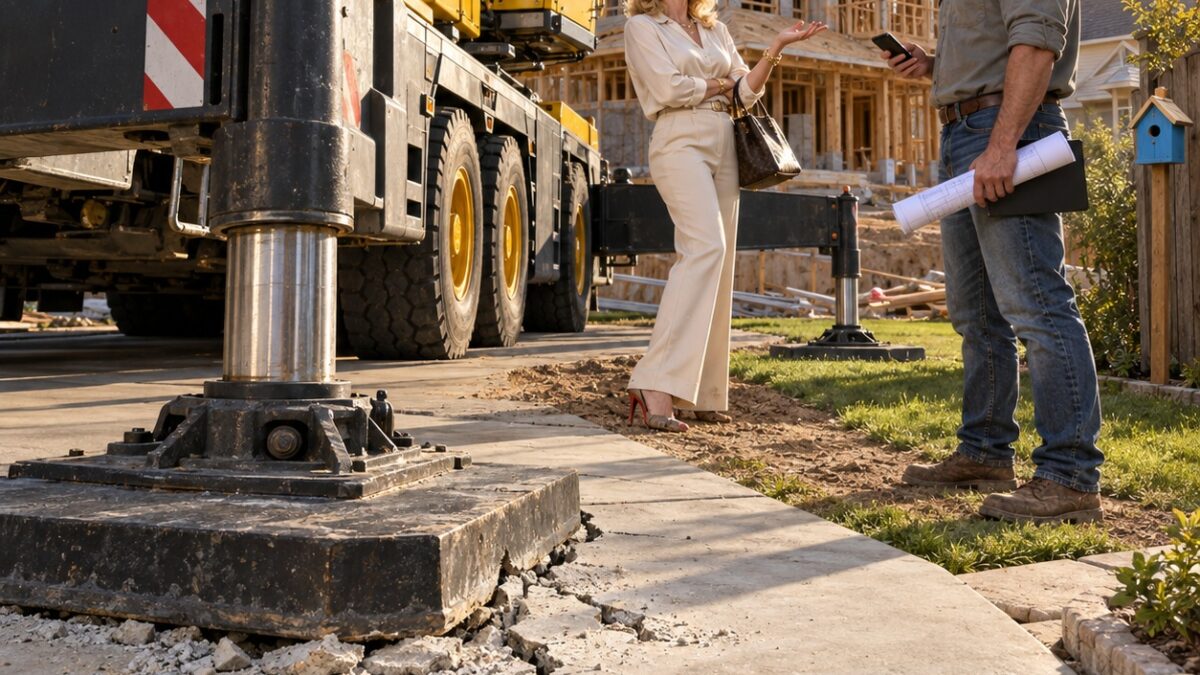
FULL STORY CONTINUATION
I did not tell her that.
Not yet.
There is a moment in almost every enforcement dispute when somebody gives you information they do not realize is useful.
The worst thing you can do is interrupt them.
Brenda believed confidence was authority.
For four years, Ridgecrest Meadows had taught her that belief worked.
She would cite some rule.
Most homeowners would assume she knew what she was talking about.
People do that when the person standing in front of them appears polished enough.
Brenda was very polished.
She looked like she had been assembled by a branding firm.
Perfect honey-blonde hair.
High cheekbones.
Silk blouses.
Gucci belts.
Designer sunglasses.
A pearl-white Porsche Cayenne Turbo GT that cost more than some houses in smaller Texas towns.
She carried an Hermès Birkin bag to HOA meetings the way some people carry legal credentials.
Her Instagram account described her as a “community aesthetic director.”
She liked phrases like:
Governance is glamour.
And:
Curating excellence one subdivision at a time.
The performance worked because most people did not want conflict badly enough to test the script.
The first week after my family moved in, Brenda had appeared at our front door with a compliance binder thick enough to stop a small-caliber bullet.
She looked past me at our moving boxes.
Then my work truck.
Then the new sod.
“Is the truck going to remain visible from the street?”
“It’s my work truck.”
“We do have standards for vehicle appearance.”
Then she produced a landscaping maintenance form.
The sod had barely rooted.
Apparently that did not matter.
Jenna later told me she had watched Brenda bend down near the curb while walking back to her Porsche and measure the grass.
I thought Jenna was joking.
She was not.
Over the next four years, I watched Brenda turn petty compliance into a personal art form.
Two hundred dollars for a basketball hoop visible from a common area.
One hundred fifty dollars for a garden flag that exceeded an approved dimension by seven-eighths of an inch.
Three hundred dollars for the wrong paint sheen on front-door trim.
She once brought a gloss meter to a hearing.
A gloss meter.
For residential trim.
Another time, she measured a homeowner’s pergola with a jeweled caliper.
The pergola was eight feet high.
The governing restrictions allowed ten.
Still, Brenda issued a fine for an “unauthorized permanent structure” and told the owners that challenging it could trigger a complete property compliance audit.
They paid.
Not because she was right.
Because she controlled the board, the meeting agenda and the fines.
My neighbor Cal Rodriguez described it best.
Cal was seventy-one and had spent his career as a Williamson County records clerk.
He kept notes on everything.
One Saturday while we were pulling weeds, he leaned toward me and said:
“She runs this place like a fashion label, and everyone who lives here is an unpaid intern who can’t afford to quit.”
I laughed.
I did not yet know Cal was building a spreadsheet.
That spreadsheet would matter later.
At the time, my problem was simpler.
There was a sixty-ton crane breaking my driveway.
I went home after the first incident and searched every HOA email I had received for the previous twelve months.
No “community development addendum.”
No section 11.4.
No notice authorizing access to private driveways.
Then I opened the full declaration and CC&Rs.
Sixty-three pages.
I read every section.
Section 8.2 dealt with temporary construction activity on common areas during board-approved improvement projects.
Common areas.
My driveway was not common property.
My lot description made that extremely clear.
Brenda had taken a real concept and expanded it until it conveniently covered something it had never covered.
That is a common form of fabricated authority.
People rarely invent everything from nothing.
They start with a legitimate clause.
Then stretch it.
Add language nobody approved.
Change context.
Rely on confidence.
I sent a professional email to the full board.
No insults.
No accusations.
Photographs attached.
I asked that no future construction equipment be staged on my property without written consent.
Brenda replied to the entire board.
Her answer cited no clause.
No recorded easement.
No vote.
She simply claimed the board possessed “general authority to facilitate community improvement projects.”
General authority.
One of those wonderful phrases that means:
I cannot show you the rule, so please stop asking.
Then the crane came back.
Monday morning.
Same Link-Belt.
Same basic setup.
This time one outrigger crushed an irrigation riser.
Water sprayed across my concrete.
Another crack appeared.
Then another.
I called Mitchell directly.
He owned Carver Development Group.
His company was building the house on lot 93.
The vacant lot beside mine had sat empty for years.
Then suddenly Mitchell’s crews appeared with excavation equipment and a professionally printed sign.
CARVER DEVELOPMENT GROUP CUSTOM HOME CONSTRUCTION
At a board meeting, Brenda unveiled the project like she was introducing a luxury resort.
Two-story Mediterranean-style villa.
Thirty-two feet to the ridge.
Far larger and taller than anything surrounding it.
She called it a “flagship property.”
An “investment in community visual identity.”
“Aesthetic elevation.”
The words were silly.
The money behind them was not.
When I called Mitchell about the crane, he sounded tired.
“Nate, I understand.”
“It is damaging my driveway.”
“It’s temporary.”
“You do not have an easement.”
“Brenda handles the community side.”
“The community side cannot give your crane access to my driveway.”
“I’ll try to keep it off your side when I can.”
When he could.
I was holding the phone thinking:
There is no “when you can.”
Either the crane is on my property or it is not.
Either you have legal access or you do not.
Mitchell ran a construction company.
He knew that.
But he had spent so long letting Brenda define the environment around him that even he spoke as though her HOA authority might somehow solve a construction-access problem.
I attended the next monthly board meeting with photographs.
Forty-one homeowners showed up.
I brought a driveway repair estimate.
$4,200 at that point.
I stood during open comment.
“My driveway has been used as a crane staging area for a project owned by the HOA president’s husband.”
Brenda sat at the front in a white sheath dress.
“The authorization cited to me as section 11.4 does not exist.”
A few people turned toward her.
“I am requesting a board vote prohibiting construction equipment from entering private property without written owner consent.”
Brenda leaned toward the microphone.
“The board appreciates your input.”
That voice.
Warm enough to sound civilized.
Cold enough to make clear that she believed civilization ended where her patience did.
She explained that lot 93 represented a substantial investment in Ridgecrest Meadows and that temporary inconvenience was part of development.
“I’m not asking for advice,” I said. “I’m asking for a vote.”
“The board sets the agenda.”
My request was tabled.
No vote.
No debate.
Cal Rodriguez stood.
He called her construction deadline “performance art.”
The meeting ended.
Brenda walked out.
The clicks from her heels across the community-center floor sounded like a countdown.
Cal caught me in the parking lot.
He pulled a folded printout from inside his jacket.
“She’s paying Mitchell with HOA money.”
I looked at him.
“What?”
He handed me the sheet.
A budget line had appeared months earlier.
COMMUNITY ENHANCEMENT RESERVE
Forty-seven thousand dollars transferred out.
Paid to Carver Development Group for “site preparation.”
I stared.
“The lot is privately owned.”
Cal nodded.
“CDG Properties LLC.”
“Mitchell’s company.”
“Exactly.”
“So HOA dues are funding his spec house.”
“That’s what the books say.”
Cal had spent decades in county records.
He knew how to follow paper.
He had cross-referenced payments with property ownership.
The HOA was subsidizing a private development controlled by the president’s husband.
Suddenly Brenda’s obsession with the project made more sense.
Lot 93 was not simply an aesthetic statement.
It was financially entangled with the board she controlled.
I watched her through the community-center window.
Laughing near the refreshment table.
Paper cup of wine.
Diamond earrings under fluorescent lights.
Everything about Brenda looked legitimate.
That was the trick.
People often imagine fraud arrives looking suspicious.
Sometimes it arrives perfectly dressed and has an agenda packet.
I went home.
Opened the governing documents again.
I was searching for a mechanism.
Some HOA procedure.
Some internal check that would force a real vote or outside review.
The documents were built for normal neighborhood disputes.
Fence heights.
Landscaping.
Paint.
Architectural approval.
They were not designed for a president who had turned rulemaking into improvisation.
Then I realized something embarrassing.
The mechanism I needed was not in the HOA documents.
It was in the briefcase I carried to work every morning.
I just had not connected the pieces yet.
Because when a problem happens beside your home, you think like a homeowner.
You forget the rest of yourself.
The crane returned twice more during April.
Every visit made the driveway worse.
The repair estimate climbed to $6,800.
Then, on the final day of April, I walked outside and saw the crane boom swinging across my property line.
A 4,200-pound steel beam hung forty feet above the corner of my garage.
My woodworking shop was underneath.
Owen’s half-finished lizard terrarium project was underneath.
My house was occupied.
I walked straight to the cab.
“You’re swinging loads over my structure.”
The operator looked down.
“Shortest path.”
“Do you have a lift plan?”
Blank stare.
“Load weight. Boom angle. Swing radius. Ground-bearing pressure. Proximity to structures.”
He said nothing.
“Signal person?”
No answer.
“Outrigger mats?”
No.
The operator had been doing what somebody told him.
But that did not make the lift compliant.
I identified the violations.
He lowered the beam.
Retracted the boom.
That day the load stopped crossing my property.
In the evening, I stood in the garage doorway.
The frame next door was now rising above the fence.
Two stories.
And for the first time, I really looked at it professionally.
Not as the annoyed homeowner.
As an engineer.
Something in my stomach tightened.
The headers above several first-floor openings looked undersized.
A two-story load path appeared to be bearing on single members that did not match what I would expect.
The center steel beam connection looked almost nonexistent.
No gusset plates.
One visible bolt.
The roof trusses were spaced at approximately thirty-two inches.
Our standard required twenty-four in that configuration.
Hurricane ties were missing at visible connections.
No metal clips.
Just toenails.
I stood there thinking about Brenda’s gloss meter.
This woman had fined a neighbor for using semi-gloss instead of satin.
Her husband was building a house where roof trusses appeared to be attached with a framing method that had not satisfied modern code for decades.
The hypocrisy was almost impressive.
I spent the next three evenings observing from my own property.
Never crossed the line.
Binoculars.
International Residential Code open on my laptop.
Photographs taken from places I had a lawful right to stand.
I counted fourteen visible structural deficiencies.
Undersized headers.
Missing hurricane ties at eighteen of twenty-two visible connections.
No gusset plates where the steel beam met support columns.
Thirty-two-inch truss spacing instead of twenty-four.
Foundation reinforcement appearing to be spaced at roughly thirty-six inches instead of twenty-four.
This was not cosmetic.
Someone was going to buy that house.
Someone’s children might sleep upstairs.
A structure can look beautiful and still be dangerous.
I had seen real failures.
Connections weaker than what I was looking at had killed people.
Then I checked the permit board.
It stood near the street.
I did not need to enter the lot.
Permit:
WC-2024-04291
Issued October 14.
Project:
SINGLE-FAMILY RESIDENTIAL DWELLING — ONE STORY — 2,400 SQUARE FEET
I looked up.
Two stories.
Permit expiration:
January 14.
We were at the end of April.
Expired three months.
Wrong building.
Wrong plans.
And fourteen visible structural problems.
That was the moment the obvious finally connected.
I was the chief building official of Williamson County.
This house fell under the jurisdiction of my department.
Every permit Mitchell filed.
Every inspection.
Every stop-work order.
Everything.
The woman who had spent four years enforcing fake neighborhood rules had built her husband’s project around violations of real law.
And she had picked the one neighbor whose office enforced those laws for the county.
I did not grab a county truck and storm next door.
That would have been improper.
The project was directly adjacent to my own home.
I had a personal property dispute with the builder.
Conflict of interest.
Unlike Brenda, I understood what those words meant.
I could not personally inspect the project.
What I could do was file a formal professional complaint.
As a licensed PE.
Then recuse myself.
So I did.
Six pages.
Single-spaced.
Expired permit.
Major deviation from approved plans.
Fourteen structural deficiencies visible from adjacent property.
No engineer of record.
Crane safety issues.
I attached thirty-seven photographs.
Every photograph dated.
Annotated.
Cross-referenced to relevant building-code provisions.
I included the OSHA crane concerns separately.
No lift plan.
No proper outrigger setup.
No signal person.
Loads over an occupied structure.
PE stamp on every page.
Two copies.
One for the department.
One for my file.
Jenna found me on the porch staring at lot 93.
“You’re doing the thing.”
“What thing?”
“The thing where you stare at a building and calculate how many ways it can fail.”
“Fourteen that I can see.”
She handed me iced tea.
“When are you calling?”
I looked at the driveway.
“I need the crane back once.”
She raised an eyebrow.
“Why?”
“Right now I have the permit complaint and the structural deficiencies.”
“And?”
“If it comes back onto my driveway, everything is occurring at once. Trespass. Property damage. OSHA issues. Active unpermitted work.”
She stared at me.
“You want her to hang herself with her own crane.”
“I want the process to have a complete picture.”
Jenna took a drink.
“You’ve been planning this since the first crack.”
I smiled.
“I’ve been planning this since she measured our grass.”
The crane returned on a Tuesday morning in May.
Same diesel rumble.
Same yellow machine.
Same operator.
He rolled onto my driveway as though he had a recurring reservation.
Outriggers extended.
The left pad landed on a damaged section.
The concrete gave way.
I heard the split from inside.
When I walked out, the center portion of the driveway had collapsed into the subbase.
Eight broken slabs.
Edges displaced.
Four years of maintenance destroyed.
Then I saw Owen’s birdhouse.
The cedar post leaned at about forty-five degrees.
A construction vehicle had struck it while backing near the property edge.
Blue birdhouse tilted toward the sky.
Something inside me became very quiet.
I did not yell.
I went inside.
Opened my briefcase.
Complaint ready.
Six pages.
Thirty-seven photographs.
Professional stamp.
I called Robert Tran.
My deputy.
Chief inspector for seven years.
Thorough.
Impartial.
Not impressed by expensive clothes, angry contractors or political phone calls.
“Robert, it’s Nate.”
“What’s up?”
“I’m filing a formal PE complaint on lot 93 in Ridgecrest Meadows.”
I gave him the permit number.
“Expired since January. The structure materially deviates from approved plans. Two-story construction under a one-story permit. Fourteen documented structural deficiencies visible from adjacent property. Active crane operations with OSHA concerns. I’m recusing myself.”
Robert went silent for two seconds.
“I need an independent full-scope inspection today.”
“I’ll be there in two hours.”
Then:
“I’m calling OSHA on the way.”
I hung up.
Outside, the crane operator whistled while rotating the boom.
He had no idea what had just started.
At 1:14 p.m., a white county pickup turned onto Ridgeline Court.
Robert stepped out carrying the approved plan set.
A second vehicle arrived with Sandra Wells, an OSHA compliance officer Robert had contacted.
I met them on the public sidewalk.
Handed Robert my complaint.
He spread the approved plans across the hood of his truck.
Then looked at the two-story frame rising behind them.
“The permit is for one story.”
“Yes.”
“Twenty-four hundred square feet.”
“Yes.”
He folded the plans.
“This is not that.”
“No, Robert.”
“It is not.”
He went to work.
Watching Robert inspect from the outside was one of the most satisfying professional experiences of my career because he did exactly what I needed him to do.
He did not perform for me.
Did not assume I was correct because I was his boss.
He inspected.
Foundation.
Framing.
Connections.
Mechanical work.
Dimensions.
Truss spacing.
Headers.
Rebar exposure.
Approved plans versus reality.
That impartiality mattered.
I had identified fourteen deficiencies.
He was free to find fourteen.
Four.
Or none.
The result needed to be his.
Mitchell arrived about thirty minutes later.
Gray Dodge Ram.
He sat behind the wheel for nearly a minute before getting out.
Then stood near the street with his hands in his pockets.
That familiar posture.
The man looked as though he had spent so many years standing behind Brenda that he had forgotten what to do when consequences wanted him in front.
Ten minutes later, the Porsche arrived.
Brenda stepped out.
Silk blouse.
Tailored trousers.
Birkin.
Phone.
She marched directly toward Robert.
“What’s going on here?”
Robert looked at her.
“This project is under inspection.”
“This is an HOA-approved community development project.”
Robert did not blink.
“The building department doesn’t answer to your HOA board, ma’am.”
She stopped.
“We answer to the building code.”
That was the moment.
Not the stop-work order.
Not the demolition.
That one sentence.
For four years Brenda had operated in a system where charisma could influence process.
She controlled agendas.
Filled seats.
Invented interpretations.
Threatened audits.
People gave in because resistance was inconvenient.
Robert Tran did not care who she was.
Building code does not become more flexible because your handbag has a waiting list.
Brenda reached for her phone.
“I’m calling the County Commissioner’s office.”
“You’re welcome to.”
Robert turned away and continued measuring.
He did not look back.
I almost felt sorry for her.
Almost.
Sandra went directly to the crane.
Within forty minutes, the crane operation was shut down.
The operator could not produce the required certification documentation.
No lift plan.
Multiple safety violations.
OSHA issued four citations and an impoundment order.
The crane could not move under its own power from my driveway until compliance issues were resolved.
I stood on the broken concrete absorbing the irony.
Brenda had forced a crane onto my private driveway.
Now federal safety enforcement had trapped it there.
Robert’s inspection lasted nearly two hours.
My fourteen deficiencies became seventeen.
Three more than I had identified.
Expired permit.
Unauthorized two-story deviation.
No engineer of record.
The steel framing lacked proper engineering documentation.
The foundation violated the required side setback by two feet three inches.
The approved plan no longer resembled the building under construction.
By 3:17 p.m., Robert posted a red STOP WORK notice on the construction sign.
Everything stopped.
Workers packed tools.
One foreman walked past me on the way out.
He glanced at my driveway.
Then the red tag.
“You’re the one who called?”
“Yes.”
He shook his head.
“She told us that driveway was HOA property.”
I said nothing.
“She told us permits were squared away.”
He looked toward Brenda.
“She told us a lot of things.”
That was how it worked.
Brenda sounded certain.
People converted certainty into truth.
Until someone checked.
Once the real enforcement process started, consequences moved faster than HOA politics ever had.
County fines against Mitchell totaled $31,000 for structural violations, unpermitted deviations and permitting failures.
His contractor license was suspended pending review.
The couple from Dallas who had already contracted to buy the house had $80,000 in earnest money at risk.
They backed out within a week.
Their attorney demanded a full refund.
They received it.
OSHA assessed $47,200 in penalties against the crane rental company.
The crane company then pursued Carver Development Group because Mitchell’s people had provided false or improper site-access information.
But the largest structural consequence was simple.
The house could not be repaired into compliance.
The deviations were too extensive.
The county ordered demolition.
Everything.
Trusses.
Framing.
Steel.
Foundation.
Start again with proper plans and a professional engineer.
Demolition estimate:
$62,000.
When all the permit penalties, demolition costs, failed sale, OSHA-related exposure and legal expenses were considered, the financial damage exceeded $340,000.
That number became popular in the neighborhood.
People enjoyed saying Brenda’s fake rule had cost more than some residents’ mortgages.
I did not need to celebrate.
I watched the demolition crew arrive in June.
They took the house down in four days.
Roof trusses first.
Then walls.
Steel.
Foundation.
By the end, lot 93 looked exactly the way it had four years earlier.
Flat packed caliche.
Orange survey stakes.
Owen stood beside me at the kitchen window.
“The birthday cake is back.”
I looked at him.
“What?”
“The stakes.”
He pointed.
Orange sticks across dirt.
“Like candles.”
He smiled.
The lot had once been his bicycle slalom.
Before Brenda’s “flagship property.”
Before cranes.
Before red tags.
Before any of this.
To Owen, the silence was enough.
The crane stayed another three days after the stop-work order while OSHA paperwork was resolved.
Then it finally left.
My driveway did not recover with it.
The damage was worse than the original estimate.
Center slab destroyed.
Edges shifted.
Hydraulic fluid contaminated part of the subbase.
Full replacement:
$7,400.
Mitchell’s insurance company paid.
No argument.
The adjuster reviewed my documentation.
Photos.
Dates.
Measurements.
Repair progression.
I had enough evidence to make a forensic engineer happy.
The check arrived within three weeks.
I repoured the driveway in July.
Saturday.
New compacted base.
Ninety-five percent density.
Reinforcement at eighteen-inch spacing.
Tighter than minimum code because if I am pouring my own driveway, I am going to sleep at night.
Single continuous pour.
Owen helped with the screed board.
“Smooth, Daddy.”
Every pass.
“Smooth.”
He barely added any actual force.
Did not matter.
The next morning, before final sealing, his size-two work boots left two tiny prints near the slab edge.
I could have repaired them.
I did not.
Those stayed.
Brenda had damaged the driveway.
Owen made the replacement ours.
That should have been the end.
It was only the beginning of what unraveled inside Ridgecrest Meadows.
Two days after the stop-work order, Cal Rodriguez distributed his findings to every mailbox in the neighborhood.
Eight pages.
Single-spaced.
Appendices.
Cal had finished tracing the money.
The $47,000 “community enhancement reserve” had gone directly to Carver Development Group.
Mitchell’s company.
Private lot.
Private spec house.
Then Cal found another $11,000.
Consulting payments to BHC Solutions.
A sole proprietorship registered to Brenda Holt Carver.
Brenda had been paying herself through the HOA budget for two years.
Total documented misappropriation:
$58,000.
The woman who had fined residents for grass height and paint sheen had been using neighborhood dues for her husband’s private project and her own consulting payments.
That changed the mood.
A property-line argument is personal.
An expired permit is construction.
Fifty-eight thousand dollars belongs to everyone who paid dues.
Now 220 households had a reason to look.
An emergency meeting was scheduled.
Ninety-four people attended.
Brenda did not.
Her house stayed dark.
Cal ran the meeting.
The motion to remove Brenda Carver as HOA president passed:
89 to 5.
Three of the opposing votes came from board members she had installed.
One from Mitchell’s business partner.
One homeowner later said he had misread the ballot.
That detail made me laugh.
Brenda’s real support may have been four people.
A new board was elected within the month.
Paul Kessler became president.
The same homeowner Brenda had fined over his basketball hoop.
Cal took the treasurer seat.
Linda Cho became secretary.
Cal’s first major act was opening the financial records to every homeowner.
No secrecy.
No curated summaries.
No Birkin-bag governance.
Just books.
The new board filed a civil suit against Brenda and Mitchell.
Breach of fiduciary duty.
Conversion of HOA funds.
Fraud.
Six months later, the case settled.
Full amount returned.
Legal fees covered.
No dramatic trial.
No criminal arrest.
No prison sentence.
The source does not support any of that, and reality did not need it.
The financial record was enough.
Brenda and Mitchell sold their house in August.
I later heard they moved to a subdivision in Pflugerville.
One without an HOA.
There was poetic symmetry in that, assuming the report was correct.
I also heard Brenda deleted her Instagram account.
For a woman whose public identity had been built around performing authority, that may have been one of the quieter consequences.
No more:
Governance is glamour.
No more:
Brenda curates.
The neighborhood survived.
The new board did something Brenda’s board had avoided for years.
They reviewed the fines issued during her presidency.
Seventy-one turned out to rely on provisions that had never been properly ratified.
Board resolutions adopted without the required homeowner vote.
Rules treated as law because Brenda said they were rules.
The homeowners with the pergola got their $300 back.
Paul Kessler received reimbursement connected to his previous dispute.
Rosa Gutierrez’s mother received the $600 she had been charged over a birdbath.
Other families received refunds too.
People who had paid because fighting Brenda seemed harder than writing a check.
My refund was $263.
It was not the driveway.
Insurance had handled that.
It represented HOA charges that should never have been imposed.
I used the money to buy lumber.
Owen wanted a bookshelf.
Not just any bookshelf.
One large enough for forty-two lizard field guides.
That number was his.
I did not ask why forty-two.
Maybe because forty-one was not enough.
Maybe because seven-year-olds build specifications the way HOA presidents build bylaws.
We worked on it one Saturday.
I cut the joints.
Owen sanded edges.
Jenna watched from the garage doorway drinking coffee.
The blue birdhouse sat on the top shelf when we finished.
It needed a new home after the wrens moved on for winter.
Owen set it with the entrance hole facing the window.
“They’ll find it again in spring.”
“I think they will.”
“Because we built it good.”
“Because you built it well.”
He rolled his eyes.
Grammar is another form of inspection.
That should have closed the whole story.
But the final moment came later.
I was in the garage working on floating shelves when Owen walked in with both hands behind his back.
Gap-toothed grin.
Always suspicious.
“What do you have?”
“Nothing.”
“That is clearly something.”
He brought out a piece of cedar.
Four by six.
Sanded smooth.
He had used a wood-burning pen to write:
CALLAHAN WORKSHOP
EST. 2020
I stared.
“For the door,” he said.
“Why?”
“So people know who built this.”
I mounted it that afternoon.
Level.
Centered.
Exactly where it belonged.
There are people who would say that is obsessive.
They would be right.
Outside, my new driveway was smooth.
Clean.
Owen’s tiny boot prints near the edge.
Lot 93 was empty.
Orange survey stakes in the dirt.
No crane.
No two-story structure disguised under a one-story permit.
No construction crew being told my driveway was HOA property.
Ridgecrest Meadows was quieter.
The old board was gone.
Financial records were open.
Invalid fines had been refunded.
And the house Brenda had once called an “aesthetic elevation” no longer existed.
I thought about the first afternoon beside the crane.
Brenda looking me up and down.
Work boots.
Dirty truck.
Ordinary homeowner.
She had said:
“People like you don’t tell people like me what to do.”
That was the line underneath everything.
Not architecture.
Not community standards.
Hierarchy.
Brenda divided the world into people who looked authoritative and people who were supposed to obey them.
She measured everything.
Grass.
Flags.
Paint.
Pergolas.
Vehicle appearance.
She measured a neighborhood down to fractions of an inch.
But she never measured the only thing that mattered in our first argument.
Her own authority.
If she had checked it, she would have found the limit immediately.
The HOA did not own my driveway.
There was no section 11.4.
The board could not grant construction access across my private lot.
The “community development addendum” did not exist.
Her husband’s project did not match its permit.
The permit was expired.
The house had structural violations.
The crane operation had safety violations.
The financial reserve was not hers to use for a private spec house.
The consulting account did not become legitimate because it had a business name.
Every part of Brenda’s system depended on one assumption:
Nobody will check.
For years, most people did not.
Not because they were stupid.
Because ordinary people are busy.
They have jobs.
Children.
Mortgages.
Dinner.
School pickups.
They receive an official-looking fine in the mail for $200 and calculate that two hundred dollars is cheaper than three evenings of arguing at HOA meetings.
So they pay.
A president like Brenda learns the wrong lesson.
She thinks:
They paid because I was right.
No.
Sometimes people pay because you made resistance expensive.
That difference eventually matters.
Cal checked the books.
I checked the governing documents.
Robert checked the permit.
Sandra checked the crane.
Once people started checking, Brenda’s authority disappeared astonishingly fast.
That is the thing I remember.
Not how powerful she seemed.
How dependent that power was on nobody opening the correct file.
One page of the permit told the story.
One story.
2,400 square feet.
Expired January 14.
I looked up from that board and saw two stories.
A child could understand the mismatch.
The professional details mattered afterward.
Headers.
Connections.
Truss spacing.
Setbacks.
Engineering documents.
But the foundation of the problem was simple.
The project being built was not the project approved.
The woman who had demanded perfection from everybody else had granted her own family a private exemption from reality.
That hypocrisy made the story satisfying to neighbors.
For me, the structural risk mattered more.
I have seen what bad buildings do.
People think construction defects are abstract until a roof lifts in wind.
Until a connection lets go.
Until a beam rotates.
Until a family hears a noise at two in the morning and discovers the contractor saved a few hundred dollars behind a wall.
The lot 93 house was being sold.
It had a buyer.
A couple from Dallas.
$80,000 earnest money.
They would have moved in believing permits meant somebody had checked the important things.
That trust is exactly why building departments exist.
Most buyers cannot evaluate load paths.
They should not need to.
They should be able to assume the framing behind their drywall was built from approved plans and inspected against code.
Mitchell had bypassed that system.
Brenda had spent four years preaching standards while benefiting from that bypass.
Stopping the project was not revenge.
It was the job.
That distinction mattered enough that I recused myself.
I could have personally arrived with a county badge and stop-work authority.
I did not.
I filed the complaint the way any licensed engineer could.
I handed the inspection to Robert.
He found seventeen violations independently.
Three more than I had identified.
That protected the integrity of the result.
Had I personally inspected the house, Brenda could have claimed retaliation.
Conflict.
Personal vendetta.
By stepping out, I took that argument away.
Good process matters most when you are angry.
Maybe especially then.
Brenda’s entire downfall began because she believed process was optional when she controlled the outcome.
I refused to make the same mistake simply because I believed I was right.
I filed.
Stamped.
Documented.
Recused.
Then let the department work.
The system was not dramatic.
Robert had a clipboard.
Plans.
Tape measure.
Camera.
Sandra had compliance authority.
No screaming.
No raid.
No handcuffs.
That is what real enforcement often looks like.
A measurement.
A photograph.
A code citation.
A red tag.
Then everyone who had been acting as though rules were suggestions suddenly understands paper can become very physical.
A stop-work tag turns saws off.
An impoundment order turns a sixty-ton crane into a very expensive parked object.
A demolition order turns four months of construction back into a flat lot.
Paper is not weak when authority behind it is real.
Brenda had spent years imitating that.
She issued papers too.
Fine notices.
Compliance letters.
Made-up sections.
The difference was legal foundation.
A fake rule printed beautifully remains fake.
A real code written plainly remains enforceable.
Designer authority works only until actual jurisdiction enters the room.
Robert’s sentence stays with me:
“The building department doesn’t answer to HOA boards. We answer to the building code.”
That was the entire story in one line.
Brenda could control Ridgecrest board meetings.
She could not control Williamson County’s adopted building code.
She could call commissioners.
She could call lawyers.
She could call every person in her phone.
None of those calls changed the truss spacing.
They did not create missing hurricane ties.
They did not make a one-story permit two stories.
They did not move a foundation back two feet three inches.
Physical facts are stubborn.
Records can be too.
That combination is hard to bully.
The crane was the perfect symbol.
On the first day, Brenda used it to demonstrate power.
Massive machine.
My driveway.
Her decision.
She told me to deal with it.
By the final day, that same crane sat immobilized on the same broken driveway because somebody with legitimate regulatory authority had looked at its operation and said:
Stop.
Brenda had created the scene herself.
No trap.
No trick.
I did not call the crane back.
She did.
I simply waited until the facts aligned.
Jenna called that “hanging herself with her own crane.”
I prefer:
Complete evidence package.
Hers is shorter.
Probably better.
The $340,000 figure also deserves context.
People hear it and imagine I somehow cost Mitchell $340,000 with one phone call.
No.
Mitchell cost himself that money over months.
Building outside approved plans.
Allowing unsafe framing.
Working on an expired permit.
Using improper crane staging.
Failing to secure legal access.
Selling a house that could not lawfully be completed as built.
Those decisions existed before my call.
My call exposed them.
That is different.
The buyer leaving was not revenge.
They learned the house they were purchasing had serious permitting and structural issues.
Leaving was rational.
Demolition was not punishment for insulting me.
The county determined remediation was not acceptable given the extent of deviation.
Insurance paying my driveway was not a windfall.
It paid for concrete their project destroyed.
Every consequence followed a decision already made.
That is why I never felt guilty watching demolition.
I felt relieved.
Someone would not live inside that frame.
That mattered.
Mitchell’s contractor license suspension made sense too.
A general contractor has obligations independent of his spouse.
He could not hide behind:
Brenda handles the HOA side.
The building side belonged to him.
He knew permits.
He knew plans.
He knew access.
He knew the house was two stories while the permit described one.
He chose silence every time Brenda spoke.
Silence does not transfer responsibility.
That was Mitchell’s mistake.
People in Ridgecrest sometimes talked about him as Brenda’s passive husband.
The quiet one.
Always behind her.
Maybe true socially.
Professionally, he ran Carver Development Group.
He signed contracts.
Took money.
Built structures.
Passive personality does not cancel professional duty.
That lesson mattered because it would have been easy to make Brenda the only villain.
She was the loudest.
She controlled the board.
She invented the rules.
But Mitchell’s company took $47,000 of HOA money.
Mitchell’s project used my driveway.
Mitchell’s project violated the permit.
His company bore responsibility.
The civil suit later named both of them for a reason.
I also did not blame the crane operator for everything.
The foreman’s words after the stop-work order stayed with me.
“She told us the driveway was HOA property.”
Workers operate on information provided by the people paying them.
They still have safety responsibilities.
Sandra’s OSHA citations showed that.
But access representations came from above.
That is why the crane company later pursued Carver Development Group.
Everybody in the chain discovered that Brenda’s confident statements had consequences once translated into insurance and regulatory documents.
Confidence is cheap.
Indemnity claims are not.
Cal Rodriguez deserves more credit than anybody in the neighborhood probably gave him before this.
Seventy-one-year-old retired records clerk.
Quiet.
Pulled weeds.
Took notes.
He did not have my engineering license.
Did not need one.
His expertise was paper.
He noticed the budget line.
Cross-referenced property records.
Found the private LLC.
Found the consulting company.
Followed $47,000.
Then another $11,000.
That was enough.
Once the emergency meeting happened, Brenda’s glamour stopped working because the argument was no longer aesthetic.
People understood money.
Their money.
Fifty-eight thousand dollars changes a room.
So does an 89-to-5 vote.
The board recall also proved something I wish more HOA homeowners remembered.
A board can feel permanent when nobody participates.
Brenda had won unopposed originally because nobody wanted the job.
Then she slowly populated the board with people connected to her.
Business partner.
Pilates instructor.
Homeowners who did not want conflict.
The structure became Brenda because everybody else treated governance as annoying background noise.
That is understandable.
Still dangerous.
Power fills empty seats.
The replacement board did not need glamour.
It needed transparency.
Paul.
Cal.
Linda.
Open books.
Real votes.
Proper procedures.
Boring governance.
Excellent.
I would take boring governance over “governance is glamour” every day for the rest of my life.
Boring governance does not show up in viral stories because it works.
Nobody films the board that reads the bylaws and reimburses an invalid fine.
Maybe they should.
The audit of old fines was one of the best things the new board did.
Seventy-one.
That number stunned me.
Seventy-one enforcement actions based on provisions that had never been properly ratified.
Think about that.
Seventy-one moments when somebody opened an envelope and assumed the person sending it had checked.
Many paid.
Some probably argued with spouses.
Some rearranged budgets.
Some felt embarrassed.
All because an internal resolution had been treated as binding when the required two-thirds homeowner approval had never happened.
Brenda’s system depended on homeowners not distinguishing:
Board said so
from:
The governing documents legally authorize this.
That distinction is not always easy.
HOA documents are tedious.
Long.
Cross-referenced.
People are not lawyers.
That is why transparent boards matter.
Authority should not require every homeowner to become an investigator.
But when authority is abused, somebody has to check.
Cal did.
The refund checks were small compared with Mitchell’s losses.
Yet emotionally, they mattered.
The pergola owners got their $300.
The birdbath fine came back.
Fourteen other families received refunds.
My $263 bought lumber.
That felt right.
Fake rule converted into something real.
Wood.
Shelf.
Time with my son.
No revenge could improve on that.
The birdhouse also mattered because it was the first thing I saw after my driveway collapsed.
Blue.
Crooked.
Post leaning.
Owen and I had built it together.
Brenda did not know that.
The construction crew did not know.
To them it was just a small object beside a fence.
To me it was Saturday morning.
Owen holding clamps.
Paint on his fingers.
Wrens arriving.
Property damage becomes personal through small things.
The driveway cost $7,400.
The birdhouse cost almost nothing.
Guess which one made me colder when I saw it damaged.
Exactly.
Afterward we put it on the bookshelf.
Safe.
Facing the window.
Owen believed the wrens would find it in spring.
That child’s certainty was healthier than anything happening at HOA meetings.
I wanted the ending to belong to him.
Not Brenda.
That is why the cedar sign is where the story ends for me.
CALLAHAN WORKSHOP — EST. 2020
“So people know who built this.”
Seven-year-old logic.
Simple.
Build something correctly.
Put your name on it.
Be willing to stand behind it.
Mitchell had put his company name on a construction sign.
But the building behind the sign did not match the permit.
Owen burned our name into cedar after sanding the board himself.
One represented branding without accountability.
The other represented pride in work.
Maybe I am making too much of a child’s sign.
I am an engineer and a father.
We are allowed some symbolism.
I mounted it level because of course I did.
Jenna watched.
Did not comment on the level.
Marriage requires knowing when not to encourage a problem.
Outside, lot 93 stayed vacant.
I liked it better that way.
Not because nobody should ever build there.
Someone may eventually.
If they do, submit proper plans.
Get a current permit.
Build what was approved.
Keep cranes off my driveway unless I say yes.
Very low bar.
I am not anti-development.
I spend my career helping legal development happen safely.
That is one reason Brenda’s “community improvement” excuse bothered me.
She used development as if it suspended property rights.
It does not.
Construction can be inconvenient.
Noise.
Dust.
Traffic.
Temporary disruption.
Neighbors generally tolerate those things because neighborhoods evolve.
But inconvenience is different from trespass.
A hammer at 8 a.m. is inconvenience.
A crane outrigger breaking my private driveway is property damage.
A permitted two-story home is development.
A two-story frame built on an expired one-story permit is a violation.
Words matter because people blur them when facts are inconvenient.
Brenda called my objections resistance to improvement.
No.
I was resisting unauthorized use.
If she had asked on day one:
“Nate, the lot is tight. May the crane stage on your driveway for two days if Mitchell pays for protective mats and any damage?”
I still might have said no.
My right.
But at least it would have been a real conversation.
Instead she announced authority she did not possess.
That changed everything.
Consent is not a paperwork inconvenience.
Construction professionals know this.
Access agreements exist for a reason.
Temporary construction easements exist.
Insurance certificates.
Indemnity clauses.
Surface-protection requirements.
Lift plans.
There were professional ways to solve the space problem.
Brenda chose:
Your driveway is convenient.
Deal with it.
That is not development.
That is entitlement.
The funny part is that for a woman obsessed with appearances, she could not see the difference between appearing authoritative and possessing authority.
Her Instagram bio said “community aesthetic director.”
Fine.
Direct aesthetics within lawful authority.
But she began treating style as substance.
Designer clothes.
Expensive car.
Expensive bag.
Perfect hair.
A lectern.
A microphone.
Those things create visual hierarchy.
None creates jurisdiction.
My Ford F-250 had no county markings.
My work boots were dirty.
I did not introduce myself as Chief Building Official Nate Callahan when she came to my house.
Why would I?
I was home.
My job should not determine whether someone respects my property.
Even if I had been unemployed, she had no right to put the crane there.
That is important.
This is not a story where Brenda was wrong only because she accidentally bullied someone powerful.
She was wrong before she knew who I was.
My position simply gave me knowledge about which legitimate system could address part of the misconduct.
Any homeowner deserved the same property respect.
The fact that she had driven out three families before me, as she bragged in the opening confrontation, made that clearer.
She had learned to judge resistance based on social power.
“People like you don’t tell people like me what to do.”
No.
Property deeds tell people where access stops.
Building codes tell contractors what must be built.
OSHA tells crane operators what safety procedures apply.
HOA declarations tell boards what their powers are.
People like us simply read them.
That is the lesson I kept.
Not:
Be secretly important.
Instead:
Check the source of authority.
When Brenda cited section 11.4, I checked.
No section.
When she cited a community-development addendum, I checked.
No addendum.
When Mitchell built the house, I checked the permit.
Wrong permit.
Cal checked the accounts.
Money trail.
Robert checked the structure.
Seventeen violations.
Sandra checked the crane.
Four OSHA violations.
The new board checked historical fine authority.
Seventy-one problems.
Brenda’s world did not collapse because of one phone call.
It collapsed because checking became contagious.
Once people stopped accepting presentation as proof, every layer exposed another weakness.
That is why the stop-work order felt so mechanical.
The consequences were already built in.
Robert merely connected them.
The house did not match plans.
Tag.
Crane did not meet requirements.
Shutdown.
Money went where it should not.
Audit.
President lost confidence.
Vote.
Civil claim.
Refunds.
No magic.
Systems functioning.
That is also why I did not need to scream at Brenda.
She expected arguments.
Arguments were her home field.
She controlled meetings.
Tone.
Agenda.
Social pressure.
Code enforcement was not her field.
She could not charm a missing hurricane tie into existence.
Cannot intimidate a tape measure.
Cannot Instagram a setback into compliance.
Facts are refreshing that way.
The moment she faced Robert, I saw her realize her normal tools were useless.
She said she would call the commissioner.
Robert essentially said:
Go ahead.
And kept inspecting.
That may have been the first time in four years a person with authority had not cared whether Brenda was impressed.
I never enjoyed humiliating her.
I enjoyed watching the process remain unimpressed.
Difference.
Brenda eventually sold her house.
The Porsche disappeared.
The designer meetings stopped.
Lot 93 became quiet.
Ridgecrest did not fall apart.
Property values did not collapse because her “flagship” vanished.
People still mowed lawns.
Kids still rode bicycles.
Garbage came Tuesday.
School buses arrived.
The world did not require Brenda’s curation.
Communities often discover that after domineering leaders leave.
All the chaos they predicted fails to happen.
Normal life is more resilient than personality cults.
The new board even managed to operate without a gloss meter.
Miraculous.
I saw Paul Kessler once after he became president.
He joked that his first executive action would be banning jeweled measuring devices.
I told him not to create another invalid rule.
He laughed.
Good.
People could laugh again.
The neighborhood had spent too long treating ordinary choices like compliance crises.
Maybe that was Brenda’s most subtle damage.
She made everyone watch themselves.
Basketball hoop.
Flag.
Trim.
Pergola.
Birdbath.
Every small decision carried the possibility of a notice.
Living in your home started feeling like working inside somebody else’s brand.
After she left, the temperature changed.
Not lawlessness.
Normality.
Real restrictions remained.
Those properly adopted.
People followed them.
That is how an HOA should work.
Clear rules.
Known process.
No fabricated sections.
No personal enrichment.
No ruler hiding in an expensive handbag.
I still kept copies of everything.
Habit.
Cal did too.
Transparency only works if somebody reads occasionally.
But paranoia was unnecessary.
Good governance should not require residents to live like auditors.
The house next door stayed a vacant lot throughout the source timeline.
Orange survey stakes.
Owen’s old bicycle route.
No grand replacement villa.
That visual ending fit.
Something overbuilt and dishonest had returned to zero.
Start again, if anyone wanted.
This time correctly.
Construction teaches humility.
If a foundation is wrong enough, you do not decorate around it.
You demolish and rebuild.
Same with governance.
The new board did not try to cosmetically repair Brenda’s system.
They opened books.
Replaced leadership.
Reviewed old decisions.
Refunded improper fines.
Sometimes demolition is the honest form of repair.
Lot 93 demonstrated that physically.
Ridgecrest demonstrated it institutionally.
My driveway demonstrated something gentler.
You can remove damaged concrete.
Prepare the base.
Reinforce properly.
Pour again.
Then your kid leaves footprints.
Now the repaired thing has a different history.
Better, maybe not because damage was good, but because repair became part of family.
Again, I refuse to romanticize harm.
I would have preferred Brenda never park the crane there.
I did not need a lesson.
I already knew about concrete.
But since damage happened, I chose what came next.
Quality.
Owen.
Tiny boot prints.
Same with the birdhouse.
Could have thrown it away.
Instead, shelf.
Memory.
Nothing Brenda did deserved gratitude.
What we built afterward belonged to us.
There is a difference.
I kept working for Williamson County.
Still drove the F-250.
Still wore work boots.
My neighbors now knew more about my job than I preferred.
For a few months people would stop me and ask permit questions while I was taking out trash.
Occupational hazard.
I reminded them that official questions belong at the office.
Jenna enjoyed watching that.
“You wanted everyone to know you’re important.”
“I absolutely did not.”
“You did it very dramatically.”
“I filed a complaint.”
“With your own department.”
“I recused.”
“Very noble.”
Marriage again.
She kept me from becoming too pleased with myself.
Necessary service.
The most important part of my job was never the authority to stop work.
It was making sure work could eventually continue safely.
People hear “building official” and imagine enforcement as punishment.
The real goal is compliant buildings.
Safe buildings.
Structures people can trust.
That is why I would have been perfectly happy if Mitchell had submitted corrected plans at the beginning and built a good two-story house.
Get engineering.
Correct setbacks.
Proper foundation.
Proper connectors.
Proper crane plan.
Fine.
The problem was not ambition.
It was shortcuts.
That distinction should remain clear.
Mitchell could have started over after demolition.
The source does not tell us he did.
In fact, Brenda and Mitchell sold and moved.
So I will not invent a future project.
Lot 93 ends empty.
As it should here.
The civil settlement also deserves restraint.
The new HOA sued.
Six months later, full amount plus legal fees.
No courtroom confession.
No public bankruptcy.
No criminal theft conviction.
The evidence supported a civil financial resolution.
That is enough.
Stories get weaker when we add punishments simply because audiences enjoy them.
Brenda lost the presidency.
Lost the project.
Paid money back through settlement.
Moved.
Her Instagram disappeared.
Those are source-supported consequences.
They already complete the arc.
The neighborhood became more transparent.
Families got refunds.
That is the meaningful aftermath.
Not making Brenda suffer forever.
Once she was gone, I stopped caring what shade of lipstick she considered authoritative on Tuesdays.
Her life became hers.
Mine became quieter.
That is victory.
The original confrontation had made me angry because she treated my privacy and property as evidence of lower status.
Her final consequence was not that I became higher status.
It was that status stopped mattering.
Robert enforced the same code against Mitchell that we would enforce against anybody.
The board returned money because rules had not been properly adopted.
Insurance paid property damage.
Process did not need hierarchy.
That is exactly how systems should work.
Brenda’s system was personal.
Real authority should be impersonal.
The inspection does not care whether the builder drives a Dodge or Porsche.
Concrete does not care.
Steel does not care.
Gravity is radically egalitarian.
That is one reason engineering appealed to me from the beginning.
A load either has a path or it does not.
Connection either develops capacity or it does not.
Beauty cannot negotiate.
Neither can arrogance.
The lot 93 house was attractive in the rendering.
Mediterranean façade.
Balanced windows.
Luxury finishes probably planned.
None mattered if the basic frame could not safely deliver loads to the foundation.
A beautiful unsafe building is still unsafe.
Brenda herself had built the same way.
Beautiful presentation.
Weak connections underneath.
No legitimate rule tying authority to action.
No ratified provision tying fines to power.
No ethical connection between dues and private payments.
Her entire presidency was structurally unsound.
Once load increased, it failed.
As an engineer, I appreciate the metaphor.
As Jenna would say, I am probably doing the thing again.
Still.
It fits.
Cal’s spreadsheet was the missing gusset plate in the neighborhood.
Robert’s inspection became the load test.
The recall was demolition.
The new board rebuilt.
See?
I cannot help myself.
Owen’s cedar sign still hangs above the garage handle.
Level.
Square.
The words are crooked because he was seven.
I could sand them out.
Never will.
Perfect things are not always the things worth keeping.
That is another lesson Brenda never learned.
She obsessed over gloss level.
Fractional dimensions.
Appearances.
But good construction is not visual perfection.
It is honest connections.
Sound support.
Things doing the job they claim to do.
Owen’s letters are crooked.
The board is solid.
He made it.
He signed it.
I know exactly who stands behind the work.
That is quality.
The blue birdhouse is similar.
Paint imperfect.
Edges slightly rough where he sanded.
Wrens still used it.
Function.
Not Instagram.
Maybe that is why the final quiet mattered.
Lot 93 empty.
Driveway repaired.
Birdhouse safe.
Workshop sign hanging.
No cameras.
No meeting.
No dramatic music.
Just a family home that belonged to the family living there again.
Brenda had tried to make the whole subdivision part of her personal aesthetic project.
The new board returned it to people.
Homes.
Not props.
That mattered.
I sometimes walked past the community center after everything and thought about the old meetings.
White sheath dress.
Microphone.
“Leading through listening.”
The irony still made me smile.
Real listening would have ended everything at the first meeting.
I showed photographs.
Showed repair estimate.
Asked for a vote.
She tabled it.
If the board had simply said:
Yes, private-property access requires owner consent,
the crane leaves.
Driveway survives.
Then perhaps Cal still uncovers the money eventually.
Perhaps Mitchell’s permit problems still surface.
But the direct conflict would end.
Bad leaders often receive multiple chances to choose smaller consequences.
Brenda refused every one.
First request.
Formal email.
Board meeting.
Phone call to Mitchell.
Crane safety warning.
Each was an exit.
She kept walking deeper because backing down felt like losing authority.
Eventually she reached a place where actual authority was waiting.
Red tag.
The loudest lesson I took from Brenda’s story was not “know powerful people.”
I was the powerful person in one narrow regulatory system.
That alone would have been dangerous if misused.
The better lesson is:
Know which system actually governs the problem.
HOA dispute about my private driveway?
Property rights and governing documents.
Crane safety?
OSHA.
Structural construction?
County code.
Professional engineering?
Texas engineering requirements.
HOA money?
Fiduciary duty and financial records.
Improper fines?
Association voting requirements.
Break a large bully problem into jurisdictions.
Then stop arguing in the arena the bully controls.
Brenda controlled the HOA meeting.
So arguing endlessly there would only exhaust us.
I documented.
Cal documented.
Then the proper systems did their jobs.
That is less emotionally satisfying in the moment than shouting.
Much more effective later.
The first crack in my driveway made me angry.
The last crack made me mechanical.
By then I understood what mattered.
Evidence.
Process.
Timing.
I picked up the phone.
One call.
People later focused on that call.
They would say:
“One phone call destroyed Brenda’s empire.”
No.
One phone call started an inspection.
The inspection revealed what had already been built wrong.
The financial records revealed what had already been spent wrong.
The vote revealed what residents already believed.
One call can open a door.
It cannot invent seventeen structural violations.
Brenda and Mitchell had spent months doing that work themselves.
I simply asked the right people to look.
That distinction protects against becoming arrogant after winning.
If I start believing I personally destroyed them, I become Brenda in work boots.
No thanks.
The system mattered.
Robert mattered.
Sandra mattered.
Cal mattered.
Homeowners voting mattered.
Insurance mattered.
Even the foreman’s admission mattered.
No single hero.
That is how real accountability usually works.
Many boring steps.
One visible result.
The same is true of safe buildings.
Thousands of little correct decisions.
Nobody applauds.
The house stands.
That is success.
Brenda wanted applause.
I wanted things to stand.
Different priorities.
Months after everything settled, I found myself filling a tiny crack in the new driveway.
Jenna came outside.
Looked at me.
“You cannot possibly be serious.”
“It’s surface shrinkage.”
“It is microscopic.”
“Microscopic things become—”
“If you say structural cracks, I’m taking your epoxy away.”
I stopped.
She handed me iced tea.
Some habits survive HOA wars.
Good.
Normalcy had fully returned.
Owen rode his bike along the edge of lot 93 again.
Orange stakes.
Birthday-cake candles.
Nobody had started another build.
The lot was simply dirt.
That felt peaceful rather than empty.
Sometimes nothing is exactly what a place needs after too much badly planned something.
The neighborhood itself felt similar.
Less curated.
More lived-in.
A basketball hoop here.
Garden decoration there.
People still maintained property.
The sky did not fall because nobody measured every blade of Bermuda.
I had always found Brenda’s “aesthetic excellence” philosophy strange because communities look better when people care voluntarily than when they fear rulers.
Pride is different from compliance.
People can tell.
The new board enforced legitimate rules when necessary.
But there was context.
Conversation.
Actual authority.
No jeweled calipers.
Progress.
I never learned whether Brenda missed Ridgecrest.
Not my concern.
I do not know what she did in Pflugerville.
Do not know whether she reinvented herself somewhere else.
Source gives no more.
Good.
My story does not need her later life.
Once she left the neighborhood, she left my narrative.
That is what I wanted all along.
Distance.
Property respected.
Work safe.
Family peaceful.
One of the easiest mistakes in revenge stories is letting the antagonist remain center stage after they are gone.
Then they still control attention.
I prefer Owen.
His sign.
His birdhouse.
His boot prints.
Those are things I look at every day.
Brenda’s Porsche is memory.
The cracked driveway is gone.
The bad house is gone.
Lot 93 is flat.
Her fake section 11.4 lives only in an old email.
That is the proper proportion.
Bad authority should become archival.
Good work should stay physical.
I still have my PE stamp.
Still have the complaint copy.
I keep records because that is who I am.
But I do not take them out for entertainment.
No need.
The result is outside.
Smooth driveway.
Stable garage.
Quiet cul-de-sac.
That is the only evidence I need most mornings.
When I open the garage, the cedar sign is right there.
CALLAHAN WORKSHOP — EST. 2020
Crooked lettering.
Perfect installation.
Owen insisted on both.
Sometimes he stands underneath it while handing me clamps.
He is taller now than he was when this happened.
Still obsessed with lizards.
Still not reliable with a tape measure.
We are working on it.
He will learn.
Maybe he will become an engineer.
Maybe not.
I do not care.
What I want him to understand is simpler.
If you build something, build it honestly.
If you put your name on it, be willing to stand behind it.
If someone tells you they have authority, ask where it comes from.
And if a sixty-ton crane appears on your driveway because an HOA president in designer heels says your property belongs to “the community,” do not start by screaming.
Check the documents.
Because sometimes the loudest person in the neighborhood has spent years measuring everyone else while never once measuring the limits of her own power.
Brenda measured our grass.
Our paint.
Our flags.
Our pergolas.
Our vehicles.
She measured everything she thought made people smaller than her.
But she never checked my deed.
Never checked section 11.4 because it did not exist.
Never checked her husband’s permit closely enough.
Never checked his framing.
Never checked the board’s voting requirements.
Never checked whether $58,000 of HOA money could be hidden forever.
And she never asked the work-booted neighbor beside lot 93 the most basic question:
“What do you do?”
She did not have to respect me because I ran the building department.
She had to respect my property because it was mine.
But if she had asked, maybe she would have discovered early enough that the quiet man repairing shrinkage cracks next door spent his professional life finding exactly the kind of shortcuts her husband was taking.
Instead, she laughed.
“Deal with it.”
So I did.
I dealt with the driveway.
The permit.
The structure.
The crane.
The accounts.
The governing documents.
Not by inventing my own power.
By using the rules she assumed only other people had to follow.
That was the difference.
Her rules changed whenever she needed them to.
Mine were published.
Adopted.
Inspectible.
Appealable.
Real.
And once real authority showed up on Ridgeline Court with approved plans in one hand and a tape measure in the other, all the designer confidence in Texas could not hold up a house that had never been properly built in the first place.








