FULL STORY:HOA Queen Ordered Me to Remove My Fence From Her “Community Waterway”—Then Her Illegal Dam Flooded 118 Homes in Under 48 Hours
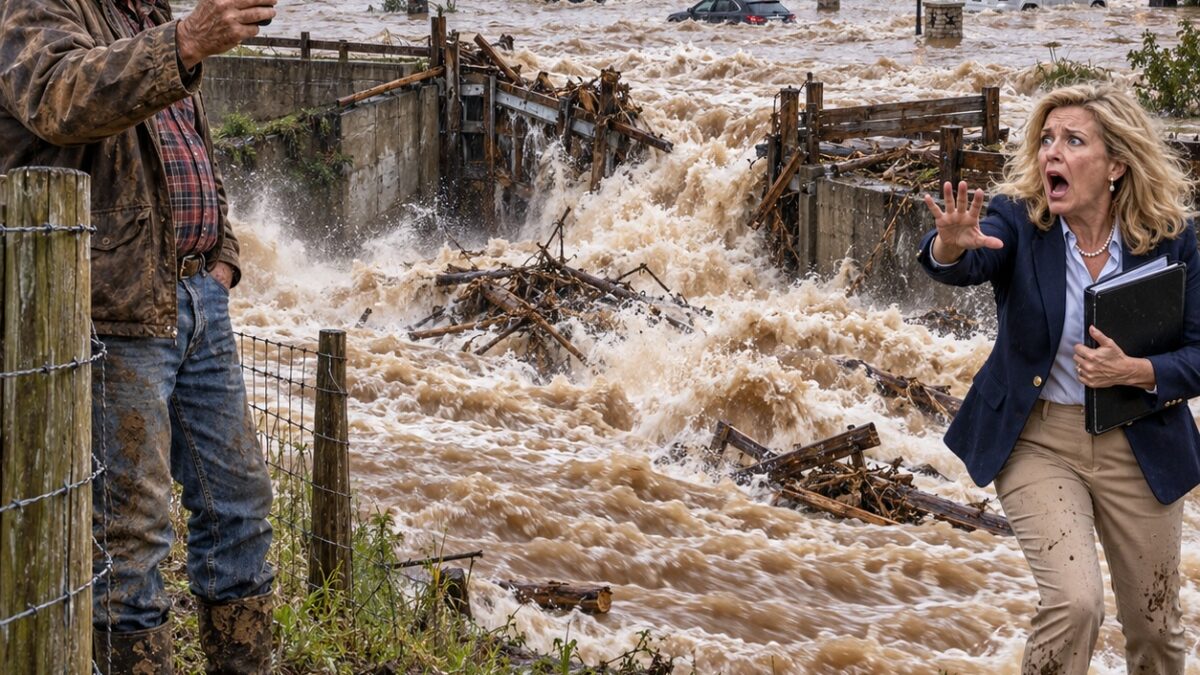
FULL STORY CONTINUATION
Ann Pruitt Hall met me the following Monday.
Her office smelled like old files and burnt coffee.
She read the easement once.
Then a second time.
Then a third.
She read Diane’s letters.
The $200 violation the HOA had already tried to impose because my cattle supposedly had access to a “shared waterway.”
Then she took off her glasses.
“Mr. Coin, do they know you own the creek?”
“I don’t think so.”
“Do they know the only reason their subdivision can legally discharge storm water onto your property is because your father gave their developer permission?”
“I don’t believe so.”
She looked back down.
“Then this is going to become interesting.”
Her finger moved along one paragraph.
The operative language was plain.
The subdivision’s right to discharge storm water across Coin property was conditioned upon preserving the natural flow of the creek.
Then came the critical part.
No obstruction.
No impoundment.
No diversion.
Not without the prior written consent of the landowner.
Ann looked up.
“If they touch that channel to control the flow without your written permission, they don’t merely trespass.”
She tapped the page.
“They breach the condition of the very easement that allows their subdivision to drain through your land.”
I sat quietly.
She continued.
“And if they breach the easement condition, they may lose the ability to enforce its benefit.”
I understood the practical consequence before she finished saying it.
For twenty years, runoff from 118 homes had moved downhill into their retention pond, through the old spillway, into my branch, and away.
If the HOA interfered with that path—
The water would stay uphill.
On them.
Ann leaned back.
“What exactly did Diane mean when she said they intended to manage the flow?”
“I don’t know yet.”
“Good.”
“Good?”
“Don’t warn them.”
I looked at her.
“If they’re planning something they don’t have authority to build, let them put it on the record themselves.”
That sounded fine to me.
“What should I do?”
“What you did for the highway department.”
Document.
So I did.
For two weeks I documented every part of the creek.
The low crossing.
Fence.
Banks.
Spillway.
Retention pond outlet.
Culvert where subdivision drainage entered my property.
I dated the photographs.
I pulled Cattail Bend’s recorded plat from the county.
All four sheets.
Placed them beside my deed.
Then beside my grandfather’s original survey.
The subdivision boundary stopped on the ridge.
The creek did not belong to them.
The spillway did not belong to them once it crossed into my property.
The banks.
Bed.
Crossing.
All inside my line.
I hired a licensed surveyor named Hollis anyway.
Old records are useful.
A current sealed survey is better.
Hollis spent two days walking the property.
When he finished, he spread his new plat across my truck hood.
He tapped the creek.
“You realize this entire subdivision drains toward you.”
“Yes.”
“If anybody blocks this channel, that water backs uphill.”
“I know.”
He looked at me.
“You sound like you’ve thought about it.”
“Thirty-eight years.”
He signed the survey.
I put it in a second folder.
Deed.
Easement.
Survey.
Pictures.
HOA letters.
My notebook containing Diane’s exact words.
Then I closed the drawer.
And waited.
I did not have to wait long.
My neighbor Dale Burrow called near sunset on a Thursday.
Dale was a retired farrier with a bad hip and excellent binoculars.
“Walter.”
“What?”
“They’ve got a track hoe up by that pond.”
I stopped what I was doing.
“What kind?”
“Little yellow machine. Came in on a trailer.”
“Anything else?”
“Riprap. Concrete-looking pieces. Some kind of gate.”
I went quiet.
Dale continued.
“Your friend in the navy blazer is up there pointing at things.”
“Can you photograph it from the public ridge road?”
He laughed.
“Already took eleven.”
“Get the date on them.”
“Already did.”
Dale was a good neighbor.
By the end of the story, he would also become an excellent witness.
I did not go up that evening.
Heavy equipment sitting on a trailer at dusk rarely does meaningful work until daylight.
I knew whatever they intended to build would be easier to document in the morning.
So I ate dinner.
Slept.
And at first light walked the length of my creek with a camera.
What I found near the pond outlet was a dam.
The HOA did not call it that.
Later, I read the meeting minutes.
They called it:
FLOW CONTROL STRUCTURE AND STORM WATER RETENTION IMPROVEMENT.
I had inspected enough structures in thirty-eight years to know a dam when I saw one.
An earthen berm crossed the channel below the pond.
Keyed into both banks.
Riprap faced the upstream side.
A concrete headwall had been installed.
And in that headwall sat a manual gate valve.
Close the valve.
Hold water.
Open it.
Release water.
Simple.
The HOA wanted the neighborhood pond to remain fuller.
Prettier.
More attractive beside the walking trail and gazebo.
They believed too much water was escaping through the old spillway and flowing onto what Diane had called “unmaintained private land.”
Mine.
The problem was obvious.
That pond did not collect only direct rainfall.
It received runoff from 118 roofs.
One hundred eighteen driveways.
Multiple cul-de-sacs.
Sidewalks.
Yards.
Every hard surface across that western ridge.
The subdivision had been engineered to shed water downhill.
Into the pond.
Then through my creek.
That was why the easement existed.
Now Diane intended to close the outlet.
I stood on my side of the fence.
Photographed everything.
Berm.
Gate.
Headwall.
Excavator.
Workers.
Riprap.
Diane’s white Lexus.
Forty-one photographs before I left.
Diane saw me.
She walked toward the fence.
Different shoes this time.
Still the navy blazer.
“Mr. Coin.”
“Morning.”
“We’re improving the drainage.”
I looked at the new berm.
“Are you?”
“You’ll actually see less water on your property.”
“I see.”
“So really this benefits you.”
Then she smiled.
“The board voted. It’s all documented. You’re welcome to review the minutes.”
That sentence almost made me smile.
Documented.
Exactly what Ann had wanted.
“Thank you.”
Diane looked surprised.
I did not tell her what she had done.
Did not tell her the berm violated the easement.
Did not point out that the valve was an impoundment device.
Did not lecture her about runoff.
I simply walked home.
Called Ann.
She listened without interrupting.
When I finished:
“They built an impoundment in the channel?”
“Yes.”
“With a controllable gate?”
“Yes.”
“Photographs?”
“Forty-one from this morning. Eleven from Dale last night.”
“Boundary survey?”
“Signed and sealed.”
Pause.
Then:
“Mr. Coin, they have just done the single worst thing available to them.”
I waited.
“They have breached the express condition of the easement that gives Cattail Bend the right to discharge storm water through your property.”
“I figured.”
“If they close that valve and physically impound the flow, the breach becomes even cleaner.”
I looked toward the window.
The sky had gone gray.
Wet slate.
May weather.
Ann continued.
“But there is something else they clearly did not think through.”
“The water.”
“Yes.”
She explained what I already knew from a career in bridges and culverts.
The pond held runoff from the entire western ridge.
If they restricted the outlet to keep the lake higher, the water would accumulate on the subdivision side.
Behind a berm built in roughly a day and a half.
By a small excavator.
Without evidence of a proper engineered core.
Without the kind of compaction a real impoundment structure required.
I said:
“There’s rain coming.”
Ann was quiet.
“Then do nothing.”
“Nothing?”
“You didn’t build it.”
“No.”
“You didn’t close it.”
“No.”
“Not your land?”
“The berm is upstream on their side, though the controlled discharge directly affects my creek.”
“Then you are under no duty to instruct someone that their unauthorized structure is poorly designed.”
She paused.
“Keep your camera charged.”
So I did.
I set up the good tripod I had used years earlier for inspection work.
Placed it on my side of the north fence with a clear view of the berm.
Fresh memory card.
Date stamp checked twice.
Then I waited.
The rain began Thursday afternoon.
Warm.
Steady.
A stalled front out of the southwest.
At first, nothing dramatic.
Rain on leaves.
Dark earth.
Water beading on fence wire.
I had kept rainfall records on the property for thirty-one years.
There was a gauge beside the spring house.
By Friday noon:
2.1 inches.
By midnight:
4.6.
By Saturday morning:
7.3 inches.
Seven-point-three inches of rain in less than forty hours.
Across 118 roofs.
Driveways.
Pavement.
Sloped yards.
All flowing downhill toward one pond.
Behind one fresh berm.
With one closed gate.
I did not need to see the ridge to know something was wrong.
Before dawn Saturday, the sound of the branch changed.
People who live near moving water know what I mean.
Water has voices.
Low flow.
Normal rain.
Flood stage.
Debris.
Scour.
That morning, underneath the creek, I heard another sound.
A low wet slump.
Saturated earth losing shape.
At first light, I put on my slicker.
Covered the camera.
Walked north.
The Cattail Bend pond was no longer a pond.
It looked like a lake.
Brown water stretched beyond its normal shoreline.
Into lawns.
Near patios.
Toward the lowest streets.
It pressed hard against the new berm.
The HOA had wanted a fuller lake.
They had one.
The berm was already failing.
The upstream face had slumped.
Riprap moved.
Water poured over the crest in a brown sheet.
The overflow had started cutting a notch down the back side.
Classic erosion.
Once overtopping begins on an unprotected earthen embankment, the structure can deteriorate quickly.
But the failing berm was not the first thing I photographed.
I aimed uphill.
The water had backed into the subdivision.
Exactly where gravity said it would.
The lowest streets of Cattail Bend were flooded.
Garages.
Patios.
Walking trail.
Gazebo.
Landscaping.
Mailboxes.
Brown water stood where residents had parked cars days earlier.
The same HOA that had told me my creek needed management had managed the flow so effectively that the storm water no longer had anywhere to leave.
I stood on dry ground.
My grandfather had chosen the high bank a century earlier for a reason.
I photographed everything visible from my property.
Timestamp.
Frame.
Timestamp.
Frame.
I did not laugh.
There is nothing funny about people’s homes filling with water.
Most of those homeowners had not built the berm.
Some probably had no idea their board had done it.
I felt no satisfaction seeing their garages flooded.
But I did feel something colder.
Recognition.
Water had answered the engineering question before the lawyers ever got the chance.
The county sent an emergency-management engineer on Sunday.
Young man named Cole.
Mud-covered truck.
Clipboard.
He inspected the berm.
Dale later told me what Cole had said from the public road.
Whoever authorized the structure had effectively built an unpermitted dam.
No engineer.
No proper design.
No permit.
No understanding of the drainage load.
The word dam entered the county record.
I did not put it there.
Diane’s board did.
The following Wednesday, another certified letter arrived.
Not addressed to me.
Ann obtained a copy a few days later.
A group of Cattail Bend homeowners whose properties had flooded were suing their own HOA and individual board members.
Unpermitted structure.
Negligent storm-water management.
Property damage.
They wanted compensation.
They wanted names.
I never sued Diane.
Never filed a claim against the HOA over the creek.
That part matters.
I did not have to.
I had my deed.
The easement.
Current survey.
Photographs.
Dates.
Witness.
County record.
When the evidence is clean enough, sometimes the smartest thing you can do is allow institutions to function.
Cattail Bend applied for a variance to keep the flow-control structure.
The county scheduled a hearing before the drainage board.
Ann explained our role.
“We are not part of the homeowners’ flood suit.”
“Good.”
“We’re something more useful.”
“What?”
“The landowner.”
The county needed one answer from me.
Had I given Cattail Bend written consent to build the berm and gate in the creek channel?
No.
Simple.
The hearing happened on a Tuesday morning in June.
County building beside the courthouse.
Low ceilings.
Old floor wax smell.
Water stain on one ceiling tile.
Diane attended in her navy blazer.
Lawyer beside her.
Two remaining board members sat behind them.
Several others had already resigned.
Diane carried the same gold-logo folder.
She had proper shoes on this time.
Her attorney spoke first.
Long explanation.
Storm-water management.
Community assets.
Association obligations.
Shared drainage features.
The word waterway appeared repeatedly.
As though repetition could transfer title.
Chairman Alcott sat at the center of the drainage board.
Heavyset man.
Farmer before public service.
He listened.
Then asked one question.
“Whose property is the structure on?”
The HOA lawyer began talking about community drainage.
Alcott stopped him.
“That was not my question.”
Ann stood.
She carried three documents.
She laid down the first.
“The Coin deed.”
Fee-simple ownership.
Creek channel.
Banks.
Crossing.
All inside my parcel.
Second.
“Hollis boundary survey.”
Current.
Licensed.
Sealed.
Confirmed the same.
Third.
“Book 214, page 88.”
The drainage easement.
Ann explained that my father granted Meridian Land Partners and its successors, including Cattail Bend, the right to discharge storm water across Coin property.
Then she read the condition.
Slowly.
No obstruction.
No impoundment.
No diversion within the creek channel without prior written consent from the landowner.
She set the document down.
“The structure at issue is an impoundment.”
Nobody interrupted.
“It was constructed without Walter Coin’s prior written consent.”
Diane shifted.
Ann continued.
“It is therefore not merely unpermitted under county drainage requirements. It violates the express condition of the easement that gives the association its legal right to drain across Mr. Coin’s property.”
She paused.
“The association is asking this board to authorize a structure that breaches its own drainage rights.”
Alcott looked at the HOA attorney.
The attorney looked through his notes.
No answer appeared.
Then Diane stood without being recognized.
“The creek has always been treated as a community waterway.”
Alcott looked at her.
“It is on Mr. Coin’s deed.”
“It serves our community.”
“That is not the same thing.”
“He doesn’t even do anything with it.”
I almost smiled.
Same argument.
If I am not actively monetizing something, apparently it becomes hers.
Alcott asked:
“Mrs. Wessling, did you personally read book 214, page 88 before your board authorized construction?”
“The board voted.”
“That wasn’t my question.”
“It’s in the minutes.”
“That wasn’t my question either.”
He asked again.
“Did you read the recorded easement?”
Diane said nothing.
There are moments when silence becomes testimony.
That was one.
When they called me, I kept it short.
Alcott asked:
“Mr. Coin, did you provide written consent for Cattail Bend to construct a berm, gate, or any other impoundment in the creek?”
“No.”
“Were you asked for consent?”
“No.”
“Does the association have a drainage right?”
“Yes.”
Diane looked toward me.
I continued.
“Under the easement, they can discharge storm water through my property as long as they maintain the natural flow and do not obstruct, impound, or divert the creek without my written permission.”
“Did they comply?”
I looked at Alcott.
“The water on their lower streets already answered that.”
Then I sat down.
Before lunch, the board denied Cattail Bend’s variance.
The ruling was plain.
The structure had been built without authority in a private creek channel.
It violated the recorded easement.
Cattail Bend was ordered to remove the berm.
Remove the gate.
Restore natural flow.
At its own expense.
This time under actual engineering supervision.
Deadline:
Sixty days.
I thanked the board.
Collected my documents.
Walked outside.
No speech.
No confrontation.
The paper merely confirmed what the rain had already demonstrated.
Diane closed the gate Thursday.
By Saturday, the lower section of Cattail Bend was underwater.
The sequence was that simple.
Seven-point-three inches of rainfall struck the watershed.
The runoff came off 118 homes and paved surfaces.
The pond filled.
The gate restricted discharge.
Water backed uphill.
Garages took eighteen to twenty inches.
Patios disappeared.
The walking trail became a shallow canal.
The gazebo stood in brown water.
Even the carefully regulated mailboxes sat with their little red flags barely above the flood.
Then the berm itself began to fail.
Water overtopped.
Erosion cut the downstream face.
The structure slumped.
And eventually the water tore through.
So Cattail Bend suffered twice.
First from holding the water.
Then from failing to hold it.
I photographed both.
Not because I enjoyed it.
Because I knew what happens when facts depend on memory.
People remember selectively.
Photographs remember geometry.
The HOA later tried to suggest the storm itself was extraordinary.
It was heavy.
Absolutely.
Seven inches in less than two days is serious rain.
But heavy rainfall was the precise condition a storm-water system was supposed to handle safely.
Their subdivision had functioned for roughly twenty years because the water had an outlet.
They deliberately restricted that outlet without engineering the consequences.
Rain did not create that decision.
The homeowners’ lawsuit moved forward.
Their attorney had county inspection findings.
Flood photographs.
Board records.
Construction invoices.
Minutes describing the “flow control structure.”
Eventually, the suit settled.
Cattail Bend paid damages to affected lower-lot homeowners.
The reserve fund took the hit.
Then came the predictable part.
Special assessment.
Every homeowner was charged to help rebuild the reserves.
That was the ugly communal consequence.
One board president had claimed to act for the neighborhood.
In the end, every household paid cash for the decision.
I did not celebrate that either.
Most of them had never stood by my creek.
Most had probably never heard of book 214, page 88.
That is why board governance matters.
People entrust authority to a few neighbors because nobody wants to read drainage easements after dinner.
Those few neighbors have a responsibility to know where their authority ends.
Diane did not.
Or refused to learn.
She resigned before the homeowners’ settlement was finalized.
The minutes listed:
Personal reasons.
That was fine.
No need for a dramatic public confession.
The creek did not care why she left.
The county drainage order remained.
Ann also filed a short declaratory action on my behalf so ownership and the easement terms would never again be treated as ambiguous.
The channel was confirmed as Coin property in fee simple.
The drainage right was recognized exactly as written.
No expansion.
No invented “community waterway.”
No HOA management authority over my creek.
The association spent roughly $11,000 in legal fees establishing publicly something my grandfather’s deed had already established generations earlier.
That number amused Ann more than it amused me.
“They paid eleven thousand dollars to learn how to read a deed.”
“That’s an expensive literacy program.”
She laughed.
By July, engineers supervised removal of the berm.
Real engineers this time.
The earthen structure came out.
The headwall gate was removed.
The channel was restored.
Within about a week, the creek looked familiar again.
Brown first from disturbed soil.
Then clearer.
Then quiet.
Water returned to the path gravity had always given it.
No board vote required.
I walked the fence line the morning after it settled.
Spring redbuds were long gone.
Everything had turned summer green.
At the low crossing, the water moved the color of weak tea over pale gravel.
A great blue heron stood in the deep water near the south cedars.
Same place herons had stood when I was a boy.
I found a cedar fence post that winter ice had pushed loose.
One my grandfather had set decades earlier.
I straightened it.
Packed earth around it by hand.
Tamped it the way my father taught me.
And while I worked, I realized I had not thought about Diane for maybe an hour.
Then another.
That, more than the hearing, felt like the real ending.
Land has a way of reducing people to their proper scale.
For a few months, Diane seemed enormous.
Certified letters.
HOA fines.
Laminated notices.
Board votes.
Threats.
Lawyers.
Then she was gone.
The creek remained.
There is a temptation in stories like this to say I beat the HOA.
I don’t think of it that way.
I held a document.
Waited.
Documented what happened.
The HOA defeated its own position.
Book 214, page 88, did not appear because I needed revenge.
It had existed the entire time.
The hydrology did not change because I was angry.
The subdivision had always drained east.
The rain was not on my side.
Rain has no side.
Water followed elevation.
The outcome felt personal only because Diane had made it personal.
Engineering stripped the emotion out.
Close outlet.
Water rises.
Weak berm overtops.
Flood occurs.
That is not revenge.
That is load path.
I had spent thirty-eight years watching people try to argue with physical systems.
Bridge overloaded?
They said traffic would only be heavy occasionally.
Culvert undersized?
They said the creek usually stayed low.
Scour undermining an abutment?
They said the bridge had stood there fifty years.
Water does not care about those explanations.
Neither does gravity.
A structure works or it does not.
Drainage has capacity or it does not.
Diane had approached the creek like an HOA rule.
Something subject to management through wording.
“Shared community waterway.”
“Flow control.”
“Environmental management.”
“Association responsibility.”
None of those phrases changed the watershed.
The most dangerous thing about her plan was not arrogance alone.
It was certainty without understanding.
She had decided the pond should stay fuller.
That seemed simple.
Close the outlet slightly.
Hold more water.
Pretty lake.
But storm-water infrastructure exists for the ugly days.
Not the brochure days.
The day with blue sky and calm water tells you almost nothing about whether a system is adequate.
The seven-inch storm does.
That was what my entire career had taught me.
You design for load.
Not appearance.
Cattail Bend’s original drainage arrangement had one great advantage.
It followed terrain.
Water fell east.
Pond attenuated flow.
Creek carried discharge away.
Simple.
Then Diane added control without capacity.
The moment that happened, somebody needed to recalculate everything.
Storage volume.
Rainfall intensity.
Emergency overflow.
Berm stability.
Downstream effects.
Upstream flooding.
Freeboard.
Soil compaction.
Gate operation.
No one did.
Two men and a rental excavator built something that looked manageable under dry skies.
Then weather applied the design load.
Failure.
I could have warned her.
People asked later why I didn’t.
That question is complicated.
Legally, Ann was clear.
I had no obligation to engineer or supervise an unauthorized structure built without my consent.
Practically, Diane had already ignored every warning I had offered about ownership.
She believed a board vote solved jurisdiction.
Would she have listened to a hydrology lecture?
Maybe not.
Still, I never enjoyed knowing homeowners suffered.
I want that clear.
If I had believed lives were in immediate danger, I would have called emergency services.
Of course.
But when the berm went in, the risk was property flooding under heavy rain, not an obvious imminent threat to life based on what I could see.
When the storm became severe, county emergency management responded.
The subdivision was dealing with its own flooding.
Nobody was left trapped because I withheld some secret switch.
The real secret was not technical.
It was ordinary.
Do not obstruct drainage you do not understand.
The county engineer wrote that lesson into more professional language.
The board wrote it into its order.
The homeowners wrote it into their lawsuit.
The reserve fund wrote it into dollars.
Everyone learned differently.
I learned too.
I had owned the easement for years.
Rarely thought about it.
That was a mistake of comfort.
Not legal error.
Just complacency.
Important property records should not wait in drawers until somebody threatens you.
After the case, I organized everything.
Deed.
Survey.
Easement.
Drainage-board order.
Declaratory judgment.
Photographs.
Correspondence.
Digital copies.
Ann kept copies.
County records had copies.
If another Cattail Bend board ever decided the creek belonged to them, the answer would take five minutes instead of two months.
That was progress.
The new HOA board eventually contacted me.
Different president.
Different tone.
He asked to meet.
We sat at my kitchen table.
He had read the easement.
Good beginning.
“We want to make sure the association remains compliant.”
“That would be wise.”
“We understand the creek is private.”
“Yes.”
“We also understand the subdivision retains the drainage right under the conditions.”
“Yes.”
“What do you expect from us?”
“Follow the agreement.”
He waited.
“That’s it?”
“That’s it.”
No need for humiliation.
I did not want control over their subdivision.
I wanted them to stop pretending they had control over my creek.
Those are different desires.
We discussed routine maintenance near the lawful discharge point.
Notice requirements.
Emergency situations.
No structures in the channel.
If engineering changes were ever proposed, they would contact me first.
Simple.
That meeting lasted less than an hour.
No lawyers needed.
That is what respect saves.
Time.
Money.
Fights.
Had Diane started with:
Mr. Coin, our pond is silting and residents are concerned about water levels. May we discuss options?
Maybe there was a solution.
Dredging.
Vegetation management.
Professional engineering.
Different outlet configuration that preserved natural flow with consent.
I do not know.
We never reached that conversation because she began with:
Your fence is a liability.
Remove it.
Then:
The creek belongs to the community.
Once somebody starts by claiming your property, cooperation gets harder.
Authority can be useful.
Presumption is not.
One winter after everything ended, ice pushed another fence post loose.
I repaired it.
The creek ran beneath thin sheets of ice.
Cattail Bend sat quiet on the ridge.
Their pond had been dredged professionally by then.
Not cheap.
Exactly the expense Diane’s board had tried to avoid.
They also improved sediment management.
Hired an engineer.
Updated storm-water maintenance plans.
What they should have done in the beginning.
The irony was painful.
Avoid dredging because it costs too much.
Build cheap berm.
Flood neighborhood.
Pay lawyers.
Pay damages.
Drain reserve.
Special assessment.
Then dredge anyway.
Shortcuts often charge interest.
That is what the special assessment represented.
Every household paid for avoiding the expensive correct option.
I heard the number per lot.
Did not write it down.
It was their financial matter.
The source of the cost was enough for me.
Residents sometimes blamed Diane entirely.
She deserved responsibility.
But boards vote.
Minutes existed.
Other members approved.
Some resigned when things turned.
That is why I never reduced everything to one villain.
Diane drove the idea.
Diane confronted me.
Diane represented the association.
But governance failed collectively.
Somebody could have asked:
Whose creek?
Somebody could have pulled the easement.
Somebody could have hired an engineer.
Somebody could have looked at storm-water volume.
Somebody could have said:
Maybe do not build an unpermitted dam.
Apparently nobody did.
Organizations fail when everyone assumes someone else checked.
That lesson applies far beyond HOAs.
Bridge projects.
Drainage departments.
Businesses.
Families.
Before acting, identify the load path.
In property matters, the load path is often title.
Who owns it?
What rights are recorded?
What conditions apply?
Diane started at the wrong end.
What do we want?
Then:
How do we make Walter comply?
Correct order:
What rights do we have?
Then:
What options exist inside them?
Changing that order changes everything.
My father understood.
That easement impressed me more after the dispute.
Not because it was complicated.
Because it was limited.
He gave Meridian exactly what it needed.
A right to discharge storm water.
He did not give them ownership.
Did not give broad control.
Did not let them obstruct the creek.
Did not say “for any future community purpose.”
He made a permission specific.
Good agreements are often defined as much by what they do not grant as what they grant.
My father trusted handshakes more than I did.
But on that day, he called a lawyer.
I was grateful.
He probably paid Pruitt Hall a few hundred dollars.
That clause later protected land from an HOA willing to spend far more fighting over it.
Legal clarity is cheap when written early.
Expensive when reconstructed during conflict.
Ann liked saying that.
She probably put it on invoices.
Dale remained proud of his eleven original photographs.
He came over one evening.
“Mine were better than yours.”
“You took them from half a mile away.”
“Better composition.”
“You were photographing trespass evidence, not a sunset.”
“Art can serve multiple purposes.”
I laughed.
He became mildly famous around the neighborhood after the homeowner litigation because his pictures showed the construction beginning before the berm was finished.
Date.
White Lexus.
Equipment.
Riprap.
Diane.
Witnesses matter.
Not because he had some dramatic testimony.
He simply saw what happened and recorded it.
Again:
Boring evidence.
Strong.
The homeowners’ attorneys used county records more heavily than ours, but Dale’s timeline helped.
He enjoyed that.
“Always knew these binoculars would serve justice.”
“They mostly serve gossip.”
“Justice is organized gossip.”
I told him not to repeat that in court.
Life returned.
Cattle.
Fence.
Rain gauge.
The rain gauge stayed.
Every May, I still watched it.
One storm later dropped nearly five inches.
No flood in Cattail Bend.
Why?
Outlet open.
Creek flowing.
Proper maintenance.
Same topography.
Same gravity.
Different human decision.
That storm was perhaps the cleanest proof.
Heavy rain itself had not been the enemy.
Blocked drainage was.
I took no pictures.
Did not need them.
Water moved through.
By morning, creek ran high.
By afternoon, dropping.
Cattail Bend streets dry.
That was the system working.
Sometimes success is boring.
Nothing floods.
Nobody calls attorneys.
No county hearing.
The absence of disaster does not attract attention.
Engineers understand.
You maintain systems for days when nobody notices them.
Diane had looked at the branch and said:
“You’re not really doing anything with it.”
That may have been her deepest misunderstanding.
A functioning drainage corridor can look like nothing.
Water enters.
Water leaves.
No crisis.
Therefore, somebody assumes it has no value.
Same with easements.
Same with boundaries.
Same with maintenance.
Invisible systems look unnecessary until someone interferes with them.
My creek was “just sitting there” because it was doing exactly what it should.
Moving water downhill.
Quietly.
That is performance.
Not idleness.
I thought about her phrase for years.
Community waterway.
People like that word because it sounds cooperative.
Shared.
Public.
Available.
But labels cannot substitute for title.
A road can serve a community while remaining private.
A creek can carry community drainage while remaining privately owned.
A utility can cross private land through an easement without owning the underlying land.
Multiple rights can coexist.
The legal world handles that every day.
Diane wanted one simple category:
Community asset.
That category gave her control.
Reality was more precise.
Coin-owned creek.
Cattail Bend drainage easement.
Conditional right.
No obstruction.
No impoundment.
No diversion.
That precision saved the land.
I eventually gave a copy of the records to a younger neighbor who had bought property downstream.
Not because his land was part of my easement.
Because he asked how I knew what to look for.
I told him:
“Start with the deed.”
He expected something more clever.
“That’s it?”
“Then survey.”
“Then?”
“Recorded easements.”
“And if somebody shows up with HOA letterhead?”
“Still start with the deed.”
Official appearance impresses people.
Gold logo.
Blazer.
Laminated card.
Certified mail.
It all creates psychological weight.
But legal foundation exists elsewhere.
Record books.
Surveys.
Recorded instruments.
Or statutes.
Something verifiable.
That is the lesson I kept.
Not:
Never trust an HOA.
Too simple.
Not:
Always fight.
Also too simple.
Ask:
What is the claim built on?
If solid, deal with it.
If weak, do not strengthen it by treating confidence as authority.
Diane’s first letter contained no legal description.
No easement citation.
No deed reference.
No proof my property fell under association covenants.
Just assertion.
That should always make you slow down.
Not panic.
Not rage.
Slow down.
Read.
When she visited in April, I said little she could write down.
That was intentional.
People create trouble for themselves when anger makes them talk too much.
I had watched contractors do it during state inspections.
“This crack has always been there.”
“How long?”
“Well, maybe not always.”
Words multiply.
I preferred notes.
Date.
Time.
Statement.
Condition.
Photograph.
Later, those records become memory without emotion.
My notebook still contains Diane’s sentences.
You’re not really doing anything with this creek anyway, are you?
The board voted.
We’ll be taking steps to manage the flow with or without your cooperation.
At the hearing, she repeated essentially the same thinking.
The board voted.
That phrase fascinated me.
A board vote is powerful inside the area the board controls.
Outside it, a board can unanimously vote that the moon belongs to Cattail Bend.
Still no title.
Authority has geography.
Every institution has edges.
HOA covenant boundary.
County jurisdiction.
Property line.
Easement corridor.
Diane treated her office as though it had no edge.
The creek showed her one.
After the declaratory action, the county record became even clearer.
Future title searches now showed ownership and drainage conditions without anybody digging for context.
Ann considered that the best outcome.
“Not the flood ruling?”
“No.”
“Not Diane resigning?”
“No.”
“Then what?”
“The next dispute becomes impossible to manufacture honestly.”
I thought about that.
She was right.
The purpose of legal resolution is not only to win today.
It should reduce tomorrow’s ambiguity.
Now nobody could credibly say:
We thought it was shared.
The record answered.
That gave me peace.
The creek never needed revenge.
It needed clarity.
I never built a sign announcing ownership.
No PRIVATE CREEK board nailed to a tree.
No need.
The fence remained.
The crossing remained.
County records were enough.
I did replace one cedar post a year later.
The old one had finally rotted below ground.
When I pulled it out, the center still smelled faintly of cedar.
My grandfather had cut some of those posts himself.
The new one came from a tree on the property.
I set it deep.
Tamped it by hand.
My father taught me that method.
Same motions.
Three generations.
You cannot put that kind of relationship into an HOA spreadsheet.
Maybe that is why Diane assumed the creek was unused.
People who measure value through visible amenities overlook continuity.
The branch had no gazebo.
No branded sign.
No walking trail.
No HOA newsletter photo.
Yet it had moved water through that valley longer than any of us had been alive.
Use does not require decoration.
Ownership does not require constant performance.
Sometimes land is valuable because you leave it alone enough to keep doing what it does.
The subdivision learned that expensively.
Cattail Bend eventually recovered.
Homes repaired.
Reserve rebuilt slowly.
New board.
Professional storm-water plan.
The pond remained attractive.
Residents still walked around it.
Children fished.
Gazebo repaired.
Life continued.
I was glad.
I did not want them permanently punished for Diane.
A healthy ending is not an enemy remaining miserable forever.
It is the system becoming less stupid.
Cattail Bend became less stupid.
That is success.
A few residents introduced themselves over the years.
Most conversations were polite.
One man from a lower lot said:
“I was angry at you at first.”
“Why?”
“I heard you refused to let us control runoff.”
I almost laughed.
“Who told you that?”
“You know.”
I probably did.
He looked toward the creek.
“Then I saw the easement language.”
I nodded.
“Our garage had nineteen inches.”
“I’m sorry.”
He looked surprised.
“You are?”
“Of course.”
“It wasn’t your fault.”
“No. Still sorry it happened.”
That mattered to him.
Conflict encourages people to divide suffering into teams.
Your side flooded?
Good, because your board was wrong.
No.
A man’s garage flooding is not a legal argument.
It is damage.
He can be innocent and his board wrong at the same time.
I never forgot that.
The homeowners who sued did what they had to do.
Their damages were real.
The settlement was appropriate.
The special assessment was painful.
All true.
No need for cheering.
When Diane resigned, I felt mostly relief.
Not triumph.
She no longer had authority to send me letters pretending my creek belonged to her.
That was enough.
I never saw her much afterward.
Once at the county building.
She walked by.
We did not speak.
I preferred it.
Some people remain too important in your mind after conflict.
Real closure is demotion.
From enemy to irrelevant stranger.
Land helped.
Every morning there was work unrelated to Diane.
Cattle needed checking.
Fence.
Equipment.
Storm.
Trees.
Life kept assigning larger priorities.
The creek ran.
That was the final verdict.
One fall evening, I sat near the south cedars.
Heron in the pool.
Low water.
Leaves drifting.
I thought about the 7.3-inch storm.
How violent that creek had sounded.
How quickly the neighborhood flooded.
Then looked at the quiet surface.
Same watercourse.
Different condition.
Systems can move between peace and crisis quickly when pressure changes.
So can people.
The trick is not to confuse quiet with weakness.
Diane saw a creek that was “just sitting there.”
Then she blocked it.
The creek demonstrated capacity.
Something similar happened legally.
She saw one old man on private land.
Not using the HOA.
Not attending their meetings.
Not advertising authority.
She assumed that meant there was none.
Then she pushed.
Deed.
Survey.
Easement.
Attorney.
County.
Record.
Quiet is not absence.
That became my favorite lesson.
You do not need to shout rights every morning for them to exist.
You need to know where they are recorded.
When challenged, produce them.
That is enough.
The second folder eventually became thick.
At first:
Two HOA letters.
Then:
Photographs.
Survey.
Dale’s pictures.
County inspection.
Drainage-board order.
Homeowner suit correspondence.
Declaratory judgment.
Restoration documentation.
What began with Diane’s laminated card ended in several inches of evidence.
I labeled the folder simply:
CREEK.
Ann saw it once.
“You could have used something more dramatic.”
“What?”
“CATTAIL BEND V. WATER.”
“No.”
“THE BRANCH STRIKES BACK?”
“Absolutely not.”
She laughed.
Lawyers need entertainment.
The file did not.
Records should be boring.
That is their power.
A future person should open it and understand immediately.
Who owns?
Coin.
What right does Cattail Bend have?
Conditional storm-water discharge.
May it obstruct?
No.
Written consent?
Required.
Done.
No narrative needed.
I kept the story for people.
The folder kept facts for institutions.
Different purposes.
If someone today walked onto my property with a gold-logo folder and called the branch a community waterway, I would probably handle it faster.
Invite them inside.
Make coffee.
Put book 214, page 88 on the table.
Read together.
Maybe save everyone a flood.
But I do not regret how the original dispute unfolded.
Not because of what happened to Cattail Bend.
Because the outcome permanently clarified the right.
Sometimes conflict forces neglected records into daylight.
Afterward, everyone knows.
And the memory of consequences makes future boards more careful.
The new board minutes routinely cited the drainage easement when discussing pond work.
Good.
Someone learned to read.
I hope they continue.
The county also added oversight after the unpermitted structure.
Any substantial modification affecting that discharge now receives proper review.
Good.
System improved.
That is the part I wish people focused on more.
Not merely:
HOA president got what she deserved.
Maybe she did.
But better:
Nobody can repeat the same mistake easily.
Punishment ends with a person.
Reform outlasts one.
The berm removal cost money.
The lawyers cost money.
Damages cost money.
Special assessment cost money.
But updated procedure may save far more in the future.
Expensive education.
Still education.
The one phrase from Ann I remember most came from that first office meeting.
“An easement is a permission, and permissions come with conditions.”
Simple.
People hear easement and imagine somebody else owns part of your land.
Usually not.
An easement grants a defined right over land someone else owns.
Defined.
That word matters.
Cattail Bend had a right to discharge storm water.
Not to redesign my creek.
Not to impound it.
Not to manage my livestock.
Not to remove my fence.
Not to declare the channel communal.
Specific permission.
Specific conditions.
Diane treated permission like ownership.
That mistake caused almost everything after.
It reminded me of something my father used to say about borrowing tools.
“If a man lets you use his wrench, that doesn’t mean you own his toolbox.”
Same principle.
Cattail Bend had the wrench.
Diane tried taking the toolbox.
Then acted surprised when somebody opened the deed.
My father would have appreciated the comparison.
He also would have been angry about the berm.
He understood bottomland.
He had watched floods before modern weather radar.
He knew why the spring house sat where it did.
Why the cattle fence crossed at that angle.
Why the house stayed high.
Generations before engineers formalized everything, farmers learned by consequences.
Do not build where water repeatedly claims ground.
Do not dam a channel casually.
Do not trust dry weather.
The county engineering made it technical.
Grandfather knew it physically.
Both reached the same truth.
Topography wins.
I was fortunate the Coin house sat high.
If Diane’s obstruction had flooded my home instead of theirs, I might have felt very different.
Anger would have been harder to avoid.
But the branch’s natural geometry sent the backup where it originated.
Uphill into Cattail Bend’s lowest lots.
Again:
Not justice.
Elevation.
That distinction kept me grounded.
People called it karma.
I did not.
Karma suggests judgment.
Water performed no judgment.
A gallon falling on a roof does not know who signed the construction invoice.
It runs downhill.
Block the outlet.
It accumulates.
Basic.
I prefer explanations that do not require the universe to take sides.
Human accountability came later.
County hearing.
Lawsuit.
Settlement.
Resignation.
Those were judgments.
The flood was physics.
Both mattered.
One revealed the problem.
The other assigned responsibility.
That is why I kept photographs and records.
Physical event alone does not establish legal responsibility.
Context does.
Who authorized?
Was there consent?
Was there a permit?
What did the easement say?
Records connect cause to duty.
Without them, Diane might have called the berm an emergency measure.
Or blamed extraordinary rainfall.
Or blamed downstream blockage.
The photographs showed timeline.
The easement showed prohibition.
County inspection showed lack of permit.
Homeowner damages showed consequence.
Complete chain.
I taught that approach to junior inspectors for years.
Never write:
“This bridge looks terrible.”
Write:
Crack measures X.
Location Y.
Photograph Z.
Load condition.
Observed movement.
Facts survive argument.
Feelings do not.
I followed my own training.
That may be why I stayed calm.
I had work to do.
Measure.
Photograph.
File.
Wait.
Anger becomes less useful when you have a process.
A younger neighbor once asked:
“How did you not scream at her?”
I said:
“I’d rather have her talking.”
“What do you mean?”
“People say useful things when they think they’re in control.”
Diane did.
Board voted.
All documented.
We’ll manage the flow.
You’re not using it.
Each statement revealed assumptions.
Had I shouted, she might have become careful.
Instead, she documented herself.
Ann knew that.
“Let them pull the thread.”
They did.
The track hoe was the thread.
The berm was the thread.
Closed gate was the thread.
Rain pulled hard.
By the time of the drainage hearing, nobody needed to speculate about intended control.
The structure existed.
Valve existed.
Flood existed.
Clean.
I never thanked Diane for that.
No need.
One summer many years from now, someone may buy a Cattail Bend house without hearing her name.
They will enjoy the pond.
Walk the trail.
Watch the water leave through a professionally maintained system.
Fine.
Maybe that is the best outcome.
Lessons embedded so deeply in procedure that people no longer need the story.
Meanwhile, whoever owns my land after me will open the property file.
See:
Coin deed.
Book 214, page 88.
Survey.
Court confirmation.
They will know.
That is stewardship.
You do not own land forever.
You hold it during your portion of time.
My grandfather held it.
Father.
Me.
Someone after.
The work is to pass along not just acreage but knowledge.
Where water goes.
Where boundaries are.
Who has rights.
What those rights mean.
What not to sign casually.
I became much better about that after Diane.
Conflict can educate the person who wins too.
I had been relying on memory.
Now I rely on records.
My rain notebook still hangs in the spring house.
Thirty-one years became thirty-two.
Then thirty-three.
Each line:
Date.
Rainfall.
Sometimes temperature.
One entry remains obvious.
7.3.
I never added:
HOA FLOOD.
No need.
The number tells me enough.
Rainfall was not extraordinary in the cosmic sense.
But combined with deliberate impoundment, devastating.
Context.
Always.
The spring house wall has other storms nearly as large.
Those did not flood Cattail Bend.
Because the creek remained open.
That is a beautiful controlled comparison.
Same watershed.
Similar rain.
Outlet functional.
No disaster.
If Diane ever doubted causation later, the hydrology answered repeatedly.
Open channel works.
Closed gate failed.
Simple.
One autumn I saw the new HOA president near the county office.
He waved.
We talked briefly.
“The pond looks good.”
“Glad.”
“We dredged.”
“I heard.”
“Expensive.”
“I imagine.”
He laughed.
“Less expensive than flooding everyone.”
“That tends to be true.”
Then:
“We keep a copy of the easement in the HOA’s main records now.”
“Good.”
“Highlighted.”
“Even better.”
He smiled.
“Diane should have done that.”
I said nothing.
Some truths do not need agreement.
He left.
I went home.
The branch was low that evening.
Heron.
Cattle.
Fence.
No drama.
That is what all the paperwork purchased.
Not victory.
Normality.
If I had to tell the whole story in one lesson, it would not be:
Never mess with an old man who owns a creek.
That sounds good online.
But it misses the useful part.
The useful lesson is:
When an institution claims something of yours through authority, first inspect the foundation of the claim.
Not the tone.
Not the logo.
Not the title of the person delivering it.
Foundation.
Deed.
Easement.
Statute.
Recorded boundary.
Contract.
Something.
Diane arrived with a laminated card.
I had a deed from a family history stretching back to 1919.
She had a board vote.
I had book 214, page 88.
She had minutes.
I had a current sealed survey.
She had the phrase “shared community waterway.”
I had fee-simple ownership.
Those things were not equal.
They merely looked equal until somebody checked.
That is why I never advise people to obey or fight automatically.
Check first.
Sometimes the HOA is right.
Sometimes the fence really violates a covenant.
Sometimes an easement really does grant access.
Sometimes the utility really can enter.
Reality matters more than pride.
In my case, reality was clear.
The creek was mine.
Their drainage right was conditional.
The condition was explicit.
They violated it.
Everything after followed.
I think about Diane’s first morning occasionally.
White shoes.
Wet clay.
Gold logo.
Standing beside water she had mentally transferred to herself because the subdivision benefited from it.
She seemed certain.
That certainty is what I remember.
Not cruelty.
Not rage.
Certainty.
Unverified certainty can do extraordinary damage when paired with authority.
A doubtful person might have checked.
A curious person might have called the county.
A careful person might have opened the easement.
Diane was certain.
So she acted.
Then rain tested the certainty.
That is why humility is not merely a moral virtue in engineering or governance.
It is a safety mechanism.
Ask:
What am I missing?
Who owns this?
What does the old agreement say?
What happens under maximum rainfall?
What if I am wrong?
Those questions might have saved Cattail Bend hundreds of thousands of dollars.
No one asked.
Until afterward.
The creek has no memory.
People do.
Today, water passes the crossing exactly as it did before the berm.
During storms it rises.
After storms it falls.
Sediment moves.
Branches collect.
I clear them.
Fence posts loosen.
I reset them.
The herons still stand in the deep pool.
Cattail Bend still sits on the ridge.
Its houses are older now.
Trees taller.
People have moved in and out.
Diane is no longer president.
The branch has outlasted every title involved.
That is comforting.
It reminds me the conflict was temporary.
Most are.
We inflate them because we live inside them.
Land sees longer.
One day somebody else will stand where I stood.
Hopefully with the folder already open.
Maybe they will never need it.
Even better.
But it will be there.
The manila envelope is preserved now inside a protective sleeve.
The old corners no longer have to take handling.
Certified copies exist.
Book 214, page 88.
My father’s caution translated through time.
The page does not look powerful.
No photograph could make it exciting.
Black text.
Old signature.
Recording stamp.
Yet that paper was stronger than Diane’s board vote because it answered the foundational question.
Permission.
Who had it.
For what.
Under which conditions.
Everything else was noise.
At the end of the dispute, Ann handed me the certified drainage-board order.
“Add this to your folder.”
I did.
“Getting crowded.”
“That’s what happens when people refuse to read the first three pages.”
She smiled.
We placed it beside the easement.
A modern order reinforcing an old agreement.
Two generations of paper saying the same thing.
Then I drove home.
No celebration.
I checked cattle.
Ate supper.
Walked to the creek before dark.
Water moved over the low crossing.
Quiet.
I stood there long enough to hear frogs.
Nothing about the scene suggested a neighborhood had flooded because somebody tried to control that flow.
That is another thing about water.
It does not preserve our embarrassment for us.
It moves on.
People should learn the same skill.
I did.
Eventually.
I stopped checking Cattail Bend meeting minutes.
Stopped asking Dale what the new board was doing unless it affected me.
Stopped watching the ridge.
Stopped expecting white Lexus headlights at the drive.
That was when the property felt entirely mine again.
Conflict can occupy land psychologically even when the deed never changes.
For months, Diane had turned the creek into a legal battlefield in my head.
Then one day it became the branch again.
That may have been the best moment.
No HOA waterway.
No exhibit.
No servient estate.
No drainage dispute.
Just the branch.
My family’s name for it.
Simple.
I have kept one of Diane’s original certified letters.
The one calling my fence an unauthorized obstruction.
Sometimes I put it beside the final county order.
The contrast is useful.
First letter:
Remove your fence because the association says so.
Final order:
Association must remove its structure because it lacked authority.
A full reversal.
But I never framed it.
The dollar-fine stories like drama.
Mine does not need a trophy.
The land itself is enough.
If anyone wants a memorial, they can look at the creek.
Still flowing.
Fence still there.
Crossing still there.
Natural channel restored.
That tells the story better than paper on a wall.
Diane wanted me to remove my fence from her “community waterway.”
Instead, her own board had to remove the dam it built across my privately owned creek.
She wanted to keep Cattail Lake fuller.
It filled until her neighbors’ garages did too.
She wanted association management.
The county ended up putting the limits of that management permanently into the public record.
And the strangest part is that I never had to beat her at anything.
I never touched the gate she built.
Never redirected the water.
Never sabotaged the berm.
Never sued her.
I held the deed.
I held the easement.
I kept the camera charged.
And I waited.
Forty-eight hours after she closed that gate, the lower third of Cattail Bend was underwater.
Not because I fought the HOA.
Because the HOA picked a fight with gravity.
Gravity won.
Today, when someone asks me what to do when an institution shows up with a logo, a vote, and a confident person telling you that something you own has suddenly become theirs, I give the same answer every time.
Don’t begin with the argument.
Begin with the record.
Find the deed.
Find the survey.
Find the easement.
Read every condition.
Because sometimes the most powerful thing on your property is not the fence, the creek, or even the land itself.
Sometimes it is an old piece of paper sitting quietly in a drawer, waiting for the day somebody powerful finally makes the mistake of not reading it.








