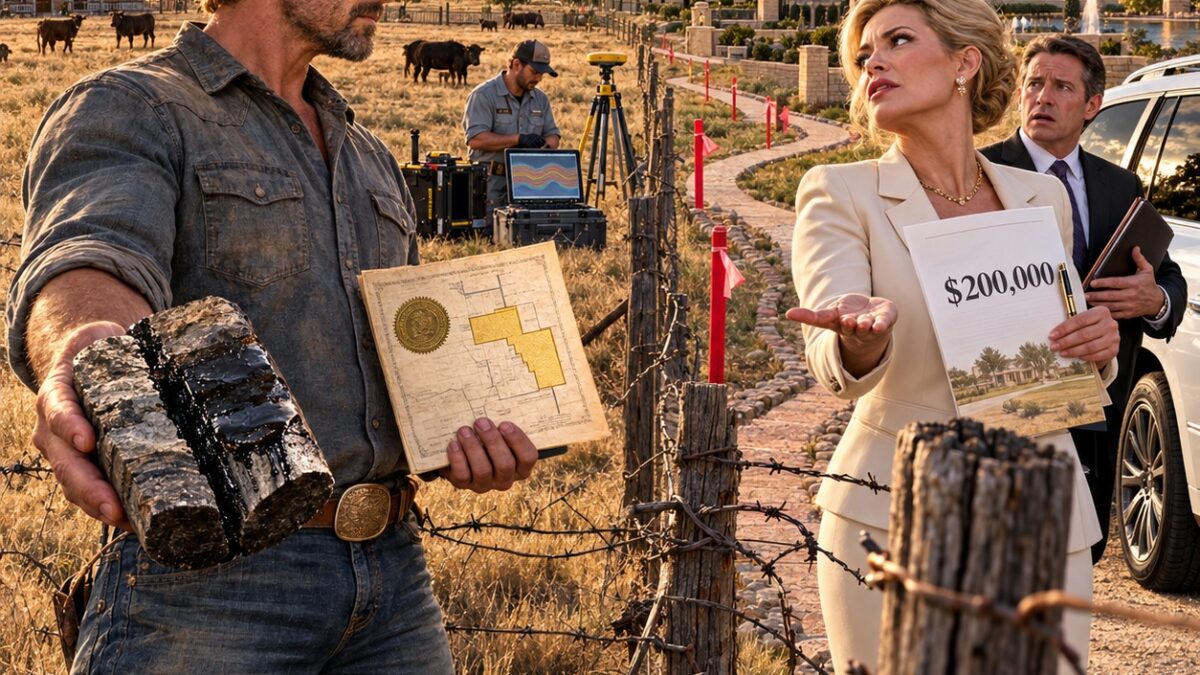
FULL STORY:HOA Queen Offered Me $200,000 for My “Worthless” 640-Acre Ranch—She Had No Idea She Was Standing on Oil My Family Still Owned
FULL STORY CONTINUATION
Elena watched Miranda’s Range Rover disappear down the road.
Then she stepped onto the porch and looked at the red marks Miranda’s heels had left in the loose caliche.
“That woman just called this place dirt.”
“She did.”
“She offered you two hundred thousand dollars.”
“She did that too.”
Elena folded her arms.
“What are you going to do?”
“Run the ranch.”
She waited.
“And?”
“Wait.”
Elena had been married to me long enough to understand that petroleum engineers use the word wait differently from everybody else.
Sometimes we mean patience.
Sometimes we mean data is incomplete and talking before the data is complete is stupid.
Miranda’s first strategy was paperwork.
Within three weeks, code enforcement began receiving complaints.
Dust from my gravel road.
Livestock odor.
Early-morning equipment noise.
Visual blight from old ranch structures.
Potential livestock runoff.
Every complaint was anonymous.
None of them was difficult to trace emotionally.
The ranch had operated for six decades.
Hawthorne Creek had existed for fourteen years.
Nobody had suddenly discovered cattle smelled like cattle in March 2022.
Deputy Inspector Carl Meeks came out repeatedly.
He walked the property.
Checked the cattle pens.
Measured distances.
Inspected the barn.
Looked at drainage.
The nearest Hawthorne Creek property line sat more than four hundred feet from the pens.
Nothing he found supported the complaints.
On his fifth visit, Elena brought him sweet tea.
Carl sat on my tailgate.
For a while, he stared toward the subdivision’s pale stone wall.
Then he sighed.
“Mr. Callahan, these complaints aren’t about code violations.”
“I know.”
“They’re about somebody wanting your land.”
“I know that too.”
He took another drink.
“I’ve had more complaints out of Hawthorne Creek in six years than the rest of the county combined.”
That did not surprise me.
Miranda had spent six years turning ordinary neighborhood choices into violations.
Garden decorations.
Basketball hoops.
Flag placement.
Anything she could classify as inconsistent with her vision of Hawthorne Creek.
Now my ranch had become the biggest visual problem in that vision.
I did not live under her HOA.
That frustrated her.
So she tried to manufacture another form of authority.
When code enforcement failed, she moved to politics.
Miranda started knocking on doors inside Hawthorne Creek.
She told residents the ranch was depressing property values by twelve to fifteen percent.
She warned young families about coyotes near the neighborhood playground.
Coyotes had lived in that part of Texas long before the playground existed.
That distinction did not make her petition.
She collected forty-seven signatures.
Then she appeared before the county commission.
I went too.
Commissioner Wayne Briggs was seventy-one and had been a cattleman before public office.
Miranda presented her petition.
She explained that Hawthorne Creek represented 220 families whose property values were being damaged by an incompatible agricultural use.
Wayne read the document.
Then he looked at her.
“Ma’am, your development was built beside a working ranch.”
Miranda straightened.
“I represent two hundred twenty families.”
“And Mr. Callahan represents sixty-one years of continuous agricultural use.”
She opened her mouth.
Wayne looked down.
“This petition is noted and filed. Next item.”
That was the first time I watched Miranda encounter an authority structure she could not control by insisting harder.
She did not enjoy it.
By June, she brought a developer named Cliff Saunders to see me.
Cliff arrived in a dark suit in nearly hundred-degree weather.
Within minutes, he was sweating through it.
He offered $400,000.
Twice Miranda’s first offer.
Still $625 an acre.
He described it as fair market value for unimproved ranch land.
I looked at Hank’s barn.
The corrals.
The stock tanks.
Miles of fence.
Six decades of maintenance.
“Unimproved?”
Cliff wiped his forehead.
Miranda stepped in.
“What exactly do you think this land is worth?”
That question nearly made me smile.
I had already received the first laboratory results by then.
I almost answered.
Instead, I said:
“It’s not for sale.”
Miranda’s expression hardened.
Cliff closed his folder.
The meeting ended.
Her next move came from a land-use attorney named Bradley Chesterton.
The letter used the word blight repeatedly.
Miranda wanted the county to treat a functioning, tax-current cattle ranch as if it were abandoned dangerous property.
I forwarded the letter to Dell Harmon, my mineral-rights attorney in Midland.
Dell had practiced for thirty-one years.
His office looked like an office instead of a luxury hotel lobby.
Wooden desk.
Texas flag.
Files.
He read Bradley’s letter.
Then he put it down.
“She’s not serious.”
“She hired a lawyer.”
“She hired a lawyer to scare you.”
“She’ll keep going.”
Dell nodded.
“Let her.”
I looked at him.
“The worse she behaves, the better your paper trail gets. Complaints. Offers. Threats. Keep everything.”
I did.
Miranda’s most brazen move came that fall.
I was checking the eastern boundary when I saw fresh cedar posts.
At first I assumed somebody had been repairing adjoining fencing.
Then I realized the posts were on my property.
Someone had removed a sixteen-foot section of barbed wire.
Installed a steel gate.
Poured concrete around new posts.
And built a crushed-granite walking path approximately ninety-three feet into my pasture.
A polished sign stood beside the gate.
HAWTHORNE CREEK COMMUNITY TRAIL
HOA MEMBERS ONLY
I stared at it.
Of all the things Miranda had done, this one almost impressed me.
She had converted trespassing into a landscaping project.
I called Dell.
“They cut my fence.”
Silence.
“They did what?”
“Removed a sixteen-foot section. Installed a gate.”
More silence.
“And built a walking trail.”
“How far onto your land?”
“Ninety-three feet.”
Dell took six seconds before answering.
“Photograph everything.”
“I was planning to remove it.”
“No.”
“It’s on my property.”
“I know. Don’t touch it.”
“Why?”
“Because right now it’s evidence they paid contractors to construct an HOA amenity on land they do not own. Don’t improve their position by destroying the proof.”
He was right.
I took forty-seven photographs.
Then I mounted two trail cameras with infrared capability and cloud backup.
Over the next week, those cameras recorded 216 uses.
Joggers.
Dog walkers.
Couples.
Groups.
Residents had apparently been told the trail was legitimate.
That part mattered to me.
I did not blame every person walking through the gate.
Most believed their HOA had created a lawful amenity.
Miranda had manufactured the authority.
At the next community meeting, she described the trail as “community-adjacent open space.”
She referred to “informal recreational agreements.”
She called my ranch “functionally vacant.”
Functionally vacant.
I had eighty-four Angus cattle, two stock tanks, miles of fencing, barns, corrals, equipment, and daily ranch work.
But Miranda’s definition of occupied land apparently required stone monuments and an HOA newsletter.
I could have spent hours arguing.
I did not.
Because by then something more important was happening.
Underneath us.
When I moved back to the ranch, I had walked the entire 640 acres.
That was habit.
I had spent eighteen years reading landscapes for clues most people never notice.
Rock exposed by erosion.
Fracture patterns.
Color.
Porosity.
Sediment.
Soil gas.
A petroleum engineer learns that the visible surface is only the first page.
Along the eastern draw, erosion exposed a limestone formation.
I knew the texture.
The fracture pattern made me stop.
Below it sat darker, organic-rich shale.
Possible source rock.
Nothing conclusive.
Just enough to make me curious.
I collected fourteen soil samples.
Sent them to a laboratory in Midland.
When the results came back in April, they showed elevated concentrations of light hydrocarbons.
Methane.
Ethane.
Propane.
Levels suggesting possible thermogenic migration from a deeper source.
Again:
Not proof.
A clue.
I called Marcus Webb.
Marcus had been my supervisor at Sentinel.
Thirty years evaluating formations.
The kind of man who considered a clean geological map a luxury item.
“Marcus, pull the regional seismic data for eastern Colton County.”
“What did you find?”
“Maybe nothing.”
“That means you found something.”
“Look around the Ellenburger interval.”
He did.
He combined publicly available seismic data with my sample locations.
At eleven one night, my phone rang.
Marcus did not waste time.
“Jesse, there’s an anticline structure under you.”
I stood up from the kitchen table.
“How clean?”
“Very.”
He continued.
“Possible stratigraphic trap. Signature is consistent with a charged reservoir around twenty-eight hundred to thirty-two hundred feet.”
I looked through the dark window toward the southern boundary.
“How far does the structure extend?”
Marcus paused.
“Under the development.”
“All of it?”
“Looks like it.”
That was the moment everything Granddad had said became something more than family memory.
The 640-acre ranch sat on the northern half.
Hawthorne Creek Estates covered the 560-acre southern tract Hank had sold in 2006.
The surface belonged to homeowners, the HOA and whatever entities held title there now.
The mineral estate had never gone with it.
Hank reserved it.
Then passed it to me.
I called Elena into the room.
“I found oil.”
She stared.
“Actual oil?”
“Probably.”
“Under us?”
“And under Hawthorne Creek.”
She was quiet.
“Who owns it?”
“We do.”
Her eyes widened.
“All of it?”
“The mineral estate tied to the old tract.”
She leaned against the counter.
Then she started laughing.
I knew exactly why.
“What?”
She shook her head.
“Miranda called this place worthless dirt.”
“Yes.”
“What’s it worth?”
“I don’t know yet.”
“That means a lot.”
“Potentially.”
“How much?”
“Enough that I’m not saying a number until I have better data.”
That was the difference between Miranda and me.
Miranda treated confidence as evidence.
I wanted evidence before confidence.
For the next several months, I worked quietly.
First, Dell reconstructed the entire mineral-title chain.
The original purchase documents.
The 2006 deed.
The reservation language.
Probate records transferring Hank’s interests to me.
No break.
No conflicting conveyance.
No surprise lien on the mineral estate.
Dell called it one of the cleanest mineral-title situations he had seen.
“Your grandfather knew exactly what he was doing.”
“He worked roughneck crews for eleven years.”
“That explains it.”
“He watched other people get rich from acreage while the people doing the finding owned nothing.”
Dell tapped the deed.
“So he made sure that never happened to him.”
Next came independent geological work.
I contacted Palisade Energy, a midsize exploration company that worked West Texas formations.
Their chief geologist was Dr. Sarah Chen.
She reviewed Marcus’s analysis and requested a three-dimensional seismic survey.
For twelve days, the ranch turned into a grid of geophones and vibroseis work.
The equipment was not glamorous.
That was fine.
I have always trusted things that work better than things that photograph well.
The processed data came back.
The structure was real.
Palisade estimated approximately 4.2 million barrels of oil and around 12 billion cubic feet of natural gas associated with the formation.
The gross in-place economic estimate discussed in our evaluation was around $330 million.
I read the report twice.
Then a third time.
Miranda’s first offer:
$200,000.
Potential hydrocarbon value beneath the combined old Callahan acreage:
Hundreds of millions.
But the most important finding was not the headline number.
It was well placement.
Sarah spread the development plan across the table.
“We can access the reservoir from your 640.”
“How?”
“Horizontal laterals.”
I already knew.
I wanted to hear her say it anyway.
“We stay on your surface,” she continued. “Drill vertically on the ranch, land the well in-zone, then extend laterally south through the reservoir.”
“No Hawthorne Creek surface location.”
“None required for the development concept we’re proposing.”
That solved the practical problem.
I did not need Miranda’s clubhouse.
Her roads.
Her approval.
Her gate.
Her pool property.
I needed a valid mineral estate, lawful permits, and surface locations on land I controlled.
The lease negotiations took time.
I did not rush.
Hank’s warning sat in my head.
Don’t sell the minerals.
So I did not sell them.
I leased development rights.
In October, I signed with Palisade.
The agreement included a $6,000-per-acre signing bonus across the mineral acreage described in the lease, totaling $7.2 million, plus a twenty-five-percent royalty on production.
The permits went to the Texas Railroad Commission in November.
Two horizontal wells.
Callahan No. 1.
Callahan No. 2.
Targets around 3,000 feet.
Laterals extending south through the reservoir beneath the development.
The applications were public records.
Miranda never mentioned them.
She was still busy with her trail and land-use campaign.
In some ways, that amazed me.
She had spent a year trying to acquire my ranch.
Yet she had never seriously investigated the mineral title associated with the very tract she wanted.
She investigated appearance.
Property values.
Development concepts.
Surface use.
Not what Hank reserved.
Not what I did for a living.
Not what Palisade had filed.
She only looked down when a drilling rig made ignoring the subsurface impossible.
It arrived January 8, 2023.
A Schramm T200 rig on a six-axle carrier.
Pilot trucks.
Pipe.
Support equipment.
By sunrise, it stood 147 feet tall on the northeast drilling pad.
Diesel engines carried across the cold morning.
The rig could be seen from parts of Hawthorne Creek.
Miranda noticed on day two.
My trail camera captured her Range Rover stopping outside the ranch gate at 9:20.
She sat there for several minutes.
Staring.
Then the calls began.
County first.
The county explained that the drilling permits came through the state regulatory process.
Then the Railroad Commission.
The permits were valid.
Setbacks approved.
Then lawyers.
Then the newspaper.
A reporter named Jake Soto came out.
He checked the permits.
Interviewed people.
The article described lawful oil exploration beginning on the Callahan Ranch adjacent to Hawthorne Creek.
Miranda gave him a quote.
“No one consulted our community about industrial activity on our doorstep. This is unacceptable.”
I read it at breakfast.
Elena looked at me.
“Were you supposed to ask her?”
“No.”
“Good.”
She went back to her coffee.
The article did not explain the mineral-rights history in detail.
That part remained where it had always been.
County records.
Paragraph 9(b).
A reservation written sixteen years earlier.
The drilling began January 15.
The bit moved through surface casing.
Intermediate casing.
Then toward the Ellenburger.
At 2:15 one morning, the mud logger called me.
I drove to the rig.
He held cuttings under ultraviolet light.
“Gas show at twenty-nine twelve.”
He moved another tray.
“Oil show around twenty-nine forty.”
The cuttings fluoresced.
That familiar golden response.
Hydrocarbon-bearing rock.
After all the months of samples, title work, seismic processing and modeling, I was holding physical confirmation.
I thought of Granddad.
The porch.
The dry ground.
His voice.
This ground ain’t empty.
Callahan No. 1 was completed February 18.
Initial production was approximately 1,400 barrels of oil per day and 2.6 million cubic feet of gas.
At the prices used in the source account, the well was generating around $112,000 per day in gross production value.
Callahan No. 2 came online six weeks later.
About 1,100 barrels per day.
Combined production pushed daily gross revenue toward $200,000.
My twenty-five-percent royalty interest translated, at that stage, to roughly $50,000 a day.
The ranch Miranda had offered to buy for $200,000 could generate approximately that amount to my royalty interest in four days of production.
And the horizontal laterals did exactly what they were designed to do.
They extended south through the reservoir under the former Callahan surface acreage.
Under Hawthorne Creek.
Under roads.
Homes.
Pool.
Clubhouse.
Landscaping.
The residents owned their homes.
They owned their surface estates.
I had no claim to their houses.
They had no claim to my reserved mineral estate.
That distinction was about to become the most important sentence in Miranda’s life.
She came to the ranch on March 4.
Sunday afternoon.
Around 3:45.
I almost did not recognize her at first.
Not because her face had changed.
Because her posture had.
The woman who had first walked onto my porch speaking to me as if I were the caretaker of land she had already decided belonged in her portfolio now moved slowly.
No entourage.
No developer.
No Todd Brennan.
No Cliff Saunders.
No board members.
Elena and I were sitting on the porch.
The pumpjacks moved in the distance.
Miranda stopped at the bottom of the steps.
“Jesse.”
“Miranda.”
“I need to talk to you about the mineral rights.”
“What about them?”
She looked toward the wells.
“Your grandfather kept them when he sold the southern property.”
“He did.”
“Under the whole development.”
“Yes.”
“And you inherited them.”
“Yes.”
She closed her eyes briefly.
Then opened them.
“I’m proposing a partnership.”
I waited.
“The HOA contributes surface access. You contribute the mineral rights. Fifty-fifty.”
I honestly thought I had misheard her.
“Surface access to what?”
“Our property.”
“Palisade doesn’t need your surface.”
She frowned.
“The oil is under our homes.”
“The laterals are drilled from here.”
“That doesn’t mean—”
“That is exactly how the project was designed.”
She stood very still.
Then tried another number.
“Ten percent.”
I said nothing.
“Five.”
“Why?”
“Because the reservoir is beneath our community.”
“Your homeowners own the surface estate.”
I kept my voice calm.
“My family owns the reserved mineral interest.”
“There has to be some equitable—”
“The deed is recorded.”
She looked toward the pumpjacks again.
For almost a year, Miranda had believed the ranch held no value beyond whatever another developer might build on it.
She had mocked the cattle.
The house.
The barns.
The dust.
She had treated ownership like something surface-level.
Now the most valuable part of the entire combined tract was invisible, and her HOA had no ownership claim to it.
“I’ll sue,” she said.
The words came quietly.
Not like a threat.
More like she needed there to be one remaining option.
“You can.”
“There must be something.”
“Dell already reviewed the title. Palisade did too. The permits are approved.”
She looked at me.
“My grandfather worked roughneck crews for eleven years. He wrote that mineral reservation because he knew exactly what it meant.”
I paused.
“You should have read it before spending a year trying to buy my land.”
Miranda said nothing.
Then she turned.
Walked to her Range Rover.
And drove away.
The HOA sued anyway.
They hired an Austin firm.
The claims centered on nuisance theories and an argument attacking the old mineral severance.
Dell responded with a motion to dismiss.
The supporting record was straightforward.
Deed.
Mineral reservation.
Title history.
Tax records.
Probate transfer.
Railroad Commission permits.
Then Dell added something I had not expected.
One of Miranda’s own HOA newsletters.
It described Hawthorne Creek as:
a premier residential community built on the finest land in Colton County.
I laughed when I saw it.
A year earlier, the land next door had been worthless dirt when she wanted me to sell cheaply.
Now the HOA was telling a judge that the same larger property setting was premium land while challenging my right to produce the minerals Hank had reserved.
Judge Katherine Morales dismissed the case.
The court recognized the recorded mineral severance and rejected the HOA’s attempt to undo it.
The dispute ended with an agreement resolving the remaining issues.
The HOA dropped its mineral claims.
The illegal trail and gate were removed.
Hawthorne Creek formally acknowledged the Callahan mineral rights.
I agreed to a 1,000-foot setback arrangement that did not materially interfere with the horizontal-development plan.
The same residents who had been told my pasture was “community-adjacent open space” watched workers remove the sign, gate and granite path.
My fence went back where it belonged.
Miranda resigned two weeks later.
The reported vote was 218 to 0, with two abstentions.
After six years of running unopposed, she left with almost no support.
I did not attend to watch her resignation.
I had cattle work.
And by then, I had stopped measuring victory by what happened to Miranda.
The oil had already made the point.
In its first twelve months, the Callahan Mineral Estate generated approximately $18.4 million in gross revenue.
My twenty-five-percent royalty came to about $4.6 million.
The $7.2 million signing bonus went into a trust.
Conservative.
Diversified.
The kind Hank would have respected.
Elena and I did not move.
That surprised some people.
We did not buy a mansion in Dallas.
Did not sell the herd.
Did not trade the ranch for some gated community where somebody else measured our mailbox.
We rebuilt the house.
Same footprint.
Same limestone-and-cedar character.
New roof.
New plumbing.
A new kitchen Elena designed herself.
I tried offering opinions on the tile.
She informed me petroleum engineers do not automatically become interior designers after discovering oil.
Fair.
We replaced roughly fourteen miles of fencing.
Expanded the cattle herd to 220 head.
Improved ranch infrastructure.
Drilled a new stock-water well.
I did enjoy the irony of drilling for water on land sitting above hundreds of millions of dollars in hydrocarbons.
Then we established the Hank Callahan Agricultural Scholarship.
A full ride to Texas A&M for a Colton County student pursuing agriculture, petroleum engineering, or another field built around understanding land beyond how it looks from the road.
That was the part I was proudest of.
Granddad had spent eleven years on drilling crews before buying the property.
He never had the educational opportunities I did.
He learned geology from work.
Mud.
Cuttings.
Rig floors.
Watching wells come in.
Watching other men own what workers found.
Those experiences shaped the forty-seven words he insisted on putting into the 2006 deed.
Words that outlived him.
Words that turned out to be more valuable than every structure Garrett Loomis later built on the surface.
The wells kept producing.
Palisade later added a third well targeting another productive interval.
The reservoir performed better than the initial decline assumptions.
That meant the field appeared capable of producing economically for longer than originally projected.
Hawthorne Creek got a new HOA president.
Roger Doyle.
Retired accountant.
Khaki shorts at board meetings.
His idea of leadership seemed to involve keeping the pool heater running and making sure the financial statements reconciled.
I liked him immediately.
He came by the ranch one fall.
Elena had started smoking brisket on weekends, mostly because she enjoyed it.
Then half the county decided her brisket was better than anything else they could buy on Saturday.
Roger arrived for a plate.
We sat outside.
He looked toward the cattle.
Then the pumpjack.
“Most of us never agreed with the way Miranda handled things.”
“I know not everybody did.”
“She had a blind spot.”
“What blind spot?”
Roger thought for a moment.
“She could only see the surface.”
I smiled.
He continued.
“She’d see a property and judge the landscaping. The front door. Curb appeal. She’d see people and judge their clothes, their car, their shoes.”
He shook his head.
“She never thought much about what was under anything.”
“No.”
“Your grandfather did.”
“He spent eleven years on roughneck crews.”
“He knew.”
“He suspected.”
Roger looked toward the south.
“Why didn’t he tell anybody?”
I thought about Hank.
Same boots for years.
Cheap watch.
Old truck.
Never particularly interested in proving anything to anyone.
“Because telling people what you have is one way to lose control of it.”
Roger nodded.
“And because the people who spend the most time announcing what they’re worth usually aren’t worth what they’re announcing.”
He laughed.
“Smart man.”
“Smartest I ever knew.”
That evening, Elena and I sat on the porch.
The pumpjacks moved in the fading light.
Cattle grazed farther out.
Mesquite cast long shadows over ground Miranda once called worthless.
Elena said something I still think about.
“Your grandfather didn’t leave you a ranch.”
I looked at her.
“No?”
“He left you a test.”
“What kind?”
“Whether you’d sell something because somebody richer-looking told you it wasn’t worth anything.”
I leaned back.
“And?”
“You kept it long enough to find out.”
That was true.
Hank’s real gift was not oil.
Not exactly.
Oil prices move.
Wells decline.
Money can be spent badly.
The deeper inheritance was judgment.
He knew value can exist without advertising itself.
The ranch looked ordinary.
Dry.
Scrubby.
Hard country.
A person interested only in surfaces would see dust, cattle, old fencing and a house built in 1963.
Hank saw geology.
Then he protected the possibility legally.
He did not need to know the exact size of the reservoir.
He did not need a 3D seismic model in 2006.
He simply refused to surrender something he understood could matter.
That refusal changed everything.
Miranda’s mistake was not being wealthy.
It was not driving an expensive SUV.
It was not caring about appearances.
People are allowed to like beautiful things.
Her mistake was believing appearance told her the whole story.
The ranch looked beneath Hawthorne Creek’s standard.
Therefore the rancher must not understand value.
My clothes were ordinary.
Therefore I must be easy to pressure.
The house was old.
Therefore the land was obsolete.
The cattle smelled like cattle.
Therefore agriculture was blight.
The mineral rights were invisible.
Therefore they might as well not exist.
She repeatedly confused what she could see with what was real.
That is an expensive habit in petroleum geology.
It turned out to be expensive in property disputes too.
The first time Miranda stood in my driveway, she told me geologists had looked decades earlier and found no oil.
Maybe they had.
Technology changes.
Data changes.
Interpretation changes.
A dry hole nearby does not mean every trap is empty.
A decades-old opinion is not a reservoir model.
I did not argue with her that morning because I had nothing conclusive yet.
That mattered.
I had expertise.
I still did not know.
So I sampled.
Checked seismic.
Verified title.
Brought in independent professionals.
Ran a 3D survey.
Then acted.
Confidence after evidence.
Miranda preferred confidence first.
Evidence only if convenient.
That difference defined the entire conflict.
Her seven anonymous complaints produced five inspections and no violations.
Her petition met sixty-one years of agricultural history.
Her lowball offers met a landowner who understood his property.
Her blight letter met an attorney who understood the statute she was trying to invoke.
Her community trail met cameras and a title boundary.
Her mineral lawsuit met paragraph 9(b).
At every point, the surface impression was louder than the underlying fact.
The underlying fact won.
Not quickly.
But reliably.
The illegal trail may have bothered me more than the insults.
An insult disappears in air.
A cut fence is physical.
I had grown up repairing those lines with Hank.
Fence is one of the simplest statements land can make.
This side.
That side.
Nothing emotional.
Miranda turned that into a marketing opportunity.
She installed cedar posts.
Granite.
Professional signage.
It looked legitimate.
That was the dangerous part.
Residents used it because professional appearance suggests somebody checked.
That is how overreach becomes normalized.
A polished sign can make trespass look like an amenity.
I never blamed the couple walking a dog at sunset.
They believed their HOA.
I blamed the people who gave them the false confidence to enter.
After the settlement, crews removed the trail.
The granite disappeared.
The gate came down.
I repaired the fence.
That should have felt like revenge.
It did not.
It felt like correction.
Land back to what the title had always said.
That was enough.
The same was true of Miranda’s resignation.
People sometimes asked whether I enjoyed seeing her lose the presidency.
I cannot pretend there was no satisfaction.
She had spent a year trying to make me leave property my family owned before her subdivision existed.
But by the time the vote happened, I had millions of reasons not to spend much emotional energy on an HOA election.
My victory was not her humiliation.
It was keeping the ranch.
Keeping the minerals.
Keeping the right to make decisions based on evidence rather than pressure.
If Miranda had resigned and I had sold the land cheap, I would still have lost.
If Miranda had stayed president but respected the title and stopped trespassing, I would have been fine.
That perspective kept the story from becoming about her.
Hank mattered more.
Elena mattered more.
The ranch mattered more.
The wells mattered more.
The scholarship mattered more.
The cattle certainly did not care who chaired Hawthorne Creek.
They wanted water.
Feed.
Fence.
Life becomes simpler around animals.
Oil money changed our finances.
It did not need to change our values.
That was harder than I expected.
People begin treating you differently when they learn there is real money.
Calls.
Investment proposals.
Land deals.
Relatives you have not heard from in years remembering your phone number.
Hank had understood that too.
Maybe that was why he never announced what he suspected.
Potential value attracts people before value exists.
Actual value attracts more.
We built the trust first.
That protected us from ourselves.
Then we decided what the ranch actually needed.
Not what oil money allowed us to show.
Fences were tired.
Replace them.
House systems were old.
Rebuild while preserving the footprint.
Herd could expand responsibly.
Do it.
Water infrastructure needed improvement.
Drill the well.
Then scholarship.
That was enough.
Elena enjoyed the new kitchen.
I enjoyed the fencing more.
We both considered the other person slightly unreasonable.
Marriage remained healthy.
The scholarship became my favorite use of the money because it completed something Hank never said out loud.
He had bought land after watching oil wealth pass through other people’s hands.
He protected minerals so his family would not repeat that.
Now some of that mineral income could help another Colton County kid learn the science properly.
Agriculture.
Engineering.
Soil.
Geology.
Anything requiring the humility to study what is actually there.
Not what you assume from the surface.
That is a useful education in almost any field.
The pumpjacks became ordinary surprisingly quickly.
At first, every nod felt unbelievable.
Mechanical confirmation that the reservoir existed.
Then they became part of the ranch soundscape.
Cattle grazed nearby.
Trucks serviced the site.
Production reports came.
Royalty statements.
Decline curves.
Normal operations.
That is another truth about dramatic discoveries.
Eventually they become management.
Oil is exciting until you own an operating interest or royalty stream.
Then there are statements.
Taxes.
Contracts.
Maintenance.
Commodity prices.
Real life always catches the headline.
I preferred that.
Boring production is good production.
Palisade’s later third well made the field even more interesting geologically.
But I never forgot that the surface was still a ranch.
The reservoir did not cancel cattle.
Money did not cancel soil.
One resource did not need to erase another.
That mattered because Miranda’s development logic had always assumed improvement required replacing what existed.
Ranch becomes houses.
Mesquite becomes landscaping.
Dust becomes paved streets.
Cattle become an equestrian amenity where somebody else cleans stalls.
I did not share that definition.
Improvement can mean maintaining what works while adding what makes sense.
The oil operation occupied a controlled part of the ranch.
The rest remained agriculture.
That balance suited me.
Hank would have approved.
Probably after criticizing at least three decisions.
That was his style.
I still hear him when I walk the eastern draw.
The limestone exposure that started everything remains there.
I sometimes stop.
Touch the fractured rock.
Nothing about it looks like hundreds of millions of dollars.
That is the point.
Geology does not decorate itself for investors.
The shale does not care whether anybody recognizes it.
The reservoir existed before Hank.
Before Colton County.
Before Hawthorne Creek.
Before Texas.
Before any human idea of ownership.
We were simply the temporary legal owners of a mineral estate over something ancient.
That perspective keeps money from making you stupid.
At least it should.
Miranda’s world had been built around immediate perception.
Mine had been built around geological time.
You cannot spend eighteen years studying rocks hundreds of millions of years old without becoming skeptical of urgency.
An HOA letter demanding action in ten days loses some emotional force when you spend mornings thinking about formations laid down before mammals existed.
That patience helped.
Miranda escalated because every refusal felt like a challenge.
I kept collecting data.
She filed complaints.
I logged them.
She sent lawyers.
Dell saved the letters.
She built a trail.
I photographed it.
She called the ranch worthless.
I sampled the soil.
By the time she realized the actual conflict, most of my work was already done.
That is why patience mattered more than anger.
Anger makes you reveal information.
Hank taught me that indirectly.
The man who talks first in a negotiation often gives away what the other side needs.
When Cliff asked what I thought the land was worth, I nearly told him.
Imagine that mistake.
At that stage, the reservoir was not fully confirmed, but I knew enough to suspect the answer would change dramatically.
If Miranda had learned early, every move after that would have been shaped by mineral value.
Lawyers sooner.
Offers structured differently.
Pressure more sophisticated.
Instead, she kept documenting a pattern of trying to acquire and interfere with the ranch while publicly calling it low-value.
Her contempt protected me by keeping her curious about the wrong things.
That is a strange advantage.
Never interrupt someone who insists on underestimating you if their misunderstanding is not harming anybody immediately.
Let them reveal what they think.
Miranda revealed plenty.
Her $200,000 offer told me what she thought I knew.
The $400,000 offer told me she still thought the same thing.
The blight letter told me she preferred leverage over fair negotiation.
The trail told me she was willing to cross physical boundaries.
By the time the rig appeared, her worldview was so committed that changing it required visible steel 147 feet tall.
I remember her sitting in the Range Rover at the gate.
Three minutes.
Long enough to understand something had happened outside her knowledge.
That image stayed with me.
Not because I enjoyed the shock.
Because it captured the danger of assuming expertise you do not have.
Miranda knew luxury real estate.
She knew presentation.
She knew how to sell a house.
Those are real skills.
The mistake was believing success in one domain made her judgment universal.
She did not know petroleum geology.
Mineral-title history.
Agricultural operations.
State drilling regulation.
Yet she treated all of them as secondary to her instinct.
I have met engineers who make the same mistake in reverse.
They understand reservoirs and suddenly believe they understand people, finance, law and politics better than professionals in those fields.
They usually learn too.
Expertise should create humility at its edges.
That may be the real lesson.
Know what you know.
Know what you do not.
Call Dell for mineral law.
Call Sarah for independent geology.
Call Marcus for seismic interpretation.
Call the county when the county has authority.
Do not let pride substitute for competence.
Granddad did that well.
He knew enough from roughneck work to protect minerals.
He did not pretend he could drill them himself.
He waited.
I inherited both the asset and the patience.
The residents of Hawthorne Creek mostly adjusted.
That mattered.
They were not all Miranda.
Some had signed her petition because they believed property values were at risk.
Some used the trail because they thought it belonged to the community.
When the mineral dispute became public, many were probably angry or afraid.
That is understandable.
A drilling rig near homes raises real concerns even when permitted.
We agreed to the setback.
Palisade operated from the ranch.
The laterals remained underground.
The surface community continued to exist.
Their houses did not vanish because they did not own the minerals.
My ranch did not vanish because they owned the neighboring surface.
Two estates.
Same geology.
Different legal interests.
Once everybody stopped trying to own what belonged to the other side, life became much quieter.
Roger Doyle’s presidency helped.
He did not care about aesthetic warfare.
He wanted finances accurate and pool equipment functioning.
The community did not collapse.
Another useful lesson.
For six years, Miranda had acted as though her constant intervention was the only thing preventing Hawthorne Creek from descending into chaos.
Then she resigned.
People still cut their grass.
Homes still stood.
Property values did not vaporize because a garden gnome survived.
The pool heater probably got more attention.
Good.
Leadership should make institutions less dependent on one personality.
Roger seemed to understand that instinctively.
He came for brisket, not leverage.
I appreciated the difference.
Elena’s weekend smoker became its own little community fixture.
That amused me.
After all the conflict over ranch smell, people now drove out because smoke from brisket was apparently acceptable rural aroma.
I never said that to Miranda.
She was gone.
Some jokes do not need delivery.
The scholarship students mattered more.
Each application reminded me that land has different meanings depending on who studies it.
One applicant might see crop science.
Another water management.
Another geology.
Another engineering.
Hank’s ranch contained all of those stories.
It had never been “just dirt.”
No land is just dirt to the person who understands it.
Soil has structure.
Water has movement.
Rock has history.
Fences have labor.
Barns have use.
Property records have intent.
Calling land worthless usually tells you more about the observer than the land.
That was Miranda’s biggest error in the first conversation.
Not the exact price.
The certainty.
“Nobody wants this land.”
She believed value required visible demand.
That is real-estate thinking at its narrowest.
Geology does not wait for a listing agent.
The resource existed whether buyers knew.
Hank understood hidden value enough to reserve it.
Then I happened to inherit the training to test his instinct.
That combination was fortunate.
I do not pretend every old family ranch hides oil.
Most do not.
Keeping land solely because a miracle might be underground is not a strategy.
The lesson is not:
Never sell.
The lesson is:
Understand what you own before somebody else convinces you to part with it.
Hank did.
That means surveys.
Title.
Mineral reservations.
Easements.
Water rights.
Access.
Actual productive capacity.
Maybe the land is worth exactly what an offer says.
Maybe more.
Maybe less.
Know first.
Miranda wanted me to sell before I knew.
That is why the pressure was dangerous.
Urgency benefits the person who already has more information.
In this case, ironically, she had less.
Still.
Pressure can make an owner surrender the time needed to understand.
I refused.
Time gave me data.
Data gave me options.
Options gave me leverage.
Not anger.
People like the revenge version of the story.
HOA queen insults rancher.
Rancher discovers oil.
HOA queen loses everything.
It is satisfying.
But reality was more useful than revenge.
Miranda did not lose her house to me.
I did not take her Range Rover.
I did not seize Hawthorne Creek.
The homeowners kept their homes.
The HOA continued.
The mineral estate remained mine because it had always been mine.
The trail disappeared because it had never belonged there.
Miranda resigned because residents no longer wanted her leadership.
Those are corrections.
Not conquest.
The oil money then went into the ranch, a trust and scholarship.
That is the ending I care about.
Not whether Miranda felt embarrassed.
She probably did.
Embarrassment fades.
A scholarship can change a life.
Fence can last decades.
A well can support cattle.
A trust can protect family assets.
Those outcomes outlive the moment somebody realizes they misjudged you.
That is what Hank would have valued.
He never cared much about winning arguments.
He cared about keeping what he earned.
His boots lasted twelve years because he did not replace working things for appearance.
His watch cost less than forty dollars.
He knew what mattered to him.
I think of that whenever oil money tempts me toward something flashy.
Would Hank think this is useful?
Not:
Could I afford it?
Those are completely different questions.
The wells made us wealthy by county standards.
They did not make the ranch less demanding.
Cattle still break fence.
Pumps still fail.
Heat still arrives.
Rain still refuses to show up when convenient.
Oil royalties do not change Texas weather.
That is grounding.
Elena likes to remind me that no amount of mineral income makes me qualified to choose backsplash colors.
Also grounding.
Some Saturday mornings, people line up early for her brisket.
Roger arrives occasionally.
We talk about ordinary things.
Pool repairs.
County roads.
Feed prices.
Production numbers if he asks.
Nobody discusses Miranda much anymore.
That is how I know the conflict is truly over.
When an antagonist stops being interesting, you have moved on.
The ranch did not become meaningful because oil was discovered.
That is important to me.
It mattered before.
It was Hank’s life.
My childhood.
Cattle.
Work.
Elena and me starting another chapter there.
If the seismic survey had come back dry, Miranda still would have been wrong to trespass.
Her offers still would have been ours to reject.
The land did not need $330 million beneath it to deserve respect.
The oil only exposed how shallow her valuation had been.
Property rights do not depend on dramatic hidden treasure.
A ranch worth $200,000 would still belong to its owner.
That is the part I never want the story to lose.
Miranda was wrong before I found oil.
The geology made the irony larger.
Not the principle.
If she had respected the first no, we would have remained neighbors with an awkward conversation behind us.
Instead, she escalated.
Every escalation made her eventual position worse.
Complaints documented harassment.
Petition documented her public campaign.
Offers documented acquisition interest.
Blight letter documented legal pressure.
Trail documented trespass.
When the oil emerged, that history made it impossible for her to pretend the relationship had always been cooperative.
Dell had been right.
Let her build the file.
She did.
The geology simply supplied the final contrast.
Surface value versus subsurface reality.
That contrast became almost too perfect.
Miranda cared about surfaces professionally and personally.
I studied what was beneath them professionally.
But I tried not to reduce her entire human worth to that symbol.
People are more complicated than metaphors.
She had skills.
Drive.
Influence.
She simply used them badly in this conflict.
The lesson is useful precisely because anybody can make the same mistake.
Judging people by clothes.
Land by appearance.
Old houses by age.
Ranchers by income.
Neighborhoods by landscaping.
Value hides in places our biases tell us not to examine.
Sometimes literally.
Usually not.
Hank had understood that before me.
He never told me exactly what he knew in 2006.
Maybe he had seen geological indications.
Maybe he simply refused to make the same mistake he had watched roughnecks make for years.
The deed gives us the result.
He reserved the minerals.
That was enough.
The first time I received a royalty statement showing numbers I could barely reconcile emotionally with the land I knew, I took it to Hank’s grave.
Not because he could read it.
Because I needed somewhere to put the gratitude.
I stood there for a while.
Did not say much.
He would have hated a speech.
I finally said:
“You were right.”
Wind moved through dry grass.
That was all.
Sometimes the dead do not need more.
Back at the ranch, the pumpjacks kept nodding.
I understand why people compare them to mechanical animals.
Slow.
Repetitive.
Patient.
They pull value from a place most people cannot see.
There is something fitting about that on Callahan land.
Hank’s whole life followed the same pattern.
Quiet work.
No display.
Save.
Buy.
Protect.
Wait.
Then decades later, the value surfaced.
Not because he chased attention.
Because he understood what he owned.
Elena’s “test” metaphor stayed with me.
Maybe inheritance always is one.
Do you preserve?
Improve?
Waste?
Sell too early?
Hold too long?
There is no single correct answer.
Every generation has different circumstances.
My test happened to arrive in a white Range Rover offering me $312.50 an acre and explaining that the ranch embarrassed her subdivision.
I passed mostly because Hank had prepared the answer in 2006.
Paragraph 9(b).
The shortest important inheritance I ever received.
Forty-seven words.
The number still amazes me.
People imagine wealth as something enormous.
Vaults.
Buildings.
Portfolios.
Sometimes it is a paragraph.
A reservation clause.
A signature.
A county recording stamp.
The physical document can fit in a folder.
The right it preserves can control hundreds of millions of dollars.
That taught me to respect legal language in a way engineering school never could.
Geometry tells you where the reservoir is.
Title tells you whether you benefit.
You need both.
That was why Dell mattered as much as Marcus or Sarah.
Oil without clean title becomes litigation.
Title without oil is only a right to something that may not exist.
Our situation aligned.
Geology.
Law.
Timing.
Technology.
That is why I call it fortunate rather than inevitable.
Granddad made one excellent decision.
Then decades of other conditions had to cooperate.
Miranda saw only the final reveal.
She probably believed I had hidden a fortune from her.
I had hidden nothing she had a right to know.
The deed was public.
The permits became public.
The mineral estate was recorded before Hawthorne Creek existed.
She simply never looked.
That is not deception.
It is due diligence she did not perform.
There is a difference between secrecy and privacy.
Hank did not announce the mineral reservation.
He recorded it.
That is exactly what property law asks.
Notice existed.
Anybody purchasing the surface could discover it.
Garrett Loomis accepted the deed.
Later buyers purchased homes subject to the title history associated with the property.
Nobody had been promised my minerals legally.
Miranda only assumed community importance should translate into ownership.
It did not.
The thousand-foot setback was easy to concede because our horizontal well design did not require us to crowd the subdivision.
I was happy to reduce conflict where it cost us nothing meaningful.
Winning does not mean taking every right to its maximum.
Sometimes good neighbors use less than the law would permit.
That distinction mattered after Miranda left.
I did not want Hawthorne Creek living under permanent hostility.
Two hundred twenty households.
Children.
Families.
Retirees.
People who had nothing to do with the worst decisions.
They deserved quiet too.
Roger and I built a workable relationship.
That is a better ending than eternal war.
Hawthorne Creek remained Hawthorne Creek.
Callahan Ranch remained Callahan Ranch.
The minerals remained Callahan minerals.
Everybody finally respected the boundary between those sentences.
Simple.
It had only taken a year of Miranda refusing to do so.
When I drive the southern fence now, the place where the illegal trail once crossed looks ordinary.
You would not know.
Fence repaired.
Pasture reclaimed.
No granite.
No sign.
That is how I prefer it.
Evidence served its purpose.
Then land returned to land.
The pumpjacks are more visible.
They remind me daily.
Not of Miranda.
Of Hank.
The man who bought scrub ground after years on rigs.
Ran cattle for decades.
Never became rich from ranching.
Never acted as though he had been cheated.
Then protected a future asset he might never personally develop.
That kind of long thinking is rare.
Most of us want proof within our own lifetime.
Hank wrote a deed for a grandson.
Maybe without knowing exactly when it would matter.
That is stewardship.
The scholarship carries his name because the oil does not tell the whole story.
A student receiving that money should understand where it came from.
Not a lucky lottery ticket.
Work.
Observation.
Legal foresight.
Patience.
Then science.
If they study agriculture, good.
Petroleum engineering, good.
Soil science.
Hydrology.
Anything that teaches them to ask what lies beneath the obvious answer.
That question is the family inheritance now.
What is underneath?
Under the soil.
Under the contract.
Under the complaint.
Under the person’s presentation.
Under your own assumption.
Miranda taught me the last one indirectly.
It would be easy to assume everybody driving an expensive car is shallow because she was wrong.
That would simply reverse her mistake.
Surfaces can mislead in both directions.
A person in a suit may be brilliant.
A rancher in work boots may be foolish.
A beautiful subdivision may be legally sound.
An ugly barn may be dangerous.
You still have to look.
Evidence.
Always.
That is the part of petroleum engineering I carried into life.
Interpret the data, not the costume.
The reservoir keeps producing.
The cattle keep grazing.
Elena’s brisket keeps selling out before noon some Saturdays.
The house still looks like Callahan land even after the rebuild.
New systems.
Same shape.
I like that.
Improvement without erasing identity.
Exactly what I wanted for the ranch.
Exactly what Miranda never understood when she looked at the old place and saw only something waiting to be replaced.
Some things do not need replacement.
They need maintenance.
Some old rights do not need modernization.
They need enforcement.
Some land does not need a luxury development to become valuable.
It needs somebody willing to understand what it already is.
Granddad did.
Eventually I did too.
The last thing Miranda said to me about the mineral rights was that there had to be something she could do.
There was not.
Not because I was more powerful.
Because the legal documents were older than her presidency.
The geology was older than every house in the county.
The permits were valid.
The lease was valid.
The title was clean.
Her authority simply did not reach that far.
That is the humbling thing about boundaries.
They do not care how convinced you are.
The first day she stood in my driveway, she believed power was something you carried visibly.
The Range Rover.
The HOA title.
The real-estate network.
The offer.
The lawyer standing behind her.
I was standing in worn ranch clothes on a gravel drive beside an old limestone house.
By her measure, the hierarchy was obvious.
But the most powerful thing present that morning was not visible.
It was below her feet.
And the second most powerful thing was sitting quietly in a county records office.
A deed.
Hank understood both.
Miranda understood neither.
That was why she lost.
Not because I shouted louder.
I rarely shouted at all.
Not because I had a better lawyer threatening her.
Dell mostly told me to document.
Not because I outspent the HOA.
I did not need to.
I knew what I owned.
Then I verified it.
Then I waited.
Sometimes patience looks passive to people who confuse motion with control.
It is not.
A reservoir spends geological ages waiting.
A good title waits in the courthouse until somebody tries to ignore it.
A ranch can wait while subdivisions rise around it.
Hank waited.
I inherited that too.
Now, when the sun goes down across the mesquite and the pumpjacks move against the horizon, I sometimes remember Miranda’s first offer.
Two hundred thousand dollars.
Take it and disappear.
Go somewhere that suits you better.
I stayed.
The ranch suited me fine.
The dust.
The cattle.
The old house.
The rock.
The mineral estate.
The life Hank built.
And beneath the resort pool, the stone walls and the streets of Hawthorne Creek, the reservoir continues doing what it had been doing long before anyone built a subdivision over it.
Holding value where nobody could see it.
Until somebody finally looked underneath.








