FULL STORY:HOA Queen Held Her Wedding in My Dead Wife’s Memorial Garden, Then Billed Me $40,000—She Forgot I Measure Property Lines for a Living
FULL STORY CONTINUATION
The first thing I checked was the HOA’s own paperwork.
That was habit.
Surveyors learn early that the fastest way through a confident claim is usually not an argument.
It is the document underneath it.
The design review committee supposedly requiring approval of Grace’s pergola had one member.
Brenda Chambers.
Chair.
Secretary.
Sole voting authority.
Community Beautification Standard 7.3—the rule allegedly making my cedar fence noncompliant—had been created six days earlier.
The document metadata showed the date.
The “approved visual palette” mentioned in the koi pond notice did not exist in any filing at the county recorder’s office.
Worse, Brenda’s new wrought-iron fence requirement contradicted the HOA’s actual recorded covenants, which called for natural wood or composite perimeter fencing.
She was not enforcing established rules.
She was manufacturing rules in real time.
Then pointing them at me.
I sent a certified letter.
Three sentences.
My property was not part of Meadow Creek Estates.
My deed carried no HOA covenant.
A recorded copy of the deed was enclosed.
Brenda never answered me directly.
Instead, she posted a photograph of the Blue Ridge sunset on the neighborhood Facebook group.
The caption did not use my name.
It did not need to.
Some people choose to live among us, but refuse to be one of us. Disappointing. I hope our community remembers who’s building something beautiful here and who’s standing in the way.
Within a week, neighbors who had waved at me for years stopped.
One woman crossed the street rather than pass while I checked the mailbox.
That was how Brenda worked.
Not confrontation.
Atmosphere.
She wanted people around the target to do some of the pressure for her.
Hank Morrison told me that.
He lived three houses down.
Sixty-two.
Retired contractor.
The kind of man whose hands looked permanently shaped around tools.
He arrived one Friday evening with two bottles of beer.
Sat on my porch.
“She’s done this before.”
I looked at him.
“How many times?”
“Four families that I know.”
He named them.
Petersons.
Hendersons.
Coles.
Watsons.
Families I vaguely remembered.
People who had moved faster than I understood.
“She picks somebody,” Hank said. “Turns the neighborhood against them. Rules start appearing. Inspections. Complaints. People get tired.”
“Why doesn’t anyone stop her?”
He laughed without humor.
“Because she’s marrying Garrett Holloway.”
The developer.
The man whose company had built every Meadow Creek house.
Hank leaned back.
“People think if they cross Brenda, permits get difficult. Resale gets difficult. Improvements get delayed. She makes everything feel connected.”
“Is it?”
“Doesn’t have to be.”
He looked toward Grace’s garden.
“She only needs people to think it is.”
I took a drink.
“I’m not selling.”
“Good.”
Hank nodded.
“Because I’m tired of watching.”
That night, I started a folder.
Every letter.
Every screenshot.
Every envelope.
Dates.
Times.
Photographs.
I did not yet know how far Brenda intended to go.
But twenty years in land surveying had taught me this:
When someone starts moving boundaries, document everything.
Sooner or later, somebody has to measure the truth.
The first county complaint arrived the next Monday.
Anonymous resident.
The handwriting on the cover sheet looked remarkably similar to the flourish on Brenda’s newly invented beautification rule.
Complaint one:
My koi pond endangered neighborhood children.
I checked the HOA directory.
Forty-seven households.
No child under twelve except Lily, and she was fifteen.
The nearest toddler lived miles away.
Complaint two:
My pergola was an unpermitted structure posing a structural hazard.
Grace had pulled the permit herself in 2019.
Five months before her diagnosis.
The approval remained inside a folder she had labeled:
GARDEN LEGAL.
Her handwriting.
I sat at the kitchen table holding it longer than necessary.
Her signature was at the bottom.
One of the last ordinary signatures I had from her before medical paperwork began swallowing everything.
The county inspector arrived Wednesday.
His name was Earl.
Quiet.
Work boots that had clearly touched real construction sites.
He spent twenty minutes on my property.
Measured pond depth.
Checked pergola footings.
Ran a level across the fence.
Then came to the porch.
“Mr. Whitfield.”
“Yes?”
“Everything here is permitted.”
He looked back at the garden.
“And honestly, this is some of the better residential work I’ve inspected this year.”
“Any idea why the complaint came in?”
He shook his head.
“No.”
He handed me his findings.
Another document for the folder.
Brenda’s next move was not legal.
It was visual.
She hired a photographer.
Long lens.
Tripod.
My house photographed from the public sidewalk.
Front.
Side.
Gap through the fence showing Grace’s garden.
That evening, edited versions appeared on the HOA Facebook page.
Color desaturated.
Shadows crushed.
Contrast pushed until the slate roof looked dingy and the landscaping looked neglected.
This is what brings down property values. This is what I’m fighting against. We deserve better than this.
My house was arguably the best-maintained property on that side of Meadow Creek.
Grace’s garden was the only landscape in the area ever included on the county tourism board’s scenic registry.
None of that mattered.
Brenda was not documenting reality.
She was building a story.
Then came the cards.
Small cream envelopes.
Pressed flowers printed across the front.
Elegant cursive.
16 days until our special day. Please ensure your property meets community standards by then.
Next morning:
15 days.
Then 14.
The cards smelled faintly of Brenda’s perfume.
Floral.
Sharp.
Artificially expensive.
At nine days, one appeared underneath the windshield wiper of my truck in the Walmart parking lot.
That meant she had either followed me or had somebody else do it.
I added it to the folder.
Two days later, Lily came home from school.
She dropped her backpack onto the kitchen table.
A card slid out.
Same cream paper.
This one had a handwritten message on the back.
Your father’s stubbornness is ruining things for everyone, sweetie. I hope he comes around before it’s too late.
Lily stood in the doorway.
“Dad?”
I looked up.
Her arms were crossed tightly.
Not angry.
Scared.
“Who is this woman?”
Something inside me changed.
Until that moment, Brenda had irritated me.
Threatened me.
Harassed me.
Now she had involved my daughter.
I photographed the card.
Front.
Back.
Placed it in a plastic sleeve.
Added date.
Time.
Where Lily found it.
That night I locked the front door before sunset.
First time since we had moved there.
Two weeks before the wedding, I came home from a job in Warren County and heard chainsaws before I reached my driveway.
Commercial chainsaws.
Hardwood.
I dropped my gear bag in the truck and walked around the house.
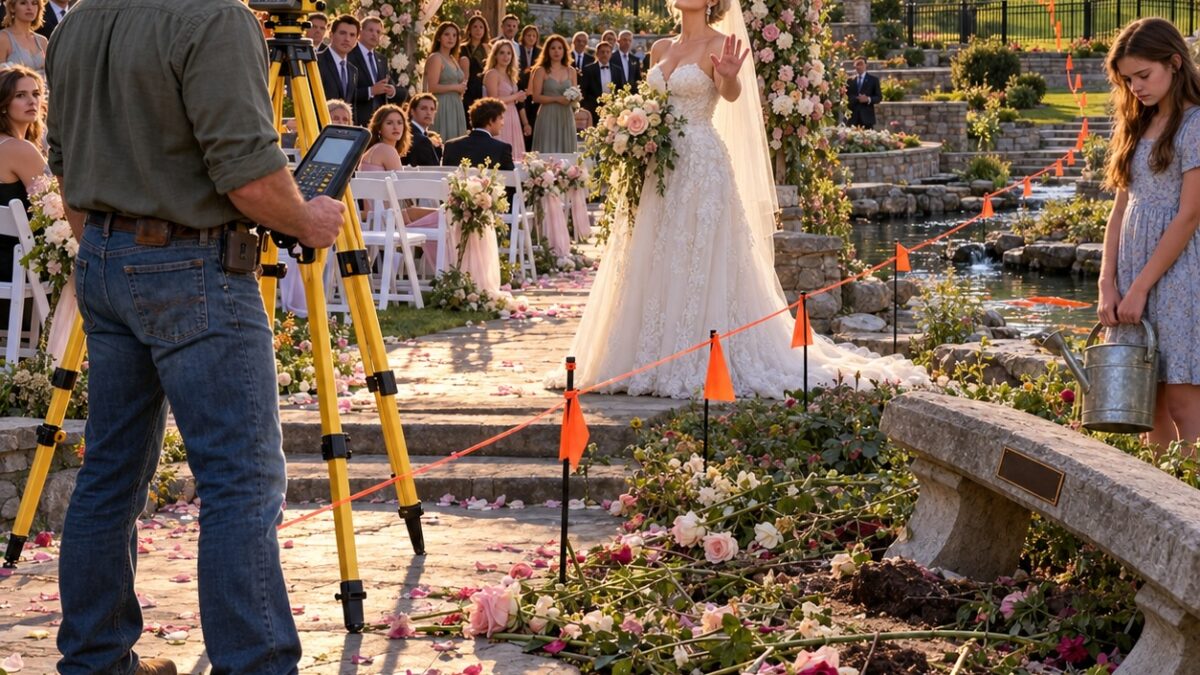
Three men in orange safety vests stood inside my backyard.
One was on a ladder against Grace’s white oak.
Eighty years old.
The tree anchored the southeast corner of her terraced garden.
One branch was already coming down.
Thick as my thigh.
Two others lay on the grass.
Fresh white wood exposed where they had been cut.
Sawdust floated through sunlight.
Brenda stood outside the fence.
Pink linen blazer.
White jeans.
Sunglasses pushed onto her head.
Phone in her hand.
“The canopy was blocking afternoon light for my ceremony.”
I looked at her.
“This needed to happen.”
She said it casually.
As if trimming my tree was equivalent to moving a centerpiece.
I walked to the trunk.
Sap smell everywhere.
“Who authorized this?”
“I did.”
“You authorized cutting a tree on my land?”
“As HOA president, I have jurisdiction over anything affecting community events.”
“No, you don’t.”
“It’s in the bylaws.”
“It isn’t.”
Her smile remained.
I turned to the foreman.
“Do you have a written work order?”
He looked from me to Brenda.
Then reached into his vest.
Single sheet.
Authorized by the Office of the HOA President, Meadow Creek Estates. Tree canopy reduction, adjacent lot. Approved: B. Chambers.
No owner signature.
No county permit.
No arborist report.
I pulled a deed copy from the folder I had started carrying in my truck.
The foreman read it.
Then looked at Brenda.
“Ma’am, this isn’t HOA common land.”
“It’s adjacent.”
“Doesn’t matter.”
He climbed down.
Shut off the saw.
“I can’t cut on private property without the owner’s authorization.”
Brenda’s face tightened.
“Fine.”
Then she looked at me.
“But this isn’t over, Caleb.”
She walked away.
Her heels sank into the grass.
She kept going.
The foreman apologized twice.
He had been told the oak stood on common property.
I believed him.
The crew left.
I stood underneath Grace’s tree.
A hole had been cut into the canopy.
Direct western light poured through.
The terraced garden below had been designed for partial shade.
Ferns.
Hostas.
Bleeding hearts.
Several rose varieties.
Within days, plants began showing stress.
Two of Grace’s oldest roses suffered worst.
Queen Elizabeth.
Peace.
She had planted them the first spring after we bought the property.
Watching their petals curl in the new heat made me angrier than the HOA notices ever had.
That Friday evening, I walked the rear fence with a flashlight.
That was when I found the stakes.
Seven.
Wooden.
Orange flagging.
Freshly driven into the soil.
Approximately thirty feet inside my property.
I pulled one.
Cheap pine.
Rough cut.
Hardware-store marker.
Not county work.
Not professional survey control.
Someone was trying to manufacture a new boundary.
That was where Brenda made the mistake she could never undo.
She targeted a surveyor.
The next morning I went to the Clark County recorder’s office.
I had spent hundreds of hours there over my career.
That morning felt different.
Personal.
I requested the original Meadow Creek Estates subdivision plat filed by Holloway Development Group.
The clerk brought out the tube.
I unrolled the sheets.
Used my coffee cup and a stapler to hold the corners.
Ten minutes.
That was all it took.
The plat was wrong.
Not sloppy.
Not an innocent field error.
The mathematics were clean.
Bearings consistent.
Distances closed.
But the entire western boundary had been built from the wrong starting monument.
Thirty feet wrong.
The original deed monument from 1978 sat thirty feet west of the point Holloway’s subdivision plat treated as its anchor.
Move the anchor.
Recalculate everything from there.
The whole line shifts.
Thirty feet onto my land.
I traced it.
Community pavilion.
Fire pit.
Stone walking path.
Flower beds.
All partly or completely inside my parcel.
Then I found the wedding location.
Twenty-two feet inside my actual boundary.
Brenda’s altar was going to stand on my land.
I sat there staring at the drawing.
Then requested the HOA’s financial filings.
Six years.
Annual reports.
Publicly available nonprofit disclosures.
I compared them with bank information later obtained through records requests.
A pattern appeared.
Community event enhancement fee.
Five hundred dollars per booking.
Birthday parties.
Graduations.
Retirement events.
Private gatherings at the pavilion.
Money collected over six years:
Approximately $47,000.
Money reported in the annual HOA filings:
Zero.
Separate account.
No clear disclosure.
I kept going.
Inside the back of the current HOA binder was something labeled:
AMENDMENT 12B — TEMPORARY ACCESS RIGHTS FOR PREMIUM COMMUNITY EVENTS.
It purported to give the HOA president power to access adjacent property during events designated by the “Office of the President.”
Signed:
Brenda Chambers.
Dated three months earlier.
I checked the board minutes.
No amendment vote.
No discussion.
No approval.
No second signature.
Brenda had written herself authority to trespass.
Signed it.
Stamped it with the HOA seal.
Inserted it into the binder.
I sat in my truck outside the recorder’s office.
Original plat across the passenger seat.
Financial summaries on the dashboard.
Fake amendment in my lap.
For weeks Brenda had acted as if she were rewriting my property line.
Now I knew she had been doing something much bigger.
She intended to hold her wedding on my land.
She had been collecting money from neighbors through an undisclosed event-fee system.
She had created a fake amendment giving herself access to adjacent property.
And somebody associated with Garrett Holloway’s development company had filed a subdivision plat shifting thirty feet of my land into the HOA common area.
I called Tom Ashford.
Tom was seventy-one.
Had surveyed land in the Shenandoah Valley longer than I had been alive.
Judges trusted his plats.
Attorneys trusted his measurements.
Surveyors trusted his name.
I told him what I found.
Silence.
Then:
“Caleb.”
“Yes?”
“If that monument was intentionally shifted and the entire plat calculated from the false point, you may be looking at survey fraud.”
“That’s what I think.”
“What do you need?”
“A corrected survey nobody can attack.”
He came the next morning with a two-man crew.
Total station.
GPS receiver.
Original monument calls.
Full chain traced.
Two days later, Tom rolled the finished plat across my kitchen table.
“Thirty-point-two feet.”
I looked at him.
“Certain?”
He gave me a look that said I should know better than to ask.
“Thirty-point-two.”
He pointed.
“Pavilion is inside your parcel.”
Another point.
“Fire pit.”
Another.
“Walking path.”
Then a circle.
“And the wedding altar location.”
“How far?”
“Twenty-two feet inside.”
I filed Tom’s sealed correction with the county the next morning.
Now the record contained both.
Old fraud.
New correction.
Then I installed cameras.
Six HD units.
Motion activated.
Encrypted cloud backup.
Two faced the common-green boundary.
Two covered the garden and pergola.
One watched the driveway.
One the rear fence.
Lily helped me position them.
She stood below checking the feeds on my phone while I adjusted angles.
Neither of us said what we were expecting.
We both knew.
Then I called Patricia Lowell.
Property litigation attorney in Winchester.
Small practice.
Terrifyingly calm.
She had a framed line behind her desk:
THE LAW IS NOT A SUGGESTION.
I liked her before I ever hired her.
I spread everything across her conference table.
Original subdivision plat.
Tom’s corrected survey.
Financial reports.
Bank discrepancies.
Amendment 12B.
Tree-cutting work order.
HOA violations.
Countdown cards.
The message placed in Lily’s backpack.
Patricia read everything.
Twice.
Then she lifted the fake amendment.
“She wrote this herself?”
“Yes.”
“Signed herself?”
“Yes.”
“Sealed it?”
“Yes.”
“Filed it in the official binder?”
“Yes.”
Patricia set it down.
“How long has Brenda been president?”
“Six years.”
“Anyone ever challenge her?”
“Four families moved instead.”
She looked at me.
“Then we’re going to make sure you’re not the fifth.”
The next night, I sat in Hank Morrison’s garage.
Hank.
Linda Walsh.
Pete Dawson.
Three neighbors.
All had stories.
Linda paid Brenda $500 for her mother’s eightieth birthday at the pavilion.
Cash.
No receipt.
Pete paid three event fees.
$1,500.
Once, Brenda billed him after the event.
Hank had always suspected financial reports did not make sense.
He never pushed.
“Trouble found us anyway,” he said.
I pulled the original recorded Meadow Creek bylaws.
The real ones.
No Amendment 12B.
No Office of the President.
No premium-event designation.
No one-person design review committee.
No beautification standards Brenda had cited against me.
The entire enforcement structure she had been using was fictional.
Printed on letterhead.
Repeated confidently.
Accepted because nobody compared it with the recorded documents.
The wedding weekend arrived.
It also happened to fall on Grace’s birthday.
Since Grace died, Lily and I spent that weekend in the Blue Ridge Mountains every year.
Our tradition.
A quiet campsite.
Grace’s favorite overlook.
Trail mix made from her recipe.
Almonds.
Dark chocolate.
Dried cherries.
Thursday night, I loaded the truck.
Sleeping bags.
Camp stove.
Lily’s sketchbook.
Before leaving, I checked the cameras.
Six green dots.
Recording.
Cloud connection active.
I looked through the kitchen window one last time.
Grace’s pergola.
Bench.
Roses.
The wounded oak.
Then we drove away.
By Friday afternoon, catering trucks were already arriving near the community green.
Workers unloaded chairs.
Tables.
Decorations.
Brenda stood in the grass pointing in every direction like a general positioning artillery.
She never noticed my truck leaving.
The mountains were peaceful.
Saturday morning, Lily and I hiked to Grace’s favorite overlook.
Granite ledge above the tree line.
Three counties visible.
River shining below.
Lily sketched.
I sat beside her.
Neither of us said much.
Grace used to say silence between people who love each other is not empty.
It is full.
We returned Sunday evening.
Almost nine.
Wedding over.
Street quiet.
The destruction began at my driveway.
Heavy tire tracks cut across the front lawn.
Around the side, sixty white chairs stood stacked on my grass.
Cocktail tables near the fence.
Extension cords plugged into my exterior outlets and running toward the community green.
My electricity.
Then I saw the pergola.
String lights had not been draped.
They had been nailed.
Nail gun.
Dark punctures across cedar Grace had sanded by hand.
Foreign flower petals were ground into the flagstone.
Champagne glass beside the koi pond.
Cigarette butts floating among lily pads.
Seven.
I counted them twice.
Two rose bushes had been crushed.
Queen Elizabeth.
Peace.
Canes broken at the base.
Lily came around behind me.
I kept walking.
Under the pergola, something was missing.
The bench.
Grace’s bench.
Gone.
A scrape ran across the stone floor toward the forsythia.
I followed it.
The bench lay face down in the bushes.
One corner chipped.
The brass plaque pressed into mulch.
For Grace, who made every garden grow.
In the place where it had stood, Brenda had installed a white fabric photo backdrop.
Large script:
B & G FOREVER.
Rose petals on the stone.
Tea lights arranged in a heart.
This was where Brenda had married Garrett.
Where Grace used to sit.
Where Lily used to sit beside her mother.
Where I had placed the memorial after the funeral.
Brenda had dragged it away because it did not fit her photographs.
Lily knelt.
Brushed dirt from the brass plaque using her jacket sleeve.
Placed one hand on the stone.
She stayed like that a while.
Then went inside.
I stood alone.
The cameras had recorded everything.
Fourteen hours.
Timestamped.
Backed up.
Every chair.
Every guest.
Every nail.
Every person crossing my property.
Every second of Grace’s bench being dragged across the stone.
I opened the camera app.
Watched the first thirty minutes.
Then I stopped.
Went inside.
Locked the door.
Set my alarm for five.
Monday morning, FedEx arrived.
8:47.
Certified envelope from Harrison and Park LLP.
Brenda’s attorneys.
I opened it in the kitchen.
DEMAND FOR MODIFICATIONS RE: CHAMBERS-HOLLOWAY WEDDING EVENT.
Amount:
$40,000.
I started laughing.
Not because it was funny.
Sometimes the mind chooses laughter when anger is too ridiculous to process.
$18,000 for venue modification costs.
Because I had refused to repaint the pergola and redesign Grace’s garden, Brenda claimed she had been forced to purchase extra staging and flowers.
$8,500 emotional distress.
$6,000 loss of premium photography angles.
Apparently the oak she had illegally cut created harsh afternoon lighting after the branches were removed.
She damaged my tree.
Then billed me for the missing shade.
$4,500 catering-flow disruption.
$3,000 for—
I had to read the phrase twice.
Depreciation of wedding content value across social media platforms.
Instagram.
Brenda wanted $3,000 because her wedding photographs were not profitable or attractive enough online.
The final paragraph threatened a lien on my home if I failed to pay within fourteen days.
Lily sat across the kitchen.
“What does it say?”
I folded the paper.
“Nothing we can’t handle.”
She watched me.
She did not believe the sentence.
But she trusted me.
That was enough.
I called Patricia at 9:15.
Read the demand.
She interrupted only once.
“Say the social-media part again.”
I did.
Silence.
Then:
“Caleb.”
“Yes?”
“She held her wedding on your property.”
“Yes.”
“She damaged the property.”
“Yes.”
“She removed a memorial to your deceased wife.”
“Yes.”
“And she is billing you for ruining the experience?”
“That appears to be the position.”
Patricia’s voice became very calm.
“Send me every second of footage.”
Fourteen hours uploaded.
She reviewed them over two nights.
Wednesday, she called.
Different tone.
Not angry anymore.
Precise.
“I watched them drag Grace’s bench.”
I said nothing.
“I watched the planner replace it with the wedding backdrop.”
Still nothing.
“Sixty guests through the garden. Cigarette in the koi pond. Equipment plugged into your outlets. Lights nailed into the pergola.”
Pause.
“Caleb, the altar itself was on your property.”
“I know.”
“The ceremony?”
“Yes.”
“First dance?”
“Yes.”
“She got married on land she did not own.”
“Yes.”
Patricia breathed out slowly.
“This is going to be extraordinary.”
That evening, I opened Brenda’s Instagram.
Public account.
Forty-seven wedding photographs.
Professional.
Perfect grid.
Every one documenting my property.
Pergola.
Koi pond.
Roses.
Oak.
One photograph showed Brenda beneath Grace’s pergola in a white Vera Wang gown.
Bouquet against her chest.
Light coming through the damaged canopy.
Caption:
The most beautiful day of my life. Worth every fight, worth every obstacle. This venue was made for this moment.
She called it her venue.
Geotagged.
Timestamped.
High-resolution proof.
I called Patricia.
“Instagram.”
“What?”
“She posted everything.”
“Save all of it.”
“I am.”
“Screenshots. Captions. Metadata. Every post.”
Forty-seven screenshots.
Another folder.
Thursday morning, Patricia filed our countersuit.
Trespass.
Property damage.
Unauthorized tree cutting.
Fraud.
Embezzlement-related allegations connected to HOA funds.
Falsified organizational documents.
Survey issues were separately referred through the appropriate channels.
We requested damages well above Brenda’s $40,000 demand.
That same day, Brenda called an emergency HOA meeting.
One agenda item:
Authorize a $40,000 lien against Caleb Whitfield’s property.
Quarterly HOA meetings usually attracted twelve residents.
That Thursday, forty came.
People had seen the Instagram photographs.
Some finally recognized the pergola.
The roses.
The pond.
My property.
Brenda arrived at 6:55.
Cream dress.
Valentino heels.
Diamond ring catching fluorescent light.
Leather portfolio.
Glass of Prosecco.
She took the microphone.
“Thank you all for coming on short notice.”
Silence.
“Our community recently hosted a milestone celebration—my wedding to Garrett.”
She let that sit.
“Unfortunately, one member chose to undermine the event through hostile conduct and deliberate property neglect.”
She looked directly at me.
Third row.
Left side.
“I am requesting authorization for a $40,000 lien against Mr. Whitfield’s property.”
Then she smiled.
“I move to vote.”
I stood.
Chair legs scraped the linoleum.
Patricia stood beside me.
Tom Ashford rose carrying a map tube.
Hank.
Linda.
Pete.
Near the rear door stood Deputy Craig Lawson.
Brenda noticed him.
The confidence shifted only slightly.
“Madam President,” I said. “Before the board votes, I would like to present information relevant to the lien.”
“You’re not an HOA member.”
“Correct.”
“You have no standing to address this meeting.”
Patricia stepped forward.
“My client is the property owner directly affected by your proposed lien.”
She cited the applicable Virginia nonprofit governance rules.
“Either he speaks tonight or we seek emergency injunctive relief tomorrow.”
Brenda stared around the room.
No one rescued her.
“Fine.”
She lifted the Prosecco.
“Make it quick.”
I walked to the front.
Tom set up an easel.
I connected my phone to the television.
“Three things.”
Nobody moved.
“First, what happened during the wedding.”
I pressed play.
Fourteen hours reduced to eleven minutes.
Catering van driving over my lawn.
Workers carrying chairs through the fence.
Extension cords connected to my house.
Lights being nailed into Grace’s pergola.
Guests walking through the garden.
Two people dragging the memorial bench.
The stone scraping across the floor.
Bench dumped face down into the bushes.
White backdrop going into its place.
A man in a tuxedo flicking a cigarette into my koi pond.
Nobody spoke.
I paused the video.
“Second.”
Tom removed the cap from the map tube.
Unrolled his corrected survey.
Red boundary line.
His voice carried easily.
“My name is Thomas Ashford. I’m a licensed land surveyor.”
He traced the original deed monuments.
Then Holloway’s recorded plat.
Then the corrected line.
“The subdivision plat is offset by approximately thirty-point-two feet along this boundary.”
Someone whispered.
Tom tapped the pavilion.
“This structure is located on Mr. Whitfield’s parcel.”
Fire pit.
Path.
Then wedding site.
“The altar stood twenty-two feet inside Mr. Whitfield’s recorded property.”
He looked toward Brenda.
“You held your wedding on his land.”
Someone in the back swore quietly.
Brenda set down the glass.
I continued.
“Third.”
Hank stood.
“Money.”
Linda followed.
“Five hundred dollars for my mother’s eightieth birthday.”
Pete:
“Fifteen hundred across three events.”
Patricia held up the compiled records.
“Approximately $47,000 in community event enhancement fees collected over six years.”
She looked toward the board.
“None appears in the annual financial filings we reviewed.”
The room became louder.
Brenda grabbed the microphone.
“This is financial information taken out of context.”
I lifted Amendment 12B.
“And this gives the HOA president authority to enter adjacent properties during premium community events.”
Brenda stared.
I continued.
“No vote appears in board minutes.”
Hank shook his head.
“No discussion either.”
“No second signature.”
I turned the page.
“Written by Brenda Chambers.”
Patricia took over.
“Our countersuit was filed this morning.”
Brenda’s face changed.
Patricia listed the claims.
Trespass.
Property damage.
Fraud-related claims.
Falsified documents.
Unauthorized tree cutting.
Financial irregularities.
Then Deputy Lawson walked forward.
No drama.
No handcuffs.
Just a civil summons.
“Ms. Chambers.”
Brenda looked at him.
“I have service for you.”
She accepted the envelope.
Her hand looked steady.
The Prosecco glass beside it did not.
Garrett stood from the rear row.
He moved toward the exit.
A second deputy stepped from the hallway.
“Mr. Holloway.”
Garrett stopped.
The deputy held another document related to the survey investigation.
Garrett took it.
Sat back down.
The room was silent except for the ancient coffee urn gurgling behind us.
Forty neighbors.
The people Brenda had spent years controlling.
Now none met her eyes.
I picked up my folder.
She had demanded $40,000 from me.
For ruining a wedding she held on my land.
I looked at her.
“You used the place where I memorialized my wife as your wedding backdrop.”
Brenda said nothing.
“You dragged her bench into the bushes.”
Still nothing.
“And then you sent me a bill.”
I closed the folder.
“That was a mistake.”
I walked out.
Lily waited in the truck.
Reading under the dome light.
She closed the book when I got in.
“How’d it go?”
I started the engine.
“Good, sweetheart.”
Pause.
“It went good.”
The vote to remove Brenda happened the following Tuesday.
First board meeting in six years called by somebody other than Brenda.
Thirty-eight votes to remove her.
Two against.
Brenda voted for herself.
Garrett looked like he wanted to disappear.
Then the separate legal processes began moving.
The financial investigation.
Corporate document issues.
Survey review.
Brenda faced criminal charges within the month tied to embezzlement, fraud, and falsified records.
Garrett’s development company came under its own scrutiny.
Tom’s corrected plat triggered review of other surveys filed by the company.
Two additional subdivisions showed boundary discrepancies serious enough to require attention.
The details of Garrett’s settlement were not public.
I did not need them.
My fight was with the line on my land.
That line had been corrected.
Our countersuit resolved in October.
Judgment:
$72,000.
Twelve thousand for property damage.
Oak.
Roses.
Lawn.
Pergola.
Eight thousand related to the unauthorized tree cutting.
Fifteen thousand for emotional distress.
Thirty-seven thousand punitive.
The judge described Brenda’s actions as a calculated pattern of entitlement without legal merit.
The trial lasted three days.
Brenda arrived the first day dressed like she expected cameras.
Valentino.
Perfect hair.
Second day:
Wrinkled blazer.
Flats.
Third:
Gray hoodie.
No makeup.
Garrett sat at a separate table.
They barely looked at each other.
Whatever B & G FOREVER had meant beneath Grace’s pergola, it did not survive discovery and cross-examination.
Her Instagram went private after the HOA meeting.
The photographs vanished.
Too late.
I had all forty-seven.
Screenshots.
Metadata.
Captions.
Patricia entered them into evidence.
At trial, the judge read one aloud.
This venue was made for this moment.
Brenda closed her eyes.
That sentence had been written for followers.
It became an admission.
I think about that often.
People manufacture reality online.
Edit photographs.
Choose captions.
Crop out what complicates the story.
But sometimes the performance documents what actually happened.
Brenda wanted everybody to believe she had staged the perfect wedding.
So she posted proof that she occupied my property.
She wanted everybody to see Grace’s garden behind her.
So the garden became identifiable.
She wanted to call it a venue.
So she did.
Repeatedly.
She built part of my case because admiration mattered more to her than caution.
In November, the new HOA board contacted me.
Janet Calloway became president.
She mailed a handwritten apology.
Not legal stationery.
No gold seal.
Just paper.
She asked what the association could do to repair the damage between my family and Meadow Creek.
I could have demanded money.
Could have fenced the thirty-foot strip permanently.
Could have removed the pavilion.
Walking path.
Flower beds.
The corrected survey showed they occupied my parcel.
Legally, I had leverage.
I thought about Grace.
Not Brenda.
Grace.
What would she want?
She loved gardens because she believed land was supposed to bring people together.
Even difficult people.
Maybe especially difficult people.
I offered Meadow Creek a permanent easement across the thirty-foot strip.
Free.
One condition.
The strip would become the Grace Whitfield Community Garden.
Open to everyone.
Maintained by volunteers.
No Brenda.
No wedding fees.
No fake access rights.
No invented boundaries.
Just a garden built on the real line.
The board agreed.
We broke ground in April.
Hank arrived at seven in the morning with a borrowed excavator.
Linda brought a cooler of lemonade so large two people carried it.
Pete arrived with forty bags of topsoil.
Thirty neighbors came.
Some were people who had stopped waving at me months earlier.
I remembered.
I did not mention it.
Not every debt deserves collection.
Lily spoke at the small dedication.
Hands in her jacket pockets.
Wind moving her hair.
“My mom always said the best gardens grow from the hardest soil.”
She paused.
“I didn’t understand that until this year.”
I looked away for a second.
Then she smiled.
“But I think I do now.”
That afternoon, I planted one rose beside the restored bench.
The variety was called Compassion.
Coral pink.
Deep fragrance.
Grace had circled it in a catalog the autumn before she became too sick to work outside.
Beside it she had written:
Next spring.
She never got to order it.
I did.
The bench went back beneath the pergola.
Chipped corner repaired as well as possible.
Brass plaque cleaned.
For Grace, who made every garden grow.
Lily knelt beside it.
Ran her fingers across the words.
This time, she smiled.
The oak survived.
Tom knew an arborist who helped us stabilize the damaged canopy.
The scars remained.
Trees do that.
Heal around injury.
Not erase it.
The two destroyed heritage roses could not be restored.
I hated that.
Some losses do not convert neatly into damages.
A judge can assign dollars.
Money does not recreate eleven years of Grace pruning a particular plant.
I kept pieces of the old canes for a while.
Eventually, I let them go.
Not because they stopped mattering.
Because Grace’s garden was always alive.
She never wanted it frozen as a museum.
Plants die.
New ones grow.
The memorial was her way of living through the garden, not trapping the garden in the past.
That was why the community garden felt right.
Brenda had treated beauty as ownership.
If something looked useful to her wedding, she believed she had the right to use it.
Grace understood beauty differently.
You planted.
Tended.
Shared.
Respected the ground.
That difference became clearer after everything ended.
The strangest part of the whole fight was that Brenda could have asked.
Imagine that.
“Caleb, your garden is beautiful. Would you consider allowing us to photograph part of the wedding near it?”
Maybe I would have said no.
Probably.
It was Grace’s birthday weekend.
Lily and I were leaving.
The memorial mattered.
But asking would have preserved something.
Respect.
Maybe we could have found another arrangement.
Instead, Brenda began with a nine-page demand.
Repaint the pergola.
Change the flowers.
Silence your house.
Give me the lawn.
Then when I said no, she interpreted the boundary as defiance.
People who confuse authority with ownership often experience consent as an insult.
That was Brenda.
The HOA presidency allowed her to control certain community matters.
Real authority.
But six years of nobody pushing back had taught her a dangerous lesson.
That every nearby boundary would move if she leaned hard enough.
Four families moved.
Rules changed.
Fees appeared.
Nobody opened the founding documents.
Nobody compared the financial filings.
Nobody checked the plat.
Then she encountered the one profession built around answering the question:
Where, exactly, does your authority stop?
Thirty-point-two feet.
That was the answer.
I remember holding the fake survey stake under my flashlight.
Cheap orange flagging.
Fresh dirt.
Somebody had pushed it into my land as though a wooden stick could change a deed.
That image still makes me laugh.
Survey monuments are not magic either.
They are evidence tied to descriptions and records.
But a random stake has no authority because someone wants the line to be there.
The law does not ask where Brenda preferred the boundary.
It asks what the recorded chain establishes.
That is what Tom verified.
A corrected survey did not give me new land.
It showed what had always been mine.
Same with the HOA rules.
Brenda invented standards.
The founding covenants did not change.
Same with Grace’s pergola.
Brenda called it noncompliant.
County permit stayed valid.
Same with the tree.
She called it event-related.
It remained mine.
Same with the wedding venue.
She called it Meadow Creek.
The deed called it Whitfield.
Names can create atmosphere.
Records create rights.
That may be the deepest lesson I carried away.
The new HOA board eventually cleaned up years of Brenda’s paperwork.
Fake amendments removed.
Fee procedures rewritten.
Financial controls tightened.
No single-person committees with imaginary powers.
No “Office of the President” language granting access to adjacent property.
Community-event money deposited openly.
Receipts.
Reporting.
Votes.
Boring.
Good governance is often boring.
That is a compliment.
The opposite had been exciting.
Luxury wedding.
Secret fees.
Fake rules.
Boundary manipulation.
Police summons.
Nobody needed more excitement.
Janet once told me:
“I think Brenda believed efficiency meant not asking permission.”
“That’s called trespassing.”
She laughed.
Then stopped.
“You’re right.”
That distinction mattered.
Permission can feel inefficient.
Votes take time.
Owner consent slows plans.
Accounting creates paperwork.
Survey verification costs money.
Those delays protect people.
Brenda’s entire system ran quickly because everything went through her.
Need a rule?
She wrote it.
Need approval?
She signed it.
Need property?
She declared it communal.
Need event fee?
Pay her.
Fast.
Then the system collapsed because none of the friction that prevents abuse remained.
Surveying taught me to appreciate friction.
If an old deed monument does not match a new plat, you stop.
You do not pick the answer that makes construction easiest.
You investigate.
If two calls conflict, stop.
If the chain does not close, stop.
If property ownership is unclear, stop.
Those pauses can save millions later.
Garrett’s company learned that.
The survey review of his developments became a serious problem.
I stayed out of most of it.
Tom handled technical work where asked.
State and county authorities handled the rest.
I did not need to turn Garrett into another personal enemy.
He had enough trouble.
My property line was corrected.
That was my concern.
People asked whether I enjoyed seeing his development empire investigated.
Not really.
Survey fraud hurts people who often do not know they are involved.
Homeowners can discover fences, sheds, driveways, even structures sit somewhere unexpected.
Mortgages.
Insurance.
Resale.
Everything becomes complicated.
That is not entertaining.
The responsible response is correction.
Not celebration.
Same with the missing HOA event money.
$47,000 over six years looked terrible.
Residents deserved answers.
But I did not want elderly neighbors losing services because reserve funds were depleted.
That was why Hank, Linda, and Pete pushed for reform instead of vengeance.
The board recovered what it could.
Changed controls.
Moved forward.
Brenda faced consequences.
That was enough.
The $72,000 judgment did not make Grace’s garden whole.
It did help repair damage.
Arborist care.
Pergola restoration.
Lawn.
Koi pond cleanup.
Legal costs partly elsewhere.
But no number measured the moment Lily found her mother’s bench face down in mulch.
That was the image I could not price.
Sometimes courts have to assign money because money is the tool available.
Real harm does not arrive with a price tag.
The emotional-distress award recognized that.
It did not erase it.
What helped more was restoring the bench.
Then planting Compassion beside it.
Then watching Lily continue watering roses before school.
Routine heals differently.
The first morning after the bench returned, I saw Lily through the kitchen window.
Watering can.
School backpack already on.
She stopped at the plaque.
Touched it.
Then moved to the next plant.
That made me feel closer to resolution than the judgment ever did.
Grace was not the damaged bench.
She was not the roses.
Not the pergola.
Those things carried memory.
Important distinction.
Brenda could damage objects.
She could not take what they meant.
That took me a while to understand.
When I first saw the bench in the bushes, it felt like she had invaded grief itself.
Like she had entered the one place that belonged only to us.
But after everything, I realized memorials are not fragile in that way.
The stone chipped.
Memory did not.
The garden changed.
Grace remained.
That is why giving part of the disputed land to a community garden did not feel like surrender.
The boundary remained legally mine.
The easement was mine to grant.
I chose.
Consent.
That word again.
Brenda took.
I gave.
Same land.
Completely different act.
The new community garden became popular.
Children helped plant herbs.
Retired neighbors took turns weeding.
People donated perennials.
No five-hundred-dollar event fee.
No president approving color palettes.
One summer, somebody suggested hosting a neighborhood anniversary gathering there.
Janet called me.
Asked first.
I laughed.
“What?”
“Nothing.”
“Is that a yes?”
“Yes, with some conditions.”
She listened.
No vehicles on Grace’s garden side.
No attaching anything to the pergola.
No moving the bench.
No smoking near the koi pond.
She wrote everything down.
Then asked:
“Anything else?”
“No.”
That event went perfectly.
People cleaned afterward.
Nobody nailed anything into cedar.
Nobody moved a memorial.
No lawyers.
Amazing what permission can accomplish.
The garden also repaired something between me and the neighborhood.
For months, Meadow Creek had become Brenda in my mind.
White Range Rover.
Fake letters.
Stares.
Then thirty neighbors showed up with shovels.
A person is not a community.
I had forgotten that.
Brenda controlled the social climate because decent people were quiet.
When the evidence appeared, some of those same people found voices.
Hank.
Linda.
Pete.
Janet.
Others.
I learned not to judge all of them by the period when fear made them passive.
Could they have stood up earlier?
Yes.
Would that have helped the families who moved?
Probably.
But people become braver after seeing someone survive resistance.
That is human.
Not admirable.
Not unforgivable.
Just true.
I did not mention the people who stopped waving.
Eventually they waved again.
I waved back.
Life became easier.
One neighbor apologized directly.
“I believed her when she said your property was hurting values.”
I looked at him.
“My house?”
“I know.”
He looked embarrassed.
“Those pictures.”
“You mean the edited ones.”
“Yes.”
I could have made him feel worse.
Instead:
“She was good at creating a version of things.”
He nodded.
“She was.”
Then he bought a rose for Grace’s community garden.
Maybe that was enough.
Patricia remained my attorney after the case.
Mostly because once you watch someone read a $40,000 Instagram-damage demand without laughing for nearly thirty seconds, you respect her professionalism.
She occasionally teased me.
“You realize most people would’ve exploded when they found a wedding in their yard.”
“I was tired.”
“You reviewed camera footage.”
“Useful.”
“You made a spreadsheet of damage.”
“Also useful.”
“You really are a surveyor.”
“Is that an insult?”
“Yes.”
Tom was worse.
He brought me a framed copy of the corrected plat for Christmas.
Across the bottom he wrote:
30.2 FEET: PLEASE TRY NOT TO LOSE IT AGAIN.
I hung it in the office.
Next to nothing else.
The actual legal copy remained in the fireproof cabinet.
Because jokes are good.
Records are better.
I also kept Brenda’s $40,000 demand.
Not framed.
Too much ego in it.
But I kept it.
The line about social-media content still amazed me.
Three thousand dollars because her Instagram photographs supposedly lost value.
Then those same photographs became evidence against her.
There is symmetry in that.
She thought the camera existed to make her look beautiful.
I used cameras to establish what happened.
Two completely different relationships with images.
Presentation versus record.
Her photographer framed out boundaries.
My security cameras showed them.
Her editing removed imperfections.
My footage preserved damage.
Her Instagram called my garden a venue.
The metadata placed her on my parcel.
One set of images created fiction.
The other measured reality.
Again, my profession had trained me toward the second.
A survey plat is a visual statement.
But it must correspond to the ground.
That is everything.
Draw whatever you like.
Eventually someone checks the monument.
Brenda built her whole leadership style like a false plat.
Internally consistent.
Rules referenced other rules.
Committees reinforced her.
Letters carried seals.
Residents behaved as though it all connected.
But the starting monument was wrong.
Authority shifted thirty feet beyond where it actually ended.
Once somebody found the original pin, the whole structure moved back.
I sometimes wondered which part embarrassed her most.
The money?
The fake amendment?
The wedding footage?
Survey?
I never asked.
By the end, her embarrassment was not my concern.
Consequences were.
There is a difference.
Humiliation is emotional.
Accountability is structural.
Remove false authority.
Correct property records.
Return money where appropriate.
Pay damages.
Repair rules.
That lasts.
Embarrassment fades.
If I had made the entire case about humiliating Brenda, she would have remained the center.
I wanted Grace’s garden back at the center.
That is why the ending mattered.
Community garden.
Rose.
Bench.
Not courtroom.
The judge’s words were useful.
The judgment mattered.
But courts are where broken things get measured after failure.
The garden was where life continued.
Lily changed too.
At fifteen, she had watched an adult woman use power against our home.
That worried me.
I did not want her learning that authority was automatically corrupt.
Or that the correct response was permanent suspicion.
So I let her see the whole process.
Records.
County inspector.
Tom’s survey.
Patricia’s legal work.
HOA vote.
Court.
New board.
Reform.
Authority had been abused.
Authority also corrected the abuse.
That distinction matters.
The county inspector told the truth.
Recorder preserved deeds.
Survey profession corrected a fraudulent boundary.
Court enforced ownership.
HOA members removed a president.
Law is not only the threatening letter you receive.
It is also the structure that lets you answer it.
Lily understood that.
Years later, I suspect she will remember Grace’s bench more than Amendment 12B.
Good.
She should.
She once asked:
“Dad, why didn’t you tell Brenda you knew before the wedding?”
We were planting in the community garden.
I thought carefully.
“I told her no.”
“I know.”
“That should have been enough.”
“But once you knew she was going to do it?”
I looked at her.
“I documented.”
She frowned.
“Why not stop her?”
Fair question.
I could have pursued an injunction before the wedding.
Possibly.
Patricia and I discussed options once evidence accumulated.
But timing mattered.
We were leaving for Grace’s birthday tradition.
Brenda had been formally told no repeatedly.
Cameras provided evidence if she crossed the line.
She chose to cross it.
Still, I told Lily:
“If I believed somebody was going to be hurt, I would’ve stopped everything immediately.”
“Okay.”
“But adults sometimes have to be responsible for the choices they make after they’ve been clearly warned.”
She planted another flower.
“So you let her prove it?”
“I let the record prove it.”
That answer satisfied me more.
I did not bait Brenda.
Did not invite trespass.
Did not tell her the property was free while secretly filming.
I told her no.
Again.
Again.
Again.
She disregarded it.
That distinction matters.
When people retold the story later, they sometimes made it sound like I set a trap.
No.
A locked boundary is not a trap.
A clear no is not a trap.
A security camera on your house is not a trap.
If someone enters anyway, the camera does not create their choice.
It records it.
That was true from the beginning.
Brenda built her own evidence because she believed consequences applied only to people she controlled.
The tree crew was the first crack.
I think about that foreman often.
Honest face.
Sunburned neck.
He could have said:
“I have an HOA work order.”
Cut the tree.
Instead, I showed him the deed.
He stopped.
That is professionalism.
He had been misled.
Once corrected, he adjusted.
Brenda did not.
That difference separates mistakes from misconduct.
Everyone can be wrong.
The question is what you do after evidence appears.
Foreman:
Stops.
County inspector:
Finds compliance.
Tom:
Corrects boundary.
New HOA board:
Reforms system.
Brenda:
Doubles down.
That is why her outcome was different.
She had countless exits.
After the wedding agreement was refused.
After deed copy.
After county inspector.
After tree crew stopped.
After she saw the cameras? I do not know whether she noticed them.
After the corrected survey became public.
After the wedding itself.
Even after the demand letter, she could have withdrawn.
She kept going.
That is often how entitlement becomes self-destruction.
The first unreasonable act is survivable.
Then protecting it requires another.
Rules invented to defend request.
Complaints filed to defend rules.
Boundary manipulated to defend access.
Fake amendment to defend trespass.
Wedding held to prove control.
Demand letter to reverse victim and offender.
Emergency lien vote to formalize pressure.
Every layer made retreat harder.
By the meeting, admitting error meant admitting six years of conduct.
So she stood at the microphone and moved to vote.
Momentum.
That is dangerous.
Sometimes the bravest act in leadership is saying:
I was wrong.
Brenda could not.
The land did not care.
Thirty-point-two feet remained thirty-point-two feet.
That number outlasted all of her speeches.
The corrected survey also changed how I thought about my own responsibility.
I should have caught the encroachment earlier.
I was a surveyor.
How had a pavilion, path, and fire pit ended up on my parcel?
Because I trusted the subdivision plat.
Because the structures appeared gradually.
Because the area was landscaped like common green.
Because life happened.
Grace became sick.
Then died.
I was raising Lily.
Working.
Grieving.
I did not survey my own backyard every weekend.
Professional knowledge does not make you immune to inattention.
I learned that.
After the case, I walked every boundary.
Confirmed monuments.
Updated records.
Not paranoia.
Stewardship.
The thirty-foot strip had been physically treated as HOA land for years.
If enough time passed under different facts, legal issues could become more complicated.
The corrected record prevented that.
Again:
Do not wait for a fight to understand what you own.
I tell clients that now with more conviction.
People spend hundreds of thousands buying land.
Then put the deed in a drawer without reading the exceptions.
Know the boundaries.
Know easements.
Know covenants.
Know access.
Not because every neighbor is Brenda.
Because clarity keeps ordinary misunderstandings from becoming Brenda-sized disasters.
Grace had always understood boundaries in a different language.
Plants.
Sun.
Water.
A shade garden is a shade garden because light has a boundary.
Move that boundary and plants suffer.
Brenda cut the oak because she wanted more sunlight.
By Friday, the bleeding hearts wilted.
That was another kind of survey.
Grace had designed with conditions.
Canopy.
Moisture.
Soil.
Brenda saw only obstruction.
Cut branch.
Get light.
Simple.
Then the garden responded.
I thought about that when planting Compassion.
You cannot separate a living system into only the part you want.
Land.
Trees.
Neighborhoods.
Organizations.
Interference has consequences.
The oak survived because professionals helped.
Some plants did not.
Meadow Creek survived because its members finally corrected leadership.
Some relationships did not.
Garrett and Brenda separated during the legal aftermath.
At least, that was what I heard.
I did not follow closely.
Their marriage was not my concern.
The giant B & G FOREVER backdrop disappeared.
Good.
Nothing is forever because somebody writes it in script.
Grace never needed those words.
Eleven years of garden work said more.
Lily watering roses said more.
A bench.
A plaque.
Quiet.
I found myself thinking about weddings too.
Not Brenda’s spectacle.
Mine.
Grace and I married simply.
Small church.
Dinner afterward.
No designer venue.
No social-media content because social media barely mattered then.
Grace cared most that the flowers were alive plants she could replant afterward.
Of course she did.
Several ended up at our first apartment.
Then some came with us when we bought the house.
She understood celebration as something that continued growing.
Brenda treated celebration as something everything around her had to submit to.
That difference explains why one wedding became a garden and the other became evidence.
I know which one mattered more.
The Grace Whitfield Community Garden grew well.
Hard soil amended.
Volunteers learned which plants could tolerate the sun.
We added a shade structure near the path, deliberately not attached to the original pergola.
The HOA wanted a plaque recognizing donors.
I asked them to keep it small.
Grace hated oversized signage.
The main plaque simply said:
Grace Whitfield Community Garden
Grow Something Good Here.
Lily suggested the second line.
I liked it.
People did.
Somebody once left a bridal bouquet at the bench.
No idea who.
Maybe a neighborhood bride.
Maybe coincidence.
I smiled.
Gardens absorb stories.
That one had enough.
I no longer thought of Brenda every time I stepped outside.
That took months.
At first, nail holes in the pergola triggered anger.
Then repairs softened them.
The oak scarred over.
New leaves filled some of the canopy.
The koi pond cleared.
Rose beds changed.
Life covered the evidence slowly.
Not completely.
That is okay.
Healing that leaves no mark is not the only healing.
The bench retained a slight discoloration where it had hit mulch.
I could have polished it away.
I did not.
Not as a monument to Brenda.
As proof stone survives being dropped.
Maybe I needed that.
Lily eventually stopped watering every morning before school.
Schedules changed.
Sports.
Friends.
Growing up.
At first, that made me sad.
Then I realized Grace would have hated being used as an obligation.
The garden was there when Lily needed it.
That was enough.
Memorials should support the living.
Not chain them.
The same was true of my fight.
I had to stop becoming “the man Brenda tried to steal land from.”
That could become its own cage.
So I went back to work.
Survey jobs.
Route 340.
Boundary retracements.
Construction staking.
Ordinary disputes.
Someone’s shed six inches over a line.
Someone’s fence three feet off.
Nothing involving Vera Wang gowns or Instagram damage claims.
Wonderful.
Occasionally a client recognized my name.
“You’re that surveyor.”
“I’m a surveyor.”
“The wedding guy.”
“I try not to put it on business cards.”
They laughed.
Then we talked land.
That suited me.
Brenda became a cautionary story among local HOA boards and surveyors for a while.
That also faded.
Good.
Stories should eventually become lessons, not identities.
The lesson from mine is simpler than people make it.
A title is not ownership.
A vote is not a deed.
A logo is not jurisdiction.
A fake rule does not become real because nobody challenges it.
And a boundary does not move because somebody needs prettier wedding photos.
Measure it.
Check it.
Record it.
Then stand where the line actually is.
The $40,000 demand remains the strangest document in my file.
Sometimes I still reread the itemization.
$18,000 venue modification.
$8,500 emotional distress.
$6,000 photography.
$4,500 catering.
$3,000 social-media content.
Brenda genuinely tried to reverse the entire relationship.
She trespassed.
Then billed the owner for making trespass inconvenient.
That strategy works only if the target becomes confused about who owes whom.
Pressure can do that.
Official letterhead.
Law firm.
Deadline.
Lien threat.
A person opens the envelope and thinks:
Maybe I did something wrong.
That hesitation is the weapon.
My advantage was knowing the boundary.
Not emotionally.
Literally.
I knew where my land ended.
That gave every other argument a foundation.
If you know the foundation, intimidation loses force.
Patricia once told me:
“Your profession saved you.”
Maybe.
But more precisely, the habits of the profession did.
Verify.
Do not assume.
Keep field notes.
Use independent control.
Preserve evidence.
Distinguish monument from marker.
Distinguish record from representation.
Those habits work outside surveying too.
If a bank says you owe money, ask for the contract.
If an HOA says a rule exists, read the covenants.
If somebody says an easement crosses your land, pull the easement.
If someone says your boundary is somewhere else, find the monument.
Authority should survive measurement.
Brenda’s did not.
That is why she hated measurement.
The fake stake was thirty feet inside.
The fake amendment was three months old.
The unreported fees totaled about $47,000.
The wedding altar sat twenty-two feet inside my land.
The judgment was $72,000.
Numbers turned her atmosphere into facts.
That was satisfying in a way anger never could be.
The court did not care whether Brenda was charismatic.
The county record did not care about her wedding dress.
Tom’s total station did not care about the HOA presidency.
The camera did not care that she had 1,200 likes.
Measurement is rude that way.
It refuses to be impressed.
Grace would have appreciated that.
She used to tease me for measuring everything.
Pergola beams.
Plant spacing.
Pond depth.
Then ignore my measurements and place flowers where they “felt right.”
We balanced each other.
The community garden carries both approaches.
Tom surveyed the easement precisely.
Lily chose where Compassion felt right.
Perfect.
The first spring after everything, that rose bloomed.
Coral petals.
Strong scent.
I stood beside it in the evening.
Grace’s bench behind me.
Children somewhere on the path.
Neighbors talking.
Not a wedding.
No performance.
Just people using space respectfully.
I thought about Brenda saying:
This venue was made for this moment.
She had been wrong twice.
It was never her venue.
And Grace’s garden had been made for something larger than one moment.
That was what Brenda never understood.
She wanted beautiful things as backgrounds.
Grace built beautiful things as places to live.
One is image.
One is stewardship.
The law could only resolve ownership.
Time resolved the rest.
The oak filled in.
Roses returned.
The new garden rooted.
Lily grew.
Meadow Creek changed presidents.
People forgot some details.
Good.
The land remained.
I still walk the boundary sometimes.
Professional habit.
Iron pin.
Fence.
Rear corner.
The thirty-foot strip.
Everything where the corrected survey says it is.
The pavilion now legally sits within the easement I granted.
The path remains.
Neighbors use it.
Nothing had to be torn down.
That was important.
People ask why I gave the easement away free after spending so much effort proving the land was mine.
Because ownership means choice.
Not permanent exclusion.
If I had been forced to give it, that would have been wrong.
Once the line was recognized, I could decide.
I chose community use.
Under truthful terms.
That distinction is everything.
Brenda believed community benefit gave her the right to skip consent.
I believed community benefit could happen after consent.
The second model worked.
The first ended in court.
Whenever I see that part of the property now, I think about Grace before Brenda.
That is the victory I wanted.
Not money.
Not the removal vote.
Not even the judgment.
Memory restored to its proper place.
Brenda had physically shoved Grace’s bench into bushes to replace it with herself.
For one weekend, she tried to overwrite a life with a wedding.
The bench went back.
Her backdrop went away.
That is enough symbolism for me.
One evening, years later, Lily and I sat there together.
She was older.
Different school worries.
Different life.
She traced the brass letters with one finger.
“Do you ever think about that wedding?”
“Sometimes.”
“I don’t much anymore.”
I looked at her.
“That’s good.”
She nodded.
“I think about Mom.”
“So do I.”
We sat quietly.
Full silence.
Grace was right.
Silence between people who love each other is not empty.
It is full.
That is where the story really ends for me.
Not the emergency HOA meeting.
Not the summons.
Not Brenda in court.
Not the seventy-two-thousand-dollar judgment.
There is a corrected survey in the county office.
A permanent easement granted on truthful terms.
A community garden carrying Grace’s name.
A rose she wanted but never got to plant.
A bench exactly where it belongs.
And a property line that never moved no matter how many fake rules, fake stakes, fake amendments, wedding photographs, or $40,000 letters Brenda put on top of it.
Some people spend years confusing authority with ownership because nobody forces them to measure the difference.
Brenda finally did.
Thirty-point-two feet.
That was all it took to unravel six years of control.
And every time I walk past that old survey marker now, I remember the one thing she should have learned before she ever stepped onto my porch with that nine-page wedding agreement:
You can decorate somebody else’s land.
You can photograph it.
You can hold a wedding on it.
You can invent rules, send letters, threaten fines, and tell an entire neighborhood that it belongs to you.
But sooner or later, somebody checks the deed.
And the ground does not care who thought she was president.








