FULL STORY:HOA Queen Fined Me After Her Son Spray-Painted My Dead Wife’s Name—She Never Knew the Widower Next Door Was the Detective Building Her Case
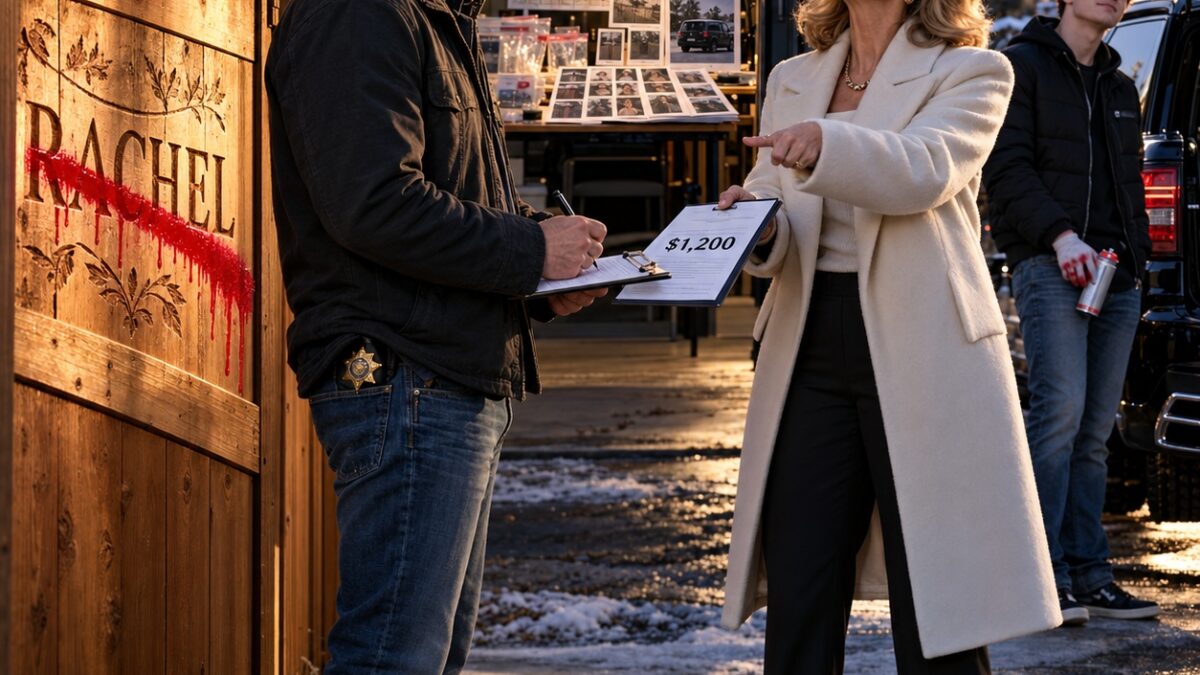
FULL STORY CONTINUATION
Vivian’s first complaint came before I had fully unpacked.
Cooper had left Christmas lights hanging as a joke.
It was not Christmas.
Vivian informed me they had to be removed by Friday.
“Yes, ma’am.”
That phrase became useful.
Not submissive.
Neutral.
People reveal more when they think you have accepted the hierarchy they invented.
Vivian walked back toward her house.
Five-bedroom colonial.
Pearl-white Lexus GX.
Large guest house behind it.
From an open window, I could hear a young man yelling at a video game.
Preston.
I closed my door.
Opened the laptop on the kitchen table.
Added the first note.
Holloway household priority.
Preston confirmed in residence.
Vivian confirmed HOA president.
Maintain patient approach.
Saturday morning I made Cooper grilled cheese.
Some routines survived anything.
Rachel had started our Saturday lunches when Cooper was little.
After she died, I kept them.
Not because grilled cheese mattered.
Because ritual does.
The following morning, I called the HOA office and requested community-camera footage from the night my fence had first been tagged.
The receptionist put me on hold.
Eight minutes later, Vivian answered.
“Mr. Caldwell, I’m so sorry, but the community-camera system suffered a technical malfunction Friday night.”
“Again?”
A pause.
“Again?”
“I heard another resident mention previous outages.”
“Well, these systems can be temperamental.”
“Of course.”
“Vendor is coming next week.”
“Thank you.”
I hung up.
Six camera failures in five months.
Every one occurring on a night connected to reported vandalism.
Coincidence eventually becomes a pattern.
I drove to the HOA office.
Grant Holloway sat behind a mahogany desk.
Vivian’s husband.
Vice president of Holloway Development.
He avoided eye contact when I asked about the camera logs.
Vendor issue.
IT contract.
Nothing specific.
His hand shook while lifting his coffee.
I had interviewed guilty men for most of my adult life.
Grant did not look like the person smashing mailboxes.
He looked like a man who knew exactly who was.
That distinction mattered.
I installed four trail cameras along our rear property line.
Two obvious.
Two hidden inside a bluebird house Cooper and I had built the previous spring.
I made the visible installation look amateur.
Dropped the drill.
Wiped sweat on my shirt.
Adjusted one camera twice.
Cooper stood on the deck.
“Dad, why are you acting like you don’t know how to use a drill?”
“Because somebody’s watching.”
A few minutes later, my phone pinged.
Preston’s Instagram story.
Video shot from his bathroom window.
Zoomed in on me.
He mocked the “wannabe work cop next door” installing cameras.
Said I thought I was Batman.
I watched the story twice.
Saved it.
New note:
Subject monitoring neighbor from private residence.
Preston thought he was laughing at me.
What he was really doing was confirming exactly where he watched from.
Vivian held an emergency HOA meeting that night.
Subject:
Managing Aesthetic Deterioration From New Residents.
She did not invite me.
She invited forty other homeowners on our block.
I attended anyway.
The clubhouse smelled like burned coffee and floor cleaner.
Vivian stood at a podium beside a projector.
Slide three showed my vandalized fence.
Caption:
GRIEF-DRIVEN VANDALISM ATTRACTS COPYCATS
I almost admired the audacity.
Her son was a prime suspect in the vandalism.
She had converted the damage into evidence against me.
Her proposal:
Another $500 per week until I repainted the fence in an approved color and removed what she called excessive memorial elements.
I raised my hand.
Vivian saw me.
Her mouth tightened for half a second.
Then the smile returned.
“Mr. Caldwell?”
I stood.
“My property was criminally damaged.”
People shifted.
“I filed a report with the sheriff’s office.”
More movement.
“I’d appreciate it if the HOA did not punish the victim of a crime for the crime committed against him.”
I sat.
Vivian tilted her head.
“This is a community, Mr. Caldwell. Not a courtroom.”
No.
Not yet.
“Your victim mentality,” she continued, “is part of the aesthetic problem we’re addressing.”
The vote passed thirty-one to three.
Six absent.
I wrote down every vote.
Three rows behind me sat Elaine Brookshire.
Wheelchair.
Gray hair.
Hands folded.
She had returned to the neighborhood she said had driven her away three years earlier.
Our eyes met.
She gave me one small nod.
Nothing else.
That was enough.
When I reached home, my phone buzzed.
Unknown number.
One laughing-face emoji.
One spray-can emoji.
Saved.
Logged.
Three nights later, aluminum striking wood woke me at 2:07 a.m.
I rolled out of bed without switching on a light.
Three shapes stood near the driveway.
Preston Holloway held the bat.
Chad Prentice had his phone raised.
Tanner Wolfe was drinking and laughing.
Bryson Kirkland stood beside them.
I opened the trail-camera feed.
Four angles.
4K.
Audio.
Preston swung again.
Metal folded.
He shouted toward my house.
Called me the widower next door.
Said I would be crying over my dead-wife shrine by morning.
I woke Cooper.
“Stay upstairs.”
He sat up.
“Is this the case?”
“Yeah.”
He nodded.
Then lay back down.
That level of trust scared me sometimes.
I called the non-emergency line.
Asked for Deputy Shawn Whitlock.
He already knew the operation.
He would respond as a routine noise call.
Not immediately.
Enough time for Preston to finish.
That sounds strange until you understand investigations.
Stopping one act gets you one act.
Documenting the complete conduct can establish intent, damage, accomplices, pattern, and restitution.
Eight minutes later, Preston finally lowered the bat.
My mailbox leaned about forty-five degrees.
Post cracked.
Mail across the lawn.
He kicked one envelope into the storm drain.
Then the four of them drove away in Preston’s Range Rover.
Morning came.
I played homeowner.
Called Whitlock formally.
Filed a report.
Cooper helped gather the mail.
“Why do you have to pretend?”
I crouched.
“Because if I catch Preston tonight, I lose Vivian.”
“You think she knows?”
“I know she knows something.”
He thought about that.
“Okay.”
Then:
“I can pretend.”
Vivian arrived before lunch.
Lavender exercise dress.
Clipboard.
She did not ask about the mailbox.
Did not ask whether Cooper was frightened.
She handed me another HOA notice.
$2,500.
Reason:
Attracting vandalism through inadequate exterior maintenance.
At the bottom, handwritten:
Perhaps a community like Willow Ridge is not the right emotional environment for a family in your situation.
I read it.
“Mrs. Holloway, do you know who’s been vandalizing properties?”
“Outsiders.”
“Outsiders?”
“Rural Colorado has been attracting certain elements lately.”
Preston’s Range Rover passed behind her.
Sunroof open.
He shouted something about needing better neighborhood security.
Then laughed.
Vivian did not turn around.
Not even slightly.
“Have a productive day, Mr. Caldwell.”
She walked home.
I photographed the notice.
Front.
Back.
Filed it.
Then loaded the trail-camera files.
Preston’s face filled the screen.
No hood.
No mask.
Audio clean.
Final swing at 2:11:34 a.m.
Visual identification solid.
Audio identification clear.
Chad filming.
Tanner and Bryson present.
I uploaded the footage to the evidence server.
Added recommended charges.
The case was no longer a theory.
We had him.
What we did not yet have was the full proof against Vivian.
That night Cooper handed me a sheet of graph paper.
Chessboard drawn in pencil.
Smiley face underneath.
“What’s this?”
“You.”
“Me?”
“You’re playing four-dimensional chess against a guy who thinks checkers is a personality.”
I laughed.
Actually laughed.
Hard.
The sound surprised both of us.
Cooper tried to hide how pleased he was.
Rachel would have loved that joke.
More than that, she would have loved who Cooper was becoming.
Five days later, he came home from school with red eyes.
He went upstairs without speaking.
I waited twenty minutes.
Then knocked.
Cooper sat on his bed holding his phone.
He passed it to me.
TikTok.
Ninety-second video.
Community pool.
Preston had put the camera inches from Cooper’s face.
“Look at Widower Junior.”
Cooper tried to walk away.
Chad grabbed his towel.
Tanner laughed.
Preston kept pushing.
My son finally spoke.
“They wouldn’t stop.”
I sat beside him.
For one full minute, I did not answer.
Because the first things in my head would have ended my career.
“Are you hurt?”
“No.”
“Did anybody see?”
“Lifeguard was on his phone.”
“You want to talk to the school counselor?”
Cooper shook his head.
“I have you.”
I put my hand on his shoulder.
“Okay.”
We ate spaghetti.
Then I read three chapters of The Hobbit the way I had when he was smaller.
When he fell asleep, I changed clothes.
Jeans.
Gray sweatshirt.
Running shoes.
No badge visible.
No sidearm.
I drove to the community pool.
Preston, Chad, Tanner, and Bryson were in the hot tub.
Beer cans nearby.
Music too loud.
I sat on the concrete edge without removing my shoes.
Preston smirked.
“The widower’s here.”
I leaned toward him.
“Preston, you just added harassment of a minor to your file.”
His smile changed.
“What are you talking about?”
“You’ll find out.”
Chad laughed.
“You threatening him?”
I looked at Chad.
Then said his full name and date of birth.
After that, I mentioned information from a public financial case involving his father.
His face went pale.
I wanted them unsettled.
Not frightened of violence.
Frightened that the man they considered harmless somehow knew exactly who they were.
Preston doubled down.
“My mom owns this place.”
I stood.
“Yeah.”
Brushed off my jeans.
“For now.”
By the time I reached my truck, Preston was livestreaming.
The widower had lost it.
Thought he was Sherlock.
I saved that too.
Evidence has strange sources.
Sometimes suspects generate half the prosecution themselves because attention matters more to them than caution.
I called Detective Owen Ashcroft.
“Preston harassed Cooper.”
“You okay?”
“I’m fine.”
“You do not sound fine.”
“How close are we?”
“Seven to ten days.”
I looked back toward the pool.
“HOA quarterly meeting is Thursday.”
“So?”
“Vivian’s planning to remove my voting rights.”
Owen understood.
“Public?”
“Public.”
There was a pause.
“That’s cold.”
“No. It’s documented.”
Monday morning, forensic technician Dr. Nora Wexler handed me the DNA report.
Transfer material from spray-can nozzles.
Match to Preston’s 2022 DUI sample.
Same DNA across four cans recovered from separate crime scenes over three months.
Fingerprints too.
He had not even worn gloves.
“Serial pattern,” Nora said.
“Court-ready.”
Owen arrived with another folder.
Search warrant return.
Text messages.
Vivian to attorney Randall Kessler.
Months of them.
One message:
Preston did it again. Old man’s shed on Fourth Street. Handle it before he files.
Another referenced an older widow refusing to withdraw a report.
Another:
Preston left paint on his jacket this time. I’m handling the laundry. You handle the sheriff.
Eleven more in the same pattern.
I stared at the folder.
Accessory.
Obstruction.
Knowledge.
Active concealment.
Elaine had been right.
Someone had followed her after she left Willow Ridge.
And Vivian had been shielding him.
I called District Attorney Colleen Whitfield.
She listened.
No interruption.
Then:
“Grand jury Wednesday.”
I said nothing.
“Warrants Wednesday afternoon.”
Still nothing.
“Arrests Thursday night at your call.”
My grip tightened around the phone.
“I want it at the HOA meeting.”
“You want media?”
“Yes.”
“She made nine years of this public humiliation for her victims.”
Whitfield’s voice stayed calm.
“Then accountability can be public too.”
She wanted Vivian arrested at the podium.
I wanted Detective Ashcroft to read the rights.
Not me.
Professional.
Not personal.
That distinction mattered.
I drove home.
Cooper was doing math.
“Thursday’s going to be big.”
“You catching them?”
“Both.”
He put down his pencil.
“Can I come?”
I answered immediately.
“Yes.”
Wednesday morning, the grand jury returned indictments.
Preston Holloway:
Seventeen counts of felony criminal mischief.
Two felony harassment counts.
One felony menacing charge involving a minor.
Vivian Holloway:
Eight counts accessory to crime.
Six obstruction counts.
And eventually one additional false-report count tied to what she did next.
Because while we were signing warrants, Vivian sensed the ground moving under her.
And she panicked.
She emailed all eighty-four Willow Ridge homeowners.
Subject:
URGENT — PROTECTING OUR CHILDREN FROM PREDATORY BEHAVIOR
The message accused me of inappropriate behavior around teenagers.
Called my attachment to Rachel unhealthy.
Described a widowed father raising a fourteen-year-old son as a “developmental risk factor.”
Attached a cropped photograph from my confrontation with Preston at the pool.
Then she filed a Colorado Child Protective Services report alleging Cooper lived in an unsafe emotional environment.
The language was designed to trigger rapid review.
At 8:02 that evening, CPS investigator Yvette Sinclair rang my bell.
I let her in.
Before she began, I handed her my badge.
She read it.
Then read the report on her tablet.
Then looked back at me.
“Detective Caldwell.”
“Yes.”
“The complainant is Vivian Holloway.”
“Yes.”
“She is currently under grand jury indictment?”
“Yes.”
“And her son is the primary suspect in your investigation?”
“Yes.”
“Arrest scheduled tomorrow?”
“Yes.”
Yvette exhaled.
“I’ve received six complaints from that woman in two years. All against neighbors. All dismissed.”
She tapped something on the tablet.
“This one is getting flagged.”
She left four minutes after arriving.
New evidence.
New count.
Vivian also personally called parents of Cooper’s classmates.
Told them the new widower on Aspen Ridge Court was dangerous around children.
Three called me.
Two thought the accusation was ridiculous.
One was Nathan Ashby.
His lawnmower had been vandalized four months earlier.
“I’ll see you at the clubhouse tomorrow, Detective.”
Then Preston made his final mistake.
He climbed over my rear fence carrying a can of Regal Red paint.
Same brand.
Same color.
He walked to the cedar plank where Rachel’s name was carved.
He had his phone out.
Livestreaming.
I was twenty feet away in the shadow of my deck.
I did not move.
The trail camera recorded one angle.
My phone recorded another.
His livestream created a third.
He sprayed an obscene image directly across Rachel’s name.
Then laughed.
Said the dead-wife memorial was the “final boss level.”
His friends laughed through the phone.
I had my hand near my holster.
I did not draw.
Did not confront him.
Not tonight.
The warrants were signed.
The meeting was hours away.
Preston finished.
Climbed back over.
Walked home.
Never looked behind him.
I approached the fence.
Paint still wet.
Chemical smell hanging in the cold air.
I put my palm on the cedar beside Rachel’s name.
Did not touch the paint.
“Sorry, love.”
The screen door opened.
Cooper stepped onto the deck in pajamas.
“Dad, are you crying?”
“No.”
“Cold air in your eyes?”
“Exactly.”
“You always say that.”
He held out a plate.
“I made you a sandwich.”
I followed him inside.
It was slightly burned.
I ate every bite.
Thursday night, Cooper came downstairs in a white button-up shirt and khakis.
Shoes polished.
Hair combed.
He looked older.
“Dad.”
“Yeah?”
“You look like Mom’s favorite version of you.”
That sentence nearly broke the operation before it started.
I handed him the truck keys.
“Go unlock it.”
Willow Ridge clubhouse was already full when we arrived.
Around two hundred people squeezed into a room designed for fewer.
Reporters at the back.
Cameras ready.
Detectives in plain clothes.
Deputies positioned where they could quietly close exits when the time came.
Preston sat in the front row.
Balenciaga sweatshirt.
Chad and Tanner nearby.
Bryson farther back.
Grant Holloway sat alone with his hands folded.
Vivian stood behind the podium.
White designer dress.
Pearl earrings.
Hair perfect.
At 7:02, she struck the gavel.
“Good evening, Willow Ridge.”
Then came twelve minutes of what she had always done best.
Presentation.
She talked about respect.
Aesthetic excellence.
Shared standards.
The difficulty of integrating certain families into the community.
Her slides showed my vandalized fence.
Cooper and me near the community pool.
Rachel’s memorial.
She called me a predatory single father.
Described Cooper’s grief as manipulative.
Then proposed:
Strip my HOA voting rights.
Ban me from amenities.
Force me to list the house within sixty days.
Penalty for refusal:
$15,000.
At 7:19, she called for the vote.
I raised my hand.
“Point of order.”
Vivian stopped.
The room turned.
I stood.
“Under Article Eight and Robert’s Rules, I have three minutes to respond before any vote affecting my residency or standing.”
Vivian knew I was right.
She had helped write the provision.
“Of course.”
Then, with that same little smile:
“Let’s give the widower his moment.”
Preston laughed.
Several of Vivian’s people did too.
Nathan Ashby did not.
Elaine Brookshire did not.
Neither did the other victims spread throughout the room.
I walked forward.
Connected my laptop.
Vivian stepped aside.
Two hundred people waited.
I opened my jacket.
Reached inside.
Removed my Larimer County Sheriff’s Office badge.
Put the leather lanyard over my head.
The badge settled against my chest.
Silence.
Three seconds.
Longer than it sounds.
Then I spoke.
“Good evening.”
Preston’s phone slipped from his hand.
Hit the tile.
“My name is Detective Ethan Caldwell.”
Grant closed his eyes.
“I am the lead investigator assigned to a property-crimes task force involving Willow Ridge and two neighboring subdivisions.”
Vivian’s face lost color.
“I have been investigating this pattern for ninety-two days.”
Slide one.
Badge.
Case number.
Slide two.
STATE OF COLORADO v. PRESTON HOLLOWAY
Twenty counts.
The room reacted all at once.
Preston tried standing.
Owen had already moved beside him.
One hand on his shoulder.
“Stay seated.”
Slide three.
DNA.
I read Nora’s summary.
Match to Preston’s booking sample.
Fingerprints on multiple spray cans.
Serial connection across separate scenes.
Slide four.
Video.
My fence.
My mailbox.
Cooper at the pool.
No editing.
No commentary.
Faces clear.
Voices clear.
When the clip showed Cooper trying to walk away while Preston shoved the phone toward him, someone behind me whispered:
“Oh my God.”
Slide five.
Audio.
Preston’s voice mocking Rachel’s name as he vandalized the memorial.
A gasp moved across the room.
His mother finally stopped looking at me.
Slide six.
Texts between Vivian and Kessler.
I enlarged one.
Preston did it again. Handle it before he files.
Another.
She won’t drop the report. What are our options?
Another referencing paint on Preston’s jacket and Vivian handling the laundry.
Vivian’s hands started shaking.
Grant stood.
Tried reaching the side exit.
Deputy Trent Halverson stepped into the doorway.
Grant stopped.
Then sat down on the floor.
Slide seven.
Seventeen crime scenes.
Red dots around Willow Ridge and surrounding subdivisions.
Slide eight.
Victims.
Names mostly redacted.
Categories visible.
Widows.
Single mothers.
Older residents.
Former Willow Ridge homeowners.
Nathan stood.
Deborah Fenn stood.
Then three more victims.
And from the rear of the room, Elaine Brookshire walked forward with her cane.
Slow.
Steady.
The crowd opened for her.
She came to the podium.
Stood beside me.
Did not say a word.
She did not need to.
Slide nine.
The CPS complaint Vivian had filed less than a day earlier.
I read one sentence.
Then:
“CPS dismissed the allegation after review. The filing is now incorporated into the criminal investigation as a false report.”
Slide ten.
STATE OF COLORADO v. VIVIAN HOLLOWAY
Fifteen counts.
I shut the laptop.
Turned off the projector.
Then looked at the room.
Not just Vivian.
Everyone.
“For nine years, HOA authority in this neighborhood has been used against people selected because somebody believed they were easier to intimidate.”
No one moved.
“Widows.”
Elaine stood beside me.
“Single parents.”
Several people looked down.
“Older residents.”
Another pause.
“People in grief.”
Then I looked directly at Vivian.
“You protected your son while property damage followed former residents into other neighborhoods.”
Her mouth moved.
Nothing came out.
“You used violations and complaints to pressure people already being victimized.”
I glanced toward Cooper in the back.
“And when your son targeted a fourteen-year-old boy, you filed a false state report against his father.”
Owen stepped up.
I moved aside.
Professional.
Not personal.
“Vivian Holloway.”
She gripped the podium.
“You are under arrest.”
Owen read every right clearly.
Eight accessory counts.
Six obstruction counts.
One false-report count.
Vivian tried to stand straight.
Her knees shook.
Then came the line people remembered most.
“Do you know who my father is?”
Owen did not blink.
“Yes, ma’am.”
He told her Franklin Blackwood had already taken financial action involving her property that morning.
The room reacted.
Deputy Karina Voss stepped forward.
Vivian placed her hands behind her back.
Even as the cuffs closed, one hand rose instinctively toward her hair.
Reporter Amelia Pratt caught the photograph.
At the same moment, Deputy Whitlock cuffed Preston.
That was when Preston’s confidence disappeared.
“Mom!”
Then louder:
“Mommy, do something!”
For months he had mocked widows.
Elderly homeowners.
My wife.
My son.
Now two hundred people watched the twenty-one-year-old man who had treated his mother’s influence like immunity call for her while deputies secured his wrists.
Somebody laughed.
Then several.
Elaine began clapping.
Slowly.
One.
Two.
Three.
Nathan joined.
Deborah.
The other victims.
Then dozens.
Then most of the room.
People stood.
Vivian was escorted past me.
She stopped.
“You’ll pay for this.”
I did not answer.
I tilted the badge slightly.
Enough for her to read the engraving.
DETECTIVE E. CALDWELL
LARIMER COUNTY SHERIFF’S OFFICE
She looked down.
Cooper walked forward.
I put an arm around his shoulders.
Amelia’s camera clicked.
Six weeks later, Preston pleaded guilty to seven counts.
Sentence:
Six years in Colorado State Prison.
$180,000 restitution distributed among seventeen victims.
Five years parole after release.
He was transferred to Sterling Correctional several weeks later.
Vivian rejected every plea offer.
The district attorney took the case to trial.
Six days.
Jury returned guilty verdicts on all fifteen counts.
Eighteen months in Larimer County Jail.
Four years probation.
$85,000 in fines.
Ten-year prohibition on holding an HOA board position anywhere in Colorado.
The photograph from the clubhouse traveled farther than I expected.
Vivian in the white dress.
Hands being cuffed.
One hand still moving toward her hair.
But I stopped following the internet reaction.
The case had never been about humiliating Vivian.
Elaine did not spend three years afraid so strangers could make memes.
Nathan did not replace his lawnmower so somebody could collect likes.
Cooper had not been harassed for entertainment.
The convictions mattered.
Restitution mattered.
The victims mattered.
Everything else was noise.
Grant Holloway filed for divorce about a month after the arrest.
He left Holloway Development.
Moved away.
Whatever he had known and whatever he had chosen not to stop remained something he had to live with.
Vivian’s father, Franklin Blackwood, issued a public statement.
Short.
Direct.
He distanced the company from her actions.
Then contributed $200,000 to a restitution fund covering property losses and legal expenses for victims.
I did not praise him for it.
But I did not reject it either.
Money cannot undo fear.
It can replace mailboxes.
Fences.
Windows.
Paint.
Legal bills.
Sometimes practical repair is the beginning of accountability.
Willow Ridge held an emergency HOA election.
Elaine Brookshire ran.
Unopposed.
Seventy-nine yes.
Zero no.
Five abstentions.
The woman who had been driven from her home returned as HOA president.
Her first act:
Void every fine Vivian had issued against residents under the abusive enforcement pattern.
Second:
Official written apologies to every family forced out of Willow Ridge over the previous decade.
Twenty-three letters.
Third:
Community funds allocated to repair all seventeen properties damaged in the vandalism campaign.
No speeches about elegance.
No aesthetic-compliance crusades.
Just repair.
Sheriff Harmon called me into his office.
“Lieutenant.”
I looked behind me.
He smiled.
“Stop that.”
“I’m not a lieutenant.”
“You are if you accept.”
Property Crimes Division.
I said yes.
With one condition.
I wanted a program built around something Rachel had believed deeply.
Accountability should repair what it can.
Not merely punish.
Harmon approved it.
We named it the Rachel Caldwell Restitution Program.
Eligible young adults convicted of property offenses could receive alternative sentencing components requiring them to meet victims, apologize directly, and physically repair what they had damaged under sheriff’s supervision.
Preston did not qualify.
His convictions and sentence were far beyond the program.
Chad, Tanner, and Bryson did.
Their plea agreements required participation.
One of the first meetings was between Chad Prentice and Elaine Brookshire.
He had helped Preston destroy the mailbox she held like a broken bird the first morning I met her.
Chad stood in front of her.
Could barely speak.
Then cried.
Not dramatic.
Not performative.
A young man finally looking at the person instead of the target.
Elaine watched him.
Then stepped closer.
Hugged him.
“Sit down,” she said.
“I’ll make tea.”
That was Elaine.
Harder than anyone who had tried to scare her.
Kinder than they deserved.
Both things could be true.
Cooper and I repaired our cedar fence ourselves.
Every weekend in October.
Measure.
Cut.
Drill.
Hammer.
The damaged plank carrying Rachel’s name was different.
I could not sand away what Preston had painted without destroying the carving.
So we removed it.
Took it to a metal workshop in Loveland.
Had a copper plate made.
Rachel’s name at the top.
Beneath it:
WATCHED OVER BY PATIENCE
On the final Saturday of the month, Cooper drove the last screw.
Cedar smell in the cold air.
Snow coming soon.
Sun low.
He wiped his forehead.
“Dad?”
“Yeah?”
“Do you think Mom saw what happened at the clubhouse?”
I had thought about the answer for six weeks.
“Buddy, I think your mom would’ve had notes.”
Cooper laughed.
So did I.
Then I touched the copper plate.
Rachel had been gone three years.
I still talked to her.
Not because I expected an answer.
Because forty years of habit does not disappear just because one person is no longer in the room.
She had loved Cooper fiercely.
She had loved my work when it was done right.
She hated shortcuts.
She hated bullies.
She would have been furious that I used myself and our son as bait.
Then she would have asked whether we caught them.
I know exactly how that conversation would have gone.
That night Cooper and I ordered pizza.
Extra pepperoni for him.
Meat lovers for me.
Then he beat me at chess in forty-two moves.
I accused him of cheating.
He reminded me chess does not work that way.
Fair.
The next morning, reporter Miles Sutter brought us a framed copy of the Coloradoan front page.
Amelia’s photograph.
Me at the podium.
Badge visible.
Arm around Cooper.
Crowd standing behind us.
Headline:
DETECTIVE’S SILENCE ENDS NINE-YEAR HOA REIGN OF FEAR
I stared at it.
Then handed it to Cooper.
“Keep it.”
“Where?”
“Start a scrapbook.”
“I don’t have a scrapbook.”
“Then start one.”
He put the frame on his desk instead.
It is still there.
For a long time afterward, people asked me why I waited.
Why did I let Preston smash the mailbox?
Why did I let Vivian issue fines?
Why did I not reveal the badge the first day?
Those questions make sense.
The answer is not that patience is always better than immediate intervention.
It is not.
Sometimes you stop the act in front of you.
Sometimes safety comes first.
But this investigation had already shown something larger.
Preston was not a single vandal.
Vivian was not merely an overbearing HOA president.
Seventeen cases existed across three subdivisions.
Former Willow Ridge residents had been followed after moving.
Evidence disappeared on nights when cameras mysteriously malfunctioned.
Victims had been pressured to withdraw reports.
A mother was actively concealing her adult son’s conduct.
If I arrested Preston the first night, I could prove one attack.
Maybe several.
Vivian would hire a lawyer.
Call him troubled.
Claim ignorance.
Distance herself.
The larger pattern might survive.
I wanted the whole system.
That meant waiting until knowledge became evidence.
Evidence became charges.
Charges became accountability.
Cooper understood more of that than I expected.
Still, watching him become part of the case was the hardest moment of my career.
I had chosen to move him into Willow Ridge.
Yes, with Harmon’s authorization.
Yes, with precautions.
But he was my son before he was anything else.
When Preston humiliated him at the pool, every professional instinct disappeared for sixty seconds.
I wanted to drive next door.
I wanted to forget the case.
Forget procedure.
Forget restraint.
Then Cooper said:
“I have you.”
That pulled me back.
He trusted me to remain his father and the detective at the same time.
I owed him both.
So we ate dinner.
Read The Hobbit.
Then I did the next correct thing.
Not the emotionally satisfying thing.
The correct thing.
That distinction saved the case more than once.
Vivian understood emotion as a weapon.
Grief.
Embarrassment.
Fear.
Social pressure.
She used them because emotional people act quickly.
Pay the fine.
Sell the house.
Withdraw the complaint.
Stop fighting.
Leave.
Patience disrupted that system.
Elaine had waited three years.
Nathan had kept records.
Other victims had saved letters.
I collected all of it.
That was the thing Vivian never understood about people she considered weak.
Quiet is not surrender.
Grief is not stupidity.
Age is not helplessness.
Single parenthood is not vulnerability waiting to be exploited.
Sometimes the person who looks exhausted is simply conserving energy.
She had used the word widower as if it meant defective.
First in fines.
Then in meetings.
Then through Preston.
The irony was that widowhood was exactly why I could outwait her.
After Rachel died, I learned there are nights you survive by doing nothing dramatic.
You sit.
You breathe.
You get your child to school.
You make grilled cheese.
You wash one plate.
You wake again.
People imagine strength as force.
Grief teaches another kind.
Endurance.
Vivian mistook that for weakness.
Preston did too.
He believed anyone who cried was easy to humiliate.
He mocked Elaine.
Widowers.
My son.
Rachel.
He believed pain lowered a person’s value.
That belief had been protected so long by his mother that he stopped even trying to hide what he did.
No gloves.
Livestreams.
Same paint.
Same handwriting.
Same car.
He expected the world to bend around him because it always had.
Vivian had turned maternal protection into insulation from consequences.
Every time Preston damaged something, she cleaned the jacket.
Called the lawyer.
Applied HOA pressure.
Found a way to make the victim feel responsible.
That is not protection.
Protection teaches a child that actions have boundaries before the state has to teach them with handcuffs.
She protected him from small consequences until the consequences became enormous.
Six years.
Restitution.
Parole.
Seventeen victims.
None of it happened in one night.
It accumulated while adults looked away.
Grant looked away.
HOA board members looked away.
Camera failures kept happening.
Complaints disappeared.
Residents stopped asking.
Everyone assumed somebody else would deal with it.
That is how abuse of small institutions grows.
Not because one person becomes powerful enough to control everything.
Because enough people decide resisting is inconvenient.
Vivian issued violations.
People paid.
She threatened.
People sold.
She framed victims as problems.
Neighbors believed her because checking would require effort.
Elaine’s election mattered because it reversed that culture.
Her board did not begin with new punishments.
It began with apologies.
Records.
Repairs.
That is how you rebuild legitimacy.
Not by pretending the institution was innocent.
By acknowledging what it had enabled.
Twenty-three apology letters.
Every family driven out.
Some probably never returned.
An apology cannot restore three years in another town.
It can establish the truth.
You were not the problem.
That matters.
Elaine’s own letter was never necessary.
She already knew.
The morning I found her in hiking boots and a nightgown, she understood the truth before any of us did.
“They followed me.”
I believed her enough to start looking.
That is another lesson policing taught me.
People describing frightening things do not always describe them neatly.
Elaine did not bring me a theory chart.
She brought a smashed mailbox.
A sentence.
A fear.
My job was to test it.
Not dismiss it because the story sounded strange.
Once we mapped the cases, the pattern appeared.
Eight former Willow Ridge residents.
Same paint.
Same handwriting.
Same targets.
Data did not solve the case alone.
It told us where to look.
Then patience built the rest.
The bluebird-house cameras became one of my favorite pieces of evidence.
Cooper had helped me build that birdhouse before the operation.
It was supposed to attract mountain bluebirds.
Instead, it recorded Preston destroying a mailbox.
Life repurposes things.
Cooper joked afterward that the birds had become confidential informants.
I told him not to repeat that around Harmon.
He did anyway.
Harmon laughed.
Then ordered two similar housings for another task force.
Police departments steal good ideas shamelessly.
Cooper began asking more questions about investigative work after Willow Ridge.
Not because he wanted to become a detective.
At least not then.
He wanted to understand evidence.
Why timestamps mattered.
Why I refused to edit clips.
Why chain of custody mattered.
Why the arrest had to wait for warrants.
Why I let Owen read Vivian her rights.
I explained the same thing each time.
Process protects cases from us.
Not only suspects from police.
Us from our emotions.
If I had arrested Vivian personally on the podium after everything she did to Rachel’s memorial and Cooper, people could call the moment revenge.
Let Owen do it.
Let the warrant speak.
Let the charges speak.
Let the judge handle punishment.
My job was to build something that survived scrutiny.
That is why I never regretted refusing Whitfield’s offer to read Vivian her rights myself.
There was no satisfaction I needed badly enough to damage the professional line.
Vivian eventually faced a jury.
That mattered more than a dramatic sentence from me.
People still remember Preston shouting for his mother.
I remember something else.
Grant Holloway sitting on the floor after Deputy Halverson blocked the exit.
His legs seemed to stop working.
That image bothered me.
Not because I felt sorry for him exactly.
Because passivity has consequences too.
The source of our evidence showed Grant knew.
His shaking hand at the HOA office.
Camera records.
The atmosphere in that house.
He was not the primary offender.
But silence inside a system can become support.
You do not need to swing the bat to help the person swinging it.
Sometimes you only have to make sure the camera is broken.
I never decided whether Grant was a coward or simply a man who had surrendered control of his own household years earlier.
It no longer mattered after the case.
Vivian and Preston were accountable for their own conduct.
Grant had to live with his.
Franklin Blackwood’s response was another complicated thing.
Publicly severing himself from his daughter did not repair what happened.
The restitution money did real work.
I respected the second more than the first.
Statements are easy.
Checks that repair seventeen victims’ losses are practical.
That does not make him a hero.
It means he participated in repair.
Enough.
The Rachel Caldwell Restitution Program came from that same belief.
Punishment has a role.
Preston needed incarceration.
His conduct was serial, deliberate, escalating, and involved harassment of vulnerable people and a minor.
But Chad, Tanner, and Bryson were not identical cases.
They enabled.
Filmed.
Laughed.
Participated.
For them, I wanted consequences that forced contact with reality.
Not comments.
Not livestreams.
Not likes.
Victims.
Faces.
Broken things.
Tools.
Hours.
Repair.
Chad crying in Elaine’s kitchen was not the program’s goal.
Understanding was.
Maybe he understood.
Maybe not fully.
But he rebuilt what he helped break.
That mattered.
Elaine offering tea afterward was her choice.
Not required forgiveness.
Victims never owe offenders absolution.
That point was written into the program.
Apology can be required.
Forgiveness cannot.
Rachel would have insisted on that.
She was kinder than me in many ways.
Also less sentimental about accountability.
If someone harmed Cooper, she wanted consequences.
But she believed consequences should change behavior when possible.
The copper plate on our fence became the final version of that idea.
Rachel’s name.
WATCHED OVER BY PATIENCE
Some people thought the phrase referred to me.
Maybe.
I thought of Elaine.
Seventeen victims.
Cooper.
Nora in the lab.
Owen waiting for warrants.
Whitfield waiting for grand jury.
Deputies waiting behind doors.
Everybody doing the next piece correctly.
Justice rarely arrives as one grand act.
It is a chain.
One weak link can break it.
Patience keeps people from yanking the chain apart before it is strong enough.
That does not mean justice is guaranteed.
It is not.
We got lucky in places.
Preston was careless.
Vivian texted too freely.
Victims kept records.
DNA existed.
Cameras worked.
Not every case gets those gifts.
That knowledge kept me from turning the story into a lecture about how patience always wins.
Sometimes innocent people wait and nothing comes.
That is why institutions need to work.
Elaine should not have needed me to move next door under cover.
Her first reports should have mattered.
The camera failures should have triggered deeper review earlier.
The pattern should have been identified before seventeen victims.
Our eventual success did not erase those failures.
It exposed them.
Harmon knew that.
After the case, the sheriff’s office changed how repeated vandalism involving displaced residents was flagged.
Cross-subdivision matching improved.
Evidence from HOA-related complaints received a more careful review when retaliation patterns existed.
No press conference.
Just process.
That kind of reform is less exciting than an arrest.
Probably more important.
Willow Ridge changed too.
Elaine’s presidency lasted because she did not become Vivian in reverse.
She did not use authority to punish Vivian’s supporters.
Did not fine every old-board member.
Did not demand public loyalty.
She reviewed records.
Voided bad fines.
Sent apologies.
Repaired property.
Then ran the HOA.
Pool.
Landscaping.
Budget.
Snow removal.
Boring work.
That is what governance is supposed to look like most of the time.
If your neighborhood leadership constantly feels like a political thriller, something is probably wrong.
Cooper relaxed slowly after the case.
I noticed it before he did.
The first week, he still checked the window when a Range Rover passed.
Then less.
He started leaving his towel at the pool again without keeping it in sight.
Small things.
Fear exits through ordinary behavior.
One evening I found him at the kitchen table sketching another chessboard.
“What now?”
“You.”
“Again?”
“Different.”
He had drawn one king.
No other pieces.
“That seems unfair.”
“Game’s over.”
I sat across from him.
“Preston isn’t the king.”
“I know.”
“Vivian wasn’t either.”
“I know.”
“Then what is that?”
He shrugged.
“Mom.”
I looked at him.
He tried smiling.
Did not quite make it.
I reached across the table.
He let me hold his hand for about three seconds before remembering he was fourteen.
Then pulled away.
That was enough.
Rachel remained everywhere in the story without ever being physically present.
That made people uncomfortable sometimes.
Vivian used it deliberately.
Called my memorial excessive.
Called Cooper’s grief manipulative.
Used widowhood as an insult.
But grief is not a zoning violation.
It is not evidence of instability.
A name carved into cedar does not harm a community.
A father reading to his son after a bad day does not make him dangerous.
The people who treated our grief as weakness eventually revealed more about themselves than us.
I learned to say Rachel’s name more after the case.
Not less.
For three years, I had often softened references.
“My wife.”
“Cooper’s mother.”
As if other people might feel awkward hearing the name of a dead person.
Rachel.
Her name was Rachel.
She had existed.
Loved us.
Died.
We continued.
All true at once.
Preston painting over her name did not erase it.
Vivian fining the memorial did not make it inappropriate.
The copper plate made the name harder to damage physically.
But what really protected Rachel’s place was Cooper and me refusing to act ashamed of remembering her.
That is what Vivian never understood.
You cannot fine someone out of grief.
You can only make grief lonelier.
She had done that to many people.
Elaine lost her husband.
Others had losses I did not know in detail.
Vivian selected people whose lives already felt unstable and applied institutional pressure.
Maybe she assumed sadness reduced resistance.
Sometimes it does.
That is why abusing grieving people is especially cruel.
They are already spending energy surviving.
Every certified letter costs more.
Every meeting.
Every threat.
Every broken mailbox.
Preston did not merely damage objects.
He chose objects connected to identity.
Memorials.
Mailboxes.
Property belonging to people his mother had labeled undesirable.
That is why restitution amounts alone never captured the harm.
A mailbox costs money.
Fear at four in the morning costs something else.
Elaine did not sleep normally for years.
You cannot invoice that.
You can still acknowledge it.
That became part of sentencing statements.
Every victim had a chance to speak.
I listened.
Some wanted maximum punishment.
Some wanted only repayment.
One older man said:
“I want him to understand I wasn’t weak because my wife died.”
That sentence stayed with me.
Neither was I.
Neither was Elaine.
Neither was Cooper.
Grief changes your posture.
Not your worth.
After my promotion, Harmon asked whether I wanted to move back to Pine Gate.
I said no.
Not immediately.
The foreclosure at Aspen Ridge had become home despite everything.
Cooper had friends nearby.
Elaine was back often.
Neighbors brought food.
The street felt different.
Rachel’s copper plate was on the fence.
Leaving would have felt like giving the Holloways ownership of the place in memory.
So we stayed.
At least long enough for the house to contain other stories.
Pizza.
Chess.
Cooper’s school projects.
Snow.
Summer.
Normal.
That mattered.
The house no longer needed to be “the place where the detective trapped the HOA president.”
It became our house.
That is how places recover too.
New memories dilute old ones.
Not erase.
Dilute.
Elaine visited one Saturday.
She stood by the repaired fence.
Touched the copper plate.
“Patience.”
“Yeah.”
She smiled.
“You were never patient.”
“That’s rude.”
“It’s accurate.”
She looked at Rachel’s name again.
“She must’ve been something.”
“She was.”
Elaine nodded.
Then:
“You know the funny part?”
“What?”
“Vivian thought she was the dangerous woman in that neighborhood.”
I waited.
Elaine smiled.
“She never met your wife.”
That made me laugh.
Elaine had never met Rachel either.
Did not matter.
She understood from Cooper and me.
Some people leave an outline strong enough that strangers can see it.
Rachel did.
The Coloradoan photograph eventually stopped feeling like evidence.
It became family history.
Cooper kept the framed front page on his desk.
Later he added photographs around it.
Rachel.
Elaine.
The rebuilt fence.
A shot of Chad repairing a mailbox during the restitution program.
The collection was not exactly a scrapbook.
But it became one.
“Chapter one,” I told him.
He rolled his eyes.
“What’s chapter two?”
“Hopefully something boring.”
That became my wish.
Not another takedown.
Not another public reveal.
Boring.
School.
Work.
Driving lessons.
Arguments about curfew.
College applications someday.
A life where his father did not move him into an investigation.
That was success.
Vivian spent nine years turning ordinary community governance into warfare.
I wanted Cooper to see that justice was supposed to restore normal life, not become life itself.
Once the case was over, we stopped living as investigators at home.
I took the obvious cameras down.
Kept ordinary security.
The bluebird house went back to being a bluebird house.
Eventually, actual birds nested there.
Cooper sent Harmon a photograph.
Caption:
Informant retired.
Harmon printed it for the office.
The Rachel Caldwell Restitution Program continued.
Not every participant transformed.
Some apologized because they had to.
Some did the work and never returned.
A few changed visibly.
That was enough.
Justice systems do not need a one-hundred-percent redemption rate to try restorative approaches where appropriate.
They need boundaries.
Victim consent.
Supervision.
Accountability.
Alternatives for cases where incarceration is not the only useful response.
Preston remained where his sentence put him.
Different conduct.
Different consequence.
That distinction mattered too.
Compassion does not require pretending everyone presents the same risk.
Elaine understood that better than most.
She could hug Chad while supporting Preston’s prison sentence.
No contradiction.
Different people.
Different acts.
Different histories.
One thing I never did was visit Preston.
No reason.
His rehabilitation belonged to him, corrections staff, and eventually parole.
I had done my part.
I did not visit Vivian either.
Same reason.
Accountability does not require permanent emotional attachment to offenders.
Eventually you release them from your daily thoughts.
That is another form of victory.
For months, Vivian occupied every notebook.
Every late-night discussion.
Every evidence meeting.
Then one day I realized I had gone a week without saying her name.
Good.
Rachel deserved more space in my mind than Vivian.
Cooper deserved infinitely more.
Elaine.
Victims.
Work.
Life.
Those were worth keeping.
The copper plate weathered gradually.
Bright at first.
Then deeper brown.
I liked it better that way.
The cedar around it changed too.
Sun.
Snow.
Rain.
Our repaired fence became ordinary.
If a stranger walked past now, they would not know a crime had happened there.
They would see a fence.
A name.
One line beneath.
That is enough.
People occasionally ask whether I regret not handing Vivian the badge the morning she fined me.
No.
I remember her standing there.
Telling me her son had been correcting an eyesore.
Telling me Rachel’s name did not belong on public display.
Calling widowers emotional.
Threatening to double the fine.
I signed.
She smiled.
Walked home.
She believed she had won another tiny contest.
If I had shown the badge?
Her phone would have lit up before she reached her driveway.
Attorney.
Grant.
Preston.
Evidence disappears.
Stories change.
People coordinate.
Instead, she walked away confident.
Confidence made her careless.
Preston climbed another fence.
Vivian filed another false report.
Texts stayed on phones.
The case matured.
By the time I wore the badge at the clubhouse, there was nowhere left to retreat.
DNA.
Prints.
Video.
Audio.
Warrants.
Messages.
Victims.
Indictments.
A case does not become strong because a detective has a dramatic reveal.
The reveal works because the case is already strong.
That is what people forget.
The badge was theater.
Evidence was power.
Without the file, my badge would have been metal.
With the file, it simply told the room who had been documenting them.
Ninety-two nights.
That number became part of the newspaper story.
People called it extraordinary patience.
Some nights did not feel patient.
They felt lonely.
Cooper asleep upstairs.
Me at the kitchen table.
Rachel’s old photograph near the lamp.
Trail-camera clips.
Damage reports.
Spreadsheets.
Coffee gone cold.
There were nights I wondered whether I had uprooted my son for a case that might never close.
Then another victim appeared.
Another match.
Another text.
The shape sharpened.
Eventually patience became momentum.
Then one Thursday night, Vivian handed me three minutes.
Three minutes.
She thought three minutes was enough to let the widower embarrass himself.
It took longer than that to show the full deck.
Nobody stopped me.
By slide three, the meeting no longer belonged to her.
That is still the irony that makes Cooper laugh.
Her own rules gave me the floor.
Robert’s Rules.
Article Eight.
She had helped adopt it.
Authority contains obligations.
People like Vivian love rules when rules point outward.
They become surprised when procedure points back.
That is why institutions must be written to constrain whoever holds power, not only whoever is governed.
Article Eight gave a targeted resident time to respond.
She could not deny it without exposing herself publicly.
So she smiled.
“Give the widower his moment.”
She did.
I used it.
Elaine’s clap is the sound I remember most.
Not the cuffs.
Not Preston yelling.
Not the crowd.
One clap.
Then another.
A seventy-eight-year-old woman who had been driven from her neighborhood standing at the front of the room where it began.
She had waited three years.
When she clapped, I think she was not applauding me.
She was applauding the end of waiting.
That mattered.
Eventually, Willow Ridge stopped being known only for the Holloways.
That was Elaine’s real achievement.
New board.
Repairs.
Apologies.
Normal meetings.
Families who had left received letters acknowledging what happened.
Some visited.
Some did not.
You cannot demand reconciliation from people you harmed.
You can open the door.
Elaine did.
The neighborhood continued.
It always does.
Another family eventually lived near us.
Kids learned to ride bikes.
Snowplows came.
Lawns grew.
People argued over ordinary things.
That is the correct scale for neighborhood conflict.
Not criminal obstruction.
Not serial vandalism.
Not weaponized CPS reports.
Ordinary disagreement.
Life.
One evening Cooper and I finished rebuilding a section of fence near the back corner.
Not because of Preston.
Wind had damaged it.
Normal maintenance.
He held the level.
I drove screws.
He looked toward Rachel’s plate.
“Dad?”
“Yeah?”
“Do you still talk to Mom?”
“All the time.”
“Out loud?”
“Sometimes.”
He nodded.
“Me too.”
I stopped working.
He kept looking at the level.
“I thought that was weird.”
“It is.”
He looked at me.
I smiled.
“So are we.”
He laughed.
We finished the fence.
That is the kind of ending I prefer.
Not handcuffs.
Not sentencing.
Not headlines.
A father and son repairing wood because wood eventually needs repair.
Rachel’s name nearby.
Nothing under threat.
Nobody watching from a guest-house window.
No camera needed.
No operation.
Just us.
Vivian thought grief made people fragile.
Sometimes it does.
For a while.
But grief can also strip away the nonsense you once feared.
After burying Rachel, I was not afraid of an HOA fine.
After watching Cooper survive losing his mother, I was not impressed by a woman with a clipboard.
After meeting Elaine in that driveway, I understood that cruelty often depends on its victims believing nobody sees.
So I watched.
Documented.
Waited.
And when the moment came, I did not need to threaten anyone.
I put on the badge.
Opened the file.
And let ninety-two nights of evidence speak.
The Holloways had spent years believing silence meant nobody was coming.
They were wrong.
Sometimes silence means a detective is still building the case.








