FULL STORY:HOA Queen Fined Me $1 for Locking My Own Gate—She Had No Idea That Tiny Gate Controlled Her $100 Million Development
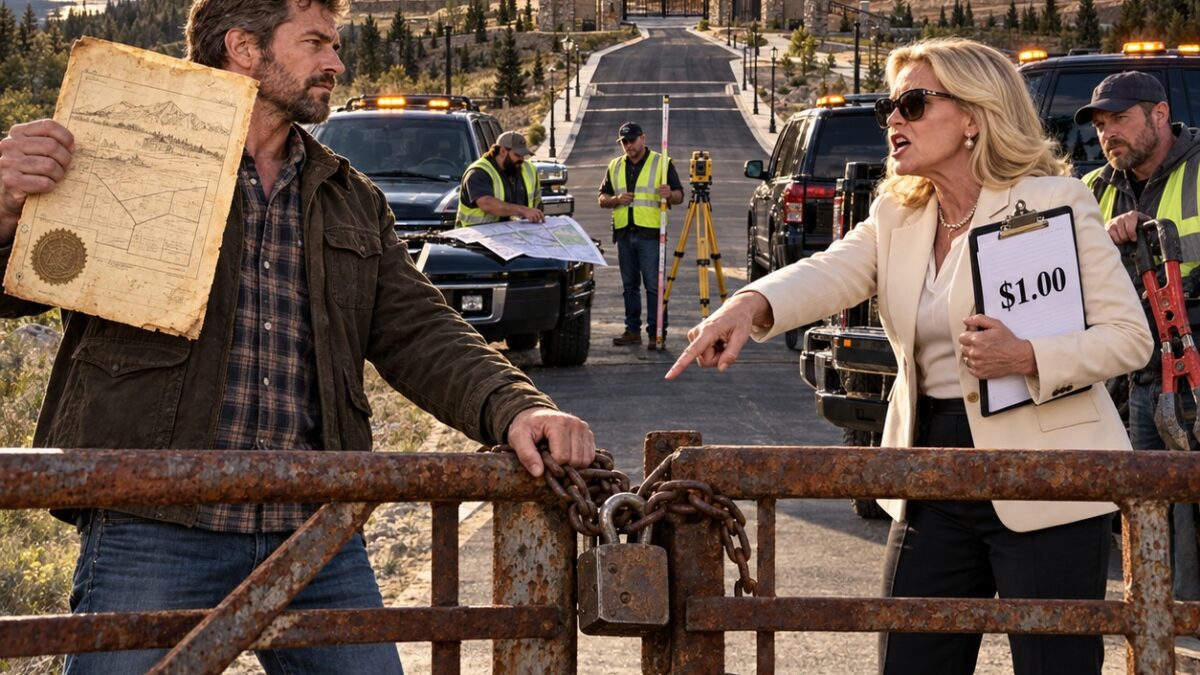
FULL STORY CONTINUATION
The county wanted to inspect the gate and the road behind it.
That made no sense to me.
I called the number on the letter.
The engineer assigned to the inspection introduced himself and then sounded almost as confused as I was.
“Mr. Jake, did Silver Ridge explain why this inspection was requested?”
“No.”
A pause.
“There’s a drainage and access project proposed for the ridge.”
“What does my gate have to do with drainage?”
Another pause.
“I don’t know yet.”
I did not like that answer.
Not because I expected every county employee to have every detail memorized.
Because the HOA was pushing a road through my land while the county was simultaneously asking to inspect something connected to drainage.
That felt like two pieces of a puzzle somebody else already understood.
So I drove back toward the eastern side of my property.
The old gate was still there.
Same hinges.
Same chain.
Same steel.
But now a small metal survey marker had been driven into the ground nearby.
Orange paint marked the dirt.
Another marker stood farther up the service road.
Then another.
I had not put them there.
I followed them.
The service road climbed gradually through the trees.
My grandfather had used it when timber crews worked that side of the property.
I still drove it occasionally.
But not often.
About half a mile in, I began seeing places where brush had been cut back.
Fresh.
Not my work.
Then trees.
Several had been cleared.
I kept walking.
When I reached the ridge, I stopped.
Construction spread across the other side.
Not houses.
Something much larger.
Massive concrete foundations.
A newly carved road.
Earthmoving equipment.
And lower on the slope, an excavation so large it looked like somebody had bitten a chunk out of the mountain.
Then I saw the sign.
SILVER RIDGE — PHASE 4
$100 MILLION REGIONAL EXPANSION
I stood there for a long time.
The red line on Karen’s map.
The surveyors.
The gate.
The county inspection request.
Everything suddenly began to connect.
They did not care about a steel gate worth a few hundred dollars.
They cared about what the gate represented.
Access.
If Silver Ridge could create a record showing my gate was improperly blocking a “community corridor,” then every notice after that would look slightly more official.
First:
Violation.
Then:
Fine.
Then:
Removal order.
Then:
Contractor.
Then maybe:
Routine use.
A paper trail.
I turned around and looked back toward my property.
Karen’s sentence returned.
Sometimes it’s not about the amount.
Exactly.
The dollar was almost perfect.
Too small to fight.
Too ridiculous to spend money challenging.
Most people would pay it.
One dollar.
Done.
Then the HOA could say:
Homeowner complied with corridor violation.
I drove home.
Went straight into my grandfather’s old office.
He had been the kind of man who kept everything.
Receipts from equipment sold thirty years earlier.
Tax maps.
Timber contracts.
Handwritten notes.
Old deeds.
Survey copies.
County letters.
Most of it lived inside wooden cabinets and cardboard boxes that smelled like dust and paper.
I started digging.
One hour.
Then two.
I found road documents.
Utility agreements.
Old tax plats.
Nothing explaining Silver Ridge.
Then near the bottom of a filing cabinet, behind a stack of yellowed county maps, I found a folded document.
Dated 1972.
Across the top:
RIDGE ACCESS AND WATER CONTROL AGREEMENT.
That title made me sit down.
The first page described the service road.
The second discussed county maintenance access.
The third contained old legal language defining how the eastern corridor could be used.
Then at the bottom was a handwritten note.
I read it once.
Then again.
Then a third time.
No private development may use the eastern corridor without the landowner’s written consent.
I stared at the sentence.
Private development.
Written consent.
Mine.
I turned the page.
An engineering map had been attached.
The ridge.
Service road.
Drainage system.
Water-control infrastructure.
And one section marked in red.
My gate.
I looked toward the window.
The ridge was visible through the trees.
Somewhere beyond it, people were building a $100 million project.
And the route they needed crossed land governed by a fifty-year-old agreement that explicitly required my permission.
My phone rang.
Karen.
I answered.
She did not say hello.
“You found the old agreement, didn’t you?”
I said nothing.
Neither did she.
Finally:
“How did you know?”
“Because that agreement was never supposed to matter anymore.”
I looked down at the page.
“Then why are you worried about it?”
She hung up.
That was the moment I stopped thinking of the situation as an HOA dispute.
I called Daniel Reed.
Daniel was a property attorney who had helped me years earlier with another land issue.
He came that afternoon.
We spread everything across the kitchen table.
The agreement.
Map.
HOA violation.
County letter.
Pictures from the ridge.
Daniel read slowly.
That was one thing I liked about him.
He never became excited before the documents justified it.
Finally, he tapped the engineering map.
“Jake.”
“What?”
“This is bigger than a road.”
“What do you mean?”
He traced a second line.
“This corridor is part of the original ridge water-control system.”
I leaned closer.
“Drainage?”
“More than drainage.”
He followed the markings downhill.
“If Silver Ridge changes this access corridor, they may also be changing how storm water is controlled and maintained across the ridge.”
I remembered the enormous excavation.
“The construction site.”
“What did you see?”
I showed him photographs.
Concrete foundations.
Cut slope.
Excavation.
Daniel enlarged one.
“That could be a retention structure.”
“For the development?”
“Possibly.”
I looked at the old map again.
“Why do they need my gate?”
“Because the gate controls the practical maintenance route.”
He leaned back.
“And your property may be the last privately controlled piece between their development and the county system.”
That sentence stayed with me.
Last privately controlled piece.
The next morning, Daniel requested the original county engineering records.
While he handled paperwork, I went back to the ridge.
This time on foot.
I followed the cleared areas farther.
Heavy machinery was working beyond the crest.
Then I saw a concrete channel built into the hillside.
Huge.
Not something associated with a few houses.
A temporary construction fence surrounded part of it.
A sign read:
PHASE 4 STORM WATER STORAGE FACILITY.
I called Daniel.
“There’s a storm-water facility going in.”
“How large?”
“Massive.”
“Can you see the outlet?”
I followed the concrete channel downhill.
It continued toward the eastern corridor.
Toward my property.
Toward the old gate.
“The outlet runs almost directly above my land.”
Daniel went quiet.
Then:
“Take pictures of everything visible from your property or lawful access.”
“I already am.”
“Do not cross their construction fence.”
“I know.”
That afternoon, he called back.
“I found something.”
“What?”
“The county rejected Silver Ridge’s first Phase 4 drainage plan.”
“Why?”
“Because the proposed discharge relied on the old eastern corridor.”
“Through my property?”
“Yes.”
I sat down.
“Then why are they building?”
“They submitted a revised plan.”
“So problem solved?”
“No.”
That answer came fast.
“The revised plan still depends on the same corridor.”
“So they changed the drawing.”
“They changed enough paperwork to make it look different. But functionally, yes, they still need access.”
I stared at the 1972 agreement.
Then Daniel added:
“There’s another issue.”
“What?”
“Financing.”
I waited.
“The lender for Phase 4 required certification that Silver Ridge had secured all necessary property access and infrastructure rights before releasing the next major construction funding.”
Everything clicked.
“They need proof.”
“Yes.”
“And they don’t have mine.”
“No.”
“So the dollar fine—”
“Could help them begin creating a record that your gate is an unauthorized obstruction rather than a legitimate boundary.”
I leaned back.
One dollar.
Suddenly, it looked much more expensive.
Two days later, Karen requested a meeting.
I agreed.
Not because I trusted her.
Because I wanted to know what somebody says when they realize the other side has found the document they were hoping would stay buried.
The meeting happened in Silver Ridge’s development office.
Karen was there.
So was the project engineer.
Development manager.
And a financial representative from the company funding Phase 4.
Karen smiled when I entered.
“Jake, I’m glad you came.”
“Let’s skip that.”
The finance representative opened a folder.
“We’re prepared to resolve the access issue.”
“There is no access issue.”
Karen slid a document across the table.
At the top:
$300,000.
I left it untouched.
“For what?”
“Temporary access rights.”
“No.”
Karen frowned.
“You haven’t read it.”
“I don’t need to.”
The development manager leaned forward.
“This is a significant opportunity.”
“For who?”
“For everyone involved.”
I pointed at the number.
“Why would you pay me three hundred thousand dollars for access you claim the HOA already has?”
Nobody answered.
That silence told me more than the offer.
I pushed the paper back.
Then placed the 1972 agreement on the table.
Everything changed.
The engineer looked at Karen.
“You said that agreement was irrelevant.”
Karen’s face tightened.
“Where did you get this?”
“My grandfather kept records.”
The financing representative picked up the document.
Read the handwritten clause.
Then the engineering attachment.
He looked toward the project engineer.
“Is this still part of the property record?”
The engineer hesitated.
“Yes.”
Karen jumped in.
“It’s fifty years old.”
The engineer corrected her.
“That doesn’t remove it.”
The financing representative closed his folder.
“How much of Phase 4 depends on this corridor?”
Nobody answered.
He asked again.
“How much?”
The engineer finally said:
“Most of it.”
The financial representative stood.
“I need to speak with legal.”
Karen looked furious.
“You’re overreacting.”
He turned.
“No. I’m doing my job.”
Then he left.
The development manager followed.
Karen remained.
She stared at me.
“You have no idea what you’re doing.”
I stood.
“I know enough.”
“You’re putting hundreds of millions of dollars at risk.”
“No.”
I tapped the agreement.
“Your project did that.”
She stepped closer.
“You really think the county is going to side with you?”
“I don’t know what the county will do.”
Then I pointed at the handwritten clause.
“But I know you can’t turn my property into your road because you want it.”
Her voice dropped.
“You’re going to regret this.”
I smiled.
“You already fined me a dollar.”
She did not smile.
The next morning, county inspectors arrived.
Three engineers.
Daniel came too.
They inspected the gate.
Measured the corridor.
Walked the old service road.
One engineer disappeared into the woods for nearly half an hour.
When he returned, he carried a rolled map.
“This is the original corridor.”
He spread it across the hood of my truck.
Then placed Silver Ridge’s current plan beside it.
At first, they looked nearly identical.
Then he pointed.
The original county system stopped at my boundary.
Silver Ridge’s current road continued through it.
And construction beyond the boundary had already begun.
The engineer shook his head.
“They’re building infrastructure beyond the approved property-control line.”
“Can they?”
“Not without the required rights.”
Daniel looked at me.
“That’s why the gate matters.”
Then the county engineer noticed something else on the old map.
A small symbol.
He tapped it.
“Do you know what this is?”
“No.”
“Original emergency water-control station.”
I looked toward the ridge.
“Where?”
He compared coordinates.
Then pointed straight toward the Phase 4 construction.
I felt my stomach tighten.
“They built over it?”
“Not exactly.”
He studied the current plan.
“They built around it.”
Then stopped.
“No.”
“What?”
“They moved it.”
Daniel’s expression hardened.
“Who authorized relocation?”
The engineer did not answer immediately.
Instead, he went back to his truck.
Returned with another folder.
Inside was county correspondence from six months earlier.
The language was clear.
No relocation or modification of the eastern water-control station may occur without written consent from the affected landowner.
My name appeared on the following page.
I had never seen it.
Daniel looked at me.
“You never received this?”
“No.”
The county engineer shook his head.
“You were supposed to.”
That afternoon, the county issued a temporary stop-work order covering the affected Phase 4 area.
The effect was immediate.
Equipment slowed.
Crews left part of the ridge.
Calls began.
Silver Ridge homeowners started asking why construction had stopped.
The developer scheduled an emergency review.
Karen sent me another letter.
This one abandoned any pretense of friendliness.
It demanded that I:
Remove the gate.
Allow engineering crews onto my property.
Recognize Silver Ridge’s alleged corridor rights.
Permit construction access.
Withdraw all objections.
Daniel read it.
Then laughed.
“They’re trying one last time.”
“Before what?”
“Before the lender understands how bad this is.”
He was right.
The following morning, the lender issued formal notice.
Phase 4 funding suspended pending verification of access, drainage, and property-control rights.
The $100 million expansion stopped.
But Karen was not finished.
That evening, she came to my house alone.
No security vehicles.
No contractor.
No attorney.
She stood outside my gate.
For the first time since the whole thing began, she looked nervous.
“You’ve made your point.”
I shook my head.
“No.”
Her eyes narrowed.
“You don’t understand.”
“I understand enough.”
She glanced at the gate.
“We can make this go away.”
“How?”
“Sell us the eastern parcel.”
I almost laughed.
“After everything you’ve done?”
“Jake.”
“No.”
She stepped closer.
“You don’t know what happens if Phase 4 fails.”
I looked toward the ridge.
“I know exactly what happens.”
Her jaw tightened.
Then she said:
“If you don’t sell, they can’t build the final water system.”
Silence.
Her expression changed immediately.
She knew she had said too much.
I said:
“So the whole project depends on my land.”
She did not answer.
She left.
The next morning, the county called an emergency hearing.
Daniel called five minutes later.
“Bring the 1972 agreement.”
“Obviously.”
“And every photograph.”
“Why?”
“Because county staff found something inside Silver Ridge’s own files.”
“What?”
“A certification Karen signed.”
I waited.
Daniel said:
“This could bring down the entire Phase 4 plan.”
The hearing was scheduled for 9:00 a.m.
By 8:30, the county conference room was full.
Silver Ridge attorneys.
Pioneer Ridge development team.
Lender representatives.
County engineers.
Planning staff.
Karen.
Daniel and me.
Maps covered a long table.
The county director opened the hearing.
“This matter concerns unauthorized access, water-control modifications, and construction activity associated with Silver Ridge Phase 4.”
Karen’s attorney objected immediately.
“The characterization is unnecessarily aggressive.”
The director ignored him.
He looked toward the engineer.
“Show us the original corridor.”
The 1972 engineering map appeared on the screen.
My property centered.
Eastern corridor marked.
Water-control station shown.
Then the current Phase 4 plan appeared beside it.
A road crossed directly through my parcel.
Continued toward Silver Ridge’s new water facility.
The county director looked toward Karen.
“Where is the recorded landowner permission?”
Her attorney answered.
“The HOA has relied on historical community access.”
The director frowned.
“That isn’t what I asked.”
He turned directly to Karen.
“Where is the written consent from the owner?”
She did not answer.
The developer’s attorney shifted.
The lender representative leaned forward.
Finally, Karen said:
“We believed those rights existed.”
Daniel stood.
“Belief isn’t documentation.”
He placed the 1972 agreement on the table.
Then the county warning letter.
Then my photographs showing construction beyond the approved boundary.
The director studied them.
“Was the water-control relocation approved?”
The engineer answered.
“No.”
“Was the landowner notified?”
“No.”
“Was Silver Ridge aware consent was required?”
The engineer looked at Karen.
“Yes.”
Karen’s attorney stood.
“We dispute that.”
The engineer opened another folder.
“I have the correspondence.”
Email.
Six months earlier.
Subject:
EASTERN CORRIDOR PROPERTY CONSENT.
The body was short.
Owner has not agreed to access or water control relocation.
The room went silent.
Daniel looked at me.
I stayed still.
The county director asked:
“Who received this email?”
The engineer read the distribution list.
Karen Whitmore.
Project manager.
Developer’s engineer.
Financing coordinator.
The lender representative slowly turned toward Karen.
“You knew.”
Karen’s face hardened.
“We were negotiating.”
“That isn’t what this says.”
Daniel then placed another document on the table.
This was the one county staff had discovered.
Inside the development financing package.
Signed by Karen.
The certification stated that Silver Ridge had secured all necessary property rights for Phase 4.
Access.
Drainage.
Water control.
Infrastructure.
Maintenance.
All secured.
Except they weren’t.
The county director stared at the signature.
“Is this yours?”
Karen did not answer immediately.
Her attorney whispered to her.
Finally:
“Yes.”
The lender representative stood.
“Then you certified that the necessary rights existed.”
Karen snapped:
“We had every intention of obtaining them.”
The lender representative stared.
“That is not the same thing.”
The room erupted.
Attorneys talking.
Developer representatives arguing.
Karen trying to explain.
County staff asking for order.
Then the director hit the table.
“Enough.”
Silence.
He turned toward the developer.
“Was your financing based on this certification?”
“Yes.”
“And without the eastern corridor?”
The representative hesitated.
“We cannot complete Phase 4 as designed.”
“How much of the project?”
He looked toward the lender.
The lender answered.
“Essentially the entire final phase.”
“Estimated value?”
“Approximately one hundred million dollars.”
I sat there quietly.
One dollar.
That was where this had started.
A $1 HOA violation.
Now a $100 million development was sitting in a county conference room explaining why its entire final phase depended on a gate it had pretended was illegally blocking community access.
But one question remained.
Why the gate specifically?
The county engineer answered.
He returned to the 1972 map.
“The gate is marked as a control access point.”
He explained that county maintenance crews historically entered there to reach the eastern water-control station.
The station itself remained tied to land under my ownership.
Silver Ridge’s new plan relocated key parts farther into Phase 4.
That allowed them to build a much larger storm-water retention system.
But it created a continuing access problem.
During construction and later maintenance, they needed reliable passage through my property.
They did not have it.
So the pressure campaign began.
Survey.
Violation.
Dollar fine.
Security.
Gate-removal crew.
County engineering request.
Construction beyond the boundary.
The county director looked toward Karen.
“Why was the landowner fined?”
Her attorney answered.
“Because the gate interfered with the planned community corridor.”
The director cut him off.
“Planned by whom?”
Silence.
“The county had not approved a community corridor through Mr. Jake’s property.”
No response.
“So the HOA fined a private landowner for refusing access to land the HOA did not control.”
Karen finally spoke.
“We believed the rights would be finalized.”
The director looked at her.
“Then why did you send a contractor to cut off his gate before they were finalized?”
Karen said nothing.
That silence may have been the most important moment in the hearing.
Not a confession.
No dramatic breakdown.
Just the absence of any good answer.
Then the lender representative asked to review the original title package.
County staff handed it over.
He read the 1972 agreement.
Engineering map.
Property description.
Current Phase 4 plan.
His expression changed.
“This project has a bigger problem.”
The developer representative looked at him.
“What?”
“Our financing requires uninterrupted legal access to the regional storm-water infrastructure.”
He pointed toward the map.
“Part of that infrastructure sits outside the development boundary.”
Everyone looked at me.
“And the owner has not granted the required rights.”
Karen’s attorney stood.
“We can resolve that.”
The lender shook his head.
“Not today.”
He closed the folder.
“Funding remains suspended.”
The developer asked:
“For how long?”
“Until the property-rights issue is resolved.”
“And if it isn’t?”
“Phase 4 does not proceed.”
The county issued its formal decision before lunch.
Construction on the affected portions of Phase 4 was suspended immediately.
The HOA was ordered to stop interfering with my gate.
Unauthorized survey markers had to be removed.
The altered route across my property had to be restored.
Silver Ridge could not use my land for construction or maintenance without separate legal authorization.
And the county refused to approve the new water-control configuration.
Silver Ridge would have to submit a completely new engineering plan.
Not a correction.
A redesign.
The existing plan was finished.
So was the timeline built around it.
So was the financing schedule.
I did not destroy anything.
Never touched their equipment.
Never sabotaged construction.
Never blocked a public road.
Never threatened anybody.
I simply refused to give them something they did not own.
Permission.
As Daniel and I walked out, Karen caught up.
“You’ve destroyed everything.”
I turned.
“No.”
“You blocked the entire project.”
“I didn’t block it.”
I pointed toward the county offices.
“They did.”
She shook her head.
“You know how many families depend on Silver Ridge?”
“You should’ve thought about that before building a plan around somebody else’s property.”
Her expression hardened.
“You could have made a fortune.”
I looked at her.
“So could you.”
She did not answer.
I walked away.
The next several weeks were brutal for Silver Ridge.
Construction stopped.
Crews disappeared from the ridge.
Equipment was removed.
The giant cranes that had dominated the skyline came down one by one.
The half-finished access road ended in dirt and weeds.
Phase 4 buyers received notices.
Then residents.
The HOA had to disclose that access and drainage rights were unresolved.
The lender froze remaining financing.
The existing $100 million expansion plan was no longer financially viable.
Silver Ridge called a special homeowners’ meeting.
I did not intend to attend.
Then Daniel said:
“You should hear how they explain it.”
So I went.
The room was packed.
Karen sat at the front.
Different setting.
Same attempt at control.
She opened by saying the property dispute had been unexpected.
That lasted maybe three minutes.
A homeowner stood.
Held up the email.
Owner has not agreed to access or water control relocation.
“Unexpected?”
Karen stared.
Another resident asked:
“Then why did you tell us everything had been approved?”
No answer.
Another:
“Why did you fine him?”
Karen said:
“It was a compliance measure.”
Someone else shouted:
“For one dollar?”
The room changed.
That question hit harder than anything involving engineering.
Why exactly one dollar?
Karen looked around.
“It was symbolic.”
A homeowner laughed.
“You were trying to establish that his gate was an HOA violation.”
Karen’s face went pale.
Because now everyone understood what I had realized weeks earlier.
The amount had never mattered.
Payment would have mattered.
Compliance would have mattered.
A record would have mattered.
The dollar was designed to make resistance look unreasonable.
Who fights over a dollar?
I did.
Not because I cared about the dollar.
Because the violation was false.
Two months later, Karen resigned.
By then, Pioneer Ridge had withdrawn from Phase 4.
The developer could not restructure the project around the unresolved water and access system fast enough to satisfy the existing financing arrangement.
The lender released its final position.
The $100 million expansion under the existing Phase 4 design was canceled.
Not postponed.
Not “under review.”
Canceled.
The county required restoration of disturbed areas around the ridge.
Silver Ridge had to pay for repairs where unauthorized construction had damaged land or infrastructure.
Sections of the cleared route were replanted where possible.
Survey markers on my property were removed or replaced correctly.
The old service road returned to its previous status.
A road on my land.
Used only under legitimate permission.
And the gate?
The gate stayed.
Exactly where it had been.
Same steel.
Same hinges.
Same latch.
Worth maybe a few hundred dollars.
Daniel came out one evening after the restoration crews had finished most of their work.
Sunset turned the ridge orange.
Silver Ridge’s abandoned Phase 4 site sat strangely quiet.
No cranes.
No trucks.
No engines.
Daniel looked at the gate.
“You know what’s funny?”
“What?”
“They spent millions trying to get around that thing.”
I smiled.
“All for a gate worth a few hundred bucks.”
He shook his head.
“No.”
He held up the 1972 agreement.
“They weren’t fighting the gate.”
He tapped the paper.
“They were fighting the person who owned what was behind it.”
That was the best summary I ever heard.
For months, Silver Ridge had treated my land like an obstacle.
A line on a map.
A difficult parcel.
A problem to solve.
They thought if they made the dispute small enough, I would behave as though my rights were small too.
One dollar.
Tiny number.
Pay it.
Move on.
Then the road becomes community access.
Then the gate becomes unauthorized.
Then a contractor removes it.
Then construction traffic passes through.
Then temporary use becomes ordinary use.
Then ordinary use gets described as historical use.
Eventually, the story becomes:
We’ve always had access.
That is how rights can become blurred if the owner stops paying attention.
My grandfather had understood that better than I did.
The 1972 agreement was not dramatic.
Legal language.
Maps.
Maintenance provisions.
One handwritten note.
But that note preserved a distinction:
County maintenance could use the corridor under defined circumstances.
Private development could not.
Not without written consent.
That distinction survived fifty years.
Outlived my grandfather.
Outlived the original county engineers.
Then one morning it became the difference between my gate being mine and Silver Ridge pretending it was theirs.
I began going through all of the old property records after that.
Not because I expected another $100 million development.
Because I realized how much inherited land comes with inherited knowledge.
A deed is only part of the story.
Road agreements.
Water rights.
Utility access.
Old easements.
Temporary licenses.
Maintenance permissions.
Survey notes.
Somebody can own land for years without understanding every legal layer attached to it.
That had been me.
I knew the gate was mine.
I did not know exactly why it mattered to the regional water system.
Karen did.
Or at least she knew enough.
That information imbalance had made her confident.
She believed she understood my land better than I did.
For a while, she did.
Then I opened a filing cabinet.
That was all it took.
People later asked why Karen called me right after I found the agreement.
I never got a complete answer.
Maybe somebody at the development office told her I had begun requesting old records.
Maybe the county inquiry alerted Silver Ridge.
Maybe she simply knew I would eventually look.
I did not invent certainty.
What mattered was what she said.
“That agreement was never supposed to matter anymore.”
It mattered.
Records do not expire because somebody finds them inconvenient.
Age can weaken documents if the terms say so.
Some rights do expire.
Some get replaced.
Some are modified.
But you cannot erase an agreement by assuming nobody remembers it.
That was Silver Ridge’s mistake.
Assumption.
Again and again.
They assumed the corridor could be normalized.
Assumed financing would continue.
Assumed county approval would catch up.
Assumed my consent could be obtained later.
Assumed one dollar would be easier to pay than fight.
Every assumption depended on the next.
Then one failed.
Mine.
I would not pay.
That forced me to look.
Looking found the agreement.
Agreement led to the county maps.
Maps led to the water station.
Water station led to the unauthorized relocation.
Relocation led to the warning letter.
Warning letter led to the email.
Email led to the financing certification.
Certification led to the lender.
That is what amazed me afterward.
The fine did not stop the project.
The fine exposed the structure holding it up.
Karen wanted to create a paper trail.
Instead, she gave me a reason to follow one.
I framed the dollar violation notice.
Not because it was valuable.
Because it was absurd.
One dollar.
At the time, an insult.
Later, almost a gift.
Had the HOA demanded $5,000, I would have called Daniel immediately.
A major fine announces itself as serious.
One dollar invites dismissal.
That was the clever part.
Also the mistake.
The smallness made me curious.
“Sometimes it’s not about the amount.”
Karen’s own words.
Correct.
It was about precedent.
My framed notice sits in my office today.
People ask why.
I tell them:
“Because that dollar was the most expensive dollar Silver Ridge ever tried to collect.”
Not literally.
The project failed for larger reasons.
Access.
Engineering.
Financing.
False certification.
But the dollar opened the door to all of them.
I never paid it.
The HOA eventually withdrew it along with any claim that my gate violated community access rules.
I requested written confirmation.
Daniel insisted.
“Why?”
“Because years from now, somebody might see the original violation without knowing the outcome.”
Another lesson.
Correct the record.
Do not settle for:
Everybody knows now.
People leave.
Boards change.
Files remain.
So the file now includes both.
Violation.
Withdrawn.
Gate recognized as private.
No Silver Ridge access right.
Clear.
The county also updated its own records.
The eastern corridor was marked to show the private-control limitations from the 1972 agreement.
The water-control system received more explicit documentation.
No future developer should be able to say:
We assumed.
At least not credibly.
The county engineers were embarrassed.
One admitted as much.
“We should’ve caught this earlier.”
Daniel said:
“Which part?”
“The relocation.”
“The access?”
“All of it.”
He showed us how Phase 4’s revised drainage plan had been reviewed.
Different teams looked at different components.
Storm-water capacity.
Environmental requirements.
Construction standards.
Access.
Financing.
No single reviewer had initially connected the new station location back to the old private corridor restriction.
Complex systems create blind spots.
Silver Ridge moved aggressively through one.
Karen relied on nobody joining the files.
Then the gate dispute joined them.
That was important to understand because it would be too easy to tell the story as:
Corrupt HOA versus heroic landowner.
Reality was more complicated.
County staff made mistakes.
Developer staff made assumptions.
The lender trusted a certification.
Project engineers relied on access assurances.
Karen’s certification was central because she signed it despite records showing I had not agreed.
But a large project is never one person.
The failure became expensive because multiple systems accepted incomplete information.
The hearing forced them to compare.
That is what transparency does.
Separate documents can support different stories.
Together, they have to agree.
Silver Ridge’s did not.
One page:
Owner has not agreed.
Another:
All necessary property rights secured.
Those two sentences could not both be true.
The lender noticed.
Funding stopped.
Simple.
That was more powerful than any argument I could have made.
I did not need to call Karen dishonest.
The documents contradicted each other.
Let them speak.
Daniel taught me that repeatedly.
“Don’t add adjectives.”
“What?”
“Unauthorized is enough. You don’t need outrageous unauthorized.”
“Fine.”
“Don’t say fraudulent unless someone has established fraud.”
“She signed a false certification.”
“Say exactly that.”
“You’re no fun.”
“I keep you credible.”
He did.
That mattered when the story spread.
Silver Ridge residents were angry.
Rumors became wild.
Karen had planned the entire scheme personally.
Karen was secretly getting millions.
The developer bribed county staff.
None of that was in the records I had.
I refused to repeat it.
What I could prove was already serious.
She knew I had not granted access.
She signed a certification saying necessary rights had been secured.
She fined me over the gate.
She sent a contractor to remove it.
She insisted the corridor existed.
Those were facts.
Enough.
Exaggeration would have given her something to attack.
Truth needed no help.
The restoration of the ridge took months.
Not everything could be returned exactly to the way it had been.
Trees take years.
Disturbed soil changes.
But county requirements forced Silver Ridge and the developer to stabilize the affected area.
Drainage restored.
Unauthorized markings removed.
Access cutbacks corrected.
Some areas replanted.
The unfinished road gradually disappeared under weeds.
That image became strangely satisfying.
Not because I enjoyed watching a project fail.
Because nature was reclaiming a route that had been drawn as inevitable.
Red line on a map.
Millions committed.
Crews mobilized.
Marketing published.
Still not inevitable.
Land ownership had something to say.
I was not anti-development.
People assumed I was after the hearing.
“You stopped a hundred-million-dollar project.”
No.
I stopped unauthorized use of my property.
Silver Ridge could have redesigned.
Bought legitimate rights somewhere else.
Negotiated with me before construction.
Changed the water system.
Those options had costs.
Their lender ultimately decided the existing plan was no longer viable.
That was a business decision.
Not me standing on the ridge with a shotgun yelling at progress.
I never threatened anyone.
Never damaged equipment.
Never blocked approved county access.
Never interfered with work happening lawfully on Silver Ridge land.
I said no to my property being used without agreement.
That was all.
People sometimes make individual rights sound unreasonable when large money is on the other side.
$100 million.
Families.
Jobs.
Homes.
Infrastructure.
All real.
Then:
One gate.
One man.
Why should he matter?
Because scale does not erase ownership.
If the project truly needed my property, that made obtaining my consent more important.
Not less.
The dependence increased my relevance.
Karen treated it as justification for ignoring me.
That inversion was the heart of the dispute.
“You’re putting hundreds of millions at risk.”
No.
You put hundreds of millions at risk when you designed around a right you did not have.
There is a difference between blocking a project and refusing to rescue someone else’s bad assumption.
I did not owe Silver Ridge the missing permission simply because they spent money before getting it.
Sunk cost is not authority.
That lesson cost them more than the gate ever could.
The homeowners had the hardest emotional position.
Many had bought into Silver Ridge believing Phase 4 amenities and expansion would be completed.
Some property values were tied to future development expectations.
They were angry.
At me initially.
A few messages reached me.
“You’re hurting everyone over a road.”
“Why not take the $300,000?”
“Be reasonable.”
I understood the frustration.
Then the email and certification became public.
The anger shifted.
Because the story changed.
I had not suddenly objected after approval.
Silver Ridge knew I had not agreed.
That distinction mattered to residents too.
They had been told access was resolved.
It was not.
Their anger belonged higher up the chain.
One resident later apologized.
“I thought you were holding the project hostage.”
“I know.”
“They never told us the corridor was private.”
“I figured.”
“Karen said it was historical community access.”
“That was the phrase.”
He shook his head.
“I paid extra for a Phase 4 view lot.”
I did not know what to say.
His frustration was legitimate.
He had made a financial decision based on representations I had nothing to do with.
I said:
“I’m sorry.”
Not because I caused it.
Because his loss was still real.
Accountability does not require enjoying collateral damage.
That is something revenge stories often forget.
A project collapses and people cheer.
But projects contain employees.
Homeowners.
Contractors.
Small businesses.
Families.
Not everyone participates in the decision that creates the failure.
I never celebrated the workers leaving.
I hated the method Silver Ridge used.
I was relieved my rights held.
Those emotions could coexist.
Karen’s resignation felt different.
That was consequence directly connected to leadership.
She had authority.
She used it.
Residents lost confidence.
Two months later, she stepped down.
Fair.
I never saw her carry boxes out of an office.
No dramatic final confrontation.
A resignation notice came through.
Done.
That was enough.
I did not need humiliation.
Her title was what had allowed her to make the dollar fine look official.
Once that title disappeared, the problem changed.
The new HOA president contacted me.
His first sentence:
“We do not claim access rights across your property.”
Excellent opening.
He asked whether we could document procedures for legitimate county maintenance crews using the old service road.
I said:
“Yes.”
Because that use had existed for decades.
Legitimate.
Limited.
Not private-development access.
We worked with county staff.
Written notice procedures.
Emergency exception.
No HOA control.
No ambiguity.
That was how it should have been handled.
Silver Ridge residents benefited indirectly from a functioning regional water system.
Fine.
Public infrastructure can cross private property through defined agreements.
The difference is definition.
Karen wanted the phrase “community corridor” to do the work of an easement.
It could not.
Words do not create rights merely because they sound official.
“Historical community access.”
“Planned corridor.”
“Regional development.”
“Compliance measure.”
All phrases.
The 1972 agreement had a sentence.
No private development may use the eastern corridor without the landowner’s written consent.
One sentence outweighed all the vocabulary.
That is the beauty of good records.
Clarity.
My grandfather had probably never imagined a luxury HOA.
He could not have known Silver Ridge.
Phase 4.
$100 million.
Modern storm-water systems.
But someone in 1972 understood a basic principle.
Public maintenance and private development are not the same.
Preserve the difference.
That decision protected his grandson fifty years later.
I wished he could have seen it.
He had always been suspicious of vague agreements.
If somebody said:
“Don’t worry, we’ll work it out later,”
he would answer:
“Then we can write it down later too.”
As a younger man, I thought that made him difficult.
Now I understood.
Memory weakens.
People die.
Companies change names.
Boards turn over.
Paper stays.
The handwritten note was not fancy.
No gold seal.
No giant signature page.
Still enough.
I began digitizing everything.
Every deed.
Survey.
Agreement.
County letter.
Map.
Not because paper was bad.
Because the next generation should not have to search three hours through dust while a contractor waits outside with a hydraulic cutter.
I labeled files clearly.
EASTERN CORRIDOR — PRIVATE CONSENT REQUIRED.
Hard to miss.
I gave Daniel a copy.
County had one.
Future me had one.
If I ever sold the property, the next owner would know.
Knowledge should transfer with land.
Otherwise, somebody else eventually rediscovers it under pressure.
One afternoon, I stood by the gate when a county maintenance truck arrived.
The driver stopped.
Got out.
“Jake?”
“Yeah.”
“We need to inspect equipment farther up.”
“You have the work order?”
He handed it over.
Proper county maintenance.
Covered by the old agreement.
“Go ahead.”
He opened the gate.
Drove through.
An hour later, returned.
Closed it.
That simple exchange captured the entire dispute.
The gate was not about refusing everyone.
It was about distinguishing who had a right.
County maintenance?
Yes, under the agreement.
Private Silver Ridge development?
Written consent required.
The gate physically looked the same in both situations.
Legal context changed everything.
That is why Karen needed the gate removed.
A gate forces someone to ask.
Who opens it?
Why?
Under what right?
An open road becomes psychologically different.
People drive through.
Routine forms.
Routine becomes expectation.
Expectation becomes “historical use.”
The gate preserved friction.
A pause.
That pause protected ownership.
I began appreciating it differently.
Not just steel.
A question in physical form.
May I enter?
Most boundaries are like that.
Fence.
Gate.
Door.
Contract.
Password.
Consent.
They are not hostility.
They are structures that require permission.
People who respect you rarely hate boundaries.
People who want something from you without asking often do.
Karen hated the gate.
That should have told me everything.
The dollar notice remains framed above a filing cabinet.
Daniel makes fun of me.
“Your one-dollar art collection.”
“You’re jealous.”
“I billed you substantially more than a dollar.”
“Which makes the fine the cheapest legal education I’ve ever had.”
He could not argue.
The $300,000 offer also stayed in my records.
I sometimes thought about what would have happened if I accepted.
Maybe I would have been financially better off in the short term.
Three hundred thousand is real money.
But the temporary-access document was vague.
Daniel later reviewed it.
It granted broader rights than Karen had described.
Construction.
Maintenance.
Equipment.
Potential extensions.
Not something I would have signed once I understood the water system.
The number was designed to feel generous before I knew value.
Information changes negotiation.
That was another important lesson.
They knew most of Phase 4 depended on the corridor.
I did not when they offered $300,000.
Who had more information?
Them.
That imbalance benefits whoever stays quiet.
The 1972 map corrected it.
Once I understood dependency, the offer looked different.
Not necessarily fraudulent.
Not necessarily unfair in every context.
Just strategically timed.
They wanted agreement before I understood leverage.
Common business practice, maybe.
Also a reason property owners need independent advice.
Never assume the first person telling you what a right is worth has an incentive to maximize your understanding.
Get your own information.
Daniel’s best work was not arguing.
It was slowing me down.
When Karen threatened regret, I wanted to confront her.
He said:
“Let her write.”
When survey flags appeared:
“Photograph before removal.”
When county engineers came:
“Walk with them.”
When the $300,000 offer arrived:
“Do not sign.”
When lender funding stopped:
“Do not contact the lender yourself.”
Every impulse I had was action.
His advice was often restraint.
Let documents accumulate.
That was hard.
Also effective.
Karen kept producing evidence because she thought momentum favored her.
Each new demand clarified what Silver Ridge needed.
Remove gate.
Provide access.
Recognize rights.
Withdraw objection.
Why would they need me to recognize something that already existed?
Exactly.
The more aggressively they claimed authority, the more obvious the missing piece became.
My consent.
One of my favorite moments came months after Phase 4 was canceled.
Not the hearing.
Not Karen resigning.
A county crew came to replace damaged survey markers.
They worked carefully.
One worker asked:
“Where do you want this boundary marker checked?”
I showed him.
He confirmed coordinates.
Placed it correctly.
Then said:
“Anything else?”
“No.”
He left.
No drama.
Land line restored.
That was the opposite of Silver Ridge’s survey crew arriving with a route already drawn through my property.
One process begins with assumption.
The other with verification.
I had become a fan of verification.
The trees cleared without authorization were replanted where possible.
Saplings looked pathetic compared with what had been removed.
That angered me.
Trees do not return instantly because a county order says restore.
Some damage takes time.
I did not romanticize the outcome as if everything became exactly as before.
It did not.
The ridge bore scars.
But restoration began.
The unfinished road softened under weather.
Grasses returned.
The giant construction zone became quieter.
Nature moved slower than lawyers.
More reliably.
One evening Daniel and I stood there watching the sun go down.
That was when he said they were fighting the owner, not the gate.
I thought about that for weeks.
Big organizations often reduce people into categories.
Parcel owner.
Holdout.
Access issue.
Obstruction.
Stakeholder.
Those words are useful administratively.
They can also make it easier to forget that someone has an actual choice.
In a spreadsheet, my land was a route.
In my life, it was my grandfather’s property.
My home.
A road I had walked since I was a kid.
A gate I had repaired.
Context matters.
Silver Ridge saw the eastern parcel only for what it could provide them.
I saw everything behind it.
Neither perspective was imaginary.
But only one of us owned it.
That settled the decision.
I never became wealthy from the fight.
People sometimes assumed I did because of the $300,000 offer.
I rejected it.
The $100 million project failed.
That money did not come to me.
There was no giant payout.
No court awarding me tens of millions.
No secret development buyout.
My “win” was mostly keeping what I already had.
That sounds anticlimactic.
It shouldn’t.
Property rights often work that way.
Victory is not gaining somebody else’s money.
It is preventing somebody else from taking your choice.
I kept my land.
Gate.
Road.
Water-control rights.
That was enough.
The HOA had to pay for certain repairs.
The developer absorbed its own losses.
The lender protected itself.
Pioneer Ridge withdrew.
Everyone carried consequences according to role.
I carried legal fees and months of stress.
Not every victory is free.
Still worth it.
Had I paid the dollar?
I cannot know exactly what would have happened.
Important.
Maybe payment alone would not have legally created access.
Probably not by itself.
A one-dollar HOA fine is not a magic easement.
But that was not the point.
Karen was building narrative.
The owner complied with corridor enforcement.
The gate identified as unauthorized.
HOA treated the route as community access.
Each layer helps the next argument.
Daniel explained:
“One bad piece of paper rarely gives away your property. The danger is when ten bad pieces all point the same direction and nobody objects.”
That is why written objection mattered.
I sent one.
Daniel drafted it.
Clear.
I dispute HOA jurisdiction.
Gate lies on private property.
No community access right acknowledged.
No consent granted.
All rights reserved.
Boring.
Powerful.
That letter became another part of the record.
If future attorneys ever looked back, they would not see silence.
They would see immediate rejection.
That matters.
Silence gets interpreted.
Sometimes unfairly.
Respond when rights matter.
Document your no.
Another lesson.
The new HOA board later canceled several old “corridor compliance” policies Karen had created.
Apparently my gate was not the only boundary issue, though mine was the biggest.
Residents began asking how much authority the HOA had outside recorded Silver Ridge property.
Good question.
Answer:
Less than Karen acted like.
The board hired outside counsel to review boundaries.
Again, boring reform.
Useful.
I had no interest in becoming their adviser.
Not my HOA.
I lived outside it.
That remained one of Karen’s strangest assumptions.
She fined somebody who was not actually a Silver Ridge member.
Her theory was that the obstruction affected community access.
But sending an HOA “compliance fee” to a nonmember property owner should have raised alarms immediately.
It did for me.
Later, residents admitted they assumed I belonged to some legacy section.
No.
That confusion helped Karen.
She treated proximity as jurisdiction.
Common mistake.
A subdivision grows around older land.
Eventually newer residents assume everything inside visual range belongs to the same system.
It doesn’t.
Development maps have edges.
So do HOA covenants.
My farm predated Silver Ridge.
The gate predated Silver Ridge.
The service road predated Silver Ridge.
History mattered.
Not because old automatically beats new.
Because title history defines rights.
Silver Ridge could buy land.
Negotiate easements.
Seek lawful approvals.
It could not retroactively absorb older private property into community infrastructure through confidence.
No matter how nice the entrance sign was.
The county director said something privately after the hearing.
“Mr. Jake, large projects fail on small rights more often than people realize.”
I asked:
“Why?”
“Because everybody reviews the big things.”
Financing.
Environmental studies.
Engineering.
Market demand.
Construction cost.
Then one narrow easement.
One maintenance route.
One title exception.
One old agreement.
Ignored.
He tapped the 1972 map.
“This is a narrow right with a big consequence.”
That perfectly described the gate.
Small object.
Big consequence.
The project was not physically blocked by steel.
A bulldozer could remove that gate in seconds.
The gate mattered because removing it did not remove ownership.
Karen confused physical ability with legal authority.
A contractor could cut the chain.
That did not create rights.
Construction crews could grade the road.
That did not create consent.
A developer could pour concrete.
That did not fix title.
Physical facts can move faster than legal facts.
Eventually legal facts catch up.
Then moving concrete becomes very expensive.
Silver Ridge learned that.
The relocated water station was especially costly.
They had built around a configuration the county refused to recognize.
Engineering had to be reconsidered.
Even if access had been resolved later, the existing plan carried too much uncertainty.
That contributed to cancellation.
Again, not because my gate possessed magical power.
Because the whole design assumed control where none existed.
The gate simply made the assumption visible.
One resident asked me later:
“Would you ever have sold?”
I thought.
“Maybe.”
He looked surprised.
“Seriously?”
“Yes.”
“What price?”
“I don’t know.”
“Then why didn’t you negotiate?”
“I would have.”
That was the tragedy.
Had Silver Ridge approached me before building Phase 4:
Here is the project.
Here is why we need the corridor.
Here is the drainage impact.
Here is the maintenance requirement.
Here is our offer.
Would you consider access?
Maybe we reach a deal.
Maybe not.
But negotiation was possible.
Karen seemed to think asking gave me too much power.
So she tried to make permission look unnecessary.
That decision killed the possibility of trust.
Once they had surveyed without consent, fined me, brought a cutter, built beyond approved boundaries, ignored a warning, and signed a certification, any later offer looked different.
Trust has value too.
Destroying it raises price or ends negotiation.
Developers should understand that better than anyone.
Pioneer Ridge withdrew not because I hated houses.
Because their Phase 4 risk became unacceptable.
The project depended on uncertain rights and invalid engineering assumptions.
A lender’s job is to notice that.
Eventually.
They did.
The funding suspension was not personal.
That was the beauty.
Karen kept framing everything personally.
Jake is difficult.
Jake blocks access.
Jake risks families.
The lender looked at documents.
Required access exists?
No.
Funding stops.
No emotion.
Business.
That impartiality protected me.
Just like the county process.
Systems can fail.
They can also correct themselves when information reaches the right level.
I gained respect for that.
Not blind faith.
Respect.
County had missed things.
Then county engineers investigated.
Issued stop-work.
Reviewed the warning.
Held hearing.
Made a decision.
Process corrected.
Good.
You do not need institutions to be flawless for rules to matter.
You need correction mechanisms.
Appeal.
Review.
Hearings.
Records.
Independent parties.
Use them.
I was fortunate to have Daniel.
Not everybody can easily afford legal help.
That bothered me afterward.
What if I had been alone?
Would the one-dollar notice have worked?
Maybe.
That is why knowing your basic documents matters before trouble.
Deed.
Survey.
HOA membership status.
Recorded easements.
You do not need to become a lawyer.
You need enough information to know when somebody’s claim does not sound right.
Then get help.
The words that saved me first were not legal brilliance.
“My gate is on my property.”
Basic.
Karen replied:
“That doesn’t change the fact…”
Actually, it changed almost everything.
Ownership was the starting point.
From there, she had to show a right.
She never did.
I sometimes replay that first phone call in my mind.
“Silver Ridge has a recorded interest.”
“Then send me the document.”
She never did.
That was the early warning.
When somebody claims a recorded right but refuses to show the record, pay attention.
If it exists, production is easy.
Deed book.
Easement.
Agreement.
Title report.
Something.
Instead, she sent enforcement.
Pressure replacing proof.
Another warning.
The contractor with the hydraulic cutter bothered me for a long time.
Imagine how close the dispute came to physical escalation.
Had he tried cutting while I stood there?
What would I have done?
I do not like the possibilities.
Luckily, he did not.
Karen ordered them off after I refused.
No gate was damaged that day.
I later learned the contractor had been told the HOA had legal authority.
Again, layers of assumption.
He was not there plotting a land grab.
He thought he had a work order.
That is why I resisted turning every person into an enemy.
Focus upward.
Who represented authority?
Who signed?
Who directed?
Who knew?
Responsibility follows knowledge.
Karen knew the agreement existed enough to call me the moment I found it.
That mattered.
The project engineer knew it was part of the property record.
The financing coordinator received the email saying I had not agreed.
Those were higher-level facts.
The operator holding the cutter probably knew none of them.
Precision prevents anger from becoming unfair.
I wanted fairness even while defending myself.
Otherwise, what exactly was I fighting for?
The framed dollar fine became famous among friends.
People visiting my office noticed it.
“Seriously?”
“Yes.”
“One dollar?”
“Yes.”
“You saved it?”
“Obviously.”
One friend offered to reimburse me.
I said:
“I never paid it.”
“Then I’ll give you a dollar anyway.”
“Get out.”
Humor helped.
For months, the situation had been stressful enough that my sleep suffered.
Afterward, laughing at the absurdity made it smaller.
That is another form of recovery.
A conflict should eventually become a story you can tell without reliving the fear.
It took time.
At first, every Silver Ridge vehicle near my boundary made me tense.
Survey crew?
Lawyer?
Security?
Later, I stopped caring.
The project was gone.
New HOA leadership respected the line.
County records were clearer.
The road quiet.
My nervous system caught up.
One evening, I opened the gate and drove the old road myself.
No particular reason.
Sunset.
I followed it to the ridge.
The Phase 4 site was mostly empty.
Foundations remained in places.
Some disturbed earth.
But the cranes were gone.
I stood where the huge project sign had once been.
Wind.
Nothing else.
A $100 million plan had occupied that view.
Then disappeared.
My first reaction was not joy.
It was disbelief.
Large things feel permanent while being built.
Concrete especially.
Money too.
You hear one hundred million and assume momentum becomes destiny.
It does not.
Everything rests on permissions.
Permits.
Financing.
Engineering.
Property rights.
Break one foundation and the scale above it does not save you.
Sometimes scale makes collapse more expensive.
The mountain did not care.
The ridge existed before Silver Ridge.
Would exist after.
That helped me keep perspective.
People build.
People cancel.
People argue.
Land waits.
My grandfather had understood that too.
His old agreement treated the road as something with multiple uses across time.
Timber.
County.
Water control.
He did not try to predict every future project.
He preserved consent.
That was enough.
Sometimes the best contract is not one that anticipates every possibility.
It is one that preserves who decides when the possibility arrives.
Written consent of landowner.
Four words doing decades of work.
I made sure future documents on the property were equally clear.
Any road use.
Utility rights.
Maintenance permission.
Temporary means temporary.
Private use distinct from public.
Assignment rules.
Expiration.
Daniel accused me of becoming paranoid.
“I prefer educated.”
“You’re becoming me.”
“Don’t insult me.”
He laughed.
Still, he was right.
I cared more about wording.
Because I had seen what vague language invites.
“Community access.”
What community?
What right?
“Historical use.”
Under what agreement?
“Regional corridor.”
Recorded where?
Never let labels substitute for source documents.
That became almost a reflex.
When a utility company later asked for temporary access for unrelated maintenance, I did not refuse.
I asked:
“Send the agreement.”
They did.
Clear scope.
Two days.
Defined route.
Insurance.
Restoration.
I signed.
No conflict.
That was proof the Silver Ridge fight had not turned me into someone who said no to everything.
It taught me to say yes properly.
Consent works both ways.
A boundary is useful because it lets you decide when to open the gate.
If it never opens, it becomes a wall.
Mine remained a gate.
Important distinction.
The county continued using the road occasionally under the old arrangement.
They called first when circumstances allowed.
During certain maintenance situations, access rights were already defined.
No problem.
I never tried to weaponize the old agreement against public infrastructure.
Again, private development was the restricted category.
Public maintenance had its own provisions.
Karen blurred them.
The hearing unblurred them.
That is the legal heart of the story.
Not:
Jake owned a magic gate.
But:
Different users had different rights.
Silver Ridge wanted the county’s historical access to become its own.
It could not.
You cannot borrow somebody else’s permission simply because the same pavement is convenient.
That sounds obvious when phrased that way.
It did not seem obvious to Karen.
Or she hoped it would not seem obvious to everyone else.
The lender certainly understood once the title package landed on the table.
That moment still stands out.
The representative turning pages.
Expression changing.
“This project has a bigger problem.”
Big project.
Small clause.
Exactly.
A lender does not care how confident the HOA president sounds if collateral and infrastructure rights are uncertain.
Money hates uncertainty.
The certification had been meant to remove that uncertainty.
Instead, once contradicted, it amplified it.
Because now the lender had to ask:
What else was assumed?
That is how credibility collapses.
One false certification can contaminate unrelated assurances.
That may have been the most expensive consequence Karen created.
Not just the missing corridor.
Trust in the information Silver Ridge had provided.
Once trust disappeared, financing became much harder.
Homeowners understood eventually.
That was why the email destroyed Karen’s credibility at the special meeting.
It proved the dispute was not unexpected.
She knew.
Residents can forgive mistakes.
Harder to forgive being misled.
Two months later, she resigned.
I heard she blamed the developer privately.
Maybe she had reasons.
Complex projects involve many people.
But I never chased her version.
I had enough facts.
Her future was not my responsibility.
The gate was.
That narrowed my life again.
Healthy.
People often ask what I would have done if Silver Ridge had offered millions after the hearing.
No offer came that I considered serious enough before cancellation.
Would I have sold?
Maybe.
I do not romanticize land to the point of never negotiating.
Everything has a value to somebody.
But value is not only money.
Access changes future use.
Maintenance traffic.
Drainage responsibility.
Liability.
Noise.
Development pressure.
Permanent rights.
A check looks simple.
The consequences are not.
That is why Karen’s “Everything has a price” line bothered me.
Maybe.
But the owner gets to decide the price.
And whether money is the right currency at all.
Permission can be refused.
That concept seemed almost offensive to Silver Ridge because the rest of the project had momentum.
No.
Momentum is not consent.
I wrote that sentence inside the folder holding the dollar fine.
Not legal language.
Personal reminder.
Momentum is not consent.
A contractor standing at your gate does not mean the decision is made.
Survey stakes do not mean the route is approved.
Construction nearby does not mean your property is included.
An expensive project does not make your no cheaper.
Sometimes it makes your no more important.
Another year passed.
The replanted areas began greening.
The old service road looked familiar again.
Not identical.
But close.
One evening Daniel came by.
We stood beside the gate.
He asked:
“You ever think about replacing that thing?”
I looked at the rust.
“It still works.”
“It looks terrible.”
“So do you.”
“Very funny.”
“Why replace history?”
He shook his head.
“It’s not history. It’s a rusty gate.”
Maybe both.
I eventually repaired the hinges.
Scraped some rust.
Painted parts.
Kept the same gate.
Not as a monument.
Because it worked.
That was enough.
I did not put a plaque on it.
No sign saying:
THIS GATE DEFEATED $100 MILLION.
Tempting.
Ridiculous.
The gate defeated nothing.
Documents did.
Ownership did.
The county did.
The lender did.
Silver Ridge defeated itself by building assumptions into the foundation.
The gate was simply where those assumptions met reality.
That is why Daniel was right.
They were never fighting steel.
They were fighting the person who had the right to say no.
People sometimes confuse resistance with stubbornness.
Maybe I was stubborn.
I am comfortable with that.
But stubbornness without evidence would not have won.
If the 1972 agreement had granted Silver Ridge’s predecessor broad private-development access, I would have had a different problem.
Maybe Karen would have been right.
That possibility mattered.
I did not assume my grandfather’s ownership automatically meant no easement.
I checked.
The document could have hurt me.
I opened it anyway.
That is another lesson.
Do not research only to confirm what you want.
Find the truth.
Sometimes property you own is burdened by rights you dislike.
Then you deal with reality.
In my case, reality helped.
But I was prepared to know either way.
That mindset kept me credible.
Karen started with conclusion.
We have access.
Then searched for ways to normalize it.
I started with question.
Do they?
Then documents answered.
Better method.
The county director later told Daniel that the hearing prompted internal changes to how major development projects verified off-site water-control access.
Good.
Future projects should not reach the construction stage with private rights unresolved.
That reform mattered more than my personal satisfaction.
If another landowner avoided the same pressure because of it, something useful came from the mess.
Pioneer Ridge’s withdrawal taught the development community too.
At least locally.
Title verification before major capital.
Basic.
But basics become optional when schedules get aggressive.
Someone always says:
We’ll resolve that parcel later.
Later can cost $100 million.
I do not know whether the actual losses reached the full advertised project value.
Important distinction.
The project was valued around $100 million.
Cancellation did not mean somebody literally burned $100 million in cash.
Some money had been spent.
Some financing had not yet been released.
Land retained value.
Plans retained pieces of value.
But Phase 4 as designed—roughly a $100 million expansion—was canceled.
That is what the records supported.
I never exaggerated beyond that.
Again:
Truth is enough.
The HOA paid for repairs associated with unauthorized activity.
The developer handled restoration obligations.
Karen resigned.
No secret prison sentence.
No mansion seized.
No dramatic bankruptcy.
Reality did not need those additions.
The enormous consequence was already there.
A major expansion died because the people behind it tried to treat a missing land right as paperwork they could solve later.
That is a powerful enough ending.
My life after the dispute returned to normal.
Farm work.
Equipment maintenance.
Weather.
Taxes.
Pine needles clogging drains.
Ordinary problems.
I loved them.
Nothing makes a broken tractor seem pleasant like months of lawyers.
The dollar notice gathered dust in its frame.
Sometimes visitors asked.
Sometimes nobody did.
The gate opened and closed when I wanted.
That was the real luxury.
Choice restored to ordinary scale.
One Saturday morning, I needed to take the truck up the service road.
I unlocked the gate.
Swung it open.
Drove through.
Closed it behind me.
No audience.
No surveyor.
No Karen.
No lender.
Just me.
For months, that motion had been the center of a hundred-million-dollar argument.
Now it took ten seconds.
Open.
Close.
That is ownership when nobody is contesting it.
Boring.
Private.
Quiet.
Exactly right.
At the ridge, I stopped.
Looked back downhill.
The road wound through my property.
Grandfather had used it.
County crews had used it.
Timber had moved down it.
Silver Ridge wanted it.
The road itself had no opinion.
People assign rights.
That is why records matter.
A physical path can invite assumptions.
Looks like a road, so somebody must be allowed to use it.
Not necessarily.
A road is land with a surface.
The right to travel it comes from law, ownership, agreement, or public status.
Do not confuse appearance with right.
Karen did.
Or pretended to.
The dollar fine tried to turn appearance into authority.
The old map stopped it.
I think that is why I still like maps.
They are blunt.
Lines.
Parcels.
Routes.
Not perfect.
But harder to charm.
Karen could smile.
Threaten.
Offer $300,000.
Say everything had a price.
The map showed the boundary.
The agreement showed the condition.
Eventually everyone had to deal with them.
I learned to trust documents more than confidence.
People speak from incentives.
Paper has incentives too—it can be wrong, outdated, incomplete—but at least it gives you something specific to verify.
“Recorded interest.”
Which recording?
“Historical rights.”
Which instrument?
“Approved access.”
Which approval?
Questions turn rhetoric into research.
That saved me.
Near the end, Karen accused me of destroying everything.
I understood emotionally why she said it.
Her leadership collapsed around the dispute.
The development failed.
Residents blamed her.
But the statement was still wrong.
A person who reveals a structural flaw does not create the flaw.
If the project could survive only while I remained ignorant of my rights, it was already unstable.
The 1972 agreement existed before I found it.
The county warning existed before I saw it.
The email existed before the hearing.
Her certification existed before Daniel uncovered it.
I did not create any of those facts.
I connected them.
There is a difference between causing a disaster and refusing to hide one.
That helped me let go of guilt over the homeowners affected.
I had sympathy.
Not responsibility.
Their contracts were with Silver Ridge.
Their representations came from Silver Ridge.
My property was never theirs.
I did not owe my land to stabilize promises somebody else made without asking me.
That sounds harsh.
Boundaries sometimes sound harsh when somebody already spent your yes before receiving it.
Still necessary.
The old service road remains today.
County uses it occasionally.
I use it.
No Silver Ridge traffic.
The new HOA leadership never again sent me a violation over the gate.
Good.
The $1 fine remains framed in my office.
Below it, I eventually placed a copy of the handwritten 1972 sentence.
Not because visitors needed the full legal history.
Because the pairing amused me.
Top:
$1 compliance fee.
Bottom:
No private development may use the eastern corridor without the landowner’s written consent.
One side tried to create authority for a dollar.
The other preserved authority for fifty years.
Interesting comparison.
If my grandfather were alive, he would probably look at the frame and ask why I wasted money on a frame.
Then tell me I should have checked the agreement before Karen ever called.
He would be right on both counts.
I learned late.
Still learned.
That is enough.
And if someone asks what the biggest secret behind Silver Ridge really was, I would not say the water-control station.
Or the lender.
Or Karen’s certification.
The secret was simpler.
Their $100 million future depended on land they did not control.
Everything else came from trying to hide that fact.
The dollar fine.
The survey.
The cutter.
The “community corridor.”
The revised drainage plan.
The certification.
All attempts to turn one missing permission into something that looked inevitable.
It never was.
My gate is still there.
The dollar is still unpaid.
The development behind the ridge never became what Phase 4 promised.
And every time I drive past that old steel gate, I remember how close I came to laughing off the smallest notice I had ever received.
One dollar.
That was all.
But sometimes the smallest pressure tells you exactly where to look.
And when an HOA thinks it can fine, intimidate, or paper its way across property it does not own, the smartest thing you can do is exactly what Karen never expected me to do.
Check the map before you move the gate.








