FULL STORY:HOA Queen Dumped Eight Truckloads of “Rotten” Apples on My Farm and Ordered Me to Deal With Them—She Panicked When I Found Out Why She Wanted Them Gone
FULL STORY CONTINUATION
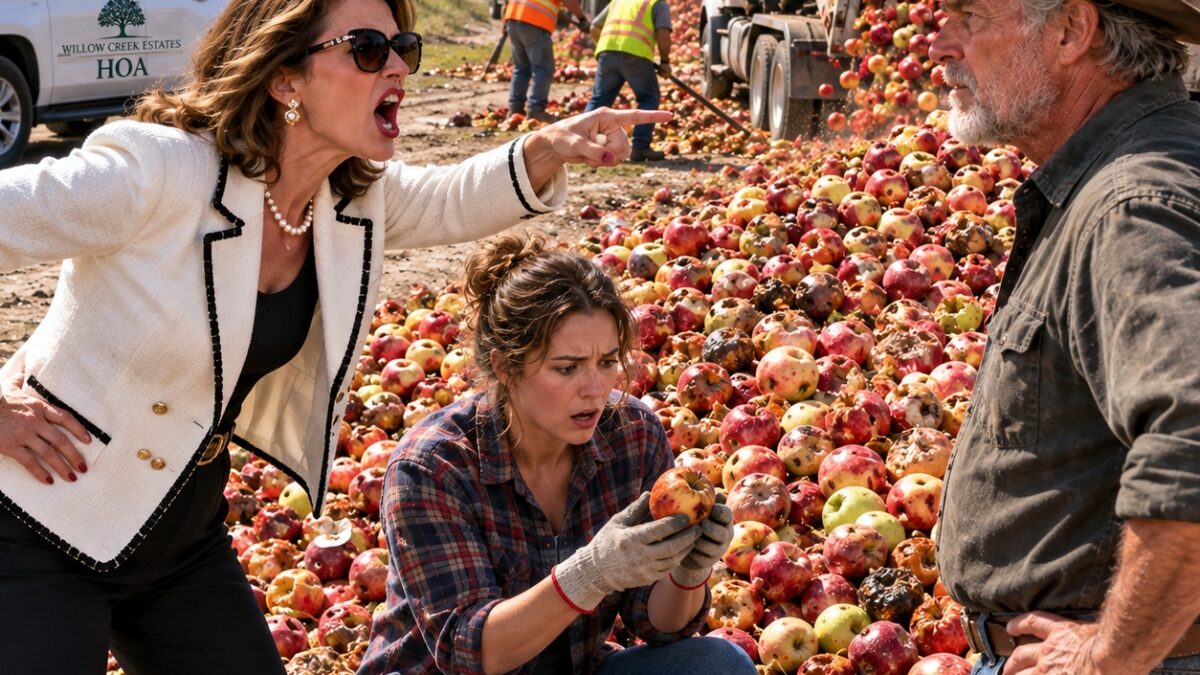
She turned the apple slowly in her hand.
“What?”
“This is a packing-house identifier.”
I looked at the sticker.
It meant nothing to me.
A little code.
Numbers and letters.
Nora knew better.
“These came through commercial handling.”
“So somebody in the neighborhood bought grocery-store apples and threw them out.”
“No.”
She picked up another.
Different sticker.
Another.
Different code.
Then a third.
Her movements became faster.
Focused.
“This is not one source.”
I folded my arms.
“Explain.”
She began creating piles.
One for fruit too far gone to use.
One for bruised but potentially processable fruit.
One for apples with mostly cosmetic damage.
“What are you doing?”
“Sorting.”
“I can see that.”
“Different commercial lots. Different varieties. Some of these have packing identifiers. Look here.”
She held one up.
The skin had a scar.
No deep rot.
“This would get rejected for retail appearance.”
“Meaning?”
“It looks ugly.”
“That makes it garbage?”
“For a grocery display? Sometimes.”
She found another.
Small.
Perfectly firm.
“Too small.”
Another.
Uneven red coloration.
“Color inconsistency.”
Another.
Surface bruising.
“Still processable if handled properly.”
I looked at the mountains Heather had dumped against my fence.
“So these aren’t trash.”
“Some are.”
She pointed to fruit already collapsing.
“That is compost.”
Then at the rest.
“But a lot of this is recoverable.”
The word Heather had used came back.
Waste.
Nora looked toward the barn.
“Where’s Grandpa’s old cider press?”
I laughed.
“That thing?”
“Does it work?”
“Probably.”
“Then let’s find out.”
I was not trying to start a business.
That needs to be clear.
I was irritated.
Curious.
And too stubborn to let Heather’s dumping become exactly what she intended.
A cleanup bill for me.
Nora wanted to run a test.
So we selected several hundred pounds of usable fruit.
We washed every apple.
Anything questionable went straight to compost.
Anything salvageable was trimmed.
Then we ran the fruit through the old press my father had used years earlier.
The first juice came out cloudy gold.
Not beautiful by supermarket standards.
It smelled incredible.
Nora tasted it.
Then handed me a cup.
“Try.”
Sweet first.
Then sharp acidity.
Much richer than I expected.
“That’s good.”
“Very.”
“Is it safe?”
“We’re not selling anything until laboratory testing says what we have.”
That was Nora.
Excitement first.
Then discipline.
She took samples.
Recorded varieties.
Marked batches.
Sent them to a food laboratory.
For two days, I went back to normal farm work while pretending I was not thinking about the results.
Heather did not call.
No trucks returned.
I assumed she had successfully transferred her problem and forgotten about it.
Then Nora phoned.
“Dad.”
“Yes?”
“Do not throw anything away.”
I stopped walking.
“What happened?”
“The juice has unusually high natural acidity.”
“That sounds bad.”
“For drinking straight, it depends. For shelf-stable processing, it can be excellent.”
She started listing products.
Apple butter.
Cooking sauces.
Concentrated juice.
Vinegar.
Then she stopped.
“And something else.”
“What?”
“I’m not telling you until I confirm it.”
“You called me to tell me you’re not telling me something?”
“Yes.”
“You get that from your mother.”
“See you tonight.”
She arrived carrying a cardboard box.
Inside were several small bottles.
Different batches.
Different varieties.
She placed one on the counter.
“Try that.”
I did.
Sweet.
Sharp.
Then deep, almost caramel-like fruit flavor.
“What is it?”
“Apple reduction.”
“Meaning?”
“Concentrated fruit sauce.”
“It’s good.”
“Restaurant good.”
I looked at the bottle.
“This came from Heather’s garbage.”
“Rejected fruit.”
“Same thing to her.”
“Not scientifically.”
She smiled.
A few days earlier, the apples had been somebody else’s disposal problem.
Now we had bottles on my kitchen counter.
That should have been enough to make the whole situation interesting.
It was not even the beginning.
The next morning, I walked through my own orchard.
My trees were older than most of Willow Creek Estates.
Some had been planted by the previous owner.
Others descended from older lines.
I had never treated the orchard like a major commercial operation.
We harvested enough for family.
Neighbors.
Small farmers-market sales.
Nothing ambitious.
Then I noticed something.
A few of the dumped apples looked remarkably similar to varieties growing on my property.
Not the common supermarket types.
Older shapes.
Odd coloration.
Fruit that did not travel well but had flavor.
I called Nora again.
She compared our orchard samples to the recovered fruit.
“This is interesting.”
“What?”
“Some of these varieties aren’t common anymore.”
“Good or bad?”
“For grocery retail? Complicated.”
“Why?”
“They don’t ship beautifully. They bruise. Some ripen inconsistently. But flavor can be exceptional.”
“And processing?”
Her expression changed.
“Sometimes old varieties are much more interesting for processing than modern retail varieties.”
I asked the question I had been avoiding.
“Could this make money?”
She did not answer.
She called someone.
That person was Miguel Santos.
Miguel worked for a regional grocery distributor supplying more than forty stores.
Nora described the test batches.
Sent pictures.
Provided basic laboratory information.
Miguel asked for samples.
Three days later, a refrigerated van pulled into my farm.
Miguel stepped out.
Mid-forties.
Fast-moving.
The kind of man who seemed to evaluate everything while pretending to make conversation.
He tasted the reduction first.
Then the vinegar Nora had started.
Then a small experimental cider batch.
He set the glass down.
“How much can you produce?”
I laughed.
“This was an experiment.”
He did not.
“I’m not asking how much you have.”
He pointed toward the barn.
“I’m asking what you could produce.”
“Why?”
“Because we are constantly looking for locally produced processed fruit products with a real supply story.”
“What kind of supply story?”
“Recoverable fruit. Minimal waste. Small-farm production. Heritage varieties if you can verify them.”
He picked up the reduction again.
“And this tastes good.”
Nora looked at me.
Miguel said:
“If you can keep quality consistent, I could test it in twelve stores.”
“Twelve?”
“Initially.”
“And what would you pay?”
He gave me a number.
I thought he was joking.
He was not.
That evening, Nora and I sat at my kitchen table with the laboratory report.
I kept staring at Miguel’s estimated wholesale price.
The numbers made no sense next to Heather’s word.
Waste.
Nora tapped the report.
“There’s more.”
“You keep doing that.”
“What?”
“Keeping the interesting part until the end.”
She turned the paper.
“These heritage-looking apples have characteristics that are unusually good for fermentation.”
“Cider?”
“Premium cider.”
I leaned back.
“You’re telling me Heather dumped thousands of dollars of product beside my fence.”
Nora shook her head.
“No.”
That answer surprised me.
She pointed at the final line.
Suitable for premium heritage fruit fermentation trials.
“I’m saying she may have dumped something much more interesting.”
I stared through the window toward the orchard.
For the first time, the mess looked different.
Not free money.
It was not that simple.
Most of the fruit still required sorting.
Some had to be discarded.
Processing required equipment.
Sanitation.
Testing.
Licensing.
Labor.
Packaging.
Buyers.
Nothing about it was effortless.
But it was opportunity.
Heather returned four days later.
This time, she brought a lawyer.
They parked near the northern fence.
Most of the original piles were gone.
The unusable fruit had become compost.
The salvageable portion was inside our processing area.
The most interesting varieties had been separated and documented.
Heather stepped out.
Her eyes went immediately toward the cleared pasture.
“Where are the apples?”
I leaned against the fence.
“Why?”
“They belong to the association.”
I laughed.
“You dumped them here.”
“They were temporarily stored.”
“You called them waste.”
“Temporary storage does not transfer ownership.”
“Neither does dumping.”
Her attorney stepped forward.
Thin man.
Gray suit.
Leather folder.
“Mr. Hail, Willow Creek Community Association transferred agricultural material to your property under its community sanitation program.”
I looked at him.
“Transferred?”
“Yes.”
“You mean dumped.”
“The association maintains it retained ownership.”
“Then it should have retrieved them.”
Heather said:
“We’re retrieving them now.”
“You’re too late.”
“Those apples were never yours.”
I nodded.
“Neither was my pasture.”
Nora came out of the barn.
She had heard enough.
She approached holding a clipboard.
Heather glanced at her.
“And you are?”
“Nora.”
“My daughter,” I said.
Nora looked at the attorney.
“If you’re claiming ownership, I’d like to see the transfer record.”
He blinked.
“What transfer record?”
“The document proving the HOA purchased or legally acquired these apples.”
Heather said:
“They are association waste.”
Nora smiled.
“Then why do you suddenly want them back?”
Silence.
That was when I understood.
Heather knew.
Maybe not everything.
But she knew we had started doing something with the fruit.
She was not worried about apples decomposing near my fence anymore.
She was worried they had stopped being worthless.
The lawyer changed approach.
“Our client is willing to resolve this amicably.”
“How?”
“We’ll remove any remaining material and reimburse cleanup expenses.”
“Fine.”
“However, the association requests that you discontinue any commercial use.”
I looked at him.
“Why?”
He glanced at Heather.
“There may be regulatory concerns.”
Nora asked:
“Which regulations?”
Nothing.
Heather finally said:
“You cannot turn community waste into commercial product without authorization.”
Nora folded her arms.
“From who?”
“The association.”
“That isn’t how food law works.”
The lawyer interrupted.
“This isn’t a food-law debate.”
Nora said:
“No. It’s a debate about why something became valuable four days after you called it garbage.”
They left without taking anything.
By that afternoon, Miguel called.
His first test location wanted two hundred cases.
I thought I had heard wrong.
“Two hundred?”
“Initial order.”
“One store?”
“Yes.”
He explained that the buyer had sampled the products with managers.
They liked the flavor.
More importantly, customers responded to the concept.
Locally recovered fruit.
Small farm.
Heritage varieties.
Minimal waste.
“What do we call it?” he asked.
I had not thought that far.
Nora had.
“Fence Row Orchard.”
I looked at her.
“Why?”
She smiled.
“Because that’s where it started.”
I liked that.
Not fancy.
Honest.
Our first production run began the next week.
We were careful.
Painfully careful.
Food safety came before the story.
Every apple inspected.
Anything moldy beyond safe trimming disappeared into compost.
Anything questionable disappeared too.
The usable fruit was washed.
Sorted.
Trimmed.
Pressed.
Cooked.
Fermented where appropriate.
Bottled.
Documented.
The old barn began changing.
Temporary stainless tables.
Cleaning stations.
Batch sheets.
Thermometers.
Labels.
It was messy.
Slow.
Completely different from the farming I had done for most of my life.
But it worked.
The first grocery shipment left on a Wednesday.
Thirty-six cases.
Two days later, Miguel called.
“Richard.”
“What broke?”
“Nothing.”
He laughed.
“That’s the problem.”
The first stores had sold through faster than expected.
One wanted another shipment immediately.
A second wanted vinegar.
A third wanted more of the reduction.
Then a regional buyer asked for a meeting.
“How many stores?”
“Forty-two.”
I sat down.
Nora came in that afternoon with production projections.
“We need more apples.”
I pointed toward the orchard.
“I have apples.”
“Not enough.”
“Local growers?”
“Already calling them.”
That was Nora again.
Three steps ahead.
Several small orchards nearby had rejected fruit they could not sell through normal grocery channels.
Too small.
Bruised.
Scarred.
Odd color.
We could buy it.
Fair price.
Process it locally.
Give growers revenue from fruit that otherwise had little market value.
Suddenly, this was no longer about Heather’s eight trucks.
It was becoming a supply model.
Then Heather came to the barn.
She stood outside while two employees loaded boxes into a refrigerated truck.
Her eyes went to the labels.
FENCE ROW ORCHARD.
She picked up a bottle.
“You’re selling this?”
“Yes.”
“You used the association’s fruit.”
“Some of it.”
“Without permission.”
I put down the box in my hands.
“You threw it away.”
“We never authorized commercial processing.”
“You authorized dumping.”
She stared at me.
Then said something that would have been funny if she had not been serious.
“The association wants a percentage.”
I laughed.
“Of what?”
“Revenue.”
“Why?”
“Because the fruit originated inside Willow Creek.”
“Then ask the residents who grew it.”
“This isn’t a joke, Richard.”
“Neither is ownership.”
She stepped closer.
“We can make this very difficult.”
Nora looked up.
“How?”
Heather ignored her.
“You have already violated community rules.”
I stared.
“I do not live in your community.”
“Your business affects the community.”
“My business operates on my farm.”
“You have commercial traffic.”
“One delivery truck.”
“Customers.”
“Not many on-site.”
“Noise.”
“From what?”
She looked toward the processing barn.
“Equipment.”
“You can barely hear it from my driveway.”
Then came smell.
Signage.
Appearance.
Traffic.
Every argument sounded improvised.
She eventually turned and walked away.
The next morning, I received a formal letter.
Eleven alleged violations.
Commercial activity.
Agricultural processing.
Traffic.
Waste handling.
Noise.
Odor.
Unapproved signage.
Food production.
Customer deliveries.
Property appearance.
And my favorite:
Unapproved fruit disposal.
Nora read the list twice.
Then pointed.
“They dumped fruit on your farm and cited you for receiving it.”
“That takes creativity.”
I called Daniel Price.
Daniel had handled property work for me before.
He drove out that afternoon.
Read the letter.
Then smiled.
“I think Heather made a mistake.”
“Which one?”
“She wrote everything down.”
He asked for my property map.
Then Willow Creek’s HOA declaration.
We spread both out.
My property was not inside their jurisdiction.
Not one acre.
Not one barn.
Not one strip beside the fence.
Daniel tapped the line.
“They have no enforcement authority over your farm.”
“I know.”
“Then most of this letter is meaningless.”
“Most?”
“County zoning still matters. The HOA doesn’t control you, but the county does.”
Fair.
So we checked.
My zoning allowed agricultural processing as an accessory use.
Direct agricultural sales were permitted.
Our delivery volumes remained below county commercial thresholds.
The processing operation qualified.
Daniel closed the file.
“She is trying to create jurisdiction by sending enough paper.”
“That sounds like Heather.”
Then something even bigger happened.
A buyer representing a regional grocery chain had seen the products.
Seventy-five stores.
Seasonal supply agreement.
Projected annual value higher than anything my farm had produced in one year before.
I did not sign immediately.
The number was exciting.
Also dangerous.
Growing too fast destroys good businesses all the time.
I wanted reliable supply.
Food safety.
Consistent product.
Proper equipment.
Traceability.
Nora agreed.
Then she found the source of Heather’s apples.
She traced the packing-house codes.
They did not come from random Willow Creek homeowners.
They came from commercial orchards around the development.
Heather’s HOA had a private waste-hauling arrangement.
The orchard owners paid Willow Creek to remove rejected fruit.
I stared at Nora.
“So the HOA was collecting apples from commercial orchards.”
“Yes.”
“And charging them?”
“Yes.”
“Then dumping it on me.”
“Yes.”
“But why tell me it came from homeowners?”
She looked at the paperwork.
“That’s what we need to find out.”
Daniel found the contract.
The HOA was listed as waste coordinator.
Not owner.
That distinction mattered.
The association had been paid to remove rejected fruit.
But no document transferred ownership of the fruit to Willow Creek.
Even more interesting, the HOA charged the orchards by weight.
They got paid to collect it.
Then dumped it on my farm for free.
Heather had made money coming and avoided disposal cost going.
But the contract used one phrase that changed the entire argument.
Recoverable agricultural material.
Not garbage.
Nora looked at me.
“They knew.”
Daniel nodded.
“They knew at least that the material had potential secondary use.”
The contract contained approved destinations.
Composting facilities.
Animal-feed processors.
Biomass facilities.
An agricultural recovery program.
Hail Farm was nowhere on the list.
Heather had not accidentally sent authorized material to an approved recovery site.
She had dumped it where she hoped nobody would complain loudly enough.
Then something else appeared.
One orchard in the contract carried a note.
HERITAGE VARIETY SOURCE.
RESTRICTED COMMERCIAL PROPAGATION.
Nora froze.
“What?”
“If those heritage apples came from that orchard…”
“What?”
She opened our lab report.
The unusual batches.
High acidity.
Strong fermentation performance.
Older varieties.
She looked at me.
“Dad, some of those seeds may be viable.”
“So?”
“That orchard has been maintaining protected heritage genetics.”
I still did not understand.
She explained.
Certain older apple lines were becoming commercially rare.
Preservation programs existed to maintain them.
If properly documented and legally propagated, we could potentially establish a registered heritage orchard on my farm.
“Would that be valuable?”
“Potentially more interesting long-term than the grocery business.”
I looked toward my own old trees.
“That serious?”
“Yes.”
Heather had not simply dumped bruised fruit.
She may have dumped genetic material tied to a preservation program she had been paid to manage.
The next morning, a county agricultural inspector arrived.
Samuel Ortiz.
No warning.
He checked the barn.
Sanitation records.
Equipment.
Batch sheets.
Source documentation.
Nora handed him everything.
He moved slowly until he reached the heritage notation.
Then stopped.
“Where did these apples come from?”
“The HOA dumped them on my land.”
Samuel looked up.
“What HOA?”
“Willow Creek.”
He closed the folder.
“That may be a problem.”
My stomach tightened.
“For us?”
“Possibly. Possibly not.”
He pointed to the heritage notation.
“Some of this material is connected to a state agricultural preservation program.”
Nora asked:
“Does that prohibit processing?”
“Not automatically.”
He looked toward my orchard.
“The bigger issue may be how Willow Creek got access to the fruit and what they were authorized to do with it.”
That afternoon, Daniel found the answer.
Ten years earlier, when Willow Creek Estates had been developed, the HOA had inherited limited responsibility for maintaining a buffer around an old heritage orchard.
It was not ownership.
Maintenance responsibility.
The association could collect fallen fruit for approved purposes under the preservation arrangement.
Then Heather expanded the program.
Commercial orchards began paying the HOA to coordinate removal of rejected fruit.
The money was substantial.
Over five years:
$643,800.
I stared at the figure.
“Six hundred forty-three thousand?”
“Eight hundred,” Daniel said.
“From apples?”
“Agricultural recovery and disposal fees.”
“Did homeowners know?”
“Not the full arrangement.”
Nora sat across from us.
“Now we know why she wanted the fruit back.”
Daniel shook his head.
“Not entirely.”
He pulled out an internal HOA memorandum.
Six months old.
The document mentioned my farm.
Fence Row did not exist yet.
This was before Heather had dumped the loads.
The note discussed heritage fruit.
Preservation obligations.
Agricultural recovery.
At the bottom, in Heather’s handwriting:
Do not allow Hail to commercialize recovered fruit. It could expose the association’s existing agricultural contracts.
I read it twice.
Then a third time.
“This existed before she dumped the apples.”
“Yes.”
“So she already worried about me processing fruit.”
“Apparently.”
“Why me?”
Daniel shrugged.
“Maybe because you had an orchard. Maybe because your property bordered the handling route. Maybe there had already been discussion we haven’t found.”
Nora leaned back.
“She didn’t come after Fence Row because she suddenly hated our business.”
“No,” I said.
“She came after it because the business made people ask where the fruit came from.”
Daniel nodded.
“And that question leads straight into the HOA contracts.”
That was the first moment the grocery orders became secondary.
We had thought the conflict was:
Heather dumped apples.
I made something useful.
She became jealous.
Too simple.
The real conflict was hidden in paperwork.
Willow Creek had been collecting hundreds of thousands of dollars through an agricultural recovery program.
Some of the material involved protected heritage varieties.
Heather knew commercialization by an outsider might cause people to trace the fruit.
And once they traced it, they might ask where the money went.
Daniel requested a formal meeting with the HOA board.
Heather resisted.
The board called one anyway.
The room was packed.
Not a courtroom.
Just one of Willow Creek’s community rooms.
Long table.
Microphones.
Residents in folding chairs.
Heather sat at the head.
For years, that seat had belonged to her almost psychologically.
She wore the same expression she always did.
Controlled.
Slightly impatient.
Prepared to educate everyone.
Daniel placed two pages in front of each board member.
First page:
Agricultural recovery agreement.
Second:
Heather’s handwritten instruction.
Do not allow Hail to commercialize recovered fruit. It could expose the association’s existing agricultural contracts.
Silence.
Heather finally said:
“That sentence is being taken out of context.”
Daniel looked at her.
“What context makes it mean something different?”
She did not answer.
The HOA attorney picked up the page.
“President Caldwell, did you write this?”
Heather looked around.
“I don’t remember.”
From the other end of the table, Margaret Lewis spoke.
“I do.”
Heather’s head turned.
Margaret was the HOA treasurer.
Quiet woman.
Usually careful.
The kind of person who seemed more comfortable with spreadsheets than confrontation.
Heather said:
“Margaret.”
Margaret opened a folder.
“I asked you what that note meant.”
“When?”
“About eight months ago.”
Heather’s jaw tightened.
“And?”
“You told me Richard’s farm could interfere with the agricultural recovery contracts if he began processing fruit independently.”
Daniel asked:
“Did you know the HOA did not own the fruit?”
Margaret looked down.
“Not originally.”
“When did you learn?”
“About eight months ago.”
Heather interrupted.
“That isn’t relevant.”
Margaret looked directly at her.
“It became relevant when I found the payments.”
The room changed.
She opened another folder.
Five years of recovery and disposal revenue.
$643,800.
Daniel asked:
“Where did it go?”
“Operating expenses. Maintenance. Then several consulting accounts.”
“How much to outside consultants?”
Margaret turned a page.
“About $186,000.”
“Any related parties?”
She hesitated.
Heather spoke.
“Be careful.”
Margaret continued.
“One consulting company belongs to Heather’s brother.”
People began whispering.
Heather immediately said:
“That does not mean anything improper happened.”
And technically she was right.
A relationship does not prove illegality.
The documentation did.
Or failed to.
Another company belonged to a former contractor involved in the recovery program.
Daniel asked:
“Were all consulting contracts approved by the full board?”
“No.”
“How much was paid through contracts without complete approval?”
Margaret checked.
“Approximately ninety-four thousand.”
Heather leaned toward her microphone.
“This is becoming a witch hunt.”
I looked at her.
“No.”
Everyone turned toward me.
“It’s becoming bookkeeping.”
A few nervous laughs.
I was not trying to humiliate her.
I meant it.
Paper.
Money.
Authority.
Ownership.
Simple questions.
Who received the fruit?
Who owned it?
Who paid whom?
Who approved what?
No witch required.
Samuel Ortiz from the county preservation office attended.
He explained the original heritage program.
The old orchard had been preserved not merely because the trees were pretty or historic.
The genetic varieties themselves mattered.
Some were disappearing commercially.
Willow Creek inherited limited maintenance responsibility when homes were built nearby.
The HOA could collect fallen fruit for approved preservation, composting, research, or recovery purposes.
It could not treat protected material as its private commercial property without complying with the preservation agreement.
Heather interrupted.
“Then Mr. Hail shouldn’t be selling it.”
Samuel looked at her.
“That is not what the agreement says.”
She stopped.
“It requires traceability.”
He looked toward me and Nora.
“Mr. Hail’s operation has traceability.”
That was Nora’s doing.
Every supplier.
Every batch.
Every processing date.
Every test.
Every bottle.
She had documented all of it because she refused to let the excitement become an excuse for sloppy food production.
Now that discipline mattered beyond food safety.
Daniel laid out the chain.
Commercial orchard.
Recovery contractor.
Willow Creek collection.
My pasture.
Processing barn.
Grocery distributor.
Every step documented.
Then the missing document.
No transfer from the HOA to me.
Because there had been no sale.
No gift.
No temporary storage agreement.
They had dumped the fruit.
Daniel summarized:
“The association cannot retroactively convert a disposal action into an ownership claim simply because the discarded material became commercially valuable.”
Heather stood.
“This is absurd.”
She pointed at me.
“He is making money because the association gave him the fruit.”
I shook my head.
“No.”
She stared.
“I’m making money because I took something you called garbage and turned it into something people wanted.”
For the first time, Heather seemed to lose control of the room.
No yelling.
No dramatic confession.
She simply had no answer that fit all the documents.
Then Miguel Santos arrived.
Daniel had asked him to attend as a commercial witness.
Miguel explained the product testing.
Sales.
Demand.
The proposed seasonal supply agreement.
Seventy-five stores initially.
Potential expansion if customers responded.
One homeowner raised a hand.
“Why do grocery stores want this?”
Miguel smiled.
“Because it tastes good.”
People laughed softly.
Then he continued.
“And customers respond to what it represents.”
He counted on his fingers.
“Small farm.”
“Heritage varieties.”
“Local processing.”
“Minimal waste.”
The last phrase hung there.
Minimal waste.
The entire business had begun because Heather wanted waste off Willow Creek’s books.
I spoke before anyone could turn the meeting into a celebration of me.
“We will continue only if we can do this properly.”
Nora looked at me.
I continued.
“We buy fruit legally from growers.”
“Pay fair prices.”
“Maintain traceability.”
“Document heritage material.”
“Compost anything unsuitable.”
“No shortcuts.”
Miguel nodded.
Samuel did too.
The county approved the process for formally registering parts of my orchard under the heritage program.
The old trees on my farm would become a foundation for documented propagation.
The grocery operation would remain separate enough to preserve clean records.
That distinction mattered.
I did not want to build a successful business out of the same kind of sloppy authority Heather had relied on.
If Fence Row Orchard lasted, it had to survive scrutiny.
The HOA attorney then returned the conversation to Heather.
A motion was made.
Effective immediately, Heather Caldwell’s authority to execute agricultural, commercial, or property-related agreements on behalf of Willow Creek Estates would be suspended pending independent review.
Vote.
Eight to one.
Heather voted against it.
Nobody else did.
For someone who had spent years speaking as though disagreement was merely confusion waiting for correction, watching eight board members refuse to follow her was striking.
She did not scream.
Not then.
She sat very still.
The board authorized an independent audit.
Agricultural recovery payments.
Consulting contracts.
Approvals.
Related-party relationships.
Recovery destinations.
Everything.
The association also stopped claiming ownership over agricultural material collected from property outside its own boundaries.
That line mattered to me most.
Stay on your side of the fence.
Literally and legally.
Over the following months, auditors worked.
Some payments were legitimate.
I am careful about saying that because anger makes people want every suspicious thing to become criminal.
Reality was more complicated.
Some services were real.
Some invoices existed.
Some expenses were appropriate.
Others were poorly documented.
Several consulting charges could not be adequately supported.
The association agreed to return money tied to unauthorized arrangements and restructure the entire recovery program.
Heather eventually resigned.
She never apologized.
I was not waiting for one.
Apologies are useful when people mean them.
Paper correction was more important.
She no longer had authority to sign contracts that could affect other properties.
The agricultural program would have oversight.
Residents finally knew what had been operating behind the phrase “community sanitation.”
And my farm?
My farm changed.
Gradually.
That part mattered.
The county preservation office inspected the orchard.
Nora handled documentation.
We identified several older varieties.
Registered what could be verified.
Used approved propagation material for new trees.
Not seeds collected carelessly from uncertain sources.
Properly documented stock.
The old barn changed too.
What began with a borrowed cleaning station and my father’s press grew into a real small processing facility.
Not a factory.
Still a farm operation.
But organized.
Wash stations.
Stainless equipment.
Presses.
Cooking systems.
Fermentation tanks.
Bottling equipment.
Cold storage.
Batch-control procedures.
The kind of infrastructure Nora had been telling me we would need while I kept saying:
“Let’s see if anyone buys it first.”
People bought it.
Local growers began calling us.
“I have three thousand pounds of cosmetically rejected Gala.”
“We’ve got storm bruising.”
“Packing house refused half this load for size.”
“Can you use it?”
Sometimes yes.
Sometimes no.
We paid fair prices for usable fruit.
That mattered.
I did not want Fence Row Orchard’s business model to depend on farmers giving away something because supermarkets rejected it.
If we could turn their low-value fruit into a higher-value product, they deserved a share through an honest purchase price.
Nora insisted on that.
I agreed.
Fruit came in.
Every load checked.
Mold?
No.
Unsafe decay?
No.
Contamination?
Rejected.
Good fruit hidden behind an ugly appearance?
Process it.
What could not become food became compost.
Nothing went into a bottle because we needed volume.
Safety first.
Story second.
That rule protected everything.
The heritage fruit line became more interesting over time.
Some varieties were incredible for reduction.
Others for cider.
Some too soft for shipping but beautiful for sauce.
Others carried sharp acidity that blended well.
The grocery business taught me something I should have known from farming already.
Uniformity and quality are not the same thing.
Grocery produce is selected partly because it travels.
Stacks.
Looks consistent.
Survives handling.
Those are legitimate commercial needs.
But the traits that make a fruit good-looking after a thousand-mile journey are not necessarily the traits that create the best flavor in a bottle.
Heather had seen rejected appearance.
Nora saw chemistry.
Miguel saw a market.
I eventually saw a business.
Different eyes.
Same apple.
The first major shipment under the new agreement left on a cool October morning.
Not thirty-six cases.
Twenty refrigerated pallets.
I stood beside the loading dock while the final pallet went in.
Forklift backed out.
Trailer doors shut.
Nora walked up holding two coffees.
“Remember the first morning?”
I looked toward the northern fence.
“Unfortunately.”
She laughed.
“All those apples.”
“Hard to forget several tons fermenting beside your pasture.”
“Your favorite HOA gift.”
“It wasn’t a gift.”
“What was it?”
I looked at the truck.
“A mistake.”
She smiled.
“Expensive mistake.”
“Not for me.”
She handed me a bottle.
New label.
FENCE ROW ORCHARD.
Underneath:
Heritage Apple Reduction.
Grown and Processed at Hail Farm.
I turned it around.
Ingredients:
Apples.
Simple.
The story behind it was anything but.
I thought back to Heather sitting in the SUV.
These apples are waste.
So certain.
That certainty had been the beginning of everything.
Not the dumping by itself.
The assumption.
Ugly equals worthless.
Rejected equals useless.
Not wanted here equals not valuable anywhere.
That belief existed throughout the entire system.
Packing houses rejected fruit because customers expected visual standards.
Fine.
Orchards needed a way to move it.
Fine.
Willow Creek built a recovery program.
That could have been good.
Then the program became opaque.
Money moved.
Authority stretched.
Fruit got treated as something the HOA could control despite not owning it.
And when Heather needed somewhere inconvenient material could disappear, she chose my farm.
That was her mistake.
Not because I possessed some magical formula for turning rotten fruit into millions.
I did not.
A lot of the apples were genuinely useless for food.
We composted them.
The valuable part required work.
Sorting.
Testing.
Food science.
Processing.
Distribution.
Regulation.
Agricultural knowledge.
The opportunity existed because Nora took the time to ask:
What is actually here?
That question changed everything.
Months after Heather resigned, I walked the same northern fence line.
Grass had recovered.
No apples.
No trucks.
Beyond the fence, Willow Creek looked exactly as it always had.
Perfect lawns.
Matching signs.
New homes.
The kind of landscaping Heather loved.
Somewhere in those houses, I imagined residents opening refrigerators and finding Fence Row Orchard products their own grocery stores now carried.
That made me smile.
Not because I had beaten them.
The homeowners had not dumped the apples.
Most had never known what Heather was doing.
Some eventually became customers.
Good.
I had no reason to punish a neighborhood for one woman’s decisions.
I stopped by the old gate.
I could still picture the first morning.
Orange vests.
White SUV.
Heather telling the truck driver to keep unloading.
Me standing in front.
The driver shutting off the engine.
Eight loads.
Waste.
I wonder sometimes what would have happened if I simply paid somebody to haul it away.
Probably nothing.
The apples go to compost or landfill.
Heather’s agricultural contracts remain hidden longer.
Fence Row never exists.
The heritage varieties on my own farm remain something I harvest casually.
Local growers keep discarding cosmetically imperfect fruit.
A regional grocery product never develops.
All because I accepted her definition.
Waste.
Words matter.
They tell you what category to place a thing in.
Once something enters the category of waste, people stop investigating it.
That was Heather’s advantage.
Waste does not need accounting beyond removal cost.
Waste does not need ownership questions.
Waste does not need traceability.
Waste is what people pay to make disappear.
But her own contracts used a different phrase.
Recoverable agricultural material.
That phrase required questions.
Recoverable into what?
By whom?
Under what authority?
Who gets paid?
Who owns it?
Where can it legally go?
Once those questions started, Heather’s control weakened.
That was what her handwritten memo revealed.
Do not allow Hail to commercialize recovered fruit.
It could expose the association’s existing agricultural contracts.
She knew visibility was dangerous.
Not because my apple butter threatened civilization.
Because success attracts curiosity.
If Fence Row failed quietly, nobody cared where my first fruit came from.
If grocery stores started stocking it?
People asked.
Where did you get the apples?
Why did an HOA have them?
Why did the HOA dump them?
What was the recovery program?
How much money did it make?
Who got paid?
That is how small questions become audits.
Heather understood that before I did.
Her mistake was trying to stop the questions after she had already delivered the evidence to my fence.
I never needed to search Willow Creek’s offices.
Never needed to hack emails.
Never needed to spy.
The apples came to me.
Then Heather put her jurisdiction claims in writing.
Then Nora traced packing codes.
Then Daniel read contracts.
Then Margaret opened the books.
Then Samuel explained the preservation rules.
Everything came from documents people had created themselves.
That is something I appreciated.
No dramatic revenge.
No secret camera.
No hidden inheritance clause.
Bookkeeping.
Exactly what I told Heather.
The truth usually looks less exciting than people expect.
Invoices.
Signatures.
Batch codes.
Boundary maps.
Meeting minutes.
Packing-house stickers.
But put enough boring documents beside each other and they can become devastating.
Heather had spent years relying on nobody connecting them.
Margaret had revenue records.
Someone else had contracts.
County had preservation terms.
Orchards had packing identifiers.
Nora had laboratory analyses.
I had land.
Individually, fragments.
Together, story.
The audit caused Willow Creek embarrassment.
Residents were angry.
Understandably.
They had been told the agricultural recovery program was essentially sanitation.
They discovered it generated hundreds of thousands.
Some money supported association operations.
Some outside consulting.
Some related parties.
That did not automatically make every payment wrong.
But hiding or poorly disclosing revenue creates mistrust even where expenditure is legitimate.
That is the price of opacity.
Once people suspect the books, every line becomes questionable.
Heather complained that residents had turned on her.
I heard that through others.
Maybe she believed it.
From her perspective, perhaps she had managed programs, solved problems, generated income, kept common areas clean.
Then one farmer made apple sauce and suddenly everybody wanted invoices.
But leadership works like that.
Authority is easiest when nobody asks.
Trust is proven when they do.
If your decisions survive questions, good.
If questions threaten everything, the problem is not the questions.
I had spent fourteen years farming outside Willow Creek without wanting anything from them.
No influence.
No vote.
No dues.
No role.
Even after the conflict, I had no interest in HOA politics.
Several residents asked whether I would attend meetings about the new agricultural program.
I declined unless it directly touched my property or supply agreements.
Their association.
Their responsibility.
My lesson was about boundaries.
It would have been ridiculous to win a boundary fight and then start inserting myself into their governance unnecessarily.
Distance can be healthy.
Heather had failed because she refused to respect that.
Her HOA ended at the line.
My farm began.
Simple.
One of the stranger things that happened later was an orchard owner visiting me.
His name was Sam.
He had supplied fruit into the old HOA recovery program.
He walked through our processing barn slowly.
Then said:
“I used to pay them to take this stuff.”
I nodded.
“Now you’re paying me.”
“Yes.”
He laughed.
“Something is backwards.”
“Depends which market you’re serving.”
His rejected fruit had been worth almost nothing under the fresh-retail standard.
Under processing, it had value.
Not equal to perfect fresh fruit.
But something.
Enough to offset harvest and handling.
Enough to reduce waste.
Enough that a farmer no longer had to pay someone to make usable produce disappear.
Sam watched apples moving through the wash line.
“My father would hate this.”
“Why?”
“He spent thirty years trying to grow apples pretty enough for grocery stores.”
I smiled.
“Mine would’ve said cider doesn’t care what the skin looks like.”
Sam laughed.
“That sounds like him.”
That became Fence Row’s philosophy.
The bottle does not care whether the fruit had a cosmetic scar before pressing.
The customer cares whether it tastes good and is safe.
That created a second life for produce the visual market rejected.
We never pretended we could use everything.
Some waste is real.
Mold exists.
Rot exists.
Food safety matters.
But “not premium fresh grade” and “worthless” are not synonyms.
Heather had treated them as the same.
So had I, maybe, before Nora challenged me.
That is why I never told this story as:
Old farmer outsmarts stupid HOA.
I did not see the opportunity first.
My daughter did.
I saw a pile.
Knew enough to suspect some fruit was usable.
Nora saw commercial identifiers.
Varieties.
Chemistry.
Processing pathways.
Miguel saw retail demand.
Samuel saw preservation obligations.
Daniel saw ownership.
Margaret saw money.
Everybody contributed expertise.
Heather’s failure was not that she lacked all those skills.
Nobody has all of them.
Her failure was assuming she did not need anyone else’s perspective.
Certainty made her careless.
The irony of Fence Row Orchard was that the business eventually became more valuable because we refused to copy that mistake.
Nora controlled food science and traceability.
I handled farm operations.
Miguel handled distribution.
Growers handled fruit production.
County handled regulatory oversight.
Our lawyer handled contracts.
Nobody got to say:
Trust me, I’m in charge.
If a question belonged to somebody else, ask them.
That is slower than Heather’s method.
Also safer.
The heritage program became the part I cared about most.
More than grocery numbers.
The county helped us identify which old trees on my land belonged to documented lines and which were simply older unknown varieties.
We did not guess.
Registered material came from approved propagation sources.
Records stayed clean.
Over time, rows of young heritage trees appeared beside some of the old ones.
That felt different from launching a product.
Products sell.
Trees outlive you.
I was sixty-seven when Heather dumped those apples.
You start thinking in different time spans at sixty-seven.
Not:
What can I build next year?
Also:
What will still be here after I’m not?
The young trees might reach full maturity when I was much older.
Some perhaps after I was gone.
Nora would know them.
Maybe her children one day.
That gave the whole story a different weight.
Heather had treated fruit as something inconvenient to move.
The preservation program existed because some varieties cannot be recreated once they disappear.
Genetics do not care about HOA budgets.
Lose a rare line, it can be gone.
Keeping it requires patience.
That became Hail Farm’s next chapter.
Not a sudden empire.
A gradual shift.
Processing business.
Expanded orchard.
Documented heritage plantings.
Relationships with local growers.
A better use for fruit that fell outside retail standards.
I still farmed.
Fences broke.
Equipment failed.
Rain came when I did not want it.
Did not come when I did.
The grocery contract did not turn agriculture into magic.
Some batches underperformed.
One season, local supply tightened.
Packaging costs rose.
A refrigeration unit failed at the worst possible time.
Real business.
That mattered to me because the viral version of stories like this often skips work.
HOA dumps apples.
Farmer gets rich.
End.
No.
Heather accidentally delivered raw material and exposed an opportunity.
We built the value.
Those are different.
If I had left the apples beside the fence, they would have rotted.
If Nora had not tested them, no product.
If we ignored sanitation, no legal sales.
If Miguel could not distribute, no market.
If growers would not supply, no scale.
If customers disliked the product, the story ended after one shipment.
Opportunity is not outcome.
Work lives between them.
That became another lesson I carried.
People see successful things after they become visible.
They do not see the hundreds of uninteresting decisions underneath.
Temperature logs.
Cleaning schedules.
Label compliance.
Delivery windows.
Supplier calls.
Rejected batches.
Paperwork.
That is where a business actually lives.
Heather had always liked visible authority.
Signs.
Letters.
Meetings.
Fence Row succeeded through mostly invisible discipline.
Funny contrast.
One winter, months after her resignation, I saw Heather at a county building.
She was leaving as I walked in.
We stopped.
Not because either of us wanted a conversation.
The hallway was narrow.
She looked older.
Or maybe simply less armored.
No HOA badge.
No folder.
No white SUV visible.
“Richard.”
“Heather.”
She looked at me for a moment.
“I heard the orchard was approved.”
“It was.”
“And the grocery contract?”
“Going well.”
Her mouth tightened.
Then:
“You know none of that would have happened if we hadn’t brought you the fruit.”
There it was.
Even after everything.
I almost laughed.
Instead, I said:
“You’re right.”
She looked surprised.
“If you had not dumped it on my land without permission, I probably would not have started Fence Row when I did.”
She nodded as though she had won something.
Then I continued.
“But that doesn’t make what you did lawful.”
Her expression changed.
“And it doesn’t make the work afterward yours.”
Silence.
“You threw away something you didn’t understand.”
I stepped aside.
“That is not the same thing as creating what came next.”
She looked as if she wanted to argue.
Then did not.
We passed.
That was our last real conversation.
I liked it better than an apology would have been.
Not because I wanted the final word.
Because I no longer needed anything from her.
Her agreement was irrelevant.
Heather could continue believing she had somehow gifted me the business.
Fine.
Ownership records said otherwise.
Board records said otherwise.
The audit existed.
Fence Row existed.
My life did not require her version to collapse emotionally.
Facts were enough.
That is another thing age teaches you.
You do not have time to win every argument inside someone else’s head.
Correct the practical problem.
Move on.
The new Willow Creek leadership eventually redesigned the agricultural recovery program.
Growers received clearer contracts.
Approved destinations were documented.
Protected heritage material had traceability.
No informal dumping.
No association claim over property it did not own.
Good.
Some residents were embarrassed by the entire episode.
I told them not to be.
They had not driven the dump trucks.
Organizations make mistakes through leadership.
They can also repair through leadership.
What matters next.
The new board contacted me once about whether Fence Row could become an approved processing destination for certain legally available fruit.
I said maybe.
Under a proper contract.
Nora reviewed the source.
Daniel reviewed ownership.
Samuel reviewed preservation conditions.
Then we accepted some loads.
That might surprise people who expected me to refuse on principle.
Why?
The system was corrected.
The fruit was usable.
Growers needed processing.
We had capacity.
My fight was never:
Nothing from Willow Creek will ever cross my fence again.
My fight was:
You ask first.
You document it.
You respect ownership.
Once that happened, business could happen.
That is the difference between resentment and boundaries.
Resentment says:
Never.
Boundaries say:
Under these terms.
I prefer terms.
They are easier to live with.
The first legitimate Willow Creek load arrived on a weekday morning.
One truck.
Scheduled.
Bill of lading.
Source records.
Weight ticket.
No Heather.
The driver stepped out.
“Where do you want it?”
I almost laughed.
That one question was the entire difference.
Where do you want it?
Not:
We’ve decided.
Not:
This is temporary.
Not:
It’s community waste.
Permission.
I pointed toward the receiving area.
“Back it in there.”
He did.
Nora checked the fruit.
Accepted part.
Rejected part.
Business.
No drama.
I thought about 5:30 that first morning.
How much conflict people create by skipping one sentence.
May we?
Sometimes yes.
Sometimes no.
But at least everyone knows whose choice it is.
My farm had changed enough by then that people sometimes called me an entrepreneur.
I never got comfortable with that.
I was a farmer who learned to process apples because somebody made a mess beside my fence.
Nora rolled her eyes whenever I said that.
“You own a regional food brand.”
“I own a farm.”
“You employ processors.”
“Farm employees.”
“You negotiate grocery contracts.”
“With help.”
“You have branded products.”
“Labels are legally required.”
She would stare.
“You are impossible.”
Probably.
Maybe that was part of why Heather picked the wrong pasture.
She expected inconvenience to produce surrender.
Instead, it produced curiosity.
My father was like that too.
He hated throwing away useful things.
Old equipment parts.
Wood.
Fruit.
Everything had one more purpose if you understood it properly.
The cider press Nora found had belonged to him.
For years, it sat in my barn gathering dust.
Then a machine from another era became the first processing tool in a business selling to modern grocery stores.
I found that fitting.
Nothing finished until it was actually finished.
Trees.
Tools.
Fruit.
Farm.
People, maybe.
My daughter certainly believed the farm had more future than I had allowed myself to imagine.
Before Fence Row, I had been thinking quietly about slowing down.
Not retiring completely.
Farmers are bad at retirement.
But reducing.
Maybe leasing fields.
Letting parts go idle.
Keeping the orchard mostly for family.
Then Heather dumped eight loads against my fence.
Six months later, I was discussing production schedules for seventy-five stores.
Life has terrible timing.
Also good timing occasionally.
Nora became more involved in the farm.
That mattered more to me than the revenue.
She had built her own career.
I never expected her to return and work closely with Hail Farm.
I would not have asked.
Children deserve their own lives.
Fence Row gave us a reason to collaborate without either of us forcing it.
Her knowledge fit something the farm suddenly needed.
She enjoyed it.
I enjoyed pretending not to be impressed when she solved problems I did not understand.
One evening, we walked through the young heritage rows.
She said:
“These could be producing for decades.”
“If we manage them right.”
“You realize we should plan succession.”
I groaned.
“Can we enjoy one sunset before you turn it into legal paperwork?”
“No.”
“Definitely your mother.”
She laughed.
But she was right.
We updated farm plans.
Business structure.
Heritage records.
Processing ownership.
Future management.
That is what enduring value requires.
Document it.
Another lesson Heather accidentally reinforced.
If you leave authority vague, somebody eventually fills the gap.
I wanted no gaps.
Years later, I expect the most valuable thing Fence Row produced may not be a bottle.
It may be knowledge.
Which varieties grow well here.
Which local growers have processing-quality fruit.
How to maintain heritage lines.
What fruit can become when appearance no longer controls price.
That knowledge can outlast a single grocery contract.
Markets change.
Customers change.
Distributors merge.
But understanding your land and product gives options.
Heather’s entire strategy had depended on information inequality.
She knew about contracts I did not.
She assumed that was permanent.
Once information moved, her advantage vanished.
I did not want my own business built the same way.
Growers knew what we paid.
Contracts clear.
Traceability available.
County knew sources.
Buyers knew product standards.
Transparency may make negotiation less exciting.
It creates fewer surprises.
I had experienced enough surprises.
One of the older heritage trees on my property became something of a favorite.
Crooked trunk.
Not especially productive.
Fruit too delicate to ship far.
Incredible flavor when processed.
Nora once said:
“If a modern commercial orchard evaluated this tree purely on fresh-market yield, they might remove it.”
I looked up into the branches.
“Would you?”
“No.”
“Why?”
“Because its value is somewhere else.”
That sentence stayed with me.
Its value is somewhere else.
That was the story of the dumped fruit too.
Heather did not necessarily misjudge whether the apples were poor candidates for grocery shelves.
Some were.
She misjudged whether that was the only form of value they could have.
People make that mistake constantly.
If something fails in one market, one role, one context, they call it worthless.
The apple does not care.
It can become cider.
Vinegar.
Reduction.
Butter.
Compost.
Seedstock where legally appropriate.
Animal feed.
Different path.
Same material.
I found myself applying that thought beyond fruit.
The farm itself.
I had seen Hail Farm mainly as traditional agricultural land.
Orchard.
Fields.
Barns.
Then processing became part of it.
Preservation.
Retail.
Education eventually.
We hosted a small group of agricultural students once.
Nora talked about food waste.
Samuel discussed genetic preservation.
I stood at the back wondering when exactly my quiet farm became someplace college students carried notebooks.
One student asked:
“Did you know immediately the apples could become a business?”
“No.”
“What did you think?”
“I thought I had eight truckloads of somebody else’s problem.”
They laughed.
“Then what changed?”
“My daughter looked closer.”
That was the truth.
Look closer.
Simple.
The first apple I picked up had brown flesh near the break.
Easy to dismiss.
Nora cut away damage.
Found usable fruit.
Then looked at stickers.
Then varieties.
Then lab chemistry.
Every stage came from refusing the first interpretation.
That mindset became Fence Row’s greatest asset.
What exactly is here?
Not:
What do people call it?
Waste.
Old.
Rejected.
Ugly.
Low grade.
Those are labels.
Analysis comes next.
Sometimes the label is correct.
A rotten apple is rotten.
Compost it.
Sometimes it is incomplete.
Bruised apple.
Still food.
Old variety.
Poor shipper.
Excellent flavor.
Small farm.
Limited traditional revenue.
Maybe processing potential.
You discover by looking.
That is what Heather did not do.
She did not need to.
The association was getting paid to remove the fruit.
Under her model, the less value it appeared to have, the better the disposal business looked.
Maybe that incentive shaped perception.
If people make money treating something as waste, they may become strangely resistant to seeing it as resource.
That was part of the agricultural recovery problem.
The HOA was charging disposal fees.
Fence Row bought usable material.
Opposite models.
One earns because the fruit must disappear.
The other earns because the fruit becomes something.
I preferred ours.
Not morally pure.
Still business.
But aligned with reducing waste.
Grower makes some money.
We get raw material.
Customer gets product.
Unusable remains compost.
Good chain.
The preservation varieties required more care because commercializing genetic material is not the same as processing fruit.
Samuel emphasized that repeatedly.
Eating or processing legally available fruit did not automatically grant unrestricted propagation rights.
That is why Nora kept separate documentation.
I mention this because people who heard the story later simplified it into:
HOA dumped rare apple seeds and Richard planted a fortune.
No.
We established the heritage orchard using approved propagation material and county registration.
The original fruit helped identify the opportunity.
The lab work and chain of custody triggered questions.
But we did not simply plant restricted seeds and claim ownership.
Shortcuts would have turned us into exactly what we criticized.
I refused.
If the heritage program meant anything, it had to be protected.
Legally.
Scientifically.
That took patience.
Trees are good teachers of patience.
You can force a meeting.
You cannot force an orchard.
Plant.
Prune.
Wait.
Weather happens.
Years pass.
That pace helped wash some of Heather’s urgency out of my system.
During the conflict, every day felt like another letter.
Another discovery.
Another meeting.
Afterward, tree time returned.
Seasons.
Bud break.
Bloom.
Fruit set.
Harvest.
Human drama gets smaller beside biological cycles.
Heather resigned.
The trees did not care.
The grocery contract expanded.
The trees did not care.
Audit findings came.
The trees did not care.
They just grew.
I appreciated that.
At some point, Willow Creek stopped feeling like the enemy landscape beyond my fence.
It became houses again.
Families.
Dogs.
Kids.
People who happened to live near my farm.
That was healthy.
For a while, the subdivision represented Heather to me.
White SUV.
HOA letters.
Claims.
Then residents began stopping at our small direct-sales area.
One woman recognized me.
“I live in Willow Creek.”
“I figured.”
She held a bottle of apple reduction.
“This is really from the fruit program?”
“Some early batches were.”
She looked embarrassed.
“I didn’t know the HOA was dumping on your land.”
“Most people didn’t.”
“I’m sorry.”
“You didn’t do it.”
She bought two bottles.
That mattered more than a community apology.
Normal interaction.
No inherited hostility.
The story could end there.
But the image I return to is October.
Twenty pallets.
Refrigerated trailer.
Nora beside me.
Bottle in my hand.
That shipment represented everything Heather had failed to imagine.
Not revenge.
Transformation.
I never got rich overnight.
The farm did better.
Much better.
Fence Row became significant.
But agriculture remains agriculture.
Margins.
Equipment.
Labor.
Seasonality.
Nothing magical.
The “huge loss” Heather suffered was not some check written directly to me for millions.
It was control.
Hidden agreements exposed.
Signing authority suspended.
Audit.
Resignation.
Related contracts scrutinized.
A revenue arrangement she had managed quietly forced into daylight.
That is more believable and, to me, more satisfying.
The consequence matched the behavior.
She used opacity.
Lost authority through transparency.
She used HOA paperwork to pretend jurisdiction.
Paperwork proved she had none.
She called recoverable fruit garbage.
Traceability proved its origin.
She demanded a share of revenue.
Ownership documents proved the association had no claim.
She tried to stop commercialization because it might expose contracts.
Commercialization exposed them.
Every result came from her own premise turning backward.
That is why I never felt the need to insult her.
The irony already did enough.
I was standing near the fence one afternoon when a delivery van from Willow Creek’s new recovery contractor passed.
Proper route.
Did not enter my land.
I smiled.
Small things tell you systems have changed.
No one uses Hail Farm as convenient empty space anymore.
No truck arrives before sunrise without authorization.
If something crosses my property, I know why.
That peace is worth more than any speech I could have given Heather.
Property ownership is partly the right to say no.
It is also the right to say yes on your own terms.
Fence Row eventually bought fruit from sources associated with Willow Creek.
That was my yes.
The dump trucks had been Heather’s unauthorized yes spoken for me.
That was the difference.
Consent.
Everything grows out of that.
One morning, years after the first incident, I found several fallen apples beside the northern fence.
Three.
Maybe four.
Probably from a homeowner’s tree on the other side.
I picked one up.
Bruised.
Still firm.
For a moment, I laughed.
Nora happened to be nearby.
“What?”
I held it up.
“Community waste.”
She rolled her eyes.
“Do not start.”
I tossed it toward her.
She caught it.
Looked.
“Actually, this variety—”
I raised my hand.
“No.”
She laughed.
“Coward.”
Maybe.
Some opportunities can stay small.
We composted it.
Not every apple needs a destiny.
That felt like maturity too.
The lesson was never:
Everything discarded is secretly valuable.
Sometimes trash is trash.
The lesson was:
Find out.
Do not let somebody else’s certainty replace your own examination.
Heather had decided.
Waste.
Finished.
I looked closer.
Not finished.
The farm was similar.
At sixty-seven, I could have decided Hail Farm’s best years were behind it.
Traditional operation.
Old orchard.
Maybe gradual slowdown.
Then a ridiculous pile beside a fence exposed a path I had never considered.
Not finished.
Nora’s involvement deepened.
Young trees went in.
New growers partnered with us.
Barn changed.
Products moved through stores.
Students visited.
Different future.
Not finished.
That phrase became more important to me than any revenge story.
Not finished.
The bruised apple.
The old press.
The heritage tree.
The farm.
Maybe me.
Heather looked at things according to what they were worth to her that morning.
I began learning to ask what else they could become.
That question turned out to be more profitable.
And more interesting.
I kept one copy of Heather’s original violation letter.
Eleven accusations.
Commercial activity.
Traffic.
Noise.
Odor.
Food processing.
Fruit disposal.
It sits in the same cabinet as our first grocery agreement.
Not framed.
I do not need a museum.
But occasionally I see both.
One document tried to stop the business before it had truly started.
The other proved somebody wanted to buy what we made.
Authority on one page.
Market on another.
Only one of them had jurisdiction over my farm.
Neither, actually.
County rules did.
Property law did.
Food regulations did.
The customer simply had a choice.
So did I.
Heather’s paper had relied on the assumption that a formal-looking letter could create power.
Daniel exposed that quickly.
Your property isn’t listed.
That was it.
Eleven violations collapsed because the association’s border stopped at the map.
Again, boundaries.
So many problems become easier once you ask:
Where does your authority end?
Heather never liked that question.
The county did.
The contracts did.
The survey did.
The audit did.
That is another reason I kept records after the conflict.
Not because I expected Heather to return.
Because clarity prevents the next version of her.
People change.
Boards change.
Memories fade.
Recorded boundaries remain.
The farm’s non-HOA status is clear.
Processing permits clear.
Heritage registrations clear.
Supplier contracts clear.
No future president should be able to wave a clipboard and invent uncertainty.
That is how you turn one fight into long-term protection.
The new Willow Creek board also documented that the association would not claim ownership of agricultural material collected from outside its boundaries.
Good.
Institutional memory.
Somebody ten years from now may read that policy and wonder why it exists.
Maybe no one remembers Heather.
That is fine.
A good lesson does not require preserving the embarrassment forever.
It only needs to prevent repetition.
I was never interested in making Willow Creek permanently ashamed.
Residents did not need that.
Systems needed repair.
Heather needed consequences.
Then life needed to move.
It did.
The orchard grew.
The youngest heritage rows began producing their first meaningful crops.
That was a milestone Nora celebrated more than any grocery expansion.
She held an apple like it was a rare jewel.
“First real crop from this row.”
I looked at it.
“Small.”
She glared.
“Do you understand genetics at all?”
“No.”
“Then respect the apple.”
I laughed.
“Fine.”
She cut it.
We tasted.
Sharp.
Complex.
Not ideal fresh-market sweetness.
Excellent processing potential.
Of course.
The ugly duckling fruit again.
We made a small heritage batch.
Miguel got one case.
He called later.
“I need more.”
Nora grinned when I told her.
“Not yet.”
“Why?”
“The trees aren’t ready for commercial scale.”
“Can’t we—”
“No.”
I smiled.
Look at that.
My daughter saying no to growth.
Exactly the discipline I had wanted.
We could have overharvested.
Blended too aggressively.
Marketed the rarity beyond what we could produce.
Short-term excitement.
Long-term damage.
No.
Trees first.
Business second.
That ethic came partly from seeing what happened when Heather treated every asset as something to monetize immediately.
Preservation requires restraint.
Another word HOA leaders sometimes forget.
The $643,800 in recovery revenue became almost less interesting with time.
At first, shocking.
Later, just an audit number.
The amount mattered.
The process mattered more.
Money is easy to count.
Trust is harder.
Heather lost trust.
That was the largest cost.
Residents stopped assuming her decisions served them.
Board members began asking for contracts.
Approvals.
Invoices.
Conflict disclosures.
That is what happens after hidden arrangements surface.
Even legitimate work gets questioned.
You spend years rebuilding confidence.
She resigned before doing that.
The new board inherited the work.
To their credit, they did it.
I respected Margaret.
She had stayed quiet longer than she wished.
Then once she understood enough, she brought records.
People criticized her for not speaking earlier.
I did not.
Hindsight creates brave people.
In the moment, challenging a strong president inside an organization is difficult.
Information can be partial.
You wonder whether you misunderstood.
Whether there is some approval you never saw.
Margaret checked.
Then acted.
That is what mattered.
The same applies to the driver from the first morning.
He shut off his truck when I stood in front.
Did not argue that Heather’s order outranked the property owner standing there.
He had probably been told the drop was authorized.
His discomfort suggested he knew something was odd.
But he was a contractor.
Not investigator.
Responsibility belongs proportionally.
I had no interest in turning every participant into a villain.
Heather made the decision.
The board failed to oversee enough.
Contracts created incentives.
People operated within parts of the system.
Fix the right part.
That principle saved me from wasting anger.
Anger is expensive.
Farm work gives it somewhere to go.
For the first month, every time Heather sent a letter I found a fence that needed repair.
Nora noticed.
“At this rate, Heather is going to give us the best fences in Georgia.”
“Useful woman.”
She laughed.
Humor mattered.
Without it, conflict becomes identity.
I did not want to become the man whose entire personality was hating his neighboring HOA.
I had a farm.
Daughter.
Business.
Trees.
Life.
Heather was a problem.
Problems should become files eventually.
She did.
After her resignation, I stopped hearing much about her.
Good.
I did not search.
Did not ask.
Her life after Willow Creek leadership was hers.
Just as my farm had always been mine.
There is symmetry in respecting somebody’s boundaries after they failed to respect yours.
I did not need ongoing punishment.
That would have made her permanent.
I preferred irrelevance.
The white SUV stopped appearing.
The fence became just a fence.
That was peace.
If you ask me what Fence Row Orchard’s first ingredient was, most people expect:
Apples.
Nora once said:
“Spite.”
I denied it.
She did not believe me.
Maybe the first week had some.
There is energy in proving someone wrong.
But spite cannot run a food business.
It does not sanitize equipment.
Does not negotiate supply.
Does not maintain trees.
Does not pass inspections.
Eventually something healthier has to replace it.
Curiosity did.
Then pride.
Not the kind Heather had.
Pride in process.
We made something good.
Customers returned.
Growers got paid.
Fruit stayed out of waste streams where possible.
Heritage lines received attention.
The farm strengthened.
That is the satisfaction.
If Heather had disappeared from the story after day one, the business still would have become worthwhile once we understood it.
That is how I knew I had moved beyond revenge.
Fence Row no longer needed an enemy.
It had a purpose.
One afternoon, a grocery buyer visited.
Different from Miguel.
She walked through the orchard.
Asked about the brand’s origin.
I gave the short version.
“An HOA dumped rejected fruit beside my fence.”
She laughed.
“You’re serious?”
“Unfortunately.”
“Best origin story I’ve heard.”
“It gets less funny when lawyers arrive.”
She smiled.
Then asked:
“Is that why the brand is called Fence Row?”
“Yes.”
She looked toward the northern boundary.
“Do you ever think about changing the name now that you’re bigger?”
“No.”
“Why?”
“Because the origin is honest.”
Fence Row.
A place where somebody thought value ended.
A boundary.
A pile.
A beginning.
Perfect.
The label stayed.
So did the simple ingredient lists.
I never wanted marketing to outgrow reality.
Customers are not stupid.
If product is mediocre, no inspirational waste story saves it.
Miguel had said that from the beginning.
The product is good.
Then story.
In that order.
That kept us disciplined.
The apples had to earn the repeat purchase.
They did.
That was another quiet answer to Heather.
She had implied people wanted it only because of novelty.
Maybe the first purchase included curiosity.
The second was flavor.
You cannot legislate that.
One of the products became particularly popular with restaurants.
The apple reduction Nora had first made in tiny bottles on my kitchen counter.
Chefs used it with pork.
Cheese.
Desserts.
Sauces.
I once ate at a restaurant and saw Hail Farm named on the menu.
That felt surreal.
I did not tell the server.
Just ordered the dish.
Tasted it.
Good.
I texted Nora.
We’ve become fancy.
She replied:
You are wearing work boots at a white tablecloth restaurant.
I looked down.
Fair.
Dad had once used the same press to make rough cider for family.
Now fruit from that equipment’s descendant process ended up on restaurant plates.
Not finished.
Again.
Objects and places continue if someone finds another use.
Maybe that is why the story resonated so much with me at sixty-seven.
Age makes society do strange things.
People start treating you as though your future should narrow.
Slow down.
Retire.
Simplify.
Some of that is sensible.
Bodies change.
Energy changes.
But a person can still become something new.
I had owned Hail Farm for fourteen years before Fence Row existed.
At sixty-seven, I started a new line of business.
Not because I needed to prove age wrong.
Because opportunity showed up smelling terrible beside my fence.
Sometimes life has a sense of humor.
Nora handled more of the day-to-day growth as time passed.
That was right.
She had the expertise.
Energy.
Longer horizon.
I remained involved.
Farm planning.
Grower relationships.
Orchard.
Quality decisions.
And saying:
“No, we are not buying another machine this month.”
She bought it the following month.
Again, her mother.
The heritage orchard eventually became something school groups visited.
That made me laugh every time.
Heather had once described those apples as sanitation waste.
Now children stood under trees while Nora explained genetic diversity.
Teachers asked about food waste.
Samuel spoke occasionally about agricultural preservation.
The same subject had gone from hidden contract to education.
That is what transparency can do.
Information once protected as leverage becomes knowledge.
Knowledge becomes value everyone can use.
The HOA even sent a youth group once.
That amused me.
One kid asked:
“Did our neighborhood really dump apples here?”
I looked toward the chaperone.
She looked horrified.
I said:
“Years ago, some people made a bad decision.”
The child asked:
“Why?”
“They thought the fruit wasn’t useful.”
He held up a sample bottle.
“But it was.”
“Yes.”
Kids understand some lessons faster than boards.
At the end of that visit, one girl picked up a scarred apple from a demonstration bin.
“This one is ugly.”
Then she looked at me.
“But still good?”
“Cut it and find out.”
Nora smiled.
That was the whole story in six words.
Cut it and find out.
Look closer.
Test.
Do not assume.
We did.
And the farm changed.
The final time I revisited Heather’s handwritten note was during a records cleanup.
Do not allow Hail to commercialize recovered fruit. It could expose the association’s existing agricultural contracts.
I held it.
Then put it into archive storage.
No emotion.
That surprised me.
Years earlier, seeing those words had made my stomach burn.
Now:
Paper.
Historical.
Done.
That is how you know conflict has ended inside you.
Evidence no longer feels alive.
It just proves what happened.
I kept it because future business histories might need the context.
Not because I needed to look at it.
Fence Row’s present mattered more.
The orchard beyond my window was alive.
New trees.
Old trees.
Harvest coming.
Growers calling.
Orders scheduled.
Heather’s handwriting could stay in a box.
One cool October morning, almost exactly like the one when our first twenty-pallet shipment left, I stood at the loading dock.
Another trailer.
More product.
Nora checked paperwork.
Driver closed the door.
Before leaving, he asked:
“You guys really started because somebody dumped bad apples here?”
I pointed toward the northern fence.
“Right over there.”
He laughed.
“Lucky.”
I thought about it.
“Maybe.”
Luck is easy to say afterward.
The pile could have become a cleanup bill.
The opportunity existed because we noticed.
Then worked.
Luck handed us a question.
We answered it.
That is more accurate.
The trailer pulled away.
Dust settled.
I walked to the fence.
Willow Creek beyond.
Quiet.
My side quiet too.
No trucks unloading.
No white SUV.
I remembered Heather’s first words.
Solving a community problem.
In a strange way, she did.
Just not the problem she thought.
She wanted unwanted fruit gone.
We helped build a system where usable rejected fruit had somewhere legitimate to go.
Growers stopped paying just to dispose of as much of it.
Willow Creek’s recovery program became cleaner.
County preservation records improved.
Heritage varieties received more attention.
My farm found a future I had not planned.
A problem got solved.
Several, actually.
Heather just lost control of the solution.
That was probably what bothered her most.
She had always believed leadership meant deciding what happened next.
But nobody owns the next chapter merely because they created the mess that started it.
That chapter belonged to us.
Nora.
Me.
Growers.
Employees.
Buyers.
Everyone who built something from the opportunity.
I picked up one apple that had fallen from a tree near the fence.
Small scar.
Uneven color.
I turned it in my palm.
Years earlier, I might have tossed it into compost without thought.
Now I knew better.
Not that every imperfect apple was valuable.
That every imperfect apple deserved one question before disposal.
What are you actually good for?
Fresh eating?
Maybe.
Processing?
Maybe.
Cider?
Maybe.
Nothing?
Then compost.
No shame in that either.
Even compost has value.
Waste is sometimes just a stage before another use.
I smiled at that.
Too philosophical for a farmer, maybe.
Age does that.
I carried the apple toward the barn.
Nora saw me.
“What do you have?”
“An apple.”
“I can see that.”
“Ugly.”
She held out her hand.
I gave it to her.
She examined it.
“Good firmness.”
“See?”
“Don’t get sentimental.”
“Me?”
“You gave a speech to a truck driver last month about bruised pears.”
“He asked.”
“He asked where the bathroom was.”
“That conversation evolved.”
She laughed.
We went inside.
That was my life now.
Still Hail Farm.
Still 112 acres.
Still outside Willow Creek Estates.
Still mine.
Only more alive with possibilities than I had imagined the morning Heather decided my fence was where unwanted things should go.
She thought she had left me eight truckloads of garbage.
What she really left was a question.
What happens when you stop judging something by how it looks at the moment somebody else gives up on it?
For us, the answer became Fence Row Orchard.
A grocery contract.
A registered heritage program.
A stronger farm.
A new business for my daughter to help shape.
New income for local growers.
And an HOA forced to explain hundreds of thousands of dollars in contracts that had remained comfortably hidden until one pile of apples became visible.
Heather never understood the fruit.
That was never required.
She did not need a food-science degree.
Did not need to know fermentation.
Did not need to recognize heritage genetics.
She only needed to respect one basic fact.
Something can be inconvenient to you without being worthless.
She did not.
She dumped it over my fence.
And by the time she realized what she had thrown away, it was already too late to take it back.








