FULL STORY:HOA Queen Demanded My Wi-Fi Password, Then Started Probing My Network—She Had No Idea What the Quiet Neighbor in a Hoodie Did for a Living
FULL STORY CONTINUATION
I did not touch anything for several seconds.
Not because I was frightened.
Because I wanted to make sure irritation was not making me see what I expected to see.
That is a basic problem in my field.
You think you know who is responsible.
Then you start interpreting every piece of data as proof.
So I went back.
Timestamp.
Connection attempt.
Device behavior.
Path.
Cached identifier.
Proximity.
I checked everything again.
Same result.
Someone nearby was poking at an isolated network zone that had absolutely nothing to do with normal internet use.
The attempt itself was not sophisticated.
It was the digital equivalent of walking through a neighborhood and testing whether car doors were unlocked.
The identifier suggesting Denise’s involvement was interesting.
It was not yet enough for me to accuse her of anything.
So I did the most important thing.
Nothing dramatic.
I preserved the log.
Then I went downstairs.
Molly was reading on the couch.
“You have that face.”
“What face?”
“The face you get when something annoying has become interesting.”
I sat down.
“Remember Denise’s digital wellness review?”
“That phrase is going to bother me for the rest of my life.”
“Someone tried accessing one of my monitoring zones.”
She lowered her book.
“Random internet stuff?”
“Doesn’t look like it.”
“Denise?”
“I have an identifier that points in her direction.”
Molly stared at me.
“What does that mean?”
“It means I’m not accusing anyone yet.”
“Aaron.”
“It means somebody local tried something they shouldn’t.”
“Can they get into your work?”
“No.”
That answer came immediately.
My professional systems did not live on the same casual home network architecture Denise seemed to imagine.
The monitored environment that had detected her was intentionally isolated.
No sensitive federal information.
No work data.
No family records.
Nothing a curious neighbor could stumble into because she bought a cheap extender and developed delusions of technical authority.
Molly relaxed slightly.
“Can they get into our personal stuff?”
“Not from what I saw.”
“But?”
“But I want to know what she thinks she’s doing.”
Molly looked toward the front of the house.
“Do you think she tried because you refused to give her the password?”
“I think we should not jump ahead.”
“You’re saying that because you already jumped ahead.”
“Probably.”
She sighed.
“Please don’t start a cyber war with Denise.”
“I’m not starting anything.”
“That is exactly what people say before starting something.”
“I’m going to document.”
She considered that.
“Document sounds safe.”
“It is.”
“No secret government satellites?”
“No.”
“No sending her printer a picture of your face?”
I smiled.
“That would be funny.”
“Aaron.”
“I’m kidding.”
Mostly.
The next morning, Denise sent a neighborhood-wide email.
Subject:
VOLUNTARY ROUTER TRANSPARENCY INITIATIVE.
I opened it at breakfast.
Molly read over my shoulder.
The attached form asked residents to provide four things.
Wi-Fi network name.
Password.
Router brand and model.
Number of connected devices.
Molly slowly put down her coffee.
“No.”
“Apparently yes.”
“Who gives an HOA their Wi-Fi password?”
“Hopefully nobody.”
The first reply-all arrived three minutes later.
Is this real?
Another followed.
No.
I laughed.
Then Denise responded with a multi-paragraph explanation about community harmony, bandwidth fairness, children’s educational access, and the need to identify sources of wireless congestion.
She wrote as though internet bandwidth were a communal swimming pool and I had parked a truck across the deep end.
I said nothing publicly.
That part was deliberate.
I did not want Denise changing her behavior because she knew I was watching.
Over the next three days, the monitored attempts continued.
The first device remained clumsy.
Then a second appeared.
Different behavior.
More cautious.
Better timing.
Still nowhere near what I would call sophisticated.
But competent enough to tell me something important.
Denise probably was not doing this by herself.
She understood compliance forms.
Pressure.
Neighborhood politics.
She did not understand network intrusion well enough to create the second pattern I was seeing.
Someone was helping her.
That bothered me.
An annoying HOA chair asking neighbors for passwords is absurd.
Someone providing her with equipment or instructions to probe private networks is a different category of problem.
I started a folder.
Not a physical folder at first.
Evidence.
Screenshots.
Logs.
Dates.
Copies of HOA emails.
Photos of the form.
Nothing altered.
Nothing theatrical.
No attempts to break into anyone else’s devices.
I was documenting what touched systems under my control.
That distinction mattered enormously.
I did not retaliate.
I did not scan Denise’s house.
I did not enter her router.
I did not attempt to identify every device she owned.
I watched my own monitored environment.
If someone approached it, the system recorded the approach.
Simple.
Thursday afternoon, Rachel from three houses down knocked on my door.
Rachel was the kind of neighbor who always seemed to know where her kids were, what everybody needed from the grocery store, and which contractor in town would actually return a phone call.
She held a sheet of paper in both hands.
“Do you know why my printer spit this out last night?”
I took it.
The page contained one line.
Testing community range node 3.
My stomach dropped.
“When did this happen?”
“About eleven thirty.”
“Was anybody printing?”
“No.”
“Does your printer have wireless access enabled?”
She stared.
“I assume so?”
“Okay.”
“Is that bad?”
“Not automatically.”
“That is not reassuring.”
I looked at the paper again.
“Did Denise come by recently?”
Rachel frowned.
“Yesterday morning.”
“What did she want?”
“She asked whether my router was near a window.”
I looked at her.
“She said she was mapping signal patterns.”
“Did you give her anything?”
“No password. I told her my husband handles that stuff.”
“Did she come inside?”
“No.”
“Anyone with her?”
Rachel thought.
“One of those teenagers. Maybe somebody sitting in a car. I didn’t pay attention.”
I handed the page back.
“She is being weird.”
Rachel folded her arms.
“I already knew that.”
“Now she may be being weird with equipment.”
Her face changed.
“What does that mean?”
“It means I want you to change your Wi-Fi password.”
“Okay.”
“Router admin password too, if it’s still default.”
“I have no idea what that means.”
“I can show you how without seeing the password.”
She looked at me carefully.
“You think she got into my printer?”
“I think something interacted with it. I don’t know enough yet to say how.”
“Aaron.”
“I’m not going to exaggerate this.”
“That makes it sound worse.”
“I know.”
Rachel looked toward Denise’s side of the neighborhood.
“Why would she care about my printer?”
“I don’t think she cares about the printer.”
“Then what does she care about?”
“Access.”
That word sat between us.
Rachel went home.
I added a copy of the printed page and her account of Denise’s visit to my documentation.
That night, I took our dog for a walk.
Not to investigate Denise.
Actually to walk the dog.
I took the same route I usually took.
When we passed her house, I noticed a small black box tucked behind a large planter beside the garage.
Little status lights blinked beneath the leaves.
I slowed.
Did not step onto her property.
Did not touch it.
Took a photograph from the public sidewalk.
Kept walking.
At home, I enlarged the image.
Molly stood in my office doorway.
“That hers?”
“Appears to be.”
“What is it?”
“Could be several things.”
“Useful answer.”
“I’m not identifying hardware from one nighttime photo.”
She came closer.
“Is this bigger than HOA nonsense?”
I looked at the logs on one monitor.
Rachel’s printer incident on another.
The photo.
Denise’s transparency form.
“Yes.”
“How much bigger?”
“She’s trying to gain visibility into private networks.”
“Trying to access them?”
“Yes.”
Molly looked genuinely angry now.
“Can you stop her?”
“I already have, as far as our systems are concerned.”
“Then why do you look worried?”
I turned toward her.
“Because somebody helped her set this up.”
Friday became the turning point.
By then I had been watching the pattern long enough that impatience had become dangerous.
Not hers.
Mine.
A part of me wanted to walk to Denise’s door with printed logs and ask whether “digital wellness” now included unauthorized access attempts.
That would have felt wonderful.
It also might have destroyed the cleanest chance of finding out what she and whoever was helping her actually intended.
So I did not.
I worked.
Around late afternoon, I glanced through the window and saw Denise near the sidewalk.
A man stood with her.
Early thirties.
Expensive casual clothes.
Hair styled to look like he had not styled it.
The kind of guy who wore a smartwatch, drove a leased BMW, and introduced himself using words like solutions.
I had seen him before.
Travis.
Denise’s nephew.
According to Denise, he was a “smart home consultant.”
According to one neighbor, he mostly installed overpriced cameras and convinced people that their refrigerators needed to be on separate subscription plans.
Denise and Travis stood beside the sidewalk pretending to discuss irrigation.
I knew they were pretending because neither looked at the grass once.
Then my monitors lit up.
Connection attempt.
Another.
A device identifier matching the newer pattern.
My posture changed immediately.
“Molly.”
She came in.
“What?”
“Don’t touch anything.”
“I wasn’t planning to.”
The monitored decoy had a fake shared folder.
It was labeled:
Neighborhood_Resident_List.
There was no real resident information inside.
Nothing private.
No actual addresses.
No passwords.
No HOA records.
Just harmless fabricated files inside a controlled environment.
The folder existed for exactly one purpose.
If somebody without authorization went looking where they did not belong, I wanted to know what they were interested in.
The connection opened.
Hovered.
Then accessed the folder.
I watched.
The system recorded everything it was designed to record.
Time.
Device identifiers.
Connection path.
Interaction.
No malware.
No counterattack.
No secret damage.
Just observation.
They took the bait.
Not because I pushed it toward them.
Because they reached for it.
I felt the anger arrive several seconds after the technical part of my brain finished confirming the logs.
This was no longer Denise making absurd neighborhood policy.
She and Travis were actively testing private digital boundaries.
And they were looking for resident information.
I checked the connection path.
The device.
The associated domain information linked to Travis’s consulting work.
That domain caught my attention for another reason.
It had already appeared in a separate complaint involving data harvesting.
I sat very still.
Molly watched my face.
“What?”
“I have enough.”
“For what?”
“To stop treating this like neighborhood drama.”
I compiled the material.
Not everything I had ever collected.
Only what was relevant.
Timestamps.
Device identifiers.
Photographs.
Rachel’s report.
Connection paths.
Copies of Denise’s network-information request.
Attempts against my isolated monitoring zones.
The interaction with the fake resident-list folder.
The technical link to Travis’s consulting domain.
Then I used a proper channel and contacted a former colleague in federal cyber enforcement.
I did not call him and say:
Please arrest my HOA Karen.
I sent evidence.
Context.
Asked for guidance.
His response came twenty minutes later.
Do not confront.
Preserve logs.
This is actionable.
I read it twice.
Then a third time.
Molly sat beside me.
“What does actionable mean?”
“It means somebody with authority wants to look at it.”
“Federal?”
“Yes.”
She was quiet.
Then:
“Denise asked for our Wi-Fi password five days ago.”
“I know.”
“And now federal cyber enforcement is involved.”
“I know.”
“How does she do this?”
I laughed once.
No humor in it.
“I don’t think she understands the scale of what she’s doing.”
Molly folded her hands.
“You’re angry.”
“Yes.”
“More than before.”
“Yes.”
“Why?”
I looked toward the street.
“Because she decided everyone’s privacy belonged to her.”
That was the part that stayed with me.
Not the insult.
Not her treating me like some stubborn homeowner who needed to be put in line.
I was used to people misunderstanding technical issues.
What bothered me was the philosophy underneath her behavior.
Denise believed fear created authority.
Her grandson had internet problems.
Therefore she deserved other people’s passwords.
Someone refused.
Therefore refusal itself became suspicious.
The neighborhood had private networks.
Therefore a committee she chaired could demand visibility into them.
She used clean language.
Safety.
Transparency.
Fairness.
Wellness.
Community.
Compliance.
Words polished enough to make control sound responsible.
But underneath them was one ugly assumption.
Your privacy exists only until I become curious about it.
I had seen that mindset in far more serious contexts.
It never improves when rewarded.
Molly said:
“Do you think she knows what your job actually is?”
“No.”
“Does Travis?”
“Probably not.”
“What do neighbors think you do?”
“Computer stuff.”
She smiled faintly.
“Firewall Aaron.”
“No one calls me that.”
“Not yet.”
I stared at her.
“Don’t start.”
“I didn’t say I was starting it.”
The following Monday was quiet.
Too quiet, maybe because I knew something had left my control.
Once evidence goes to the proper authorities, patience becomes mandatory.
I could monitor my systems.
Preserve logs.
Answer questions.
I could not decide timing.
That was good.
Emotion should not decide timing in an investigation.
Denise sent one more HOA message reminding residents that participation in the router transparency initiative was strongly encouraged.
No one responded.
Not publicly.
Rachel called me.
“Should I warn people?”
“Tell anyone who asks not to give out passwords.”
“That seems obvious.”
“You’d be surprised.”
“Can I tell them Denise is under investigation?”
“No.”
“Why?”
“Because I don’t know that she officially is.”
“You sent evidence.”
“That doesn’t mean I announce conclusions.”
Rachel groaned.
“You federal people are exhausting.”
“I’m not speaking as federal anything.”
“You’re still exhausting.”
Fair.
Tuesday morning, almost exactly one week after Denise first stood on my porch, I was upstairs when Molly called.
“Aaron.”
Something in her voice brought me to the window.
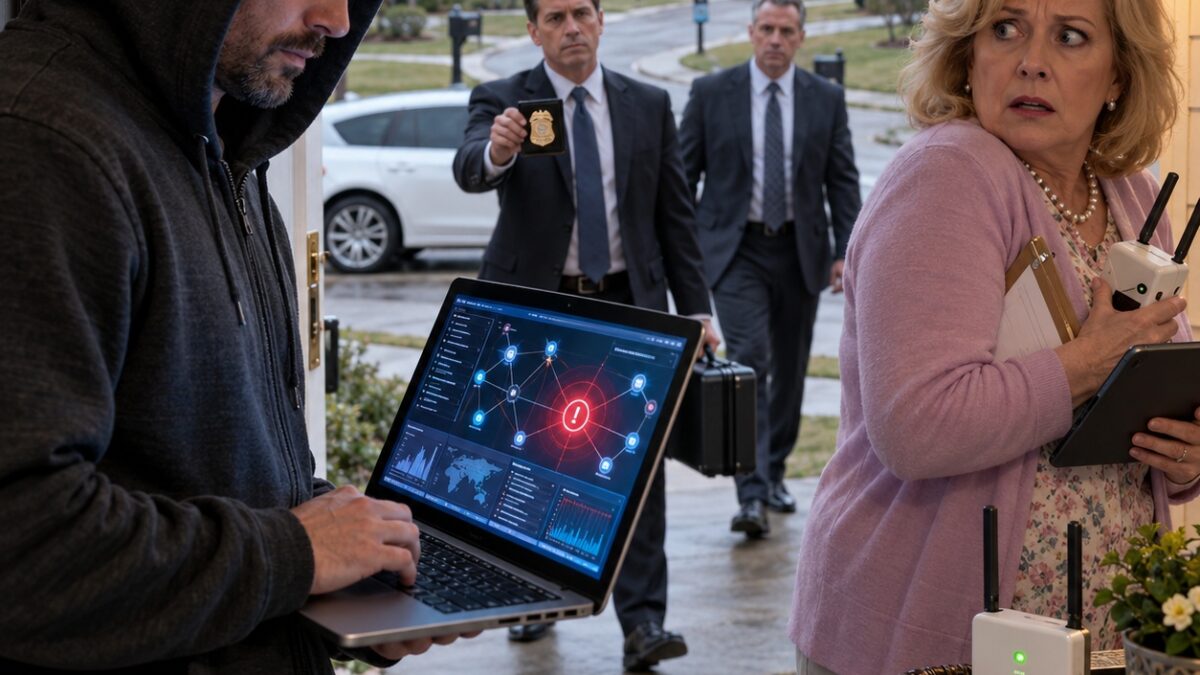
White government sedan.
Two agents.
Across the street.
Denise opened her door wearing slippers.
Barefoot.
Coffee mug.
At first she smiled.
Probably thought they were contractors.
Maybe new residents.
Maybe someone else she could explain neighborhood standards to before they even finished introducing themselves.
Then the agents showed identification.
The smile disappeared.
I stood behind the curtain.
Molly came beside me.
“This is happening?”
“Looks like it.”
“You knew?”
“I knew someone was reviewing the evidence.”
“That’s not what I asked.”
“No. I didn’t know they were coming today.”
One agent spoke.
Denise’s posture changed.
She looked toward my house.
Pointed.
I could not hear everything.
The windows were closed.
But once they moved closer to the driveway, pieces carried.
My name.
Misunderstanding.
Neighborhood safety.
Then one agent said loudly enough that I heard it clearly.
“Ma’am, this warrant concerns unauthorized digital access and surveillance equipment.”
Molly inhaled.
I said nothing.
Denise’s face went white.
The agents entered the garage.
By then, the street had begun waking up to what was happening.
Curtains moved.
Doors opened.
Rachel appeared on her porch in slippers and immediately texted Molly.
IS THIS ABOUT THE PRINTER???
Molly showed me.
I almost laughed.
“Tell her not to come over.”
“Why?”
“Because half the neighborhood is about to be standing outside.”
She typed.
Within forty minutes, I was right.
People found reasons to check mail that had not arrived.
Walk dogs that had already been walked.
Water plants that had survived perfectly well without emergency attention.
I went outside too.
Not because I wanted to gloat.
Because pretending I had not noticed federal agents searching my neighbor’s garage would have been absurd.
I knelt near one of our flower beds.
Pulled a weed.
Then another.
Molly stood in the doorway.
“You have never cared about those weeds in your life.”
“I care deeply today.”
“You’re embarrassing.”
“I’m blending in.”
“With federal agents across the street?”
“Perfect camouflage.”
She shook her head and went inside.
The search continued.
Equipment began coming out.
Extenders.
Routers.
A laptop.
Printed forms.
Boxes.
Then I saw the little black device I had photographed behind the planter.
Bagged as evidence.
Inside the garage, the agents apparently found what one neighbor later described as a homemade command center.
Folding table.
Laptop.
Networking gear.
Printed password collection forms.
Christmas decorations stacked nearby.
The mental image was almost too absurd.
Cyber surveillance beside plastic reindeer.
Travis arrived about twenty minutes later.
He slowed his BMW when he saw the government sedan.
I watched through the flower bed.
He did not park.
He continued toward the corner.
Molly whispered from behind the screen:
“Is he leaving?”
“Yes.”
“Does that look suspicious?”
“Extremely.”
Another vehicle met him before he got far.
I could not see the conversation clearly.
I did see Travis eventually step out.
Denise was not dragged away in handcuffs that day.
Real investigations are rarely as cinematic as people want them to be.
But she was served.
Her equipment was seized.
Questions were asked.
Her compliance-committee position effectively vanished before dinner.
The HOA sent a neighborhood-wide email at a speed that suggested an attorney had been standing over someone’s shoulder while it was drafted.
The association has never authorized the collection of resident network credentials or access to private digital systems.
Molly read it aloud.
Then looked at me.
“Translation?”
“Denise is on her own.”
Another paragraph said any forms or requests related to private network information should be disregarded immediately.
The board announced an emergency meeting.
Attendance strongly encouraged.
I had no intention of skipping it.
Neither did anyone else.
The clubhouse was packed.
Brook Hollow Ridge had never looked so politically engaged.
People stood along walls.
Extra chairs filled the back.
Rachel sat behind Molly and me.
An older couple I barely knew sat across the aisle.
The two teenage boys Denise had dragged to my porch on day one were nowhere to be seen.
Good.
They had suffered enough.
Denise stood at the front.
No clipboard.
Printed statement instead.
Her hands shook slightly.
For the first time since I had known her, she looked less like the person controlling a meeting than someone hoping the meeting would not turn on her.
The HOA president opened with legal language.
There was an ongoing investigation.
The board was cooperating.
The compliance committee had not been authorized to collect passwords or access resident systems.
New temporary restrictions were already in place.
Then Denise asked to speak.
I heard several people shift.
She stood.
“I want everyone to understand that I was only trying to protect this community.”
Rachel made a sound behind me.
Denise continued.
“In recent months, residents have reported inconsistent network performance, device interference, and concerns about wireless security.”
A man near the aisle said:
“So you asked children for passwords?”
The president raised a hand.
“Please let her finish.”
Denise gripped the paper.
“My intention was to create a voluntary cooperative system for identifying harmful interference.”
Rachel stood.
“You accessed my printer.”
Every head turned.
Denise looked at her.
“I did not personally—”
“My printer printed ‘Testing community range node three’ at eleven thirty at night after you came to my house asking where my router was.”
Silence.
Another neighbor stood.
“You asked my son for our Wi-Fi password.”
Denise shook her head.
“I asked whether he knew how to access the router because—”
An older man in the back interrupted.
“You told my wife our baby monitor needed calibration.”
A few people muttered.
Someone said:
“She did what?”
The older man repeated it.
Denise looked around.
For nine years? No, source doesn’t say nine years; that’s previous story. Here Denise was chair, duration unspecified. Need stay source. Let’s continue without number.
For as long as I had known Denise, she had relied on a simple advantage.
She entered conversations believing she was the authority.
Most people did not want the fight required to challenge that assumption.
Now the room had changed.
Everyone wanted the fight.
She no longer had one resistant homeowner in front of her.
She had an audience comparing notes.
That was the moment her performance started collapsing.
Denise looked toward me.
Her fear turned into anger.
“You.”
I stayed seated.
“You set me up.”
The room went quiet.
I felt Molly’s hand touch my arm.
Not to stop me.
Just there.
I stood slowly.
“No, Denise.”
“You created those fake files.”
“Yes.”
A murmur moved through the room.
Her expression brightened as though I had just confessed.
“Exactly. You created false data specifically to entrap me.”
“No.”
I kept my voice level.
“You knocked on my door and asked for my Wi-Fi password.”
Her jaw tightened.
“After that, I paid attention.”
“You deliberately configured systems to record us.”
“I maintained isolated monitoring environments on my own network.”
“You lured us into them.”
“I did not send you a password.”
She froze.
“I did not connect to your equipment.”
No answer.
“I did not scan your devices.”
The room was absolutely silent now.
“I did not ask you to approach my network.”
Denise looked around as though searching for support.
There was none.
I continued.
“You tried accessing systems you had no authorization to access. My systems recorded that.”
“You knew what you were doing.”
“Yes.”
For the first time that evening, I let a little anger into my voice.
“I knew enough not to touch your network.”
That landed.
Denise’s mouth opened.
Closed.
I looked at the neighbors.
“Nothing I provided to investigators came from breaking into her devices. I preserved attempts made against environments I controlled, neighbor reports voluntarily given to me, photographs taken from public areas, and communications sent to residents.”
Then back to Denise.
“You built this yourself.”
Her face was red.
“I was trying to protect people.”
“From what?”
“Interference. Unsafe devices. Unknown networks.”
“My router name being strong on your grandson’s tablet is not probable cause.”
“This isn’t a courtroom.”
“No.”
I looked around the room.
“That is why I didn’t prosecute anything.”
A few people actually laughed.
Not because the situation was funny.
Because tension needed somewhere to go.
Denise looked toward the HOA president.
“This has been turned into a witch hunt.”
Rachel said:
“You asked for passwords.”
The older man in back added:
“You asked about a baby monitor.”
Another voice:
“You put equipment around the neighborhood.”
Denise slammed the paper onto the podium.
“I was trying to make this community safer!”
Someone replied:
“You made it creepy.”
That ended her argument more effectively than anything I could have said.
The meeting continued for nearly two hours.
Emergency policy changes.
Questions.
Board members trying to determine how much Denise had done under the compliance committee’s name.
Residents asking whether any HOA funds purchased the equipment.
Attorneys cautioning people not to speculate publicly about criminal liability.
I mostly stayed quiet.
Once the evidence had reached proper authorities, I had no interest in turning myself into a neighborhood prosecutor.
That distinction mattered.
I had not spent my career defending critical systems because I enjoyed catching people.
Most cyber defense is not catching dramatic villains.
It is prevention.
Segmentation.
Logging.
Controls.
Making sure one bad decision does not become a larger failure.
What disturbed me about Denise was how casually she treated privacy boundaries that existed for a reason.
Her entire justification rested on the assumption that she was entitled to access because she had decided she was responsible for safety.
That idea is dangerous anywhere.
In a neighborhood, it can look ridiculous right up until it stops being ridiculous.
Three months passed before the legal outcome became clear.
Denise ultimately pleaded guilty to reduced charges tied to unauthorized access attempts and unlawful surveillance.
Travis received a worse deal.
His consulting domain and his name were connected to other cases.
The situation had not started and ended on our street.
That part did not surprise me by then.
He had brought knowledge Denise did not possess.
Equipment.
Technique.
A level of confidence that probably came from having done questionable things before.
I never learned every detail of those other matters.
I did not need to.
My part was finished.
The HOA rewrote its rules.
Explicitly.
No resident.
No committee member.
No board officer.
Nobody acting in an HOA capacity could request passwords, private network credentials, or access to residents’ digital systems.
If legitimate cybersecurity concerns ever arose, the association would use licensed providers and lawful, consent-based procedures.
It was one of those policies that felt embarrassing to need in writing.
Do not ask residents for their Wi-Fi passwords.
Yet there it was.
Institutional scar tissue.
A rule created because one person had forced everyone to discover the absence of it.
Denise put her house up for sale before spring.
I did not celebrate.
I did not stand outside with champagne.
I did not post anything in the neighborhood group.
By then, I wanted quiet more than victory.
Her house sold.
A new family moved in.
The first Saturday after they arrived, the doorbell rang.
Molly looked at the camera.
“New neighbors.”
“Should I hide?”
“Why?”
“Maybe they want our password.”
She glared at me.
“Go answer the door.”
I opened it.
A couple stood there with a foil-covered loaf pan.
Behind them, a little girl was trying to look around her father’s leg.
“Hi,” the man said. “We just moved in across the street.”
“Welcome.”
“My wife made banana bread.”
His wife smiled.
“We’re trying to meet everyone before we become the mysterious people who never leave the garage.”
I took the bread.
“That happens faster than you think.”
Then the man asked:
“Do you happen to know a good internet provider around here?”
Behind me, Molly made a choking sound.
I turned.
She had one hand over her mouth.
“What?”
She shook her head.
Then disappeared into the kitchen.
I looked back at the confused neighbors.
“She’s fine.”
“Did I say something?”
“No.”
I smiled.
“You just arrived at the end of a very long story.”
They eventually heard it.
Everyone did.
Not from me first.
Brook Hollow Ridge could transmit gossip faster than any wireless system Denise ever built.
The new family was nice.
Normal.
They used their own router.
They never asked me to calibrate anything.
The street slowly returned to what it had been before Denise decided Wi-Fi belonged under HOA compliance.
Kids rode bikes.
People walked dogs.
Trash cans disappeared by eight.
Wreaths changed with the seasons.
Nobody carried network-password forms door to door.
For a while, neighbors treated me differently.
More people waved.
Some asked technology questions.
Too many.
“Can you look at my router?”
“No.”
“Why?”
“Trauma.”
Rachel started calling me Firewall Aaron.
The name spread.
I pretended to hate it.
I did not entirely hate it.
Molly loved it.
“Firewall Aaron, can you take the trash out?”
“No.”
“Firewall Aaron, the dishwasher says error seven.”
“I defend critical infrastructure, not appliances.”
“Firewall Aaron, your critical infrastructure is sleeping on the couch and forgot to buy milk.”
I regretted everything.
Still, humor was better than suspicion.
For several weeks after the search, I had caught myself looking through the blinds whenever a car stopped across the street.
Not because I feared Denise.
Because sustained vigilance becomes habit.
My work already trained me to see patterns.
The neighborhood incident had pulled that professional posture into my home.
I did not like it.
Home should not feel like an operations center.
Eventually, it stopped.
That may have been the real ending for me.
Not the plea.
Not Denise moving.
Not Travis’s worse legal deal.
The first day I worked an entire afternoon without checking anything except what my job required.
No side logs.
No street camera.
No wondering whether a black box was hidden behind a planter.
Just work.
Then dinner.
Then Molly and I took a walk.
Normal.
Privacy is strange that way.
You usually notice its value only after somebody starts behaving as if it belongs to them.
Before Denise, I rarely thought about the fact that my home network was mine.
Of course it was.
Just like my desk.
My mail.
My house keys.
The door lock.
You do not spend every morning appreciating the fact that your neighbor cannot demand to inspect your email.
Then someone shows up with a clipboard and says:
If you have nothing to hide, give me the password.
Suddenly the boundary becomes visible.
People often misunderstand privacy as secrecy.
They imagine only guilty people need it.
That has never made sense to me.
I close the bathroom door.
Not because I am committing crimes in there.
I do not hand strangers my phone.
Not because my photos are illegal.
Privacy is not evidence of wrongdoing.
It is part of ordinary autonomy.
Denise had inverted that idea.
Refusal became suspicious.
She had done it in a way I recognized immediately because I had seen the logic elsewhere.
If you have nothing to hide—
Stop there.
The burden is backward.
You do not get access first and demand that other people justify saying no afterward.
You need authority.
Consent.
A lawful basis.
Something.
An HOA committee title is not a universal search warrant.
The scary part was how reasonable Denise sounded to herself.
I believe she genuinely thought “community safety” was enough.
That does not excuse what she did.
If anything, it made the situation more instructive.
People who knowingly choose evil are easy to condemn.
People who convince themselves control is kindness are harder.
They have a moral vocabulary.
They say:
Protect.
Coordinate.
Review.
Fairness.
Transparency.
They rarely say:
I want access to things that are not mine.
Denise did not stand on my porch saying:
I would like to violate your privacy.
She said:
Digital wellness review.
Same request.
Cleaner packaging.
That was why my professional instincts reacted so sharply.
Good security often begins by stripping away the story and looking at the permission.
Does this person have authorization?
No.
Then no.
Not:
Does she mean well?
Not:
Is she chair of something?
Not:
Will saying no make the conversation awkward?
Authorization.
That is the question.
She did not have it.
The first day could have ended in thirty seconds.
“I need your Wi-Fi password.”
“No.”
“Understood.”
Goodbye.
Instead she treated no like the beginning of negotiations.
That choice caused everything afterward.
Her email initiative.
The forms.
The devices.
Rachel’s printer.
The black box.
Travis.
The decoy folder.
Federal agents.
The emergency meeting.
Charges.
Her house sale.
People later asked whether I had intentionally trapped Denise.
That word came up constantly.
Trap.
Did you trap her?
Did you lure her?
Did you set her up?
I understand why people like that version.
It turns the story into a clever revenge plot.
Cybersecurity guy builds elaborate trap.
HOA tyrant walks into it.
Checkmate.
Reality was less theatrical.
The decoy environment already existed as part of the way I monitored unwanted access.
I did label a harmless folder in a way likely to reveal interest in resident data once the pattern became clear.
That is true.
But the crucial point never changed.
I did not send Denise there.
I did not give Travis credentials.
I did not compromise their systems.
I did not place anything on their devices.
They had to cross the boundary voluntarily.
That distinction is why I could stand at the HOA meeting and say:
You knocked on my door.
After that, I paid attention.
It was the truth.
The law enforcement response was not triggered because Denise annoyed me.
It was triggered because the collected evidence suggested unauthorized access attempts and surveillance behavior that exceeded neighborhood politics.
That is another distinction people blur when they retell stories.
I did not have federal colleagues swoop in because an HOA chair hurt my feelings.
I used appropriate channels because evidence suggested conduct relevant to their authority.
They made their own assessment.
They obtained their own warrant.
They decided what was actionable.
I was not standing behind the curtain directing a raid with a headset.
I was pulling weeds.
Badly.
Molly still mocks me for that.
“You held the same weed for five minutes.”
“I was assessing it.”
“You were staring across the street.”
“Multitasking.”
“You nearly uprooted a flower.”
“Collateral landscaping risk.”
She rolled her eyes.
Marriage has a way of shrinking your most dramatic stories down to their embarrassing details.
Good.
I needed that.
For all the professional seriousness surrounding the case, the emotional part was deeply domestic.
Molly lived there too.
Denise’s requests implicated her privacy.
The neighborhood tension affected her home.
She had to watch federal agents search across the street while wondering how far the whole thing might go.
I tried to shield her from worry by being technically precise.
That did not always work.
One night during the investigation, before the agents arrived, Molly said:
“You keep telling me our systems are safe.”
“They are.”
“That isn’t what I’m asking.”
I looked up.
“What are you asking?”
“Do you think Denise is dangerous?”
That question stopped me.
“Physically?”
“I don’t know. Generally.”
I thought carefully.
“I think she’s entitled.”
“That isn’t the same thing.”
“No.”
“Do entitled people stop when they’re embarrassed?”
“Sometimes.”
“And sometimes?”
“They escalate.”
Molly nodded.
“That’s what worries me.”
She was right.
Cybersecurity teaches you not to focus only on technical controls.
People behave unpredictably when they feel authority slipping.
That was another reason the instruction not to confront mattered.
Preserve.
Do not provoke.
Let people with proper authority take over.
I began parking inside the garage.
Not because I expected vandalism.
Because reducing opportunity is easy.
We saved camera footage.
We did not answer Denise’s later informal questions.
Everything went through normal channels.
That was not fear.
That was risk management.
The hardest part was appearing normal.
Denise would wave from across the street before the search.
I sometimes waved back.
Imagine knowing your neighbor’s devices had been poking at monitored systems while she smiles and checks whether somebody left a trash can visible.
Surreal.
One morning she stopped me near the mailbox.
“Aaron.”
“Denise.”
“Have you reconsidered participating in the transparency initiative?”
“No.”
“It would help clear up a lot of confusion.”
“No.”
“You understand that nonparticipation creates gaps.”
“In your spreadsheet?”
“In neighborhood visibility.”
“My private network is supposed to be a gap in your visibility.”
She sighed.
“You always make everything confrontational.”
That almost impressed me.
The person asking for private credentials accusing the person saying no of confrontation.
“I’m getting my mail.”
I walked home.
Did not tell her she was under review.
Did not tell her I had evidence.
Did not get the emotional payoff.
That restraint helped later.
At the emergency meeting, Denise’s strongest argument was that I had set her up.
Imagine how much stronger that argument would have sounded if I had spent the previous week taunting her.
Instead, neighbors had seen me mostly doing nothing.
She asked.
I refused.
She continued.
The investigation appeared.
Chronology matters.
Quiet behavior creates clean chronology.
That is not as satisfying in the moment.
It is much more satisfying when everyone compares notes later.
Rachel became an unexpected friend through the whole ordeal.
After her printer incident, she became militant about basic digital hygiene.
She changed passwords.
Updated devices.
Disabled features she did not use.
Then started telling everyone else to do the same.
One afternoon, she called.
“I changed Mom’s router password.”
“Congratulations?”
“She was using the default.”
“That happens.”
“Do you know what the default was?”
“No.”
“Password.”
I closed my eyes.
“Of course.”
“I almost drove to Denise’s old house and apologized for humanity.”
“Please don’t.”
Rachel laughed.
“Relax. I’m joking.”
“You have a history of showing up with printed network evidence. I take you seriously.”
The neighborhood learned.
That was perhaps the one good thing Denise accidentally caused.
People began understanding that convenience devices were still networked devices.
Printers.
Cameras.
Baby monitors.
Doorbells.
Smart speakers.
Not every device required panic.
Just basic responsibility.
Strong unique passwords.
Updates.
Do not hand credentials to someone with a clipboard.
Simple.
The HOA eventually hosted a legitimate digital-safety presentation led by an outside professional.
I declined to present it.
The board asked.
I said no.
The president understood immediately.
Again, healthy leadership.
They hired somebody with appropriate credentials and no neighborhood drama attached.
The presentation reportedly began with:
“No legitimate HOA representative should ever ask for your personal Wi-Fi password.”
Rachel sent me a picture of that slide.
Caption:
LOOK WHAT YOU DID.
I replied:
Civilization advances.
She sent back:
Firewall Aaron strikes again.
I blocked her for eleven seconds.
Molly made me unblock her.
Denise’s departure was quieter than her tenure on the compliance committee.
Moving truck.
For-sale sign removed.
Car gone.
House empty.
I watched none of it deliberately.
Still, when someone lives across the street, you notice.
The night after she moved, I stood by the window.
Her house was dark.
This time, darkness did not mean sabotage.
Just vacancy.
Molly came beside me.
“Feel weird?”
“A little.”
“Sad?”
“No.”
“Happy?”
“Not exactly.”
“Then what?”
I thought.
“Finished.”
That was the word.
Finished.
I did not hate Denise.
I hated what she had decided she was entitled to do.
There is a difference.
Hatred keeps a person central.
By then, I wanted her irrelevant.
She became irrelevant.
The new family’s banana bread helped.
It was excellent.
I told them that.
Molly told them the internet-provider question almost killed her.
Eventually they heard why.
The husband stared at me.
“You’re that guy?”
“I hate that sentence already.”
“The cyber guy.”
“I work in cyber defense.”
“Denise’s neighbor.”
“Former neighbor.”
He laughed.
“Well, we promise never to ask for your password.”
“Great start.”
His wife said:
“We were told this neighborhood has very involved HOA people.”
Molly made another choking sound.
I said:
“Less involved now.”
Life moved.
Months.
The legal outcomes arrived.
Policy changed.
The story faded from daily conversation.
That should be the goal after conflict.
Not permanent vigilance.
Resolution.
There is a temptation, especially when you have the technical ability to monitor things, to keep watching forever.
One more log.
One more sensor.
One more check.
Security professionals are particularly vulnerable to that mindset because we know how much can go wrong.
But perfect visibility is impossible.
And wanting perfect visibility can turn you into the very thing you oppose.
That realization bothered me.
Denise wanted visibility into every resident network.
She justified it as safety.
My response could not become:
Therefore I should monitor the whole street better than she did.
No.
My responsibility ended at my systems, my home, and information people voluntarily brought me.
That boundary mattered ethically as much as technically.
I dismantled some temporary additional monitoring I had enabled during the incident.
Not the normal security controls.
Those stayed.
But the heightened neighborhood awareness stopped.
That was deliberate.
If the threat environment changes, controls should change too.
Do not let emergency posture become personality.
Denise had.
Her compliance mindset apparently expanded until everything looked like something she should inspect.
Grass.
Lights.
Trash cans.
Routers.
Passwords.
Baby monitors.
Once someone believes their role is to prevent every possible problem, limits start feeling irresponsible.
Then boundary violations begin to look like diligence.
That is how entitlement can disguise itself as duty.
I thought about that often.
Denise probably did not wake one morning and decide:
Today I become a criminal.
The source story’s final reflection got this exactly right.
She started with entitlement.
Small.
Socially tolerated.
She believed her concern gave her extra authority.
She believed her title gave her judgment more weight than other people’s rights.
She believed quiet people would rather comply than fight.
And most importantly, she kept receiving enough cooperation to think pressure was a legitimate substitute for permission.
That is how many people like Denise win.
Not because they are brilliant.
Because decent people want peace.
Someone asks for something inappropriate.
You think:
Is this worth an argument?
Someone sends an absurd notice.
You think:
Maybe I should just comply.
Someone says:
If you have nothing to hide—
You think:
I know I’m innocent, so why not?
Every surrendered boundary teaches the person pushing it that pushing works.
I had an advantage.
My profession had trained me to treat access as a binary question.
Authorized.
Unauthorized.
Denise’s social pressure did not blur that for me.
She could make the request awkward.
She could not make it legitimate.
Other neighbors did not have that framework.
That is why some almost cooperated.
One parent later admitted Denise had nearly gotten their router password by saying she needed to test whether home-schooling devices were competing for channels.
Another older couple thought the form was mandatory until their son told them not to fill it out.
People are trusting when requests look administrative.
Logos matter.
Clipboards matter.
Tone matters.
That is uncomfortable.
Denise’s photocopied authorization sheet had no signature, vote, or policy number.
Still, if she had handed it to somebody who did not want conflict?
Maybe they would have complied.
“Arts and crafts” was sarcastic.
Also technically accurate.
Appearance is not authority.
That lesson became almost a motto on our street.
Rachel once suggested printing shirts.
NO SIGNATURE. NO VOTE. NO POLICY NUMBER. ARTS AND CRAFTS.
I threatened to move.
She threatened to order one in my size.
Molly sided with Rachel.
Betrayal inside my own home.
I began to understand why Denise liked committees.
Still, jokes meant healing.
We could laugh because the danger had passed.
That does not trivialize what happened.
It means the event no longer controlled the emotional atmosphere.
The legal system had handled the serious part.
The neighborhood handled the social aftermath.
And our household handled the ridiculous leftovers.
Every now and then, someone new would hear the story and ask:
“So you hacked her back?”
No.
“You planted something on her computer?”
No.
“You tracked her?”
No.
“You secretly turned her equipment against her?”
No.
“Then how did you catch her?”
I gave the answer Denise hated.
“I paid attention.”
Security is often less exciting than people imagine.
Logs.
Patterns.
Timestamps.
Preservation.
Corroboration.
A neighbor’s printed page.
A photograph.
A device touching something it should not.
One event alone can mean little.
Together, events form a pattern.
You do not need cinematic hacking when somebody leaves a trail.
You need patience.
That was why Travis worried me more than Denise initially.
He had enough technical knowledge to make the behavior less random.
But not enough discipline to avoid creating evidence.
That combination is common.
People learn tools before ethics.
They know how.
They never stop to ask whether they should.
A “smart home consultant” label does not grant permission to interact with networks because your aunt chairs an HOA committee.
Technical competence without authorization is still unauthorized.
Sometimes more dangerous precisely because the person knows enough to go farther.
Travis’s connection to other data-harvesting complaints reinforced that concern.
His worse legal deal made sense in that context.
Again, I did not know the full details.
I did not need to invent them.
His choices elsewhere belonged to those cases.
Our case showed enough.
He helped Denise turn entitlement into equipment.
That made him part of it.
The government search was the most dramatic morning Brook Hollow Ridge had seen in years.
People still remembered details.
Denise’s coffee mug.
The folding table.
Christmas decorations.
Travis trying to leave.
The HOA panic email.
My weed pulling.
Especially my weed pulling, thanks to Molly.
One neighbor swore I looked “completely calm.”
Molly corrected him.
“He uprooted a flower.”
I said:
“One flower.”
She said:
“My favorite.”
“It was not your favorite.”
“You don’t know that.”
The myth of calm cyber professional died instantly.
Good.
People should know competence and adrenaline coexist.
I was nervous that morning.
Not about being exposed.
About escalation.
Search warrants are serious.
Once federal agents stand on someone’s porch, the social environment changes permanently.
Even when justified, it is heavy.
Denise’s actions had crossed enough lines to bring that response.
I did not enjoy watching her realize it.
Satisfaction and enjoyment are different.
I felt satisfied that the behavior was being stopped.
I did not need to enjoy her fear.
That distinction helped me move on afterward.
If the goal becomes humiliation, you can never get enough.
There is always another joke.
Another public embarrassment.
Another retelling.
If the goal is stopping harmful behavior, success has an endpoint.
Equipment seized.
Access stopped.
Committee role removed.
Policies changed.
Legal consequences.
Done.
That was enough.
Molly understood that before I did.
A few weeks after the emergency meeting, I read a neighborhood post mocking Denise.
I almost replied.
Molly said:
“Don’t.”
“They’re getting details wrong.”
“Does it matter?”
“They’re saying she hacked a federal network. She didn’t.”
“Okay.”
“That makes the story sound ridiculous.”
“Then don’t feed it.”
I looked at her.
“You sound like Alina.”
“Who?”
“Wrong story.”
She stared.
I laughed.
Different matter.
The point remained.
Do not let correction become participation in gossip.
I stayed out.
The official facts were serious enough.
No exaggeration needed.
Unauthorized access attempts.
Surveillance equipment.
Private-network credential requests.
Neighbor devices touched.
Proper referral.
Federal intervention.
Reduced guilty plea.
Policy reform.
Travis facing worse consequences because of other connections.
Clear.
Realistic.
More compelling than adding imaginary supervillain hacking.
Months after Denise moved, I was walking the dog when the new family’s little girl waved from the driveway.
Her father was setting up a router inside near the window.
He saw me.
“Hey, Aaron?”
I stopped.
“Yeah?”
“Does putting the router higher actually help?”
I considered the question.
“Yes, depending on layout.”
“Can I put it on that shelf?”
“Probably.”
He smiled.
“Thanks.”
Then:
“And no, I’m not giving you the password.”
I laughed.
“Excellent.”
The girl looked confused.
Adults around Brook Hollow Ridge had developed inside jokes she would not understand for years.
Good.
Children should not grow up thinking neighbors demanding private passwords is normal.
The street was ordinary again.
That was the line I kept returning to.
Ordinary again.
No lawnmowers stopping for government sedans.
No black boxes behind planters.
No printed password forms.
No emergency meetings.
No network maps created by people with no authority to create them.
Just suburbia.
Which includes its own absurdities.
Trash cans.
Holiday decorations.
Parking complaints.
People disagreeing about mulch.
Fine.
Let the conflict return to mulch.
Mulch has never tried accessing my decoy folder.
As far as I know.
Rachel would probably find a way.
My work continued.
Real threats.
Real critical infrastructure.
Incidents where consequences extended far beyond one subdivision.
The Denise episode remained small by comparison.
That was another useful perspective.
At home, it felt enormous because home is where you expect safety from professional problems.
At work, I handled environments where hostile actors genuinely intended disruption.
Denise was not a nation-state adversary.
She was an entitled HOA committee chair with access to a nephew who knew enough technology to turn bad judgment into unlawful behavior.
Keeping that scale in mind prevented me from dramatizing her beyond reality.
She did not become a mastermind because federal agents arrived.
She remained what she had been at the beginning.
A person who believed authority followed desire.
The tools changed.
The principle did not.
She wanted access.
She had no right.
She pushed anyway.
The reason the story escalated so dramatically was because digital systems do not treat entitlement as authorization.
Passwords.
Permissions.
Authentication.
Logs.
Computers are sometimes wonderfully literal.
Denise’s title did not authenticate.
Her clipboard did not authenticate.
Her committee form did not authenticate.
So she tried other means.
Those means produced records.
In a strange way, the digital world exposed the weakness in her social strategy.
In person, confidence can blur boundaries.
In a log, an unauthorized attempt is much less charismatic.
Timestamp.
Device.
Path.
Action.
No red lipstick.
No smile.
No “community wellness.”
Just what happened.
I appreciated that.
The emergency HOA rule changes were almost funny in their bluntness.
No requesting private network passwords.
No unauthorized access.
No surveillance equipment used for resident digital monitoring.
Again:
Things normal people assume do not need to be stated.
But organizations often create rules after somebody proves the assumption inadequate.
Fire exits exist because fires happen.
Cyber policies exist because somebody eventually asks an intern to email everyone’s password in a spreadsheet.
Brook Hollow Ridge got its rule because Denise happened.
I hope the document lasts longer than anyone’s memory of her.
Good policy should.
Personal memory fades.
People move.
New boards arrive.
Eventually, someone will read that section and ask:
“Why is this even in here?”
Maybe somebody will answer:
“Long story.”
Perfect.
That is institutional learning.
The story becomes policy.
Then the policy prevents the story from repeating.
That is more useful than permanent outrage.
Denise selling before spring closed the social chapter.
The guilty plea closed the legal one.
The neighborhood rule closed the organizational one.
My own chapter took longer.
I still had to decide what the experience meant.
For a while, I told myself the lesson was simple.
Document everything.
True.
Then I thought it was:
Never underestimate an HOA busybody.
Also somewhat true.
Eventually I landed somewhere else.
Authority and access must be separate from confidence.
That is the real lesson.
Every safe system—technical, legal, social—needs ways to answer:
Who are you?
What exactly are you allowed to do?
Who gave you that permission?
Where does that permission stop?
Denise had answers only to the first question.
Who are you?
Denise Whitaker.
HOA compliance chair.
Fine.
What are you allowed to do?
She improvised.
Who gave you permission?
She gestured at the committee.
Where does it stop?
Apparently nowhere she could see.
That is a governance failure.
Digital systems exposed it, but the flaw existed before technology entered the story.
She treated grass height the same way.
Porch lights.
Cars.
Scarecrows.
Each little success expanded her sense of mandate.
No one incident seemed worth a serious fight.
Then she arrived at a boundary people could not safely surrender.
Private network credentials.
I was simply the person who said no early enough and had the professional context to recognize what came next.
That does not make me heroic.
It made me inconvenient.
Sometimes inconvenient people protect systems.
The teenagers on her first visit understood before she did.
I still remember the taller boy trying not to laugh when I said:
“Noted in cursive.”
I hope neither of them thought they had done something wrong by being there.
They were kids dragged along by an adult authority figure.
After the incident, I heard Denise had described them as youth compliance volunteers.
Poor guys.
I never involved them in any statement beyond noting they had been present at the door.
They did not deserve to become evidence of anything.
Adults are responsible for adult choices.
That boundary mattered too.
One of them saw me months later at a grocery store.
He recognized me.
I recognized him.
He smiled awkwardly.
“Hey.”
“Hey.”
Then he said:
“For the record, I thought the password thing was weird.”
I laughed.
“For the record, so did everyone.”
He looked relieved.
That was it.
No interrogation.
No moral lesson.
He went back to choosing cereal.
Normal life.
I liked that moment.
Not every person near a bad decision is part of it.
Denise’s nephew was different because Travis actively provided technical involvement.
The teenagers carried clipboards.
Important distinction.
Patterns.
Roles.
Intent.
Evidence.
The same principles that apply professionally should apply socially.
Do not flatten everyone into teams.
One of the most frustrating things about neighborhood conflict is how quickly people divide.
Pro-Denise.
Anti-Denise.
Pro-HOA.
Anti-HOA.
That was never the useful framework.
The HOA was not inherently the enemy.
It ultimately changed its rules and disowned unauthorized collection.
The compliance concept itself was not inherently wrong.
Neighborhoods need some agreed rules when people have signed onto them.
The issue was scope.
Denise exceeded it.
That is why the HOA’s panic email mattered.
The association has never authorized collection of resident network information.
Some residents read that as cowardice.
Throwing Denise under the bus.
Maybe partly.
But it also established something necessary.
Her behavior was not legitimate HOA policy.
Good.
Make that clear.
Then fix controls so one committee chair cannot create unofficial digital surveillance policy with a photocopier and her nephew.
They did.
I could criticize the board for failing to catch it sooner.
I also had to recognize they corrected course once evidence appeared.
Accountability should leave room for institutions to improve.
Otherwise there is no incentive to admit mistakes.
Denise did not get that benefit personally because her choices went far beyond a mistaken policy interpretation.
There were access attempts.
Equipment.
Forms.
A warrant.
A plea.
Different level.
Again:
Scale matters.
My favorite part of the story changed over time.
Initially, it was the agents.
Of course.
Federal badges on Denise’s porch after she told me refusal would be noted.
The symmetry was irresistible.
Then I liked the HOA meeting.
Her accusing me of setting her up.
My answer:
You asked for my password. After that, I paid attention.
Clean.
True.
Later, I stopped caring about those dramatic scenes.
My favorite became banana bread.
The new family.
A question about internet service.
Molly laughing so hard she had to leave.
Why?
Because banana bread meant the house across from us was just a house again.
The person living there was a neighbor.
Not an active threat.
The question about internet was ordinary.
No hidden agenda.
No clipboard.
No demand.
Just:
Do you know a good provider?
That is what security work is for, in the broadest sense.
Not permanent drama.
Restoration of normal use.
Systems should return to their purpose.
A network should let a family work, stream movies, call relatives, help kids do homework.
A neighborhood should let people live.
A home should feel private without feeling fortified.
When those things become true again, the incident is over.
Brook Hollow Ridge became normal again.
Kids rode bikes.
Molly planted things I was no longer allowed to weed unsupervised.
Rachel became the neighborhood password evangelist.
The new family learned quickly never to mention routers without somebody laughing.
And yes, some people still called me Firewall Aaron.
I continued pretending to dislike it.
One Saturday, Molly bought me a cheap coffee mug online.
FIREWALL AARON.
I stared at it.
“You’re encouraging them.”
“I’m honoring local history.”
“I’m throwing this away.”
“You won’t.”
She was right.
It sits in my office.
Mostly because it makes her happy.
Not because I like the nickname.
Probably.
The older I get, the more I think about the first sentence Denise used that bothered me.
“If you have nothing to hide, this should not be an issue.”
There is a reason that phrase appears wherever power wants shortcuts.
It turns privacy into suspicion.
It makes refusal feel like confession.
The answer should always be:
Access still requires permission.
Nothing about innocence eliminates that.
I can have nothing illegal in my home and still lock the front door.
I can have nothing embarrassing on my phone and still refuse to hand it to a stranger.
I can operate a perfectly ordinary Wi-Fi network and still refuse to give an HOA committee chair the password.
Rights that require a secret to justify them are not rights.
Denise never accepted that.
Eventually the law made the distinction for her.
Three months later, a guilty plea tied to unauthorized access attempts and unlawful surveillance.
Not because she asked one stupid question.
Because she kept moving after the answer was no.
That is the part people should remember.
The first request was outrageous but not the whole story.
People ask inappropriate things.
Sometimes from ignorance.
The critical moment comes after refusal.
Do they respect it?
Denise did not.
She turned no into a challenge.
Then into a project.
Then into evidence.
Travis made the same mistake.
Technical access is especially unforgiving in that respect.
You cannot retroactively manufacture consent because you later claim good intentions.
Permission comes first.
That is security 101.
It is also human relationships 101.
The HOA eventually understood.
The neighborhood understood.
I hope Denise did too.
I do not know.
She moved.
Her life went elsewhere.
I did not follow it.
That is another boundary.
I had every right to care what she did when it touched my systems, my neighbors, or the investigation.
After she left and legal issues concluded, her future stopped being my business.
Privacy works both ways.
That may be the most important thing I can say after a story about someone violating it.
I did not become entitled to monitor her forever because she once monitored others.
A principle that disappears when the wrong person benefits was never much of a principle.
So I let her go.
No searches.
No updates beyond what was public and relevant to the case.
No curiosity disguised as justice.
Finished.
Sometimes neighbors ask whether I think I took things too far.
Usually they mean the monitored decoys.
Should I have confronted her sooner?
Should I have warned her?
Could a conversation have stopped everything before federal agents arrived?
Maybe.
But the timeline matters.
I did have a conversation.
At my front door.
She asked for access.
I said no.
Clear.
She told me refusal would be noted.
Then access attempts appeared.
Then a neighborhood password form.
Then Rachel’s printer.
Then equipment.
Then Travis.
At what point was another friendly conversation required before I was allowed to document conduct touching private systems?
I do not think one was.
Confronting her might have stopped a single attempt.
It also might have caused evidence to disappear while the underlying belief remained.
The proper response once the conduct became serious was not personal revenge.
It was preservation and referral.
That is what I did.
Authorities decided the rest.
Could Denise have stopped before it reached them?
Absolutely.
At dozens of points.
She could have accepted no on the porch.
Canceled the transparency initiative.
Stopped using equipment.
Told Travis the idea was stupid.
Apologized to Rachel.
Walked away.
Every escalation was another exit she chose not to take.
That is why I do not accept the argument that the decoy “made” her do anything.
A locked test environment does not force entry.
A fake resident folder does not reach out and click itself from someone else’s device.
Opportunity is not causation.
People remain responsible for choices.
That principle applies whether the target is a physical door or a digital one.
Molly put it more simply.
“She walked into a room she wasn’t invited into and got mad there was a camera.”
Crude.
Accurate.
I would not use that phrasing professionally.
At home, it works.
My career continued.
There were far more consequential threats.
Sometimes I would be deep in a serious incident and briefly remember Denise’s photocopied “digital wellness” authorization.
The contrast was absurd.
But small incidents can reveal big principles.
Least privilege.
Authorization.
Segmentation.
Evidence preservation.
Independent oversight.
Do not trust titles.
Do not share credentials unnecessarily.
Do not let convenience erase boundaries.
Those are cybersecurity principles.
They are also useful ways to survive modern life.
Denise violated almost all of them before breakfast.
Impressive, in its way.
Brook Hollow Ridge learned faster.
The new HOA rule became standard.
New committee members received actual orientation.
I heard one board member joke that the first slide should simply say:
DO NOT ASK FOR PASSWORDS.
Maybe it should.
The simplest controls are often the best.
Rachel once asked whether the rule could include:
DO NOT TOUCH PRINTERS.
I told her printers are already punishment enough.
She agreed.
Normal jokes.
Normal life.
That is where I prefer to leave the story.
Not at the federal search.
Not at Denise’s shaking hands in the clubhouse.
Not at the plea.
At the end, when nothing interesting is happening.
My office over the garage.
Laptop open.
Coffee beside me.
Molly downstairs.
Dog asleep.
Across the street, the new neighbors living their own lives.
No black box behind the planter.
No device probing anything.
No clipboard at my door.
If I glance at the network dashboard, it looks boring.
Boring is beautiful.
Boring means the controls work and nobody is trying to turn a subdivision into a homemade surveillance project.
I can hear kids outside sometimes.
Bikes.
Basketball.
A dog.
A lawnmower.
All the sounds that disappeared the morning the federal sedan arrived.
That morning, the street went silent because everybody sensed that something serious had crossed into our ordinary little neighborhood.
Now the ordinary sounds are back.
That is the part people forget to celebrate.
Crisis ending.
Denise once thought the neighborhood needed her to inspect everyone’s digital lives in order to make it safe.
She was wrong.
The safest version of Brook Hollow Ridge turned out to be the one where everybody kept their own passwords.
The HOA stayed inside its actual role.
Neighbors asked permission before entering one another’s spaces.
And a quiet man in a hoodie was allowed to be just Aaron from the blue house again.
Mostly.
Every so often someone still calls me Firewall Aaron.
I roll my eyes.
Molly laughs.
And somewhere in a kitchen cabinet is a stupid mug proving I lost that particular battle.
I can live with that.
Because my Wi-Fi password is still mine.
So is Rachel’s.
So is the new family’s across the street.
So are the networks of every person on the block.
No committee spreadsheet.
No transparency initiative.
No homemade command center.
Just private homes belonging to people who finally understand that “community” does not mean surrendering every boundary to whoever happens to carry the clipboard.
Denise thought my silence meant I would be easy to pressure.
She mistook privacy for weakness.
She mistook professionalism for fear.
And she mistook a neighborhood title for permission.
I never needed to hack her.
Never needed to threaten her.
Never needed to raise my voice.
The most damaging thing I did to Denise Whitaker was much simpler.
I let her choices create a record.
Then I preserved it.
And when people with real authority finally asked what had happened, I handed them the truth.








