FULL STORY:HOA Queen Cut Power to My Lakefront Ranch Over My Solar Setup—She Never Checked the 40-Year Easement Feeding 80 Luxury Villas
FULL STORY CONTINUATION
I could have dismissed the first letter.
That probably would have been emotionally healthier.
The problem was that Sandra did not stop.
The citations started arriving.
One hundred dollars per day.
Then additional language appeared describing supposed violations of neighborhood electrical standards.
Some of the phrases were so absurd I kept copies because I was not sure anyone would believe me later.
One notice referred to irregular electron circulation patterns.
Another accused me of failing to maintain visible electrical coherence.
I had been an electrical engineer long enough to know when somebody had taken scientific vocabulary, dropped it into a blender, and poured it onto HOA letterhead.
At first, I tried to handle the situation professionally.
I sent responses.
My property was not within the Silverstone Estates HOA.
My installation complied with the requirements applicable to my land.
Their association had no architectural authority over my ranch.
Their easement granted utility access; it did not give them design control over my buildings.
More importantly, their understanding of the electrical relationship between my property and theirs was backward.
Silverstone Estates had been living with aging infrastructure for years.
The HOA had also allowed a service agreement with the utility provider to lapse.
That was not my responsibility.
But it mattered.
My upgraded system—particularly the battery capacity and the way I had configured stabilization at the junction—was helping smooth the electrical load affecting the neighborhood.
That did not mean I was operating the HOA’s power company.
I wasn’t.
What it meant was that Silverstone had grown increasingly dependent on a system whose weaknesses its board had failed to address.
My equipment was compensating for some of those weaknesses.
On ordinary days, that support was almost invisible.
That is the problem with good infrastructure.
When it works, people assume nothing is happening.
They notice only when it stops.
I tried explaining this to Sandra.
She appeared at the ranch again with two board members.
I took them near the equipment area and explained the situation in plain English.
“Silverstone has load problems.”
Sandra immediately said, “We do not.”
“Yes, you do.”
“Our homes are state of the art.”
“The refrigerators can be state of the art. The distribution system feeding them can still be old.”
One board member shifted uncomfortably.
I continued.
“You’ve added eighty houses full of high-demand equipment. Multiple air-conditioning systems, pool pumps, chargers, smart appliances, automated gates. Your service agreement wasn’t properly renewed, and your infrastructure hasn’t kept pace.”
Sandra waved a hand.
“We have never had a major outage.”
I looked at her.
“That’s not the argument you think it is.”
She frowned.
“My equipment is currently helping stabilize the network.”
“Your equipment is contaminating our power.”
“No.”
“Our consultant says otherwise.”
That was how I learned she had hired an independent energy adviser.
I use the word independent generously.
The man appeared at my property carrying a device that looked suspiciously like an altered metal detector.
He walked around making concerned noises.
Every so often, he would stop, stare at the ground, and nod gravely.
I followed him for part of the inspection because the performance was fascinating.
“What exactly are you measuring?”
He looked at the device.
“Energy imbalance.”
“What unit?”
He hesitated.
“Electrical distortion.”
“What unit?”
Sandra stepped between us.
“Logan, let the professional work.”
I looked at her.
“I am the professional.”
The consultant eventually announced that my property suffered from a profound electrical-energy misalignment.
I had to bite the inside of my cheek to keep from laughing.
Sandra took his conclusion seriously.
That was when I realized facts were not going to solve the dispute.
She did not want information.
She wanted validation.
She had already decided my installation was wrong.
Now she was shopping for language that made her decision sound technical.
The daily fines continued.
I kept every one.
Date.
Amount.
Allegation.
I also kept copies of my responses.
Being retired does not make an engineer stop documenting things.
If anything, age gives you a deeper appreciation for records.
Memory becomes an argument.
Paper becomes evidence.
I pulled the property documents.
The easement.
Old utility records.
County filings.
Everything connected to the electrical corridor crossing the ranch.
The more I reviewed, the more absurd Sandra’s position became.
She was trying to force control over property she did not govern while simultaneously ignoring the legal and physical structure that allowed her community to function.
I thought she might eventually realize that.
I underestimated her.
Two days after the fake consultant’s visit, I was inside the ranch house when a utility service vehicle came down the road.
I watched through the window.
Sandra was there.
That told me immediately this was not routine maintenance.
I stepped outside.
The crew had been sent to disconnect my electrical service.
I asked the obvious question.
“On whose request?”
The answer was bureaucratic enough to tell me someone had spent time pushing this through channels.
There had been coordination.
There had been a complaint.
There had been pressure.
Sandra stood a short distance away looking pleased.
I said, “You understand what you’re doing?”
She folded her arms.
“I told you to comply.”
“You’re having my service disconnected.”
“You were warned.”
“Do you understand what that does to your system?”
Her expression barely changed.
“Your system is the problem.”
I looked at one of the utility workers.
He looked uncomfortable.
There were things he could say and things he could not say while standing there on a work order.
I did not blame him.
Sandra was the problem.
The rerouting necessary to accomplish what she wanted required them to work around the existing easement relationship.
That created complications she clearly did not understand.
I tried once more.
“Sandra.”
She turned.
“My equipment has been supporting voltage regulation affecting Silverstone.”
She gave me a thin smile.
“So you’ve claimed.”
“Your infrastructure is already strained.”
“We have professionals handling it.”
“You have a man with a modified metal detector.”
Her mouth tightened.
“Goodbye, Logan.”
The truck left.
My ranch lost normal electrical service.
Sandra actually took out her phone and photographed herself near the property afterward.
A selfie.
I watched her angle the camera so the ranch sat behind her.
I could almost imagine the HOA Facebook post.
Community standards upheld.
Unauthorized electrical threat eliminated.
Something equally triumphant.
That was the moment anger arrived.
Not wild anger.
Cold anger.
My grandfather had bought that ranch decades before Silverstone existed.
The association did not own it.
Sandra had invented penalties, ignored recorded property rights, dismissed actual engineering information, pushed a utility disconnection, and then posed for a photograph as though she had conquered something.
I wanted to walk down the driveway and tell her exactly what I thought.
I didn’t.
I went inside.
Opened my computer.
And wrote an email to the entire HOA board.
I kept the language careful.
No insults.
No threats.
No emotional accusations.
I explained that in accordance with their demand and the action taken that day, I had discontinued providing supplementary stabilization to the Silverstone Estates electrical network.
I strongly recommended that they contact their utility provider immediately and arrange independent backup and infrastructure support.
I warned them that my system would no longer compensate for deficiencies in their existing network.
Then I sent it.
The board received it.
Sandra replied all.
One emoji.
A thumbs-up.
That was it.
No question.
No call.
No request for clarification.
Just:
👍
I stared at the screen for several seconds.
Then I laughed.
I printed the email.
Printed her response.
Put them together.
And eventually framed them.
Because at that point, there was nothing left for me to explain.
Physics was going to finish the conversation.
The weather did not care about HOA politics.
A few days later, the first serious heat wave of the season arrived.
Temperatures climbed hard and stayed there.
For three consecutive days, Silverstone Estates did exactly what any wealthy neighborhood packed with smart climate systems would do.
Every air conditioner ran aggressively.
Pool equipment operated.
Refrigeration systems worked harder.
Electric vehicles charged.
High-end appliances continued drawing power.
The neighborhood’s demand surged.
Under normal circumstances, my setup had been helping soften some of that strain.
Not anymore.
The network was now functioning without the supplemental support Sandra had insisted be removed from the equation.
I watched the temperature climb.
I checked my own system.
Solar working.
Battery healthy.
Generator ready if needed.
I did not touch Silverstone’s system.
That point matters.
I did not sabotage anything.
I did not shut down their power.
I did not damage a transformer.
I did not hack a controller.
I did exactly what Sandra had demanded.
I stopped supporting them.
That is a very different thing.
On the third day, I was inside the ranch when I heard it.
Boom.
The sound rolled across the lake.
Heavy.
Electrical.
Not the kind of noise an engineer has to wonder about for long.
I looked toward Silverstone.
Then at the clock.
7:38 p.m.
Their primary transformer at the critical junction had overheated.
The failure triggered a cascading shutdown.
The neighborhood went dark.
All eighty luxury smart villas.
At once.
It is difficult to describe how dependent modern luxury homes become on electricity until electricity disappears.
Lights were only the beginning.
Thermostats died.
Smart ovens shut down.
Wine coolers stopped cooling.
Automated systems failed.
Security equipment began losing function.
Motorized gates stalled.
Pool and filtration systems stopped.
Charging stations became decorative furniture.
Inside Silverstone Estates, people who had paid extraordinary amounts of money for interconnected convenience suddenly discovered that interconnected convenience has a single weakness.
No power.
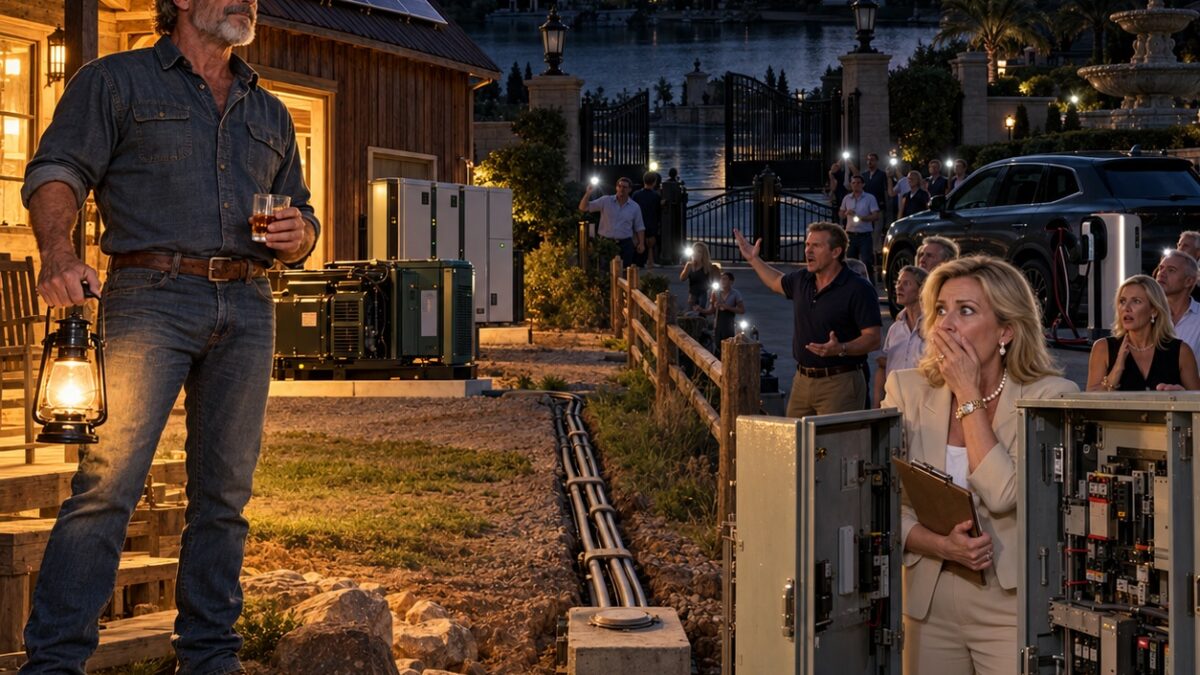
I, meanwhile, lit a kerosene lantern.
Not because I needed the drama.
Because I owned one.
I started my diesel generator.
My independent setup took over exactly as intended.
Then I poured myself a bourbon.
From where I sat, parts of Silverstone were visible across the area.
Dark.
The clubhouse was dark too.
I admit that gave me a degree of satisfaction.
The same building from which the HOA had issued its absurd violations was now sitting powerless because its board had insisted the electrical engineer next door stop interfering.
My phone began ringing.
At first, I let it ring.
Then I checked the numbers.
Board member.
Another board member.
A homeowner I barely knew.
Another.
Messages started arriving.
Do you know what’s happening?
Can you help?
How quickly can your system reconnect?
Is there any way to provide temporary stabilization?
The vocabulary changed immediately.
For weeks, my equipment had been an aesthetic nuisance.
Now it was critical infrastructure.
For weeks, I had been an obstinate ranch owner.
Now I was apparently the neighborhood’s most important technical contact.
One board member called twice.
I answered the second time.
“Logan.”
“Thank God. We have a major outage.”
“I noticed.”
“We need help.”
“With what?”
“With the electrical system.”
I leaned back.
“I thought my electrical system was contaminating yours.”
There was silence.
“That’s not—look, Sandra may have misunderstood some of the technical issues.”
“May have?”
“Can you reconnect whatever you disconnected?”
“I didn’t disconnect your neighborhood.”
“You know what I mean.”
“I know exactly what I mean. Your transformer failed.”
“Can you support the network?”
“You asked me to stop.”
“We are asking you to reconsider.”
I looked at the framed thumbs-up email sitting nearby.
“Contact your utility provider.”
“We have.”
“And?”
Another silence.
That told me the call had not gone well.
“We’re working through options.”
“Then keep working.”
I hung up.
The next morning, Sandra came to my ranch.
No dramatic entrance this time.
No triumphant posture.
No paperwork.
No fake consultant.
Her hair looked as though she had spent the night without functioning air conditioning, which she probably had.
Behind her, Silverstone remained largely powerless.
Electric vehicles sat uselessly in driveways.
Residents were angry.
The motorized infrastructure that normally reinforced the community’s exclusivity had become a reminder that expensive hardware is still hardware.
Sandra stood at my door.
“Logan.”
“Sandra.”
“We need to talk.”
“You’ve been talking to me for weeks.”
She inhaled.
“I think both sides have become entrenched.”
I almost admired the sentence.
Both sides.
As though I had issued fake fines against her property.
As though I had hired a man with a nonsense detector.
As though I had arranged her disconnection.
I said, “You had my power cut.”
“We acted based on the information available.”
“You ignored the actual information available.”
“We may have received poor advice.”
“You hired the advice.”
She looked past me toward my equipment.
“We are willing to reassess our position regarding the appearance of your installation.”
I stared.
“My neighborhood isn’t dark because you disliked the appearance.”
She stiffened.
“I understand that.”
“Do you?”
“Yes.”
“Then tell me why it’s dark.”
Sandra paused.
“The transformer failed.”
“Why?”
“Demand.”
“Why did demand become a problem now?”
Her eyes moved away.
There.
Finally.
She understood enough not to answer.
I said, “You told the one system helping stabilize your aging network to stop helping it.”
“We didn’t understand that was what you were doing.”
“I told you.”
“We had conflicting professional advice.”
“You had engineering advice and theater. You chose theater.”
Her face flushed.
Normally, that would have been the moment Sandra switched back into attack mode.
She couldn’t.
Not with eighty homes behind her waiting for electricity.
She forced herself to stay calm.
“What will it take for you to help?”
I did not answer immediately.
Because before I negotiated anything, I wanted real professionals to inspect the failure.
The HOA’s on-call electrician arrived.
Unlike Sandra’s consultant, he was an actual experienced electrician.
He examined the easement junction.
Looked at the rerouting.
Reviewed the failure.
Checked the damage.
Then he came back toward the group of board members gathered nearby.
His expression was not sympathetic.
He pointed toward my side of the system.
“You told the person stabilizing this network to stop?”
Nobody answered.
He looked directly at them.
“That’s why this crashed as badly as it did.”
Sandra began, “Our understanding was—”
He cut her off.
“Your understanding was wrong.”
I liked him immediately.
He continued.
“You’re lucky this didn’t propagate farther.”
One board member asked, “How much to fix it?”
The electrician gave them the preliminary emergency figure.
Roughly two hundred thousand dollars.
That did not include the destroyed smart equipment inside residents’ homes.
It did not include appliances that had been damaged during the electrical failure.
It did not include all the smaller claims that would start appearing once people realized what no longer worked.
The number seemed to remove oxygen from the group.
Two hundred thousand dollars.
Emergency repair.
Before secondary damage.
Then the utility company delivered more good news.
Silverstone’s old service agreement had lapsed.
To renew under current pricing, they would be paying roughly three times the previous rate.
I watched the board absorb that.
The transformer failure was expensive.
The appliance damage was expensive.
The replacement service agreement was expensive.
And every one of those facts existed beside my email warning them in writing to address the problem before the heat wave.
Sandra’s thumbs-up response suddenly felt less charming to her.
One board member asked me privately, “Did you know this was going to happen?”
“I knew the risk.”
“You knew the transformer would fail?”
“No. Anyone who tells you the exact second equipment will fail is guessing. I knew you were running strained infrastructure without support it had been relying on.”
“Why didn’t you do more?”
I looked at him.
“I sent all of you a warning.”
He looked down.
I continued.
“Your president responded with an emoji.”
He had nothing to say.
That was the point where I decided I was willing to help.
But not casually.
Not with another handshake.
Not with a vague promise that Sandra would behave better.
Silverstone Estates had spent weeks pretending recorded rights, technical facts, and jurisdictional boundaries were optional.
If we were going to build a new relationship, it would exist in documents strong enough that Sandra’s personality could not rewrite them later.
I presented my conditions.
First, every member of the board who had participated in the decision would sign a written apology acknowledging that they had misjudged the situation.
Second, every fine assessed against me would be canceled.
Not merely stopped.
Canceled.
The accumulated amounts would be cleared, including the interest they had attempted to attach.
Third, the relevant HOA agreements would be amended to formally acknowledge the essential role of the utility path across my property and the relationship of my stabilization equipment to their network.
Fourth, everything would be documented correctly.
Signed.
Notarized.
Recorded with the county clerk where appropriate.
No private understanding.
No “Sandra said.”
Paper.
Legal paper.
I also wanted a public apology.
From Sandra.
At the next full HOA membership meeting.
She looked at me as though I had asked her to donate a kidney.
“You want me to apologize in front of the membership?”
“Yes.”
“Logan, surely a written—”
“No.”
“This is becoming personal.”
“It became personal when you had my electricity disconnected and took a selfie.”
One board member looked at Sandra.
She looked away.
I continued.
“You accused me publicly. You fined me repeatedly. You claimed authority over land you don’t govern. You ignored my warnings. You pushed the disconnection. Your members deserve to know what happened.”
Sandra said nothing.
Another director asked, “And if we agree?”
“Then we can discuss restoration and stabilization.”
“What does discuss mean?”
“It means exactly what it sounds like.”
Sandra’s eyes narrowed slightly.
There was still some HOA president left in there.
“You’re using an emergency as leverage.”
“No,” I said. “I’m refusing to reenter a broken arrangement without fixing the arrangement.”
The electrician standing nearby gave the smallest nod.
Sandra noticed.
She hated that.
The board eventually agreed.
Not happily.
Necessity is an incredible negotiation coach.
The apology letters came first.
I read every one.
Sandra’s handwriting was controlled, though not quite as steady as her usual signatures on violation notices.
The letters acknowledged that the board had acted on an incorrect understanding of my equipment and property rights.
They acknowledged the importance of the infrastructure crossing my ranch.
The fines were rescinded.
All of them.
The fictional electron violations vanished.
The aesthetic penalties vanished.
The daily one-hundred-dollar charges vanished.
The amended documents were prepared.
I reviewed them carefully.
Then an attorney helped ensure the terms were drafted properly.
That part mattered.
I had learned what Silverstone’s word was worth when someone like Sandra was allowed to redefine it later.
The new arrangement needed structure.
The documents were notarized.
Filed.
Recorded.
The easement relationship was no longer background knowledge a future board president could pretend not to understand.
It was impossible to miss.
Once the immediate terms were in place, I began restoring support gradually.
The main repairs still required proper utility and electrical work.
I wasn’t performing magic.
But as the network returned, I coordinated the stabilization side carefully.
Sector by sector.
The clubhouse came back.
Then streets.
Then more homes.
I admit I did not rush Sandra’s particular section to the front.
She noticed.
To her credit, she said nothing.
There are moments in life when silence is growth.
Lights came on around Silverstone.
Air-conditioning systems returned.
Refrigerators restarted.
Gate equipment began functioning properly again.
Homeowners cheered.
Some actually applauded when their power returned.
I stood near my system watching the load.
Stable.
Exactly what I had told them.
A resident I barely knew came over later.
“I owe you an apology.”
“You didn’t fine me.”
“I voted for some of the board’s enforcement policies.”
I shrugged.
“Then maybe vote more carefully.”
He laughed uncomfortably.
“Fair.”
The public HOA meeting happened afterward.
I attended.
Not because I needed the apology emotionally.
The private paperwork had already solved the practical problem.
I attended because public authority should have public accountability.
Silverstone’s clubhouse was full.
Residents wanted explanations.
By then they had heard enough versions of the outage story to know Sandra’s decision-making was involved.
She stood at the front with prepared remarks.
That alone told me how difficult the moment was for her.
Sandra usually spoke without notes.
Now she held pages.
She began by saying the board had learned important lessons regarding utility management, infrastructure planning, and communication with neighboring property owners.
I sat quietly.
She almost managed to turn the whole thing into a leadership seminar.
Then she reached the part she could not soften.
She apologized to me.
Publicly.
She acknowledged that my warnings had not been taken seriously.
She acknowledged that my property and electrical equipment played an important role in Silverstone’s power reliability.
She acknowledged that the fines and enforcement actions had been based on a mistaken interpretation of the board’s authority.
The room was silent.
I could see how badly she wanted to get through the paragraph and sit down.
I let her.
When she finished, there was scattered applause.
Not really for her.
More relief that the conflict was ending.
I stood.
Sandra looked at me carefully.
I walked toward the front and placed another document on the table.
She frowned.
“What is this?”
“My advisory services agreement.”
The room went quiet again.
Sandra looked down.
Then looked back at me.
“You’re charging us?”
“Yes.”
“For what?”
I almost admired the question.
“For the service you just learned you need.”
A few people laughed.
Sandra did not.
The long-term arrangement compensated me for use of my stabilization capacity.
Eighteen hundred dollars per month.
In addition, Silverstone would pay hourly maintenance fees when my expertise was required.
There were on-call premiums.
The agreement ran for ten years.
It included automatic renewal provisions.
The attorney who helped draft it had made sure it was extremely clear.
No one was going to wake up in six months and decide my equipment was suddenly an illegal beige-adjacent visual disturbance.
Sandra looked through the pages.
“You expect us to sign this?”
“The board already understands the alternative.”
One director coughed.
Another avoided Sandra’s eyes.
She looked toward them.
They knew.
They were not going back to darkness to defend her pride.
The agreement passed.
Just like that, the equipment Sandra had tried to fine me one hundred dollars per day for owning became something her association paid eighteen hundred dollars per month to use.
There is poetry in accounting.
I did not need to say it aloud.
Sandra understood.
The financial consequences for her personally were smaller than the HOA’s infrastructure expenses but apparently uncomfortable enough to become visible.
Her struggling scented-candle side business was not suddenly going to absorb any of this.
At some point, the luxury Audi she had driven disappeared.
Later, she was driving a used Honda.
I never asked.
That would have been rude.
I noticed.
That was enough.
The rest of the board became much more respectful.
Funny how a six-figure repair bill can improve listening skills.
They even asked whether I would consider taking a seat on the HOA board.
I stared at them.
“You want me on the board?”
One director said, “Your engineering background would be extremely useful for long-term planning.”
I said, “I’d rather hug a live high-voltage terminal.”
There was an awkward silence.
Then nervous laughter.
I let them wonder whether I was serious.
I was mostly serious.
I had spent enough time around electrical systems to know when a circuit was badly designed.
The Silverstone HOA board was a badly designed human circuit.
Too much authority concentrated in one component.
Not enough resistance.
Very poor fault protection.
I had no desire to become part of it.
Life eventually settled.
My ranch remained what it had always been.
Older than Silverstone.
Independent.
Quiet.
The solar panels stayed on the barn.
The battery bank stayed in the equipment shed.
The structure Sandra called aesthetic sabotage remained exactly where I had installed it.
Except now Silverstone Estates sent me money every month because of it.
I would wake early.
Make coffee.
Sit outside with the lake in front of me.
My photovoltaic system running quietly.
Silverstone operating in the distance.
Every smart refrigerator humming.
Every absurd connected appliance talking to some server.
Every electric vehicle charging.
Every climate-control system pulling power.
All of it functioning much more smoothly because the people responsible for the neighborhood had finally admitted that electrical systems obey engineering, not HOA hierarchy.
Sandra sometimes walked past my fence.
We both knew the history.
She usually pretended not to see me.
I respected the commitment.
Occasionally I raised my coffee.
Never dramatically.
Just enough.
She would keep walking.
The association’s attitude toward infrastructure changed.
It had to.
They began discussing long-term utility planning with actual professionals.
They became more careful about easements.
More careful about relationships with neighboring landowners.
More careful about assuming a line on a community map represented ownership over everything touching it.
I installed a modest sign near the relevant area of my property.
ESSENTIAL INFRASTRUCTURE.
REFRAIN FROM PROVOKING THE PROPRIETOR.
Was it necessary?
No.
Was it tasteful?
Debatable.
Did Sandra see it?
Absolutely.
The monthly payments continued.
Eighteen hundred dollars.
Maintenance when needed.
On-call premiums.
Every deposit was a reminder that the board’s greatest mistake had not been underestimating me personally.
It had been confusing administrative power with physical reality.
Sandra believed a title gave her control.
President.
Chairperson.
HOA authority.
She believed a printed notice could transform my ranch into property under her rules.
She believed a one-hundred-dollar-a-day fine could transform nonsense into jurisdiction.
She believed ordering a power disconnection proved strength.
But real systems do not care about titles.
A transformer does not respect confidence.
Current does not change direction because someone speaks loudly.
Recorded easements do not disappear because a board president dislikes solar panels.
Property rights do not become optional because an HOA prints a decorative border around a letter.
Those were expensive lessons.
Silverstone paid roughly two hundred thousand dollars just for the urgent repair work around the failure.
That was before the destroyed connected appliances and household damage were counted.
Then the renewed utility agreement came back at roughly three times the old rate.
Then my monthly stabilization agreement.
Then maintenance.
Then on-call support.
Sandra had started this fight over the appearance of an inverter.
An inverter barely visible from the street.
I sometimes thought about that.
Not with anger anymore.
With fascination.
How much money can arrogance spend trying to avoid admitting it is wrong?
Apparently, quite a lot.
The story might have ended there.
It did not.
Because once eighty households lose power during a heat wave, people become curious.
They wanted to know who made the decision.
Emails existed.
Notices existed.
My warnings existed.
The thumbs-up existed.
That one was particularly popular.
Someone got a copy.
Then someone else.
The sequence was easy to understand even if you knew nothing about electrical engineering.
HOA fines engineer.
Engineer warns HOA.
HOA cuts engineer’s power.
Engineer warns them again.
HOA president responds 👍.
Transformer explodes.
Eighty houses go dark.
That is the kind of timeline people remember.
Regional media eventually picked up the story.
The headline focused on the HOA leadership’s failed power move and the massive cost to Silverstone Estates.
They used an unflattering photograph of Sandra taken during the outage.
I did not provide it.
I wish I could take credit.
The story spread online.
Then it escaped into communities devoted to HOA horror stories.
Sandra became a symbol of overreach.
People who had never met her were discussing her confidence, the fake technical accusations, the fines, the utility disconnection, and that astonishing thumbs-up.
I did not participate much.
The internet did not require my help.
It was doing fine.
Silverstone residents were less amused.
They had paid for the consequences.
Some had lost appliances.
All had experienced the outage.
Their association’s finances had taken a major hit.
And they had learned that the crisis had been preceded by explicit written warnings.
That changed the political atmosphere inside the community.
Sandra received an official reprimand from the larger organization overseeing the association.
Her authority weakened.
At meetings, residents questioned decisions they would previously have allowed through without discussion.
Once people discover the person enforcing every little rule can also make a six-figure mistake, unquestioned obedience becomes harder.
A new election approached.
Sandra ran.
Of course she did.
I think somewhere inside her, she still believed the whole episode could be reframed as an unfortunate infrastructure event that happened during her otherwise excellent leadership.
Silverstone’s residents had another interpretation.
The vote was 179 to 1.
One hundred seventy-nine against her.
One vote for her.
I was not in the room because I belonged to the HOA.
I didn’t.
I attended because by that stage watching Silverstone governance had become a form of entertainment.
When the result was announced, Sandra stood at the lectern.
Her mouth opened slightly.
Then closed.
For the first time since I had met her, she seemed to have no prepared response.
No violation notice.
No invented terminology.
No fine.
No consultant.
No board majority.
Just a number.
179–1.
Someone near me whispered, “Who was the one?”
I kept my face straight.
I had my theories.
Sandra stood there for several seconds absorbing the end of an era.
Then she stepped away.
The new leadership took over.
Their first months were not revolutionary.
That was probably a good sign.
They reviewed infrastructure.
They reviewed authority.
They reviewed relationships with surrounding properties.
At one meeting, they considered a new policy encouraging respectful communication with residents or landowners whose properties hosted critical utility pathways.
I attended that meeting for one reason.
Sandra, though no longer president, happened to be present.
Someone asked her to read part of the motion aloud.
She reached the phrase:
“indispensable community allies.”
Her voice changed slightly.
I nearly choked on my own amusement.
The vote passed unanimously.
Afterward, Sandra walked past me.
She tried to keep moving.
Then I heard her mutter something under her breath.
“I am never challenging an engineer again.”
I smiled.
That was probably the smartest engineering decision she had made during the entire story.
People sometimes ask whether I felt guilty when the power failed.
No.
I felt bad for individual homeowners who had not understood what their board was doing.
Some of them had treated me perfectly well.
That is one reason I helped restore stability once the legal and operational issues were addressed.
But guilt?
No.
I warned the board.
Clearly.
In writing.
I told them their infrastructure was strained.
I told them what my system was doing.
I recommended they arrange independent backup support.
They did not merely ignore the warning.
Their president acknowledged it with a thumbs-up.
Then the system behaved exactly like an overloaded electrical system behaves.
That is not revenge in the criminal sense.
I did not cause the failure through sabotage.
The most effective thing I did was comply.
Sandra wanted me disconnected from what she called her grid.
So I stopped supporting it.
Sometimes the cleanest response to someone demanding control is to give them exactly the responsibility they insist belongs to them.
Silverstone wanted complete independence from my installation.
For several days, they got it.
They discovered independence is expensive when you have neglected the infrastructure required to support it.
The part that still irritated me, even after everything ended, was not the money.
Not the fines.
Not even the disconnection.
It was the assumption.
Sandra had looked at my grandfather’s land and mentally absorbed it into her kingdom.
The ranch existed before Silverstone.
The easement existed because my family had allowed utility infrastructure to cross private property under a specific legal arrangement.
That cooperation helped make later development possible.
Yet once the luxury houses appeared, their board president somehow convinced herself that proximity had become authority.
That happens more often than people think.
A neighborhood grows.
An association becomes established.
Rules accumulate.
After enough years, the people enforcing those rules forget where the boundary actually is.
The document says one thing.
Confidence says another.
Sandra trusted confidence.
I trusted the deed.
The easement.
County records.
Engineering.
Documentation.
When the conflict finally mattered, only one of those categories survived contact with reality.
That is why I insisted the new agreement be recorded properly.
People sometimes asked whether requiring apologies was petty.
Maybe.
I can live with that.
The public apology had a purpose.
Sandra’s original enforcement had been public.
Homeowners knew she was pursuing me.
The fines came under the authority of the board.
The disconnection was treated as an HOA victory.
Correcting the record privately would have allowed the same culture to continue.
Public authority without public accountability becomes theater.
Sandra loved theater until she was no longer directing it.
The signed apologies from the directors served another purpose.
They made each board member acknowledge personal responsibility.
Organizations are very good at producing mistakes no individual wants to own.
The board decided.
Legal advised.
The consultant said.
The utility did.
No.
People voted.
People signed.
People ignored.
People could also apologize.
That mattered.
The money mattered too, but differently.
I did not set out to turn my ranch into a business serving Silverstone.
They created the need for a formal relationship.
The old informal balance had worked because everybody behaved reasonably.
Once that trust was broken, informal cooperation no longer made sense.
If my equipment was going to provide ongoing value to eighty luxury homes, that value needed defined terms.
Eighteen hundred dollars a month was not revenge fantasy money.
It was compensation.
The hourly maintenance charges were compensation.
The on-call fees were compensation.
The ten-year contract provided stability.
Auto-renewal provisions prevented the same argument from reappearing every time leadership changed.
An attorney made sure all of it said what it needed to say.
That was the lesson Sandra had never understood.
Real leverage is usually boring.
Recorded documents.
Technical competence.
Clear contracts.
Property rights.
Evidence.
Not screaming.
Not fines printed in bold.
Not selfies.
She had spent weeks performing power.
I had spent them documenting reality.
When those collided, reality won.
I still have the framed email.
My warning.
Her thumbs-up.
Visitors sometimes ask about it.
I tell them the story.
Most assume I added the frame after the blackout.
I did.
I am not above enjoying symbolism.
The emoji sits there like a tiny monument to confidence without comprehension.
👍
Every time I see it, I remember the transformer explosion across the lake.
I remember the calls.
I remember Sandra arriving exhausted the next morning asking to reassess the aesthetic issue.
That phrase still makes me laugh.
The appearance of my equipment had become much more attractive once her air conditioner stopped working.
Nothing improves curb appeal like necessity.
Silverstone Estates eventually recovered financially.
Eighty expensive homes generate significant dues.
The infrastructure was repaired.
The agreements were modernized.
The network operated much more reliably.
Residents got their smart homes back.
Their Teslas charged.
Their wine stayed cold.
Their gates opened.
The luxury returned.
Only now part of that luxury depended on a retired engineer at the older ranch next door.
The same man their former president had tried to disconnect.
There is a sign near the equipment reminding them.
Essential infrastructure.
Don’t provoke the owner.
Maybe one day I will take it down.
Probably not.
Sandra’s replacement was less dramatic.
That was healthy.
The new board communicated before issuing threats.
They consulted technical professionals before making technical claims.
They treated the property line as a legal fact rather than a suggestion.
Amazing innovations.
I never joined.
My answer about the high-voltage terminal remained my answer.
I had no interest in spending retirement debating mailbox shades or landscape mulch.
I had my ranch.
My solar panels.
My batteries.
My generator.
My coffee.
My lake.
And every month Silverstone sent me eighteen hundred dollars.
That arrangement suited me beautifully.
Occasionally I would see Sandra in her used Honda.
She never looked over.
I never waved unless she did first.
She did not.
Fair enough.
The candle business apparently remained difficult.
I did not celebrate that.
Business is business.
The Audi-to-Honda transition did, however, feel like one of life’s quieter editorial comments.
What mattered more was that she no longer controlled eighty households through the same unchecked authority.
The 179–1 vote took care of that.
That final meeting stayed with me.
Not because I wanted her humiliated forever.
Because it showed the community had finally changed its relationship with power.
For years, Sandra could announce a rule and people followed.
She could issue fines and people paid because challenging her was exhausting.
She mistook compliance for respect.
She mistook position for expertise.
She mistook inconvenience for authority.
Then she chose a fight with something less flexible than homeowners.
Electricity.
And electricity does not attend HOA meetings.
The laws governing voltage do not accept motions.
Transformers do not care who has the gavel.
The most powerful person in Silverstone that summer was not the HOA president.
It was whoever actually understood the infrastructure.
Sandra learned that approximately two hundred thousand dollars too late.
Sometimes I think back to the first time she stood in my driveway pointing at the solar installation.
If she had simply asked a question, none of this would have happened.
“What is your system doing?”
I would have explained.
If she had called the utility.
If she had reviewed the easement.
If she had renewed their service agreement.
If she had hired an actual engineer.
If she had listened.
So many exits existed before disaster.
She walked past every one because each required admitting she might not know something.
That was the real failure.
Not ignorance.
Everyone is ignorant about most things.
I know electricity.
I know very little about dozens of other fields.
Ignorance is normal.
Arrogance makes ignorance expensive.
Sandra could have said:
Explain it to me.
Instead she said:
Remove it.
She could have asked:
Does the HOA have jurisdiction over your ranch?
Instead:
One hundred dollars per day.
She could have asked:
What happens if we cut this support?
Instead:
👍
That emoji may be the most concise summary of the whole conflict.
I sometimes imagine putting it on the sign near the transformer.
I have restrained myself.
So far.
People call what happened revenge.
I understand why.
There is satisfaction in watching somebody’s arrogance produce consequences.
But I never thought of the blackout itself as my revenge.
The blackout was physics.
My revenge, if we want to use that word, came afterward.
It was legal.
Documented.
Signed.
Notarized.
Recorded.
It was every fake fine disappearing from my account.
It was every board director signing an apology.
It was Sandra reading one aloud.
It was a ten-year agreement recognizing what she had tried to deny.
It was eighteen hundred dollars arriving every month.
It was Silverstone rewriting its policies.
It was 179 residents voting her out.
It was the ranch remaining exactly where it had always been.
Untouched.
Independent.
Essential.
That is a better kind of revenge.
Nothing hidden.
Nothing vandalized.
Nothing illegal.
Just letting someone live with the cost of being wrong.
I still maintain the equipment properly.
I do not intentionally make Silverstone wait for service because I enjoy control.
That would make me the thing I disliked in Sandra.
The contract defines responsibility.
I perform mine.
They perform theirs.
That is how systems should work.
The irony is that Silverstone and I now have a better technical relationship than we did before the fight.
They pay attention.
I communicate.
The utility situation is understood.
Responsibilities are clear.
The network is more resilient.
Conflict forced structure.
An expensive way to get there.
But we got there.
The ranch changed very little.
That pleases me.
The barn still carries solar panels.
The equipment shed still holds the battery bank.
The lake still looks the same in the morning.
My grandfather’s property did not become part of an HOA because Sandra said so.
Its legal boundaries held.
Its old easement held.
The infrastructure beneath it kept doing what infrastructure does.
I sometimes think my grandfather would have found the whole thing absurd.
I won’t invent what he would have said.
I can only look at the land he bought in 1965 and feel grateful that the documents were kept properly.
Property history matters when somebody decides history began with their subdivision.
Silverstone was newer.
Shinier.
More expensive per square foot.
None of that made it older than the ranch.
None of that moved the easement.
None of that gave Sandra jurisdiction.
Those facts sat quietly for years.
They only became dramatic because somebody challenged them.
The regional article still floats around online.
Every once in a while, someone sends it to me as though I have never seen it.
“Is this you?”
Unfortunately.
They usually want to know whether the story is exaggerated.
I tell them the basic numbers.
Eighty villas.
Hundred-dollar daily fines.
Transformer failure.
Two-hundred-thousand-dollar emergency repair estimate.
Utility agreement at roughly triple the previous rate.
Eighteen hundred per month for stabilization.
Ten-year contract.
179–1 election.
Then I show them the thumbs-up.
They stop asking whether Sandra was really that confident.
Nobody could invent that emoji with enough credibility.
The board’s later policy about treating holders of key utility pathways with respect was perhaps my favorite administrative consequence.
Not because it named me.
It did not need to.
Everybody knew why it existed.
Sandra having to read the phrase “indispensable community allies” aloud was almost cruel.
Almost.
I sat in the back and behaved.
Mostly.
After the meeting, one of the newer directors came over.
“We learned a lot from this.”
“I hope so.”
“Do you think the relationship between Silverstone and the ranch is good now?”
“Yes.”
He looked relieved.
Then I added, “Because it’s in writing.”
He laughed.
I was serious.
Good relationships benefit from trust.
Important relationships benefit from trust plus documentation.
The older I get, the more convinced I become of that.
Especially when electricity and property rights are involved.
The technical side remained simple compared with the human side.
Current flows according to physical rules.
People flow according to ego.
That is harder to model.
Sandra became less visible in community politics after losing.
I still saw her occasionally.
Her posture changed.
She seemed smaller somehow.
Not physically much.
Less certain that every space belonged to her.
I did not enjoy that in a cruel way.
Well.
Maybe a little.
But mostly I thought she had learned something necessary.
Authority should make you more careful.
Not less.
The more power you have over other people, the more willing you should be to ask:
Am I sure?
Sandra had spent years replacing that question with:
Can I enforce it?
Those are not the same.
The electrical crisis forced the first question back into Silverstone governance.
That made the community better.
Even people who had supported Sandra initially began telling stories about other times she had pushed rules too far.
That often happens after authority collapses.
People remember how uncomfortable they had been.
A landscaping fine.
A decoration argument.
Some obscure standard.
None of those became part of my own dispute, and I did not need them to.
My conflict stood on its own.
But the atmosphere explained why so many residents were ready to vote against her once the blackout exposed the cost of unchecked decision-making.
They had tolerated small overreach.
Then the overreach broke something expensive.
Suddenly the pattern mattered.
The election number reflected that.
179–1.
I still cannot say it without smiling.
Not because unanimous humiliation is inherently good.
Because Sandra had spent so much time claiming to represent the community.
The community eventually answered.
Very clearly.
If someone asked me what the climax was, they would probably expect the transformer explosion.
That was certainly loud.
But the real climax, to me, happened earlier.
The moment Sandra responded to a careful engineering warning with a thumbs-up emoji.
Everything after that was consequence.
That one response captured her entire mindset.
She did not need to understand.
She had won.
My power was off.
Her authority had been demonstrated.
End of discussion.
Except engineering problems do not end when the person with the gavel stops discussing them.
Load continued rising.
Temperature continued rising.
The transformer continued heating.
The system continued losing the support she had ordered removed.
Reality continued.
That is why arrogance is so dangerous in technical environments.
Reality does not negotiate with confidence.
It waits.
Then presents the bill.
Silverstone’s bill was enormous.
And unlike my fake hundred-dollar daily fines, theirs was real.
No board vote could erase it.
I never had to retaliate illegally.
Never had to cut a cable.
Never had to trespass.
Never had to threaten anyone.
I complied.
Then I waited.
When people call it the perfect HOA revenge, that is what they mean.
The person abusing authority expects you to explode emotionally.
Argue.
Shout.
Do something reckless they can use against you.
Documentation is less satisfying in the moment.
Until later.
Keep the letter.
Keep the email.
Keep the easement.
Keep the county record.
Keep the warning.
Let them sign things.
Then when consequences arrive, you do not need to convince anyone what happened.
The timeline does it.
Mine did.
Sandra fined me.
I objected.
She escalated.
I explained.
She hired nonsense.
She disconnected me.
I warned the board.
She replied 👍.
Heat wave.
Failure.
Two hundred thousand dollars.
That story does not require embellishment.
The facts already have pacing.
The only detail I sometimes add in person is the bourbon.
People assume that part is theatrical.
It wasn’t.
I genuinely poured one.
What else was I supposed to do?
Silverstone had spent weeks refusing engineering advice.
Now the transformer had delivered it at a volume audible across the lake.
My generator was running.
My house had light.
There was nothing productive for me to do until somebody was ready to listen.
So I sat.
Bourbon.
Lantern.
Dark luxury villas in the distance.
I admit it was a memorable evening.
The next morning was better.
Sandra at my door.
That was when I knew the power dynamic had changed.
Not because she looked exhausted.
Because she asked.
For the first time, Sandra needed something she could not issue herself through a violation letter.
Expertise.
Cooperation.
Consent from the property owner.
She had to negotiate.
That was healthier for everyone.
The new contract simply made that reality permanent.
I sometimes wonder whether Silverstone would have been better off if I had joined the board.
Probably not.
I have technical patience.
I have very little committee patience.
Someone would propose a thirty-page regulation on porch-light color temperature and I would end up moving to another state.
Better to remain next door.
Available when the transformer matters.
Absent when begonias become political.
The monthly fee is enough civic participation for me.
There is one more reason I refused.
Independence mattered.
The entire conflict began because Sandra could not accept that my property existed outside her authority.
Joining the board after defeating that claim would have blurred the line I had fought to protect.
I was their technical partner.
Not their subject.
That distinction was worth keeping.
Today Silverstone Estates runs smoothly.
The smart villas glow at night.
Temperatures stay comfortable.
Cars charge.
Pools filter.
Automated gates perform their little ritual.
The clubhouse lights stay on.
Most residents probably go weeks without thinking about where their power passes.
That’s fine.
Infrastructure should become invisible again once people respect it.
My ranch remains outside the gate.
Exactly where I want it.
Every month, the association pays for the stabilization service it once tried to ban.
The irony no longer makes me angry.
It makes me laugh.
The same equipment Sandra called an aesthetic violation became an operating expense in her own community.
The same ranch she treated like a nuisance became formally recognized as critical to their electrical supply.
The same easement she ignored became something the board now discusses with reverence.
The same retired engineer she tried to fine became someone they once begged to join leadership.
None of that required me to become more powerful than Sandra.
I already had what mattered.
Ownership.
Knowledge.
Records.
Patience.
She had volume.
Volume wins many short arguments.
It loses badly against documentation.
The sweetest moment was not watching Silverstone go dark.
I would not wish unnecessary equipment damage on ordinary homeowners.
The sweetest moment came much later.
Morning.
Coffee.
My system humming quietly.
Silverstone running normally in the distance.
A notification on my phone.
Monthly payment received.
Eighteen hundred dollars.
I smiled.
Not because the amount would make me rich.
Because money is difficult to argue with.
A citation says:
We think your equipment is a problem.
A recurring payment says:
Please keep your equipment operating.
Of the two, I prefer the second assessment.
Sandra’s hundred-dollar fines had tried to pressure me into removing the system.
Instead, the HOA now paid me more in one month than eighteen days of her old penalties.
And unlike her fines, my invoices were backed by a contract.
Signed.
Notarized.
Recorded.
Ten years.
Auto-renewal.
My attorney had enjoyed that part.
So had I.
If that sounds vindictive, perhaps it was a little.
But vindictiveness did not make the contract necessary.
Sandra did.
The board’s conduct proved an informal arrangement was not safe anymore.
Formal compensation and defined obligations protected both sides.
Silverstone knew what it was buying.
I knew what I was responsible for.
No future president could suddenly decide the battery bank produced bad vibes and still expect free stabilization.
That is progress.
I kept the ranch’s backup capability strong.
Solar.
Battery.
Diesel generator.
Redundancy.
One reason I had invested in those systems was resilience.
The outage proved the philosophy.
Systems fail.
Good systems fail gracefully.
Silverstone had built luxury on top of dependency without enough redundancy.
The board learned.
So did residents.
Some later installed additional backup capability of their own.
Fine by me.
The more resilient individual homes became, the less likely another single infrastructure failure would turn into neighborhood panic.
That was the mature response.
Not pretending the blackout could never happen again.
Preparing better.
Sandra had treated preparation as aesthetic rebellion.
The new board treated it as engineering.
That difference alone made the whole ordeal almost worth it.
Almost.
I could have done without the weeks of fake fines.
There is still a folder containing them.
Irregular electron circulation.
Visible electrical coherence.
Magnetic-field imbalance.
I considered turning them into wall art beside the thumbs-up.
There are limits to how much Sandra decor I want in my home.
The thumbs-up remains enough.
Every so often, I read the first cease-and-desist letter again.
The confidence is astonishing.
It never once seriously grapples with the fact that my ranch is not in the HOA.
That is the foundation of the entire error.
Sandra skipped jurisdiction and went directly to enforcement.
People do that when they have been obeyed too long.
They stop asking whether they can.
They ask only how fast.
The answer cost Silverstone a transformer.
I doubt the new board will make that mistake soon.
County records have become strangely popular in their decision-making.
I approve.
The irony is that I never hated HOAs as a concept.
Shared communities need mechanisms for maintaining shared property.
Roads.
Common spaces.
Infrastructure.
Budgets.
Rules can be useful.
The problem begins when maintaining shared property becomes managing people who never agreed to be managed.
My ranch was not common property.
My solar array was not theirs.
My battery bank was not theirs.
My barn roof was not theirs.
The easement gave specific access for a specific purpose.
It did not make Sandra queen of everything electricity touched.
That boundary should have been enough.
It wasn’t.
So the transformer drew one in darkness.
After the election, I saw Sandra once at the grocery store.
We both noticed each other.
There was an awkward second where either of us could have spoken.
I nodded.
She nodded.
That was it.
No speech.
No final confrontation.
I preferred it.
Stories make people expect dramatic closure.
Real closure is often two adults realizing they have nothing left to say in the produce aisle.
She knew what happened.
I knew.
The contracts were signed.
The election was over.
Move on.
The ranch needed me more than the grudge did.
I went home.
Silverstone’s lights came on that evening exactly as designed.
I saw them from across the water.
For a moment, I thought about the blackout.
Then I went inside.
I had other things to do.
That may be the final victory in any long conflict.
It stops occupying your life.
Sandra once consumed hours of my week.
Letters.
Responses.
Research.
Meetings.
Technical explanations.
Now she was a story.
An expensive one.
A funny one.
But finished.
The system worked.
My rights were documented.
The association paid.
I slept fine.
I have no idea whether Sandra still sells scented candles.
I hope she does well.
Genuinely.
Everyone needs hobbies.
Preferably ones that do not involve controlling utility infrastructure.
The old Audi never returned, at least not that I saw.
The Honda did its job.
There is another lesson there.
Reliable and modest beats expensive and dysfunctional.
That applies to cars.
It also applies to electrical systems.
Silverstone could put a smart screen on every wall.
If the underlying network was neglected, luxury only created more things to lose when the power failed.
The ranch looked less impressive.
It stayed lit.
That image probably explains the whole story better than anything else.
Eighty advanced homes dark.
One old ranch glowing from a kerosene lantern and independent backup.
Sandra had spent years curating appearances.
Physics graded function.
Function won.
I never changed the sign near the infrastructure.
ESSENTIAL INFRASTRUCTURE.
REFRAIN FROM PROVOKING THE PROPRIETOR.
A little self-indulgent?
Certainly.
But after someone fines you for “visible electrical incoherence,” you earn one joke.
Residents who walk nearby sometimes photograph it.
I do not mind.
It has become part of local folklore.
At least the folklore encourages people to read easements before threatening engineers.
There are worse legacies.
The strangest part is that some newer Silverstone residents know me only through the story.
They moved in after Sandra left.
They will introduce themselves and say:
“Oh. You’re Logan.”
Depending on the tone, I know immediately what they have heard.
“Yes.”
“The electrical guy.”
“Retired electrical guy.”
“The one with the ranch.”
“That too.”
Then they usually laugh.
One man said, “My realtor told us never to annoy you.”
I said, “Your realtor is oversimplifying. Just don’t disconnect critical electrical support without a plan.”
He laughed harder.
We got along fine.
I do not want fear.
I want competence.
That is what Sandra never understood.
Respect is not obedience.
I did not need Silverstone to obey me.
I needed its board not to make technically disastrous decisions affecting both properties.
The new arrangement solved that.
Their utility plan is clearer.
Their responsibilities are clearer.
Mine are clearer.
Predictability is better than dominance.
Engineers like predictable systems.
Retired engineers perhaps even more.
I spend more time now thinking about sunrise than HOA politics.
That is how retirement should work.
Coffee.
Lake.
Solar generation beginning to climb.
Battery status.
Maybe a little maintenance.
No emergency calls.
No Sandra.
Perfect.
Sometimes the automatic deposit arrives while I’m sitting outside.
Silverstone Stabilization Service.
$1,800.
I raise the coffee mug toward the neighborhood.
Nobody sees.
That is enough ceremony.
If my grandfather’s ranch had been swallowed into Silverstone decades ago, none of this would have happened.
But it remained separate.
That fact mattered legally.
It also mattered emotionally.
The ranch was family property before the subdivisions.
I had no interest in allowing a newer association to rewrite that relationship through intimidation.
This was not simply stubbornness.
Boundaries survive only if people defend them when challenged.
Otherwise temporary convenience becomes assumed authority.
Sandra assumed I would pay.
Then she assumed I would modify my property.
Then she assumed I would tolerate disconnection.
Each assumption depended on me being more exhausted by conflict than she was.
That strategy had probably worked before.
It failed because I knew the system better than she did.
And because I was willing to wait.
Patience is devastating to bullies who rely on escalation.
Sandra escalated.
I documented.
Sandra escalated.
I explained.
Sandra escalated.
I warned.
Sandra escalated.
Then the transformer took over.
After that, she de-escalated very quickly.
Nothing changes tone like a neighborhood full of angry homeowners in ninety-plus-degree weather.
Especially when their electric vehicles cannot charge.
I still remember seeing some of the residents outside after the failure.
People were sweating.
Phones glowing.
Confused.
One man kept looking at his Tesla as though staring would create electrons.
Another was trying to manually understand a gate he had probably never opened without a motor.
Those people were not my enemies.
Most had no idea what their board had done.
That distinction mattered.
I could have remained stubborn after the failure.
Refused every request.
Let the HOA spend whatever it took to redesign everything permanently around the ranch.
Legally, depending on the details, that might have been possible.
But it was not what I wanted.
I wanted correction.
Not destruction.
Once they acknowledged the mistake, fixed the documents, removed the fines, and created a fair agreement, cooperation made sense again.
Revenge without an exit becomes obsession.
I wanted an exit.
The contract was it.
Clear terms.
Fair compensation.
Respect for ownership.
Done.
The public apology was the emotional period at the end of the sentence.
The election was an epilogue Sandra wrote for herself.
179–1.
Even now, that number feels almost too neat.
If it were fiction, someone would accuse me of exaggeration.
Reality occasionally has a sense of humor.
The one vote remains mysterious.
Maybe Sandra voted for herself.
Maybe somebody genuinely supported her.
Either way, it was not enough.
She stepped down.
Silverstone moved on.
So did I.
And that is where the story really ends.
Not with eighty houses dark.
Not with a transformer smoking.
Not with Sandra at my door.
Not even with the $200,000 emergency repair estimate.
It ends with the system working.
My ranch still mine.
Their community still theirs.
The easement respected.
The equipment running.
The bills paid.
The lights on.
Sandra gone from office.
No one needing to shout.
That is what a satisfying legal victory looks like.
Boring afterward.
People sometimes want me to say I planned the whole thing.
That I knew the exact night the transformer would fail.
That I smiled while secretly counting down.
No.
I knew the engineering risk.
I knew the load was dangerous.
I knew my equipment had been helping.
I knew removing that support without fixing the underlying problems was reckless.
But complex systems are complex.
The exact failure came when it came.
I did not need to predict the minute.
I only needed to be correct about the principle.
Sandra had confused “it hasn’t failed yet” with “it cannot fail.”
Engineers know better.
Absence of failure is not proof of adequate design.
Sometimes it means you have been living on borrowed margin.
Silverstone’s borrowed margin happened to include my ranch.
Sandra cut it loose.
Then the heat arrived.
That was all.
No secret sabotage.
No hidden switch.
No cinematic button marked REVENGE.
Just load.
Heat.
Aging infrastructure.
Lost stabilization.
Physics.
Boom.
If there is a lesson in this story, it is not that every homeowner should fight an HOA over everything.
Most disagreements are ordinary.
Talk.
Compromise where appropriate.
Read the rules.
But when somebody claims authority they do not have, documentation matters.
When somebody makes technical claims, expertise matters.
When infrastructure crosses private land, easements matter.
When someone tells you a system is strained, do not answer with an emoji until you understand what they are saying.
Especially if that person spent a career as an electrical engineer.
Sandra eventually understood.
The rest of Silverstone understood too.
The last time I attended one of their meetings, somebody introduced a minor infrastructure update and another director asked:
“Has Logan reviewed this?”
The room laughed.
I did too.
“No,” I said. “And unless it crosses my property, I would like to keep it that way.”
More laughter.
Healthy laughter this time.
No hostility.
No fear.
People who had survived one ridiculous conflict together and had no interest in repeating it.
Sandra was seated farther back.
She did not laugh.
That’s all right.
Not every lesson has to be enjoyable.
As the meeting ended, I walked outside.
The neighborhood lights were glowing.
The clubhouse behind me was bright.
Electric cars hummed quietly at chargers.
Air-conditioning compressors ran in the warm evening.
Normal.
I drove back to the ranch.
Past the fence.
Past the sign.
Past the equipment Sandra once demanded I remove.
The battery system was operating normally.
The solar array had finished producing for the day.
Everything was exactly where it belonged.
I went inside.
On the wall was the framed email.
My warning.
Sandra’s answer.
👍
I looked at it.
Then at the lights.
Still on.
Somewhere across the lake, eighty smart villas were still enjoying the electricity their former HOA president had once tried so hard to separate from me.
And every month, right on schedule, Silverstone Estates paid me for the privilege of making sure it stayed that way.








